
Inbound-led Outbound: How to Connect Inbound and Outbound in Your Organization and Get Your Revenue Team To Operate as One

by
In this post:
At most companies, inbound and outbound live in two completely different teams and growth operations.
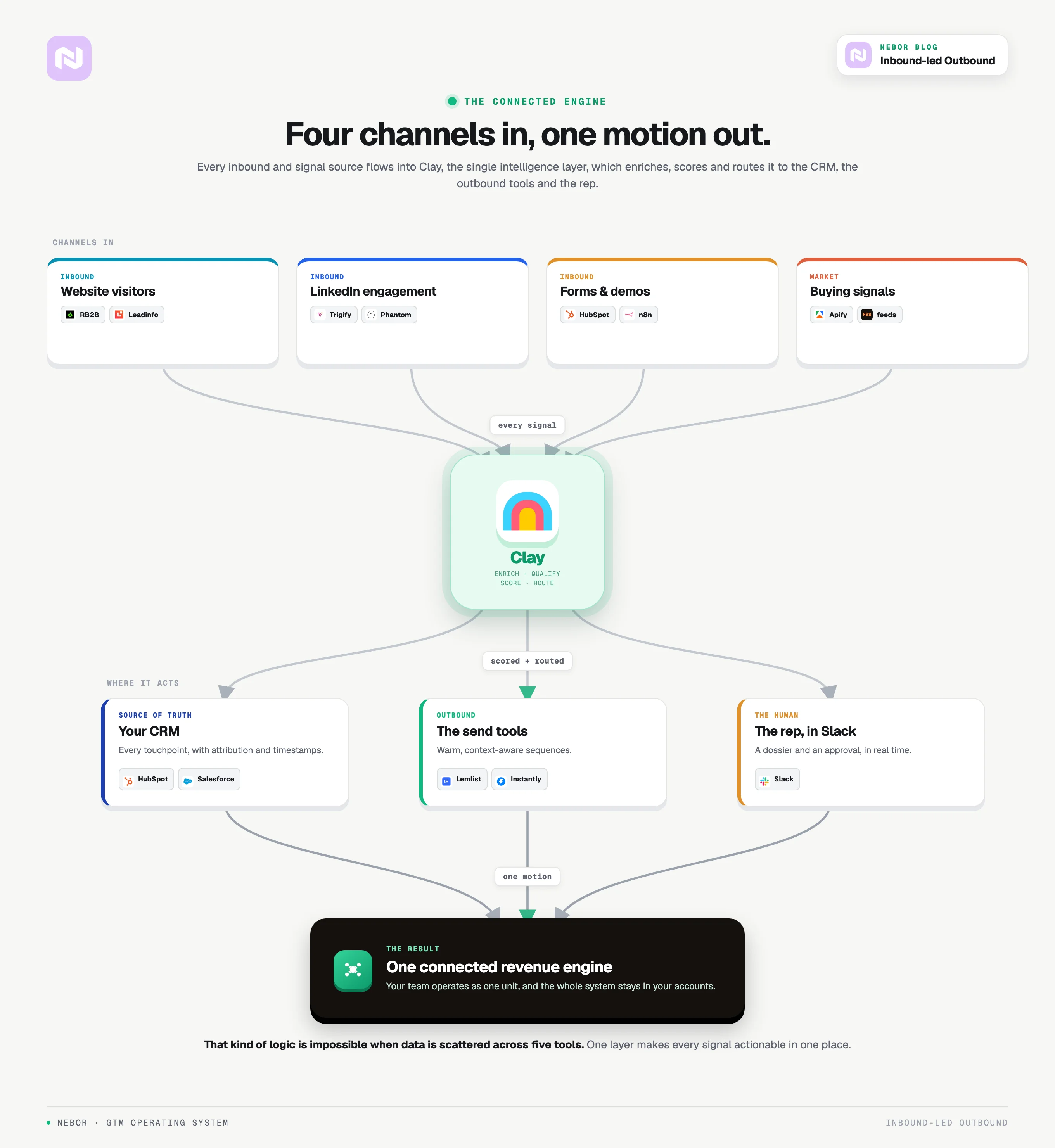
Marketing owns inbound. Actually, marketing itself is considered to be inbound according to conventional wisdom. Marketing builds the website, writes blog posts, manages LinkedIn, buys paid ads, and tracks impressions and MQLs.
So they're not really wrong. On the other hand, sales owns outbound. They do cold email, cold call, do LinkedIn outreach, and track meetings booked and pipeline generated.
The two teams report to different leaders. They use different tools, measure success with different metrics, and in most organizations, barely talk to each other.
We've worked with far too many revenue teams and we've seen the same just as many times. The result is always the same. A pipeline that leaks at every seam.
Your marketing generates interest that nobody follows up on in time. Your sales does cold outreach without knowing which accounts are already engaging with your content. Your CRM is holding intent data that nobody acts on.
Buying signals show up across LinkedIn, your website, your email lists, and your customer base, but they all live in different systems with no connective tissue between them. The only thing left of your "alignment" between sales and marketing is a Slack channel called #revenue where occasionally somebody posts a screenshot.
This post is about fixing that. Not by talking about marketing-sales alignment in the abstract sense, but by walking you through the actual mechanics of building a system where inbound and outbound feed each other, where every signal gets captured and acted on, and where your revenue team operates as one connected unit.
So, let's get started.
TL,DR
You can own a Clay-powered system that aligns your inbound and outbound motions and makes your sales and marketing teams lives easier.
Why inbound and outbound are treated as separate motions in the first place, and why that thinking is fundamentally broken
The split between inbound and outbound is largely historical. Marketing was built around media buying, brand awareness, and content distribution. The metrics were impressions, traffic, and lead capture forms.
Sales was built around quota carriers doing outbound, working accounts, and closing deals. The metrics were calls, meetings, pipeline, and revenue.
The two motions evolved separately because the tools and tactics were different. Marketing optimized for top-of-funnel volume. Sales optimized for bottom-of-funnel conversion. And for a long time, you could get away with keeping them in parallel because the buying journey was simpler.
But the modern B2B buyer doesn't move through your funnel the way your org chart suggests. They visit your website three times before you ever reach out to them. They read your founder's LinkedIn post and forward it to their team. They sign up for your newsletter, ignore three emails, then suddenly book a demo two months later.
By the time they show "intent," they've usually been engaging with your brand for weeks or months across multiple channels. If your inbound and outbound teams aren't connected, you have no visibility into any of this.
The conventional answer to this problem is to make sales and marketing better aligned. That's what every consulting firm has been telling B2B leaders for years.
The problem is that alignment is a meeting, not a system. You can have alignment meetings every week and still leak pipeline at every layer because the underlying infrastructure isn't connected.
Real alignment is not a Slack channel or a Slack channel you create. It's infrastructure. It's the technical and operational connective tissue that makes inbound data visible to outbound execution and outbound activity visible to inbound planning.
Without that infrastructure, alignment is just a word people use in quarterly reviews.
What inbound-led outbound means and why it changes everything about how your pipeline generates revenue
Inbound-led outbound is a strategy where your inbound engagement data directly powers and informs your outbound campaigns.
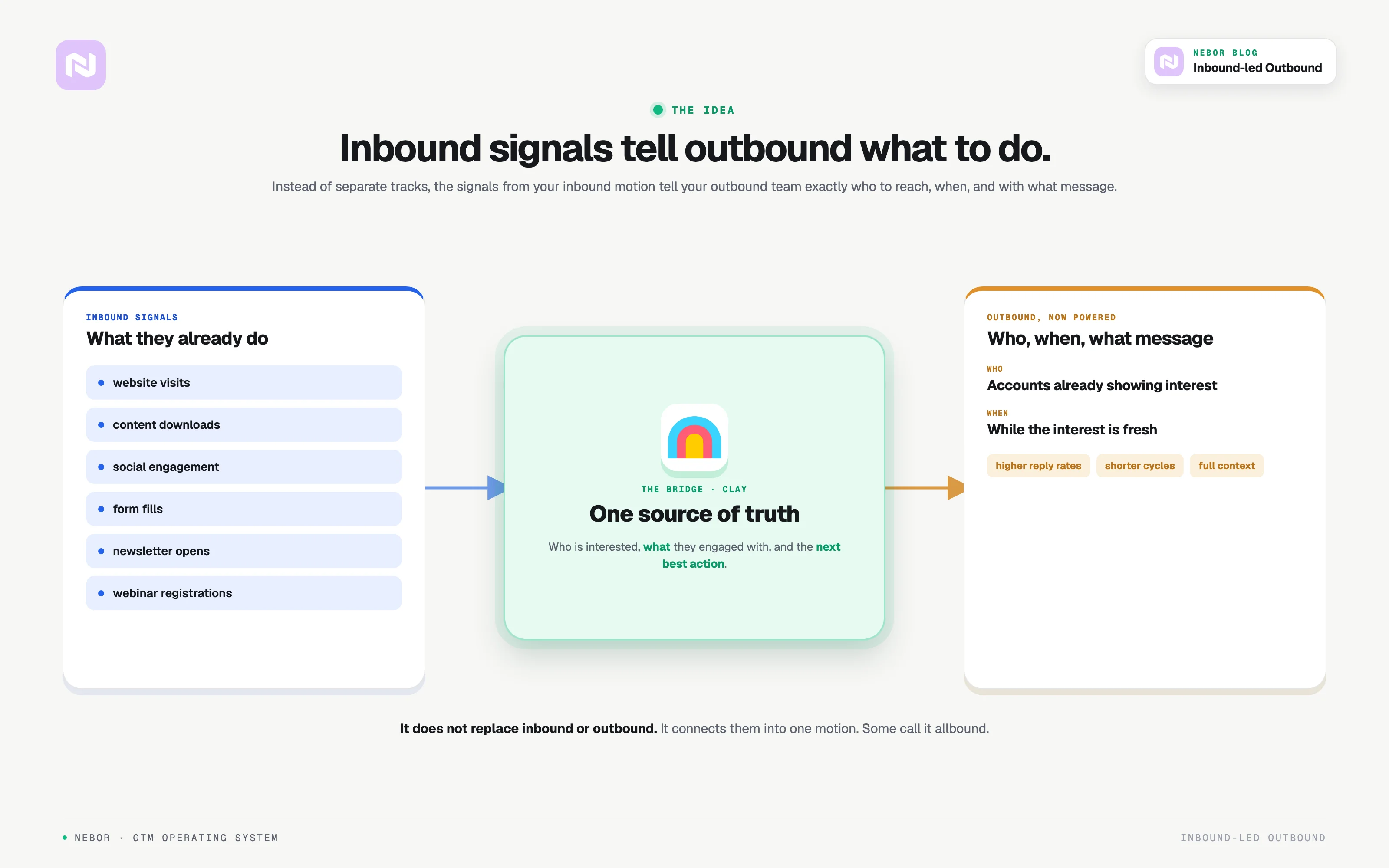
Basically, instead of keeping inbound and outbound on separate tracks, you use the signals from your inbound motion (website visits, content downloads, social engagement, form fills, newsletter opens, webinar registrations) to tell your outbound team exactly who to reach out to, when, and with what message.
It's not a replacement for either inbound or outbound. Think of it like the bridge between them.
Some people in the industry call this "allbound," which captures the same idea. Inbound, outbound, and intent data working together as one connected motion. The terminology matters less than the practice.
The point is that your revenue team should be operating from a single source of truth about who's interested in your product, what they're engaging with, and what the next best action is.
When you build this properly, the difference is massive. Your outbound campaigns target accounts that are already showing interest, which means higher reply rates and shorter sales cycles.
Your inbound leads get qualified and enriched the moment they hit your CRM, which means faster follow-up and higher conversion. Your sales team walks into every conversation with full context about what the prospect has already done with your brand.
This is the modern version of revenue operations. And it's how the best B2B companies in 2026 are pulling ahead of competitors who are still working disconnected motions.
5 places where your pipeline is leaking right now because inbound and outbound aren't connected
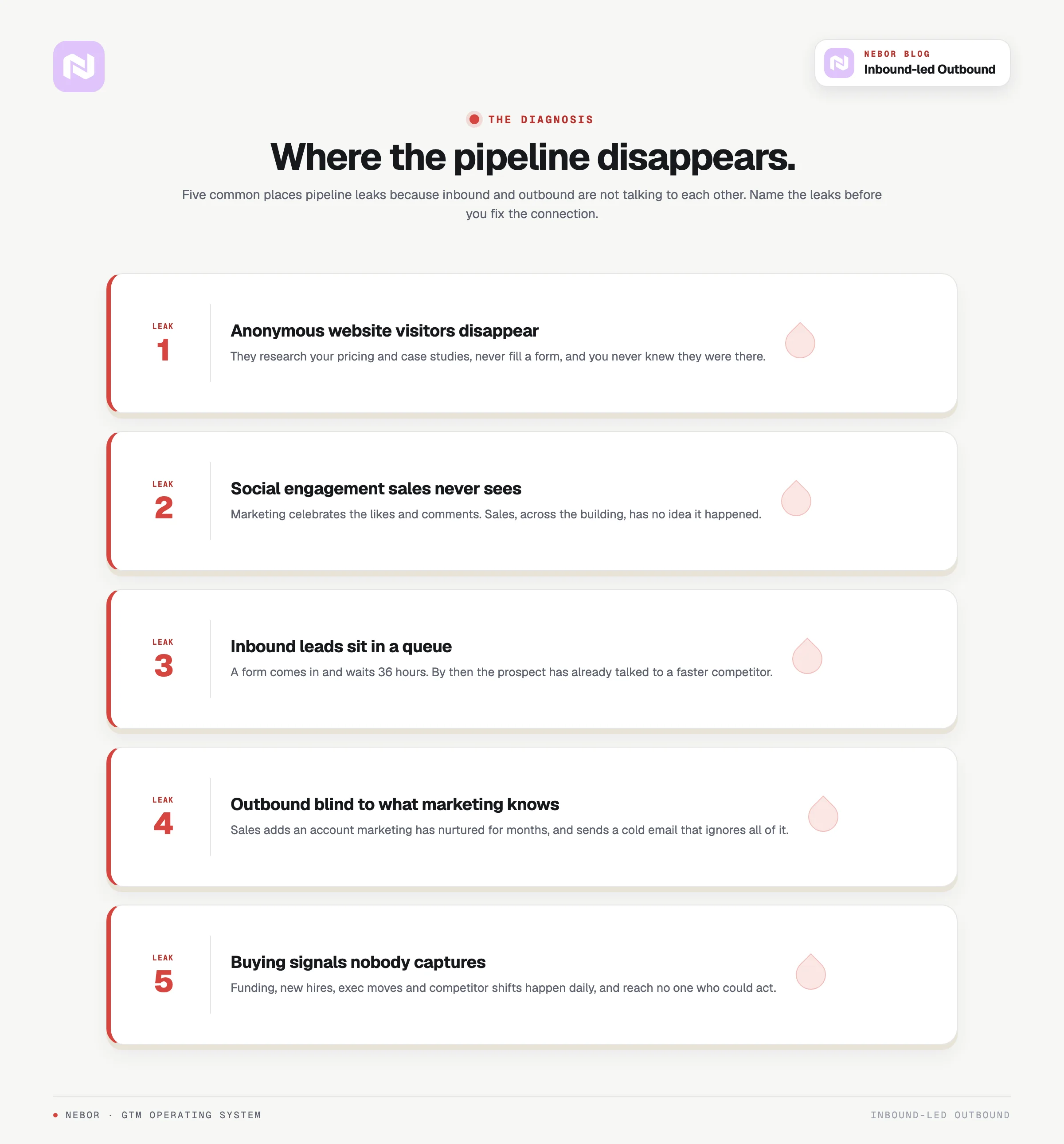
Before we get into how to build the connection, let's name the leaks.
These are the five most common places where pipeline disappears because inbound and outbound aren't talking to each other.
If you recognize three or more of these in your organization, the rest of this post is for you.
Leak one: website visitors who show buying intent but disappear because nobody knows they were there
Most of your website traffic is anonymous. Someone hits your pricing page, reads two blog posts, checks your case studies, and leaves. They didn't fill out a form. They didn't book a demo. They were interested enough to research you, but you have no idea who they were.
This is a massive leak. Visitor identification tools like RB2B (for the US) and Leadinfo (best for Europe) can de-anonymize a portion of your traffic and tell you which companies (and sometimes which specific people) are visiting your website.
But identification alone doesn't fix anything. You need a system that takes that data, enriches it, qualifies it, finds the right contact at that company, and routes it to your sales team with full context so they can reach out while the interest is still fresh.
At Nebor, we build exactly this workflow. Leadinfo identifies the company. The data flows into Clay via webhook. Clay checks the company against your blacklist and existing customer database.
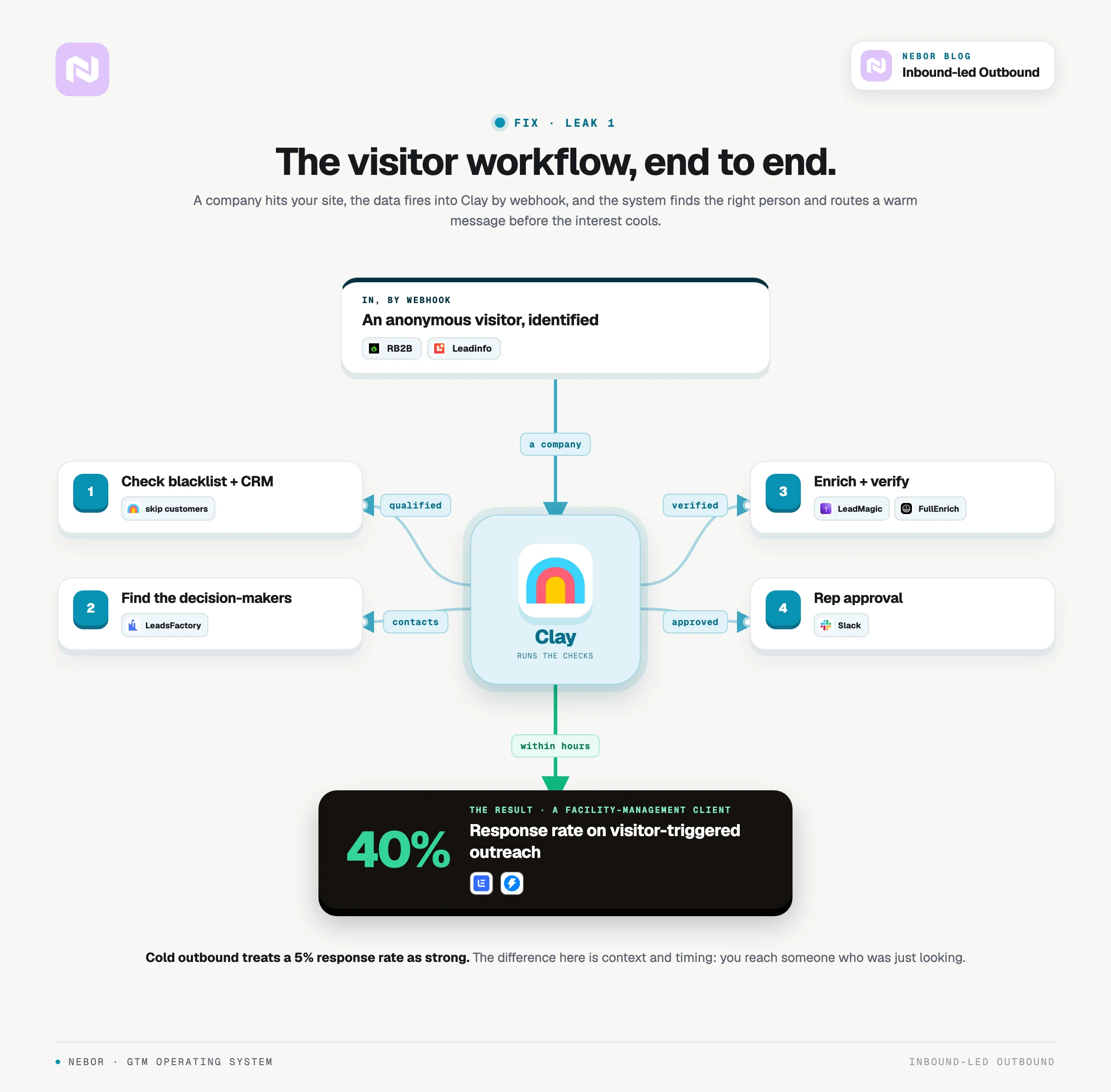
If the company passes those checks, Clay calls on LeadsFactory.io to find the right decision-makers or alternative people you should talk to instead.
Then using enrichment tools, Clay finds and verifies their email addresses through waterfall enrichment across LeadMagic, Findymail, FullEnrich, and similar providers, and sends an approval request to your sales team via Slack.
If the rep approves, the lead gets pushed into a multi-channel outreach sequence in Lemlist or Instantly with messaging that references the fact that someone from their organization was recently looking at your solution.
We built this for a facility management client. The result was a 40% response rate on the outreach triggered by website visitor data.
Compare that to cold outbound, where a 5% response rate is considered strong. The difference is context and timing. You're reaching out to someone who was already thinking about the problem you solve, within hours of them showing interest.
Leak two: LinkedIn and social media engagement that marketing celebrates but sales never sees
Your LinkedIn posts get likes. Your articles get shared. People comment on your content. Your marketing team tracks this as engagement and reports it in the monthly deck.
Your sales team on the other side of the building has no idea. They're busy working their own outbound lists.
They don't see who liked the post. They don't know that the VP of RevOps at a perfect-fit account just commented "great insights" on your founder's LinkedIn post about CRM hygiene. They don't see that three different people from a target Series B startup followed your company page this week.
This is one of the highest-quality intent signals in B2B, and most companies do absolutely nothing with it.
The fix is automation. Use PhantomBuster to scrape engagement on your LinkedIn posts (and your team members' posts). Push that data into Clay, enrich the contacts, qualify them against your ICP, and route the qualified ones into a warm outreach sequence.
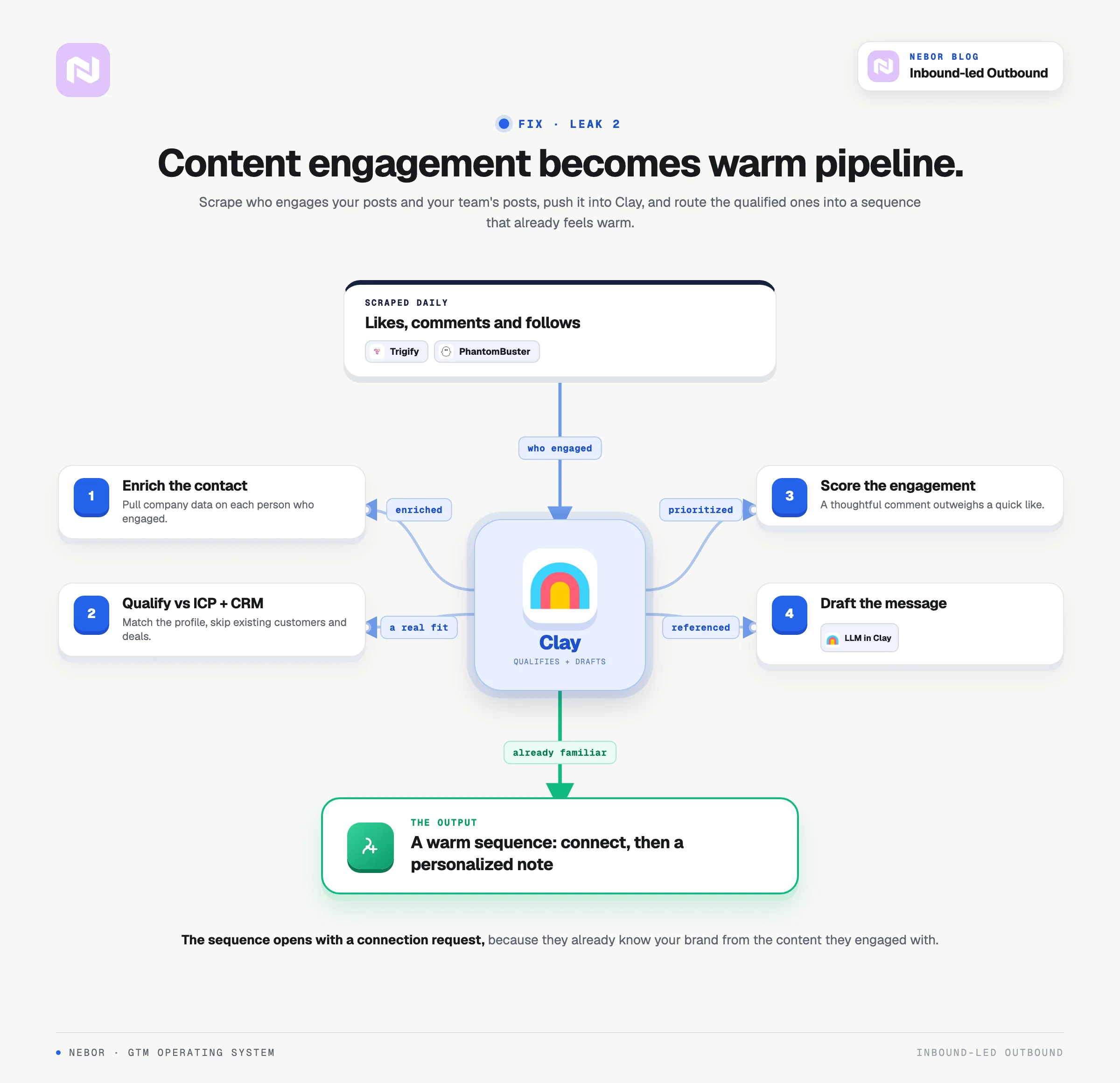
Now every LinkedIn engagement becomes a prospecting event. Your sales team works leads that are already familiar with your brand instead of cold-pitching strangers.
Leak three: inbound leads that wait in a queue for days while your sales team figures out what to do with them
A prospect fills out a form on your website. The MQL gets created in HubSpot. It waits in a queue.
By the time someone gets around to it 36 hours later, the prospect has already talked to your competitor who responded in fifteen minutes. The lead is cold by the time you reach out, and most of them never reply.
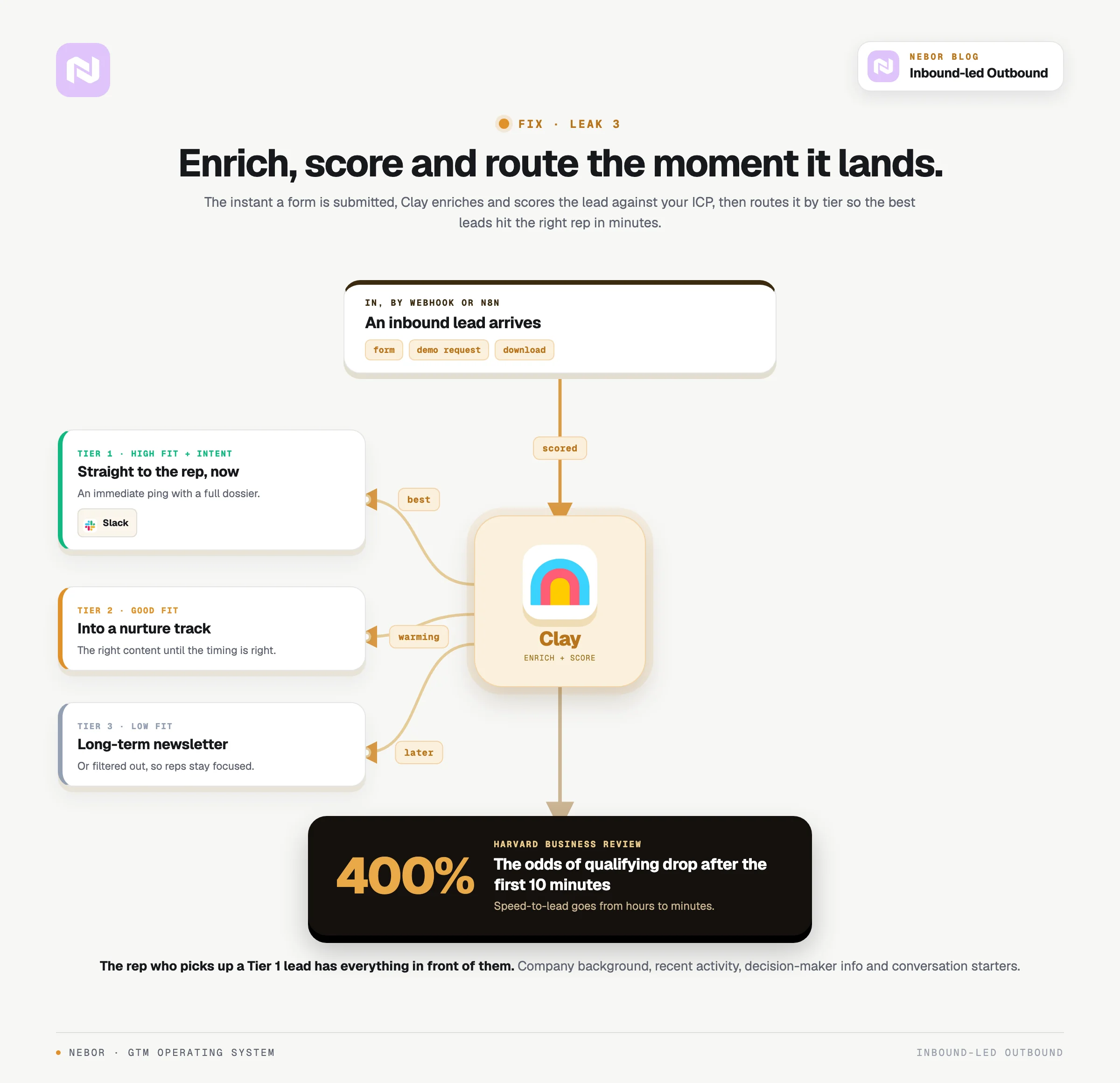
This is the classic speed-to-lead problem. Harvard Business Review research shows that the odds of qualifying a lead drop by 400% after the first 10 minutes. Ten minutes. Most companies measure response time in hours, sometimes days.
The fix is real-time qualification and routing.
We build inbound lead capture and routing workflows where the moment a form gets submitted, Clay enriches the contact and the company with firmographic data, scores the lead against ICP criteria, and routes it to the right rep through Slack with a complete dossier.
The rep gets pinged with everything they need to make the call. Company background, recent funding, tech stack, intent signals, and conversation starters tied to whatever the lead engaged with.
Response time goes from hours to minutes, and the rep walks in armed with context.
Leak four: outbound campaigns that don't know what your marketing team already knows about the same accounts
Your marketing team has been targeting an account for months. They've been showing them LinkedIn ads. The decision-maker downloaded a whitepaper last week.
Then your sales team adds the exact same account to a new outbound sequence. The cold email goes out from a separate sender, with messaging that doesn't reference any of the marketing context.
The prospect gets two completely disconnected messages from "your company" within the same week.
This is what disconnected systems look like in practice. The fix is to make your outbound layer aware of all the inbound signals that exist for an account before any cold email goes out.
When your sales rep opens an account in the CRM, they should see every interaction. What ads did this company see? What pages did they visit? Who engaged with your content recently? What's the full interaction history across every channel?
This ensures your outbound campaigns always build on top of what marketing has already done instead of ignoring it.
Leak five: buying signals happening everywhere that nobody captures because you don't have systems to detect them
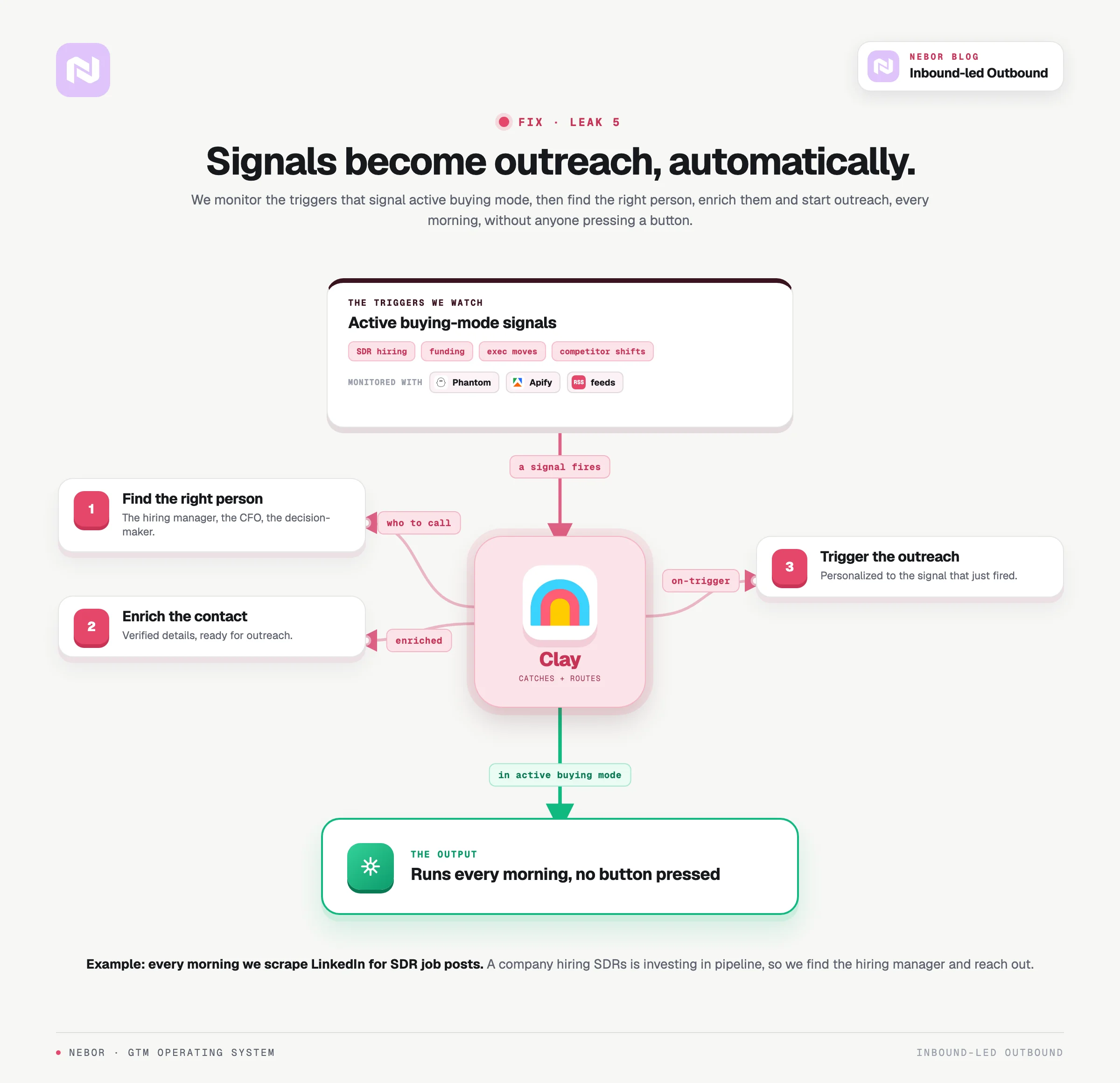
Your business generates intent data every single day. Most of it never reaches anyone who could act on it.
A target account hires three new SDRs. That signals they're struggling with pipeline generation.
A company in your ICP just raised a Series B. That means they're about to invest in growth infrastructure.
A competitor just got acquired. It opens an occasion for their customers to possibly explore alternatives.
A champion who bought your product at their last company just moved to a new organization. They'll probably need the same solution at their new job.
These signals are happening constantly. Without systems to capture, enrich, and route them, they go completely unused. Meanwhile, your reps are working through static prospect lists with no idea that some of those accounts just entered active buying mode.
We build signal-based workflows that monitor these triggers automatically. Job postings, funding announcements, executive changes, technology adoptions, news mentions. All of it gets captured, enriched, and routed to the right person at the right time.
For example, we use PhantomBuster to scrape LinkedIn job posts every morning for SDR roles. When a company hires for SDR, they're investing in pipeline. They have problems we offer solutions for.
We push the data into Clay, we find the hiring manager and department head, enrich their contacts, and trigger outreach. This happens every single day without anyone pressing a button.
For a client in the tax solutions space, we use Clay's RSS feed readers to monitor Fortune 500 financial announcements.
When a company reports a major profit margin increase, that's a buying signal for tax optimization services. We find the CFO or VP of Finance, enrich, and trigger. All automated.
How to build the connection between your inbound and outbound motions
Now let's get practical. Here's how you connect inbound and outbound into one system, step by step.
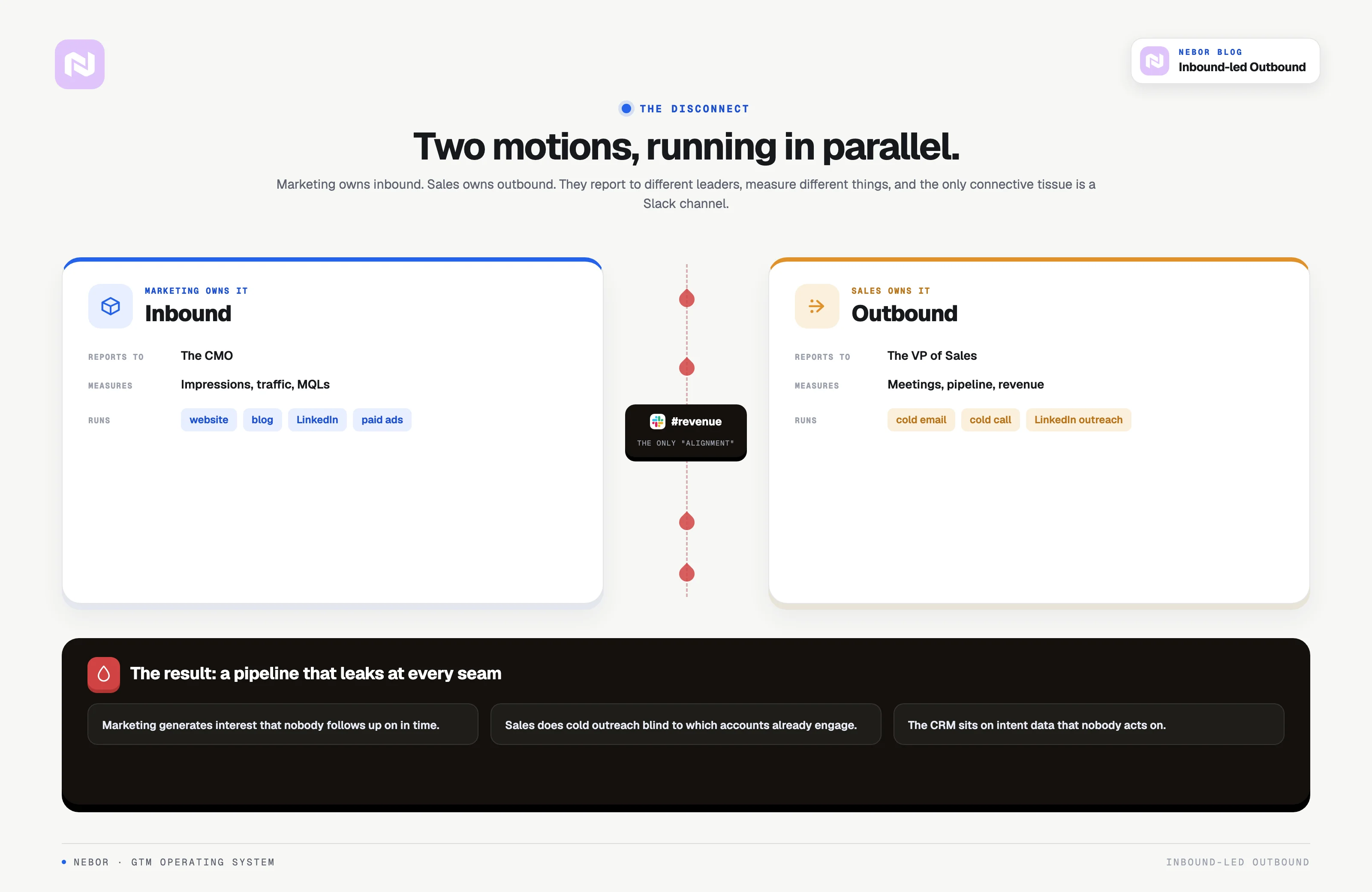
Step one: make Clay your central intelligence layer where all data flows together
The fundamental problem with most tech stacks is that data lives in different places.
Marketing data is in Google Analytics or Ahrefs/SEMrush. Sales data is in HubSpot. Outbound data is in the sequencing tool. Social data is in LinkedIn.
Visitor data is in the visitor identification tool. Each system has its own dashboard, its own access controls, its own quirks.
The first move is to centralize. We use Clay as the intelligence layer that pulls data from every source. Visitor identification flows into Clay. Form submissions flow into Clay. Social engagement flows into Clay.
Outbound campaign performance flows into Clay. Your CRM is connected to Clay so every contact gets enriched and updated automatically.
Once Clay is the center of gravity, every signal becomes actionable in one place. You can build logic that says "if this person visited the pricing page AND they match the ICP AND they engaged with our LinkedIn content in the last 30 days, route them to a rep with this specific message."
That kind of logic is impossible if your data is scattered across five separate tools.
Step two: set up website visitor identification and connect it to your outbound engine
Pick a visitor identification tool that fits your geography. RB2B for US-based traffic, Leadinfo or Snitcher for European traffic. Install it on your website.
Connect the tool to Clay through a webhook. Every time the tool identifies a company visitor, the data flows into a Clay table.
In Clay, apply the qualification logic. Is this company in your CRM already? Is it a customer or active deal? Does it match your ICP? If it passes those checks, find the right contacts using LeadsFactory.io and your enrichment stack.
Generate a personalized message that references the visitor behavior (without being creepy about it). Send the lead to a rep through Slack for approval, then push to Lemlist or Instantly for the outreach sequence.
The result is a steady flow of warm outbound triggered entirely by inbound interest.
Step three: build LinkedIn engagement scraping into an automated warm outreach pipeline
Set up Trigify or PhantomBuster to monitor engagement on your LinkedIn posts and your founders' posts. The scrapers should check daily and pull engagement data from each major post. The scraped data (names, LinkedIn URLs, job titles, companies) flows into a Clay table.
In Clay, enrich each contact. Pull company data, verify they match your ICP criteria, and check them against your CRM to avoid contacting existing customers or active deals.
Score each lead based on fit and engagement quality (a thoughtful comment carries more weight than a quick like).
For leads that pass qualification, generate a personalized outreach sequence using LLMs natively inside Clay. The message should reference the specific content they engaged with and connect it to a pain point you can solve.
Push the approved leads into your outreach tool and launch a sequence that starts with a LinkedIn connection request (since they already know your brand from the content) followed by a personalized message.
This creates a constant stream of warm outreach powered entirely by your content marketing efforts. Every LinkedIn post becomes a prospecting event.
Step four: build real-time inbound lead enrichment, scoring, and routing so nothing waits in a queue
Connect your form submissions, demo requests, and content downloads to Clay through webhooks or n8n. The moment a lead submits a form, the data flows into Clay.
Clay enriches the contact with firmographic data, technographic data, recent funding, hiring activity, and any other signals that matter for your scoring model. Apply your scoring logic.
Tier 1 leads (high fit + high intent) get immediate Slack notification to the right rep with a full lead dossier. Tier 2 leads enter a nurture track with the right content. Tier 3 leads get filtered out or sent to a long-term newsletter.
The rep who picks up the Tier 1 lead has everything they need in front of them. Company background, recent activity, decision-maker info, conversation starters tied to the content the prospect engaged with. Speed-to-lead drops to minutes, conversion rates climb.
Step five: wire your CRM so every touchpoint across every channel is visible in one place
Your CRM should be the source of truth for every interaction across every channel. When a rep opens an account, they should see the full picture. Every cold email sent, every LinkedIn engagement, every website visit, every form fill, every meeting booked.
Most CRMs are not set up this way out of the box. We architect HubSpot, Salesforce, or Pipedrive (depending on what you use) so every workflow we build pushes data back to the CRM with the correct attribution and timestamps.
The result is that your sales team is never operating blind. They always know what marketing has already done with an account, what outbound activity has happened, and what the prospect has engaged with on their own.
That visibility is what turns a disconnected motion into a connected revenue engine.
Why this isn't just about tools, and why it requires a fundamentally different way of thinking about your revenue team
The technical stack matters. You need Clay or something like it. You need visitor identification tools. You need enrichment and verification providers. You need multi-channel outreach platforms. You need a properly configured CRM.
We've covered all of that.
But the real shift is philosophical. It's about how you see or think about your sales functions and your revenue operations. It's about your revenue team operating as one unit with shared data, shared goals, and shared accountability for pipeline and revenue.
At Nebor, this philosophy drives everything we build. We operate across three interconnected pillars. Sales and GTM execution, demand generation and account-based growth, and CRM and revenue operations.
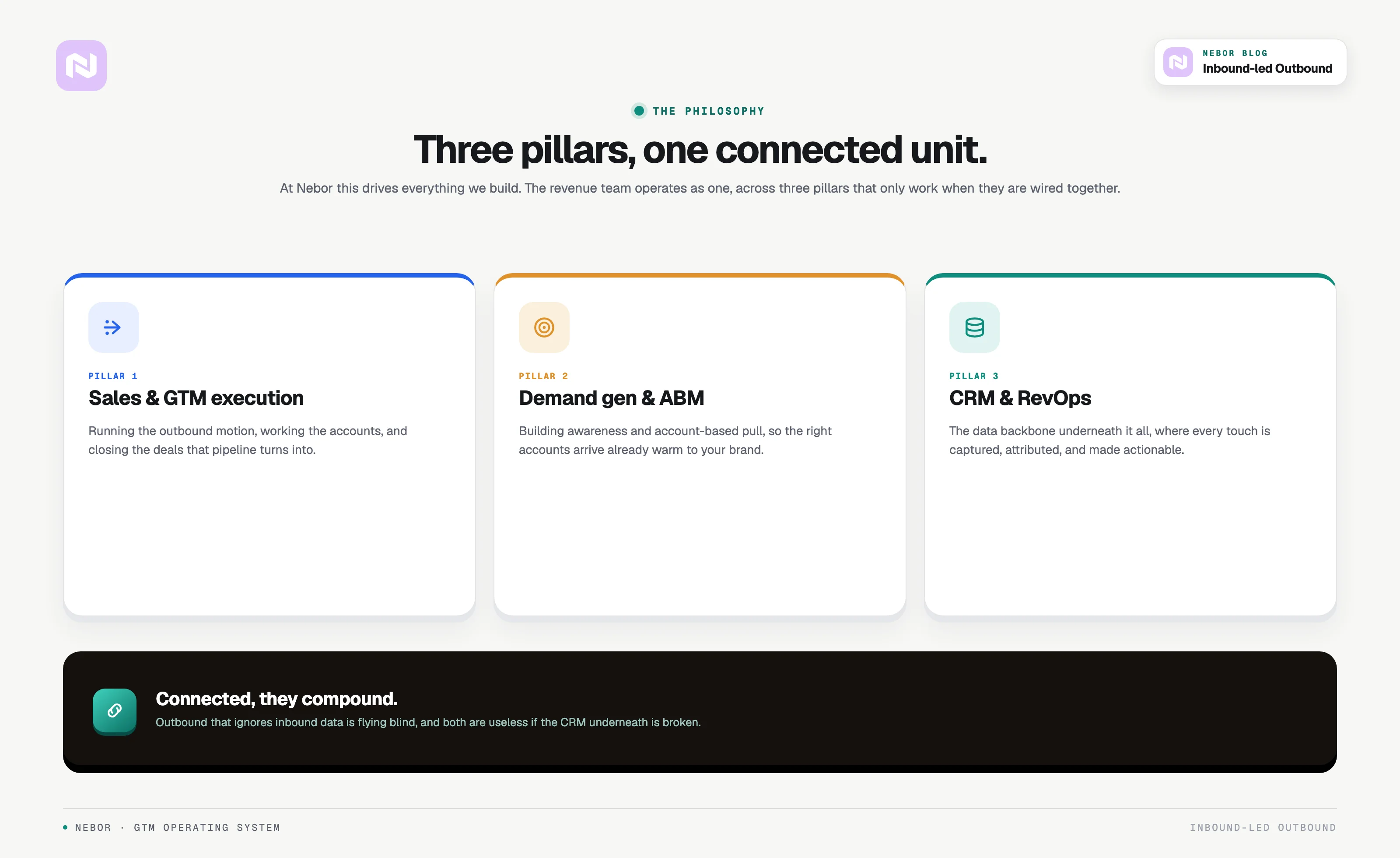
These three pillars only work when they're connected. Outbound that ignores inbound data is flying blind. Inbound that doesn't feed outbound is generating interest that goes to waste. Both are useless if the CRM underneath them is broken.
When the revenue team operates as one connected unit and the systems support that, growth compounds in a way that disconnected motions never do.
How to audit your own organization right now and find out exactly where your pipeline is leaking
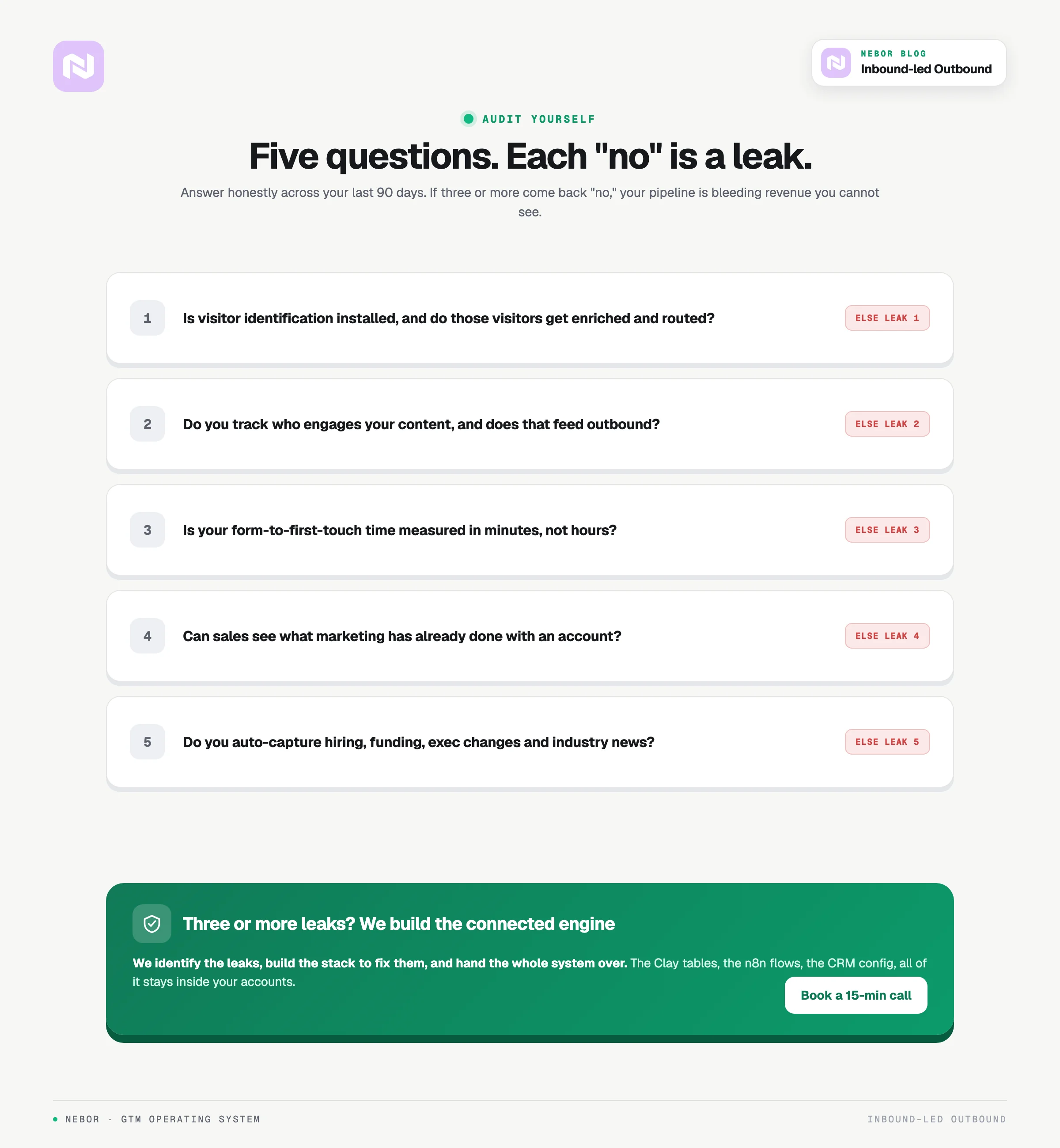
Before you talk to us or anyone else, you can audit your own revenue motion in about an hour. Here's a simple framework.
Pull up your last 90 days of data and ask the following questions.
For website visitors. Do you have visitor identification installed? If yes, do those visitors get enriched and routed to sales? If no, that's leak one.
For LinkedIn engagement. Do you track who engages with your content? Does that data feed into outbound? If no, that's leak two.
For inbound lead response time. What's your average time from form submission to first sales touch? If it's measured in hours, that's leak three.
For outbound coordination. When your sales team adds an account to outbound, can they see what marketing has already done with that account? If no, that's leak four.
For buying signal monitoring. Do you have systems that automatically capture and act on hiring announcements, funding rounds, executive changes, or industry news for your target accounts? If no, that's leak five.
If you have three or more leaks, your pipeline is bleeding revenue you don't know about. The good news is that all of these are fixable with the right infrastructure.
Hire Nebor to build the connected revenue engine that turns your inbound and outbound into one compounding system
If you've read this far, you understand what's possible. The question is whether you have the time, expertise, and operational bandwidth to build it yourself.
Some companies do. They have technical teams that understand Clay, n8n, and the broader sales tech stack, plus operational maturity to handle inbound and outbound as one motion. If that's you, take this guide as your blueprint and start fixing leaks one at a time, or evaluate the top Clay experts for outbound sales automation if you need outside help on the build.
Most companies don't. The technical work to build, integrate, and maintain these systems is non-trivial. The operational shift to make sales and marketing actually work together is harder than the tech.
That's where we come in. At Nebor, we design and build connected revenue engines for B2B companies. We help you identify the leaks, build the tech stack to fix them, and we hand the entire system over to your team when we're done.
Everything stays inside your accounts. The Clay tables, the n8n flows, the visitor identification setup, the outreach sequences, the CRM configuration. You operate the system after we wrap, and it keeps producing pipeline as long as you keep it going.
If you want a connected inbound-led outbound system for your business, book a 15-minute call and we'll walk through the leaks specific to your go-to-market motion and what it would take to fix them.
We've covered the full picture in our breakdown of why we set out to be the best growth agency if you want more context on how we work.


Related Articles


By clicking Sign Up you're confirming that you agree with our Terms and Conditions.