How to Build a Go-To-Market (GTM) System That Generates Business on Autopilot


In this post:
Most B2B companies don't have a go-to-market strategy.
What we typically see is a collection of disconnected activities that kind of happened over time because most of the time, they don't even know how they started and ended up in the mess they're currently in.
The founder thinks the ICP is one thing. Sales is pursuing a different go-to-market plan and closing a different profile. Marketing is creating content for a target market that nobody agreed on. Nobody is tracking what's actually working. And your customer acquisition cost is higher than ever.
We see this pattern over and over again with companies at Nebor. A company comes to us, and on the surface, things look like they're moving. There are campaigns going out. There's a marketing plan and content going out for the target audience. Sales reps are on market research and calls.
Everybody is busy. But revenue isn't growing the way it should because none of these activities are connected to each other.
This is especially common in founder-led businesses where everything grew organically. Someone started doing cold email because it worked once. Someone else launched a LinkedIn page because they heard it's what you're supposed to do.
An SDR got hired and started working from their own playbook. A marketing freelancer added a blog. Nobody asked whether any of these activities support each other or whether they're driving toward the same goal.
This post is about how to fix that. We're going to walk you through the GTM framework we use with our clients at Nebor, how we sequence the work, why we start where we start, and how the pieces connect into one compounding system that feeds revenue back into the top of the funnel.
So, let's get started.
TL,DR
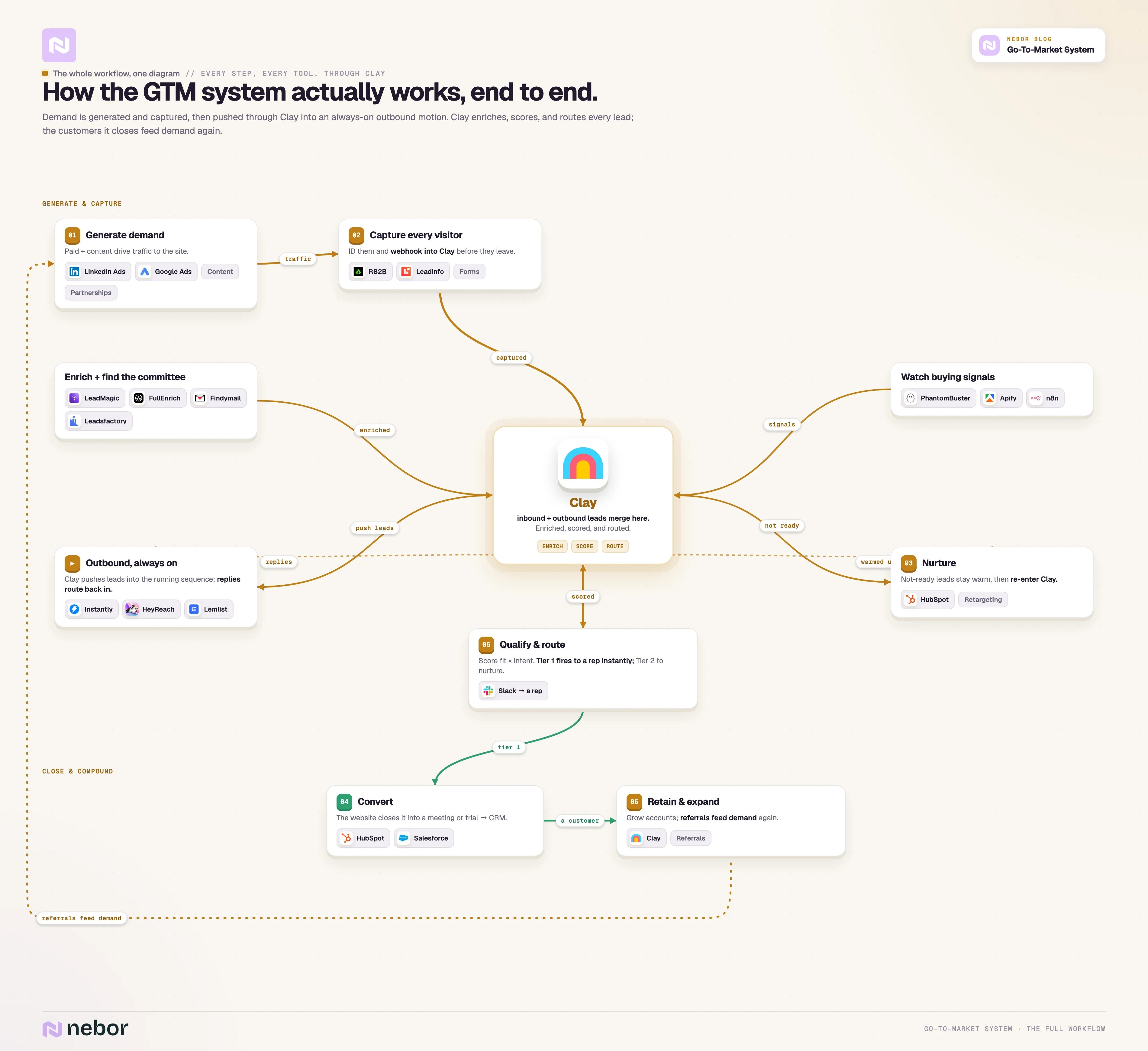
Here’s a quick representation of the main components you need to consider for your GTM system and the key tools that make it up.
Bear in mind that this is just a general representation and when we strip your business business down to its key needs, the workflows you get in the end almost always changes.
Before you build anything, you need to understand where the disconnects are
When a new client comes to us, we don't start by building campaigns. We start by figuring out what's actually going on inside the business. Because 9 out of 10 times, there's a disconnect somewhere that nobody has noticed, or nobody wants to talk about.
Our process starts with an onboarding or discovery call.
Pretty standard stuff. What do you sell, who do you think you're selling to, what sales and marketing efforts have you tried so far, what's your pricing strategy, what KPIs do you care about, what's working, what isn't, and what are your goals. This gives us a baseline.
But the real insights come during the kickoff call. And this is important. We don't just talk to the founder.
We get multiple people in the room. Sales, marketing, founders, and basically anyone who touches the revenue and customer feedback processes. We ask each of them how they see the business, who they think the ICP is, what their goals are, what they've tried, and where they think things are breaking.
And then we compare answers.
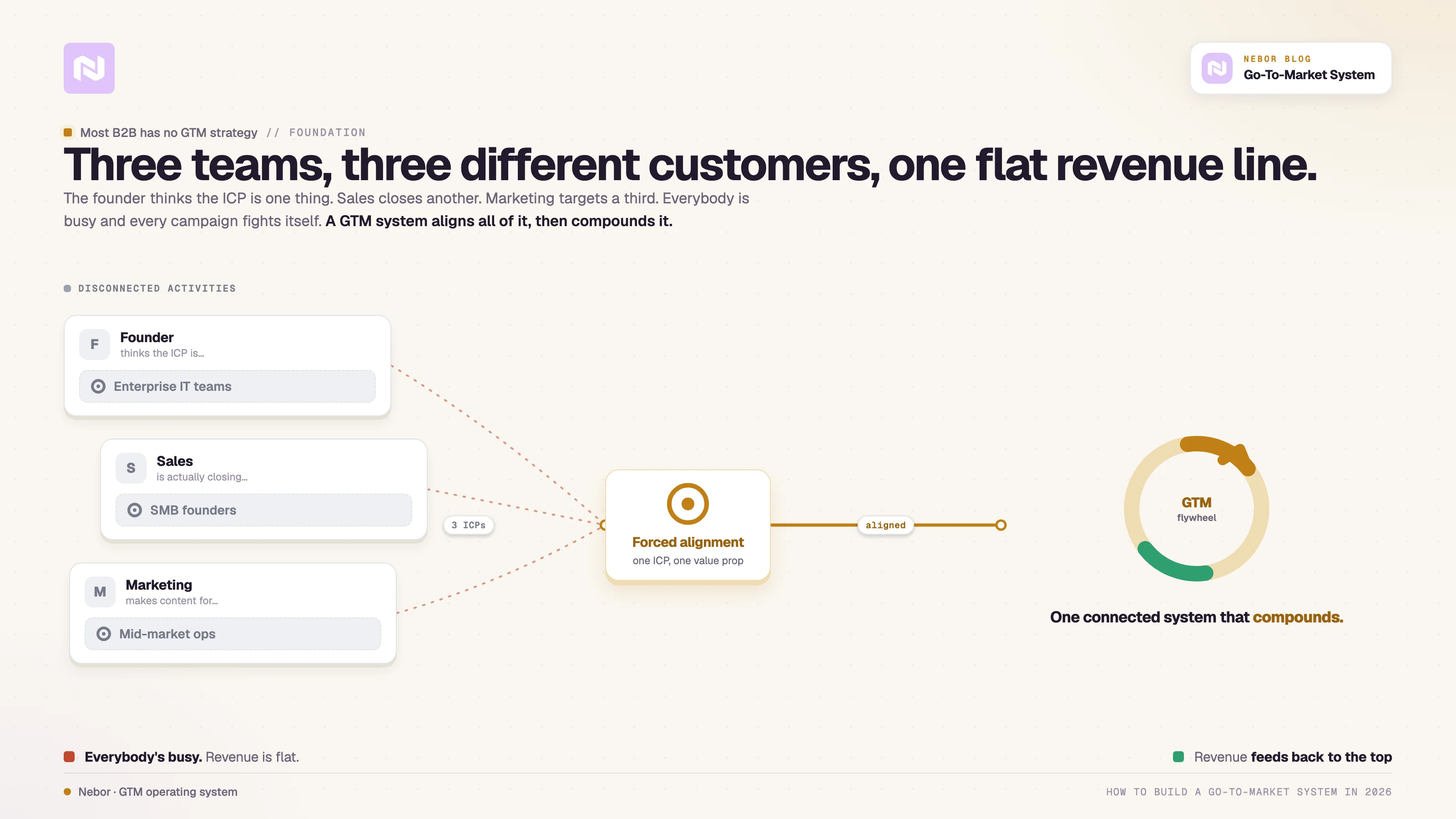
This is where the gaps surface. The founder will say the ICP is one thing. Sales will describe a slightly different profile. Marketing is targeting yet another angle. Suddenly, you have three different versions of the same supposed strategy working in parallel.
When that happens, every campaign you launch is fighting itself. Marketing creates content for one audience. Sales is having conversations with a different audience. The metrics don't add up because nobody is measuring the same thing.
So this kickoff is not just a kickoff. It's a forced alignment exercise. By the end of it, everyone in the room has agreed on who the customer is, what the value proposition is, what the strategic priorities are, and what success looks like.
That's the foundation. Without it, everything you build later collapses under the weight of misaligned assumptions.
Why we test outbound before we build a full strategy (and why you should too)
This is a controversial take in some circles, but we stand by it. After the alignment session, we don't go straight into strategy. We test outbound first.
The reason is simple. Until you have real data on what your market actually responds to, every strategic decision you make is a guess. So we build a focused outbound test to validate the assumptions we just aligned on.
That looks like this. We take the ICP we agreed on and the messaging angles we believe will resonate, and we push them through outbound campaigns at scale. Email, LinkedIn, whatever combination makes sense.
We track everything. Reply rates by segment, by message, by industry, by company size. We see what gets traction and what falls flat.
Sometimes the client's original assumptions are spot on. Great, we move faster.
But more often than not, something was off. Maybe the ICP was too broad. The messaging was leading with a feature nobody cares about. The industry they thought was their best fit is actually ice cold, and there's a completely different vertical that lights up. It even happens that the company's business objectives are off.
This is why outbound comes first in most cases. We believe it's the fastest feedback loop there is.
You can test ten different angles in two weeks and come back with hard data on what resonates, especially when you layer in AI-driven B2B lead generation strategies that improve targeting and signal detection.
Try doing that with content marketing or SEO. It would take six months just to get meaningful traffic data. Outbound gives you the answers now so you can build everything else on a solid foundation.
Why outbound first is not always the right starting point
Now, we're not dogmatic about this. There are absolutely cases where outbound first is the wrong move, and we want to be honest about that.
Here are the main exceptions.
When your TAM is too small for cold outreach. If you have 500 target accounts in your entire market, you can't afford to test messaging by burning through them with cold campaigns. You'd damage your reputation across the entire market.
In these cases, we lean into other channels and treat every account as a relationship from the start.
When your product is a sensitive enterprise sale. Some industries (regulated finance, healthcare, government) have buyer behavior that completely rejects cold outbound. The cultural norm is referrals, RFPs, and warm intros. Cold email here doesn't just fail, it actively hurts you.
When the founder has a strong existing audience. If the founder has 50,000 followers on LinkedIn and has been publishing in the space for years, the fastest path to revenue is amplifying what they're already doing. Outbound matters less when there's already an audience to monetize.
When inbound is already producing volume. Sometimes a company comes to us with strong inbound demand but a broken process for converting it. In that case, we don't need to test outbound. We need to fix the inbound funnel first and then layer outbound on top later.
For us, the rule is to look at the data and the context. There's no universal answer. The starting point depends on the company.
The 6-layer GTM framework we use to design a strategy and map the full system
Once we've validated the fundamentals through testing, we map out the entire go-to-market system.
We break it into six layers. Each one feeds the next, and the last one feeds right back into the first.
Layer 1: Getting eyeballs on your business (demand and traffic generation)
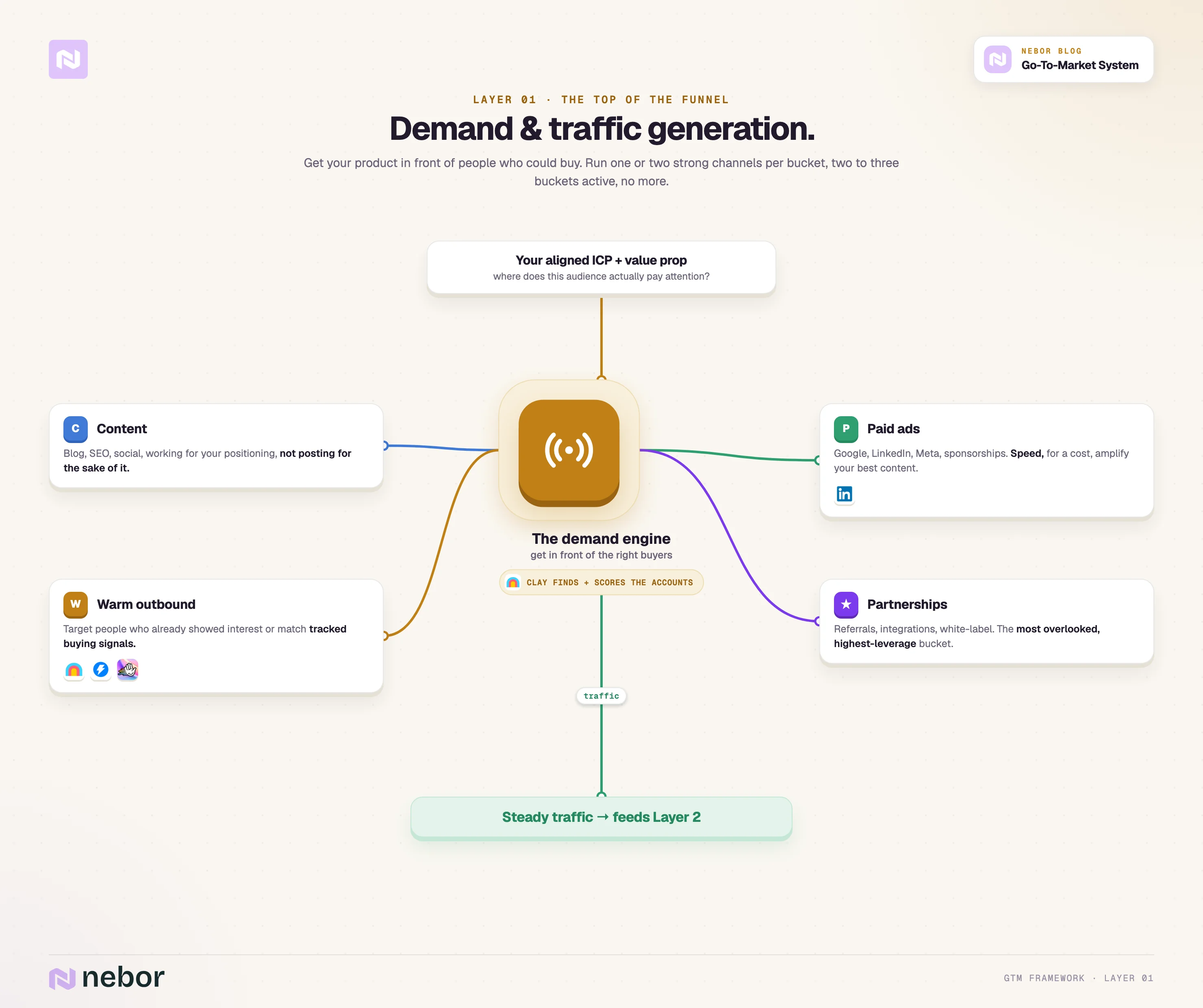
This is the top of the funnel. Awareness. Getting your product or service in front of people who could potentially buy.
There are four main buckets here.
Content marketing: SEO, AI search optimization (AEO), thought leadership posts, blog content, podcasts. This is the slow-but-compounding bucket. It pays off over time and builds a brand.
Especially when you have great content marketers who know how to get your positioning right and show it off through content.
We don't typically produce content for our clients since most businesses already have this going on to some degree, but the key is making sure it's working for your value proposition and positioning and not just existing for the sake of posting.
Paid advertising: This is if you have the budget and want to move fast. Google Ads, LinkedIn Ads, Meta, Reddit, directory listings, event sponsorships, and, for bigger players, even billboards and TV.
The upside is speed. You can get in front of your audience tomorrow. The downside is that it costs money, and you need to be honest with yourself about ROI.
And if you have great marketers, you can combine it with the content marketing section we just explained. The idea is simple.
You create great blog posts that get to the pain points and what you do right, and then instead of waiting for Google and AI to pick them up organically, you use paid ads to promote them.
That said, a lot of companies burn through ad budgets because they're sending traffic to a homepage with no clear call to action. The ads work, but the landing experience doesn't. More on that in a later section.
Outbound: Cold email, LinkedIn DMs, cold calls, and increasingly, warm outbound. This is where we live.
Warm outbound targets people who have already shown some kind of interest. They visited your site, engaged with your content, downloaded something, or fit a profile that matches buying signals we're tracking, making it a perfect fit for automated B2B lead generation workflows with Clay or partnering with a Clay-based lead generation agency like Nebor.
This warm approach is becoming more and more important because pure cold outreach is getting harder. Inboxes are more crowded, spam filters are stricter, and buyers are better at ignoring generic messages.
From our experience, the companies that are winning at outbound in 2026 are the ones layering intent data and engagement signals into their targeting so that cold emails feel relevant from the first line, and many work with top outbound experts who specialize in fixing broken pipelines.
Partnerships: Partnerships are the most overlooked bucket, and often the highest leverage. Referral programs, technology integrations, white-label arrangements, affiliates, B2B influencer collaborations, joint ventures, and agency programs.
The reason partnerships are so powerful is that other people are selling for you. A good referral partner or integration partner brings you warm leads that already trust you because someone they trust recommended you.
Most companies leave this bucket empty, and it's a mistake.
Now, here's the part that matters most about Layer 1. Don't try to do everything. Do a market analysis (maybe with competitive analysis as well) and stick one to two strong channels per bucket.
Have two to three buckets active at any time. That's enough to build real momentum without overextending. The companies that try to be everywhere at once usually end up nowhere.
How to decide which channels to activate
Choosing the right channels is where most teams get stuck. They either spread themselves thin or pick based on what's trending rather than what actually fits their business.
There are three things you need to look at.
First, where does your audience actually pay attention?
The answer changes by persona, region, and industry. A CFO at a manufacturing company spends time on LinkedIn and reads industry publications.
A senior developer might be active on GitHub, Discord, and YouTube but completely ignore LinkedIn ads. Mid-market sales reps live in LinkedIn DMs. Enterprise buyers respond to phone calls but ignore cold email. And vice versa.
You'd be surprised how many companies launch expensive cold email campaigns targeting personas who are essentially unreachable through email. Start by understanding the medium your buyers prefer before you invest in the channel.
Second, consider the regulatory environment.
Markets like Germany and Switzerland, for example, do not appreciate aggressive cold outbound. GDPR regulations in those regions make traditional outbound really tricky, and the cultural expectation is different too.
If that's your primary market, you'll need to lean much heavier into content, partnerships, and inbound rather than trying to force an outbound-first approach.
We've had clients who learned this the hard way after burning through months of outbound campaigns that generated nothing but complaints.
Third, think about which channel yields the highest potential ROI for your specific situation.
This is not just about cost per lead. It's about where in the journey you generate the highest-quality conversations.
For SMBs and mid-market accounts, automation-led outbound and inbound work incredibly well. Volume matters, automation scales, and the buyer is usually a single decision maker who can move fast.
For enterprise, the game is completely different. You're not dealing with a single decision maker anymore. You're dealing with buying committees, multiple stakeholders, internal champions who need to sell your solution to their leadership, and much longer sales cycles.
For enterprise, you need layered approaches. Think conversation ads on LinkedIn that warm up the account. Capture engagement through lead magnets or content downloads. Retarget based on that engagement. Build awareness across the entire buying committee.
Then have sales reach out when there's actual warmth. It's less about sending cold emails and hoping for a meeting and more about building presence across the account, tracking who engages, nurturing those people, and then having a rep reach out at the right moment.
The bigger the target company, the more layers you need. And oh, you'll also need to have a solid blog (content) that educates people on who you are, why you are different, and why you're best qualified for their needs.
Why you'll need audience intelligence beyond job title and industry
Beyond the channel selection, there's a whole layer of intelligence that separates good targeting from great targeting. We call it audience intelligence, and it goes far beyond the standard filters like job title, industry, and company size.
What we want to understand is what happens before a deal closes. What signals indicate that a company might be entering buying mode?
These signals include things like, what tech stack are they using? Have there been recent layoffs or new hires in specific departments? Did they just raise a round of funding? What events are they attending or sponsoring? Are they buying ads, which could signal growth or expansion? Are key people at the company following your competitors on LinkedIn?
Each of these signals tells you something about where a company is in its journey. And the more of these signals you can stack on top of each other, the more precise your targeting gets.
A company that just raised Series B funding and hired three new sales reps is in a different buying mode than a company that hasn't raised in five years and just had layoffs. Both might technically fit your ICP filters, but only one is likely to buy right now.
This is the kind of work that automation tools like Clay are built for. You set up workflows that monitor specific signals across thousands of accounts and automatically surface the ones that are showing intent, often through a partnership with Clay-focused agencies that build automated sales systems.
Layer 2: Capturing leads (because traffic without capture is just vanity)
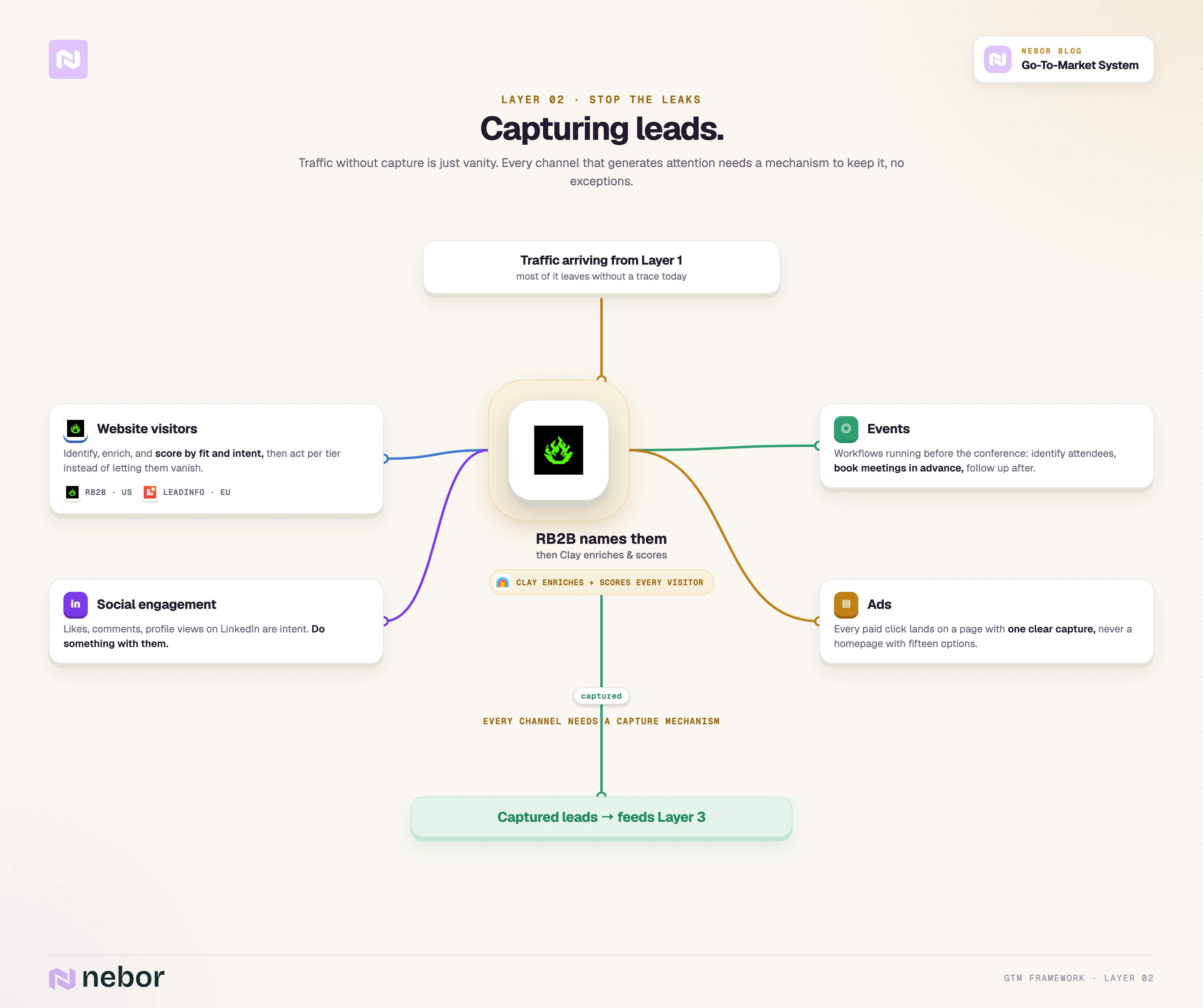
You can drive all the traffic in the world, and it won't matter if you can't capture it. Most companies are leaking badly here.
There are four core capture mechanisms. Landing page forms, lead magnets (where you give something valuable in exchange for contact information), social engagement tracking (monitoring who's interacting with your content), and building an owned social following.
But the capture mechanism has to match the channel it's connected to. Let's walk through the most common leaks we see.
Website visitors: Most companies have no idea who's visiting their site. People browse, read a few pages, and leave. Gone forever. You spent money and effort getting them there, and you have nothing to show for it.
You need a system to identify those visitors, enrich the data, score them by fit and intent, and then decide what action to take for each tier.
We've written a separate in-depth piece on website visitor identification and retargeting workflows because this single workflow can dramatically change what your top-of-funnel produces.
Social engagement: LinkedIn especially. People liking your posts, commenting, viewing your profile, following your company page. That's interest. That's intent.
But are you actually doing anything with those people? Or are you just watching the like count and moving on?
You need a system that automatically captures those engagers, enriches their profiles, and routes the ones who match your ICP into an outreach sequence. We call these warm leads hiding in plain sight, and most companies do nothing with them.
Conferences: Are you capturing leads before, during, and after the event? Or are you just scanning badges at your booth and hoping for the best?
The companies that get the most out of events have workflows going before the conference even starts. They're identifying attendees, warming them up, booking meetings in advance, and then following up with personalized outreach after the event that references specific conversations or sessions.
Ads: Where does your ad traffic actually land? Is the page set up to capture contact information? Or are you burning money sending people to a homepage that gives them fifteen different options and no clear next step?
Every paid click should go to a page with a single, clear capture mechanism. Anything else is waste.
The rule is simple. Every channel needs a capture mechanism. No exceptions. If a channel is generating attention but not capturing any of it, that's a leak in your system that needs to be fixed.
Layer 3: Nurturing (the layer where most companies completely drop the ball)
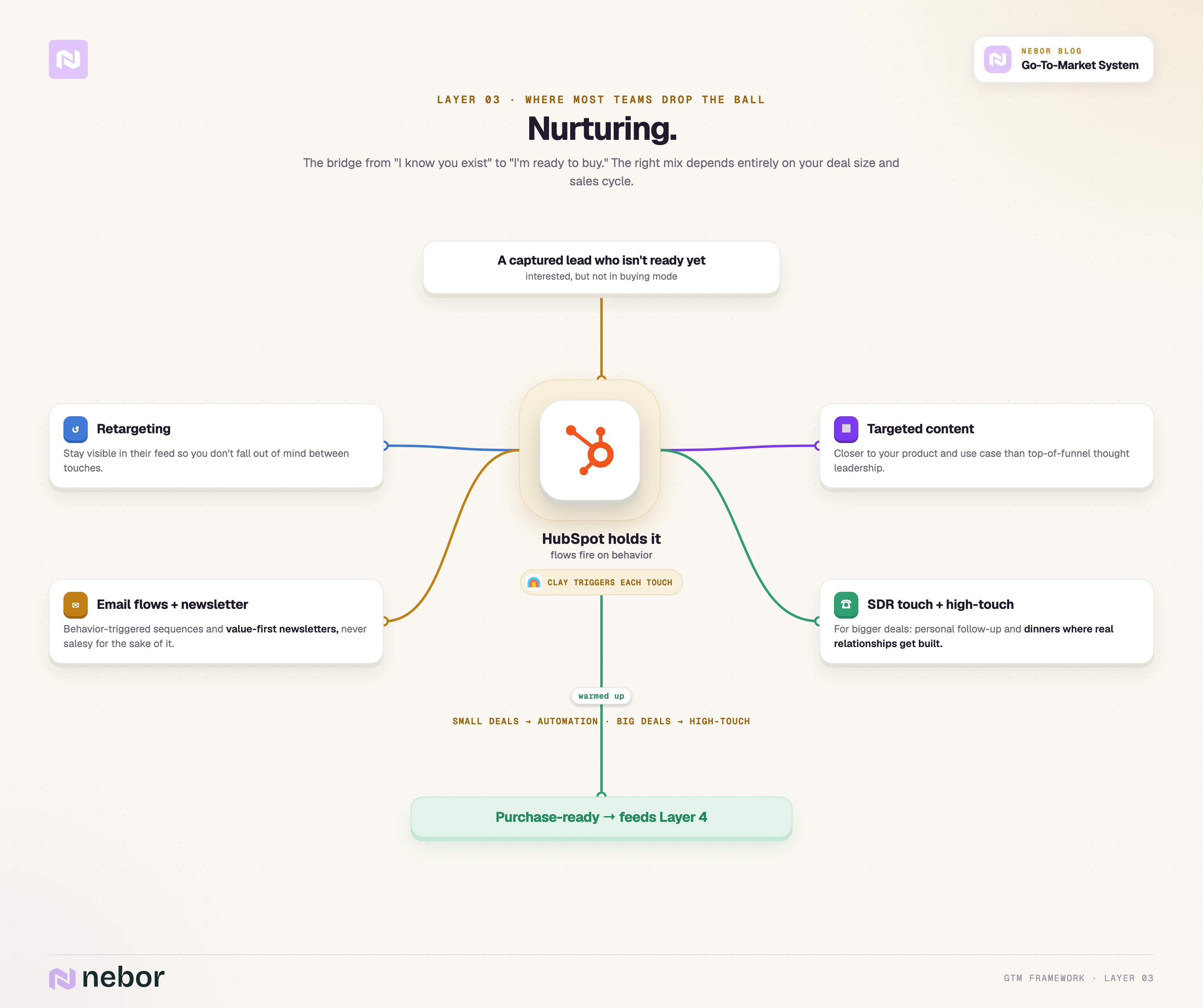
This is the bridge between "I know you exist" and "I'm sold and ready to buy." It's where most companies fall apart.
What we typically see is one of two extremes. Either the company blasts every lead with sales calls immediately (too aggressive, scares people off, and burns the lead), or they do literally nothing (the lead lingers in a spreadsheet, gets stale, and dies there). Neither works.
Nurturing is about staying present and building trust over the time it takes for someone to move from awareness to purchase readiness.
The core nurturing mechanisms include retargeting ads that keep you visible in their feed, automated email flows triggered by specific behaviors, more targeted content that's closer to your product and use case than top-of-funnel thought leadership.
There's also newsletters that provide regular value without being salesy as well as SDR touchpoints for higher-value leads that deserve personal follow-up.
The right mix depends entirely on your deal size and sales cycle.
For smaller deals with shorter cycles, automation does the heavy lifting. Email sequences, retargeting ads, and timely SDR follow-up can move someone from lead to meeting in a few weeks with minimal manual effort.
For larger deals with longer cycles and higher contract values, you need high-touch nurturing that goes beyond email sequences.
Think dinner events where you get eight people around a table with good food and wine and suddenly everyone is sharing real problems and building relationships.
Sending thoughtful gifts that are actually relevant (not garbage branded merch with your logo on it). Hosting intimate roundtables or executive events. Building a community around a niche topic in your space.
These sound over the top for most companies, but for enterprise deals with six and seven-figure contracts, they work incredibly well.
You're not going to close a 500,000 euro deal through a nurture email sequence. That deal gets closed through relationships, and relationships require investment.
Layer 4: Conversion (when the buyer is ready to buy but your website still can't convince them)
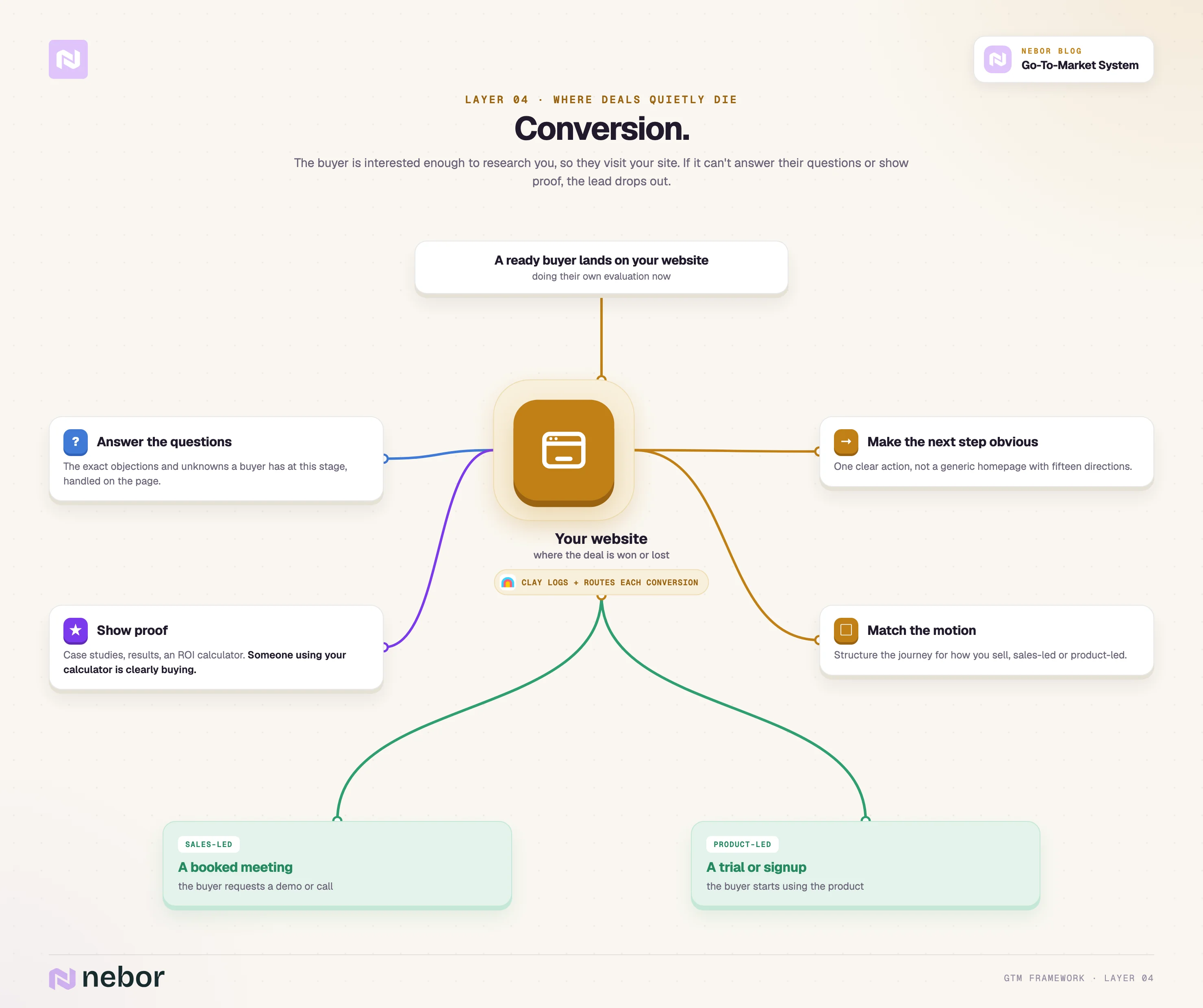
At this point, the lead knows who you are. They've seen your content, engaged with your outreach, and they're interested enough to do their own research. They visit your website. This is where a massive number of B2B companies lose deals.
All the energy goes into generating traffic and launching campaigns, but the website itself can't close. It doesn't answer the questions the buyer has. It doesn't show proof. It doesn't make the next step obvious.
Whether you're sales-led (where the goal is a booked meeting) or product-led (where the goal is a trial or signup), the buyer is doing their evaluation on your website. And if the experience is generic, the lead drops out.
There are different types of content that need to live on your site for it to do its job at the conversion stage.
Case studies that show real results with real companies. Pricing pages that are clear or, at minimum, that move people forward instead of creating friction. Comparison pages where you stack yourself against competitors.
There's also ROI tools. Calculators, assessors, or generators give value before the prospect commits to a conversation. They also capture intent data, because someone who uses your ROI calculator is clearly thinking about buying.
There's a lot more to unpack about structuring the buyer's journey on your site and where each content type belongs in that journey.
This is a topic that probably deserves its own dedicated post because getting it right can dramatically change your conversion rates without spending a single extra dollar on traffic.
Layer 5: Qualification (making sure your sales team talks to the right leads at the right time)
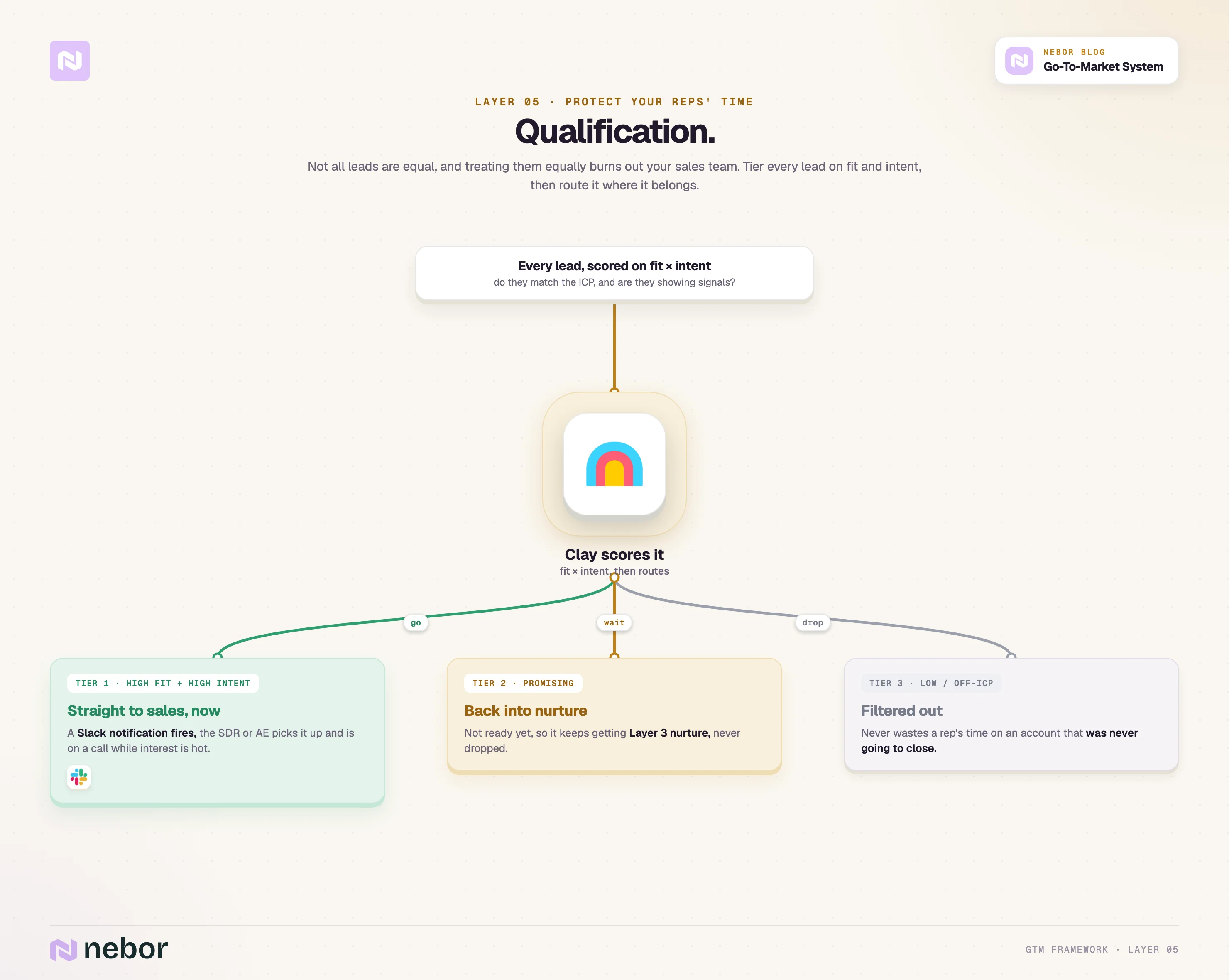
Not all leads are equal, and treating them equally is one of the fastest ways to burn out your sales team and waste their time.
This is where lead tiering comes in.
Tier 1 leads are (or rather should be) high fit and high intent. They match your ICP, they've shown clear buying signals, and they're ready for a conversation. These go straight to sales. Immediately.
A Slack notification goes out, the SDR or AE picks it up, and they're on a call with the prospect (which is exactly what our inbound meeting workflow is built for) within hours, not days.
Tier 2 leads are good fit but lower intent, or high intent but uncertain fit. They go into nurturing first, with the right content and follow-up, until they show enough intent to warrant a sales conversation.
Tier 3 leads are weak fit. They get filtered out or, at most, dropped into a long-term newsletter. You're not wasting sales cycles chasing accounts that will never close.
The qualification step keeps your team focused. Without it, your sales reps are spending equal time on accounts that will never close as they are on accounts that absolutely will.
Once you have these distinctions in place, you can layer them into sales automation platforms and agencies or collaborate with specialized Clay experts for outbound sales automation.
The companies that automate this well focus their entire sales team's energy on conversations that actually matter instead of wasting hours on leads that aren't ready.
Layer 6: Retention and expansion (the most neglected growth lever in B2B)
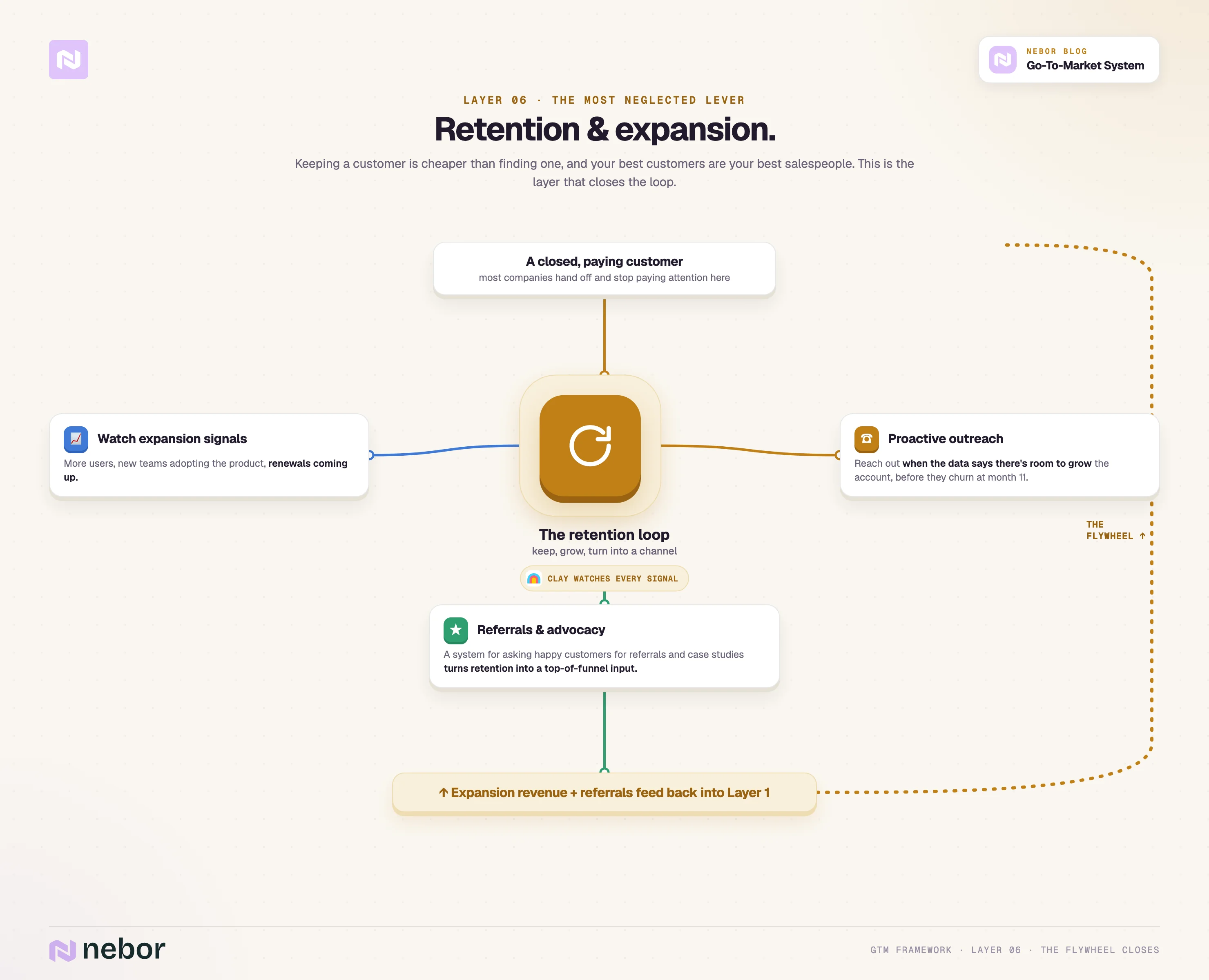
We'll be straightforward here. This layer doesn't get the depth it deserves yet in our framework, and we know it probably needs its own dedicated piece.
But the basics are important and worth covering because retention and expansion are the most efficient growth levers in B2B.
You know the saying, keeping a customer is always cheaper than finding a new one. Getting an existing customer to buy more or upgrade is the most capital-efficient growth there is.
The key concept is customer lifecycle management. So, always ask yourself. What stage is each customer in? What should they see and experience at each stage? What touchpoints make sense at month 1, month 6, year 2?
The companies that nail retention have systems for onboarding, ongoing engagement, identifying expansion signals (more users at the customer, additional teams using the product, contract renewals coming up), and proactive outreach when the data suggests there's an opportunity to grow the account.
And then there's referrals and customer advocacy. Your best customers are your best salespeople. If you have a system for asking happy customers for referrals and case studies, you turn retention into a top-of-funnel input.
Most companies miss this entirely. They acquire a customer, hand them off to customer success, and then move on to the next acquisition. Meanwhile, the customer churns at month 11 because nobody was paying attention.
The flywheel only works when the layers connect
If you read through those six layers and treated them as independent buckets, you missed the point.
The whole framework only works when the layers connect into a single flywheel where each layer's output is the next layer's input.
Traffic that doesn't get captured is wasted spend.
Captured leads that don't get nurtured are wasted effort.
Nurtured leads that hit a website that can't convince anyone are lost opportunities.
Converted customers that never hear from you again are churn waiting to happen.
When we audit a company's GTM, we're not looking at whether each layer exists in isolation. We're looking at the connections.
Does traffic flow into capture mechanisms?
Do captured leads get routed into the right nurture sequences?
Does the website support the conversion that all the upstream work is driving toward?
Are retained customers being leveraged to generate new traffic and referrals?
So, find the gaps. Fill them. Connect the pieces. You don't need every possible tactic active in every layer. You need one to two strong mechanisms per layer, and they need to be connected into a single system that compounds.
GTM goes beyond channels (the multipliers that make everything spin faster)
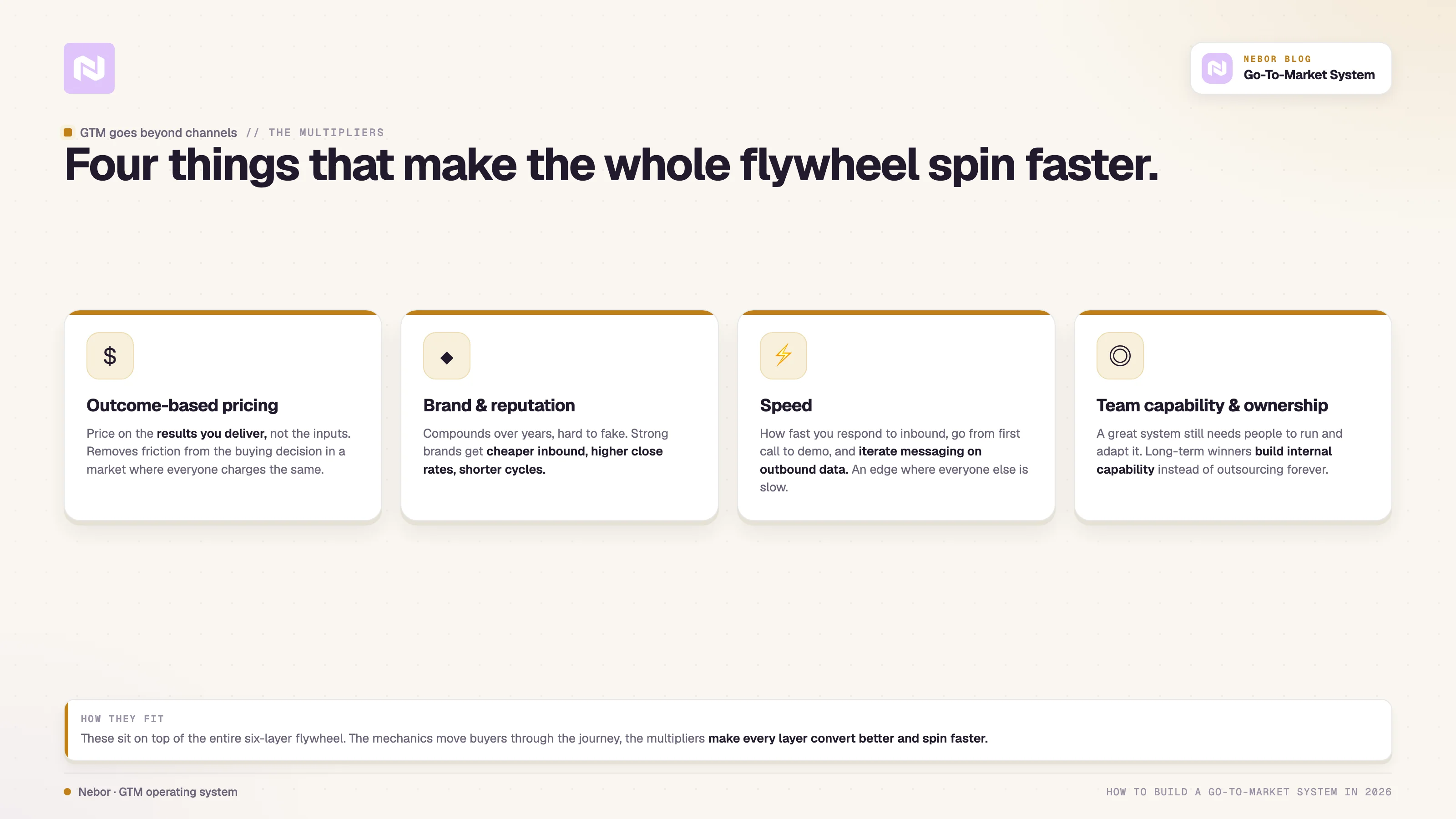
Everything we've talked about so far covers the mechanics of how to get your product or service in front of buyers and move them through the journey. But there are factors that layer on top of the entire flywheel and make everything work better.
Outcome-based pricing: This is a real differentiator in markets where everyone charges the same way. If you can structure your pricing around the results you deliver rather than the inputs you provide, it removes friction from the buying decision and positions you differently from every competitor charging hourly or per seat.
Proprietary data or intelligence: The idea is that if you have access to data, research, or insights that nobody else has, you can use that as both a marketing asset and a sales differentiator. Public reports, industry benchmarks, and original research all create demand and credibility at the same time.
Brand and reputation: This compounds over years and is hard to fake. The companies with strong brands generate inbound demand at lower cost, close deals at higher rates, and have shorter sales cycles. Brand is downstream of consistency and quality over time.
Speed: How fast you respond to inbound. How fast you go from first conversation to demo. How fast you can iterate on messaging based on outbound data. Speed is a competitive advantage, especially in markets where everyone else is slow.
Team capability and ownership: A great GTM system still needs people who can operate it, optimize it, and adapt it as conditions change. The companies that win long-term are the ones who build internal capability around their GTM system instead of outsourcing it indefinitely.
Building your GTM system deliberately is how you win in 2026
The companies that win in B2B in 2026 are not the ones with the biggest marketing budgets or the most aggressive sales teams. They're the ones with the most thoughtfully designed GTM systems, integrated with the right B2B lead generation partners where it makes sense.
That means starting with alignment instead of activity. It means looking at the full picture, and asking hard questions about where the disconnects are. It means validating your assumptions before building on them.
It also means choosing focus over breadth. It means treating your go-to-market as a system you design and iterate on, not a collection of things that happened organically.
If you're looking at your current setup and recognizing some of the gaps we've talked about, that's a good sign. It means you know where the opportunities are.
The next step is to connect the pieces.
Book a 15-minute call and we'll walk through what your GTM system should look like for your specific business.


Related Articles

By clicking Sign Up you're confirming that you agree with our Terms and Conditions.