

In this post:
A GTM stack is the collection of tools a company uses for its go-to-market motion, from the CRM and the data providers to the outreach and the automation. It's the toolkit your revenue team works in every day.
Most teams think a great go-to-market motion comes from buying the right tools, so they keep adding more. The uncomfortable truth is that tools alone don't make a motion work, and a bloated stack of disconnected apps often makes things worse instead of better.
The point of understanding your GTM stack is to use it as a means to your motion instead of an end in itself. The stack should serve a clear motion, stay connected, and earn its cost, which is a very different thing from collecting the trendiest tools and hoping they add up to a strategy.
TL;DR
A GTM stack is all the tools you use for your go-to-market motion, like your CRM, enrichment, outreach, intent, and automation tools. It's the software layer underneath your revenue team.
Buying more tools rarely fixes a go-to-market problem, because tools don't make a system. A pile of disconnected apps creates sprawl, cost, and confusion, while a smaller, well-connected stack quietly does more.
The stack should serve your motion instead of the other way around. The teams that win keep their stack tight, connect the tools into real workflows, and own the setup, instead of chasing every new tool that comes out.
So what is a GTM stack exactly, and which tools belong inside it?
A GTM stack is the set of software tools that power how a company goes to market. It covers everything from where you store your contacts to how you reach them, enrich them, and measure the results.
People sometimes use it interchangeably with the broader tech stack, but a GTM stack is specifically the go-to-market slice, the tools that sales, marketing, and revenue teams use to find, win, and keep customers. It's distinct from, say, your engineering or finance tooling, even if they all live in the same company.
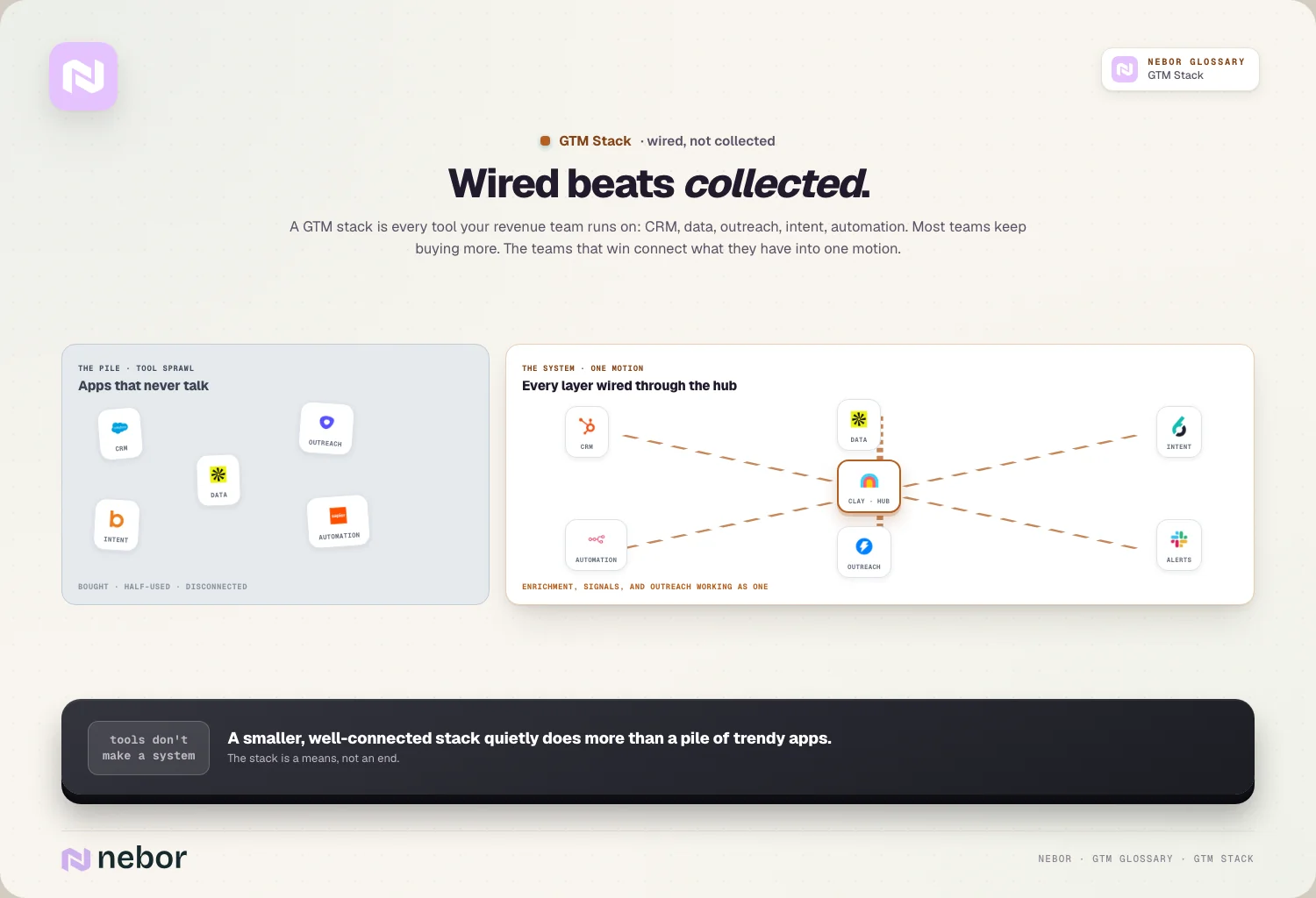
Picture it as your revenue team's toolkit. Just as a workshop has its tools, a go-to-market team has its stack, and the quality of the work depends far more on how those tools are used and connected than on how many of them there are.
What are the core layers that make up a working GTM stack today?
Most GTM stacks are built from a handful of layers, each doing a different job. Knowing them helps you see what your stack is really for and where the gaps are.
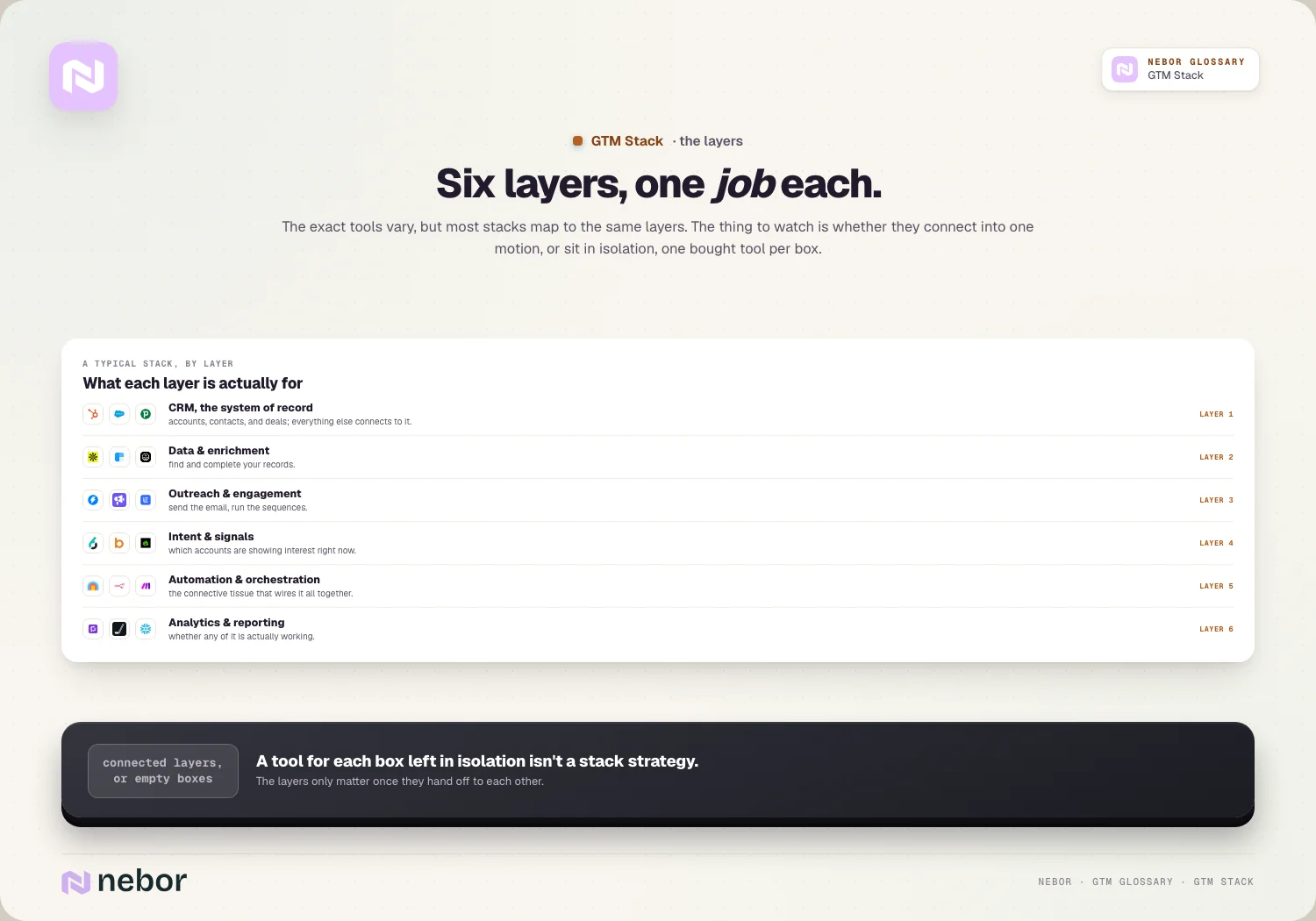
A typical GTM stack includes these layers.
The CRM, the system of record that holds your accounts, contacts, and deals, and that everything else connects to.
Data and enrichment, the tools that find and complete your records through data enrichment.
Outreach and engagement, the tools that send your email and handle your sequences, like a sales engagement platform.
Intent and signals, the sources that tell you which accounts are showing interest, feeding intent data into the motion.
Automation and orchestration, the connective tools that wire it all together through sales automation and workflow orchestration.
Analytics and reporting, which tell you whether any of it is working.
The exact tools vary, but most stacks map to these layers. The thing to watch is whether the layers connect into one motion, or whether you've just bought a tool for each box and left them isolated.
How is a GTM stack different from GTM engineering or a GTM system?
These three terms are close together, so let's separate them clearly. They describe the tools, the practice, and the result, in that order.
The GTM stack is the tools themselves, the raw materials. GTM engineering is the practice of wiring those tools into working automated motions, the skill of building with the stack.
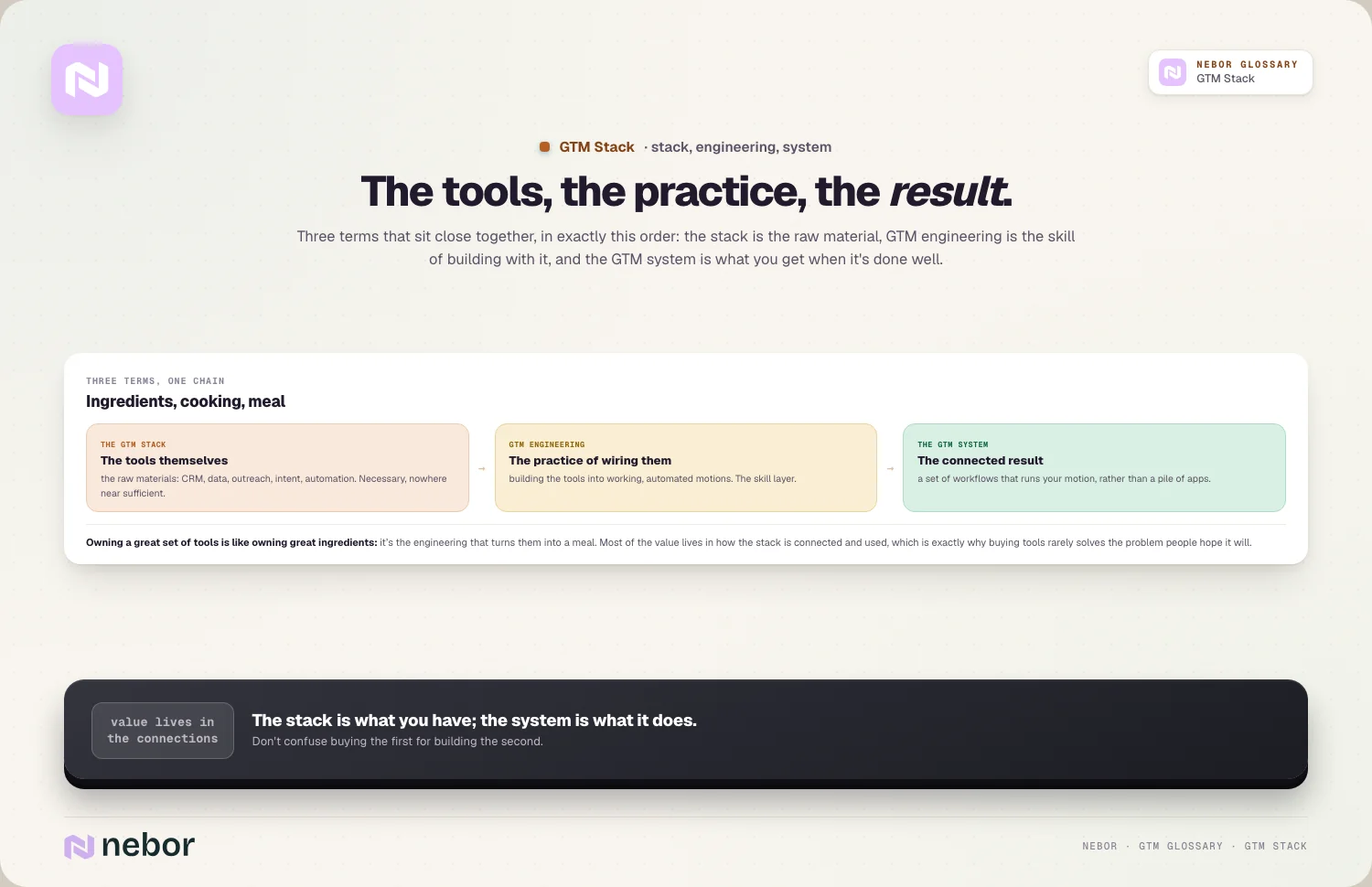
And the GTM system is what you get when it's done well, a connected set of workflows that carries your motion, rather than a pile of apps.
So the stack is necessary but nowhere near sufficient. Owning a great set of tools is like owning a great set of ingredients, because the engineering is what turns them into a meal.
Most of the value lives in how the stack is connected and used, and that's exactly why buying tools rarely solves the problem people hope it will.
Why does buying more tools so rarely fix your go-to-market motion?
There's a deep reflex in B2B to solve every go-to-market problem by buying a tool, and we've watched it disappoint over and over. Understanding why saves a lot of wasted budget.
The core issue is that tools don't make a system. A new outreach tool can't fix bad targeting, and an intent tool can't fix a motion that doesn't act on signals, because the tool is just capability left idle until someone builds a process around it.
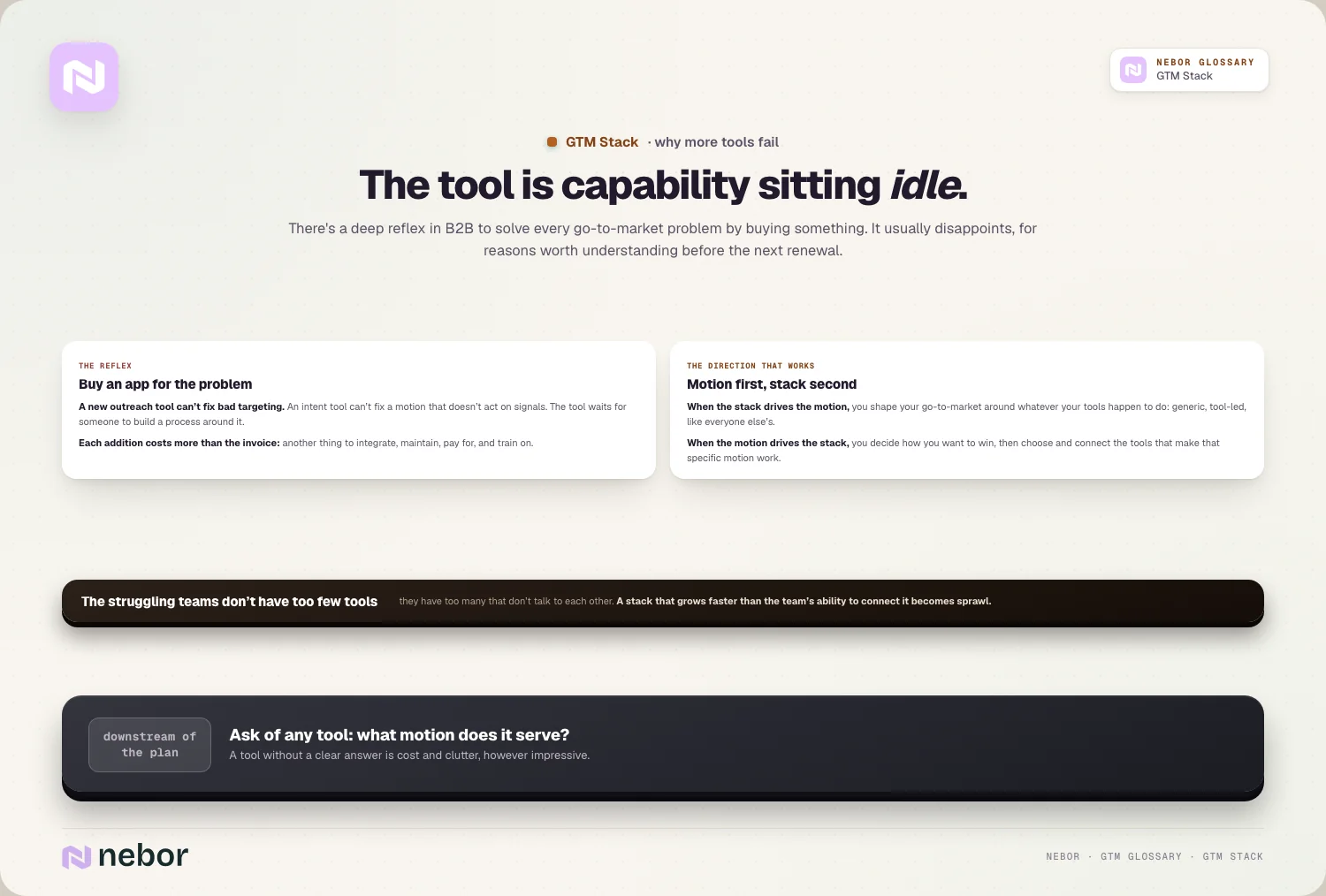
Adding tools without building the connecting workflows gives you more cost and complexity without any more results.
Worse, more tools often make things harder. Each new app is another thing to integrate, maintain, pay for, and train people on, and a stack that grows faster than the team's ability to connect it becomes sprawl.
The teams that struggle usually don't have too few tools, they have too many that don't talk to each other.
Why should your stack serve the motion instead of the other way around?
A healthy relationship between your stack and your strategy goes in one direction. The motion comes first, and the stack exists to serve it, but plenty of teams get this backward.
When the stack drives the motion, you end up shaping your go-to-market around whatever your tools happen to do, which is a recipe for a generic, tool-led motion that looks like everyone else's.
When the motion drives the stack, you decide how you want to win first, then choose and connect the tools that make that specific motion work. The second way is how you build something distinctive.
This is why the question to ask of any tool is what motion it serves, however impressive it looks on its own. A tool that doesn't support a clear part of your strategy is just cost and clutter, no matter how good it is in the abstract.
The stack should always be downstream of the plan.
What's the role of connective tissue like Clay in a modern stack?
One of the biggest shifts in GTM stacks has been the rise of connective tools that tie the layers together. They deserve attention, because they change how a stack gets built.
Tools like Clay are the middle of the stack, pulling data from many sources, applying logic, and pushing results into your other tools.
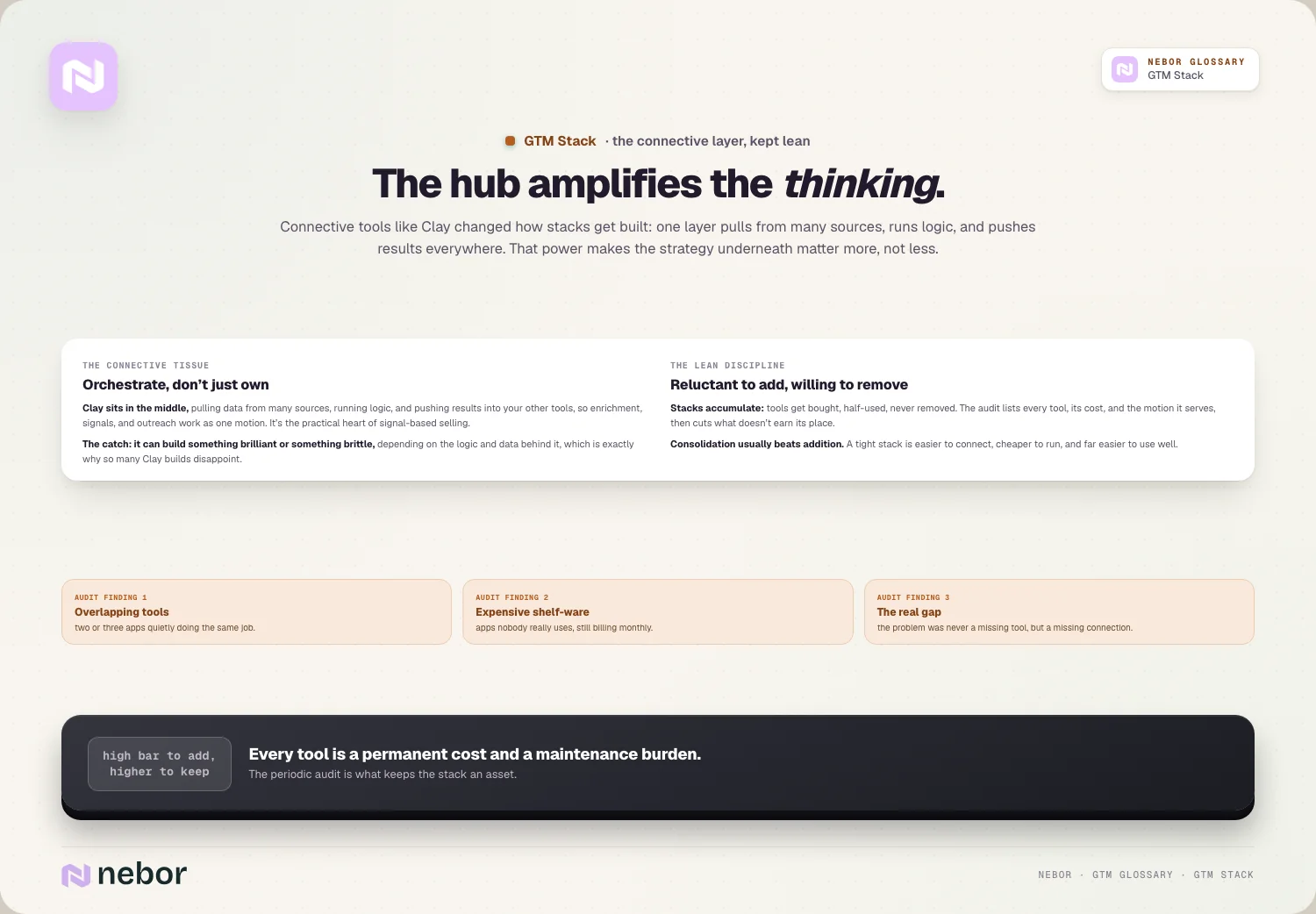
Instead of a dozen disconnected apps, a connective layer lets you orchestrate them, so your enrichment, signals, and outreach actually work as one motion. This is the practical heart of signal-based selling and most modern revenue engines.
The trade is that connective power makes the thinking matter even more. A tool like Clay can build something brilliant or something brittle, depending on the logic and data behind it, which is exactly why so many Clay builds disappoint.
The connective layer amplifies whatever you put into it, so the strategy underneath it has to be sound.
How do you keep your GTM stack from growing expensive and bloated?
GTM stacks tend to grow over time, accumulating tools that get bought, half-used, and never removed. Keeping the stack lean is an ongoing discipline, and in our experience it pays off in both cost and clarity.
The main practice is the periodic audit, where you list every tool, what it costs, and what motion it truly serves, then cut the ones that no longer justify themselves.
The audit almost always turns up overlapping tools doing similar jobs, expensive apps nobody uses, and gaps where the real problem lives. Consolidation, doing more with fewer, better-connected tools, usually beats adding another app.
The mindset that keeps a stack healthy is reluctance to add and willingness to remove. Every tool you add is a permanent cost and a maintenance burden, so the bar for adding one should be high, and the willingness to cut a tool that isn't pulling its weight should be higher.
A tight stack is easier to connect, cheaper to maintain, and far easier to use well.
Why does owning your GTM stack matter more than people realize?
There's a strategic question hidden in how you build your stack, which is whether you actually own and control it. The answer affects how durable your go-to-market is.
When you build your motion inside your own stack, with the tools in your own accounts and the workflows under your control, the capability is yours to keep.
When you outsource your motion to an agency that keeps it in their stack, or lean entirely on a black-box tool, you don't really own the engine, and it can disappear the moment the relationship ends.
That's the difference between having an engine and borrowing one.
This is why ownership matters even at the tooling level. The value of a well-built GTM stack compounds over time as you refine it, and that only pays off if it's yours. A stack you own and understand becomes a lasting asset, while one you rent or can't see into is a dependency you're stuck with.
How do you choose new tools for your GTM stack without overbuying?
Choosing tools well is mostly about discipline, since the temptation is always to buy more than you need. A few simple questions keep the decisions sound.
Before adding any tool, ask what specific part of your motion it serves, whether something you already own could do the job, and how it will connect to the rest of your stack. A tool that can't answer those clearly is usually a want rather than a need.
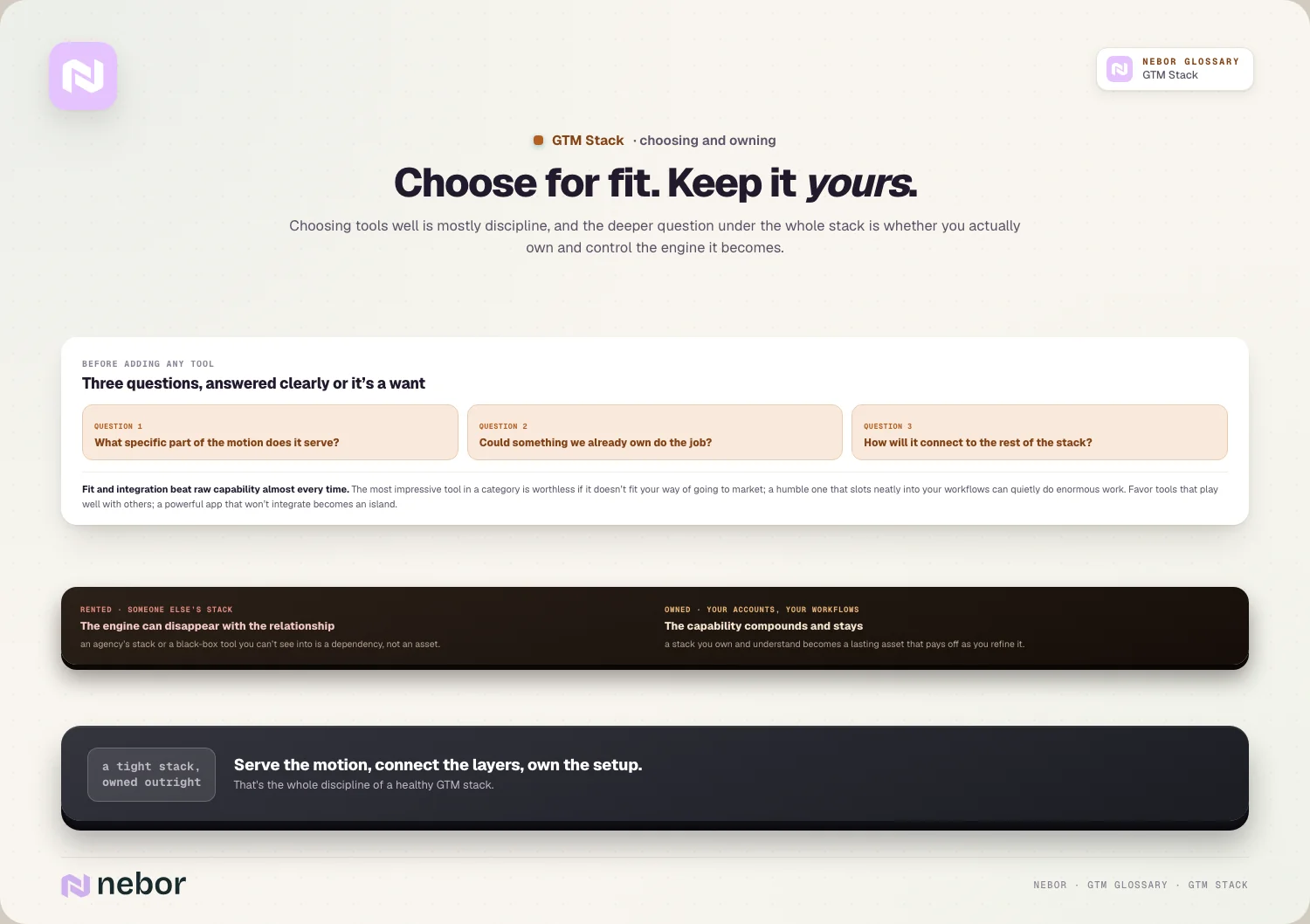
It also helps to favor tools that play well with others, since a powerful app that won't integrate becomes an island that drags on the whole stack.
The deeper principle is to choose for the motion and the connections before the feature list.
The most impressive tool in a category is worthless if it doesn't fit your specific way of going to market, while a humble one that slots neatly into your workflows can end up doing enormous work. Fit and integration beat raw capability almost every time.
What are the common GTM stack mistakes that keep repeating everywhere?
Most stack problems come from a handful of recurring mistakes, and they're all avoidable. Naming them helps you keep your stack healthy.
The biggest is tool sprawl, buying app after app without connecting them, until you have a dozen tools and no system. Close behind is letting the stack drive the strategy, shaping your motion around your tools instead of the reverse.
Then there's the integration gap, where tools exist but never talk to each other, so data and momentum leak at every seam, and the maintenance gap, where nobody owns keeping the stack clean and connected.
There's also the false economy of chasing the newest tool while ignoring the unglamorous work of connecting what you already have.
Every one of these mistakes shrinks when you keep the stack lean, choose for the motion, connect the tools into real workflows, and treat the connecting work as the job instead of the buying.
How does your GTM stack change as your company grows and matures?
A GTM stack isn't fixed, because what you need at one stage is overkill or insufficient at another. The right stack evolves with the company.
Early on, a lean stack does the job, often just a CRM, a way to send email, and a source of data, with the founder or a small team handling it by hand.
As you grow and your motion gets more complex, you add layers, like dedicated enrichment, intent, and the automation to tie it together, because the manual approach stops scaling.
Later still, the focus shifts to consolidation and connection, making the now-larger stack work as one.
The mistake is buying for a stage you're not at yet. A tiny team rarely needs an enterprise-grade stack, and bolting on heavy tools early just adds cost and complexity before there's a motion to justify them. The stack should grow with the need instead of ahead of it.
Does a bigger stack really mean a more sophisticated revenue team?
It's tempting to read a big, expensive stack as a sign of a sophisticated go-to-market team, but the opposite is often true. Sophistication shows up in how connected the stack is, and the length of the tool list tells you nothing.
The most impressive go-to-market teams we meet frequently keep leaner stacks than you'd expect, because they've consolidated around a few tools they've connected deeply.
A sprawling stack, by contrast, often signals a team that bought its way around problems rather than solving them, accumulating tools without ever building a system. More logos in the stack diagram often reads as a warning sign once you know what to look for.
So the real measure isn't how many tools you own, it's how well they work together. A small stack that works as one connected motion is far more sophisticated than a huge one held together with hope and manual exports.
Why your GTM stack is only ever as good as how it's connected
A GTM stack, on its own, is just a set of tools, and tools are only ever potential. The value comes from connecting them into a motion that wins customers, which is work no purchase can do for you.
The teams that win keep their stack tight and well-connected, treat each tool as a means to a clear end, and put their energy into the workflows that tie everything together instead of the next shiny app. They understand that a smaller, integrated stack beats a sprawling, disconnected one almost every time.
The mindset that works is to stop asking what tool to buy next and start asking how to make the tools you have work as one.
When you choose for the motion, connect what you own, own what you build, and resist the urge to add, your stack becomes a durable advantage instead of an expensive collection of apps that never quite add up.
Deel dit bericht
Workflows
Automation
Data
Begrippenlijst
Gerelateerde begrippen
De basis GTM-concepten begrijpen



Klaar om je pipeline te bouwen