
In this post:
Here's a number that should bother every sales leader. Most reps spend less than a third of their day actually selling, and the rest disappears into admin, data entry, and follow-up tracking.
You hired salespeople to sell, and they're spending most of their time on tasks a machine could do. That's the gap sales automation exists to close.
Sales automation is the use of software to handle the repetitive, manual tasks in a sales process, like data entry, follow-ups, prospecting, and enrichment, so reps can spend their time on the work that moves deals.
Replacing salespeople was never the point of any of this. The idea is to take the busywork off their plate, so the human effort goes into conversations and relationships rather than updating fields in a CRM.
TL;DR
Sales automation uses software to handle the repetitive parts of selling, from data entry and CRM updates to follow-ups, sequencing, prospecting, and enrichment, freeing reps to focus on real selling.
Reps waste most of their time on admin, spending only around 28 to 30% of their day selling, so automating the rest recovers enormous capacity.
It covers a wide range, from simple automations like logging calls and scheduling follow-ups to full workflows that prospect, enrich, and personalize outreach at scale.
One warning belongs up front, because automating a broken process just produces bad results faster, so the strategy underneath matters as much as the tooling.
So what is sales automation, exactly, and what does it take over?
Sales automation is using technology to do the repetitive tasks in selling that don't need a human. Anything rote and rules-based in your sales process is a candidate.
It spans a huge range of work. At the simple end, it's automatic call logging, follow-up reminders, and CRM updates, while at the complex end, it's entire workflows that find, enrich, and contact prospects.
The unifying idea is removing manual friction. Every step a machine handles is one a rep doesn't have to, which means less time on admin and far more on the conversations that close business.
The boundary deserves stating plainly, and we tell clients this on day one. Sales automation handles tasks while people keep the relationships, so the mechanical work moves to software and the human keeps the selling, the judgment, and the conversations.
So the goal is to multiply your team's effort, where limited human time gets spent where it matters most. The machine does the repetitive parts, and people do the parts that need a person.
Why do your reps lose so much of their day without automation?
To see why sales automation matters, look at how a rep's day breaks down in practice. The picture is worse than most leaders assume.
Reps spend only around 28 to 30% of their time selling, with the other 70% lost to admin, data entry, internal meetings, and chasing follow-ups.
A big chunk is just data work. Around 68% of sales professionals cite note-taking and data input as their most time-consuming tasks, which is exactly the kind of work software does well.
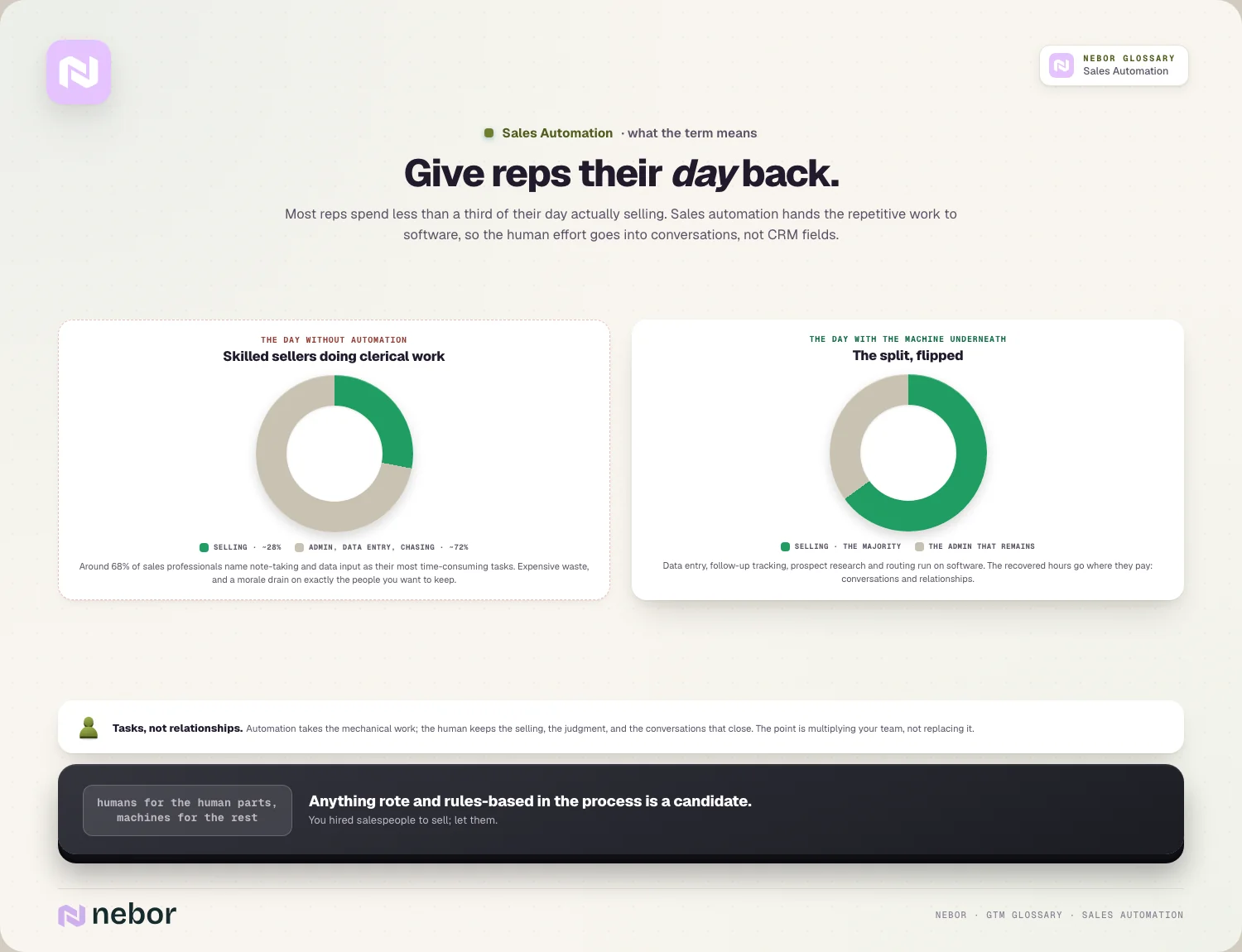
That waste is expensive in the most literal way. You're paying skilled salespeople to do clerical work, while the selling they were hired for gets squeezed into a fraction of the day.
The cost compounds across a whole team. Multiply that lost time across every rep, and a huge amount of your most expensive capacity is going to tasks a machine could handle.
There's a morale cost on top of the hours. Skilled salespeople rarely enjoy data entry, so burying them in admin tends to burn out exactly the people you most want to keep, which makes the waste even more expensive than the hours alone suggest.
What tasks can you hand to automation without losing anything?
Sales automation covers a lot of ground, and the main categories map it well, because each one removes a specific kind of manual work.
Data and CRM work is the obvious starting point, because automatic call logging, data syncing, and field updates remove the note-taking burden, and CRM entry automation alone can cut admin time by around 17%.
Prospecting and enrichment come next, because finding contacts and filling in their details through data enrichment can happen automatically, instead of a rep hand-researching every lead.
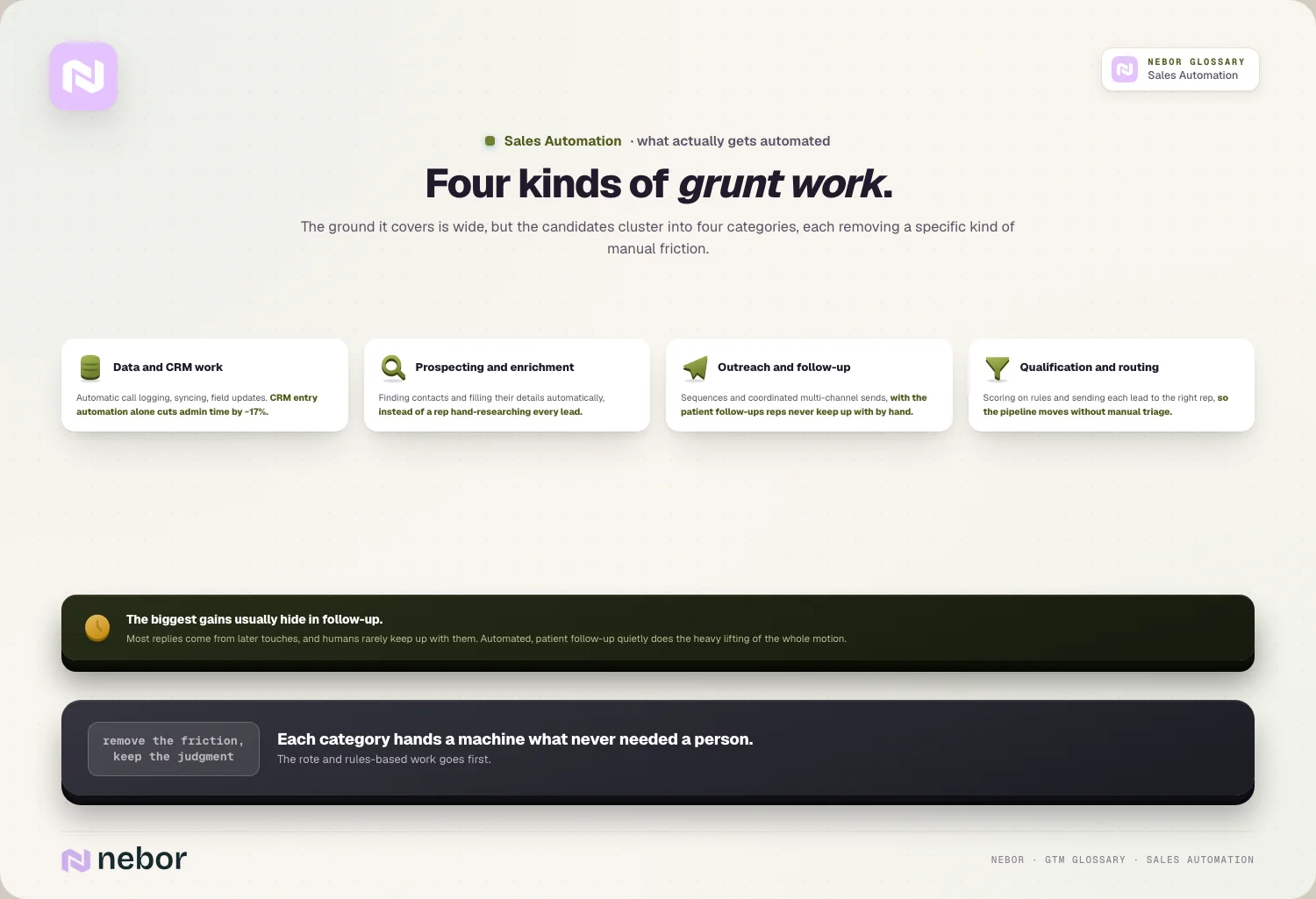
Outreach is the layer everyone pictures, because sending and following up across channels can be automated through structured email sequences and a coordinated multi-channel motion that reaches each prospect where they engage.
That follow-up piece matters most, because most replies come from later touches and reps rarely keep up with them by hand. Automated, patient follow-up is often where the biggest gains hide.
And qualification and routing round out the set, because scoring leads and sending them to the right rep can follow rules, which is where lead scoring automation keeps the pipeline moving without manual triage.
How much does sales automation help once it's genuinely live?
The case for sales automation rests on results, and the numbers make it easily. The payoff shows up in both time and revenue.
The time savings are concrete and measured. Companies using sales automation report around two hours and fifteen minutes saved daily per rep, which is a huge slice of capacity recovered.
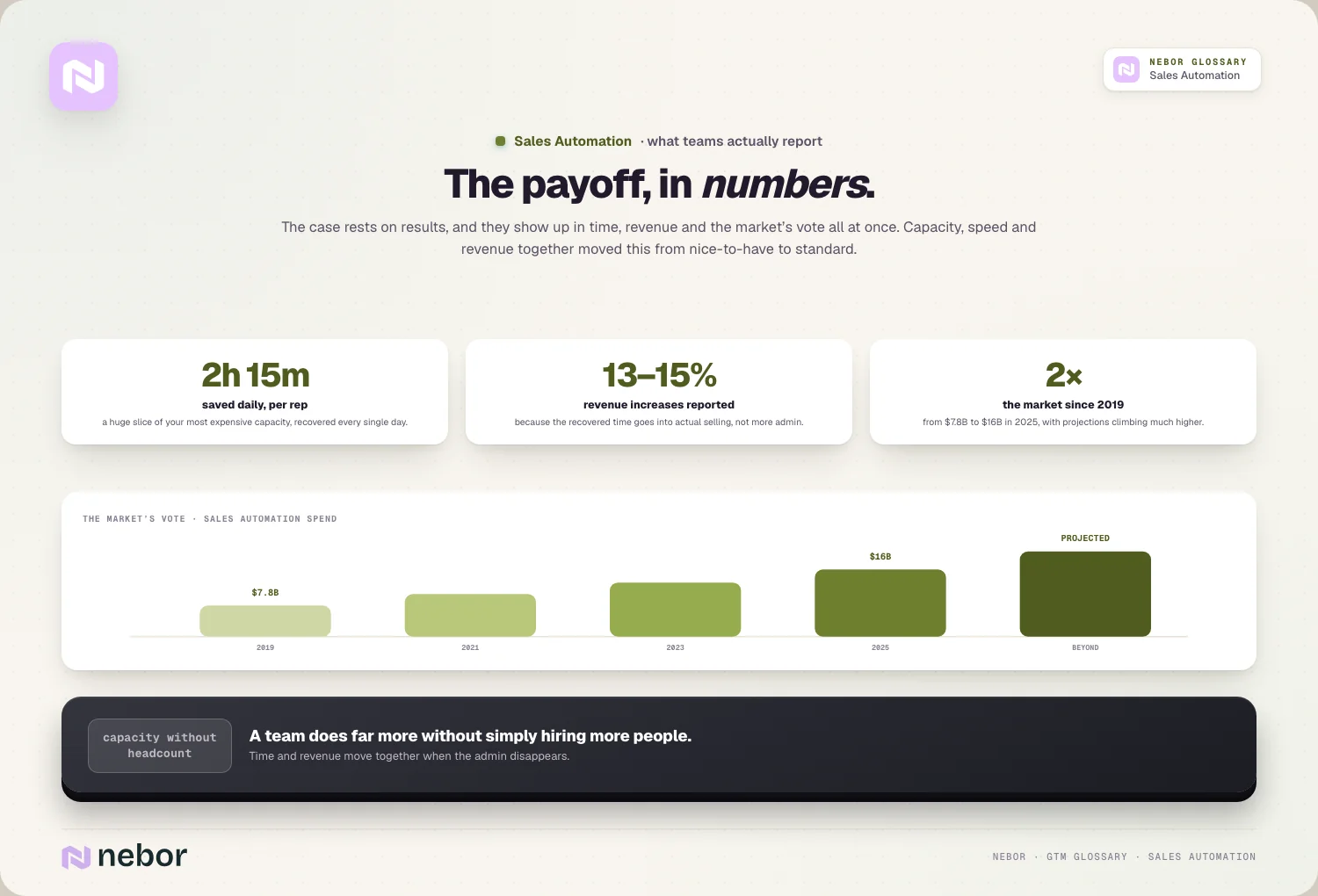
It moves revenue as well, with teams implementing sales automation reporting around 13 to 15% revenue increases, because reps spend their recovered time on real selling.
The market has grown to reflect all that demand. Sales automation has expanded from around $7.8 billion in 2019 to $16 billion in 2025, with projections climbing much higher.
So the benefit goes deeper than convenience, reaching capacity, speed, and revenue all at once, and that's the reason automation has moved from a nice-to-have to a standard part of how serious teams sell today.
How is sales automation different from the workflows built on top of it?
People sometimes blur automation with the workflows it powers, but they're related layers doing different jobs, and separating them makes the stack easier to reason about.
A single automation does one task, like logging a call or sending a follow-up. It's a discrete action that used to be manual and now happens on its own.
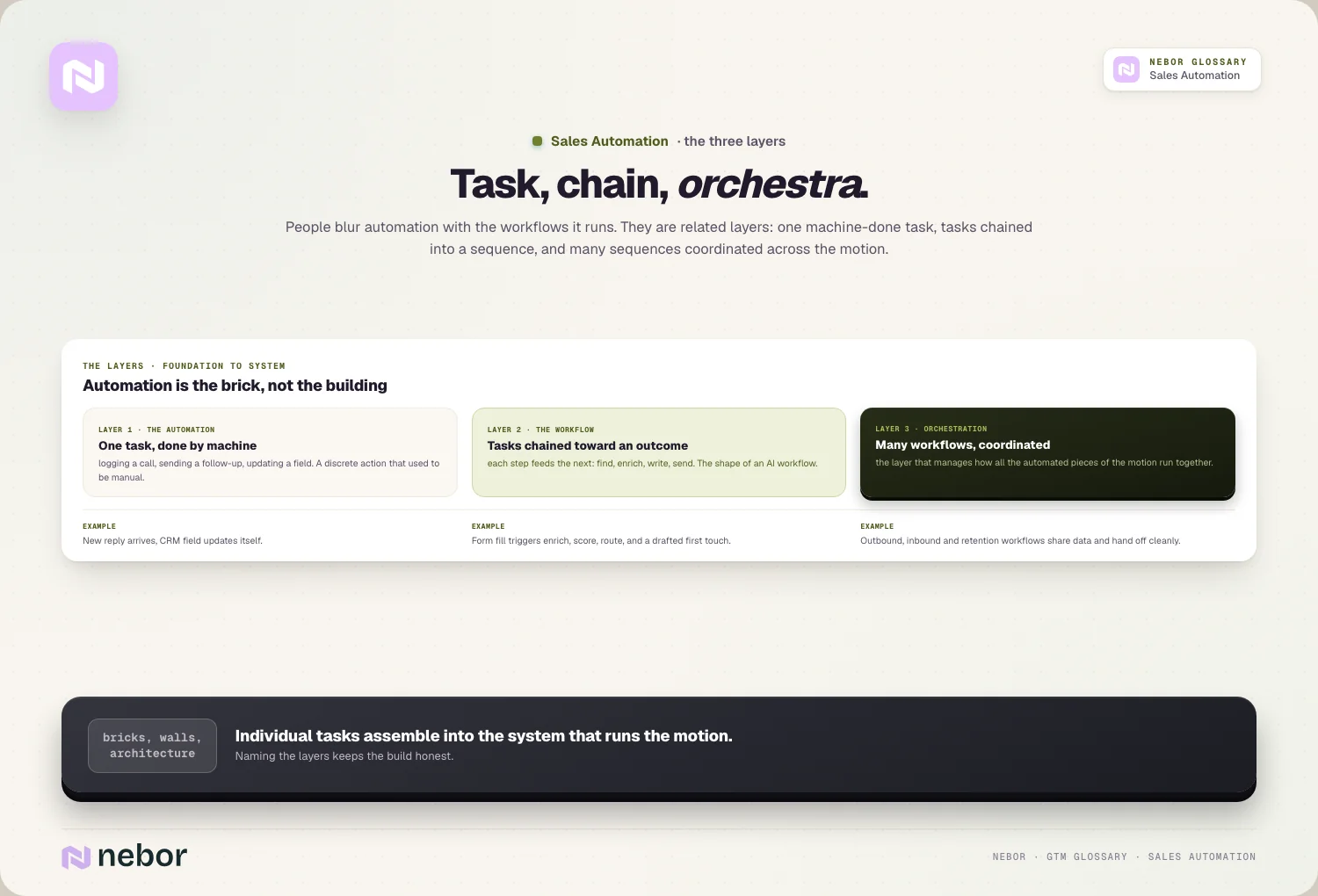
A workflow chains many of those together. Connecting automated steps into a sequence is the idea behind an AI workflow, where each step feeds the next toward a larger outcome.
Coordinating many workflows across your motion is bigger still. That's workflow orchestration, the layer that manages how all the automated pieces work together.
So sales automation is the foundation, individual tasks done by machine, and workflows and orchestration are how you assemble those tasks into a system that carries your whole motion.
Why does automation scale your process instead of fixing it for you?
This is the warning that separates automation that helps from automation that hurts. Automation scales whatever process you give it, and fixing that process was never its job.
If your targeting is sloppy, automating outreach just sends bad messages to the wrong people faster. The machine is indifferent, so it executes a flawed process as eagerly as a good one.
This is a common reason automation projects disappoint. A frequent cause behind why Clay and similar implementations fail is teams automating a process they never got right manually.
So strategy has to come before the tooling. You define a sound motion, prove it works on a small scale, and only then automate it, which is when automation multiplies a good thing instead of a bad one.
The rule of thumb we hold clients to is simple. Fix the process by hand first, then let automation scale it, because automating a mess only gives you a bigger, faster mess.
How does AI change what sales automation is able to take on?
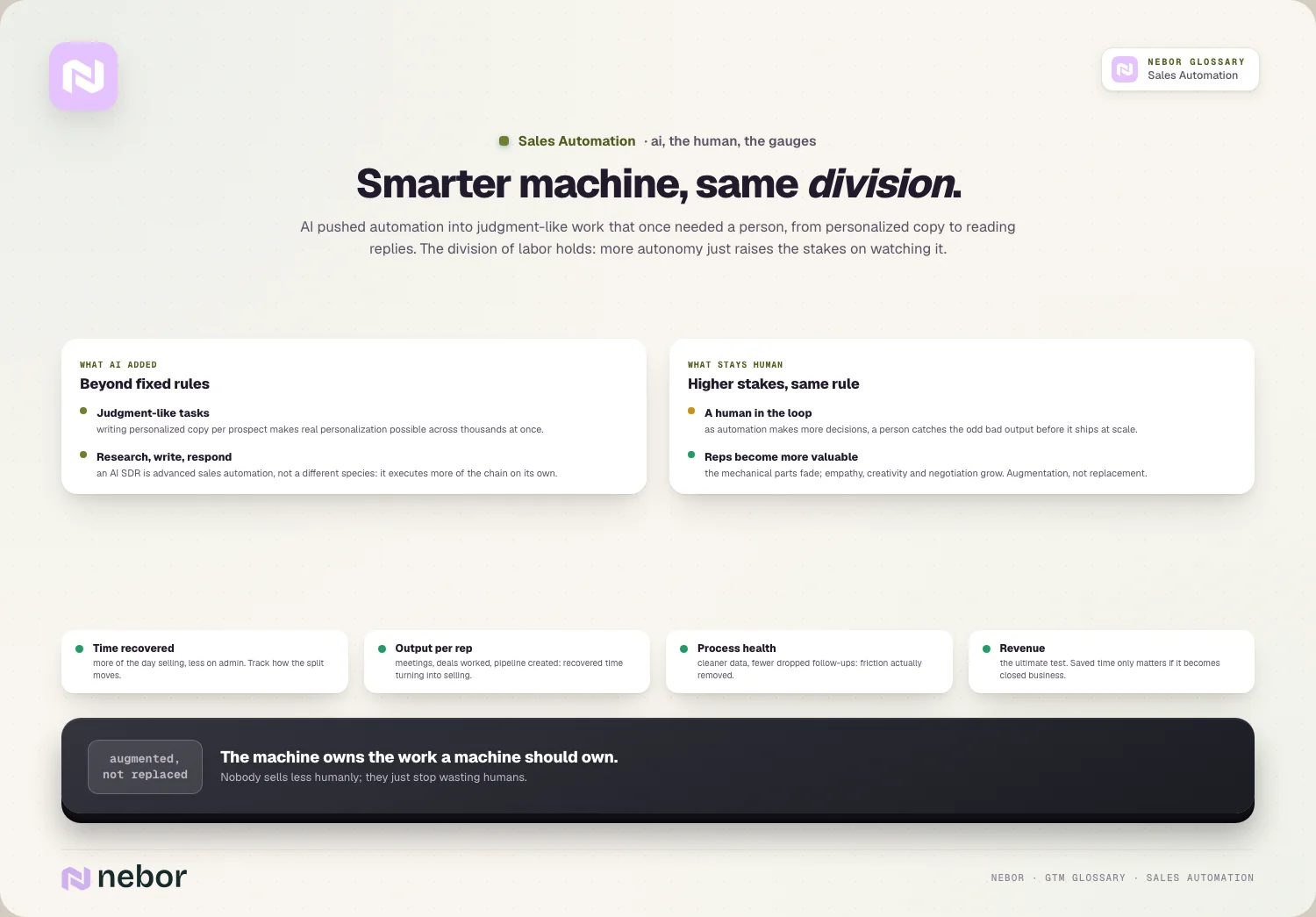
Sales automation used to mean rigid, rules-based tasks. AI has expanded what's possible, pushing automation into work that once needed a person.
Older automation could only follow fixed rules. It could send a follow-up on a schedule, but it couldn't write a relevant message or judge a nuanced situation.
AI has changed where that boundary falls. It can now handle judgment-like tasks, such as writing personalized copy, which makes hyper-personalization possible across thousands of prospects at once.
This is what powers the rise of AI sales roles. An AI SDR amounts to advanced sales automation that can research, write, and respond, going well past executing fixed steps.
But more autonomy raises the stakes with it. As automation makes more decisions, a human in the loop becomes important to catch the errors a machine acting alone would send out at scale.
How do you build sales automation that holds up past the first month?
Building good sales automation is a design exercise more than a shopping trip, and in our experience a sensible build order keeps it from becoming a tangle of disconnected tools.
Start by mapping where the manual work lives. Look at where your reps lose time, and target the repetitive, rules-based tasks first, because those give the clearest return.
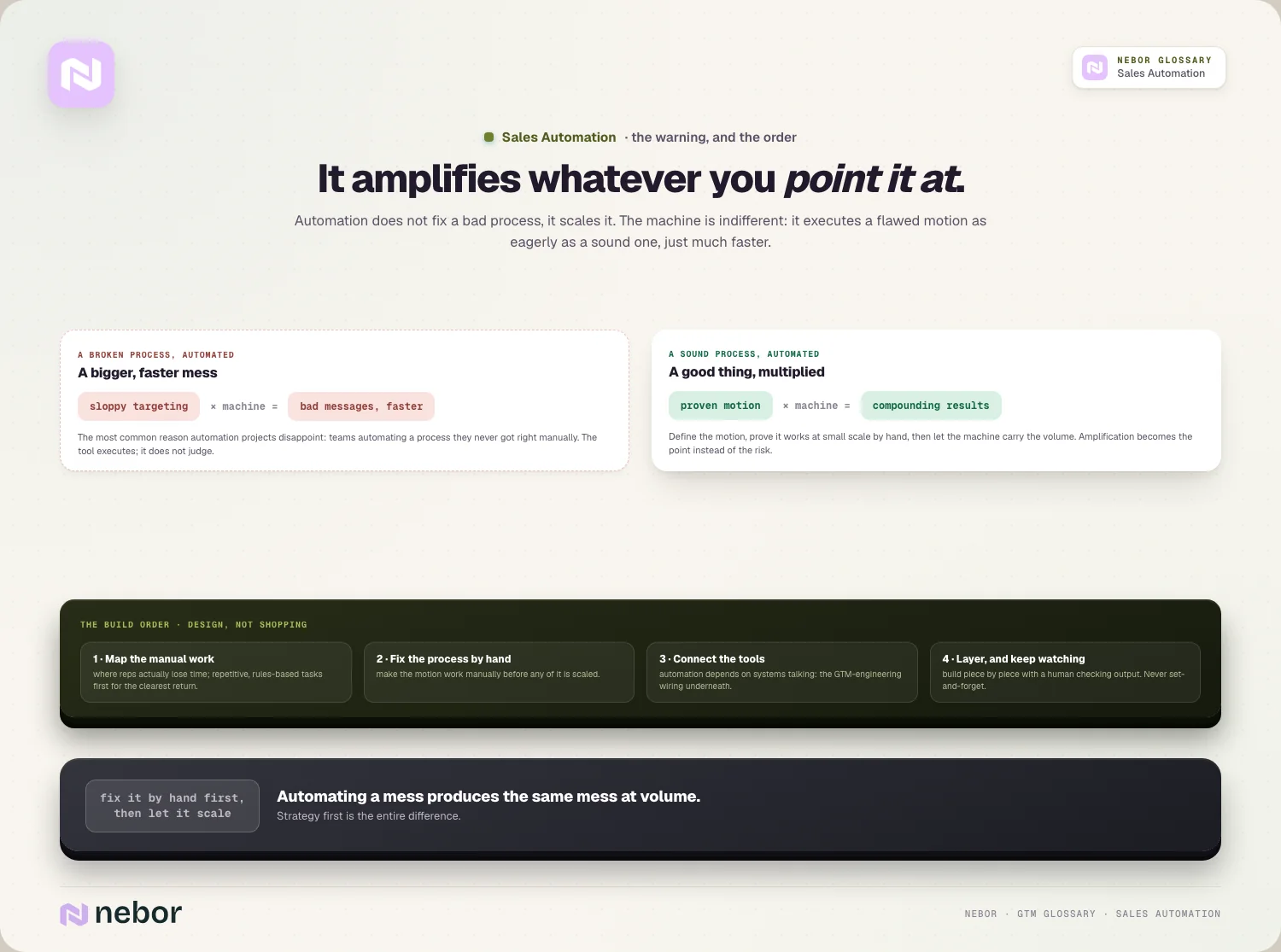
Then fix the process before automating it. Make sure the motion works manually, because automating a broken step just scales the problem, as covered above.
Next, get your tools talking to each other. Automation depends on connected systems, which is the craft of GTM engineering, wiring your stack so data and actions flow between tools.
Finally, automate in layers and keep watching. You build piece by piece, the same way you'd automate sales prospecting step by step, and you keep a human checking the output.
Does sales automation replace salespeople, or change what they do?
This is the fear that comes up whenever automation enters sales, so it deserves a straight answer. The short version is no, but it changes the job.
Automation absorbs the tasks and leaves the relationships alone. It handles the data entry, the scheduling, and the routine follow-ups, while the human keeps the conversations, the judgment, and the trust-building that close deals.
In practice it makes reps more valuable than before. When a rep spends their day selling instead of updating fields, each rep produces more, so the human time becomes higher-value instead of redundant.
It does shift what good reps focus on. The mechanical parts of the job fade, and the parts that need empathy, creativity, and negotiation grow, which raises the bar on the human skills that matter.
So the realistic picture is augmentation rather than replacement. Sales automation removes the work that drained your reps and leaves them free for the work that only people can do well.
How do you measure whether your sales automation is really working?
Automation is easy to adopt and easy to misjudge, so you need a few signals to know it's paying off. The numbers should show up in time and outcomes.
Time recovered is the first signal to watch, because if reps are spending more of their day selling and less on admin, the automation is doing its core job, so track how that split changes.
Output per rep comes second, because more meetings booked, more deals worked, or more pipeline created per rep tells you the recovered time is turning into real selling.
Process health tells its own story, because cleaner data and fewer dropped follow-ups show the automation is removing friction, which is part of keeping good CRM hygiene without manual effort.
And revenue settles the question, because the ultimate test is whether automation lifts results, and saving time only matters if that time turns into more closed business.
Does sales automation serve inbound and outbound motions equally?
Sales automation is often associated with outbound prospecting, but it serves inbound just as much. The repetitive work exists on both sides.
On outbound, automation handles the prospecting grind, finding contacts, enriching them, and sending sequences, so reps don't research and send by hand.
On inbound, it handles speed and routing. When a lead arrives, automation can enrich it, score it, and route it instantly, so the right rep follows up while the interest is still warm.
It connects the two motions as well. The same automated plumbing can act on a website visit or a form fill the moment it happens, which is what makes warm, signal-driven outreach possible.
So treat automation as a motion-wide tool. Whether a lead came from a cold list or raised their hand, automation removes the manual delay between intent and action.
What are the common mistakes teams make with sales automation?
Sales automation goes wrong in a few predictable ways, and we keep seeing the same short list in the stacks we untangle. Avoiding them is most of the battle.
Automating a broken process is the one covered above, and it stays at the top because speeding up a flawed motion just produces bad results faster, so the process has to be sound first.
Over-automating the human parts comes right after, because trying to fully automate relationship-building and nuanced conversations backfires, and those are exactly the parts that need a person.
Buying tools without strategy is the tempting shortcut, because a pile of automation software with no clear process behind it adds complexity instead of removing it.
And set-and-forget finishes the list, because automation needs monitoring, and a broken or outdated automation can send bad data or bad messages at scale before anyone notices.
Why giving your reps their selling time back pays for everything else
Sales automation matters because it fixes an absurd situation, which is paying skilled salespeople to spend most of their day on clerical work. It gives them back the time to sell.
The deeper value is the capacity it creates. By handling the repetitive tasks, automation lets a team do far more without simply hiring more people, and that leverage is what moves both time and revenue.
The honest caution is that automation scales your process without replacing your thinking. A sound motion scaled by automation compounds, while a broken one just fails faster and louder.
So if your reps are buried in admin and your pipeline depends on manual hustle, the answer usually isn't working harder. It's automating the repetitive work so people can focus on the parts only people can do.
That's exactly what sales automation is built for, and it's a core layer of any modern go-to-market system. The teams that adopt it well keep selling just as humanly as before, and simply stop wasting their humans on work a machine should own.
Share this post
Automation
Workflows
Glossary
Related glossary items
Understanding the core GTM concepts


Ready to build your pipeline











