

In this post:
The best cold email in the world fails if it arrives at the wrong time. A company that just renewed a competitor's contract won't switch no matter how good your pitch is, and one actively shopping will reply to a far weaker one.
That gap is the whole idea behind signal-based selling. Instead of choosing who to contact and hoping the timing works out, you let the timing choose for you by reaching people exactly when they show signs of buying.
Signal-based selling is a sales approach that uses real-time buying signals and trigger events, like funding rounds, leadership changes, or website visits, to decide when to reach out as well as who to reach. It shifts outbound from static lists to live behavior.
The reframe swaps the question you lead with. Traditional outbound asks which companies fit your profile, while signal-based selling asks which of them are showing readiness right now, which is often the difference between a reply and silence.
TL;DR
Signal-based selling is the practice of timing outreach to real buying signals and trigger events, reaching prospects when their behavior shows they're entering a buying window.
Timing drives response more than anything else, because the same message lands very differently depending on whether the prospect is in-market, and signals tell you when that is.
The approach trades raw volume for precision. Instead of contacting everyone who fits a firmographic profile, you contact the accounts actively showing intent, which lifts response rates dramatically.
The discipline it demands is acting fast and relevantly, because a signal you respond to slowly, or with a generic message, throws away the timing advantage that makes the whole approach work.
What is signal-based selling, and what counts as a signal worth acting on?
Signal-based selling is a methodology where buying signals determine your outreach. Rather than working a static list in order, you reach out to accounts based on what they're doing right now.
A signal is any observable behavior that suggests an account may be entering a buying window. It could be raising funding, hiring for a relevant role, switching tools, or visiting your pricing page.
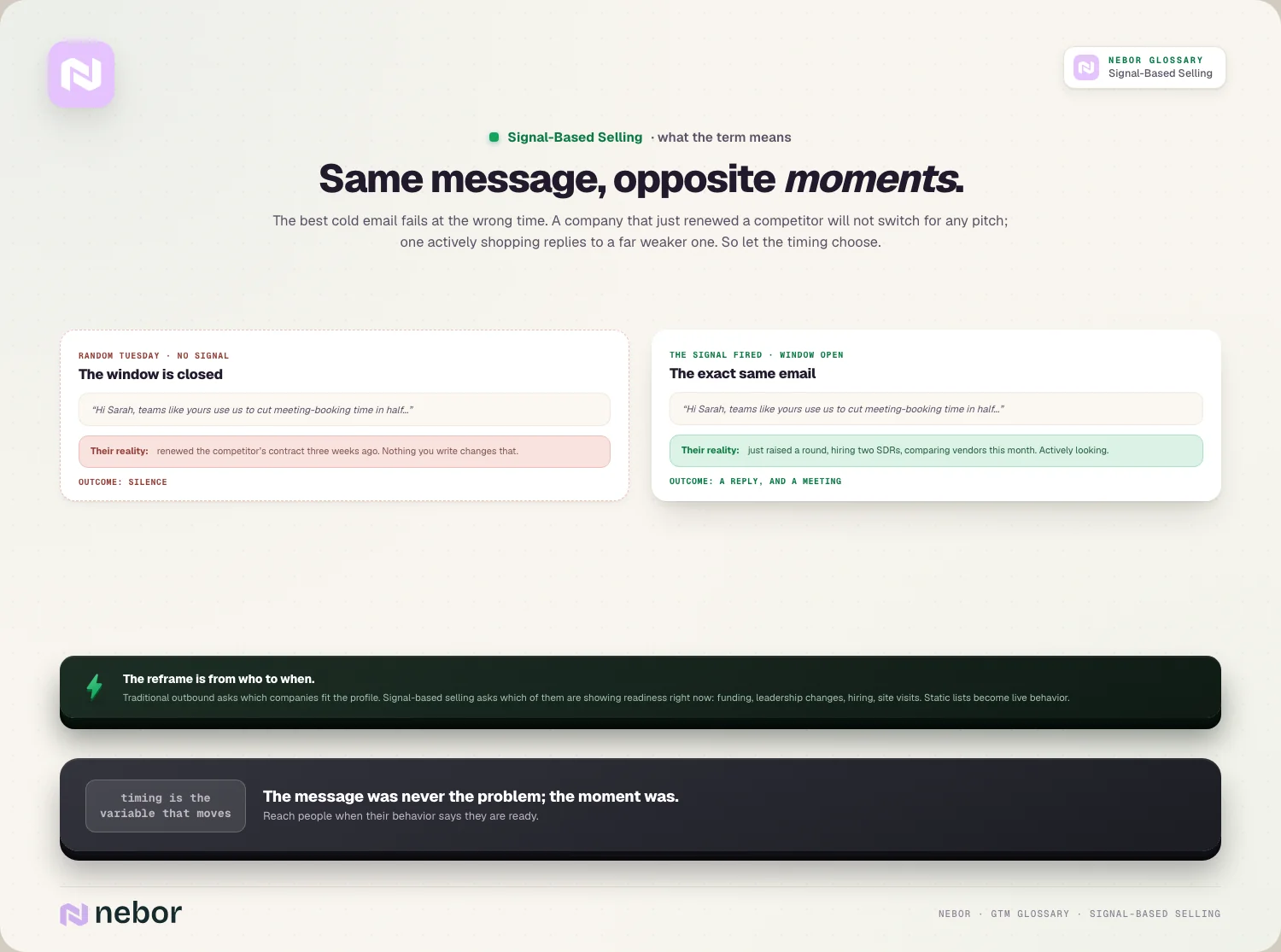
The core move is timing your outreach to those signals. When an account shows one, you reach out while the window is open, instead of contacting them at a random moment with no context.
This makes outbound reactive in the best sense. You're responding to real behavior instead of guessing, so your message lands when the prospect is most likely to care.
So signal-based selling is really about relevance through timing. The signal tells you both that an account might be ready and what to say, and that combination separates it from cold outreach that lands with no context and no reason behind its timing.
How is signal-based selling different from traditional outbound?
The cleanest way to understand the approach is to set it against old-school outbound. They target the same accounts but choose differently.
Traditional cold outbound selects accounts by what they are. You build a list from firmographic criteria like industry, size, and title, then contact everyone who matches, regardless of timing.
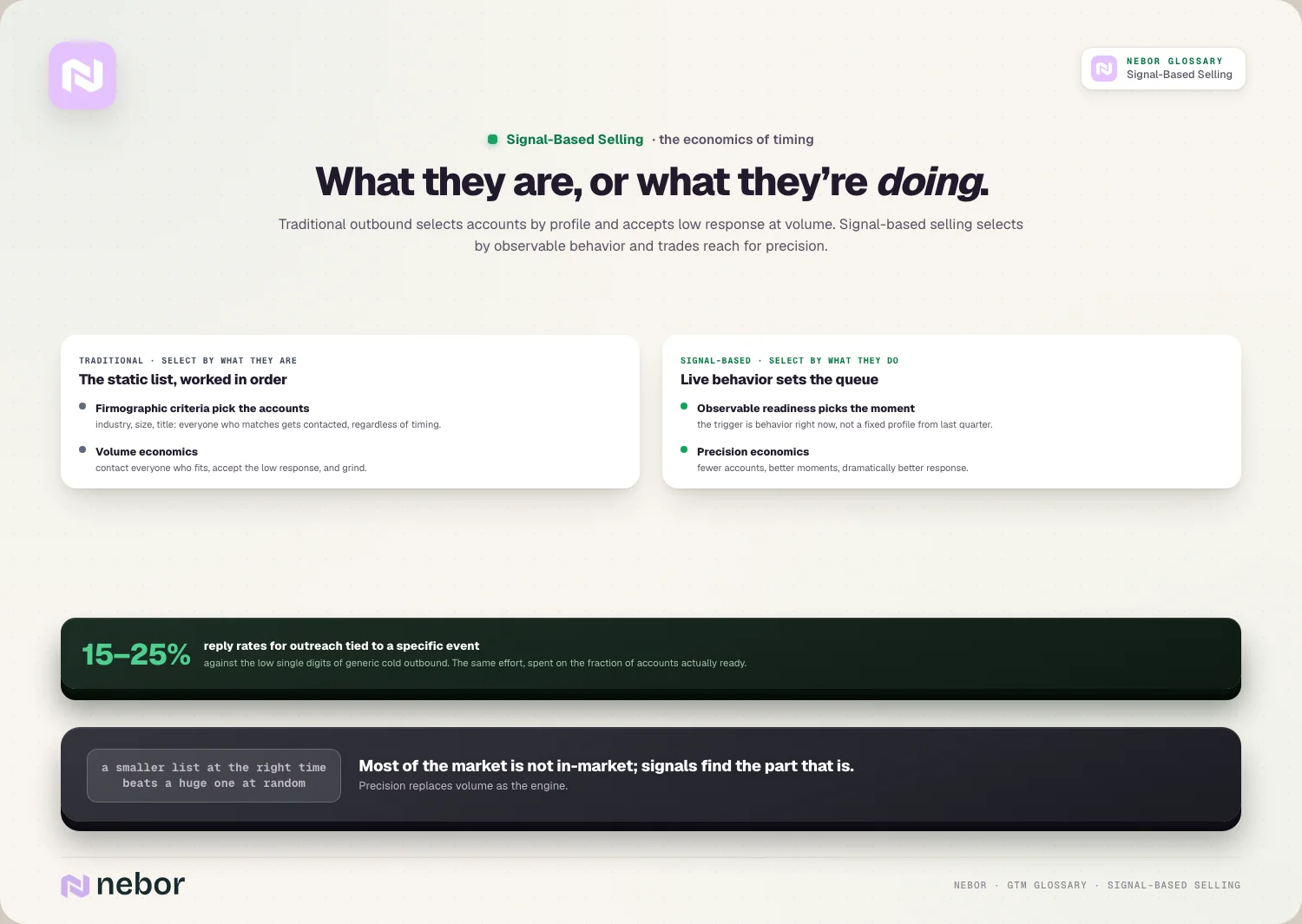
Signal-based selling selects by what accounts are doing. You contact the ones showing observable readiness, so the trigger is behavior in the moment instead of a fixed profile.
That changes the whole economics of outreach. Traditional outbound relies on volume, contacting everyone who fits and accepting low response, while signal-based selling relies on precision, contacting fewer accounts at better moments.
The payoff shows up plainly in the numbers. Signal-timed outreach can produce a meaningful multiple of the response rate of generic cold outreach, because it reaches people when they're genuinely receptive.
How is signal-based selling different from the signal stack behind it?
These terms get used together so often that they blur, so it helps to separate them. One is the system and the other is the practice.
A sales signal stack is the set of signal sources you monitor, the layered system that gathers intent data from your website, review sites, hiring data, and more.
Signal-based selling is what you do with that stack. It's the selling approach of acting on the signals the stack surfaces, reaching out at the right time with the right message.
So the stack is the infrastructure and signal-based selling is the motion. You build the stack to detect signals, and you practice signal-based selling to convert them into conversations.
The two are close to useless apart. A stack that surfaces signals nobody acts on is wasted, and signal-based selling with no stack to feed it has nothing to act on, so teams build them together instead of one without the other.
What are the highest-value signals to sell on when you're choosing?
Not all signals are equal, and in our experience a few categories stand out as strong buying windows worth prioritizing.
Funding rounds are the classic example of one. New funding means new budget, so a recently funded company is often ready to spend on tools that help it grow.
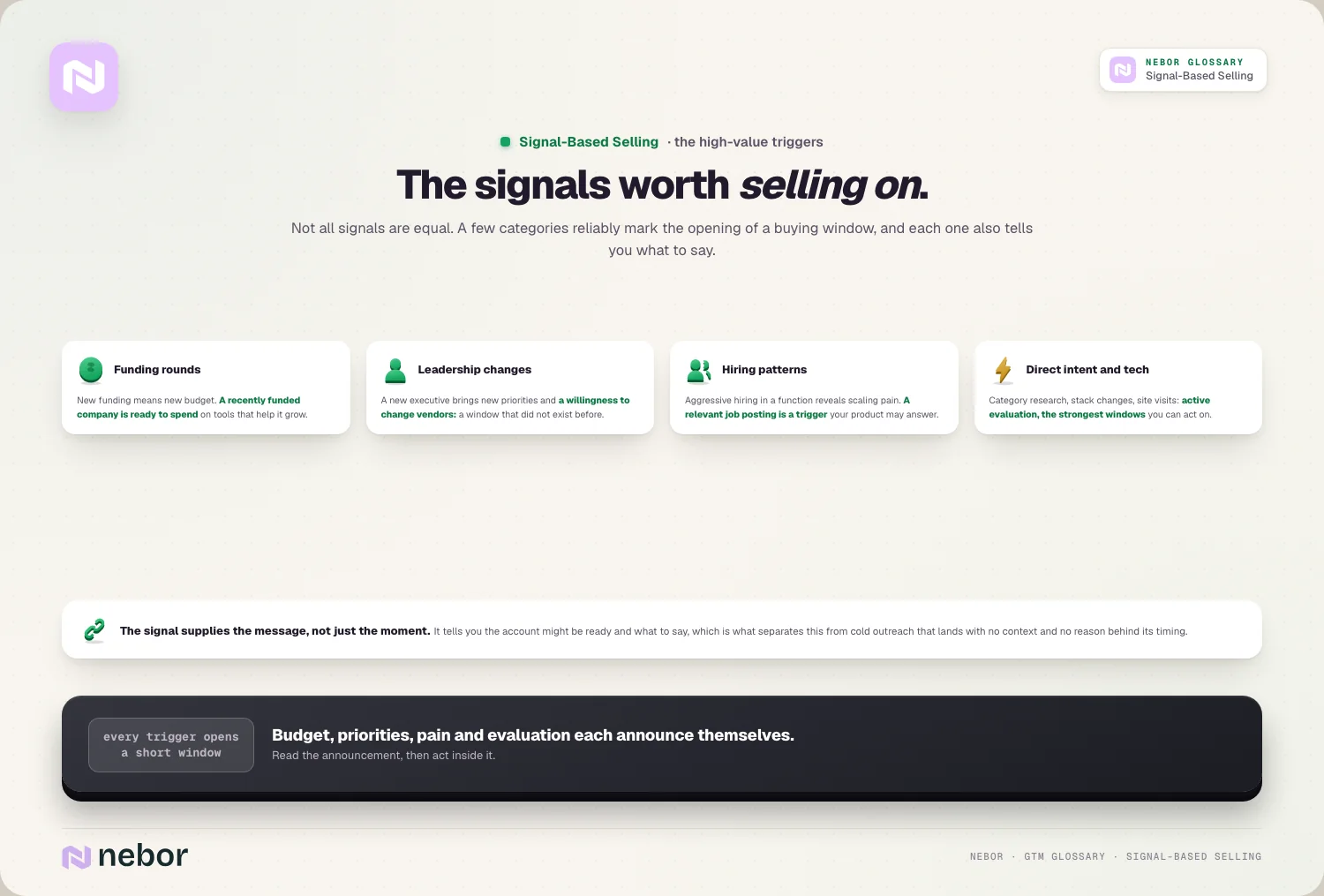
Leadership changes open windows just as reliably. A new executive often brings new priorities and a willingness to change vendors, which opens a window that didn't exist under the old leadership.
Hiring patterns reveal pain from the inside. A company hiring aggressively for a function often has scaling problems your product might solve, so a relevant job posting is a useful trigger event.
Then there are direct intent and tech signals. A prospect researching your category, changing their tech stack, or visiting your site shows active evaluation, which are among the strongest buying signals you can act on.
Why does better timing beat a bigger list in almost every case?
The deepest idea in signal-based selling is that timing matters more than reach, and the reason holds up under scrutiny.
A buyer's readiness changes all the time. Most of the time they aren't in-market, and contacting them then produces nothing, no matter how good your message is.
But there are windows when they are. A trigger event opens a short period where they're actively looking, and outreach during that window converts far better than the same outreach a month earlier.
So a smaller list contacted at the right time beats a huge list contacted at random. You're spending your effort on the fraction of accounts that are ready, instead of spraying everyone and hoping a few happen to be in-market.
The data backs this up without much ambiguity. Signal-based personalization tied to a specific event can reach 15 to 25% reply rates, compared to the low single digits typical of generic cold outreach.
Why does signal-based selling only work when you act on it quickly?
A signal is perishable, and this is what trips up most teams we talk to. The value decays quickly once the window opens.
A buying window rarely stays open long. A company evaluating tools this month may have chosen one by next month, so a signal you act on weeks later has often gone cold.
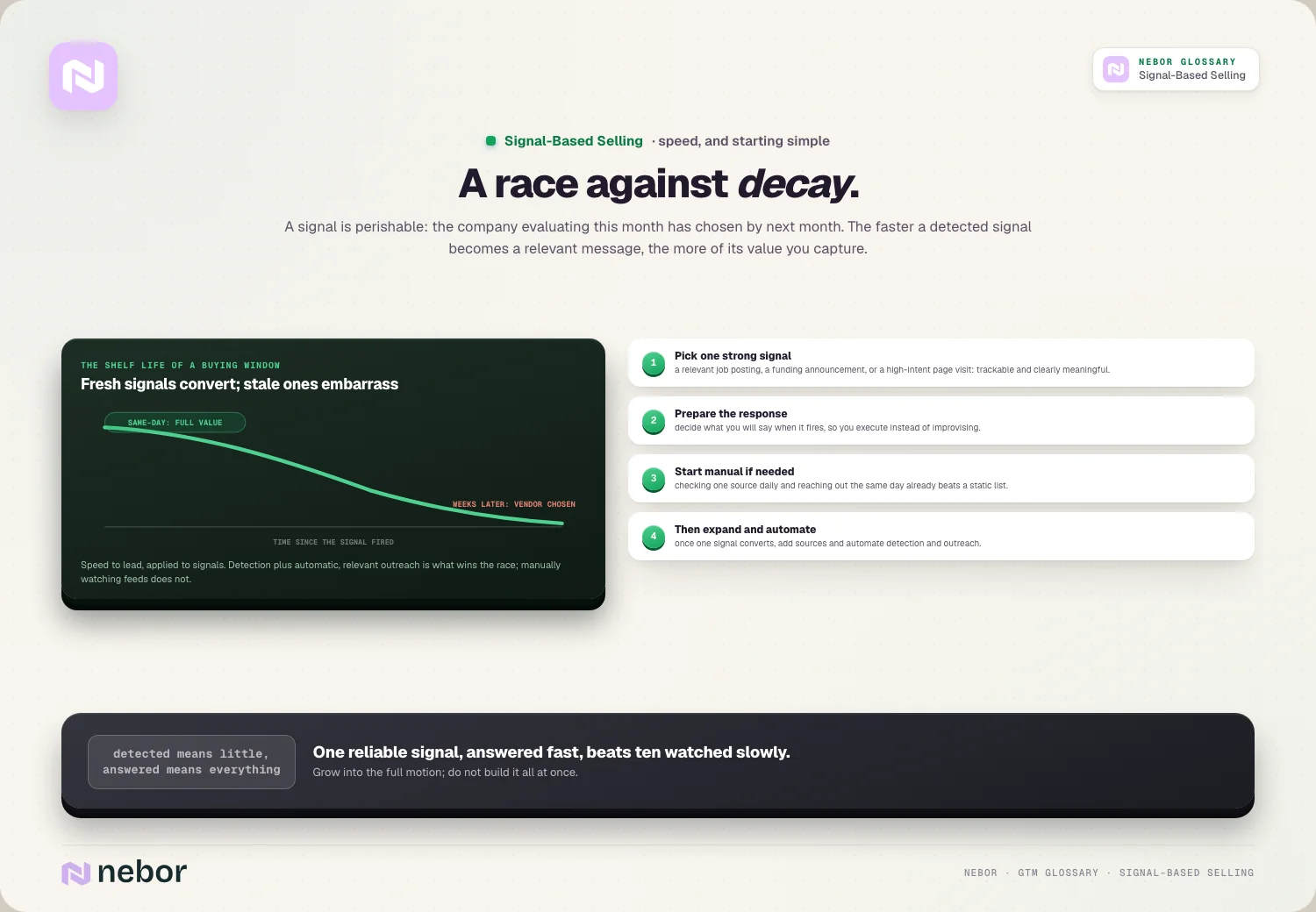
This puts speed at the heart of the practice. Reaching an account while the signal is fresh is speed to lead applied to signals, and the returns concentrate there.
It's also why automation matters so much. Detecting a signal and triggering relevant outreach automatically is the kind of work that lets you automate sales prospecting instead of refreshing feeds by hand.
So signal-based selling is a race against decay. The faster you turn a detected signal into a relevant, well-timed message, the more of its value you capture.
How do you act on a signal without making the prospect uncomfortable?
A real risk with signal-based selling is making the prospect uncomfortable. Referencing their behavior too directly can feel like surveillance instead of relevance.
The trick is to reference the public trigger and keep the private one to yourself. Mentioning their funding round or a job posting feels natural, while saying you saw them on your pricing page can feel intrusive.
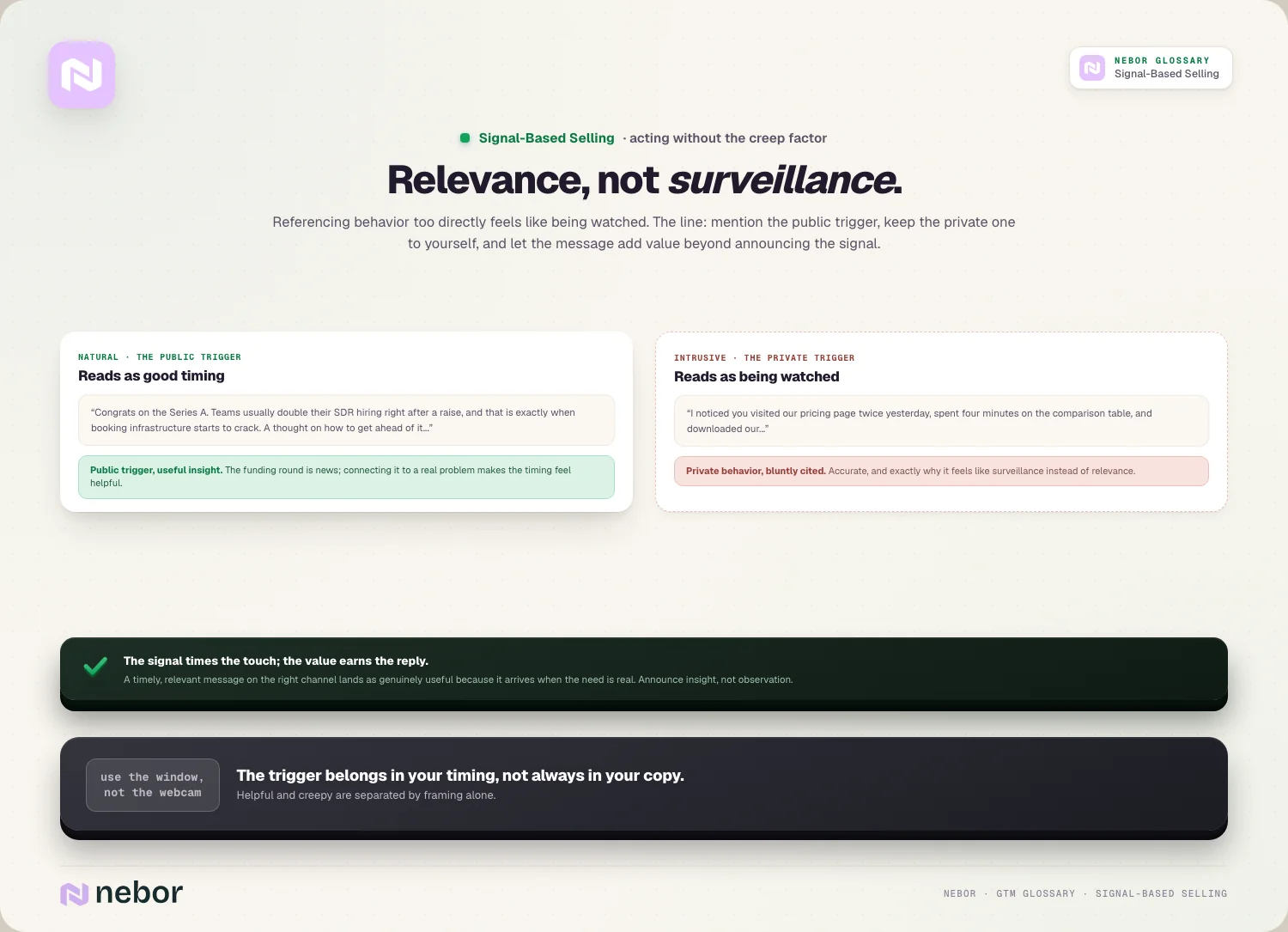
The message should add value beyond announcing the signal. Connecting the trigger to a relevant insight or offer is what makes outreach feel helpful instead of stalkerish.
This is where signal-based selling pairs with multi-channel outreach. A timely, relevant touch across the right channel lands as useful, because it arrives when the prospect has the need.
So relevance is the line between helpful and creepy. Acting on a signal with a useful, appropriately framed message is welcome, while bluntly citing someone's private activity is not.
How does signal-based selling connect your inbound and outbound motions?
Signal-based selling blurs the old line between inbound and outbound, which is one of its strengths. It uses both kinds of signals in one motion.
Some signals come from outside, like funding or hiring, and drive proactive outbound. Others come from your own channels, like a website visit, and represent inbound interest worth acting on.
The most powerful version is inbound-led outbound, where a first-party signal triggers warm outreach. A prospect showing interest on your site becomes an outbound target, but a warm one.
Capturing those first-party signals often means seeing your anonymous traffic. Pairing signal-based selling with website visitor identification puts a company name on those silent visits, so your team has someone concrete to reach.
A concrete version is a website visitor tracking workflow, where a visit signal triggers enrichment and outreach automatically, which is signal-based selling in motion.
How does signal-based selling relate to intent data and lead scoring?
Signal-based selling leans on a few neighboring concepts, so it helps to connect them. They each feed the approach in a different way.
Intent data is one major source of signals. Third-party research activity tells you which accounts are exploring your category, which is a buying window worth acting on.
Individual intent signals are the raw inputs. Each one is a single indicator, and signal-based selling is the practice of reacting to them at the right moment.
Scoring is how you prioritize among them. When many signals show up at once, weighing them the way predictive lead scoring does tells you which accounts deserve attention first.
So these pieces form a chain that ends in a conversation. Intent data and signals supply the inputs, scoring ranks them, and signal-based selling turns the strongest into timely outreach that reaches people while the window is open.
How do you start with signal-based selling without a big tech stack?
The approach can sound like it needs a big tech stack, but you can start simply. The key is to begin with one or two strong signals you can reliably detect.
Pick a signal that maps to real need. For many teams that's a job posting for a relevant role, a funding announcement, or a visit to a high-intent page, because these are easy to track and clearly meaningful.
Then build a fast, relevant response for it. Decide what you'll say when that signal goes off, so when it appears you're executing a prepared, timely message instead of improvising.
Starting manually is a completely legitimate path. Even checking a single signal source daily and reaching out the same day beats a static list, and it teaches you which signals convert for your market.
Only then do you expand and automate. Once one signal works, you add more sources and automate detection and outreach, growing into a full motion instead of trying to build everything at once.
Does signal-based selling replace traditional outbound entirely?
It's tempting to think signal-based selling makes list-based outbound obsolete, but the reality is more balanced. The two work better together than either alone.
Signal-based selling is limited by signal volume. At any moment, only a fraction of your market is showing strong signals, so signals alone may not fill your whole pipeline.
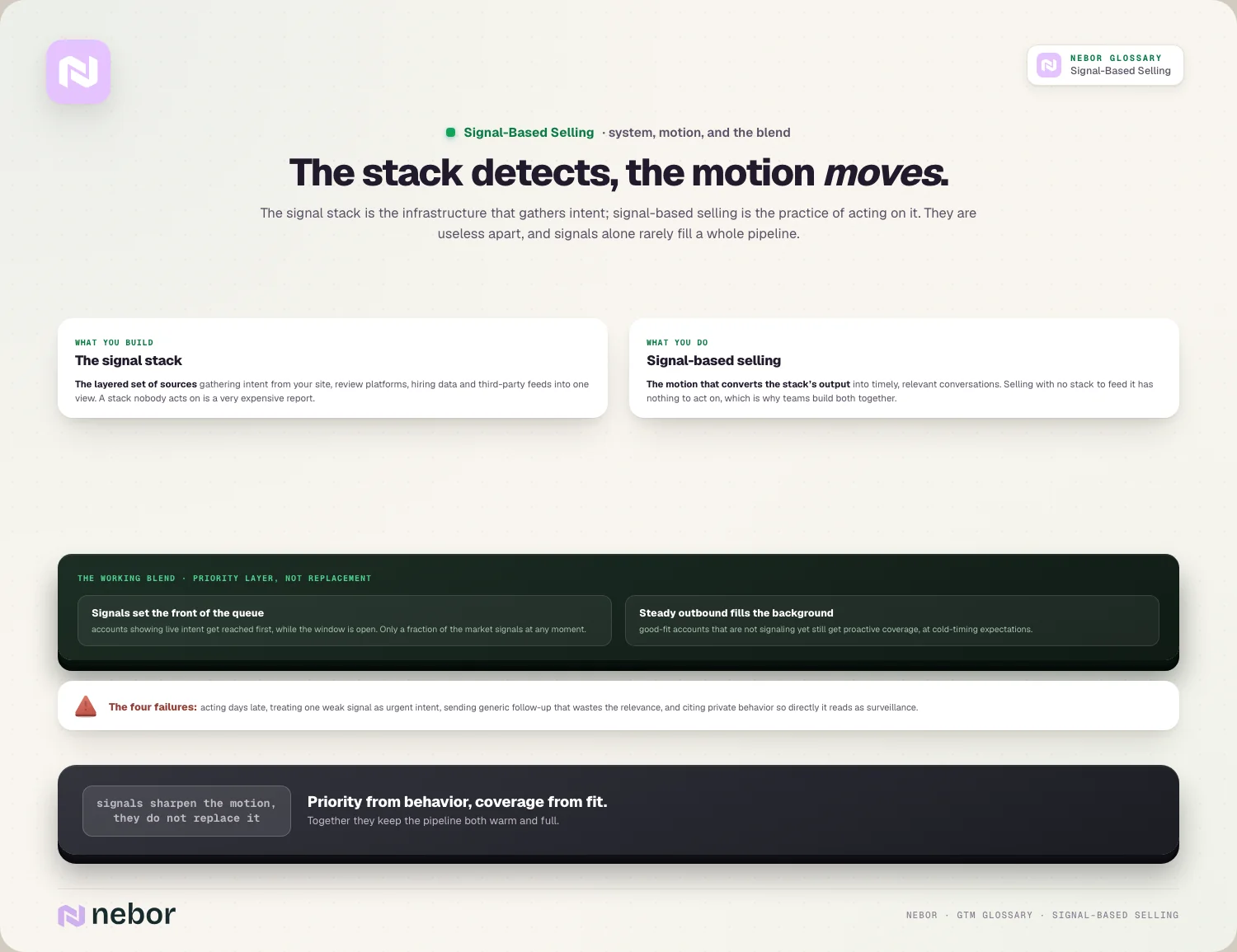
Traditional outbound covers the rest of the market. You can still proactively reach good-fit accounts that aren't signaling yet, as long as you accept the lower response that comes with cold timing.
The smartest approach we've seen blends the two. You prioritize accounts showing signals and reach them first, while keeping up steady outbound to fit accounts in the background, so signals sharpen your motion without replacing it.
So signals work as a priority layer over your outbound rather than a wholesale replacement. They tell you where to focus first, while your broader targeting keeps your pipeline full.
What are the common mistakes teams make with signal-based selling?
Signal-based selling can disappoint, usually for a few avoidable reasons we keep seeing repeated, and knowing them upfront keeps the approach effective.
Acting too slowly costs the most, because a signal you respond to days later has often gone cold, which wastes the entire timing advantage.
Acting on weak signals alone comes next, because a single soft signal isn't strong evidence, so treating it as urgent intent leads to badly-timed, low-relevance outreach.
Generic follow-up squanders the opening, because detecting a signal but sending a templated message throws away the relevance the signal made possible, defeating the point.
And coming across as creepy backfires hardest, because referencing private behavior too directly makes prospects uncomfortable, so the trigger has to be framed as relevance instead of surveillance.
Why reaching the ready beats chasing everyone who merely fits the profile
Signal-based selling matters because it fixes the biggest weakness in cold outbound, which is bad timing. The same message that gets ignored on a random Tuesday gets a reply when it lands during a buying window.
The deeper shift is in which question leads. You stop treating outbound as a volume game against a static list and start treating it as a timing game against live behavior.
The honest requirement is speed and relevance. A signal is only worth as much as your reaction to it, so detecting one means little unless you respond fast and with a message that fits the moment.
So if your outbound feels like it's fighting uphill, the missing piece may be timing rather than effort. Reaching the right accounts at the moment they're ready is what turns cold outreach warm.
That shift from chasing everyone to reaching the ready is exactly what signal-based selling is built to do. It's become a defining feature of any modern go-to-market system built around intent.
Share this post
Outbound
Intent
Glossary
Related glossary items
Understanding the core GTM concepts



Ready to build your pipeline