
In this post:
The average revenue team uses more than a dozen tools, and most of them barely talk to each other. Data is stuck in silos, leads fall through the cracks between systems, and someone is always copying information from one tool into another by hand.
That mess is what workflow orchestration is built to fix. Instead of a pile of disconnected automations, it coordinates them into one system where data and actions flow cleanly from one step to the next.
Workflow orchestration is the practice of coordinating multiple workflows, tools, and steps so they work together as one connected system, with a central layer managing how data and actions move between them. It's the conductor above your individual automations.
Automating single tasks turns out to be only half the job. When you have many automated pieces but nothing coordinating them, you get islands of automation, and orchestration is what turns those islands into a working machine.
TL;DR
Workflow orchestration coordinates many workflows and tools into one connected system, managing how data flows and what actions happen across your whole stack instead of in isolated pieces.
Tool sprawl creates the chaos it solves, because the average B2B revenue stack has grown to about around 17 tools, and without orchestration they don't work together.
It stands above individual automations as a central layer, deciding when information moves, where it goes, and what happens next across all your systems.
The demanding part is that orchestration is a design discipline instead of a single tool you buy. It takes deliberate engineering to connect your stack, and that's the reason many companies own the tools but never build the system.
What is workflow orchestration, and what does the layer actually manage?
Workflow orchestration is the coordination of many automated processes into one coherent system. Instead of building workflows in isolation, you connect them so they act together.
It's the layer above individual workflows. A single AI workflow handles one chain of steps, while orchestration manages how many such workflows and tools interact across your whole operation.
The job of orchestration is managing flow. It decides when data moves between systems, what information moves, and what action should follow, so the whole stack behaves like one machine.
This usually happens through a central layer. A workflow automation platform or custom integration layer is the middle, coordinating the tools instead of letting each one operate on its own.
So orchestration is really about coordination on top of automation. Automation makes individual tasks happen on their own, and orchestration makes all those tasks work together toward one outcome.
How is orchestration different from a single workflow working alone?
People often blur orchestration with the workflows it coordinates, so it helps to separate them. They are at different levels of the system.
A single workflow follows a defined sequence of steps. It takes an input, pushes it through a chain, and produces an output, which is the idea behind any automated workflow.
Orchestration coordinates many of those at once. It manages how multiple workflows and tools interact, handling the handoffs and dependencies between them instead of managing one chain.
The difference shows up in the complexity handled. A workflow follows fixed steps, while orchestration weighs context across the whole system to decide which workflow starts, when, and in what order.
So a workflow is a single instrument, and orchestration is the conductor. One plays its part, and the other makes sure all the parts come together into something coherent.
Why does tool sprawl make orchestration necessary in the first place?
To understand why orchestration matters now, look at how revenue stacks have grown. The problem it solves is a recent one, and we watch it worsen in the stacks clients bring us.
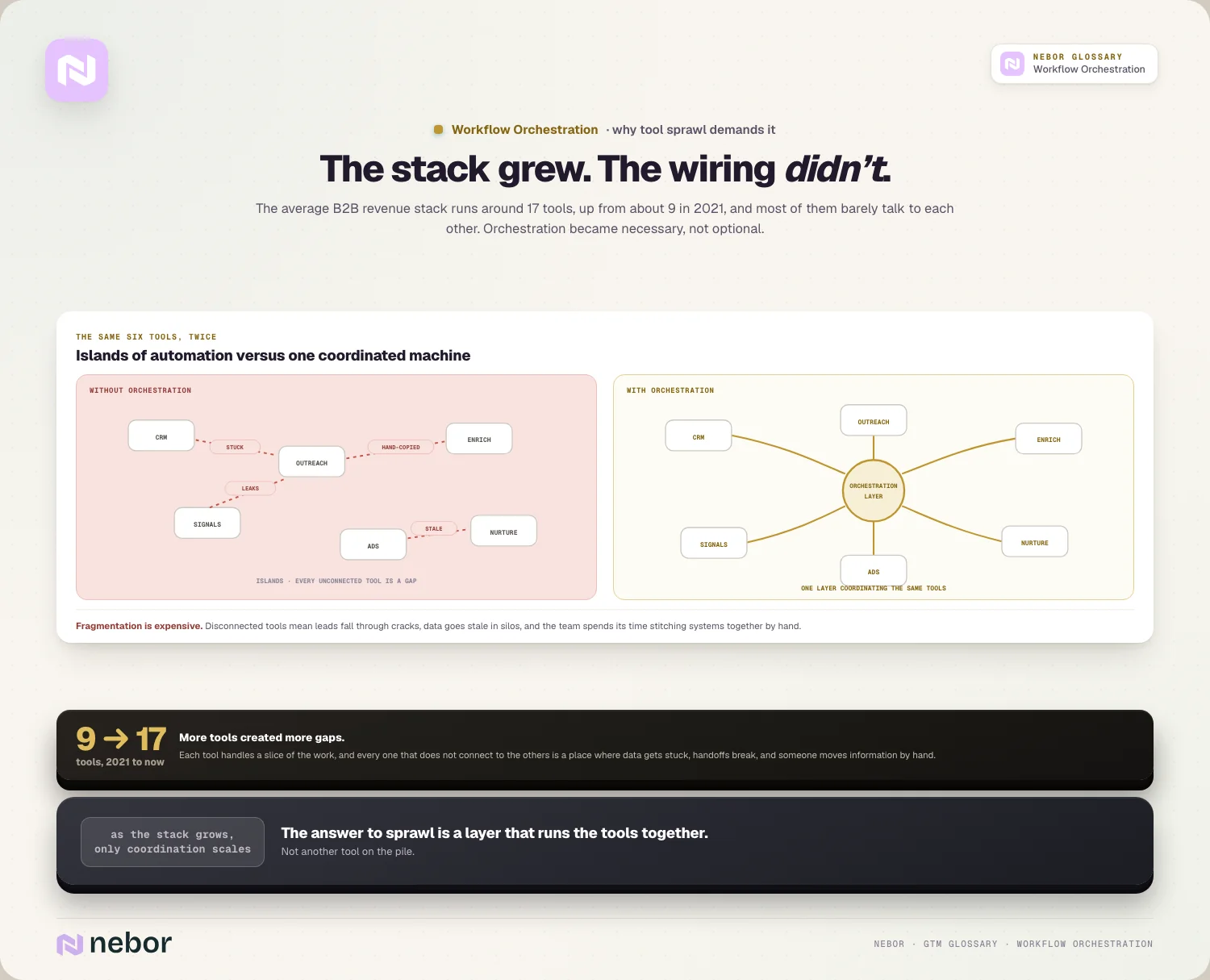
The number of tools exploded in a few short years. The average B2B company now uses around 17 tools in its revenue stack, up from about 9 in 2021, each handling a slice of the work.
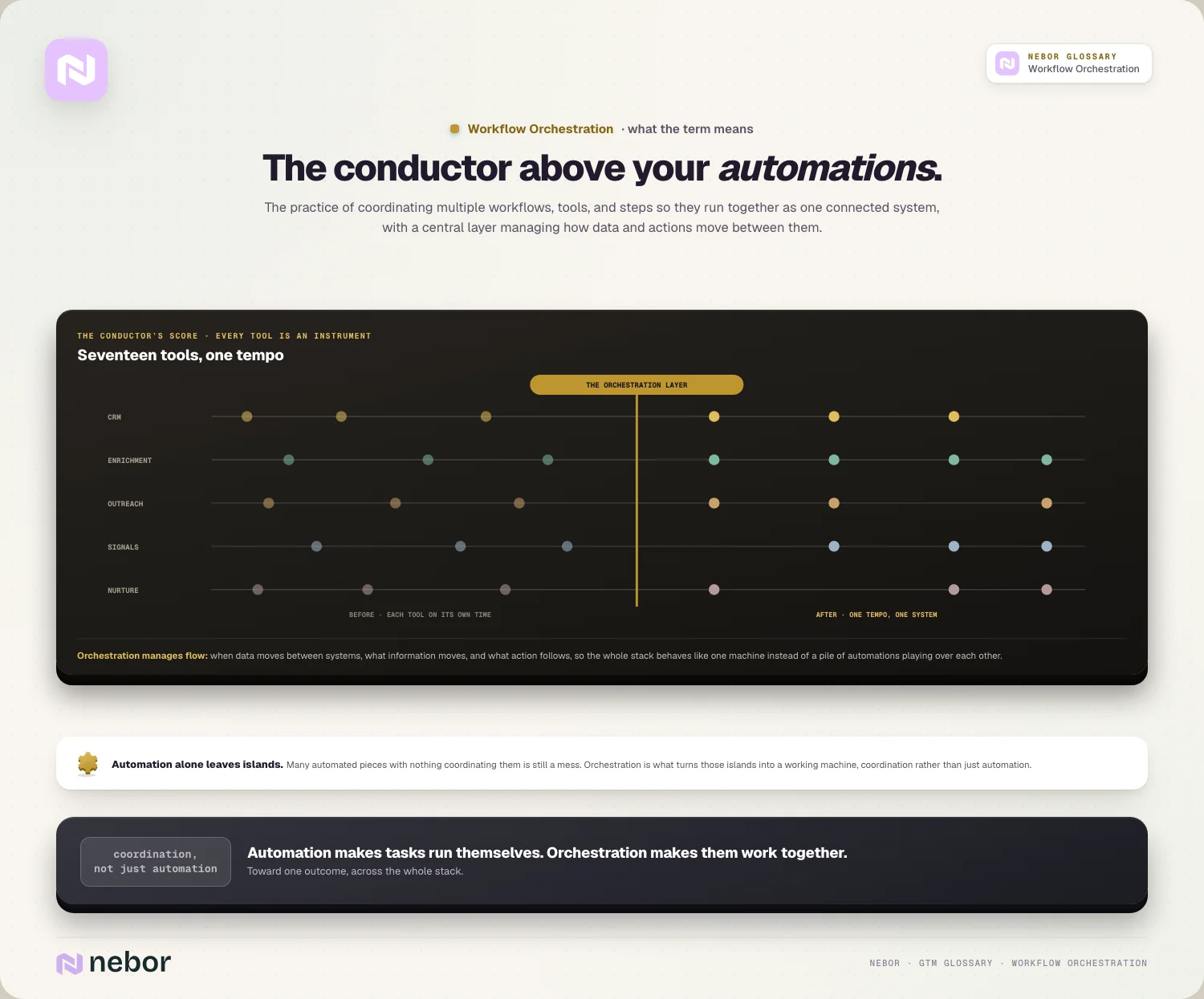
More tools created more gaps between tools. Every tool that doesn't connect to the others is a place where data gets stuck, handoffs break, and someone has to move information by hand.
That fragmentation costs more than it looks. Disconnected tools mean leads fall through cracks, data goes stale in silos, and your team spends time stitching systems together manually.
Orchestration is the answer to that sprawl. As the stack grows, the only way to keep it working is a layer that coordinates the tools, and that pressure is what made orchestration necessary instead of optional.
How does orchestration relate to automations and workflows below it?
Orchestration builds on automation in layers, with each one a step up in scope, and seeing how they stack makes the whole idea click.
The base layer is individual automation of tasks. Sales automation handles single repetitive tasks, like logging a call or sending a follow-up, removing manual work one step at a time.
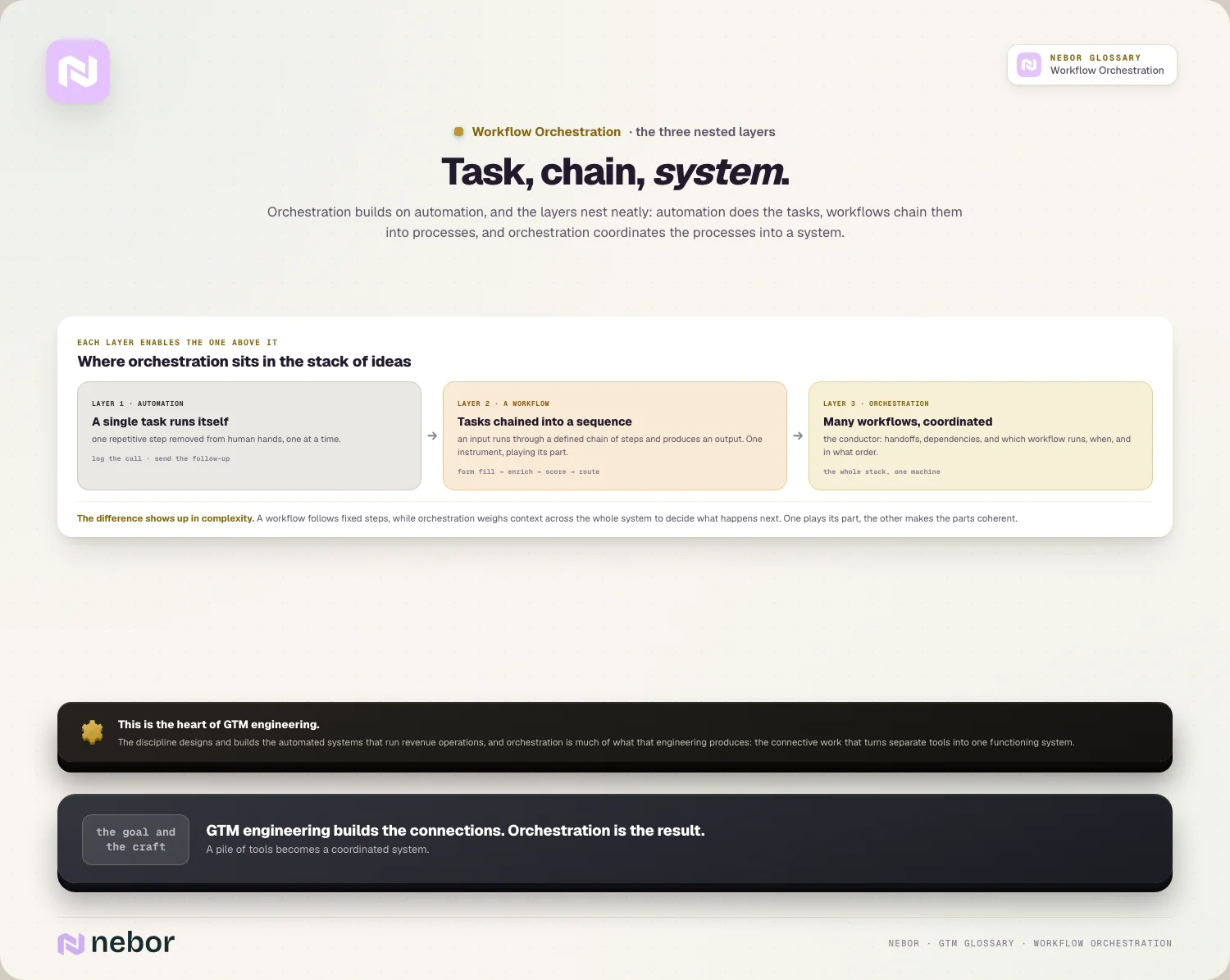
Workflows chain those tasks into longer sequences, because connecting automated steps produces a process that accomplishes a larger job from start to finish.
Orchestration then coordinates many workflows at once, as the top layer managing how all those sequences and tools work together across your whole operation.
So the three layers nest neatly inside each other. Automation does the tasks, workflows chain them into processes, and orchestration coordinates the processes into a system, each enabling the one above it.
Why is workflow orchestration the beating heart of GTM engineering?
Workflow orchestration and the discipline of building these systems go hand in hand. One is the goal, and the other is the craft that achieves it.
The discipline is GTM engineering, the practice of designing and building the automated systems behind revenue operations. Orchestration is much of what that engineering produces.
It's also what makes a GTM stack more than a pile of tools. Orchestration is the connective work that turns separate tools into a coordinated system that functions as one.
This is where automation becomes a real engine. Orchestration is what lets you automate sales prospecting end to end, instead of building disconnected automations that each handle one piece.
So orchestration is the output of good GTM engineering. The engineering builds the connections, and orchestration is the coordinated system that results from doing it well.
How do AI and agents change what orchestration is capable of?
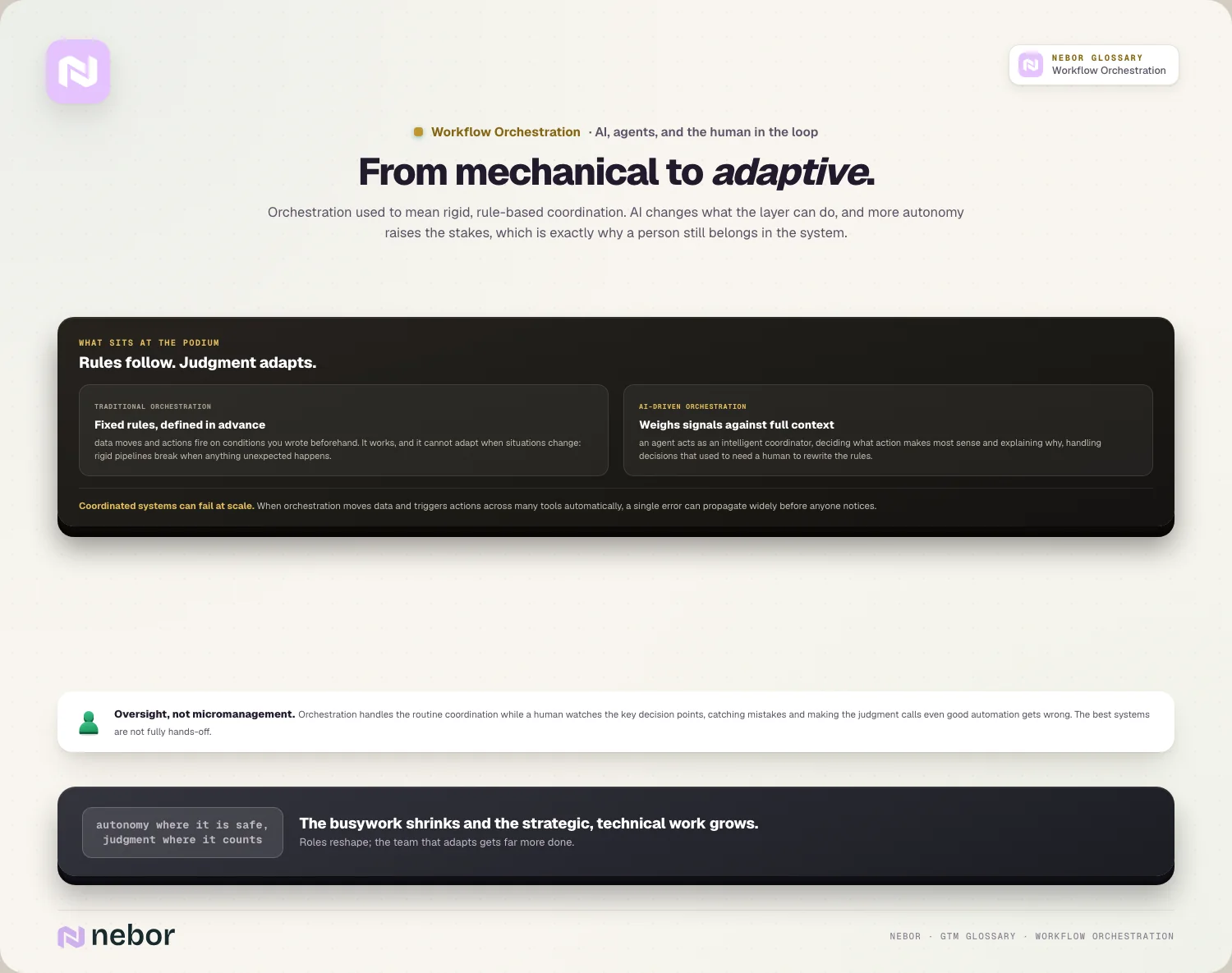
Orchestration used to mean rigid, rule-based coordination. AI is changing what the orchestration layer can take on.
Traditional orchestration can only follow fixed rules. It moves data and triggers actions based on conditions you defined in advance, which works but can't adapt when situations change.
AI adds a layer of judgment on top. Instead of just following rules, an AI-driven orchestration layer can weigh many signals against full context and decide what action makes most sense, then explain why.
This is where agents enter the picture. An AI agent can act as an intelligent coordinator, handling the decisions that used to need a human to rewrite the rules, which moves orchestration toward an agentic workflow.
So AI raises orchestration from mechanical to adaptive. The system can respond to new conditions on its own, which is a real shift from rigid pipelines that break when anything unexpected happens.
Why does orchestration still need a human involved at the key points?
More autonomy raises the stakes, so orchestration shouldn't be left entirely unsupervised. A person still belongs in the system.
Coordinated systems can fail at coordinated scale. When orchestration moves data and triggers actions across many tools automatically, a single error can propagate widely before anyone notices.
This is why a human in the loop matters. Keeping a person at the key decision points catches mistakes and handles the judgment calls that even good automation gets wrong.
The goal is oversight without the micromanagement. You let orchestration handle the routine coordination while a human watches the important moments, which balances speed with safety.
So the best orchestration keeps a human within reach. It's a system that handles most things on its own while keeping people involved where their judgment matters.
How does orchestration connect to the bigger revenue engine around it?
Orchestration forms a core part of how a modern revenue operation works, tying the whole thing together from the middle.
It's what makes a revenue engine truly work. The engine is the connected system of people, processes, and tools, and orchestration is the layer coordinating how those tools work together.
It powers signal-driven motions just as much. Acting on signals across many tools depends on orchestration to route a detected signal into the right action, instead of letting it go unseen in one system.
It relies on clean data flowing between systems. Orchestration coordinates how data enrichment and other steps feed each other, so each tool works on complete, current information.
So orchestration is the nervous system of a modern revenue operation. It's what connects all the parts into a single responsive system instead of a set of disconnected tools.
What does workflow orchestration look like when a real lead arrives?
A concrete example makes the idea clearer, because orchestration stays abstract otherwise, and it's the picture we sketch for clients most often. Here's how a single lead moves through an orchestrated system.
A prospect fills out a form, and the orchestration layer springs into action. It enriches the record, scores it for fit, and decides where it should go, all without anyone touching it.
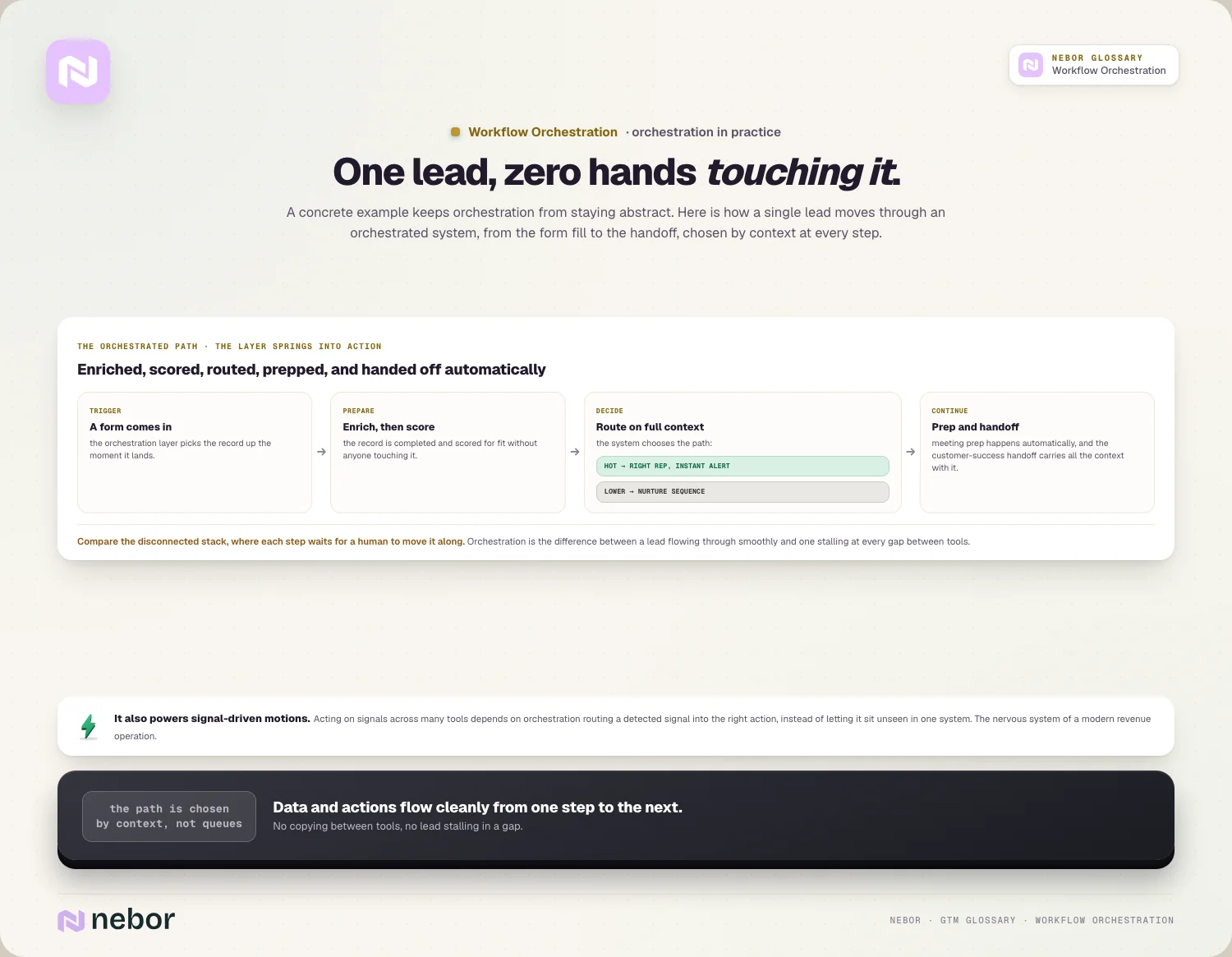
If the lead is hot, it routes instantly to the right rep and sets off an alert, while a lower-priority one drops into a nurture sequence. The system chooses the path based on the full context.
As the lead progresses, the coordination continues. When they book a meeting, the prep happens automatically, and when they convert, the handoff to customer success carries all the context with it.
Compare that to a disconnected stack, where each step waits for a human to move it along. Orchestration is the difference between a lead flowing through smoothly and one stalling at every gap between tools.
How do you start building orchestration without a giant project plan?
Orchestration can sound like a massive engineering project, but you don't build it all at once. It grows from connecting a few things well.
Start by mapping how things flow today. Look at how a lead moves through your tools right now, and find the gaps where data gets stuck or someone copies information by hand.
Then connect the worst of the gaps first. Wiring together the two or three handoffs that leak the most gives you real value quickly, without trying to orchestrate everything immediately.
From there, the system grows connection by connection. Each new link makes the whole more coordinated, so you build orchestration piece by piece instead of as one giant project that never ships.
The mindset we push clients toward is incremental. A few well-connected tools beat a grand plan that stalls, so you orchestrate the highest-pain flows and grow the system from there as you learn.
Does orchestration replace your team, or change what they do?
A natural worry is that orchestrating everything removes the need for people. In reality, it changes their work instead of eliminating it.
Orchestration takes over the coordination work itself. The routing, the handoffs, and the data movement that used to eat human time get handled automatically, freeing people from that mechanical work.
What's left for people is the higher-value work. Your team spends less time moving data between tools and more time on the judgment, relationships, and strategy that the system can't do.
It creates new work at the same time. Someone has to design, monitor, and improve the orchestration itself, which is the rise of GTM engineering as a discipline that owns these systems.
So orchestration reshapes roles rather than erasing them. The busywork shrinks, the strategic and technical work grows, and the team that adapts to that shift gets far more done.
What are the common mistakes teams make with workflow orchestration?
Orchestration goes wrong in a few predictable ways, and we keep seeing the same ones in the stacks we untangle. Most come from treating it as a tool purchase instead of a design discipline.
Buying tools without connecting them deepens the sprawl, because adding more software without orchestration just multiplies the islands, and the tools still don't work together.
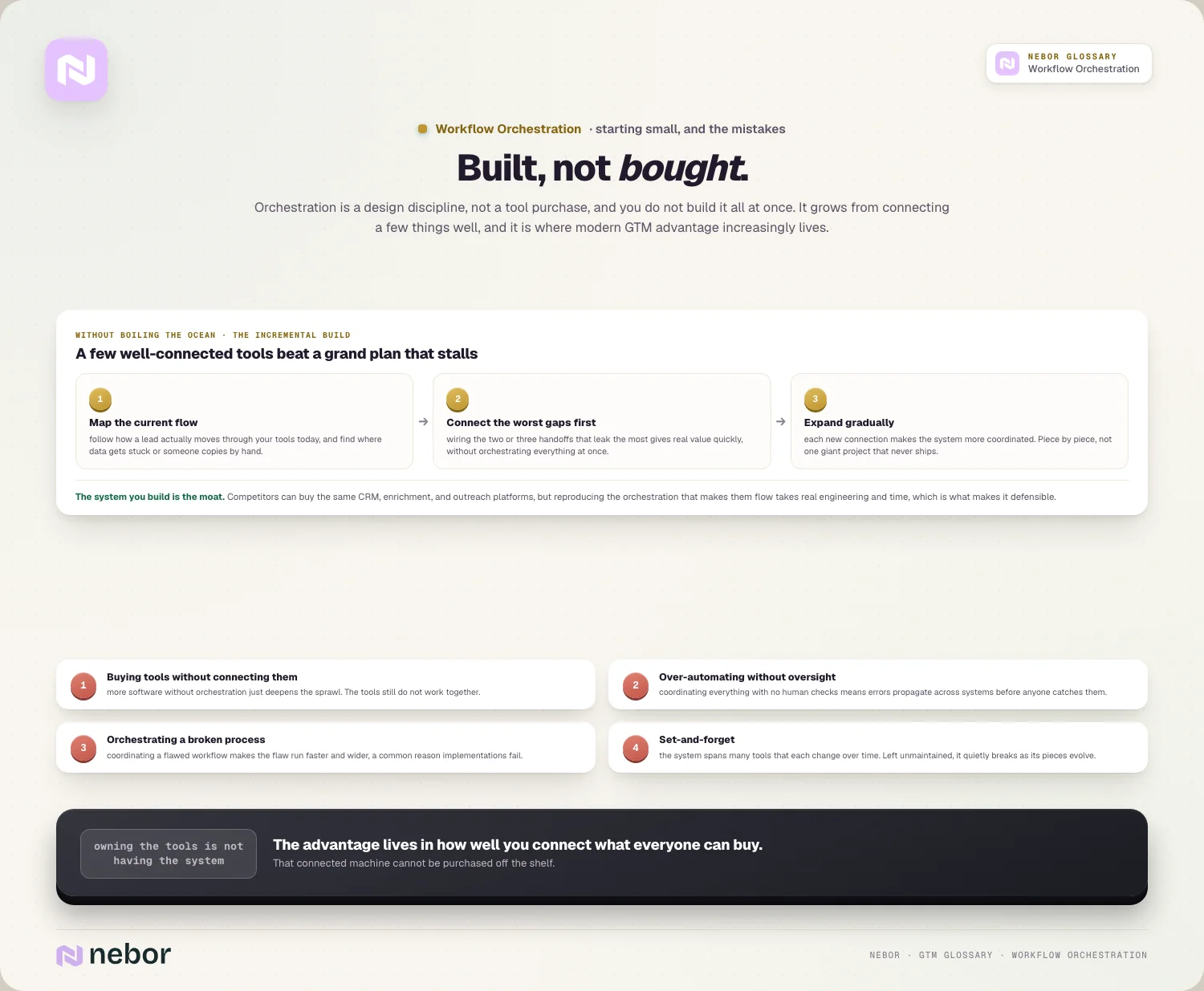
Over-automating without oversight comes next, because coordinating everything automatically with no human checks means errors propagate across systems before anyone catches them.
Orchestrating a broken process scales the flaw, because coordinating a flawed workflow just makes it spread faster and wider, which is a common reason Clay and similar implementations fail.
And set-and-forget lets the system rot, because orchestration spans many tools that each change over time, so a build left unmaintained breaks slowly as its pieces evolve.
Why is workflow orchestration becoming a genuine competitive advantage?
As tools become commoditized, orchestration is emerging as a real edge. Everyone can buy the same software, so the advantage shifts to how well you connect it.
The tools themselves are no longer differentiators. Your competitors have access to the same CRM, the same enrichment, and the same outreach platforms, so owning them isn't an advantage anymore.
The difference is the system you build on top. A team whose tools work together as one coordinated machine moves faster and wastes less than one with the same tools stuck in silos.
That system is genuinely hard to copy. Anyone can buy your stack, but reproducing the orchestration that makes it flow takes real engineering and time, and that effort is what makes it defensible.
So orchestration is where modern GTM advantage increasingly lives. The edge comes from connecting the tools into a system that competitors can't simply purchase off the shelf.
Why the layer that connects your tools is worth more than the tools
Workflow orchestration matters because automating individual tasks isn't enough once your stack grows. A dozen disconnected automations stay disconnected on their own, and orchestration is what joins them into a working system.
The deeper idea is coordination over isolation. The value lives in how the tools work together instead of in any single one of them, and managing that interplay is orchestration's whole job.
The honest reality is that no vendor sells this finished. Orchestration takes deliberate engineering to connect your tools and design how data and actions flow, so owning the tools is never the same as having the system.
So if your team has a stack of tools that don't talk to each other, the missing piece isn't another tool.
It's the orchestration layer that makes them work as one, and that layer is what turns a pile of automations into the kind of connected machine a modern go-to-market system depends on.
Share this post
Workflows
Automation
Glossary
Related glossary items
Understanding the core GTM concepts



Ready to build your pipeline