
In this post:
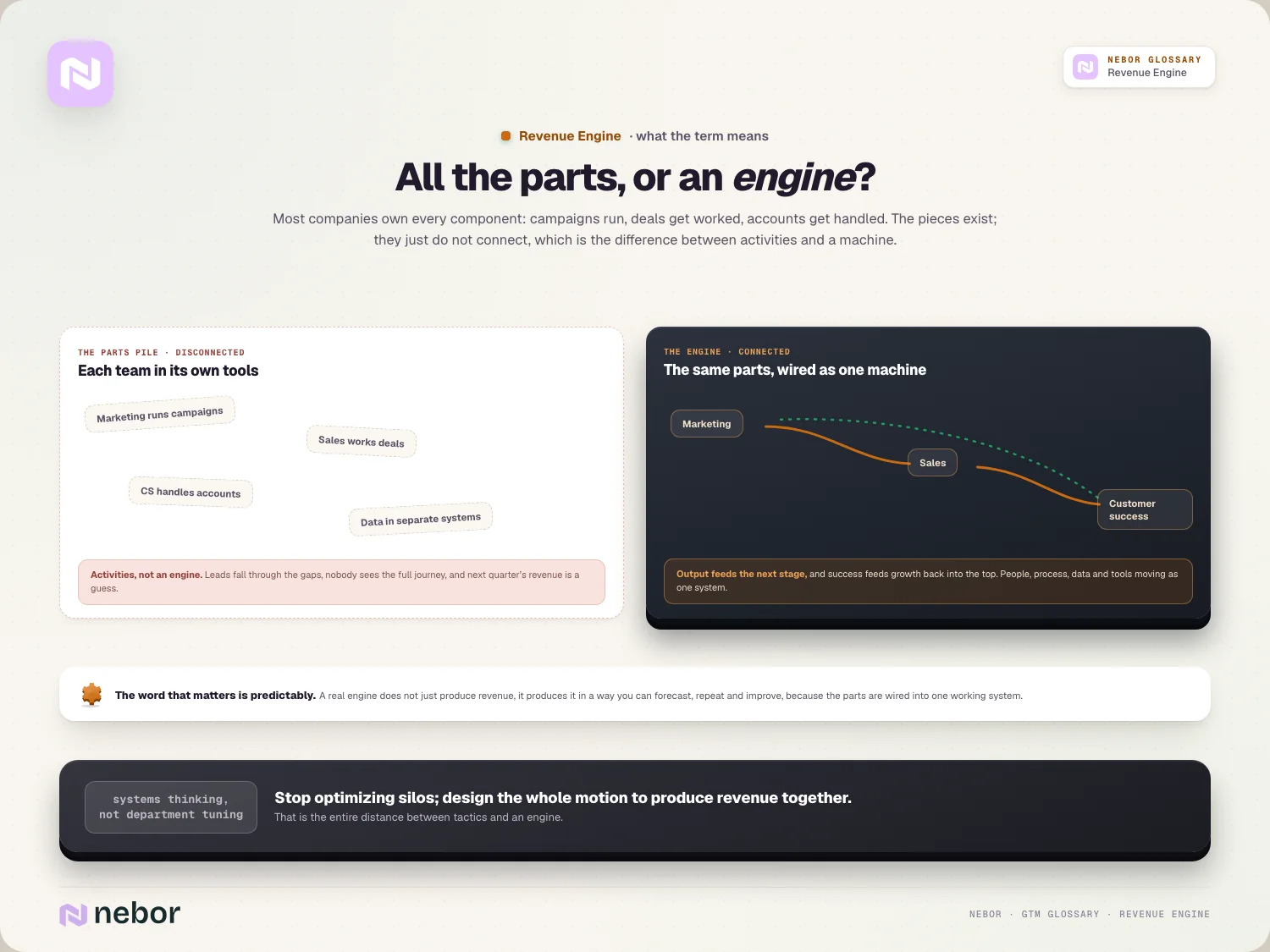
A revenue engine is the connected system of people, processes, data and tools across marketing, sales and customer success that produces revenue you can forecast and repeat. The word doing the work there is "connected". Most companies own every part of a revenue engine and still don't have one.
Marketing runs campaigns in one tool, sales works deals in the CRM, customer success manages accounts in a third system, and every team is good at its own job. The trouble sits between them. A lead waits two days for someone to notice it, a new customer gets asked the same questions they answered in the sales process, and nobody can say within a sensible range what next quarter will bring.
The phrase sounds like something from a keynote, but it can be tested in plain terms. Can a record move from first touch to renewal without anyone copying data by hand? And can you work backwards from a revenue target to the number of opportunities you need this month? If both answers are yes, you have an engine. If not, you have parts.
TL;DR
The handoffs are where a revenue engine works or fails. Follow one customer from form fill to renewal and the context gets lost at three points: marketing to sales, sales to onboarding, and the account back to sales when it's ready to grow.
Disconnected teams show the same symptoms everywhere: leads that leak, data nobody trusts, lumpy quarters and duplicated work. Buyers are already cross-functional, with Forrester finding that 89% of B2B purchases involve two or more of the buyer's departments.
Think of the engine as four layers that feed each other (a sharp ICP, demand, conversion, retention and expansion). Retention is the one most teams build last and the one that compounds.
Predictability is arithmetic. With a known deal size, win rate and cycle length, a €600k quarterly target becomes 20 deals and about 80 opportunities, and you can see in week one whether the pipeline is there.
Build in order: strategy, then clean shared data, then the handoffs, then automation. Software bought before those three exist just adds more disconnected parts.
Nebor builds the connections (enrichment, scoring, routing, handoffs and reporting) in the tools a company already uses, and hands the finished engine over to its team.
A customer's first year, seen from inside a revenue engine
Take one buyer, the operations director at a 300-person logistics company, and follow her from the first form to the first renewal. In a working engine, almost nothing in this story needs someone to remember to do it.
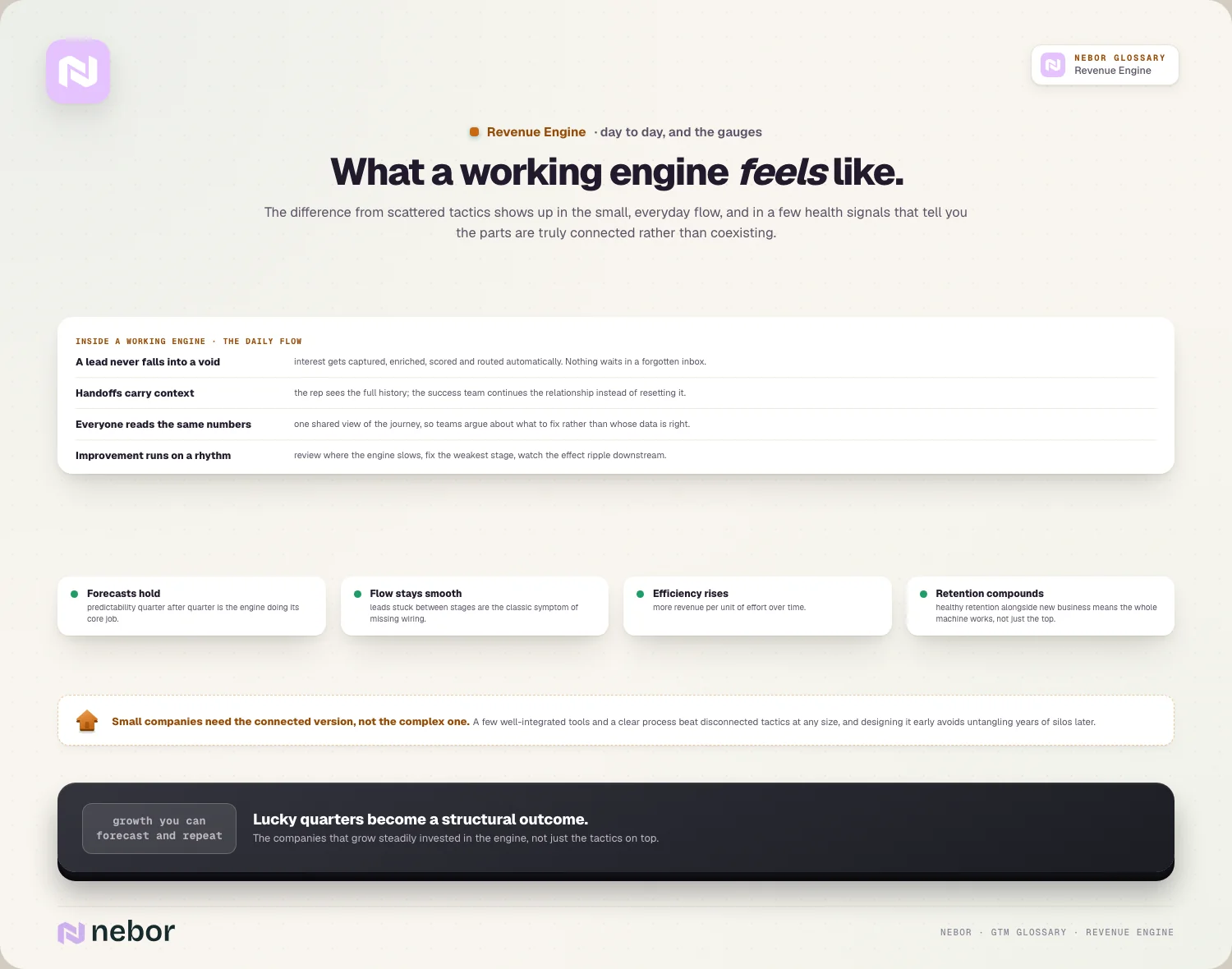
Tuesday, 10:14. She downloads a pricing guide. Within a minute, data enrichment fills in her company's size, industry and tech stack, her lead score clears the bar, and lead routing assigns her to the rep who covers logistics in her region. The rep calls before lunch, with the guide she downloaded and the pages she viewed in front of him.
Week 3. After a good discovery call, she becomes a sales qualified lead and then an opportunity. In HubSpot, this is the lifecycle stage property, which HubSpot describes as showing how leads are handed off between marketing and sales, and its automatic updates only ever move a record forward. In Salesforce, the same moment is lead conversion, which turns the lead record into an account, a contact and an opportunity. Either way, this is the first handoff, and the engine's job is to make sure the history travels with her.
Week 9. The deal closes. Customer success inherits the deal notes, the people involved on her side, the integration the rep promised and the go-live date she cares about. The kickoff call starts from there, instead of asking her to explain her business all over again.
Month 10. Her team opens a second warehouse and usage jumps. The engine flags the change to the account owner as an expansion signal, and the renewal shows up in the same forecast the sales team uses for new business.
Now run the same year without the connections. The guide download sits in the marketing tool until Thursday's export. The rep opens the call with "so, tell me about your company". The kickoff gets scheduled from a Slack message, and the expansion signal never reaches anyone, because usage data lives in a product database that sales can't see. Each team did its job, and the customer still had a worse year.
What breaks when the parts don't connect
Disconnected teams fail in a predictable way, and the same four symptoms turn up in almost every audit we run.
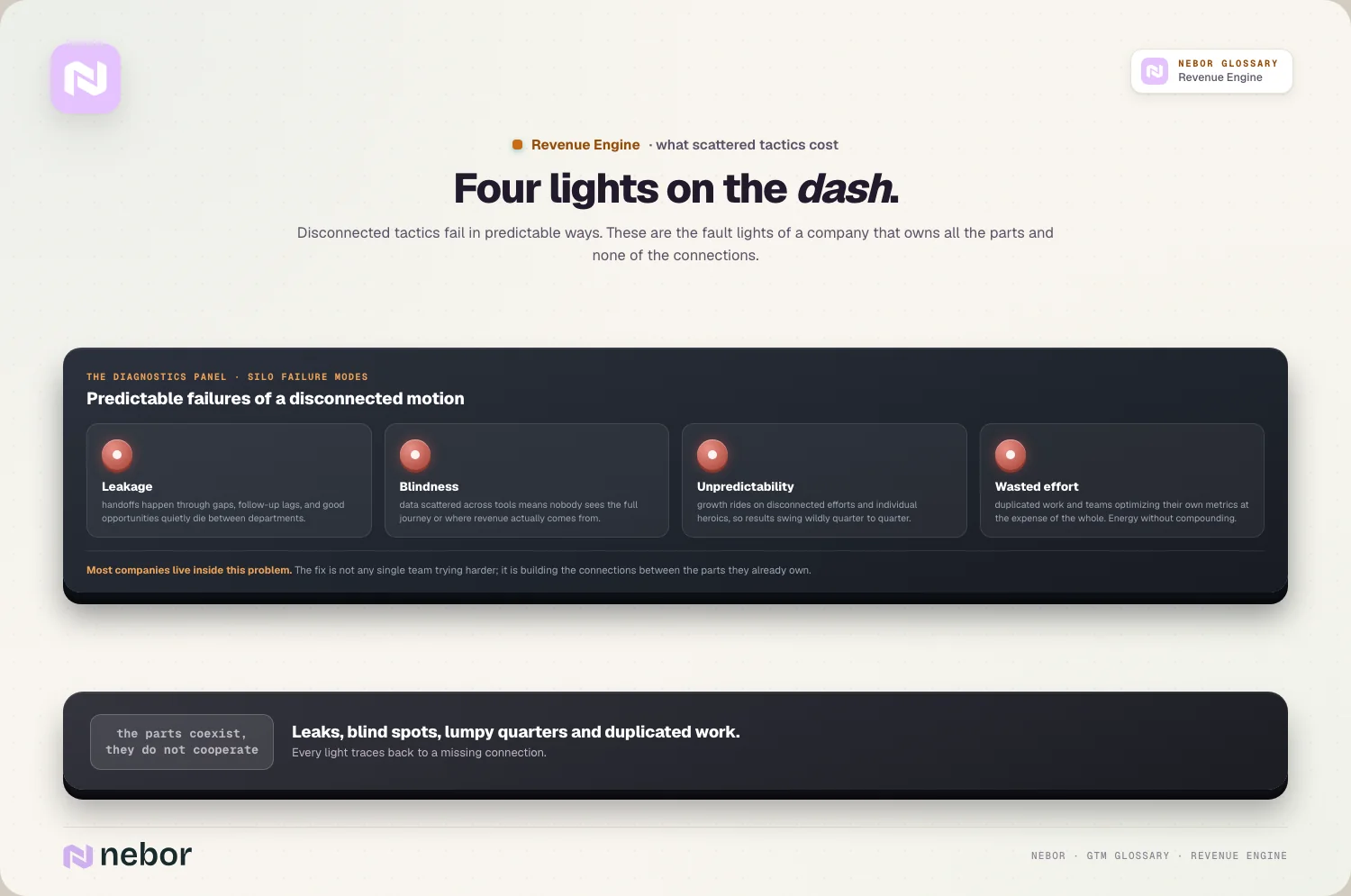
Leakage is the most visible. Leads wait in a queue nobody owns, follow-up starts after the buyer has moved on, and good opportunities get lost between departments. We wrote a separate entry on lead leakage, because it's usually where the money goes first.
Blindness follows from scattered data. When marketing counts leads in one tool and sales counts pipeline in another, each with its own definition of a "customer", nobody can trace which campaigns produced revenue. Meetings turn into arguments about whose number is right.
Unpredictability is the one leadership feels. If growth depends on a few strong reps having a good month, results swing from quarter to quarter and the forecast is a guess. Low forecast accuracy is usually a symptom of disconnected data, not of reps who can't count.
Wasted effort is the most expensive and the least obvious. Two teams enrich the same records with two different tools, SDRs rebuild lists marketing already has, and each department optimizes its own metric at the expense of the total.
The buyer's side makes this worse. Forrester's 2024 State of Business Buying counts at least two of the buyer's departments in 89% of purchases, and 86% of B2B purchases stall at some point in the buying process. A buyer who is already juggling colleagues from finance and IT has little patience for a seller whose own teams don't share notes.
The four layers of a revenue engine
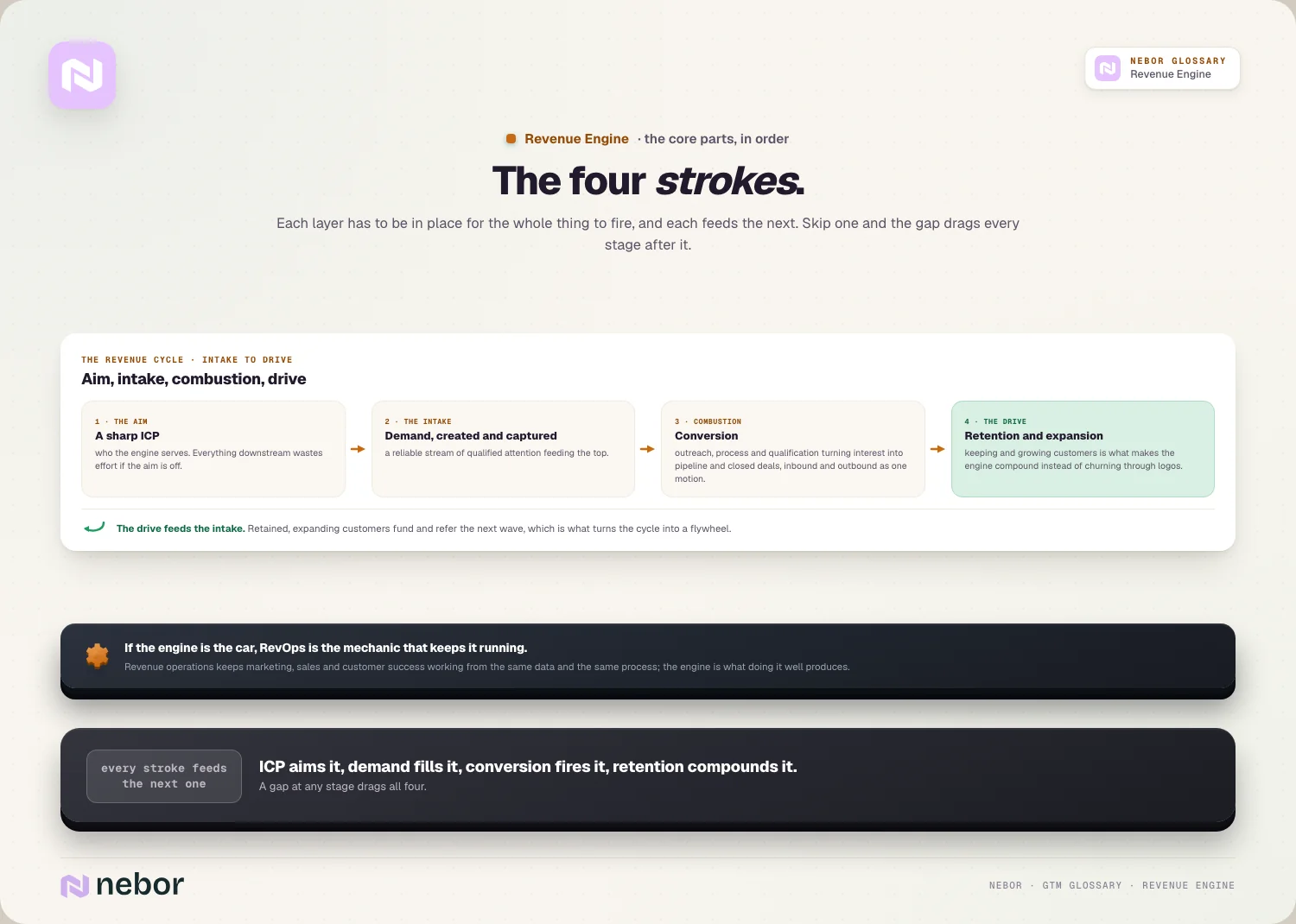
A revenue engine has four layers, and each one feeds the next. A gap in any of them slows everything after it.
Aim: who the engine is for
A sharp ideal customer profile points the engine at the right accounts. Everything after this layer multiplies whatever you feed it, so a vague ICP means a well-oiled engine that efficiently produces the wrong pipeline.
Intake: demand created and captured
The engine needs a steady flow of qualified attention at the top, which is the work of demand generation. In a connected setup, inbound and outbound stop competing for credit and start feeding each other. With inbound-led outbound, the accounts that visit your pricing page or read your guides tell your outbound team who to contact this week.
Conversion: interest into revenue
This is where qualification, the sales process and the follow-up cadence turn interest into pipeline and closed deals. It's the layer most companies have invested in most, and often the one that gets blamed for problems that started in the two layers above it.
Retention and expansion: the layer that compounds
Keeping and growing customers is what turns a funnel into an engine. Measured by net revenue retention, it's the difference between a company that has to replace its whole revenue base every few years and one that starts each year with growth already built in. In our view it's the most neglected layer, because customer success often runs in a separate tool that sales and marketing never look at.
When retention works, it feeds the intake. Happy customers refer peers, expand into new teams and provide the case studies your demand generation runs on, so each turn of the cycle makes the next one easier. That loop is what we call a GTM flywheel.
Predictable revenue is arithmetic
The promise of a revenue engine is predictability, and predictability comes from structure. When the parts connect, you can work backwards from a target to the activity it needs, and check every week whether that activity is happening.

Here's a simple version with round numbers. Say the target is €600,000 in new annual contract value next quarter, and the average deal is €30,000. That's 20 deals. With a 25% win rate, you need about 80 qualified opportunities working toward a close this quarter. If your sales cycle runs around 75 days, most of those 80 have to exist already on the first day of the quarter, because anything created in week ten won't close in time.
That last step is where disconnected companies get caught out. They find out in week eight that the pipeline was never there. A connected engine shows it in week one, through pipeline coverage against the target and pipeline velocity through each stage, while there's still time to do something about it.
Each of those inputs (deal size, win rate, cycle length, opportunities created) usually lives in a different team's report. You only get a forecast you can trust when they come from one shared set of data with one definition per stage. That's also why fixing the weakest stage in a connected engine shows up in revenue a quarter later, while the same fix in a disconnected company disappears into the gaps.
Build it in this order, and buy tools last
A revenue engine is a design project, not a software purchase. The order matters, because each step depends on the one before it.
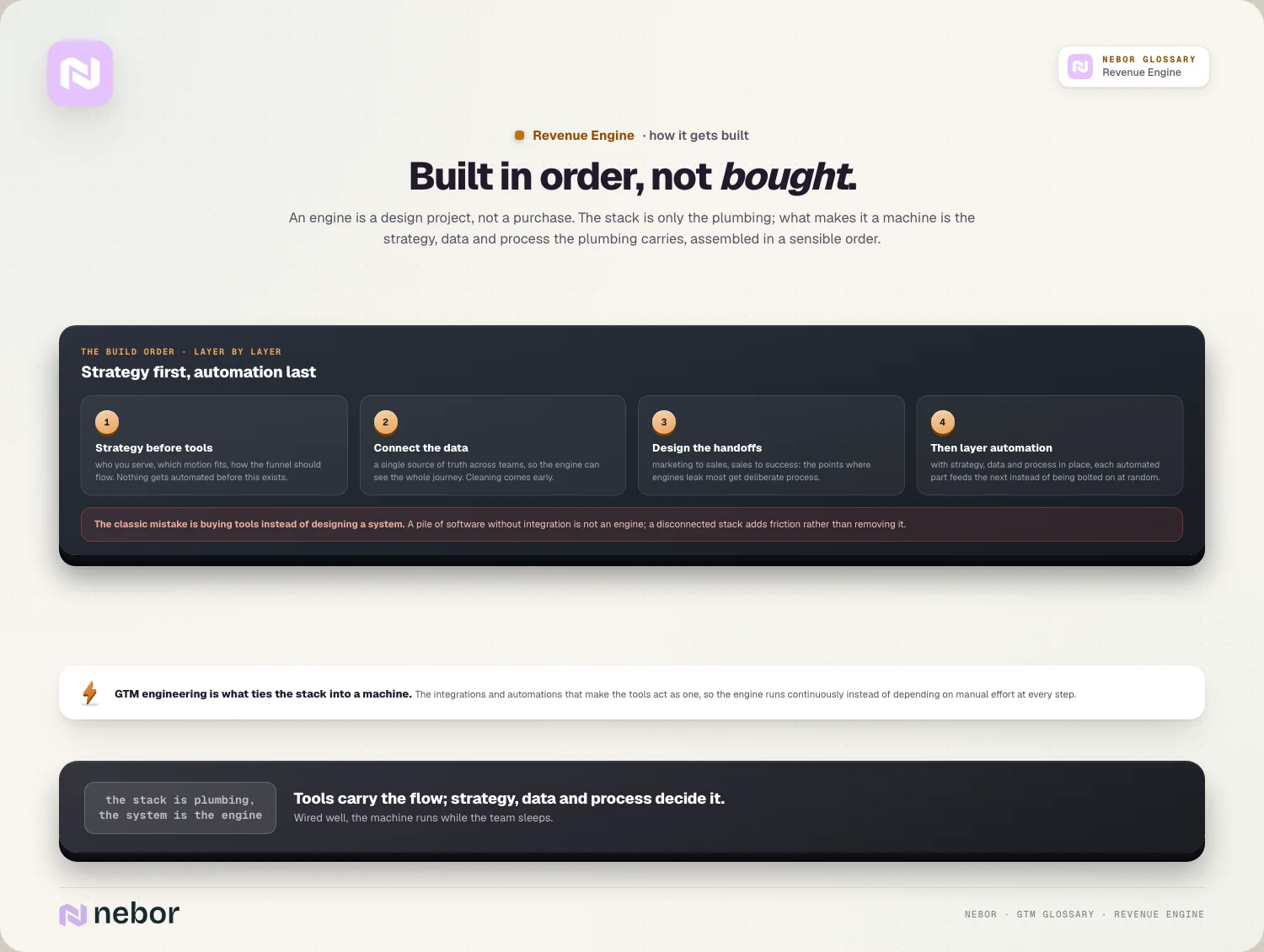
Strategy first. Decide who you serve, which motion fits and how a buyer should move from first touch to renewal. This is the work of your go-to-market strategy, and nothing should be automated before it exists.
Then one set of data. Agree on a single system of record and one definition for each lifecycle stage, then clean what's already there. CRM hygiene comes this early because every rule you build later reads from these fields.
Then the handoffs. Design the moments where marketing passes to sales and sales passes to customer success: which fields have to be filled in, who gets notified, and how long each step is allowed to take. These are the points where engines leak most.
Then automation. With the first three in place, you connect the tools so each step triggers the next. This is also when it makes sense to automate sales prospecting and other repetitive work.
The tools are the plumbing. Your GTM stack moves data and work between the layers, but it can't decide what should flow where. Buying more software before the first three steps are done is the most common mistake we see, and a stack of disconnected tools often adds friction instead of removing it.
What turns a stack into an engine is the integration work, the field mappings, the routing logic and the automations that make separate tools act as one. That's the craft of GTM engineering, and it's the same sequence we describe for a full go-to-market system, assembled layer by layer instead of bolted together. If you want to see how we package it, our GTM revenue engine page lays out the build.
Someone also has to own the engine once it's running. In most companies that's revenue operations, the function that keeps marketing, sales and customer success working from the same data and the same process. If RevOps is the mechanic, the revenue engine is the car.
Recap
Most companies that say they need a revenue engine already have the people, the tools and a decent amount of data. What's missing is the wiring between them, at the places where a buyer moves from one team to the next.
That's why the useful questions are concrete ones. Does the rep see what marketing saw? Does customer success know what sales promised? Does the forecast come from the same numbers everybody else uses? Each "no" is a connection to build, and fixing them one at a time tends to do more than any new hire or new platform.
The payoff is not dramatic growth in one quarter. It's growth you can predict, explain and improve, which over a few years matters more.
When we build one, we wire it into the CRM and tools the client already pays for, document why each rule exists, and hand the whole engine to their team to run.
Frequently asked questions
Is a revenue engine the same thing as RevOps?
No, but they're closely linked. Revenue operations, or RevOps, is the function and discipline that designs, builds and maintains the engine. It aligns marketing, sales and customer success around shared data, shared definitions and shared processes. The revenue engine is the working system that results. A simple way to hold the difference: RevOps is the team doing the engineering, and the revenue engine is the machine they keep running and improving.
Does a small company need a revenue engine?
Yes, in a simple form, and earlier is easier. A small team doesn't need many layers, but it does benefit from one system of record, clear stage definitions and a defined handoff from sales to onboarding. Companies that add the connections after years of separate tools have to untangle messy data and habits first. For a ten-person company, the engine might be a CRM, an enrichment tool and a handful of well-built automations.
What is the difference between a revenue engine and a sales funnel?
A sales funnel describes the stages a buyer passes through before they buy, and it usually ends at the closed deal. A revenue engine covers the whole system that moves buyers through those stages, including the people, data and tools, and it continues after the sale into onboarding, renewal and expansion. The funnel is a picture of where buyers are. The engine is the machinery that moves them and keeps them.
How is a revenue engine different from a GTM flywheel?
They describe the same system from two angles. The revenue engine is about the parts and the connections between them: teams, processes, data and tools. The flywheel is about momentum, meaning how retained and expanding customers feed referrals, case studies and new demand back into the top so each cycle gets easier. A connected engine is what makes a flywheel possible, because the feedback only works if customer data reaches marketing and sales.
Can you buy a revenue engine as a software product?
No. Several vendors sell revenue platforms or revenue orchestration tools, and some of them are useful, but software only provides part of the plumbing. The engine also needs agreed definitions for each stage, clean shared data, designed handoffs and someone who owns the whole thing. Companies that buy a platform before deciding those things usually end up with one more disconnected tool and the same gaps between teams.
Which metrics show whether a revenue engine is healthy?
Look at four things. Forecast accuracy shows whether inputs reliably turn into outputs. Stage-to-stage conversion and time in stage show whether records flow smoothly or get stuck at handoffs. Revenue per unit of sales and marketing spend should improve over time. And net revenue retention shows whether the engine keeps and grows customers after the close. A company that only tracks new bookings is measuring a funnel, not an engine.
How long does it take to build a revenue engine?
For a small or mid-sized B2B company, a first working version usually takes a few months, because the strategy, the data cleanup and the handoff design have to come before the automation. Most of that time goes into agreeing definitions and fixing data, not into building workflows. After launch, the engine keeps changing. Each quarter you find the slowest stage, fix it and check whether the improvement reaches revenue.
What is the most common mistake when building a revenue engine?
Buying tools before designing the system. A large stack of software without an agreed strategy, shared data and clear handoffs never becomes an engine, however good each tool is. The next most common mistakes are keeping separate goals and data for marketing, sales and customer success, building only for new business while ignoring retention, and automating processes on top of a CRM full of duplicates and empty fields.
Does a revenue engine work for a services business, or only for SaaS?
It works for any B2B business with a repeatable sale, including agencies, consultancies, wholesalers and industrial suppliers. The layers stay the same: a clear target, a source of demand, a sales process and a way to keep and grow clients. What changes is the data. A services firm might track utilization, project renewals and referrals where a SaaS company tracks product usage, but the handoffs between teams matter just as much.
Share this post
RevOps
Workflows
Glossary
Related glossary items
Understanding the core GTM concepts




Ready to build your pipeline