
Why Most Clay Implementations Fail and What You Need to Get Right Before You Touch the Tool


In this post:
Clay is not going to save your sales team.
Not if you buy it tomorrow and start building tables, not if you hire someone on Upwork to set up a few workflows, and not even if you hire a Clay agency that knows the platform better than anyone.
If you're any bit familiar with us or our blog, you know we love Clay. It is one of the most powerful tools in B2B sales right now, and it has been for some time.
It can scrape data from dozens of sources, enrich leads with context you'd never find manually, apply AI prompts on every row, and orchestrate entire outbound workflows from a single spreadsheet interface.
We've used it at the center of (almost) every system we've built for the past few years, first at Utmost Agency and now at Nebor. We've built hundreds of Clay tables across dozens of clients. We know the tool inside and out.
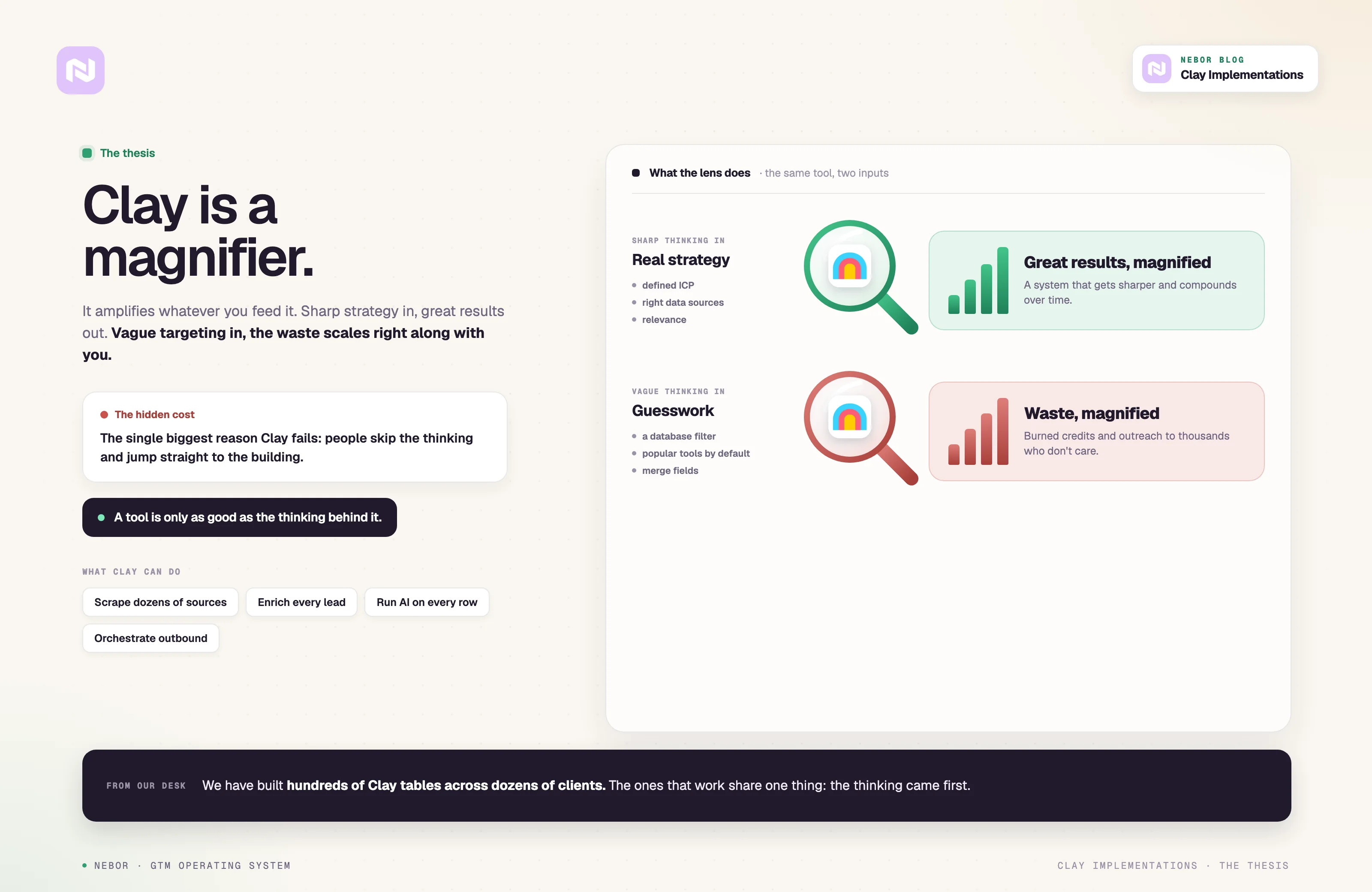
Clay is a tool. A very good one, for that matter. But a tool is only as useful as the thinking behind it. The single biggest reason Clay implementations fail is that people skip the thinking entirely and jump straight to the building.
They sign up, watch a few YouTube tutorials, plug in some enrichment columns, and expect the platform to fix their pipeline.
In this post, we’ll share our experience on why most Clay implementations don’t amount to anything meaningful.
Let’s get started.
TL,DR
Clay helps facilitate and amplify where you’ve already tested and proven effective. If you buy Clay or hire an agency that doesn’t understand the value of strategy or that doesn’t know how to sell (even before Clay) your Clay implementation will most likely fail.
Why buying Clay because everyone on LinkedIn says you should is not a sales strategy
Someone on the sales or RevOps team sees a LinkedIn post about how a company generated 500 leads in a week using Clay.
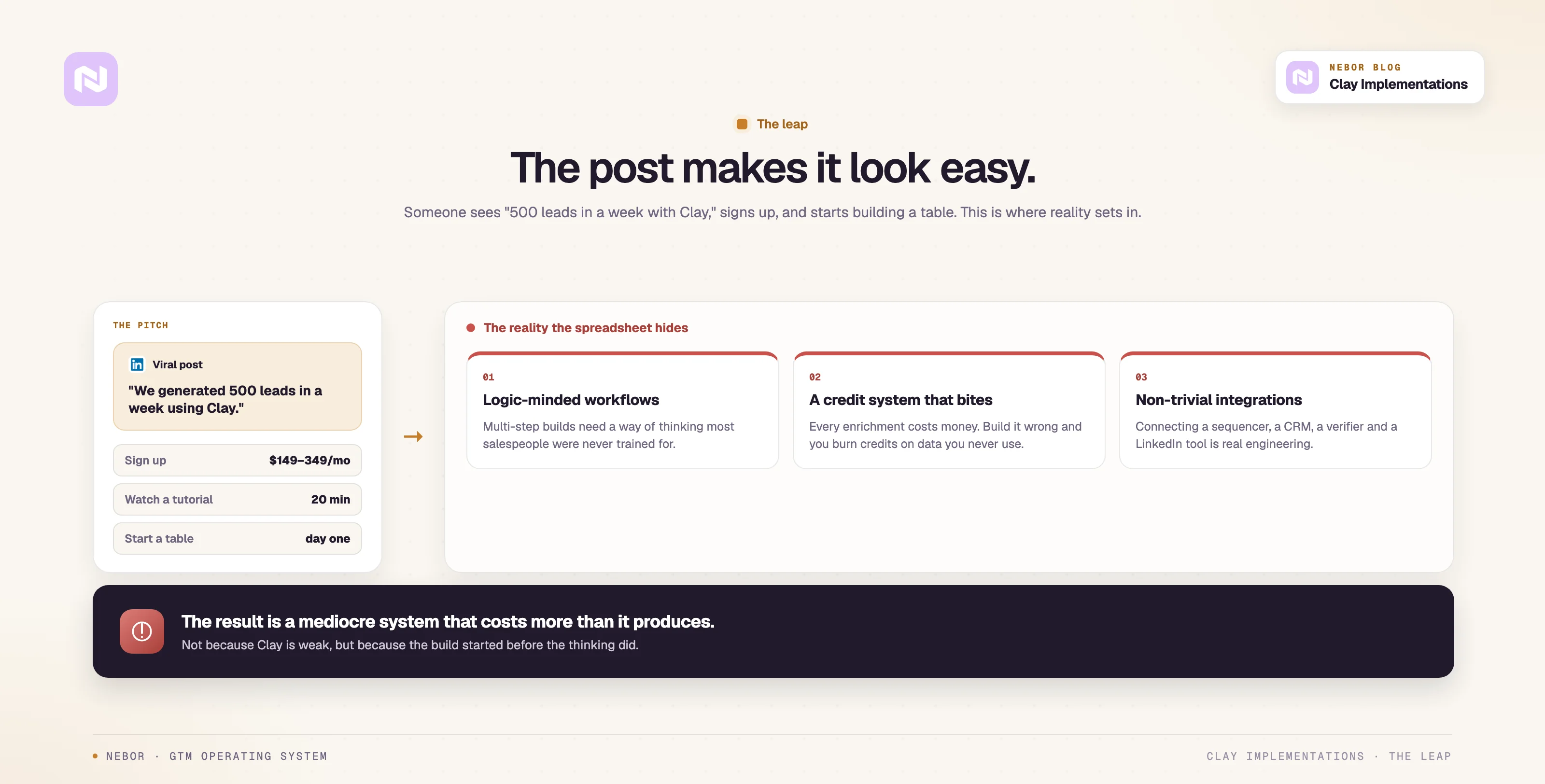
Or they watch a YouTube video showing a slick workflow that scrapes companies, enriches them, writes personalized emails with AI, and pushes everything to an outreach tool automatically. It looks easy and sounds like the answer to their pipeline problems.
So they sign up. Maybe they start on the free tier or jump straight to the $149 or $349/month plan. They start building a table. This is where reality sets in.
The spreadsheet interface looks approachable, but it hides considerable complexity.
First, multi-step workflows require logic-minded thinking that most salespeople aren't trained for.
Second, the credit system means every enrichment costs money, and if you build the workflow wrong, you burn credits on bad data that you'll never use.
Third, you need to connect Clay to other tools (an email sequencer, a CRM, a LinkedIn automation tool, a verification provider) and that integration work is non-trivial. The result is a mediocre system that costs more than it produces.
5 strategy failures that kill Clay implementations before they even get started
After working with dozens of clients who came to us with broken Clay setups, we've seen the same five strategy failures over and over again. None of them are about the tool itself. All of them are about what happens before someone opens Clay.
Failure one: you don't actually know your ICP, so Clay is enriching the wrong people
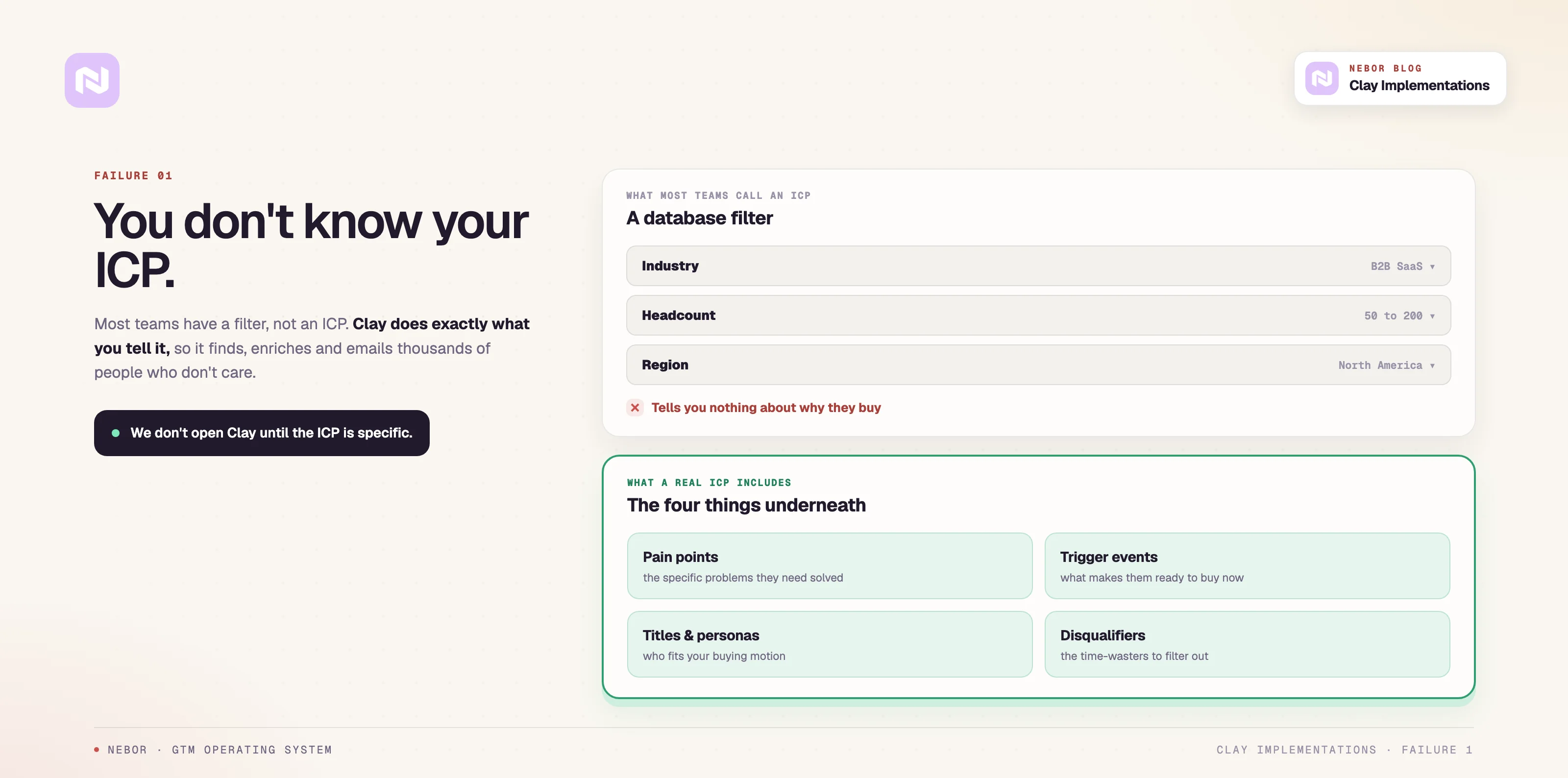
Most companies say they know their ICP, but when you push them, the definition is something like "B2B SaaS companies with 50 to 200 employees." That's not an ICP. That's a filter.
A real ICP definition includes the specific pain points your buyers are trying to solve, the trigger events that make them ready to buy right now, the job titles and personality profiles that fit your buying motion, and the disqualifiers that filter out the time-wasters.
When you don't have this clarity, Clay does exactly what you tell it to. It finds companies matching those broad filters. It enriches them with data. It generates messages based on whatever prompt you wrote.
Then it sends outreach to thousands of people who don't care about what you're selling because you never did the work to figure out who actually does.
Here at Nebor, we don't touch Clay until we've had deep conversations with your team about your business. Why did you start this company?
What specific pain point do you solve? Who are your best customers and what do they have in common?
What does the day-to-day look like for the person who makes the buying decision? How do they currently live without your solution? What triggers make them need your solution right now?
Only after we have clear, specific answers to these questions do we start building anything. Because Clay is a magnifier. If you feed it great targeting, it magnifies great results. If you feed it vague targeting, it magnifies waste.
Failure two: you're using the wrong data sources because you defaulted to the popular ones instead of the right ones
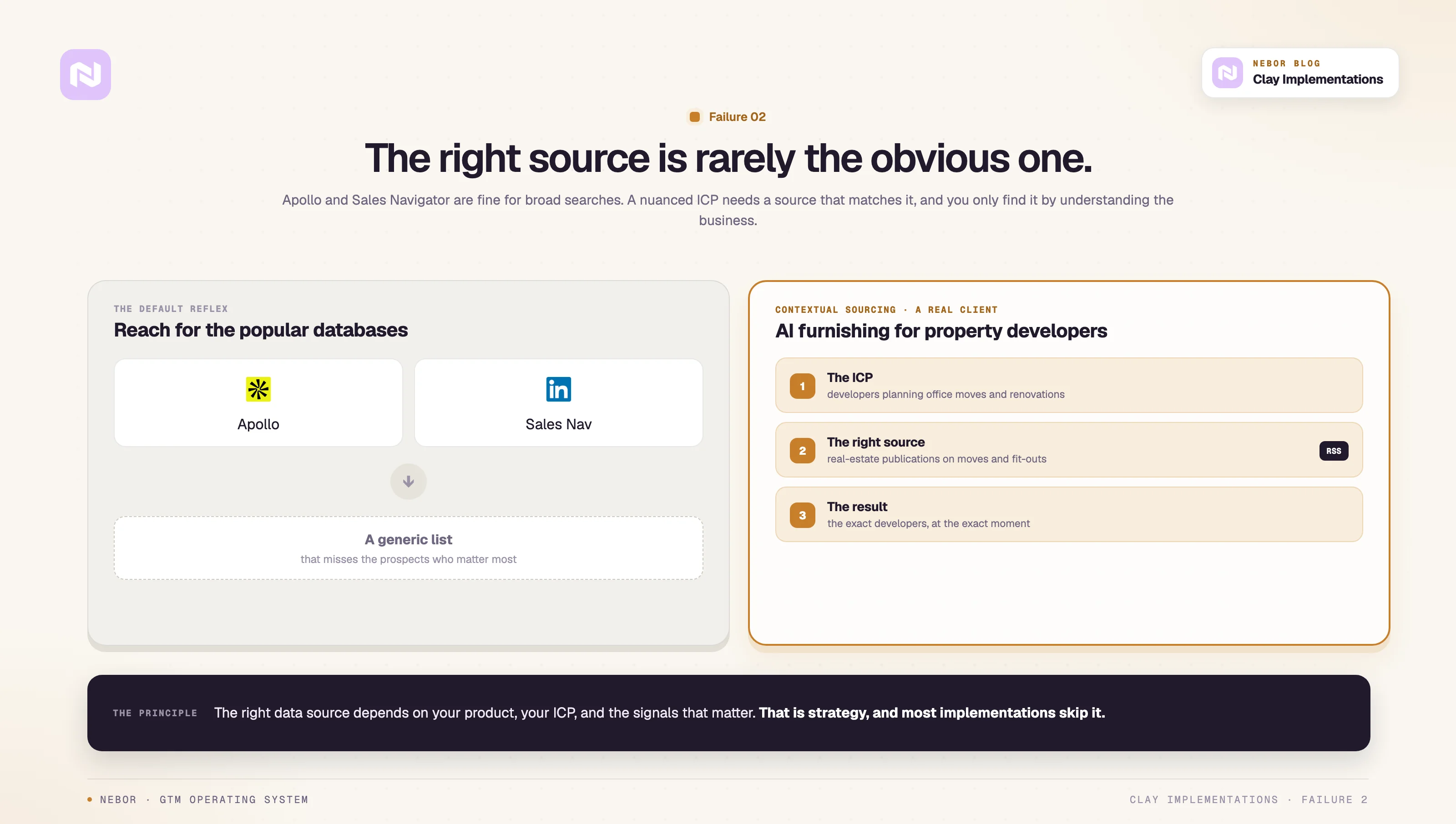
Here's a pattern we see constantly. A team sets up Clay, connects it to Apollo or LinkedIn Sales Navigator, pulls a list of companies matching their basic filters, enriches the contacts, and launches a campaign.
And the results are mediocre. You guessed it right.
The problem isn't that Apollo or Sales Navigator are bad tools. They're fine for broad searches. But if your ICP is even slightly nuanced, those general databases will return generic lists that miss the prospects who matter most.
For one of our clients selling AI-powered furnishing solutions to property developers, the right data source wasn't Apollo. It was RSS feeds from real estate publications that discuss office moves and renovations.
None of these sources will show up when you Google "best B2B data providers." You only find them when you deeply understand the business you're serving and think creatively about where the data actually lives.
The right data source depends on your product, your ICP, and the buying signals that matter for your specific business. Clay can connect to almost anything. But Clay doesn't tell you what to connect to. That's strategy, and most implementations skip it.
Failure three: you're burning Clay credits on enrichment without a plan for what you actually need
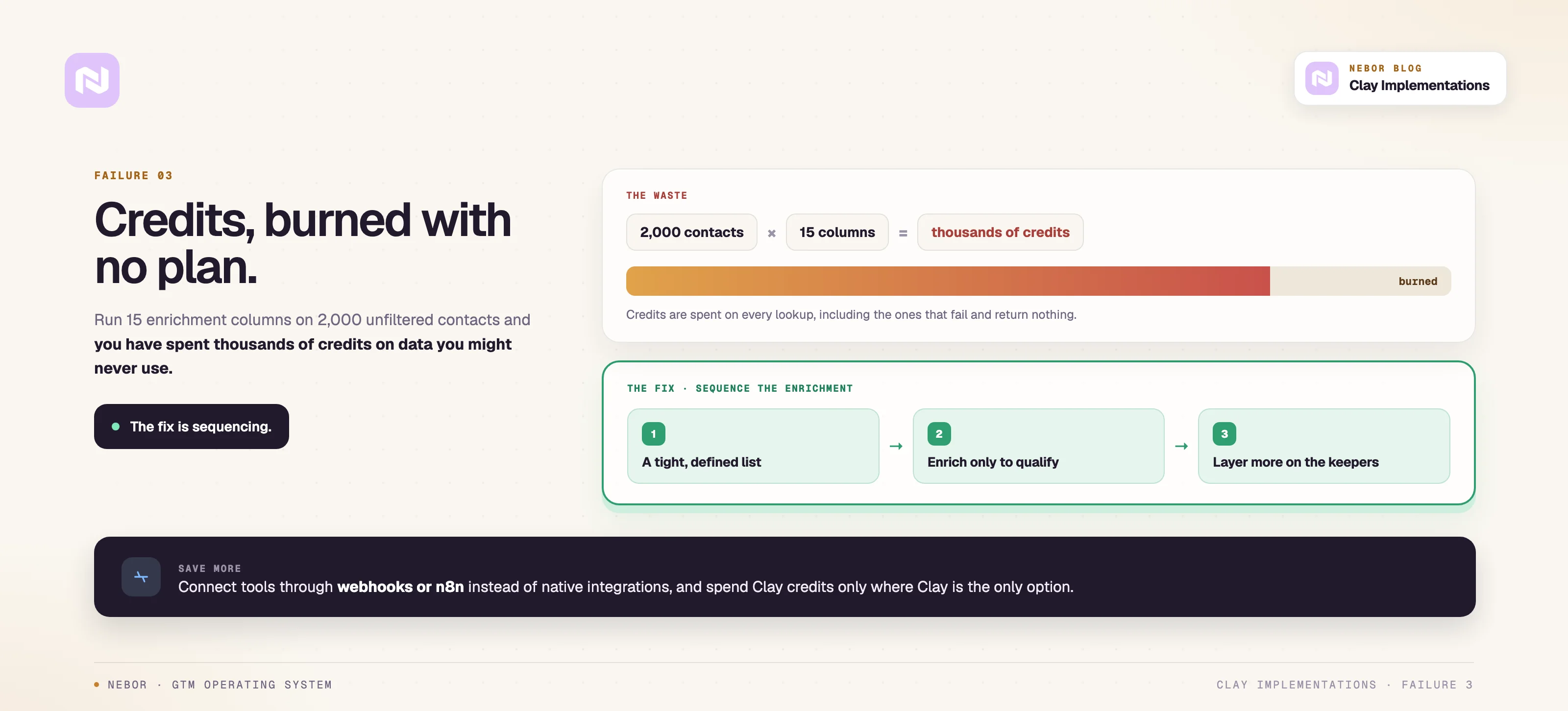
Clay's credit system is one of the most common sources of frustration. Credits get consumed every time you trigger an enrichment, and they get consumed whether the lookup succeeds or fails.
If you build a table with 15 enrichment columns and point it at 2,000 contacts before filtering for quality, you've just burned thousands of credits on data you might never use.
The fix is sequencing. Start with a tight, well-defined list. Enrich only what you need to qualify a lead. Then layer additional enrichment on the qualified subset.
A second common waste is using Clay's native integrations for everything when you could use webhooks instead. Clay's built-in integrations are convenient, but they cost Clay credits.
When you connect the same tool through its own API or through n8n.io webhooks, you pay the tool's own subscription cost (which is usually lower) and save your Clay credits for the enrichments that only Clay can do.
This sounds like a small technical detail, but at scale, it's the difference between a system that's cost-effective and one that bleeds money.
Failure four: your messaging is generic because you automated the writing without automating the thinking
This is the failure that breaks our hearts because it's the one where Clay's AI capabilities get blamed for something that isn't Clay's fault.
Here's what happens. A team sets up a Clay table, enriches their leads, and then adds a column that uses ChatGPT or Claude to generate a personalized email for each lead.
They write a prompt like "Write a cold email to this person based on their company and job title. Make it personalized."
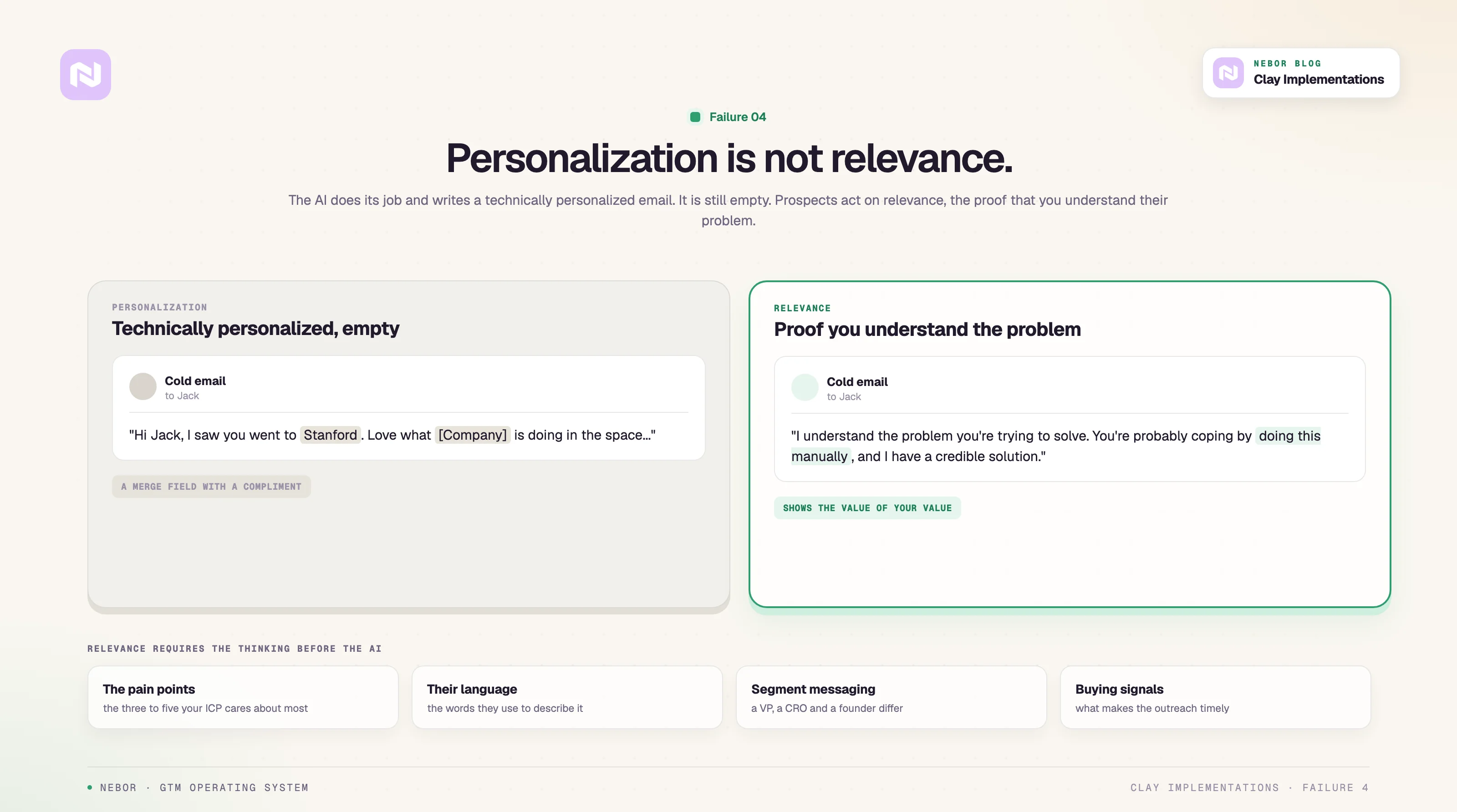
The AI does its job. It generates an email that mentions the company and the title and adds a vaguely complimentary line. The output is technically personalized, but it's empty.
The work we keep telling our clients about isn't really personalization as much as it is relevance. There's a fundamental difference.
Personalization sounds like "Hi Jack, I saw you went to Stanford." Relevance sounds like "I understand the problem you're trying to solve. You're probably coping by doing this, and I have a credible solution."
Prospects care about the latter. It's what shows them the value of your value and makes them act.
Getting relevance right requires strategic work before you touch the AI. You need to understand the pain points your ICP faces. You need to know what language they use to describe those pain points.
You need segment-specific messaging that speaks to different personas differently. You need to identify the buying signals that make your outreach timely.
All of that is strategy. The AI is just the tool that writes it at scale once you've done the thinking.
Failure five: you built a table instead of a system, so nothing connects and nothing compounds
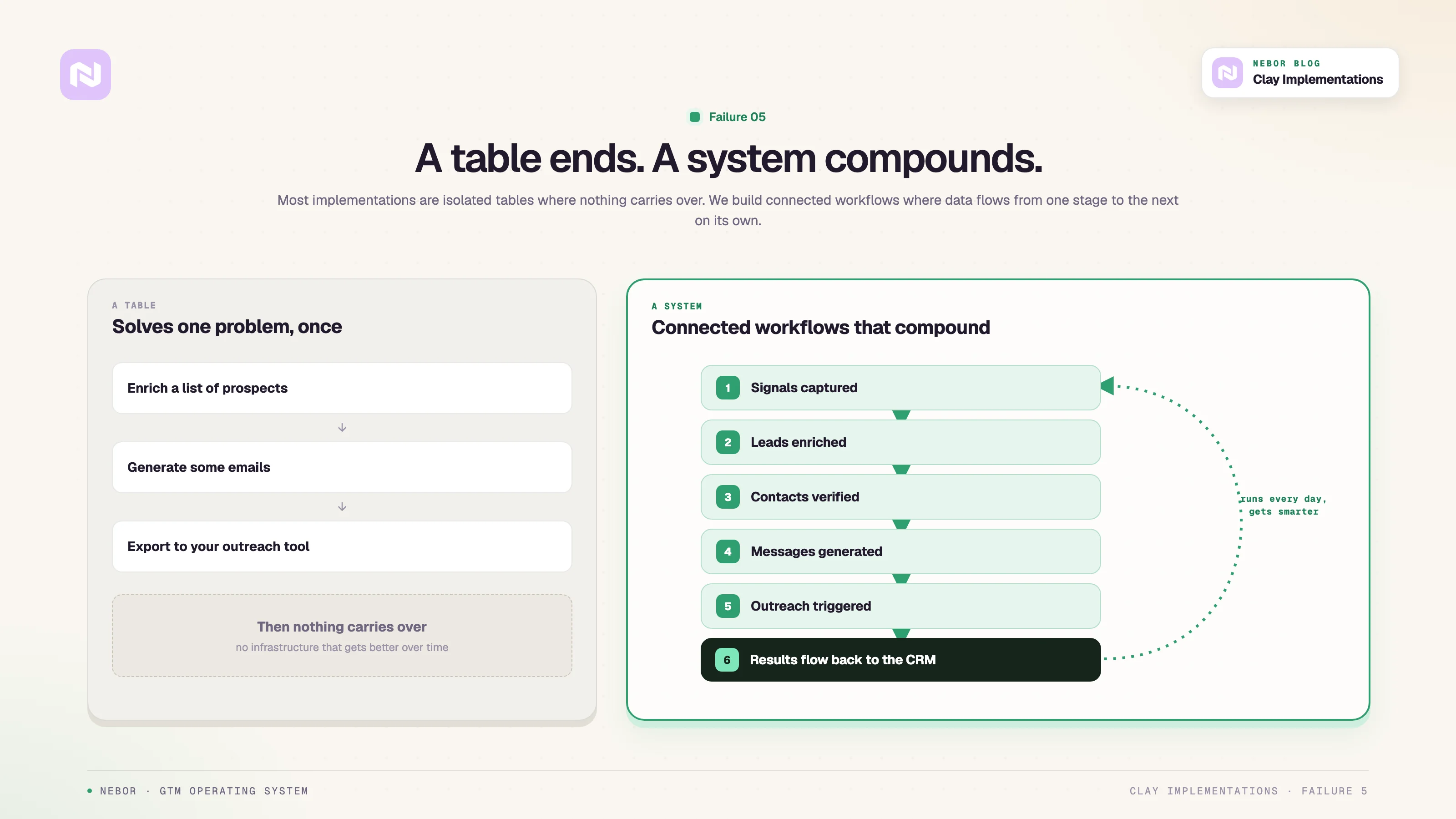
The last failure is the most structural one. Most Clay implementations are isolated tables that solve a single problem.
You enrich a list of prospects. You generate some emails. You export to your outreach tool. Then nothing carries over. There's no infrastructure that gets better over time.
A system is different. A system is a set of connected workflows where data flows from one stage to the next automatically. Think about it this way.
Signals get captured. Leads get enriched. Contacts get verified.
Messages get generated. Outreach gets triggered. Results flow back into the CRM.
The whole thing keeps going continuously, every day, getting more precise and smarter as the data accumulates.
So, as you can imagine, we don't build tables. We build systems.
We connect Clay to your CRM (HubSpot, Salesforce, Pipedrive, or whatever CRM you use) so that every lead, every interaction, and every signal is visible in one place.
We connect inbound data (website visitors, LinkedIn engagement, form submissions) to the same Clay infrastructure that powers outbound. We set up signal-based workflows that work on autopilot and compound over time. And we make sure the whole thing is documented, maintainable, and operated by your team.
What Clay actually needs from you before it can deliver real results
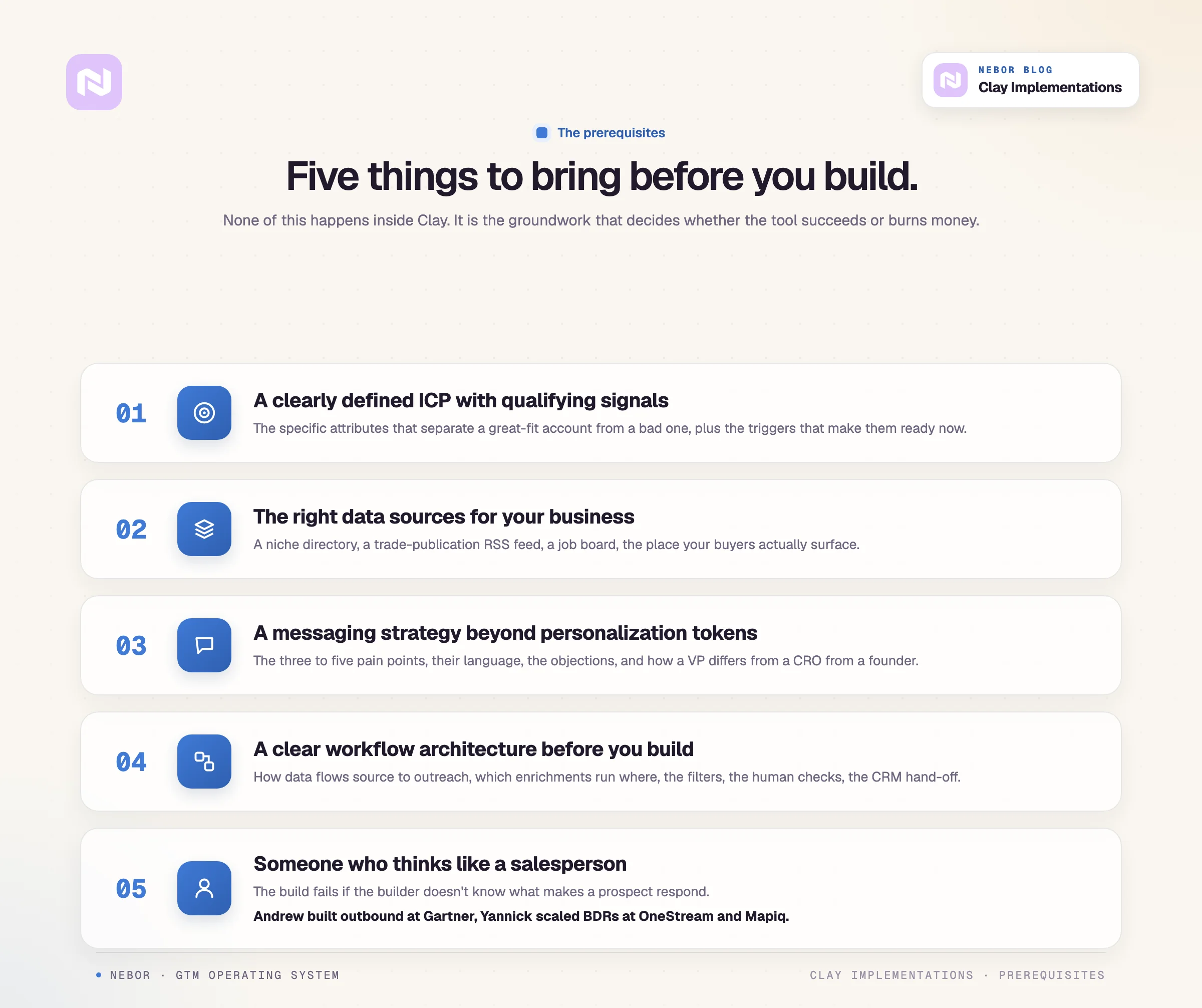
If you want Clay to actually work for your business, here's what you need to bring before you open the platform.
You need a clearly defined ICP with specific qualifying signals
Start by forgetting about filters like "mid-market SaaS companies." You need to know what your best customers have in common.
What triggers make them need your solution? What does the day-to-day look like for the person who buys? What are the specific, measurable attributes that distinguish a great-fit account from a bad one?
This work takes hours and sometimes days. It requires interviewing your founders, your sales team, your customer success team. You need to analyze your existing customer data and think deeply about why your product exists and who it truly serves.
You need to identify the right data sources for your specific business
The best data source for your business is not always Apollo or LinkedIn. It could be a niche industry directory, an RSS feed from a trade publication, a job posting board, or a public database specific to your ICP's industry.
Finding the right data sources requires creativity and domain knowledge. It's not something you figure out by reading Clay's documentation.
You need a messaging strategy that goes beyond personalization tokens
Before you write a single AI prompt in Clay, you need to know the three to five pain points your ICP cares about most. What language do they use? What offers resonate?
What objections do they have? How should messaging differ for a VP of Sales versus a CRO versus a founder?
This is copywriting and sales strategy work, and it has to happen before you automate anything.
You need a clear workflow architecture before you start building
How will your data flow from source to outreach? What enrichments will happen at what stage?
What filters will determine which leads proceed and which get dropped? Where will human approval steps make sense?
How will the system connect to your CRM? Where will the results go?
Mapping this out before you build prevents the spaghetti of disconnected tables that plagues most implementations.
You need someone who thinks like a salesperson and not just like an automator
This is the point that matters most. The best Clay implementation in the world fails if the person who built it doesn't understand sales.
You need to make sure they understand what makes a prospect respond, how deal cycles work, and what information a sales rep actually needs to have a productive conversation.
At Nebor, our team includes people who've spent over a decade in B2B sales before they ever touched Clay. Andrew spent years building outbound systems at Gartner. Yannick scaled BDR teams at OneStream and Mapiq. That sales experience shapes everything we build.
Why buying more sales tools never solves the problem (and what actually does)
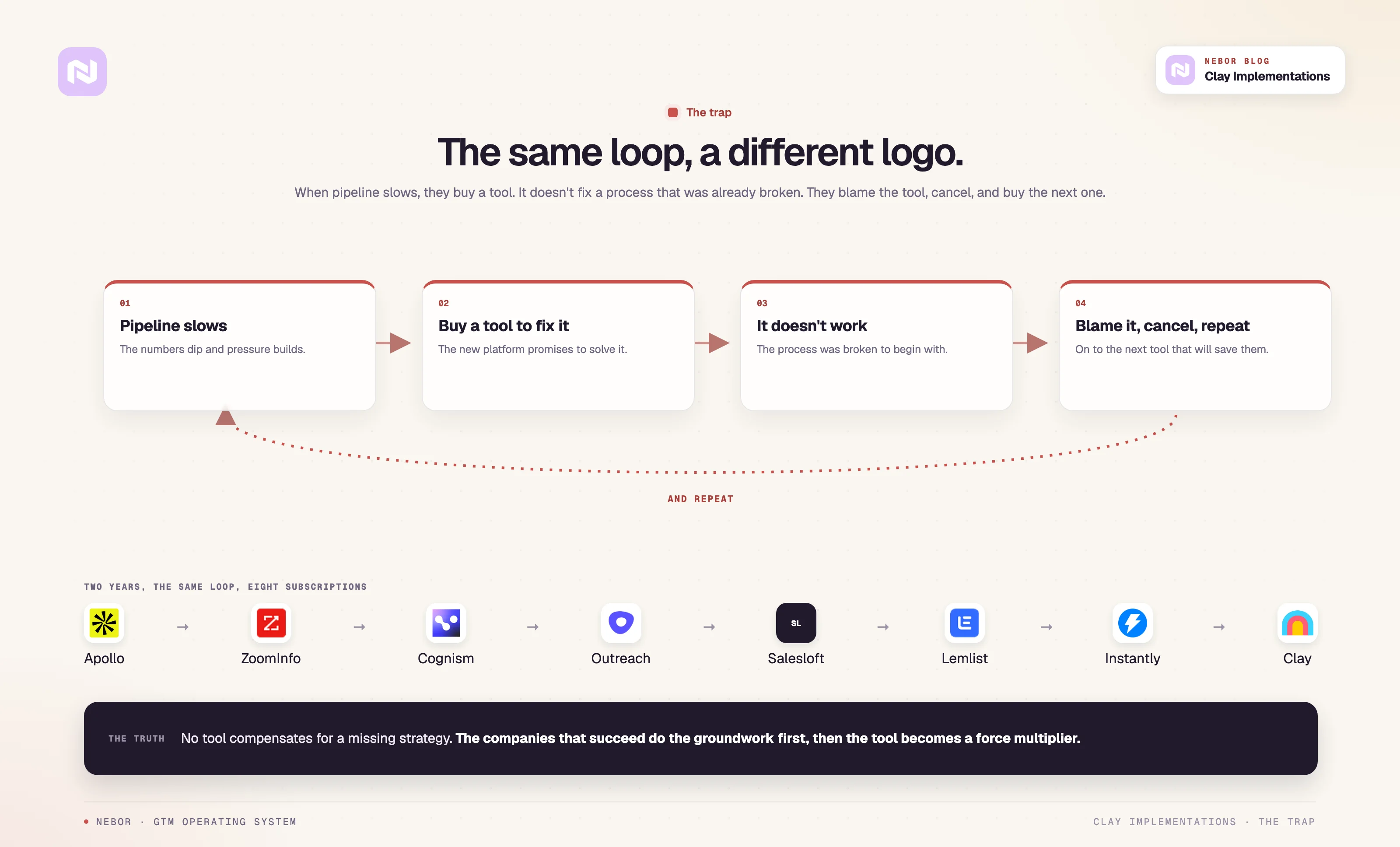
Let's zoom out from Clay for a moment because this point applies to every sales tool on the market.
Companies with broken sales processes have a pattern. When their pipeline slows down, they buy a tool to fix it. The tool doesn't fix it because the process was broken to begin with. They blame the tool, cancel, and buy a different one. Repeat.
We've seen companies cycle through Apollo, ZoomInfo, Cognism, Outreach, Salesloft, Lemlist, Instantly, and Clay, all within a couple of years.
Each time, they're looking for the tool that will finally make outbound work. Each time, they're disappointed because no tool can compensate for a lack of strategy. We wrote a longer piece on the broader sales tech stack and how to think about layering tools without burning money on shelfware.
The companies that actually succeed with Clay, or with any sales AI tool, are the ones that do the ground work first. They define their ICP with precision. They map their total addressable market. They identify the buying signals that matter.
They know what data sources to pull from and why. They have a messaging strategy that goes beyond merge fields. They build connected workflows, not isolated tables.
When you have all of that, Clay becomes a force multiplier. When you don't, it becomes another tool that burns money without producing results.
How Nebor approaches Clay differently from every other Clay agency
There are plenty of Clay agencies on the market. Most of them are technical implementers. They know the platform inside out, they can build complex workflows, and they can configure integrations efficiently. That's valuable.
But that's not what we do.
The difference isn't that we know Clay better than they do. Many of them are outstanding technically. The difference is what we do before we open Clay.
We start with your business. We want to understand why you started this company.
What your best customers look like. What makes someone buy today versus in six months. What triggers create urgency.
What your sales team's actual workflow looks like day to day. Where the bottlenecks are. Where the leaks are. What intelligence would make the biggest difference for your reps.
Only after that conversation do we design the system. And the system isn't just Clay.
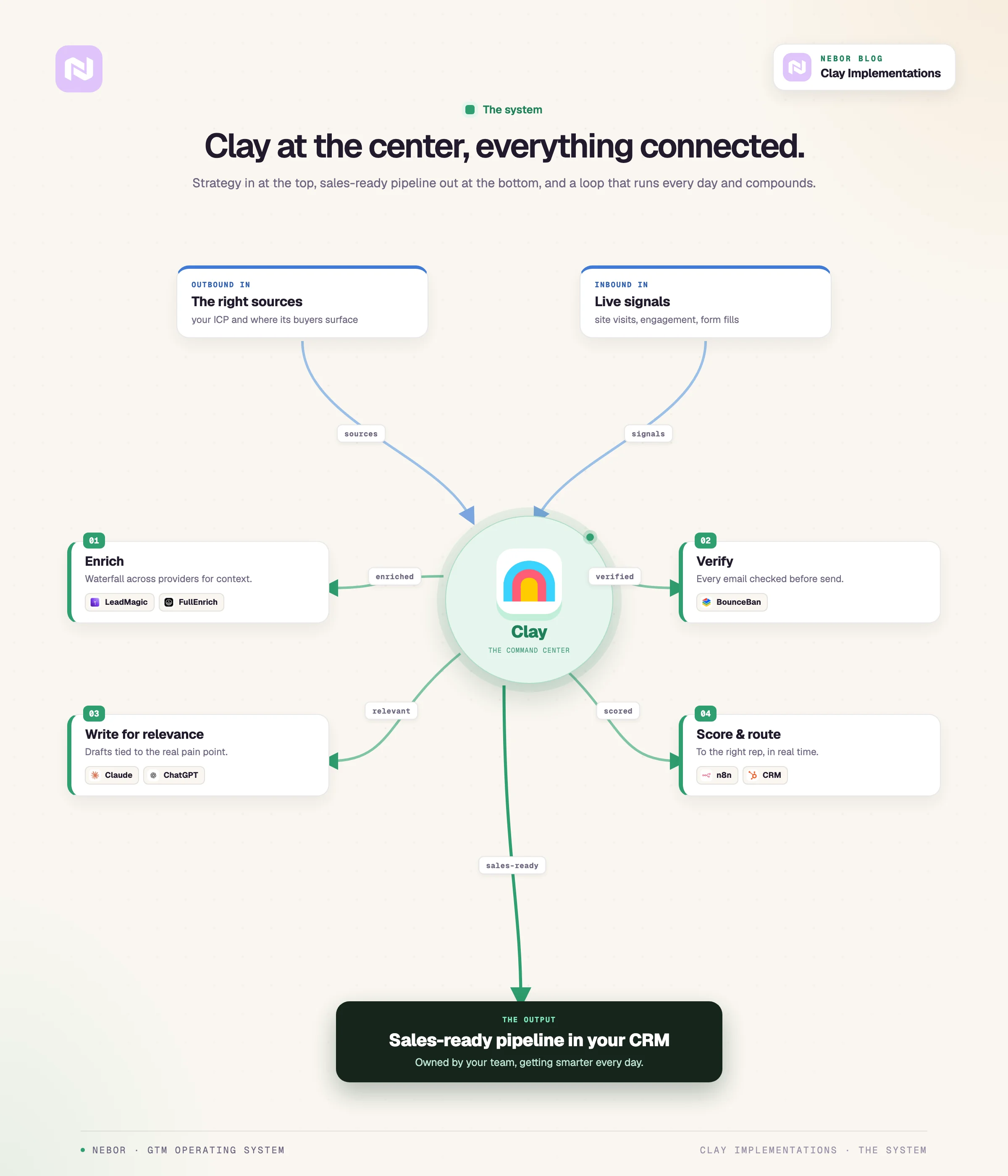
It's Clay connected to your CRM and RevOps infrastructure, to your marketing and demand generation data. It's Clay powering signal-based campaigns that work on autopilot, enriching inbound leads in real time and routing them to the right rep with full context.
We operate across three connected pillars. Sales and GTM execution, account-based growth and demand generation, and CRM and revenue operations.
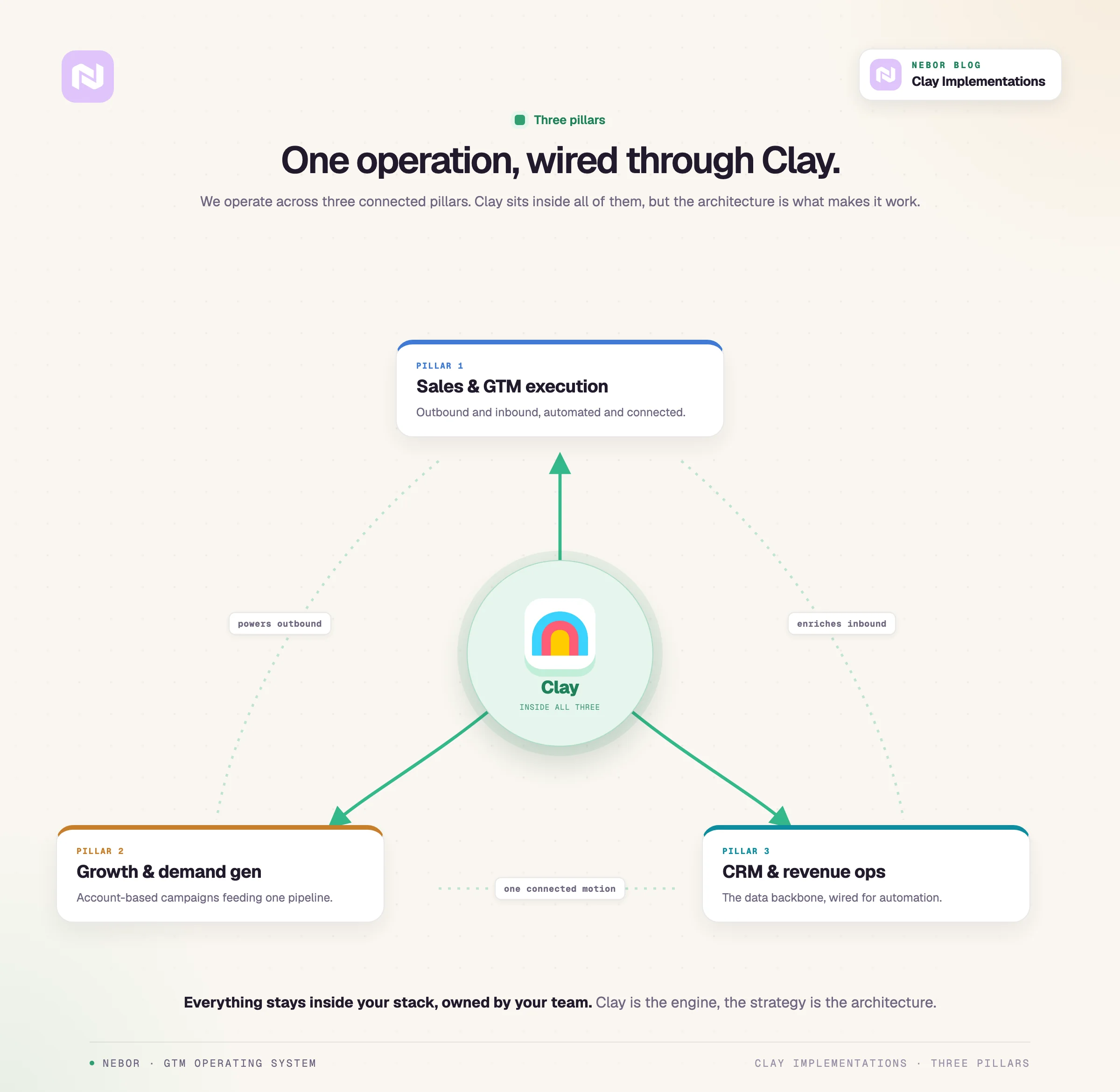
Clay is inside all three, but it's the strategic architecture that makes it work, not the tool itself.
Most Clay agencies are the first kind. The expert who uses Clay. We're the second.
Hire Nebor to build the Clay-powered system your business actually needs
Clay is an incredible tool. We use it every day. We've built our entire service model around it. And we know from years of experience that it only works when the strategy is right.
If you've tried Clay and it didn't work, the tool probably wasn't the problem. If you're thinking about buying Clay, don't start with the tool.
Start with the questions that determine whether the tool will succeed. Who are you really selling to? What signals indicate they're ready to buy? How should your entire revenue operation work as one connected system?
That's the conversation we want to have with you.
We build Clay-powered growth infrastructure. And everything stays inside your stack, owned by your team. If you want a Clay implementation that actually works, book a 15-minute call and let's figure out what your system should look like.


Related Articles


By clicking Sign Up you're confirming that you agree with our Terms and Conditions.