

In this post:
A rep doing outreach by hand spends most of the day on admin. Remembering who to follow up with, sending each message, logging every call, and deciding what to do next eats the hours that should go to selling.
A sales engagement platform exists to take that burden off them.
It's the software layer that carries out the outreach itself. Rather than storing records like a CRM, it executes the day-to-day activity of reaching prospects, so a rep can work far more accounts without drowning in the mechanics.
A sales engagement platform is software that automates and tracks multi-channel outreach, working sequences across email, phone, and social while logging every interaction. It handles the execution of prospecting so reps spend less time on busywork and more on conversations.
The category earns its place because outreach at any real scale is impossible to manage manually. Once a rep is working hundreds of prospects across several channels, only a system can keep the sequences, timing, and follow-ups straight.
TL;DR
A sales engagement platform automates and tracks multi-channel outreach, sending sequences across email, phone, and social and logging every touch.
It executes activity instead of storing records, which is the key difference from a CRM, so the two work together instead of competing.
It exists because outreach at scale can't be done by hand, because no rep can track hundreds of prospects and sequences across channels manually.
Its value depends on the fundamentals underneath, so a platform amplifies good targeting and messaging but only multiplies the damage of bad ones.
What a sales engagement platform does for a rep's working day
A sales engagement platform handles the mechanics of outreach so a rep doesn't have to. It turns a scattered manual process into a managed, automated flow.
It delivers the multi-step outreach sequences themselves. The platform executes multi-step outreach across channels, sending each touch on schedule so a rep isn't manually remembering who to contact when.
It tracks prospect engagement as it happens. Opens, clicks, replies, and calls are all recorded, so the rep sees who's engaging and can focus attention where it counts.
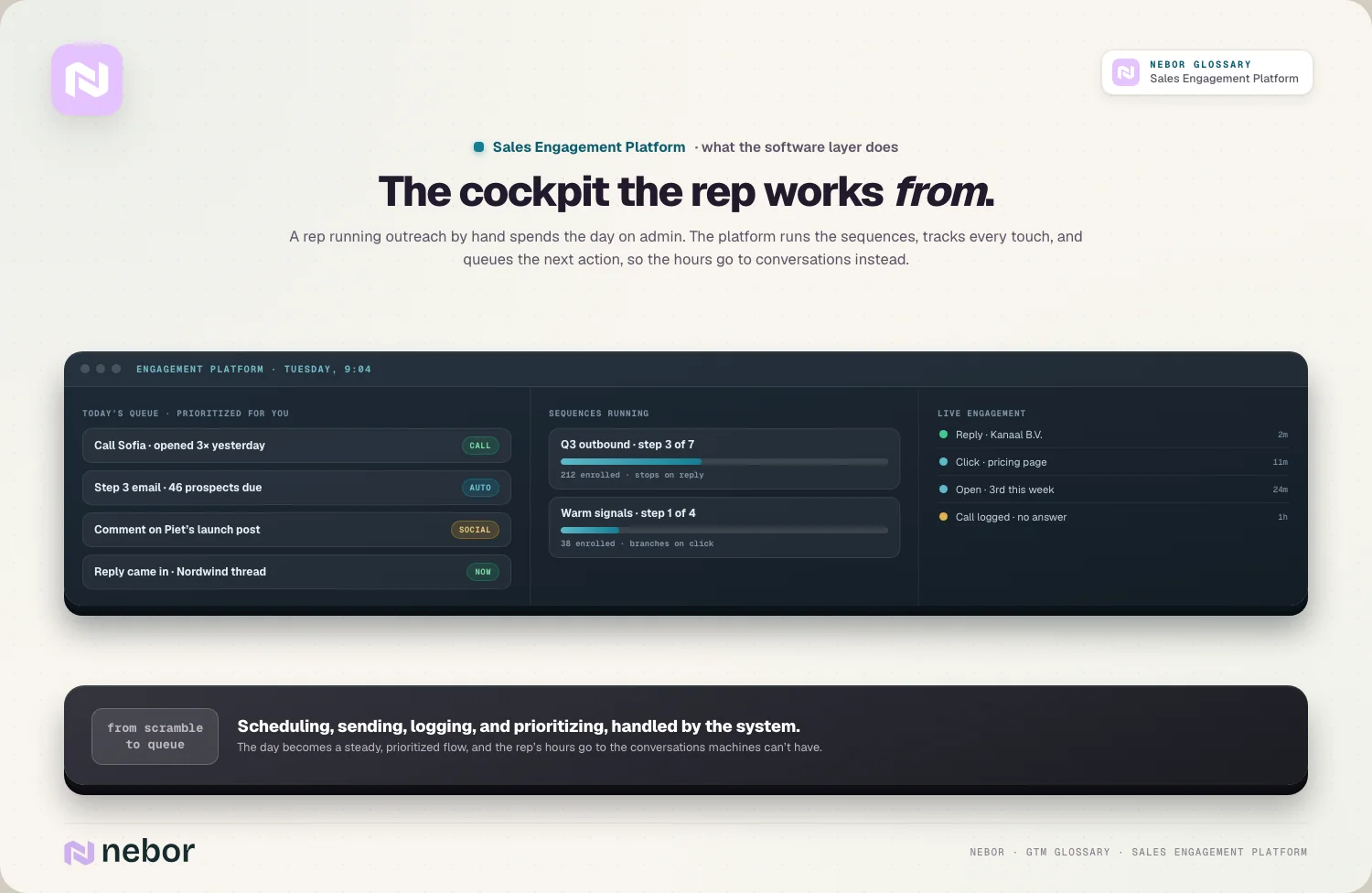
It surfaces the next action for each rep. Rather than a rep deciding what to do next on their own, the platform queues the priority tasks for them, so the day is organized around the highest-value moves.
So a sales engagement platform is the cockpit a rep works from. It handles the scheduling, sending, and tracking, which frees the rep to spend their time on the conversations that machines can't have.
The shift it creates is from reactive to organized, and we watch it change how teams work within weeks. Instead of a rep scrambling to remember tasks, the platform presents a clear queue each day, so the work becomes a steady, prioritized flow instead of a scramble.
How a sales engagement platform differs from your CRM in practice
The most common confusion about these platforms is how they relate to a CRM. The two do different jobs, and precision about the distinction saves confusion.
A CRM stores the records of your deals. It holds your contacts, deals, and account history, acting as the system of record for the whole relationship.
A sales engagement platform executes the activity instead. It drives the outreach that moves those contacts through the pipeline, doing the work instead of filing the results.
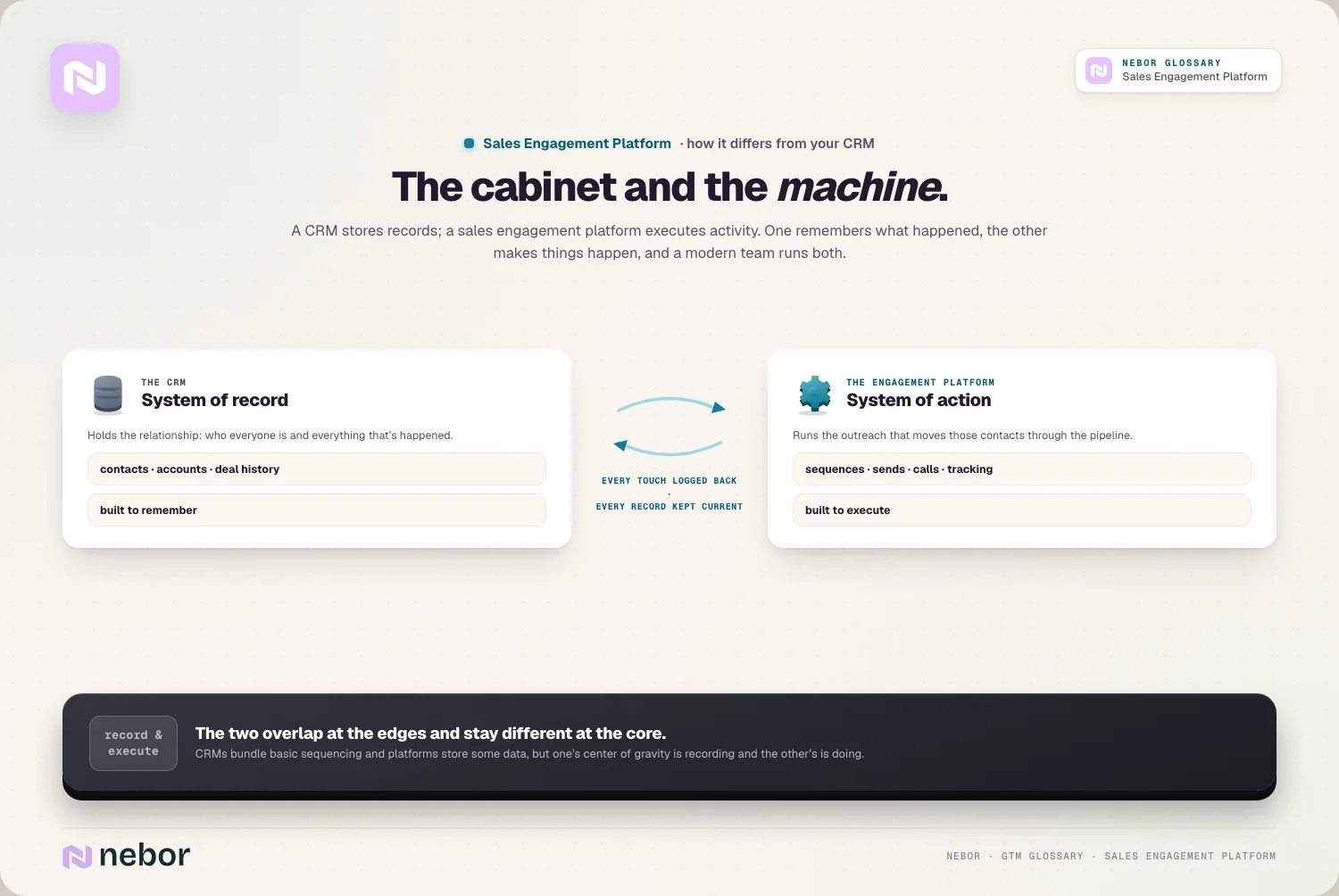
The two systems sync with each other constantly. The platform logs every touch back into the CRM, so the record stays current while the platform handles the doing, and that split is why they complement each other.
So a CRM is the filing cabinet and a sales engagement platform is the machine that acts. One remembers what happened, the other makes things happen, and a modern sales team almost always uses both.
The confusion is understandable because they overlap. Many CRMs now bundle basic sequencing, and many platforms store some contact data, but their center of gravity stays different, with the CRM built to record and the platform built to execute.
Why manual outreach falls apart at any real level of sending volume
The reason this category exists comes down to the limits of doing outreach by hand. Manual effort breaks the moment volume rises.
Tracking becomes impossible to do by hand. A rep working hundreds of prospects across email, phone, and social can't remember who's due for which touch, so follow-ups slip through the cracks.
Consistency is the first thing to collapse under that load. Without a system enforcing the sequence, each prospect gets a slightly different, ad hoc experience, and the disciplined follow-up that wins replies disappears.
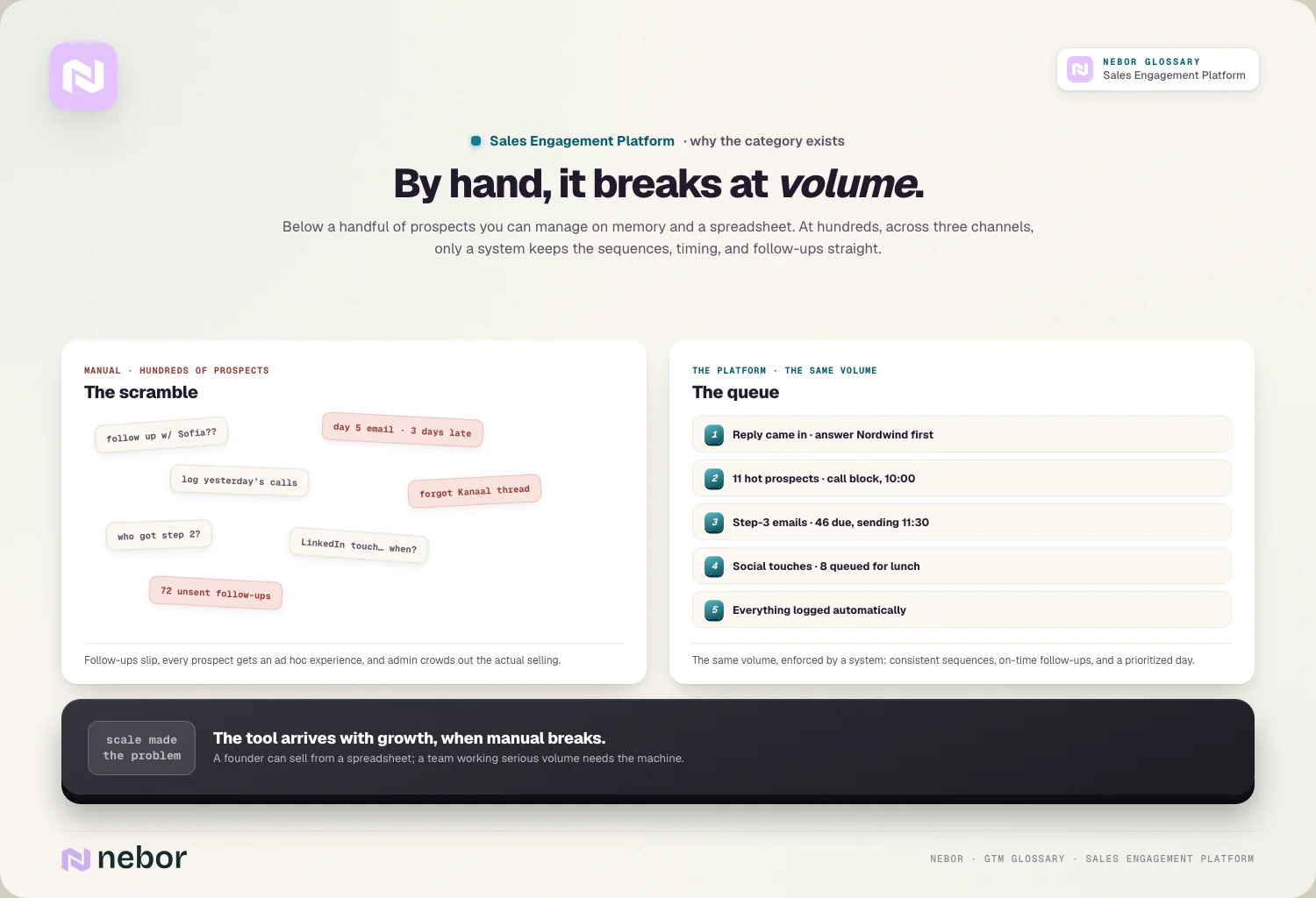
Admin work crowds out the actual selling. The time spent sending and logging by hand is time not spent in conversations, so manual outreach caps how much a rep can accomplish.
So a sales engagement platform solves a problem that scale creates. Below a handful of prospects you can manage by hand, but real volume needs a system, and the platform exists to provide it.
This is why the tool tends to arrive with growth, and we tell clients to expect the need before it bites. A single founder selling can get by on a spreadsheet, but the moment a team is working serious volume, the manual approach breaks and a platform becomes necessary instead of optional.
How automated sequences are the very heart of the platform
The core feature of any sales engagement platform is the sequence, and understanding it explains most of what the category does. Everything else in the platform exists to make sequences work well.
A sequence is a planned series of touches, and in our experience it's the feature teams get the most from. It lays out the steps, the channels, and the timing, so each prospect moves through a deliberate sales cadence built from a proven email sequence instead of a random set of contacts.
The platform executes each scheduled step automatically. Once a prospect is enrolled, the platform sends each step on schedule and stops when they reply, so the persistence happens without manual tracking.
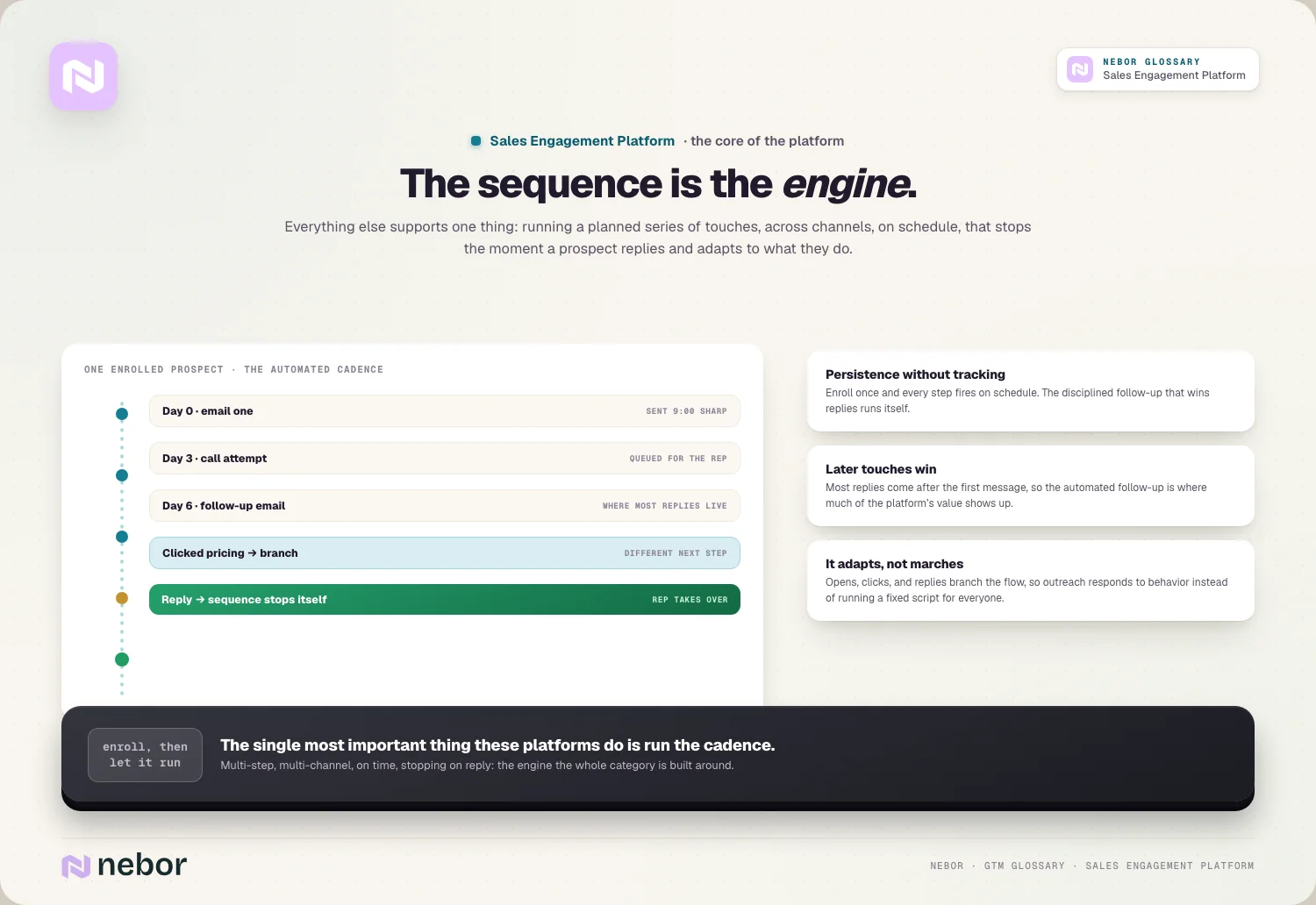
It handles the follow-ups where most replies live. Since most replies come from later touches, the platform's automated follow-up sequence is where much of its value shows up.
So the sequence is the engine and the platform is what keeps it moving. Automating the multi-step, multi-channel follow-up is the single most important thing these platforms do.
Good platforms also branch the sequence on behavior. Based on whether a prospect opens, clicks, or replies, the flow can send different next steps, so the outreach adapts to behavior instead of marching through a fixed script for everyone.
How a sales engagement platform relates to broader sales automation
A sales engagement platform is one expression of a broader idea, and placing it helps. It's a focused slice of automation aimed at outreach.
It's a focused form of sales automation. The platform automates the repetitive parts of prospecting, which is the heart of what sales automation broadly means.
It focuses on the engagement layer specifically. Where sales automation can cover many tasks, a sales engagement platform concentrates on the outreach and follow-up that engage prospects directly.
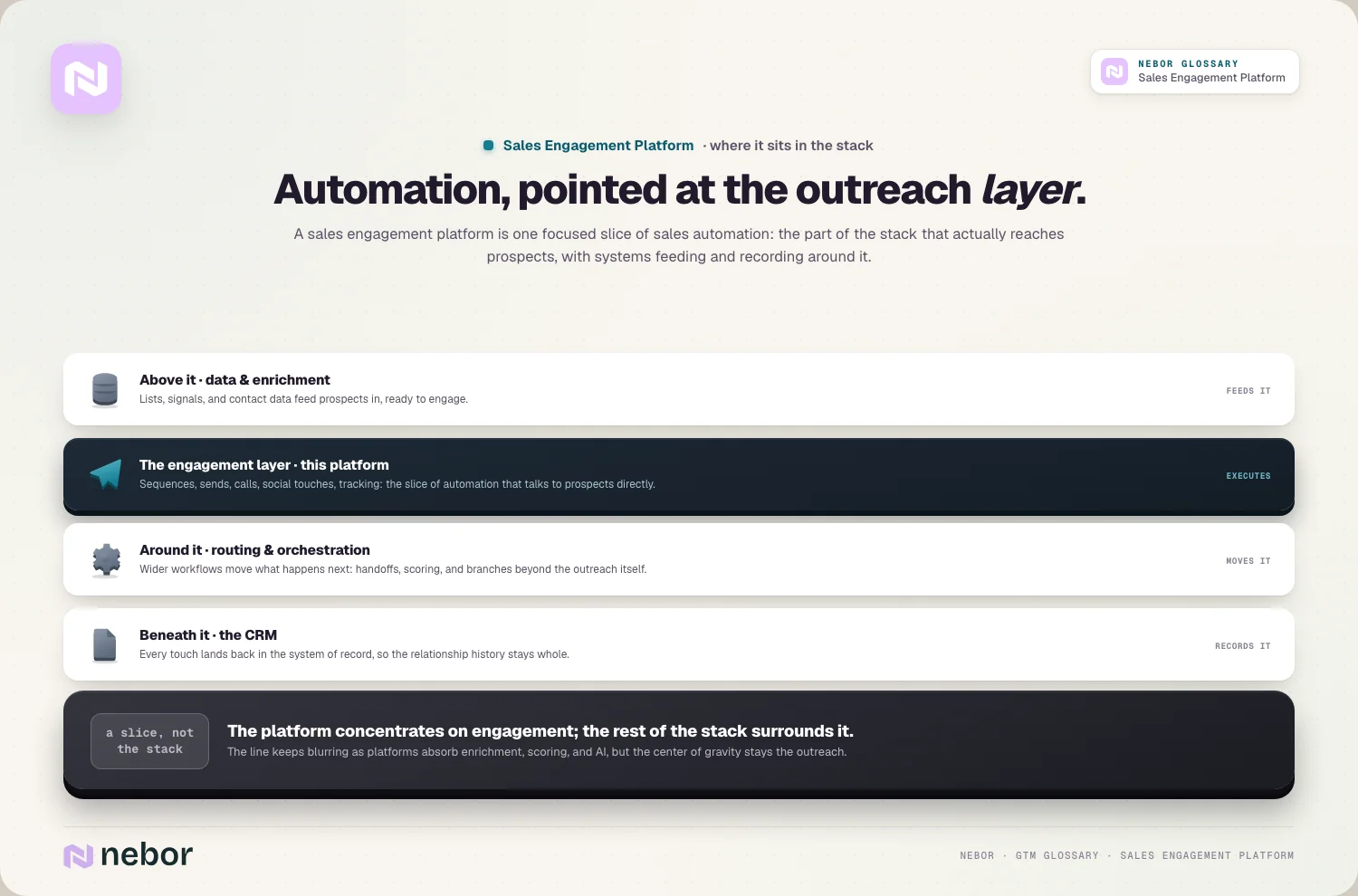
It often connects into wider automated flows. The platform is one piece of a larger workflow orchestration that spans data, enrichment, and routing around it.
So a sales engagement platform is automation pointed at the outreach layer. It's the part of the automated stack that reaches prospects directly, working alongside the systems that feed and support it.
The line between these categories keeps blurring. As platforms add enrichment, scoring, and AI, they increasingly reach into territory that once belonged to separate tools, so what counts as a sales engagement platform is steadily widening.
Why a platform amplifies your fundamentals instead of fixing them
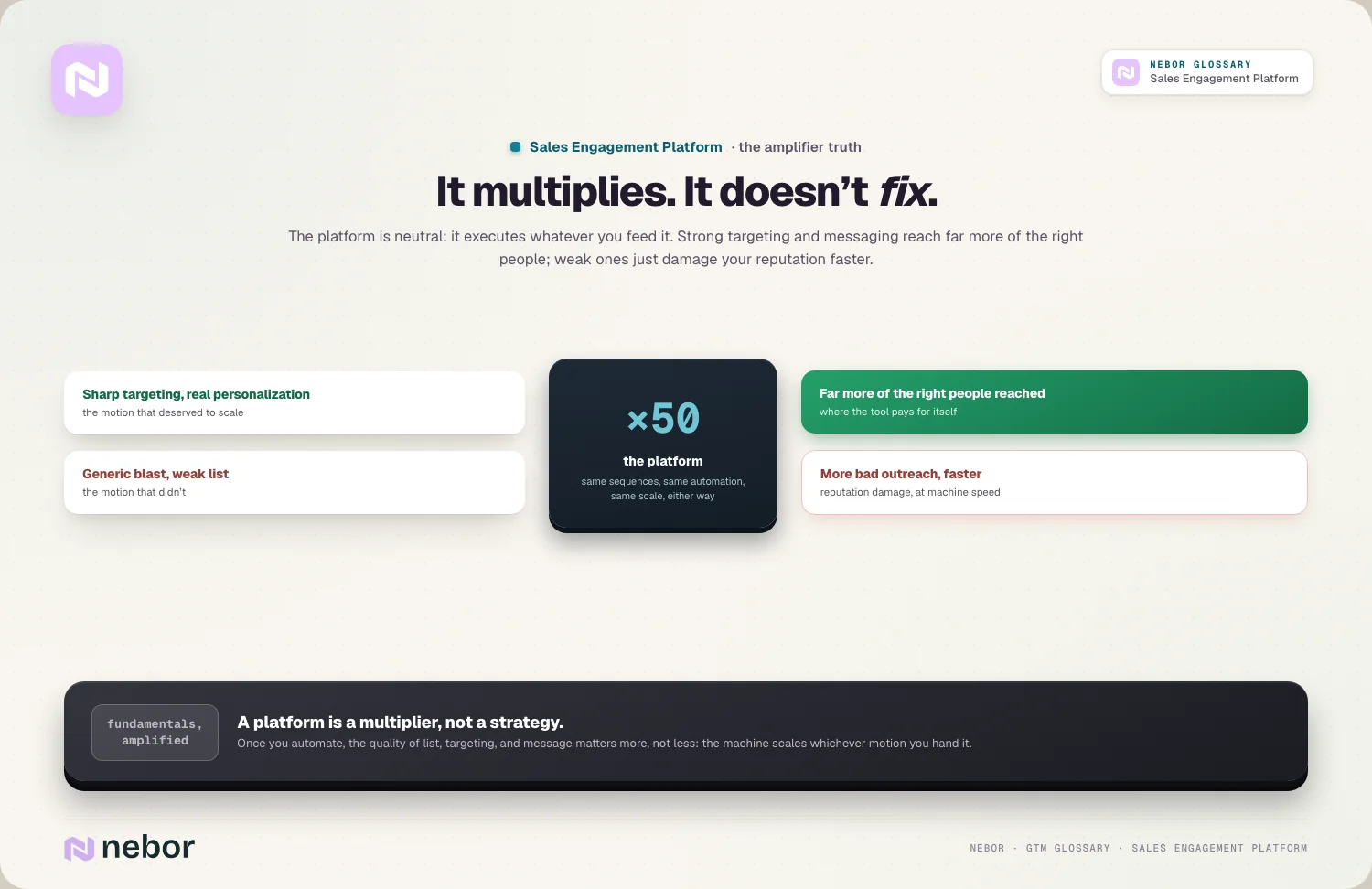
An essential truth about these platforms is that they multiply whatever you put into them. The tool doesn't fix a weak approach, it scales it.
Good inputs get amplified with perfect faithfulness. Strong targeting and sharp messaging, pushed through a platform, reach far more of the right people, which is where the tool pays off.
Bad inputs get amplified just as faithfully. Poor targeting or generic messaging, automated at scale, just sends more bad outreach faster, which damages your reputation more quickly.
The platform itself stays entirely neutral about quality. It executes whatever you give it, so the quality of your list, your personalization at scale, and your messaging still decides the outcome.
So a sales engagement platform is a multiplier instead of a strategy. It makes a good motion bigger and a bad motion worse, so the fundamentals matter even more once you automate.
How engagement tracking changes the way reps prioritize their day
Beyond sending, the tracking side of these platforms reshapes how reps spend their attention. Seeing who engages turns a flat list into a ranked one.
It reveals prospect interest as it forms. Knowing who opened, clicked, or replied tells a rep which prospects are warming up, so they can focus on the ones showing signs of life.
It lifts the metrics that really matter. Watching the reply rate per sequence and step shows what's working, so reps and managers can sharpen the approach.
It catches the right moment to act. Real-time signals like a prospect revisiting your site let a rep reach out when interest peaks, which is far more effective than a scheduled touch.
So tracking turns outreach from a broadcast into a responsive process. The platform tells you where to aim next as well as sending, and that guidance is what makes limited rep time go further.
The same data rolls up for managers. Aggregate engagement numbers show which sequences and messages perform, so a team can improve its whole approach instead of leaving each rep to guess in isolation.
How a sales engagement platform keeps your CRM clean as it works
An underrated benefit of these platforms is what they do for your data. Automatic logging keeps the system of record accurate without manual effort.
It logs every touch without being asked. The platform records each email, call, and reply back to the CRM, so the account history stays complete without a rep typing it in.
It protects your data quality without any effort. Because logging is automatic, the CRM hygiene that manual entry constantly erodes stays intact, which keeps reporting trustworthy.
It saves your reps' time twice over. Reps skip both the manual sending and the manual logging, so the platform frees hours on each end of every interaction.
So the platform maintains your data while it works. The same automation that sends outreach also keeps the CRM current, which is a benefit that compounds across a whole team.
Where sales engagement platforms are heading in the age of AI
The category is shifting quickly, and the direction matters for how these platforms are used. AI is moving them from tools reps drive to systems that act more on their own.
Sequences are getting steadily more autonomous each year. Newer platforms can adjust outreach based on real-time buyer behavior, so the sequence reacts instead of following a fixed script.
Scoring is moving earlier in the flow. Predictive analytics increasingly rank leads before they engage, so the platform points reps at the best prospects from the start.
Content is increasingly generated inside the platform. Programmatic message generation lets the platform draft outreach at scale, which shifts the rep's job toward editing and judgment.
So the platform is evolving from a rep's tool toward a semi-autonomous engine. The human role moves up the stack to strategy and oversight, while the system handles more of the execution.
How a sales engagement platform supports multi-channel outreach
A defining strength of these platforms is that they coordinate across channels instead of just automating email. That coordination is what makes modern outreach coherent.
It pulls several channels into one flow. A single sequence can weave email, calls, and social touches together, so multi-channel outreach lands as one coordinated motion instead of separate efforts.
It keeps all the channels in sync. Because the platform tracks every touch in one place, a rep isn't emailing someone who just replied on another channel, which keeps the outreach coherent.
It applies consistent timing across all of them. The platform spaces touches sensibly across channels, so a prospect experiences a deliberate rhythm instead of a scattered pile of contacts.
So the platform turns many channels into a single orchestrated sequence. Coordinating them by hand is nearly impossible at scale, and that difficulty is a large part of why the category exists.
The common mistakes teams make with a sales engagement platform
These platforms get misused in a few predictable ways, and each undercuts their value. Avoiding them is what makes the investment pay off.
The biggest is automating a bad motion. Pointing a platform at poor targeting or weak messaging just scales the failure, so the fundamentals have to come first.
Another is over-automating away the human touch. Blasting every prospect with the same sequence, with no personalization, produces the generic outreach that gets ignored.
A third is chasing volume over quality. Using the platform to send more instead of send better burns your reputation and trains prospects to tune you out.
The last is ignoring the deliverability underneath entirely. Automating high volume without proper sending infrastructure lands your messages in spam, so the platform's output never reaches anyone.
Why a sales engagement platform is a multiplier worth using well
The right way to see a sales engagement platform, and the framing we give clients, is as a force multiplier on your outreach, valuable only to the degree the motion underneath it is sound. It scales effort while leaving the judgment to you.
It removes the old ceiling on volume. By automating the mechanics, the platform lets a rep work far more accounts than they ever could by hand, which is its core promise.
It rewards a strong foundation more than anything else. Because it amplifies whatever you feed it, a platform pays off most for teams with sharp targeting, good data, and relevant messaging.
It keeps the human where humans matter. By handling the busywork, it frees reps for the conversations and judgment that actually close deals.
A sound motion underneath is what makes a sales engagement platform one of the core tools in a modern go-to-market system. It's the execution layer that lets a team automate sales prospecting without losing the relevance that makes outreach work.
Share this post
Sequences
Outbound
Glossary
Related glossary items
Understanding the core GTM concepts


Ready to build your pipeline











