

In this post:
Most companies have all the parts of a revenue engine without having an engine. Marketing launches campaigns, sales works deals, customer success handles accounts, and each does its own thing in its own tools.
The pieces are there, but they don't connect. Leads fall through gaps between teams, data lives in separate systems, and nobody can say with confidence what will produce revenue next quarter.
A revenue engine is the connected system of people, processes, data, and technology across marketing, sales, and customer success that works together to generate revenue predictably. It treats the whole customer journey as one machine instead of separate departments.
That word predictably is the heart of it. A real revenue engine doesn't just produce revenue, it produces it in a way you can forecast, repeat, and improve, because the parts are wired into one working system.
TL;DR
A revenue engine is the unified system across marketing, sales, and customer success, including the people, processes, data, and tools, that turns inputs into revenue in a repeatable, predictable way.
Scattered tactics produce unpredictable results, because when teams operate in silos, growth is lumpy and hard to forecast, while a connected engine makes revenue a structural outcome instead of a lucky one.
Building one means aligning the whole funnel around shared data, shared metrics, and a smooth handoff from one stage to the next, so each part feeds the one after it.
The part that surprises people is that an engine is a system rather than a tool you buy. It takes deliberate design across teams, and that's the reason so many companies own all the components and still don't have a working engine.
So what is a revenue engine, exactly, and what counts as one?
A revenue engine is the full system a company uses to generate revenue, viewed as one connected whole. It spans every function that touches the customer journey, with sales as just one part.
It has four kinds of parts working in concert. There are people across marketing, sales, and customer success, the processes they follow, the data they share, and the technology that ties it all together.
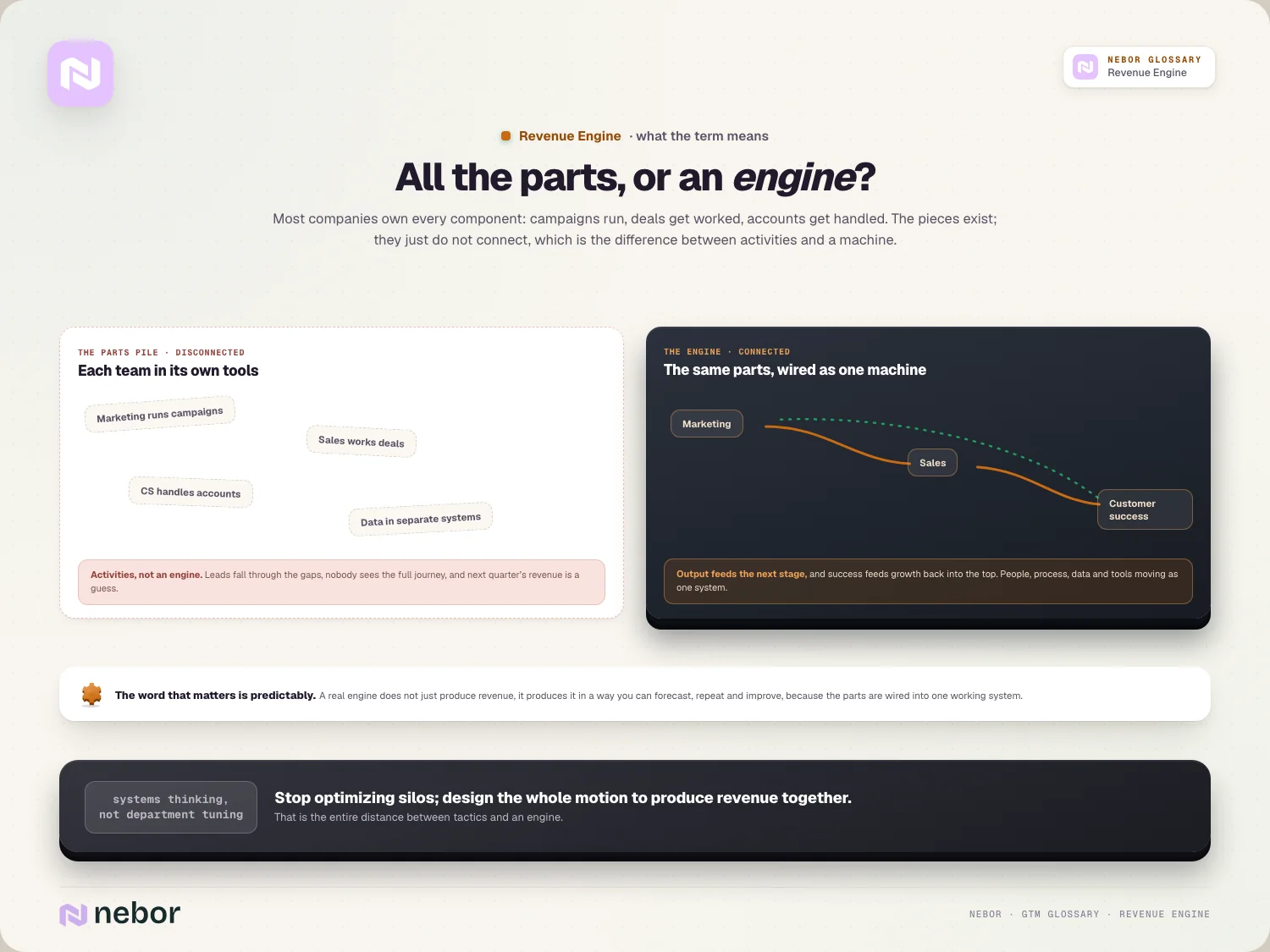
The defining trait is that these parts work together. Marketing's output flows cleanly into sales, sales feeds customer success, and customer success feeds back into growth, so the whole thing moves as one.
That's what separates an engine from a pile of tactics. A company can buy ads, send outbound, and onboard customers, but without connection between them, it has activities instead of an engine.
So the term is really about systems thinking. A revenue engine is what you get when you stop optimizing departments in isolation and start designing the whole motion to produce revenue together.
Why do scattered tactics keep failing to produce predictable growth?
The problem a revenue engine solves deserves spelling out, because most companies live inside that problem, and in our experience disconnected tactics create the same failure modes everywhere.
Leakage does the most visible damage, because when teams hand off through gaps instead of a smooth process, leads get dropped, follow-up lags, and good opportunities die between departments.
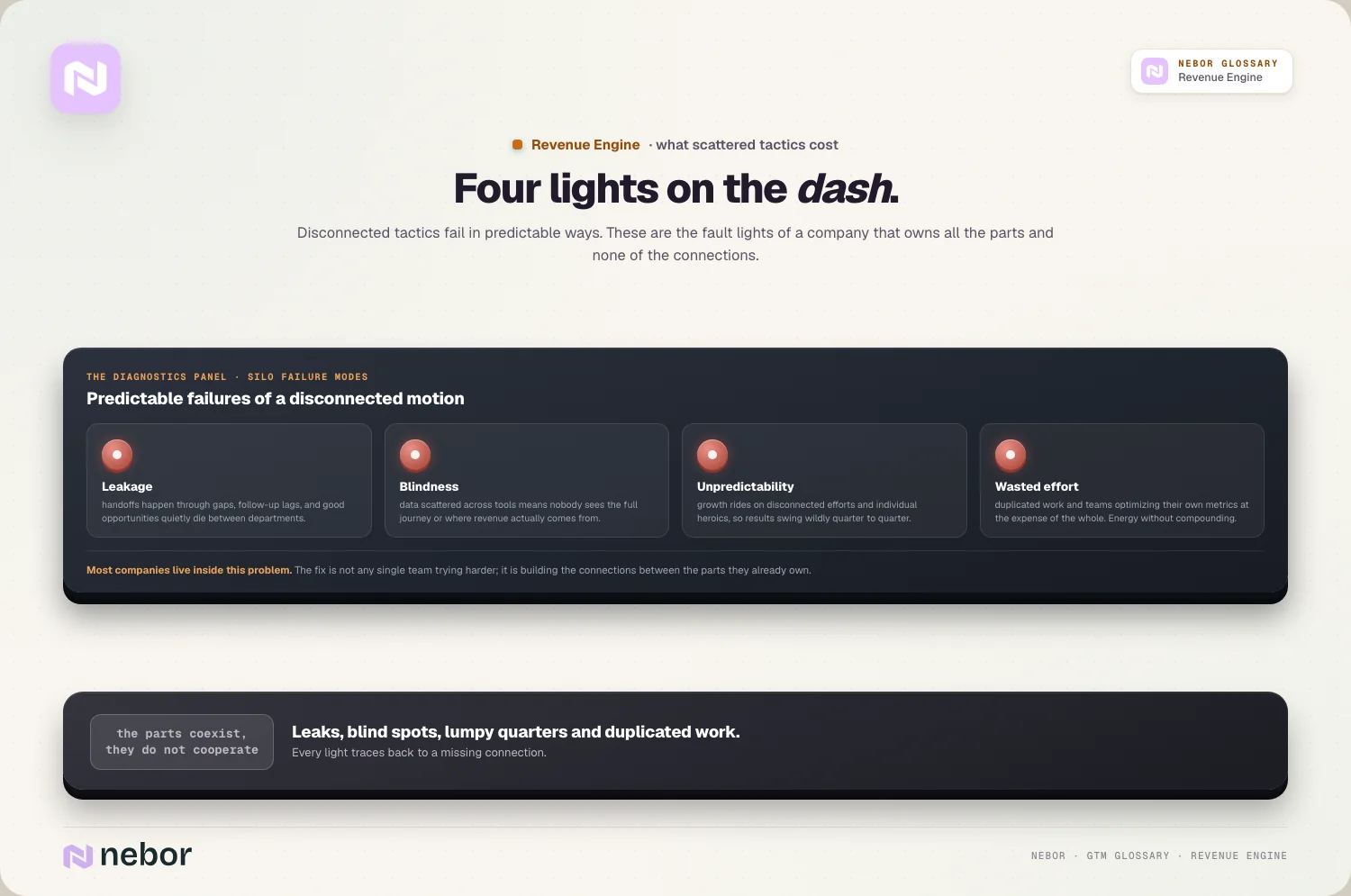
Blindness follows from the silos, because with data scattered across separate tools, nobody sees the full journey, so you can't tell what's working or where revenue really comes from.
Unpredictability is the one leadership feels, because when growth depends on disconnected efforts and individual heroics, results swing wildly quarter to quarter and forecasting becomes guesswork.
And wasted effort quietly taxes everything, because teams duplicate work, optimize for their own metrics at the expense of the whole, and pull in different directions, so a lot of energy produces little compounding result.
How does a revenue engine make your growth predictable in practice?
Predictability is the real promise of a revenue engine, so it deserves a closer look. It comes from structure instead of from trying harder.
When the parts connect, inputs reliably produce outputs. You can see that a certain amount of pipeline at a known pipeline velocity tends to produce a certain amount of revenue, which makes forecasting real.
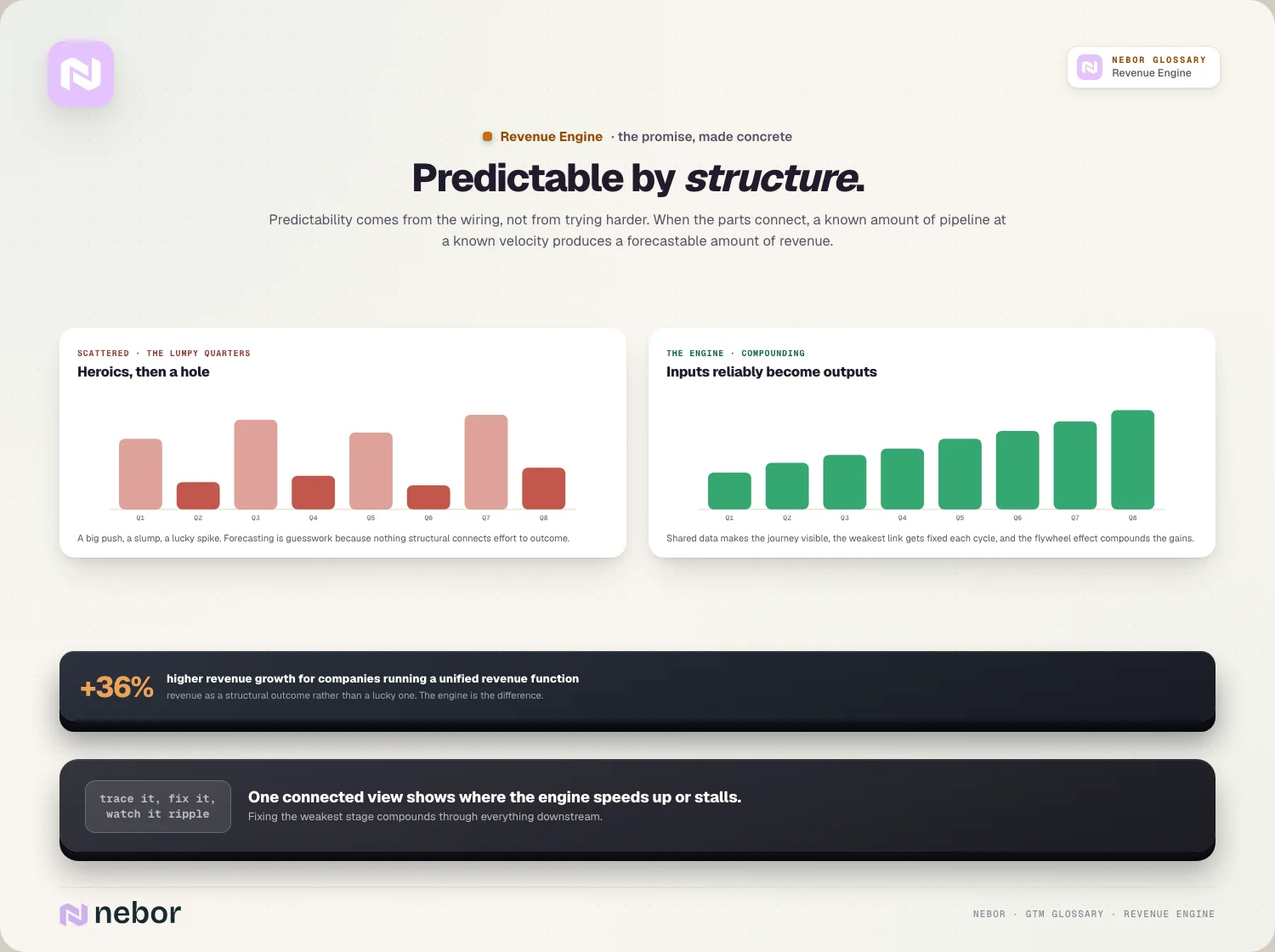
Shared data is what makes this visible. With one connected view of the journey, you can trace how a lead becomes a customer and where the engine speeds up or stalls.
It compounds on top of that, because a working engine improves over time as each part feeds the next and you fix the weakest link, which is the idea behind a GTM flywheel.
The result is that revenue becomes a structural outcome. The evidence points the same direction, with companies that have a unified revenue function reporting around 36% higher revenue growth than those without one.
How is a revenue engine related to the RevOps function behind it?
People often use revenue engine and RevOps in the same breath, so separating them is useful, because they're closely linked without being identical.
Revenue operations is the function and discipline that builds and maintains the engine. It's the team and operating model that aligns marketing, sales, and customer success around shared data and processes.
The revenue engine is what that discipline produces. RevOps is the practice of engineering it, and the engine is the working machine that results from doing RevOps well.
This is why RevOps has grown so fast. Gartner expects around 75% of high-growth B2B companies to adopt a formal RevOps model by 2026, precisely because it's how you build a predictable engine.
A simple picture holds the whole relationship. If the revenue engine is the car, RevOps is the engineering and maintenance that keeps it working and getting faster.
What are the core parts every working revenue engine has to include?
A revenue engine has a few essential layers, and each has to be in place for the whole thing to work. Skipping one leaves a gap that drags the rest.
The foundation is clarity on who you serve. A sharp ideal customer profile aims the entire engine, because everything downstream wastes effort if you target the wrong people.
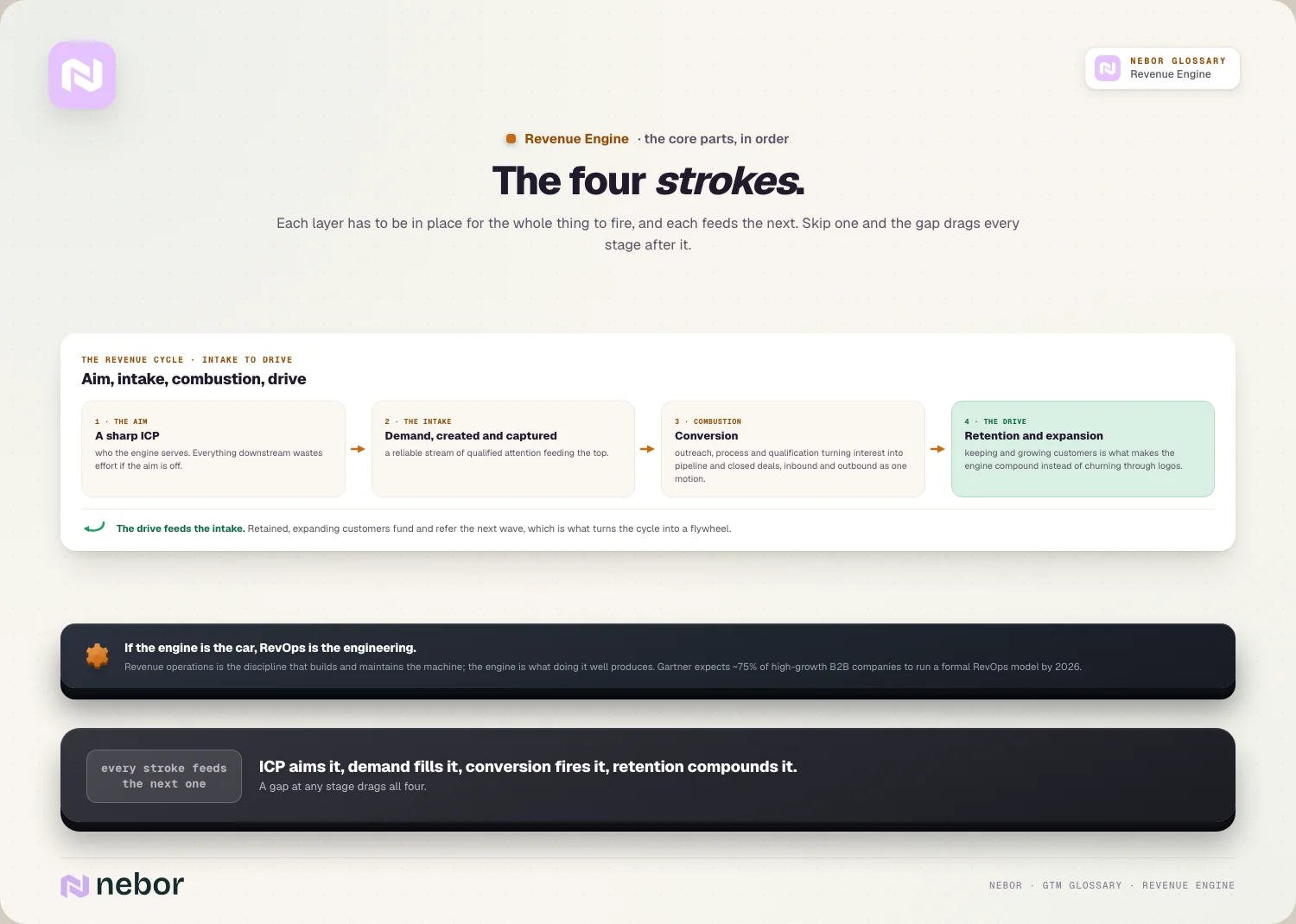
Demand comes next in the stack of layers. The engine needs a reliable way to create and capture interest, which is the job of demand generation feeding qualified attention into the top.
Then comes the conversion layer, where outreach, sales process, and qualification turn that interest into pipeline and closed deals, often blending inbound and outbound into one motion.
Retention and expansion finish the set of layers. Keeping and growing your customers, measured by net revenue retention, is what makes the engine compound instead of just churning through new logos.
Why is the technology stack the plumbing and never the engine itself?
Technology doesn't make a revenue engine on its own, but the engine can't work without it. The tools are the plumbing that lets data and work flow between the parts.
This is your GTM stack, the connected set of tools that handle data, outreach, CRM, and analytics. When they're wired together, information moves cleanly through the engine.
The danger is mistaking tools for the system. Buying more software doesn't create an engine, and a stack of disconnected tools can add friction instead of removing it.
What ties the stack into a real engine is the craft of connecting it. That's the work of GTM engineering, building the integrations and automations that make the parts act as one.
When the wiring is in place, the stack lets you automate sales prospecting and much of the repetitive work, so the engine keeps going continuously instead of depending on manual effort at every step.
How do you build a revenue engine in an order that holds together?
Building an engine is a design project more than a purchase, and we walk clients through it in a deliberate order, layer by layer.
Start with strategy before any tools enter the picture. Define who you serve, what motion fits, and how the funnel should flow, which is the work of a clear go-to-market strategy before anything gets automated.
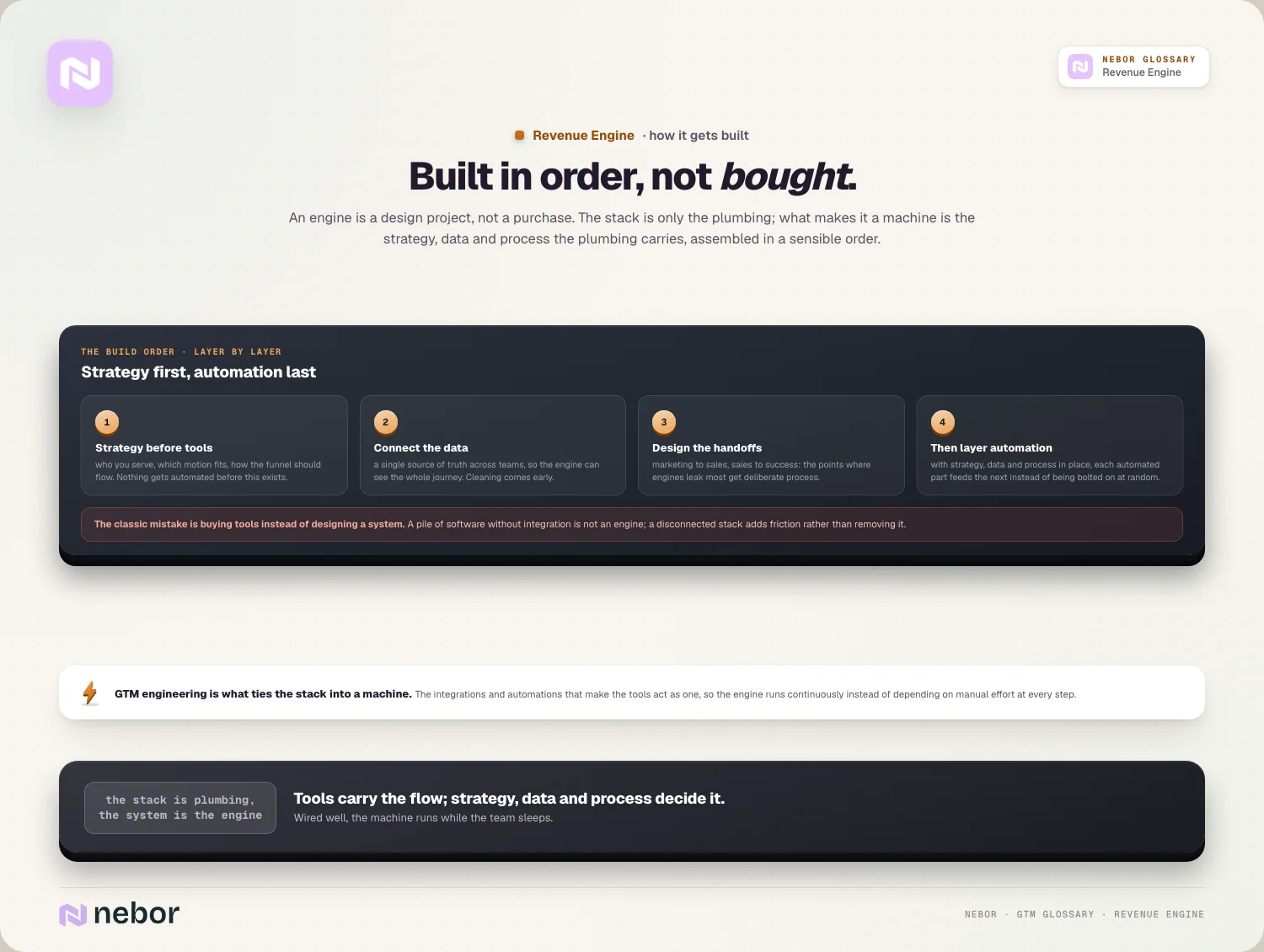
Then connect your data into one view, because a single source of truth across teams is what lets the engine see the whole journey, so cleaning and unifying data comes early.
Next, design the handoffs with care, because the points where marketing passes to sales, and sales to customer success, are where engines leak most, so those transitions deserve deliberate process.
Only then does automation get layered in. With strategy, data, and process in place, you sequence the build so each part feeds the next, the same way a full go-to-market system is assembled in sequence instead of bolted together at random.
How do inbound and outbound fit inside one engine instead of competing?
A revenue engine treats inbound and outbound as one machine working together, and treating them as one motion is part of what makes the engine strong.
Inbound creates demand and surfaces interest, while outbound reaches specific accounts on purpose. In a real engine, these feed each other instead of working as separate programs.
The most efficient version is inbound-led outbound, where signals from your inbound channels tell your outbound motion exactly who to reach and when.
That blending is a hallmark of a mature engine. Instead of arguing inbound versus outbound, the engine uses each where it's strongest and connects them through shared data and signals.
So a revenue engine dissolves the old turf war. The two motions become inputs into the same machine, which is far more powerful than either one alone.
What does a working revenue engine feel like in the day-to-day flow?
Theory aside, it helps to picture how a real engine behaves in practice, because the difference from scattered tactics shows up in the small, everyday flow we watch at clients.
In a working engine, a lead never falls into a void. Interest gets captured, enriched, scored, and routed to the right rep automatically, so nothing waits in your team's forgotten inbox.
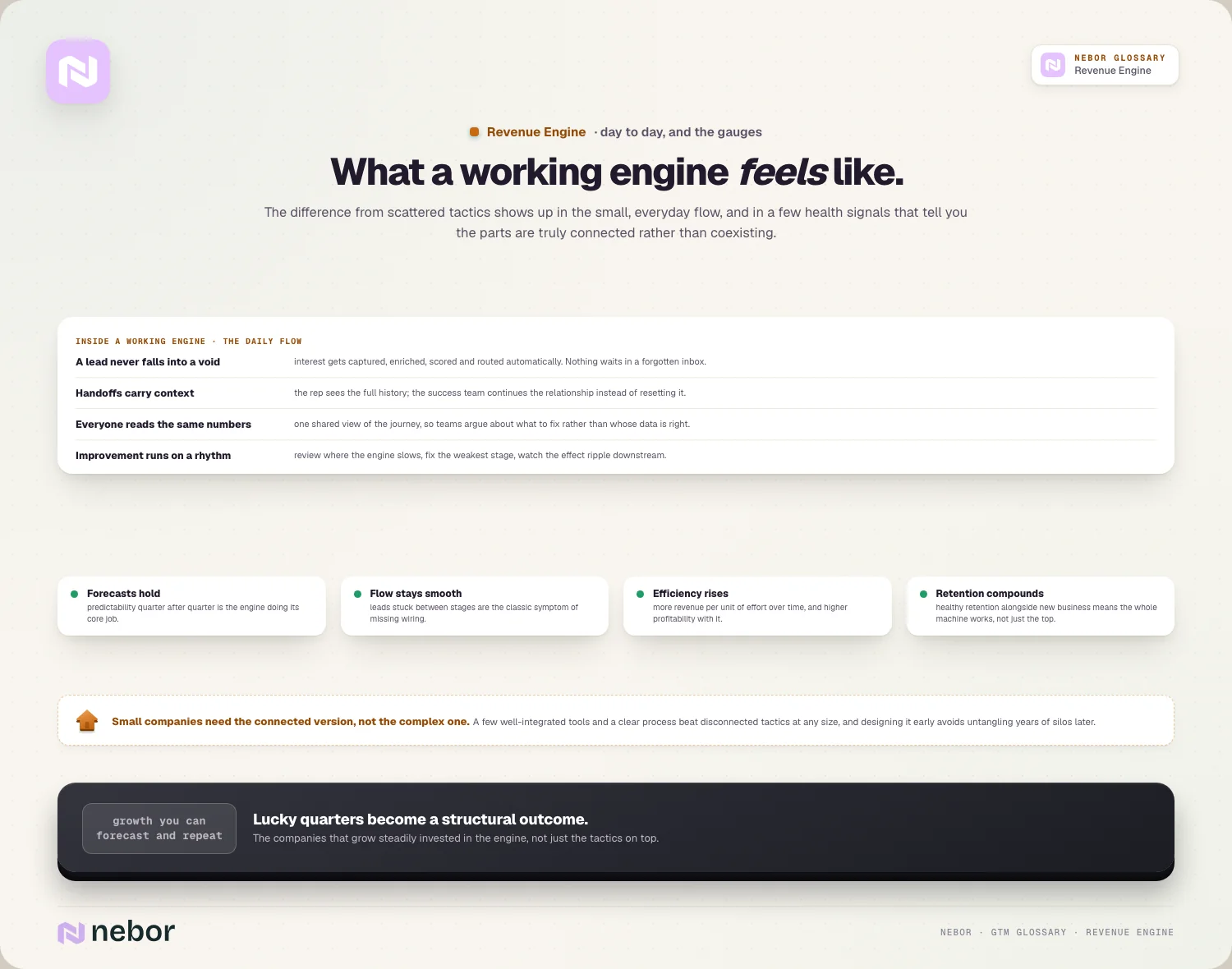
Handoffs carry their context along with them. When marketing passes a lead to sales, the rep sees the full history, and when sales passes a customer to success, the relationship continues instead of resetting.
Everyone reads from the same set of numbers. Marketing, sales, and customer success look at one shared view of the journey, so they argue about what to fix instead of whose data is right.
And the whole thing improves on a rhythm, where the team reviews where the engine slows, fixes the weakest stage, and watches the effect ripple downstream. That rhythm is what steady, compounding growth feels like.
How do you know whether your revenue engine is honestly working?
An engine is only as good as the results it produces, so you need a few signals to judge it. These tell you whether the parts are truly connected or just coexisting.
The clearest sign is the predictability you were promised. If you can forecast revenue with reasonable accuracy quarter after quarter, your engine is doing its core job, because predictability is a structural outcome.
Smooth flow through your pipeline makes another good test. Watch for leads getting stuck or lost between stages, because friction at the handoffs is the most common symptom of an engine that isn't really wired together.
Efficiency gives you a third signal to watch. A working engine produces more revenue per unit of effort over time, and companies that build one report meaningfully higher profitability than those without.
Retention strength is the last box to check. An engine that keeps and grows customers compounds, so healthy retention alongside new business tells you the whole machine is functioning, and that includes the parts past the close.
What are the common mistakes companies make when building an engine?
Companies trip over the same obstacles when trying to build an engine, and we see the same short list in nearly every audit, so knowing them upfront helps you dodge the most expensive ones.
Buying tools instead of designing a system is the most common, because a pile of software without strategy and integration never becomes an engine, no matter how impressive the stack looks.
Leaving silos in place is a close second, because if marketing, sales, and customer success keep separate goals and data, the engine never really connects, and handoffs keep leaking.
Ignoring retention is the expensive one, because an engine built only to win new customers, with no focus on keeping and growing them, leaks revenue out the back as fast as it brings it in.
And skipping the data foundation undermines all the rest, because without clean, unified data, you can't see the journey or forecast it, so the engine works blind even if every part technically functions.
Does a small company need a revenue engine this early in its life?
It's tempting to think a revenue engine is only for big companies with whole RevOps teams. The opposite is closer to the truth, because building the engine early pays off most.
A small company needs a connected engine more than a complex one. Even with a tiny team, having clean data, clear handoffs, and a defined motion beats stitching together disconnected tactics.
Starting early avoids painful rework later on. Companies that bolt an engine on after years of silos have to untangle messy data and habits, while those that design it from the start grow into it cleanly.
The scale just changes the form it takes. For a small team the engine might be a few well-integrated tools and a clear process, while a large one has more layers, but the principle is identical.
So the question isn't whether you're big enough for a revenue engine. It's whether you want growth that compounds, which is worth building toward at any size.
Why connecting the parts you already own is what unlocks the growth
A revenue engine matters because it turns growth from a series of lucky quarters into a structural outcome. When the parts connect, revenue becomes something you can forecast, repeat, and steadily improve.
The deeper shift is in how you think. Instead of optimizing marketing, sales, and customer success separately, you design the whole motion to produce revenue together, and that design choice is what makes the difference.
The honest reality is that this takes real work. An engine gets built instead of bought, through strategy, clean data, smart process, and the engineering that wires it all into one system.
So if your growth feels lumpy and hard to predict, the issue usually isn't any single team trying harder. It's that you have the parts of a revenue engine without the connections between them.
Building those connections is how scattered tactics finally become predictable growth. The companies that grow steadily are usually the ones that invested in the engine itself, beyond the individual tactics built on top of it.
Deel dit bericht
RevOps
Workflows
Begrippenlijst
Gerelateerde begrippen
De basis GTM-concepten begrijpen




Klaar om je pipeline te bouwen