

In this post:
Cold outbound is mostly educated guessing about timing. You build a list of accounts that look like they might need you, then reach out and hope your timing happens to line up with their interest. Most of the time it doesn't, and that mismatch is what keeps cold response rates so low.
Inbound-led outbound flips that order completely around. Instead of guessing who might be interested, you watch for the accounts already showing interest, then reach out to those. The guessing is gone, because the signal told you who to contact and when.
Inbound-led outbound is a sales motion where your outbound outreach is triggered and prioritized by inbound signals instead of static lists. Those signals are things like website visits, content views, or form fills.
You reach out to accounts that have already shown interest, while that interest is still fresh.
Timing is most of what makes outreach work. Reaching the right account at the moment they're actively looking converts far better than reaching them at random, and inbound signals are what make that timing possible.
TL;DR
Inbound-led outbound triggers your outbound outreach off inbound signals, so you reach accounts that have already shown interest instead of working a cold static list.
Timing drives conversion, because reaching out while a buyer is actively researching converts far better than contacting them at a random moment.
It works by capturing signals, qualifying them for fit and strength, then reaching out fast to the ones that matter, while interest is still active.
The discipline it demands is qualification, because not every signal deserves outreach. You still filter for fit and intent, given that acting on weak or off-profile signals wastes the advantage.
So what is inbound-led outbound, exactly, and what pulls the trigger?
Inbound-led outbound is outbound outreach driven by inbound signals. Instead of deciding who to contact from a static list, you let real signs of interest decide for you.
The trigger is always an inbound action. Someone visits your pricing page, reads a key piece of content, or fills out a form, and that action is what prompts the outreach.
The execution stays entirely outbound in character. You proactively reach out, the way you would in any outbound motion, but you do it to accounts the signal surfaced instead of ones you guessed at.
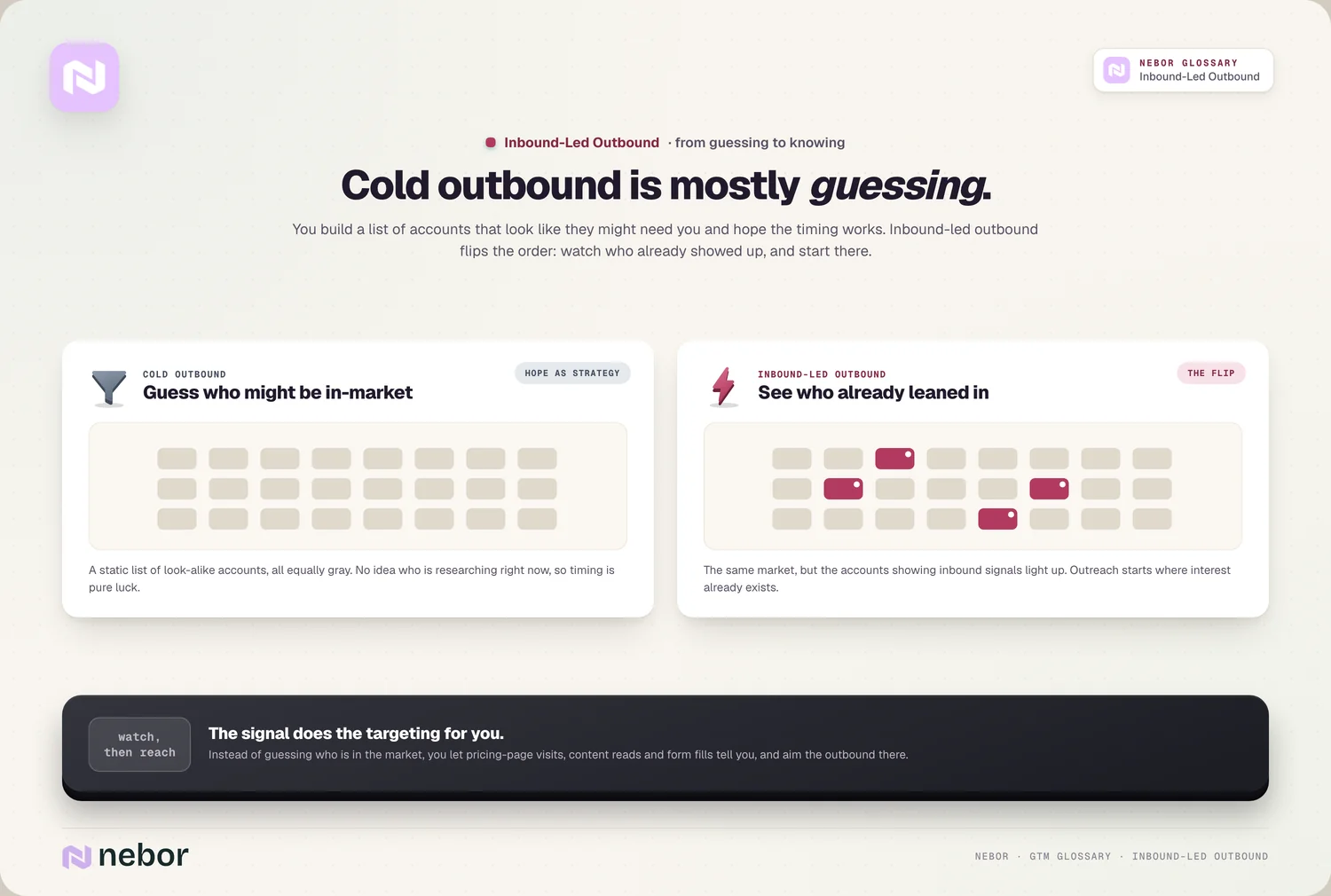
The defining trait is the timing it achieves. Because the outreach follows a fresh signal, it reaches the buyer while their interest is active, which is when they're most receptive.
So inbound-led outbound amounts to outbound with the targeting and timing solved. The signal tells you who's interested and when, so you spend your outreach on accounts that are genuinely in the market.
The shift it represents is from pushing to responding. Instead of pushing your message at a cold list, you respond to interest people are already showing, which is a far easier conversation to start.
How is inbound-led outbound different from ordinary cold outbound?
The contrast with cold outbound is the whole point, and the difference is what drives the targeting.
Cold outbound works from a static list. You pick accounts that fit your profile and reach out, with no idea whether any given one is in the market right now.
Inbound-led outbound works from live signals instead. You reach out because an account just showed interest, so you know they're at least thinking about your category at that moment.
The timing gap is the key difference. Cold outbound hits accounts at a random moment in their buying cycle, while inbound-led outbound hits them when they're actively looking.
So the two motions look similar in execution but differ in trigger. Both involve proactive outreach, but inbound-led outbound aims it at accounts that have signaled interest, and that aim is what converts so much better.
How does it differ from warm outbound and signal-based selling?
These terms overlap a lot, but they belong at different levels of the same idea, nesting from broad to narrow.
Signal-based selling is the broadest of the three. It means letting any buying signal guide your outreach, of which inbound signals are one important type.
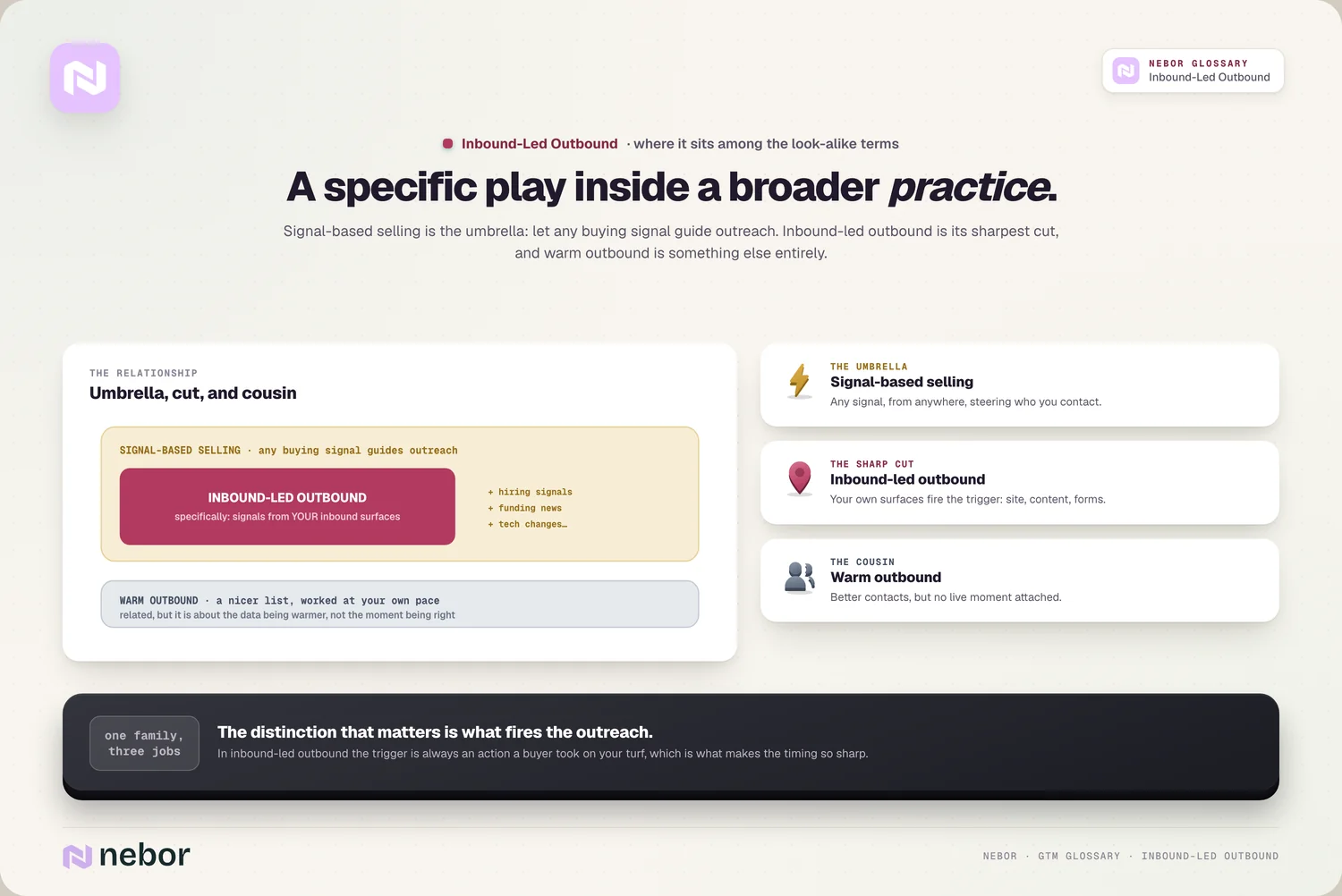
Warm outbound is the broader category of reaching out to non-cold prospects. Inbound-led outbound is a specific, sharp form of it, triggered by recent inbound activity instead of just warmer data.
Inbound-led outbound is the most specific of them. It's outbound triggered specifically by inbound signals, so it's a precise motion within those wider ideas instead of a synonym for them.
So inbound-led outbound is the narrowest and sharpest of the three. It's warm outbound and signal-based selling applied to one high-value signal source, the interest people show on your own properties.
What signals should set an inbound-led outbound motion in motion?
The signals are the fuel, and they're all forms of interest a prospect shows you on your own properties.
Website behavior is the core of it. Visits to high-intent pages like pricing or product, especially repeat visits, are strong signs an account is actively evaluating.
Content engagement matters right alongside the visits. Downloading a guide, watching a demo, or reading several posts shows research, which is exactly the moment to reach out.
Form fills and signups are the clearest of all. A demo request or trial signup is the strongest signal there is, because the person directly raised their hand.
So the signals range from subtle to explicit, all pointing at interest. Watching them across your properties is what tells you which accounts are worth proactive outreach right now.
How do you see signals from accounts that never fill a form?
Most of your interested visitors never identify themselves, so capturing them is the hard part. This is where the technical pieces come in.
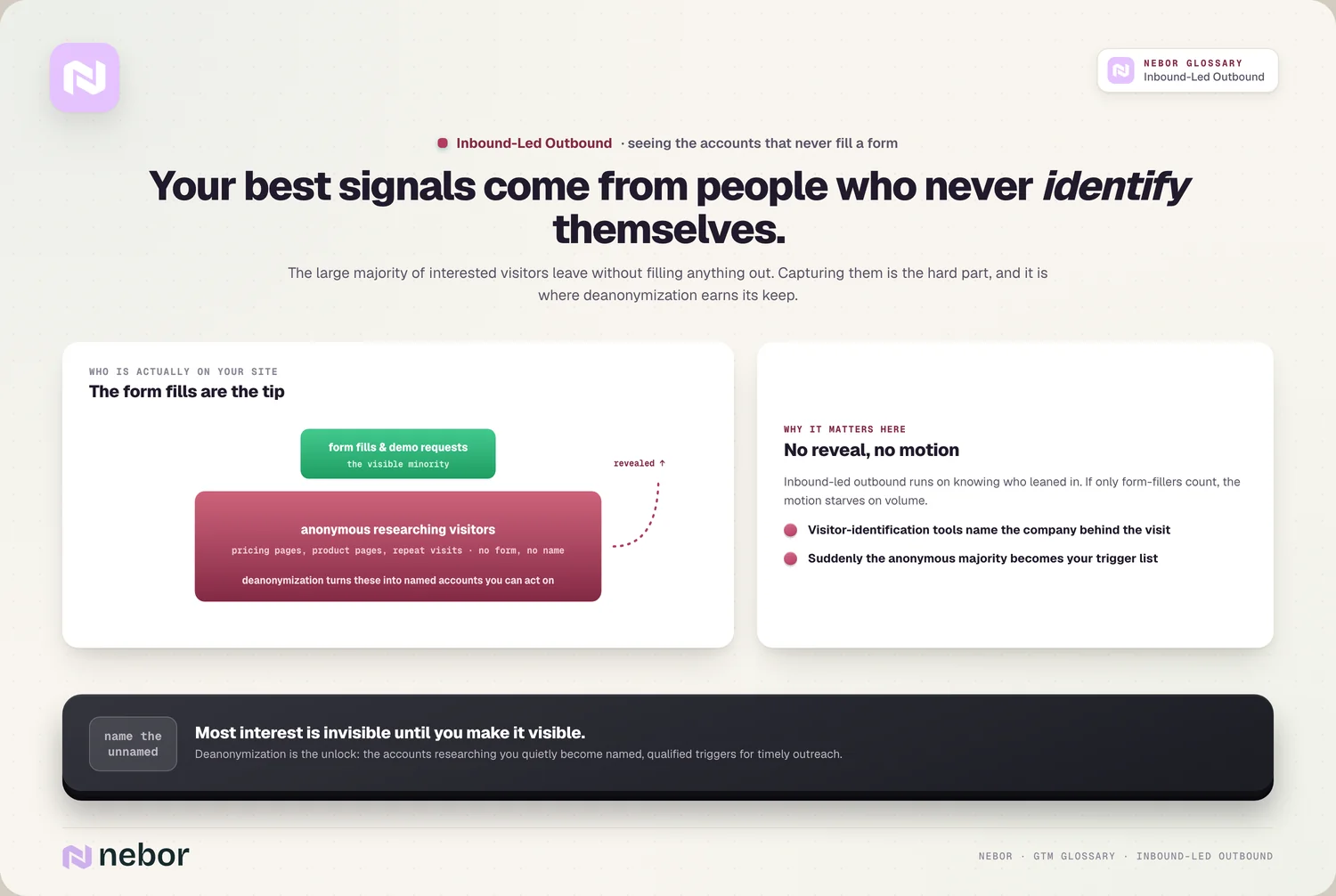
Most of your traffic stays anonymous by default. The large majority of visitors leave without filling anything out, so without extra steps you never know they were interested at all.
Deanonymization is what surfaces them for you. Website deanonymization identifies the companies behind anonymous traffic, so the interest that never filled a form still reaches your team and your CRM.
It often starts with the IP address. A reverse IP lookup maps a visitor's network to a company, which is one common way to reveal who's browsing without a form.
So inbound-led outbound depends on seeing more than your form fills. Identifying the anonymous accounts showing interest is what expands the motion from the few who submit to the many who don't.
The difference in scale is larger than it sounds. Form fills are a tiny slice of your interested traffic, so a motion built only on them leaves most of the signal on the table, while deanonymization captures the rest.
Why does inbound-led outbound convert so much better than cold?
The performance is the reason this motion has spread, and it comes down to timing and relevance working together.
Timing wins most of the battle on its own. Reaching a buyer while they're actively researching, the way inbound-led outbound is built to do, lands when they're receptive instead of when they're not.
Relevance follows directly from the signal you caught. Because you know what the account looked at, you can shape the message around it, so the outreach is specific and clearly relevant instead of generic.
Speed compounds both of those advantages further. Acting fast on a fresh signal, the heart of speed to lead, reaches the buyer while the interest is still hot instead of after it cools.
So inbound-led outbound converts because it solves the two hardest problems in outreach at once. It fixes both who you contact and when, so its response rates dwarf cold outbound.
How do you qualify the signals before any outreach goes out?
A common mistake is treating every signal as a reason to reach out. Qualification is what keeps the motion sharp.
Not every signal is worth acting on. A random visitor far outside your market isn't worth outreach just because they browsed, so you filter before you act.
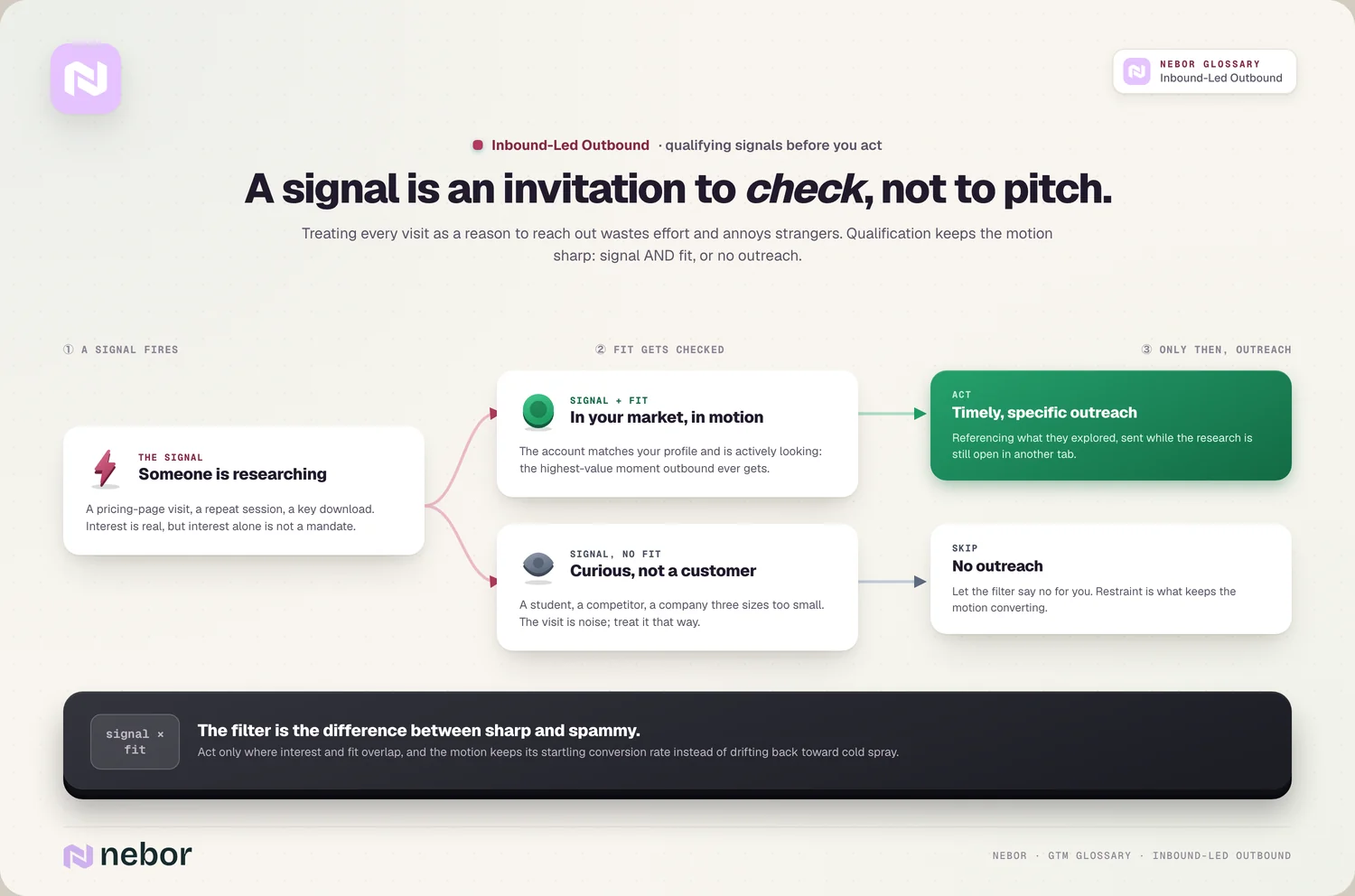
Fit gets checked before anything else happens. You compare the account against your ideal customer profile, because a signal only matters if the account is one you'd want as a customer.
Signal strength matters right after the fit. A pricing-page visit is stronger than a single blog read, so you prioritize the accounts whose behavior shows real evaluation over casual interest.
So inbound-led outbound is selective by design. You act fast on qualified signals, but you qualify first, which is what separates a focused motion from spraying outreach at everyone who visits.
How does enrichment power the inbound-led outbound motion end to end?
A raw signal is thin, so you have to fill it out before you can act well. Enrichment is what turns a signal into something usable.
A signal alone gives you too little. Knowing an account visited tells you they're interested, but not who to contact or what to say, so you need more context.
Enrichment adds exactly the context that's missing. Inbound enrichment fills in the company, the right contacts, and the firmographics, turning a bare signal into an account you can reach out to properly.
It feeds the whole stack around it too. Combining signals with enrichment is what builds a useful sales signal stack, where each signal arrives with the context needed to act on it.
So enrichment is the bridge between seeing a signal and acting on it. It turns the fact that someone was interested into a complete picture of who they are and how to reach them.
Without it, a signal is just a hint you can't use. Enrichment is what makes the signal actionable, so the two pieces always work together in this motion.
How does inbound-led outbound fit into your wider go-to-market motion?
Inbound-led outbound works as one motion inside a larger system, connecting to everything around it.
It's a kind of trigger event selling. The inbound signal is the trigger, so the motion is a focused application of acting on timely events instead of working a flat list.
It feeds your meeting prep further down. When a signal turns into a conversation, knowing everything about the account beforehand, the way a strong inbound meeting workflow does, makes the first call far stronger.
It depends on a layer of automation underneath. Capturing signals, qualifying them, and triggering outreach is exactly the kind of flow you can automate sales prospecting around, so it scales beyond manual watching.
So inbound-led outbound is woven into your broader go-to-market. It's a precise, high-converting motion that works alongside your signals, enrichment, and automation instead of in isolation.
Does inbound-led outbound replace your cold outbound completely?
A natural question is whether this motion makes cold outbound obsolete. The honest answer is that it complements it rather than replacing it.
Inbound-led outbound is limited by signal volume. You can only act on the accounts that show signals, and that pool is smaller than your full addressable market, so it can't fill the whole pipeline alone.
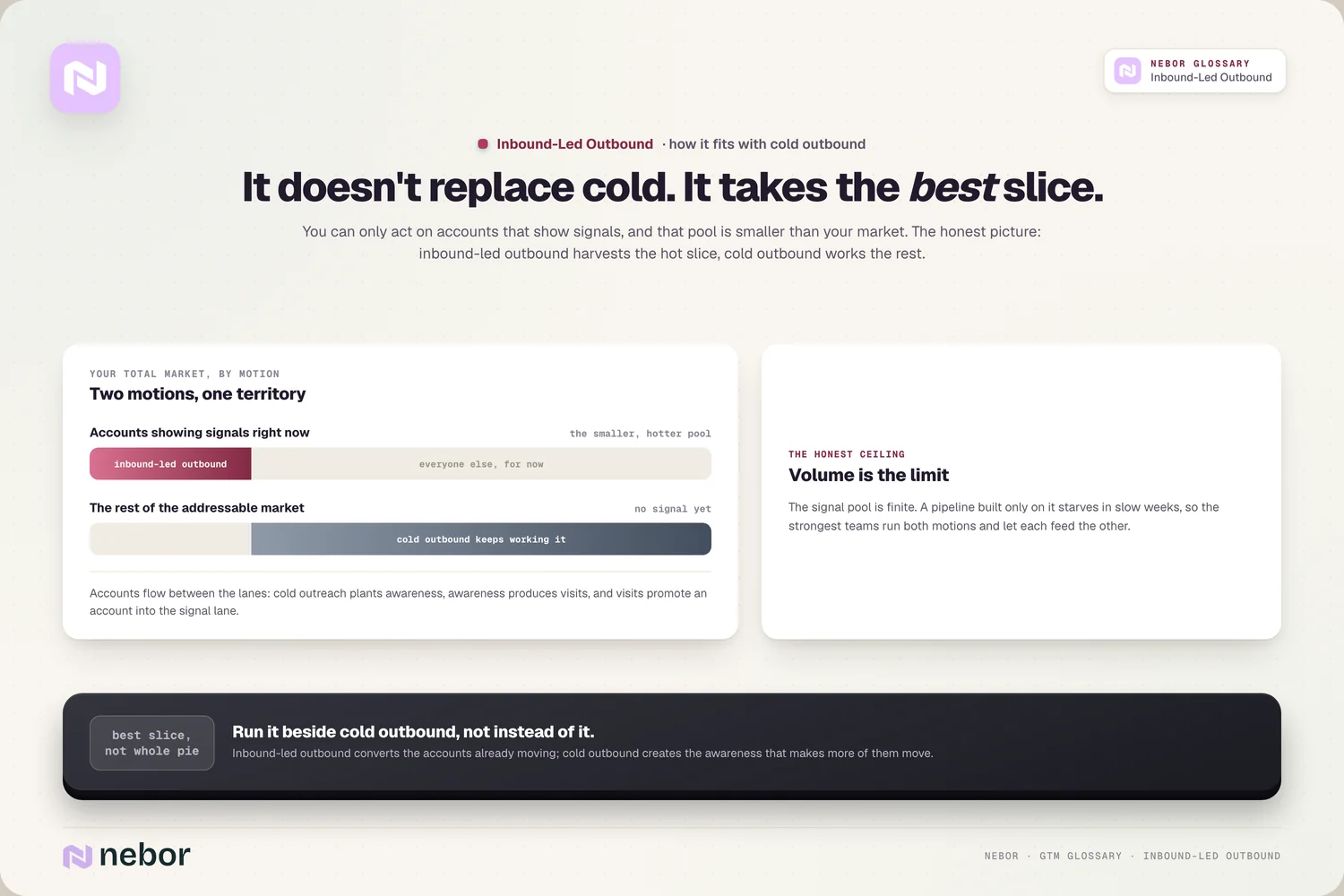
Cold outbound still reaches everyone the signals miss. Plenty of good-fit accounts never visit your site or engage with content, so cold outreach is how you reach them before they signal anything.
The strongest setups we build use both. They prioritize inbound signals for the highest-converting outreach, then use cold outbound to cover the accounts that haven't surfaced yet.
So inbound-led outbound is the sharp tip of the spear rather than the whole weapon. It handles your warmest accounts brilliantly, while cold outbound keeps reaching the larger market that hasn't shown its hand.
How do you set up inbound-led outbound from capture to outreach?
Inbound-led outbound is a system you build, and in our experience a few pieces make it work, with the setup connecting signal to action.
Signal capture opens the whole flow up. You track the inbound behavior that matters, from form fills to anonymous visits, so you can see which accounts are showing interest.
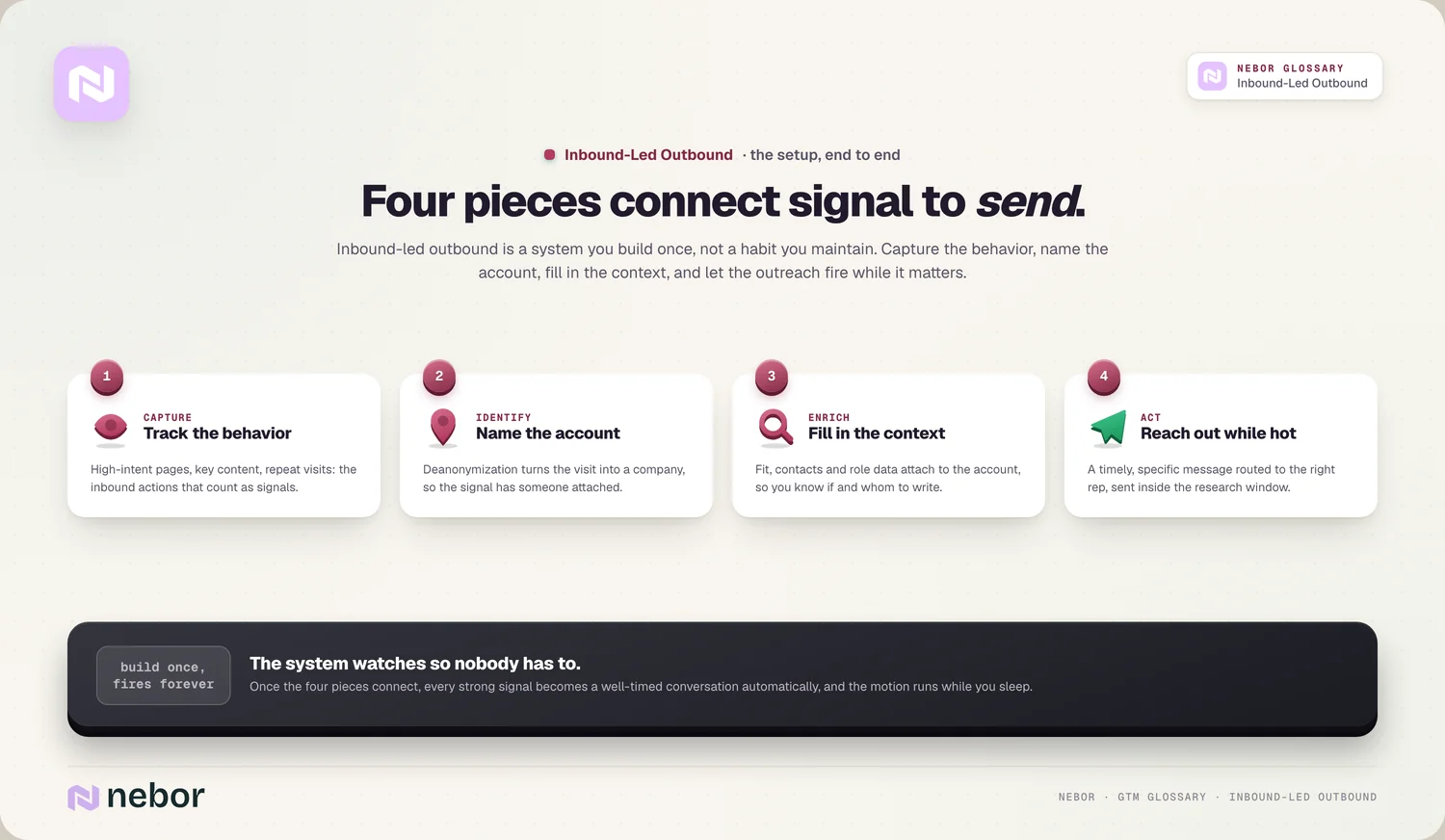
Qualification then filters everything the capture surfaced. You screen signals for fit and strength automatically, so only the accounts worth pursuing trigger outreach.
And fast, contextual outreach finishes the chain. You wire qualified signals to prompt outreach quickly, with the context of what the account did, so the message is relevant and timely.
So setting up inbound-led outbound means connecting capture to qualification to fast outreach. When the chain holds, an account showing interest becomes a relevant conversation within hours instead of never.
What are the common mistakes teams make with inbound-led outbound?
Inbound-led outbound goes wrong in a few predictable ways, and we keep seeing the same ones in the motions we review. Avoiding them keeps it the high-converting play it should be.
Acting on every signal wastes the advantage first, because reaching out to every visitor regardless of fit burns effort and annoys people, so qualification has to come before anything.
Being too slow costs nearly as much, because a signal that's days old has gone cold, so outreach that lags behind the signal loses the timing edge that makes the motion work.
Coming across as invasive backfires in its own way, because referencing exactly what someone browsed can feel unsettling, so the outreach should be relevant without revealing how closely you watched.
Ignoring anonymous traffic caps the whole motion, because relying only on form fills misses most of your interested accounts, so deanonymization is what makes the full reach possible.
And forgetting cold outbound entirely leaves gaps, because inbound signals can't fill the whole pipeline, so leaning only on them leaves good-fit accounts that haven't signaled yet untouched.
Why letting real interest aim your outreach beats guessing every time
Inbound-led outbound solves outbound's hardest problem, which is timing. Reaching accounts while they're actively researching converts far better than working a cold list and hoping the timing lines up.
The deeper point is that the signal does the targeting for you. Instead of guessing who's in the market, you let real interest surface the accounts, so your outreach lands on people already thinking about your category.
The honest caveat is that it still takes qualification and speed. Acting on every signal or acting slowly throws away the advantage, so the motion works only when you filter for fit and reach out while interest is fresh.
So if your cold outbound keeps landing on deaf ears, inbound-led outbound is how you aim it. Letting inbound signals trigger your outreach is one of the highest-converting motions a modern go-to-market system can deliver.
It works because it reaches the right account at the only moment that really matters, which is when they're already looking.
Share this post
Inbound
Outbound
Intent
Glossary
Related glossary items
Understanding the core GTM concepts




Ready to build your pipeline











