

In this post:
A lot of people hear RevOps and assume it's just sales ops with a trendier name. That misreading misses the whole point, and it's why so many companies set up RevOps and get little from it.
Sales ops supports one team, while RevOps exists to align three, treating marketing, sales, and customer success as one connected revenue function instead of separate departments with their own tools and goals.
Revenue operations, or RevOps, is the business function that aligns marketing, sales, and customer success around shared data, shared processes, and shared metrics to drive predictable revenue growth. It's the operating system for how a company makes money.
That shift in scope is the whole story. RevOps appeared because growth got too complex to manage with each department optimizing itself in isolation, and no renamed team was going to solve that.
TL;DR
RevOps is the function that unifies marketing, sales, and customer success under one operating model, with shared data, aligned processes, and common metrics, to produce predictable, scalable revenue growth.
Siloed teams create friction, leakage, and unpredictable results, and RevOps removes the gaps between departments so the whole revenue motion works as one system.
In practice, RevOps owns the data, tools, processes, and analytics that connect the funnel end to end. It's the discipline that builds and maintains your revenue engine.
One condition decides how much you get from it, because RevOps is a strategic function before it is an administrative one. Treated as ticket-takers who clean the CRM, it underdelivers, while given real ownership of the revenue process, it transforms growth.
So what is revenue operations, exactly, and what does it unify?
Revenue operations is the function responsible for aligning every team that touches revenue. Instead of marketing ops, sales ops, and success ops each working separately, RevOps unifies them under one operating model.
It centers on three things shared across teams. One dataset, so everyone sees the same truth, one set of processes, so work flows cleanly, and one set of metrics, so everyone rows in the same direction.
The job spans the whole customer lifecycle. RevOps owns how a stranger becomes a lead, a lead becomes a customer, and a customer grows over time, which reaches well past helping deals close.
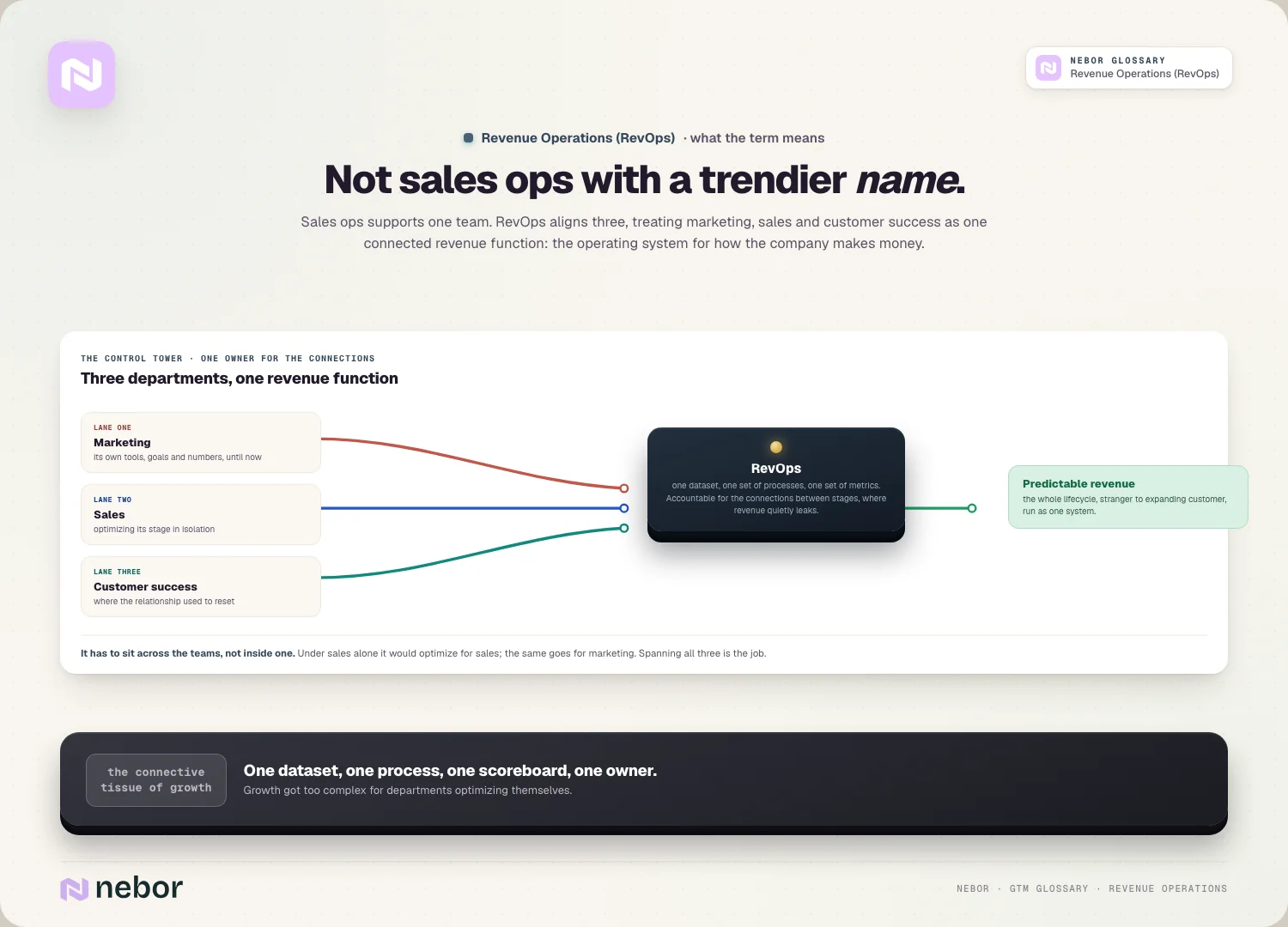
That end-to-end scope is what defines it. Where older ops roles supported a single stage, RevOps is accountable for the connections between all of them, which is where most revenue leaks away.
So RevOps is best understood as the connective tissue of growth. It's the function that makes sure the parts of your revenue motion genuinely work together.
This is also why RevOps spans teams instead of living inside one. If it lived under sales alone, it would optimize for sales, and the same goes for marketing, so it has to span all three to do its job.
How is RevOps different from the revenue engine it builds and maintains?
People use RevOps and revenue engine almost interchangeably, so the line between them deserves drawing clearly, because they describe two sides of the same coin.
A revenue engine is the system itself, the connected machine of people, processes, data, and tools that produces revenue predictably, the thing that keeps producing day after day.
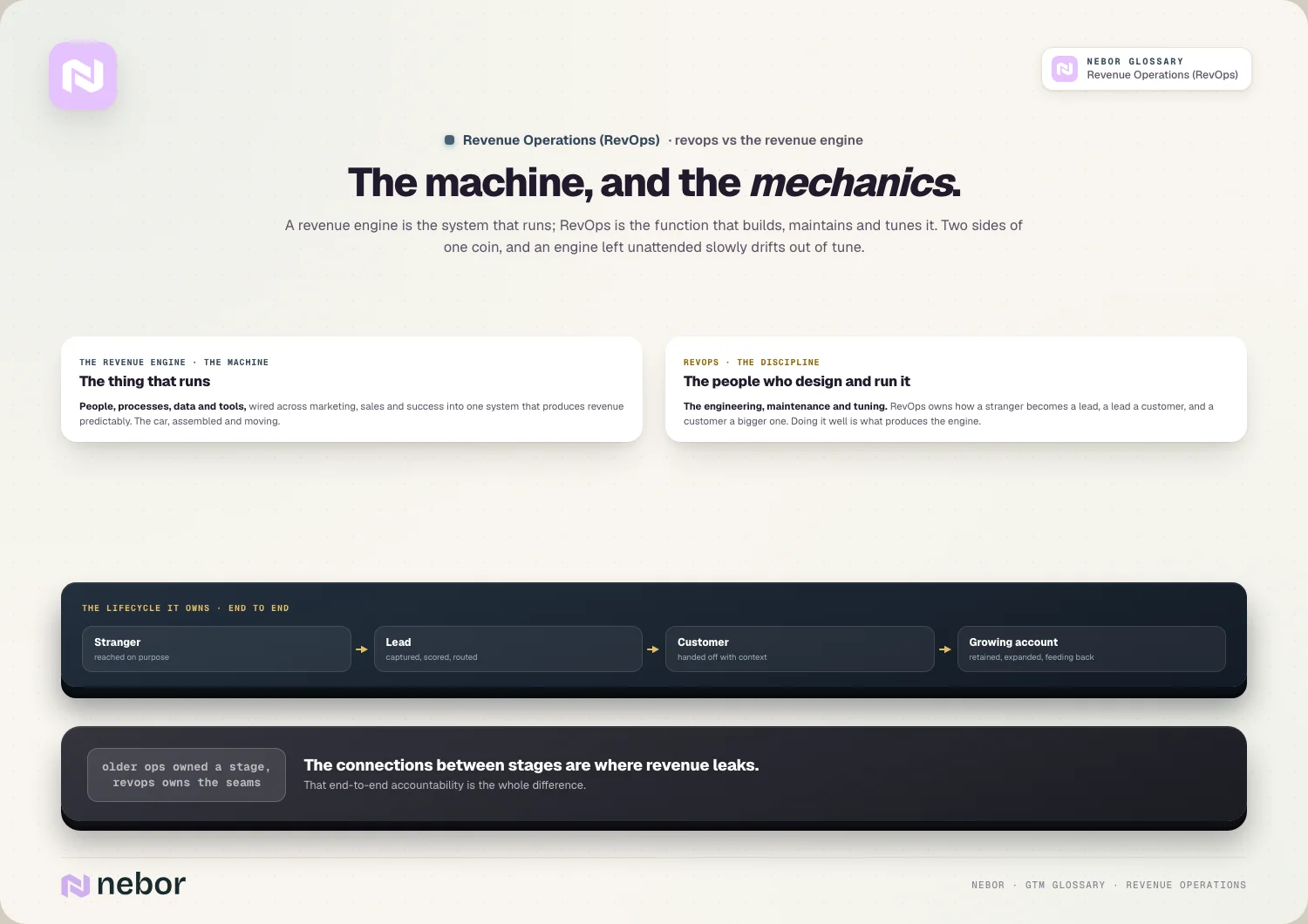
RevOps is the function that builds and operates that engine. It's the team and discipline doing the engineering, maintenance, and tuning that keeps the engine working and improving.
So one is the machine and the other is the people who design and maintain it. You can't really have a strong revenue engine without a RevOps function, formal or not, behind it, since an engine left unattended slowly drifts out of tune.
This is why the two terms travel together so often. When companies talk about building an engine for predictable growth, RevOps is how that engine gets built and maintained over time.
Why did RevOps emerge as its own function over the past decade?
RevOps didn't exist as a named role a decade ago, and the reason it appeared explains a lot about what it should do. The cause was growth getting more complex than siloed ops could handle.
Buying behavior was the first thing to change. Customers now move across marketing, sales, and success in messy, nonlinear ways, so optimizing each team separately created friction at every handoff between them.
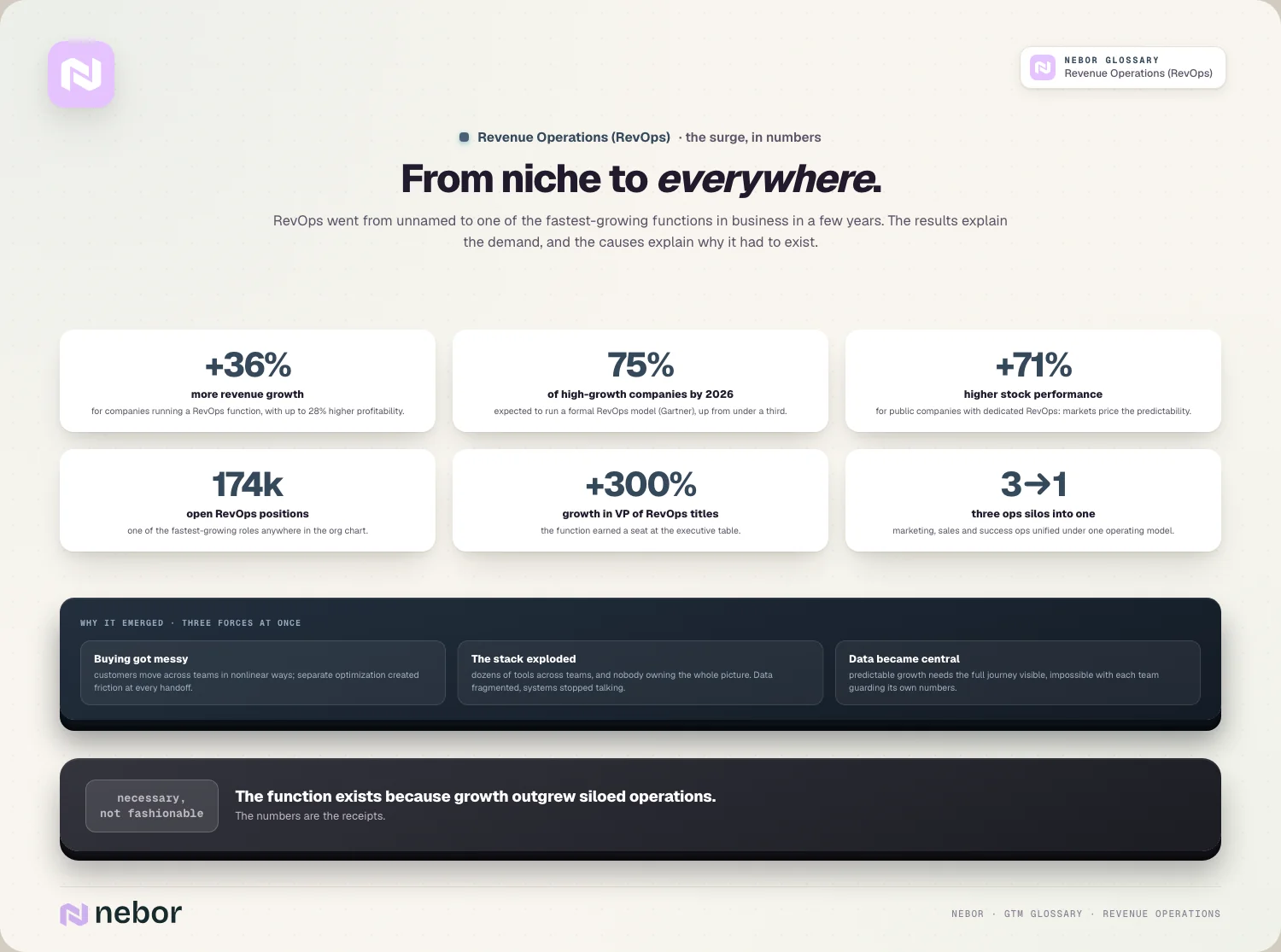
The tech stack exploded around the same time. Companies accumulated dozens of tools across teams, and without someone owning the whole picture, data fragmented and systems stopped talking to each other.
Then data moved to the center of everything. Predictable growth requires seeing the full journey, which is impossible when marketing, sales, and success each guard their own numbers in their own systems.
RevOps emerged to solve all three at once. It's the function that owns the cross-team data, processes, and tools, and that ownership is what made it necessary instead of optional.
What does a RevOps team do with its time across an average week?
The day-to-day of RevOps can seem fuzzy, so it helps to make it concrete, and in our experience the work clusters into a few core responsibilities.
Data and systems take the biggest share, because RevOps owns the connected GTM stack and the data flowing through it, keeping one clean source of truth across teams.
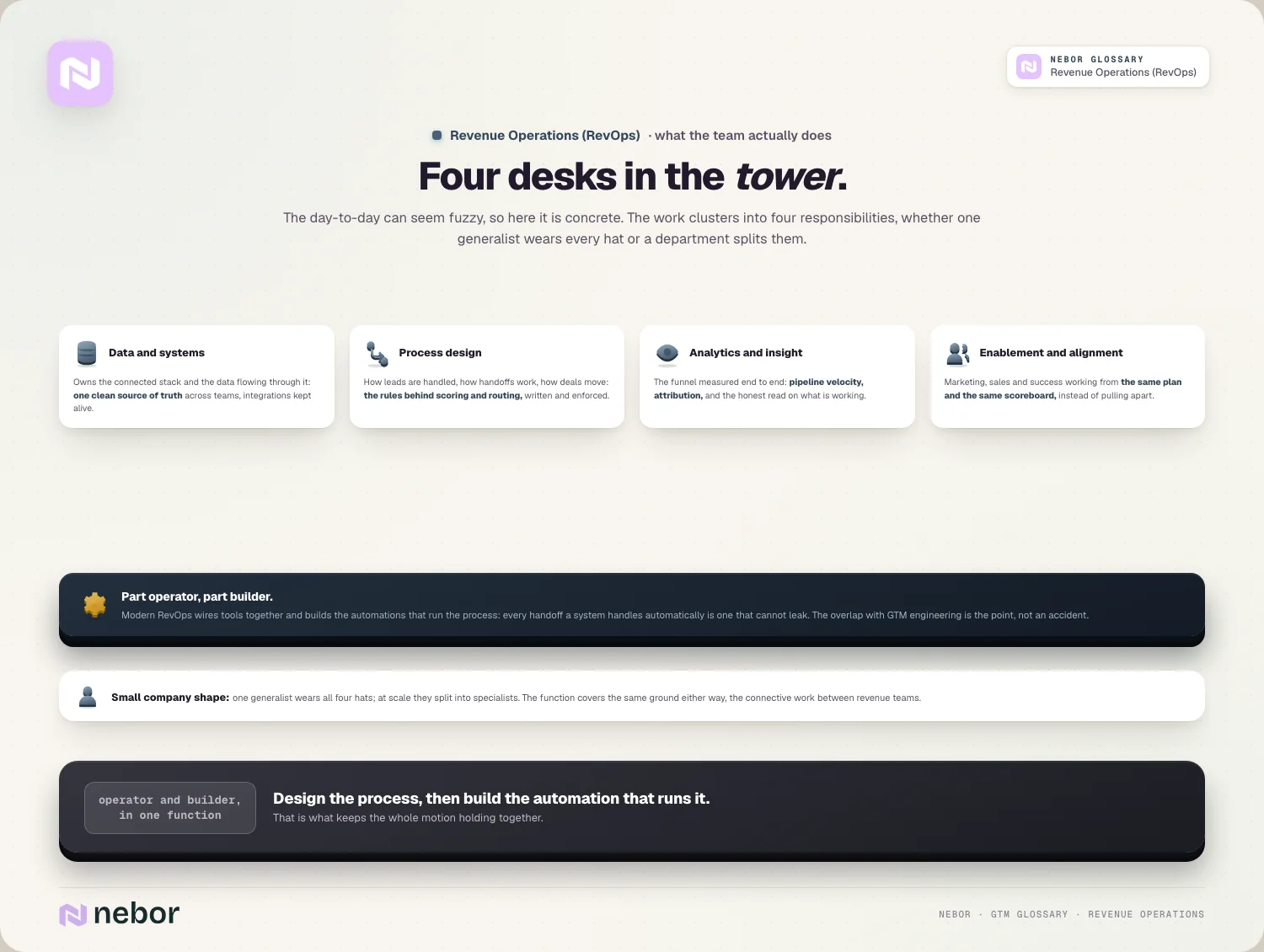
Process design comes alongside that, where RevOps defines how leads are handled, how handoffs work, and how deals move, including the rules behind lead scoring and routing.
Analytics and insight fill much of the rest, because RevOps measures the funnel end to end, owning metrics like pipeline velocity and untangling credit through multi-touch attribution.
And enablement ties the work back to people, because RevOps keeps marketing, sales, and success working from the same plan, so the teams stop pulling in different directions.
Why is RevOps growing so fast right now across so many companies?
RevOps has gone from niche to everywhere in just a few years, and the numbers behind that shift show how fast it's moving.
The job market tells the story on its own. RevOps has become one of the fastest-growing roles, with over 174,000 open positions reflecting how many companies are building the function.
Leadership roles are climbing right alongside the hiring. The VP of Revenue Operations title has seen around 300% growth in a short span, as RevOps earns a seat at the executive table.
The results are what explain the demand. Companies with a RevOps function report around 36% more revenue growth and up to 28% more profitability than those without it.
And adoption keeps accelerating year over year. Gartner expects around 75% of the highest-growth companies to adopt a RevOps model by 2026, up from under a third not long ago.
Even the public markets seem to notice. Companies with a dedicated RevOps function have shown around 71% higher stock performance than those without one, which signals investors value the predictability it brings.
How does RevOps connect to the go-to-market strategy it executes?
RevOps and strategy are tightly linked, because RevOps is largely how strategy gets executed. One sets the direction and the other makes it real.
Your go-to-market strategy decides who you serve and how you'll win. RevOps then builds the operating model that turns that plan into a working motion.
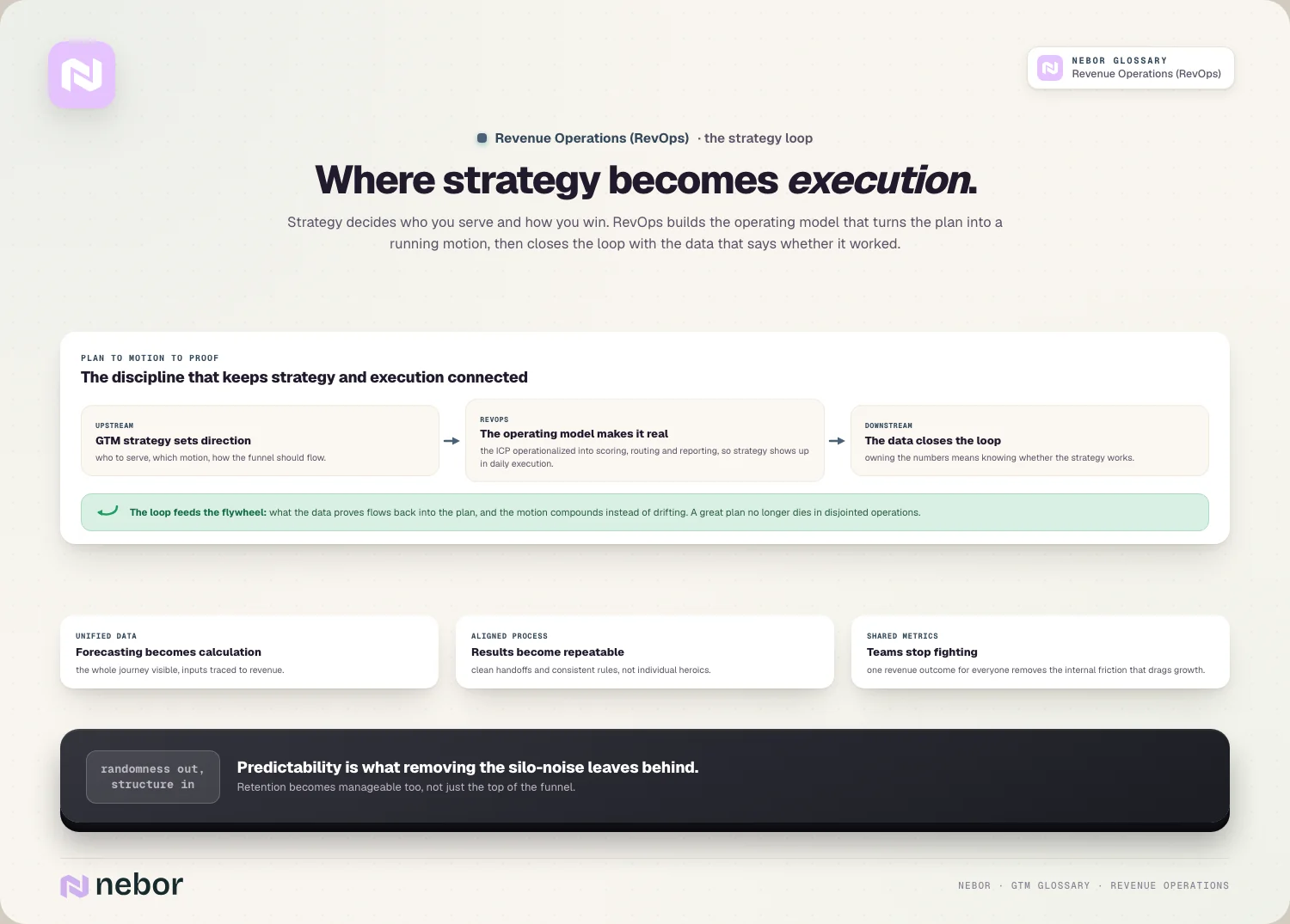
It also aims the whole machine at the right targets. RevOps operationalizes your ideal customer profile into scoring, routing, and reporting, so the strategy shows up in daily execution.
And it closes the loop on strategy itself, because by owning the data, RevOps tells you whether the plan is working, which feeds back into a GTM flywheel that compounds over time.
So RevOps isn't separate from strategy, it's the discipline that keeps strategy and execution connected, instead of letting a great plan die in disjointed operations.
How does RevOps turn lumpy growth into something you can predict?
Predictability is the core promise of RevOps, so it deserves a direct look. It comes from removing the randomness that silos create.
When data is unified, you can finally see the whole journey. That visibility turns forecasting from a guess into a calculation, because you can trace how inputs become revenue.
When processes are aligned, results get repeatable. Clean handoffs and consistent rules mean the motion produces similar outcomes each time, rather than swinging on individual heroics.
When metrics are shared, teams stop optimizing against each other. Everyone works toward the same revenue outcome, which removes the internal friction that drags growth.
The payoff shows up in retention too. RevOps extends past the sale into keeping and growing customers, so metrics like net revenue retention become something you can actively manage.
How do automation and engineering fit into the modern RevOps role?
Modern RevOps leans heavily on automation and technical craft. The function has moved well beyond spreadsheets and manual CRM cleanup.
A growing part of the role is building systems that work on their own. The same work that lets a company automate sales prospecting and routing lives squarely inside RevOps.
This is where it overlaps with GTM engineering. RevOps increasingly involves wiring tools together and building automations, which makes it a technical discipline as much as an operational one.
The aim is to remove manual friction. Every handoff a system can handle automatically is one that won't leak, and that's the reason engineering has become central to good RevOps.
So the modern RevOps person is part operator, part builder. They design the process and then build the automation that carries it out, and that pairing is what makes the whole go-to-market system hold together.
What roles make up a RevOps team as the function grows with the company?
RevOps can be one person or a whole department, but the responsibilities tend to be the same. It helps to see the shape of the function as it grows.
At the center are operations and systems. These are the people who own the CRM, the integrations, and the data flow, keeping the technical backbone clean and connected.
Around that core are process and enablement. These roles design how teams work, build the playbooks, and make sure marketing, sales, and success follow consistent steps.
The analytics layer completes the shape of the team. These are the people turning the unified data into insight, owning the reporting and the metrics that tell you whether the engine is working.
In a small company, one generalist may wear all these hats. As it scales, they split into specialists, but the function still covers the same ground, meaning the connective work between revenue teams.
Does a company need a RevOps team, or just a RevOps mindset?
Not every company can hire a RevOps department, which raises a fair question. Is RevOps a team you build, or a way of operating you adopt?
The honest answer is that the mindset comes first. Even a tiny company can align its teams around shared data, clear handoffs, and common metrics without a dedicated hire.
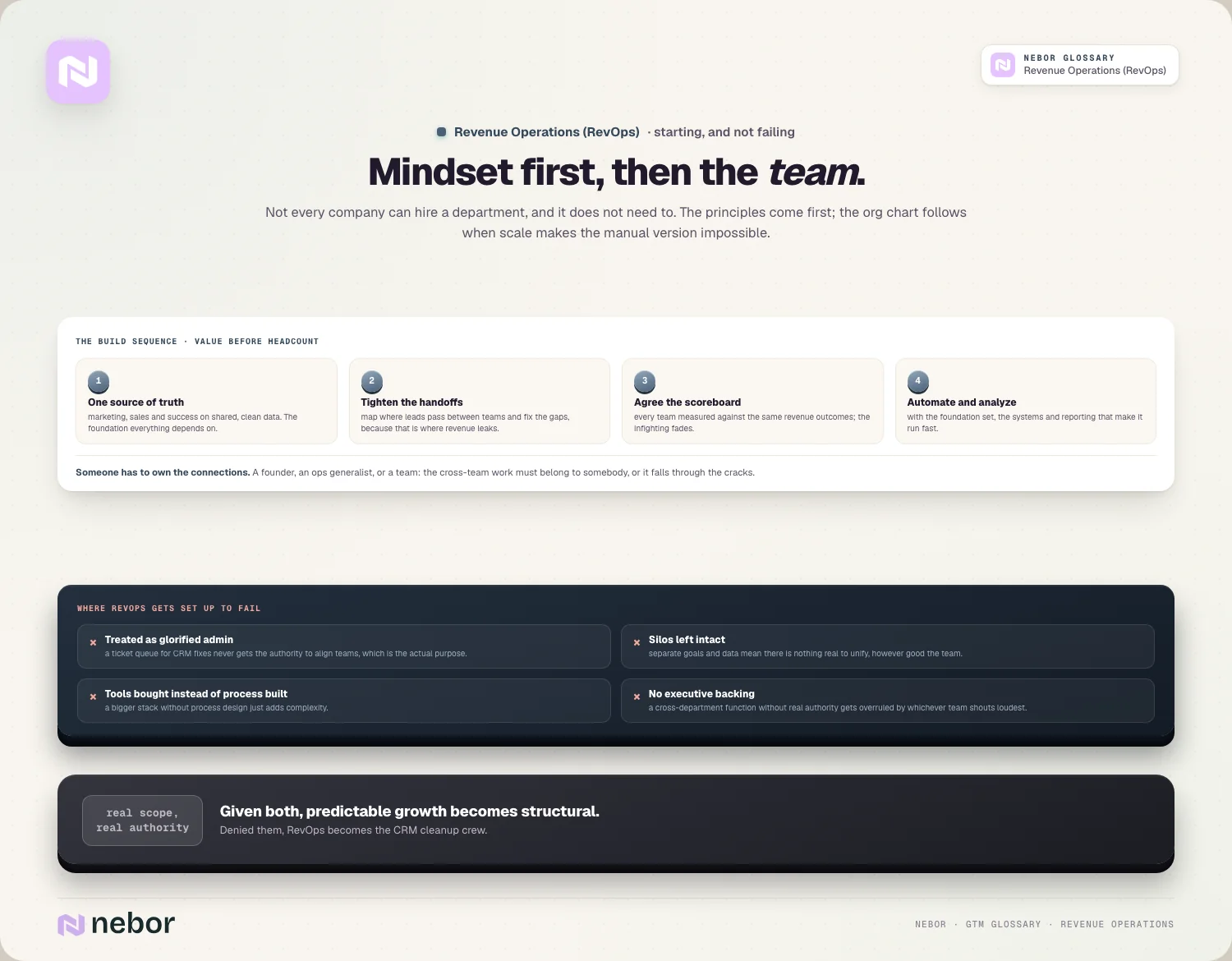
What matters is that someone owns the connections, and we tell clients this regardless of headcount. Whether it's a founder, an ops generalist, or a small team, the cross-team work has to belong to someone, or it falls through the cracks.
As you grow, the mindset usually needs a team to sustain it. The complexity of more tools, more people, and more data eventually demands dedicated owners to keep everything aligned.
So start with the principles instead of the org chart. Adopt the RevOps way of thinking early, and formalize the team when scale makes the manual version impossible to maintain.
How do you start building RevOps without hiring a whole department?
Building RevOps can feel daunting, but in our experience it follows a sensible sequence, and you don't need everything at once to start getting value.
Begin with the data before anything else. Getting marketing, sales, and success onto one clean, shared source of truth is the foundation everything else depends on, so it comes first.
Then fix the handoffs one by one. Map where leads pass between teams and tighten those transitions, because the gaps between departments are where most revenue disappears.
Next comes agreeing on shared metrics, because when every team measures success against the same revenue outcomes, the internal friction that drags growth starts to disappear.
From there, layer in automation and analytics. With the foundation set, you can build the systems and reporting that make the whole motion move faster, the same way any durable engine gets assembled in order.
What are the common mistakes companies make when they stand up RevOps?
RevOps can disappoint, and it usually fails for structural reasons rather than effort. We keep meeting the same few mistakes when companies bring us in to look.
Treating it as glorified admin is the classic one, because when RevOps is just a ticket queue for CRM fixes, it never gets the authority to align teams, which is its whole purpose.
Leaving the silos intact comes next, because standing up a RevOps team while marketing, sales, and success keep separate goals and data means the function has nothing real to unify.
Buying tools instead of building process is the tempting one, because RevOps is a discipline rather than a software purchase, and a bigger stack without process design just adds complexity.
And no executive backing sinks the rest, because RevOps spans departments, so without leadership giving it real authority, it gets overruled by whichever team shouts loudest.
Why the discipline that connects your teams beats another tool or campaign
RevOps matters because growth has outgrown the old way of managing operations. When marketing, sales, and customer success each optimize themselves, the whole revenue motion suffers at the seams between them.
The deeper idea is that RevOps treats revenue as one system with one owner. It unifies the data, the process, and the metrics so the funnel works end to end instead of in disconnected pieces.
The honest requirement is that RevOps needs real scope and real authority. Given those, it turns predictable growth from a hope into a structural outcome, and that track record is exactly why it's become one of the fastest-rising functions in business.
So if your teams are busy but your growth is lumpy, the fix may not be another tool or another campaign. It may be the discipline that connects everything you already have.
Building that discipline is what revenue operations is for. Whether you grow it in house or bring in help, the goal is the same, an operating model that produces revenue predictably and keeps getting better instead of fading like a one-off push.
Share this post
RevOps
Glossary
Related glossary items
Understanding the core GTM concepts




Ready to build your pipeline