

In this post:
An ideal customer profile, or ICP, is a description of the type of company that gets the most value from your product and is most likely to become a great customer. It defines the businesses you should be going after, based on the traits your best customers share.
Most companies think a bigger market is a better one, so they keep their ICP broad to avoid ruling anyone out. The uncomfortable truth is that a vague, everyone-shaped ICP makes your whole go-to-market worse, because outreach aimed at everyone resonates with no one.
A sharp ICP is one of the most powerful decisions you can make, even though it feels like you're narrowing your options. When you know exactly who you serve best, every other part of your motion gets easier, which is why narrower almost always beats broader.
TL;DR
An ideal customer profile is the description of the company that fits your product best, built from the shared traits of your strongest existing customers. It tells you which businesses to pursue and which to skip.
The typical ICP is too broad, kept vague so the company never has to rule anyone out, and that vagueness wrecks targeting, messaging, and efficiency. A narrow, specific ICP makes everything downstream sharper.
The strongest ICPs come from studying who succeeds with you instead of who you wish you sold to. When the ICP is right, your targeting, outreach, and sales all improve, because everything in go-to-market is built on top of who you're for.
So what is an ideal customer profile exactly, and what does it do?
An ideal customer profile is a clear description of the kind of company that's the best possible fit for what you sell. It captures the traits, like size, industry, and situation, that your most successful customers tend to have in common.
It's an account-level idea, describing the company rather than any individual person inside it. That's an important distinction, because an ICP tells you which businesses to target, while a buyer persona tells you which people within those businesses to talk to.
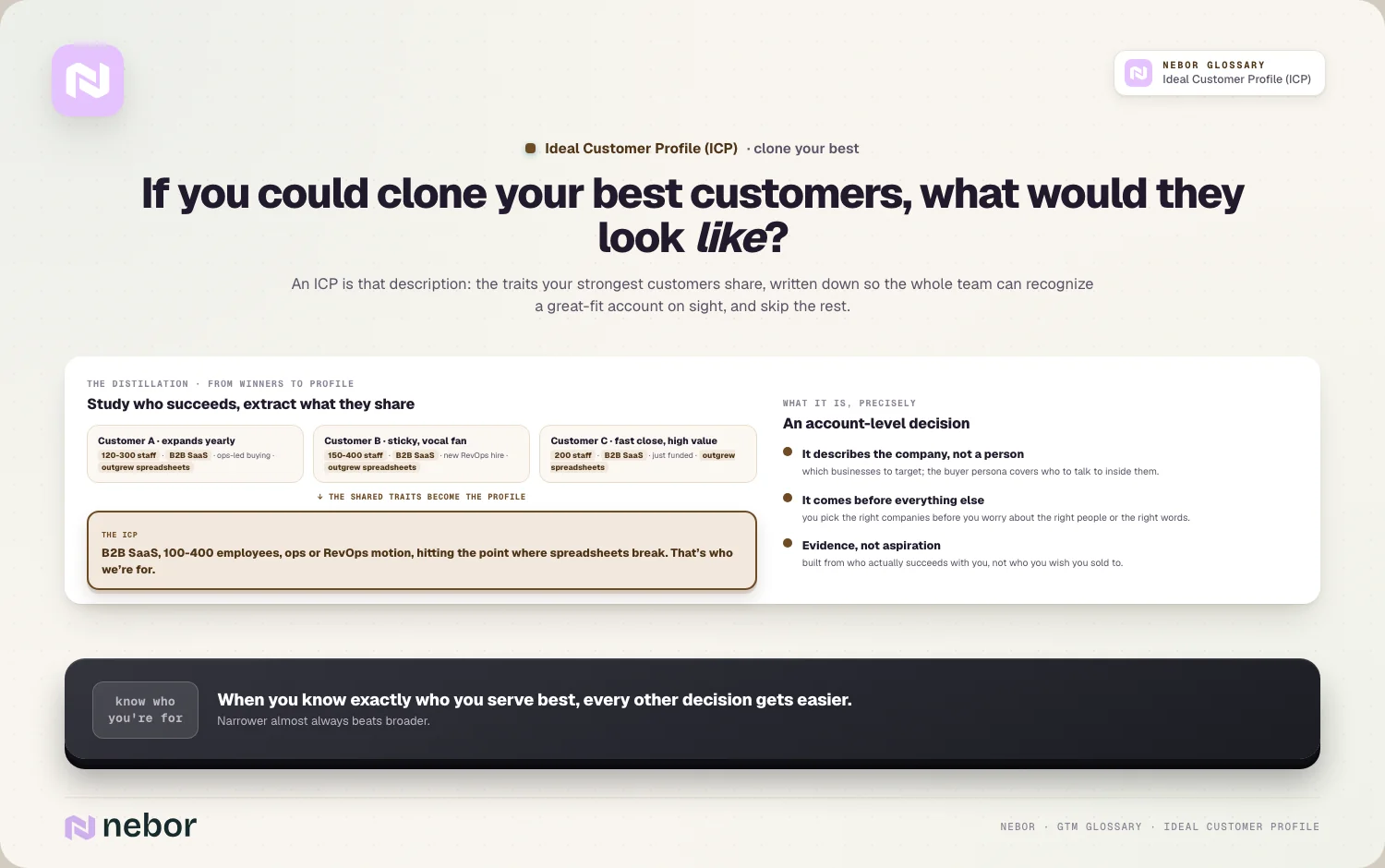
The ICP comes first, because you decide which companies are worth pursuing before you worry about who to reach inside them.
One question captures the entire idea behind it. If you could clone your best customers, what would they look like?
The ICP is that description, and it exists so your whole team can recognize a great-fit account when they see one, instead of treating every company as equally worth chasing.
How is an ICP different from a buyer persona, and which comes first?
These two get confused constantly, and the mix-up causes real targeting problems. They describe different things, and you need both, working at different levels.
An ICP describes the company, the account-level traits that make a business a good fit, like its size, industry, and growth.
A buyer persona describes a person inside that company, the role, goals, and pain points of the individuals you sell to and through. One tells you which doors to knock on, and the other tells you who's likely to answer and what to say to them.
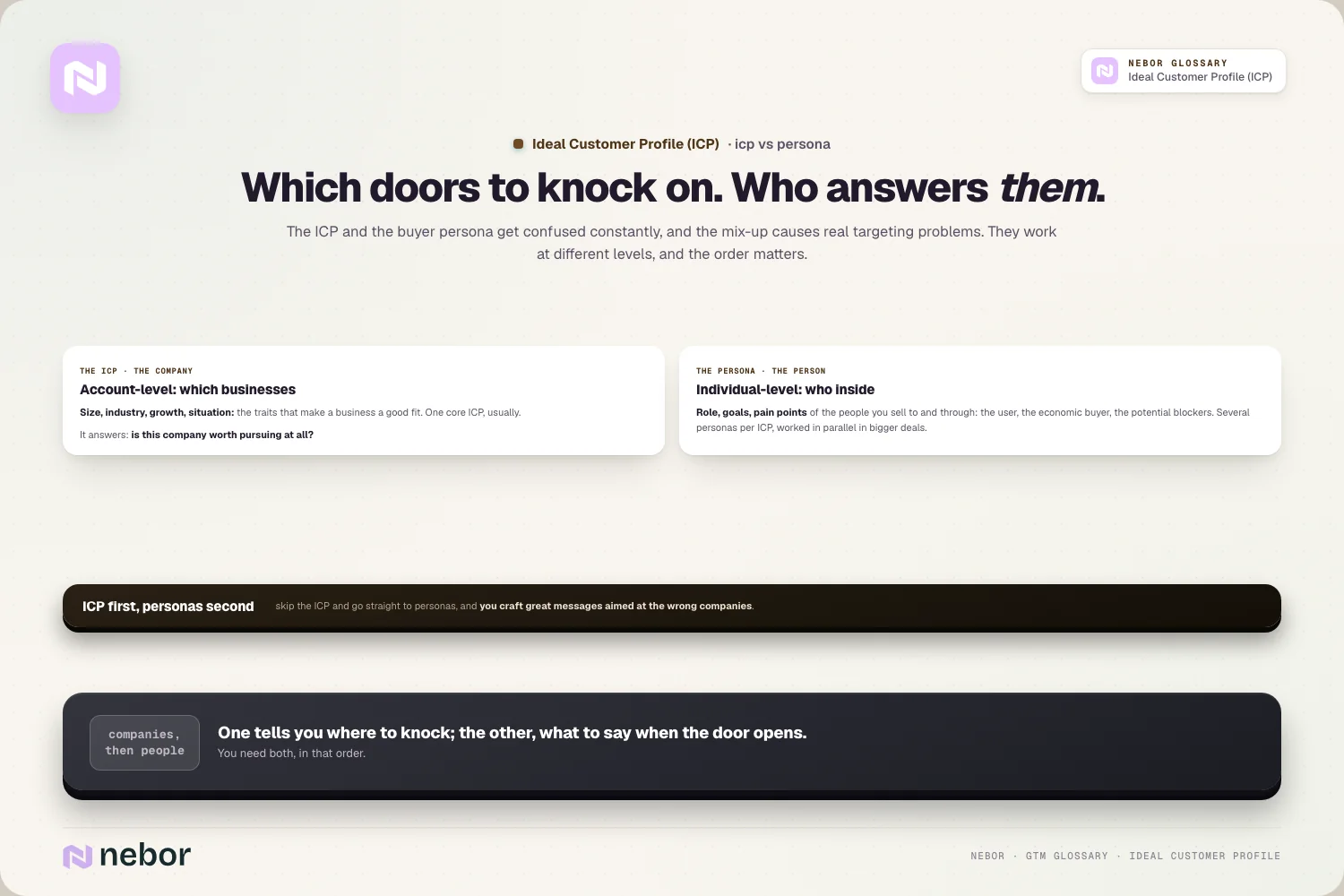
You usually have one core ICP and several buyer personas, because a single type of target company often contains multiple people who matter, like the user, the economic buyer, and the people who can block a deal.
That's the reason working several of them at once through multi-threading matters in bigger deals.
The order is what matters, deciding the right companies through your ICP first, then working out the right people inside them through your personas. Skipping the ICP and going straight to personas means you craft great messages aimed at the wrong companies.
Why does a broad ICP hurt you in ways you don't notice at first?
It feels safer to keep your ICP wide, because a bigger pool of potential customers seems like more opportunity. In practice, and we've watched this play out at client after client, a broad ICP makes your go-to-market weaker in ways that aren't obvious until you trace them.
When your ICP includes everyone, your messaging has to speak to everyone, which means it speaks specifically to no one.
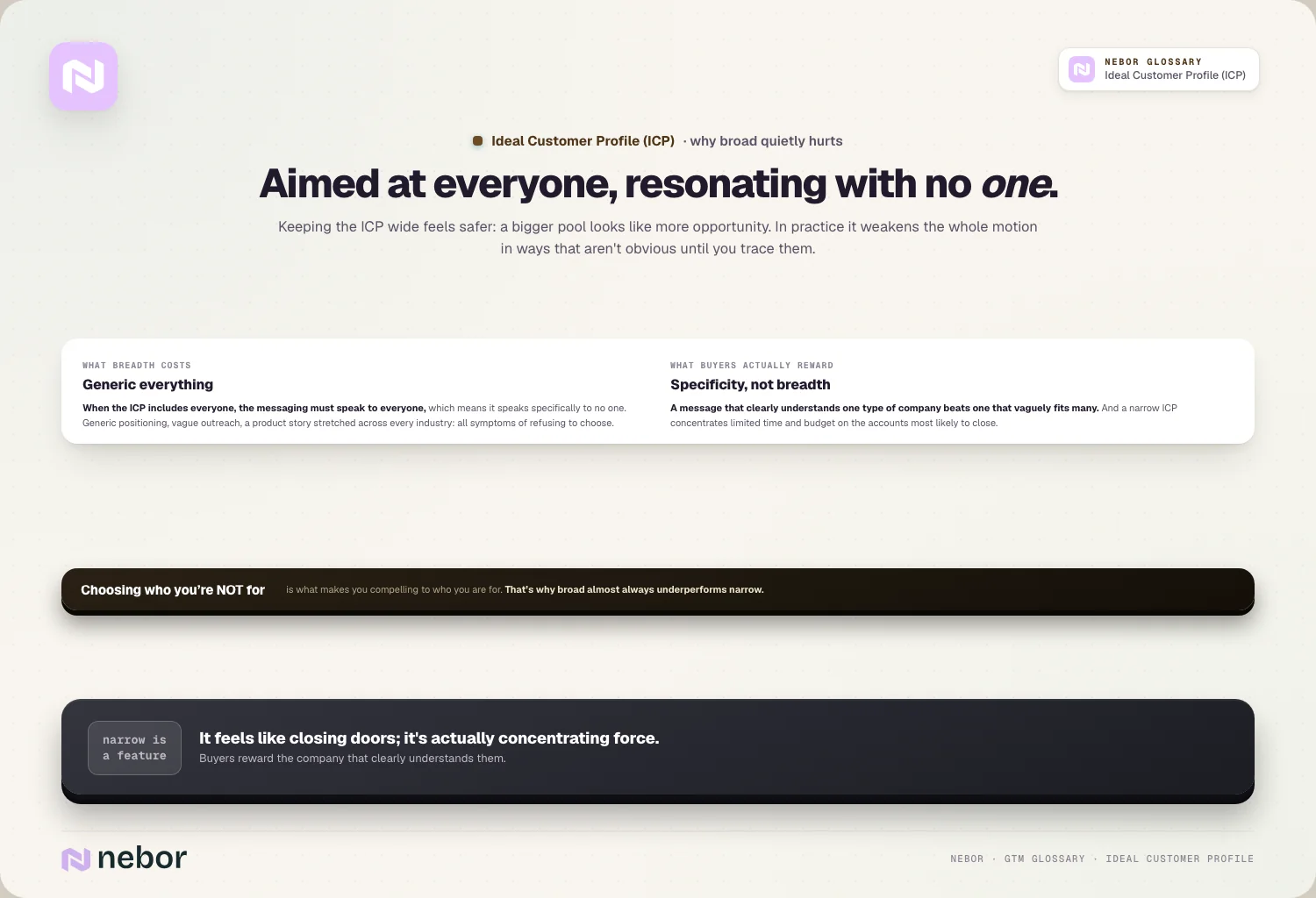
Generic positioning, vague outreach, and a product story that tries to appeal to every industry all come from refusing to choose, and buyers reward specificity over breadth. A message that clearly understands one type of company beats one that vaguely fits many.
A broad ICP also wastes your effort, spreading your limited time and budget across accounts that were never going to buy. The narrower your ICP, the more concentrated your effort on the accounts most likely to close, and the sharper your message to them.
Choosing who you're not for is what makes you compelling to who you are for, and that's the reason broad almost always underperforms narrow.
How do you build an ICP from the customers you already have?
Building an ICP is less about brainstorming the customer you wish you had and more about studying the customers you already serve well. In our experience the best source of truth is your own results.
You start by looking at your strongest existing customers, the ones who get real value, stick around, expand, and are a pleasure to work with.
Then you look for what they have in common, like their size, industry, business model, the problem that drove them to you, and the situation they were in when they bought.
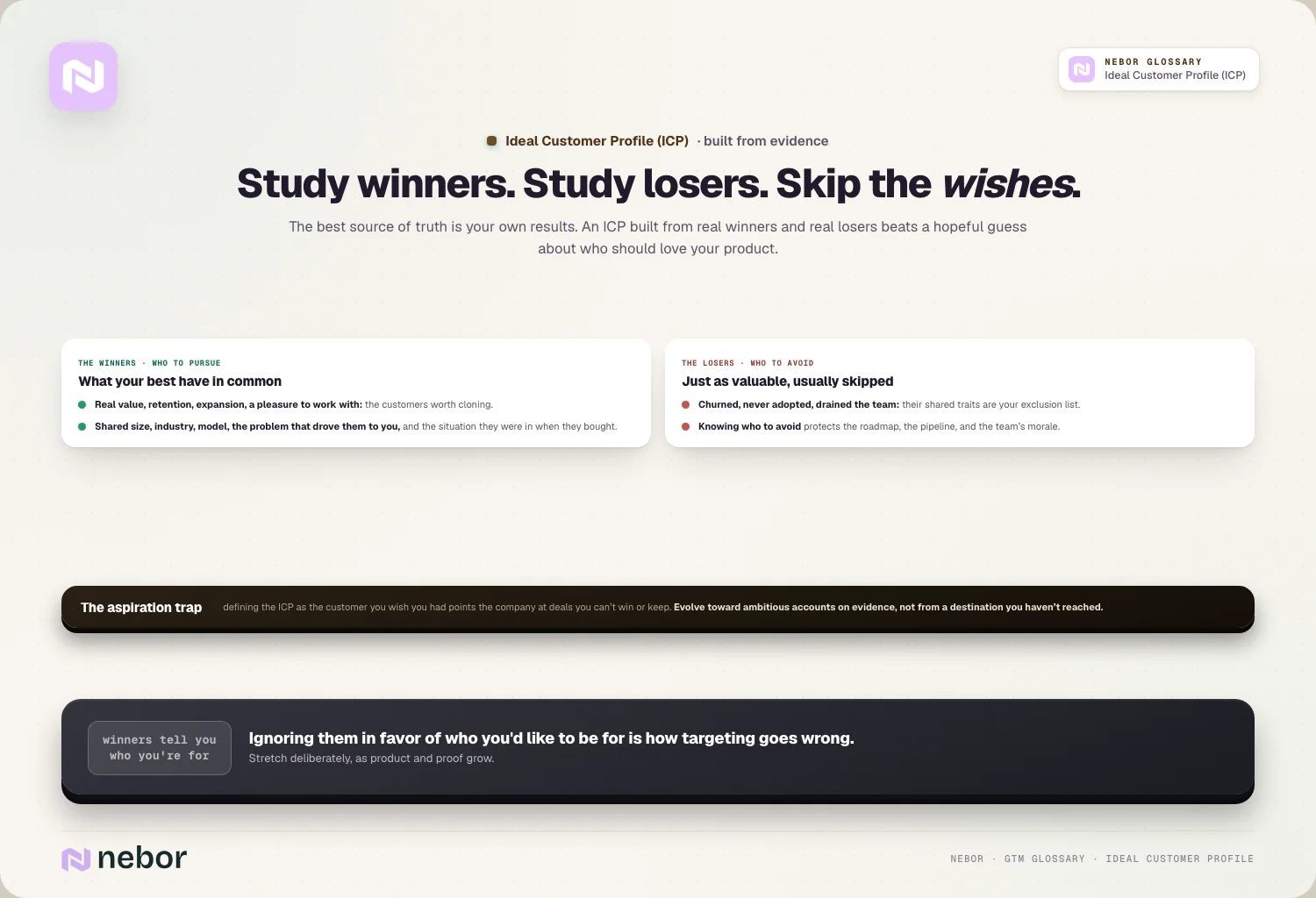
Those shared traits become your ICP, grounded in evidence instead of aspiration, often built out with firmographic data and a read on what triggered the purchase.
It helps to look at your worst-fit customers too, the ones who churned, failed to adopt, or drained your team. Their shared traits tell you who to avoid, which is just as valuable as knowing who to pursue.
An ICP built from real winners and real losers is far more useful than one built from a hopeful guess about who should love your product.
Why should your ICP come from real customers instead of aspiration?
There's a strong temptation to define your ICP as the customer you wish you had, like the big logo or the prestigious industry, instead of the one you serve well today. This is the most common and costly ICP mistake we see.
An aspirational ICP points your whole company at accounts you can't yet win or keep, so you chase enterprise deals your product isn't ready for, or an industry that never really valued what you do.
The result is long, painful sales cycles and customers who never succeed, because the ICP described a fantasy rather than reality. Your real best customers are telling you who you're for, and ignoring them in favor of who you'd like to be for is how targeting goes wrong.
This doesn't mean your ICP can never evolve toward more ambitious accounts, it means the evolution should follow real evidence that you can serve them well.
The honest question is who genuinely succeeds with you today, and the ICP should answer that first, then stretch deliberately as your product and proof grow, instead of starting from the destination you haven't reached yet.
What goes into an ICP, and how specific should the detail get?
A useful ICP is specific enough to act on, and certain kinds of detail belong in it. Vague descriptors don't help anyone target, while concrete ones do.
A solid ICP usually covers a company's size, by employees or revenue, its industry or vertical, its business model, and its stage or growth trajectory.
It often includes situational traits too, like whether the company is hiring for certain roles, using certain tools, or facing a particular trigger that makes your product relevant now.
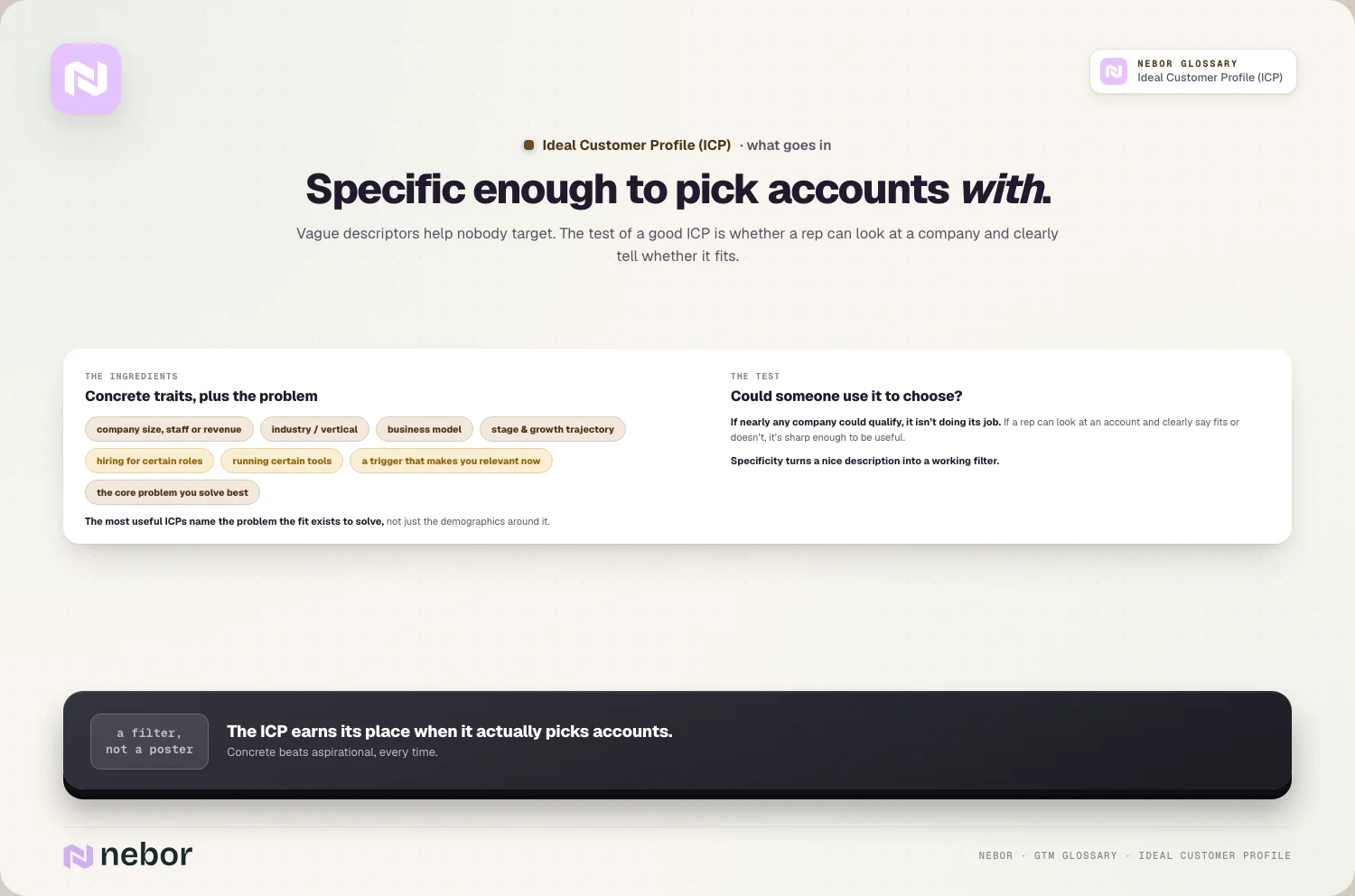
The most useful ICPs also name the core problem these companies have that you solve better than anyone, since that's the real reason the fit exists.
The test of a good ICP is whether someone could use it to actually pick accounts. If your ICP is so broad that nearly any company could qualify, it isn't doing its job, but if a rep can look at a company and clearly tell whether it fits, the ICP is sharp enough to be useful.
Specificity is what turns an ICP from a nice description into a working filter.
How does an ICP connect to your scoring, targeting, and outreach?
An ICP isn't meant to gather dust in a document, it's meant to drive how you find and pursue accounts. Several parts of your motion work directly off it.
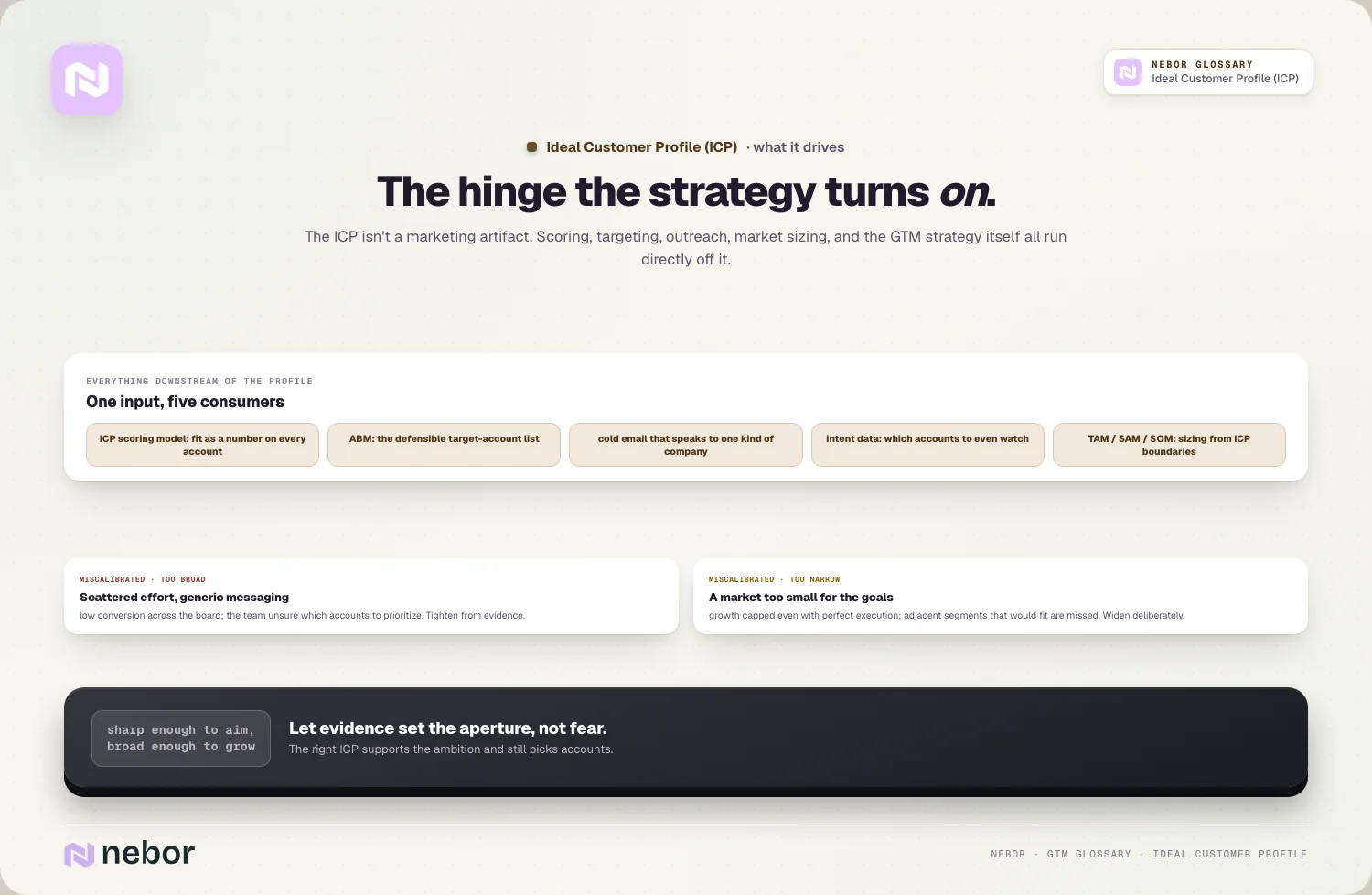
The most direct link is the ICP scoring model, which turns your ICP into a numeric fit score on every account so reps can prioritize by how well a company matches.
From there, your ICP shapes your targeting in account-based marketing, where you focus on a defined set of best-fit accounts, and it guides who you enrich and pursue through data enrichment and signal-based selling.
It also sharpens your outreach, because knowing exactly who you're talking to lets you write cold email that speaks to a specific kind of company instead of a generic everyone, and it tells you which accounts to watch through intent data for signs they're ready to buy.
The ICP is the input to all of this, so a fuzzy ICP weakens every downstream step and a sharp one strengthens them. Everything in targeting and messaging is built on top of who you've decided you're for.
How does the ICP fit into the rest of your go-to-market strategy?
The ICP isn't just a marketing artifact, it is the center of your whole go-to-market strategy. Most of the big strategic decisions radiate out from it.
Your go-to-market strategy decides how you reach and win customers, and almost every part of it depends on knowing who those customers are.
The channels you choose, the message you lead with, the sales motion you choose, and the price you set all flow from the kind of company you're targeting, and the ICP is exactly what defines that. With the wrong ICP underneath it, even a well-built strategy spends its energy on the wrong companies.
The ICP also frames your market sizing, because your TAM, SAM, and SOM come straight from your ICP boundaries.
Knowing how many companies match your ideal profile tells you whether your market is big enough to support your goals, or whether you've drawn the ICP too narrowly to grow into. The ICP is the hinge that the rest of the strategy turns on.
How do you know whether your ICP is too narrow or far too broad?
Since the whole game is finding the right level of focus, it helps to know the signs of an ICP that's miscalibrated in either direction. Both extremes show up in your results.
An ICP that's too broad shows up as scattered effort, generic messaging that doesn't resonate, low conversion across the board, and a sales team unsure which accounts to prioritize.
An ICP that's too narrow shows up differently, as a target market so small you can't hit your growth goals even with perfect execution, or as missed opportunities in adjacent segments that would fit well.
The right ICP is narrow enough to be sharp and broad enough to support your ambitions.
The way to find that balance is to let evidence guide it instead of fear. If your message isn't landing and effort feels scattered, the ICP is probably too broad and needs tightening, and if you're consistently winning beyond your stated ICP, it may be too narrow and due a careful widening.
The ICP works best as a hypothesis you keep calibrating against real results instead of a number you guess once and freeze.
What are the common ICP mistakes, and where do they come from?
A handful of ICP mistakes show up across companies, and most of them come from avoiding the discipline of choosing. Naming them helps you keep your ICP useful.
The biggest is keeping the ICP too broad to avoid ruling anyone out, which guts your messaging and scatters your effort. Close behind is the aspirational ICP, built from who you wish you sold to instead of who succeeds with you.
Then there's the ICP that's too vague to act on, full of descriptors so general that any company qualifies, and the static ICP nobody ever revisits even as the business changes.
There's also the mistake of building an ICP and never using it, leaving it in a doc while reps target on gut feel.
They all come back to the same discipline. You build the ICP from real best customers, make it specific enough to filter accounts, keep it narrow enough to sharpen your message, revisit it as you learn, and wire it into how your team targets and prioritizes.
How does your ICP evolve as the company grows and gathers proof?
An ICP isn't a permanent decision, because the right target shifts as your product, market, and proof change. The ICP that fits you today may not be the one that fits you in two years.
Early on, your ICP is often narrow by necessity, focused on the specific type of company your young product serves well, and that focus is a strength rather than a limitation.
As your product matures and you accumulate proof, you can deliberately expand into adjacent segments or move upmarket, widening the ICP in step with your actual ability to serve those accounts.
The key word is deliberately, because the expansion should follow evidence instead of ambition.
The mistake is treating the ICP as finished once it's written, or expanding it faster than your product can keep up.
The companies that grow well revisit their ICP regularly, tightening it where effort is scattering and widening it where they're consistently winning beyond it. A living ICP that evolves with real results beats a fixed one that slowly drifts out of step with who you actually serve.
Why your ideal customer profile is the foundation everything else rests on
The ICP, in the end, is the single decision that shapes the rest of your go-to-market, because it defines who you're for.
Your targeting, your message, your channels, and your sales motion are all built on top of it, and they inherit whatever clarity or fuzziness you built into it.
The teams that get it right build the ICP from their real best customers, make it specific enough to filter accounts, keep it narrow enough to sharpen their message, and treat it as a living hypothesis they calibrate against results.
They understand that choosing who they're not for is what makes them compelling to who they are for.
The mindset that works is to resist the pull toward broad and embrace the power of specific.
When you decide clearly who gets the most value from what you sell, point your whole motion at them, and refine the picture as you learn, every other decision in go-to-market gets easier, because you finally know exactly who you're for.
Share this post
Prospecting
Marketing
Glossary
Related glossary items
Understanding the core GTM concepts




Ready to build your pipeline











