

In this post:
Demand generation is the work of creating real interest in what you sell, so that more of the right people want to buy from you over time. It covers everything from a stranger first hearing your name to a buyer entering your sales process ready to talk.
It's a broad discipline instead of a single tactic. Demand generation includes the content that builds awareness, the trust that builds affinity, and the capture that turns that interest into pipeline once buyers are ready.
The trouble is that most of what gets called demand generation isn't really generating demand at all. It's collecting contact details from people who already had it, which is a different job with a different name.
TL;DR
Demand generation is the whole discipline of building and capturing genuine interest in your product, measured on pipeline and revenue instead of form fills. It spans creating demand among future buyers and capturing it from the ones who are ready now.
Most teams quietly do lead generation and call it demand gen. They gate content, count MQLs, and harvest contacts who were already in the market, while doing little to create new interest among the much larger group who aren't.
Real demand generation plays a longer game. You build a market that knows and trusts you, so that when buyers are finally ready, you're the name they already have in mind. That's harder to measure, and far more valuable.
So what does demand generation actually mean, beyond the buzzword?
Demand generation is the full set of activities that make people want your product and then act on that want. It starts long before anyone is ready to buy, and it ends when a truly interested buyer enters your pipeline.
That makes it wider than any single channel. It covers how people first discover you, how they come to trust you, how they learn about your offering on their own terms, and how they eventually raise their hand. Every one of those steps is part of generating demand.
The key word is demand, which means actual desire to buy instead of just awareness or attention. Plenty of people might know your name without wanting your product, so real demand generation is about building the want on top of the recognition.
Why is demand generation so often confused with lead generation?
This is the confusion at the heart of the whole topic, and it deserves a blunt answer. Demand generation creates interest, while lead generation captures contact details from people who already have it.
A lead gen play gates a whitepaper, collects an email, and calls that a result. A demand gen play publishes something genuinely useful, ungated, that shapes how a buyer thinks, even if you never learn their name. One harvests existing demand, the other builds new demand.
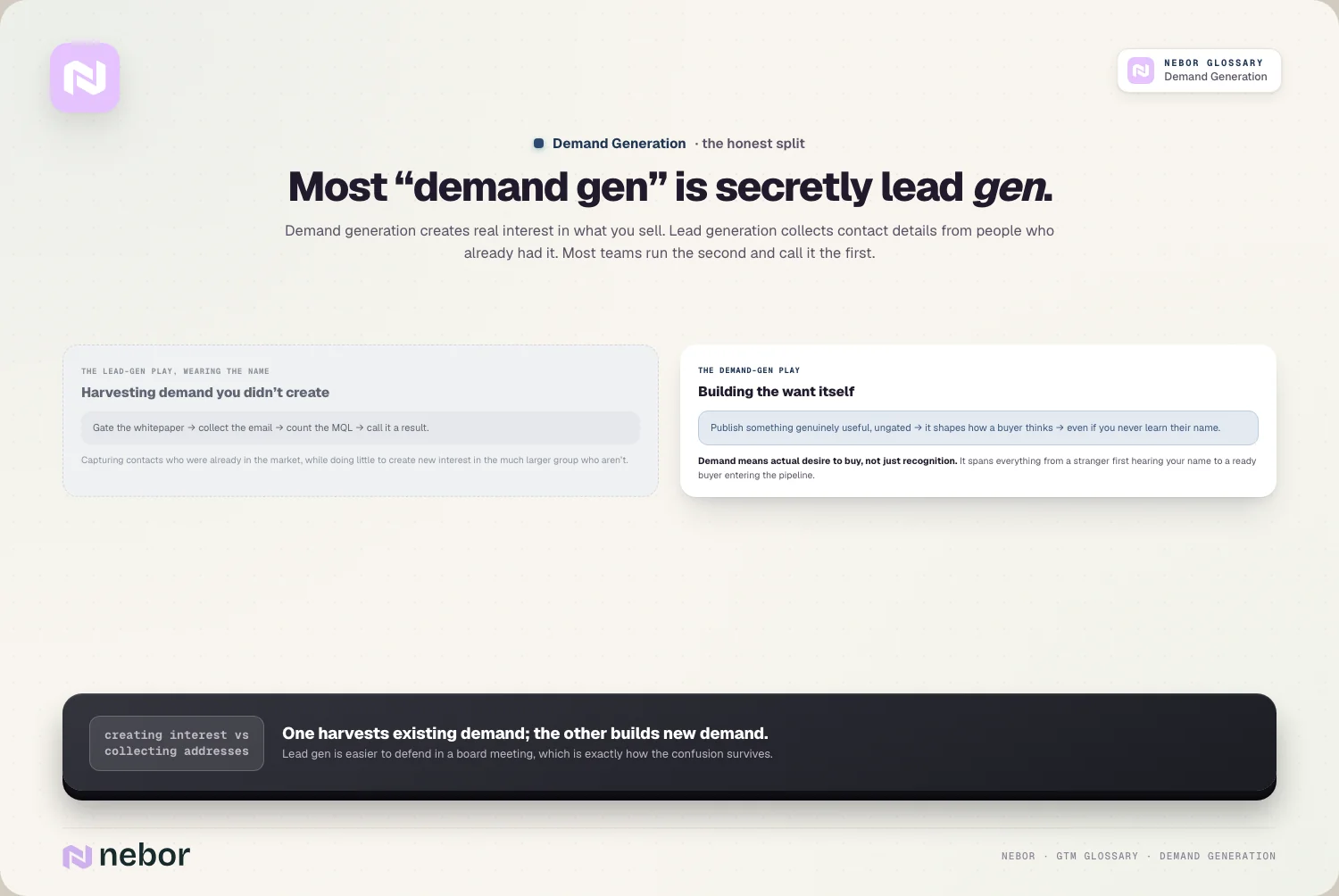
The two blur together because lead gen is easier to measure and easier to defend in a board meeting. We've written about why a GTM motion beats a lead-gen motion, and this is where that difference bites.
If your demand gen program is really just a form-fill machine, you're capturing demand you didn't create and calling it growth.
How does demand generation hold both creating and capturing demand together?
The structure underneath makes the idea clearer. Demand generation is the umbrella, and beneath it are two jobs, creating demand and capturing it. You need both, and they're covered in depth in demand capture versus demand creation.
Creating demand means reaching the people who aren't looking yet, which matters because at any moment only about 5% of your buyers are in the market and the other 95% are not. Capturing demand means converting the small slice who are ready now, by meeting their buying intent when they search and compare.
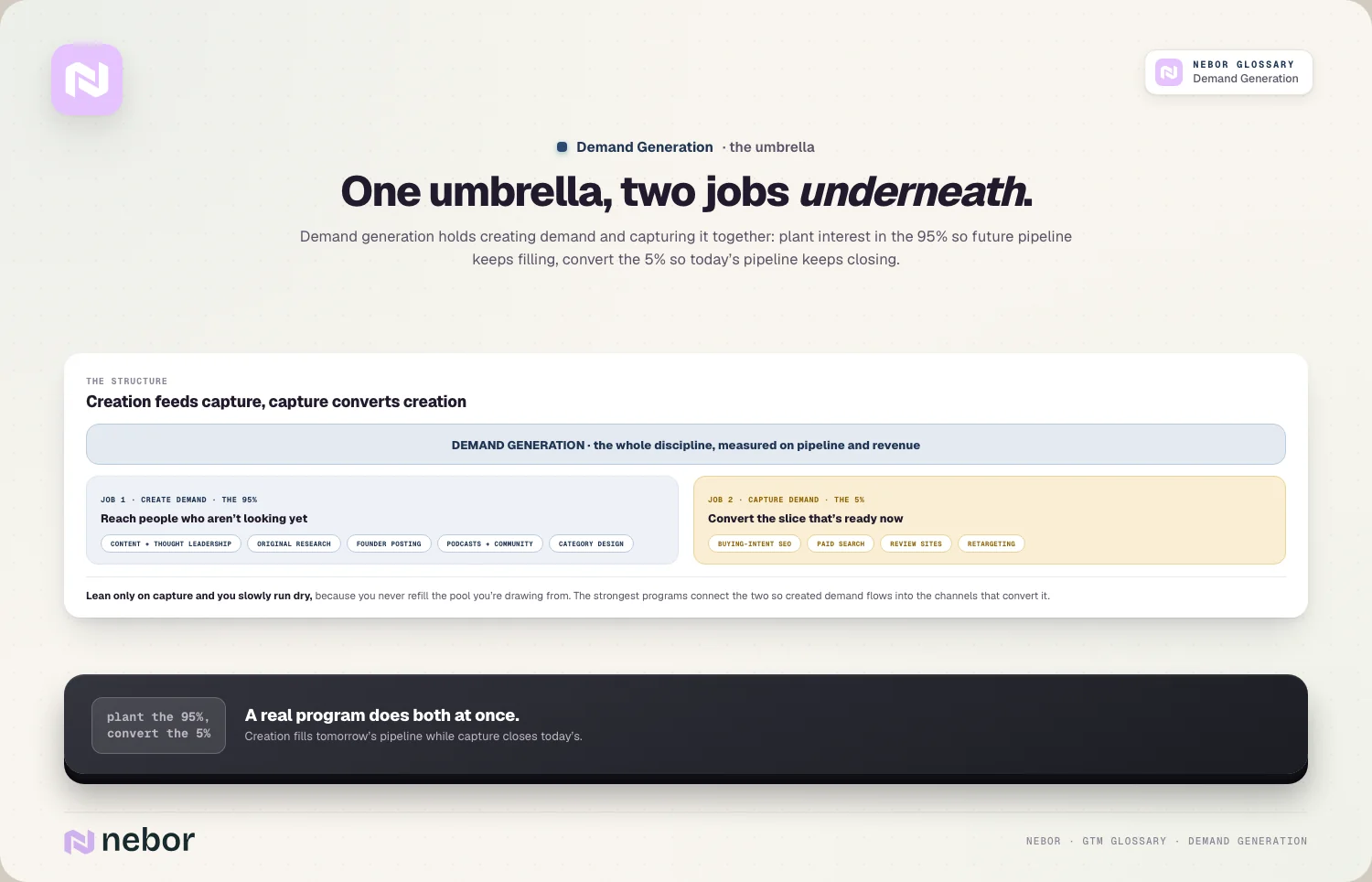
A real demand generation program does both at once. It plants interest in the 95% so that your future pipeline keeps filling, and it captures the 5% efficiently so that today's pipeline keeps closing. If you lean only on capture, you slowly dry up, because you never refill the pool you're drawing from.
What does demand generation look like across your real channels?
The actual tactics make it concrete, because demand generation can feel abstract until you name them. They split neatly into the ones that create demand and the ones that capture it.
On the creation side, you have content and thought leadership, original research and benchmark reports, founder-led posting, podcasts, community building, and at its most ambitious category design. All of these reach people before they're shopping and shape how they think about their problem.
On the capture side, you have SEO for buying-intent terms, paid search, review-site presence, and retargeting, all aimed at people already looking. The strongest programs connect the two, so the demand you create flows into the channels that capture it.
It works on both sides of the funnel too, the way we build it. Inbound, your content pulls future buyers toward you. Outbound, the same content powers content-led outbound and a cold-to-warm pipeline, where you warm prospects with value before you ever pitch them.
Why do MQLs make your demand generation look better than it is?
The single biggest trap we flag in demand gen is the marketing qualified lead. Counting MQLs feels like progress, because the number goes up and it's easy to report, but it usually measures the wrong thing.
An MQL is often just someone who downloaded a gated PDF, which tells you almost nothing about real demand. You can hit your MQL target every quarter while pipeline stays flat, because you're rewarding form fills instead of genuine intent. This is how teams convince themselves a program is working when it isn't.
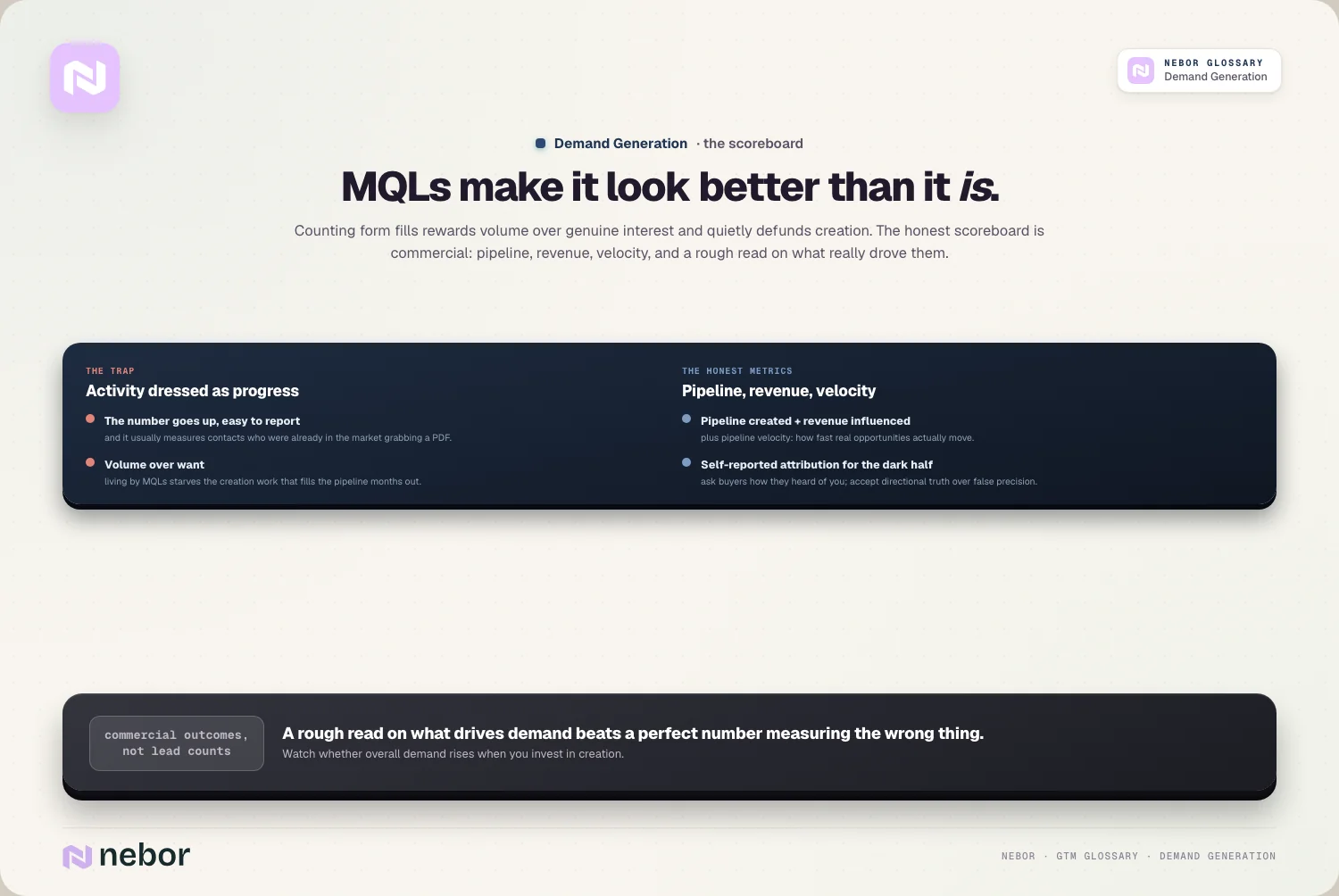
Worse, the MQL mindset pushes you toward gating everything and chasing volume, which actively starves the demand creation that fills your future pipeline. If you want a better account-level version of the idea, a marketing qualified account at least looks at the whole buying group instead of one curious downloader.
So how should you honestly measure your demand generation instead?
Since MQLs mislead, you need a different scoreboard, one built on commercial outcomes instead of activity. The honest metrics for demand generation are pipeline and revenue instead of lead counts.
Look at pipeline created and revenue influenced, and at pipeline velocity, which tells you how fast real opportunities move. Watch whether overall demand rises when you invest in creation, even when you can't draw a clean line to each deal.
You also have to measure the part you can't track directly, because a lot of demand gen lives in the dark funnel where your attribution can't follow it.
The fix we lean on is self-reported attribution, simply asking buyers how they heard about you, plus accepting directional truth over false precision. A rough read on what's really driving demand beats a perfect number measuring the wrong thing.
Where does outbound fit into a real demand generation program?
People often file demand gen under marketing and outbound under sales, but that split is a mistake. Outbound is one of the most direct ways to both create and capture demand, when you do it well.
Cold outbound that pitches strangers does little for demand, and often hurts it. Warm, content-led outbound plays a different game entirely. When you reach out off a real signal, or after a prospect has seen your content, you're activating demand you helped create rather than interrupting people at random.
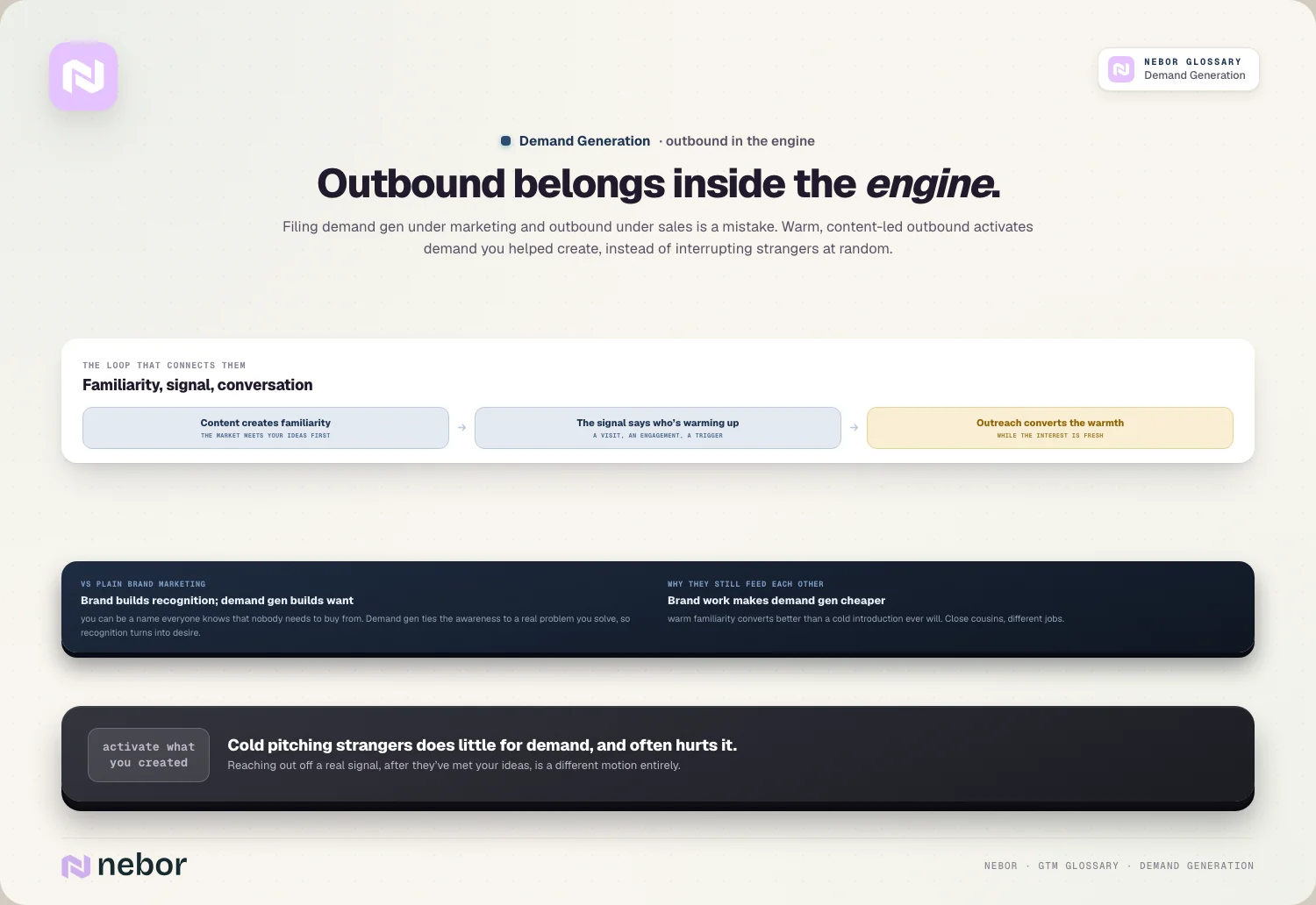
So the best demand generation programs treat outbound as part of the engine rather than a separate motion. The content creates familiarity, the signal tells you who's warming up, and the outreach converts that warmth into a conversation while the interest is fresh.
What are the most common ways a demand generation program goes wrong?
Most demand gen programs stumble in the same handful of ways, and nearly all of them trace back to confusing it with lead gen. The biggest is gating everything, which trades real reach for a few more email addresses and shrinks the audience you're trying to build.
Another is living and dying by MQLs, which rewards volume over genuine interest and steadily defunds creation. A third is short-termism, expecting demand creation to pay back this quarter when its whole point is filling pipeline months out. Teams kill the creation work right before it would have started compounding.
The last common mistake is measuring only what's easy. If you judge the program purely on trackable last-click conversions, you'll starve everything that happens in the dark funnel, which is usually where the real demand was built. You end up optimizing for the visible sliver and wondering why growth stalls.
How is demand generation different from plain brand marketing?
These two get lumped together, and they're close cousins, but they aren't identical. Brand marketing builds awareness and affinity, the sense that people know you and feel good about you. Demand generation takes that further, into actual want and action.
You can have strong brand recognition and weak demand, like a company everyone has heard of but nobody feels a need to buy from. Demand generation closes that gap by tying the awareness to a real problem you solve, so recognition turns into desire.
In practice the two overlap heavily and feed each other. Brand work makes your demand gen cheaper, because warm familiarity converts better than a cold introduction ever will. Brand builds the relationship, and demand generation turns that relationship into pipeline.
How do you get a real demand generation engine off the ground?
If you're starting from a lead-gen setup, the shift can feel daunting, but the first moves are simple. You don't rebuild everything at once, you start creating real demand alongside the capture you already do.
Pick one or two creation channels you can sustain, like a founder posting consistently or a steady stream of consistently useful content, and commit to them for months instead of weeks. Ungate your best material so it reaches people, and stop treating every download as the goal.
Then connect creation to capture, so the interest you build flows into the channels that convert it. Make sure someone owns the whole thing end to end, and start reporting on pipeline instead of lead volume from day one. The early months feel slow, which is exactly why most teams quit and stay stuck in lead gen.
Why does demand generation work far better as a system than a campaign?
The campaign mindset is where a lot of demand gen falls apart. A campaign has a start and an end, but demand compounds only when the work is continuous, so treating it as a one-off burst wastes most of its value.
Watch how trust builds in real life. A buyer sees your name once and forgets it, sees it a few more times over months and starts to recognize it, and only after sustained exposure does it turn into preference. None of that happens in a six-week sprint.
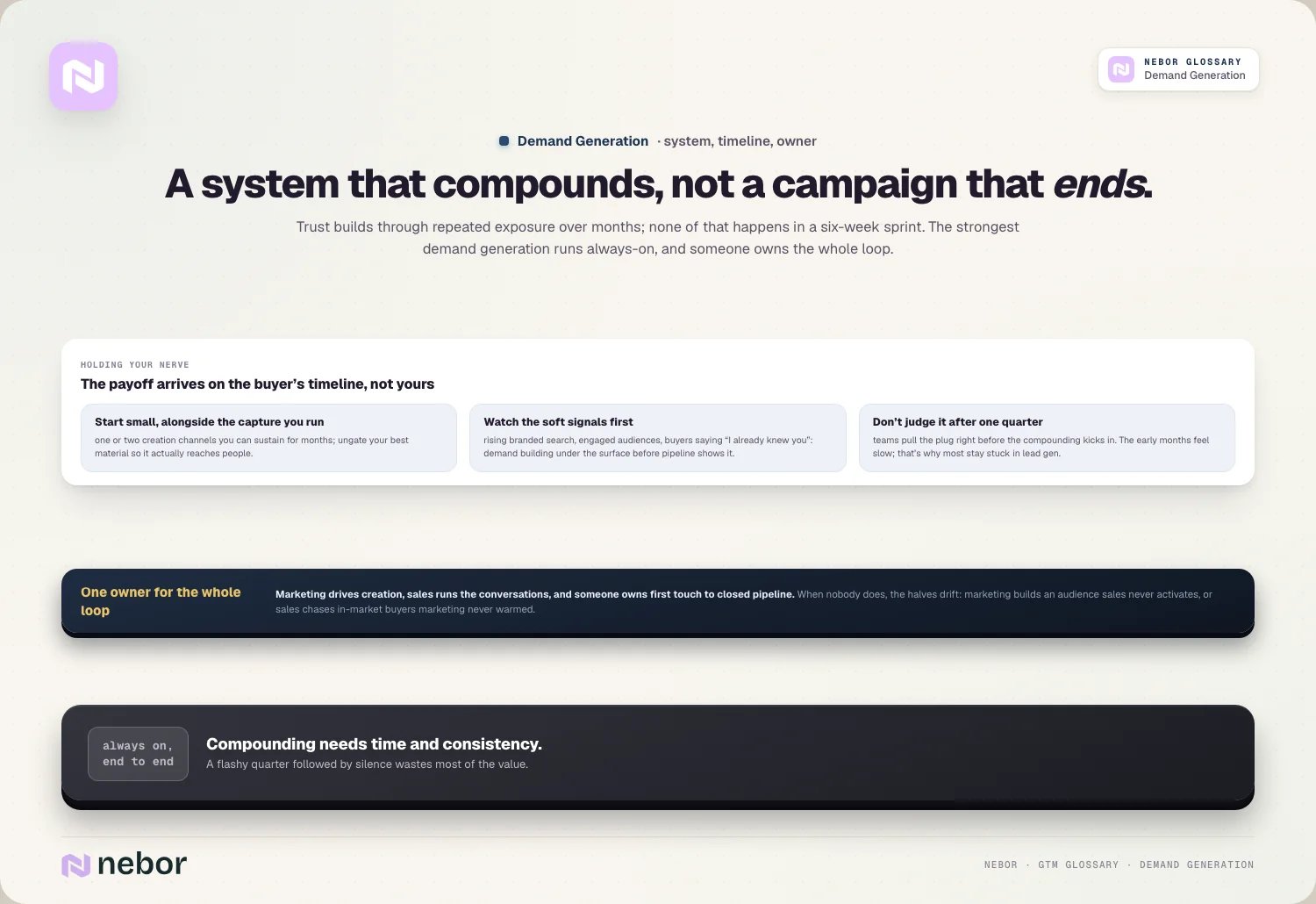
So the strongest demand generation works as an always-on system, where content, distribution, capture, and measurement all connect and keep going. The compounding is the whole point, and compounding needs time and consistency rather than a flashy quarter followed by silence.
How long before your demand generation truly starts to pay off?
This is the question that makes finance nervous, and the honest answer is that it takes a while. Demand creation works on the buyer's timeline instead of yours, and most B2B buyers won't be in the market for months after you first reach them.
In the early going you'll see soft signals before hard ones, like rising branded search, more engaged audiences, and more buyers saying they already knew you when they finally show up. Those are the leading indicators that demand is building under the surface.
The pipeline impact usually arrives gradually, and then it becomes hard to imagine working without it. Judging the program after a single quarter means pulling the plug right before the compounding kicks in.
If you can hold your nerve through the slow start, demand generation becomes the most durable growth you have.
Who on your team ends up owning demand generation day to day?
Ownership of demand generation is surprisingly contested, and that confusion is part of why it underperforms. It doesn't fit neatly inside marketing, because the capture side and the outbound side touch sales directly.
The honest answer is that it's a shared motion with a single owner. Marketing usually drives the creation work and the content engine, sales owns the conversations that capture warm demand, and someone has to own the whole loop so nothing falls between the two.
When no one owns it end to end, the creation and the capture drift apart. Marketing builds an audience that sales never activates, or sales chases in-market buyers that marketing never warmed up. Naming a single owner for the full engine, from first touch to closed pipeline, is one of the simplest fixes most teams skip.
Why demand generation is really about building a market that remembers you
Once the tactics fall away, demand generation comes down to one simple idea. You're building a market of people who know you, trust you, and think of you first when their moment comes.
That's why the lead-gen framing is so limiting. Harvesting forms from in-market buyers is a real job, but it only ever captures demand that already exists, and it does nothing to make tomorrow's pipeline bigger than today's. Demand generation is the work that grows the pool.
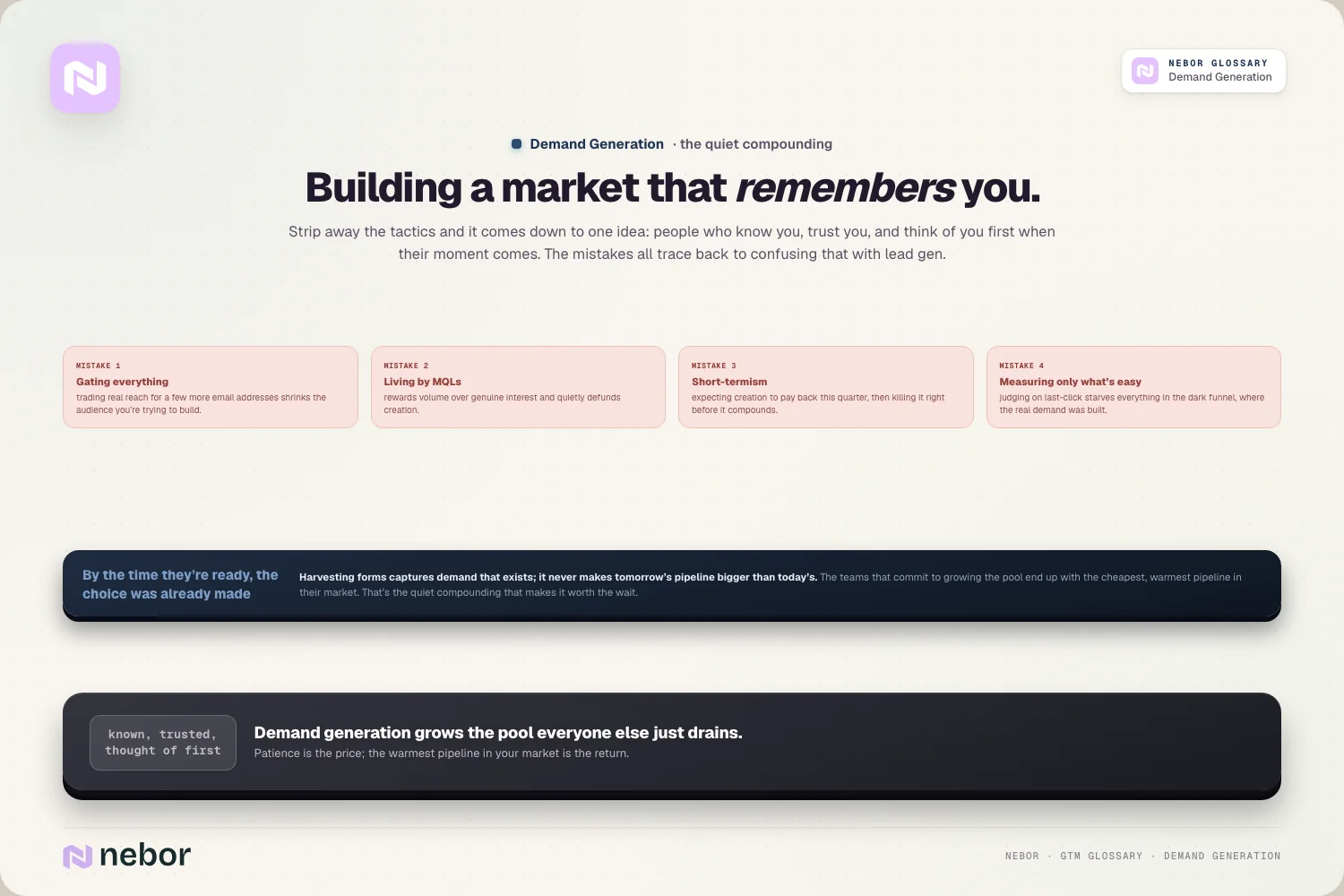
It asks for patience, because most of the payoff arrives later and refuses to show up cleanly in a dashboard. The teams that commit to it anyway end up with the cheapest, warmest pipeline in their market, because by the time their buyers are ready, the choice was already made.
That's the quiet compounding that makes demand generation worth the wait.
Share this post
Marketing
Glossary
Related glossary items
Understanding the core GTM concepts




Ready to build your pipeline











