
10 Best SDR Agencies to Hire in 2026 (And Why You Probably Don’t Need One)


In this post:
The best SDR agencies in 2026 are Belkins, CIENCE, and Martal Group, followed by seven more we review below. Which outsourced SDR company fits you depends on your deal size, your channels, and your budget, and we go through all ten with honest pros, cons, and pricing.
But before you pick one, there are five questions we believe you should ask, because they matter more than anything in the sales pitch:
Do you own the data and the systems when the contract ends, or does the outsourced SDR company keep them?
How does the agency define a qualified meeting, and do they report held meetings or just booked ones?
How long is the ramp, and what do you pay while their SDR team learns your market?
Does their channel mix, meaning cold calling, email, LinkedIn, or all three, match how your buyers want to be reached?
Will your sales infrastructure be stronger when the engagement ends, or are you renting appointment setting month to month?
We are Nebor, and we should say our bias up front, because SDR companies rarely do. We build automated sales development systems that do most of what SDR outsourcing sells, so we earn money when you do the opposite of hiring an agency.
If after reading this you think that system is the better fit, you can book a call with us. And if an agency is the right call for your situation, this list will help you pick the right one.
Note: Most SDR agencies will outsource you a rep, or a team of reps, to take care of your prospecting and some of your other sales functions.
The question worth asking is whether that is what you need. SDR agencies are expensive, and most of the jobs those reps do can now be handled by smart workflows built with tools like Clay, Claude and ChatGPT, which make your existing team far more efficient and cost you a fraction of the retainer.
At Nebor, we are a GTM engineering and RevOps agency, and building those AI workflows is what we do. From experience, most teams need fewer people and better systems and not the other way round.
Book a meeting with us and let's discuss how your sales motion works today, then find the best solution for your situation.
TL;DR
Most SDR agencies rent you people. You pay $3,000 to $30,000 per month for humans to build lists and book meetings, and the day you stop paying, the pipeline and the playbook leave with them.
The ten agencies below are the best at that model, and in a few situations, meaning new markets, no in-house SDR bandwidth, or very large deals, hiring one is the right call.
But for most B2B teams, the smarter buy in 2026 is an automated sales development system you own. It prospects, enriches, and watches buying signals around the clock, it costs less than one retainer, and it keeps working after any contract ends. That is what we build at Nebor.
The 10 best SDR agencies at a glance
Agency | Best for | Pricing |
|---|---|---|
Belkins | Research-heavy B2B lead generation and appointment setting across 50+ verticals | $5,000 to $15,000+ per month |
CIENCE | High-volume outbound and lead generation at enterprise scale | $2,000 to $9,500+ per month |
Martal Group | International campaigns with onshore, multilingual reps | From ~$5,000 per month |
SalesHive | Testing SDR outsourcing without a long contract | $6,000 to $12,500 per month |
SalesRoads | Phone-first lead generation for high-value industrial deals | ~$10,000 per 4-week cycle |
Cleverly | Budget LinkedIn outreach for small businesses | From $297 per month |
demandDrive | SDR services plus RevOps and CRM work | ~$7,000 to $15,000+ per month |
CloudTask | A marketplace of vetted SDR talent with pay-per-performance options | $1,500 to $40,000+ per month |
SalesBread | Ultra-personalized outreach for high-ACV boutiques | ~$3,000 per month |
Callbox | Enterprise, global, every channel at once | $15,000 to $30,000+ per month |
Before you hire an SDR Agency, here's what a sales automation system can do for you instead (and why one or two closers is all you need)
We (Yannick and Andrew, founders of Nebor.ai) were salespeople before we became sales workflow builders. We watched businesses waste 60% of their reps' time on manual work, and we worked at agencies that cared more about retainer revenue than results.
That frustration is what drove us to build Nebor as a fix for a broken system instead of yet another lead generation agency. Here is a quick picture of the top of the funnel we build for your team.
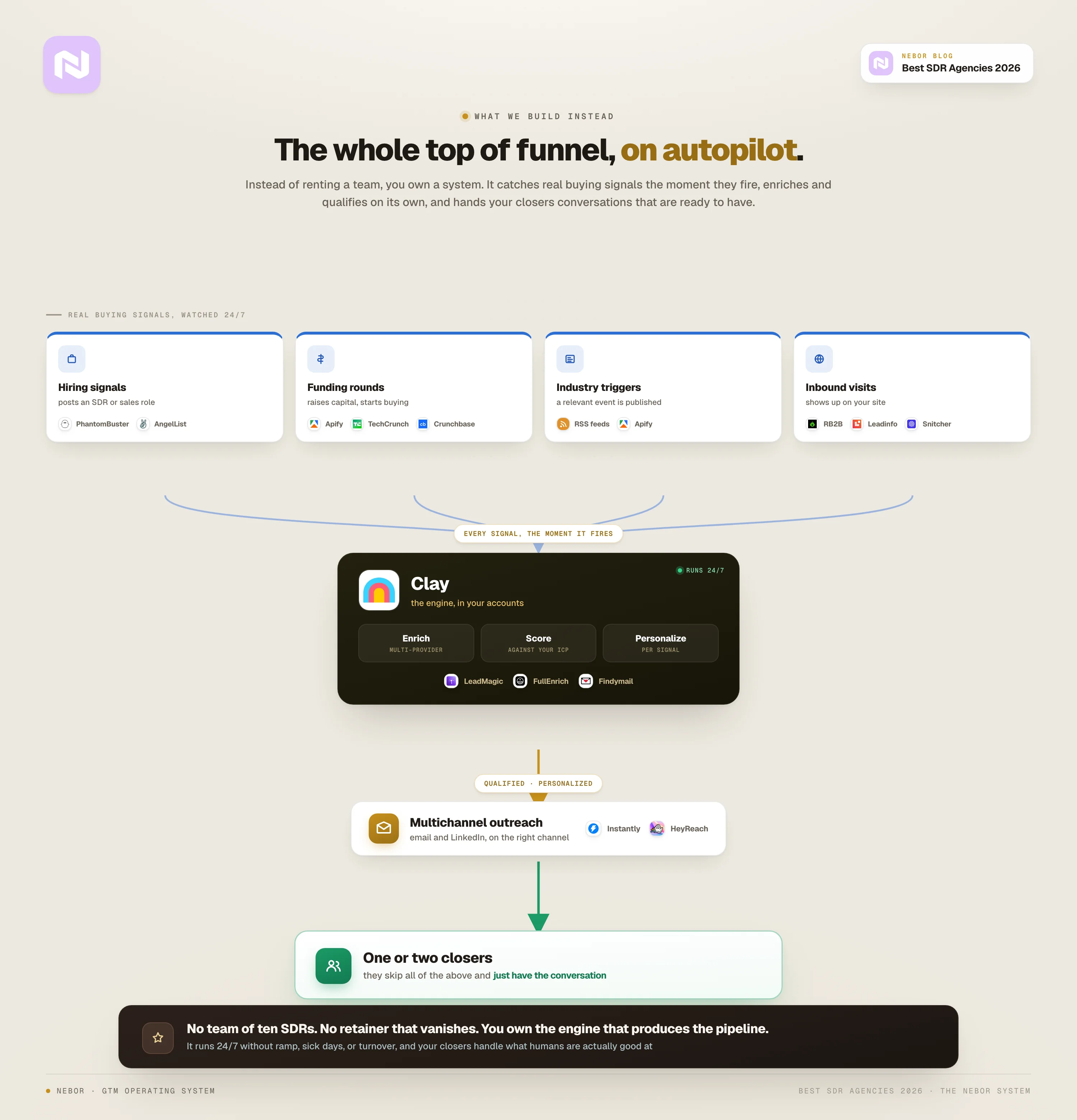
Here's the core problem with the SDR agency model. You're paying $5,000 to $15,000 per month for people to do work that automated sales workflows now do faster and cheaper, and when you stop paying, you keep nothing.
The agencies feel this shift too, and that is why so many now pitch themselves as partners blending human sales expertise with automation and data intelligence to build a predictable pipeline. The pitch got nicer, but the rental model underneath is the same.
What we build is the opposite. The Clay tables, the n8n flows, the Instantly sequences, and the enrichment waterfalls all live in your accounts and keep going whether you work with us or not.
Here is what that looks like for a team comparing outsourced SDR companies or top sales automation companies and tools.
You get automated prospecting and lead discovery that works 24/7
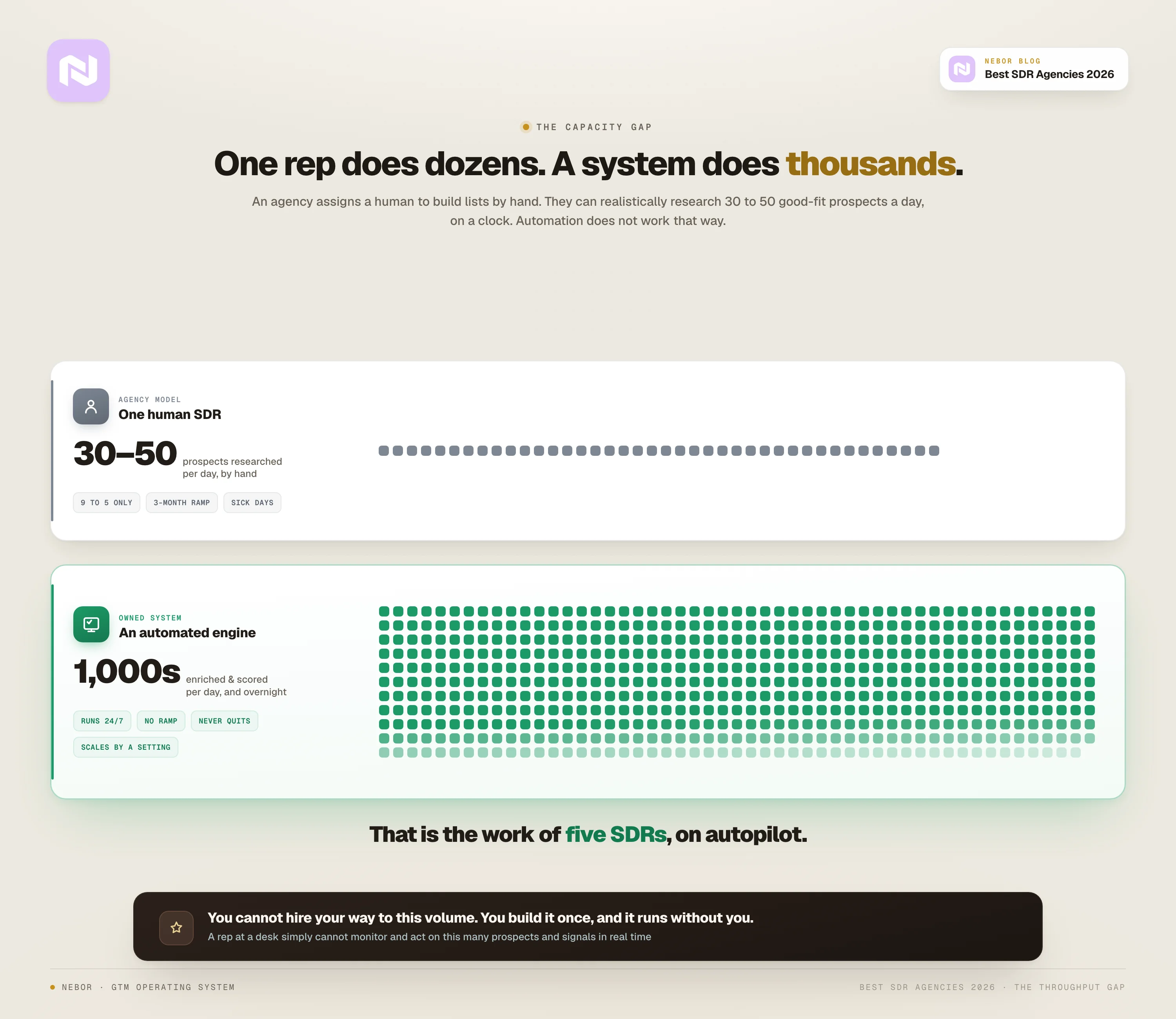
Most SDR agencies assign a rep to build prospect lists by hand in Sales Navigator, and a good rep researches 30 to 50 potential customers a day.
Our Clay workflows do the same job around the clock. They pull data from multiple providers, verify contacts through LeadMagic, FullEnrich, and Findymail, and push high quality leads straight into your sequences, with accurate data sharpening the targeting on every pass.
We build intent data and predictive scoring into the workflows to help your reps engage prospects at the right moment, and your conversion rates show the difference. You get the output of a full sales development team without the payroll.
Real-time buying signal detection (not the surface-level stuff)
Real intent is an event that ties to buying behavior, and we build monitors for exactly those:
Hiring signals: PhantomBuster scrapes LinkedIn job posts daily, because a company hiring in-house SDRs is investing in sales capacity.
Funding rounds: a raise means expansion and new tools, so outreach goes out while the news is fresh.
Industry triggers: RSS feeds and Apify scrapers watch your market's publications.
Competitor acquisitions: when your competitor gets bought, we reach their customers first.
Contact moves: when a past buyer lands at a new company, they get an offer at the new address.
None of this is manual, and an SDR agency rep at a desk cannot watch this many signals at once.
Inbound lead qualification that closes the gap between marketing and sales
Most SDR agencies only do outbound. We also build automated workflows that qualify your inbound the moment they take a step towards your business, checking every lead against your ICP with the same rigor as outbound before anyone spends time on it.
Your website visitors get identified through RB2B or Leadinfo, enriched through Clay automation workflows, scored, and routed instantly as qualified leads, which keeps your sales funnel clean.
No more leads waiting in a queue for 48 hours, and no more marketing and sales arguing over lead quality, because the same enrichment scores every record.
What this means for your sales team
When you build these systems, you don't need a team of 10 SDRs or a $10,000-per-month retainer. The system can handle prospecting upstream, leaving one or two strong closers focused on closing deals instead of top-of-funnel work, and that is why we say most teams need a system before they need SDR outsourcing services.
10 kme.litinine@gmail.com (1)ey criteria you should use when evaluating any SDR agency (and what we based our list on)
Some companies do have business needs that justify hiring outsourced sales development representatives, like a new market your in-house team cannot cover.
The good ones act as strategic partners in your sales process and tech stack, providing trained sales development representatives who handle prospecting, lead qualification, and appointment setting for your team. The models range from full-cycle outbound management to appointment-only support.
Demand for outsourced SDR companies keeps growing in 2026 as budgets tighten and B2B buying cycles stretch, so get clear on your own goals and metrics first, then ask these ten questions before you sign.
1. Do you own the data and systems, or are you renting them?
When the contract ends, do you keep your lists, sequences, and learnings? Most outsourced SDR companies keep everything, so your spend only has value while you keep paying.
2. How do they define a "qualified meeting"?
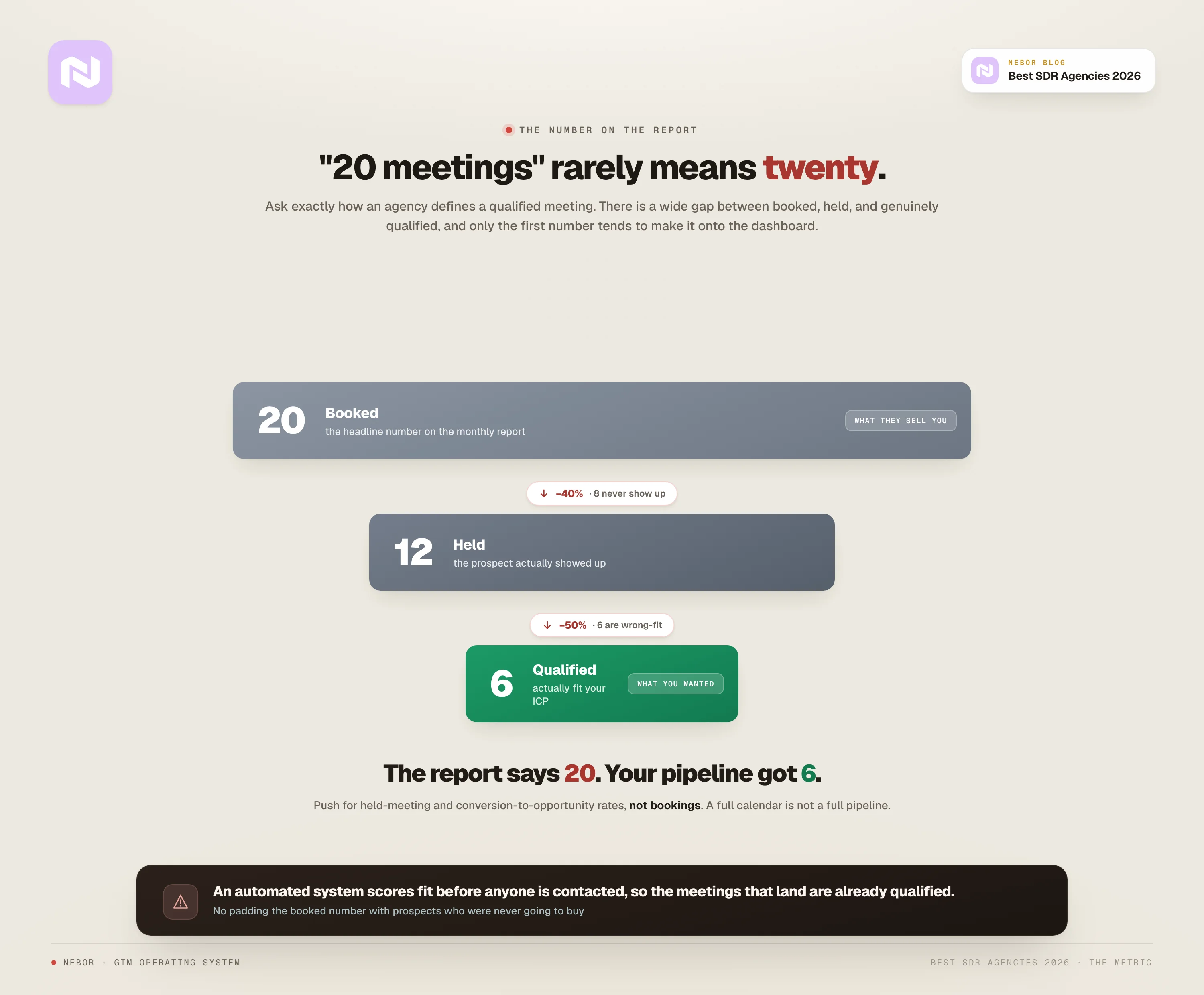
An agency may report 20 meetings booked, but if only 12 prospects show up and 6 turn out to be qualified leads, that's a very different number. Ask for held-meeting rates and how many became qualified meetings.
3. What does their ramp time look like?
Most outsourced SDR companies need 30 to 90 days before real results, and you pay full price while they learn. Ask what happens if nothing lands by day 60.
4. How do they handle email deliverability?
Great copy in a spam folder books nothing, so ask about domain warming, SPF/DKIM/DMARC, and inbox rotation. Our email deliverability guide covers the details.
5. What channels do they really use?
Some agencies say "multichannel" but only do email, and others live on the phone. The right channel mix helps SDRs engage prospects consistently across each stage of your sales funnel. Make sure their mix matches your sales strategy, because the best appointment setting program in the wrong channel books nothing.
6. What's their approach to personalization?
Ask to see real outreach examples, because a template with your company name swapped in is a red flag, and every message an outsourced SDR sends is your brand in someone's inbox.
Cultural fit matters here too. The agency has to reflect your company culture and keep brand alignment, and reps who know your product less deeply than an internal team give you less control over the conversation.
Note: Most SDR agencies will outsource you a rep, or a team of reps, to take care of your prospecting and some of your other sales functions.
The question worth asking is whether that is what you need. SDR agencies are expensive, and most of the jobs those reps do can now be handled by smart workflows built with tools like Clay, Claude and ChatGPT, which make your existing team far more efficient and cost you a fraction of the retainer.
At Nebor, we are a GTM engineering and RevOps agency, and building those AI workflows is what we do. From experience, most teams need fewer people and better systems and not the other way round.
Book a meeting with us and let's discuss how your sales motion works today, then find the best solution for your situation.
7. What does reporting and transparency look like?
You want real-time dashboards showing sends, opens, replies, and qualified meetings, because monthly high-level reporting is the mark of a black-box agency.
Ask whether reporting ties into your CRM integration so the data flows cleanly, and ask about data security, since compliance standards and access controls now separate serious providers from the rest.
8. How do they handle performance issues?
When results dip, do they share post-mortems and change the plan, or keep grinding the same playbook?
9. What's the real total cost?
Onboarding fees, setup costs, per-meeting bonuses, and upgrades stack on top of the retainer, so ask for the all-in number and weigh it against your revenue goals.
10. Are they actually building something sustainable for your business?
The best partnerships support your long-term business goals and keep working as your business grows, so ask yourself whether your sales pipeline will be stronger the day the engagement ends.
Put most SDR agencies through this filter and you start to see why owning your own engine is usually the smarter long-term play.
10 most popular SDR agencies to consider in 2026 (with honest pros, cons, and pricing)
We built this list from market presence, client reviews, and how often these outsourced SDR services come up in buyer conversations.
Most of them support lead generation efforts across multiple industries and engage prospects across phone, email, and LinkedIn, and many now pair their people with AI-based analytics and CRM integration. They are not ranked, because each one is good at a different job.
1. Belkins: the household name in B2B appointment setting with 50+ industry verticals
Belkins books meetings for you through research-heavy B2B lead generation, with SDR services covering appointment setting, cold calling, ABM, and deliverability consulting.
Pros:
1,000+ clients and 200+ strong reviews on Clutch and G2
Manual lead research that produces cleaner contact data than pure automation
Their own deliverability tool, Folderly, which most agencies lack
Cons:
Retainers of $5,000 to $15,000+ per month price out most startups
Reviews mention long ramps and unclear held-meeting rates
You don't keep the sequences or data when you leave
Our take: you're paying for human research that Clay workflows now automate, and the system leaves with the contract. Best for mid-market B2B companies with $10,000+ monthly budgets and high-ACV deals that want white-glove appointment setting.
2. CIENCE: the data-heavy sdr machine built for high-volume outbound at scale
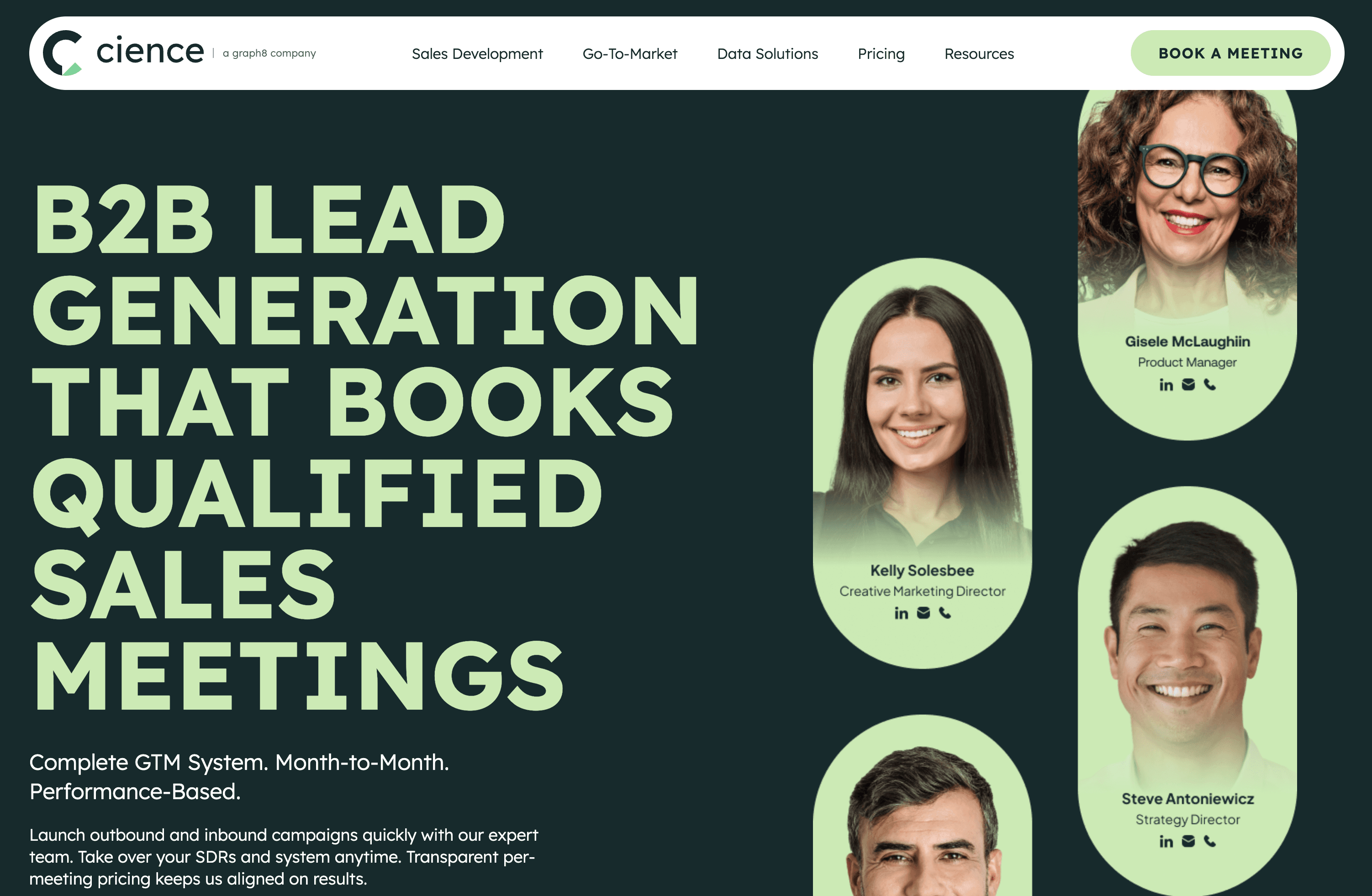
CIENCE sells outsourced SDR services and b2b lead generation at high volume, and their Talent Cloud model lets you hire trained sales development representatives directly to build in-house SDR teams.
Pros:
One of the largest providers, with proprietary tech for scoring, tracking, and market intelligence on prospect pain pointsMost outsourced SDR companies need 30 to 90 days before real results, and you pay full price while they learn. Ask what happens if nothing lands by day 60.
Multichannel coverage across email, phone, LinkedIn, and direct mail
Database building for companies without a prospect foundation
Cons:
Quality varies by assigned SDR pod, and reviews mention generic messaging
The first 1 to 2 months produce little while you pay full price
Buying signals rely on surface-level sources
Our take: CIENCE is a volume play, and we build precision instead. Best for enterprises pushing high-volume outbound across regions, at $2,000 to $9,500+ per month.
3. Martal Group: the sales-as-a-service partner with onshore reps across North America, Europe, and LATAM
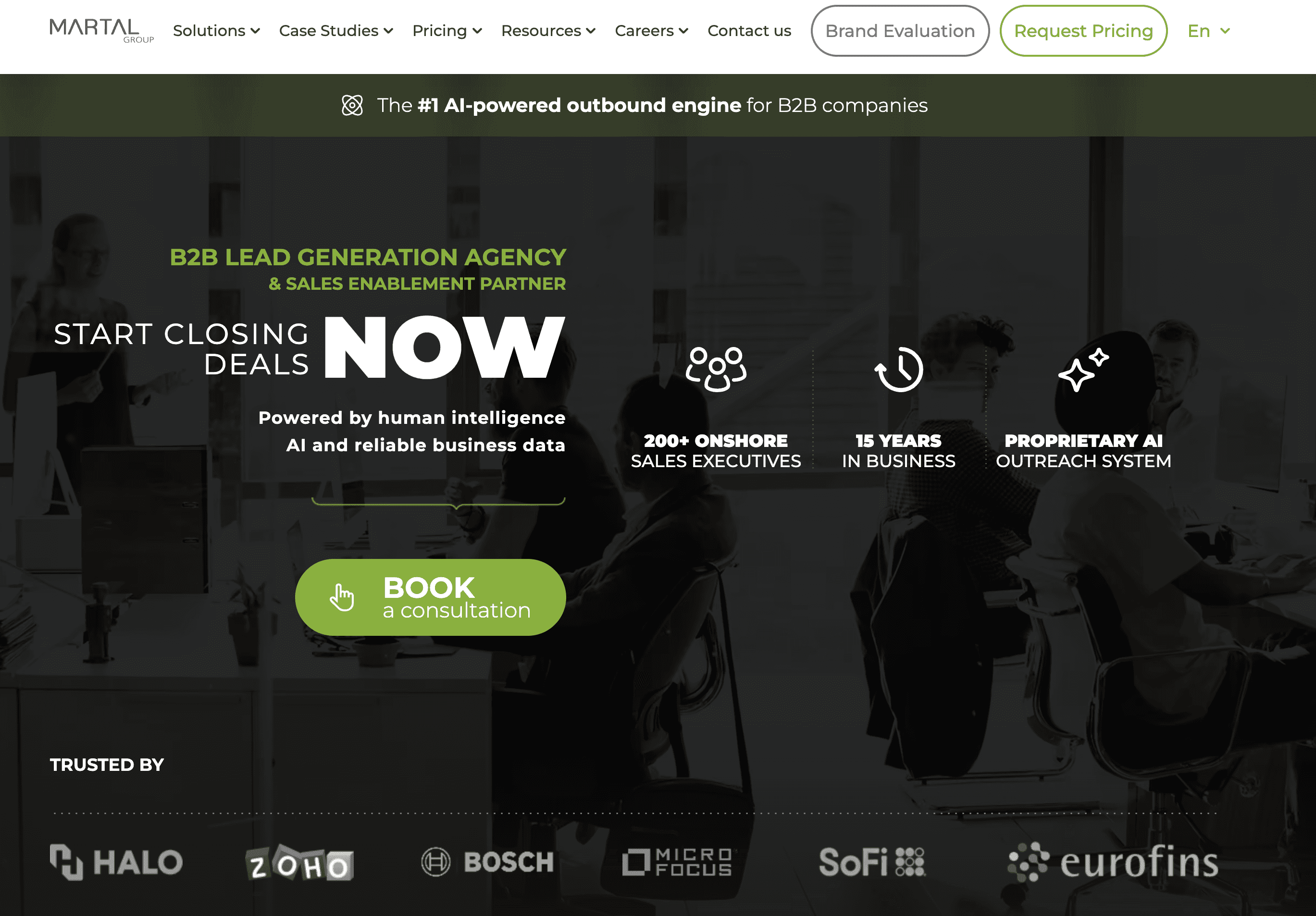
Martal Group gives you multilingual onshore reps across North America, Europe, and LATAM, with tiers that go beyond lead generation into onboarding and account management, a sales outsourcing model that reaches past top-of-funnel work.
Pros:
Multilingual, onshore reps built for international campaigns
Sales professionals with 3 to 5 years of experience on the phone
Flexible tiers most SDR agencies don't offer
Cons:
Costs climb fast as you add tiers
Custom pricing with no public rate card
You rent their process instead of owning one
Our take: their human expertise is real, but the upstream work is cheaper automated, and your in-house team only needs one or two closers for the rest. Best for international sales motions, from around $5,000 per month.
4. SalesHive: the month-to-month SDR agency that combines AI tools with US-based and offshore reps
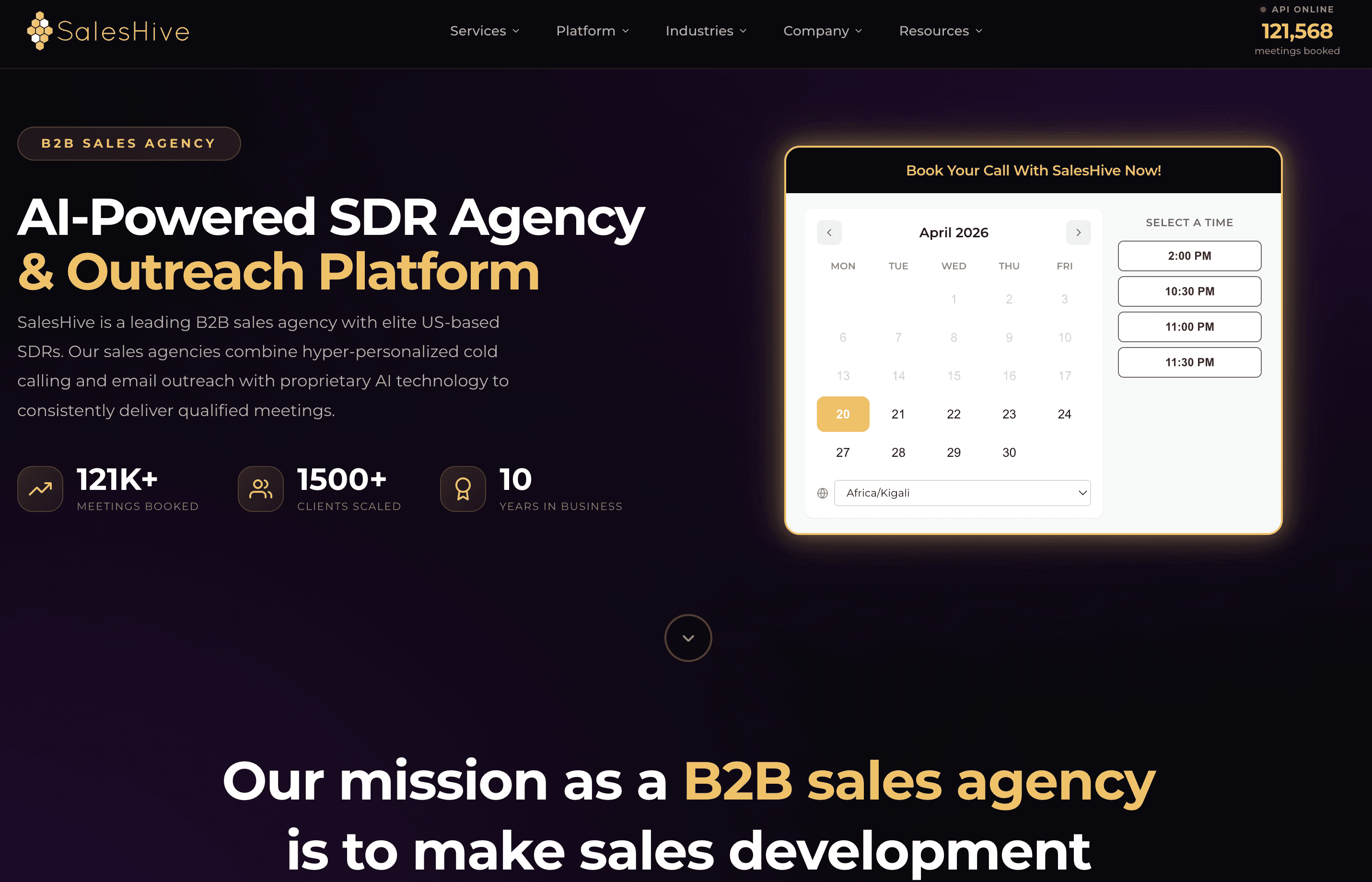
SalesHive delivers outsourced SDR campaigns on a month-to-month contract, pairing US or Philippines-based SDR teams with their own AI tools for email and cold calling.
Pros:
No long-term lock-in, which cuts your risk
Transparent pricing published on their site
A dedicated team per client, from strategist to inbox support
Cons:
Meeting guarantees sound big, but "qualified" varies
400 to 500 dials a day leans spray-and-pray for niche ICPs
Their AI tools stay theirs when you leave
Our take: the flexibility is real, but the pipeline stops when you cancel, and the same budget funds a system you keep. Best for growth-stage teams that want to test outsourced SDR services at $6,000 to $12,500 per month.
5. SalesRoads: Premium, phone-first SDR agency for high-value B2B sales cycles
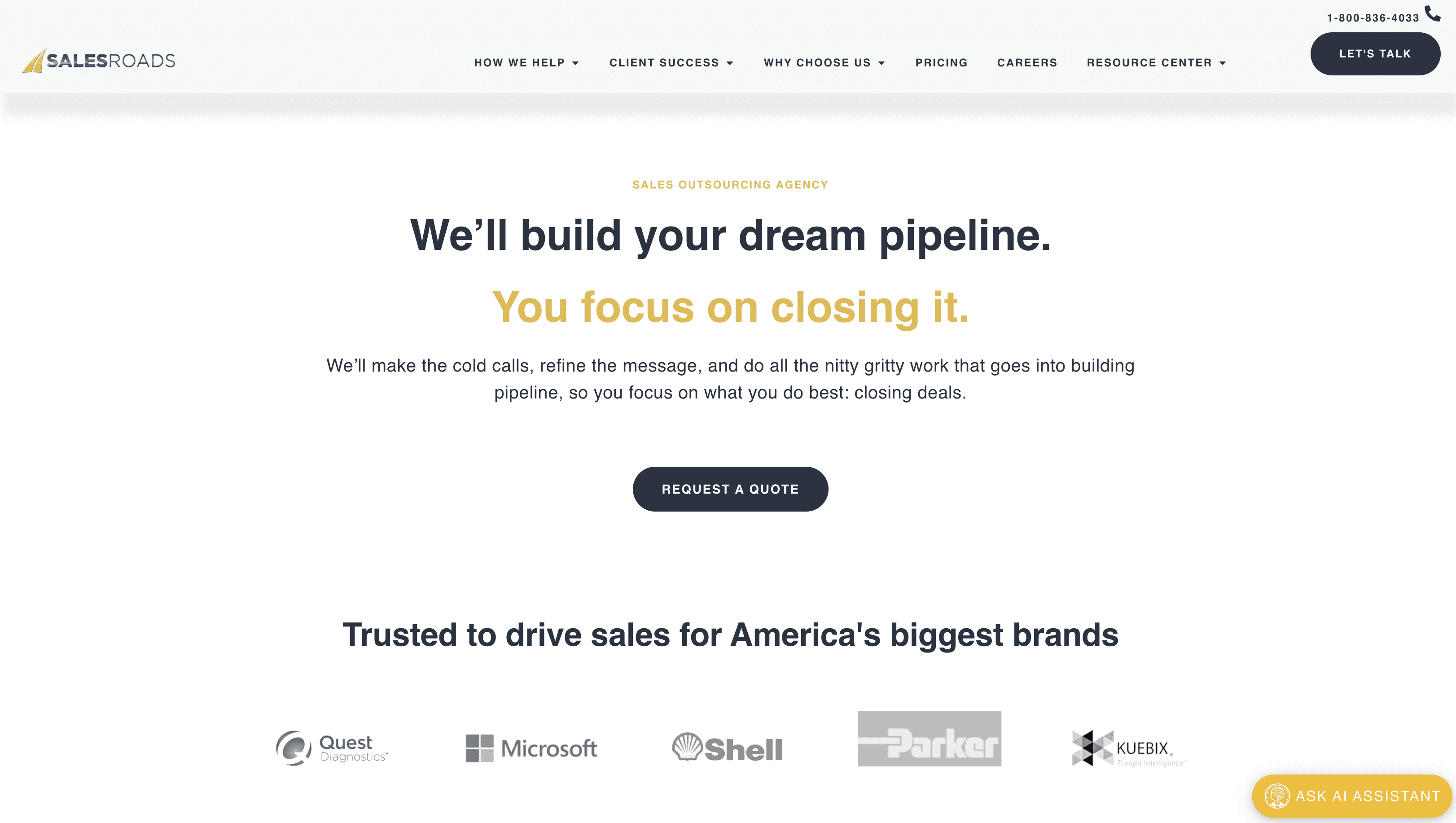
SalesRoads books meetings by phone first, with an all-US sales development team built for the complex, high-value deals where email alone does not cut it.
Pros:
Nearly two decades of institutional knowledge on the phone
Strong in industrial and manufacturing, where calls still win
All US-based reps, with no offshore quality concerns
Cons:
Around $10,000 per 4-week cycle, one of the highest entry points here
US-focused, with limited international reach
Results stop when you stop paying
Our take: at that price you can own an entire automated engine instead of renting a process. Best for high-value deals in industrial, logistics, or healthcare where decision makers still answer the phone.
6. Cleverly: Budget-friendly LinkedIn-focused agency for companies who want volume on a single channel
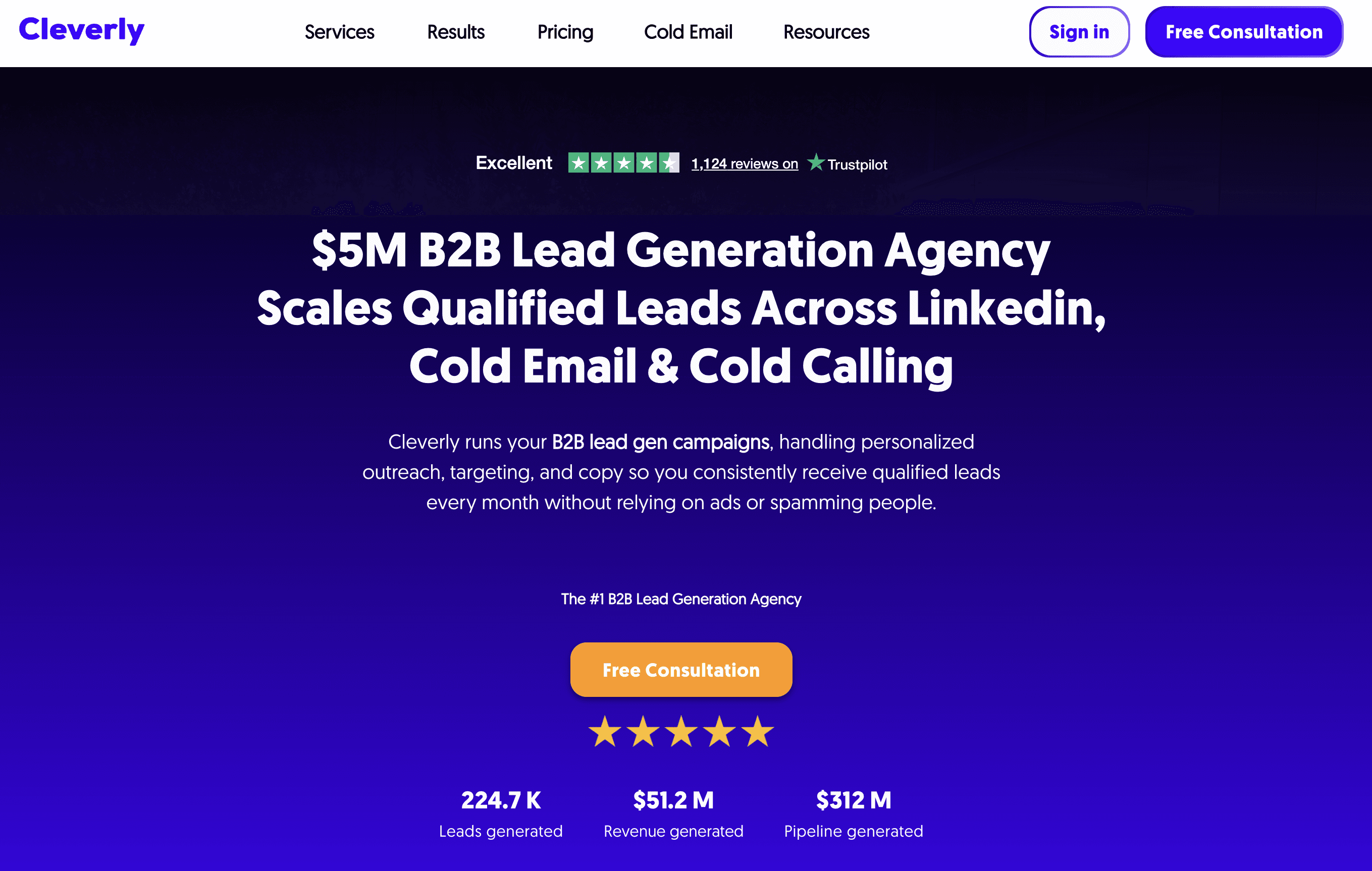
Cleverly is a LinkedIn-only b2b lead generation service for small businesses, with plans from $297 per month and add-ons like LinkedIn Ads and profile optimization.
Pros:
The cheapest entry point in the SDR agency space
Minimal onboarding, so campaigns start fast
Targeting informed by thousands of past campaigns
Cons:
One channel means missing every buyer who ignores LinkedIn
Lists come from Sales Navigator, which reviewers say returns 40%+ irrelevant results
Several clients report overpromised results and a laggy portal
Our take: Cleverly sends automated LinkedIn messages, and we build full engines with accurate multi-provider data. Best for solopreneurs and very early startups testing LinkedIn lead generation on a tight budget.
7. demandDrive: Integrated SDR and RevOps agency that goes beyond just booking meetings
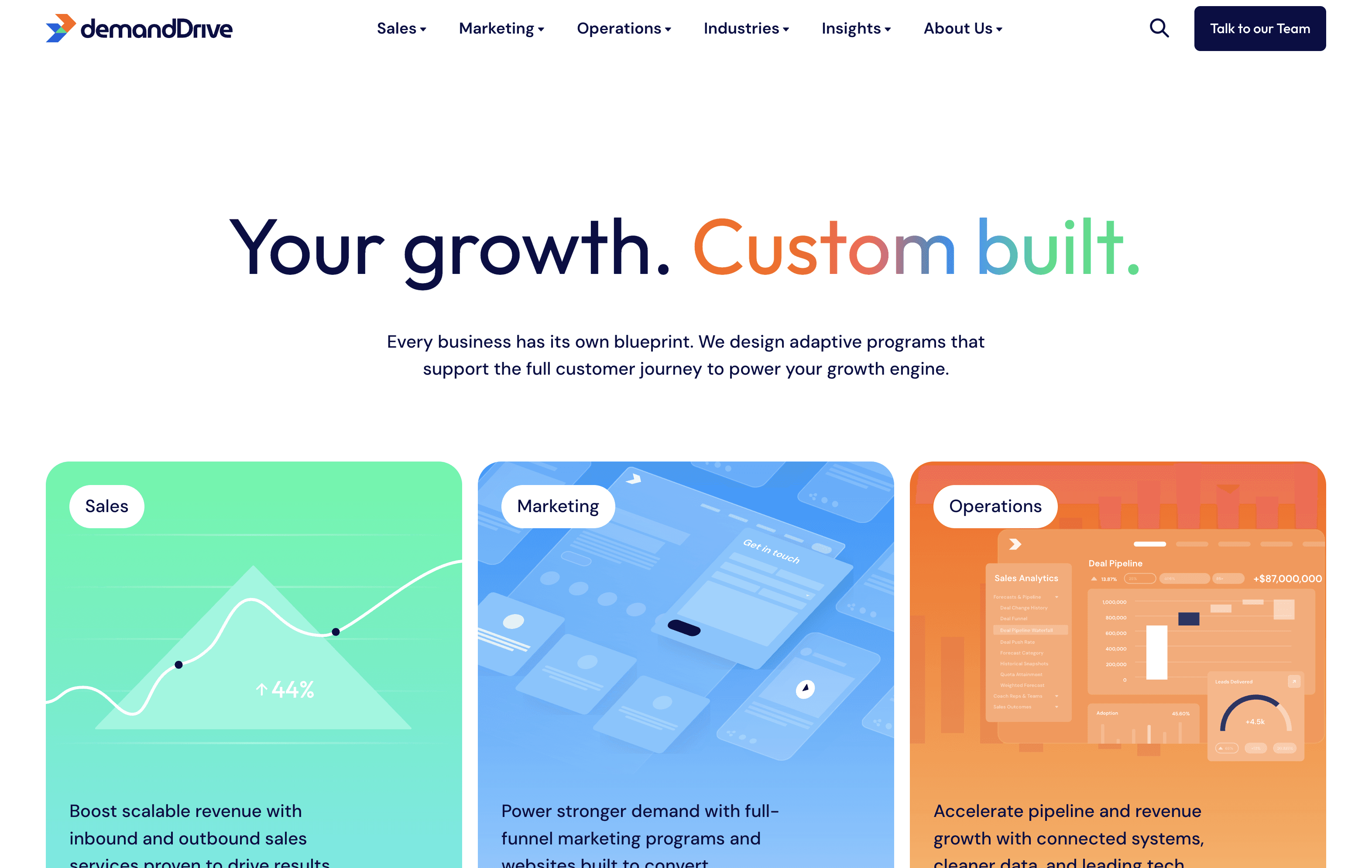
demandDrive offers SDR services plus RevOps, CRM implementation, and demand generation, so one partner covers the meetings and the operations behind them.
Pros:
One partner for meetings, market research, and RevOps cleanup
Strong SDR coaching, which means better reps and lower turnover
Range across both tech and industrial verticals
Cons:
High-touch pricing without a public rate card
Still a human SDR team doing the execution underneath
Manufacturing clients may get more attention than SaaS
Our take: their RevOps skills are solid, but the engine is still people, and our workflows deliver the infrastructure without the dependency. Best for mid-market B2B with messy RevOps, at roughly $7,000 to $15,000+ per month.
8. CloudTask: RevOps marketplace that connects you with vetted sdr talent and agencies
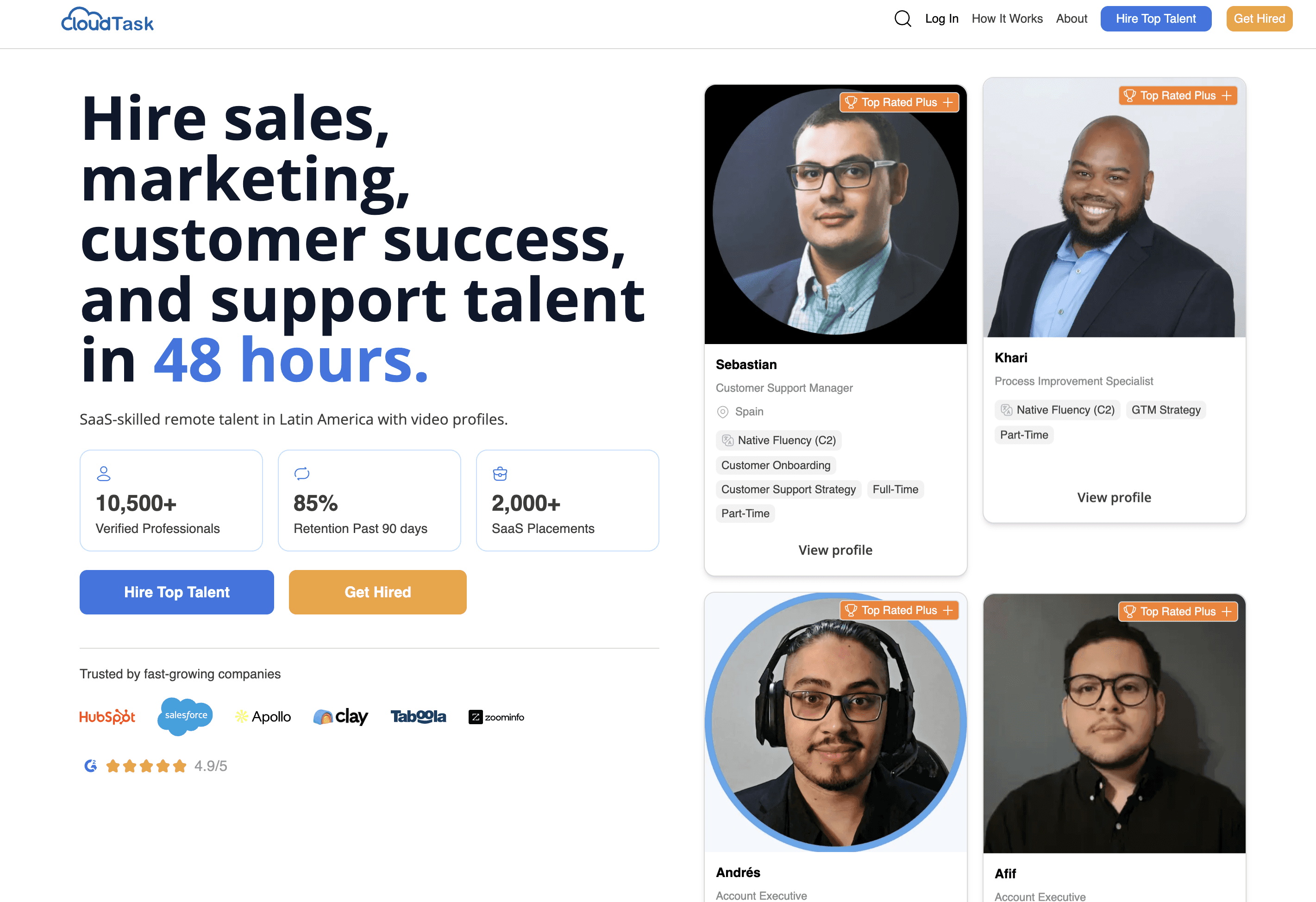
CloudTask is a marketplace of vetted sales talent and agencies, with pay-per-appointment and pay-per-lead pricing, so you can supplement an internal team without a full in-house build.
Pros:
Flexible access to talent without single-agency lock-in
Performance pricing that aligns incentives better than retainers
Verticalized teams that already know your market
Cons:
Quality depends on which talent or partner you land with
Scale campaigns cost $10,000 to $40,000+ per month
You get people and tools, and the system stays theirs
Our take: matchmaking is useful, but our clients find they need far fewer SDRs once the workflows are live. Best for teams that want performance-based lead generation pricing and options before committing, especially SaaS and fintech.
9. SalesBread: Ultra-personalized boutique agency that promises one qualified lead per day
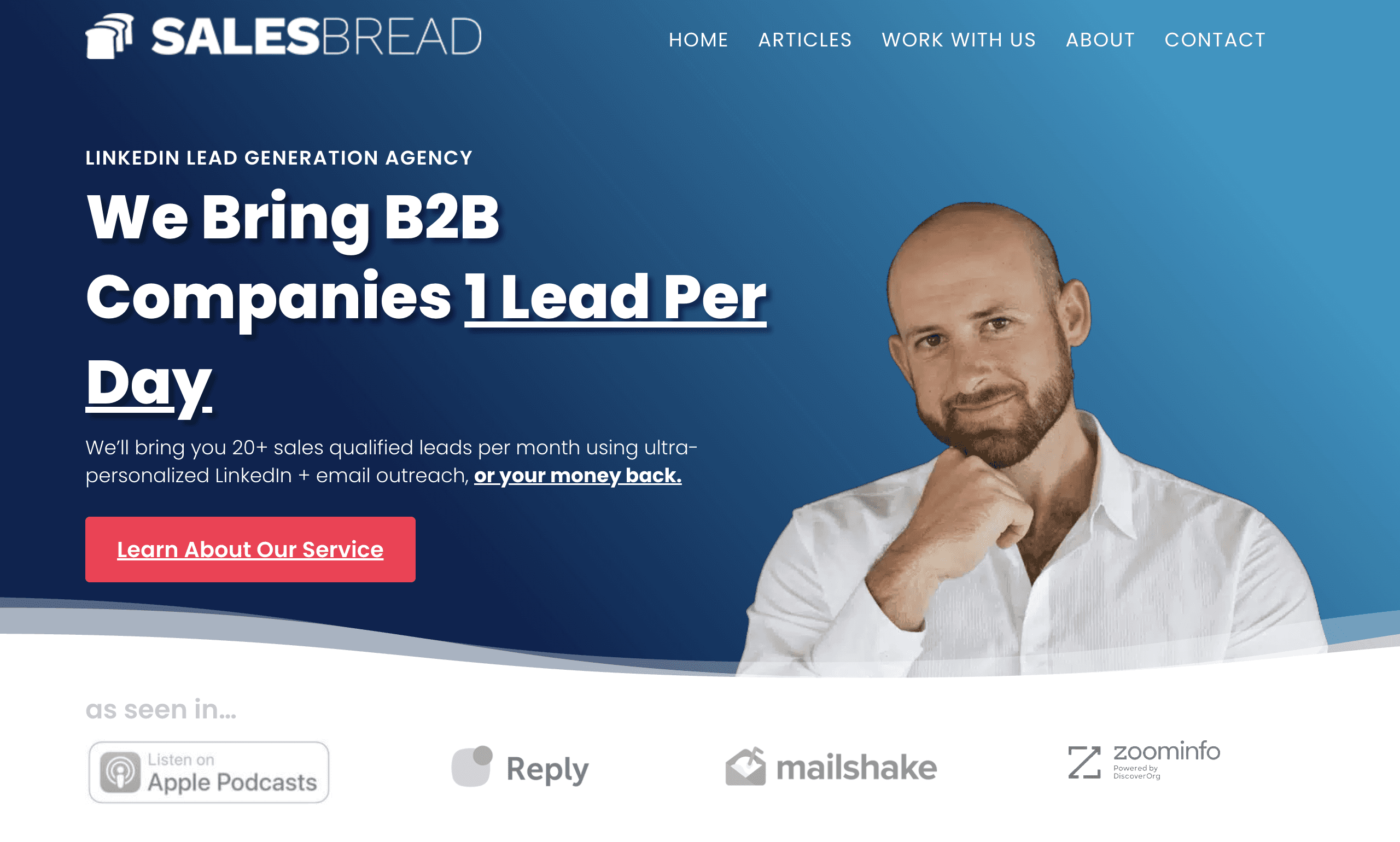
SalesBread writes every LinkedIn and email message by hand and promises one qualified lead per day, with a reported 19.98% average reply rate.
Pros:
Real personalization that earns nearly 20% replies
You work with the founder himself, with no junior account manager in between
Around $3,000 per month, below most premium SDR companies
Cons:
Boutique capacity, so no large enterprise programs
LinkedIn and email only, with no cold calling
Human-dependent, so it scales only by adding people
Our take: our AI personalization through Clay pulls the same data points and matches that quality at ten times the volume. Best for small companies selling high-value professional services, where you nurture leads carefully and every conversation matters.
10. Callbox: Enterprise-grade global SDR partner with 20+ years and a full-spectrum multichannel approach
Callbox fields complete campaign pods that reach potential clients across email, phone, social, chat, and webinars worldwide, built for enterprises with global sales motions.
Pros:
One of the deepest track records in the industry
True multichannel reach across every region
A complete pod per client, from SDR to data researcher
Cons:
$15,000 to $30,000+ per month, the priciest option here
Offshore delivery may miss expectations in US and European markets
Big-machine coordination slows campaign changes
Our take: this is the peak of throwing people at the problem, and the same budget builds an engine that never stops. Best for enterprises with global sales motions and the budget to match.
Other outsourced SDR companies you'll see on shortlists
A few more SDR companies come up in almost every comparison, and the most common one is LevelUp Leads. LevelUp Leads is a small b2b lead generation agency covering email, LinkedIn, and cold calling on month-to-month retainers.
We left LevelUp Leads and shops like it off the main list because the model is the same rental deal at a smaller scale, and every question in our criteria applies word for word.
So, should you hire an SDR agency? Or should you build a sales engine that you own?
Here is the honest split, the same one we give companies on our own calls.
Hire an outsourced SDR company if you need human reps in a market you cannot read from the outside, if internal hiring is slowing your pipeline and you need to scale outreach quickly, or if you're testing a new segment. A good one frees your sales teams from prospecting while your closers focus on revenue conversations.
Belkins and SalesRoads have the proven track record there, and SalesBread earns its fee when every conversation carries a five-figure deal.
Build the system if you are everyone else. For most B2B teams, SDR outsourcing is an expensive rental next to owning a modern sales automation engine, because the moment you stop paying, everything stops, and only the vendor keeps the asset.
And if you do hire, pick a partner that plugs into your sales process instead of operating as a disconnected vendor.
That's exactly why we built Nebor.ai differently. We don't rent you a team, we build you a sales motion your company owns.
If you want to see what that looks like on your stack, book a call and bring the quote from whichever agency you were about to sign. We will show you, side by side, what the same budget builds when you own the result.
Frequently asked questions about SDR agencies
How much do SDR agencies cost?
Most SDR companies charge between $3,000 and $15,000 per month for outsourced SDR services and lead generation programs, and enterprise providers like Callbox reach $30,000 and more. Setup fees and per-meeting bonuses come on top, so ask for the all-in number.
Is it better to outsource SDRs or build an in-house SDR team yourself?
An internal SDR team gives you control, but building it in-house is time consuming and takes a full time commitment before it produces more sales meetings, and one in-house SDR costs $80,000 to $120,000 a year fully loaded.
Outsourcing moves faster, but the process stays with the vendor. The third option, an automated sales development system you own, is the one we suggest pricing out first.
How long does it take an SDR agency to deliver results?
Plan on 30 to 90 days of ramp at full price while the agency learns your market and warms sending domains. Ask what happens if nothing lands by day 60, and get the answer in writing.
What should I ask before signing with an SDR agency?
Ask any outsourced SDR company the ten questions in this article, starting with who owns the data, how they define qualified meetings, how they protect deliverability, and whether your sales setup is stronger the day the contract ends.
Note: Most SDR agencies will outsource you a rep, or a team of reps, to take care of your prospecting and some of your other sales functions.
The question worth asking is whether that is what you need. SDR agencies are expensive, and most of the jobs those reps do can now be handled by smart workflows built with tools like Clay, Claude and ChatGPT, which make your existing team far more efficient and cost you a fraction of the retainer.
At Nebor, we are a GTM engineering and RevOps agency, and building those AI workflows is what we do. From experience, most teams need fewer people and better systems and not the other way round.
Book a meeting with us and let's discuss how your sales motion works today, then find the best solution for your situation.


Related Articles

By clicking Sign Up you're confirming that you agree with our Terms and Conditions.