
GTM Agency vs Lead Generation Agency: Why We Are Not a Lead Generation Agency


In this post:
We get called a lead generation agency at least three times a week. On sales calls. In LinkedIn DMs. In referral proposals that show up in our inbox. And every single time, we correct it.
Nebor is not a lead generation agency.
We are a growth agency, a GTM agency. The difference is not branding or semantics. It's a fundamentally different philosophy about how B2B companies should build pipeline, grow revenue, and scale their go-to-market operations.
We also know "growth agency" is a loaded term. Everyone uses it. Performance marketing shops, SEO consultants, and freelancers who buy Facebook ads all call themselves growth agencies.
The term has been diluted to the point where it barely means anything anymore. So let us tell you exactly what it means when we say it.
A growth agency, in our definition, builds the full infrastructure your revenue team needs to generate pipeline, convert it, and scale it.
Not just one piece, not just outbound, not just campaigns. The entire system. Sales and GTM execution, marketing and demand generation, and CRM and revenue operations.
All three, connected, working as one engine. That's what we build. That's what makes us a GTM agency.
TL,DR
Here’s what you get with us vs a typical lead generation agency.
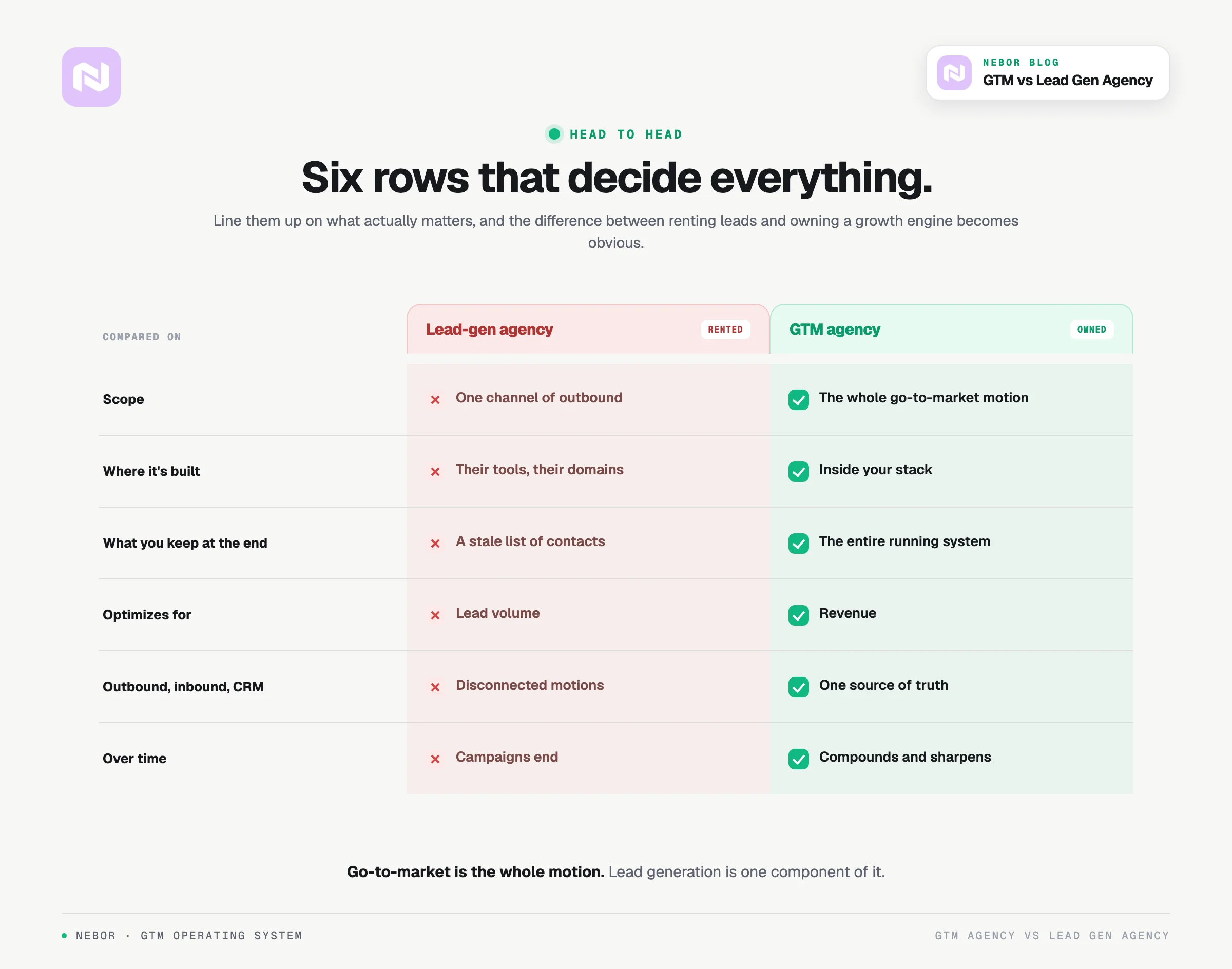
What lead generation agency model actually looks like when you strip away the marketing
Before we make the argument for what we are, let's be clear about what we're not.
A typical lead generation agency operates on a pretty narrow scope. They send cold email or LinkedIn outreach campaigns. They build prospect lists from data sources like Apollo or ZoomInfo.
They write a few templates with merge fields, set up sequences, send outbound campaigns, and report meetings booked.
That's the model. Simple, transactional, and easy to explain to a CFO.
For a lot of companies, especially those who've never done outbound before, hiring a lead gen agency feels like the obvious move. You're paying for results. Leads come in. The math seems straightforward.
But here's what they don't tell you.
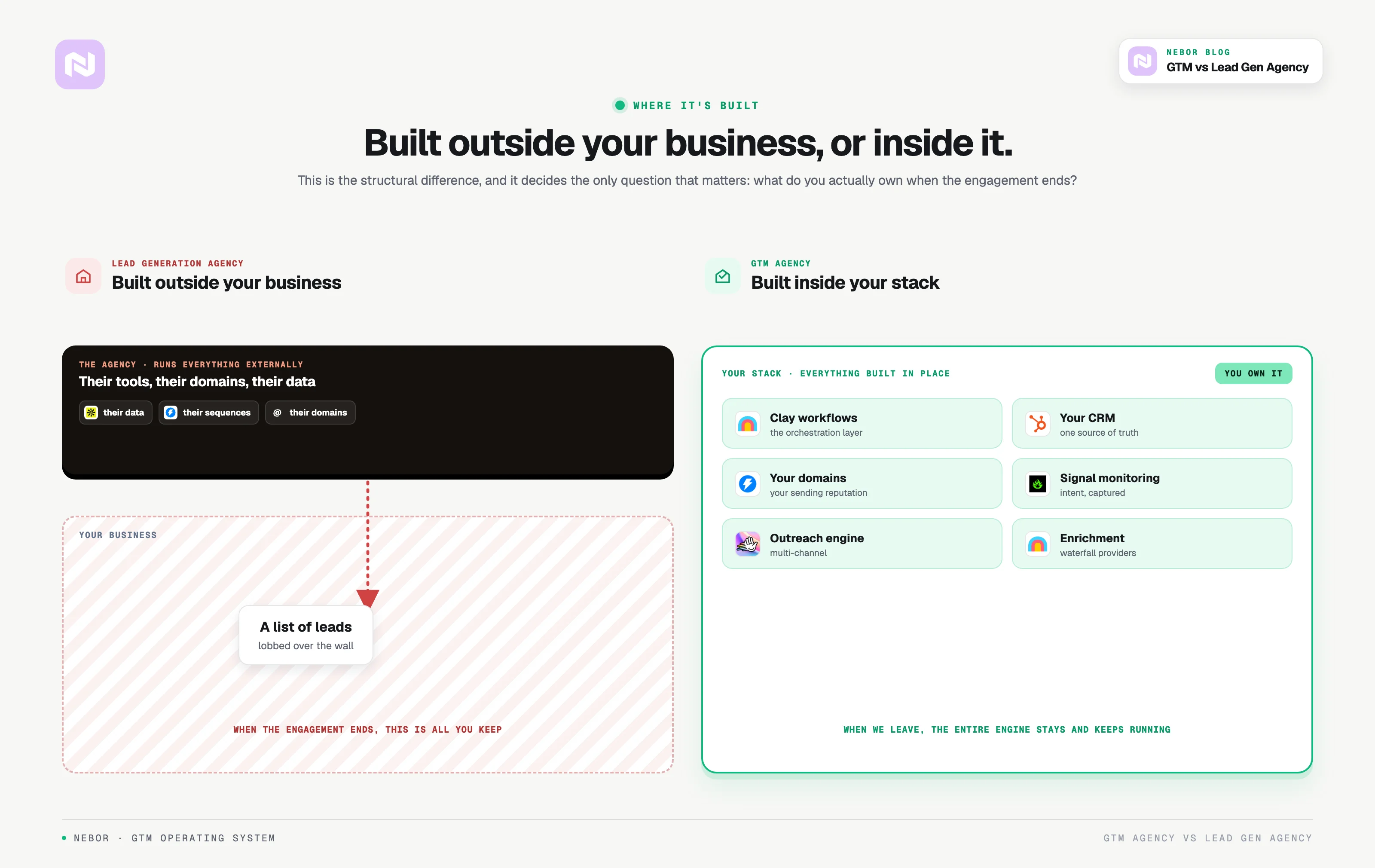
The agency operates entirely outside your business. They build sequences inside their tools, not yours. They use their own sending domains, not yours. They control the data, the workflows, the messaging, the targeting. The only thing they hand you is the leads themselves, at the end of the engagement.
The agency doesn't own what happens after the lead comes in. They don't touch your CRM, they don't connect your marketing to your outbound, they don't set up signal monitoring or intent-based workflows. They don't build the infrastructure that turns a one-time campaign into a compounding system.
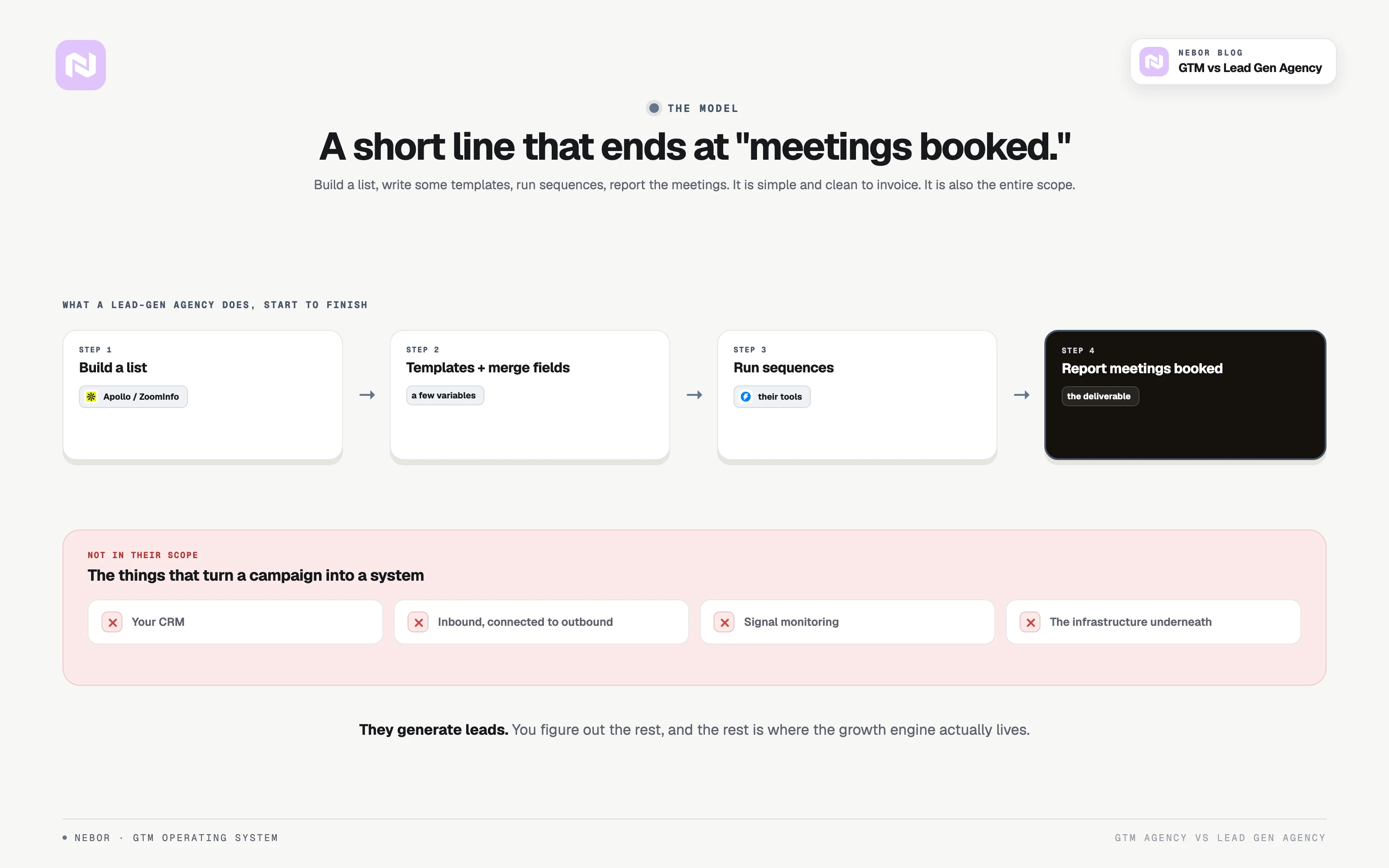
They generate leads. You figure out the rest.
For a lot of companies, that "rest" is where the entire growth engine falls apart.
Why the lead generation model breaks down the moment you try to scale
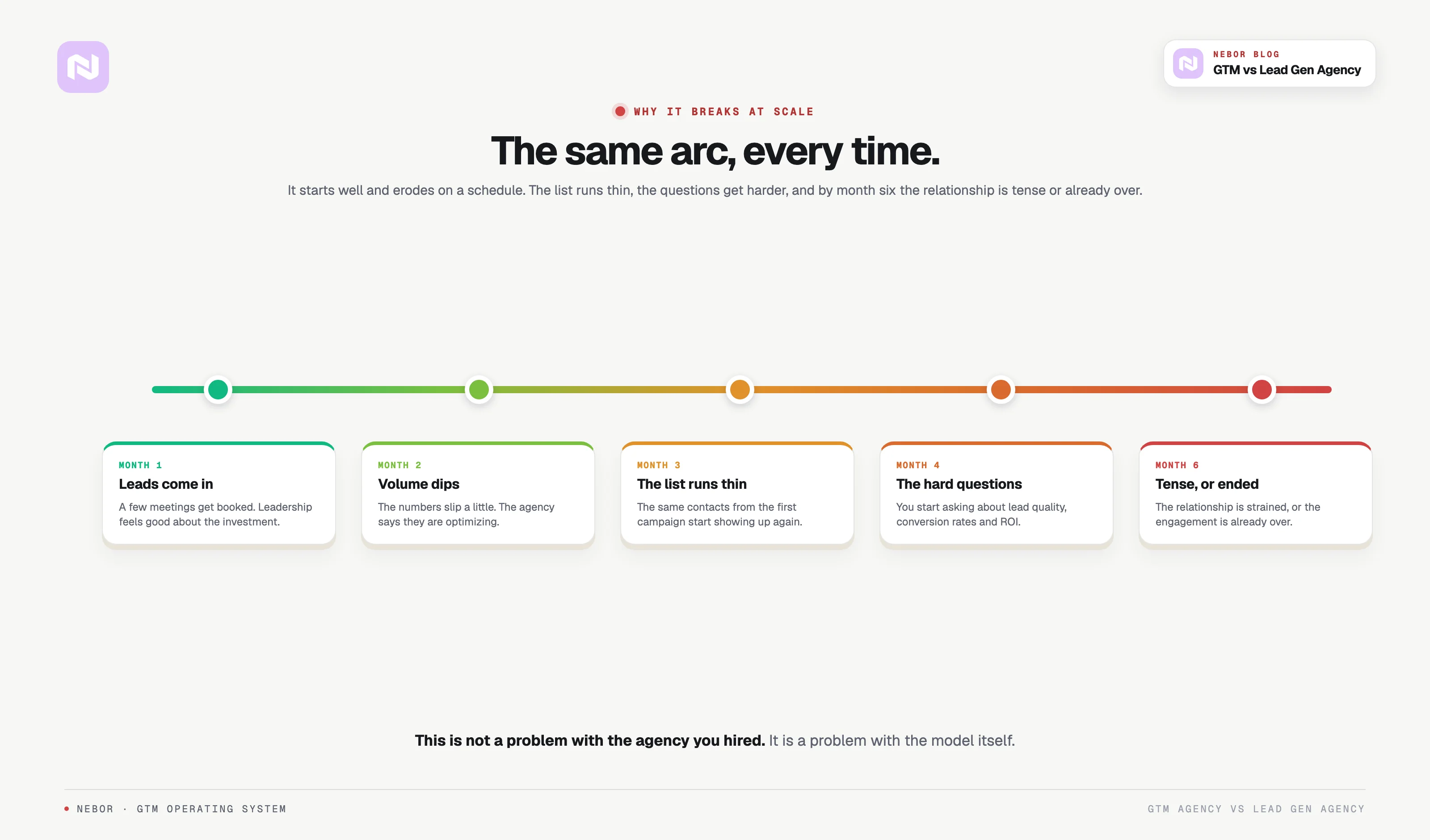
Here's what we've seen happen dozens of times across 10+ years of working with B2B companies.
You hire a lead generation agency. The first month, some leads come in. A few meetings get booked and your leadership feels good about the investment.
Month two, the volume dips slightly and the agency says they're optimizing.
Month three, the same contacts from the first campaign start showing up again because the list is wearing thin.
Month four, you start asking hard questions about lead quality, conversion rates, and ROI. By month six, the relationship is either tense or already ended.
This isn't a problem with the agency you hired. It's a problem with the model itself.
You don't own anything when the engagement ends
This is the structural failure that every lead gen agency engagement hits eventually. The agency builds the campaigns inside their own infrastructure. When you stop paying, you walk away with a list of contacts that are already stale and a gap in your pipeline where the agency used to be.
At Nebor, we build everything inside your stack. Your tools, your CRM, your domains, your workflows. When our engagement ends, the entire infrastructure stays with you and keeps going. You own it.
And no, that's not a feature of our service. It's a foundational principle of how we work.
Lead gen agencies optimize for volume and leads, not for revenue
When you hire a lead generation agency, you pay them to generate leads. That's their success metric. Your success metric is revenue. These two things sound related, but they're often in direct conflict.
When an agency optimizes for lead volume, qualification naturally loosens. Anyone who shows a bit of interest becomes a lead. A positive reply to a cold email counts as a qualified opportunity. A five-minute discovery call where the prospect clearly isn't a fit still gets logged as a booked meeting.
Your calendar fills up, but your pipeline doesn't grow at the same rate. Close rates stall. Your sales team spends their time on calls that never had a chance of converting instead of focusing on the deals that actually matter.
Alright. They're a serious agency and generate good leads. You have a decent close rate and you are happy.
But what happens to your other revenue operations? How do you handle your inbound interest? Are your inbound and CRM data feeding your sales? What does your revenue engine look like?
There's no connection between outbound, inbound, and your CRM
Most lead gen agencies operate in isolation from the rest of your revenue motion. They do cold outreach, and that's it.
Meanwhile, your marketing team is buying ads, generating inbound interest, and capturing form fills. None of that data flows into the outbound campaigns. Your CRM is holding customer engagement signals, intent data, and historical relationships. None of that feeds the agency's targeting.
You end up with two parallel motions that occasionally bump into each other. Outbound prospects who are already in your CRM as inbound leads. Cold emails sent to people who are already in active conversations with your sales team. Demos booked with companies that just churned last quarter.
A real GTM motion connects all of this. The agency model doesn't, because connecting it would require building inside your stack, which lead gen agencies don't do.
Campaigns don't compound. Systems do.
This is the conceptual flaw at the heart of the lead generation model. Campaigns are temporary. They start, they go for a few weeks or months, they produce some leads, and then they stop. When the campaign ends, the value ends with it.
A system is different. A system keeps going continuously, every day, on autopilot. It captures signals as they happen, enriches data as it becomes available, and triggers outreach when a target account shows intent. Not when someone manually decides to launch a new campaign.
That system gets better every month. The data gets cleaner. The targeting gets sharper. The workflows get more refined. The cost per opportunity drops over time because the infrastructure is already built. You're just feeding it.
That's the difference between renting your pipeline and owning it. Lead gen agencies rent you a pipeline. We build you one.
What a GTM agency actually does differently (and why the three pillars matter)
Now, GTM agency is a term that's fairly picking up steam, and for good reason. It captures something that lead generation agencies and even "growth agencies" fail to express. The idea that your entire go-to-market motion needs to work as one connected system.
At Nebor, we built our entire service model around this belief. We operate across three interconnected pillars, and we're going to walk you through each one and explain why they only work when they're connected.
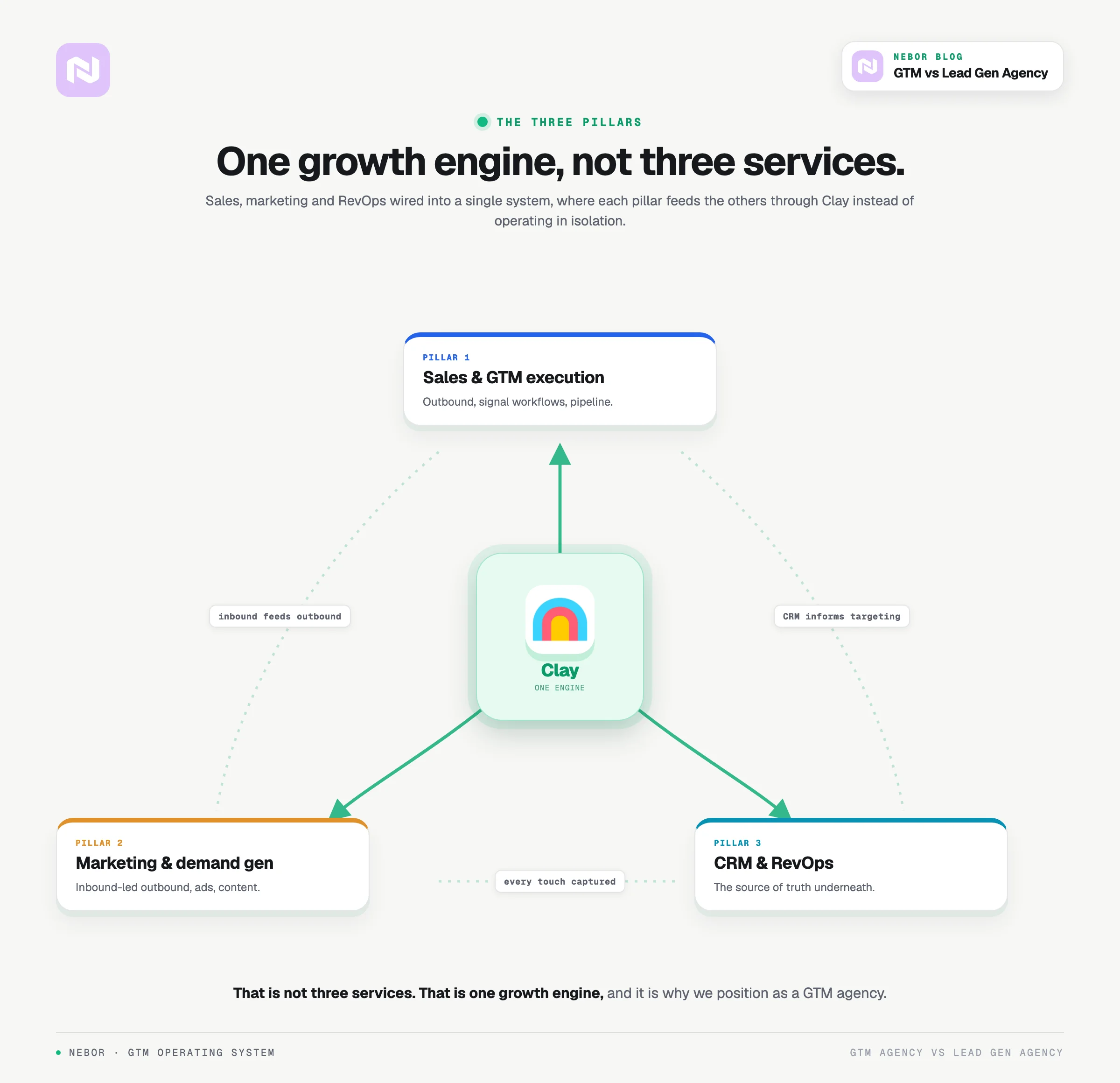
Pillar one: Sales and GTM execution
This is where most people think the conversation starts and ends. It typically involves the following.
Outbound. Prospecting. Lead generation. Pipeline.
And yes, we do all of that. We build outbound systems that identify your total addressable market, source data from the right platforms for your specific ICP, enrich and verify contacts through waterfall enrichment across multiple providers.
We also craft segmented and personalized messaging that goes far beyond merge fields, send multi-channel outreach across email, LinkedIn, and phone preparation, and build the email infrastructure that protects your deliverability while letting you scale.
But here is the difference. We don't just deliver campaigns. We build signal-based workflows that monitor the market in real time and trigger outreach when prospects enter buying windows.
For example, for a client selling cybersecurity solutions, we monitor funding announcements for IT companies. When a company raises capital, we know they're about to invest in security infrastructure.
For another client offering AI-driven tax optimization, we set up Clay's RSS feed readers to track companies announcing major profit gains. When a company has a big quarter, they suddenly care a lot more about tax optimization. We identify the right contact, enrich them, and trigger outreach. All automated, all happening every day.
For ourselves, we scrape LinkedIn job posts for SDR and BDR roles every morning. When a company posts those roles, it signals they need help with pipeline.
We find the hiring manager, enrich the contact, and send a personalized outreach sequence. This is how we've landed most of our clients to date.
A lead gen agency gives you a campaign. We give you a system that feeds your pipeline every single day, on autopilot, and gets smarter over time.
Pillar two: Marketing and demand generation
This is the pillar that lead gen agencies don't touch at all. And it's one of the most important.
Your marketing and your sales can't work on separate tracks. When they do, you get the leaky funnel problem that plagues most B2B companies.
Your marketing team generates awareness and interest, but nobody captures it properly. Your sales reps do cold outreach without knowing which accounts are already engaging with your content. Your inbound leads wait in a queue for hours or days before someone reaches out.
We close that gap with inbound-led outbound. When someone engages with your LinkedIn ad, that signal feeds your outbound sequencing. When a prospect downloads a whitepaper, they get enriched and routed to a rep in real time through our inbound meeting workflow. When a target account visits your pricing page, your sales team knows about it before they even pick up the phone.
The result is marketing that amplifies your outbound, and every outbound touchpoint reinforces your marketing. That's how you build compounding growth instead of stitching together disconnected campaigns.
Pillar three: CRM and revenue operations
This is the pillar nobody wants to talk about. It's not exciting for them. It doesn't make for great LinkedIn posts because of how they position their agencies. They just want to claim huge lead numbers and get paid.
For us, it's the foundation that everything else is built on.
Your CRM should be the command center for your entire revenue team. Every piece of data, every interaction, every signal should flow into it and be visible to the people who need it.
In reality, most CRMs are data graveyards. You have properties that nobody uses, lifecycle stages that don't match how the team actually sells, data that's so stale nobody trusts it, and reps who stopped updating records months ago because the CRM creates more work than it saves.
A lead gen agency won't touch your CRM. That's not their scope. They generate leads and dump them into wherever you tell them.
We build the CRM and RevOps layer that makes the whole engine work. We architect the pipeline. We design lifecycle stages that reflect how your team actually sells. We set up automation logic that scores and routes leads based on fit and intent. We connect every signal from outbound, inbound, and marketing into one source of truth.
When a rep opens a deal, they see the full picture. Without that infrastructure, the lead gen pillar leaks and the marketing pillar fragments. With it, the whole motion compounds.
Why these three pillars only work when they're connected
Here's the thing about pillars. You can have all three and still get nothing if they're operating in isolation. Most agencies that claim to do "the whole stack" actually keep three separate teams that hand off work between each other like a relay race.
That's also one of the things we don't stand for. The entire point of our approach is that these three pillars work as one system.
The outbound engine is informed by your existing inbound data. Ad campaigns are shaped by what the outbound data tells us about which segments respond. Your CRM captures everything from both channels and makes it actionable for the sales team.
When a target account engages with your LinkedIn ad, your outbound sequence references it. When someone clicks on your ad and lands on your site, they get identified, enriched, scored, and routed based on how well they match your ICP and how strong their intent signals are.
When a rep opens a prospect's record in the CRM, they see the full picture. Every touchpoint, every signal, every interaction across every channel.
That's not three services. That's one growth engine.
And it's why we position ourselves as a GTM agency, not a lead gen agency. Go-to-market is the whole motion. Lead generation is one component of it.
Our results speak for the model beyond our tactics or philosophy
We can talk about philosophy all day, but what matters is whether this approach actually works better than the traditional lead gen model. So let us give you some real examples.
We worked for a six-person tech startup. Before working with us, everything came through referrals and their existing network.
For them, we implemented outbound workflows, an inbound-led outbound motion, and signal-based monitoring campaigns. They went from zero meetings per week to three to four meetings per week. 500% increase in pipeline within three months. No new hires.
We did the same for a manufacturer of aerodynamic side skirts for semi-trailers. They came to us with essentially zero pipeline. The CEO was trying to do everything manually.
We built their entire outbound machine, set up HubSpot as their CRM, and connected everything into one system.
Over 18 months: €12 million in qualified pipeline, 84 new enterprise prospects in active conversations, 14 clients converted, and meetings secured with all 10 major trailer OEMs in Europe.
Today, the company has a four-person sales team operating a system they own and understand.
We also worked for a company in the event management business. Their three-person team was manually hunting through event websites and sending 30 emails on a good day.
We built an automated system that scraped thousands of relevant events, enriched the organizer contacts, and triggered personalized outreach. Their pipeline jumped within the first quarter, and their team got their evenings back.
The pattern across every one of these clients is the same. We didn't just generate leads for them. We built the system that keeps generating leads after we wrap, that grows more efficient over time, and that ties their sales, marketing, and CRM into one connected revenue engine.
That's what a GTM agency does that a lead generation agency cannot.
How to know if you need a lead gen agency or a GTM agency
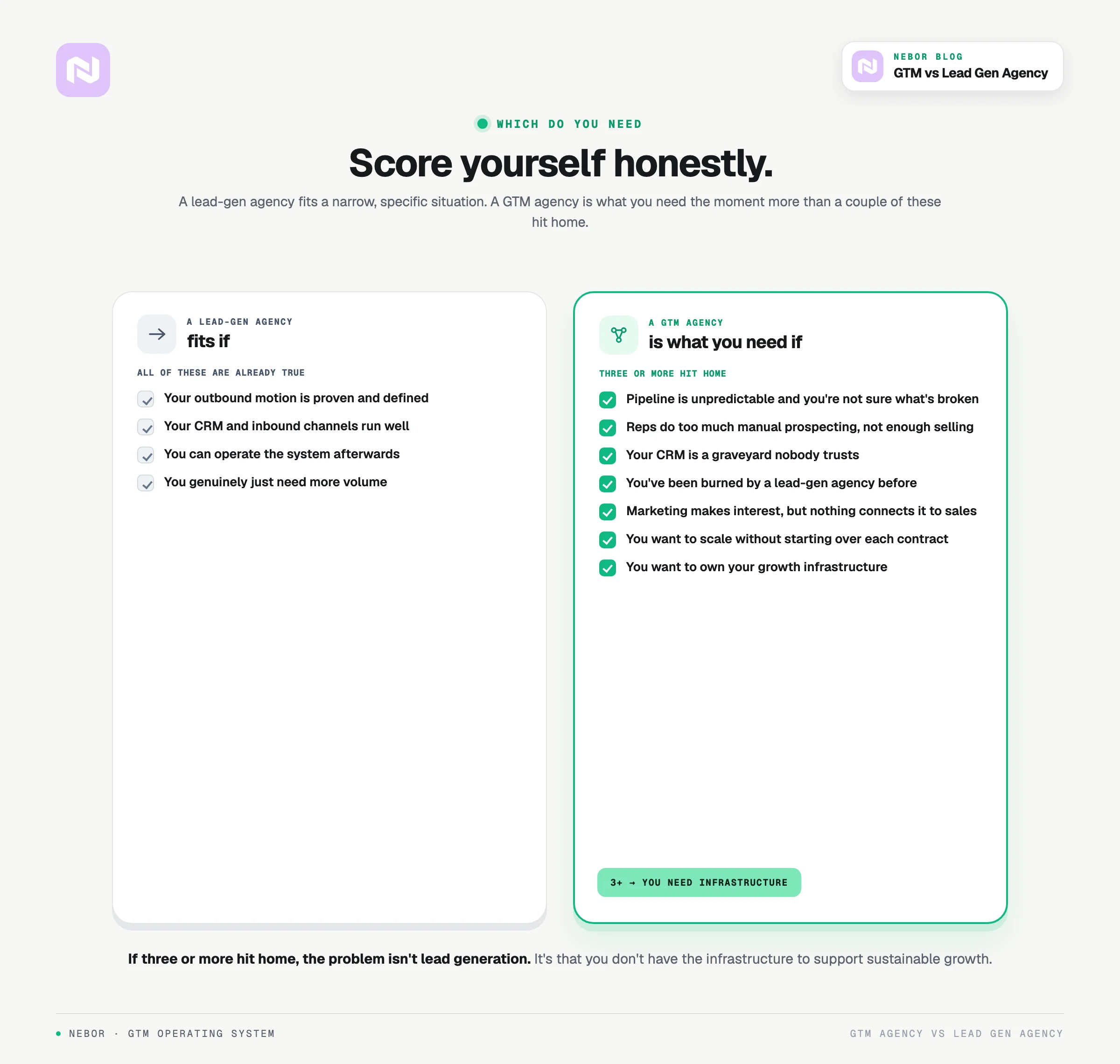
If you've read this far, you're probably wondering which model is right for you. Here's how we think about it.
A lead generation agency might make sense if your business has a clearly defined and proven outbound motion already, your CRM and inbound channels are already working well, you have internal capacity to operate the system afterwards, and you genuinely just need someone to add volume on top of what's already working.
In that case, you're hiring an extension of your existing team. Pay for activity, get more activity. The math is clean.
A GTM agency is what you actually need if any of the following hits home.
Your pipeline is unpredictable, and you don't know what's broken.
Your sales team is doing too much manual prospecting and not enough selling.
Your CRM is a graveyard that nobody trusts.
You've been burned by a lead gen agency before and walked away with nothing.
You've grown to a point where ad-hoc campaigns aren't enough anymore, and you need a real system.
Your marketing generates interest but nothing connects it to your sales motion.
You want to scale outbound, but you don't want to start over every time a contract ends or an SDR leaves.
You know intent data, signal-based outbound, and AI-driven personalization are the future, but you don't know how to operationalize them.
You want to own your growth infrastructure, not rent it.
You want every piece of your revenue motion to talk to each other.
If three or more of those hit home, the problem isn't lead generation. The problem is that you don't have the infrastructure to support sustainable growth. And no amount of leads will fix that.
Hire Nebor to build your growth infrastructure
Our approach comes down to one core belief. Your team doesn't need more leads. It needs a system that supports the growth of your business and keeps it moving.
We build that infrastructure across three connected pillars.
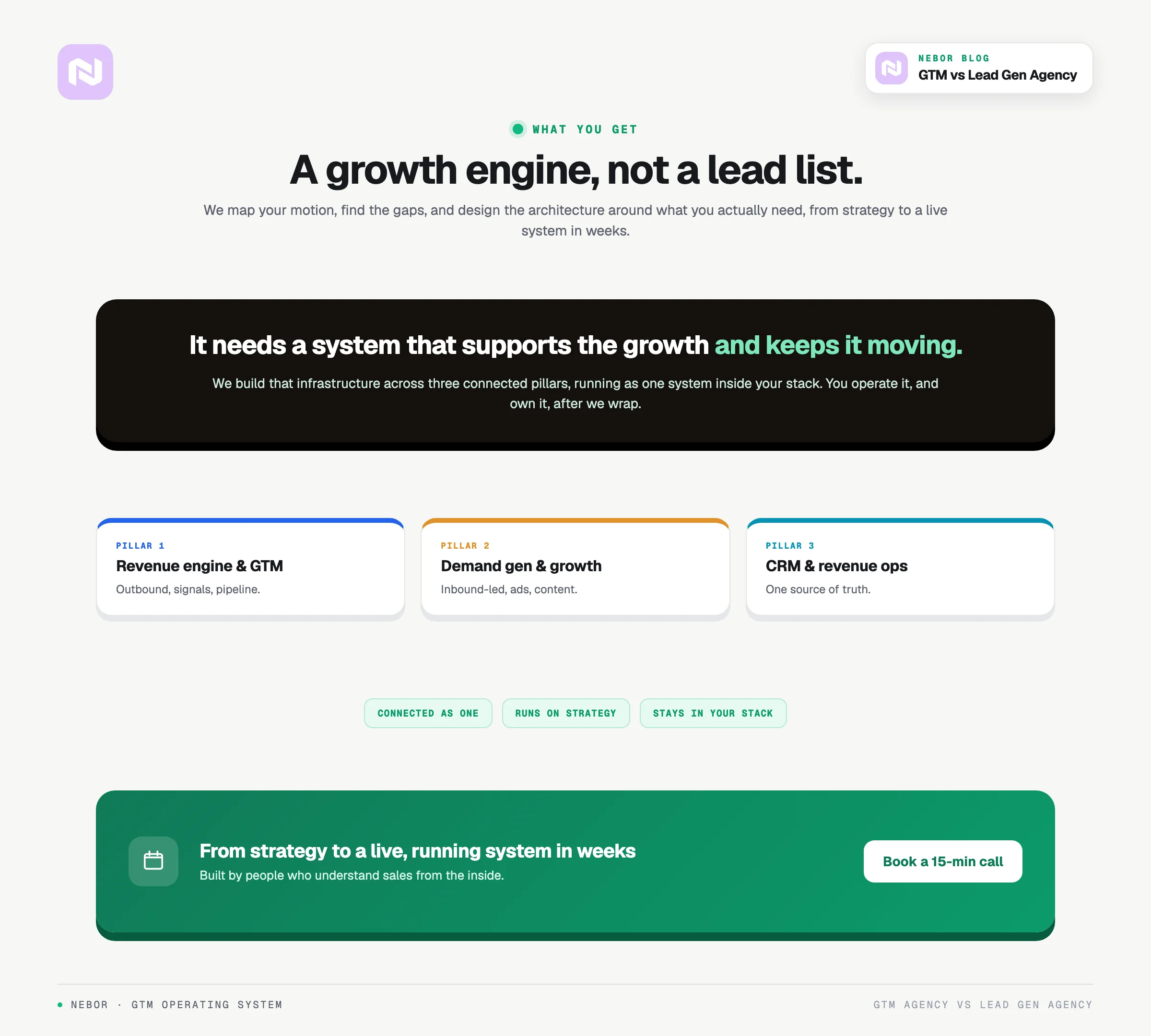
Revenue engine and GTM execution. Demand generation and growth. CRM and revenue operations.
All three, connected, working as one system inside your stack.
Every engagement starts with your business goals. We map your current GTM motion, identify where the gaps are, and design the system architecture around what you actually need. From strategy to a live, working system in weeks.
If you've been burned by lead gen agencies that over-promised and under-delivered, if your pipeline is unpredictable, or if you want a real growth engine built by people who understand sales from the inside, book a 15-minute call and let's figure out what your GTM motion should look like.


Related Articles



By clicking Sign Up you're confirming that you agree with our Terms and Conditions.