
Sales Systems vs Headcount: Why Your Revenue Team Doesn’t Need More People


In this post:
Every time pipeline slows down, the conversation in the boardroom always circles around hiring more SDRs, another AE to cover the new territory, more people making calls and sending emails, more hires.
It sounds logical. More reps (or more people in the team) equals more efforts, more outreach, equals more pipeline, which equals more revenue. It's simple math.
Except it's not.
Because that math assumes every rep you hire is operating at full capacity. It assumes your sales process is already efficient and all you need is more bodies to work it. In almost every company we've worked with, that assumption is wrong.
The real problem is rarely that you don't have enough people. The real problem is that the people you already have are spending most of their day on work that has nothing to do with selling.
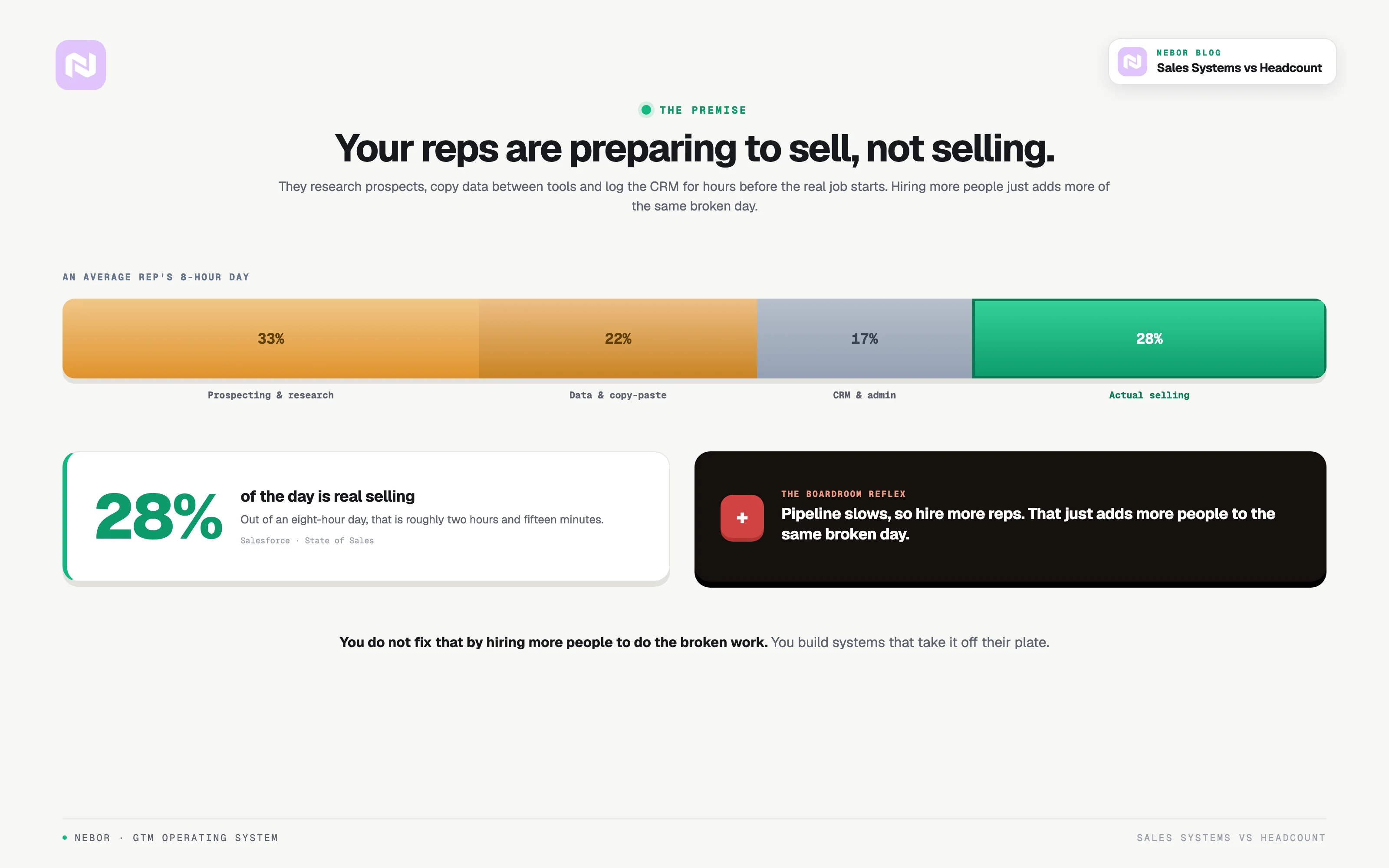
They're researching prospects instead of talking to them. They're copying and pasting data between tools instead of closing deals. They're doing desk research for two hours every morning before they can even start their actual job.
Basically, they spend their time preparing to sell instead of selling. You don't fix that by hiring more people to do the same broken work. You fix it by building systems that take the broken work off their plate.
Let’s get started.
What we actually mean when we say you don't need more headcount
We're not selling you some fantasy where an AI bot does all the selling and your team can just kick back and watch pipeline grow. No.
What we're saying is that most companies reach for headcount as a solution to problems that headcount can't solve.
Here's an example. Let's assume you have a team of five SDRs.
Each of them spends roughly two to three hours per day on (manual) prospecting.
Prospecting is sales prep work that relates to finding companies, looking up contacts, verifying emails, researching what the company does, writing a personalized first line, and logging everything in the CRM.
So, you get the idea. Only after all that work is done can they actually start reaching out.
According to Salesforce's State of Sales report, reps spend only about 28% of their time actually selling. The rest goes to admin and prospecting busywork.
So out of an eight-hour day, your reps get roughly two hours and fifteen minutes of real selling time.
Now, the instinct when pipeline starts to slow is to hire more SDRs. But that just gives you more people working the same broken process.
The smarter move is to build an internal sales system or engine that gives your existing five reps back three hours each per day. That's fifteen extra selling hours per day across the team.
That's the equivalent output of adding six or seven new reps, except you didn't hire anyone. You just stopped making your current team do work that should have been automated in the first place.
That's what we mean. The leverage isn't in more people. It's in systems that multiply the impact of the people you already have.
The headcount trap: why hiring your way out of a revenue problem almost never works
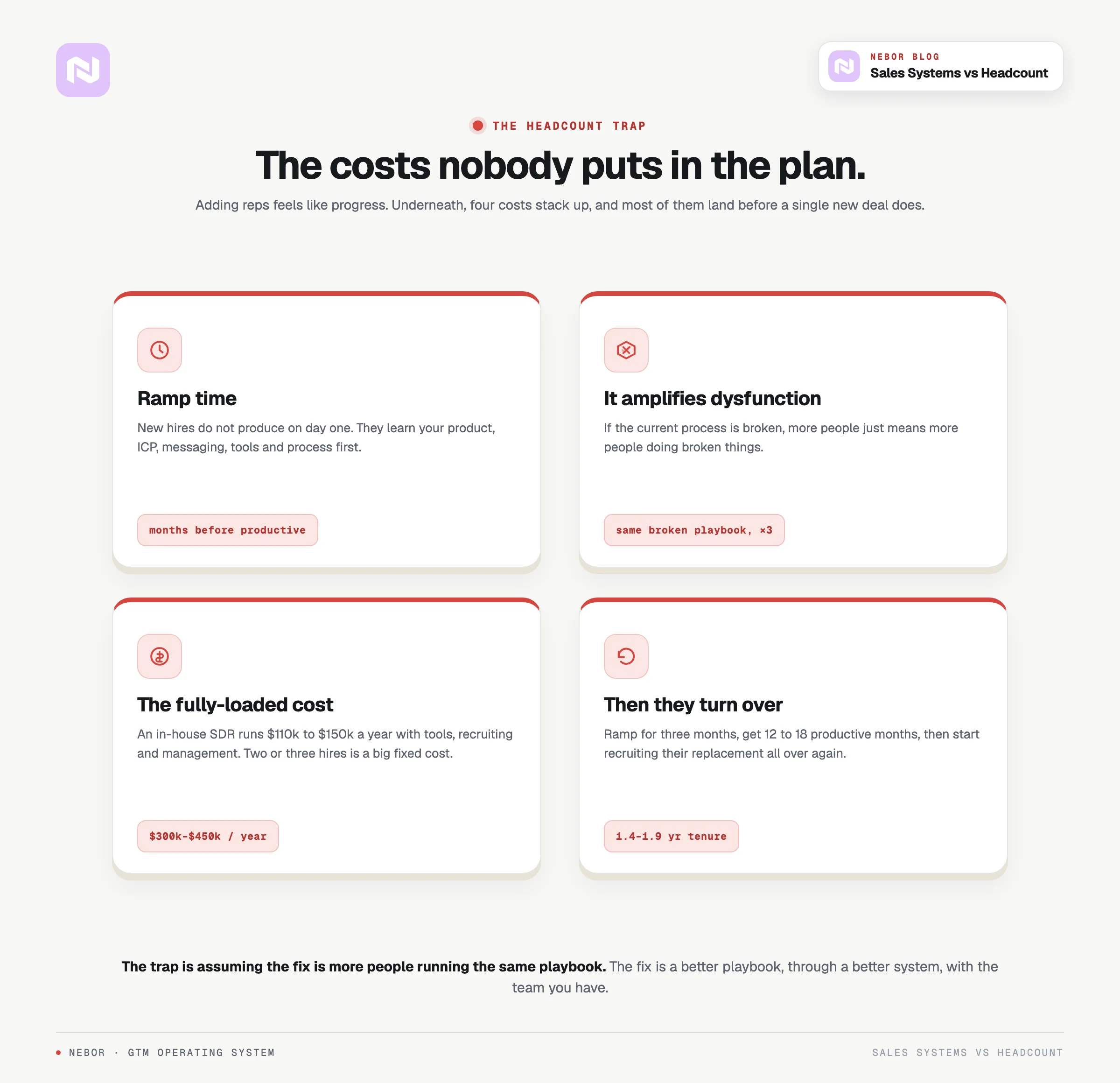
It's widely known that new sales hires don't produce on day one. They need to learn your product, your ICP, your messaging, your tools, your CRM, your internal processes. That can take months and even costs a lot of money.
So, the first problem here is ramp time. The second problem is that hiring amplifies existing dysfunction. If your current process is broken, adding more people just means more people doing broken things.
You also amplify the cost. The fully loaded cost of an in-house SDR is between $110,000 and $150,000 per year once you factor in salary, benefits, tools, recruiting, management, and ramp losses.
Multiply that by two or three new hires and you're looking at $300,000 to $450,000 per year in new fixed cost, much of it before you see any pipeline impact.
Then there's turnover. The average SDR tenure is 1.4 to 1.9 years. So you spend three months ramping someone, get 12 to 18 months of productive output, and then you're back to recruiting their replacement.
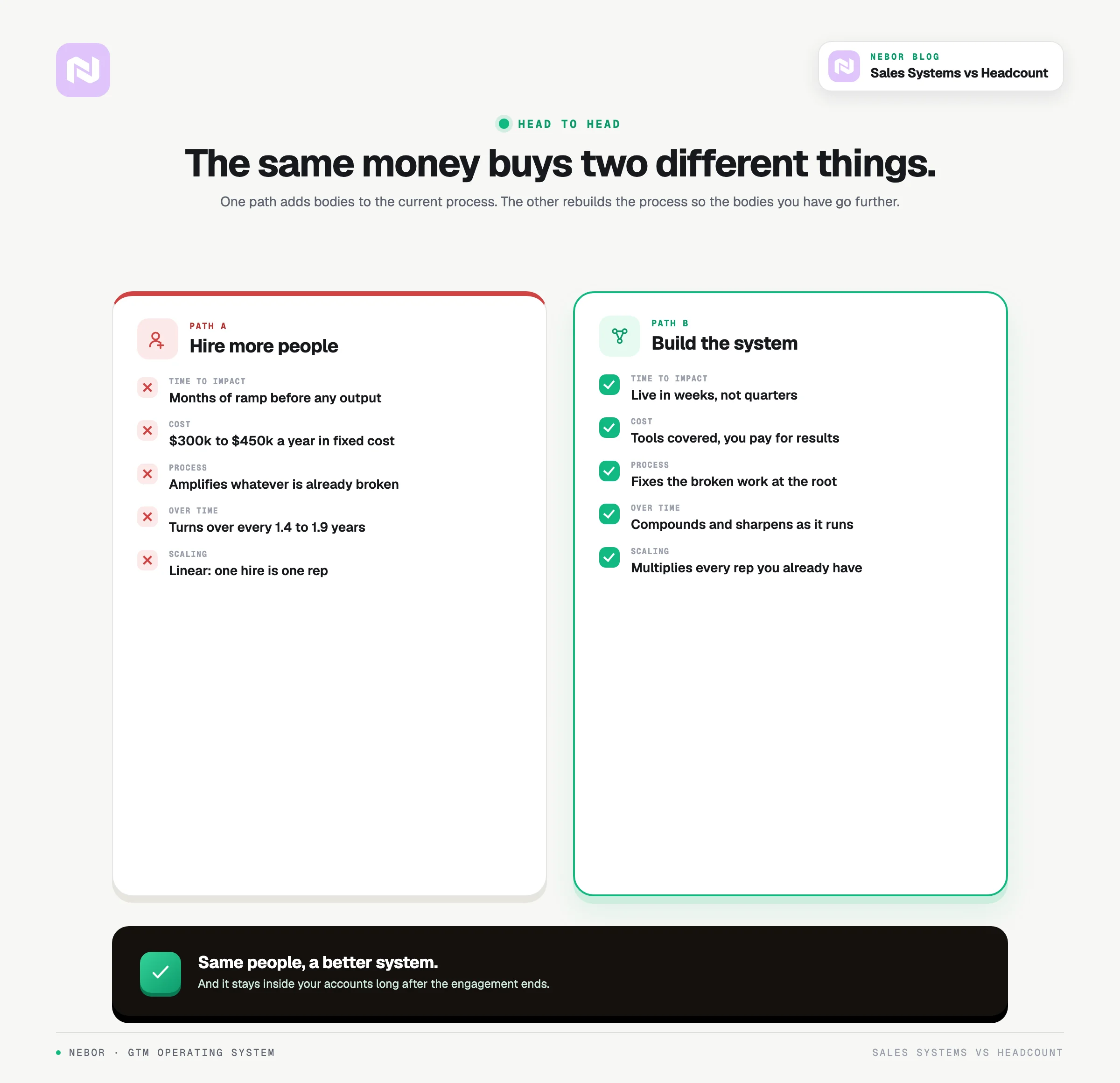
The headcount trap is the assumption that the fix to a pipeline problem is more people working the same playbook. The actual fix is usually a better playbook moving through a better system, with the same people you already have.
What a sales system actually looks like (and why it's not just buying more tools)
This is the part where most advice on the internet falls apart. Because when people hear "build better systems," they think it means buying better tools. And then they go shopping.
You sign up for a data enrichment platform. Then an email sequencer. Then a LinkedIn automation tool. Then a meeting scheduler. Then a CRM add-on. Then an intent data provider.
Before you know it, you have eight to twelve tools that don't talk to each other, data living in six different places, and a monthly SaaS bill somewhere between $3,000 and $5,000 for software that nobody fully uses because nobody set it up to work together.
That's not a system. That's a collection of tools, and there's a massive difference. We've covered the broader picture in our piece on why most Clay implementations fail for the same reason.
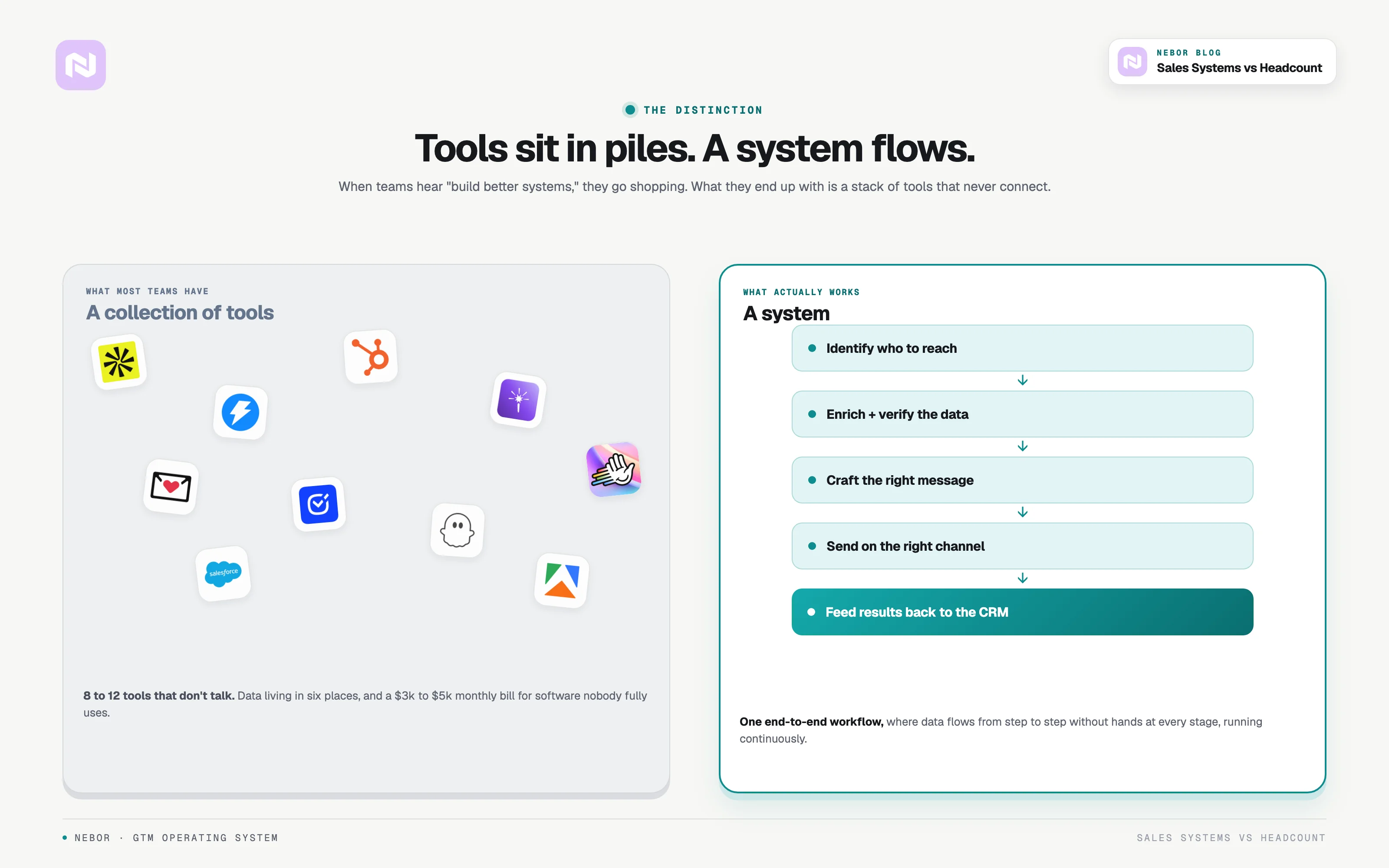
For us, a system is an end-to-end workflow where data flows from one step to the next without human intervention at every stage.
It starts with identifying who to reach out to, moves through enriching that data, verifying it, crafting the right message for the right person, sending it through the right channel, and feeding the results back into your CRM so your team has full visibility.
Every step is connected. Nothing falls through the cracks. The whole thing keeps going continuously. We believe that's the beauty of it.
What sales functions/tools and workflows you need to build an automated GTM system
Here's what an automated GTM system actually looks like when it's built properly, broken down by function.
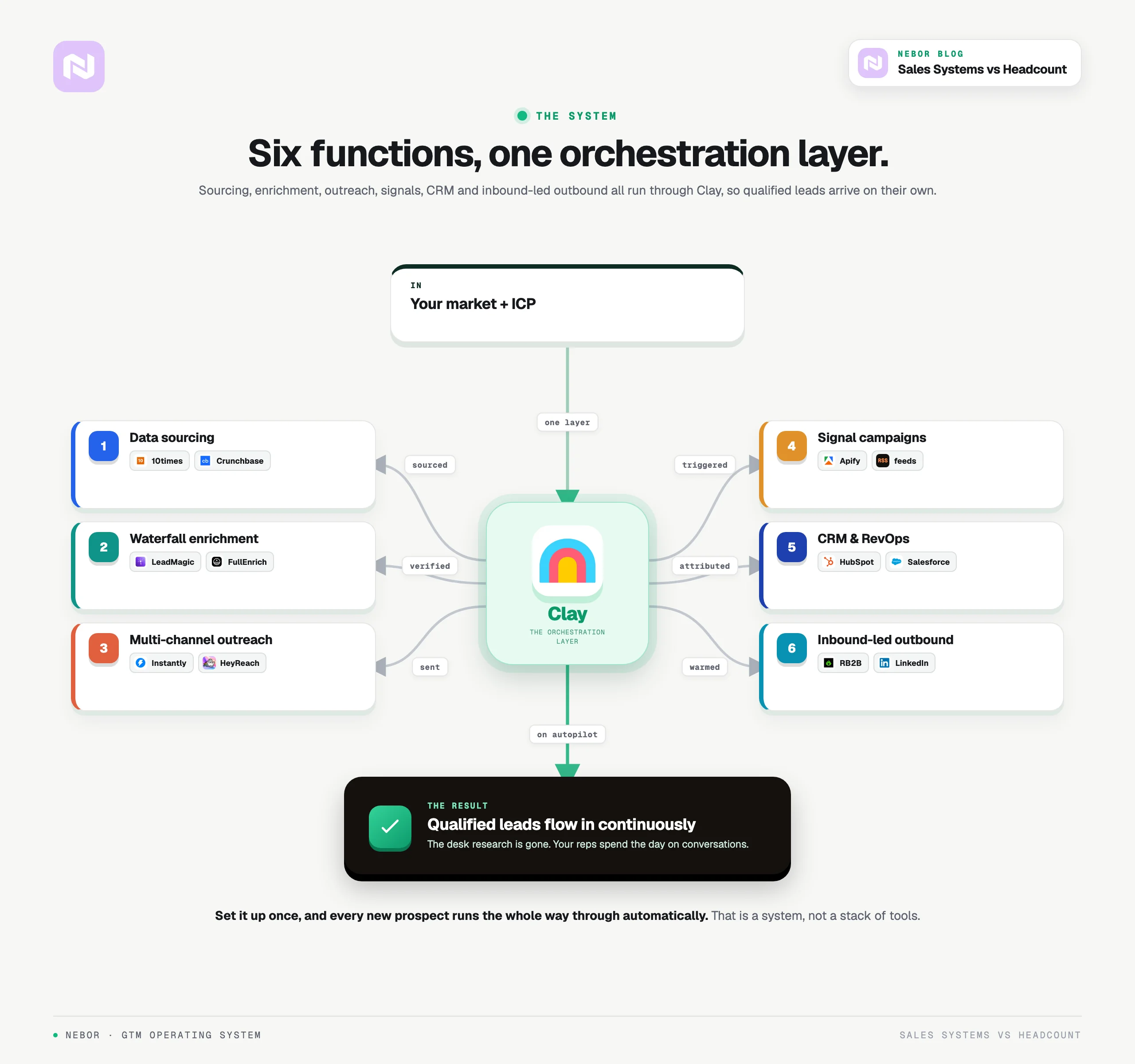
Data sourcing that matches your ICP
Most teams default to Apollo or LinkedIn Sales Navigator for prospecting data. These are fine tools for broad searches. But if your ICP is even slightly niche, you're missing a huge chunk of your total addressable market by only relying on them.
The right data source depends on who you're selling to. If your ICP is companies hosting events, a platform like 10times.com gives you better data than any general B2B database.
If you're selling to e-commerce brands, StoreLeads will show you every Shopify and WooCommerce store along with their tech stack and estimated revenue.
If you're targeting recently funded startups, Crunchbase is your source. If you need to know what technology a company uses, BuiltWith or Wappalyzer will tell you.
The point is that your data sourcing strategy should be as specific as your ICP. The generic databases will give you generic results. Generic results lead to generic outreach that gets ignored.
Waterfall enrichment across multiple providers
Once you have your target companies and contacts, you need to enrich them. Here's where most teams make a critical mistake. They rely on a single enrichment provider.
No single data vendor has 100% coverage. Not even close. That's why we use waterfall enrichment, which means passing each contact through multiple providers in sequence.
If the first provider doesn’t find the email, the second one tries. If neither finds a mobile number, the third does. We typically chain LeadMagic, Findymail, and FullEnrich together, which gets us 80%+ email match rates compared to the 40-50% you'd get with any single tool.
After enrichment, every contact passes through email verification with BounceBan, DeBounce, or ZeroBounce to validate emails, catch risky catch-all addresses, and remove anything that could hurt your sender reputation.
BounceBan is our go-to here because it's exceptionally good at validating those catch-all emails that other tools just flag as risky and skip. That alone gives us up to 30% more usable contacts from any given list.
This entire process happens inside Clay as the orchestration layer. You set it up once, and every new prospect that enters the system gets enriched and verified automatically.
Multi-channel outreach that's automated
With clean, enriched data, you need to actually reach these people. The approach matters as much as the data.
We use specialized tools for each channel rather than all-in-one platforms. Instantly for email automation. HeyReach for LinkedIn outreach.
The reason is simple. Dedicated tools do their one thing better than any multi-channel platform does all things.
But here's the part most teams get wrong. They build templates and blast them out at scale, hoping volume makes up for relevance. That doesn't work anymore.
What works is using AI inside Clay to generate genuinely personalized messages based on each prospect's actual data. Recent LinkedIn activity, company news, hiring signals, tech stack changes, anything that proves you actually know who you're reaching out to.
The AI handles the research and writing grunt work. The strategy, the segmentation, and the relevance come from the humans who set up the system.
Signal-based campaigns that work on autopilot and compound over time
This is where systems really start to outperform headcount.
Most outbound is campaign-based. You build a list, you launch a campaign, it ends, and you start over.
What we build instead are evergreen workflows that continuously monitor buying signals and trigger outreach in real time.
Here's what that looks like with real examples.
We scrape LinkedIn job posts for SDR and BDR roles from specific locations every morning at 9 AM using Apify and PhantomBuster.
When a company posts those roles, it signals that they're either struggling to build pipeline or scaling their sales team and need infrastructure. Either way, they're a fit for what we do.
The job post gets pulled into Clay automatically, we find the hiring manager and the department head, enrich and verify their contact data, and trigger a personalized outreach sequence. This happens every single day without anyone pressing a button.
For a client offering AI-powered furnishing solutions, we set up Clay's RSS feed monitoring on property development publications.
Every time a new article is published about a development project, the workflow identifies the developer, finds the right contact, generates a personalized email referencing the specific project, and sends it.
The client doesn't even know an article was published until they get a reply from an interested developer.
The beauty of signal-based campaigns is that they compound. The data keeps flowing in. The targeting gets sharper over time. Your pipeline keeps filling without anyone on your team spending their day hunting for prospects.
CRM and RevOps infrastructure that ties it all together
None of this works if your CRM is a mess. At most companies, it is.
Your CRM should be the command center for your entire revenue team. Properties that match how your team actually sells. Lifecycle stages that reflect your real sales process. Data that's clean, enriched, and trustworthy.
We build CRM and RevOps infrastructure on top of HubSpot, Salesforce, or Pipedrive (depending on what you use) so every workflow we build pushes data back to the CRM with the correct attribution and timestamps.
Lead scoring models combine fit, intent, and engagement signals. Dynamic signal tracking captures job changes, promotions, funding events, and routes them automatically. When a champion who bought your product at one company moves to a new role at a different company, your system picks it up and triggers outreach.
This is what turns a CRM from a static contact list into an intelligence system that actively drives revenue.
Inbound-led outbound: connecting your marketing and sales into one motion
This is a workflow that most companies completely miss.
Your LinkedIn post got 200 likes. Your latest blog post got shared 50 times. Someone visited your pricing page three times this week. A prospect downloaded your whitepaper.
All of that is intent data. At most companies, it just goes nowhere. Nobody even captures or acts on it. The marketing team tracks impressions and the sales team does cold outreach, and the two never connect.
What we build is an inbound-led outbound motion. We take your inbound engagement data and use it to power smarter outbound.
We scrape the people who engaged with your LinkedIn content, enrich them, identify which ones match your ICP, and add them to a targeted outreach sequence. That's a warm conversation. The reply rates are dramatically different.
On the flip side, we set up website visitor identification using tools like RB2B so you know which companies are looking at your site and what pages they're spending time on.
When a target account visits your pricing page, your sales team gets alerted. When they visit three times in a week, an automated outreach sequence triggers. You're reaching out at exactly the moment they're evaluating solutions.
This is what it looks like when marketing and sales are one connected system instead of two teams working parallel strategies with parallel dashboards. We dug deeper into the practical mechanics in our inbound meeting workflow post if you want the step-by-step build.
What happens when you build systems instead of hiring
Here are some of our wins.
GRIP Facility is a six-person tech startup. Before working with us, they had almost no proactive outreach. Everything came through referrals and their existing network.
After we implemented the outbound workflows, the inbound-led outbound motion, and signal-based monitoring campaigns, they went from zero meetings per week to three to four meetings per week. 500% increase in pipeline within three months. No new hires.
One workplace-technology company we work with has a 30-person sales team. Their reps were spending hours every day on manual desk research before they could start selling.
We automated the entire data sourcing, enrichment, and routing process. Now hundreds of qualified leads flow into their pipeline automatically from multiple sources we identified specifically for their business. Those hours of desk research? Gone.
The reps spend their time on calls and conversations instead. We can't share much on this right here but you're more than welcome to jump on a call with us and we'll show you more.
Hire Nebor: your team doesn't need more people, it needs an infrastructure that supports how they sell.
The pattern is always the same. Companies feel like they need more reps because their current reps aren't generating enough pipeline.
The current reps aren't generating enough pipeline because they're spending 70% of their day on work that should have been automated months or years ago.
Adding more reps doesn't fix the underlying issue. It just adds more cost on top of the same broken process.
What works is building the system that gives your existing team back the hours they're losing to busywork.
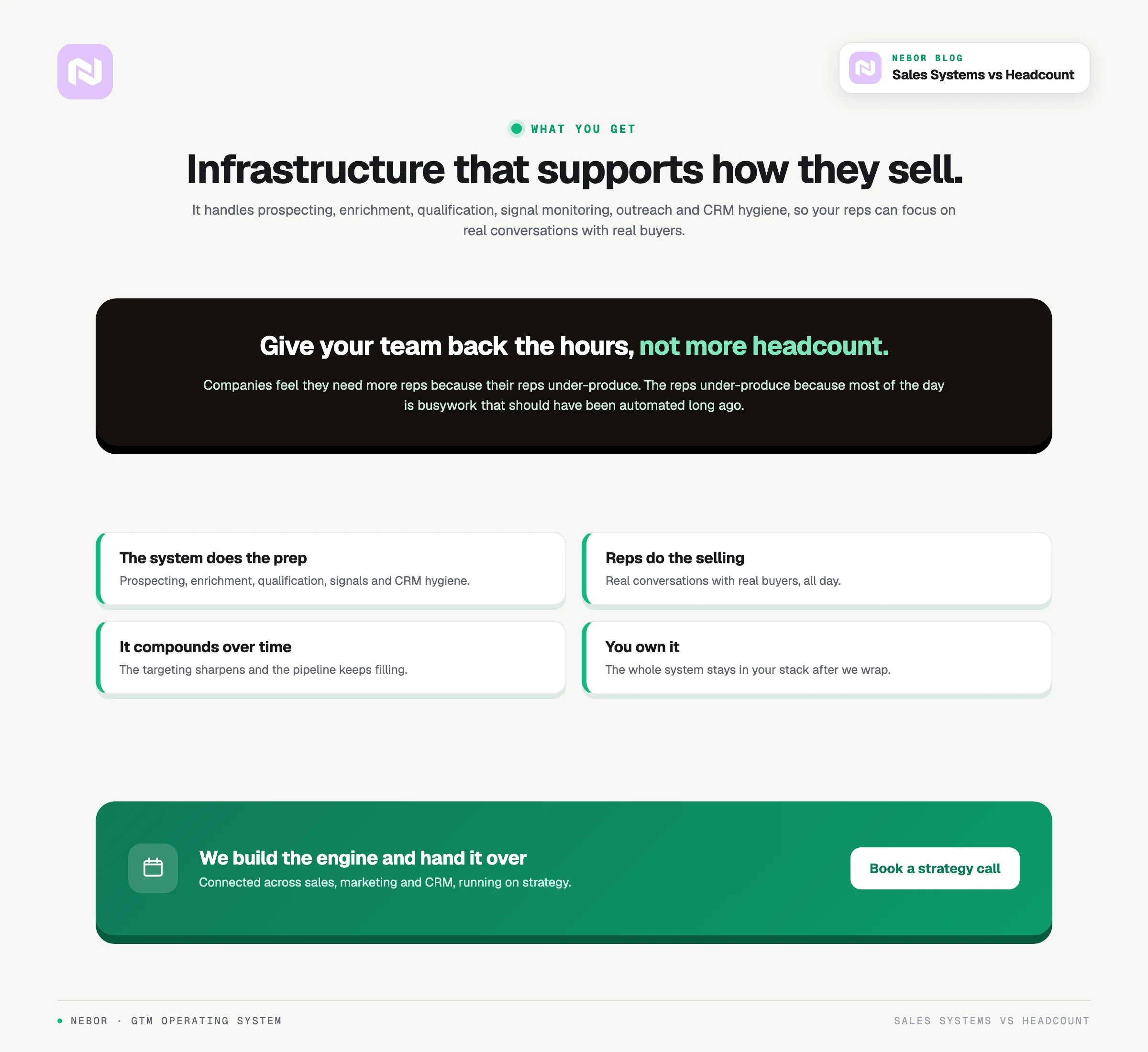
The system handles prospecting, enrichment, qualification, signal monitoring, outreach, and CRM hygiene. Your reps focus on the one thing no system can replace. Having real conversations with real buyers.
That's what we build at Nebor. You'll get connected infrastructure across your sales, marketing, and CRM that is built on strategy, compounds over time, and stays inside your stack long after the engagement ends.
If your team is stuck in the cycle of "we need more reps" every time pipeline dips, that's exactly the conversation we want to have.
We've also written a full breakdown of why we're not a lead generation agency and how to hire a growth agency if you want more context on how we work and what to look for in a partner.
Book a strategy call and let's figure out what your growth engine should actually look like.


Related Articles
By clicking Sign Up you're confirming that you agree with our Terms and Conditions.