
Outsourced vs In-House SDRs: Why Sales Automation and Clay Workflows Are The Better Answer to This Debate

by
In this post:
Should you hire sales development representatives in-house, or outsource the whole thing?
Thing is, both options feel like a compromise.
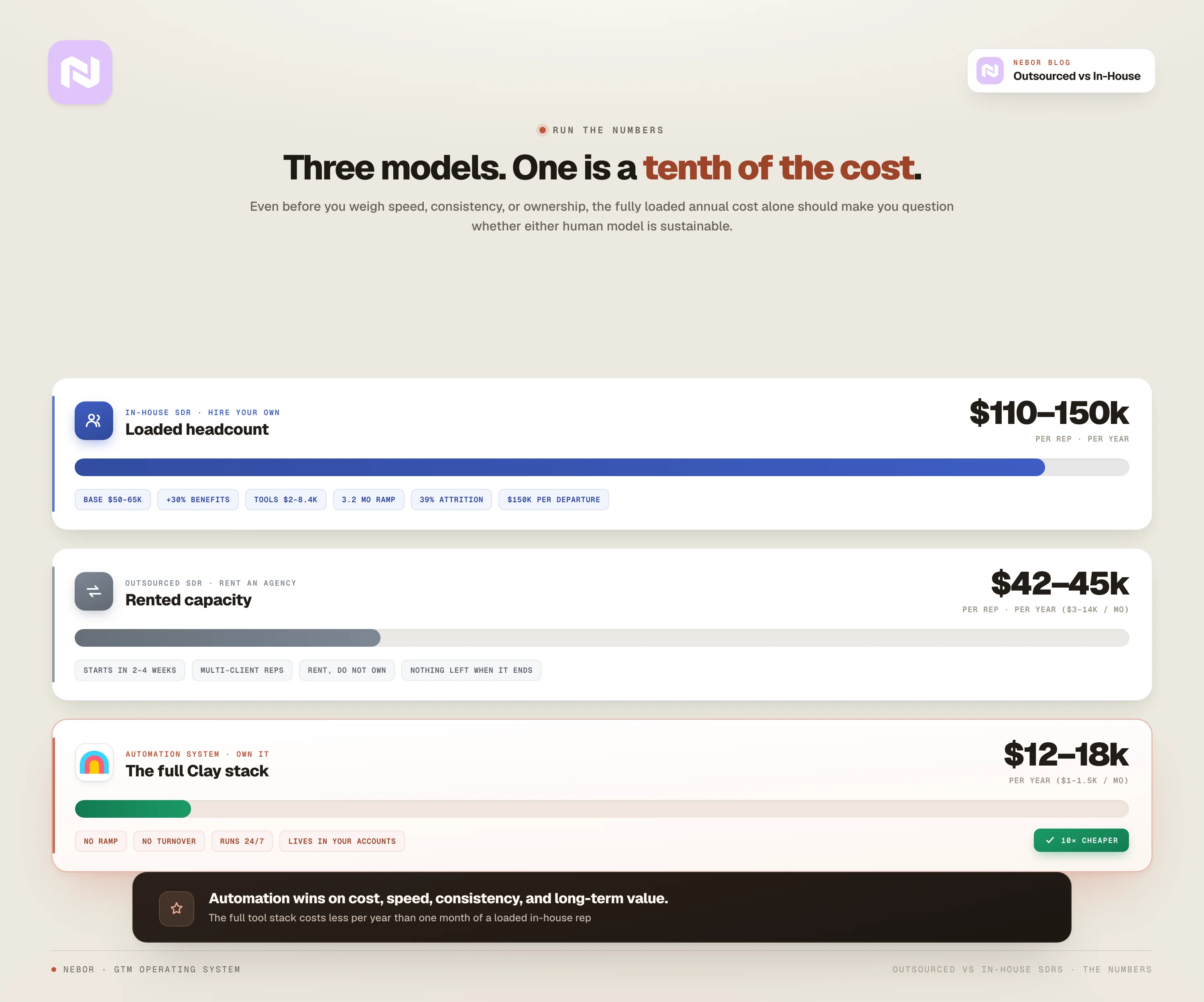
If you hire an in-house sales development team, you're looking at months of recruiting, training, and hoping they stick around long enough to produce, at $125,000 to $150,000 per rep per year once you add salary, benefits, tech tools, management overhead, and ramp up time.
If you go for outsourced sales development, pipeline stops being your problem, but you can't shake the thought that you're handing it to people who'll only start learning about your product next week. You're paying $3,000 to $14,000 a month for outsourced SDRs who juggle other clients, and when the engagement ends, you walk away with nothing but a lighter bank account.
Meanwhile, your existing team is stuck doing work that has nothing to do with selling: manually researching leads, building lists, copy-pasting between tools, updating the CRM instead of having conversations. And your pipeline looks the same as it did last quarter.
Here's what most articles about the outsourced vs in-house sales development debate won't tell you. It's 2026, and the debate is outdated, because it assumes the only way to fill your pipeline is to throw more humans at the top of the funnel. That's simply not true anymore.
There's a third option most companies overlook, and it changes the math completely. We'll cover the classic comparison, the real numbers, the hybrid approach everyone lands on, and the option we'd pick instead.
TL,DR
Why sales automation and Clay workflows make the outsourced vs in-house SDRs debate irrelevant
Before comparing in-house sales development with outsourced sales development, you need to see what's possible with sales automation today, because once you see it, the whole debate is asking the wrong question.
Think about what a sales development rep does every day: prospecting, list building, appointment setting, writing sales outreach, sending follow-ups, qualifying leads, updating the CRM. All of it manually, across five or six tools that don't talk to each other.
According to HubSpot, sales reps spend over a third of their time on administrative duties. If you're paying $125K+ per year for an in-house team member, or $5,000 to $12,000 a month for outsourced appointment setting, a massive chunk of that money goes toward work that advanced technology already automates.
This is where Clay workflows come in. Clay works less like a data tool and more like a programmable command center for your entire sales operation.
Combine it with n8n for workflow automation, PhantomBuster or Apify for scraping, Instantly for email, HeyReach for LinkedIn, and LeadsFactory for finding personas, and you get a system that replaces most of what a sales development team spends its time on, whether it's in-house or one of the outsourced teams you'd otherwise rent.
Let us walk you through a few real workflow examples, without getting technical, so you can see how this tears the playbooks of internal teams and agencies apart.
A fully orchestrated outbound lead generation workflow that cuts your reps' top-of-the-funnel research functions and generates qualified conversations
Instead of an SDR manually pulling leads from LinkedIn Sales Navigator, cross-referencing Apollo, and verifying emails one by one, we use Clay to pull from data sources that fit your niche, find the right contacts through LeadsFactory, and pass every lead through multi-provider enrichment with LeadMagic, Findymail, and FullEnrich.
We verify every email through BounceBan, DeBounce, and ZeroBounce, and score each lead against your ICP criteria, because filtering your target audience by job title alone isn't enough.
For one client targeting event hosts, our Clay automations verify that each prospect actually hosts events, confirm exhibitor counts, and check sponsor presence. Clay then generates personalized pitches through Claygent or Claude and pushes the data to Lemlist or Instantly. All on autopilot.
The same system handles inbound lead qualification. Form fills and demo requests get captured, enriched with decision-maker info, scored, and routed to the right rep with complete context and suggested talking points.
By the time a lead reaches your closer, it's fully enriched with buying signals and verified contact details. They just pick up the thread and talk to someone who fits your ICP, and the speed of your inbound response directly lifts your conversion rate.
A free trial monitoring workflow that lifts conversion rates
If you have a freemium or trial model, you know the problem: hundreds of signups, and only a handful worth your sales team's time. Most companies treat every trial user the same, or have a sales development rep reviewing accounts one by one.
A Clay workflow scores which trial users are most likely to convert based on usage patterns, company size, funding stage, and tech stack, then surfaces the accounts showing real buying signals. Your closer focuses on high-value conversations instead of chasing tire-kickers.
A CRM cleanup workflow
This one is for companies holding thousands of contacts in HubSpot or Salesforce that turned into a graveyard: contacts who left three years ago, bouncing emails, duplicates, empty fields. Your sales team avoids the CRM, and your ops team hates cleaning it.
With Clay, we re-enrich the entire database, fill missing fields from verified sources, deduplicate, and validate every address. A lead from your website gets enriched, scored, and routed automatically; a high-value account triggers an instant Slack notification to your AE with all the details.
A former customer and contact monitoring workflow
Say your best champion at a client company leaves for a new job. In most sales organizations, that relationship just disappears.
But these former champions already know your value, and in their new roles they often influence buying decisions. They're some of your highest-probability prospects, and most businesses never pursue them.
We use Clay to monitor job changes for every positive contact in your CRM, detect moves through PhantomBuster and news sources, check the new company against your ICP, and trigger personalized engagement that references your shared history. Warm outreach, working on autopilot.
RSS feeds monitoring workflow that captures buying signals and intent data on autopilot
For a client offering AI-powered furnishing solutions, we use Apify with Clay and n8n to monitor publications that report new real estate projects. When a developer announces new property acquisitions, the system picks up the signal, finds the contact, crafts a message, and reaches out before the competition knows the opportunity exists.
We wrote up more workflows like this in our piece on signal-based outbound campaigns.
Why you need to consider automation before growing the SDR function
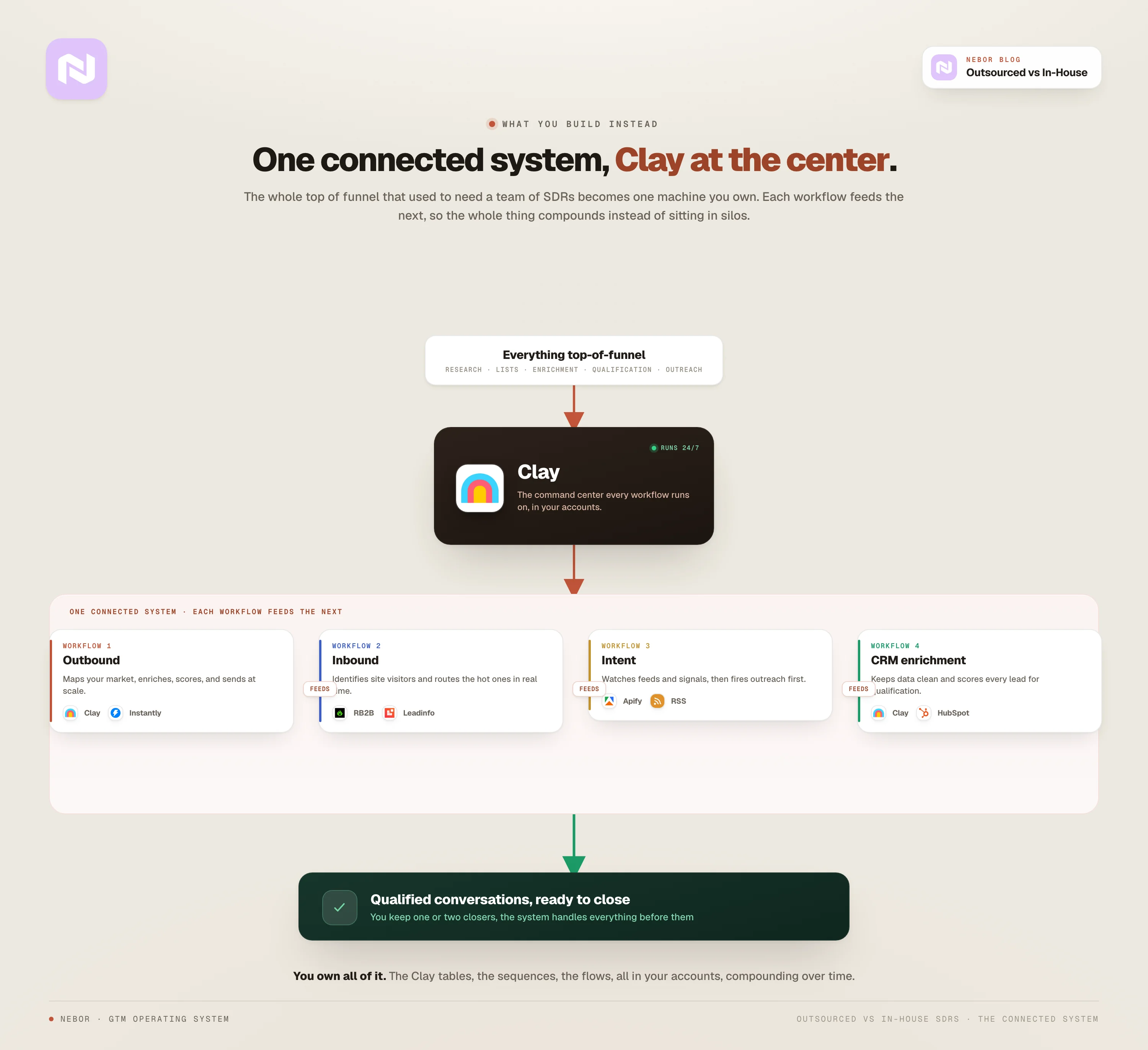
The entire top-of-funnel operation that traditionally requires a sales development team, whether in-house or rented through outsourced appointment setting, can now be automated into a system you own that works 24/7.
Outbound lead generation feeds inbound capture, intent monitoring feeds outreach, CRM enrichment feeds qualification. One connected system with Clay at the center.
You no longer need an army of reps doing research, lead qualification, and cold email all day, and you don't need to rent outsourced SDRs from an agency for sales development and appointment setting. You need one or two closers focused on conversations and closing deals, with the system handling everything else.
That system doesn't quit, doesn't need a promotion path, and doesn't take your processes with it when it walks out the door.
Outsourced vs in house sales development: what the numbers say (and why both options still fall short)
Now, to the question you came for: outsourced vs in-house SDRs, which is better? Even if you're not sold on automation yet, the math alone should make you question whether either model, in-house sales development or outsourced sales development, is sustainable.
The real cost of an in house SDR team
Most people see the base salary of $50,000 to $65,000 and think that's the investment. It's not close.
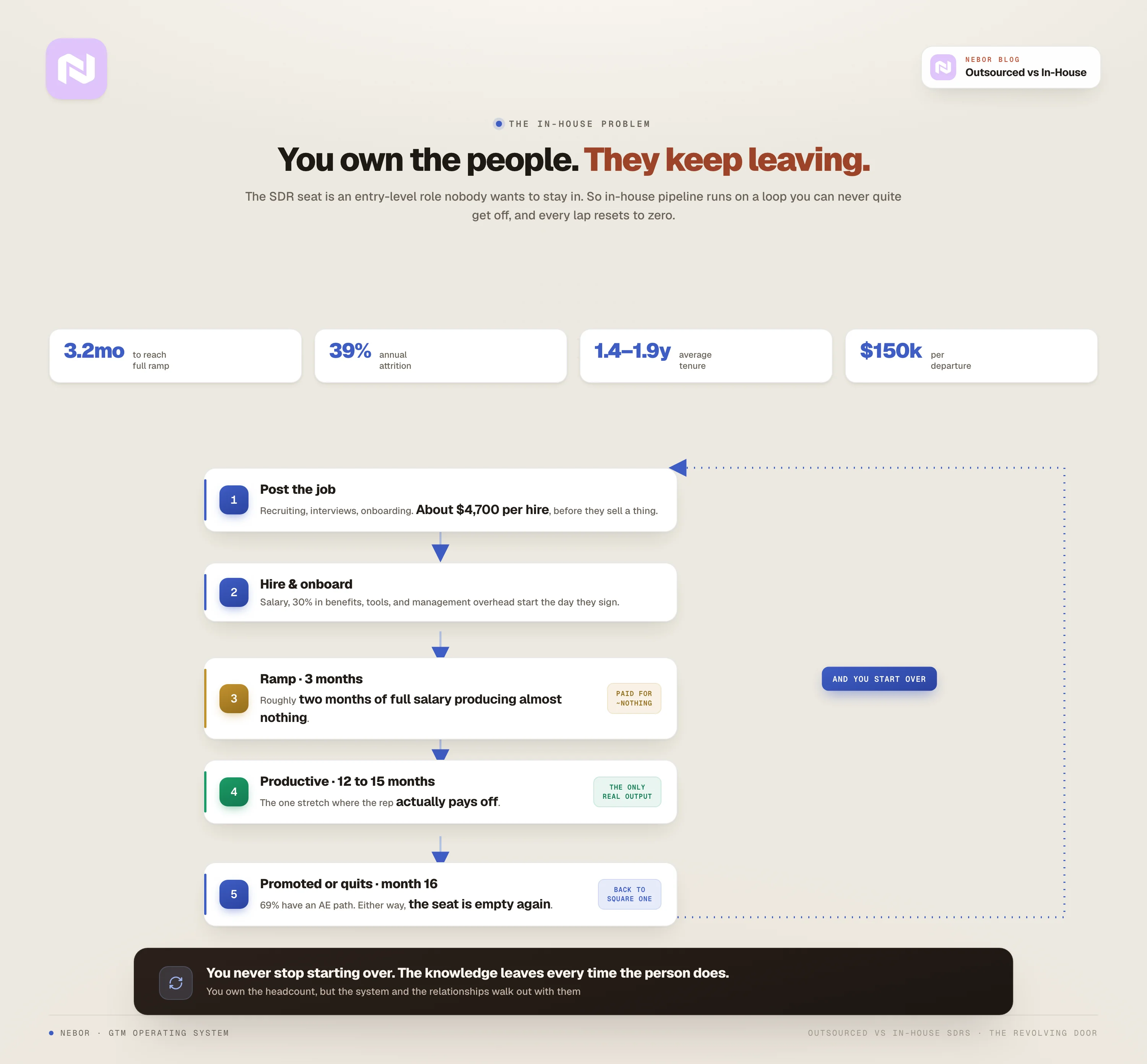
Add benefits and commissions (roughly 30% on top), sales tools ($2,000 to $8,400 per rep annually), recruiting (about $4,700 cost-per-hire per SHRM, cited by LaunchLeads), office space where relevant, management overhead, and ramp up losses, and the fully loaded cost lands between $110,000 and $150,000 per year (Martal Group).
Per The Bridge Group, the average SDR takes 3.1 to 3.2 months to reach full productivity, so the ramp up phase means months of full salary for half the output. Building an in-house team for sales development is resource intensive in a way no line item shows.
Then there's turnover. Average sales development tenure is 1.4 to 1.9 years with high turnover around 39%, and scaling means one manager for every five to eight in-house reps, so the management time scales with the headcount.
So you hire, invest three months getting someone productive, get 12 to 15 months of output, and start over. One analysis puts the total cost of each departure above $150,000 including lost pipeline momentum (TeleNet Marketing).
Compare that to a sales automation system: the full stack costs $1,000 to $1,500 a month in fixed costs, with no ramp, no turnover, and no promotion path to backfill.
The real cost of outsourced sales development
Outsourced appointment setting looks stress free and cheaper on paper.
Monthly outsourced sales development retainers cost $3,000 to $14,000, flexible pricing models are common, and the total annual cost per outsourced appointment setting rep comes in around $42,000 to $45,000 (Leads at Scale). Outsourced teams also get moving in two to four weeks instead of three to six months.
But here's what the sales outsourcing pitch doesn't highlight: with outsourced sales development you're renting results. When the engagement ends, you walk away with no system, no process, no infrastructure. Just a gap in your pipeline and the choice to re-sign or start over.
There's also quality. Outsourced teams work across multiple accounts, their outsourced SDRs don't know your product the way an internal SDR team would, and the leads they hand over often need more work before they're truly sales-ready.
With a sales automation system, the workflows live in your Clay account, the sequences in your Instantly, the intent monitoring in your n8n. Switch agencies or bring things in-house, and the system comes with you.
What each model does well, and when a hybrid approach (combining in house and outsourced SDRs) makes sense
To be fair to both sides, each model has genuine strengths, and you should know them before you decide.
In-house sales development gives you full control over messaging and brand voice, which matters when company culture is part of how you sell. In-house reps live and breathe your product, so conversations sound natural rather than scripted, and an experienced team grows into your AE bench over time.
Internal teams also suit highly technical products and businesses that need tight integration between sales, marketing strategy, and other departments, where marketing qualified leads need careful handoffs and internal resources close to the product.
Outsourced sales development wins on speed and elasticity. Outsourced providers bring external expertise, pre-trained outsourced teams, and established playbooks, so they deliver qualified leads within weeks and adjust capacity on demand, which vendors claim launches new campaigns up to 40% faster than internal capability alone.
A fresh perspective on your pitch is a real side benefit, and there's no office space or management burden on your side. For a startup testing new markets or launching a new product, that dedicated focus on speed is exactly what outsourced partners are for. And with turnover in the role past 30%, renting for a temporary need is genuinely less risky than hiring for it.
The conversion math still favors keeping things close: in-house sales development programs often see held-to-opportunity conversion rates of 60 to 70%, while typical outsourced appointment setting programs land around 25%, with only elite ones matching internal numbers.
Outsourced SDRs generating 8 to 15 meetings a month per rep is the benchmark the industry quotes, which pencils out to roughly $50,000 to $150,000 in monthly pipeline per rep, in-house or outsourced.
That's why the hybrid model has taken over: industry surveys put 73% of organizations on a hybrid sdr model, up from 53% a year earlier. The hybrid approach means an in-house team keeps the strategic accounts while outsourced teams take the high-volume lead gen and outsourced appointment setting, balancing cost, scale, and a steady sales pipeline.
Hybrid is the best version of the old debate. Our point is that even the best version still scales sales development by renting or hiring humans for work a system now does, and neither half leaves you owning the machine.
How sales automation and owning workflows changes the ROI and resource allocation equation
According to McKinsey, companies investing in AI and automation for sales see a 10 to 20% boost in sales ROI, and businesses that automate lead management report a 10%+ revenue increase within six to nine months (Rep Order Management).
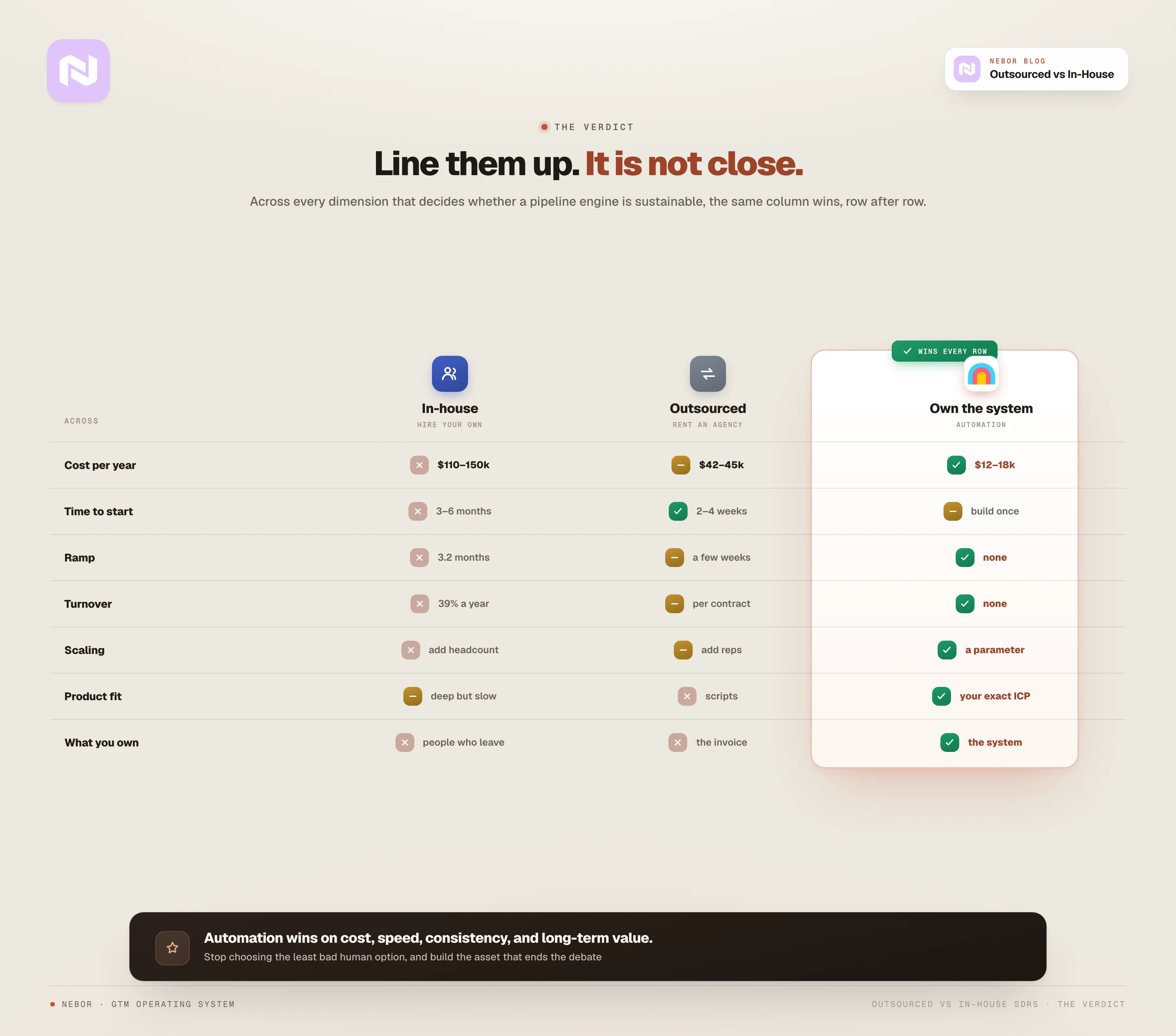
Stack the cost of an automated system against either in-house or outsourced sales development and automation wins on cost, speed, consistency, and long-term value. The resource allocation question, for internal teams and agencies alike, stops being "how many reps" and becomes "which workflows next", with full control staying yours. It's not a close comparison.
What real sales experience and common sense tell you about the key factors in the outsourced vs in-house SDR decision
If you've ever managed an SDR team or worked with an agency, you know there are problems that never show up in spreadsheets. Numbers are useful, but they don't tell the full story, so let's talk from experience.
The in-house motivation problem
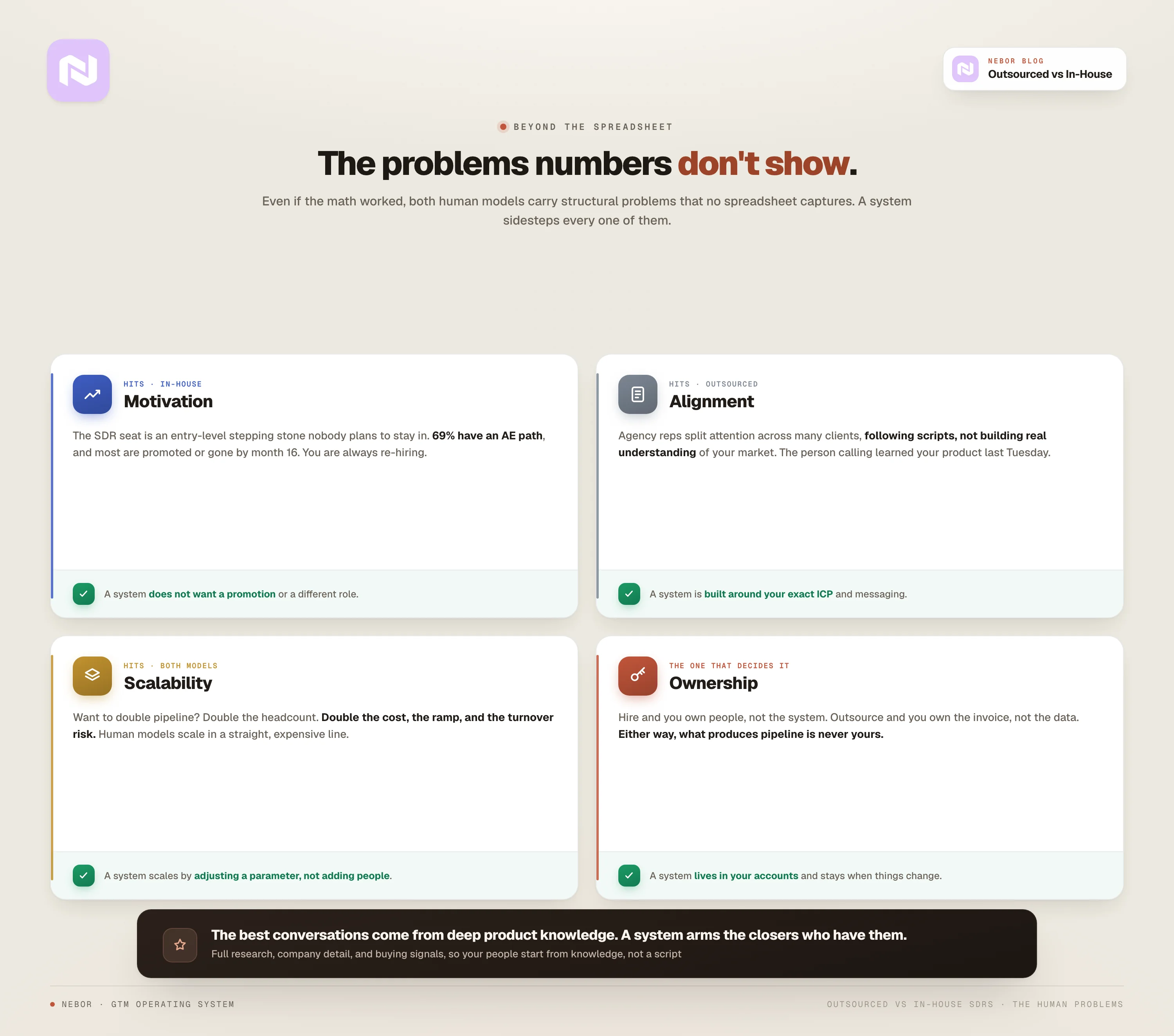
Let's be real about what the sales development role is: an entry-level sales position. Most people who take the job don't dream of cold calling for five years. Fun fact: every member of our founding team at Nebor.ai worked as sales development representatives, and we all moved on quickly.
The Bridge Group's data backs this up: 69% of companies offer an SDR-to-AE promotion path, and reps spend about 16 months in the role before moving.
So you hire, train, get a few productive months, and then they're promoted or gone, and your in-house team is back to square one while you post job ads. It's a cycle that works against your company's goals, and you won't have this problem with automation.
The outsourced SDR team alignment problem
Outsourced SDR agencies serve multiple clients at once. That's their business model, and it means your business is never their only priority. The outsourced SDRs on your account divide their attention across several products and ICPs, following appointment setting scripts instead of building a genuine understanding of your market.
Anyone who has sold anything knows the best conversations come from deep product knowledge and a real grasp of the buyer's pain points. That's hard when the outsourced SDR team calling learned your product last Tuesday.
A Clay-powered system doesn't replace human conversations. It makes sure the humans having them, your closers, are armed with full prospect research, company details, and buying signals. The conversation starts from knowledge instead of a generic pitch.
The scalability problem with both in-house and outsourced SDR models
Want to double your pipeline with an in-house SDR team? Double your headcount, which means double the salaries, the management burden, the ramp up time, and the turnover risk.
Outsourced teams scale a bit faster because the agency adds reps quickly, but you're still scaling outsourced sales development by adding people, and still renting every bit of that appointment setting capacity.
Automation scales differently. Once the core workflows exist, scaling means adjusting parameters: add a market segment to the Clay table, add an RSS feed to monitor, raise the campaign volume. The marginal cost is a fraction of scaling a human team, whatever your business goals, and your sales process stops depending on headcount.
The ownership question
This is the one that matters most. Hire an in-house team and you own the people without owning the system: when they leave, their knowledge goes with them. Outsource your sales development and you own the invoice alone: no people, no processes, no data.
Build a sales automation system and the workflows live in your accounts: the Clay tables, the Instantly sequences, the HeyReach campaigns, the n8n flows, all in your stack under your complete control. New members of your internal sales team plug into an existing machine instead of starting from scratch.
That's the fundamental difference between building an asset and paying for a service, and it's why maintaining control of the system beats maintaining control of the org chart.
Stop debating outsourced vs in-house SDRs and hire Nebor.ai, the right partner to build a system that actually scales
The outsourced vs in-house SDRs debate has gone on for years, and businesses keep circling because both options carry real tradeoffs. An in-house team gives you complete control but costs a fortune and churns. Outsourced sales development and outsourced appointment setting are faster upfront but leave you with nothing when the contract ends.
For us, the better question is: what if you didn't need either? What if the entire sales development motion, the research, list building, enrichment, scoring, outreach, and follow-ups, ran through one lead generation system that produces pipeline week after week while your sales team focuses on conversations and closing deals?
That's what we build at Nebor.ai: complete sales automation systems with Clay at the center, integrated with n8n, Instantly, LeadsFactory, PhantomBuster, Apify, and whatever fits your business and ICP. Workflows for outbound, inbound capture, CRM cleanup, intent monitoring, and former contact tracking, all customized to what you sell.
Everything we build, you own. If you're tired of going back and forth between outsourced and in-house SDRs, book a 15-minute call with us. We'll look at your current sales process, discuss your growth goals, and show you exactly how we'd build a system around them.


Related Articles

By clicking Sign Up you're confirming that you agree with our Terms and Conditions.