
SDR as a Service: What It Is, Why It Existed, and Why It No Longer Makes Sense

In this post:
SDR as a service is a model where you pay an external service provider to handle your top-of-funnel sales development: prospecting, outreach, and meeting booking. It made sense for years. In 2026, for most B2B companies, it no longer does.
Search "SDR as a service" and you'll find dozens of articles telling you why outsourcing your sales development representatives is the smartest decision you can make. They'll talk about cost savings, scalability, faster ramp times, and a full sales pipeline without hiring a single person.
A few years ago, they would have been right. But the tools, the data, and the automation available to sales teams today are fundamentally different from what existed when SDR as a service became popular. Most providers still follow the 2018 playbook. They just charge more for it now.
We're Yannick and Andrew, founders of Nebor, and we came from sales. We sat in the SDR seat, managed SDR teams, and watched how agencies deliver versus what they promise. We've also built fully automated sales workflows and seen how the math changes when the right system is in place.
In this article, we'll walk you through what SDR as a service involves, what it costs, why outsourced SDRs are becoming a worse value proposition for lead generation, and what we recommend instead.
We're not saying you should never use it. We're saying that for most growth-stage businesses, the smarter move is to build a system that does the work and to own that system afterwards.
What SDR as a service actually means and what its fully outsourced services cover
SDR as a service (sometimes called SDRaaS, outsourced sales development, or fully outsourced services for prospecting) is a model where an external agency handles the top-of-funnel lead generation and sales development work an in house SDR would do.
Their SDR services typically include prospecting, list building, contact research, cold email, LinkedIn outreach, sometimes cold calling, response handling, and meeting qualification. Many providers also sell appointment setting services as a standalone package, or bundle their SDR services with account executives who close for you.
The pitch is straightforward. Instead of hiring an in house team (an SDR takes three to six months to ramp, costs $90,000+ per year fully loaded, and might quit in 14 months), you hire a service partner with experienced professionals and a proven track record ready to go.
Providers claim SDR as a service can cut your sales costs by up to 50% once you remove hiring, training, and ongoing performance management, and they pitch it as the most cost effective route to pipeline.
The same service provider will promise more qualified leads and a sales process that produces while your in house hiring plan is still a doc.
The agency assigns its sales development representatives to your account. They use their own tools and data sources, typically ZoomInfo, Apollo, or LinkedIn Sales Navigator, write outreach sequences, send them across email and LinkedIn, and handle every follow-up.
When someone shows interest and fits your criteria, the SDR books a meeting for your sales team. From the outside it sounds clean: somebody else fills the sales funnel, and your closers show up to qualified meetings.
What SDRaaS actually costs, the cost savings pitch, and what the engagement looks like from the inside
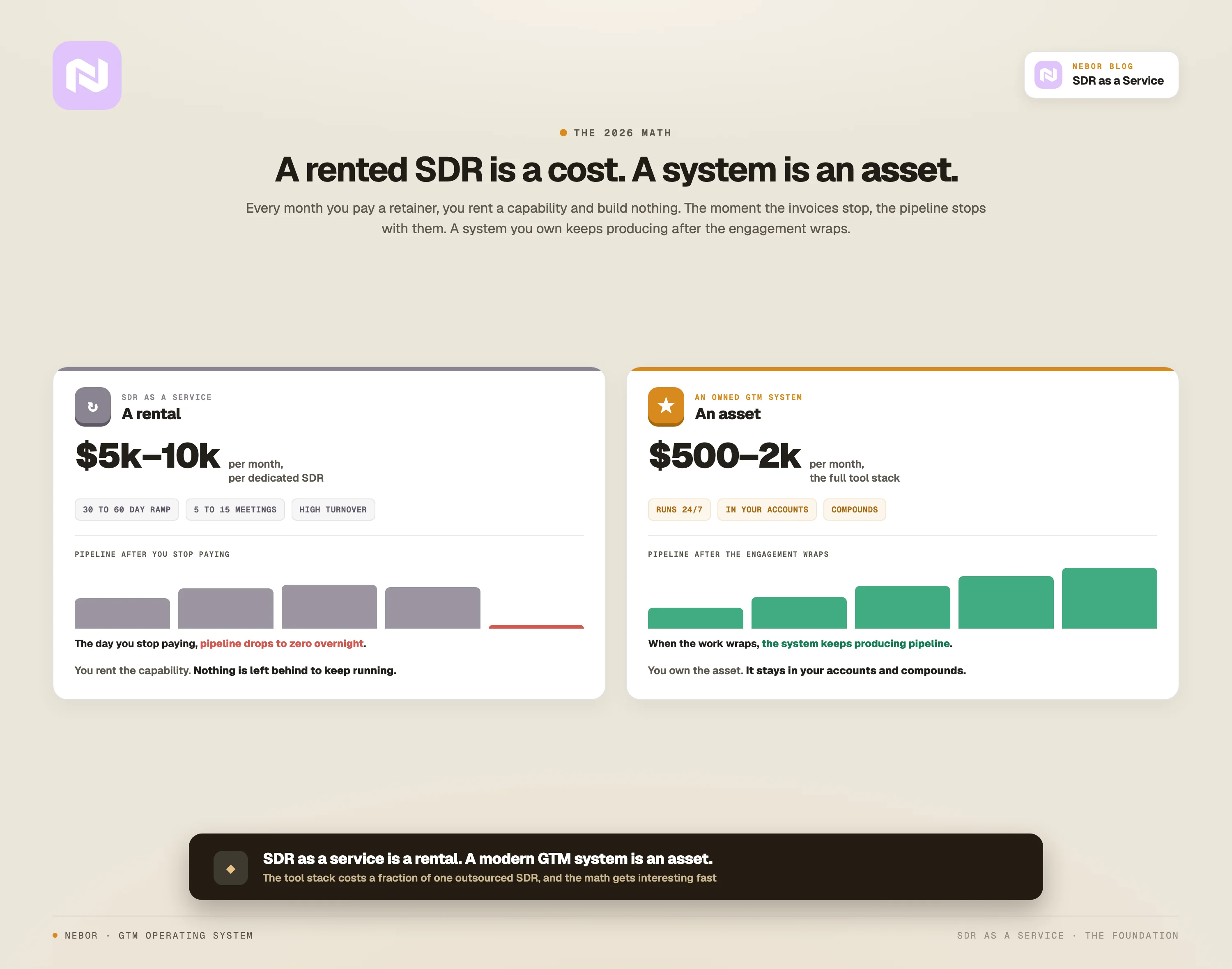
Let's talk money. SDR as a service retainers typically cost $5,000 to $10,000 per month for a dedicated sales development representative. Some providers price their appointment setting services at $300 to $800 per qualified meeting, and others use hybrid pricing that mixes a retainer with bonuses.
You still have to watch for hidden fees around data, tooling, and setup.
A full team of outsourced sales development representatives handling everything from list building to qualification costs $60,000 to $120,000 per year on the low end, and significantly more for premium providers.
The sales pitch leans on speed: onboarding is fast, engagements often come in 90-day cycles, and a good agency can produce pipeline activity within three to four weeks of signing, against the six to twelve months it takes to build an in-house SDR team.
That part is true. For companies with aggressive sales goals, it's the honest reason businesses seeking quick lead generation sign with outsourced SDRs.
What they won't tell you is that the ramp period where you pay full price for minimal results can still stretch to three months. After that, a competent service provider delivers maybe five to fifteen qualified meetings per month depending on your market and offer.
Some of those meetings are solid. Others are duds with zero buying intent who got talked into a call. That's the nature of cold outbound under SDR as a service, whatever the outreach strategy.
Why SDR as a service made sense five years ago but falls apart in 2026
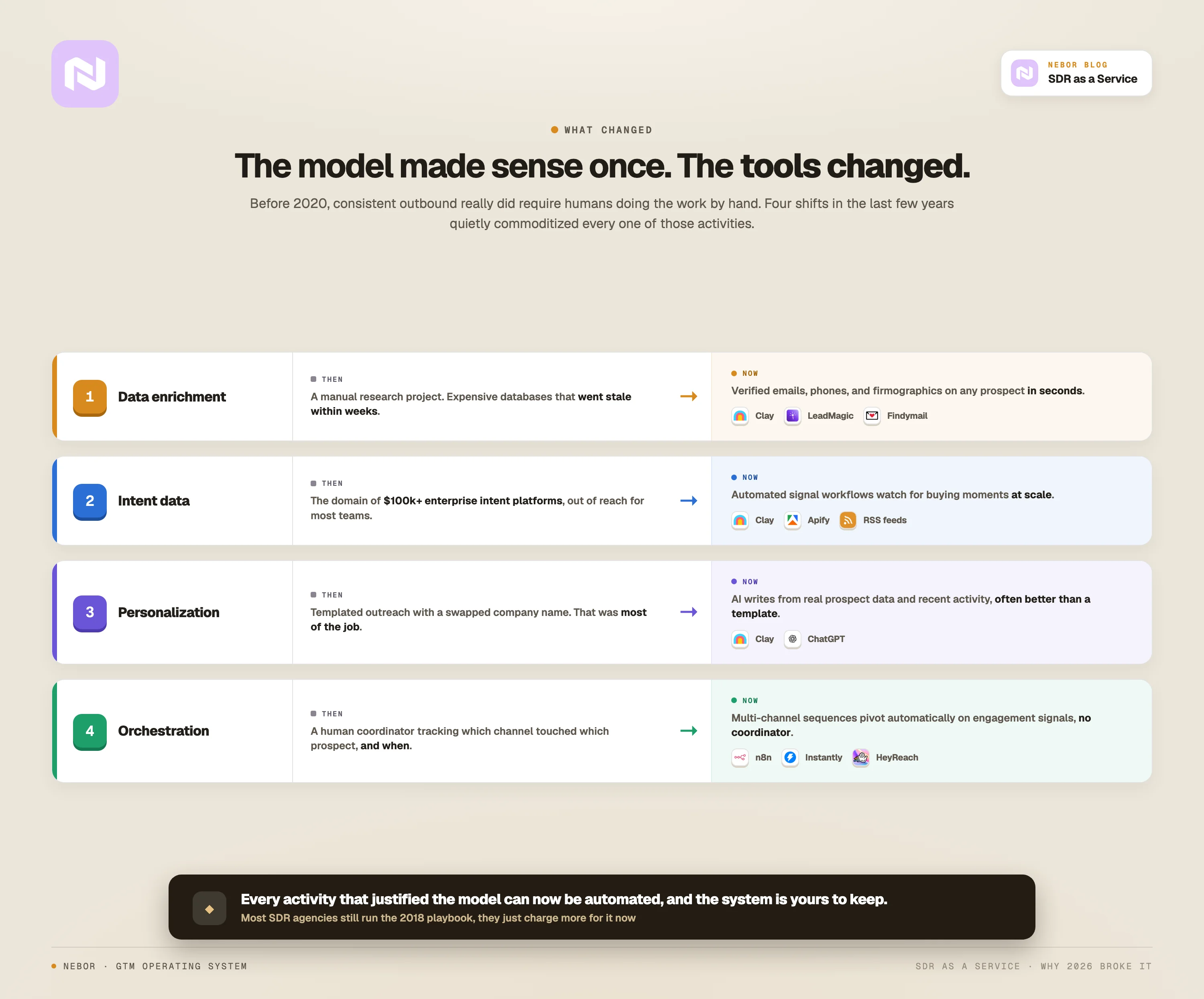
The model became popular for valid reasons. Before 2020, building automated outbound required serious technical skill, and data enrichment meant buying expensive databases that went stale within weeks. If you wanted consistent lead generation, hiring humans in house really was the best option.
The landscape has shifted since, and best-in-class outbound now depends on a technology stack of intent data platforms, AI-powered calling engines, multi-channel sequencing tools, and CRM automation.
Fact 1: Data enrichment is no longer a manual research project.
Tools like Clay, LeadMagic, FullEnrich, and Findymail find verified emails, phone numbers, and firmographic data on virtually any prospect in seconds. What used to be hours of time consuming research per prospect now happens in the background, and your reps save time on every account.
Fact 2: Intent data is no longer a premium add-on from expensive vendors.
You can set up automated intent signal workflows with Clay, RSS feeds, scrapers, and AI to monitor job changes, funding announcements, and technology adoptions at scale. That used to be the domain of $100,000+ enterprise platforms.
Fact 3: Outreach sequencing and personalization are fully automatable.
Modern AI writes personalized outreach from enriched prospect data, recent LinkedIn activity, and company news. The output is often better than what a rep working from a template produces, and it helps you generate leads at a volume no manual sales activity matches.
Fact 4: Multi-channel orchestration doesn't require a human coordinator anymore.
n8n, Clay, and Instantly orchestrate sequenced outreach across email and LinkedIn based on engagement signals, without anyone managing the sales process by hand.
So every sales development activity that justified SDR as a service five years ago can now be automated, and the system you build is yours to keep.
The SDR as a service problem nobody talks about: when you stop paying, everything stops
Every month you pay the retainer, you're renting a capability. You're not accumulating an asset, and your lead generation exists only as long as your invoices keep clearing.
The moment you stop paying, the sales pipeline dries up overnight. No workflows left behind, no enrichment processes, no intent systems, no sequences you can keep. The outsourced SDRs move to their next client, and your sales efforts reset to zero. That's how the outsourced model is structured by design.
Contrast that with what happens when we build an automated GTM system for a client at Nebor. The Clay tables, n8n flows, Instantly campaigns, and enrichment waterfalls all live in the client's accounts.
When the engagement wraps, the system keeps producing qualified leads. The client hands it to their next hire, modifies it, or expands it into new markets. It compounds instead of disappearing.
That's the structural difference, and it's one of the key factors to weigh when evaluating potential partners. SDR as a service is a rental. A modern GTM system is an asset.
What an in house SDR actually does all day and which parts automation handles better
Let's make this concrete by comparing the daily sales activity of a typical in house SDR with what an automated workflow does today.
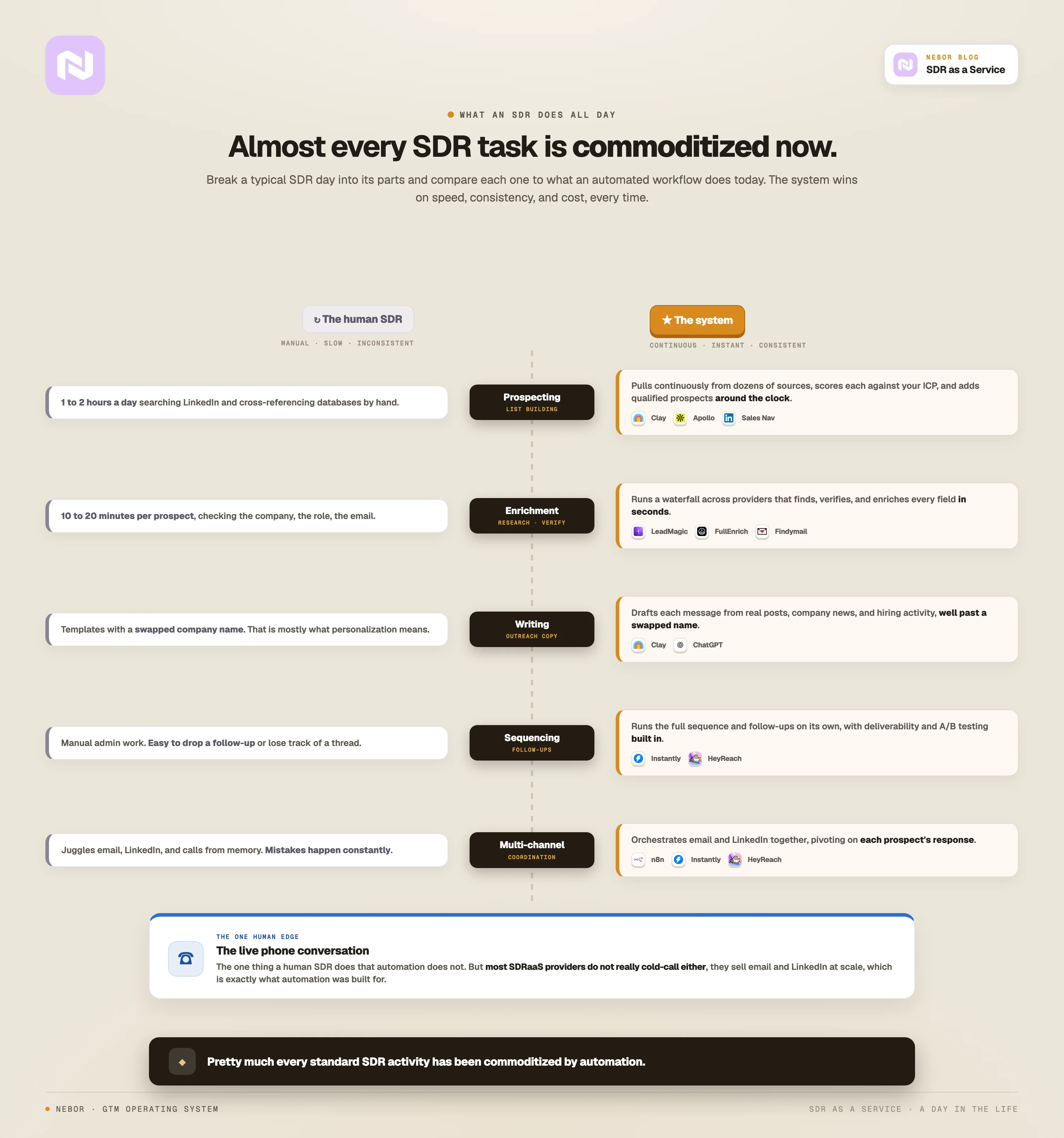
Prospecting and list building. An SDR spends one to two hours a day searching for potential leads and adding them to the CRM. A Clay workflow does it continuously, verifying every contact against your ICP and feeding qualified leads into the sales process automatically.
Data enrichment and verification. Researching a prospect manually takes 10 to 20 minutes. With Clay we chain LeadMagic, FullEnrich, and Findymail in a waterfall that enriches every data point in seconds, then validate with BounceBan, DeBounce, and ZeroBounce before any initial outreach happens.
Writing outreach. Most sales reps work from templates; swapping in the company name is what "personalization" means in most outsourced SDR work. AI integrated with Clay generates messages from real prospect data at scale, which is how you reach more potential customers without more headcount.
Managing sequences. This is administrative work, and platforms like Instantly handle it with proper deliverability, A/B testing, and response detection built in. Your team gets to save time on every send.
Multi-channel coordination. A rep juggling email, LinkedIn, and the phone forgets things; mistakes happen weekly. n8n and Clay pivot channels automatically on engagement signals and route positive replies straight to your account executives.
What's left that the system can't do? Very little. Prospecting, enrichment, writing, sequencing, and channel coordination have all been commoditized by automation in the last 24 months, and monitoring buying signals is something most agencies never did at all.
The one thing a human SDR does that automation doesn't is hold a live phone conversation. But that's not what most providers sell. Outsourced SDRs are sold as email and LinkedIn outreach at scale, and that is exactly what automation was built to do.
The types of workflows you need to build a GTM system that replaces SDRs entirely
When we build an automated GTM system, we're not just replacing outreach. We build connected workflows that together handle everything an outsourced SDR team does, faster and with a deep understanding of your data.
Workflow #1: outbound workflow that maps your entire market and turns it into more qualified leads
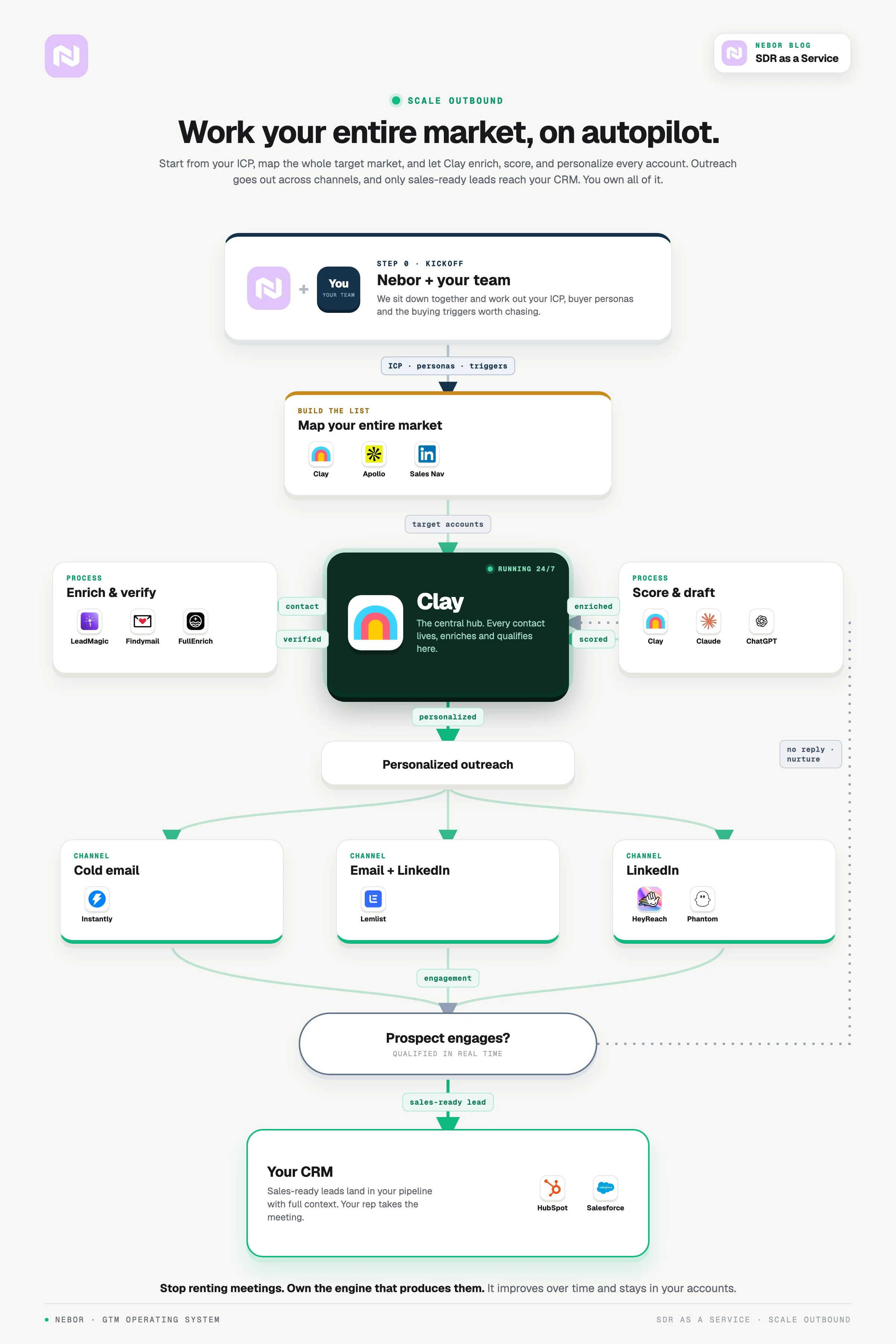
Cold outbound the manual way means a rep grinding through a list of 500 contacts: finding them, researching them, writing to each one. There are never enough hours, so whole segments of your market simply never hear from you.
Our version starts from your Ideal Customer Profile: a detailed description of the company that benefits most from your product, based on industry, company size, and demographic characteristics.
Defining that ICP is crucial for effective lead generation, because it points every send at the most promising prospects and lifts conversion rates.
From there, the system maps your entire target market, enriches and scores every account, generates personalized messages, and sends them through the channel each segment responds to. Instead of a rep working through 500 contacts, you process thousands of prospects per month.
Your sales team doesn't touch outbound sales activities at all. They show up when someone is qualified and ready to talk.
Workflow #2: intent data monitoring workflow that finds buyers before they start looking for you
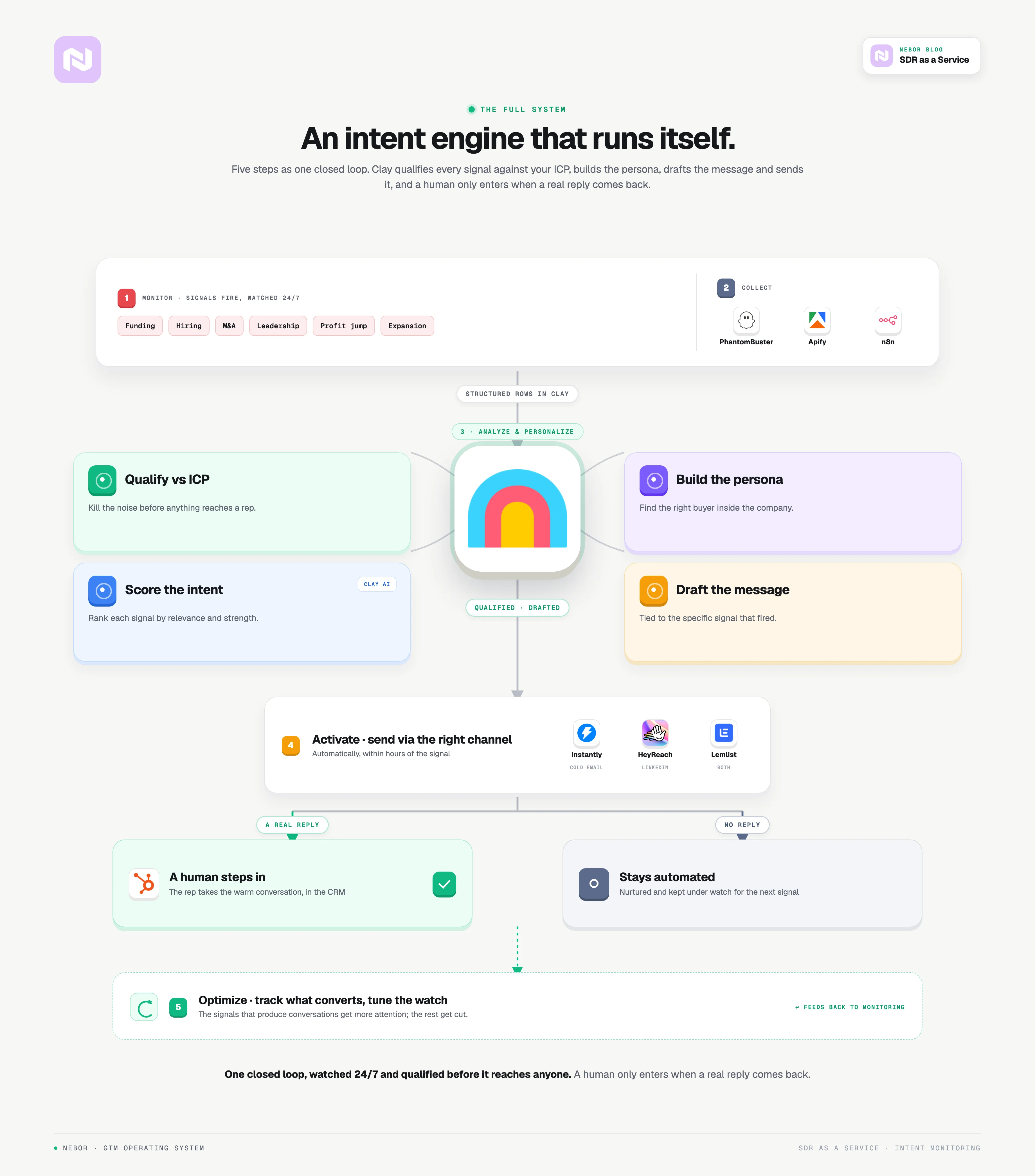
Think about how an agency prospects. They build a list at the start of the month and work through it row by row, whether or not anything has changed at those companies. The prospect who just raised a round, posted three job ads, and swapped their CRM gets the same email on the same day as everyone else.
By the time a static list catches up with the market, the buying window has opened and closed. So we build systems that watch the market in real time and turn signals into lead generation the moment buyers show up.
We combine RSS feeds, Apify, PhantomBuster, Trigify, and n8n to capture buying signals: job postings, funding rounds, technology adoption, executive moves, conference attendance.
When a signal lands, n8n pushes it into Clay, which enriches the contact and triggers outreach automatically. No SDR agency on the market offers this, because it requires specialized expertise and infrastructure staffing companies don't have. They rent people; we build sales development systems.
Workflow #3: website visitor identification workflow that turns anonymous traffic into sales conversations
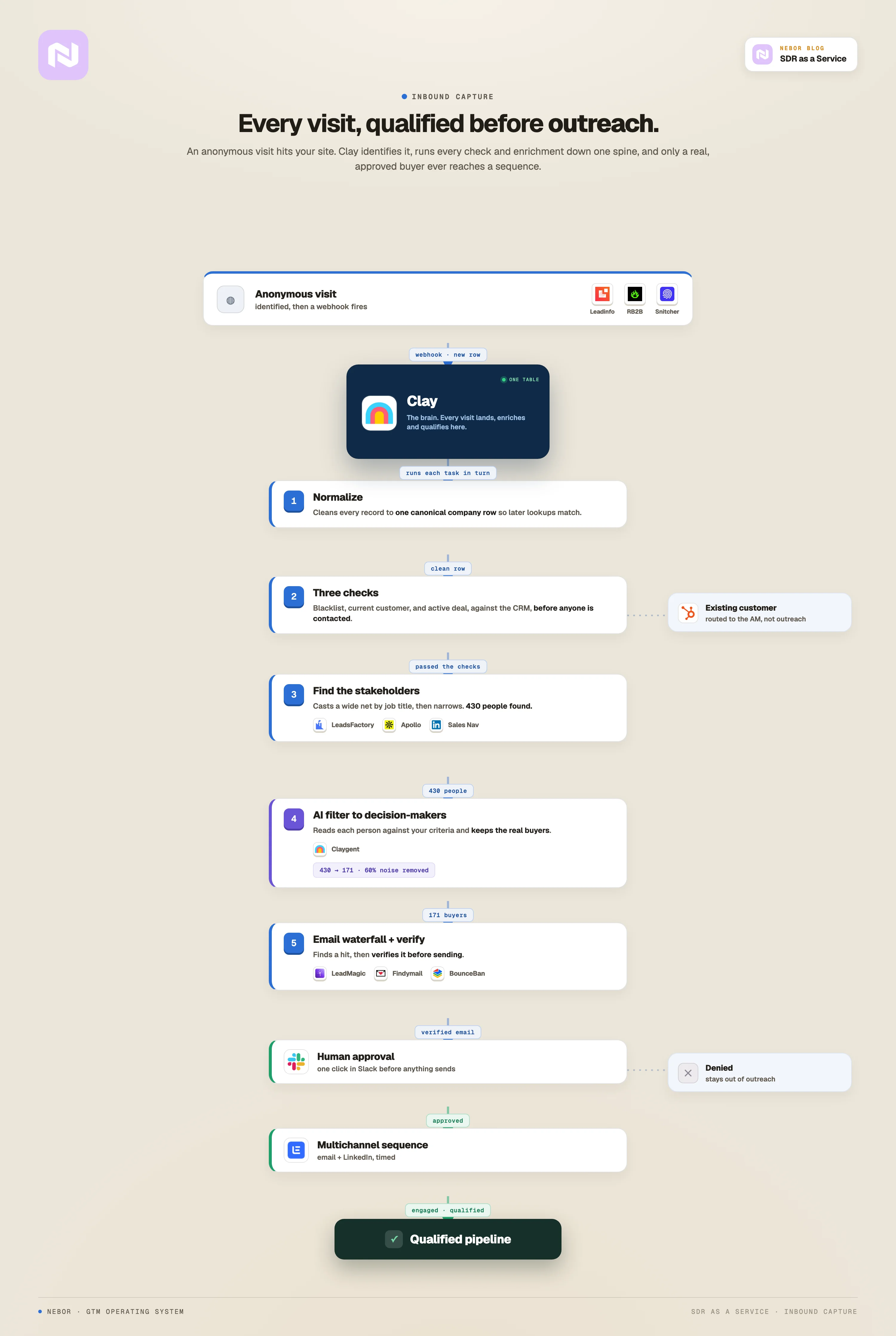
Your marketing and your ads do their job: they bring buyers to your website. Someone reads your pricing page, opens a case study, comes back two days later to check the product pages again. That's a person actively evaluating you.
Then they leave without filling out a form. And because they never identified themselves, your sales team has no idea any of it happened.
We use RB2B for US visitors and Leadinfo for the European market, combined with Leadsfactory, to identify those anonymous visitors, enrich them, and push them into Clay to generate leads from traffic you already paid for.
High-scoring visitors get outreach that references their behavior, so it lands as a warm conversation instead of a cold pitch. These warm leads convert well because the interest is demonstrated, and this workflow alone often produces more qualified pipeline than an entire rented team.
Workflow #4: inbound lead qualification workflow that makes sure no lead falls through the cracks
Most companies leak inbound pipeline without realizing it. A lead fills out your form on Tuesday morning. It lands in a shared inbox, someone means to get to it, and by Thursday it's three scrolls down.
When your rep finally calls, the prospect has already talked to the competitor who answered in fifteen minutes. Nothing was wrong with the lead. The process just moved slower than the buyer.
We build qualification that works in real time. Clay enriches every incoming lead instantly, a custom scoring model evaluates it against your criteria, and high quality leads get routed to the right rep with a full dossier: company background, decision-makers, recent signals, and conversation starters.
Sales qualified leads reach your closers while the interest is live.
Workflow #5: CRM enrichment workflow that keeps your data clean without anyone having to do it manually
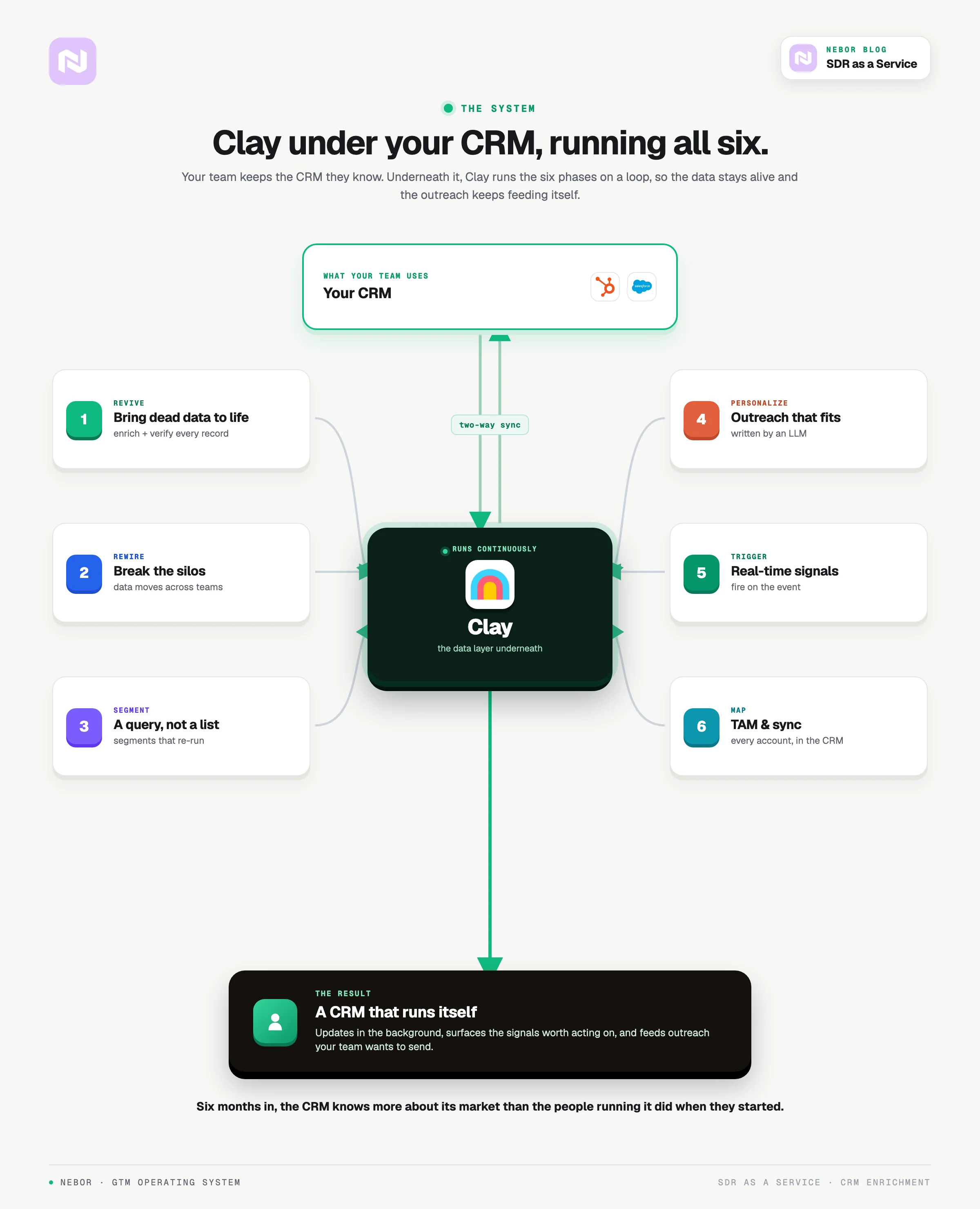
Most CRMs are graveyards of stale records. Contacts change jobs and nobody notices, duplicates pile up, and half the fields stay empty. Your reps learn they can't trust the data, so they stop updating it, which makes the data worse.
And quietly, everything built on top of that data (your reports, your scoring, your whole sales strategy) starts leaning the wrong way.
We build enrichment workflows that keep records current: new leads enriched on entry, existing records refreshed on schedule, duplicates merged, missing fields filled from verified sources.
The result is data your team trusts, which means your reports, scoring, and sales operations all start working correctly.
Examples of tools you need to build this lead generation system and what each one does in the stack
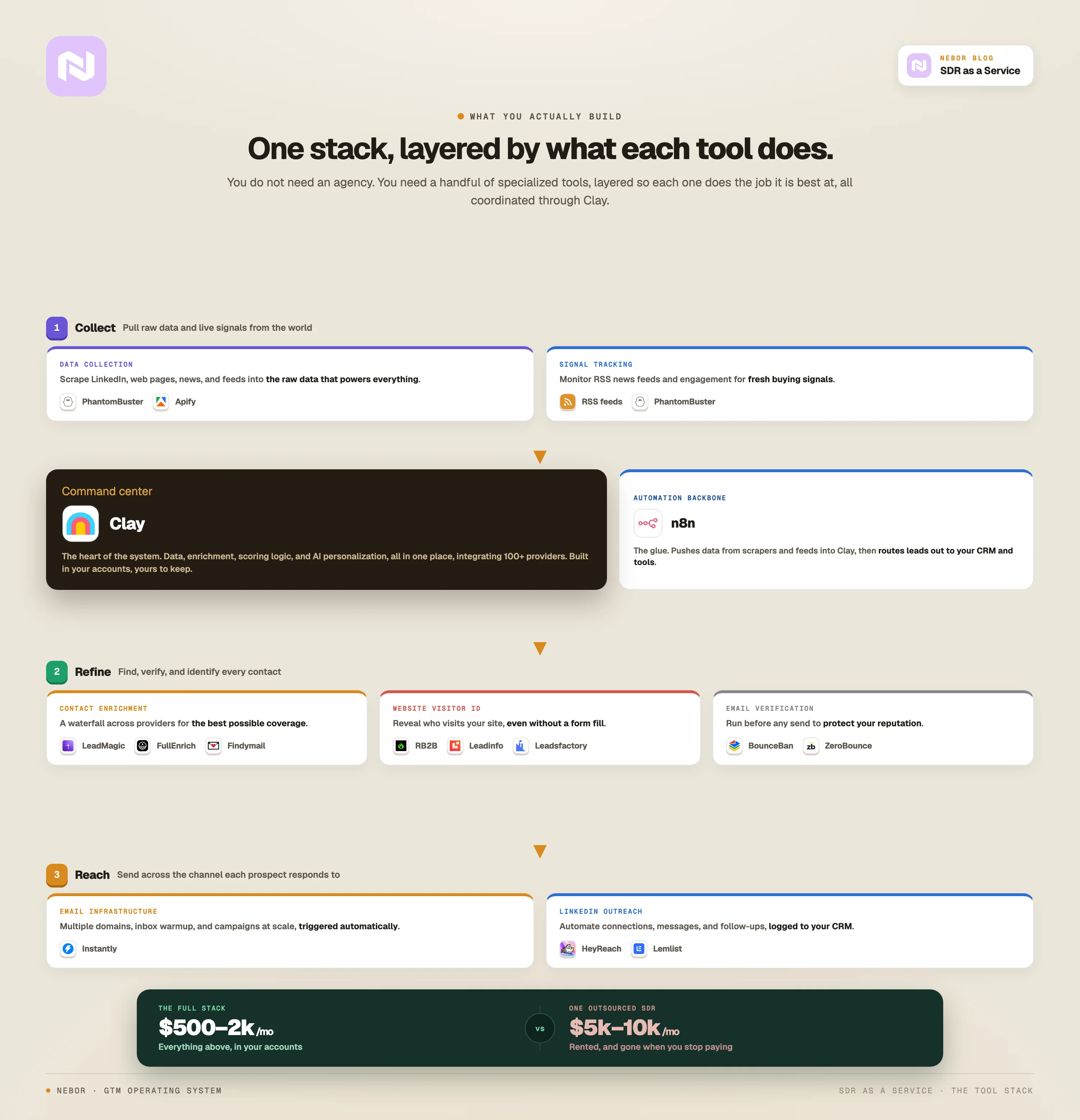
Here's what we use at Nebor for lead generation and how each piece fits.
Command center: Clay
Clay is the heart of the system: where your data lives, enrichment happens, scoring logic applies, and AI personalization happens. Think of it as a smart spreadsheet connected to 100+ data providers.
The automation backbone: n8n.io
n8n connects the external systems: it pushes data from feeds and scrapers into Clay, routes leads to your CRM, and wires your sequencing tools to your dashboards. It's the glue.
Email infrastructure and sending: Instantly
Instantly manages sending domains, warmup, and campaign execution at scale, and its API lets Clay and n8n drive campaigns automatically.
LinkedIn outreach tool: HeyReach or Lemlist
HeyReach or Lemlist automate connection requests and messages, and log the activity in your CRM.
Data collection tools: PhantomBuster and Apify
PhantomBuster and Apify handle scraping: LinkedIn data, web pages, news, feeds. They supply the raw data for everything downstream.
Social engagement or signal tracking tools: Trigify and PhantomBuster
Trigify tracks engagement with your content and your competitors' content on LinkedIn, handing you a list of prospects already leaning in.
Contact enrichment: LeadMagic, FullEnrich, Findymail, etc
We chain multiple providers in a waterfall because no single one has perfect coverage. Together they give you the best hit rate on emails, phone numbers, and firmographics.
Website visitor identification: RB2B, Leadinfo, and Leadsfactory
The first two put a name on anonymous visitors; LeadsFactory finds the decision makers and their contact details.
Email verification: BounceBan, DeBounce, and ZeroBounce
We verify before any send to protect your reputation.
The whole stack costs $500 to $2,000 per month depending on volume. Set against $5,000 to $10,000 for a single rented SDR from any service provider, it's a far more cost effective sales process, and the savings compound every month you keep it.
The human touch issue and the other objections we hear constantly
Sales leaders raise the same pain points every time we make this case against SDR as a service. Here are the big four.
"Won't automation feel robotic?" Bad automation does. But outreach that pulls from rich data, references real intent signals, and lands at the right moment often feels more personal than what a rep sends to potential customers from a template.
Most providers push templated sends with light personalization tokens; that's the robotic part.
"Don't I lose relationship building?" No, because relationships are built in conversations, and cold outbound isn't a conversation. The system gets you the meetings; your closers, who are humans with industry knowledge, build the relationships and focus on closing deals.
That division of labor beats splitting reps between low-quality outreach and rushed qualification.
"What if our market really needs phone calls?" Fair. Some markets still turn on the phone, and automation alone won't replace that. But most outsourced SDRs don't do real cold calling either; the bulk of their work is email and LinkedIn. If your market is phone-first, a calling team supported by automation upstream is the right answer.
"This sounds expensive to set up." The tools cost $500 to $2,000 per month, cheaper than one rented SDR. The build takes specialized expertise in lead generation systems, which is what we (or any sales agency doing this work) charge for.
Once built, it works continuously, cheaper than building an in house team, and cost-per-meeting drops to a fraction of what SDRaaS produces.
When SDR as a service still makes sense: phone-first sales, new markets, and early-stage speed
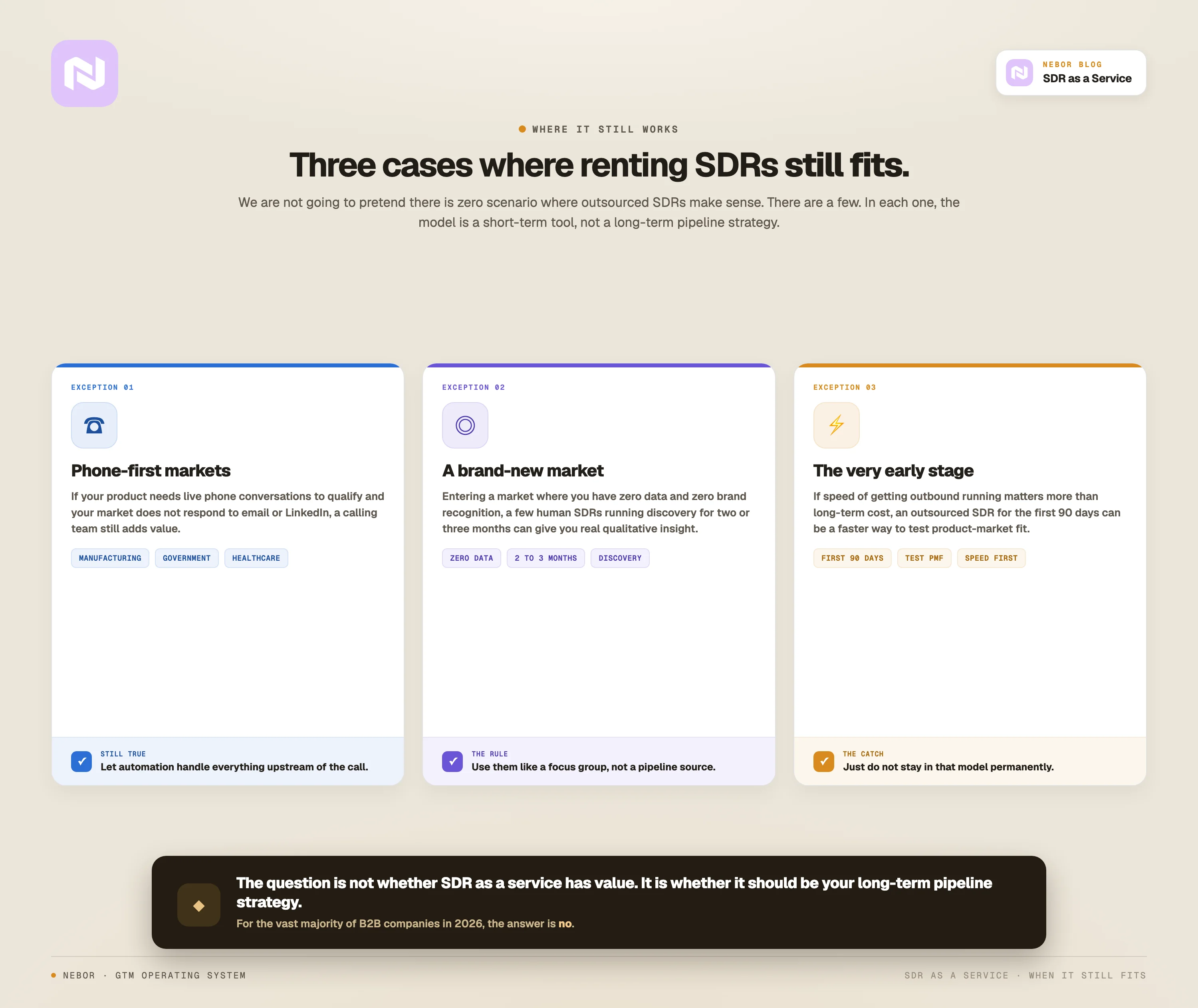
We're opinionated, but there are situations where outsourced SDRs still fit, and a service partner with a proven track record can add real value in each of them.
If your product needs live phone qualification and your market ignores email, an outsourced calling team with a dedicated team of callers still earns its fee. Certain manufacturing sectors, government, and healthcare still buy by phone; our workflows feed the context, but humans make the calls.
If you're entering a market where you have zero data and zero recognition, a few human sales development representatives doing discovery for two or three months give you qualitative insight before you build lead generation automation. Use them like a focus group.
If you're an early-stage startup and speed matters more than efficiency, a 90-day engagement is a fast, flexible solution for testing product-market fit. SaaS companies, IT companies, and startups doing new client acquisition on a deadline are the classic fit here.
It's also why the industry benchmark of roughly $3 million in pipeline per SDR per year keeps getting quoted at you.
Some teams also land on a hybrid: an internal team of SDRs on strategic accounts while SDR as a service handles high-volume lead generation. It works as a bridge, but the same ownership problem applies to the outsourced half.
In all of these cases, SDR services have value as a short-term tool for your business needs. The question is whether renting should be your long-term pipeline strategy, and for most B2B companies in 2026 the answer is no.
The bottom line: you don't need more outsourced SDRs, you need a system that works without them.
Every SDRaaS article tells the same story: building an in house team is expensive, training is slow, turnover is high, and renting outsourced SDRs from external partners who offer solutions with seasoned sales professionals fixes it all. For a long time that was true.
But those articles were written for a world where outbound meant a human manually researching and emailing their way through a list. That world is gone.
In 2026, you can build a lead generation system on Clay, n8n, and Instantly that maps your target audience, enriches every contact, monitors buying signals around the clock, sends personalized outreach across channels, qualifies responses, and routes meetings to your closers.
It shortens your sales cycle, compounds your sales efforts instead of resetting them, and never splits its attention across five other clients.
Businesses grow by putting their internal team on their core competencies. For your reps that means conversations that close more deals, while a system handles the work humans used to do.
That's why we built Nebor the way we did. We design and implement these systems for B2B companies, and when we wrap, the whole infrastructure stays in your accounts with your qualified pipeline intact.
If you're tired of paying retainers that vanish the moment you stop, book a 15-minute call and we'll show you what a modern, owned GTM system looks like for your business.


Related Articles


By clicking Sign Up you're confirming that you agree with our Terms and Conditions.