
Why You No Longer Need To Outsource Lead Generation As a B2B Company

by

In this post:
If you're reading this, you're probably in one of two camps. Either you've outsourced lead generation before and the experience left a bad taste in your mouth.
Or you've never outsourced it, your sales team is drowning in prospecting work, and you're wondering if hiring an agency would fix that.
Both are fair positions. And a year or two ago, outsourcing your lead generation might have been the right move. But the world has changed.
The technology available to B2B sales teams in 2026 is so far ahead of what existed even 18 months ago that the traditional lead generation agency model no longer makes sense for most businesses.
We're Andrew and Yannick, founders of Nebor. We were salespeople and ran sales teams before we were anything else, and we've sat on both sides of the table.
We've hired agencies, worked at agencies, and we are now an agency ourselves. We know exactly what happens behind the curtain when you outsource your lead generation. That experience is precisely why we built something different.
This post is going to walk you through what outsourcing lead generation actually means, what you're really paying for when you hire an agency, why that model is broken in 2026, and what you should do instead.
So, let's get started.
What outsourcing lead generation actually means and what you're signing up for when you hire an agency
Before we make the case against outsourcing, we need to make sure we're all on the same page about what it actually involves. Because outsourcing lead generation is one of those phrases that sounds simple but covers a lot of ground.
When you outsource lead generation, you're paying an external agency to handle some or all of the following activities for you.
Targeting your market and building prospect lists.
Researching companies and contacts that fit your ideal customer profile.
Enriching that data with emails, phone numbers, and other contact details.
Writing outreach messages for cold email or LinkedIn.
Setting up email infrastructure and managing deliverability.
Sending the actual outreach campaigns on your behalf.
Qualifying responses and booking meetings for your sales team.
Some agencies also handle cold calling, content creation, paid advertising, or appointment setting. The scope varies widely.
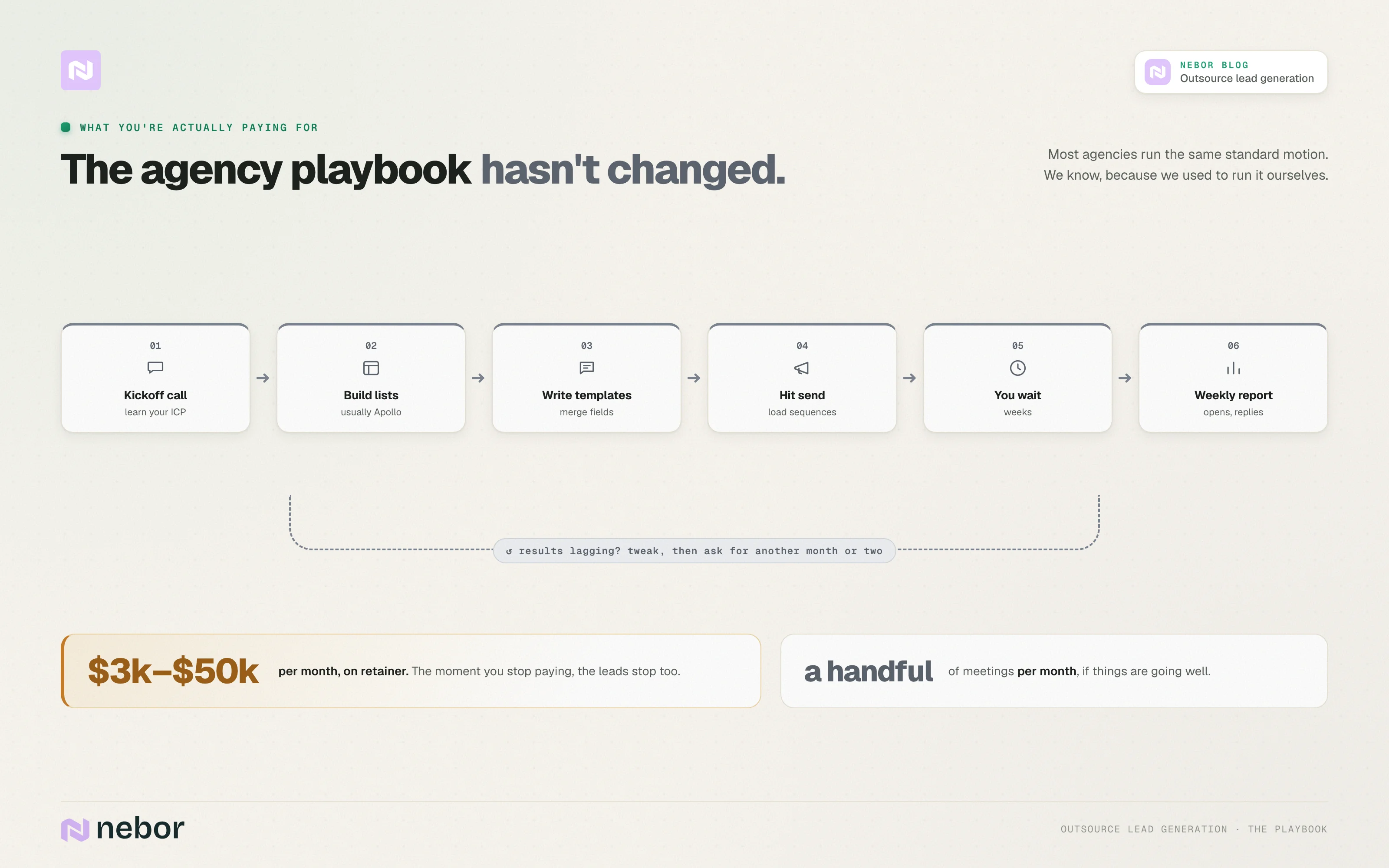
The typical arrangement looks like this. You pay a monthly retainer somewhere between $3,000 and $50,000 depending on the agency, the channels they cover, and the volume of leads or appointments they promise.
Some agencies work on a pay-per-lead or pay-per-appointment basis, where you typically pay anywhere from $150 to $600 per qualified lead or $200 to $500 per booked meeting.
In return, the agency handles the tactical execution of your lead generation while your internal team focuses on closing the meetings that come through.
What actually happens when you outsource your lead generation to a traditional agency
Let's discuss the day-to-day reality of working with a lead generation agency. We've been in this industry long enough to know the patterns, and we used to do it ourselves.
Most agencies operate on a pretty standard playbook. They onboard you with a kickoff call where they learn about your product, your market, and your ideal customer.
They spend a week or two building prospect lists, usually from one or two data sources like Apollo. They write a set of email templates with some basic personalization attributes like first name, company name, maybe a reference to the industry.
They set up sending infrastructure, load the sequences, and hit go.
Then you wait.
Reports come in weekly or monthly showing open rates, reply rates, and meetings booked. If things are going well, you get a handful of meetings per month. If things aren't going well, the agency tweaks the messaging, adjusts the targeting, and asks for another month or two to optimize.
The deeper issue is that personalization is surface-level at best, because the agency needs volume to show some results.
Plus in most cases, your brand is being represented by people who don't understand your product the way your own team does. Their incentive is to book meetings, not to build relationships that close.
We saw this firsthand. It's one of the reasons we started Nebor.ai.
Why the traditional lead generation agency model is broken in 2026
This is where we get opinionated. And we don't apologize for it.
The traditional lead generation agency model was built for a world where the tools were expensive, the learning curves were steep, and businesses genuinely needed external specialists to execute outbound sales.
Five years ago, setting up a proper outbound system required deep technical knowledge, significant upfront investment in tools, and months of trial and error to get right.
That world no longer exists.
The tools available today are more powerful, AI-powered, more accessible, and more affordable than anything that existed even 18 months ago. And that changes the math on every single argument for outsourcing.
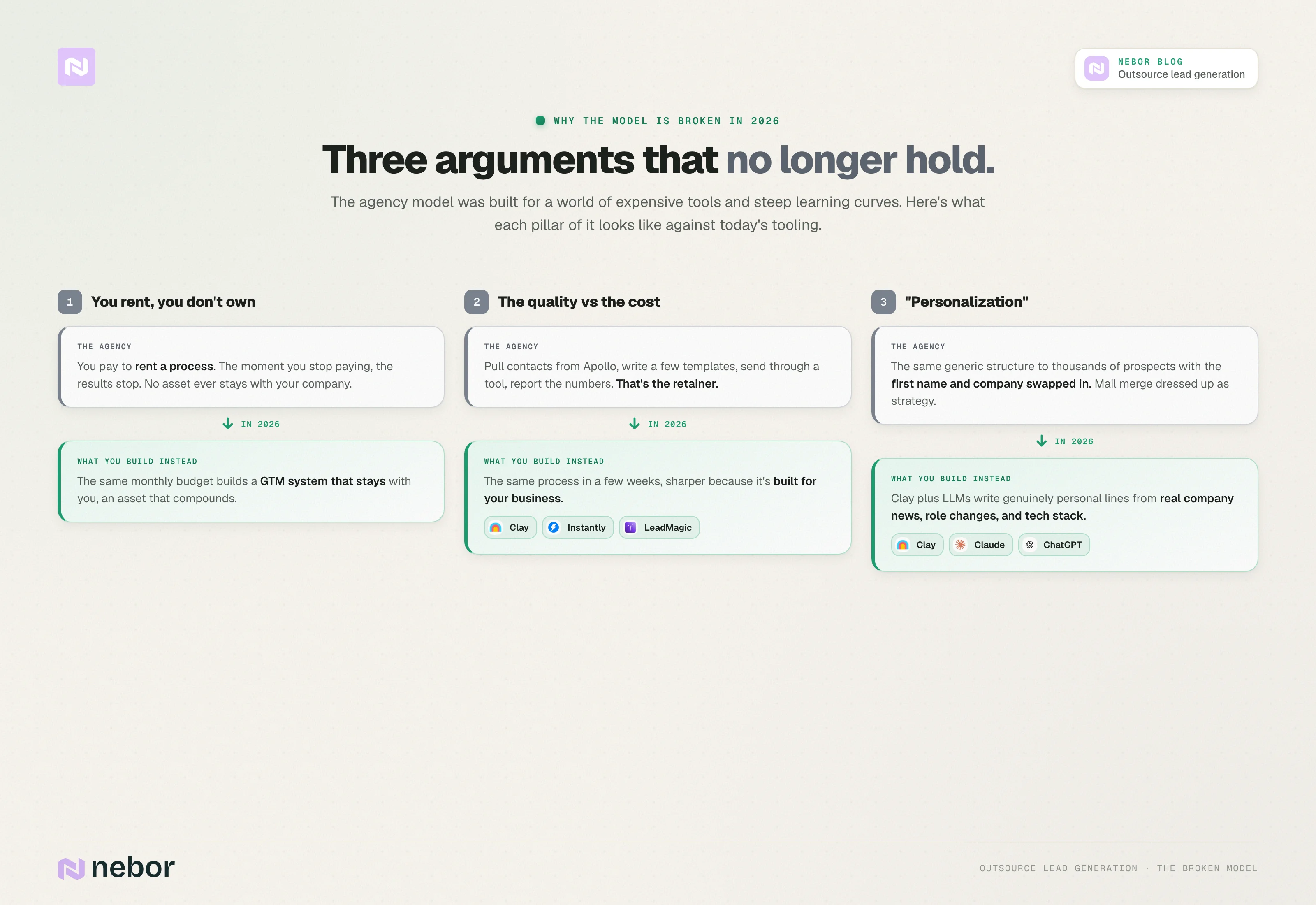
You're renting results instead of building an asset you own
When you pay a lead generation agency, you're renting a process. The moment you stop paying, you stop getting results. There's no asset that stays with your company.
Compare that to building your own go-to-market system. With the same monthly budget, you can build a GTM system using modern tools that you operate yourself.
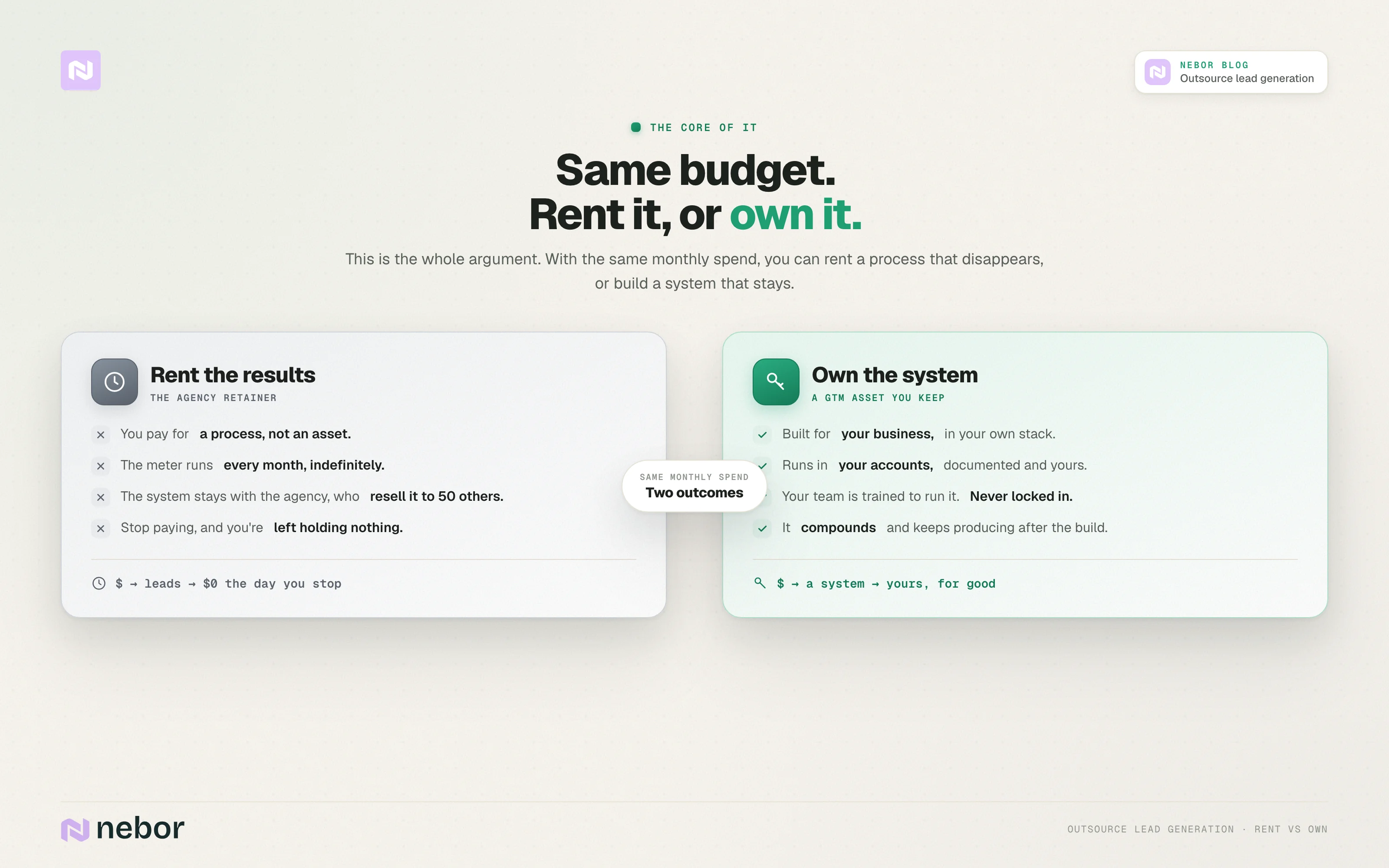
The data you collect, the workflows you build, the messaging you develop, and the relationships you create all stay with your business. If you switch agencies or bring it in-house, your sales engine keeps going.
That's a fundamentally different proposition. It's the only approach that makes financial sense for any company thinking beyond the next quarter.
The quality of work most agencies deliver doesn't justify the cost anymore
Let's break down what a typical lead generation agency actually does for their retainer. They pull contacts from Apollo. They write a few email templates. They send sequences through a tool like Lemlist, Instantly, Outreach, or Salesloft. They report the numbers.
You can set up that exact same process today in a few weeks with Clay, Instantly, and a data enrichment tool like FullEnrich or LeadMagic. The tools do the heavy lifting.
And because you're building it for your own business, the targeting is sharper, the messaging is more relevant, and the feedback loops are tighter.
The funny part is that if those agencies are being fully honest, they'll tell you this is the same system they (or something like it) build behind the scenes. But instead of making it for your business, they keep it and implement it for 50 other clients.
You might not see much wrong with that. But the thing is, when the system lives inside your own stack, there is so much more you can use it to achieve with those same tools. Sales opportunities, intent monitoring, RevOps cleanup, the lives of your revenue team made easier. It becomes an injustice to pay premium prices to an agency that only shows you the outbound lead generation side of it.
The agencies that charge premium retainers are selling you execution that modern tools have largely commoditized.
And no, we are not crazy. The strategic thinking that used to justify agency fees still matters, but you can get that through a short consulting engagement or by working with a partner who builds you a system and teaches your team to operate it.
Their idea of personalization is still mostly templates with merge fields
If they're not using sales systems and tools like Clay, then their personalization can only be templates with merge fields.
We talk to sales leaders all the time who hired an agency expecting tailored, human-feeling outreach. What they got was the same generic structure sent to thousands of prospects with the first name and company swapped in. That's not personalization. That's mail merge dressed up as strategy.
The new generation of tools, especially Clay paired with LLM integrations, can generate genuinely personalized messages at scale. Each message references the prospect's actual company news, recent role changes, technology stack, or industry-specific pain points. We use this every day with our clients, and it produces 3 to 5 times the reply rates of generic templates.
This is the standard you should be measuring agencies against. If they can't deliver this level of personalization at scale, they're behind the curve.
What you should build instead of outsourcing: a GTM system that makes lead generation agencies irrelevant
So if outsourcing doesn't make sense anymore, what does?
The answer is building your own go-to-market system using the same tools and automation that the best agencies use internally, but configured for your business, integrated with your existing stack, and operated by your team. Here is the shape it might take:
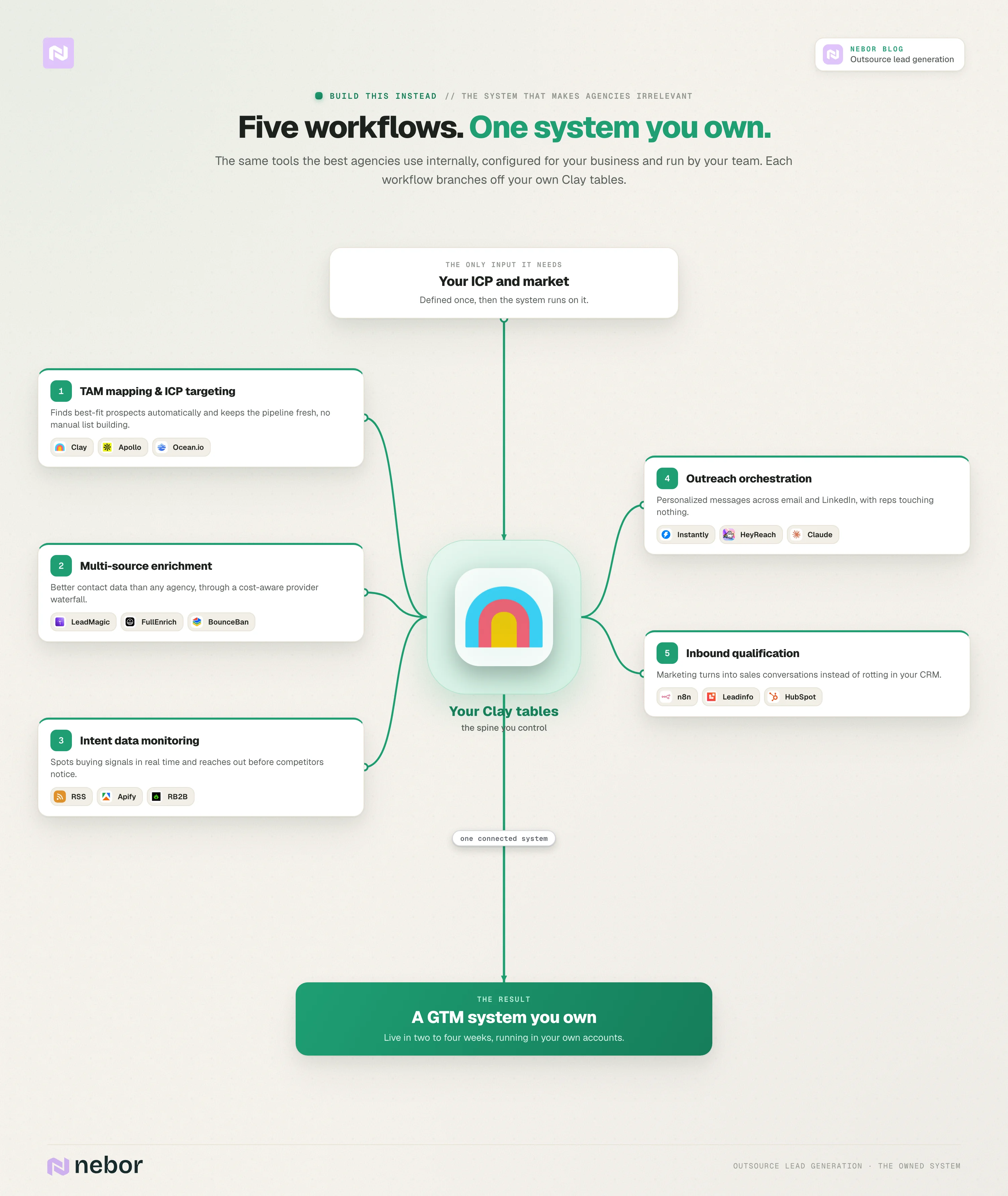
This sounds intimidating, but it's not as complex as it used to be. The technology has caught up. And with the right approach, you can have a fully automated lead generation system live in two to four weeks that outperforms what most agencies deliver.
Here's what that system looks like and what each piece does for your sales team.
A TAM mapping and ICP targeting workflow that finds your best-fit prospects automatically and keeps your pipeline fresh without manual list building
Most agencies (and most internal sales teams, for that matter) work in batches. They build a list, launch a campaign, report results, then start over. It's a hamster wheel that requires constant manual effort.
A modern GTM system works differently. You define your total addressable market once, set up automated workflows to scrape and enrich prospects from multiple data sources, and let the system keep your pipeline fresh continuously.
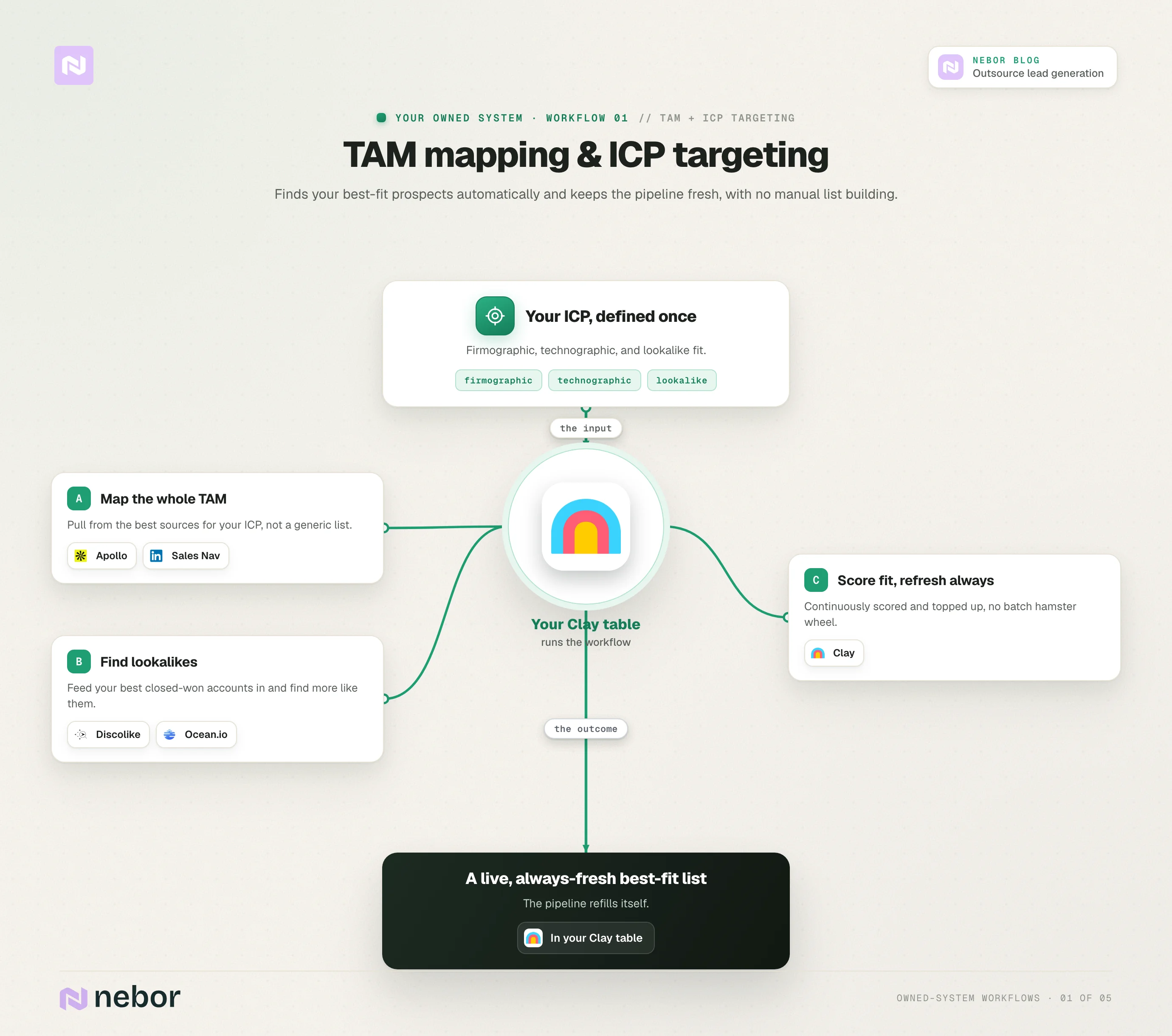
This single workflow replaces what most agencies charge thousands per month for. List building, data enrichment, and lead scoring. And unlike the agency model, the data and the logic stay with you.
A multi-source data enrichment workflow that gives your reps better contact data than any agency can provide
One of the main reasons companies outsource is because finding accurate contact information is hard. Agencies have access to expensive databases and can provide verified emails and phone numbers. That used to be a real advantage.
It's not anymore. Tools like LeadMagic, Hunter.io, FullEnrich, and Findymail use waterfall enrichment logic, meaning they search multiple data providers sequentially until they find a valid match.
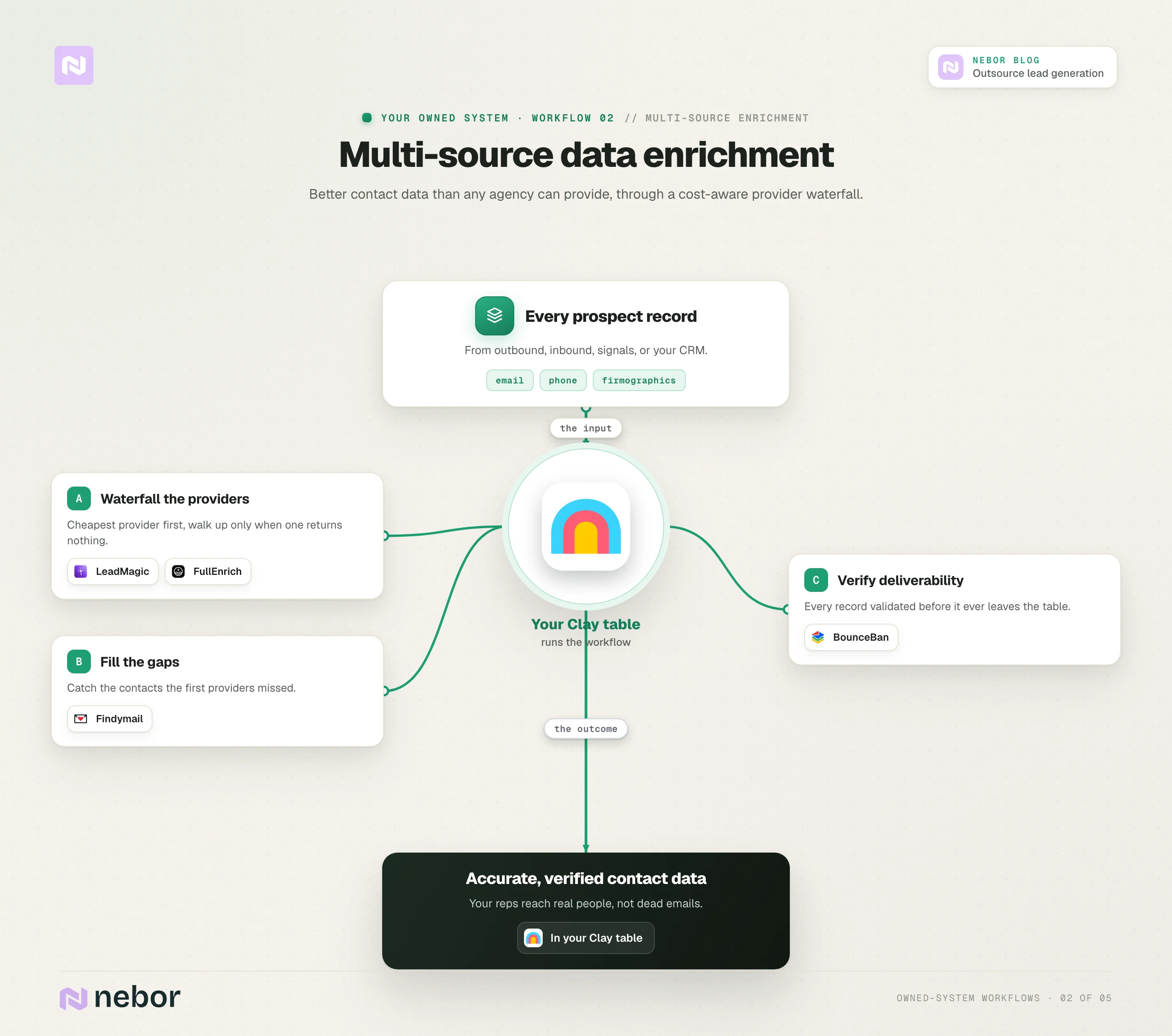
If properly configured, these tools achieve 80%+ email match rates, which is better than what most agencies deliver using a single data source.
You set this up once inside Clay. Every new prospect that enters your workflow gets enriched automatically, with no human intervention.
The cost is a fraction of what an agency would charge, and the quality is consistently higher because you can chain providers and test them against each other.
An intent data monitoring workflow that spots buying signals in real time and reaches out before your competitors even know there's an opportunity
This is where things get really interesting and where the gap between what agencies offer and what you can build with modern tools becomes massive.
Most traditional lead generation agencies work from static lists. They identify companies that match your ICP and reach out to them regardless of whether those companies actually need your solution right now.
You've probably seen some Twitter or LinkedIn lead generation guru say this is a numbers game. Send enough emails and some percentage will stick. Not only is it a poor marketing philosophy, people can now detect mass email.
We believe you should lean toward a modern GTM system that works on signals. It monitors the market in real time for events that indicate a company is moving toward needing what you sell. When those signals show up, it acts immediately.
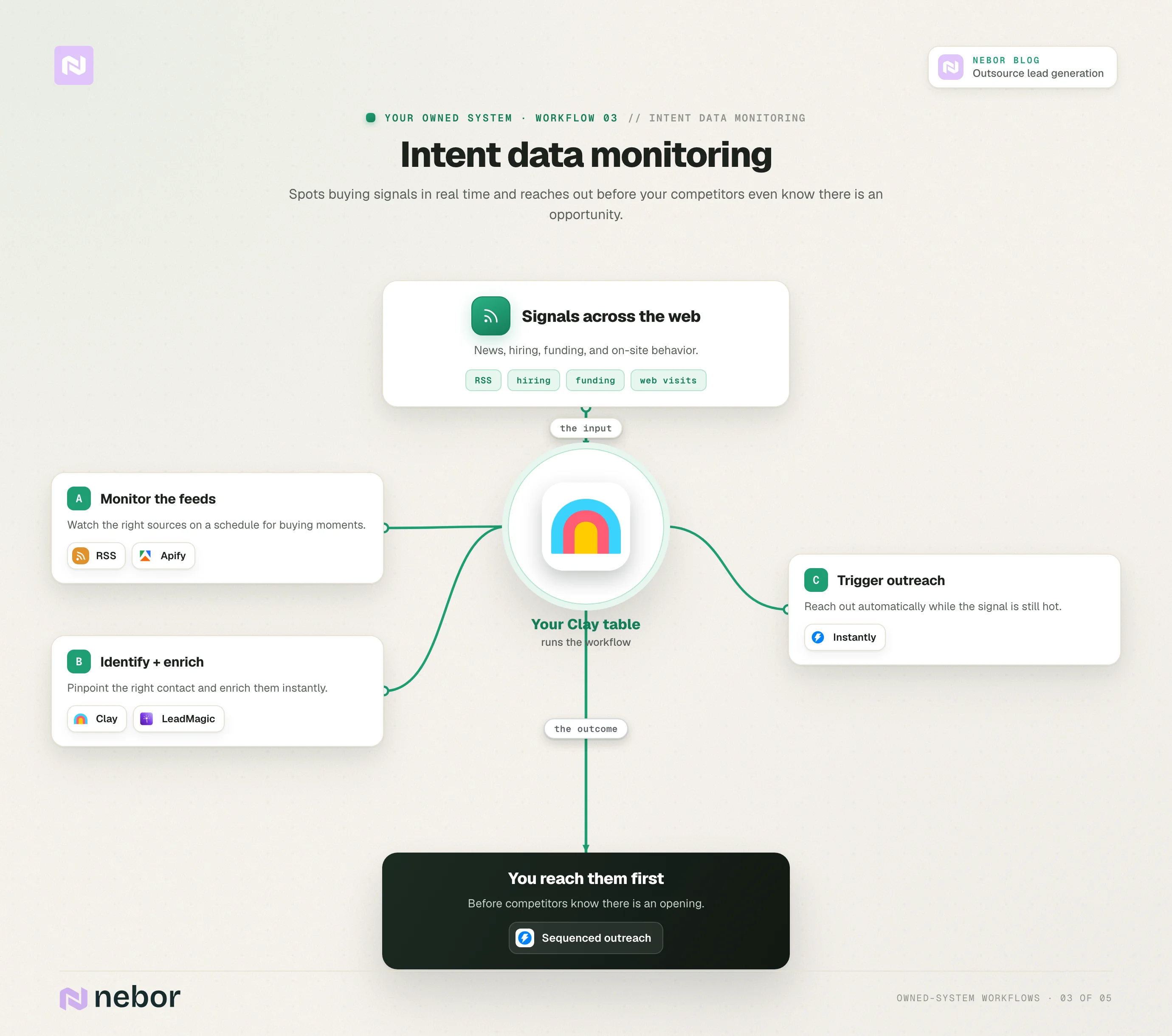
Here's what that looks like in practice. We use a combination of RSS feeds, Apify, PhantomBuster, and Clay to track buying signals across job postings, funding announcements, leadership changes, technology adoptions, and industry-specific events.
When a signal hits, our workflow automatically identifies the relevant decision-makers, enriches their data, and reaches out with personalized pitches in real time.
For example, for a client selling cybersecurity solutions, we monitor funding announcements for IT companies raising capital. When a company gets funding, it means they're about to expand, which means they need to scale their security infrastructure.
Our system catches that signal and initiates outreach automatically, often before competitors even know the opportunity exists.
For a client offering AI furnishing solutions, we use Apify to monitor real estate publications for new property acquisitions. When a real estate developer buys new properties, they're going to need furnishing solutions.
Our system picks that up and reaches out to the right contacts with relevant messaging.
No traditional lead generation agency can match this. They don't have the technical infrastructure or the sales experience to know to monitor signals in real time.
They work in weekly or monthly cycles. By the time they've built a list, the buying window has often already closed.
An automated outreach orchestration system that sends personalized messages across email and LinkedIn without your sales reps touching anything
Once your system identifies and enriches prospects, the next step is reaching out. And this is where most sales teams either burn time doing it manually or outsource it to an agency that uses templates.
With the right setup, you automate the entire outreach process across multiple channels. Cold emails go out through Instantly with warmed-up inboxes and proper deliverability infrastructure.
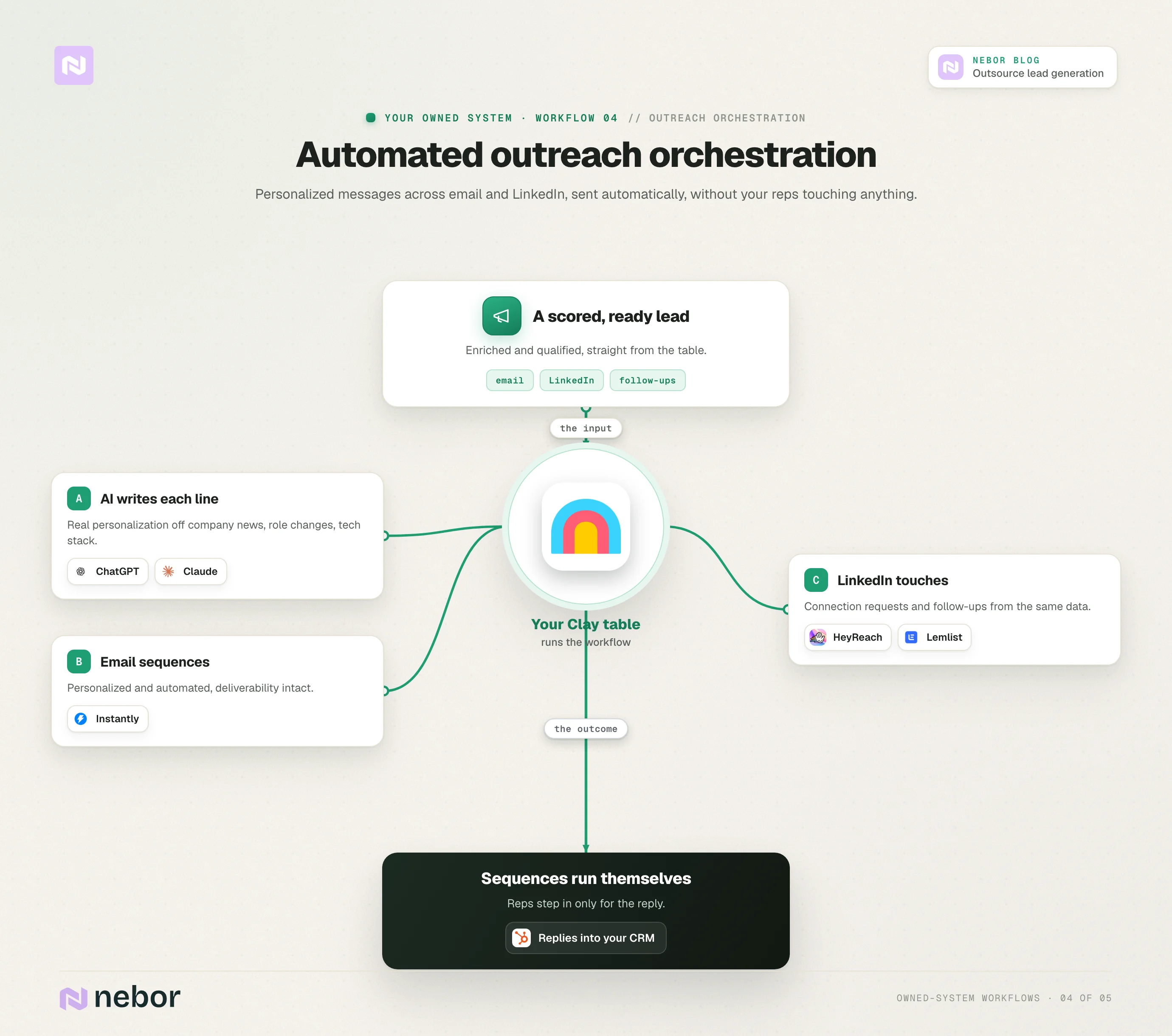
LinkedIn touchpoints get triggered through PhantomBuster or Lemlist workflows. Every message is generated based on actual prospect data using AI integrations inside Clay.
We connect everything through n8n, which acts as the glue between tools that don't natively talk to each other.
The result is a coordinated, multi-channel outreach system that works on autopilot. Your sales reps don't touch any of it until a qualified prospect responds and a meeting is on the calendar.
An inbound funnel lead qualification and handoff workflow so your marketing efforts actually turn into sales conversations instead of rotting in your CRM
Most companies have a leaky inbound funnel. Marketing generates leads through content, ads, and SEO, but those leads go stale in the CRM with no follow-up while the sales team focuses on outbound.
Or worse, the inbound leads get assigned to a junior rep who treats them like cold contacts instead of warm prospects.
A modern GTM system fixes this by automating inbound lead qualification and handoff. When a lead fills out a form, downloads a resource, or visits a high-intent page on your website, they get automatically enriched with the same depth as outbound prospects.
We set up workflows through tools like RB2B, Leadinfo, Apify, and Snitcher to watch key pages from your site and record key engagements that then get pushed into Clay. They record the engagement and de-anonymize the visitor.
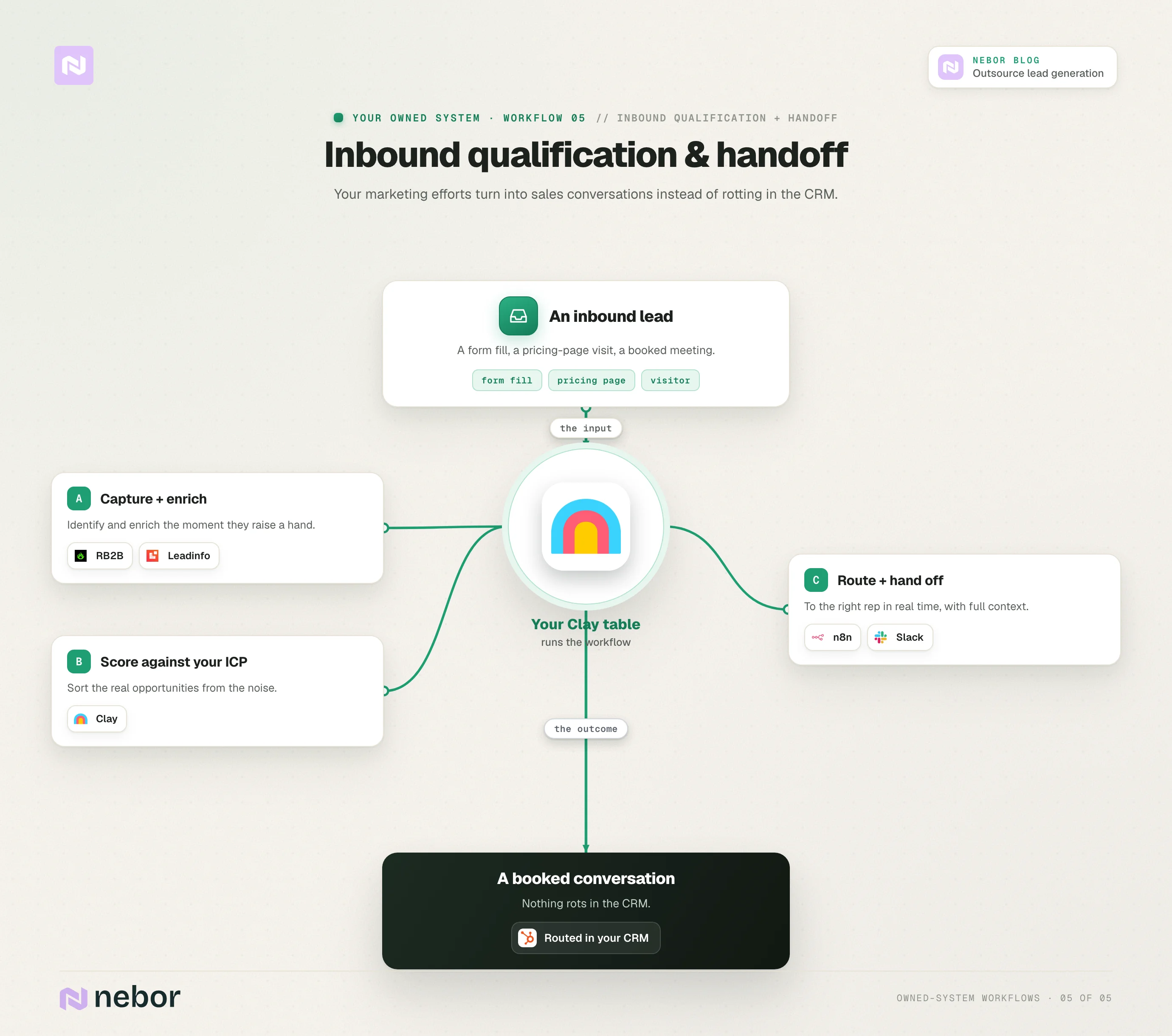
Clay applies a custom scoring model based on firmographic data, behavioral signals, and role-based attributes. High-intent leads get routed to your reps through Slack or your CRM with all the context they need. Everyone else goes into automated nurturing sequences.
This is a function that no traditional lead generation agency even offers. But it's critical to making sure your entire funnel works together instead of operating in silos.
The tools you need to build a GTM system that replaces what lead generation agencies offer on retainer
If you're wondering what tools you'd need to build all of this, here's a straightforward rundown. You don't need all of them on day one, and the specific combination depends on your business, your ICP, and your existing stack.
Clay is the central hub. It pulls in data from multiple sources, handles enrichment, scores leads, and pushes them to the right destination. It's the closest thing modern outbound has to a universal control plane.
For data enrichment, you combine LeadMagic, FullEnrich, and Findymail in a waterfall sequence to maximize email and phone match rates.
For intent signals, you use Apify and PhantomBuster to scrape job postings, news sites, social engagement, and industry publications.
For outreach, Instantly handles email at scale with proper warmup and deliverability protection. Lemlist or PhantomBuster handles LinkedIn touchpoints.
For website visitor identification, RB2B, Snitcher, or Leadinfo de-anonymize traffic and surface companies showing high intent.
For orchestration, n8n connects everything together and lets you build custom logic that triggers actions across the whole stack.
Claude or ChatGPT integrations inside Clay generate personalized outreach messages based on enriched prospect data.
The total cost of this stack is a fraction of what you'd pay in agency retainers over 12 months. And more importantly, the system stays inside your accounts. If you decide to change providers, bring on a different partner, or manage everything internally, the workflows keep going.
But what if you don't have the time or expertise to build all of this yourself?
This is a fair question. And it's the reason lead generation agencies exist in the first place. Not every company has the internal expertise to architect these workflows, integrate the tools, and get everything working smoothly.
Here's where the model matters. The old model says, pay us monthly and we'll do it for you, forever. We say, we'll build it for you, hand you the keys, and you own it.
We design and build complete sales automation systems using Clay at the center, integrated with n8n, Instantly, PhantomBuster, Apify, and whatever other tools make sense for your specific business.
We strategize and set up the TAM workflows, the enrichment logic, the intent monitoring, the outreach orchestration, the inbound qualification, and the CRM integrations. Everything is customized to what you sell and who you sell to.
And then you own it. We document everything. We train your team if you want. You're never locked in, never dependent, never left holding nothing when the engagement ends.
If you want us to operate the system for you on an ongoing basis, we do that too. But even then, the system is yours and it'll cost far less than what you'd pay traditional lead generation agencies.
The bottom line: outsourcing lead generation the old way is a rental you'll never stop paying. Build a system you own instead.
Every article you'll read about outsourcing lead generation will give you a balanced "it depends" answer. They'll list the pros and cons, acknowledge both sides, and gently push you toward hiring an agency because, surprise, the article was written by an agency.
We're an agency too, and we're telling you the opposite. Don't rent your lead generation, build it.
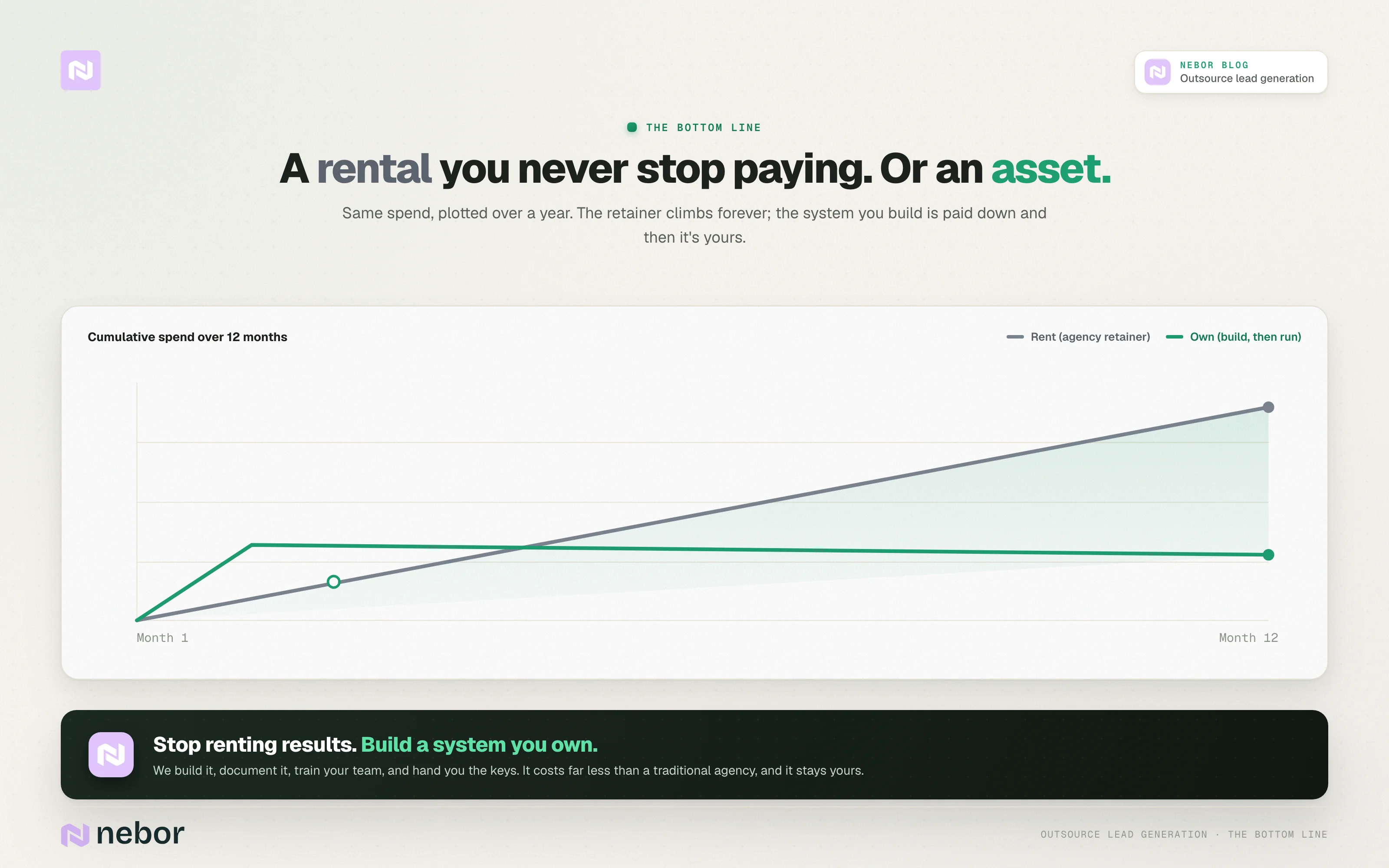
The technology exists today to create automated GTM systems that do everything a traditional lead generation agency does, but better, faster, cheaper, and with full transparency.
If your sales team is spending more time prospecting than selling, if your CRM is full of stale data, if your inbound leads are going untouched, the answer is not another agency retainer.
The answer is a modern GTM system that your team controls and that compounds over time instead of disappearing the moment the contract ends.
Book a 15-minute call with us and we'll show you exactly what a system like this would look like for your business.


Related Articles
By clicking Sign Up you're confirming that you agree with our Terms and Conditions.