

In this post:
Lead scoring is a method of ranking your leads with a number that reflects how ready they are to buy, based on how well they fit your ideal customer and how much they're engaging with you. It turns a messy pile of leads into a prioritized list, so your team knows who to call first.
The idea is sensible and almost universal, because every team with more leads than time needs a way to decide where to start. A score on each lead promises to point your reps at the best opportunities instead of letting them work the list in random order.
The problem is that most lead scoring models end up rewarding the wrong behaviors, handing high scores to people who open a lot of emails but were never going to buy.
Understanding lead scoring means understanding both how it works and why so many models end up measuring engagement instead of readiness.
TL;DR
Lead scoring assigns each lead a number based on two things, how well they fit your ideal customer profile and how actively they're engaging with you, so your team can prioritize the leads most likely to convert.
Teams have more leads than time, and working them in random order wastes effort on poor fits while hot prospects go cold. A good score puts the best leads at the top.
The danger is rewarding engagement that doesn't predict buying, so a curious newsletter reader outscores a perfect-fit account that's edging close to a decision.
The way out is to weight fit properly, score on behaviors that predict conversion, subtract points for disqualifying signals, and tune the model against who really closes.
What is lead scoring exactly, and what does the number stand for?
Lead scoring is the practice of attaching a number to each lead that represents how promising they are.
The score combines what you know about the lead into a single value, so a high score means a lead worth pursuing now and a low score means one worth waiting on or ignoring.
Most models score on two broad dimensions. Fit captures who the lead is, like their role, company size, and industry, and whether that matches your ideal customer. Engagement captures what they're doing, like visiting your site, opening emails, or downloading content, and whether that suggests active interest.
The model adds these up, often on a scale like zero to a hundred, into one number that ranks the lead against all the others.
The score exists to sort a crowd of leads into an order your team can work. When leads come in faster than your team can handle them, lead scoring is how you decide which ones to talk to first, putting the most promising at the top and the least promising at the bottom.
It's a prioritization tool, built to make limited sales time go to the leads most likely to turn into customers.
How does lead scoring really work under the hood, point by point?
Under the hood, lead scoring is mostly addition and subtraction against a set of rules you define. You decide which attributes and behaviors matter, assign each one points, and let the system tally a score for every lead.
You award positive points for things that signal readiness, like holding the right job title, working at a company that fits your profile, visiting your pricing page, or requesting a demo.
You subtract points for disqualifying signals, like an unsubscribe, a personal email domain, or a role that never buys.
As a lead accumulates points, their score rises, and once they cross a chosen threshold, they're considered ready to hand to sales, often crossing from a marketing-qualified lead to a sales-qualified one.
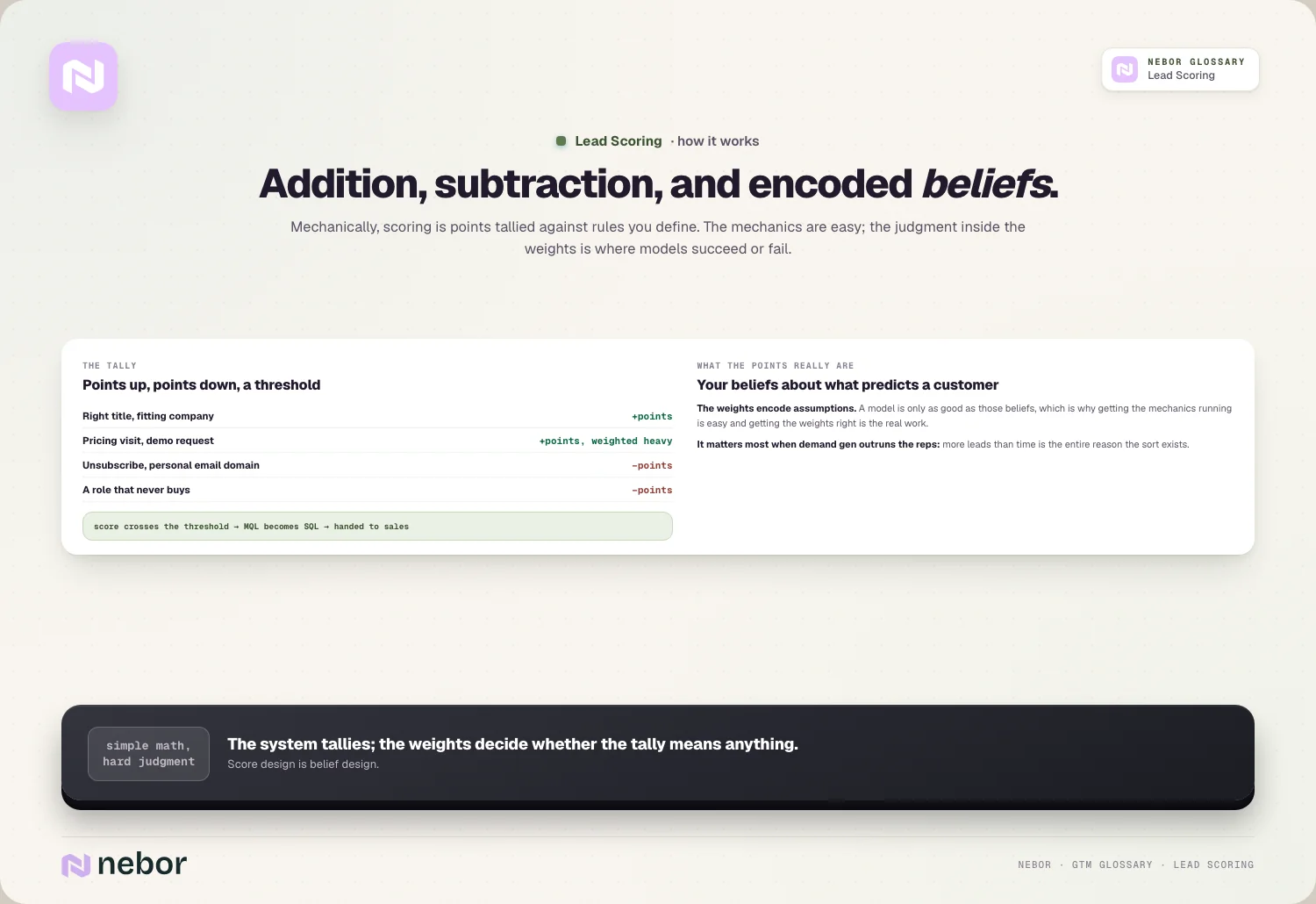
This matters most when demand generation is filling the top of your funnel faster than reps can work it.
The mechanics are simple, but the judgment behind them is where models succeed or fail. The points you assign encode your beliefs about what predicts a good customer, so a model is only as good as those beliefs.
Getting the mechanics working is easy, and getting the weights right, so the score reflects real readiness, is the actual work.
What's the difference between fit scoring and engagement scoring?
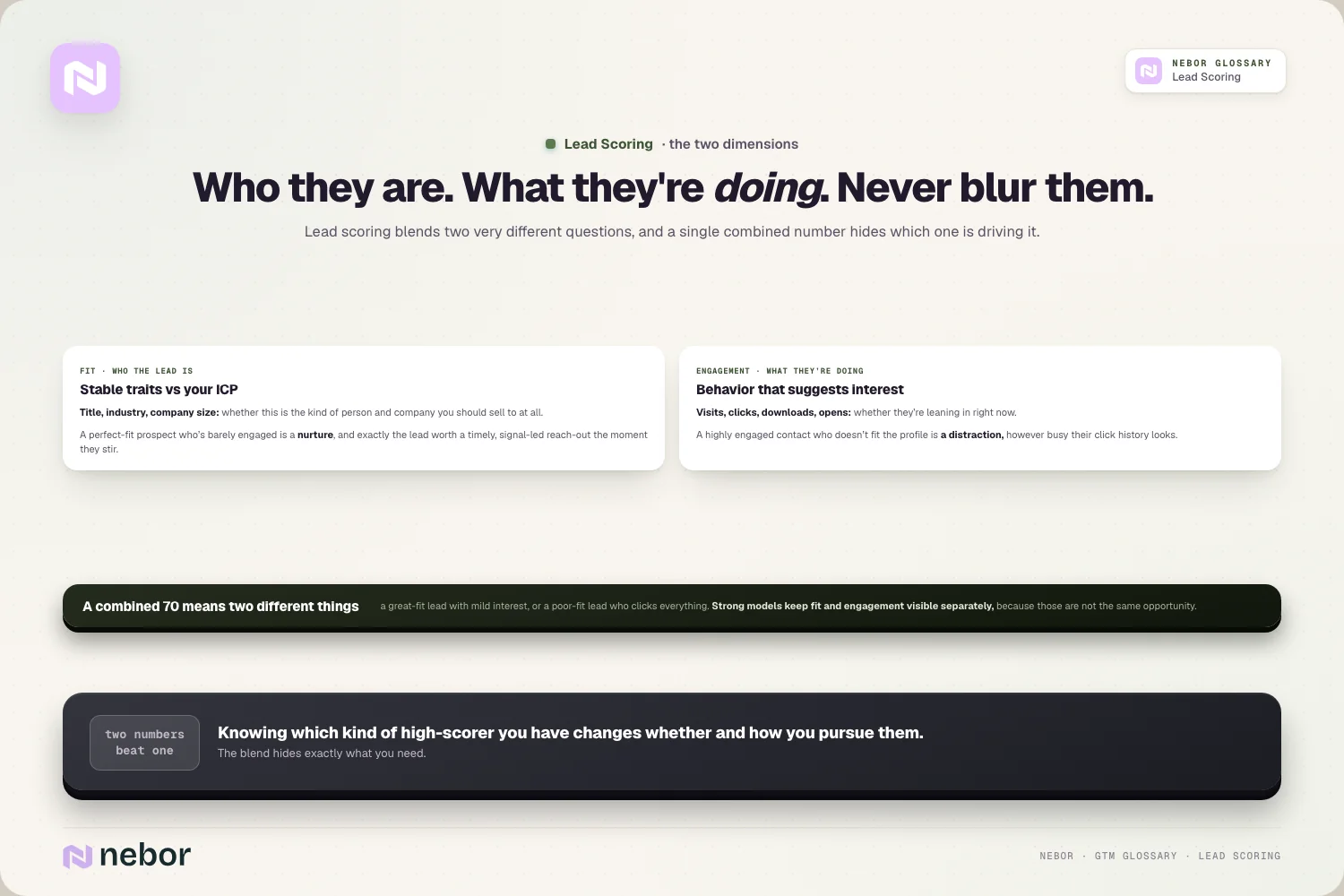
Lead scoring blends two very different questions, and keeping them distinct is key to building a good model, because one asks who and the other asks how interested.
Fit scoring is about whether a lead is the kind of person and company you should sell to, based on stable traits like title, industry, and company size, all measured against your ideal customer profile.
Engagement scoring is about whether they're showing interest, based on behaviors like opens, clicks, visits, and downloads, which is really the fit score versus intent score distinction applied at the lead level.
A lead can be high on one and low on the other, like a perfect-fit prospect who's barely engaged, or a highly engaged contact who doesn't fit your profile at all, and those two leads need very different treatment.
This is also where inbound-led outbound comes in, because a great-fit lead who just started engaging is exactly the kind of account worth a timely, signal-led reach-out.
The mistake many models make is blurring these together into one number that hides the distinction. A combined score of seventy could mean a great-fit lead with mild interest or a poor-fit lead who clicks everything, and those are not the same opportunity.
Strong models keep fit and engagement visible separately, because knowing which kind of high-scoring lead you have changes whether and how you pursue them.
How is lead scoring different from an account-level ICP score?
These two get confused because both produce a score, but they operate at different levels and answer different questions. One scores people, and the other scores companies.
Lead scoring traditionally scores individual leads, the specific people who come into your funnel, blending their personal fit and their behavior.
An ICP scoring model scores accounts, measuring how well a whole company matches your ideal profile regardless of any single person's actions.
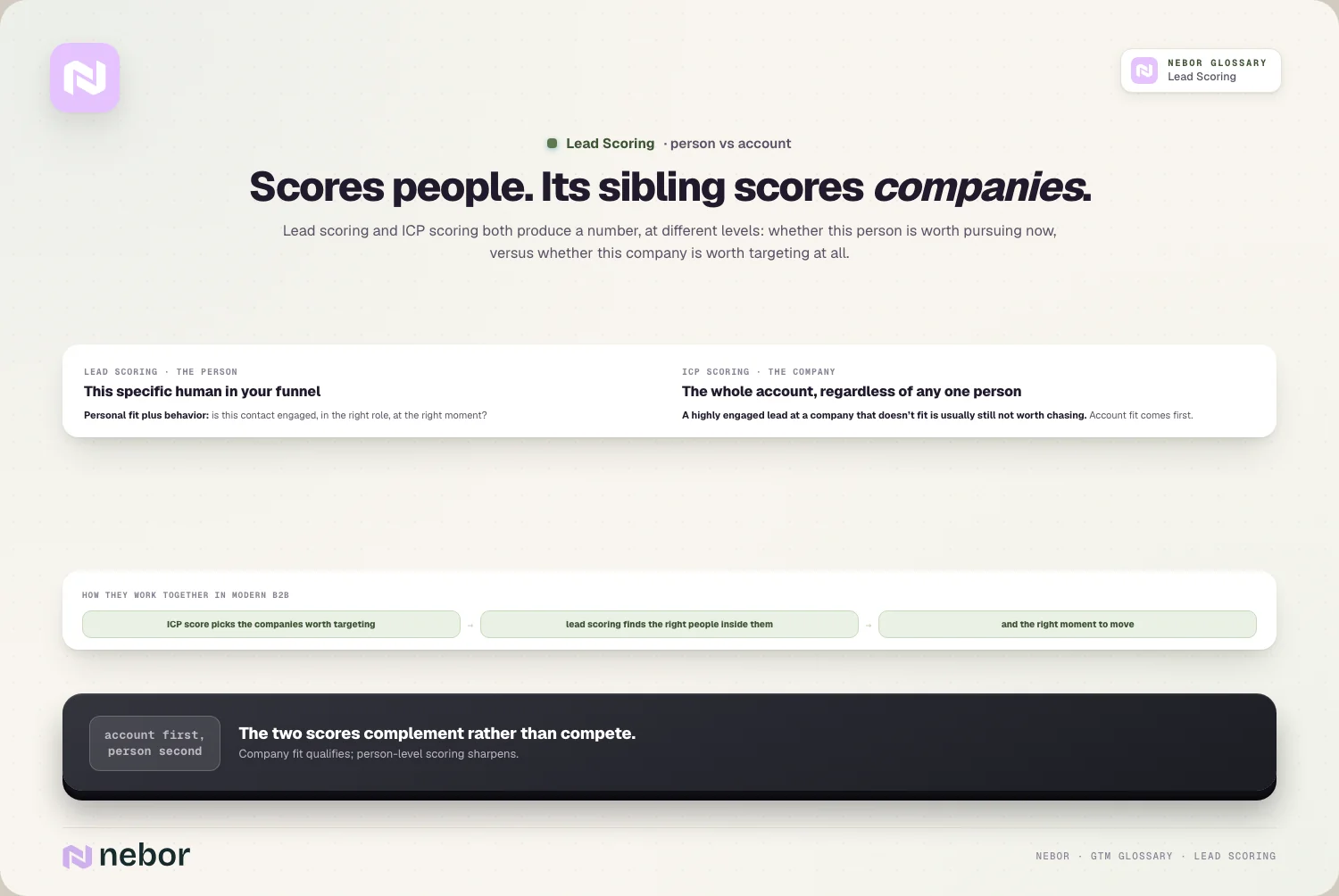
So lead scoring asks whether this person is worth pursuing right now, and ICP scoring asks whether this company is the kind you should be targeting in the first place.
In practice the two stack on top of each other. Account-level ICP scoring decides which companies deserve attention, and lead scoring finds the right people and the right moment inside those companies.
The company question gets answered before the person question, because a highly engaged lead at a company that doesn't fit is usually still a poor use of time, and person-level scoring then sharpens your focus within the accounts that made the cut.
Why do so many lead scoring models reward all the wrong things?
Here's the uncomfortable truth we keep seeing about lead scoring, that a lot of models end up measuring activity that doesn't predict buying. Seeing how this happens is the key to avoiding it.
The most common failure is overrewarding easy engagement, like email opens and content downloads, which are simple to track but weakly tied to actual purchase intent.
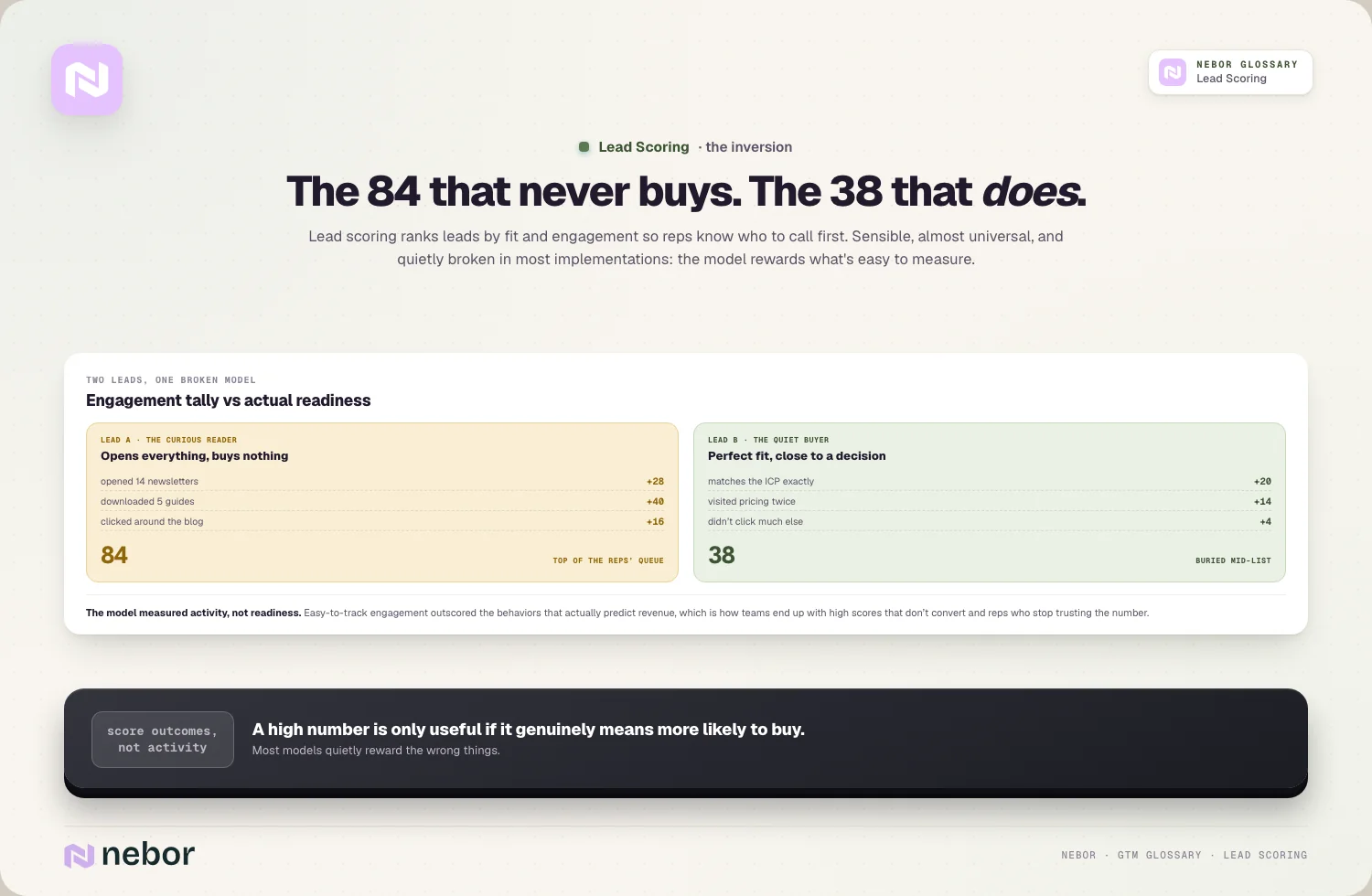
A curious reader who opens every newsletter and downloads every guide can rack up a high score while having no intention of buying, and meanwhile a serious prospect who quietly visits your pricing page twice scores lower because they didn't click much.
The model rewards the behaviors that are easy to measure rather than the ones that predict revenue.
This is how teams end up with high-scoring leads that don't convert and sales reps who stop trusting the score.
The correction is to weight behaviors by how strongly they predict buying, giving real weight to high-intent actions like pricing visits and demo requests, and little weight to low-signal activity like a single open.
A score is only useful if a high number genuinely means a lead is more likely to buy, and that requires scoring on outcomes instead of raw activity.
How do intent and buying signals fit into a lead scoring model?
Modern lead scoring increasingly pulls in signals of real buying behavior, and that's what keeps it grounded in readiness instead of vanity engagement. These signals are some of the strongest inputs a model can have.
Beyond your own first-party engagement, you can feed in intent data and buying signals that show a lead's company is actively researching your category, comparing vendors, or otherwise moving toward a decision.
These behaviors are much closer to a purchase than an email open, so weighting them heavily makes your score reflect actual readiness.
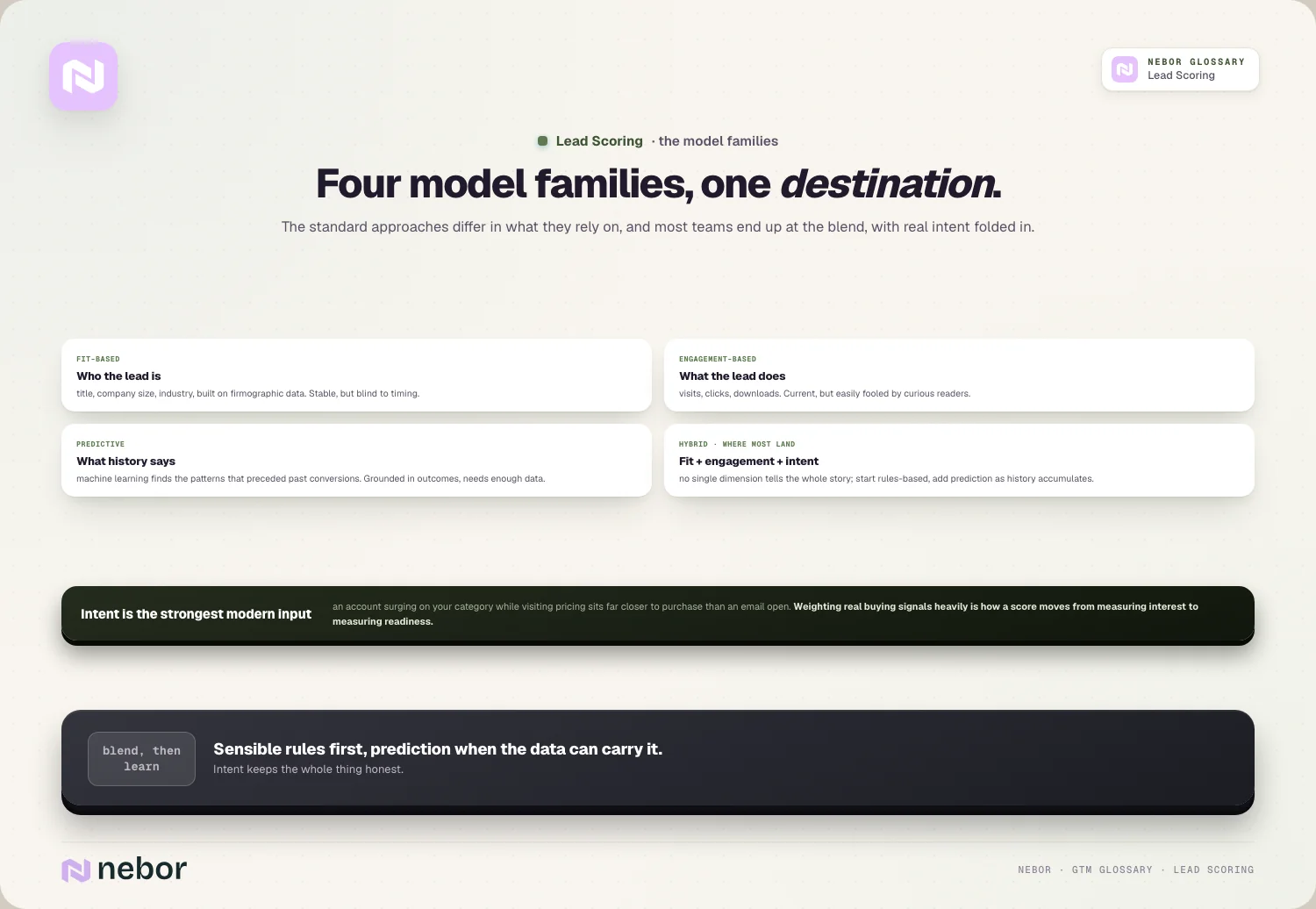
A lead whose account is surging on your category and visiting your pricing page is a far hotter prospect than one who simply subscribed to your blog, which is exactly the kind of timing signal-based selling is built to act on.
This is why the best modern scoring blends traditional fit and engagement with real intent. The signals tell you not just that a lead exists and fits, but that they're showing the behaviors of someone in the market now, which is exactly the timing information a score should capture.
Folding intent into the model is much of how lead scoring moves from measuring interest to measuring genuine sales-readiness.
What are the main lead scoring models you can choose between?
There are a few standard approaches to building a scoring model, and knowing them helps you choose the right one for your situation. They differ mainly in what they rely on.
The main approaches break down like this.
Fit-based scoring, focused on who the lead is, using attributes like title, company size, and industry built on firmographic data.
Engagement-based scoring, focused on what the lead does, using behaviors like visits, clicks, and downloads to gauge interest.
Predictive scoring, which uses machine learning on your historical data to find the patterns that actually preceded past conversions, rather than relying on human-guessed weights.
Hybrid scoring, which combines fit, engagement, and often intent into one model, and is where most teams end up because it balances signals.
Most companies land on a hybrid because no single dimension tells the whole story.
Predictive scoring is appealing because it grounds the weights in real outcomes instead of opinion, but it needs enough data to work, so most of the teams we advise start with a sensible rules-based hybrid and add prediction as they accumulate history.
Why does lead scoring need clean data underneath it to work?
Every score is only a calculation, and a calculation built on bad inputs gives you wrong answers that look precise. The reliability of your scores depends entirely on the data underneath them.
If your fit data is wrong or missing, the model misjudges who a lead is, scoring a perfect-fit prospect low because their company size is blank, or a poor fit high because their record is misleading.
This is where data enrichment matters, because filling in accurate firmographic and role data is what lets the fit half of the score mean anything. Engagement data has to be trustworthy too, capturing the behaviors that matter and attributing them to the right lead.
The deeper risk is that a bad score misleads with authority. Your rep sees a lead scored ninety, assumes it's hot, and acts accordingly, so a score resting on bad data actively misdirects effort while looking official.
Clean, complete data isn't a side concern for lead scoring, it's the foundation that decides whether the scores can be trusted at all.
How do you keep a lead scoring model from slowly going stale?
No scoring model stays accurate on its own, because the things that predict a good customer keep shifting. The weights fall out of date while nobody's looking.
Your market changes, your product evolves, and your understanding of who converts improves, so choices that made sense a year ago may be off now.
In our experience the only way to keep a model honest is to check it against reality regularly, looking at whether high-scoring leads actually closed and whether low-scoring ones turned out to be good customers.
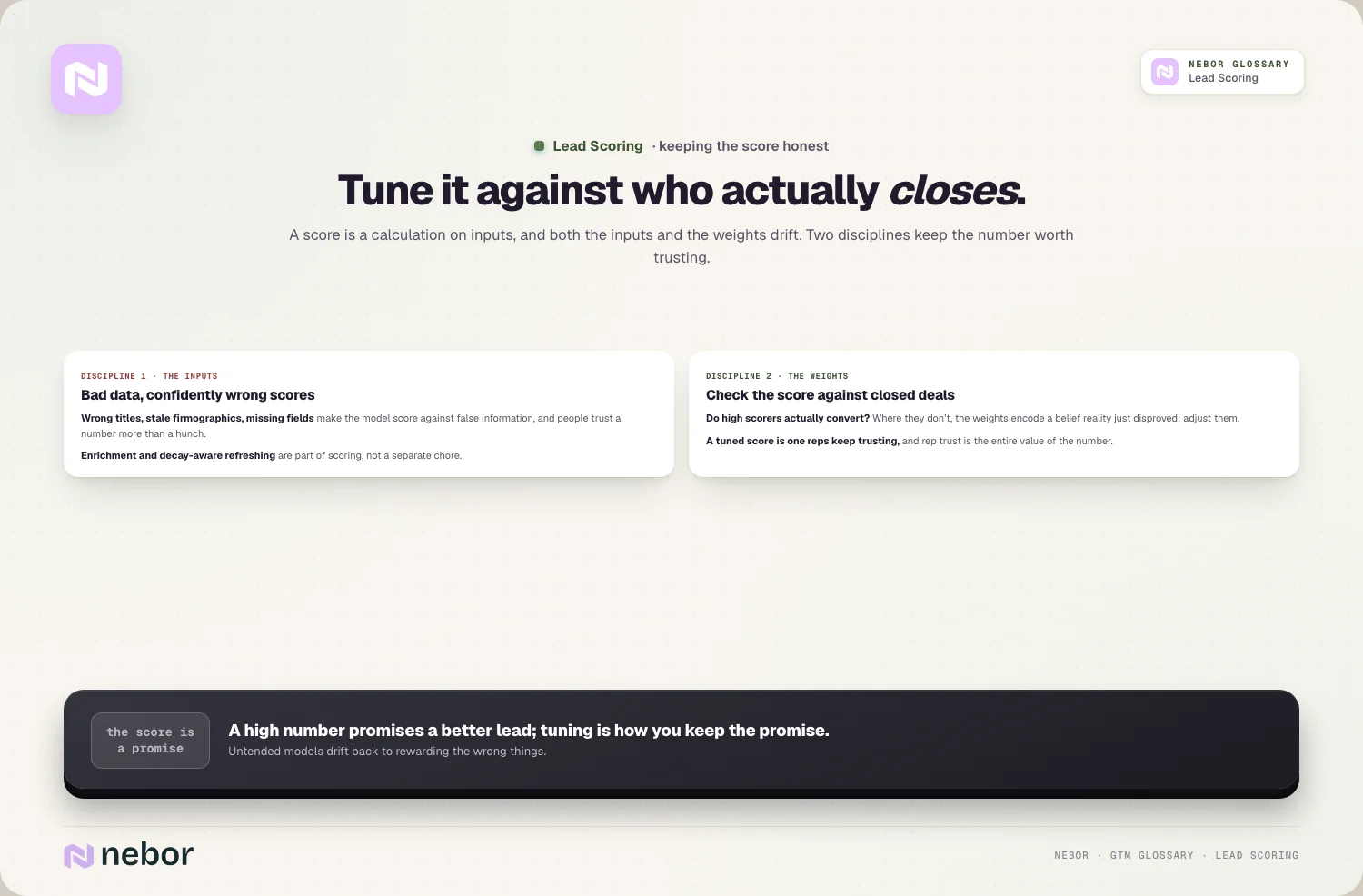
You then adjust the weights where the score and the outcomes disagree, because the data on who really converts is the truth your model should keep matching.
The mistake is setting up a scoring model and treating it as finished. A frozen model drifts further from reality every quarter, and worse, it trains your team to distrust scoring entirely once a few high scores flop.
A model you review and tune stays aligned with who really buys, which is what keeps your reps trusting it and acting on it.
What are the common lead scoring mistakes that erode reps' trust?
A handful of mistakes show up across lead scoring programs, and most come from letting the model drift away from actual buying. Naming them helps you build one that reps will trust.
The biggest is rewarding vanity engagement, piling points onto easy actions like opens that don't predict purchase.
Close behind is ignoring fit, so engaged but poorly-fitting leads float to the top, and the mirror image, ignoring engagement and scoring purely on fit, so you can't tell who's interested right now.
Then there's skipping negative scoring, where nothing ever subtracts points for disqualifying signals, which lets junk leads accumulate misleadingly high scores.
There's also the mistake of building a model and never validating it against who really converts, so nobody knows if the score works.
Every one of them yields to the same discipline. You weight behaviors by how well they predict buying, keep fit and engagement both in the picture, subtract for disqualifiers, feed the model clean data, and tune it against real conversion outcomes so a high score means a better lead.
Does a small or early team really need formal lead scoring yet?
Not every team needs a formal scoring model, because the answer depends on volume. The thinking matters even when the model doesn't.
If you have few enough leads that your team can personally evaluate each one, a formal scoring model adds overhead without much benefit, because a human looking at every lead is already doing the prioritization a score would automate.
At that stage, a simple sense of what a good lead looks like is enough. Lead scoring starts paying for itself once volume outgrows your ability to judge each lead by hand, when you truly need a system to decide who to work first.
So the honest answer is that scoring is a response to scale instead of a universal requirement. Early on, the better investment is learning which leads convert, because that understanding is what you'll eventually encode into a model.
When the volume arrives, you'll build a far better scoring system because you'll know from experience what really predicts a good customer, rather than guessing at weights from the start.
Why lead scoring is only ever as good as the things it rewards
Lead scoring, at the end of it all, is a prioritization tool, a way to point limited sales time at the leads most likely to buy.
Its entire value rests on whether a high score truly means a better lead, which depends on rewarding the behaviors and traits that predict conversion instead of the ones that are simply easy to count.
The teams that get value from it keep fit and engagement both in view, weight high-intent behaviors far above vanity activity, fold in real intent signals, subtract for disqualifiers, and tune the model against who closes.
They treat the score as a living hypothesis they validate against outcomes instead of a number they set once and trust forever.
The mindset that works is to ask, of every point your model awards, whether that behavior really predicts a sale.
When you build the model around genuine readiness instead of measurable busyness and keep it honest against real results, lead scoring becomes a sharp guide your reps trust, instead of a tidy-looking number that sends them after the wrong people.
Deel dit bericht
Data
RevOps
Prospecting
Begrippenlijst
Gerelateerde begrippen
De basis GTM-concepten begrijpen




Klaar om je pipeline te bouwen