

In this post:
An ICP scoring model is a system that turns your ideal customer profile into a number, scoring each account on how well it fits your best-customer criteria so you can rank and prioritize them.
Instead of a vague sense that an account feels like a fit, you get a score that tells you how good a fit it really is.
Almost every company has an ideal customer profile written down somewhere, and in most of them it stays in a doc that never touches the day-to-day work. A scoring model is what makes that profile operational, attaching a fit score to every account so your reps know where to spend their time.
The whole point is to move from opinion to system. When fit is a number on every account rather than a gut call, your targeting gets sharper, your prioritization gets honest, and your team stops wasting effort on accounts that were never going to buy.
TL;DR
An ICP scoring model converts your ideal customer profile into a numeric fit score on every account, using weighted criteria like company size, industry, and other traits of your best customers. It turns a written profile into something you can actually act on.
A profile in a document doesn't change behavior, but a score in your CRM does, and that gap is the whole case for the model. When every account carries a fit score, reps prioritize the right ones and stop pouring effort into accounts that will never close.
The key is to score on the traits that truly predict good customers, weight them by how much they matter, and keep fit separate from readiness. A good model tells you who's worth pursuing, and pairing it with intent tells you when.
So what is an ICP scoring model exactly, and what does it produce?
An ICP scoring model is a structured way of measuring how well any given account matches your ideal customer profile. It takes the traits that define your best customers and turns them into a scoring system, so each account gets a number reflecting how closely it fits.
It builds directly on your ideal customer profile, which is the description of the companies you serve best.
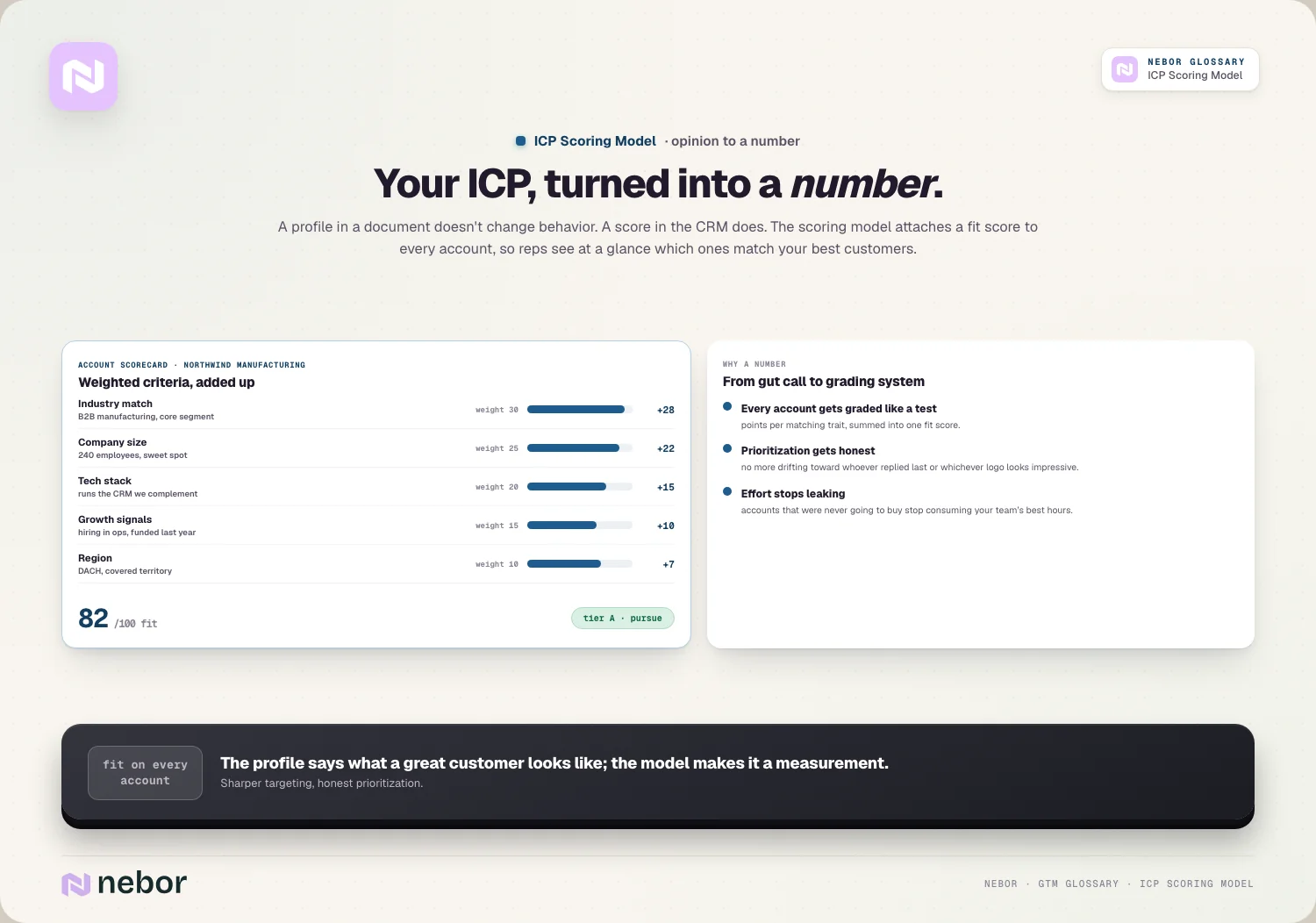
The profile says what a great-fit customer looks like, and the scoring model turns that description into a measurement, assigning points for each matching trait and adding them up into a single fit score per account.
A grading system for accounts is a fair picture of it. Just as a test gives each student a score, an ICP scoring model gives each account a fit score.
Instead of every prospect looking equally worth pursuing, you can see at a glance which ones closely match your best customers.
Why isn't a written ICP enough on its own to fix your targeting?
Plenty of teams have a documented ICP and still target badly, which seems strange until you see why. A profile in a document doesn't change what people do day to day.
The problem is that a written ICP is passive, stuck in a slide or a doc that reps rarely open while they're working a list.
When the profile lives separately from the workflow, people fall back on gut feel about which accounts to chase, and gut feel drifts toward whoever replied last or whichever logo looks impressive.
The profile exists, but it isn't steering anything.
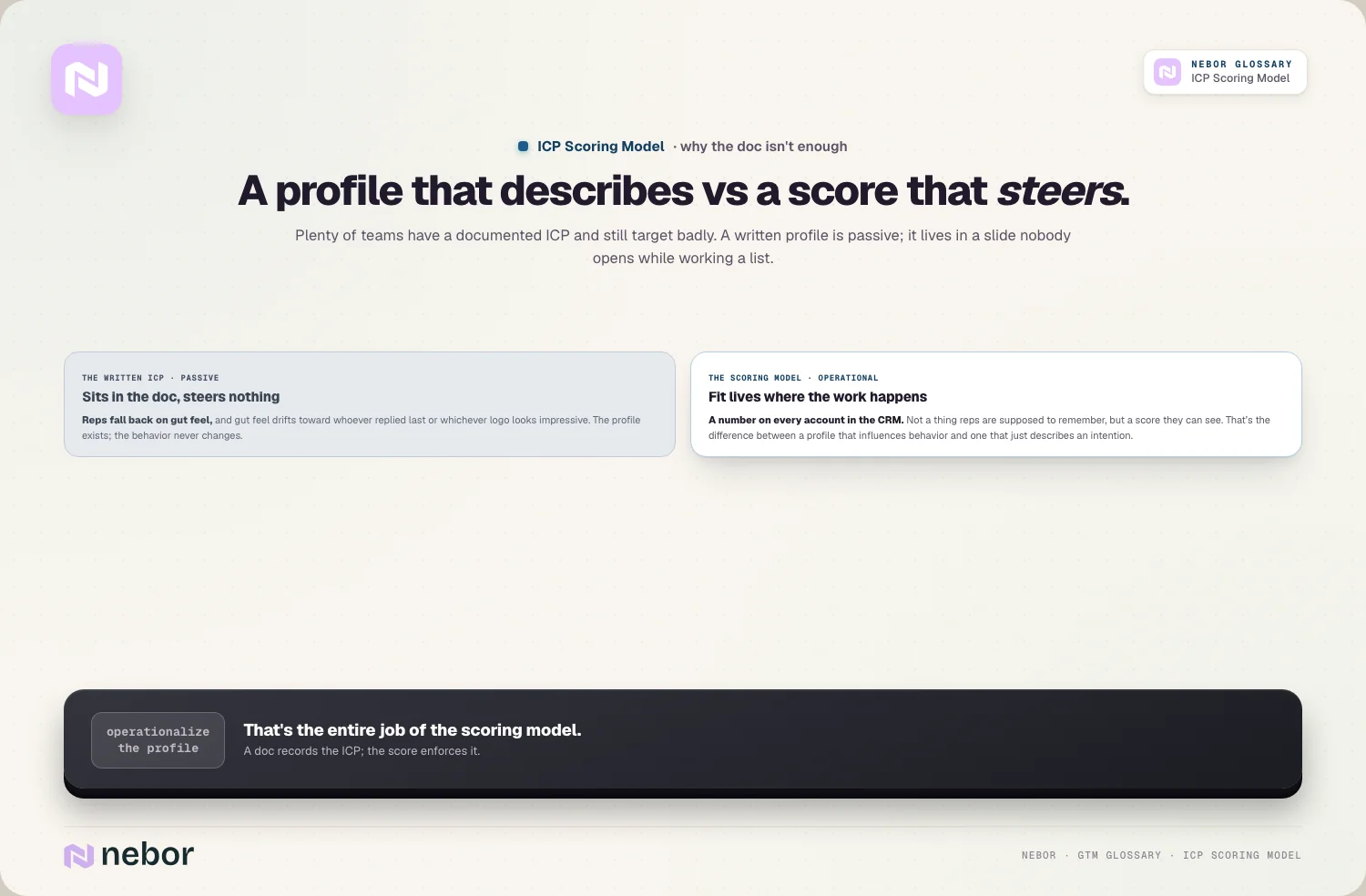
A scoring model fixes this by putting fit where the work happens, as a number on every account in the CRM.
Now the profile isn't a thing reps are supposed to remember, it's a score they can see, which is the difference between a profile that influences behavior and one that just describes an intention.
Operationalizing the ICP is the entire job of the scoring model.
What criteria go into an ICP scoring model, and which ones belong?
A scoring model is only as good as the criteria it's built on, so the choice of inputs deserves care. In our experience the traits should be the ones that separate your best customers from the rest.
Most models score on a few kinds of trait. Firmographic criteria describe the company itself, like its size, industry, revenue, and growth, built from firmographic data.
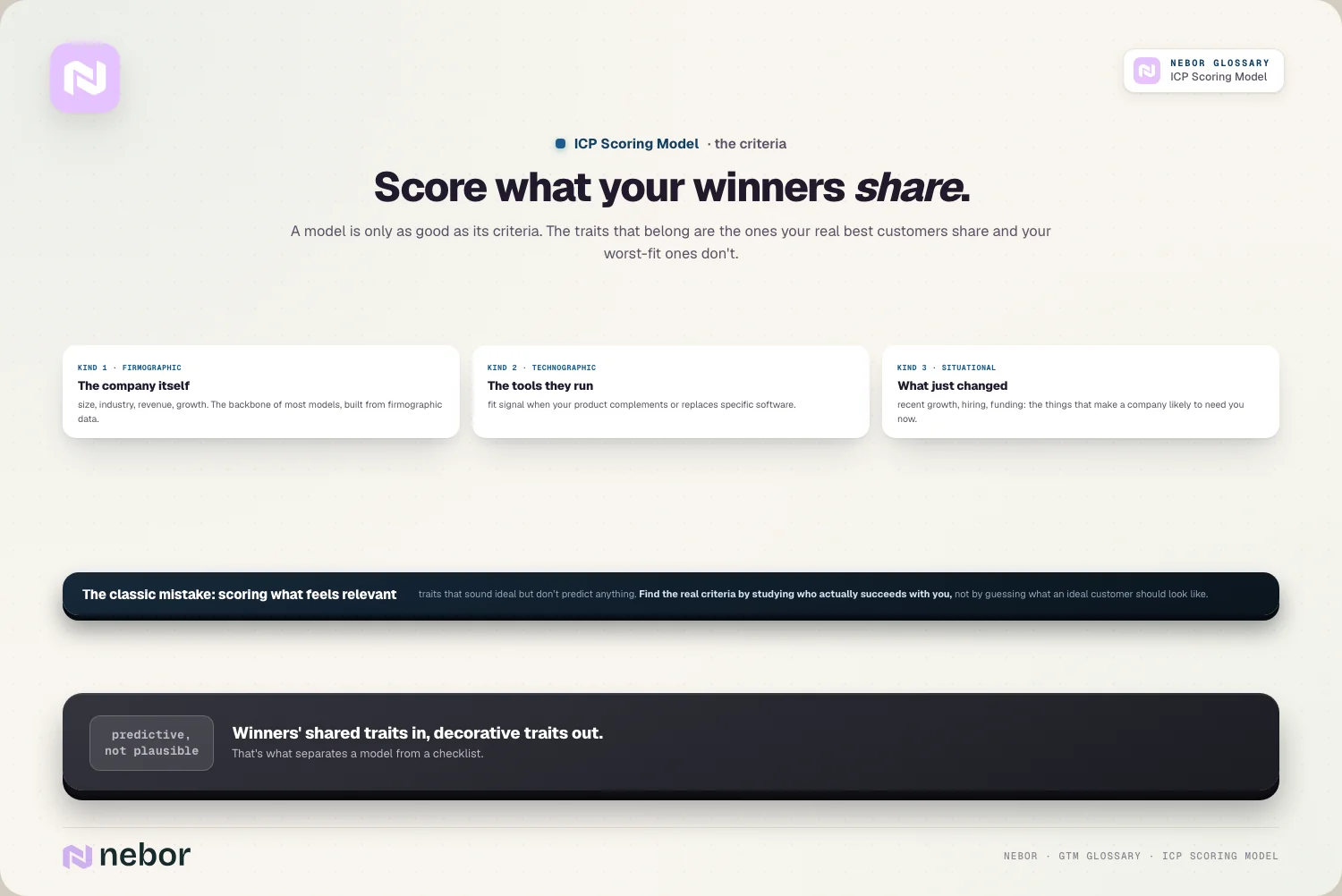
Technographic criteria describe what tools a company uses, which can signal fit if your product complements or replaces specific software. And situational criteria capture things like recent growth, hiring, or funding that make a company more likely to need you now.
The mistake is scoring on traits that feel relevant but don't predict good customers.
The criteria that belong in your model are the ones your real best customers share and your worst-fit ones don't, and you find them by studying who succeeds with you instead of guessing what an ideal customer should look like.
How do you build the scoring model without overcomplicating it?
You can build a workable ICP scoring model in an afternoon, and in our experience the fancy tooling can come later. The core is choosing criteria, weighting them, and adding up the points.
You start by listing the traits that define your best-fit accounts, then assign each one a weight based on how strongly it predicts a good customer, since not every trait matters equally. Company size might be worth more than industry, or the reverse, depending on your business.
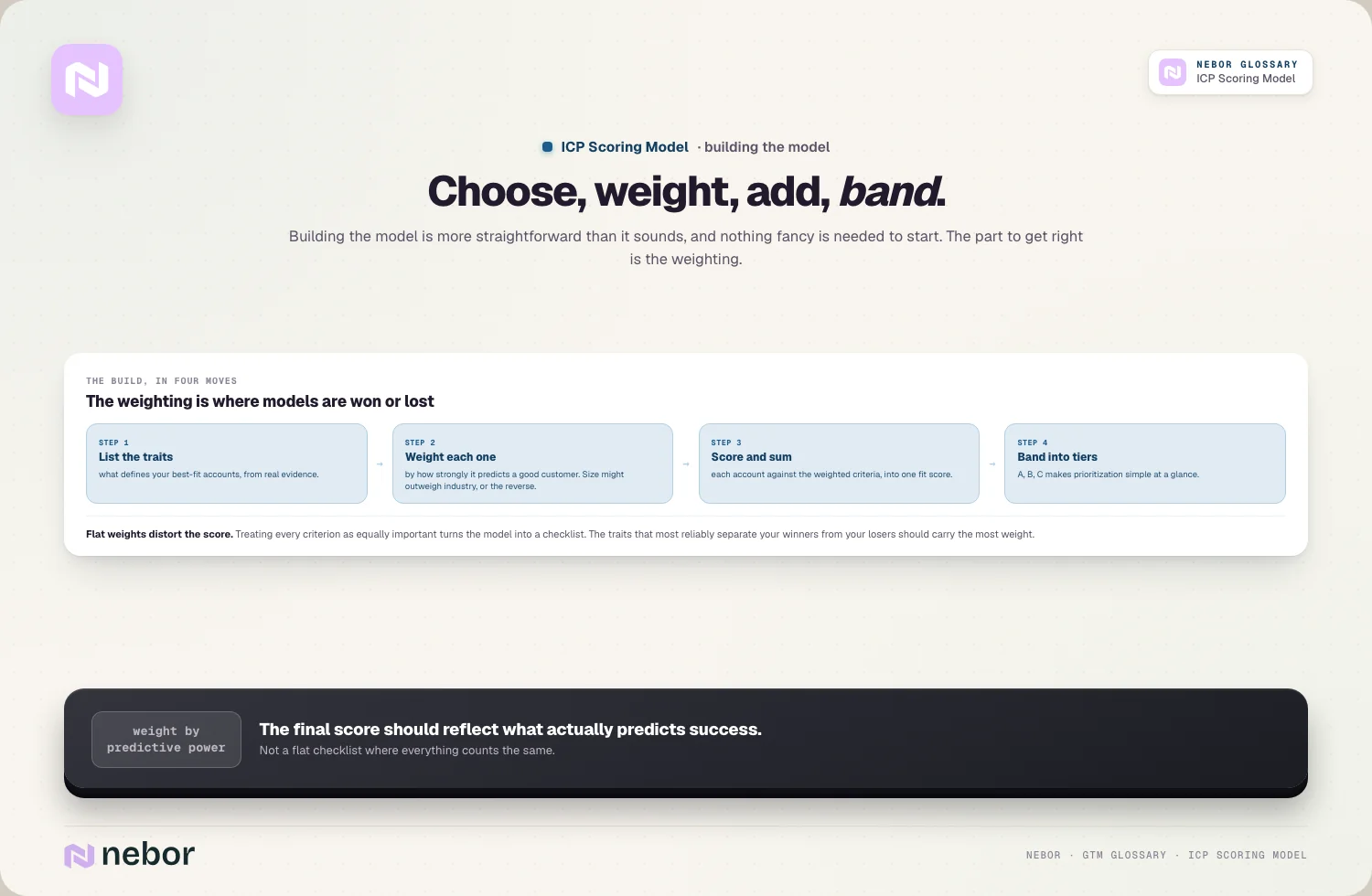
Then you score each account against those weighted criteria and add the results into a single fit score, which you can band into tiers like A, B, and C to make prioritization simple.
The thing to get right is the weighting, because treating every criterion as equally important usually distorts the score.
The traits that most reliably separate your winners from your losers should carry the most weight, so the final score reflects what predicts success instead of a flat checklist where everything counts the same.
What's the difference between a fit score and an intent score?
This is the distinction that makes scoring genuinely useful, and confusing the two leads to bad prioritization. Fit and intent answer two different questions, and you need both.
An ICP scoring model measures fit, which is whether an account is the kind of company you should sell to, based on its stable traits. Intent measures readiness, which is whether that account is showing signs of being in the market right now, based on its behavior.
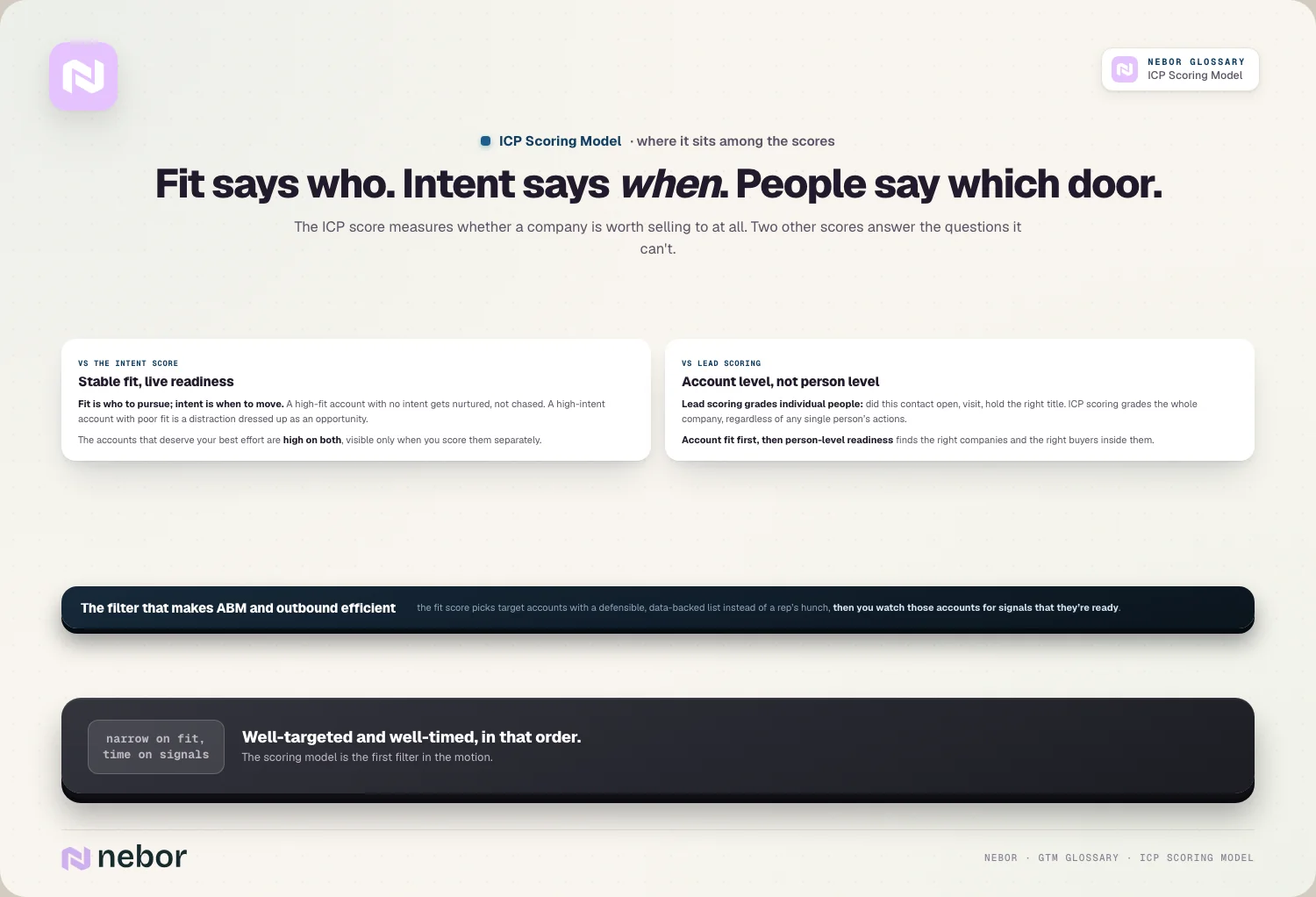
The full picture comes from combining them, which is exactly the fit score versus intent score distinction, where fit tells you who and intent tells you when.
Acting on one without the other wastes effort either way. A high-fit account with no intent is worth nurturing but not chasing hard yet, and a high-intent account with poor fit is a distraction dressed up as an opportunity.
The accounts that deserve your best effort are high on both, which only becomes visible when you score fit and intent separately and then look at them together.
How does an ICP scoring model relate to classic lead scoring?
These two terms overlap and get muddled, so they deserve a clean split. They operate at different levels and answer slightly different questions.
Lead scoring traditionally scores individual people based on their behavior and profile, like whether a specific contact opened emails, visited the site, and holds the right title.
ICP scoring works at the account level, measuring how well the whole company fits your ideal profile regardless of any single person's actions. One asks whether this person is engaged, and the other asks whether this company is a fit.
In modern B2B, the two work together rather than competing. You use the ICP score to decide which accounts are worth pursuing at all, and lead or contact scoring to find the right people and the right moment within those accounts.
Account fit first, then person-level readiness, is the combination that keeps your team focused on the right companies and the right buyers inside them.
Why does an ICP scoring model need clean, current data underneath it?
A scoring model is a calculation, and a calculation on bad inputs produces a confidently wrong answer. The quality of your scores depends entirely on the quality of the data feeding them.
If the firmographic and technographic data on your accounts is wrong or missing, the model scores accounts on false information.
A great-fit account might score low because its data is stale, and a poor-fit one might score high because its record is misleading.
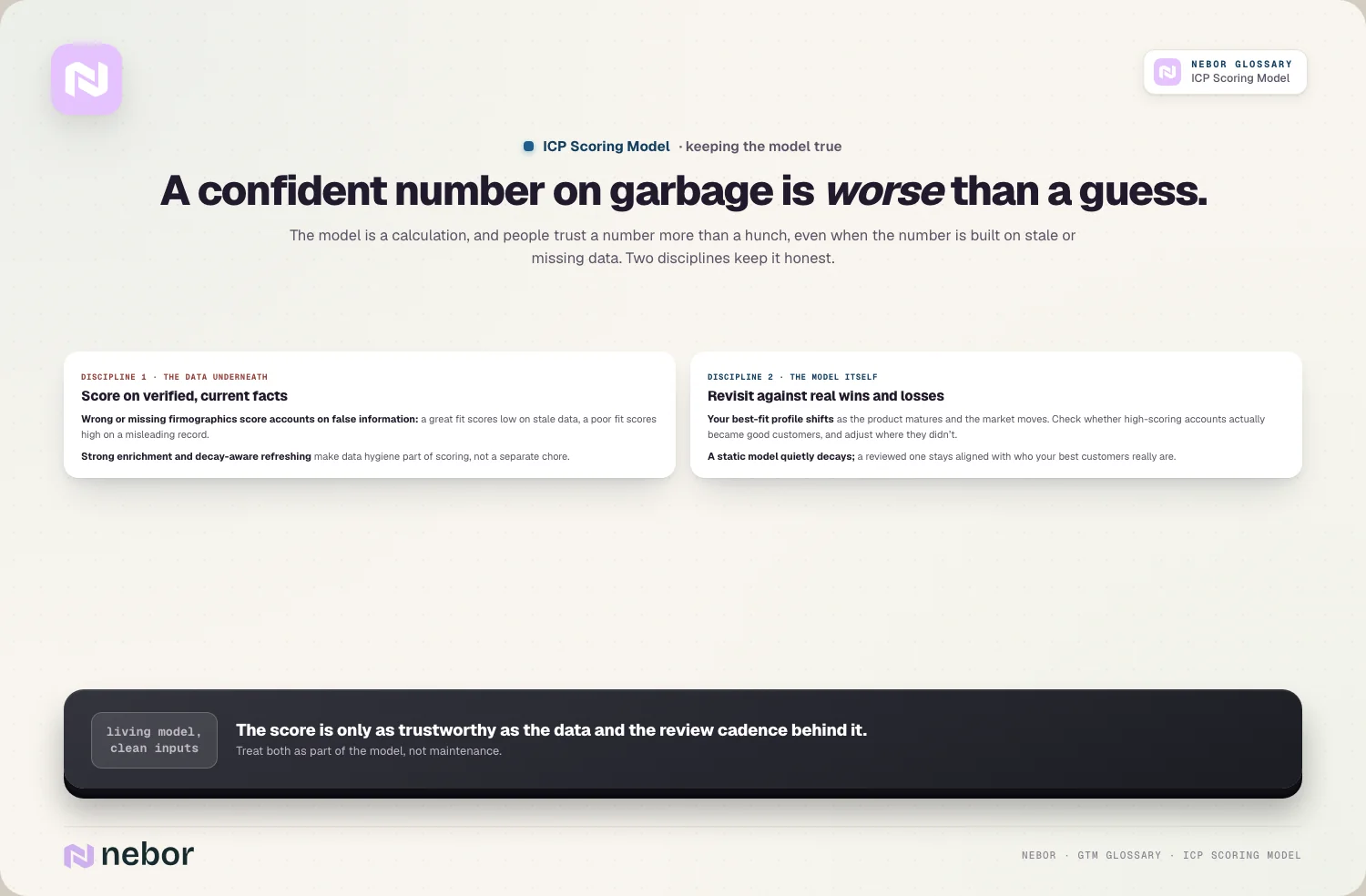
That's worse than no score, because people trust a number more than a guess, even when the number is built on garbage. Reliable scoring needs accurate, complete data on every account.
This is why a scoring model rests on strong data enrichment, filling in and verifying the traits the model scores on. It also has to account for data decay, since company data ages and a score built on last year's data slowly drifts out of truth.
The model is only as trustworthy as the data underneath it, which makes data hygiene part of the scoring work instead of a separate chore.
How does ICP scoring power account-based and outbound motions?
An ICP scoring model isn't just a tidy internal metric, it actively shapes how you build outbound and account-based programs. The score decides where your effort goes.
In account-based marketing, the scoring model is how you choose your target accounts in the first place, because ABM only works if you're focused on the right companies.
The fit score gives you a defensible, data-backed way to pick the accounts worth your concentrated effort, rather than letting a rep's hunch decide which logos make the list.
The same logic applies to outbound, where the score tells you which accounts to prioritize for signal-based selling and personalized outreach.
This is also where scoring connects to intent data and buying signals in practice.
You use the fit score to narrow to the right accounts, then watch those accounts for signals that they're ready, so your outreach is both well-targeted and well-timed. The scoring model is the filter that makes the rest of the motion efficient.
How do you keep an ICP scoring model from drifting out of date?
A scoring model isn't a build-once asset, because the things that predict a good customer shift over time. A model that's right today slowly drifts wrong if nobody maintains it.
Your best-fit profile changes as your product matures, your market shifts, and you learn more about who succeeds with you, so the criteria and weights that were accurate a year ago may not be now.
The way to keep the model honest, and the habit we build into every client setup, is to revisit it regularly against your real closed-won and closed-lost data.
You check whether high-scoring accounts actually became good customers, adjust the model where they didn't, and let the data tell you whether your scoring still matches reality.
The mistake is setting up a scoring model and treating it as finished. A static model decays as your business evolves, while a model you review and tune stays aligned with who your best customers really are.
Treating the scoring model as a living thing instead of a one-time project is what keeps it useful for years.
What are the common ICP scoring mistakes that ruin good models?
A few mistakes show up repeatedly and undermine otherwise sensible scoring models from the inside. Knowing them helps you build one that guides real decisions.
The biggest is scoring on the wrong criteria, picking traits that feel important but don't predict good customers, so the score looks rigorous while measuring the wrong thing.
Close behind is flat weighting, treating every criterion as equally important when some matter far more, which blurs the score.
Then there's confusing fit with readiness, treating a high fit score as a signal to chase hard when the account shows no intent, and building the model on stale or incomplete data so the scores are confidently wrong.
There's also the mistake of building a beautiful model nobody uses, where the score exists in the CRM but reps still work off gut feel.
Every one of these has the same antidote. You score on traits that predict success, weight them honestly, keep fit and intent separate, feed the model clean data, and make sure the score drives how the team prioritizes.
Does a small or early-stage company need an ICP scoring model yet?
Founders sometimes assume scoring models are a big-company concern, but the thinking behind them matters even early, in a lighter form. The formality scales with the company, but the discipline pays off at any size.
Very early, you may not have enough customers to build a statistically meaningful model, and that's fine, because the priority is learning who your best customers turn out to be through real deals.
Even then, a simple version helps, like a short list of must-have traits you check every prospect against, which keeps a small team from chasing every shiny logo. The goal at that stage is focus, and a sophisticated rubric can wait.
As you grow and accumulate enough customers to see patterns, the model gets more formal and data-driven, with weighted criteria and tiers.
The mistake is either skipping the thinking entirely when you're small, or over-engineering a precise model before you have the data to support it. The sophistication of the model should match the stage you're at.
Why an ICP scoring model is really about focusing your effort
An ICP scoring model exists to answer one question well, which is where your team should spend its limited time. By turning fit into a number on every account, it replaces gut feel and impressive logos with a clear, data-backed view of which accounts deserve pursuing.
The teams that get value from it score on the traits that truly predict good customers, weight those traits honestly, keep fit separate from intent, and build the whole thing on clean, current data.
They treat the model as a living system they tune against real results, so it never gets the chance to age into noise.
The mindset that works is to stop asking which accounts feel promising and start asking which ones match your best customers on the evidence, then let the score guide where the effort goes.
When you build that discipline into a model your team uses, and pair it with intent to get the timing right, your whole motion gets sharper, because every hour goes toward the accounts most likely to become customers.
Share this post
Prospecting
Data
Glossary
Related glossary items
Understanding the core GTM concepts




Ready to build your pipeline











