

In this post:
A buying signal is an observable action or event that suggests a person or company might be moving toward a purchase. A pricing-page visit, a fresh round of funding, a job posting that hints at a pain you solve, a repeat product login, these are all signals.
Signals are the evidence, and the conclusion still has to be drawn. They're how you infer buying intent, which is the readiness you can never see directly. One signal on its own rarely means much, but the right few stacked together can tell you an account is worth a real, timely reach-out.
This is the heart of how modern outbound and inbound work now, because working a static list and hoping is dead. The teams we see winning watch for the moments a buyer tips their hand, and they move on those moments while they're still warm.
TL;DR
Buying signals are the breadcrumbs that hint someone is entering the market. Most teams either ignore them completely or chase every one as if it's a hot lead, and both are expensive mistakes.
The real skill is reading signals well. That means knowing the different types, telling a strong signal from a weak one, stacking several together instead of reacting to one, and always weighing them against fit.
A signal from a great-fit account is worth dropping everything for. The same signal from a company that will never buy is just activity dressed up as opportunity.
If you get this right, you reach the right person at the moment they care, with a reason that's actually true. If you get it wrong, all you've built is a faster way to annoy people who were never going to buy.
What you're really looking at when you read a single buying signal
A buying signal is any piece of behavior or change in the world that nudges your estimate of whether an account is in-market. It doesn't prove anything on its own, it just moves the odds.
That distinction matters because you can't observe intent. You only ever see actions and events, and you infer the readiness behind them. A signal is one data point in that inference, and the quality of your guess depends entirely on which signals you watch and how you weigh them.
This has taken over go-to-market for a plain reason. Buyers leave more digital traces than ever, and most of a deal happens before they ever talk to you. Reading signals is how you find the accounts that are already moving, instead of interrupting thousands who aren't.
The buying signals you should be watching across every account
Buying signals come in several distinct families, each telling you something different, and the strongest programs watch across all of them rather than fixating on one.
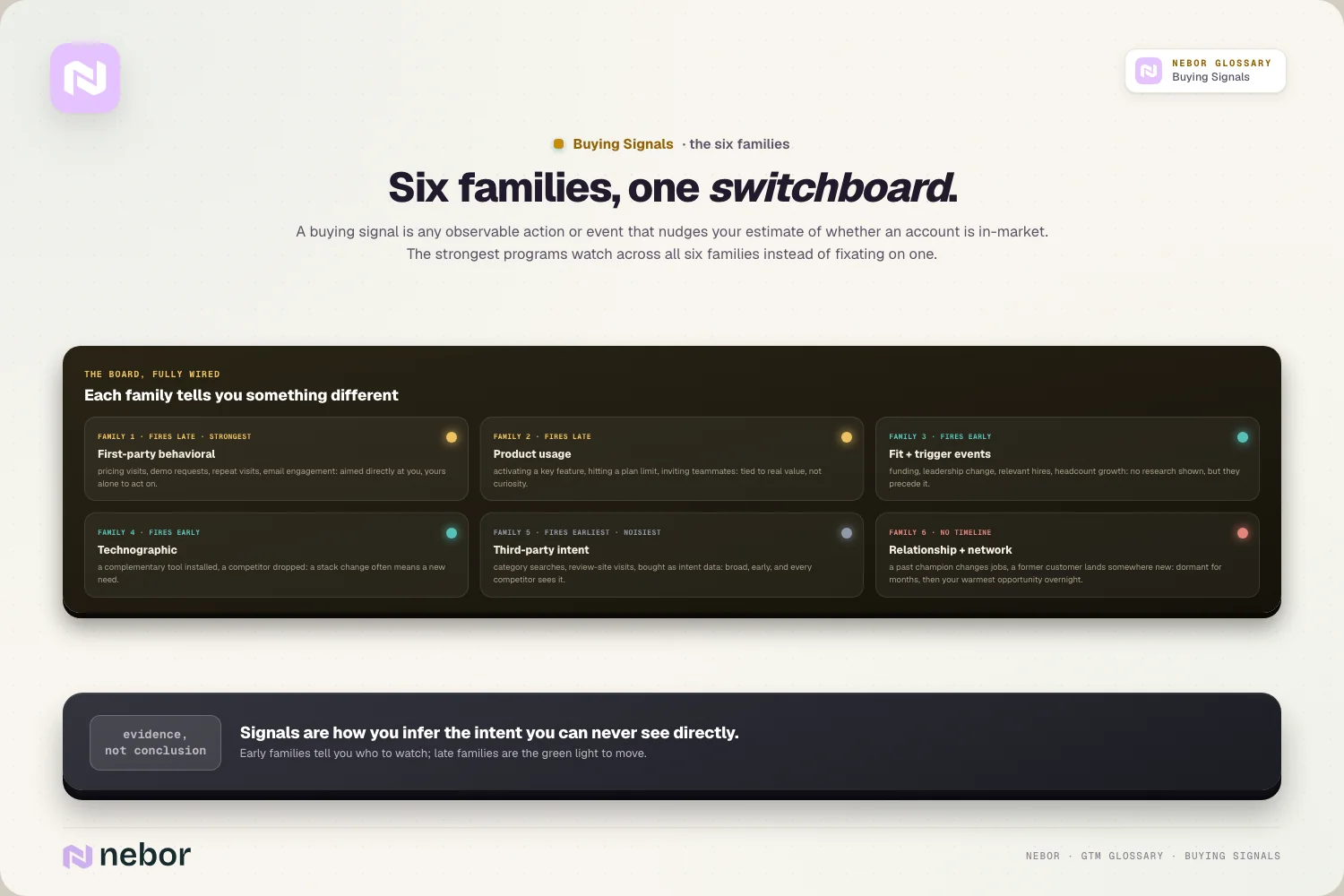
First-party behavioral signals cover what identified people do on surfaces you own, like pricing-page visits, demo requests, and email engagement. This is the highest-value family, because the behavior is aimed directly at you, and it's what our website visitor workflow is built to read.
Product usage signals track what a user does inside the product in product-led motions, like activating a key feature, hitting a plan limit, or inviting teammates. These are some of the cleanest signals you can get, because they're tied to real value instead of plain curiosity.
Fit and trigger-event signals are changes in the account that create a new reason to buy, like a funding round, a leadership change, a relevant new hire, or fast headcount growth. These don't show research, but they often precede it, and that makes them priceless for timing outbound.
Technographic signals read what's in or missing from an account's tech stack, like installing a complementary tool or dropping a competitor. This is where technographic data turns into a buying signal, because a stack change often means a new need.
Third-party intent signals capture research behavior off your own site, like category keyword searches and review-site visits, usually purchased as intent data. It's broad and early, so it catches accounts before they reach you, but it's noisier than anything first-party.
Relationship and network signals are the human moments that hint at warmth, like a past champion changing jobs to a new company, a former customer landing somewhere new, or someone engaging repeatedly with your content. A champion who moves is one of the most underrated signals in B2B.
These overlap with intent signals, which are the narrower subset specifically about active research. Buying signals is the wider bucket, and it includes fit and trigger events that have nothing to do with research, which is why treating the two as identical leaves money on the table.
Which family appears earliest in a buyer's journey matters too, because that tells you how to respond. Trigger events and third-party intent tend to land first, before the buyer has touched you, so they're your early-warning system for who to start watching.
First-party behavioral and product signals arrive later, once the buyer is already circling you, so they're your green light to move.
Relationship signals don't follow that timeline at all, which is part of why they're so easy to miss. A champion who moves jobs can lie dormant for months, then turn into your warmest opportunity the day they land somewhere that fits.
If you only watch the behavioral families, you'll keep missing the human signals that drive a lot of B2B deals without ever showing up in a dashboard.
How to tell whether a buying signal deserves your team's time at all
Not every signal deserves the same reaction. A demo request is a shout, a single blog visit is barely a whisper, and treating them the same wastes everyone's time. A few dimensions decide how much weight a signal earns.
The first dimension is specificity, because a signal aimed at you, like a pricing-page visit, is far stronger than a signal aimed at the category, like a generic industry search. The closer the behavior is to a buying decision about your solution, the more it means.
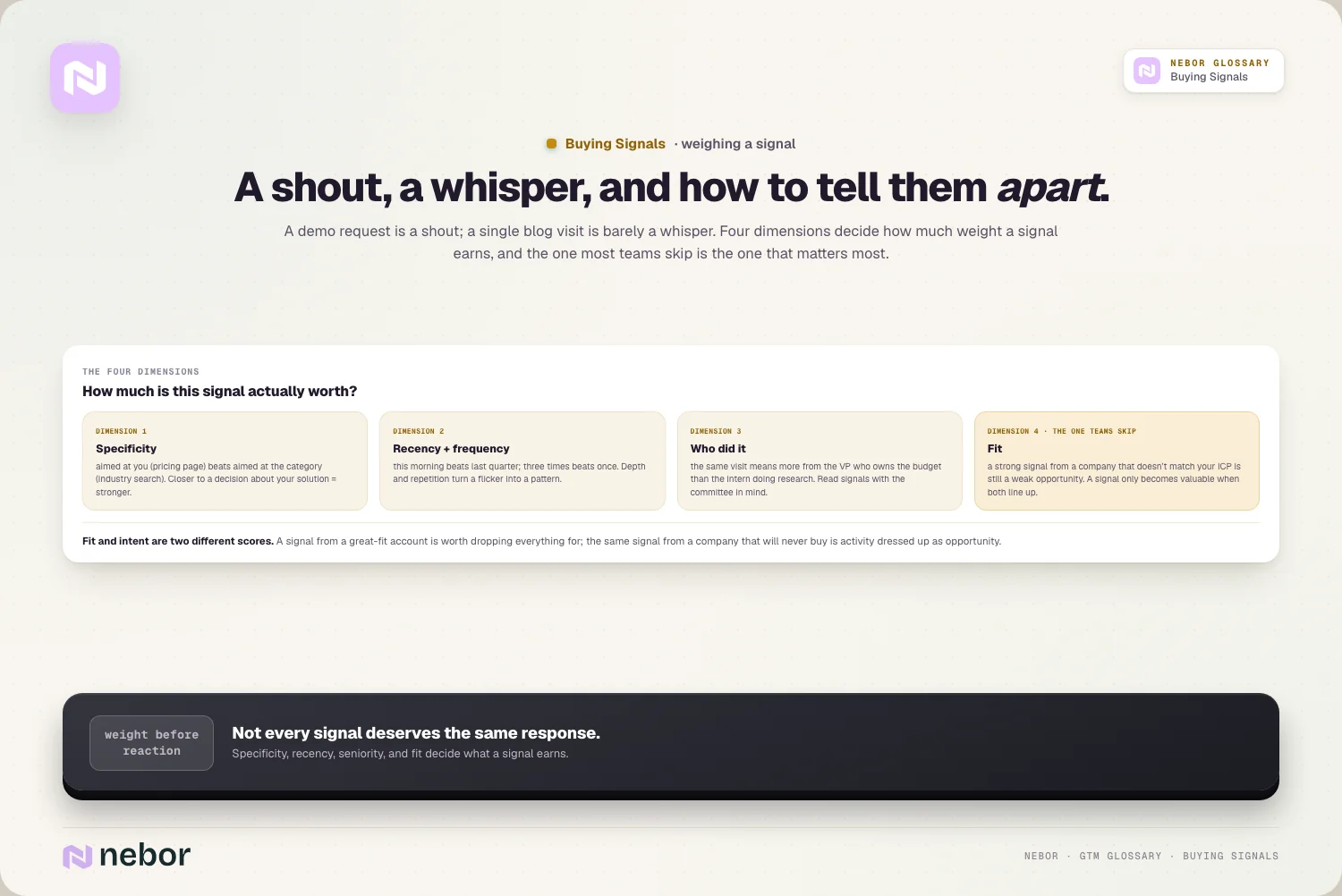
The second dimension is recency and frequency, because a signal from this morning beats one from last quarter, and an account that did something three times beats one that did it once. Depth and repetition turn a flicker into a pattern.
The third dimension is who did the thing. The same page visit means more from a VP who owns the budget than from an intern doing research. Role and seniority change what a signal is worth, so signal reading and the buying committee have to be considered together.
The fourth dimension, and the one that gets skipped, is fit. A strong signal from a company that doesn't match your ICP is still a weak opportunity. Fit and intent are two different scores, and a signal only becomes valuable when both line up.
Why you should never act on a single buying signal all on its own
The single biggest upgrade in signal reading is to stop reacting to individual signals and start stacking them, because one data point is noise, while a pattern starts to tell a story.
A pricing-page visit alone is a maybe. A pricing-page visit, plus a great ICP fit, plus a recent funding round, plus a second stakeholder from the same account viewing your case studies, is a clear picture of an account moving toward a decision, because the signals corroborate each other.
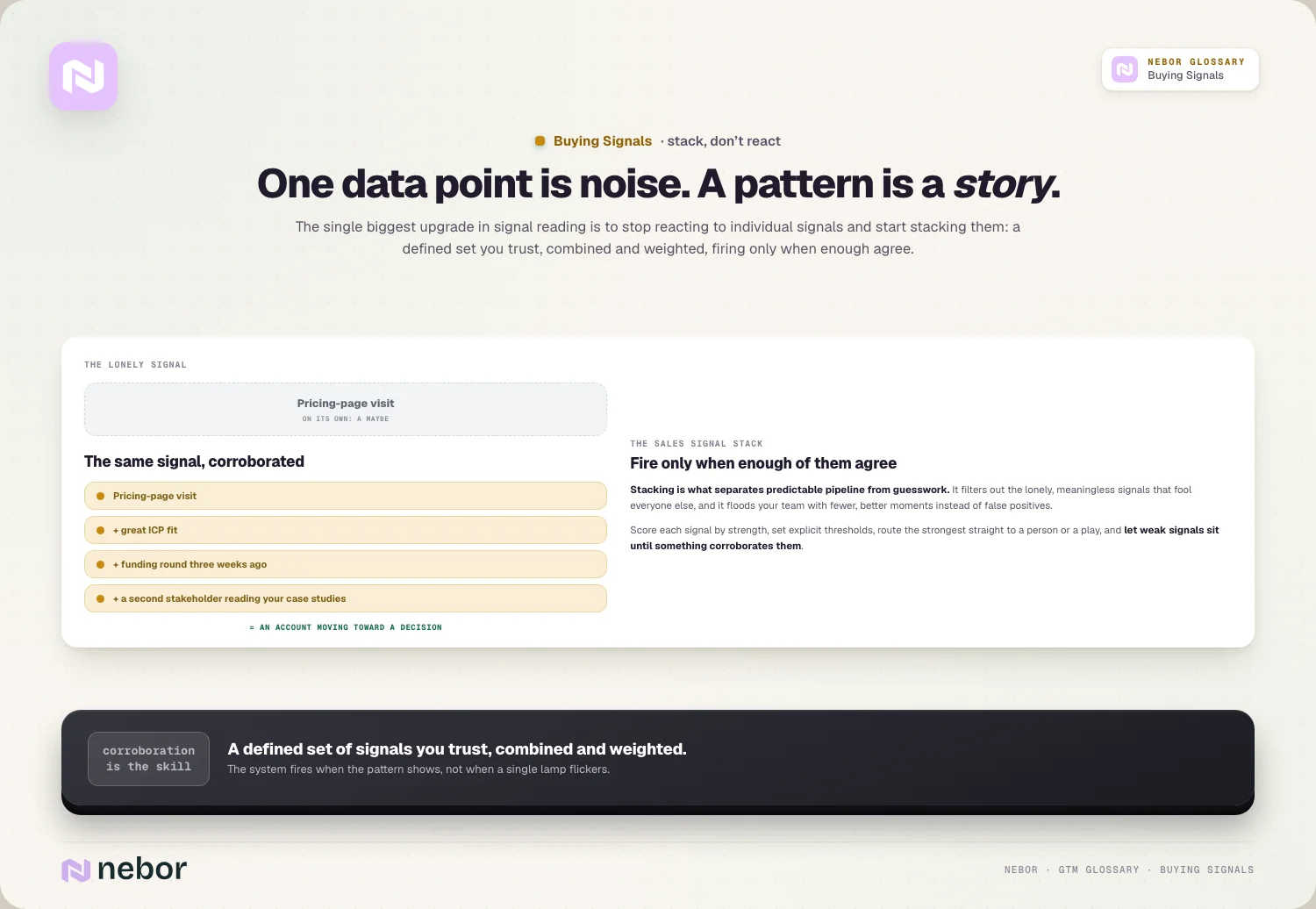
This is the idea behind building a sales signal stack, a defined set of signals you trust, combined and weighted so the system only acts when enough of them agree.
Stacking separates a program that feels like guesswork from one that produces predictable pipeline, because it filters out the lonely, meaningless signals that fool everyone else.
Why you have to move on a buying signal before it goes cold on you
A buying signal has a shelf life, and it's shorter than most teams think. The value of a signal drops by the day, sometimes by the hour, because the buyer's attention moves on and a competitor may already be in the conversation.
This is why speed matters so much. Research on inbound leads found that reaching someone within five minutes makes you far more likely to qualify them than waiting even half an hour, and the same logic applies to any signal. A perfect signal acted on a week late is just a missed opportunity with good documentation.
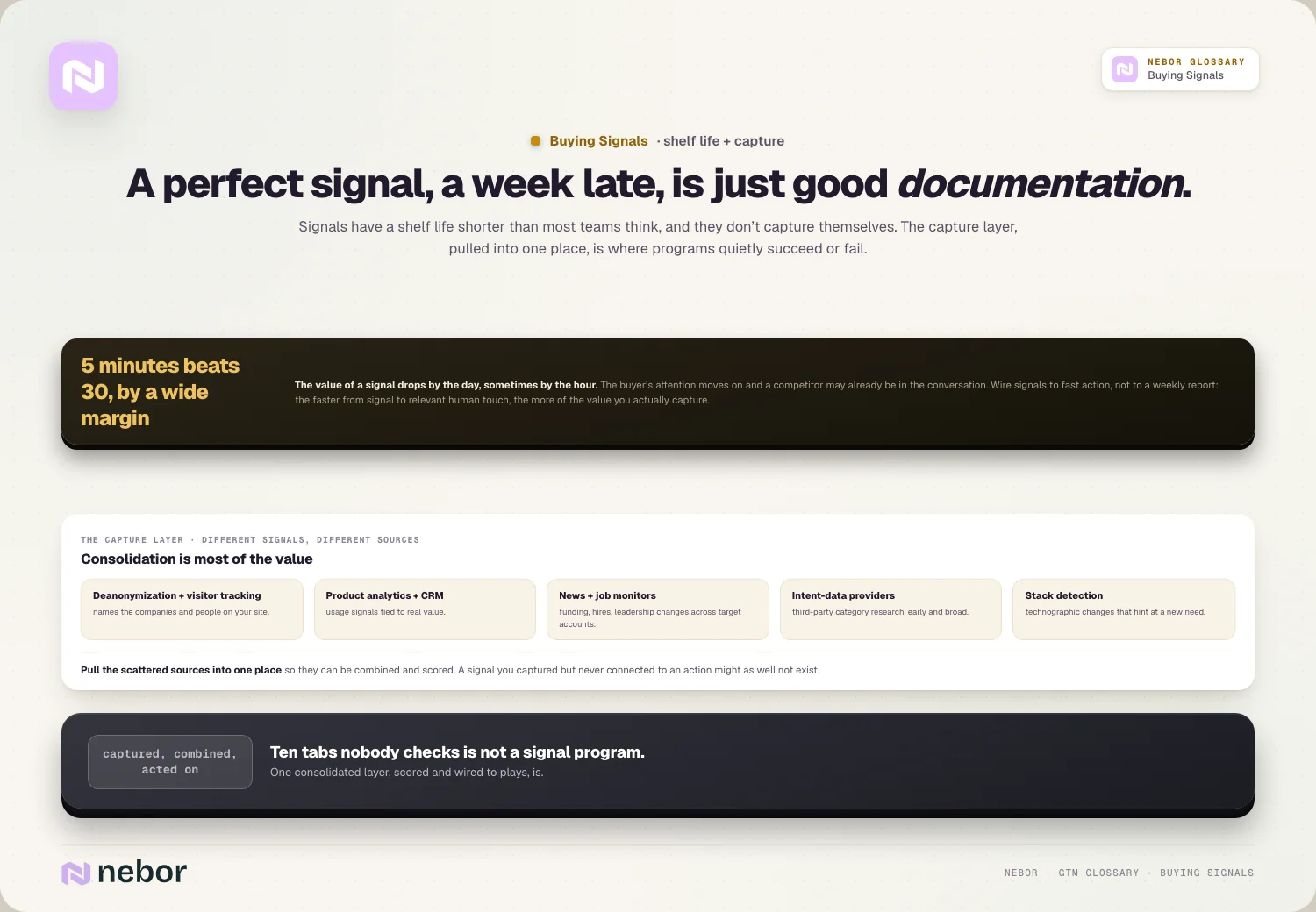
The practical takeaway is to wire signals straight into same-day action, because a weekly report is where their value goes to die. The faster you go from signal to relevant human touch, the more of that value you capture, which is the core of speed to lead.
Which signals you can trust more, the ones you own or the ones you buy
The split between first-party and third-party changes how you treat a signal more than any other, and the two are anything but interchangeable.
First-party signals come from surfaces you own, so they're about you specifically and they're yours alone to act on. They're stronger and cleaner, but they only appear once an account is already paying you some attention.
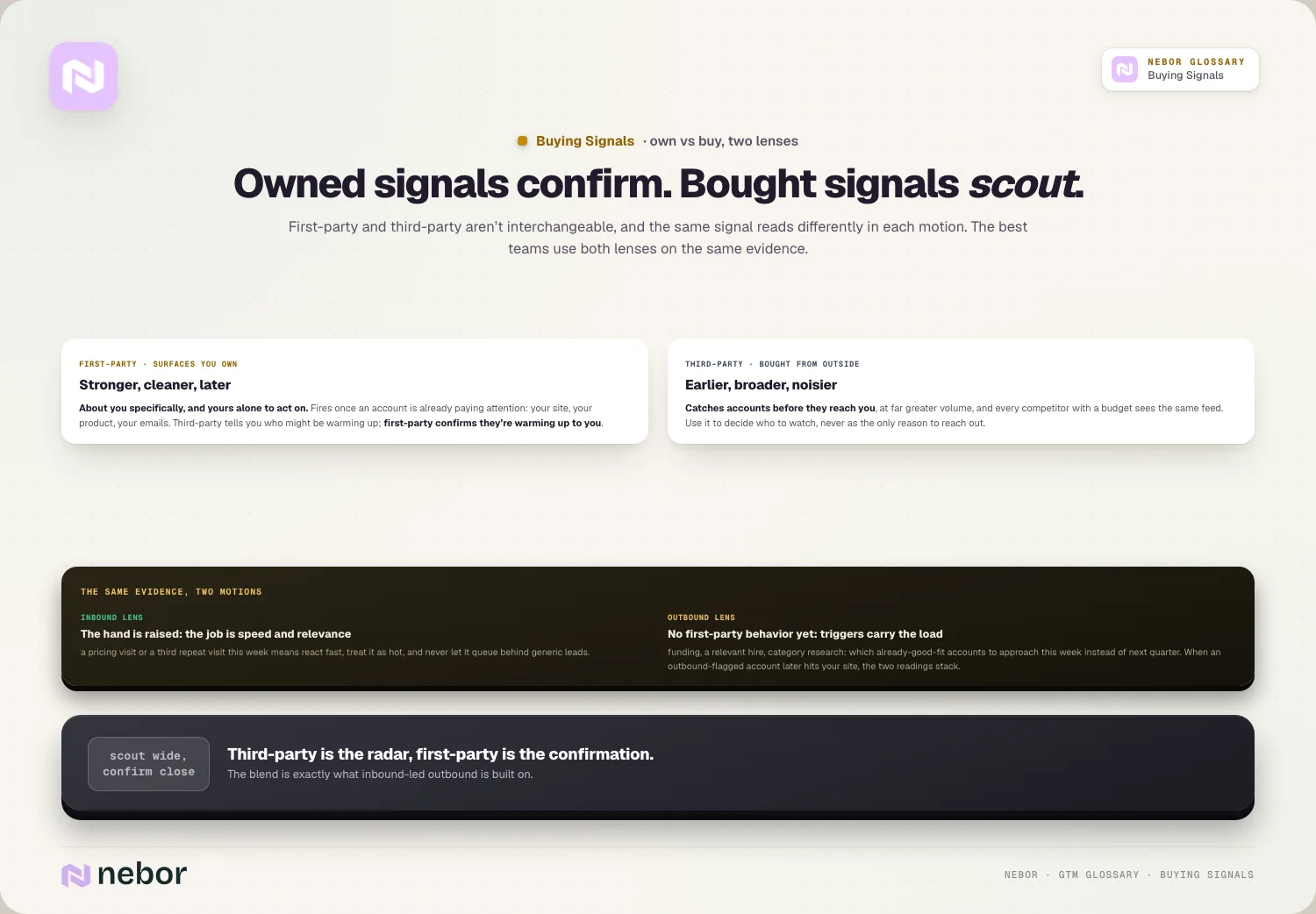
Third-party signals come from outside, so they catch accounts earlier and at far greater volume, but they're noisier and every competitor with a budget can see them too.
Picking one over the other was never the answer. You combine them, and you stay clear about which is which when you weigh a signal, the exact job the first-party versus third-party distinction exists for. Third-party tells you who might be warming up. First-party confirms they're warming up to you.
Where all of these buying signals get captured in the first place
Signals don't show up in your CRM on their own. You have to capture them, and the capture layer, where different signals need different sources, is where a lot of signal programs quietly succeed or fail.
First-party web behavior comes from deanonymization and visitor tracking tools that name the companies and people on your site, while product signals come from your own product analytics and CRM.
Trigger events like funding, hiring, and leadership changes come from news and job-monitoring tools that watch your target accounts. Third-party intent comes from intent-data providers, and technographic signals come from stack-detection data.
The work is pulling these scattered sources into one place so they can be combined and scored, rather than living in ten different tabs nobody checks. That consolidation is where we spend most of our build time, because a signal you captured but never connected to an action might as well not exist.
How to act on your signals without drowning your team in false alarms
Capturing signals turns out to be the easy half. The hard half is acting on them without burning out your team or your reputation, and that takes a real system.
Start by scoring each signal by strength using the dimensions above, then set explicit thresholds so only meaningful combinations trigger anything. Route the strongest straight to a person or an automated play, and let the weak, lonely signals wait until something corroborates them.
This is the core of signal-based selling, where a real signal prompts a timely, relevant touch instead of a fixed cadence that ignores readiness.
It works on both sides of the funnel. On inbound, a first-party signal like a pricing visit triggers a fast, warm follow-up. On outbound, a trigger event or third-party signal tells you which cold accounts are worth approaching now, so your outreach lands with a real reason instead of random timing.
When you do reach out, reach the whole account instead of a single contact, because a buying decision belongs to a group of people, and one click never speaks for the group. A strong, stacked signal from a fit account should become a same-day, multi-threaded touch while the interest is still warm.
How reading buying signals changes depending on whether you're working inbound or outbound
The same signal means different things depending on which motion you're in, and the best teams read it through both lenses. Inbound and outbound aren't separate signal programs. They're two ways of using the same evidence.
On the inbound side, your signals are mostly first-party and they're already pointed at you. Someone hit your pricing page, booked a demo, or came back three times this week, so the job is speed and relevance, and the discovery is already done.
The account has raised its hand, and your only real risk is reacting too slowly or treating a hot account like a generic lead. This is where a tight inbound meeting workflow proves its value, because it turns a fresh first-party signal into a booked conversation before the interest fades.
On the outbound side, you don't have first-party behavior yet, so trigger events and third-party intent carry the load. A funding round, a relevant new hire, or a spike in category research tells you which cold accounts have a fresh reason to care right now.
Your outreach lands with real timing instead of random luck, and the signal never replaces good targeting, it tells you which of your already-good-fit accounts to approach this week instead of next quarter.
The smartest move is to let the two motions feed each other. An outbound signal warms an account, that account later shows up on your site as a first-party signal, and now you have a stacked picture across both motions.
That blend is exactly what inbound-led outbound is built on, and it's where most of the real pipeline hides.
The signal-reading mistakes you'll want to steer around from day one
Most signal programs underdeliver for the same handful of reasons, and they're all avoidable. Knowing them ahead of time is half the battle.
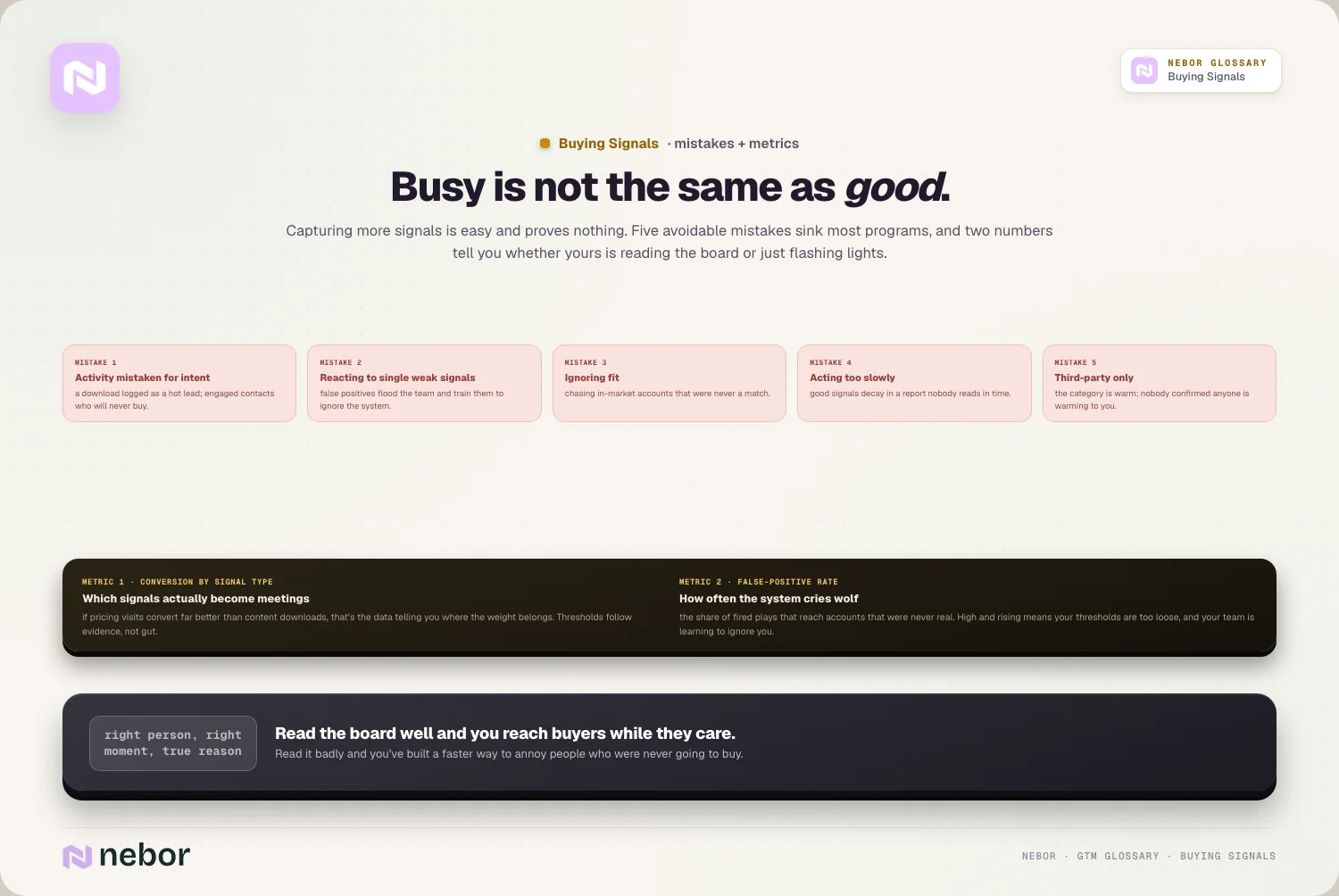
The most common is mistaking activity for intent. A content download or a webinar signup gets logged as a hot lead, when plenty of engaged contacts will never buy, and without fit underneath, activity is motion with nothing behind it.
The second is reacting to single weak signals instead of waiting for a stack, which floods your team with false positives and trains them to ignore the system.
The third is ignoring fit entirely, so the team chases in-market accounts that were never a match, and the fourth is acting too slowly, letting good signals decay in a report.
And the fifth is leaning only on third-party intent, which flags a warm category without ever pointing at you. Avoiding those five already puts you ahead of most of the market.
How the metrics tell you whether your signal reading is truly working
If you want to know whether your signal program is good or just busy, watch a few numbers rather than the volume of signals you capture. Capturing more signals is easy and it proves nothing.
The first number is conversion by signal type. If pricing-page visits convert to meetings at a much higher rate than generic content downloads, that's the data telling you which signals deserve real weight and which ones belong on a watch list. Over time, your thresholds should follow that evidence instead of your gut.
The second is your false-positive rate, the share of signal-triggered touches that go nowhere because the account was never a fit or never serious. A high rate means you're acting on lonely or low-quality signals, and it slowly trains your team to ignore the system.
The third is time from signal to first touch, because a signal program that's accurate but slow still leaves most of the value on the table.
Read together, these tell you whether to tighten your stack, loosen it, or fix your speed. A program that improves on all three is learning, and one that only grows its signal count is just logging.
What separates a real buying-signal program from a fast way to annoy people
When you strip everything else away, a buying-signal program comes down to one discipline. You read the evidence honestly, you stack it before you act, you weigh it against fit, and you move fast once enough of it agrees.
The teams that get this wrong aren't short on signals. They're short on judgment, reacting to lonely data points, skipping fit, and mistaking a content download for a buyer. More data just makes that worse, because it gives them more noise to overreact to.
The teams that get it right end up somewhere genuinely valuable. They reach the right people at the moment those people actually care, with a reason that's true, which is the whole promise of signal reading when it's done with discipline instead of hope.
Share this post
Intent
Data
Glossary
Related glossary items
Understanding the core GTM concepts




Ready to build your pipeline











