

In this post:
A fit score measures how well an account matches the kind of company you sell to. An intent score measures how likely that account is to buy right now. They answer two completely different questions, and you need both to decide who to chase and when.
Most teams blur these into a single lead score, and that one habit causes a lot of bad decisions. A great-fit company with no intent gets treated the same as an in-market company that's a poor fit, and neither gets handled well.
Keeping fit and intent as two separate scores is one of the simplest upgrades you can make to your targeting. It tells you not just whether an account is worth selling to, but whether now is the moment, which are two things you should never collapse into one number.
TL;DR
A fit score answers whether an account is the right kind of company for you, based on firmographics and ICP match. An intent score answers whether they're showing signs of buying now, based on behavior and signals.
The two are independent, so you should score them separately. Fit tells you if an account is worth selling to in the first place, and intent tells you about timing, and collapsing them into one number hides which is which.
The real value comes from combining them as a grid. High fit and high intent means act now, high fit and low intent means nurture, and high intent but low fit usually means walk away. Reading the two together is what tells you where to spend your time.
So what's the difference between a fit score and an intent score?
The two scores measure different dimensions of the same account, which is exactly why you need both. One is about who the account is, and the other is about what they're doing.
A fit score deals in suitability, asking whether an account looks like your ideal customer, based on stable attributes like industry, size, and role. A perfect-fit account is one you'd love to sell to, regardless of whether they're ready right now.
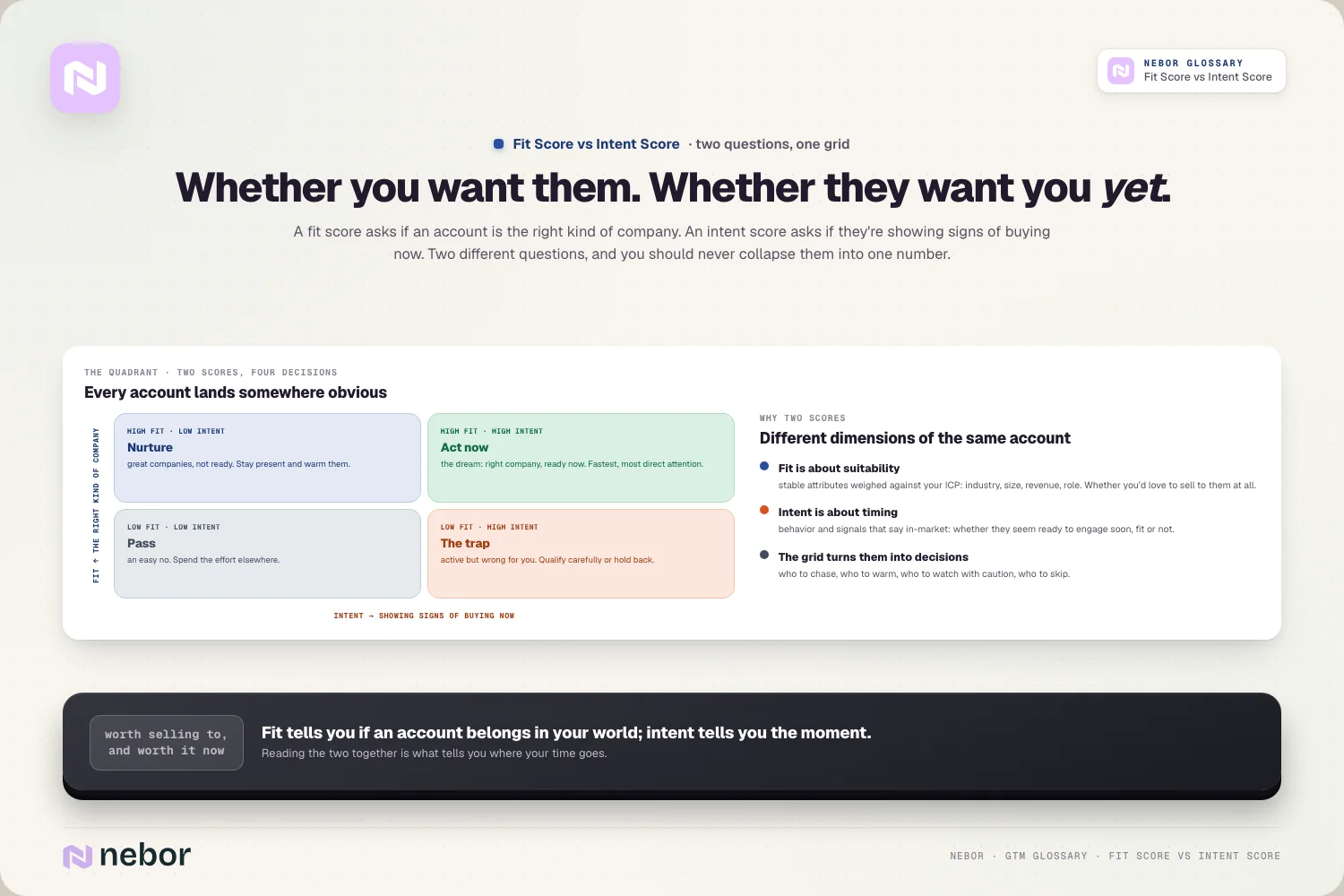
An intent score deals in timing instead, asking whether an account is showing signs of being in the market, based on their behavior and the signals they're giving off. A high-intent account is one that seems ready to engage soon, regardless of whether they're a great fit.
Fit is about whether you want them, and intent is about whether they want you yet, and those are two genuinely different questions.
What goes into a fit score, and where does the data come from?
A fit score is built from the relatively stable facts about an account, the ones that decide whether it belongs in your market at all. Most of the inputs are firmographic facts and role details.
On the company side, fit comes from firmographic data, like industry, size, revenue, and location, weighed against your ideal customer profile.
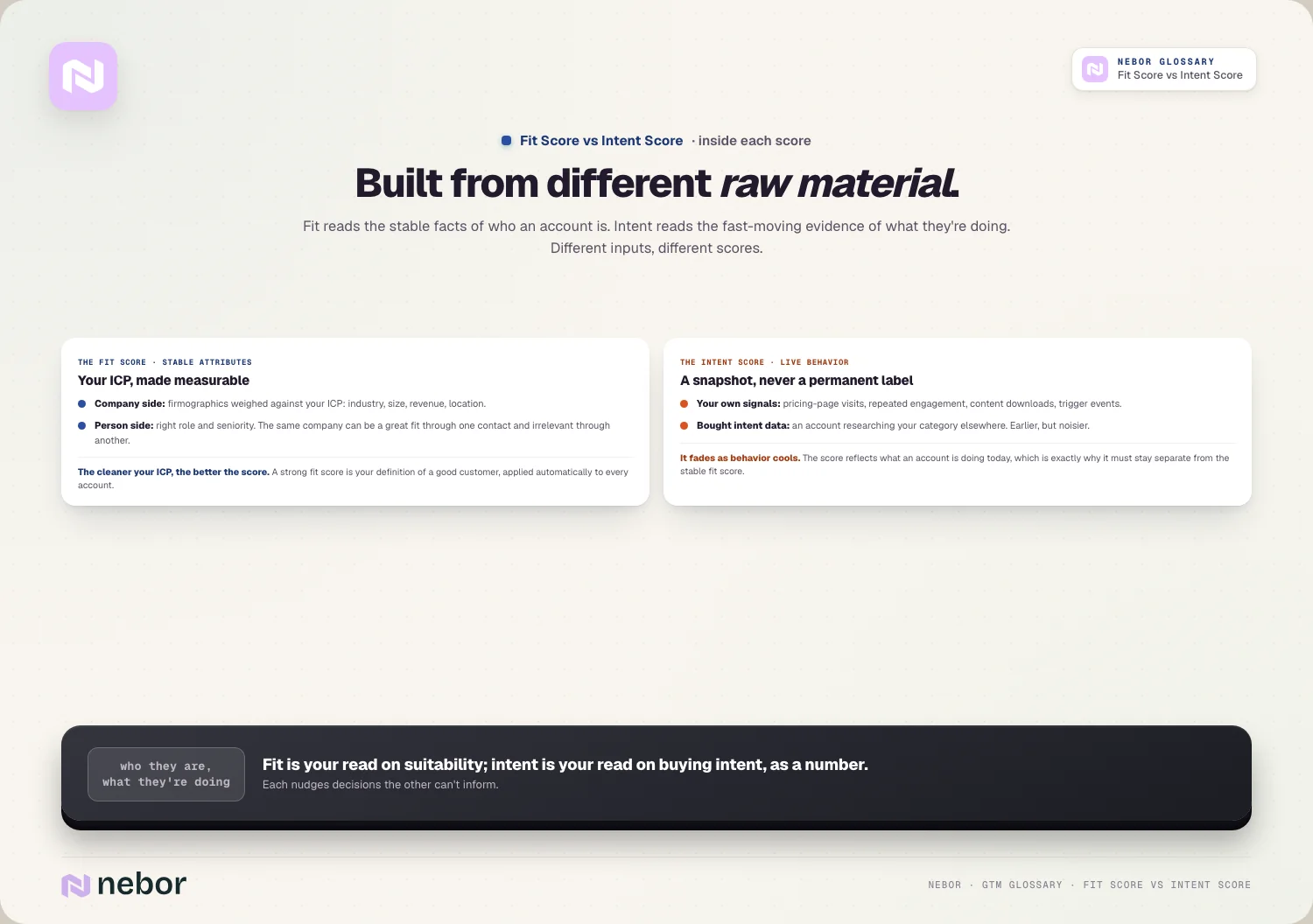
On the person side, it factors in whether you're dealing with the right role and seniority, because the same company can be a great fit through one contact and irrelevant through another.
The cleaner your ICP, the better your fit score. This is where a proper ICP scoring model proves its value, turning your definition of a good customer into a repeatable score.
A strong fit score is your ICP made measurable, applied automatically to every account that enters your funnel.
What goes into an intent score, and why does it keep moving?
An intent score is built from behavior and signals instead of fixed attributes, because it's trying to capture something that changes constantly. It reads the evidence that an account might be moving toward a purchase.
It draws on buying signals, like visits to your pricing page, repeated engagement, content downloads, and trigger events, as well as bought intent data showing an account researching your category.
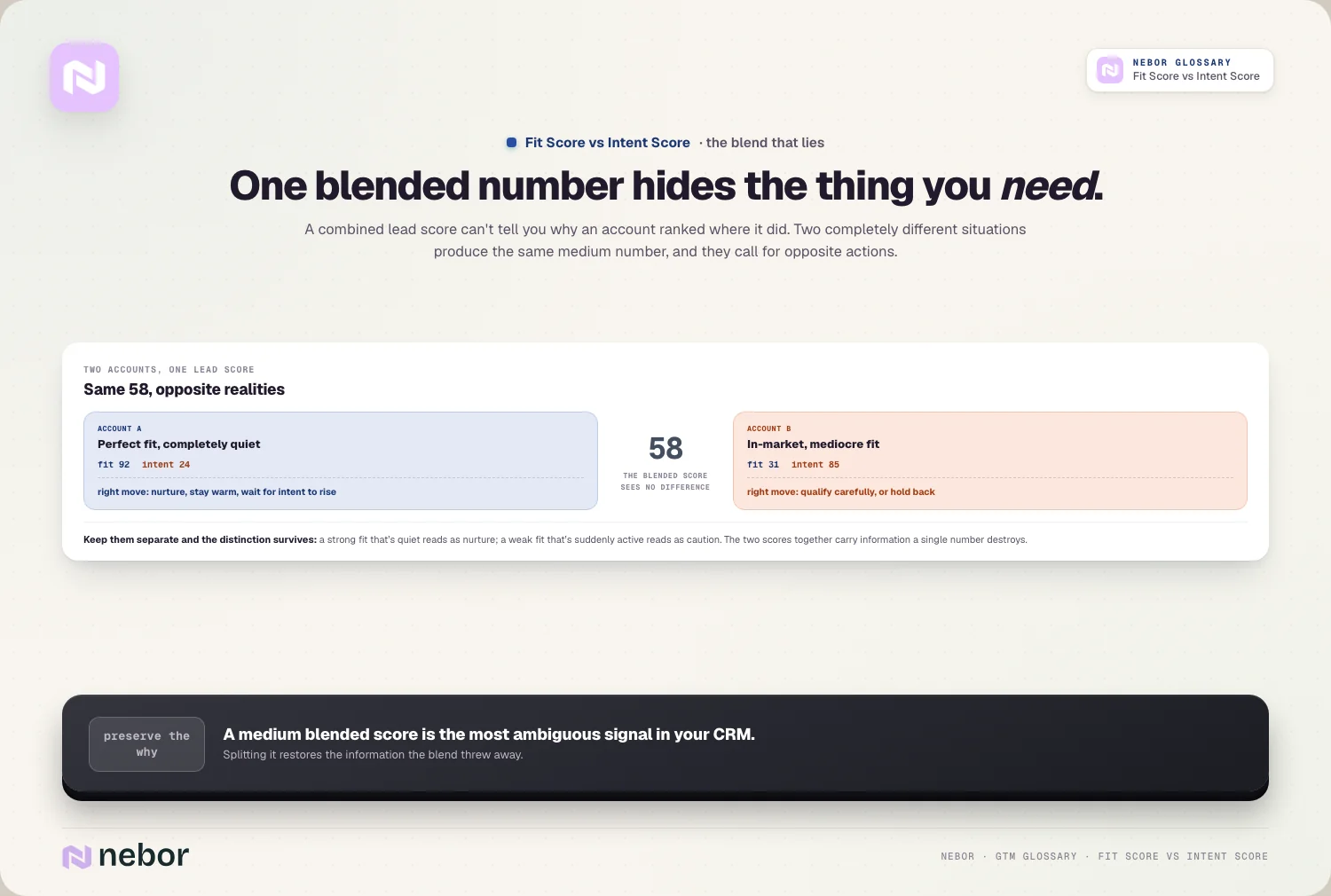
Each of these nudges the score up, and together they paint a picture of how in-market an account looks right now.
The key thing about an intent score is that it works like a snapshot rather than a permanent label. It reflects what an account is doing today, and it fades as that behavior cools, and that fading is exactly why it has to live apart from the more stable fit score.
An intent score is really your read on buying intent, turned into a number you can act on.
Why should you keep fit and intent as two completely separate scores?
This is the heart of the whole idea, and it's where most teams go wrong. Collapsing fit and intent into one number throws away the most useful information you have.
The problem is that one combined score can't tell you why an account scored the way it did. A medium score might mean a perfect-fit account with no current intent, or an in-market account that's a mediocre fit, and those two situations call for different actions.
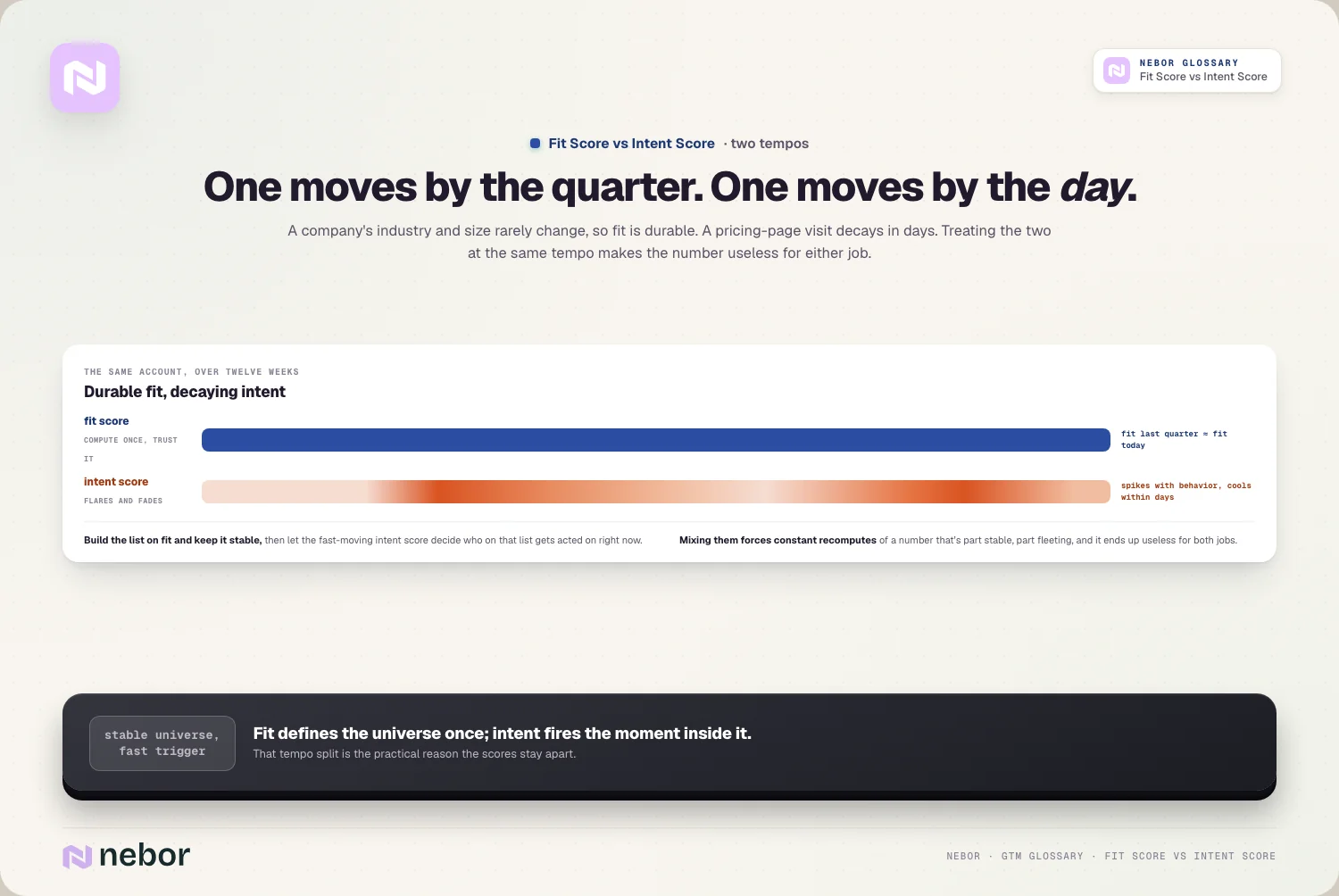
Once you blend them, you can't tell them apart, and neither account gets what its situation asks for.
Keeping them separate preserves exactly that distinction. You can see at a glance that an account is, say, a strong fit but quiet, which tells you to nurture it, versus a weak fit that's suddenly active, which tells you to be cautious.
The two scores together carry information that a single number destroys.
How do the two scores combine into a quadrant you can act on?
The cleanest way to use fit and intent together is to picture them as a simple grid, with fit on one axis and intent on the other. Each account lands in one of four quadrants, and each quadrant has an obvious action.
High fit and high intent is the dream, the right kind of company showing it's ready now, and these accounts get your fastest, most direct attention.
High fit and low intent is your nurture pile, great companies that aren't ready yet, where you stay present and warm them until their intent rises. These are exactly the accounts a patient approach pays off on.
High intent but low fit is the quadrant that fools people, an account that looks active but isn't really right for you, where you usually hold back or qualify carefully rather than chase. And low fit with low intent is an easy pass.
Reading the grid this way turns two scores into a clear set of decisions about where your effort should go.
Why is fit usually stable while intent is so sensitive to timing?
A big reason to separate the scores is that they move at completely different speeds, and treating them the same ignores that. Fit changes slowly, while intent changes by the day.
A company's fit is based on things like its industry and size, which rarely change much, so a fit score is fairly durable and you can compute it once and trust it for a while. An account that fit your ICP last quarter almost certainly still does.
Intent is the opposite, since the signals behind it, like a pricing-page visit or a research spike, are fleeting and decay quickly.
This difference in tempo has a very practical payoff. You can build your target list on fit and keep it stable, then let the fast-moving intent score decide who on that list to act on right now.
Mixing the two would force you to constantly recompute a number that's part stable and part fleeting, which makes it useless for either job.
How does fit versus intent fit into your overall lead scoring?
Fit and intent aren't a replacement for lead scoring, they're the smarter structure underneath it. Good lead scoring is really these two scores working together rather than one blended number.
In practice, the strongest setups we build score fit and intent separately and then use both to prioritize. Fit qualifies an account into your pipeline, and intent ranks the qualified accounts by how ready they are, so your team always works the right companies in the right order.
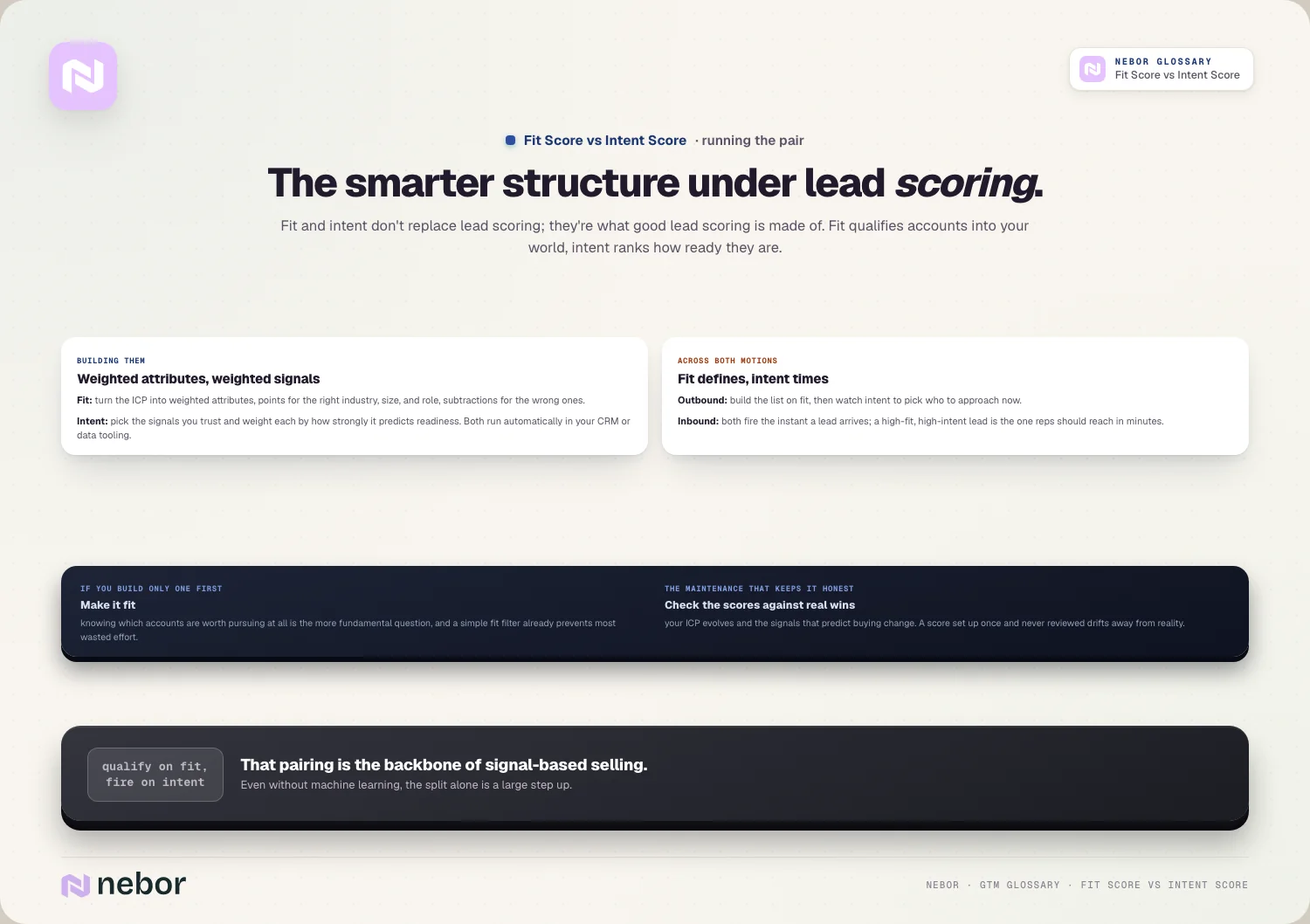
This is also the backbone of signal-based selling, where a fit-qualified account triggers action the moment its intent rises.
More advanced teams layer predictive lead scoring on top, using past wins to learn which combinations of fit and intent actually convert.
But even without any machine learning, simply splitting your one lead score into fit and intent is a large step up, because it restores the information a single number hides.
What are the common mistakes teams make with fit and intent scoring?
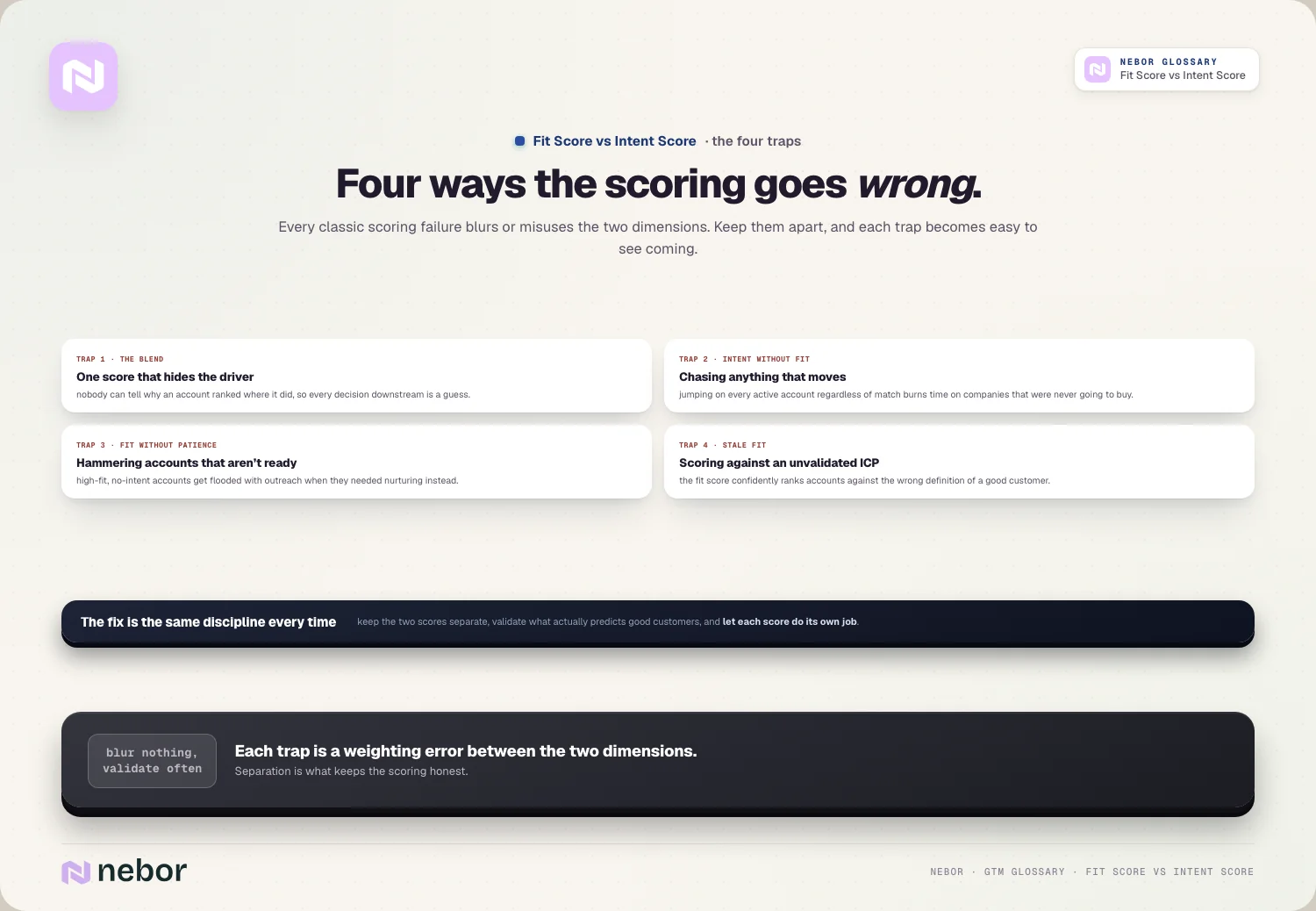
Most scoring problems come down to a few recurring errors, and they all blur or misuse the two dimensions in some way. Knowing them in advance keeps your scoring honest.
The biggest is the single blended score that hides which dimension is driving it, leaving everyone guessing why an account ranked where it did.
Close behind is chasing intent without fit, and we watch teams do this constantly, jumping on any active account regardless of whether it's a real match and burning time on companies that were never going to buy.
The opposite mistake is hoarding high-fit accounts with no intent and hammering them with outreach, when they simply aren't ready and need nurturing instead.
There's also stale fit, where the score rests on an ICP nobody validated, so the setup is confidently scoring against the wrong definition of a good customer.
All of these have the same cure. You keep the two scores separate, validate what truly predicts good customers, and let each score do its own job.
How do fit and intent scores show up on inbound and outbound work?
Fit and intent both matter on each side of the funnel, but they enter the picture at different moments. Seeing the pattern helps you apply them well.
On outbound, fit does its work before the first email goes out. You build your target list on it, filtering the market down to the right kind of company, and then you watch intent to decide who on that list to approach now.
Fit defines the universe, and intent sets the timing.
On inbound, both scores land the instant a lead arrives. When someone fills in a form or engages on your site, you score their fit against your ICP and read their intent from what they just did, so you can route and prioritize them immediately.
A high-fit, high-intent inbound lead is the one your reps should reach in minutes, which is where speed to lead and good lead routing turn the two scores into fast action.
How do you build and then maintain these two scores in practice?
Setting up fit and intent scoring is more straightforward than it sounds, and in our experience you don't need anything fancy to start. The two scores get built from different inputs, so you handle them separately.
For the fit score, you turn your ICP into a set of weighted attributes, like giving points for the right industry, size, and role, and subtracting for the wrong ones.
For the intent score, you pick the signals you trust, like a pricing-page visit or a research spike, and assign each a weight based on how strongly it predicts readiness. Both can live in your CRM or your data tooling and update automatically on every account.
The maintenance is where most teams slip. Both scores need revisiting, because your ICP evolves and the signals that predict buying change over time. A score you set up once and never review slowly drifts away from reality, so a periodic check against your real wins keeps both honest.
Does every team need both scores, or can you start with just one?
If building two scores feels like a lot, the good news is you can start with one and add the other later. They aren't all-or-nothing, and even rough versions beat working with no scoring whatsoever.
If you only build one first, make it fit, because knowing which accounts are even worth pursuing is the more fundamental question.
A simple fit score that filters your market to the right kind of company already prevents most wasted effort, even before you add any intent data. You can layer intent on once you have the signals to feed it, and start acting on timing as well as fit.
The point is to get the structure right instead of trying to perfect both scores on day one. If you start with fit, add intent as your signals mature, and keep them separate from the beginning, you'll never have to untangle a blended score later.
A simple two-score setup beats a sophisticated single one every time.
Why two scores beat one every time you have to decide who to chase
Separating fit from intent exists to protect the two pieces of information you most need, which is whether an account is worth your time and whether now is the moment. One number can't hold both, and the moment you blend them, you lose the ability to act intelligently.
The teams that get this keep the two scores apart, build their targeting on the stable fit score, and let the fast-moving intent score decide their daily priorities. That structure makes everything downstream better, from who gets routed to a rep, to who gets nurtured, to who gets ignored.
The mindset that works is to treat fit as the question of whether to play at all, and intent as the entirely separate question of when to play. When you answer them separately and read them together, you always know where your next hour of effort should go.
That clarity counts for far more than the false simplicity of a single score.
The companies that win at this rarely have the fanciest models, they just refuse to throw away the distinction between whether an account is right and whether the timing is, and that small discipline quietly compounds across every targeting decision they make.
Share this post
Intent
Data
Prospecting
Glossary
Related glossary items
Understanding the core GTM concepts




Ready to build your pipeline











