

In this post:
Firmographic data is the descriptive information about a company, like its industry, size, revenue, and location. It's the B2B equivalent of demographics, the basic facts that tell you what kind of business an account really is.
It answers the most fundamental question in targeting, which is whether a company is the sort of business you sell to at all. Before you ever think about who to email or what to say, firmographics tell you whether the account belongs on your list.
Almost everything in B2B targeting rests on this layer. Your ICP, your segmentation, your scoring, and your routing all start from firmographic facts, which is why getting them right quietly shapes the quality of everything downstream.
TL;DR
Firmographic data is company-level information, like industry, employee count, revenue, location, and structure. It describes what a company is, the way demographics describe what a person is.
It's the foundation of B2B targeting, because it tells you whether an account fits your ICP before you spend any effort on it. If the firmographics are wrong, you aim your whole go-to-market at the wrong companies.
It tells you about fit and stays silent on intent, so it's necessary without being sufficient. Firmographics narrow your list to the right kind of company, and then signals and behavior tell you which of those companies are worth reaching out to now.
So what is firmographic data, and what does it actually tell you?
Firmographic data is the set of attributes that describe a company as a whole, rather than any individual at it. Where demographics describe a person, firmographics describe an organization.
It tells you the basic shape of a business, like what industry it operates in, how big it is, how much it earns, and where it's based.
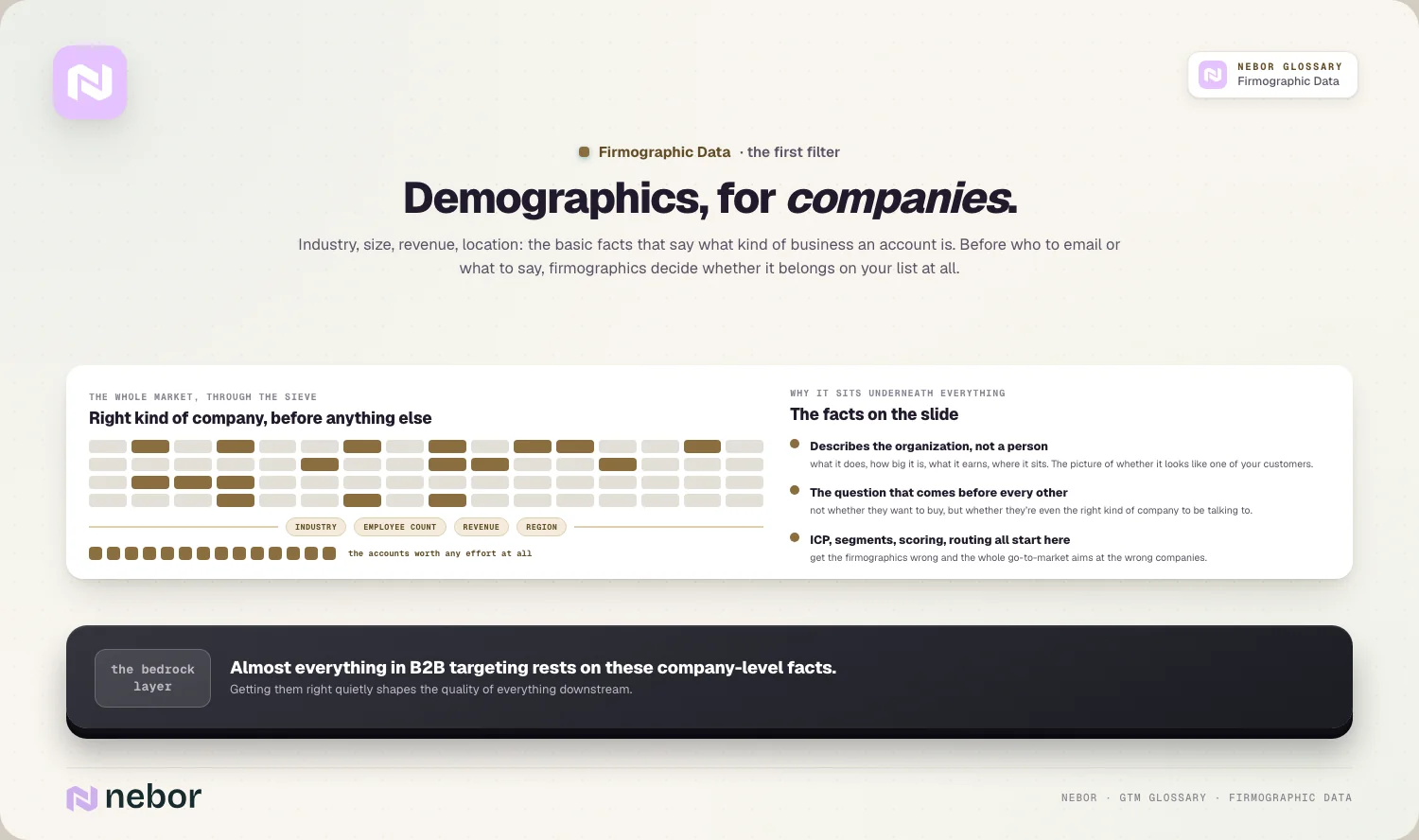
These are the facts you'd want on a slide if someone asked you to describe a target account in a sentence, and together they paint a picture of whether the company looks like one of your customers.
That makes firmographics the first filter in any B2B motion. They don't tell you whether a company wants to buy, but they tell you whether it's even the right kind of company to be talking to, which is the question you have to answer before any other.
What are the main firmographic data points you'll use day to day?
Firmographics cover a lot of possible attributes, but a core handful do most of the work. Knowing them helps you decide what to enrich and what to target on.
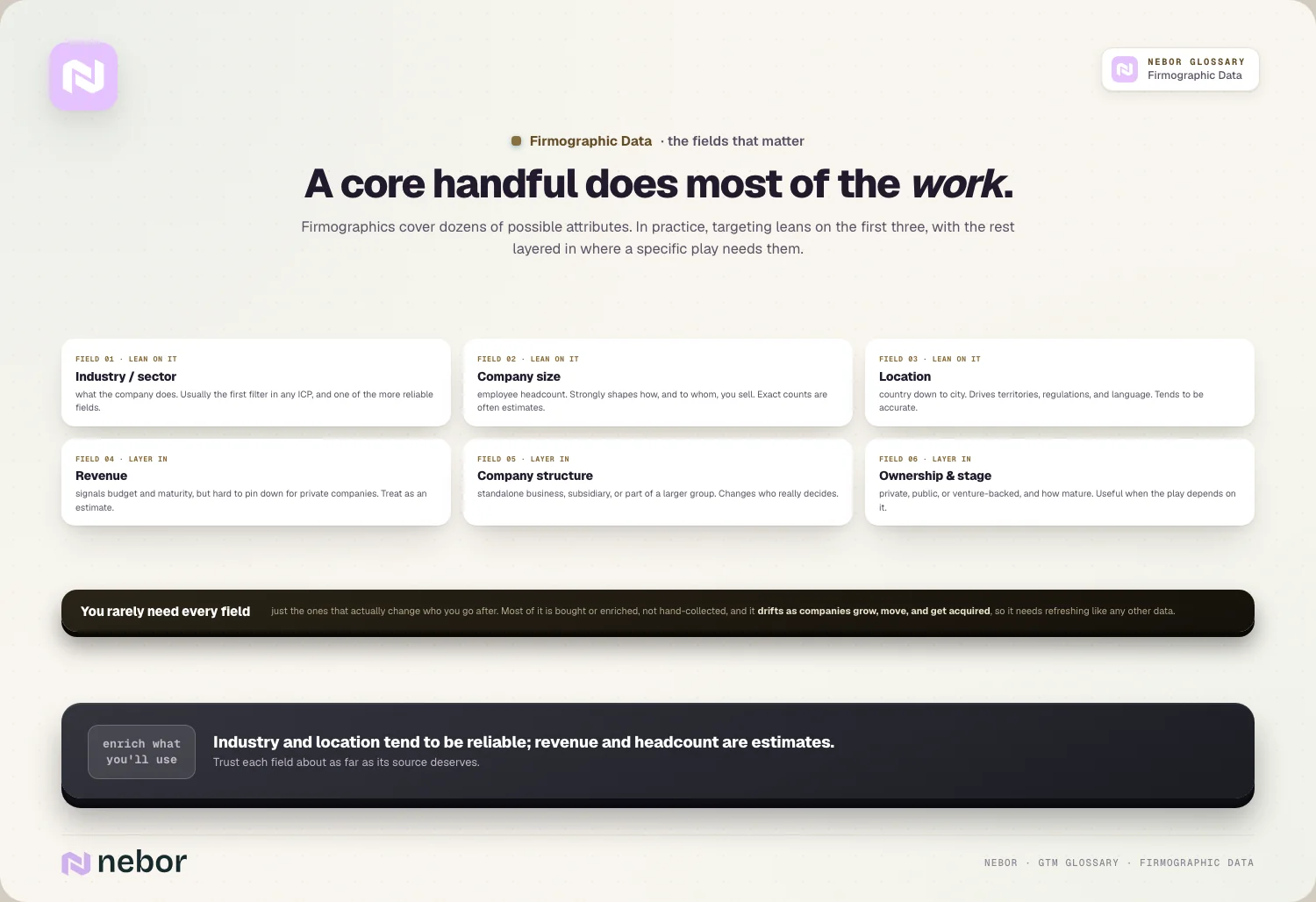
The most common and useful firmographic fields include these.
Industry or sector, which tells you what the company does and is often the first filter in any ICP.
Company size, usually measured by employee headcount, which strongly shapes how and to whom you sell.
Revenue, which signals budget and maturity, though it's harder to find accurately for private companies.
Location, from country down to city, which matters for territories, regulations, and language.
Company structure, like whether an account is a standalone business, a subsidiary, or part of a larger group.
Ownership and stage, such as whether a company is private, public, or venture-backed, and how mature it is.
Most targeting leans on the first few, industry, size, and location, with the others layered in where a specific play needs them. You rarely need every field, just the ones that truly change who you go after.
How is firmographic data different from demographic, technographic, and intent data?
These data types get muddled together, so it helps to draw clean lines. Each describes something different about an account or the people in it.
Firmographic data is about the company itself, its industry, size, and shape. Demographic data, in a B2B context, is about the individual people, like a contact's job title, seniority, and department.
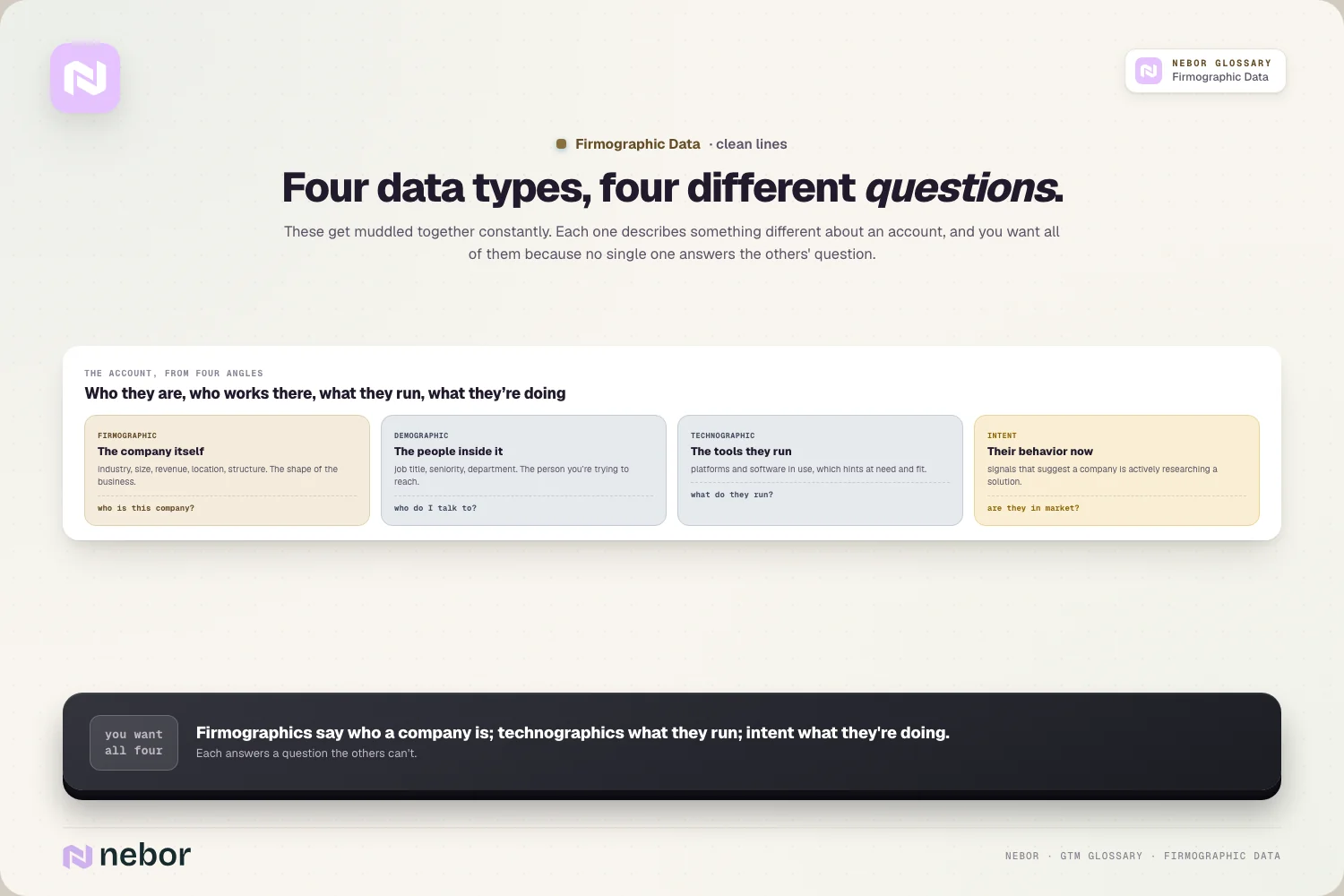
So firmographics tell you about the account, and demographics tell you about the person you're trying to reach inside it.
Technographic data is different again, describing the tools and platforms a company uses, which hints at need and fit. And intent data is about behavior, the signals that suggest a company is actively researching a solution.
Firmographics tell you who a company is, technographics tell you what they use, and intent tells you what they're doing right now. You want all three, because each answers a different question.
Why is firmographic data the foundation your whole ICP stands on?
Your ideal customer profile is built first and foremost on firmographics, and that's the reason this data is the base of everything. The ICP is essentially a firmographic description of the companies worth selling to.
When you define your ICP, you're mostly naming firmographic boundaries, like the industries you serve, the company sizes that fit, and the regions you cover. Those attributes are what separate a target account from a waste of time, and they're nearly all firmographic.
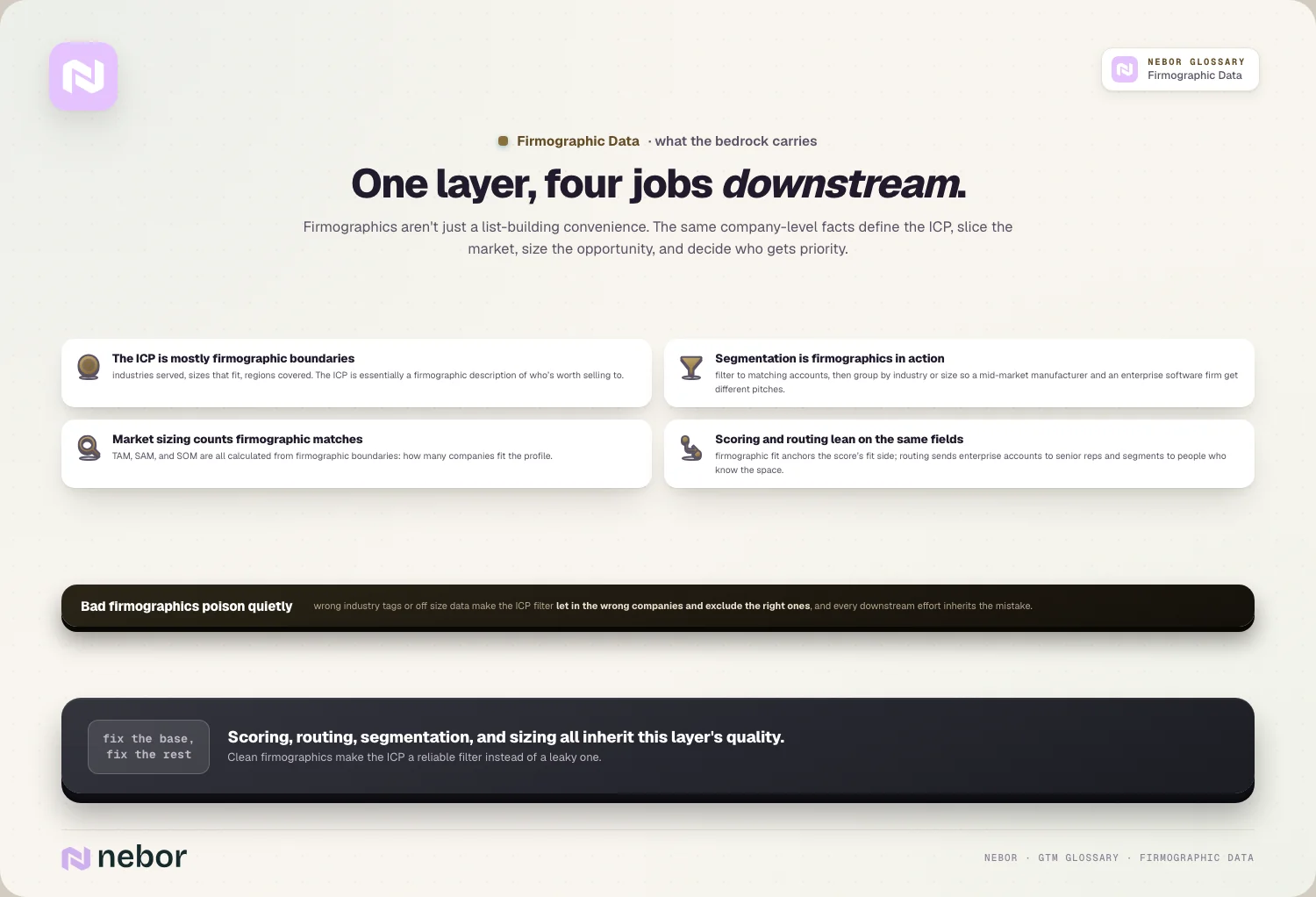
This is why bad firmographic data poisons everything it touches. If your industry tags are wrong or your size data is off, your ICP filter lets in the wrong companies and excludes the right ones, and every downstream effort inherits that mistake.
Good firmographics are what make the ICP a reliable filter rather than a leaky one.
How do you use firmographic data to target and segment your market?
Beyond defining who fits, firmographics are how you slice your market into groups you can sell to differently, and segmentation is really just firmographics in action.
The simplest use is filtering, building target lists of companies that match your firmographic ICP and excluding the ones that don't. From there, you segment, grouping accounts by industry or size so you can tailor your message to each.
A mid-market manufacturer and an enterprise software firm need different pitches, and firmographics are what let you tell them apart and treat them differently.
Firmographics also underpin your market sizing, because your TAM, SAM, and SOM are calculated from firmographic boundaries.
When you estimate how many companies you could sell to, you're counting accounts that match a firmographic profile, which makes this data the basis of how you understand the size of your opportunity.
How does firmographic data power your lead scoring and routing?
Firmographics don't just decide who's on your list, they help decide who gets priority and who handles them. They feed both your scoring and your routing.
In lead scoring, firmographic fit is usually the foundation of the score, because a lead from a perfect-fit company is worth more than the same lead from a poor-fit one.
This is the fit side of the fit and intent split, where firmographics establish whether an account is worth selling to and intent decides the timing.
Routing leans on firmographics just as heavily. You might send enterprise accounts to senior reps and smaller ones to a different team, or route by region and industry so each account reaches someone who knows that space.
Good lead routing leans heavily on firmographic fields to get each account to the right person quickly.
Where does firmographic data come from, and how accurate is it?
Firmographic data is usually bought or enriched rather than collected by hand, so you should know where it comes from and how far to trust it, because the source shapes the quality.
Most firmographic data comes through data enrichment from a data provider, which maintains a large database of companies built from public records, websites, filings, and other sources.
You start with a company name or domain, and the provider fills in the industry, size, revenue, and the rest.
Accuracy varies by field, and that's important to remember. Industry and location tend to be reliable, while revenue and exact headcount are often estimates, especially for private companies.
Firmographics also drift over time, since companies grow, get acquired, and move, so this data is subject to data decay and needs refreshing like any other.
What are the limits of firmographic data you should keep in mind?
Firmographics are powerful, but leaning on them too hard leads you astray, so let's be clear about what they can't do. They describe fit, and fit is only part of the story.
The biggest limit is that firmographics tell you nothing about intent. A perfect-fit company on paper might have no need, no budget, and no reason to buy for years, while a slightly-off-fit company might be ready to buy today. Firmographics narrow the field, but they can't tell you who's actually in the market.
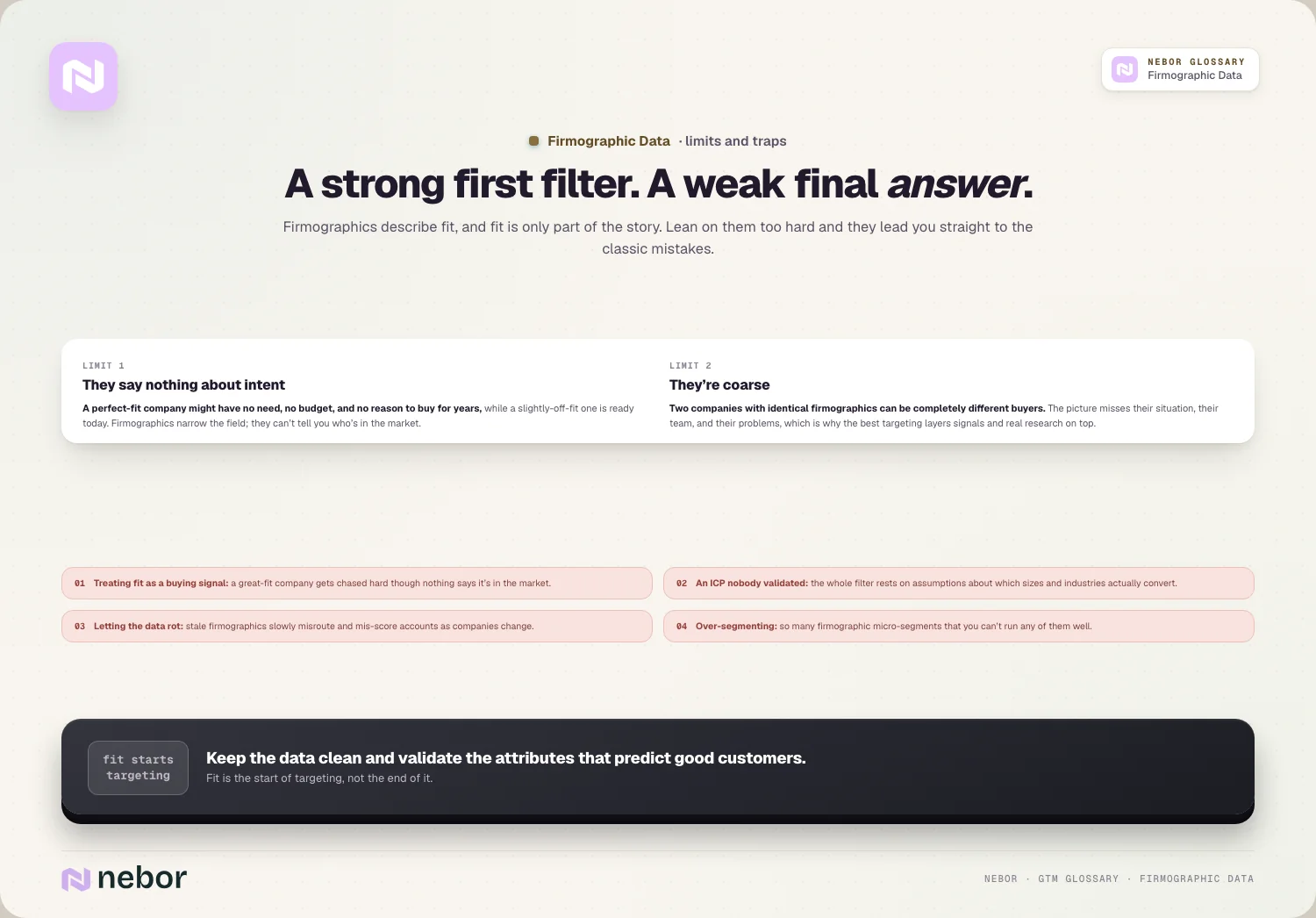
They're also a coarser instrument than they look. Two companies with identical firmographics can be completely different buyers, because the firmographic picture misses the specifics of their situation, their team, and their problems.
So firmographics are a strong first filter and a weak final answer, and that's the reason the best targeting layers signals and real research on top of them.
What are the common mistakes teams make with firmographic data?
Most firmographic missteps come from either trusting the data too much or not maintaining it. Both wear down your targeting a little more each quarter.
The most common mistake is treating firmographic fit as a buying signal, so a great-fit company gets chased hard even though nothing suggests it's in the market.
Another is building an ICP on firmographics nobody validated, so the whole filter rests on shaky assumptions about which company sizes and industries really convert.
A third is letting the data rot, since stale firmographics slowly misroute and mis-score accounts as companies change.
There's also over-segmenting, slicing your market into so many firmographic micro-segments that you can't work any of them well.
Across all of these, the protection is the same, meaning you keep your firmographics clean, validate the attributes that truly predict good customers, and remember that fit is where targeting starts instead of where it ends.
How does firmographic data work across both inbound and outbound?
Firmographics serve both motions, just at different moments. The data is the same, but each side of the funnel picks it up at a different point.
On outbound, firmographics do their work before anything else happens. You use them to build your target list before you reach out, filtering the whole market down to the companies that match your ICP so you only spend effort on accounts worth winning.
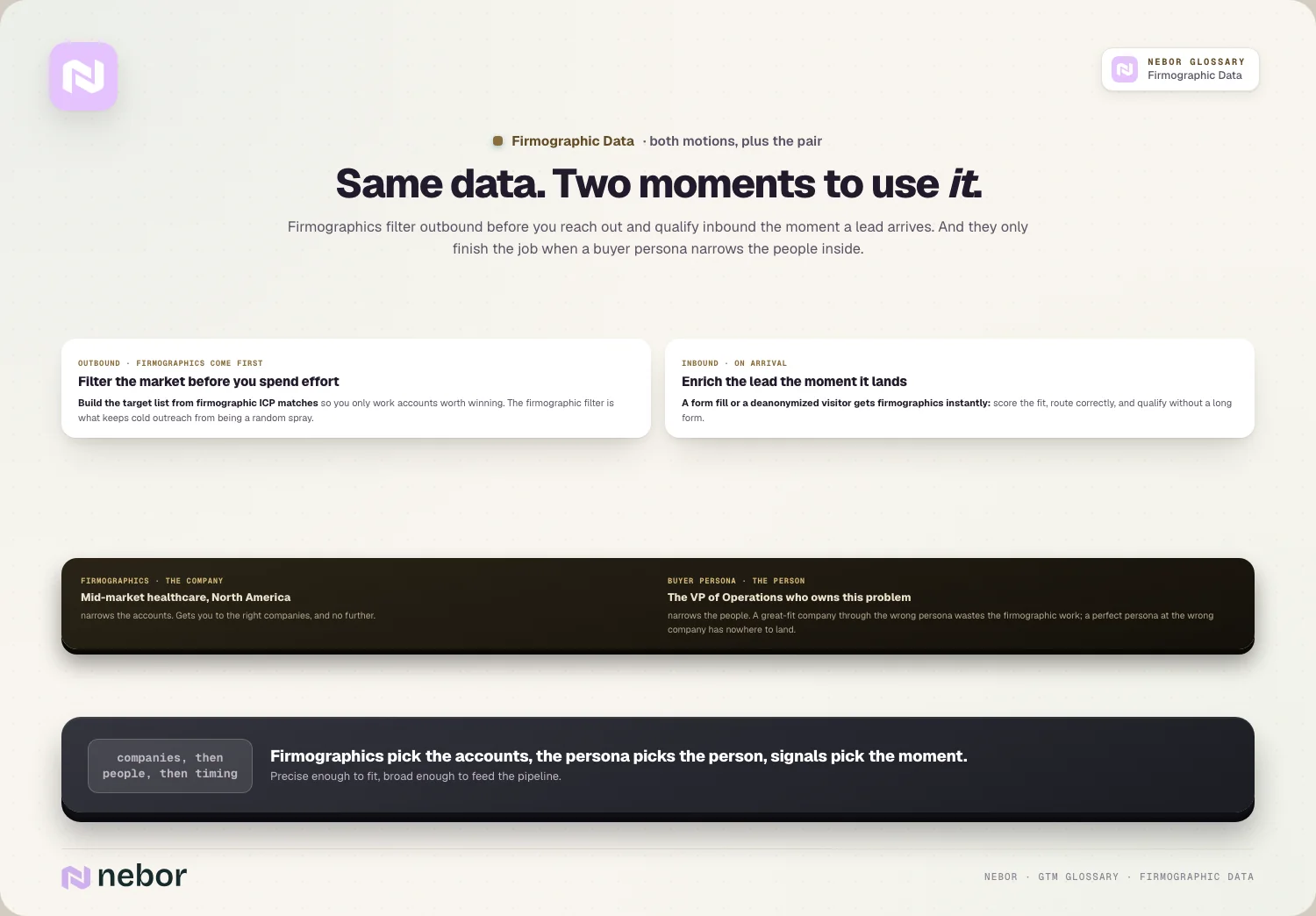
The firmographic filter is what keeps cold outreach from being a random spray.
On inbound, firmographics come in the moment a lead arrives. When someone fills in a form or a visitor deanonymizes on your site, you enrich them with firmographic data instantly.
That lets you score the fit, route them correctly, and qualify them without a long form. It's the same data, used to filter outbound up front and to qualify inbound on arrival.
What's the difference between firmographic data and a buyer persona?
These two get conflated, but they describe different things, and keeping them apart sharpens your targeting. Firmographic data describes the company, while a buyer persona describes the kind of person you sell to inside it.
Your firmographics might say you target mid-market healthcare companies in North America. Your persona says that within those companies, you sell to the VP of Operations who owns this problem and cares about these outcomes. One narrows the accounts, the other narrows the people.
You need both, and they work as a pair. Firmographics get you to the right companies, and the persona tells you who to reach and how to speak to them once you're there.
Targeting a great-fit company through the wrong persona wastes the firmographic work, and a perfect persona at the wrong kind of company has nowhere to land.
How granular should your firmographic targeting get before it hurts?
There's a real tension in firmographic targeting between precision and reach, and getting the balance wrong costs you either way. Too broad and you waste effort on poor-fit accounts, too narrow and you starve your pipeline.
The instinct, once you have rich firmographic data, is to keep adding filters until your list is tiny and perfect. But every extra condition shrinks your addressable market, and at some point you've narrowed your way into a list too small to build a business on.
Precision is only useful up to the point where you still have enough accounts to pursue.
The better approach is to filter on the firmographics that genuinely predict good customers and stop there, instead of piling on attributes that feel rigorous but barely move conversion.
A slightly broader, well-chosen filter usually beats an ultra-narrow one, because it keeps your pipeline full of accounts that are still a real fit.
Why we believe firmographic data is the quiet first filter that shapes everything else
In our own client work, firmographic data is the first thing we check, because it's the unflashy foundation that decides who you even bother talking to. It doesn't tell you what to say or when to reach out, but it decides whether an account deserves a place on your list, and every other decision builds on that answer.
The teams that respect it keep their firmographics clean, validate the attributes that predict good customers, and treat fit as a starting point instead of a verdict.
That discipline lifts the quality of their targeting, their scoring, and their routing, because all of those inherit the firmographic layer underneath.
The mindset we push clients toward is to get the firmographics right and then move past them. You use them to filter the market down to the right kind of company, and from there signals, intent, and real research tell you which of those companies to pursue.
Firmographics get you to the right neighborhood, and everything else is about finding the right door. When you treat them as the dependable first step they are and keep them clean, the rest of your targeting has a solid base to build on instead of a shaky one to inherit.
Share this post
Data
Glossary
Related glossary items
Understanding the core GTM concepts




Ready to build your pipeline











