
How To Hire a Growth Agency (What to Look for and the Red Flags Most Companies Miss)


In this post:
Most companies that search for a growth agency end up hiring the wrong type of partner.
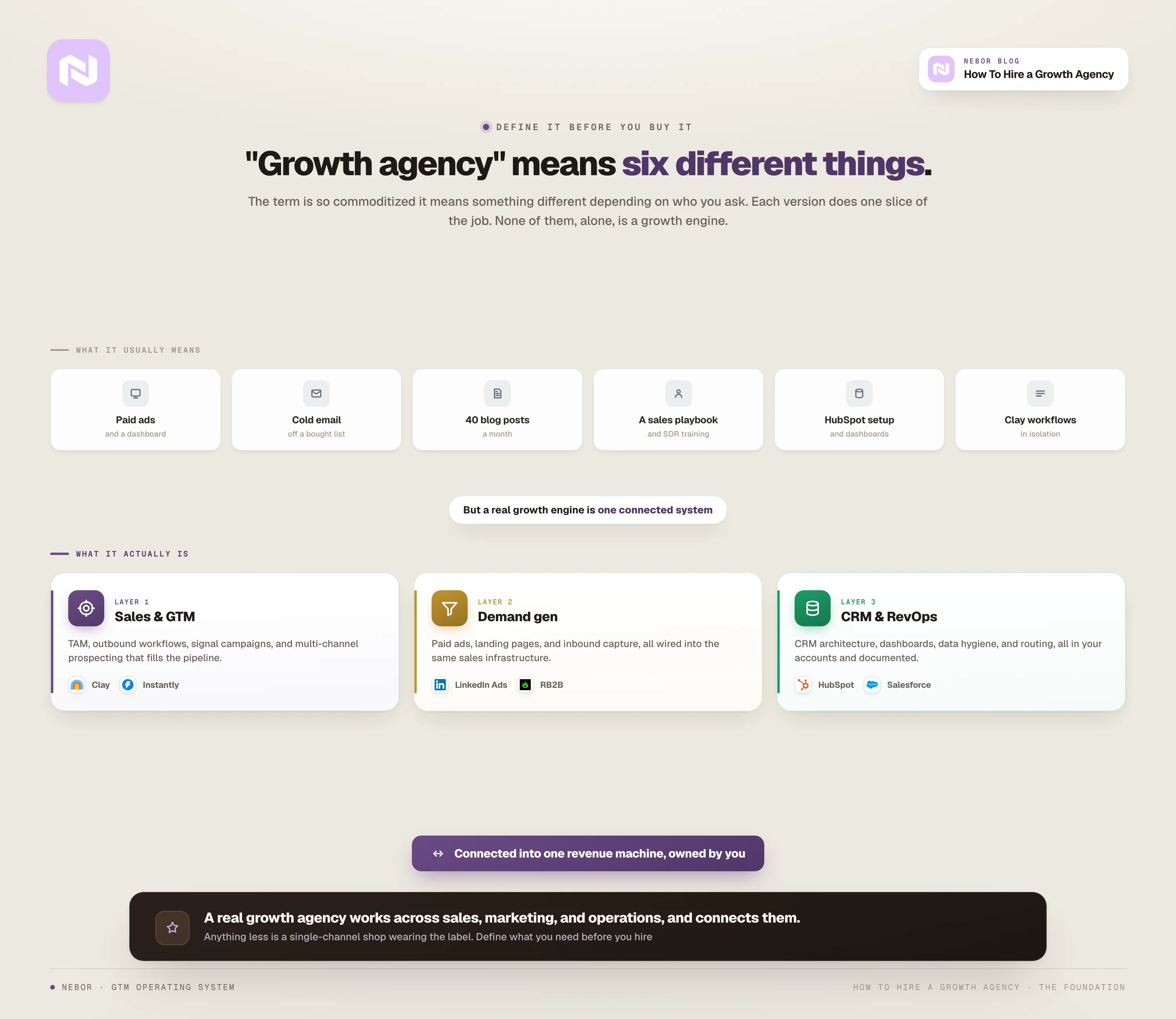
Not because they are bad at evaluating agencies. But because the term growth agency has become so commoditized that it means something different depending on who you ask.
For some agencies, growth means buying paid ads and sending you a dashboard full of impressions.
For others, it means cold emailing a list bought off Apollo until someone responds. And for a certain breed of SEO shops, it means publishing 40 blog posts a month and calling the organic traffic growth.
None of that is wrong in isolation. But none of it is a growth engine, either.
From our experience, a real growth partner does something much more different. They work to grow your business (generating real sales opportunities) while connecting your sales, marketing, and operations into a single revenue machine.
On top of generating leads, they also build the infrastructure that turns your entire go-to-market motion into something repeatable, measurable, and owned by you.
The problem is that most buyer's guides for hiring an agency focus on surface-level stuff. Check their case studies. Read their reviews. Ask for references.
That advice is fine, but it will not help you tell the difference between an agency that sends you leads and one that changes how your company grows.
This guide is different. We are going to walk through the structural questions that matter, the red flags that should make you walk away, and the real markers of a growth agency that builds something lasting.
Let’s get started.
TL,DR
Here’s how we’re different and what we stand for as a growth agency.
The problem with the term growth agency and how it covers about six completely different business models
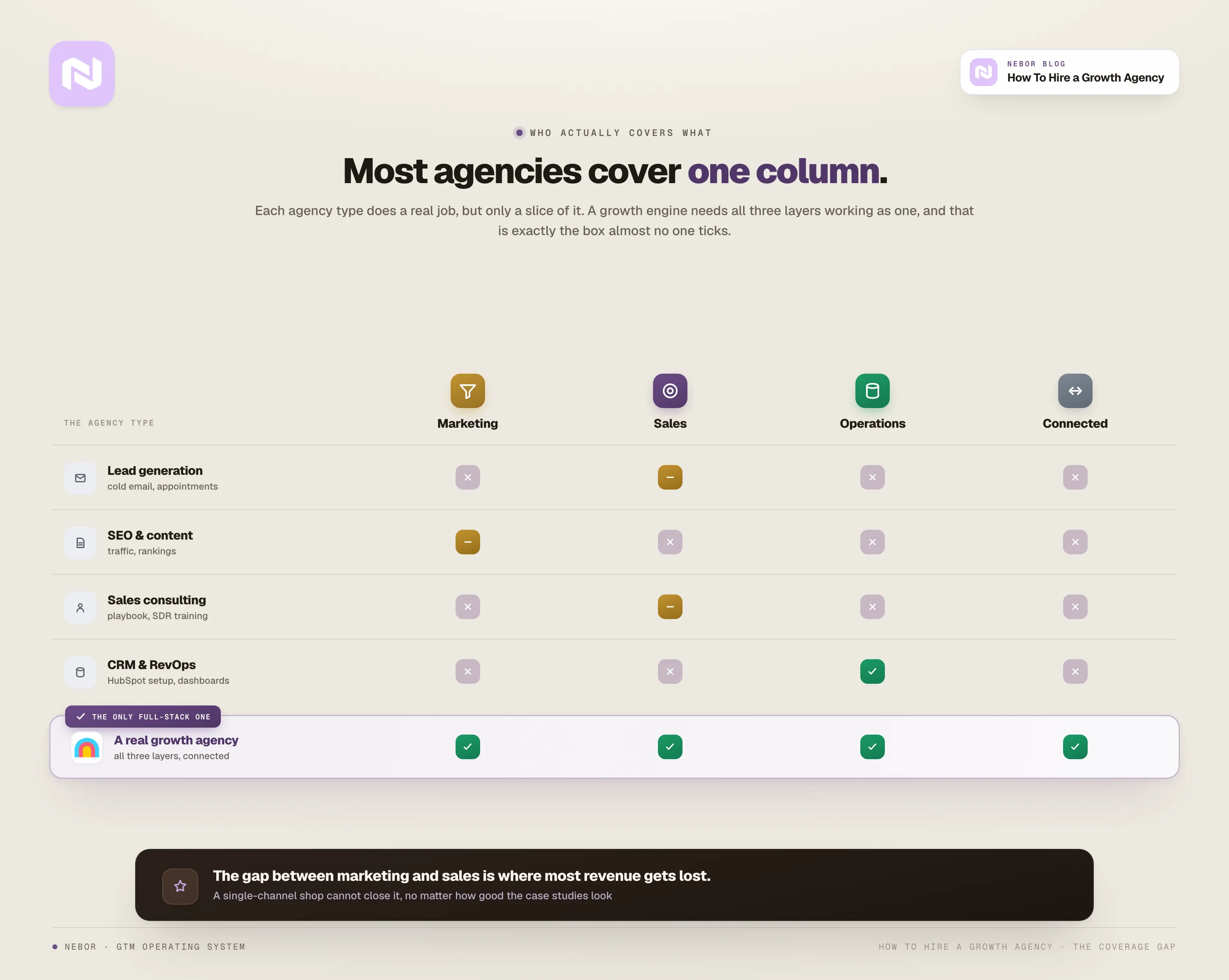
Most agencies fall into one of these types you will encounter when you search for help with growth.
Lead generation agencies. Their entire model is built around filling the top of your funnel. They buy or scrape a list, write some email sequences, send outbound cold emails en masse, and deliver leads or appointments to your sales team.
Some of them charge per appointment. Some charge a monthly retainer. But their scope starts and ends with getting someone to book a meeting with your team. What happens after that is your problem.
We wrote a longer piece on why most B2B companies don't actually need to outsource lead generation anymore.
SEO and content agencies. Sometimes you'll find some of the agencies in this category calling themselves growth marketing agencies instead of the shorter growth agency.
So in this category, they will audit your site, build a keyword strategy, publish content, and work on backlinks. The good ones can drive meaningful traffic over time.
But most of them measure success in rankings and sessions, not in pipeline or revenue. They do not touch your sales process, your CRM, or how leads get from their content to your sales team.
Sales consulting firms. These are the people that help you build your sales playbook, train your reps, design your sales process, and sometimes recruit SDRs.
But they rarely touch marketing. They may tell you that you need better leads, but generating those leads is not their job.
CRM consultants and RevOps agencies. These are the people you call on to configure your HubSpot or Salesforce, build dashboards, set up automations, and clean your CRM data.
They are essential for operational efficiency. But they rarely bring strategy. In most cases, they implement what someone else has already designed.
Each of these agency types serves a purpose. But none of them, on their own, is a growth agency.
For us, a real growth agency operates across all three layers: sales, marketing, and operations. It connects them. It builds infrastructure that spans the entire revenue cycle from first touch to closed deal to expansion.
Why Nebor is the growth agency you should be evaluating for your growth needs
Nebor exists because our founders, Andrew and Yannick, spent years selling and scaling businesses before they ever started an agency.
We both lived the frustration of working with agencies that generated leads but never connected them to revenue.
So when we built Nebor, we built it around a simple idea. Growth is not a marketing problem and not a sales problem on its own. It is an infrastructure problem. Solving it requires a partner that works across the entire revenue cycle.
That is why Nebor is built on three service pillars that work together as a single system.
Sales and go-to-market (GTM) motion and workflows that take care of your outbound and all prospecting team work
This is where we build your total addressable market (TAM), your outbound outreach workflows, your signal-based campaigns, your prospecting workflows, and your multi-channel outreach systems.
We use Clay at the center, integrated with PhantomBuster, Instantly, HeyReach, and other tools that fit your specific situation. The system identifies prospects matching your ICP, monitors for buying signals, and sends personalized outreach across email and LinkedIn.
Your sales team does not touch prospect lists. They just show up to meetings with qualified prospects already in the pipeline.
Demand generation and account-based engagement and workflows that generate the right traffic and handle your inbound lead management and sales handoff
This is where we build the demand generation engine that feeds your sales team with qualified, educated prospects. Paid ad strategy, LinkedIn ads campaigns, landing pages, conversion optimization.
But here is the difference. Everything we build on the marketing side connects directly to the sales infrastructure.
Inbound leads get enriched through the same Clay workflows that power outbound. You get workflows that track, capture, and identify website visitors and route them to the right sales workflows.
Ads and website engagement signals feed into our lead scoring models that then inform your sales reps on how to prioritize their outreach. Marketing and sales do not operate in parallel at Nebor. They operate as one system.
CRM and RevOps workflows that keep your data clean and your different departments aligned within the organization
For us, this is the one that holds everything together. This is where we build the operational layer that makes the whole engine work. CRM architecture, pipeline management, reporting dashboards, automation logic, data hygiene, lead routing, and lifecycle management.
We work primarily in HubSpot and Salesforce, and we build everything so your team can see exactly what is happening at every stage of the revenue cycle. No black boxes with us. No proprietary dashboards.
You get everything we build inside your CRM, configured and documented so your team can operate it without us.
Our services are designed to work together as a single revenue engine. The sales workflows feed data back into marketing targeting. Marketing engagement informs sales prioritization. The RevOps layer makes sure nothing falls through the cracks between the two.
This is what makes Nebor different from a lead gen agency that just sends cold emails, a marketing agency that just launches campaigns, or a Clay agency that just builds workflows in isolation.
4 questions you need to ask your growth agency to evaluate them
Most companies talking to growth agencies focus on surface-level questions. How long have you been in business? Who are your clients? What is your pricing model?
Those questions are fine. They tell you nothing about whether the agency can actually drive growth.
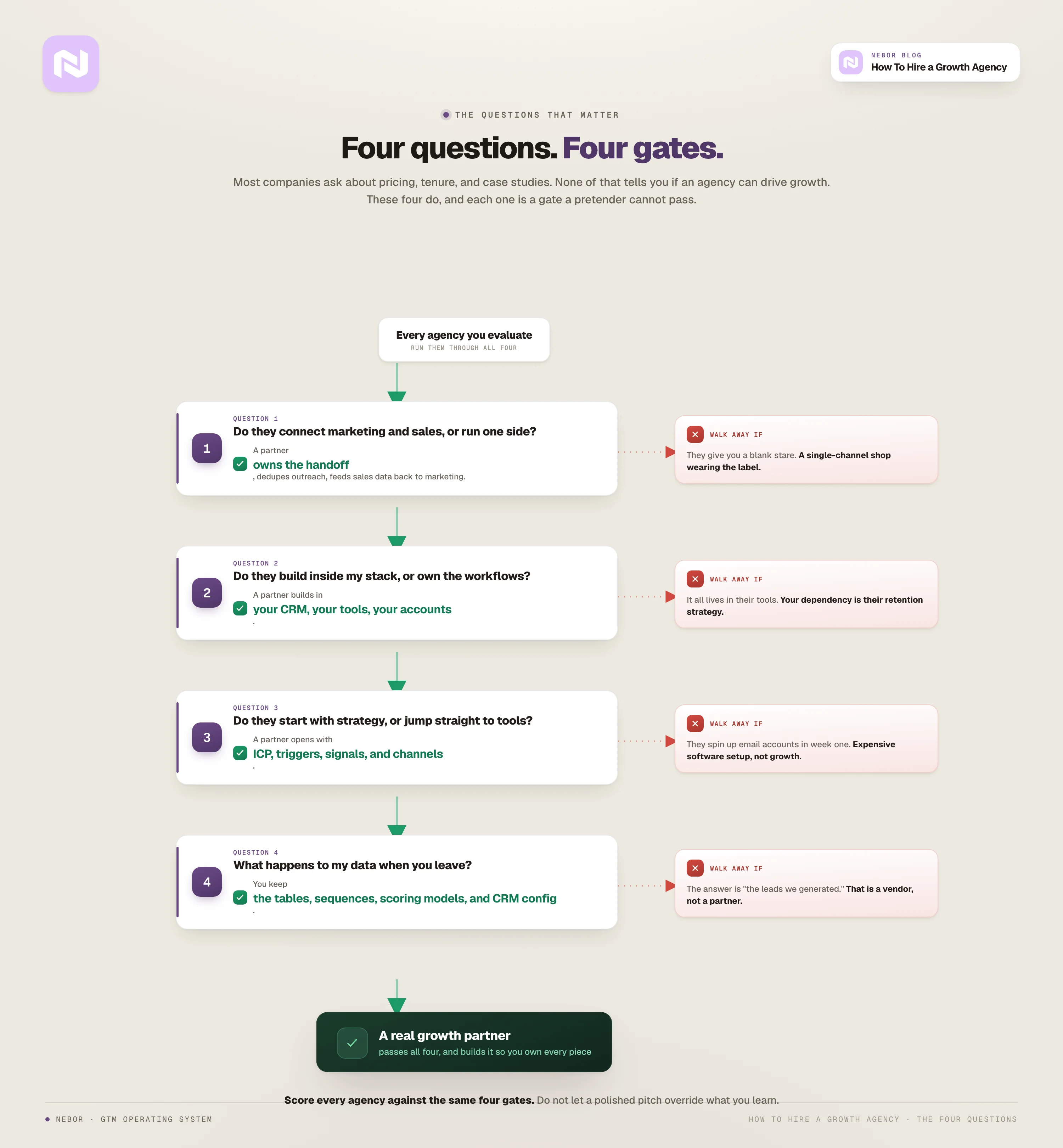
Here are the four questions that matter. These are the ones most companies do not ask, mostly because they didn't really think about these without our help.
The questions we want to discuss pertain to how reliable they are as a growth agency and whether signing up with them means you're settling for less.
Question 1: do they connect marketing and sales, or do they just cover one side?
This is where most agencies fall apart. And quite honestly, it is where most companies fall apart too.
Marketing generates leads. Sales works them. But the space between those two functions is where most revenue gets lost.
Your marketing team launches a paid ad or LinkedIn ad campaign and captures 20 prospects who booked meetings. At the same time, your traffic went up 20% and your pricing pages have higher dwell time and traffic across your site.
Who are the people visiting your site and what companies did they come from? Nobody can tell.
How many of those actually match your ICP? Nobody checks.
How many are showing buying signals? Nobody knows how to track that.
How does your sales team prioritize inbound leads against outbound prospects? That's a question you should be asking yourself.
This connection between marketing and sales is not a nice-to-have feature. It is the core of what makes a growth engine work. Without it, you just have two teams working in parallel, occasionally bumping into each other, and losing deals in the gaps between them.
When you talk to agencies, ask them how they handle the marketing-to-sales handoff. Ask them how they prevent duplicate outreach. Ask them how they use sales data to improve marketing campaigns.
If they look at you blankly, then they're a single-channel shop pretending to be a growth agency and you should walk away.
Question 2: Do you build inside my stack or do you own the workflows?
This is a question that separates a real growth partner from a vendor.
Most lead generation agencies and many marketing agencies build everything inside their own tools. They use their own email infrastructure, their own CRM, their own automation platform, their own data sources. And when the engagement ends, you get nothing. Just a gap where the leads used to come from.
This model exists because it protects the agency. If you cannot operate the system without them, you cannot leave. Your dependency is their retention strategy.
A growth agency that actually cares about your long-term success builds everything inside your stack. Your CRM, your automation tools, your enrichment workflows, your email infrastructure.
When the engagement ends, the system stays inside your accounts. The workflows keep going, the data stays in your systems, the playbooks live in your tools.
This is not a minor philosophical difference. It changes the entire dynamic of the relationship. When an agency builds inside your stack, they are investing in your infrastructure. When they build inside theirs, they are investing in their own leverage.
Ask every agency you evaluate this question directly. When this engagement ends, what do I keep? If the answer is "the leads we generated," that is a vendor relationship, not a growth partnership.
Question 3: Do they start with strategy or jump straight to tools?
Here is a pattern we see constantly. A company hires a Clay agency or a HubSpot partner or an outbound agency, and the first thing that happens is the agency starts building.
They spin up email accounts. They configure Clay tables. They write sequences. They pull lists. Within two weeks, campaigns are live.
It feels productive. It feels fast. Three months later, the results are mediocre, and nobody can explain why.
The reason is almost always the same. Nobody stopped to define the strategy before touching the tools.
Who is your ideal customer, specifically? Not the typical B2B SaaS companies with 50 to 200 employees. You should see them thinking about this more seriously and asking questions like these.
What problems does your ICP have?
What triggers make them ready to buy?
What signals indicate they are in market right now?
Which channels do they actually respond to?
What does your sales team need from a qualified lead to actually close it?
If the agency starts with these questions instead of with tool setup, that is a real growth partner. If they jump straight to configuration, you are buying expensive software implementation, not growth.
Question 4: what happens to your data when the agency leaves?
This is the question almost nobody asks until it is too late.
Your data is your most valuable growth asset. Your prospect lists, your enrichment data, your engagement history, your sequence performance, your scoring models. All of that is intelligence that compounds over time.
If your agency keeps all of this in their tools and walks away with it when the engagement ends, you are starting from scratch every time you switch partners. That is enormously expensive and slow.
If everything lives inside your stack, in your CRM, in your automation tools, in your dashboards, then you keep everything. You can hand it to your next hire, your internal team, or even a different agency. The knowledge compounds instead of disappearing.
This is why infrastructure ownership is not just a contractual detail. It is the difference between renting growth and building it.
Ask your agency candidates to show you exactly what you will own at the end of the engagement. Make them be specific.
You should own the actual Clay tables, the enrichment workflows, the email sequences, the scoring models, the automation logic, the CRM configurations, and the reporting dashboards. All of it.
If an agency hesitates on this question, that tells you everything you need to know about their business model.
6 red flags that should make you walk away from any agency conversation
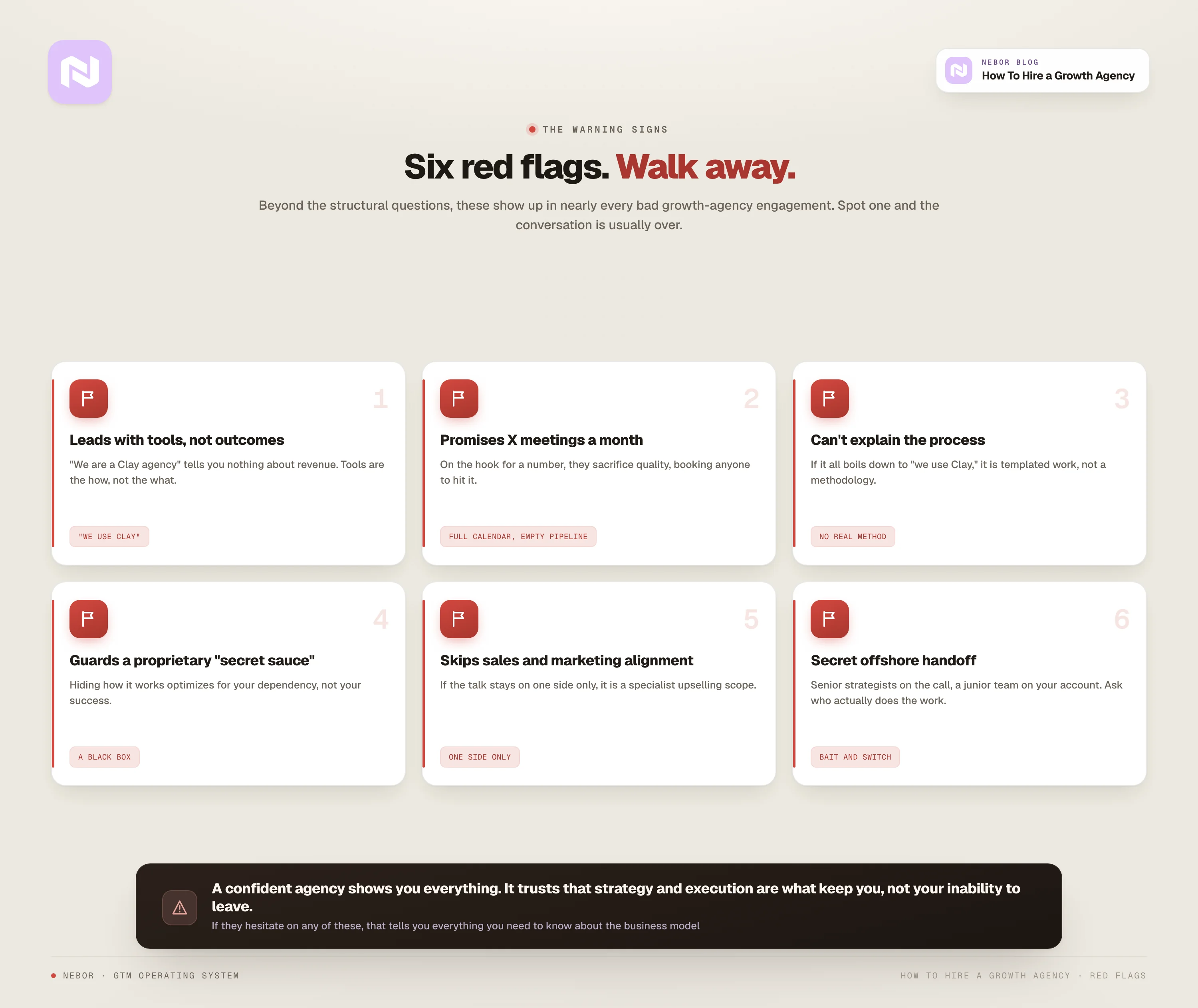
Beyond the structural questions, there are specific warning signs that show up in almost every bad growth agency engagement. Here are the ones we see most often.
Red flag 1: They lead with tools instead of outcomes
"We are a Clay agency" or "We are a HubSpot partner" sounds impressive, but it tells you nothing about whether they can drive revenue.
Tools are the how, not the what. If an agency defines itself by its tools rather than the outcomes it drives, they are probably better at configuring software than building growth systems.
Red flag 2: They promise a specific number of leads or meetings per month
This sounds great in a sales pitch, but it almost always leads to bad behavior. When an agency is on the hook for 30 meetings a month, they will sacrifice lead quality to hit the number.
They will book meetings with people who do not fit your ICP. They will use aggressive tactics that damage your brand. They will count every interested reply as a meeting even when it is not.
Volume targets without quality filters are a recipe for a full calendar and an empty pipeline.
Red flag 3: They cannot explain their process beyond the tools they use
A real growth agency has a methodology. They can walk you through how they approach ICP definition, how they design outreach sequences, how they handle qualification, how they measure success.
If everything they say boils down to "we use Clay" or "we use HubSpot," they are not a strategic partner. They are a vendor delivering templated work.
Red flag 4: They keep their secret sauce proprietary
Some agencies guard their workflows and processes like trade secrets. They will not show you how things work under the hood. This is a massive red flag.
It means they are optimizing for your dependency, not your success. A confident agency shows you everything and trusts that their strategic thinking and execution quality is what keeps you around, not your inability to understand what they built.
Red flag 5: They do not talk about sales and marketing alignment
If you are hiring a growth agency and the conversation stays entirely on the marketing side or entirely on the sales side, you are not talking to a growth agency. You are talking to a specialist trying to upsell you into a bigger scope.
Real growth requires both sides working together from day one. And if you ask us, we'll argue that it even needs to incorporate your revenue operations, data hygiene, and CRM services.
Red flag 6: They outsource execution to offshore teams without telling you
There is nothing wrong with global teams. But if an agency sells you on their senior strategists and then hands your account to a junior team in a different timezone, that is a bait and switch.
Ask who will actually be doing the work, not just who will be on the strategy calls.
How to make your final decision without getting distracted by the wrong things
When you are comparing agencies, it is easy to get distracted by surface-level differences. This one has flashier case studies. That one has a bigger team. This one is cheaper. That one has a cooler website.
None of that matters as much as the structural questions we covered in this guide. Build a simple scorecard with these five criteria.
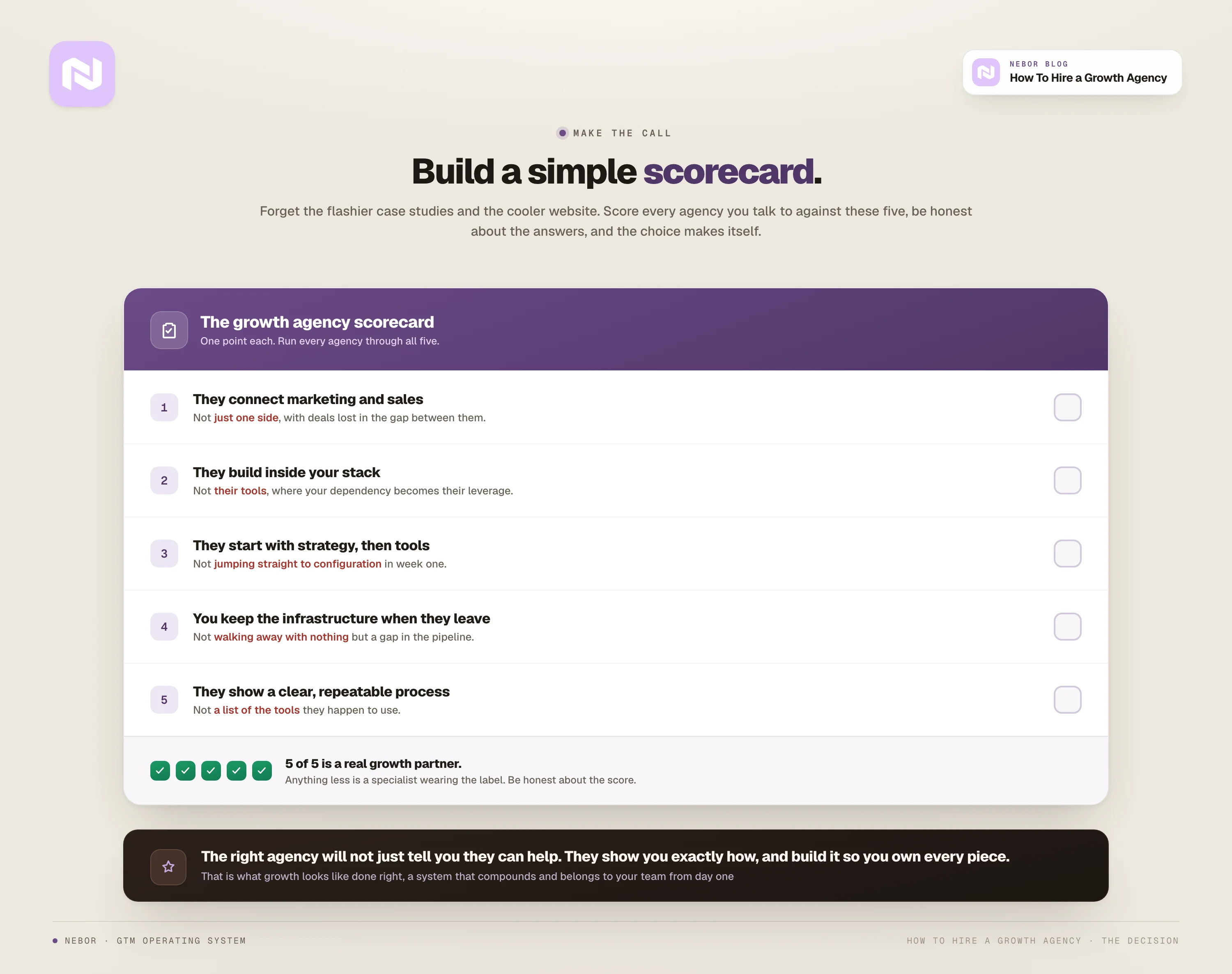
Do they connect marketing and sales or just handle one side?
Do they build inside your stack or theirs?
Do they start with strategy or jump to tools?
Do you keep the infrastructure when they leave?
Can they show you a clear, repeatable process for driving growth?
Score every agency you talk to against those five questions. Be honest about the answers. And do not let a polished sales pitch override what you learn in the discovery process.
The right growth agency will not just tell you they can help. They will show you exactly how, and they will build it so you can see, understand, and operate every piece of the system.
That is what growth looks like when it is done right. A system that compounds over time and belongs to your team from day one.
Book a 15-minute call if you want to see what that looks like for your specific business.


Related Articles



By clicking Sign Up you're confirming that you agree with our Terms and Conditions.