Why We Set Out to Be the Best Growth Agency


In this post:
If you're like most teams that come to us, your revenue team depends on effort instead of systems, and it's costing your bottom line.
Picture a sales rep who just got off the phone with a hot prospect, a real conversation with real interest.
Now, instead of moving to the next call, they spend 20 minutes logging notes in the CRM, another 15 searching LinkedIn for the next person to call, 10 more minutes tracking down an email address, and another 20 crafting a follow-up email from scratch.
By the time they're ready for their next real conversation, over an hour has passed. One call, one hour of busywork around it.
Now multiply that across your entire revenue team. Every rep doing the same dance, every day. Researching, copy-pasting, formatting spreadsheets, chasing down contact info, manually updating deal stages. They're not selling, they're preparing to sell.
That's what most B2B sales and marketing teams look like today. Not because the people are bad at their jobs, but because there's no system underneath them.
Every task is manual, every process lives in someone’s head, and every new campaign starts from scratch because nobody built a system the last time around.
We have seen this at 6-person startups and at multi-billion dollar enterprises. The symptoms show up differently, but the root cause stays the same. People compensate for missing systems with sheer effort, and effort doesn't scale.
You can't outwork a broken process. You can hire five more reps, but if they're all spending 70% of their day on admin instead of selling, you just bought yourself five more people doing the same inefficient thing.
That's what we fix, and that's why we believe we're the best growth agency you can hire today. But don't fret, we'll show you all our receipts, and you'll see for yourself that we're the real deal.
So in January of 2026, we officially co-founded Nebor. The name itself is a nod to how it all started. We were two neighbors who couldn't stop talking shop.
The picture you see at the top is us. See me on the left, I’m Andrew, wearing black and Yannick on the right.
So, the story dates back to April of 2025, when I moved into a house in Haarlem, a suburb just outside Amsterdam.
I had been leading Utmost Agency for some time at that point, helping B2B startups and scale-ups build outbound sales systems and lead generation infrastructure.
I had 24+ months of building go-to-market strategies, designing automation workflows in Clay, and watching firsthand how most companies fumble the basics of pipeline generation.
On the first day, I met with my next-door neighbor Yannick, who was leaning over the fence with a glass in hand, welcoming me to the street. That's literally how this started, over a fence, with wine.
Yannick was coming from a completely different angle. More than ten years in corporate SaaS sales.
At Mapiq, he implemented Salesforce and Salesloft from scratch and built the company's entire outbound motion.
Then at OneStream, he inherited one of the worst-performing business development teams in the organization and turned it into the best-performing team globally within 18 months.
He went on to roll that same strategy out across 50+ BDRs worldwide. He coached them, built the processes, selected the tools, and structured the playbooks.
You get the idea. Yannick wasn't leading a Clay or a lead generation agency, but he can ball.
The thing is, despite coming from different worlds (agency vs. corporate), we kept talking and kept seeing the exact same problems.
What made us realize we should actually build something together was how well our skill sets complemented each other. I think about the machine. Yannick thinks about the people using it.
I’m pretty great at strategy, automation architecture, marketing, and international growth. I know how to design systems that drive growth and GTM playbooks.
Yannick's strengths are in RevOps, CRM implementation, and structuring the operational side. He knows how to make those systems stick inside a real sales team’s daily workflow. You need both for any of it to actually work.
Today, you'll learn what we build and how we build it. But first, let's walk you through the problems we kept seeing over and over again, across every company we worked with.
Because if you recognize yourself in any of these, you'll know we built Nebor for people and companies like you.
Note: Struggling to get your revenue team out of manual work?
Your reps spend most of the week researching accounts, hunting for contact details, updating records and chasing follow-ups. None of it is why you hired them, and hiring another one only multiplies manual work across your team.
At Nebor, we are a GTM engineering and RevOps agency. We will take that work off your team and build it into a system: the prospecting, the enrichment, the outreach and the CRM updates all happening on their own, with your reps picking up only the conversations worth having.
We build everything in your own accounts, so the system is yours to keep, adjust and extend as your motion changes.
Book a 15-minute call and we'll map the manual work your team could stop doing.
TL;DR
Most revenue teams depend on their team’s effort instead of systems, and effort doesn’t scale. Better yet, there’s AI and great tools everywhere now and you just can’t keep up with your competitors who are building their growth on systems assisting their team.
We fix that by building the system or revenue engine your team needs.
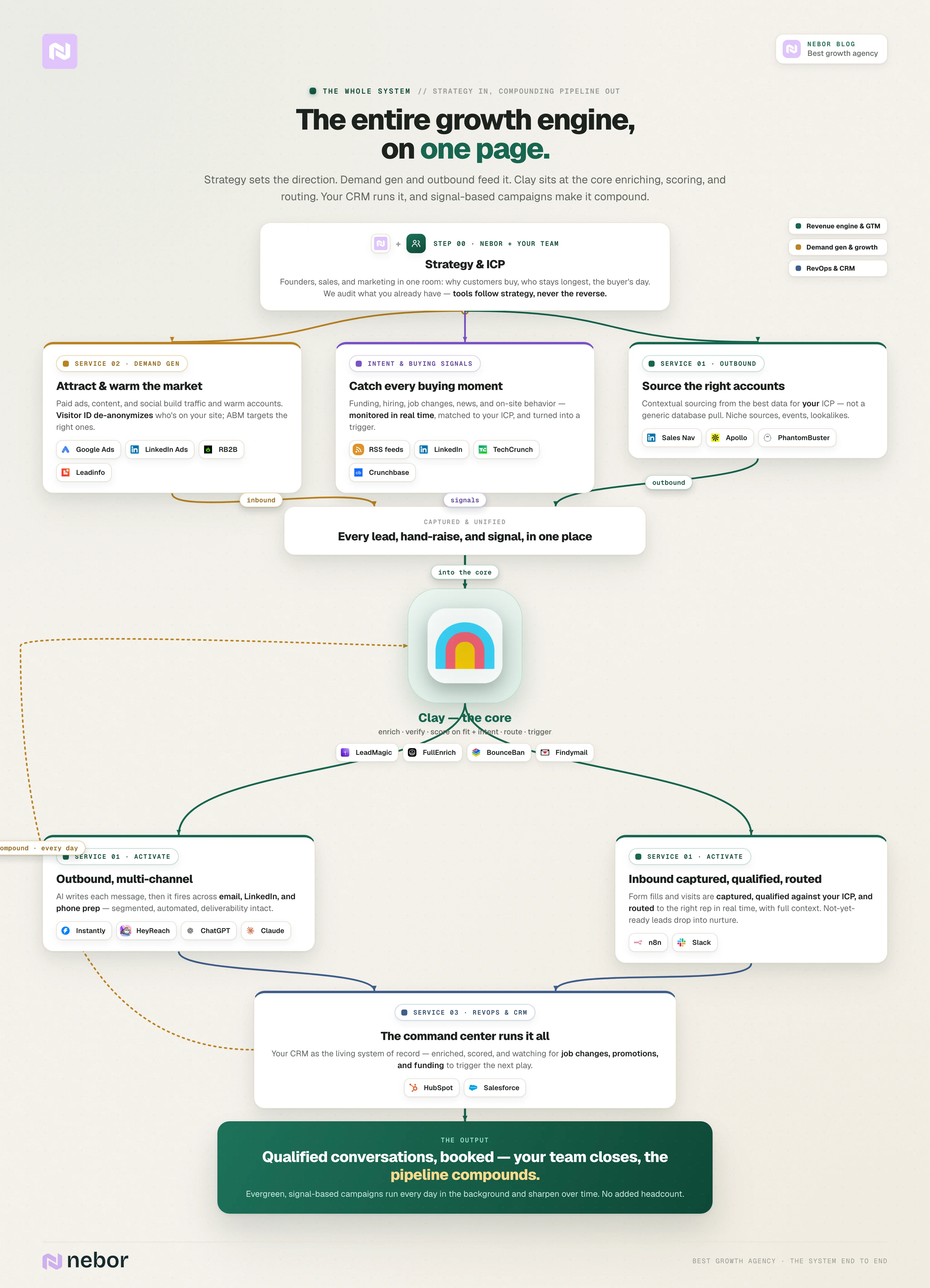
We start with a strategy conversation to pin down your ICP, then we wire your growth into one connected motion: outbound sourcing, demand generation, and real-time buying signals all feed a single engine, with Clay at the core enriching, scoring, and routing every lead.
We make your CRM the command center that drives it, and signal-based campaigns keep it compounding in the background.
This results in your team not having to worry about lead generation or prospecting or any other top of the funnel work, becoming super efficient, having qualified conversations booked on autopilot, and more sales opportunities than your competitor.
Even better, you also get a system your team owns, and a pipeline that gets sharper every month without adding headcount. Here is a quick overview of what the workflow looks like. You can click to zoom.
How most sales and revenue teams depend on effort instead of systems and what it's costing them
Let's break down the specific patterns we keep seeing.
Your sales reps are still manually prospecting in 2026
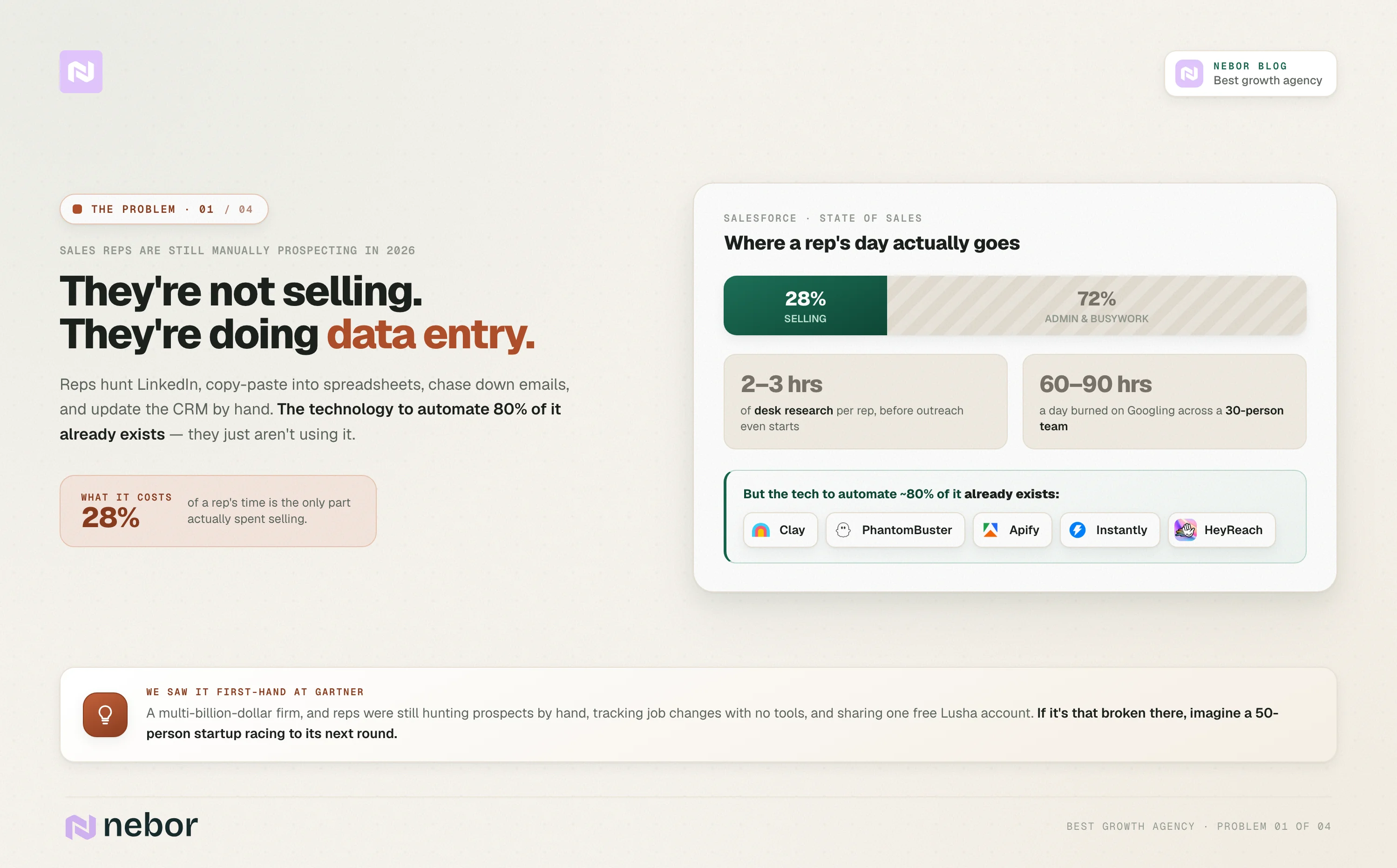
Here's a stat that should bother you. According to Salesforce's State of Sales report, sales reps spend only about 28% of their time actually selling. The rest goes to admin work, data entry, internal meetings, and prospecting busywork.
That means for every 8-hour day your sales rep works, they get roughly 2 hours and 15 minutes of actual selling.
The other 5 hours and 45 minutes go to copying data between LinkedIn and spreadsheets, Googling prospects, writing follow-up emails one by one, and updating the CRM because someone asked for a pipeline report.
Think about that for a second. You're paying a full salary for about 2 hours of productive work per day.
The thing is, we didn't even need the Salesforce stats to explain this to you. We know it because we've done sales and worked with other salespeople ourselves.
And if you're here reading this, it means you do too. It hits hardest because it's so widespread and so obviously fixable, yet almost nobody fixes it.
I saw this firsthand at Gartner where I worked as a sales rep, and we can agree that Gartner is not some scrappy startup. It's a multi-billion dollar research and advisory company.
You'd think if any organization would have modern, efficient sales operations, it would be them. Instead, the reality was shockingly different. As reps, we were manually hunting for prospects, tracking signals like job changes and new hires without any tools.
For contact details, our team relied on a free Lusha account with limited credits. Sometimes you'd find yourself literally begging former territory managers for their old prospect contact lists just to have someone to call. Even basic email sequences required manual tracking and follow-up.
If a company with Gartner's resources and market position can be that broken in its revenue-generating operations, imagine what it looks like at a 50-person startup trying to get to its next funding round.
Yannick saw the same thing from the coaching side at OneStream. Their BDRs were spending their mornings doing desk research for two to three hours before they could even start reaching out. That's two to three hours per person, per day, just finding people to talk to.
Multiply that across a 30-person sales team and you're looking at 60 to 90 hours of human labor every single day burned on what is essentially Googling. That's not a sales team at that point. That's a research department that occasionally sells.
The funny thing is, the technology to automate 80% of this manual prospecting work exists right now. Tools like Clay, PhantomBuster, and Apify can scrape, enrich, verify, and organize prospect data automatically.
Instantly and Lemlist can send sequenced outreach across email. HeyReach can handle LinkedIn. The technology is available.
Most teams just don't know how to put it together, or they don't know it exists in the first place.
We wrote extensively about this, including breakdowns of how to use AI for sales prospecting and a deep look at the latest sales automation statistics that quantify just how much time and money gets wasted on manual processes.
You don't actually understand your own ICP, and that's why every campaign feels like a coin flip
This is the problem underneath the other problems. And it's the one most teams don't want to hear.
It's actually baffling how most teams don't have a clear picture of who they should be selling to. It sounds like the most basic thing to know if you want to sell well. Yet it's where most sales or pipeline generation efforts go downhill.
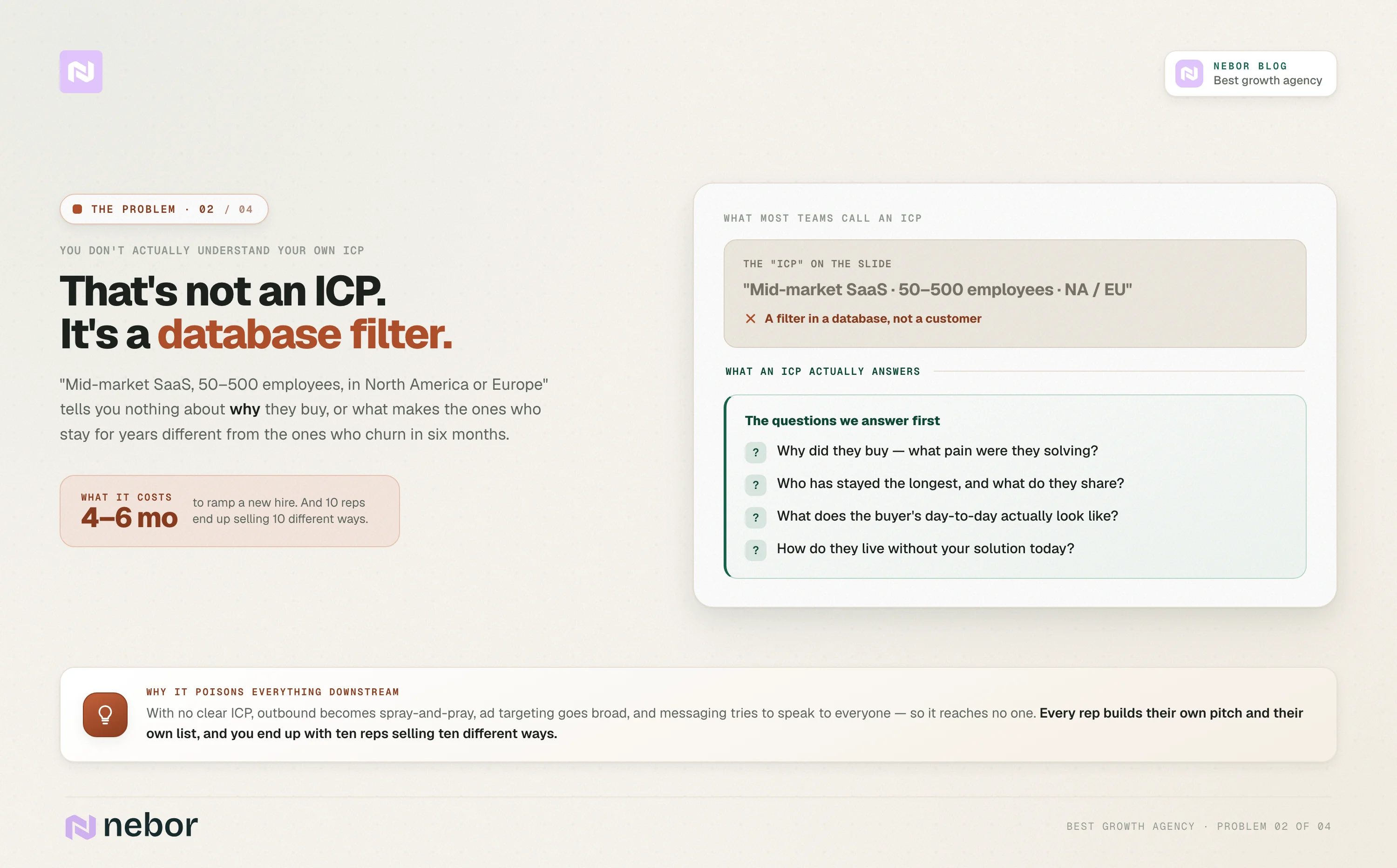
Ask most sales leaders to describe their ideal customer profile, and you'll get something like "mid-market SaaS companies, 50 to 500 employees, in North America or Europe." That's not an ICP. That's a filter in a database.
It tells you absolutely nothing about why those companies buy, what problem they're trying to solve, or what makes the ones that stay for years different from the ones that churn in six months.
Yannick saw this pattern consistently across every company he worked with. Businesses would invest heavily in tools like ZoomInfo or Apollo, pull 10,000 contacts based on surface-level filters like headcount, revenue, and industry, write one generic email, and blast it to the entire list. Then they'd wonder why the reply rate was stuck at 0.3%.
The issue isn't the tool. The issue is that nobody sat down to answer the foundational questions first.
Why did we start this business?
What specific pain point are we solving?
Who are the customers that have stayed with us the longest, and why?
What does the day-to-day job look like for the person who actually makes the buying decision?
How do they currently live without our solution?
Without answers to those questions, everything downstream is a guess. It doesn't matter what name you give it, your outbound campaigns become spray and pray. Your ad targeting gets too broad. Your messaging is generic because you're trying to speak to everyone, which means you're speaking to no one.
And it gets really expensive. When there's no clear ICP definition, new sales hires take four to six months to ramp, according to The Bridge Group's SaaS AE Metrics report. And often, even after those six months, they're still not operating from a shared understanding of who they should be talking to.
Every rep develops their own pitch, their own target list, their own process. You end up with 10 reps selling 10 different versions of your product to 10 different audiences. At that point, you don't have a sales team.
We've written about this dynamic in our guide on how to build a prospect list and our breakdown of the best way to get B2B leads, both of which walk through the strategic work that needs to happen before any outreach begins.
Your marketing and sales teams operate in silo, and nobody is capturing the signals that could change everything
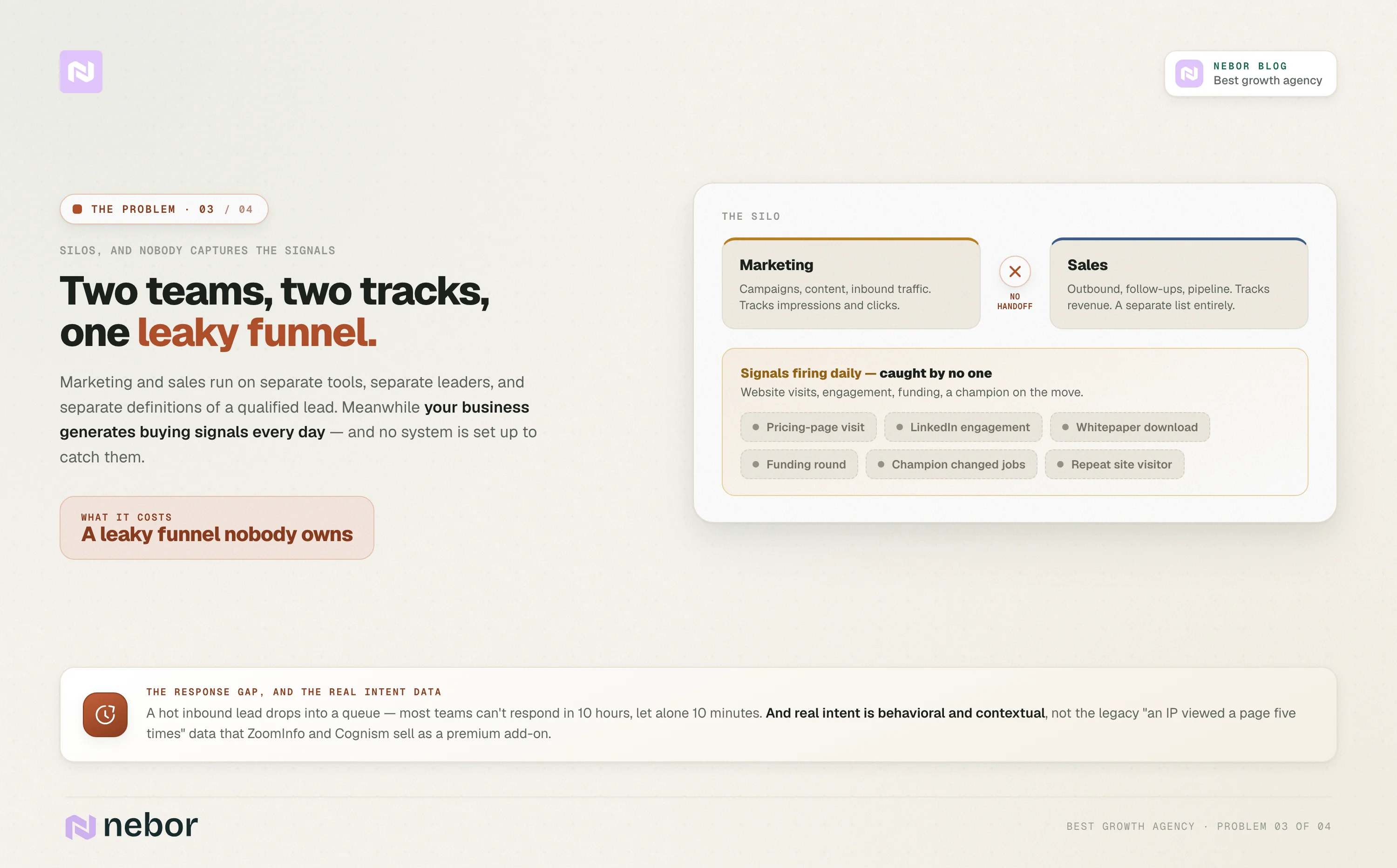
This one is about two problems that feed each other.
The first is the silo between marketing and sales. At most companies, these two teams operate on completely separate tracks.
Marketing launches campaigns, writes blog posts, generates inbound traffic and leads, posts on social media, and tracks impressions and clicks. Sales does outbound cold outreach, follows up on whatever comes in, and tracks pipeline and revenue.
They report to different leaders. They use different tools. They often don't even agree on what counts as a qualified lead.
The result is a leaky funnel that nobody fully owns.
Marketing generates interest. Someone visits your website three times, downloads a whitepaper, and fills out a contact form. That lead goes into a queue.
Maybe somebody will follow up in 48 hours, maybe next week. By the time a rep actually reaches out, the prospect has already talked to two competitors, or worse, they've forgotten they were ever interested.
According to research from Harvard Business Review, the odds of qualifying a lead drop by 400% after the first 10 minutes of initial interest. Ten minutes. Most sales teams don't even have a process for responding within 10 hours, let alone 10 minutes (we do, and we wrote it up in our inbound meeting workflow).
Meanwhile, outbound works from a completely separate list. Different messaging, different targeting, no connection to what marketing already knows about these accounts.
Think about it, your marketing team could be buying LinkedIn ads warming up the exact same accounts your sales team is cold-emailing, but nobody coordinated it. The prospect then gets a targeted ad on one day and a generic cold email on the next day that sounds like it's coming from a completely different company.
The second problem is even bigger, and it's about the signals that companies are holding and ignoring entirely.
Your business generates intent data every single day. Website visitors, LinkedIn post engagement, newsletter opens, content downloads, webinar registrations, people who connect with your team members, people who visit your pricing page.
All of this represents potential buyers who've shown interest but haven't formally entered your pipeline.
Beyond your own channels, there are external signals that are even more powerful. A company hiring multiple SDRs signals they're struggling with pipeline generation. A company that just raised funding signals they're about to invest in growth.
A competitor getting acquired means their customers might be exploring alternatives. A key contact who championed your product at one company just moved to a new organization, and they probably need the same tools at their new job.
These signals are everywhere. But almost nobody has systems to capture them, let alone act on them automatically.
Most teams still think intent data is what legacy tools like Cognism or ZoomInfo sell as a premium add-on, the "someone from this IP address visited an article about CRM five times" variety.
Real intent data is contextual and behavioral. And the companies that know how to capture it and respond in real-time are playing a completely different game than the ones still sending batch-and-blast cold emails.
We covered this in depth in our posts on what intent data actually is and how to set up website visitor tracking workflows and RSS feed monitoring to detect buying signals automatically.
Note: Struggling to get your revenue team out of manual work?
Your reps spend most of the week researching accounts, hunting for contact details, updating records and chasing follow-ups. None of it is why you hired them, and hiring another one only multiplies manual work across your team.
At Nebor, we are a GTM engineering and RevOps agency. We will take that work off your team and build it into a system: the prospecting, the enrichment, the outreach and the CRM updates all happening on their own, with your reps picking up only the conversations worth having.
We build everything in your own accounts, so the system is yours to keep, adjust and extend as your motion changes.
Book a 15-minute call and we'll map the manual work your team could stop doing.
Your tech stack is either nonexistent or a Frankenstein of disconnected tools bleeding you dry every month
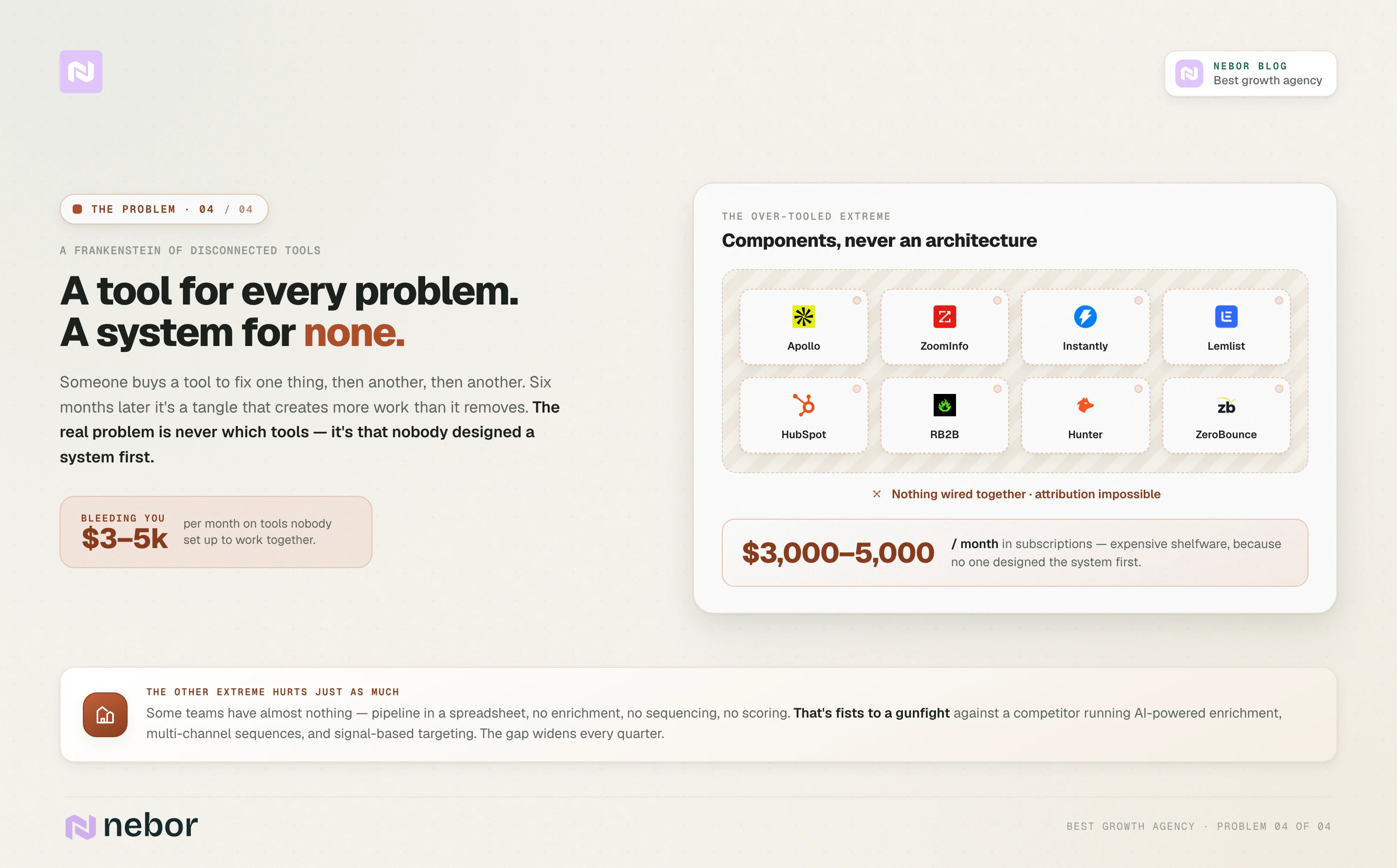
We see two extremes, and both are broken in their own way.
The first extreme is teams with almost no sales technology at all. They're prospecting manually. They're sending emails from Gmail one at a time.
They're tracking their pipeline in a spreadsheet or, at best, in a CRM that nobody has properly configured. There's no enrichment, no automation, no sequencing, no lead scoring, no signal tracking. Every bit of the revenue process depends on human effort and human memory.
This is the equivalent of bringing fists to a gunfight. Your competitor on that website you keep checking is using AI-powered enrichment to auto-build prospect profiles, multi-channel automated sequences to reach buyers across email and LinkedIn simultaneously, and signal-based targeting to identify the right accounts at the right moment.
You're sending individual LinkedIn connection requests and hoping for the best. The gap widens every quarter, and eventually it becomes insurmountable.
The second extreme is equally painful, sometimes more so because it comes with a crazy price tag. These are the teams that went all-in on tools without ever designing a system or a tooling strategy first.
They bought a prospecting tool, then an email sequencer, then a separate LinkedIn tool, then a data enrichment platform, then a meeting scheduler, then a call recorder, then a CRM add-on, then a marketing automation platform.
Before they knew it, they had 8 to 12 tools that don't talk to each other. Data lives in six different places.
Nobody can tell you which channel or campaign actually generated that closed deal last quarter because attribution is impossible when the systems aren't connected. And the bill? Somewhere between $3,000 and $5,000 per month in SaaS subscriptions for tools that nobody fully uses because nobody set them up to work together.
It always starts innocently. Someone on the team identifies a specific problem like prospecting taking too long and buys a specific tool to fix it, in this case a data enrichment platform. Then someone else has a different problem like poor email deliverability and buys another tool, a warmup and sequencing platform.
Then marketing needs something. Then RevOps needs something. Six months later, you've got a tangled web of disconnected systems that creates more work than it eliminates.
The real problem is never "which tools should we buy." It's that nobody designed a system first. Tools are components. Without architecture or strategy, they're expensive shelfware.
For more on how to think about building a cohesive sales technology setup, we previously published a detailed guide on the sales tech stack and an honest breakdown of what sales automation actually costs.
Why Nebor is the best growth agency you can hire to build your growth
Every conversation we had with a struggling sales team, every broken tech stack we audited, every time we saw a company burning money on campaigns built without strategy, it reinforced the same conviction.
The market doesn't need another agency that delivers campaigns and sends invoices. It needs someone who builds the system. The plumbing, the wiring, the architecture. The stuff that stays after the engagement ends and compounds over time.
That's what Nebor is. So, no. We don't fall in the same categories as your typical growth marketers or growth marketing agencies.
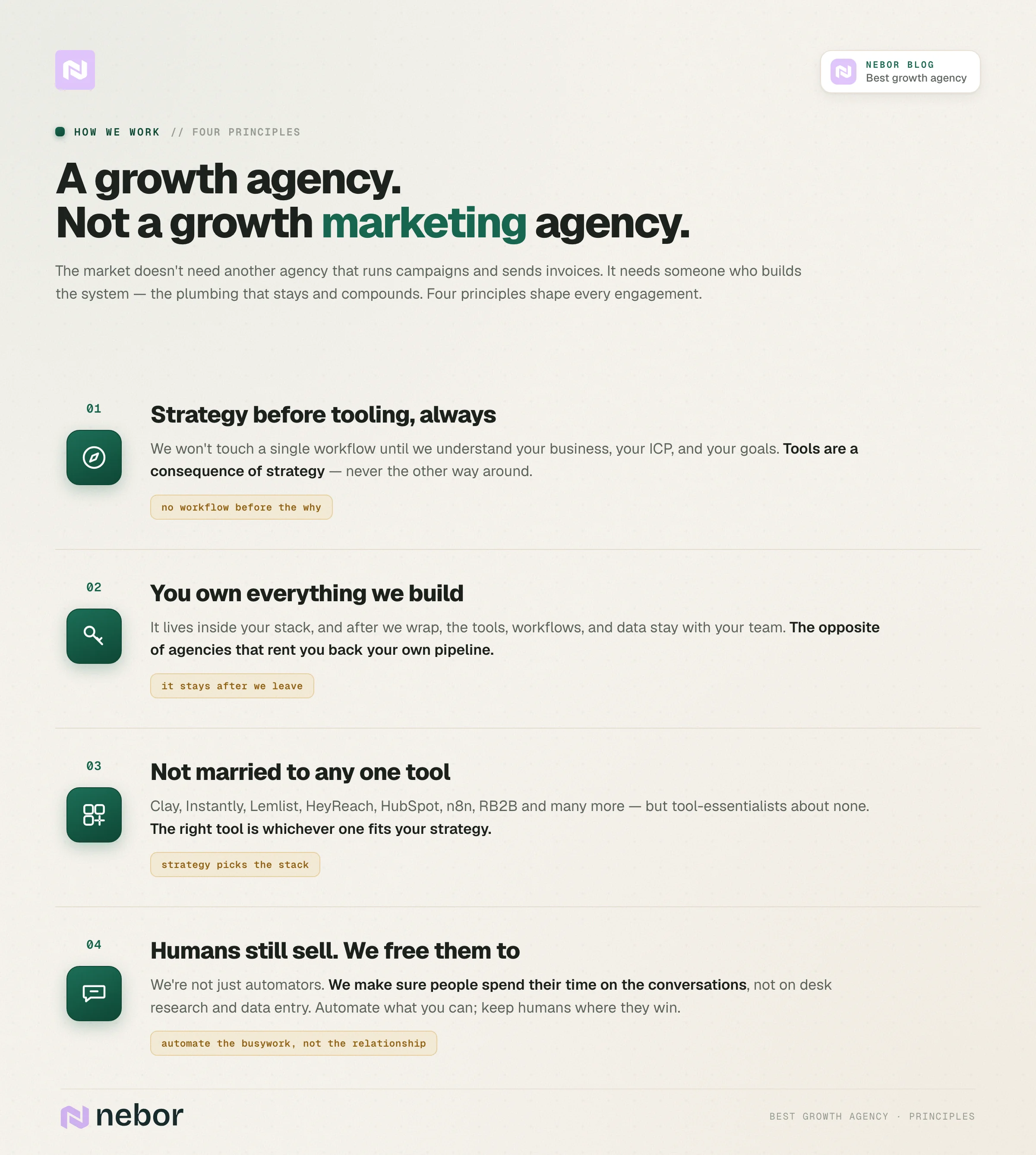
You can see from our wording that we insist on being a growth agency and not a growth marketing agency. That distinction is important for us because it shapes how you see us and what you'll be expecting from us.
There are a few principles that guide everything we do, and we want to be upfront about them because they shape every engagement.
First, strategy before tooling, always. We won't touch a single workflow until we understand your business, your ICP, your buyer's journey, and where the system is leaking.
We've seen too many companies get sold a Clay implementation or a HubSpot migration when the real problem was that nobody had done the strategic work. Tooling without strategy is just expensive decoration.
Second, everything we build lives inside your stack. After we wrap, the tools, workflows, and data stay with your team and keep producing. We're the opposite of agencies that hold the sending domains, control the tech accounts, and effectively rent you back your own pipeline.
Third, we are not tool essentialists. We work with Clay, Instantly, Lemlist, HeyReach, HubSpot, Salesloft, LeadMagic, FullEnrich, Findymail, PhantomBuster, n8n, Discolike, Apify, RB2B, and many other tools. But we're not married to any of them.
Our tool selection depends entirely on your strategy, your team, and your specific situation. The right tool is whichever one best fits the strategy we've designed for you, and that changes per client. What does not change is that we have the experience and knowledge to work with any of them.
Fourth, we are not just automators. Humans sell. We just make sure they spend their time on the conversations and not on desk research and data entry.
As Yannick puts it, "Automate what you can automate, but always make the moment you're reaching out and the message you do that with as relevant as possible, so you can spend time on talking to your potential customers instead of finding them."
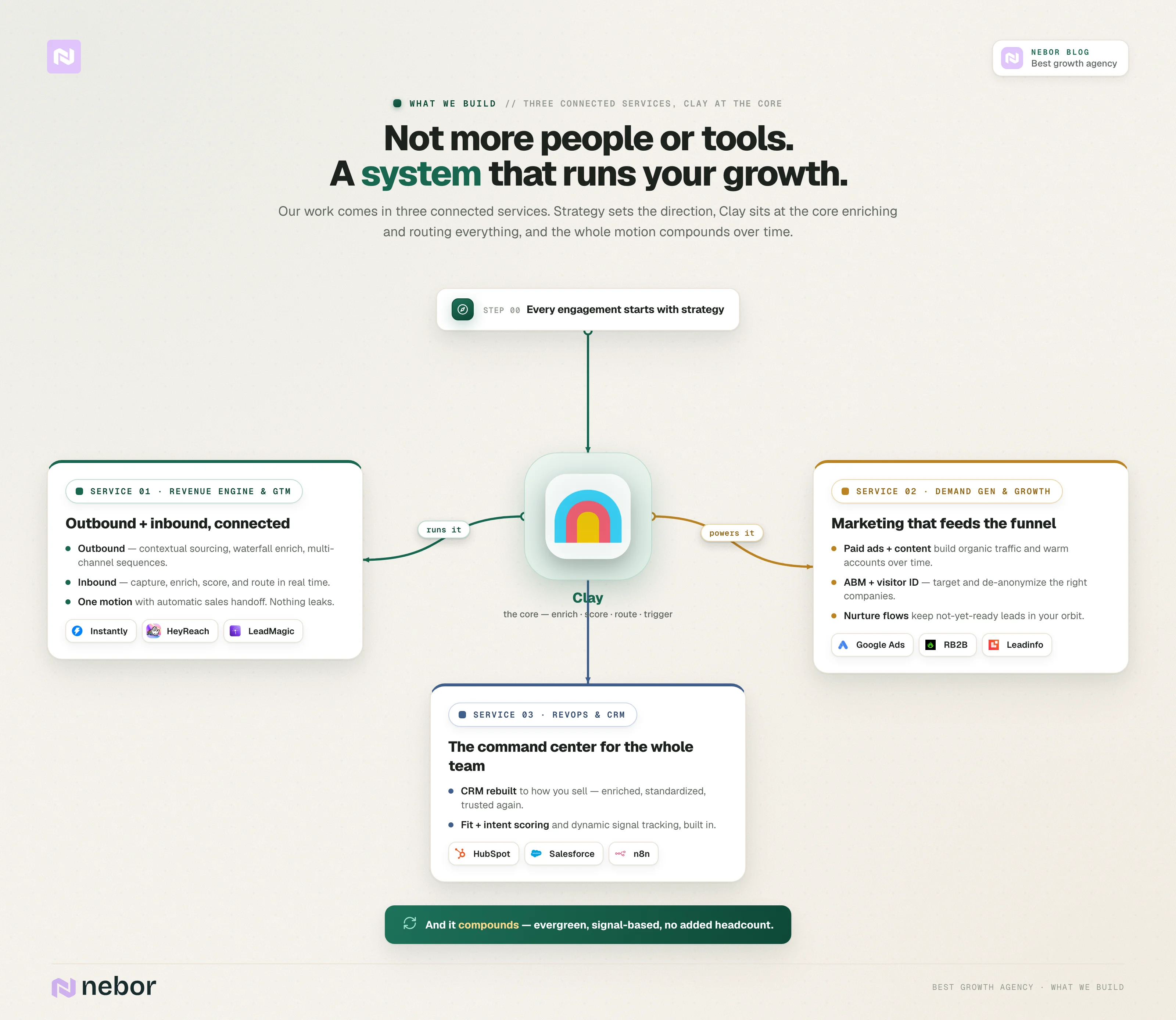
There's way more to our processes and services than we can cover here. This is going to be more of a breakdown than a deep dive, to keep it interesting and comprehensive without dragging. Now, let's walk you through how it actually unfolds.
It starts with a strategy conversation
The very first thing we do is sit down with your team. Founders, sales leaders, marketing. We want to talk to the people behind the product and the people in client-facing situations. We ask questions that most agencies never ask.
Why did you start this business? What pain points were you trying to solve? Who are the customers that have stayed with you the longest, and why?
Who are the decision makers, and what does their day-to-day look like? How do they currently live without your solution? What's the typical job description of the person who ends up buying your product?
We're not asking these questions for fun. We're trying to understand the very essence of your product and the value it brings to its users. Because we've found that most businesses can't clearly articulate this. They know it intuitively, but they've never forced themselves to get specific. And you can't build a targeting strategy on vibes.
From there, defining the ICP becomes natural. The messaging writes itself when you know exactly who you're talking to and what problem you're solving for them. And tool selection becomes a logical consequence of strategy, not the other way around.
This is also where we assess what you already have. Your existing CRM data, website traffic, LinkedIn engagement, inbound lead flow, past campaigns, and existing automations.
We don't start from zero if you're not at zero. Everything that already exists in your business is intelligence we can use.
We build the outbound and inbound engine that your team needs to free themselves of prospecting work
Once the strategy work is done, we move into building the core infrastructure. This is going to become one of your key growth levers.
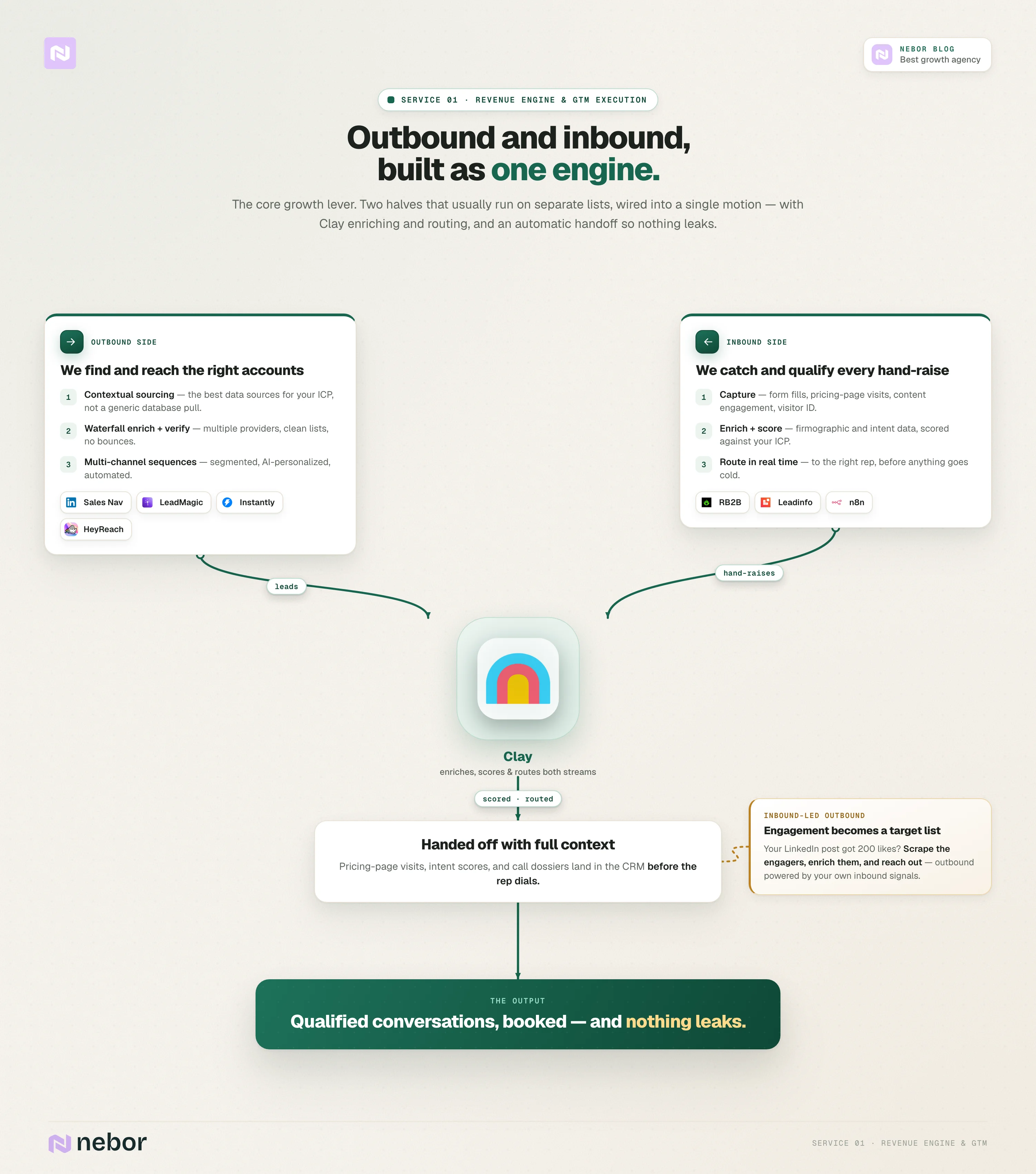
We start with the outbound side. There, we start with TAM mapping and prospect list building. But not the way most agencies do it.
Keep in mind, the core idea is to figure out what works for your revenue growth and then automate it.
We don't just pull a generic list from a database. We find the best data sources for your specific business, your offering, and your ICP.
That might be LinkedIn Sales Navigator. It might be niche industry directories, RSS feeds from trade publications, or job posting boards. The data source depends on who you're trying to reach and why.
For example, we worked with a client whose ICP was companies hosting events with exhibitors and sponsors. The right data source wasn't ZoomInfo or Apollo. It was 10times and Cvent, platforms that list upcoming events across industries and geographies.
We scraped event data, identified the organizers, verified they had sponsors and exhibitors, and then enriched the contacts. Contextual sourcing is what separates a targeted campaign from a spray-and-pray campaign.
From there, we enrich and verify every record. We use waterfall enrichment across multiple providers like LeadMagic, FullEnrich, and Findymail to make sure you have the most accurate contact data possible.
Then we clean the list, checking domains, verifying emails with tools like BounceBan, DeBounce, or ZeroBounce, removing duplicates, and filtering against do-not-contact lists.
Next, we design the outreach itself, multi-channel and automated. We segment by pain point, by tech stack, by engagement signals, by whatever criteria matter for your ICP. Different pitches for different segments, each tailored to the recipient's actual situation.
And yes, we use AI to help generate personalized messaging at scale. We use LLMs natively inside Clay to generate relevant talking points based on each prospect's company, role, recent activity, and the specific pain point we're addressing.
The AI does the research grunt work. The strategy, the segmentation, and the relevance come from us.
On the inbound side, we set up lead capture, enrichment, scoring, and routing so that when someone fills out a form, visits your pricing page, or engages with your content, they don't just wait in a queue.
They get enriched automatically with firmographic and engagement data, scored against your ICP criteria, and routed to the right rep in real time. We build this using a combination of Clay, n8n, and your CRM, so it's all connected and nothing falls through the cracks.
We wrote detailed breakdowns of many of these workflows, including the Clay outbound automation services post, how to automate lead generation, and specific sales automation workflows you can learn from.
We wire your demand generation and sales into one connected motion that also handles inbound lead qualification and sales handoff automatically so nothing leaks
This is where most growth agencies stop. They'll build you an outbound engine or set up your marketing campaigns, but they won't connect the two. We will.
The core idea is simple. Marketing should feed sales and sales should inform marketing. Not two teams working parallel strategies with parallel dashboards. One engine.
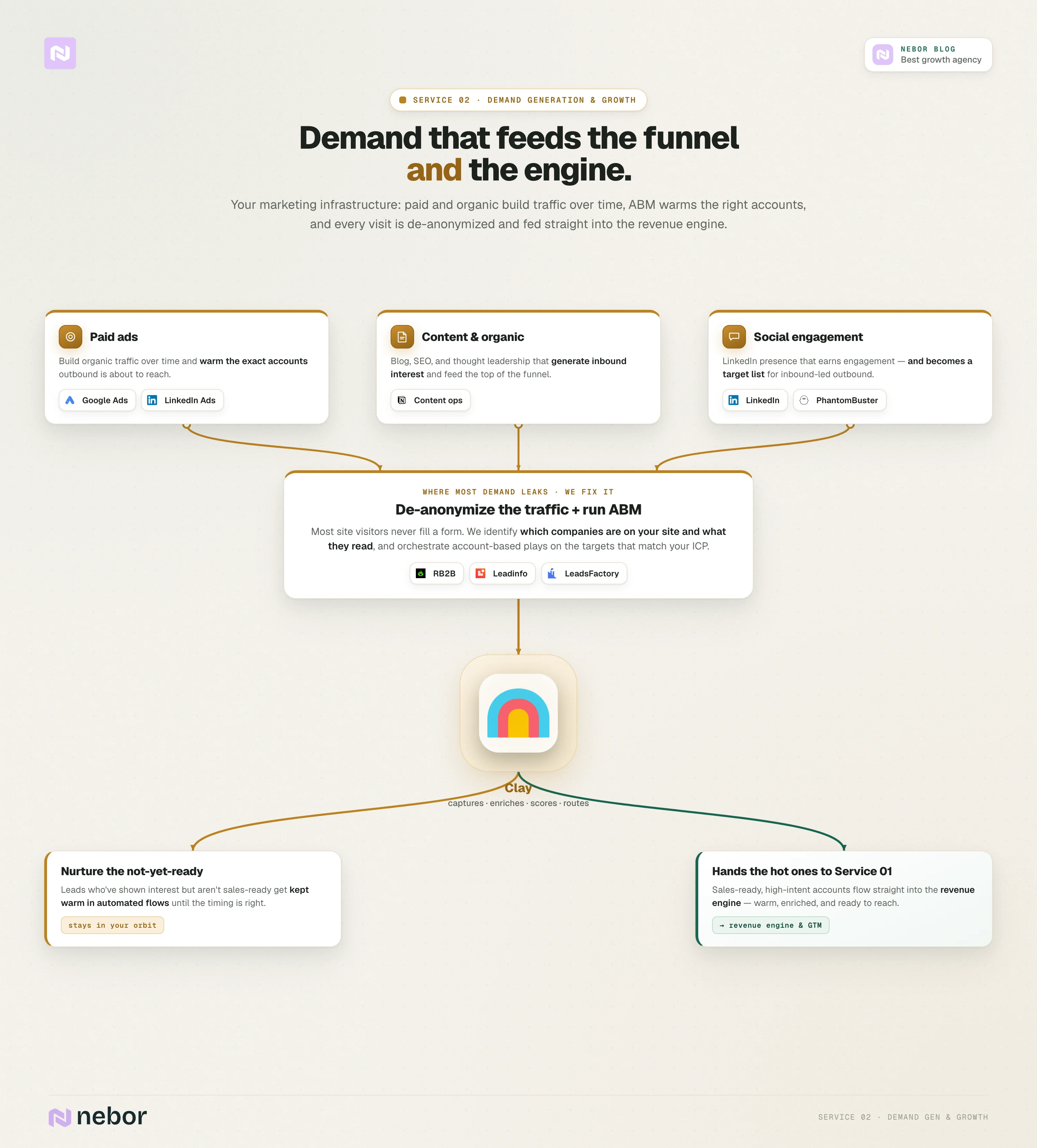
On the marketing side, we build demand generation infrastructure. LinkedIn advertising to warm up target accounts before outbound hits. Website visitor identification so you know which companies are checking out your site and what pages they're looking at.
Paid ads to build organic traffic that feeds the top of your funnel over time. Nurture email flows for leads who aren't ready for a sales conversation yet but have shown enough interest to stay in your orbit.
On the sales side, we make sure every piece of marketing activity is visible and actionable. When someone visits your pricing page, your sales team knows about it before they pick up the phone.
When a lead downloads a whitepaper or visits your key pages on your website, they get scored, enriched, and routed based on how well they match your ICP and how strong their intent signals are.
We also set up what we call inbound-led outbound, which is the strategy of using your inbound engagement data to power smarter outbound campaigns. Your LinkedIn post got 200 likes?
We can scrape the people who engaged with it, enrich them, identify which ones match your ICP, and add them to a targeted outreach sequence automatically. That's a warm conversation and the reply rates reflect it.
Cold calling isn't dead either, and we treat it as part of the same connected motion. We prepare your internal sales team with contact details, conversation starters, and key insights from our outreach campaigns and lead nurturing activities.
We can integrate all of that directly into your CRM as cold calling openers so your reps have context before they even dial. We also pass mobile phone number data through multiple providers to make sure they have the most accurate phone data available.
We turn your CRM from a data graveyard into the command center for your entire revenue team
This is Yannick's territory, and it's one of the most underestimated pieces of the growth puzzle.
Most CRMs are set up once and then slowly deteriorate. Properties get added randomly. Lifecycle stages don't match how the team actually sells.
Data goes stale because nobody keeps it current. Reps stop trusting the CRM, so they stop using it. And leadership can't get an accurate pipeline forecast because the data underneath it is garbage.
We fix that.
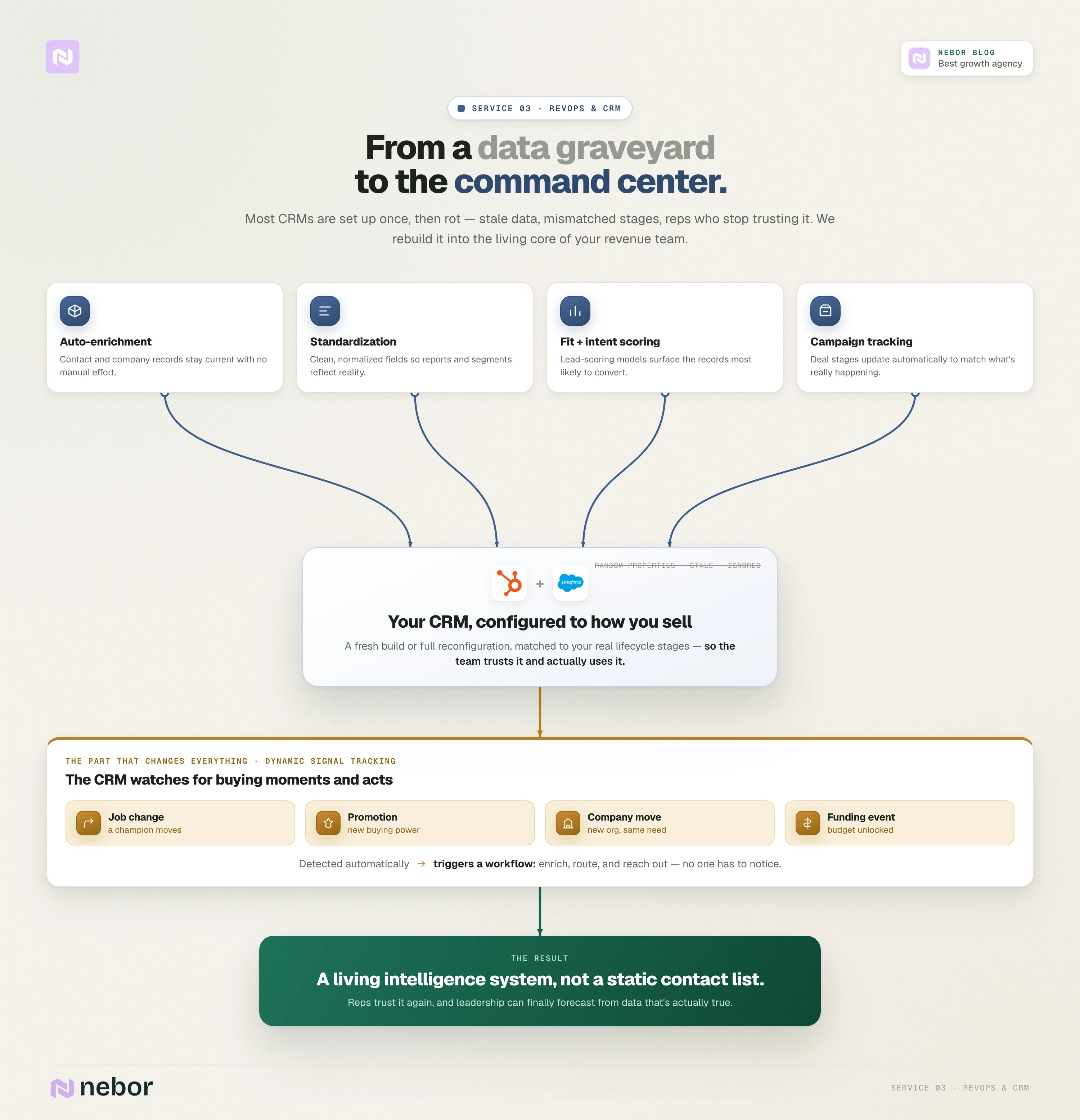
Whether it's a fresh CRM implementation or a full reconfiguration of an existing setup, we build it to match how your business actually operates. That means custom properties, lifecycle stages, deal pipelines, and automation rules that reflect your revenue model.
Then we layer on the operational side. Data hygiene automation so duplicates get caught and merged automatically. Enrichment workflows that keep contact and company records up to date without manual effort.
You also get data standardization and normalization so your reports and segmentation actually reflect reality instead of messy, inconsistent inputs.
We build lead scoring models directly inside your CRM that combine fit, intent, and engagement to surface the leads most likely to convert. We also add campaign tracking and automated status updates so deal stages reflect what's actually happening.
And here's the part that really changes things, dynamic signal tracking. We set up your CRM to automatically monitor and capture signals like job changes, promotions, company moves, and funding events.
When a champion who bought your product at their last company switches to a new organization, your system picks it up and triggers a workflow to reach out. When a decision-maker at a target account gets promoted, your team knows about it. This turns your CRM from a static contact list into a living intelligence system.
The philosophy here is that RevOps is not just about keeping data clean. It's about making your CRM the operational backbone that actively drives your sales and marketing execution.
Every decision your revenue team makes depends on data they can trust. We make sure that trust is earned.
We set up evergreen, signal-based campaigns that compound and keep feeding your pipeline month after month without adding headcount
At this stage, the system starts to pay for itself.
Most agencies deliver a campaign. It goes for a few weeks. Maybe it works, maybe it doesn't. Then it's over, and you need another one. That's a project, not a system.
What we build is different. We set up automated workflows that continuously monitor and capture intent data and buying signals, then trigger targeted outreach in real time.
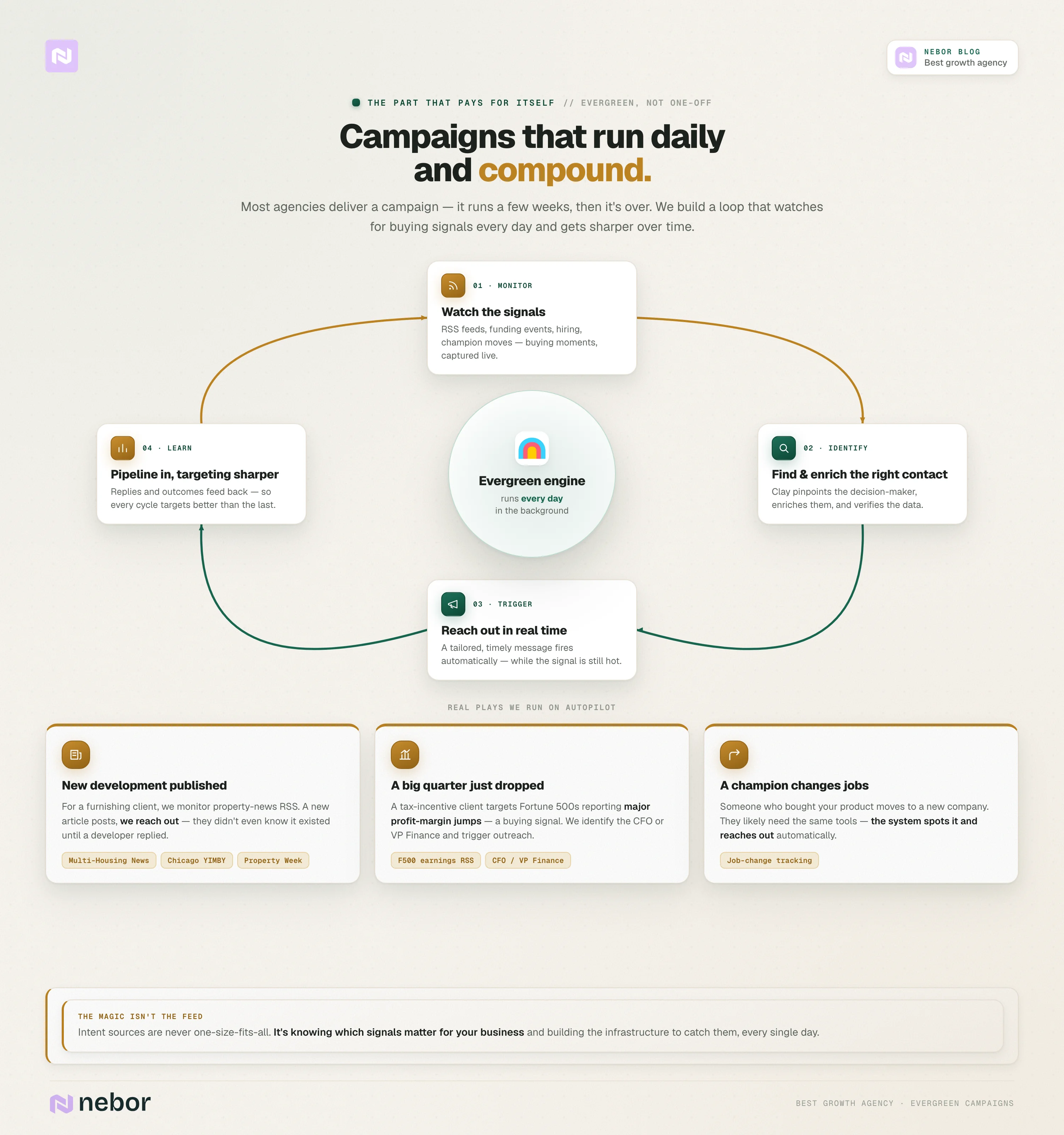
These workflows keep going every day, in the background, without anyone needing to press a button. And they get better over time because the data keeps flowing in and the targeting keeps getting sharper.
Let us give you some real examples.
We worked with a client that offers AI-powered furnishing solutions for property developers. For them, we set up monitoring on RSS feeds from sites like Multi-Housing News, Chicago YIMBY, and Property Week.
Every time a new article is published, it gets pulled into Clay automatically. Our workflow identifies whether the article is about a new property development project, extracts the developer name and project details, finds the right contact, generates a personalized email, and sends it. Every day, without anyone touching it.
The client didn't even know an article had been published until they got a reply from a developer who was interested.
Another client helps enterprise businesses with tax incentives. We set up RSS feeds to monitor Fortune 500 companies that just reported major profit margin increases. That's a buying signal.
A company that just had a big quarter is much more likely to be interested in maximizing their tax position. We identify the right contacts (usually the CFO or VP of Finance), enrich them, and trigger outreach. All automated.
A client of ours in the facility management business is a great example of what happens when all of these pieces come together. They're a small tech startup with just 6 employees.
Before working with us, they were doing almost no proactive outreach. Everything came through referrals and their existing network.
After we implemented the standard outbound workflows, the inbound-led outbound motion, and the former-contact monitoring workflow, they went from zero meetings per week to 6 to 10 meetings per week and saw a 500% increase in pipeline within three months.
Another example is a workplace-technology company with a big sales team. Their reps were spending hours every day on manual desk research before they could even start selling.
We automated the entire data sourcing, enrichment, and routing process. Now hundreds of qualified leads flow into their pipeline automatically from multiple data sources we identified specifically for their business.
The point is that intent data sources are never predetermined or set in stone. It all depends on what you offer and who your best customers are. The magic is in knowing which signals matter for your specific business and building the automated infrastructure to capture them.
Hire Nebor.ai to build the growth infrastructure your revenue team actually needs
Our entire approach comes down to one core belief. Your team doesn't need more people or more tools. It needs a system that supports the growth of your business and keeps it moving.
We build that infrastructure across three connected pillars.
The first is revenue engine and GTM execution, your outbound and inbound systems, connected, automated, and built on strategy instead of guesswork.
The second is demand generation and growth, your marketing infrastructure, from LinkedIn campaigns and SEO to website visitor identification and nurture flows, all feeding the same pipeline your sales team works from.
The third is CRM and revenue operations, your data backbone, clean, enriched, and wired for automation so every decision is based on data your team can trust.
Every engagement starts with your business goals. We map your current GTM motion, identify where the gaps are, and design the system architecture around what you actually need. From strategy to a live, working system in weeks, not months.
We don't have a magic wand. Results depend on your industry, your product, and how your team sells. But we build the system that gives you the best possible shot at predictable, scalable growth.
And unlike most agencies, what we build stays with you. It's inside your stack, owned by your team, and it keeps compounding long after the engagement ends.
If you recognized your team in any of the problems we described above, that's exactly the kind of conversation we want to have with you.
Book a strategy call and let's figure out what your growth engine should look like.
Note: Struggling to get your revenue team out of manual work?
Your reps spend most of the week researching accounts, hunting for contact details, updating records and chasing follow-ups. None of it is why you hired them, and hiring another one only multiplies manual work across your team.
At Nebor, we are a GTM engineering and RevOps agency. We will take that work off your team and build it into a system: the prospecting, the enrichment, the outreach and the CRM updates all happening on their own, with your reps picking up only the conversations worth having.
We build everything in your own accounts, so the system is yours to keep, adjust and extend as your motion changes.
Book a 15-minute call and we'll map the manual work your team could stop doing.


Related Articles


By clicking Sign Up you're confirming that you agree with our Terms and Conditions.