

In this post:
A go-to-market strategy is your plan for how you reach and win customers, covering who you sell to, what value you offer them, how you reach them, and how the whole revenue team executes. It's the connecting logic that turns a product into actual customers.
Most companies have something they call a GTM strategy, usually a deck that gets presented once and then ignored.
A real one is different, because it decides what your sales, marketing, and product teams do every day, and how those efforts feed each other.
The difference between a strategy that lives in a slide and one that actually drives your business is enormous. A genuine GTM strategy is less a document and more an operating system for how you go to market, and that's the reason getting it right shapes everything downstream.
TL;DR
A go-to-market strategy is how you bring a product to market and win customers. It answers who you target, what value you offer, which channels and motion you use, and how your revenue team executes it all together.
Most GTM strategies fail because they're a deck full of ambition with no connection to what teams do all day. A real one is a connected system, where the targeting, the message, the channels, and the execution all reinforce each other.
The strongest GTM strategies start from a sharp ICP, pick a clear motion, and back it with the infrastructure to execute. Strategy without execution is theater, and execution without strategy is random activity, so you need both, wired into each other.
So what is a go-to-market strategy, once you get past the jargon?
A go-to-market strategy is the overall plan for how your company acquires customers. It stands above your individual tactics and decides the big questions, like who you're going after and how you intend to win them.
It's broader than marketing or sales alone, because it spans the whole motion from a stranger first hearing about you to a closed, paying customer.
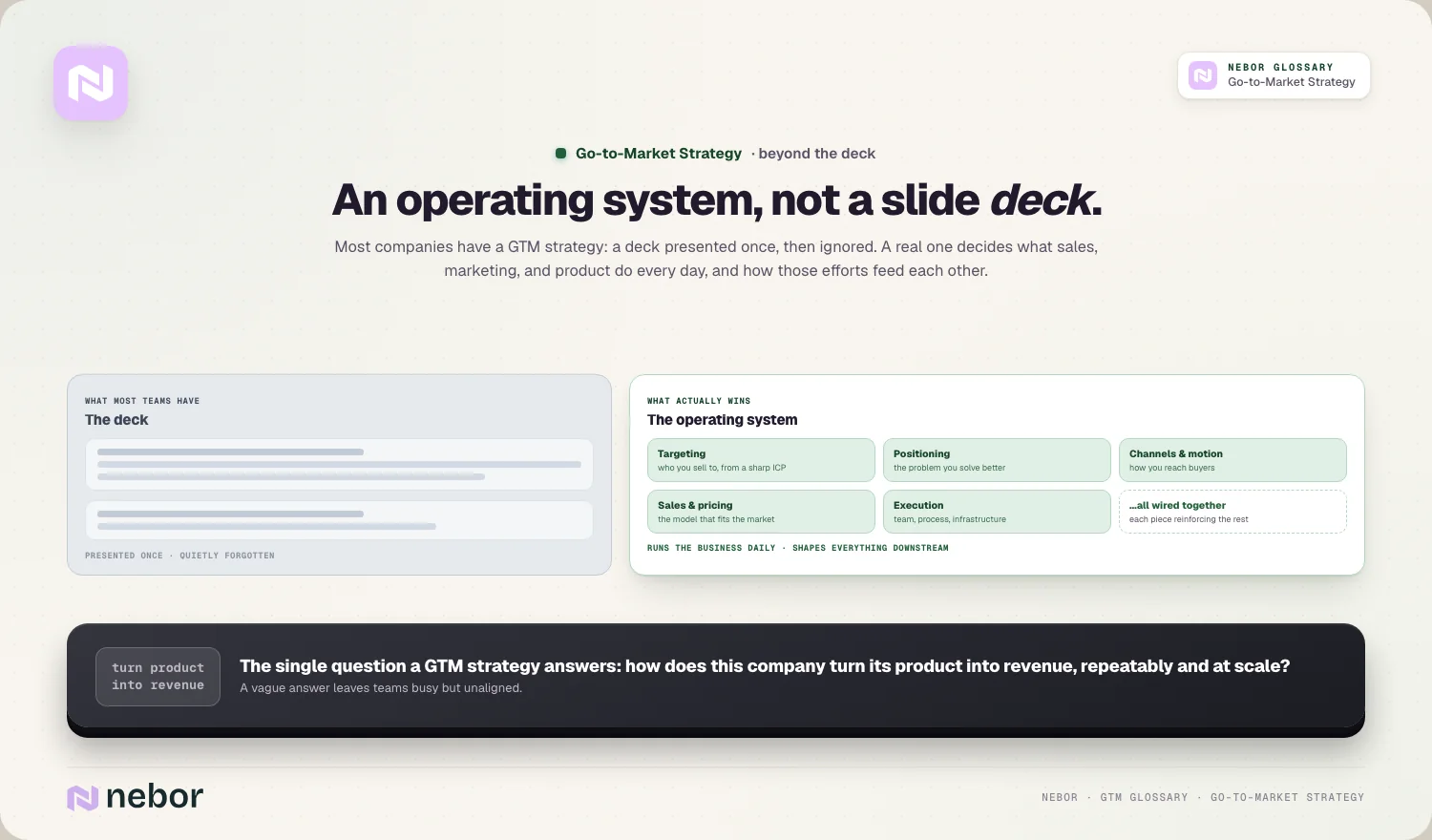
A GTM strategy decides which market you're targeting, how you'll position your product, which channels you'll use to reach buyers, and how your teams will work together to convert them.
The clearest way to think about it is as the answer to a single question. How does this company turn its product into revenue, repeatably and at scale?
Everything in a GTM strategy exists to answer that, which is why a vague or missing strategy leaves teams busy but unaligned.
What are the core pieces every GTM strategy has to answer for you?
A complete GTM strategy comes down to a handful of decisions, and skipping any of them leaves a hole. These are the questions it exists to answer.
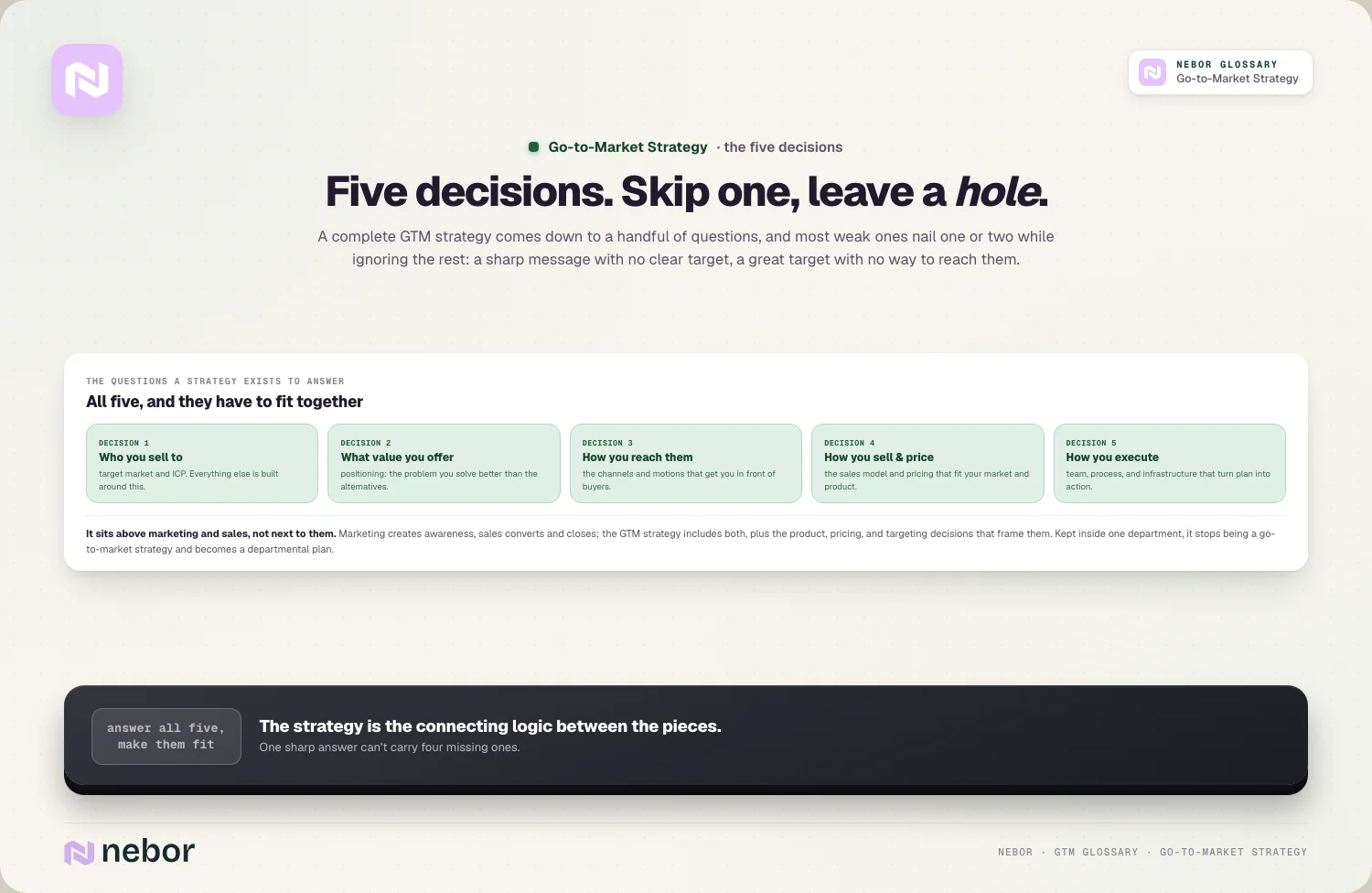
The core pieces of a GTM strategy are these.
Who you sell to, your target market and ideal customer profile, which everything else is built around.
What value you offer, your positioning and the specific problem you solve better than the alternatives.
How you reach them, the channels and motions you use to get in front of buyers.
How you sell and price, the sales model and pricing that fit your market and product.
How you execute, the team, the process, and the infrastructure that turn the plan into action.
Most weak GTM strategies nail one or two of these and ignore the rest, like a sharp message with no clear target, or a great target with no way to reach them. A strong strategy answers all of them and makes sure they fit together.
How is a GTM strategy different from a marketing or sales strategy?
People often confuse these, but a GTM strategy stands above both marketing and sales instead of next to them. It's the bigger plan they each serve.
A marketing strategy is about how you create awareness and demand, and a sales strategy is about how you convert and close. A GTM strategy includes both of those, plus the product, pricing, and targeting decisions that frame them, and it makes sure they all point the same way.
It's the layer that keeps marketing and sales from working off two disconnected playbooks.
This is why a GTM strategy has to be cross-functional instead of a marketing document. When it lives only inside marketing or only inside sales, it stops being a go-to-market strategy and becomes a departmental plan, and that's exactly how the two sides end up misaligned.
Why do most go-to-market strategies fail to change anything real?
The uncomfortable truth, and we've seen this in more companies than we can count, is that most GTM strategies have no effect, because they never make it off the slide. A deck gets built, presented, and quietly forgotten while everyone goes back to what they were doing.
The deeper problem is that strategy and execution get treated as separate things. A team writes an ambitious strategy with no connection to the systems and habits that would deliver it, so the strategy describes a destination with no road to it.
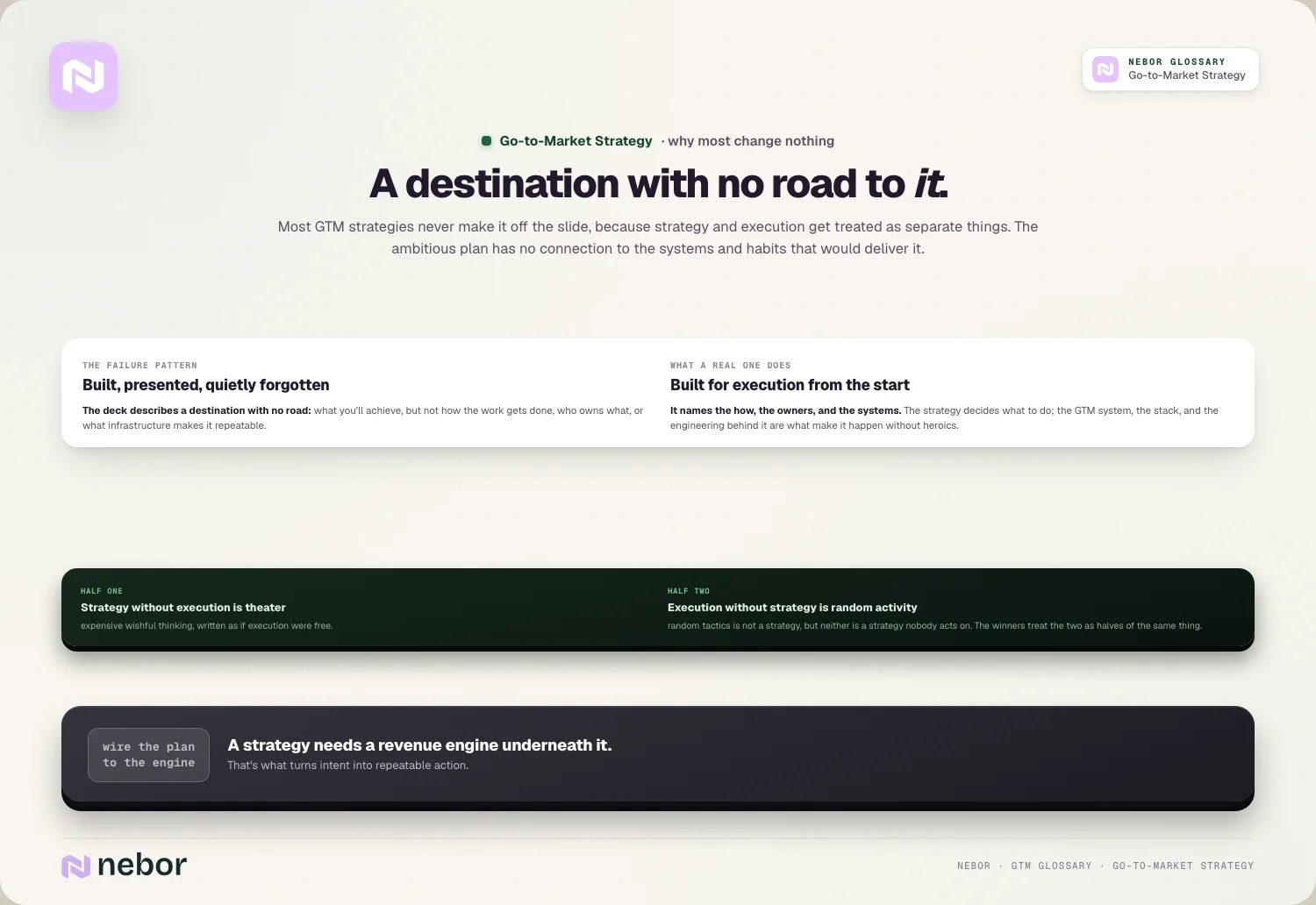
As we like to put it, random tactics is not a strategy, but neither is a strategy nobody acts on.
A real GTM strategy closes that gap by being built for execution from the start. It names what you'll do and also how the work gets done, which teams own what, and what infrastructure makes it repeatable. A strategy that can't be executed is just expensive wishful thinking.
What are the main go-to-market motions you can choose between?
A big part of your GTM strategy is choosing your motion, the primary way you acquire customers. Different motions suit different products, prices, and markets, and picking the right one shapes everything else.
The classic options include sales-led growth, where reps drive acquisition and which suits higher-priced, considered purchases, and product-led growth, where the product itself converts users through free trials and self-serve.
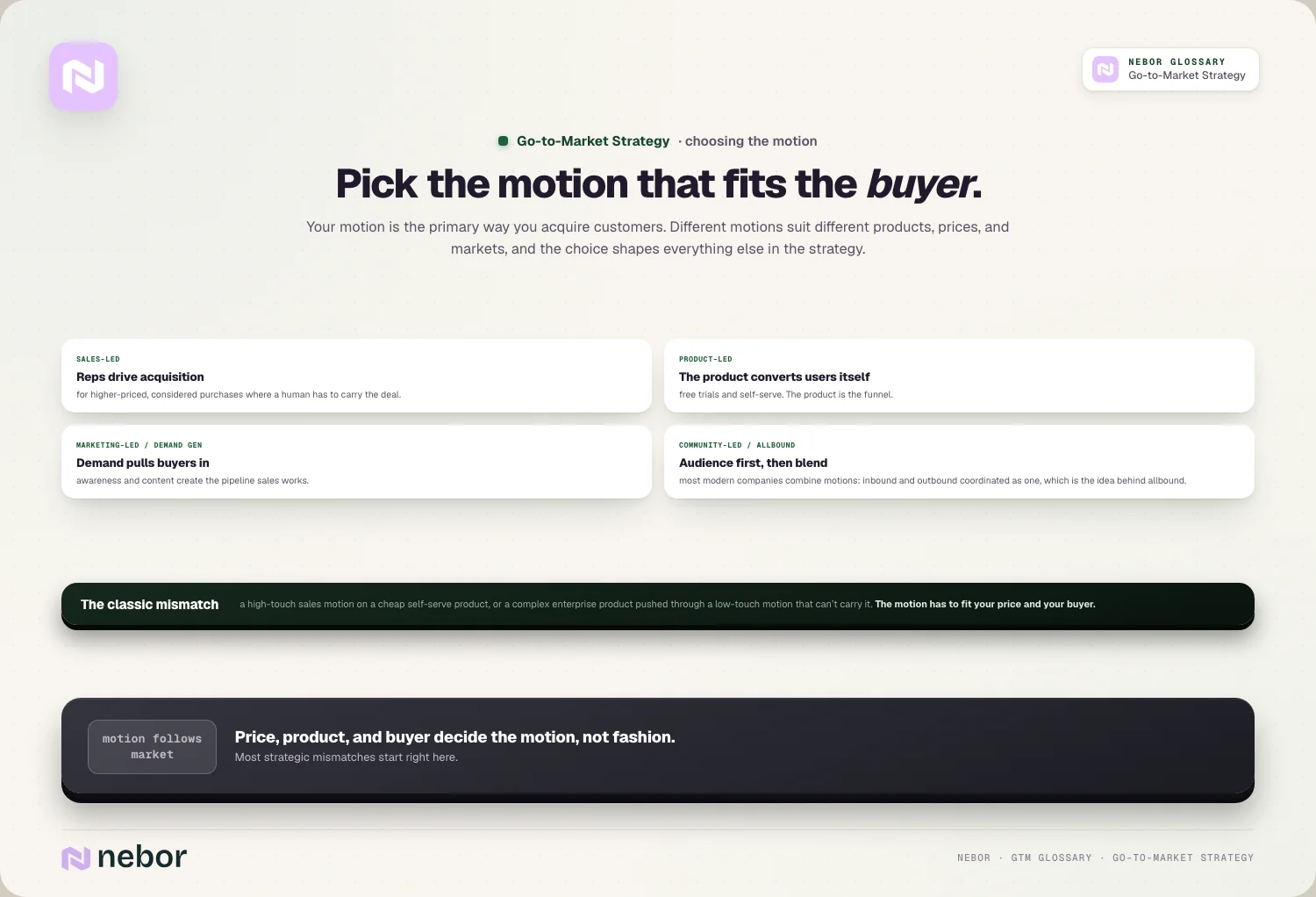
Marketing-led and demand-gen motions stand alongside those, and community-led approaches build an audience first.
Most modern companies blend several rather than picking one, which is the idea behind allbound, combining inbound and outbound into one coordinated motion.
The key is that your motion has to fit your price and your buyer, because a high-touch sales motion on a cheap self-serve product, or the reverse, is one of the most common strategic mismatches.
Why is your ICP at the center of your entire GTM strategy?
Everything in a GTM strategy radiates out from one decision, which is who you're trying to sell to. If the target is wrong, even a perfect message, channel, and motion are aimed at the wrong people.
Your ideal customer profile defines the companies worth pursuing, and it shapes your positioning, your channels, and your sales model.
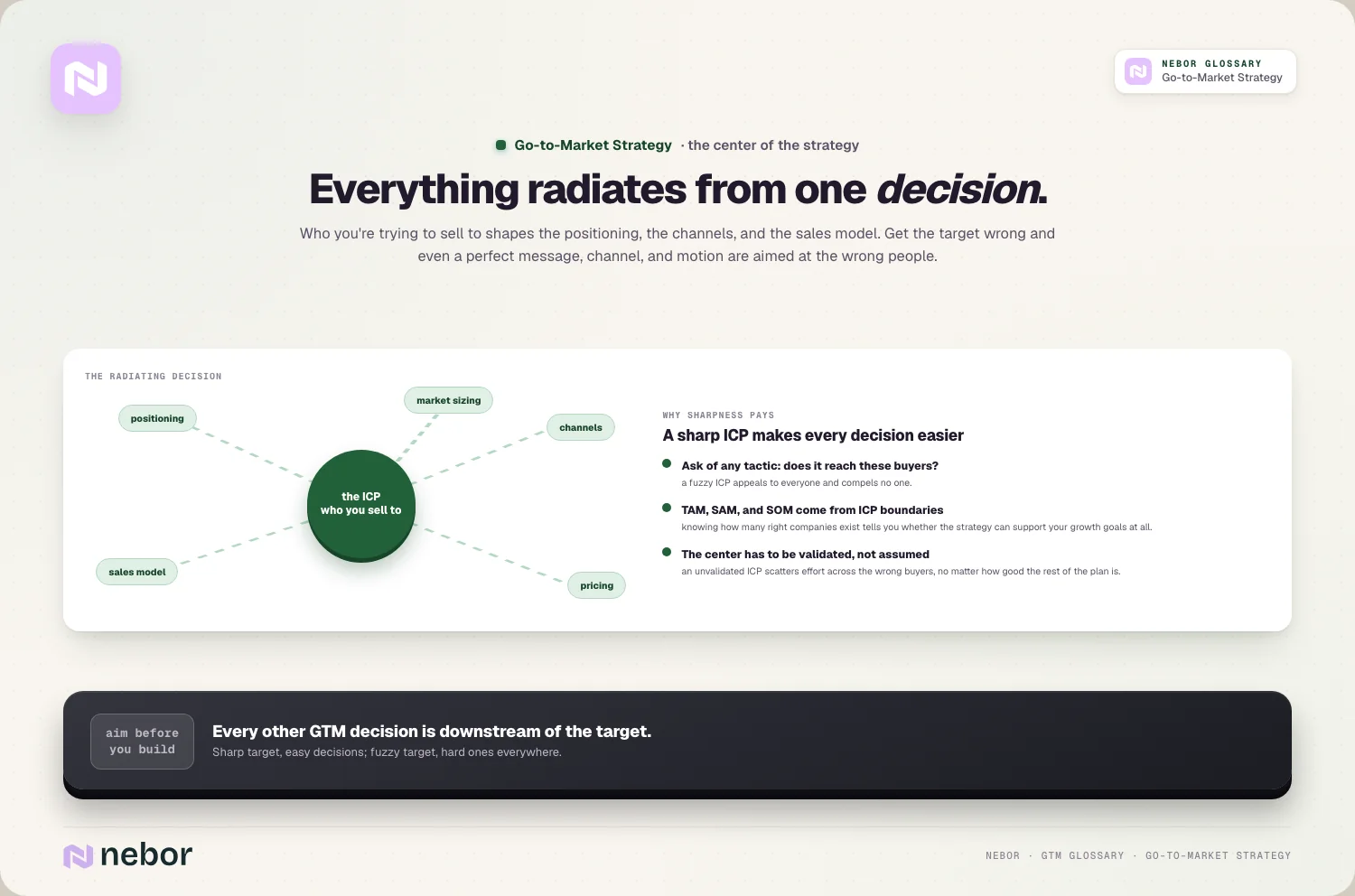
A sharp ICP makes every other decision easier, because you can ask of any tactic whether it reaches and resonates with those specific buyers. A fuzzy ICP makes every decision harder, since you're trying to appeal to everyone and end up compelling to no one.
This is also tied to your market sizing, since your TAM, SAM, and SOM come from your ICP boundaries. Knowing how many of the right companies exist tells you whether your strategy can support your growth goals, or whether you've aimed at too small a slice to build on.
How does a GTM strategy connect to your systems and infrastructure?
A strategy is only as good as your ability to carry it out, which is where infrastructure comes in. The strategy decides what to do, and the systems decide whether you can do it consistently, week after week.
This is the link between your GTM strategy and your wider GTM system, the connected set of workflows, data, and tooling that executes the plan day to day.
The strategy says you'll target these accounts through these channels, and the system, including your GTM stack and the engineering behind it, is what makes that happen without heroics.
This is exactly why so many strategies fail. They're written as if execution is free, when in reality a strategy needs a revenue engine underneath it to turn intent into repeatable action.
The companies that win treat strategy and infrastructure as two halves of the same thing, instead of writing the plan and hoping the execution sorts itself out.
How do you know if your go-to-market strategy is really working?
A GTM strategy isn't a one-time decision, it's something you test against reality, so you need to know what success looks like. The right metrics tell you whether the strategy is delivering.
The honest measures are commercial outcomes, like pipeline created, revenue, win rate, and pipeline velocity, alongside the efficiency of getting there, like your customer acquisition cost.
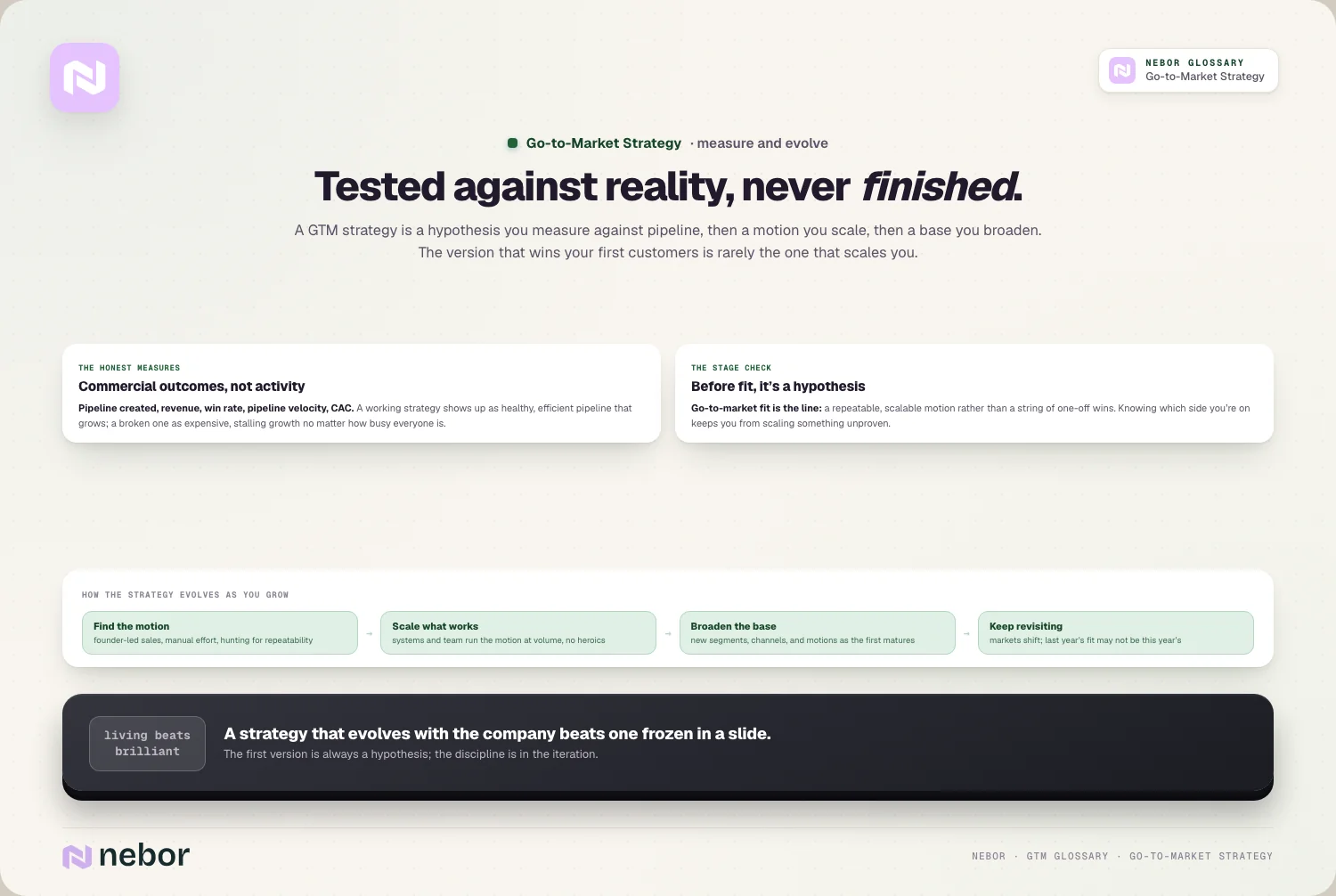
A working strategy shows up as healthy, efficient pipeline that grows over time, and a broken one shows up as expensive, stalling growth no matter how busy everyone is.
You also watch for whether you've reached go-to-market fit, the point where you have a repeatable, scalable motion instead of a string of one-off wins.
Before that fit, the strategy is still a hypothesis you're testing, and after it, the job shifts to scaling what works. Knowing which stage you're in keeps you from scaling something that isn't proven yet.
What are the common go-to-market strategy mistakes we keep seeing?
Most GTM failures trace back to a few recurring mistakes, and they tend to repeat across companies. Knowing them helps you avoid the obvious traps.
The biggest is the strategy that's all ambition and no execution, a deck disconnected from the day-to-day work. Close behind is a fuzzy or unvalidated ICP, which scatters your effort across the wrong buyers.
Then there's the motion mismatch, like forcing an expensive sales-led motion on a product that should be self-serve, and the opposite, trying to sell a complex enterprise product through a low-touch motion that can't carry it.
There's also the team that chases whatever channel is trendy without a coherent plan tying anything together.
Each of these traces back to skipping a core question, so the protection is to start from a sharp ICP, pick a motion that fits, connect the strategy to real execution, and measure it against pipeline instead of activity.
How does a go-to-market strategy evolve as your company grows up?
A GTM strategy isn't fixed, because what works at one stage stops working at the next. The strategy that gets you your first customers is rarely the one that scales you to many.
Early on, your strategy is about finding a repeatable motion at all, often through founder-led sales and a lot of manual effort, with the goal of reaching go-to-market fit.
Once you've found what works, the strategy shifts toward scaling it, building the systems and team to carry the motion at volume without relying on heroics. Later still, it broadens into new segments, channels, and motions as the first one matures.
The mistake is treating the strategy as done once it's written. The best companies revisit their GTM strategy as they grow, because the market shifts, the competition reacts, and the motion that fit last year may not fit now.
A living strategy that evolves with the company beats a brilliant one that's frozen in a slide.
How long does it take to get your go-to-market strategy right?
A GTM strategy isn't something you nail on the first try, and the first version is always a hypothesis, whatever the deck says.
You start with your best guess at the target, the message, and the motion, then you test it against real buyers and learn what actually lands.
Early signals tell you whether you're close or way off, and you adjust, often several times, before the strategy starts to click. This is normal, and the teams that expect it move faster than the ones who treat the first plan as final.
The thing to watch for is the difference between refining and thrashing. Refining means changing one part of the strategy based on real evidence, while thrashing means changing everything every few weeks out of panic.
A strategy needs enough time to prove or disprove itself, so the discipline is to test deliberately instead of abandoning the plan at the first quiet week.
Does a small startup really need a formal go-to-market strategy?
Founders sometimes think GTM strategy is a big-company concern, but a startup needs one just as much, even if it's lighter. The form is simpler, but the questions are the same.
Early on, the strategy might be a page rather than a deck, and the execution might be the founder doing sales by hand. That's fine, because the point isn't formality, it's clarity about who you're selling to and how you'll win them.
A startup with a sharp, simple GTM strategy beats one that's just trying things at random, even if neither has much infrastructure yet.
What a startup shouldn't do is skip the thinking entirely and call hustle a strategy. Activity without direction burns the limited runway a young company has, so even a rough, one-page GTM strategy is worth far more than none at all.
Why a go-to-market strategy is only as good as your ability to carry it out
In the end, a go-to-market strategy is the connecting logic that turns a product into customers, spanning who you target, how you reach them, and how your whole team executes.
It's the difference between a company that grows on purpose and one that grows by accident, until the accidents dry up.
The teams that win treat strategy and execution as inseparable. They start from a sharp ICP, choose a motion that fits their product and buyer, and back the plan with the infrastructure to support it, so the strategy is something that happens instead of something that's merely written down.
The mindset that works is to stop thinking of GTM strategy as a deck and start thinking of it as a system you build and refine.
You decide who you're for and how you'll win them, wire the execution underneath it, and keep adjusting as you learn. A strategy you can actually carry out beats a more impressive one you can't, every single time.
Deel dit bericht
Marketing
Guide
Begrippenlijst
Gerelateerde begrippen
De basis GTM-concepten begrijpen




Klaar om je pipeline te bouwen