

In this post:
Your customers love your product and it shows, seeking you out, telling their friends, and complaining the day it goes down, all classic signs of product-market fit. And yet growth has stalled, because loving your product and being able to sell it repeatably and profitably are two very different things.
Go-to-market fit is the second thing, the one that usually gets ignored until growth breaks. It's the point where you've found a reliable, cost-effective way to reach the right buyers, sell to them, and deliver at scale, so demand doesn't just exist but can be captured again without the economics falling apart.
Go-to-market fit is when a company has found a repeatable, scalable, and profitable way to sell and deliver its product to its market. Where product-market fit proves the product works for users, go-to-market fit proves the business model works for the market through the right channels and motion.
The reason it deserves its own name is that product-market fit alone does not guarantee a business can grow. Plenty of companies with deeply loved products stall out because their way of selling is inefficient or broken, so go-to-market fit is the missing piece that turns a good product into a scalable business.
TL;DR
Go-to-market fit is a repeatable, scalable, and profitable way to sell and deliver your product to its market, a separate achievement from product-market fit.
Product-market fit proves the product works for users, while go-to-market fit proves the whole business model works, through the right channels, motion, and economics.
It's the reason many companies with loved products still fail to scale, because a broken or inefficient sales motion caps growth no matter how good the product is.
It shows up in metrics like pipeline velocity, LTV to CAC, retention, and conversion rates, and it's a motion that keeps maturing instead of a milestone you hit once.
What go-to-market fit means and how it differs from product-market fit
The clearest way to grasp go-to-market fit is against its more famous sibling. Product-market fit answers whether the product works for the people using it, while go-to-market fit answers whether you can reliably and profitably get that product into the hands of the right buyers at scale.
The two describe different halves of a working business. One phrasing captures it well, with product-market fit telling you what works and go-to-market fit telling you how to keep it working, profitably, at scale, so you need both for the business to grow instead of merely exist.
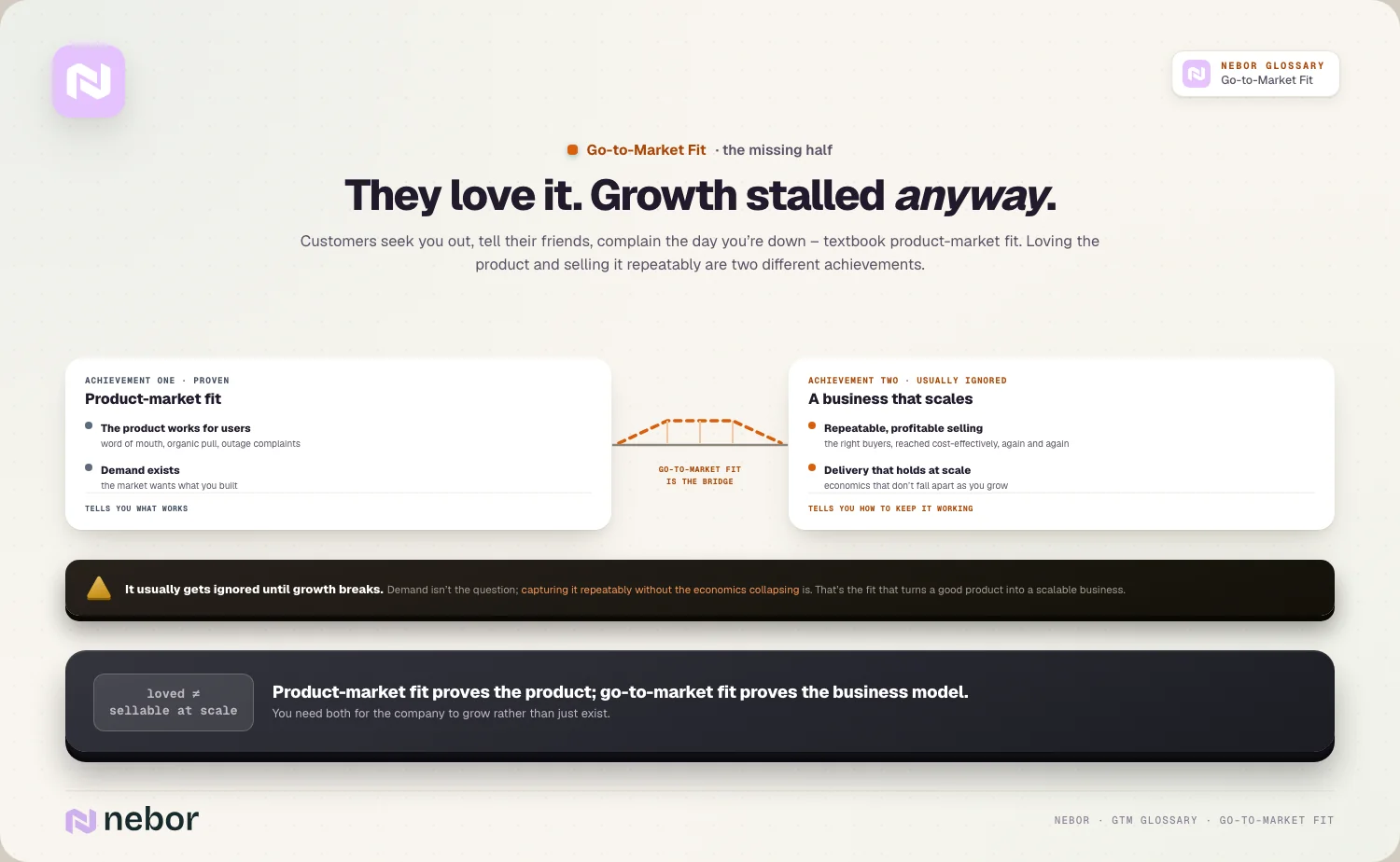
This is why go-to-market fit is really about the mechanics of selling instead of the product itself. It asks whether you're reaching the right people through the right channels, with a sales motion that repeats, so it lives in your go-to-market strategy instead of in the product roadmap.
Why product-market fit alone does not guarantee you can scale
The uncomfortable truth is that a beloved product can still fail to grow. Andreessen Horowitz's research found that nearly 60% of post-Series A startups with product-market fit still fail to scale, citing inefficient go-to-market models and broken sales motions as leading causes.
That statistic reframes what kills growth-stage companies. It isn't usually a bad product, because these companies had proven demand, but a failure to build a repeatable way to sell it, which means go-to-market fit is often the real constraint instead of the product itself.
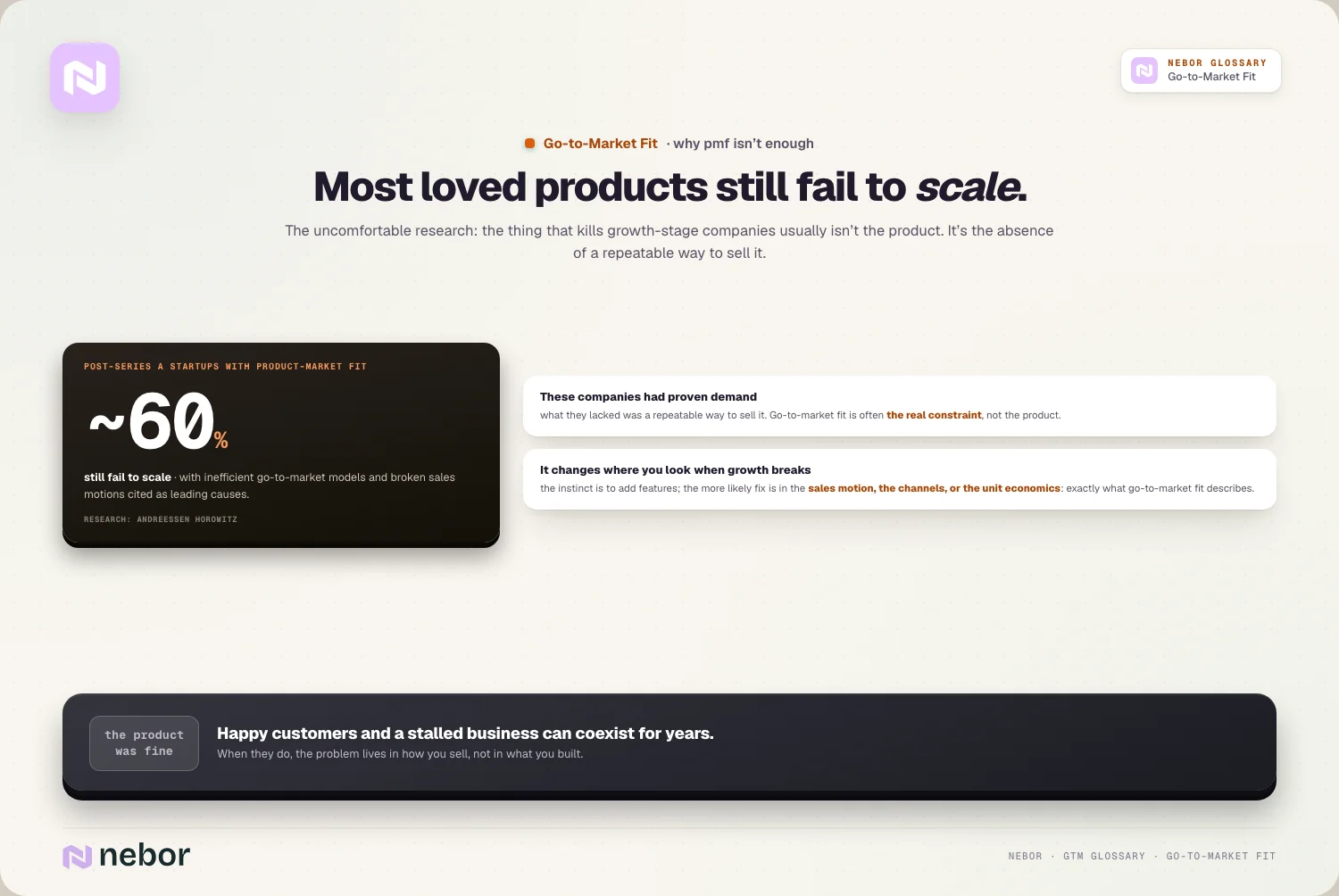
Understanding this changes where a stalled company looks for the problem. When growth breaks despite happy customers, the instinct is to add features, but the more likely fix is in the sales motion, the channels, or the unit economics, which are exactly the things go-to-market fit describes.
The four things that all have to fit for go-to-market fit to hold
Go-to-market fit isn't a single condition but the alignment of several, often described as the intersection of market, product, channel, and model. The market is who you sell to, the product is what you sell, the channel is how you reach them, and the model is how you make money doing it.
Fit emerges only when all four line up together. A great product sold through the wrong channel fails, and the right channel selling to the wrong market fails too, so go-to-market fit is fundamentally about these pieces reinforcing each other instead of any one being strong on its own.
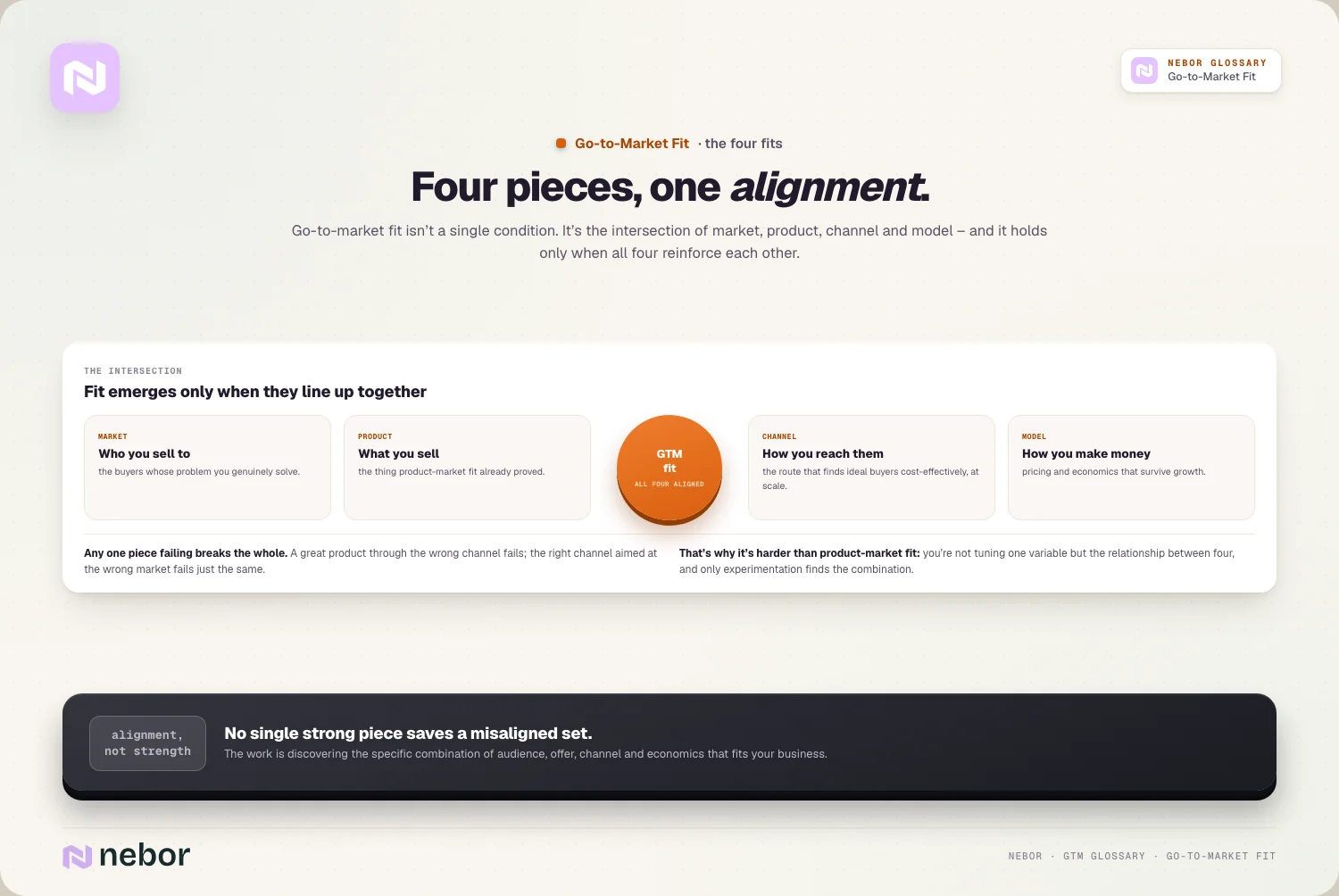
This is why go-to-market fit is harder to find than product-market fit. You're not tuning one variable but the relationship between four, so it takes real experimentation to discover the specific combination of audience, offering, channel, and economics that works for your particular business.
What the signs of go-to-market fit look like once you check your numbers
Unlike product-market fit, which often shows up as qualitative signals like word of mouth, go-to-market fit is visible in hard metrics. The clearest indicators are a healthy LTV to CAC ratio, strong pipeline velocity, solid retention, and conversion rates that hold up as you spend more.
The unifying theme is efficiency that survives scale. When your sales and marketing produce predictable results and the economics stay healthy as you grow, that repeatability is the fingerprint of go-to-market fit, whereas rising costs and falling conversion as you scale signal its absence.
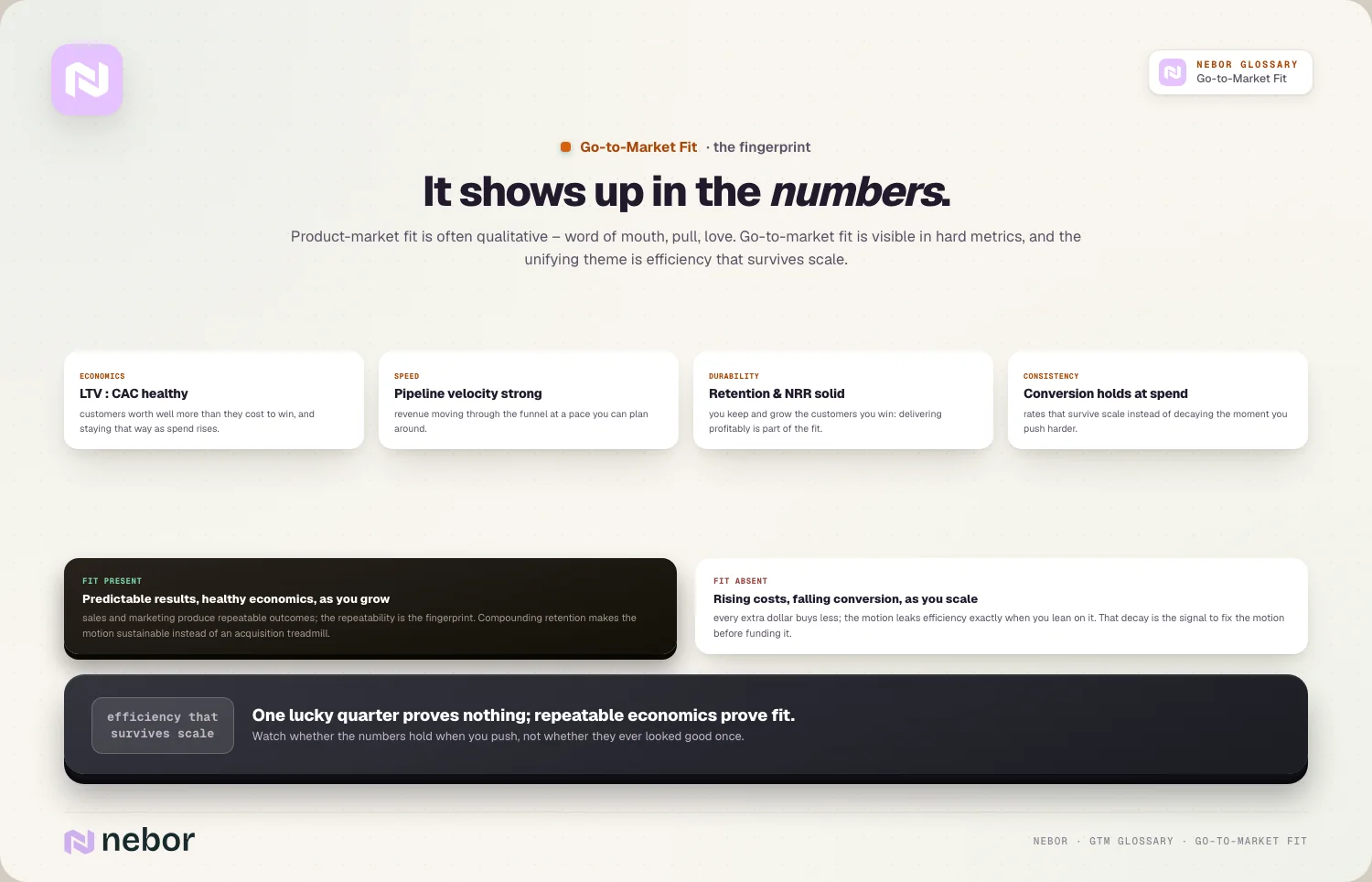
Retention and expansion matter here too, because delivering profitably is part of the fit. Strong net revenue retention shows your team not only wins customers efficiently but keeps and grows them, and that keeping is what makes the whole motion sustainable instead of a treadmill of acquisition that never compounds.
Why channel fit is the piece that growing teams most often overlook
Of the four elements, channel is the one companies most often get wrong, because they assume the channel that got their first customers will scale.
Finding the right channel to consistently reach your ideal buyers in a cost-effective, scalable way is its own discipline, and the wrong channel caps growth before anyone notices.
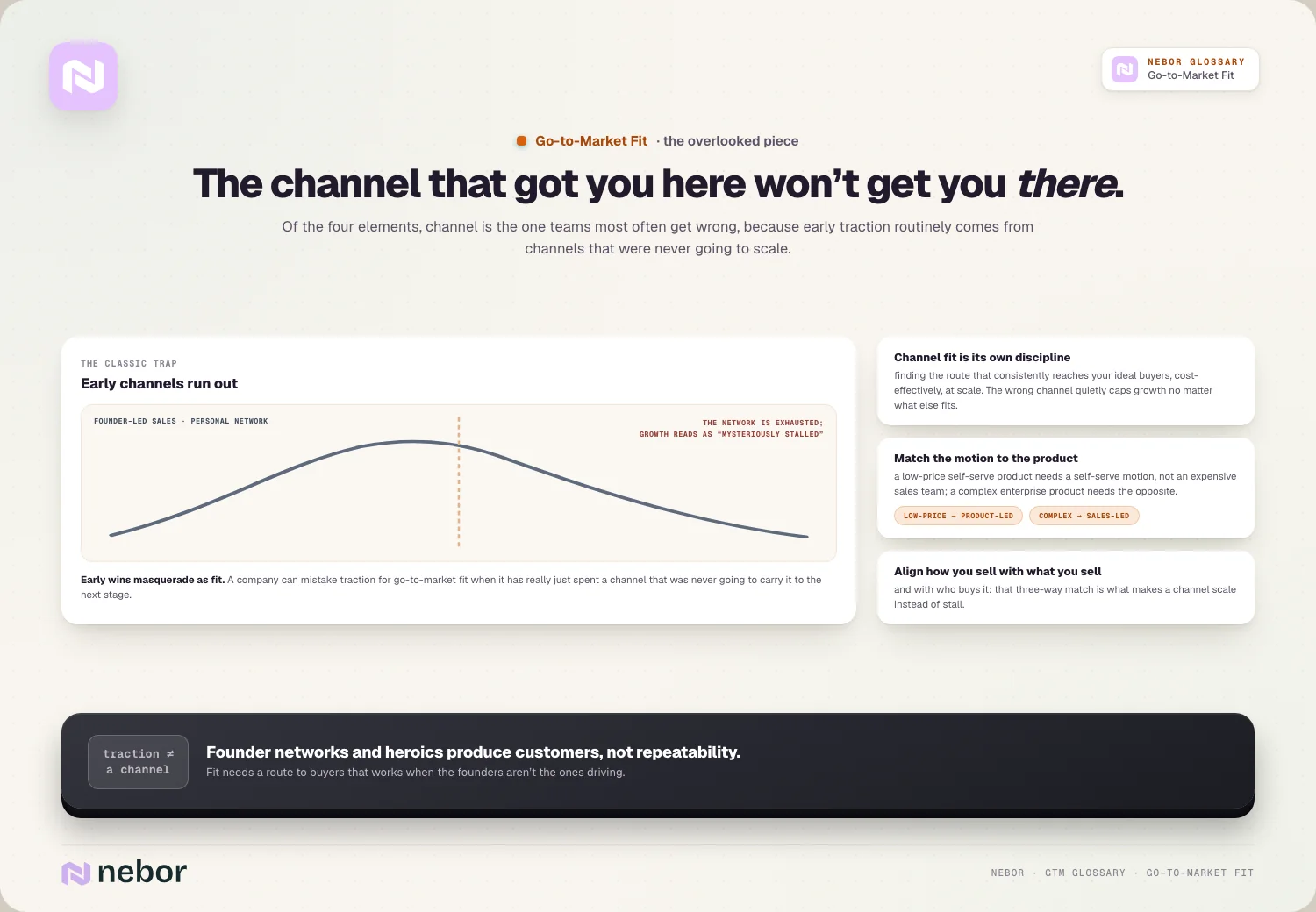
The danger is that early traction can come from channels that don't scale. Founder-led sales and personal networks work at first but dry up, so a company can mistake early wins for go-to-market fit when it has really just exhausted a channel that was never going to carry it to the next stage.
Getting channel right often means matching the motion to the product. A low-price, self-serve product may need product-led growth instead of an expensive sales team, while a complex enterprise product needs the opposite, so channel fit is really about aligning how you sell with what you sell and who buys it.
Why go-to-market fit is a motion that matures instead of a milestone
A common misconception is that go-to-market fit is a box you check once and move on. In reality it's not a milestone but a motion that keeps maturing, so what counts as fit shifts as the company grows through different stages and the market itself changes around it.
The nature of the work changes at each stage. Early on, go-to-market fit is about validation, finding any repeatable way to sell, while mid-stage it becomes about process and consistency, and later it's about optimization and scaling into new segments and regions.
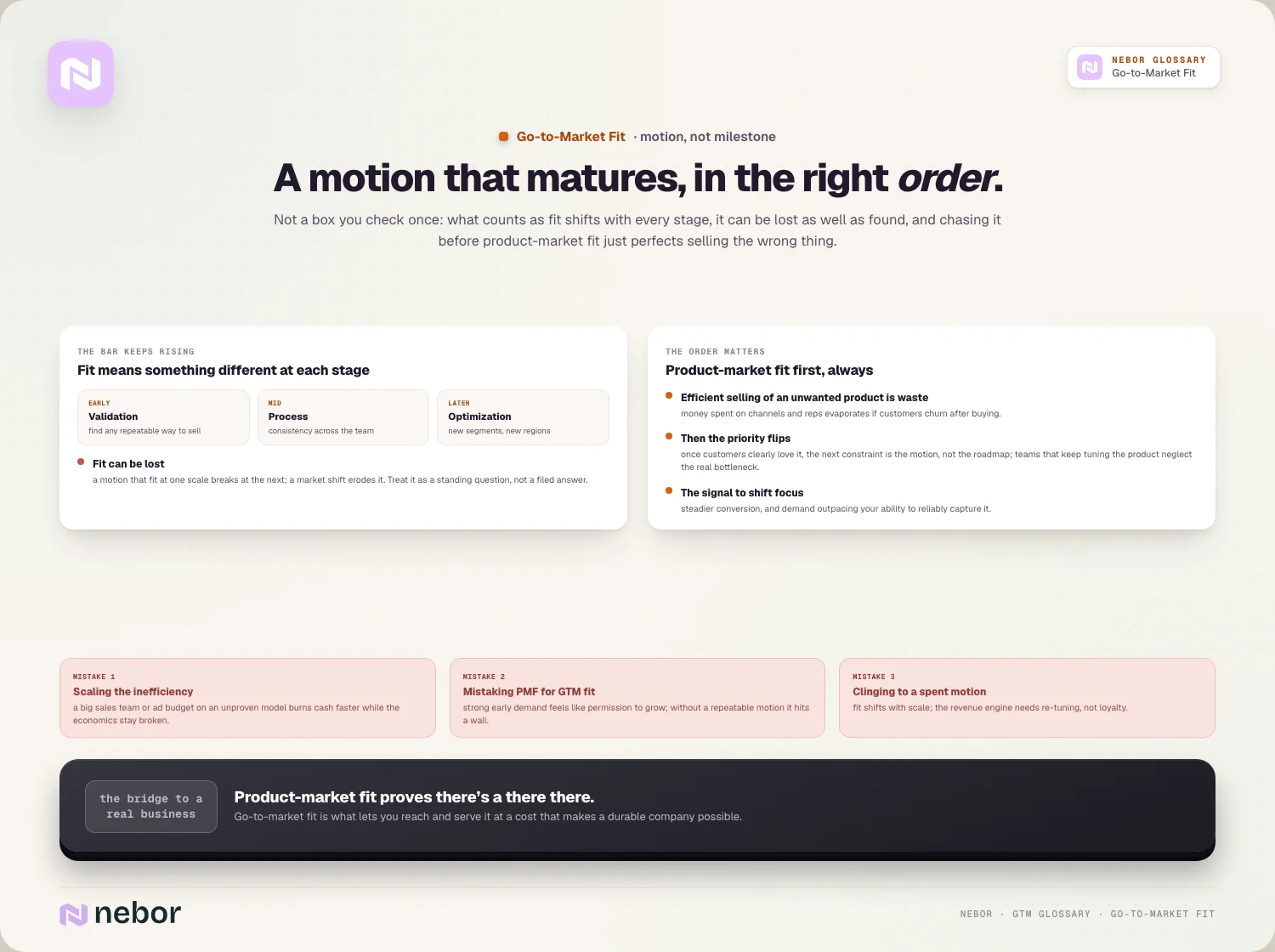
Because the bar keeps rising, a motion that felt dialed in a year ago can stop fitting as the company enters a new segment or the market shifts. That is why teams that stay ahead treat go-to-market fit as a standing question they keep revisiting instead of an answer they filed away once.
This is why go-to-market fit can be lost as well as found. A motion that fit at one scale can break at the next, or a shift in the market can erode it, so treating fit as permanent is a mistake, and maintaining it requires continually earning fresh GTM alpha as conditions change.
How companies go about finding go-to-market fit through experiments
Finding go-to-market fit is fundamentally experimental instead of a plan you execute. Because it depends on the interaction of market, product, channel, and model, you discover it by testing combinations, learning which audiences, channels, and motions produce efficient, repeatable results, and doubling down.
The search starts from a sharp view of who you sell to best, and in our experience that sharpening alone saves months of scattered testing.
A precise ideal customer profile narrows the experiments, because knowing your buyers at their best-fit core tells you which channels and messages to test first instead of spreading effort across everyone and learning nothing conclusive.
The signal you're looking for is efficient repeatability rather than a single big win. One lucky deal proves nothing, but a channel and motion that produce predictable results at a healthy cost, again and again, is the evidence that you've found real fit instead of stumbled into a one-off.
Why you should not chase go-to-market fit before product-market fit
The order in which you pursue these two fits matters, because chasing go-to-market fit first is a waste. Building an efficient way to sell a product people don't want just gets you good at selling something that won't retain, so product-market fit has to come first as the foundation everything else is built on.
Scaling a sales motion ahead of real product love is one of the most expensive mistakes a startup can make. Money spent perfecting channels and hiring reps evaporates if customers churn once they buy, because no amount of go-to-market efficiency fixes a product the market doesn't need.
Once product-market fit is solidly established, though, the priority should flip toward go-to-market fit. Teams that keep tuning the product long after customers clearly love it often neglect the sales motion, which is where the next constraint on growth tends to appear.
Recognizing when to shift focus from what you sell to how you sell it is a core part of the discipline. The signal that the moment has arrived usually shows up first in the numbers, as a steadier conversion rate and demand that outpaces your ability to reliably capture it.
The common mistakes teams make when they scale without go-to-market fit
The most damaging mistake, and the one we tell clients to fear most, is pouring money into growth before the motion is repeatable.
Hiring a large sales team or ramping ad spend on top of an unproven model just scales the inefficiency, burning cash faster while the underlying economics stay broken, which is how funded companies with good products still fail.
Another is mistaking product-market fit for go-to-market fit and assuming scale will follow automatically. Strong early demand feels like permission to grow aggressively, but without a repeatable sales motion behind it, that demand hits a wall, so treating product love as a growth engine sets a company up to stall.
The subtler mistake, and one we keep seeing in companies past their first growth spurt, is refusing to change a motion that has stopped fitting.
Because fit shifts with scale, a company that clings to the channel or model that worked early can slowly lose fit without noticing, so the discipline is treating the revenue engine as something to keep re-tuning instead of a machine you build once.
Why go-to-market fit is the bridge between a great product and a real business
The deepest way to see go-to-market fit is as the bridge that turns a product people love into a business that grows. Product-market fit proves there's a there there, but go-to-market fit is what lets you reach and serve that market at a scale and cost that make a durable company possible.
That bridge is exactly where so many promising companies get stuck, and that sticking point is what makes go-to-market fit deserve its own name and deliberate pursuit.
Treating it as a distinct problem, with its own metrics and experiments, is how a team avoids the trap of assuming a loved product will sell itself once it hits the market.
A well-built go-to-market system is really the machinery of go-to-market fit made durable, feeding a GTM flywheel that compounds as it matures.
When the way you reach and win customers keeps fitting the market, the demand you automate sales prospecting to create converts efficiently enough to fund the next stage of growth.
Share this post
Marketing
RevOps
Glossary
Related glossary items
Understanding the core GTM concepts



Ready to build your pipeline