In this post:
Sales-led growth (SLG) is a go-to-market motion in which salespeople win the customer. A seller picks the account, opens the conversation, runs discovery and the demo, steers the deal through procurement and gets the contract signed. The buyer usually gets full access to the product at the end of that process, not the start.
It exists because some purchases are too big and too tangled to happen any other way. Picture a €200,000-a-year platform that touches a dozen people across IT, finance and operations, needs a proper implementation and takes nine months to approve. Nobody buys that after a free trial and a credit card form. Somebody has to organize the decision.
The weak spot of sales-led growth is money. Every deal carries the cost of the people who worked it, so the motion is healthy only while what a seller closes comfortably exceeds what a seller costs. Most trouble with SLG starts when nobody has done that sum.
TL;DR
In sales-led growth, a seller drives the deal from the first touch. SDRs open conversations, account executives run discovery, demos and negotiation, sales engineers handle the technical evaluation, and marketing feeds the pipeline rather than closing anything.
Do the arithmetic before you hire. If one seller costs about €170,000 a year all-in and closes ten new customers, each customer carries €17,000 of selling cost, which a €60,000 contract recovers in under four months and a €3,000 contract needs more than five years to cover.
SLG fits when contracts are large, the product needs evaluation and implementation, several departments have to agree and approval runs through procurement and legal. Christoph Janz of Point Nine puts the floor for inside sales at roughly $10,000 a year per customer.
Snowflake is a sales-led company by its own description. Its 2025 annual report says it sells mainly through a direct sales team, and its 580 customers above $1 million in yearly product revenue, about 5% of the total, brought in roughly 67% of product revenue.
The bill comes as cost, speed and headcount. Snowflake spent 46% of its revenue on sales and marketing that year, large deals take longer and are harder to predict, and growth means hiring and ramping more people.
Make seller hours count with tight account tiers, signal-based outbound, a written playbook, CRM stages that require the right fields, and a monthly look at quota attainment and selling cost per closed deal.
What the seller owns in sales-led growth
The defining trait of a sales-led motion is who moves first. Nobody waits for a signup. The seller decides which accounts are worth pursuing and starts the conversation, often through outbound sales, sometimes by following up an inbound request. From then on, a person is responsible for every step the deal takes.
In a typical B2B team, that responsibility is split across a few roles:
Opening the account. A sales development rep (SDR) researches the company, finds the right people and books the first meeting.
Discovery. The account executive (AE) works out what the buyer is trying to fix, what it costs them today and who decides. Frameworks like MEDDPICC exist mostly to make sure this step isn't skipped.
Evaluation. A demo shaped around the buyer's own situation, then a technical review, a security questionnaire or a pilot, usually with a sales engineer alongside the AE.
Proposal and procurement. Pricing, custom terms and redlines from the buyer's lawyers. Non-standard requests go to a deal desk so discounts and terms stay consistent from one deal to the next.
Close and handover. Signature, then a clean transfer to onboarding and customer success, with everything the seller learned written into the CRM.
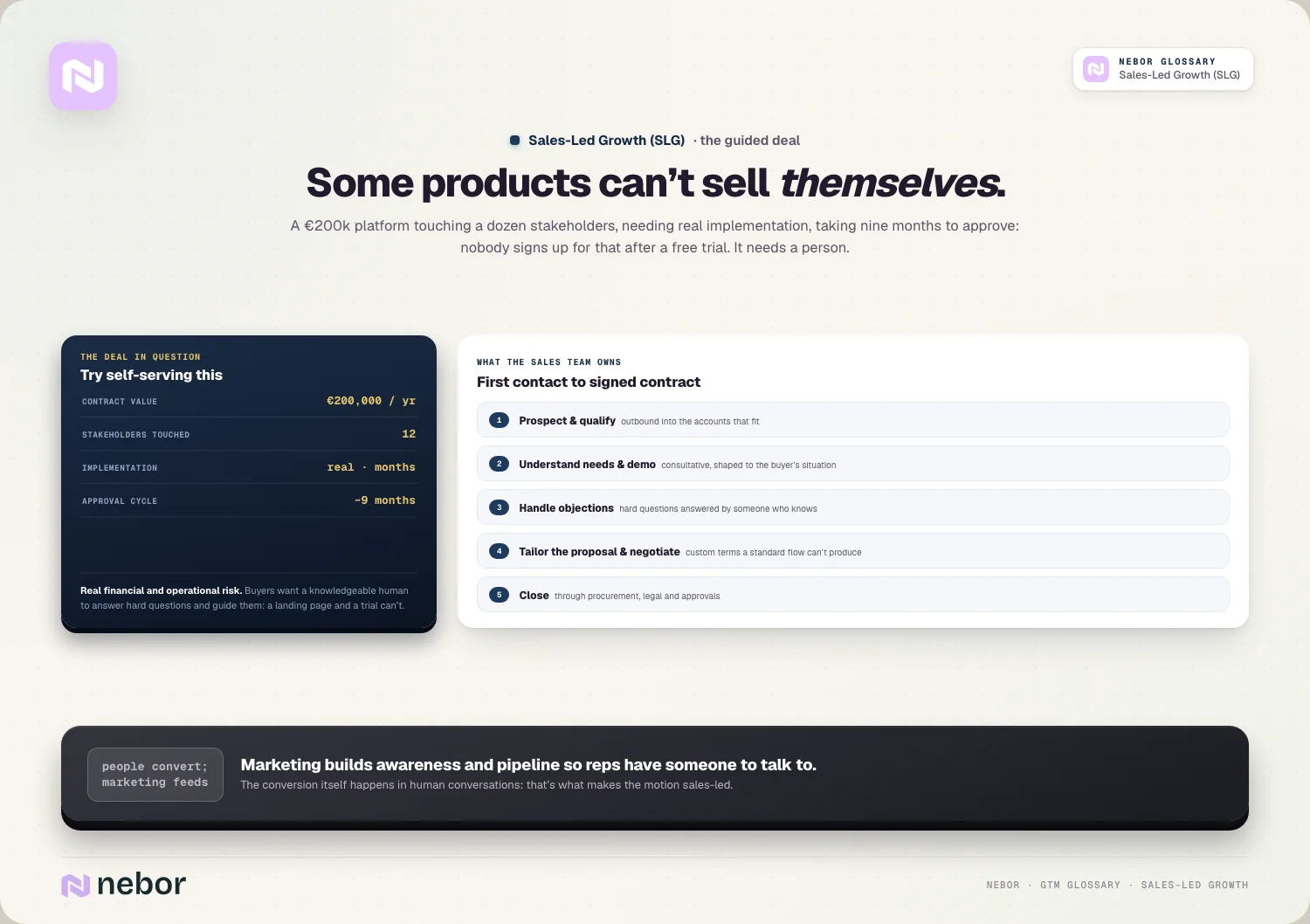
Running through all five steps is the work no product page can do: coordinating the buying committee. A seller finds an internal champion, works out who the economic buyer is, and keeps a deal moving when one of eight people goes quiet for three weeks.
Marketing still matters in a sales-led company, but its job is supply. It builds awareness and fills the pipeline so the sellers have conversations to run. The conversion itself happens in meetings and calls, and that's what makes the motion sales-led.
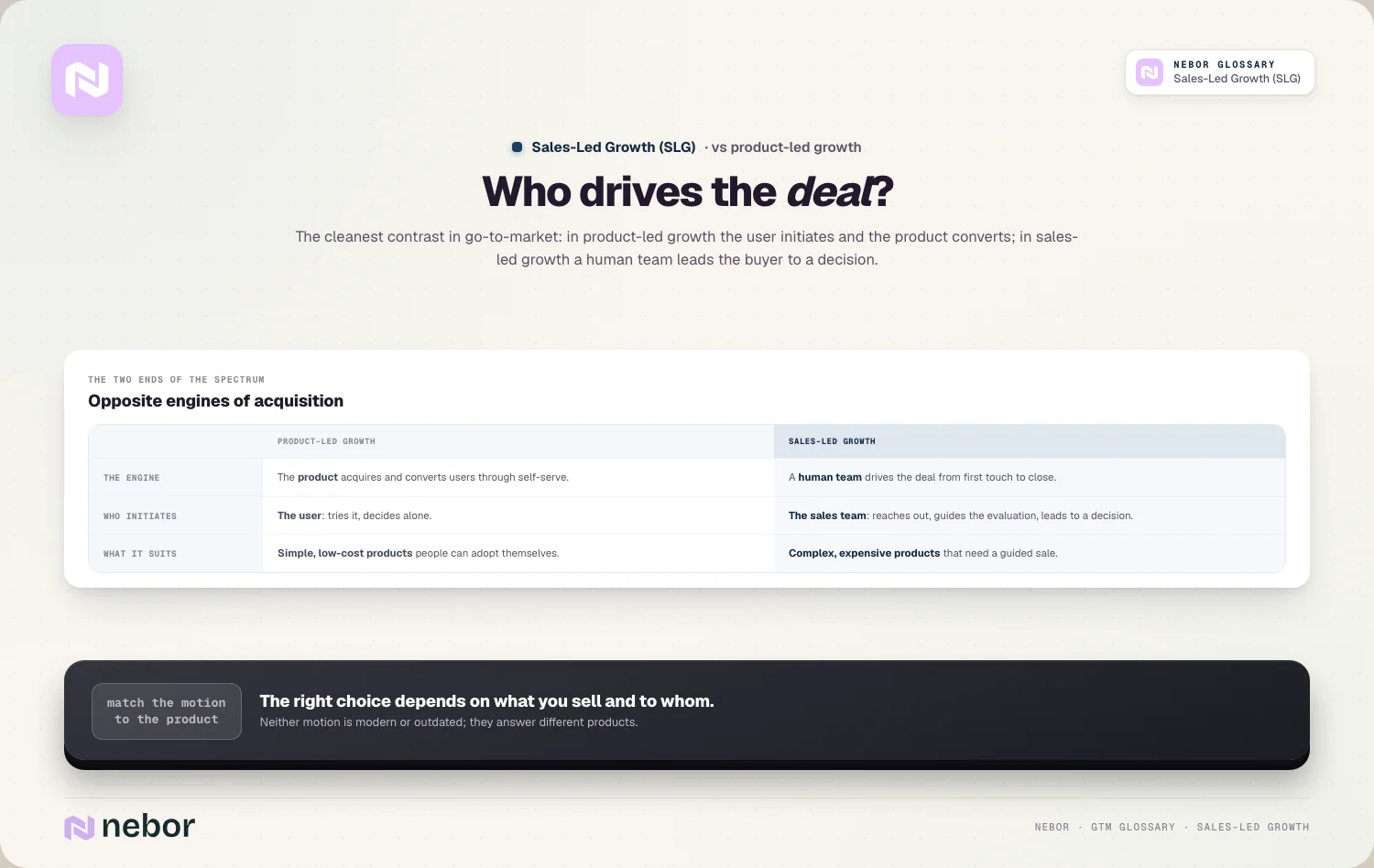
This is the mirror image of product-led growth, where the user starts things by signing up and the product does the convincing. The PLG entry covers that contrast properly. For this one, the useful point is narrower: in SLG, a person is accountable for the deal from the very first touch, and the economics have to pay for that person.
Does the deal size pay for a seller?
Before you build a sales-led team, work out what a seller costs per customer won. The numbers below are illustrative, for a made-up Utrecht company selling planning software to hospital groups in the Netherlands and Belgium.
Say one account executive costs €110,000 a year including salary, commission, social charges and tools. Add their share of an SDR, a sales engineer and a sales manager, about €60,000, and each AE "seat" costs roughly €170,000 a year. If that AE closes ten new customers a year, every new customer carries €17,000 of selling cost before marketing has spent a cent.
Annual contract value | Selling cost per new customer | Months of revenue to recover it | Deals one seller must close to cover their own cost |
|---|---|---|---|
€3,000 | €17,000 | 68 | 57 |
€15,000 | €17,000 | about 14 | 12 |
€60,000 | €17,000 | about 3.4 | 3 |
The €60,000 deal is comfortable. The €15,000 deal works if customers stay for years. The €3,000 deal never works with a seller in front of it, because no AE closes 57 new customers a year on a product complex enough to need an AE in the first place. That row is a product that should be sold self-serve.
This is the same logic as customer acquisition cost and the LTV to CAC ratio, applied before the team exists instead of after. It also tells you how many sellers a revenue target needs, which is the job of quota capacity planning.
Christoph Janz of Point Nine Capital drew the same line in his essay "Five ways to build a $100 million business": around $10,000 a year per customer usually can't fund traditional field sales, though an inside sales team can close those deals, and customers paying $100,000 or more call for real enterprise selling. The go-to-market strategy entry walks through how that choice shapes the rest of the plan.
Signs your product needs sales-led growth
Contract size is the first signal, but it rarely shows up alone. When a product is expensive, the same deals tend to have the other traits too.
The contract is large. Large enough that a seller's time is a small share of the deal, as in the table above.
The product needs evaluation and setup. Integrations, data migration, configuration or a pilot before anyone commits. If the buyer can't reach value alone in a first session, someone has to guide them there.
Several departments have to agree. IT, security, finance, legal and the team that will use it each hold a veto. A product can't run that meeting, a seller can.
Approval takes months. Procurement, legal review and budget cycles stretch the sales cycle length well beyond what a trial can survive. Without a person chasing each step, the deal simply stalls.
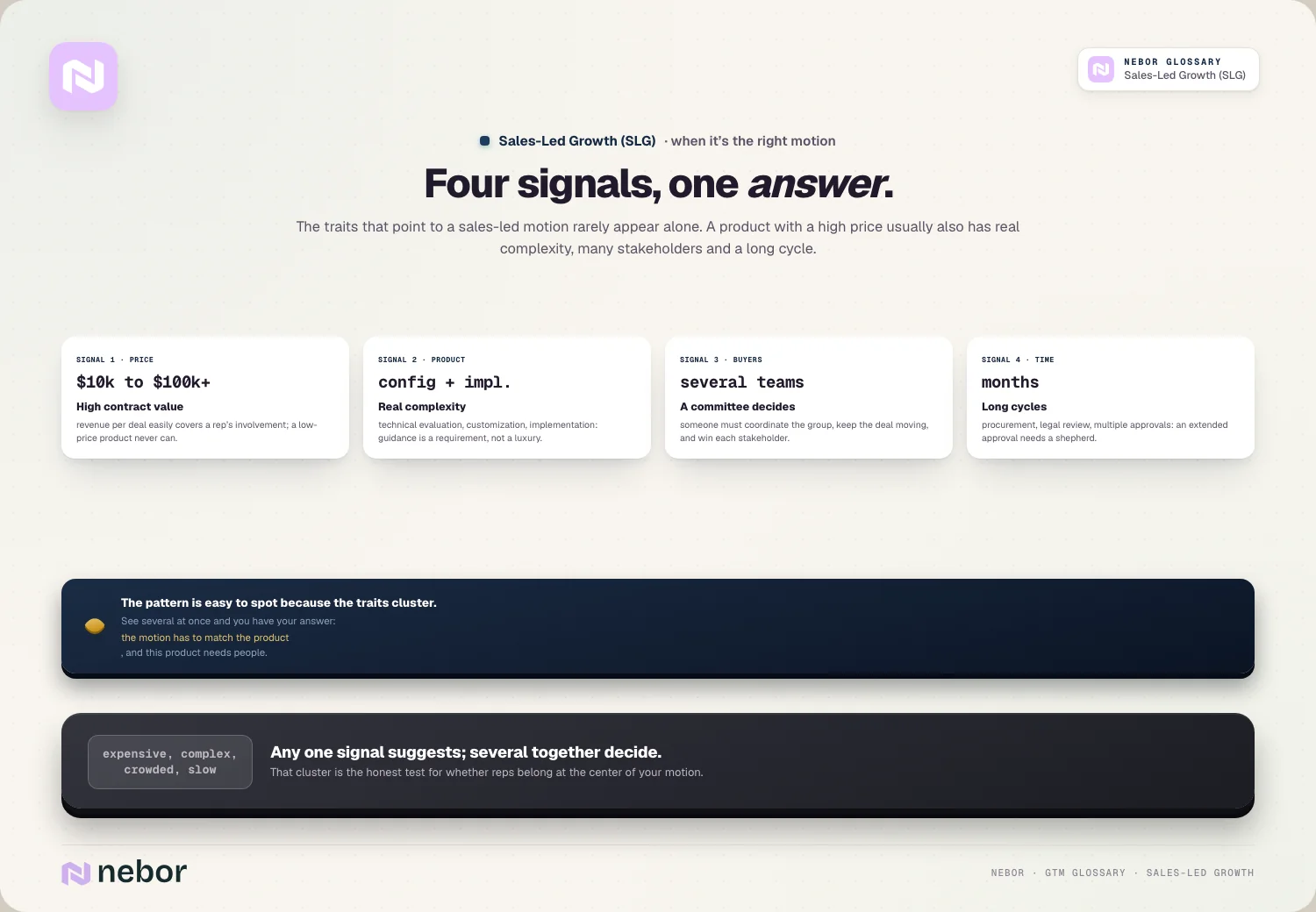
One signal on its own suggests, several together decide. A cheap product with a long legal review is still a cheap product. An expensive product that a single team lead can buy in an afternoon may not need much selling either.
Snowflake, a sales-led company in its own words
Public filings are one of the few places where a company explains its sales model and puts numbers next to it. Snowflake's annual report on Form 10-K for the year ended January 31, 2025 is a clean example.
Snowflake says it sells its platform primarily through a direct sales team of field and inside sales professionals, segmented by customer industry, size and region, with sales development, inside sales and field sales roles. It also offers a self-service trial, and the filing notes that many organizations first adopt the platform that way. In the filing's words, the self-service model reaches data analysts and engineers, while the direct sales team engages senior executives.
The numbers show why that team is worth paying for. Of 11,159 customers, 580 generated more than $1 million in product revenue over the previous twelve months. That's about 5% of customers, and the filing says they accounted for roughly 67% of product revenue. When two thirds of the money comes from a few hundred enterprise accounts, putting experienced sellers on those accounts is the business model, not an overhead.
The same report is frank about the cost. Sales and marketing came to $1.67 billion, 46% of revenue, with 3,310 people in that function at year end. Its risk factors list what selling to large customers involves: longer sales cycles, more complex requirements, substantial upfront sales costs and less predictability about when a deal will close.
What putting a seller in front of every deal costs
Those three costs apply to sales-led companies of any size, just with smaller numbers.
Money. Every closed deal carries the salaries of the people who worked it, plus the deals they lost along the way. That's why CAC in a sales-led business is high by design, and why it only makes sense when contracts are large enough to absorb it.
Speed. Human-run deals move at the speed of calendars, legal departments and budget cycles. Cash arrives later, forecasts are harder, and a quarter can hinge on two signatures that slip by a week.
Headcount. Growth is tied to how many productive sellers you have. Each new hire takes months to ramp, some never reach quota, and good ones leave. A product that sells itself can double its signups without a hiring plan. A sales-led company can't, which is why the push to build sales systems instead of adding headcount matters most in exactly this motion.
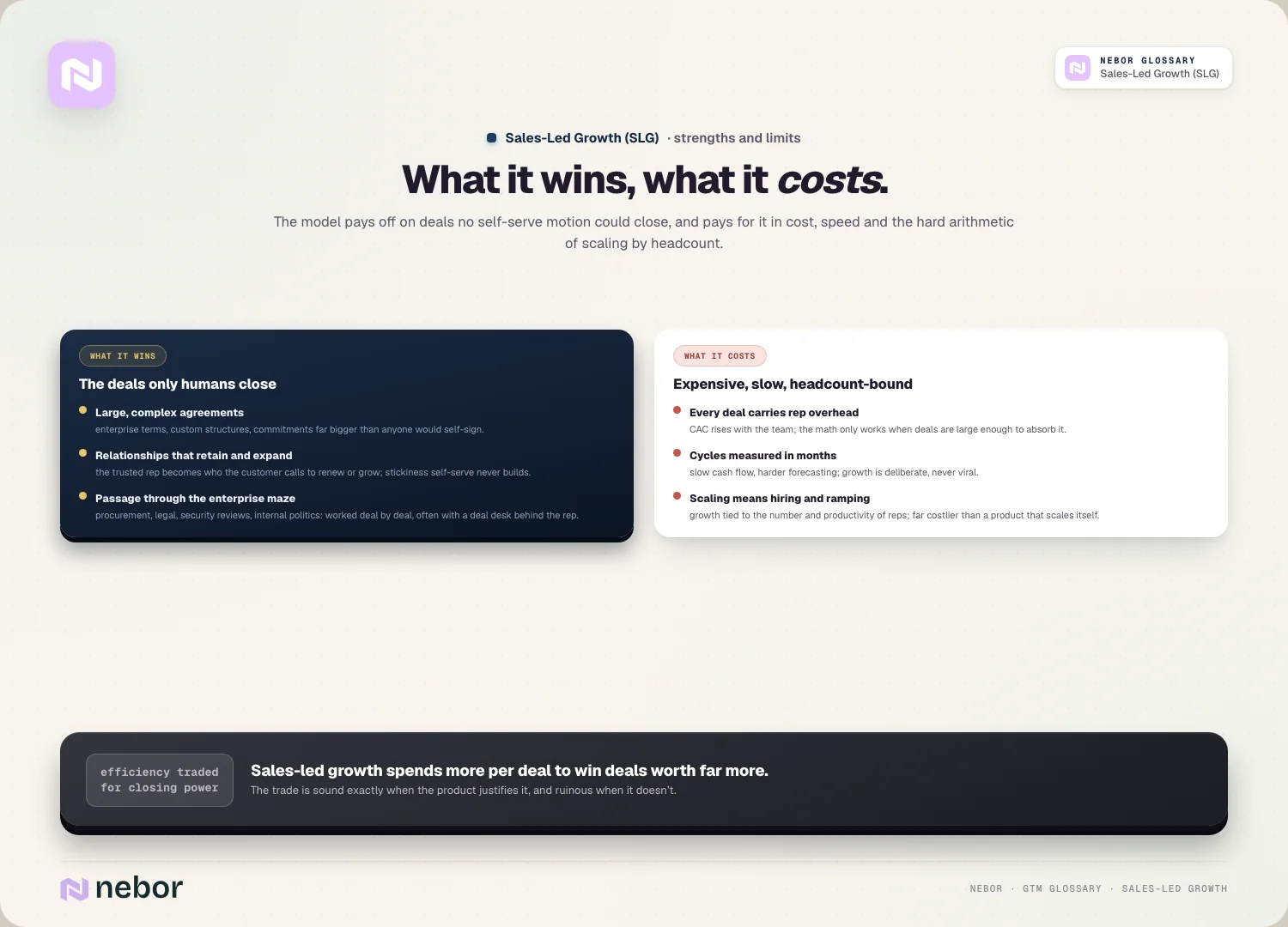
In return you get deals a self-serve funnel could never close, terms shaped around each customer, and a relationship that usually makes renewals and expansion easier. Whether the trade is good depends entirely on the deal size. That's why the arithmetic section comes before the signals.
Sales-led growth beside self-serve and product-led sales
Few companies run one motion everywhere anymore. Snowflake has a trial, and plenty of product-led companies hire enterprise sellers once big accounts appear. The common pattern is self-serve for small customers, sellers for large and complex ones, and a bridge between the two.
That bridge is product-led sales, where reps work accounts that product usage has already flagged. It differs from SLG in where the conversation starts. In product-led sales the user has acted first and the rep responds. In sales-led growth the seller starts from a list of accounts that may never have heard of you.
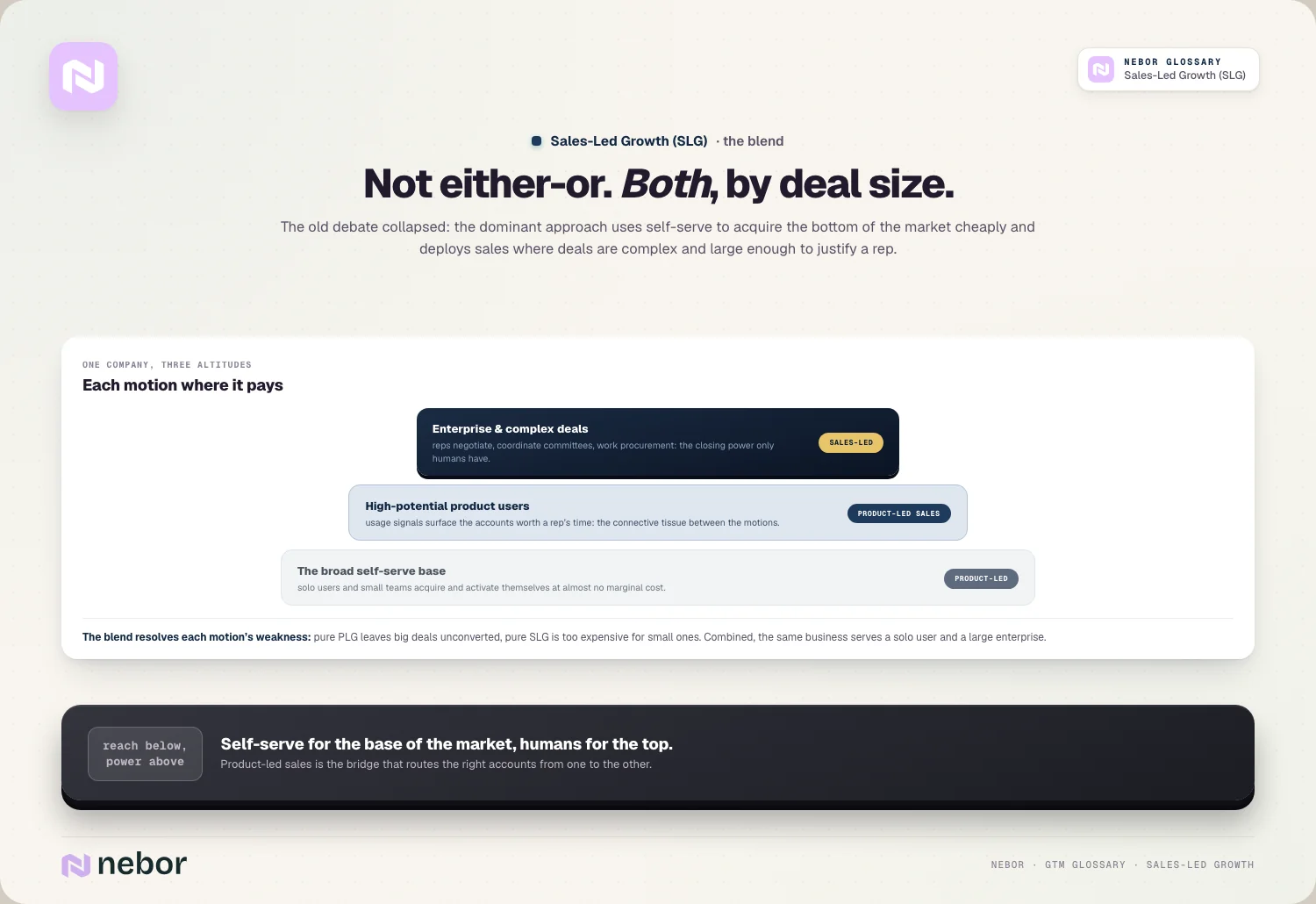
Blending works best when each motion has a clear entry rule, such as company size, contract value or a set of usage signals, so the same account isn't being pitched by a rep and nudged by an upgrade email in the same week.
Getting more out of every seller hour
Seller time is the most expensive thing in a sales-led company, so most of the work of running SLG well is about pointing that time at the right deals and wasting less of it.
Tier the accounts. A written profile of the companies worth a seller's attention, turned into tiers on every company record, keeps reps off accounts that will never close at a size that pays. The table earlier tells you where the floor is.
Start from a reason. Outbound into the right accounts works much better with a trigger: a new leader in the buying role, an expansion, a tool being replaced. That's signal-based selling, and the research and first drafts behind it are the parts of a seller's week most worth taking off their plate with prospecting automation that hands reps a reason to call.
Write the motion down. A sales playbook covers the discovery questions, the demo flow and the answers to the objections that come up every week. A sales engagement platform runs the sequences and follow-ups, so the process doesn't depend on each rep's memory.
Make the CRM enforce it. In HubSpot, each deal stage carries a win probability, and you can make properties required when a deal moves into a stage. Requiring the economic buyer, the decision date and the next step before a deal can reach "proposal" does more for forecast quality than any pipeline meeting.
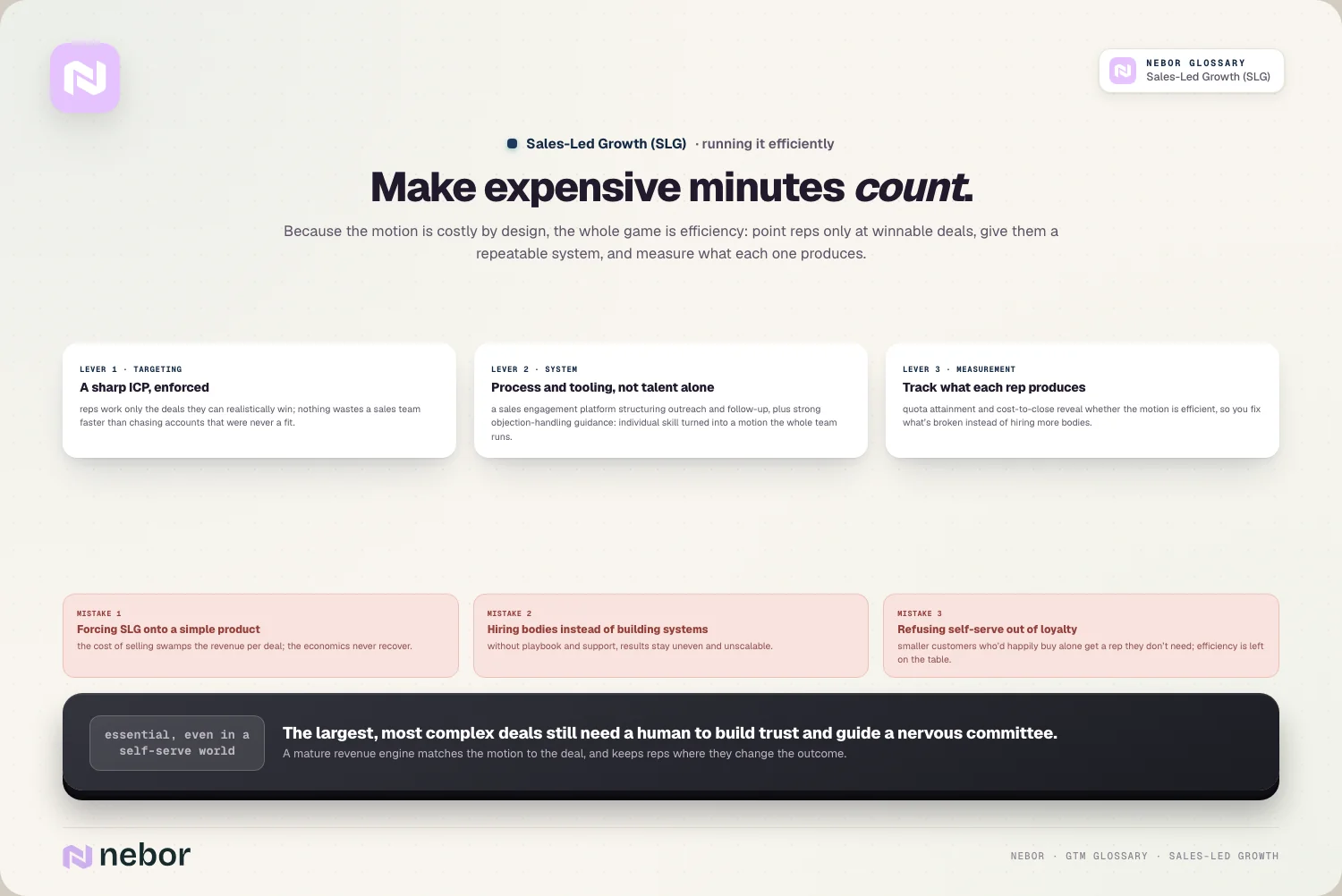
Measure what each seller produces. Quota attainment across the team, win rate by segment and selling cost per closed deal show whether the motion is efficient. When those numbers slip, the usual cause is targeting or process, and hiring more sellers into a leaky process only makes the leak bigger.
The bottom line
Sales-led growth is the right motion when the deal is big enough to pay for the people it takes to win it. Large contracts, products that need setup, committees with several vetoes and long approvals are where a seller changes the outcome, and Snowflake's filing shows how much revenue can sit in a few hundred accounts like that.
It's also the most expensive way to grow, so it rewards discipline more than enthusiasm. Write down the cost of a seller, check it against your contract values, and keep sellers on the accounts where they make the difference. Where the deal is small, let the product or a lighter touch do the work.
A well-run revenue engine uses each motion where it pays, and the pieces that make SLG efficient (account tiers, signals, sequences, stage rules) are the same pieces that hold a GTM system built from connected workflows together.
Those are the parts Nebor builds: the targeting, the signal-led outbound and the CRM rules that keep sellers on the right deals, set up in the tools a client already runs and handed to their team with notes on how every piece works.
Frequently asked questions
Can a low-priced product be sales-led?
Rarely for long. When a seller's cost per closed deal is bigger than the first year or two of revenue, every new customer loses money and growth makes it worse. Low-priced products usually do better with self-serve signup, a light inside sales team for questions, or a partner channel. Keep sellers for the larger accounts where a person changes the outcome, and let the product handle the rest.
What is the difference between sales-led and sales-assisted?
In a sales-led motion a seller owns the deal from the first contact, and the buyer gets access after the contract. In a sales-assisted motion the buyer starts on their own, through a trial or a free plan, and a rep joins to answer questions, help with procurement or close a larger plan. Sales-assisted sits closer to product-led sales, because the customer moved first.
Is sales-led growth the same as outbound sales?
No. Outbound is one way a sales-led team fills its pipeline, by contacting accounts that haven't shown interest yet. A sales-led company can also run on inbound demo requests, partner referrals or events, as long as a seller then runs the deal. Sales-led growth describes who wins the customer. Outbound describes how the first conversation starts.
Which sales roles does a company need first?
Usually a founder selling, then one or two account executives who can run a full deal alone, from first call to signature. SDRs come once the AEs have more meetings to run than accounts to find, and sales engineers once technical evaluations start eating AE time. Hiring a large SDR team before anyone can reliably close tends to fill calendars with meetings that go nowhere.
Can a sales-led company offer a free trial?
Yes, and many do. Snowflake sells mainly through a direct sales team but also runs a self-service trial, which its annual report says is how many organizations first adopt the platform. A trial in a sales-led company works as a lead source and an evaluation tool. The seller still runs the commercial deal, and usage during the trial gives them something specific to talk about.
Is sales-led growth outdated?
No. Self-serve buying has grown, but large, complex purchases still need someone to coordinate a buying committee, shape terms and get a contract through procurement. What has changed is that sales-led growth is rarely the only motion. Most companies selling to enterprises also let smaller customers buy on their own, and put sellers where the deal size and complexity justify the cost.
What does marketing do in a sales-led company?
It supplies the pipeline and supports the sale. That means building awareness in the target accounts, running events and content that create demand, producing case studies and comparison material sellers use in deals, and passing qualified inbound leads to sales quickly. Marketing in a sales-led company is usually judged on pipeline created in the right accounts, not on raw lead volume.
How do you move from founder-led sales to a sales team?
Write down what the founder actually does in a winning deal: who they call, the questions they ask, the objections they handle and the terms they give. That becomes the first playbook. Hire one or two experienced account executives, have them shadow and then run deals with the founder reviewing, and only add more sellers once the first ones close without the founder in the room.
Why are sales-led sales cycles so long?
Because more people and steps sit between interest and signature. A large purchase usually needs a business case, a technical review, a security questionnaire, legal redlines, procurement approval and a budget slot, and each of those has its own calendar. Snowflake's annual report notes that sales to large enterprises typically take longer to complete. Sellers shorten cycles mainly by mapping the steps early and agreeing dates with the buyer.
Share this post
RevOps
Marketing
Glossary
Related glossary items
Understanding the core GTM concepts




Ready to build your pipeline