

In this post:
In the traditional way of selling software, a rep convinces you to buy before you ever touch the product. You sit through demos and negotiate a contract, then finally get access. Product-led growth turns that sequence on its head.
Under product-led growth, you use the product first, often for free, and the experience of getting value from it is what convinces you to pay. The product does the persuading that a sales rep used to do, which changes almost everything about how the company grows.
Product-led growth, or PLG, is a go-to-market strategy where the product itself drives acquisition, activation, retention, and expansion. It usually starts with a free trial or freemium tier that lets users experience value before paying.
Upgrading then becomes a natural result of getting real value in-product, instead of something a rep has to push.
The model works because engagement comes before monetization. Users discover the product, reach a genuine outcome with it, and upgrade on their own, often without a sales conversation at any point.
TL;DR
Product-led growth is a strategy where the product drives acquisition, activation, and expansion, letting users experience value through a free trial or freemium tier before they pay.
It flips the old sequence, because users get value first and upgrade after the product proves itself, instead of being sold before they ever use it.
It's driven by product signals, so a user's behavior inside the product, more than their engagement with content, tells you who's ready to buy or expand.
Pure PLG rarely wins alone now, and the strongest B2B companies use a hybrid that layers sales onto product signals for their highest-value accounts.
What product-led growth means as a complete go-to-market motion
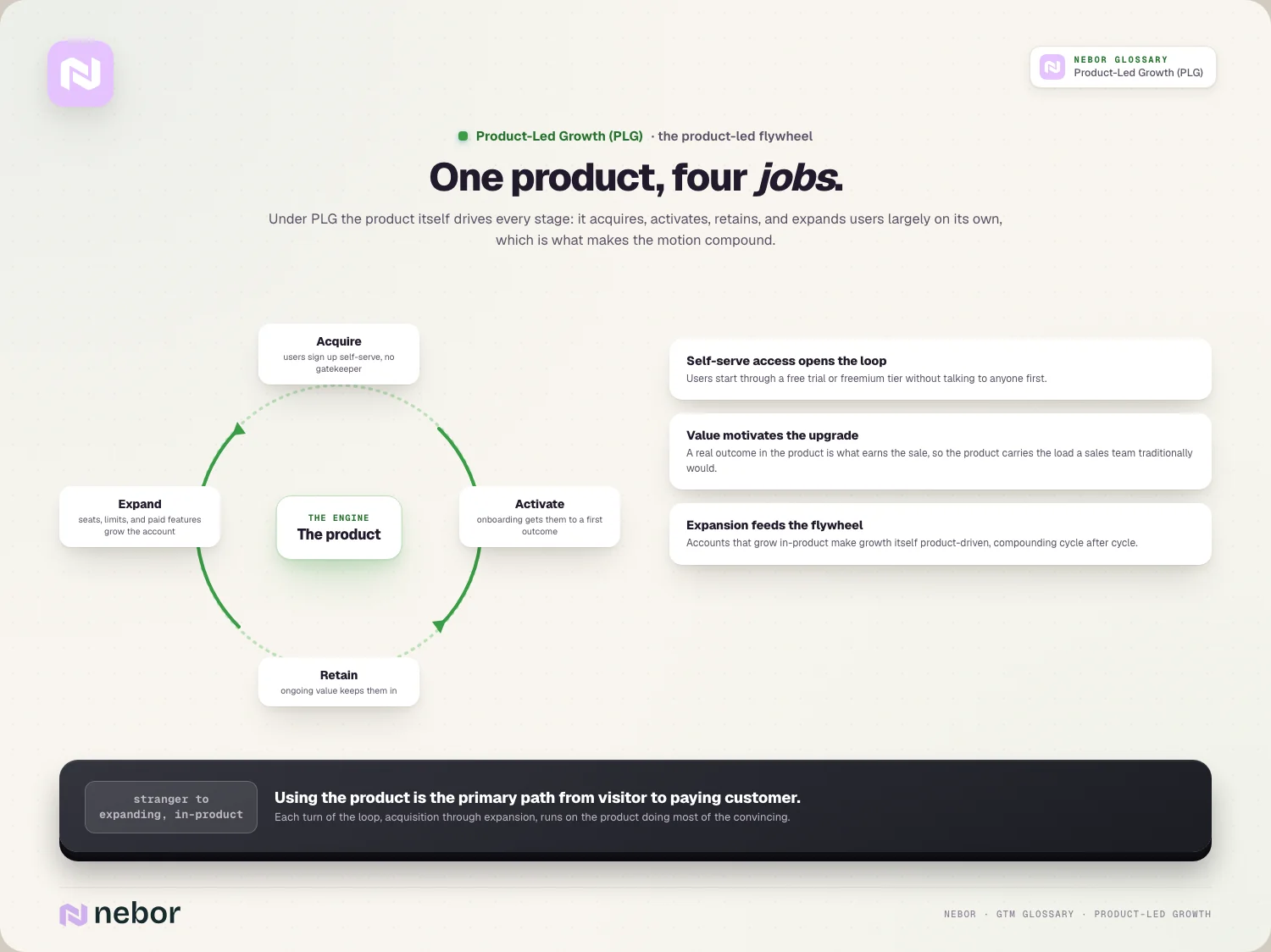
Product-led growth makes the product the main engine of the business. Instead of a sales team driving each stage, the product acquires, activates, retains, and expands users largely on its own.
It starts with self-serve access to the product. Users sign up and start using it directly, usually through a free trial or freemium tier, without needing to talk to anyone first.
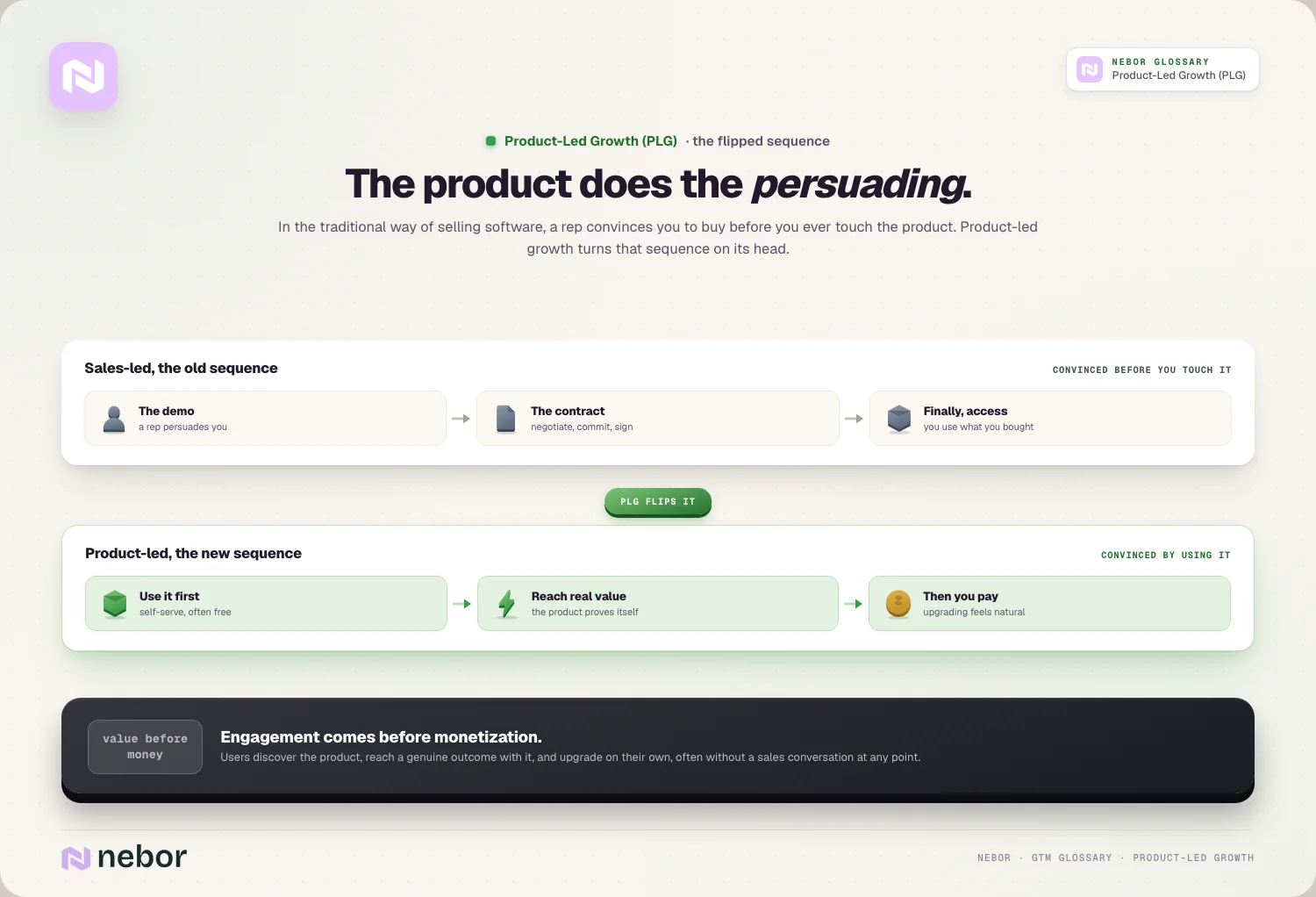
Value comes before any payment changes hands. Users experience a real outcome in the product, and that experience is what motivates them to upgrade, so the product earns the sale.
Expansion happens inside the product as well. As users get more value, they add seats, hit usage limits, or adopt paid features, so growth within an account is also product-driven and can feed a compounding GTM flywheel.
So PLG is a motion where the product carries the load a sales team traditionally would. It turns using the product into the primary path from stranger to paying, expanding customer, with the product doing most of the convincing along the way.
How product-led growth differs from traditional sales-led growth
The clearest way to understand PLG is against its opposite. Sales-led growth pushes the whole motion through people, where PLG pushes it through the product.
Sales-led starts with a rep making contact. A salesperson identifies prospects, gives demos, negotiates, and manages the relationship, so a human drives every stage of the deal.
Product-led starts with the product doing the work. Users find it, try it, and buy it largely on their own, so the product does the work a rep would in a sales-led motion.
The buyer's experience differs just as sharply. In sales-led, you're sold to before you ever use the product, while in product-led, you use it first and decide for yourself based on what you experience.
So the two motions differ in who does the convincing. Sales-led leans on people to persuade, and product-led leans on the product to prove itself, which shapes cost, speed, and the kind of buyer each attracts.
Why freemium and free trials serve as the front door of a PLG motion
Almost every PLG motion opens with one of two entry models, and choosing between them shapes your whole funnel, because both exist to let users reach value before paying.
Most PLG companies use one or the other. Around 75% of PLG companies rely on a freemium tier or a free trial as their entry point, because free access is what gets users in.
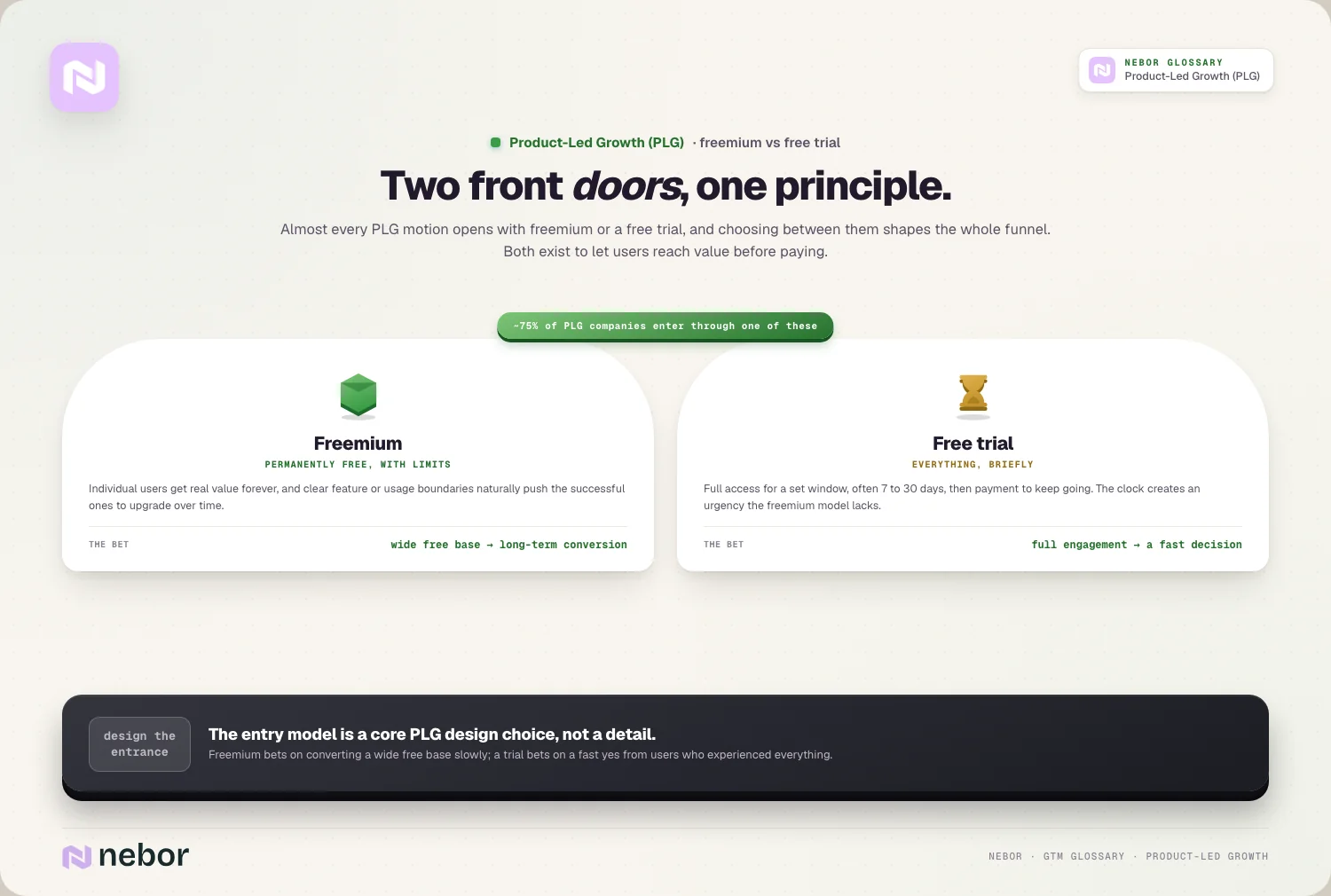
Freemium stays permanently free within set limits. It works when individual users get real value and clear feature or usage boundaries naturally push them to upgrade over time.
A free trial gives full access briefly. Users get everything for a set window, often 7 to 30 days, then have to pay to keep going, which creates a sense of urgency the freemium model lacks.
So the entry model is a core PLG design choice for your funnel. Freemium bets on long-term conversion from a wide free base, while a trial bets on a fast decision from fully engaged users.
Why product signals replace sales activity in a product-led motion
In sales-led growth, reps judge who's ready to buy. In PLG, the product's own usage data does that job, and we tell clients this is the model's single most useful export, even for their sales team.
Behavior reveals intent more honestly than words. What a user does in the product, hitting a usage threshold, adopting a key feature, or inviting teammates, shows readiness far more reliably than content engagement.
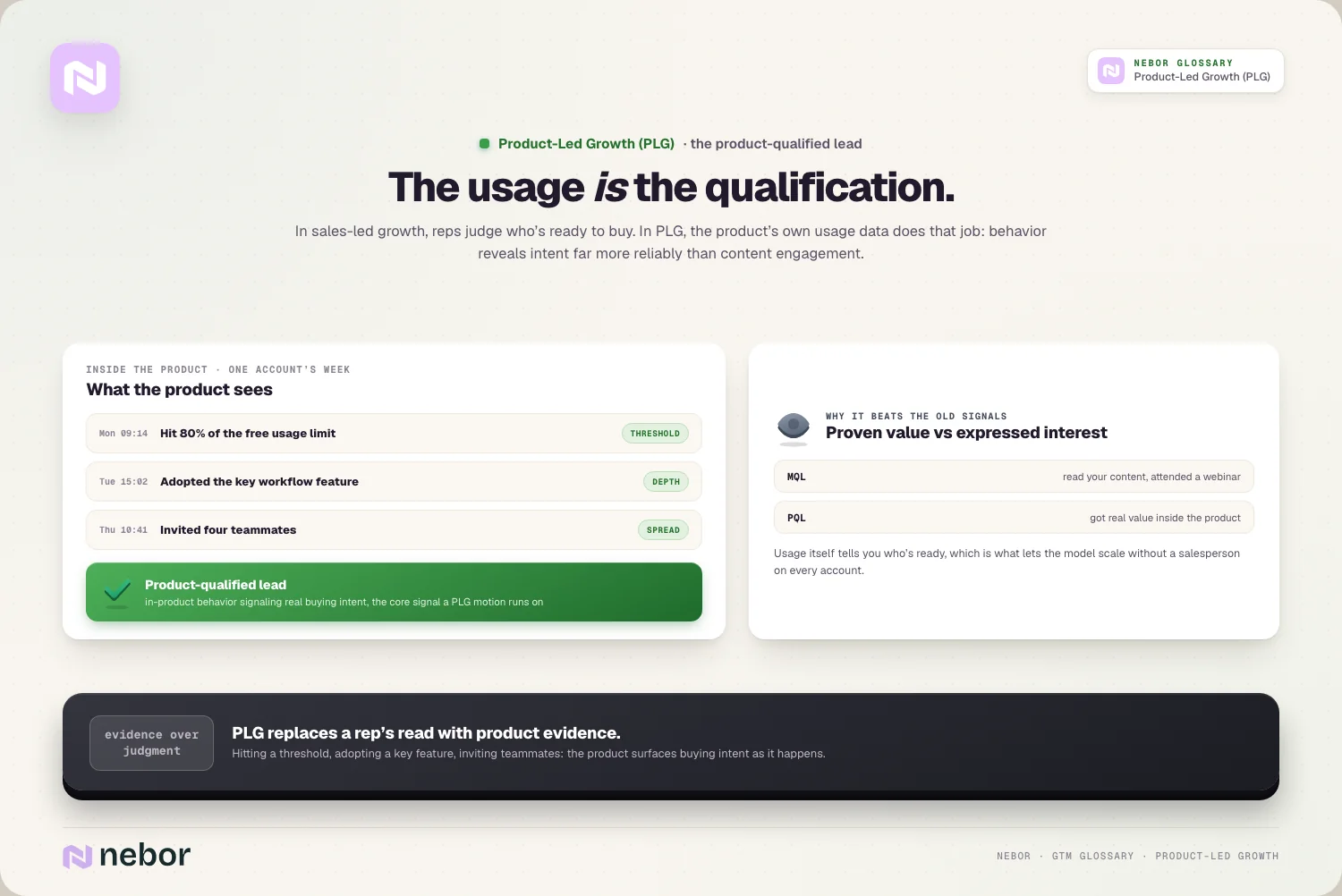
This is where the product-qualified lead comes in. A product-qualified lead is a user whose in-product behavior signals real buying intent, and it's the core signal a PLG motion depends on.
It beats the traditional lead signals comfortably. Where a marketing-qualified lead reflects interest in content, a PQL reflects proven value inside the product, so it's a much stronger sign someone will pay.
So PLG replaces a rep's judgment with product evidence. The usage itself tells you who's getting value and who's ready, and that evidence is what lets the model scale without a salesperson on every account.
Which metrics tell you whether a PLG motion is genuinely working
Because the product carries the motion, PLG is measured differently than sales-led growth. A handful of metrics reveal whether users are reaching value and staying.
Activation and time-to-value come before everything else. How many of your users reach a meaningful outcome, and how fast, shows whether the product is delivering the value the whole model depends on.
Free-to-paid conversion is the center of it. The share of free users who become paying ones tells you whether your entry model is turning value into revenue, much like a conversion rate does further down a sales funnel.
Retention and expansion sustain the whole thing. Strong net revenue retention shows users stay and grow, which is what makes a PLG motion compound over time.
Health signals round the whole picture out. Watching a customer health score tells you which accounts are thriving and which are drifting toward churn, so you can act before a free or paid user slips away.
So PLG metrics track the journey from signup to value to revenue. Activation, conversion, and retention together tell you whether the product is really doing the selling it's meant to.
Why time-to-value can make or break an entire product-led motion
One metric matters more than almost any other in PLG, because the whole model hinges on it. Users have to reach value fast, or they leave before they ever would have paid.
Free users are impatient almost by definition. Someone trying a product for free will abandon it quickly if they don't see the point, so a slow path to value loses them before conversion.
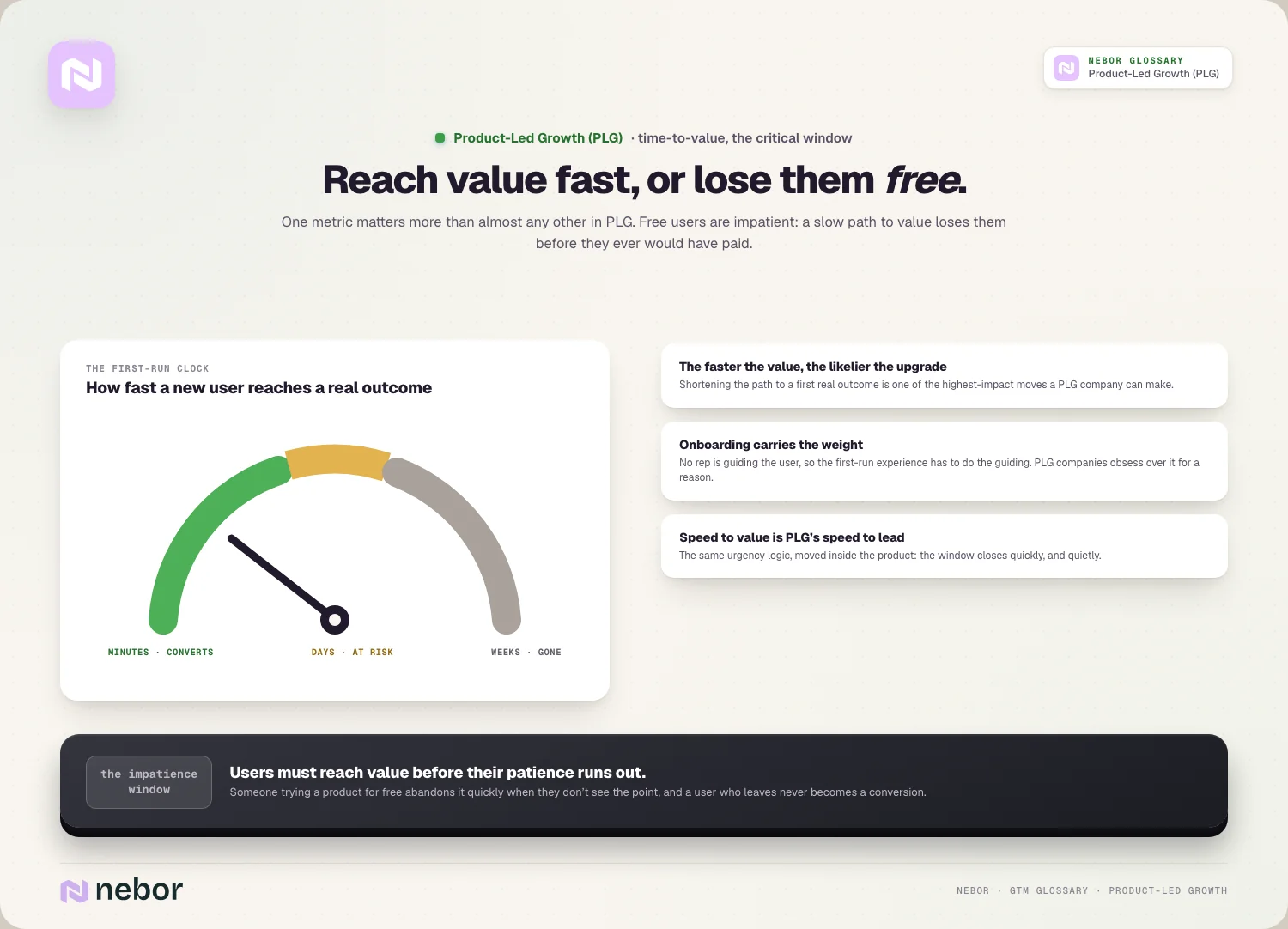
Time-to-value is the critical window in all of it. The faster a user reaches a real outcome, the more likely they convert, which makes shortening that path one of the highest-impact things a PLG company can do.
Onboarding carries the weight entirely on its own. Because no rep is guiding the user, the product's own onboarding has to get them to value, and that's the reason PLG companies obsess over the first-session experience.
So in PLG, speed to value plays the role speed to lead plays elsewhere. Getting a user to their first real outcome quickly is what turns a free signup into a paying customer.
Why pure product-led growth rarely wins entirely on its own anymore
The early PLG hype framed it as a replacement for sales, but that framing has faded, and in our experience the strongest companies now blend the two instead of choosing one.
The binary debate has largely moved on. Instead of PLG versus sales-led, the most competitive B2B companies build a hybrid that combines product-led acquisition with sales-led depth.
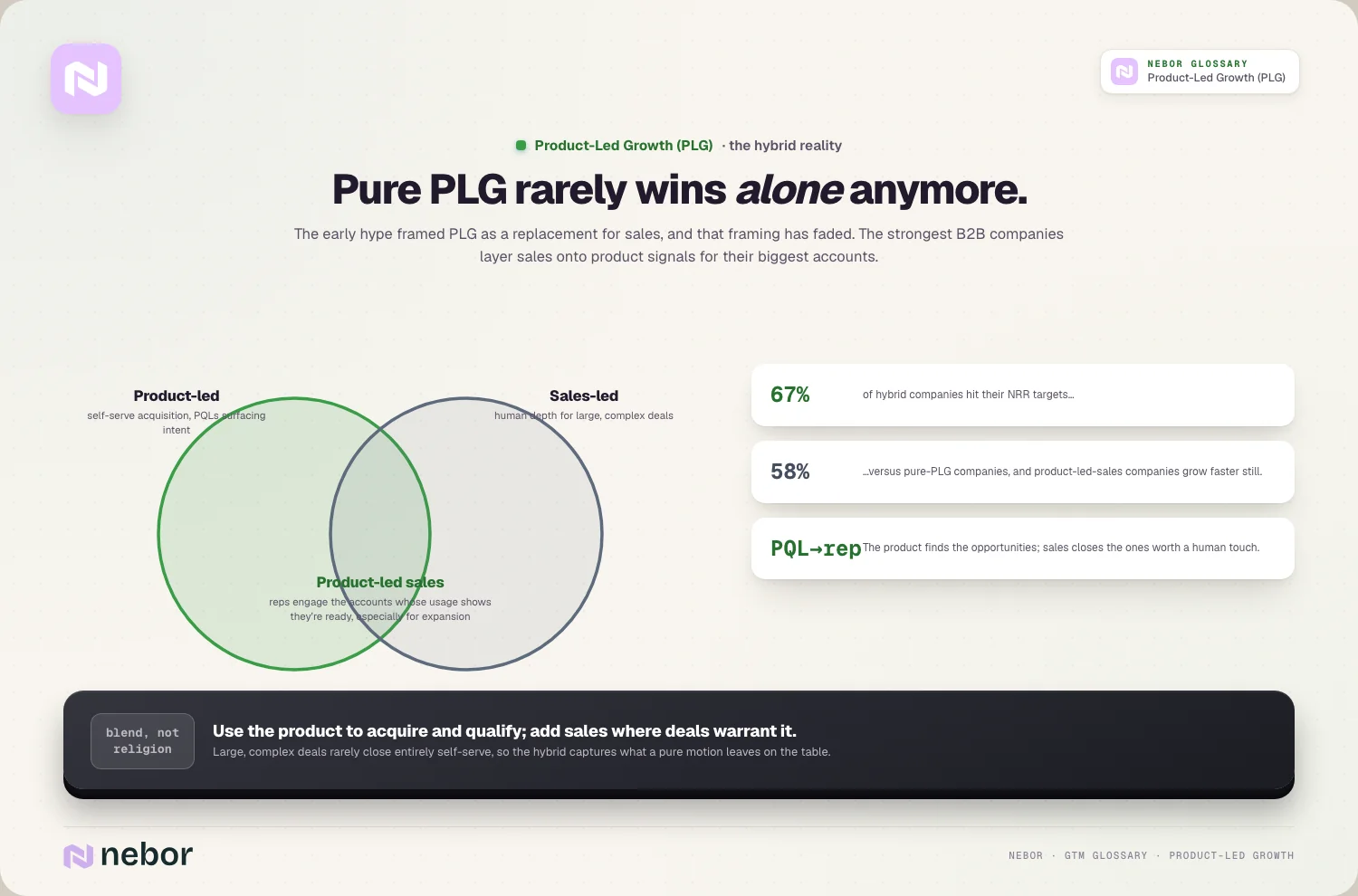
The numbers favor the hybrid model clearly. Hybrid companies hit their retention targets far more often, with hybrid NRR around 67% versus 58% for pure PLG, and product-led-sales companies grow faster.
Big accounts still need real people involved. Large, complex deals rarely close entirely self-serve, so sales steps in for the high-value accounts that a pure PLG motion would otherwise leave on the table.
So PLG works best as part of a blend instead of a religion. Using the product to acquire and qualify, then adding sales where deals are big enough to warrant it, captures more than either motion alone.
How product-led sales layers a sales team on top of a PLG motion
The bridge between PLG and sales has a name, and it's where much of the modern action is. Product-led sales uses product signals to direct a sales team.
It starts with the PQL as the signal. Product-qualified leads surface the users and accounts showing real intent, which becomes the list a sales team acts on.
Sales focuses on the best of those signals. Instead of chasing everyone, reps engage the accounts whose usage shows they're ready to expand, which is far more efficient than cold outreach.
It targets the expansion opportunities in your accounts especially effectively. A thriving one is a natural candidate for expansion revenue, so product-led sales often focuses on growing accounts that are already succeeding, which lifts their customer lifetime value over time.
So product-led sales turns product usage into a sales roadmap. The product finds the opportunities, and sales closes the ones worth a human touch, and that division is the heart of the hybrid model.
The efficiency gain is very real for your team. Because reps only engage accounts the product has already qualified, they spend their time on live opportunities instead of cold ones, which is part of why hybrid motions post such strong growth.
How outbound still fits inside a product-led company's motion
A common misconception is that PLG means no outbound whatsoever. In practice, product signals make outbound sharper instead of obsolete.
Product usage works as an outbound trigger. A user hitting a key milestone is a reason to reach out, which is a form of inbound-led outbound driven by product behavior instead of website visits.
It makes the outreach warm from the start. Reaching out to someone already using and valuing the product is far warmer than a cold approach, so the conversation starts from proven interest.
It aims at the right accounts too. Focusing outreach on accounts that both use the product and fit your ideal customer profile concentrates effort where it's most likely to convert.
So outbound in a PLG company is triggered by the product instead of replaced by it. The usage tells reps who to contact and when, which turns outbound into a precise complement instead of a separate machine.
Why product-led growth reshapes the whole company beyond just sales
PLG reshapes how the entire business operates, reaching well past the sales decision, because when the product carries the motion, every function orients around it.
Product becomes a growth engine in its own right. The team building the product is now responsible for acquisition and conversion as well as features, so the lines between product and growth start to blur together.
Onboarding and success grow sharply in importance. Because the product has to deliver value without a rep, the teams that shape the user experience carry weight they wouldn't in a sales-led company.
It reshapes the revenue engine underneath everything. A PLG revenue engine grows through self-serve conversion and expansion, which changes how the whole company measures and drives growth.
So adopting PLG is a company-wide shift instead of a tactic. It moves the burden of growth onto the product and the teams around it, and that's the reason it changes far more than how you sell.
The common mistakes companies make when they adopt product-led growth
PLG fails in a few recognizable ways, usually from treating it as a magic switch instead of a discipline, and we keep seeing the same errors when companies bring us their funnels.
The biggest is a slow path to value. If users don't reach a real outcome fast, they churn before converting, which starves the whole motion.
Another is bolting PLG onto a complex product. A product that needs heavy setup or training rarely works self-serve, so forcing PLG onto it frustrates users.
A third is ignoring the high-value accounts. Staying pure self-serve and never adding sales leaves big deals unclosed, so the hybrid model tends to win.
The last is measuring the wrong things. Tracking signups while ignoring activation and conversion hides whether users reach real value, and value is what the model lives on.
Why product-led growth is really about earning the sale through value
The instinct to see PLG as a way to avoid selling misreads it. The model moves the persuasion into the product itself instead of removing it.
The product has to prove its own worth. Where a rep once made the case, now the experience of using the product must make it, which is a higher bar in some ways instead of a lower one.
It rewards real value above all else. A product that truly helps users converts them naturally, while one that doesn't can't be talked into a sale by a motion built on self-serve trial.
The best version blends product and people. Letting the product acquire and qualify, then adding sales where it counts, captures the efficiency of PLG and the depth of sales together.
Approached that way, product-led growth becomes one of the most efficient engines in a modern go-to-market system. It lets the product earn most of the sale, while the team decides where a human, or the signals you automate sales prospecting around, should step in.
Share this post
Marketing
RevOps
Glossary
Related glossary items
Understanding the core GTM concepts




Ready to build your pipeline











