
In this post:
A GTM flywheel is a model of go-to-market where each part of your motion feeds the next, building momentum that compounds over time. Instead of a funnel that leaks customers out the bottom, a flywheel keeps the energy in the system and turns it back into more growth.
The shift in thinking goes deeper than the diagram. A funnel treats a closed deal as the end of the journey, while a flywheel treats it as fuel, because happy customers refer others, your content keeps working, and your data keeps improving the motion. The whole thing is built to spin faster the more you put into it.
For anyone building a durable go-to-market motion, the flywheel is the more honest mental model. Growth behaves less like a one-way pipe you keep pouring into and more like a loop you build momentum in, and understanding that changes where you invest.
TL;DR
A GTM flywheel is a self-reinforcing loop where customers, content, and data feed back into more growth, instead of a linear funnel that ends at the sale.
The funnel treats acquisition as a one-way trip and customers as the finish line. The flywheel treats every output, like a happy customer or a piece of content, as an input that makes the next cycle easier.
The flywheel matters because the growth it produces compounds. Each turn makes the next one cheaper and faster, as referrals, reputation, and reusable systems build up, which is a fundamentally more durable way to grow than refilling a leaky funnel forever.
So what is a GTM flywheel, and how is it different from a funnel?
A GTM flywheel is a way of picturing your go-to-market motion as a loop that builds momentum, rather than a funnel that only points one direction. The difference is in what happens to the energy you put in.
In a funnel, you pour prospects in the top, some convert, and the rest leak out, and a closed deal is the end of the line.
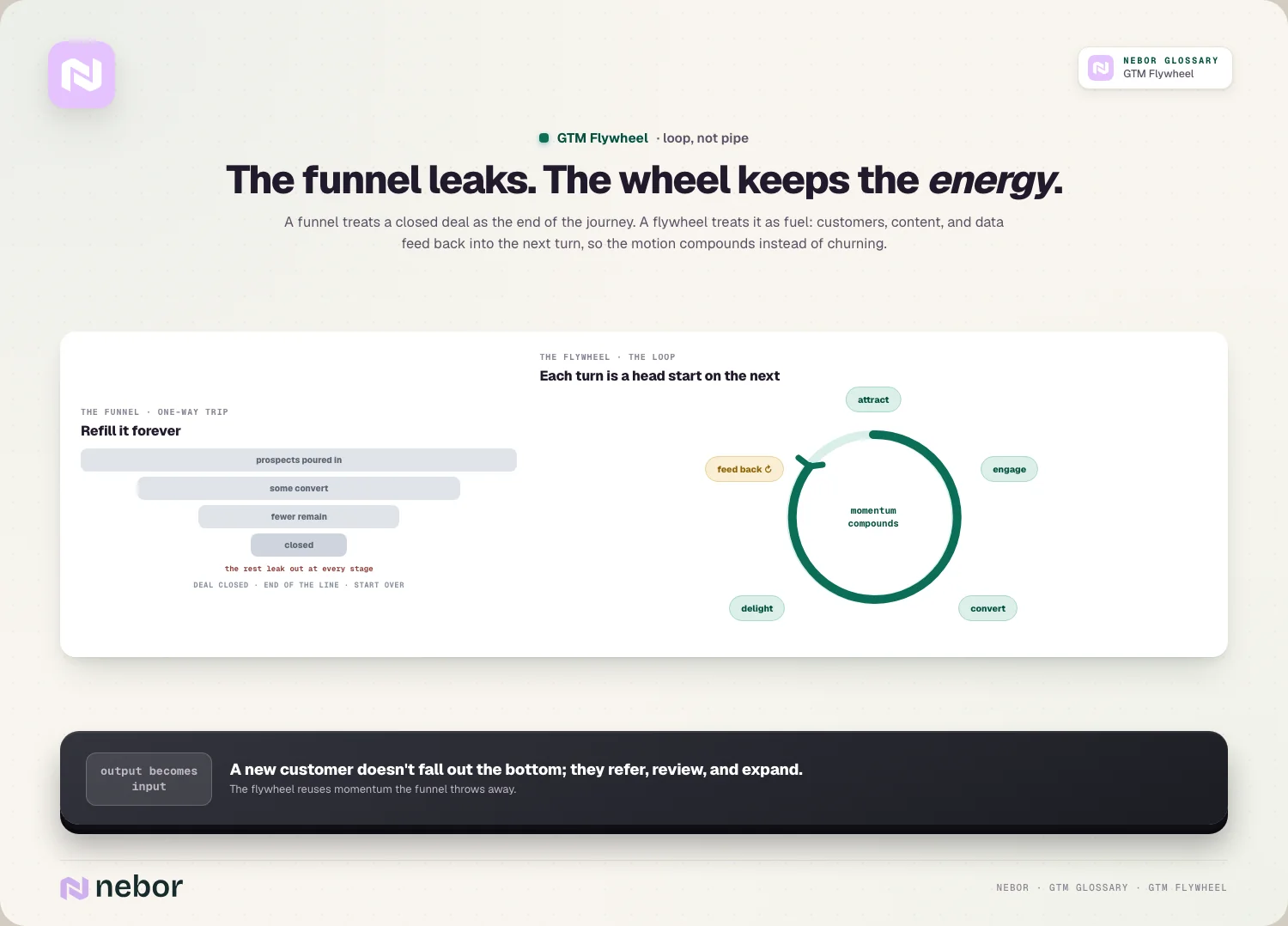
In a flywheel, the motion is circular, so the output of one stage becomes the input of the next. A new customer never falls out the bottom, because they feed the top by referring others, leaving reviews, and expanding their account.
The practical upshot is that a flywheel reuses momentum that a funnel throws away. Where a funnel forces you to refill it constantly from scratch, a flywheel turns each cycle into a head start on the next, which is why it compounds while a funnel just churns.
What are the stages of a GTM flywheel, and how do they hand off?
A flywheel still has stages, they just connect into a loop rather than a line. Naming them shows how each one feeds the next.
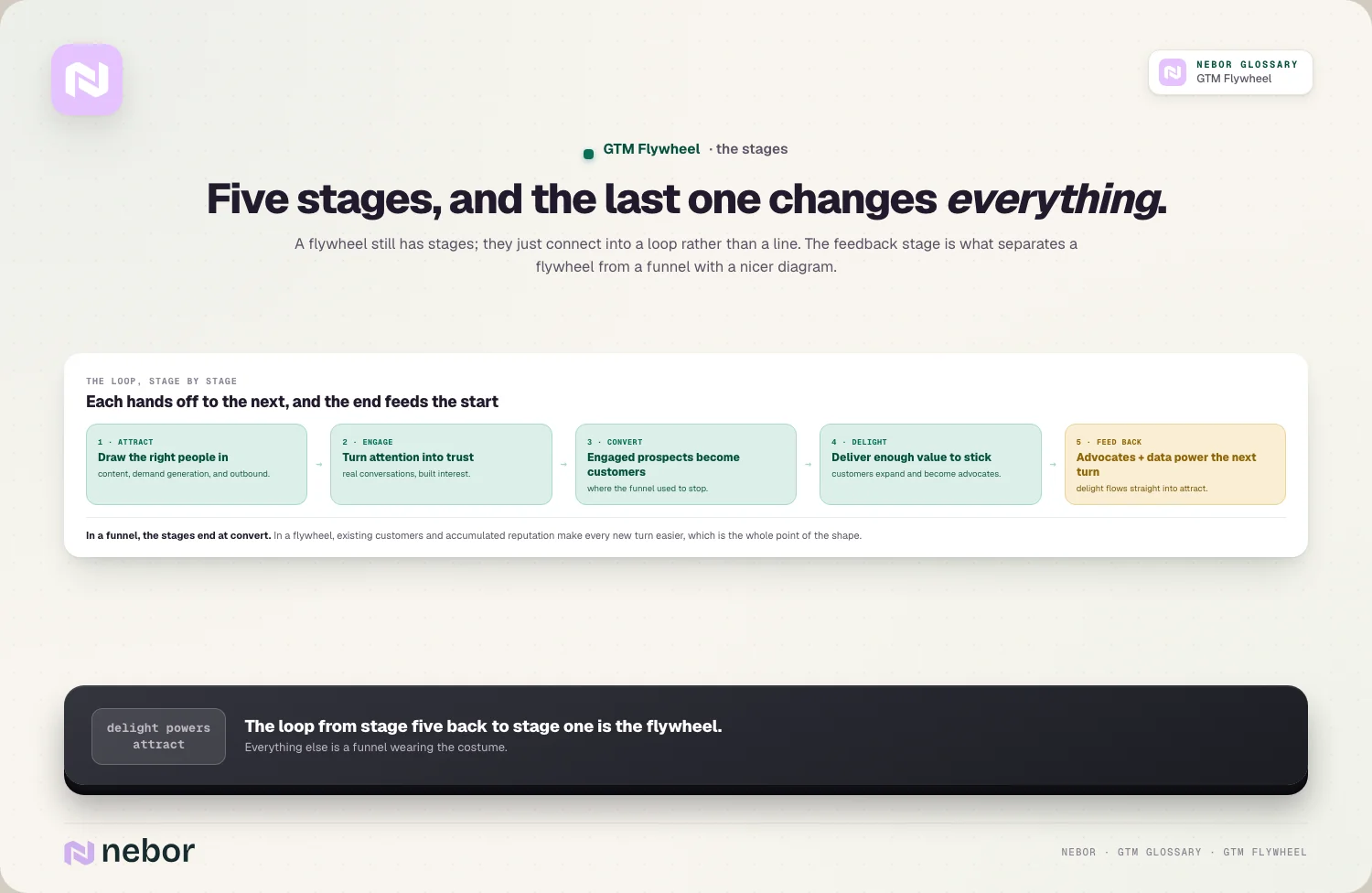
A simple GTM flywheel moves through a few phases that hand off to each other.
Attract, where you draw the right people in through content, demand generation, and outbound.
Engage, where you build interest and trust, turning attention into real conversations.
Convert, where engaged prospects become customers.
Delight, where you deliver enough value that customers stick, expand, and become advocates.
Feed back, where those happy customers and the data they generate flow back into attracting and engaging the next cycle.
The last item is the one that changes everything. In a funnel, the stages end at convert, but in a flywheel the delight stage powers the attract stage, so your existing customers and your accumulated reputation make every new turn easier.
That feedback is what separates a flywheel from a funnel with a nicer diagram.
Why does the classic funnel model hold your growth back over time?
The funnel isn't wrong, but it builds in some assumptions that limit how you grow. They deserve a closer look, because they shape where teams spend.
The biggest problem is that a funnel treats the customer as the end. Once a deal closes, the funnel's job is done, which subtly tells teams to focus everything on acquisition and treat retention and advocacy as someone else's problem.
That's how you end up with a great top-of-funnel motion and customers who never refer anyone.
The funnel also implies that every new customer costs the same effort as the last, since you're always refilling from the top.
That ignores the compounding that real growth depends on, where past customers, content, and reputation should be making each new sale easier. The funnel hides all of that, and that's exactly what makes the flywheel a more useful picture.
What makes a GTM flywheel spin faster, force or less friction?
A flywheel is a physical metaphor, so it helps to think in those terms. It spins faster when you add force and when you remove friction, and both matter.
Adding force means investing in the things that drive the loop, like creating more content, generating more demand, and delivering more value to customers so they advocate harder, and every one of those pushes gives the wheel speed.
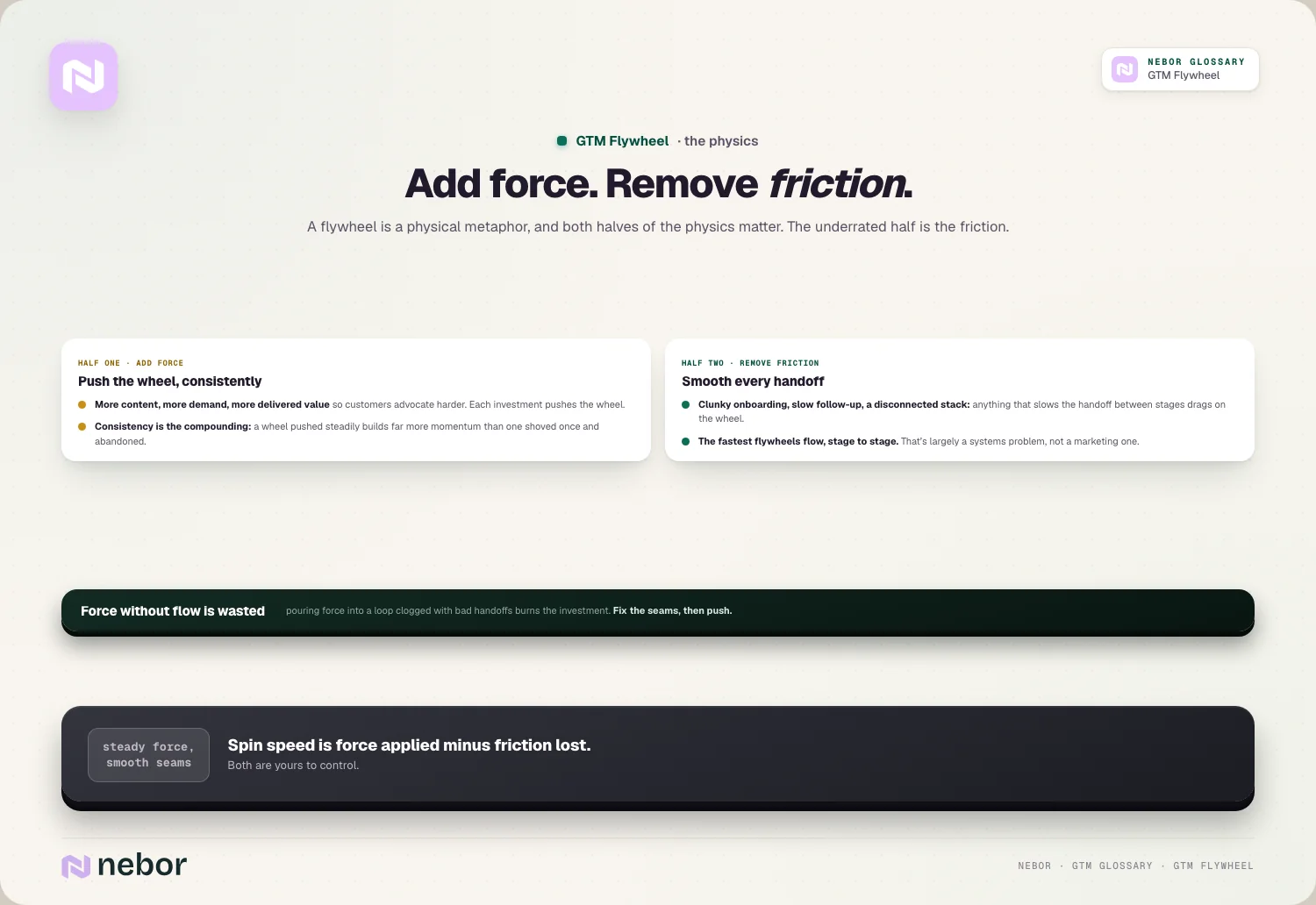
The compounding comes from doing this consistently, because a flywheel you push steadily builds far more momentum than one you shove once and abandon.
Removing friction is the half that most teams underrate. Anything that slows the handoff between stages, like a clunky onboarding, slow follow-up, or a disconnected tech stack, drags on the wheel.
The fastest flywheels aren't just the ones with the most force behind them, they're the ones where each stage flows smoothly into the next, which is largely a systems problem.
How do your customers become the engine that drives your flywheel?
The single biggest difference between a funnel and a flywheel is what happens to your customers. In a flywheel, they're not the finish line, they're the most powerful source of new growth.
Happy customers drive the loop in several ways. They refer other companies, which brings in warm, high-converting leads at almost no cost.
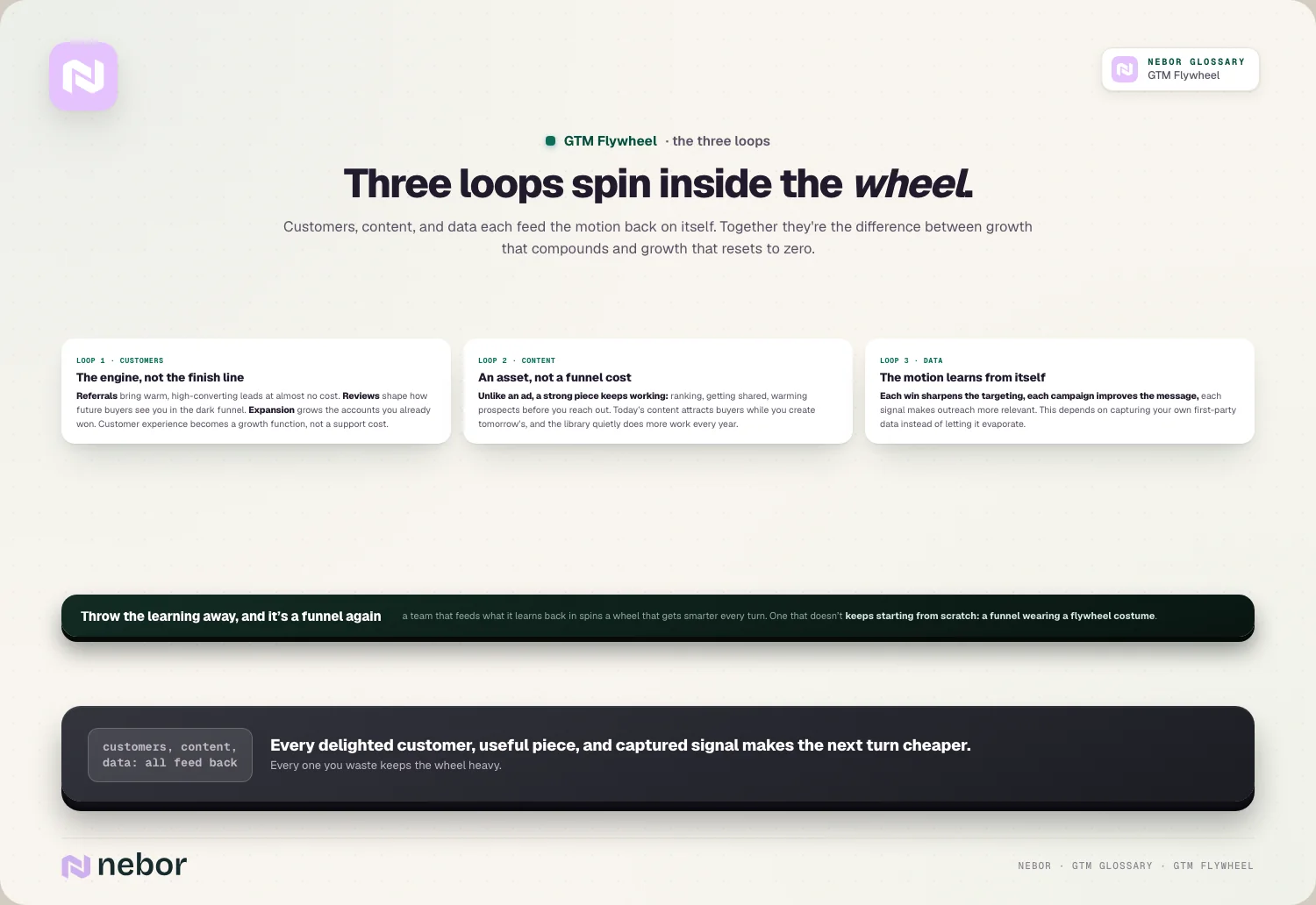
They leave reviews and speak well of you in the dark funnel, shaping how future buyers see you. And they expand their own accounts, which is where expansion revenue and strong net revenue retention come from.
This is why customer experience works as a growth function in a flywheel instead of a plain support cost. Every delighted customer makes the next cycle easier and cheaper, while every unhappy one drags on the wheel and can spin it backward through bad word of mouth.
Treating customers as the engine instead of the end is the core mindset shift the flywheel asks for.
How does your content compound inside a GTM flywheel over time?
Content is one of the clearest examples of flywheel thinking, because it keeps working long after you make it. A good piece of content is an asset that feeds the loop again and again.
Unlike an ad that stops the moment you stop paying, a strong article, post, or resource keeps attracting and engaging people for months or years. It builds your reputation, ranks in search, gets shared, and warms prospects before you ever reach out, which is the heart of content-led outbound and thought leadership.
Each piece adds to a growing body of work that makes the next cycle easier.
This is what makes content a flywheel input rather than a funnel cost. In a funnel, content is just something you spend to fill the top, but in a flywheel it's an asset that compounds, because today's content keeps attracting buyers while you create tomorrow's.
The teams that understand this build a library that quietly does more work every year.
How do your data and signals feed the flywheel back on itself?
There's a less obvious loop inside a GTM flywheel, and it feeds on data. Every cycle generates information that, used well, makes the next cycle smarter.
Each customer you win teaches you something about who your best customers are, which sharpens your targeting. Each campaign shows you what messaging works, which improves the next one.
Each signal a prospect gives off feeds your systems, so your outreach gets more relevant over time. The motion learns from itself, which is a quieter but powerful form of compounding.
This is where a flywheel depends on capturing and using your own first-party data instead of letting it evaporate.
A team that feeds what it learns back into its targeting and messaging spins a flywheel that gets smarter with every turn, while a team that throws that data away keeps starting from scratch, which is really just a funnel with a new name.
Why does the flywheel only work when your systems truly connect?
The flywheel is a lovely idea that falls apart in practice when the stages don't connect, so let's be clear that it's a systems problem as much as a strategy diagram. A loop only spins if the pieces are joined.
In many companies, the stages of the flywheel live in separate silos, like marketing attracting people, sales converting them, and customer success keeping them, with no real handoff between the three.
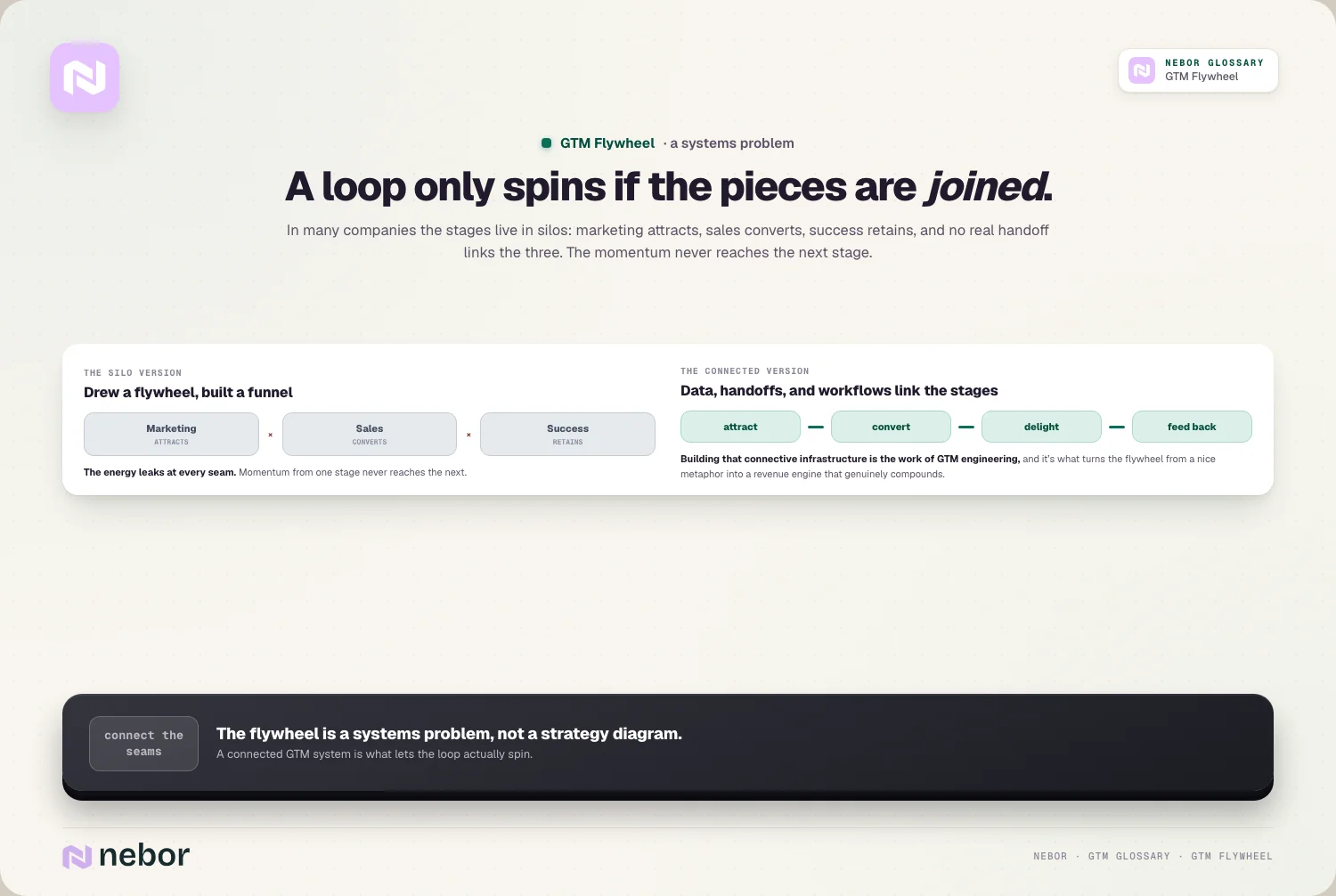
When that happens, the momentum from one stage never reaches the next, and you've drawn a flywheel but built a funnel, with the energy leaking at every seam.
This is why a flywheel needs a connected GTM system, where data, handoffs, and workflows actually link the stages.
Building that connective infrastructure is the work of GTM engineering, and it's the work we do for clients every day, turning the flywheel from a nice metaphor into a revenue engine that compounds.
How do you measure a flywheel differently from a leaky funnel?
A flywheel asks for a different scoreboard than a funnel, because the things that make it spin aren't all captured by acquisition metrics. Measuring it like a funnel misses the point.
Funnel metrics focus on conversion at each stage, which still matter, but a flywheel also cares about the feedback loop.
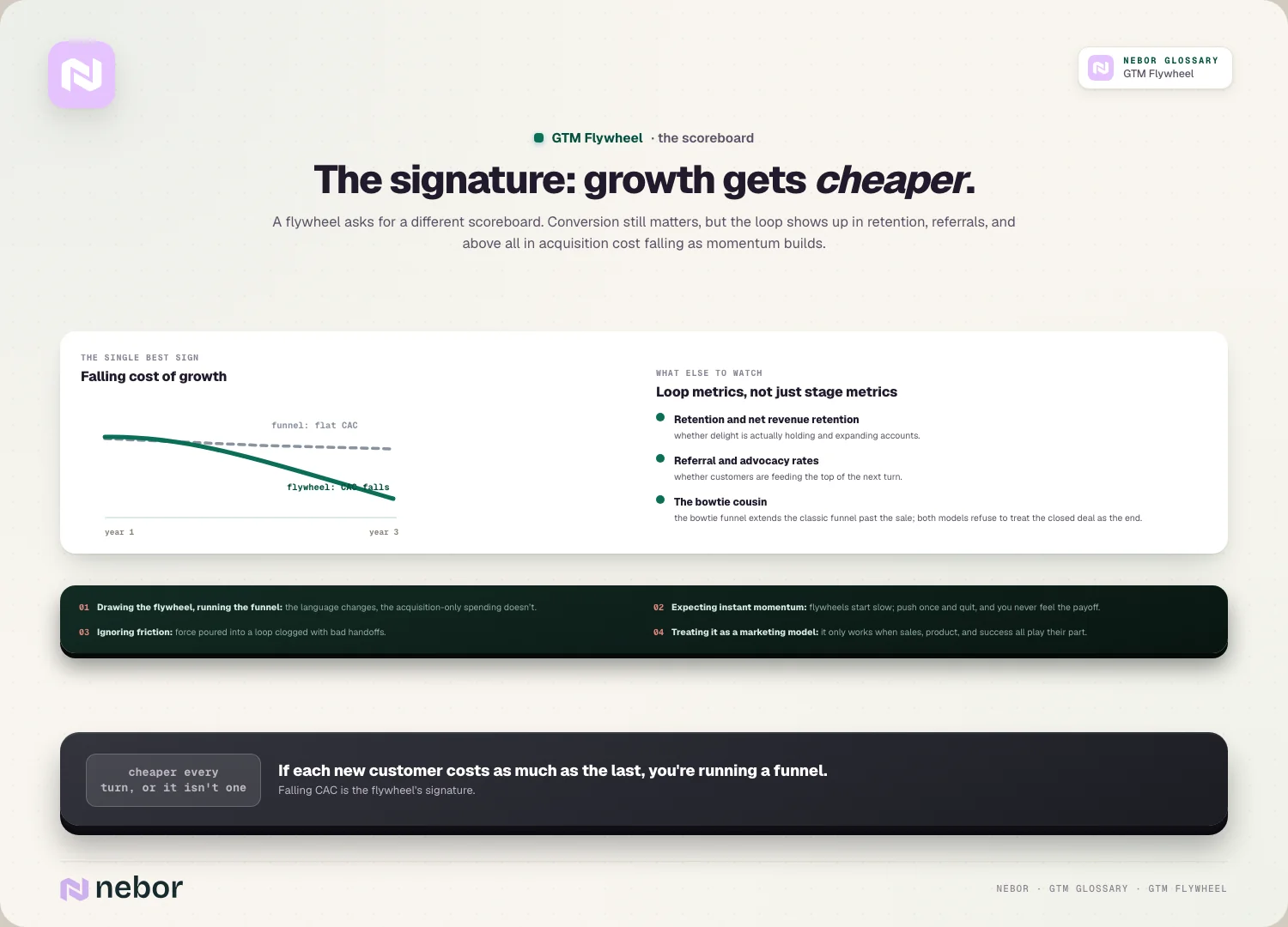
You watch retention and net revenue retention, referral and advocacy rates, and whether your customer acquisition cost is falling over time as the wheel builds momentum. A healthy flywheel shows up as growth that gets cheaper and easier as it gets bigger.
The single best sign that your flywheel is working is that acquisition gets less expensive over time.
If each new customer costs as much as the last, you have a funnel, but if your past customers, content, and reputation are making new growth cheaper, the wheel is spinning. That falling cost of growth is the flywheel's signature.
What are the common mistakes teams make with the GTM flywheel idea?
The flywheel is easy to nod along to and hard to build, so the same few mistakes show up in almost every company we meet. Knowing them keeps it from being just a buzzword on a slide.
The biggest is drawing the flywheel but working the funnel, where a team adopts the language but still pours everything into acquisition and treats customers as the end.
Another is expecting instant momentum, since a flywheel is slow to start and only compounds with consistent force over time, so teams that push once and quit never feel the payoff. A third is ignoring friction, pouring force into a loop that's clogged with bad handoffs and disconnected systems.
There's also the mistake of treating it as a marketing model instead of a whole-company one, when the flywheel only works if sales, product, and customer success all play their part.
What cures them is the same short list every time. You truly connect the stages, invest in the customer and content loops as growth drivers, and give the wheel the consistency it needs to build speed.
How does the GTM flywheel relate to the bowtie funnel exactly?
These two ideas often come up together, and they're related attempts to fix the same flaw in the classic funnel. Both refuse to treat the closed deal as the end.
The bowtie funnel extends the traditional funnel past the sale, adding stages for onboarding, retention, and expansion, so it captures the recurring-revenue reality the old funnel ignored.
It's still drawn as a shape with a flow, but it acknowledges that growth continues after the first sale. The flywheel goes a step further, bending that extended journey into a loop where the post-sale stages actively feed new acquisition.
So you can think of the bowtie as a halfway house between the funnel and the flywheel. It fixes the funnel's biggest blind spot, the customer as the end, while the flywheel takes the next step and makes those customers the engine of the next cycle.
How do you start turning your funnel into a flywheel in practice?
You don't switch from a funnel to a flywheel overnight, and in our experience the move is gradual, beginning with connecting what you already have.
The first step is to stop treating the sale as the finish line and start measuring and investing in what happens after it, like retention, referrals, and expansion.
From there, you connect the stages that are currently stuck in silos, so a happy customer's referral actually flows back into your acquisition instead of getting lost between teams.
Then you pick one loop to strengthen, whether that's customer advocacy, content, or data, and push it consistently.
The point is that a flywheel gets built instead of declared. You turn your funnel into a flywheel by joining its stages into a loop and feeding the outputs back in, one connection at a time, until the whole thing starts to spin on its own.
Why the flywheel is really about making your growth compound on itself
The GTM flywheel carries one important idea, that growth should compound instead of resetting. Every customer, every piece of content, and every lesson learned should make the next cycle easier, instead of leaking away as a funnel assumes.
The teams that win with it stop treating acquisition as a one-way pipe and start treating their whole motion as a loop they build momentum in.
They invest in keeping customers, in content that lasts, and in the connected systems that let energy flow from one stage to the next, so growth gets cheaper and faster the longer they keep at it.
The mindset that works is to ask, of everything you do, whether it feeds the wheel or just fills the funnel.
When you push consistently, remove the friction between stages, and let your customers and your content become the engine, you build the kind of growth that compounds, which is the only kind that lasts.
Deel dit bericht
Marketing
RevOps
Begrippenlijst
Gerelateerde begrippen
De basis GTM-concepten begrijpen


Klaar om je pipeline te bouwen