

In this post:
A company can win new customers every month and still be quietly going backward. If it loses old customers faster than it adds value to the ones it keeps, all your new business is just refilling a leaky bucket.
Net revenue retention is the metric that exposes this. It's the single number that tells you whether your existing customer base, your pipeline's payoff, is growing, holding, or shrinking on its own.
Net revenue retention, often shortened to NRR, measures how much recurring revenue you keep and grow from existing customers over a period, after accounting for upgrades, downgrades, and cancellations, and it deliberately ignores new customers.
That last part is what makes it so revealing. By looking only at customers you already had, NRR shows the real health of your business underneath all the new-logo noise.
TL;DR
Net revenue retention measures the change in recurring revenue from your existing customers over a period, factoring in expansion, contraction, and churn, with no new customers counted.
It shows whether your base grows or shrinks on its own. Above 100% means your existing customers spend more over time even if you sold nothing new, which is compounding growth.
The benchmarks are fairly settled by now. Below 100% is a worry, 100 to 120% is solid, and above 130% is best-in-class, with top public SaaS companies landing around 120 to 125%.
The twist is that NRR is mostly earned long before renewal. It's the downstream result of selling to the right customers and delivering real value, which ties it straight back to your go-to-market choices.
So how is net revenue retention actually calculated, step by step?
The formula is simpler than it sounds once you see the moving parts. You take one group of customers and watch what their revenue does over time.
You start with the recurring revenue from your existing customers at the beginning of a period, then add the expansion revenue from upgrades and add-ons.
From there you subtract the contraction from downgrades and the revenue lost to cancellations, divide by the starting revenue, and you have your NRR.
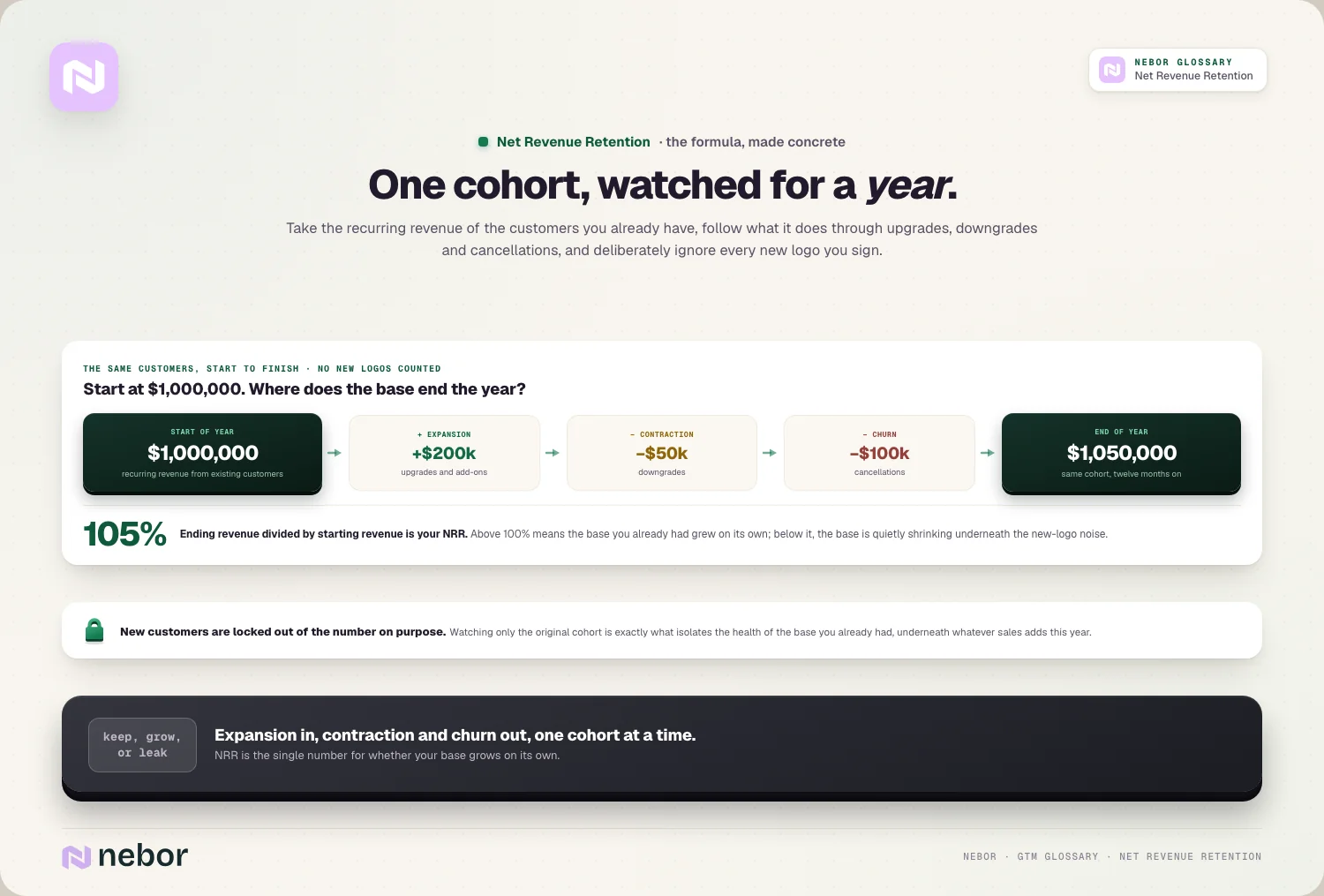
A quick example makes the formula concrete. Say you start the year with $1,000,000 in recurring revenue from existing customers.
Over the year they upgrade by $200,000, downgrade by $50,000, and churn away $100,000. Your ending revenue from that same group is $1,050,000, so your NRR is 105%.
The key detail is that this only tracks the original cohort. New customers signed during the year don't count here, and that exclusion is exactly what isolates the health of the base you already had.
Why has NRR become the one metric that everyone obsesses over?
NRR earned its status because it answers the question new-logo growth can't. It tells you whether your product keeps delivering value after the sale, which closing skill alone can't show.
When NRR is above 100%, something powerful happens. Your revenue grows even if your team stops acquiring customers entirely, because the base expands faster than it leaks.
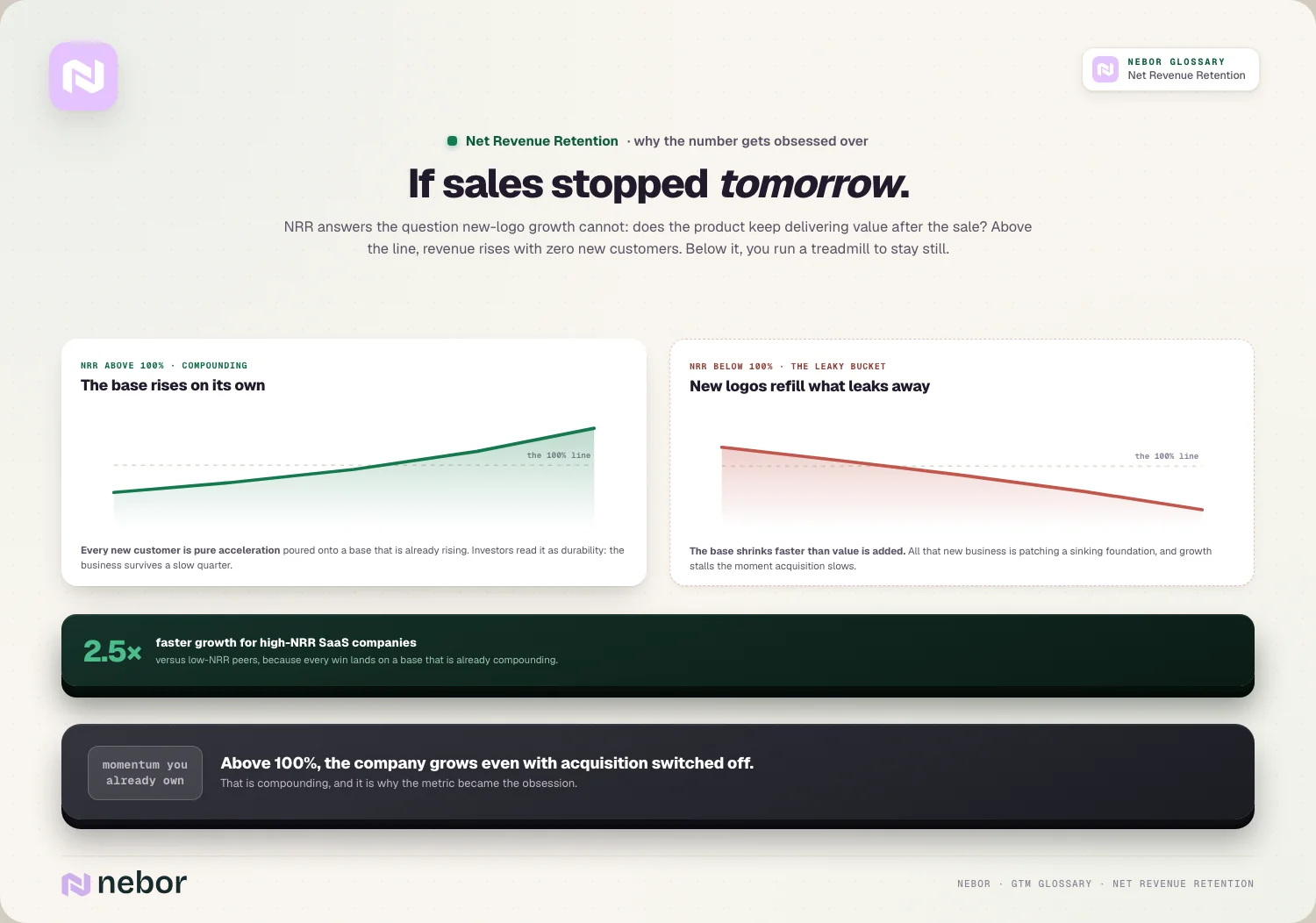
That's compounding, and it's why investors treat NRR as a proxy for durability. A business that retains and expands its customers can survive a slow quarter of new sales, while a leaky one can't.
The growth gap is hard to ignore, with high-NRR SaaS companies tending to grow around 2.5 times faster than their low-NRR peers, because every new customer adds to a base that's already rising.
It also reframes how you think about new business. With strong NRR, new customers are pure acceleration on top of a growing base. With weak NRR, they're a treadmill that only keeps you in place.
What counts as a good net revenue retention rate for your segment?
Benchmarks vary by who you sell to, but the broad bands are well established. They give you a quick read on where you stand.
Below 100% is a warning sign, because it means your existing base is shrinking, so you're losing more to churn and downgrades than you gain from expansion.
The 100 to 120% range is healthy territory, where your base is growing on its own, and most well-managed B2B software companies live here.
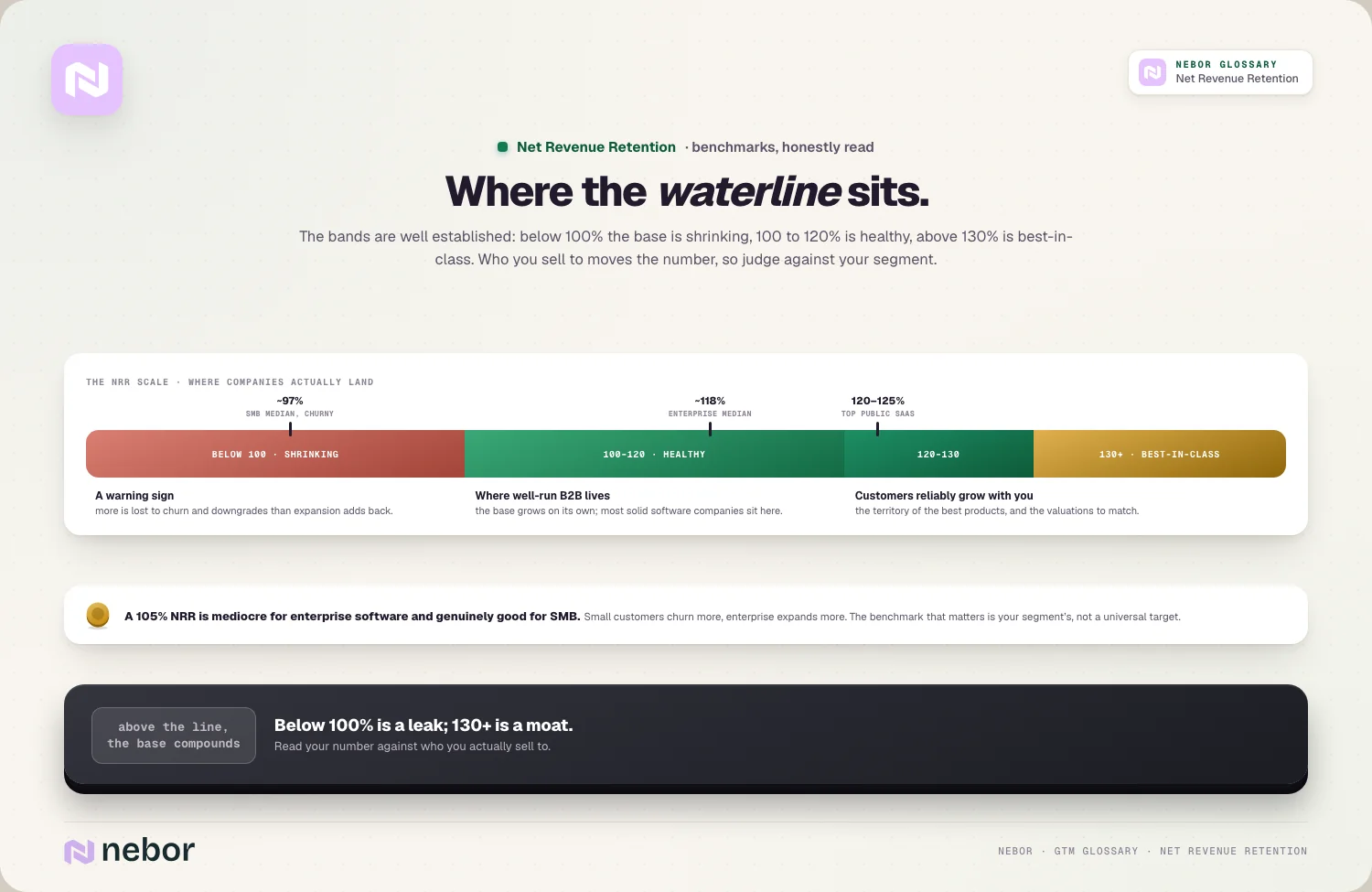
Above 130% is best-in-class, the territory of companies whose customers reliably grow with them. Top public SaaS firms cluster around 120 to 125%.
Who you sell to matters a lot, though. Enterprise-focused companies tend to post the highest NRR, often around 118% at the median, while products sold to small businesses are often closer to 97% because small customers churn more.
So your number deserves judging against your segment instead of a single universal target. A 105% NRR is mediocre for enterprise software and genuinely good for an SMB-focused product.
How is NRR different from the gross revenue retention beside it?
People often confuse these two, but the gap between them is itself useful information, because they measure related but different things.
Gross revenue retention, or GRR, only counts the bad news. It measures how much revenue you kept from your existing base, subtracting churn and downgrades, but never adding expansion.
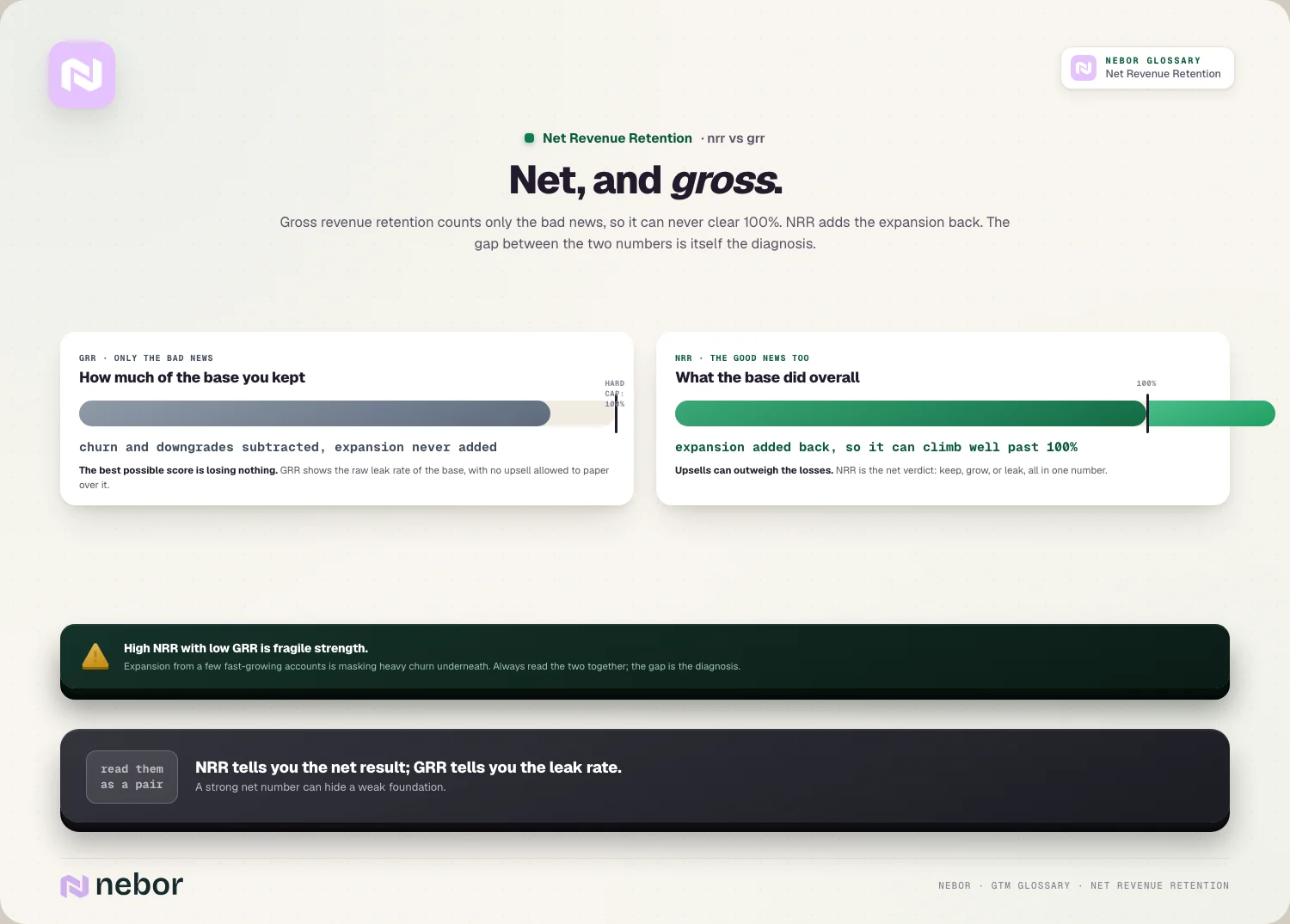
That means GRR can never go above 100%. The best you can do is lose nothing, so it caps at 100% and usually lands below it.
NRR includes the good news too, adding expansion revenue back in, which is why it can climb well past 100% when upsells outweigh losses.
Reading them together is where the power is, because if your NRR is high but your GRR is low, expansion from a few accounts is masking heavy churn underneath, which is a fragile kind of strength.
Why does strong NRR really start at the very top of your funnel?
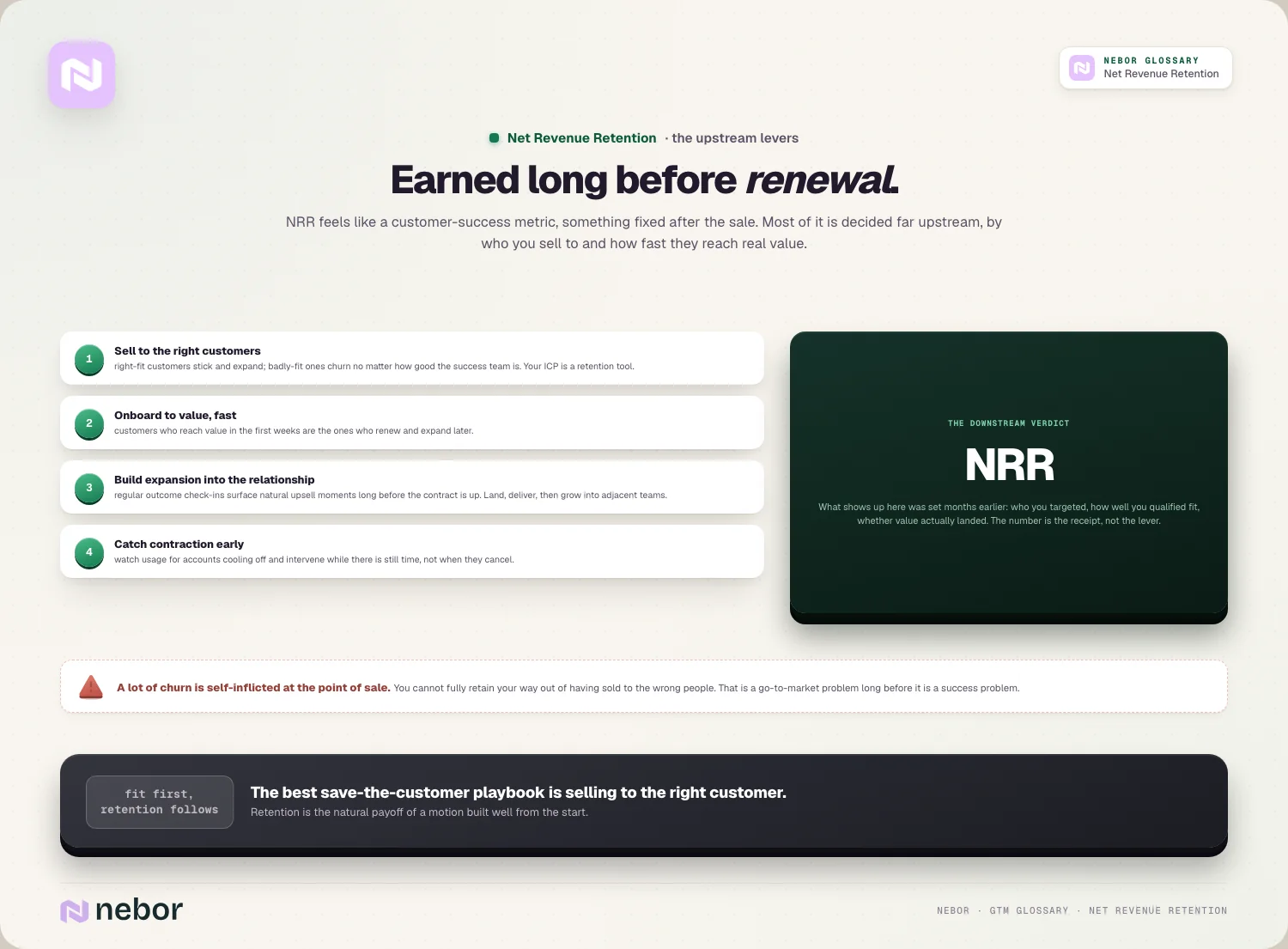
Here's the part we watch teams miss most often. NRR feels like a customer-success metric, something you fix after the sale, but most of it is decided by who you sell to in the first place.
If you sell to badly-fit customers, no amount of onboarding saves them. They never get real value, so they downgrade or churn, and your NRR sinks no matter how good your team is.
This is why retention traces straight back to your ideal customer profile. The right-fit customers are the ones who stick, expand, and carry your NRR upward month after month.
It's also why a good ICP scoring model is a retention tool as much as a prospecting one. Scoring fit before you sell means fewer doomed deals dragging your base down later.
The uncomfortable implication is that a lot of churn is self-inflicted at the point of sale. You can't fully retain your way out of having sold to the wrong people, which is a go-to-market problem long before it's a success problem.
How do expansion and the right motions lift your NRR over time?
The expansion half of NRR is where the upside lives, and in our experience it's never an accident. Growing an account takes the same deliberate work that winning it did.
The most reliable lever is land and expand. You win a foothold in one team, deliver value, then grow into adjacent teams and use cases over time.
That growth depends on relationships across the account, and building them is exactly the job of multi-threading. The more people who rely on you internally, the easier expansion becomes and the harder churn gets.
It connects to account-based marketing as well. Treating existing customers as accounts to grow instead of merely keep turns retention into a proactive motion rather than a defensive one.
There's even an inbound angle inside your own base. Watching how current customers use your product surfaces expansion signals, the same way an inbound-led outbound motion reads intent from new prospects.
Where does NRR fit inside your wider growth engine and its math?
NRR isn't a standalone scoreboard, it's a core input into how your whole business grows. It changes the math on everything upstream.
Strong NRR makes acquisition more valuable, because every customer you win keeps growing instead of fading. That higher lifetime value is what lets you afford to invest more in demand generation and outbound.
This is the heart of a GTM flywheel. Retained, expanding, happy customers fund and refer the next wave of growth, so the engine spins faster over time instead of stalling.
It's also why retention belongs in your go-to-market strategy from the start instead of bolted on later. The choices you make about who to target and how to deliver value shape NRR years before renewal.
When the whole thing is built as one connected go-to-market system, NRR becomes the signal that tells you the system is working instead of merely busy.
How often should you measure NRR, and over what time window?
The measurement window changes what the number tells you, so the choice deserves some deliberateness. Most teams track NRR both monthly and annually, and each view answers a different question.
Annual NRR is the headline figure, because it smooths out short-term noise and is the version investors and benchmarks usually mean, so it's the one to quote externally.

Monthly NRR is your early-warning system instead, catching a sudden rise in downgrades or churn fast, before a bad trend has a full year to compound out of sight.
The mismatch to avoid is comparing windows that don't line up. A monthly NRR of 101% and an annual NRR of 101% mean very different things, since the annual figure represents a full year of compounding.
One simple rule keeps it all honest. You pick your reporting window, keep it fixed, and always compare like with like, the same discipline that keeps any trend readable over time.
Why does NRR end up driving how much your whole company is worth?
If you ever raise money or sell, NRR moves from an operating metric to a valuation one. Few numbers shape an investor's view of your business more.
Durability is the reason, because a high NRR proves your revenue compounds without constant new sales, which makes future revenue more predictable and therefore more valuable.
That predictability shows up directly in price. Two companies with identical revenue can be valued very differently if one retains and expands its base while the other churns and refills it.
It de-risks the story too, because a buyer or investor reads strong NRR as proof that customers truly value the product, with no clever marketing papering over a leaky base.
This is part of why serious growth work is about building a durable engine rather than chasing logos. When you hire a growth agency or build the function in house, retention economics should be in the brief from day one.
So how do you actually improve your NRR without gaming the number?
Improving NRR isn't one move, it's a handful of levers pulled together, and we point clients at the mix instead of any single tactic.
The first lever is fixing your targeting upstream. Tightening who you sell to, often by sharpening your lead scoring, raises NRR from a distance by keeping doomed-fit deals out of the base entirely.
The second is onboarding that drives real adoption early. Customers who reach value fast in the first weeks are the ones who renew and expand later.
The third is building expansion into the relationship instead of springing it at renewal. Regular check-ins on outcomes surface natural upsell moments long before the contract is up.
And the fourth is catching contraction early, because watching usage for accounts that are cooling off lets you intervene while there's still time, instead of finding out when they cancel.
What are the common mistakes when teams start chasing NRR hard?
Once NRR becomes a headline number, teams start gaming it in ways that backfire, and the same few mistakes show up again and again.
Hiding churn behind expansion tops the list, because a couple of fast-growing accounts can prop up your NRR while your broader base is bleeding, so GRR belongs alongside it in every review.
Buying expansion with discounts and forced upsells comes next, because pushing customers into bigger contracts they don't need inflates this quarter's NRR and fuels churn next year.
Treating NRR as purely post-sale misses the cause, since much of it is set by fit and targeting, so blaming only customer success looks in the wrong place.
And there's ignoring segment context, because comparing your SMB product's NRR to enterprise benchmarks will either panic you or lull you, when neither reaction is warranted.
Does NRR still matter if you don't have a pure SaaS company?
NRR grew up in subscription software, but the idea travels further than that. Any business with recurring or repeat revenue can learn from it.
If you sell a service with retainers, a marketplace with repeat buyers, or a product with renewals, the same question applies. Is the revenue from last year's customers growing or shrinking this year?
The mechanics shift a little without clean monthly subscriptions, but the spirit holds. You still want to keep your existing base, grow it through more work or higher tiers, and limit the revenue that walks away.
Even one-off-heavy businesses benefit from the mindset. Asking how much you grow existing accounts versus how much you constantly replace pushes you toward the customers worth keeping.
So NRR works less as a SaaS-only formula and more as a discipline. The healthiest revenue is the kind that compounds from people who already chose you.
Why NRR is the answer to one blunt question about your future
NRR, in the end, answers one blunt question. If you stopped winning new customers tomorrow, would your revenue rise or fall?
A number above 100% means your business has its own momentum. The base you've already built grows on its own, and new sales pour onto a rising foundation rather than patching a sinking one.
The deeper lesson is that NRR is a verdict on choices made much earlier. Who you targeted, how well you qualified fit, and whether you delivered real value all show up here, long after the deal closed.
So the best way to raise NRR isn't a clever save-the-customer playbook at renewal time. It's selling to the right customers and earning the right to grow with them, which makes retention the natural payoff of a go-to-market motion built well from the start.
Share this post
RevOps
Glossary
Related glossary items
Understanding the core GTM concepts




Ready to build your pipeline