In this post:
Content-led outbound is an outbound motion where you lead with valuable content instead of a sales pitch. Rather than opening with what you sell, you open with something useful, an insight, a resource or a point of view, and let that start the conversation.
It is still outbound. You pick the accounts, you write first, and the person on the other end never asked to hear from you. What changes is the order of things: the prospect gets something worth having before you ask for anything, so the eventual ask lands on someone you've already helped.
Most attempts fail on the word "valuable". A link to the company ebook with "thought you might find this interesting" is a pitch with an attachment. The content that works as an opener is narrow, quick to read and plainly about the account you're writing to, and that is harder to produce than anything in the marketing library.
TL;DR
Leading with something useful changes how a stranger reads your message. They can't dismiss it as a sales request, and when the content is good there's a small, natural pull to answer the person who sent it.
The best openers are about the account itself: a teardown of their own page or process, a cut of public data that puts them next to their peers, or a sharp take on a change hitting their niche. A 40-page ebook built for everyone usually loses to a page written for one company.
The opener names the content in the subject line, gives one sentence on why you picked them, links to the piece rather than attaching it, and carries no calendar link and no product description.
The ask comes in the second or third touch and stays small: an opinion, a version for a colleague, then a short call about their situation. If the content got no response at all, change the content before you push the meeting.
Content-led outbound decides what you open with. Warming accounts before outreach is the cold-to-warm pipeline's job, and reacting to someone who visited your site is inbound-led outbound.
At volume, keep one core piece per segment and add an account-specific paragraph from a research table, with a person checking each one. That turns a 45-minute teardown into about ten minutes per account.
Judge it on positive replies, clicks on the content link and meetings per 100 accounts, set against a pitch-led sequence to a similar list. Opens tell you nothing here.
Why a useful first touch gets read differently
A cold pitch asks the reader to do the work of deciding whether you matter. Most people make that call in a second and delete. A message that opens with something about their own business flips the burden: before deciding anything about you, they want to see what you found.
Three things happen when the content is good. The reader's guard drops, because nothing in the message asks for their time. You show you understand their situation, which no claim in a pitch can prove. And a small sense of obligation appears, the ordinary pull most people feel to answer someone who did them a favour, even if the answer is only "thanks, useful".
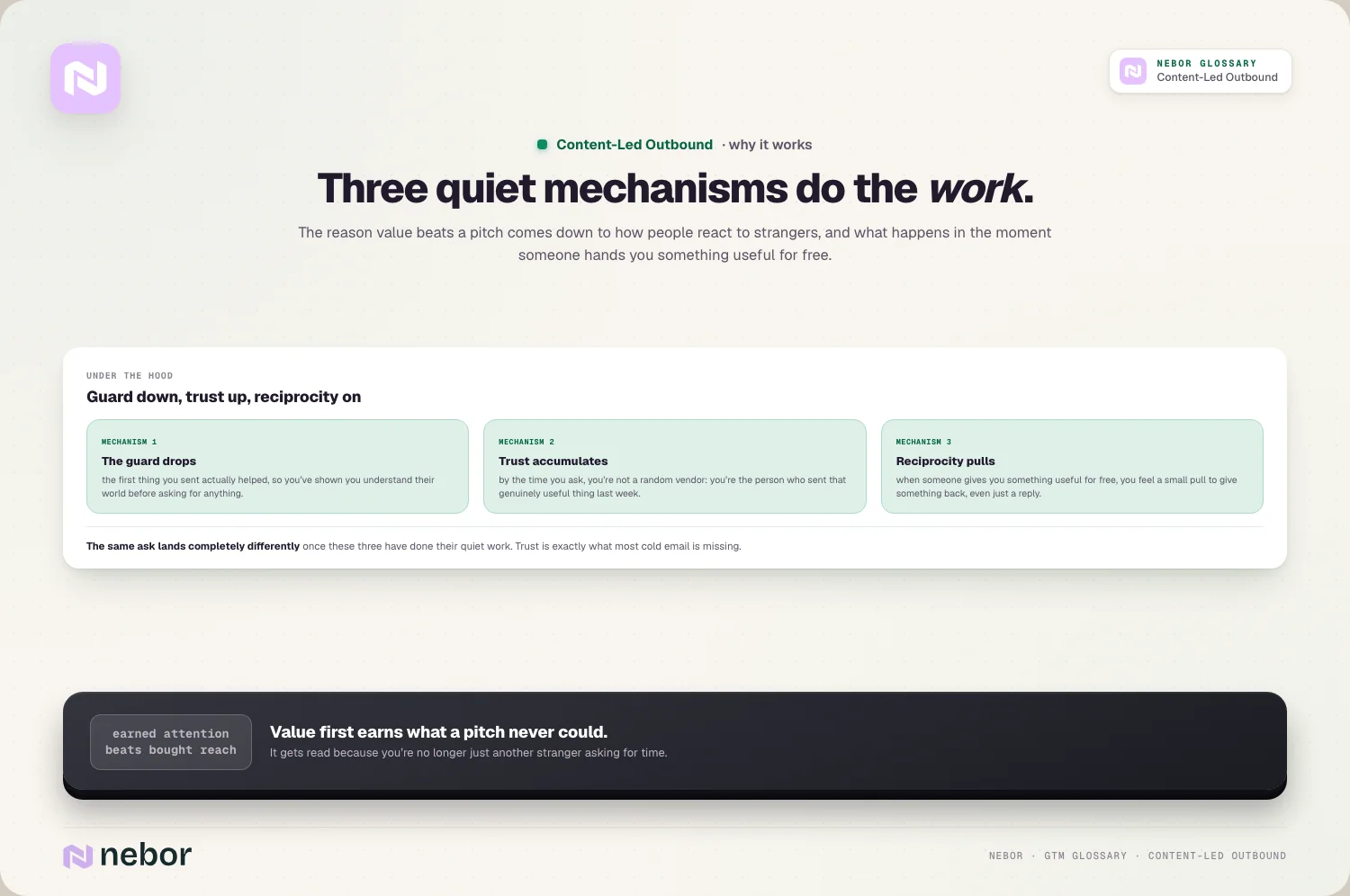
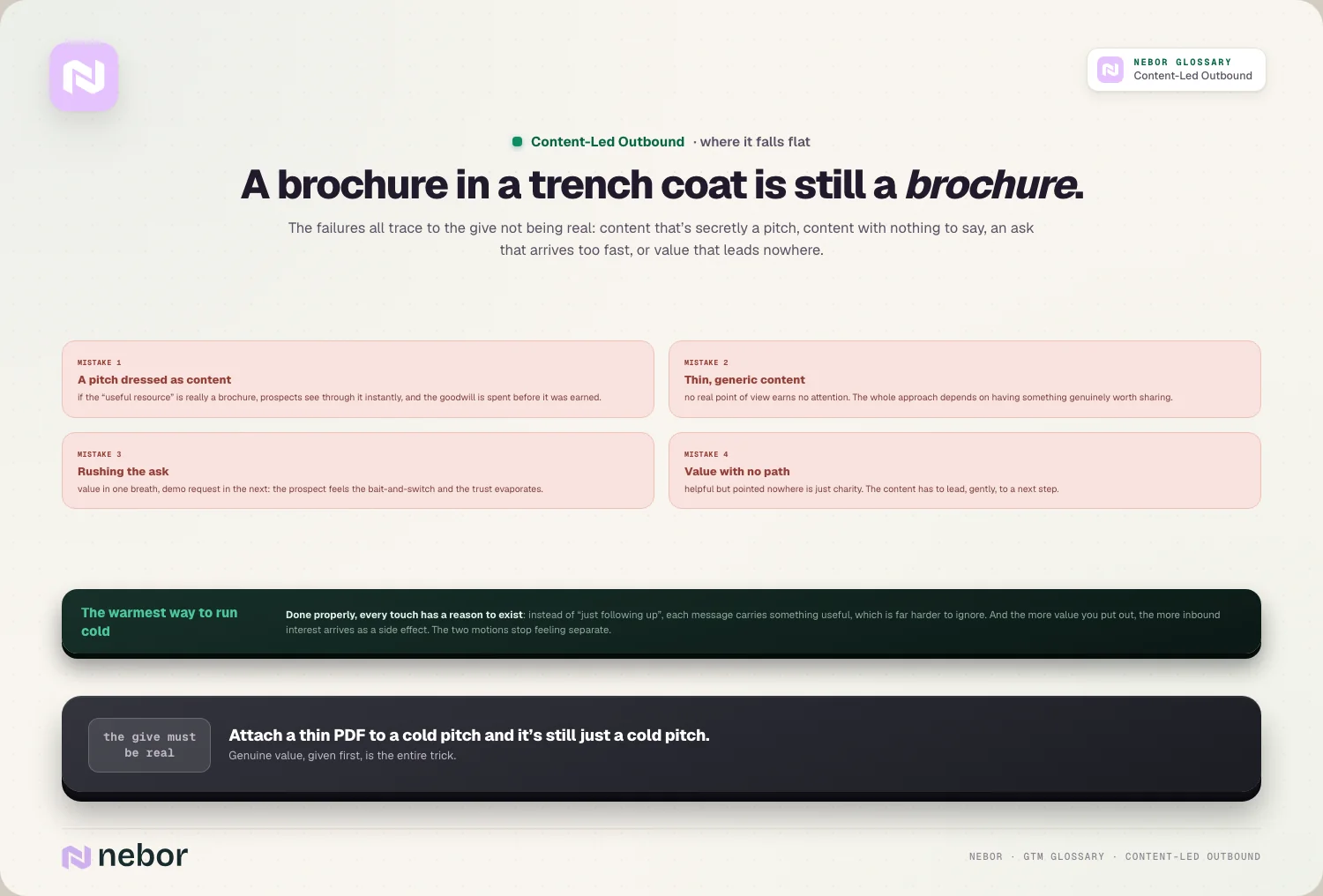
None of this survives a fake gift. If the "insight" is a brochure in disguise, the reader feels tricked, and you've spent the goodwill before you earned any. The motion depends on the content being worth reading even for someone who will never buy from you.
Content that works as an opener, and content that doesn't
The test we apply is simple: would this person forward it to a colleague without being asked? That only happens when the piece is specific to their company or their narrow corner of the market, short enough to read between meetings, and says something they didn't already know.
Formats that tend to pass:
A teardown of their own approach. Their pricing page, onboarding emails, job ads or returns policy, read closely by someone who knows the field, with two or three concrete observations. This is the format we reach for first, because nobody scrolls past something written about them.
A data cut that places them among peers. Public data arranged so they can see how they compare: how competitors in their region price, what their peers' career pages say they're hiring for, how long similar firms take to answer a support form.
A clear opinion on a change in their niche. A new regulation, a platform change, a shift in how their customers buy, with your view on what it means for a company like theirs.
A tool or template they can use today. A checklist, a calculator or a short guide that solves one specific problem, with no form in front of it.
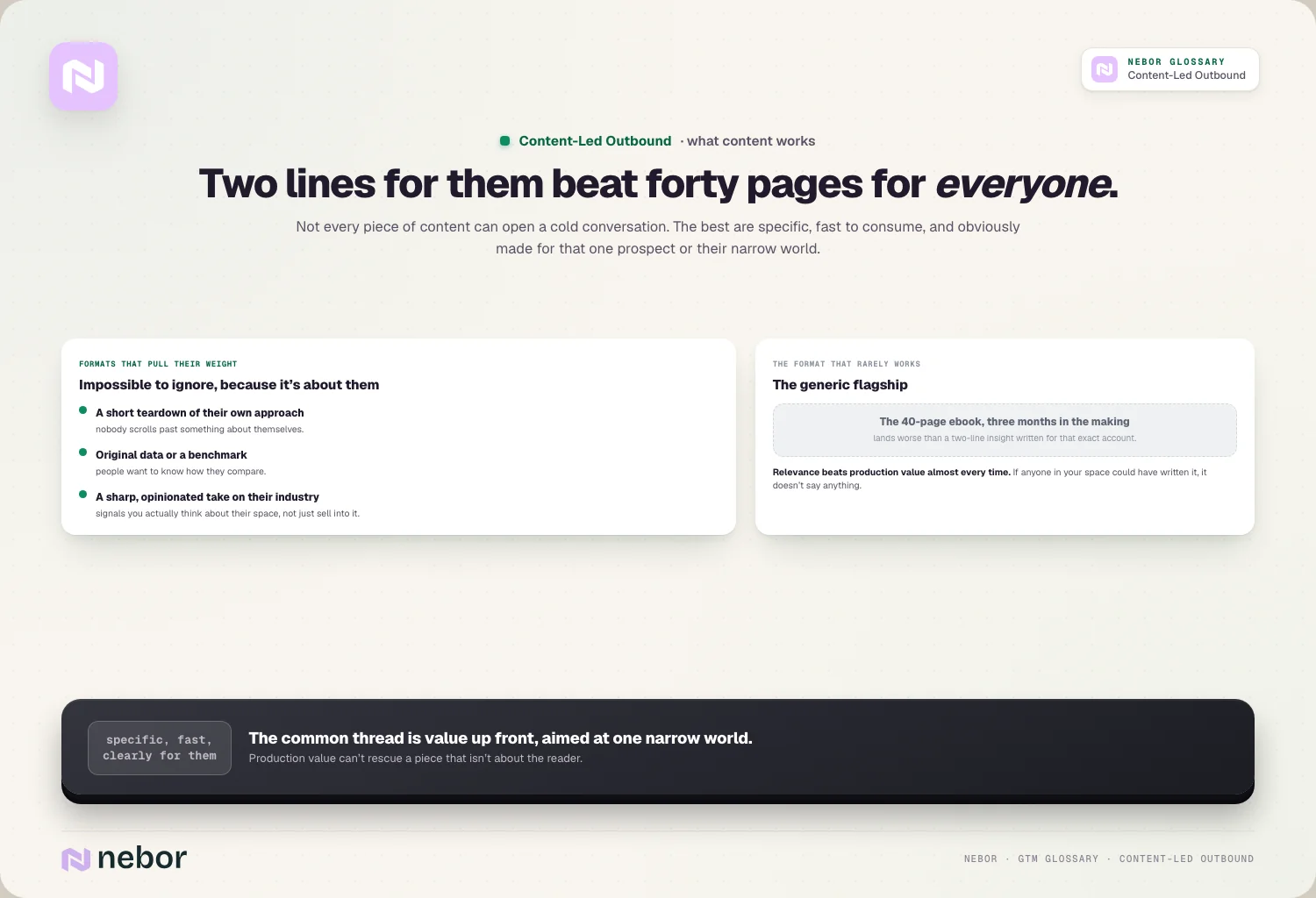
What rarely works is the flagship asset. A 40-page ebook that took marketing three months is built for everyone, which means it isn't about the person you're writing to. Gated pieces are worse still, because the reader meets a registration form before any value. That trade belongs to content syndication, where you pay to collect the details of people who chose to download. In an outbound message, the form turns your gift into a lead capture.
The raw material usually comes from your company's point of view. If you publish thought leadership with a real opinion behind it, outbound can borrow its arguments and its data. If you don't, the teardown format is the easiest place to start, since it needs expertise and a careful read rather than a research budget.
Writing an opener that offers instead of pitches
The opening message has one job, which is getting the content read. Everything that competes with that job comes out.
The subject line names what's inside, in plain words, so the reader knows it's about them before opening.
One sentence explains why you picked them, tied to something true and visible.
Two or three lines give the gist of what you found, so the message is useful even if they never click.
The piece sits behind a plain link, not an attachment. A file from a stranger looks suspicious to the reader and gets extra scrutiny on the way in: Microsoft's Defender for Office 365, for example, opens attachments in a virtual environment before delivering the message, which can hold it up. A link also lets you see whether anyone clicked through to the piece. The secure email gateway entry explains what else those filters look at.
Nothing about your product, no calendar link and no request for time. The sign-off can say plainly that no reply is needed.
Here's what that looks like for an invented example: a Mechelen company that sells help-desk software to online retailers, writing to the head of customer service at a Dutch furniture webshop.
Subject: Three questions your returns page doesn't answer
Hi Sanne, I went through your returns page and help centre the way a customer with a damaged sofa would. Three questions came up that neither one answers: who pays for collection, what happens if the pickup slot is missed, and when the refund starts. Those tend to turn into tickets. I've put the three on one page, with how two other furniture shops in the Benelux word the same answers: [link]. No need to reply if it's not useful. Joris
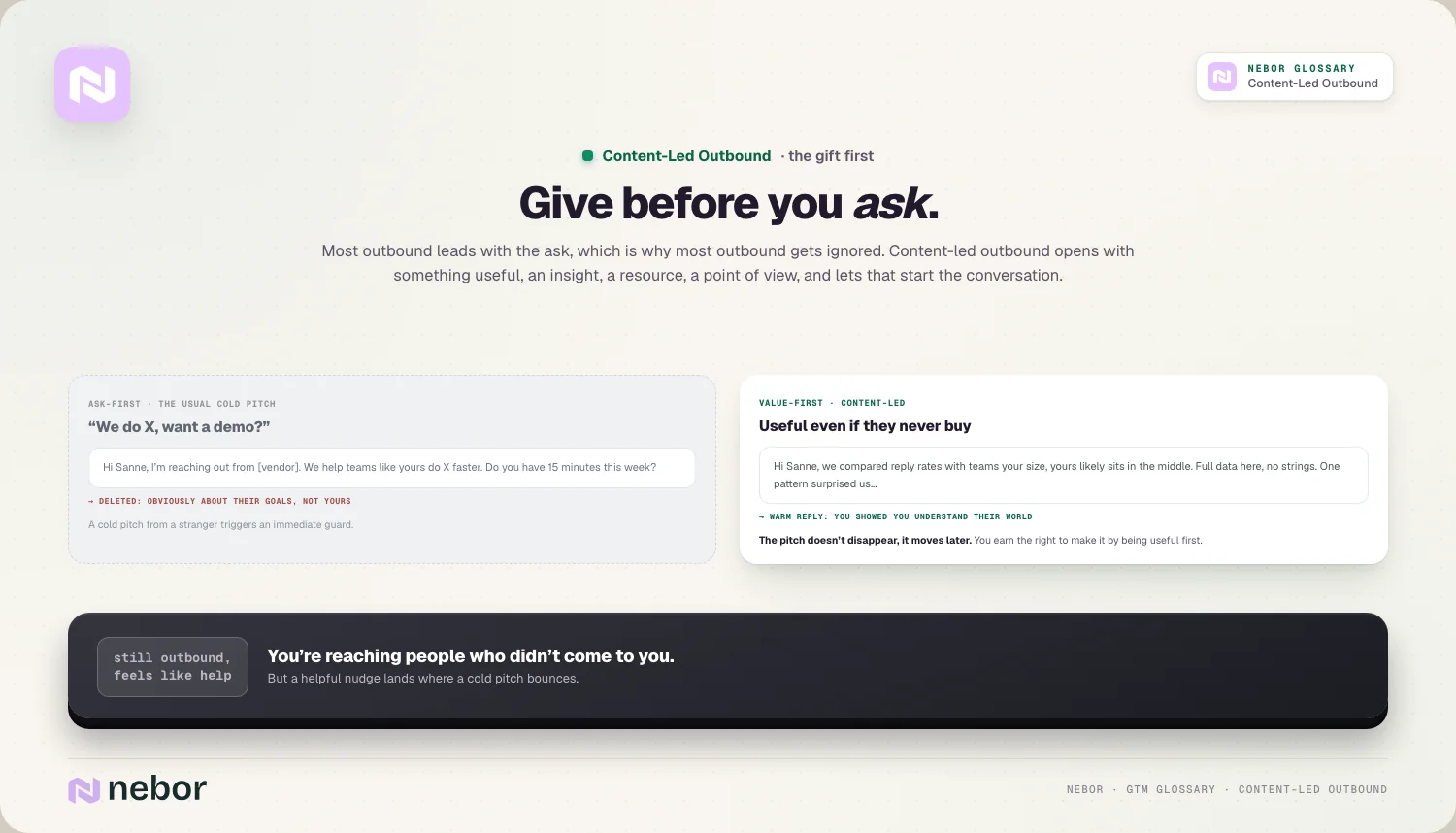
Nothing in that email mentions help-desk software. Sanne can see that Joris understands her inbox, and the page he links to is useful whether she ever buys or not. The product comes up later, if she wants it to.
The follow-up ask, and when to make it
The ask belongs in the second or third touch, a few days after the content landed. It should follow from the piece, so it reads like the next step of the same conversation rather than a switch to selling.
We think of it as a ladder with three rungs. The lowest is an opinion: "Did the collection question match what your team actually sees?" The middle is more of the same value, offered to someone else: "Happy to do the same read for your Belgian site, or send it to whoever owns the returns policy." The top rung is a short call about their situation: "If those tickets are a real cost, I can walk your team leads through how other shops cut them, 20 minutes." Each rung is easy to say yes to, and a yes on a lower one makes the next one feel natural.
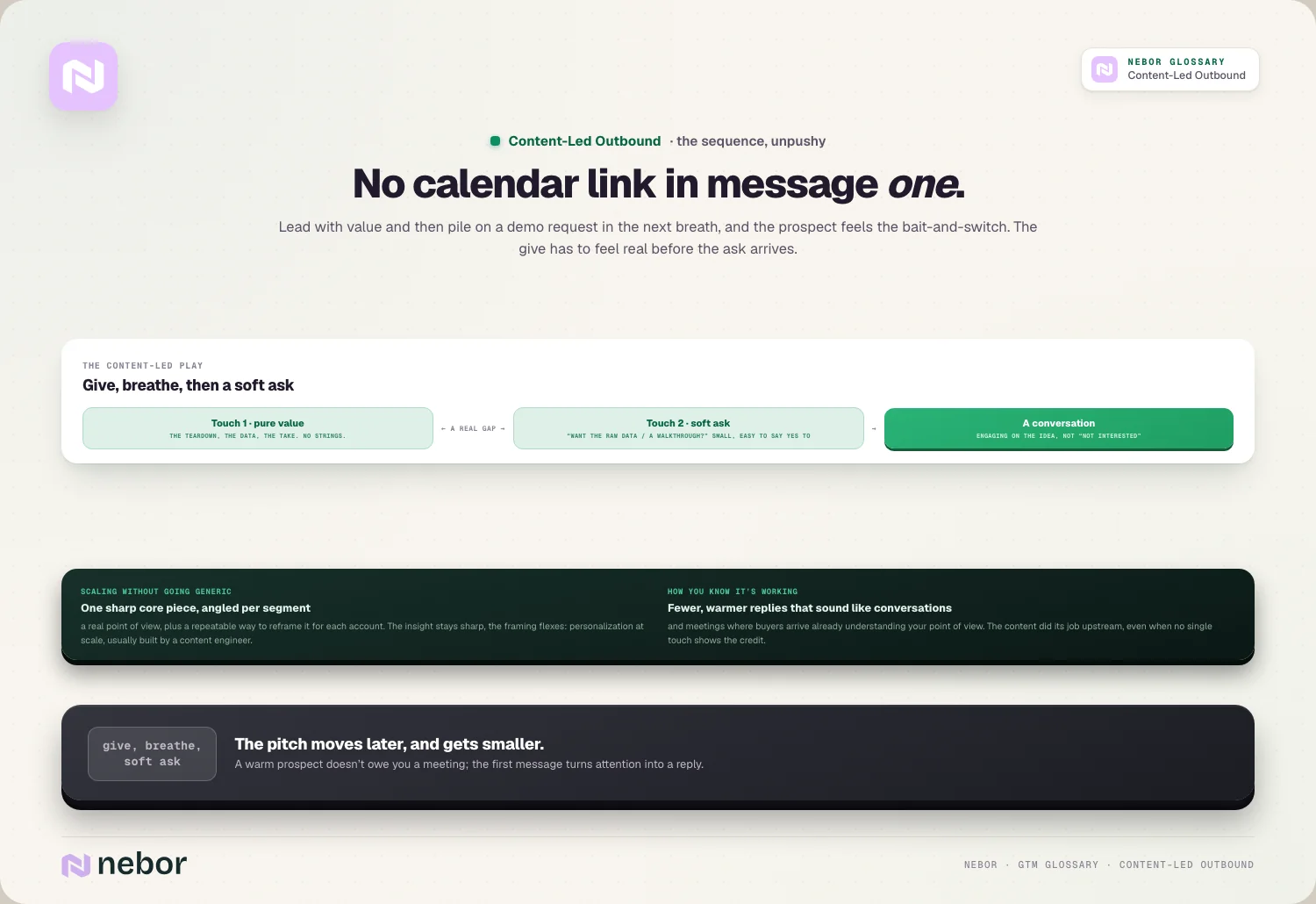
Other channels help between the touches. If the sender or the founder posts about the same topic on LinkedIn, the prospect may see it in their feed between emails, which is social selling backing up the email. The spacing and channel rules from a regular multi-channel sequence still apply. What changes is that every touch carries something useful instead of "just following up".
If the content got no reaction at all (no click, no reply), pushing harder for a meeting rarely helps. Either the piece missed or the person did. Swap in a different piece or a different contact at the account, and keep the ask where it was.
Content-led outbound is about the opener, not the warm-up
Several outbound ideas sit close to this one, and they are easier to use once you see which question each answers.
Content-led outbound answers "what do we open with?" The cold-to-warm pipeline answers "how do we make a list of accounts familiar with us before anyone writes?", and it uses content as one of its tools. Inbound-led outbound answers "who should we write to right now?", reacting to people who visited your site or showed interest first. Warm outbound covers prospects who already have some link to you.
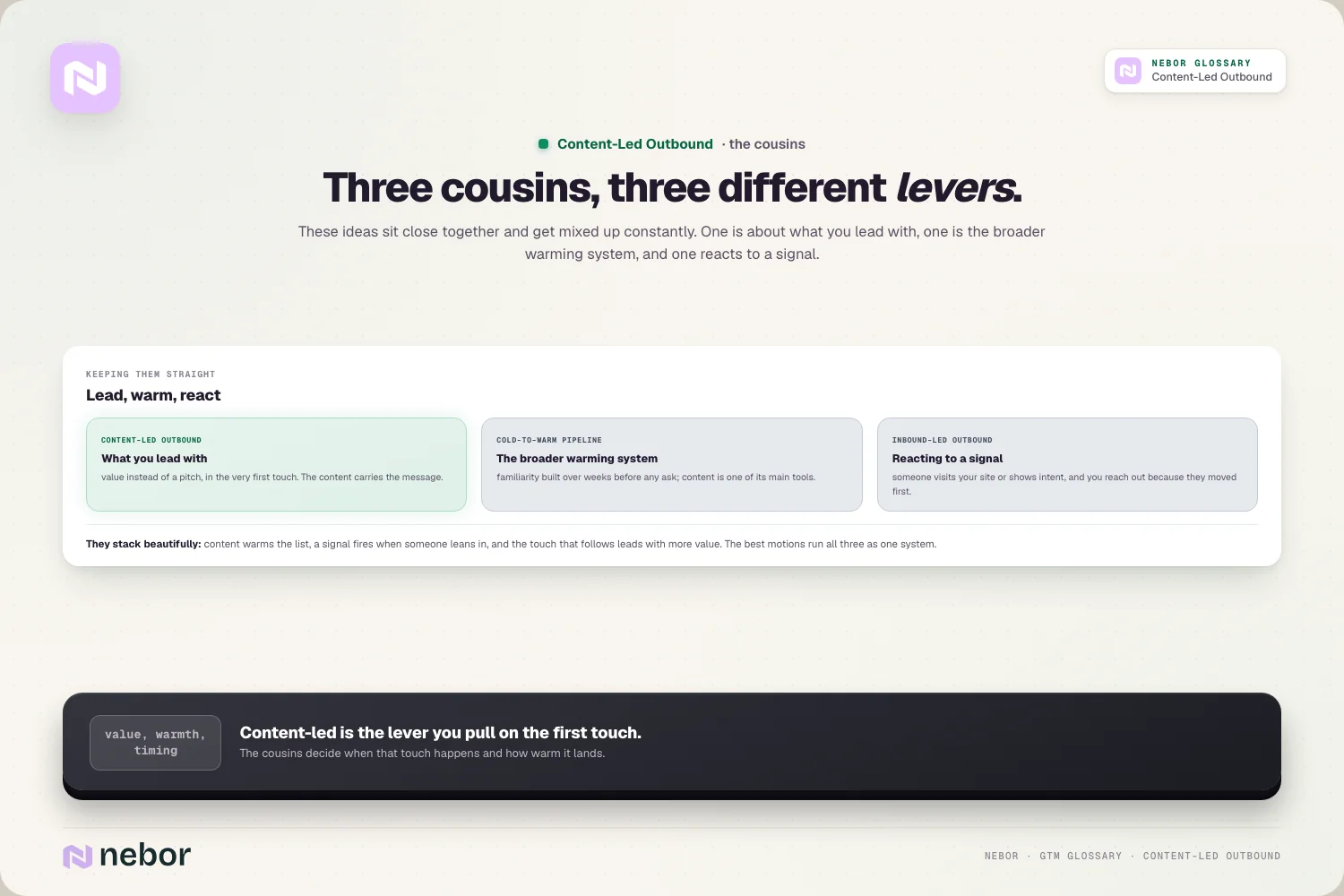
They stack well. A warmed account that shows a signal still deserves an opener with something useful in it, and a content-led touch is often what moves a cold account toward warm in the first place. Inside an account-based program, the same idea slots into one step of a coordinated play, which the entry on ABM campaign orchestration covers.
Content-led outbound also does double duty with demand generation. The teardown you wrote for one account, stripped of the company name, can become a public post that pulls in people you never targeted. Over time the outbound and the inbound feed each other.
Keeping it specific when the list gets longer
A hand-written teardown doesn't scale on its own. If one takes 45 minutes to research and write, a person doing nothing else manages about eight a day, which is six hours of work for eight messages.
The way through is a system that keeps the insight sharp and moves the variable part into a workflow. Write one strong core piece per segment, for example "the returns questions furniture shops leave unanswered". Then use a research table in a tool like Clay to pull each account's own material (their returns page, their delivery terms) and draft the account-specific paragraph. A person reads and fixes every paragraph before it goes out. At about ten minutes per account, 40 accounts take under seven hours instead of 30.
That's what personalization at scale looks like in practice, and building it is usually the work of a content engineer working alongside the reps. The core piece comes from the people with the point of view, the research table does the gathering, and the reviewer makes sure no message goes out that the account would find generic.
The wiring matters as much as the writing. A reply to a content-led email has to reach the right rep, the follow-up has to know which piece was sent, and a click on the content link should show up on the contact record. That depends on the plumbing between your CRM, research table and sequencer, and a gap there turns a thoughtful program back into cold email without anyone noticing.
Measuring content-led outbound on replies and meetings
This motion produces fewer quick "no thanks" replies and more answers that engage with the idea, so counting raw replies understates it. Four numbers tell you more:
Positive replies per 100 accounts. Anything that engages with the content or asks a question counts. Unsubscribes and "not interested" don't.
Clicks on the content link. Tag each link with campaign parameters so your analytics can attribute the visit to the campaign that sent it, or share the piece through HubSpot's documents tool, which notifies the sender when a contact views the document. A click with no reply is the cue for a different follow-up, not a sales call.
Meetings per 100 accounts, and how much context buyers bring to the first call. When they arrive having read the piece, the meeting starts further along.
Pipeline tagged with the piece that opened it. Over a quarter, this shows which content actually starts deals.
Open rates don't belong on the list, for the reasons the email sequence entry sets out. And the numbers only mean something next to a comparison. Run a pitch-led sequence to a similar slice of the same segment over the same weeks, as you would in any cold email A/B test, and compare meetings per 100 accounts. Give it longer than a pitch-led test, since the content often pays off in the second or third touch rather than the first.
In short
Content-led outbound keeps everything that makes outbound outbound (you choose the accounts, you move first) and changes what the prospect gets in the first message. The shift sounds small. In practice it decides whether you're read as one more vendor or as someone who already did something useful for them.
Most of the effort sits in the content and the system around it. A piece about the reader's own company beats a polished asset about everyone, the ask can wait a touch or two, and the comparison against a pitch-led list tells you whether it's paying off. Teams that skip the content work end up sending pitches with links attached.
Nebor builds the research tables, the review step and the sequences behind content-led outbound on the client's Clay account and sending tools, then passes them to the people who write and send, so each new segment only needs a new core piece.
Frequently asked questions
Who should own content-led outbound, marketing or sales?
One person should own the whole loop, from the point of view in the content to the angle in each message and the follow-up after a reply. When marketing makes content and sales sends outreach with nobody in between, reps end up digging through the library for anything vaguely relevant. A content engineer working next to the reps, or a senior rep with time set aside, usually fills that seat best.
Is content-led outbound the same as content marketing?
No. Content marketing publishes for an audience and waits for people to find it. Content-led outbound picks named accounts and sends them a piece directly, usually one written or adapted for that company. The two share material, and a teardown written for one prospect can later become a public article, but the targeting, the timing and the follow-up are what make it outbound.
Do you need a content team to run content-led outbound?
Not to start. A rep or founder who knows the market can write a sharp teardown of a prospect's pricing page or onboarding emails in under an hour, with no design work. A content team or a content engineer becomes useful once you want the same quality across several segments and dozens of accounts a week, because that needs core pieces, research workflows and a review step.
Can AI write the content for content-led outbound?
AI is good at the gathering and the first draft: pulling a prospect's public pages, summarising them and drafting the account-specific paragraph. It is weak at the part that makes the piece worth reading, which is an opinion grounded in real experience of the field. Keep a person writing the core argument and checking every account paragraph, or the output drifts toward the generic message the motion is meant to replace.
Does content-led outbound work on LinkedIn as well as email?
Yes, with some changes. A LinkedIn message should be shorter than an email, so it carries the one most interesting finding and a link rather than the full summary. Many teams send the content by email and use LinkedIn for a lighter second touch or a related post. Connection requests are a poor place for content, since a pitch-free note with a link still reads as a stranger's ask.
How many pieces of content do you need before you start?
One per segment is enough to begin. Pick the segment you know best, write a core piece that would interest any company in it, and plan the account-specific paragraph you'll add for each recipient. Add a second piece once you see which questions the replies raise, because those questions tell you what the next piece should answer. A library of ten generic assets helps far less than one sharp, narrow one.
Is content-led outbound slower than a pitch-led sequence?
Often, yes. The value has to land before the ask does, so meetings tend to come from the second or third touch rather than the first, and some prospects reply weeks later when the problem becomes urgent. A team that judges outbound only on same-week replies can stop the motion just before it pays off. Compare it against a pitch-led list over the same period instead.
Can you use customer stories or client data as the opening content?
Only with permission and only in a form the customer agreed to. A named case study the client signed off is fine to share. Anonymised patterns across many clients, such as how long a typical implementation takes, are usually safer and often more interesting. Never send one customer's numbers to a competitor, even disguised, because a niche market makes the source easy to guess.
What makes a content-led email read like a disguised pitch?
Usually one of four things: the linked piece is a product brochure, the content would fit any company in the market, the email asks for a meeting in the same breath as the gift, or the piece leads nowhere and the follow-up jumps straight to a demo. Any one of them tells the reader the gift was bait, and the trust you hoped to build goes with it.
Share this post
Outbound
Content
Glossary
Related glossary items
Understanding the core GTM concepts



Ready to build your pipeline