

In this post:
Sometimes a buyer lands in your CRM already convinced, and you have no idea why. They've clearly researched you, they know what you do, and yet none of that research shows up anywhere you can see.
That hidden stretch of the journey is the dark funnel, all the buying activity that happens where you can't track it. It's the conversations, the content, and the influence that shape a purchase but never reach your analytics.
For most companies it's far bigger than the part of the funnel they can measure, and learning to respect it changes how you read everything else.
TL;DR
The dark funnel is the part of the buyer's journey you can't see or attribute. Most of the real research and influence now happens in private channels, communities, and word of mouth, long before anyone fills in a form.
This wrecks your attribution from the inside. Your tools give all the credit to the last visible click, usually branded search or a direct visit, while the things that actually drove the demand stay invisible. If you trust that data, you'll defund the channels that are really working.
You can't track the dark funnel, but you can stop pretending it isn't there. Ask buyers how they found you, watch overall trends instead of single touches, and keep investing in the dark channels even when you can't prove their exact return.
What is the dark funnel, and why is it bigger than the funnel you can see?
The dark funnel is the collection of touchpoints and influences that move a buyer toward a decision without ever being tracked. It's everything that happens off your owned, measurable channels.
Your visible funnel is the tip of an iceberg, the form fills, the clicks, the tracked sessions. The dark funnel is the much bigger mass underneath, the conversations and research you never see but that do most of the actual convincing.
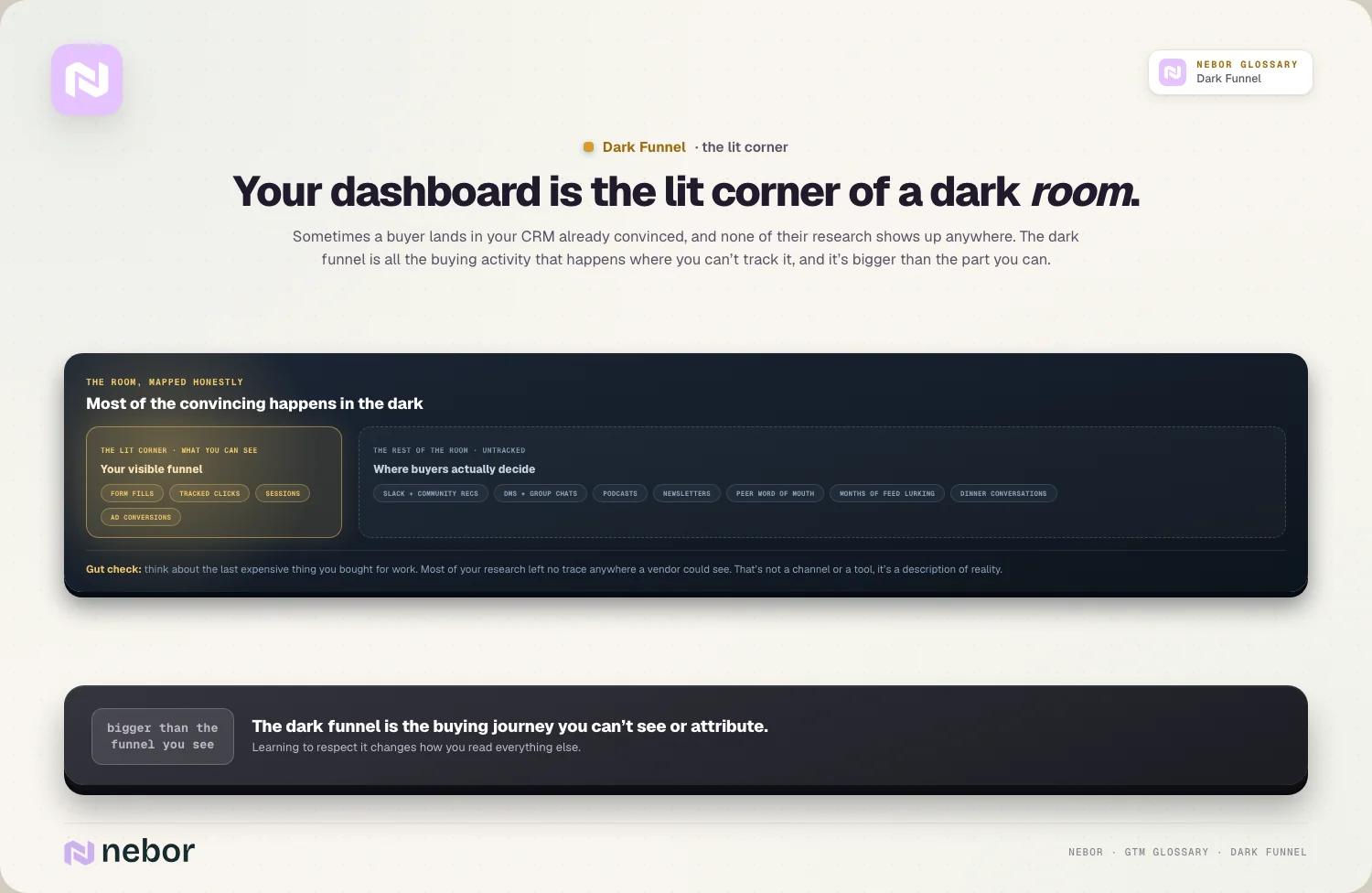
It isn't a channel you can buy or a tool you can install. It's a description of reality, the simple fact that most of how people decide to buy happens out of your view.
One way we get clients to feel how big it is comes from a simple gut check. Think about the last expensive thing you bought for work. Most of the research you did, the Slack questions, the podcast you half-listened to, the peer you asked, left no trace anywhere a vendor could see.
Why does so much of your buyer's journey now happen where you can't track it?
Buying behavior changed, and tracking didn't keep up. People don't research by clicking ads and filling forms anymore, they ask peers, lurk in communities, listen to podcasts, and read threads, mostly without ever identifying themselves.
A lot of this is private by design. A recommendation in a Slack group, a link shared in a DM, or a conversation at a dinner leaves no trace in your analytics. This is often called dark social, and it makes up a big part of the dark funnel. Even bought intent data only catches a sliver of this private research.
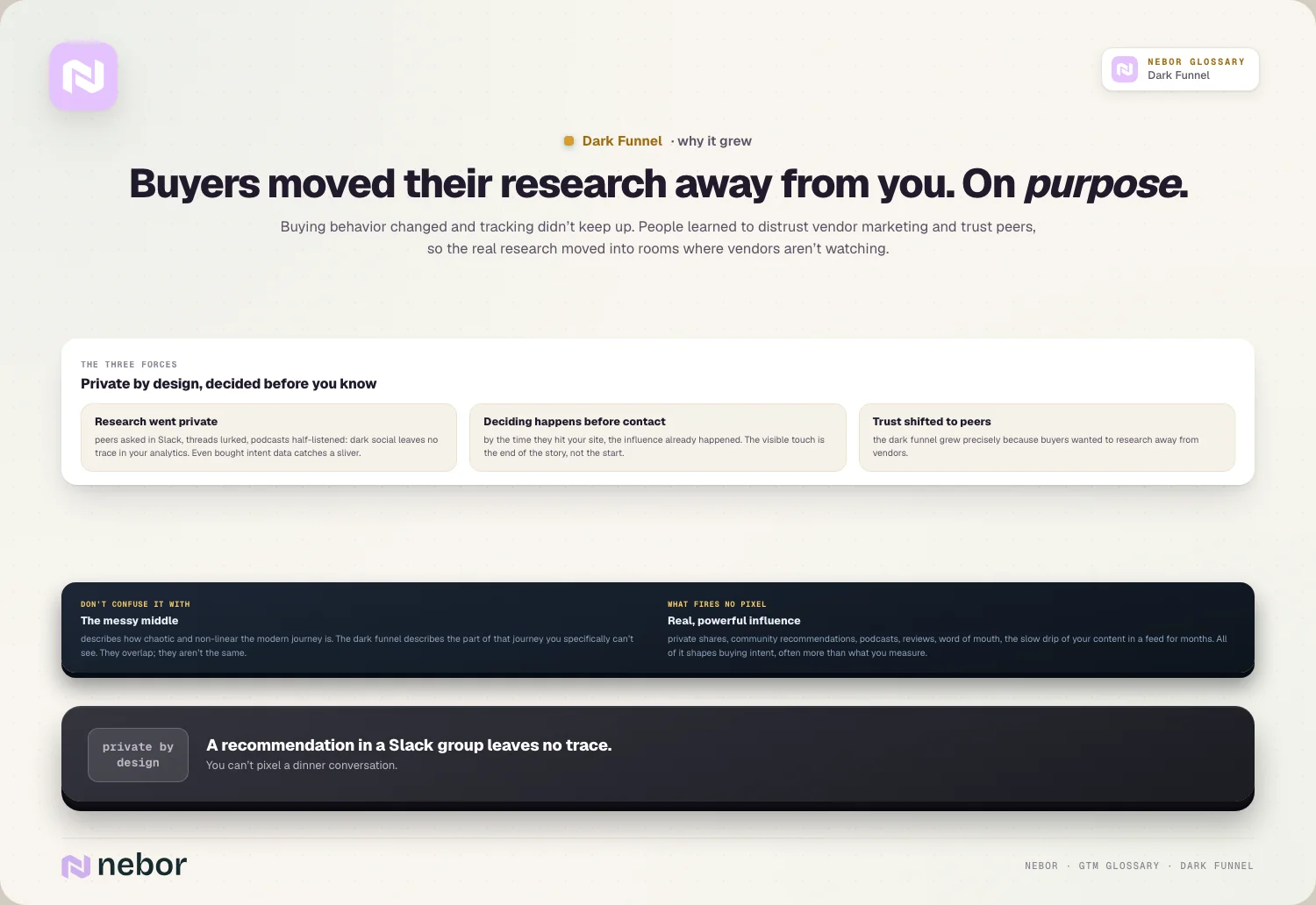
On top of that, buyers do most of their deciding before they ever talk to you. By the time they show up on your site, the influence already happened somewhere you couldn't watch, and the visible touch is the end of the story instead of the start.
There's a trust shift behind all of this too. Buyers learned to distrust vendor marketing and to trust peers, so they moved their real research into the rooms where vendors aren't watching. The dark funnel grew precisely because people wanted to research away from you.
What's actually hiding inside your company's dark funnel right now?
We like naming what's in there, because it's a lot more than vague untracked traffic. The dark funnel is full of real, powerful influence.
It includes private shares and conversations, the dark social layer of DMs and group chats. It includes communities and Slack groups where buyers ask peers for recommendations, and podcasts and newsletters where they soak up opinions without clicking anything.
It also includes word of mouth, review sites, and the slow drip of someone seeing your content in their feed for months without ever engaging.
None of that trips a tracking pixel you can tie to a deal. But all of it shapes buying intent, often far more than the channels you can measure.
The dark funnel also gets mixed up with a related idea, the messy middle. The messy middle describes how chaotic and non-linear the modern buying journey is. The dark funnel describes the part of that journey you specifically can't see. They overlap, but they're not the same thing.
Why does your attribution keep crediting the wrong channel entirely?
Here's the practical problem with all of this. Your attribution tools can only credit what they can see, so they hand the credit to the last visible click and ignore everything that happened in the dark.
Imagine someone hears about you on a podcast, sees a few LinkedIn posts, gets a recommendation in a Slack group, then finally searches your name and visits directly. Your multi-touch attribution records direct or branded search as the source, and the podcast, the posts, and the recommendation all get zero credit.
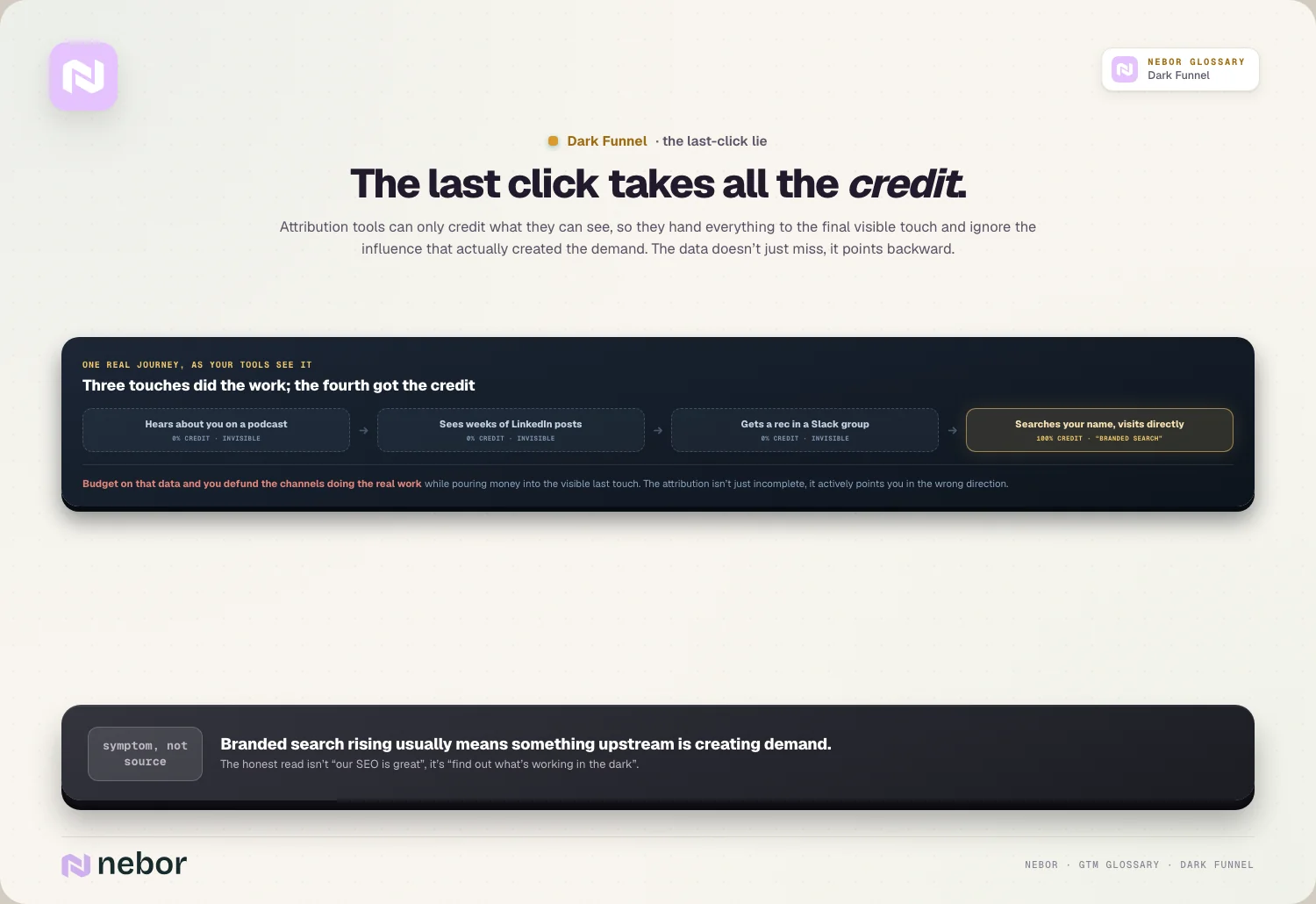
If you make budget decisions on that data, you'll pour money into the visible last touch and starve the dark-funnel channels that created the demand. The attribution isn't just incomplete, it actively points you in the wrong direction.
This is what makes the dark funnel dangerous instead of just frustrating. A blind spot you know about is manageable, while a blind spot dressed up as a confident dashboard steers you toward exactly the wrong calls.
What does a rising branded search number really tell you about demand?
One of the sneakiest effects of the dark funnel shows up in your branded search and direct traffic. Those numbers climb, your reports light up, and it's tempting to credit your SEO or your brand team.
But branded search is usually a symptom rather than a source. People search your name because something in the dark funnel told them to, a podcast, a peer, a post they saw weeks ago. The search is where the demand surfaces after it was created somewhere darker.
So if you see branded search rising while you can't quite explain it, that's often the dark funnel working. The honest read isn't "our SEO is great," it's "something upstream is creating demand, and I should find out what."
How do you go about measuring a funnel you can't see into at all?
You can't track the dark funnel directly, but that doesn't leave you helpless. The trick is to change how you measure, instead of trying to see the unseeable.
The most useful tool we've found is self-reported attribution, which simply means asking buyers how they heard about you, on forms and in conversations. It's not perfect, but it surfaces the podcasts, communities, and referrals your tracking misses entirely.
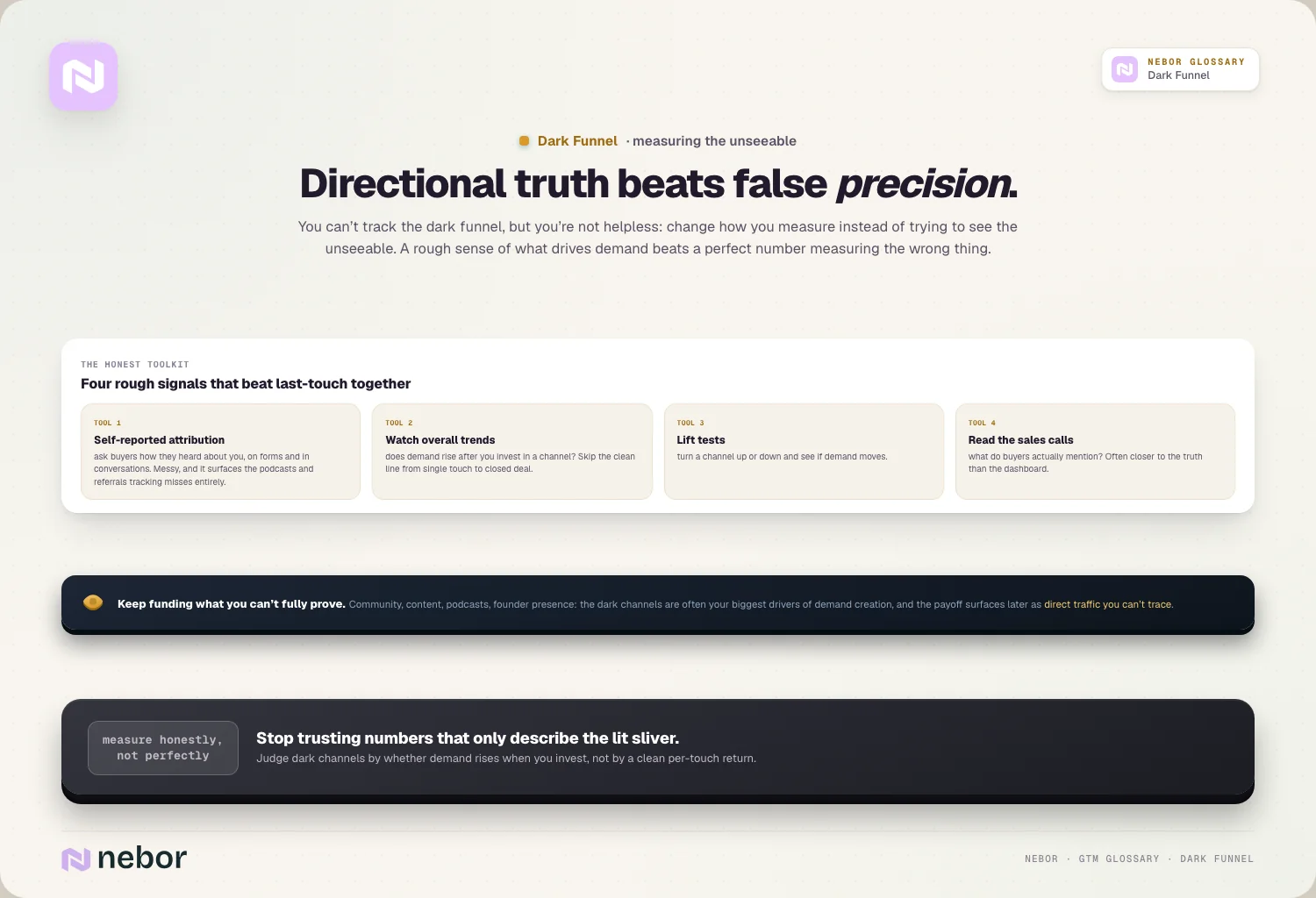
Pair that with watching overall trends, like whether demand rises after you invest in a channel, rather than chasing a clean line from a single touch to a closed deal.
The mindset shift is to accept directional truth over false precision. A rough sense of what's really driving demand beats a perfectly tracked number that's measuring the wrong thing.
There are other rough signals worth watching too. You can try lift tests, turning a channel up or down and seeing if demand moves. You can read your sales calls for what buyers mention on their own. None of these are exact, but together they paint a far truer picture than last-touch ever will.
Why should you keep investing in the dark funnel even when you can't prove it?
The hardest part is spending money on things you can't fully measure, but that's exactly what the dark funnel asks of you. The channels that live in it, like community, content, podcasts, and a strong founder presence, are often your biggest drivers of demand generation.
This is really about creating demand rather than just capturing it, which is the heart of demand capture versus demand creation. The dark funnel is where demand gets created, through thought leadership and trust built over time, even though the payoff shows up later as direct traffic you can't trace.
The same effect makes your outbound easier too. A prospect who absorbed your point of view in the dark funnel is far warmer when you reach out, which is part of why content-led outbound works so well. You're not building recognition from scratch, because the dark funnel already did some of that for you.
How do you feed your dark funnel on purpose, week after week?
You can't track the dark funnel, but you can absolutely feed it, and the best teams do this deliberately. The goal is to put useful, memorable points of view into the rooms where your buyers already research.
That means showing up where the private conversations happen. Be active in the communities your buyers trust. Get your founder on the podcasts they listen to. Post the kind of opinionated content that gets screenshotted into a DM or shared in a Slack group.
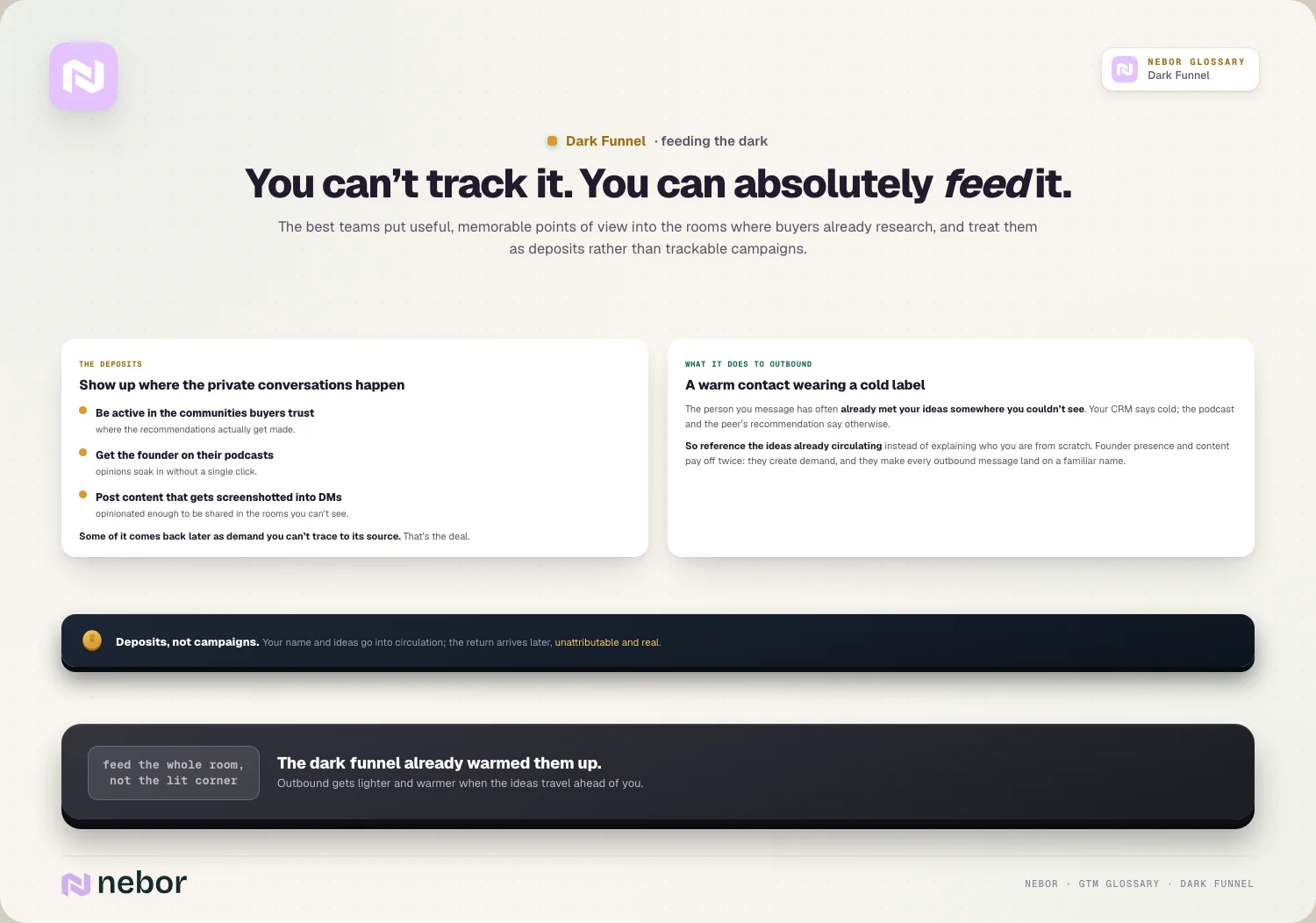
The trick is to stop thinking of these as trackable campaigns and start thinking of them as deposits. You're putting your name and your ideas into circulation, knowing some of it comes back later as demand you can't trace to its source.
How does the dark funnel change the way you build your outbound motion?
The dark funnel doesn't just affect your reporting, it changes who's really on the other end of your cold outreach. The person you message has often already met your ideas somewhere you couldn't see.
That's a gift if you use it. A prospect who absorbed your point of view through a podcast or a peer's recommendation isn't really cold, even though your CRM says they are. They're a warm contact wearing a cold label, and your outreach should treat them that way.
So instead of opening with a full explanation of who you are, you can reference the very ideas circulating in the dark funnel and meet the buyer where they already are. This is part of why a strong dark funnel makes your whole outbound motion lighter and warmer.
It also explains why founder presence and content pay off twice. The first time, they feed the dark funnel and create demand. The second time, they make every outbound message easier, because the name is already familiar before you ever hit send.
Why does the dark funnel matter more for some companies than others?
The dark funnel exists for everyone, but its weight isn't equal across businesses, and knowing where you stand helps you decide how much to care. The bigger and more considered the purchase, the bigger the dark funnel tends to be.
If you sell something expensive that a buying committee researches for months, expect a huge dark funnel, because those buyers do most of their digging privately before they ever talk to you. Long sales cycles, high prices, and lots of peer input all push more of the journey into the dark.
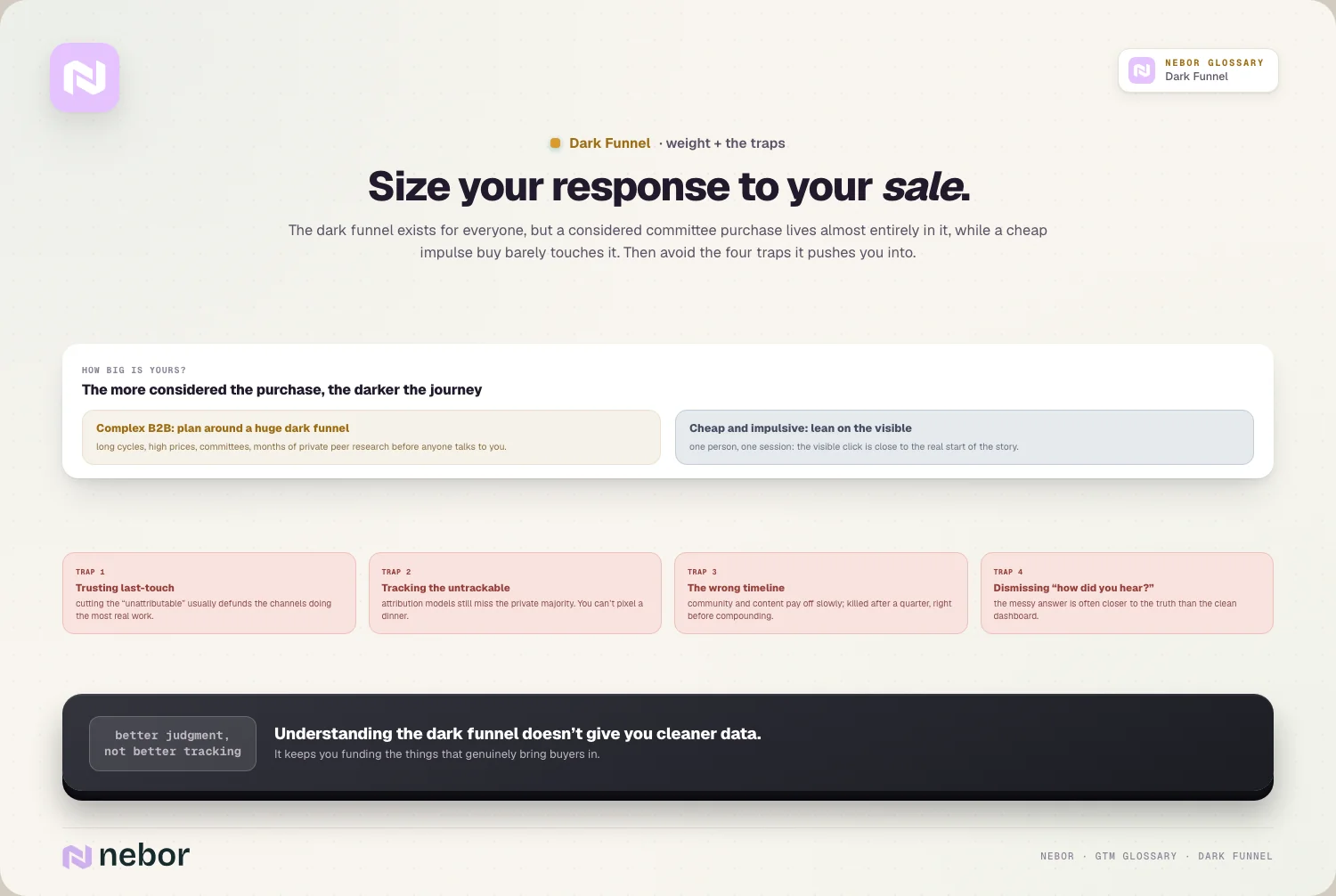
If you sell something cheap and impulsive that one person buys in a single session, the dark funnel is smaller, because there's just less private research happening. The visible click is closer to the real start of the story.
The takeaway is to size your response to your reality. A complex B2B sale should plan around a large dark funnel from day one. A simple, fast purchase can lean more on the visible channels without getting fooled.
What mistakes does the dark funnel push you into without you noticing?
The dark funnel leads teams into a few bad decisions without them noticing. The biggest is trusting last-touch attribution and cutting anything that looks unattributable, which usually means defunding the channels doing the most real work.
Another is trying to track the untrackable, pouring effort into attribution models that still miss the private, invisible majority of the journey. You can't pixel a dinner conversation, and pretending you can just wastes time.
A third is judging dark-funnel channels on the wrong timeline. Community and content pay off slowly, and if you kill them after a quarter because they didn't show a clean return, you cut them right before they would have compounded.
The fourth is dismissing how-did-you-hear-about-us answers because they're messy and qualitative. That messy answer is often closer to the truth than your clean dashboard, and ignoring it keeps you optimizing the wrong things.
Why understanding the dark funnel changes how you spend your budget
None of this is an excuse to stop measuring. It's a reason to measure honestly, and to stop trusting numbers that only describe the thin, visible sliver of the journey.
Once you accept that most of your buyer's journey happens in the dark, your spending starts to change. You stop pulling budget from the channels that don't show up cleanly in reports, and you start judging them by whether overall demand goes up when you invest in them.
That's the real value of understanding the dark funnel. It doesn't give you better tracking, it gives you better judgment, and judgment is what keeps you funding the things that genuinely bring buyers in.
The teams that win in the next few years won't be the ones with the cleanest dashboards. They'll be the ones brave enough to keep investing in the channels they can't perfectly measure, because they understood that the dark funnel is where the real buying happens.
Once you accept that, you stop chasing false precision and start building demand where your buyers really spend their time.
The blunt takeaway from all of this goes like so. Your dashboard is only the small lit corner of your funnel, and the rest of the room is full of conversations you'll never see.
The sooner you stop optimizing for the lit corner and start feeding the whole room, the sooner your demand starts to grow in ways your competitors can't even explain, let alone copy.
Share this post
Intent
Marketing
Glossary
Related glossary items
Understanding the core GTM concepts

Ready to build your pipeline











