
In this post:
The traditional sales funnel ends the moment a deal closes, as if the story is over once someone signs. For a recurring revenue business, that's almost backwards, because the signature is where the real money begins, and most of a customer's lifetime value gets earned in the years after the funnel says the job is done.
The bowtie funnel exists to fix that blind spot. It keeps the familiar funnel that narrows toward a sale, then adds a second half that widens back out through onboarding, retention, and expansion, so the whole shape looks like a bowtie and the model finally accounts for where recurring revenue truly comes from.
The bowtie funnel is a revenue model, popularized by Winning by Design, that extends the traditional funnel past the point of sale to include the post-sale stages of onboarding, retention, and expansion. It reframes revenue as one continuous system spanning the entire customer lifecycle instead of ending at the close.
The reason it caught on is that subscription businesses live or die on what happens after the sale. In a recurring model, retention and expansion drive most of the profit, so a funnel that stops at the purchase is measuring only a fraction of the business, which is exactly the gap the bowtie was designed to close.
TL;DR
The bowtie funnel extends the traditional sales funnel past the point of sale, adding onboarding, retention, and expansion so the shape widens out again after the close and forms a bowtie.
It exists because in a recurring revenue business, two of the three growth engines, retention and expansion, happen entirely outside the old funnel, which stops at the purchase and misses most of the value.
It reframes revenue as one continuous lifecycle spanning acquisition through expansion, putting customer success on equal footing with sales instead of treating the sale as the finish line.
Its core principle is that growth comes from helping customers achieve their desired outcome, so keeping and growing customers becomes as central to the model as winning them.
What the bowtie funnel is exactly and why it has that distinctive shape
The bowtie gets its name from its shape, which is two funnels joined at their narrow points. The left funnel is the familiar one that narrows as prospects move from awareness down to a purchase, and the right funnel mirrors it, widening back out as a new customer grows in value over time.
The narrow center where the two meet is the moment of sale. That point, once treated as the end of the journey, becomes the middle of the bowtie, which visually makes the argument that closing a deal is a milestone in a much longer relationship instead of the destination itself.
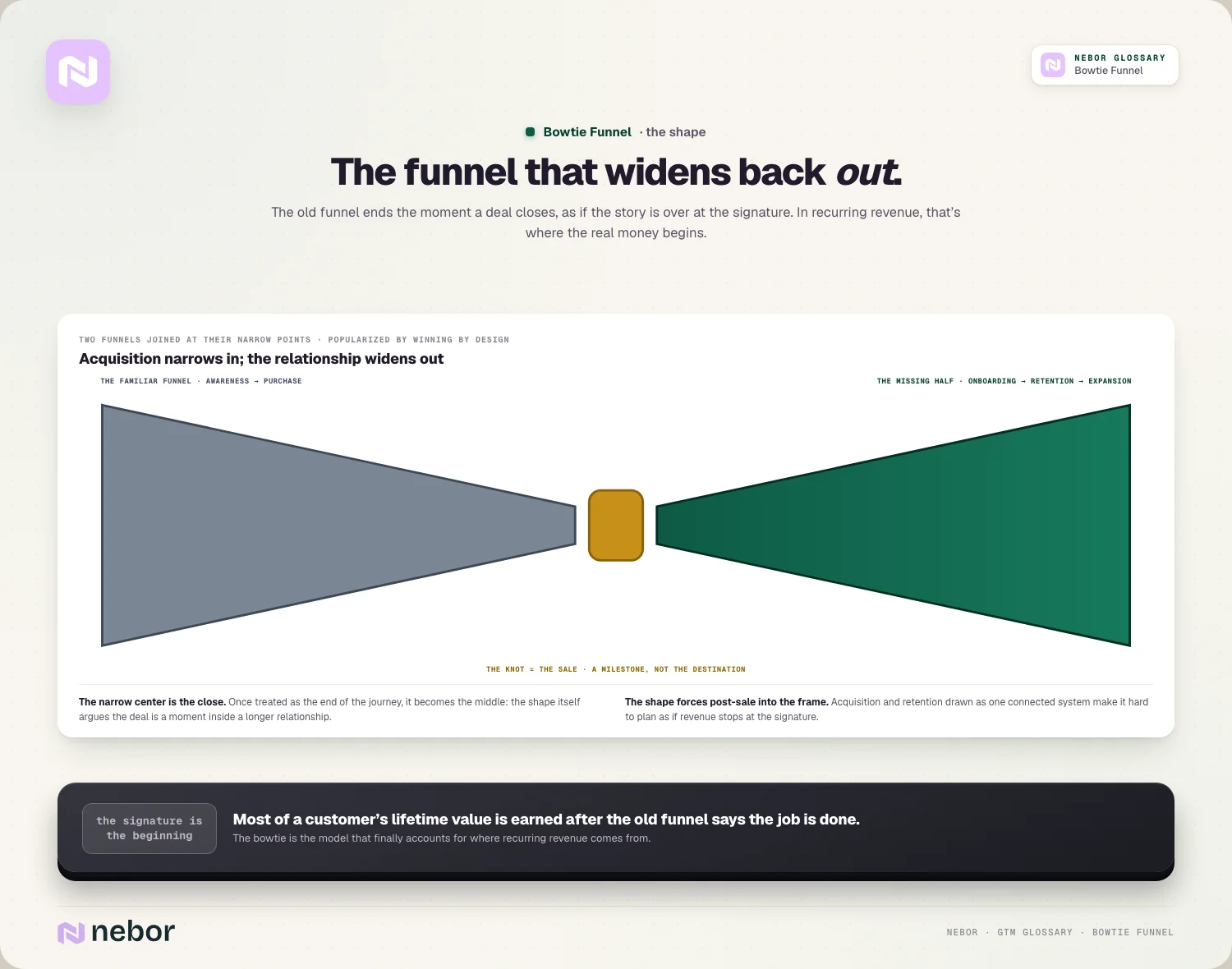
This shape is the whole point, because it forces post-sale into the same frame as pre-sale. By drawing acquisition and retention as one connected system instead of two separate concerns, the bowtie makes it hard to plan the business as if revenue stops at the signature.
Why the traditional funnel misses two of the three engines of growth
The core critique behind the bowtie is that the traditional funnel only sees a third of how a subscription business grows. There are three engines of recurring revenue growth, new business, retention, and expansion, and two of those three happen entirely after the point where the old funnel ends.
This means the classic funnel is blind to where most recurring revenue and profit originate. Because renewals, upsells, and the compounding value of kept customers all occur past the sale, a model that stops at the close leaves the majority of the revenue engine outside its view, which is a serious blind spot.
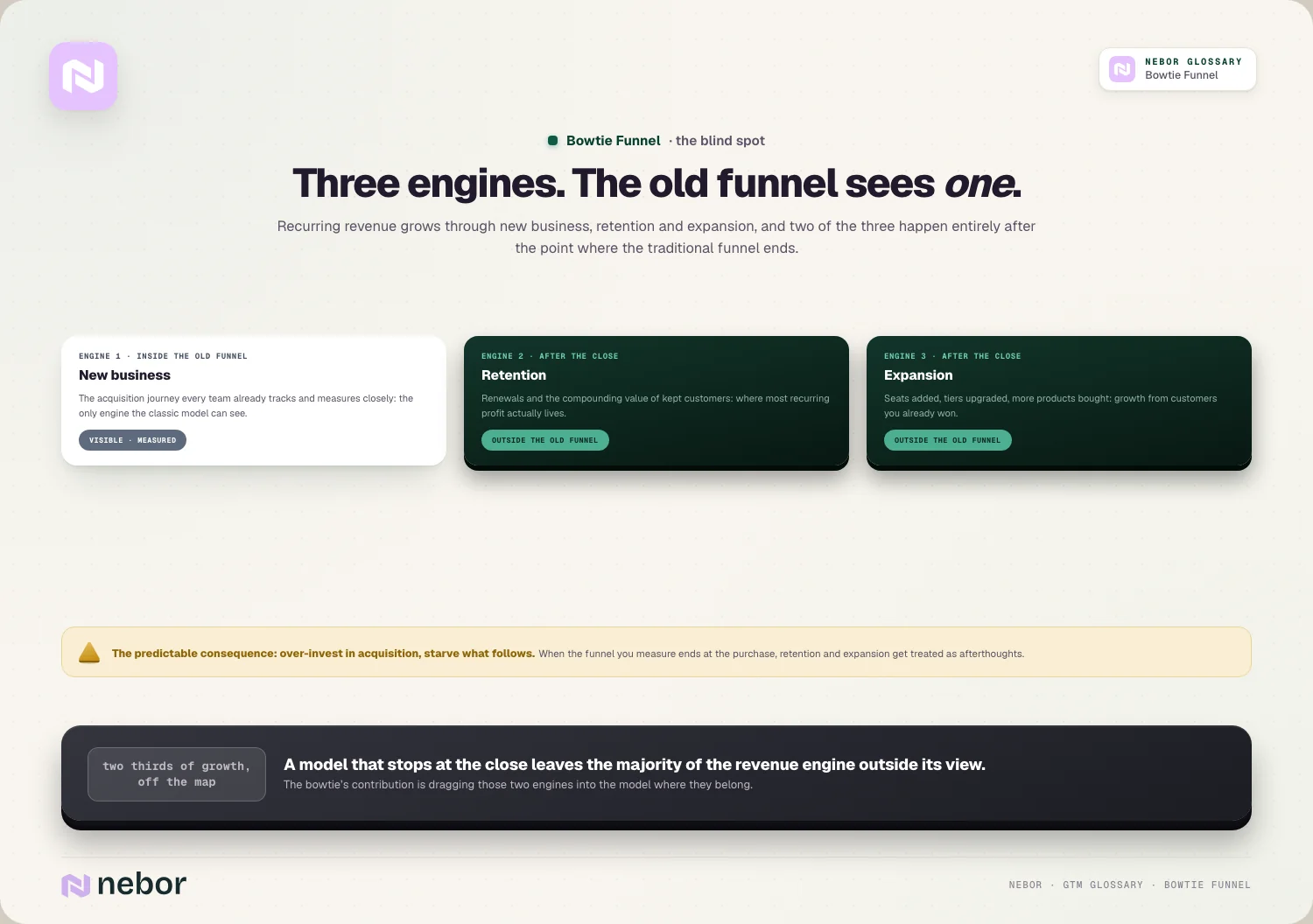
The consequence in practice is that companies over-invest in acquisition and under-invest in what follows. When the funnel you measure ends at the purchase, retention and expansion get treated as afterthoughts, so the bowtie's real contribution is dragging those two engines into the model where they belong.
The stages on each side of the bowtie from awareness to expansion
The left side of the bowtie is the traditional funnel, moving a prospect from awareness through interest, evaluation, and finally a purchase decision. This half is well understood, because it's the acquisition journey every sales and marketing team already tracks, ending at the closed deal in the center.
The right side is where the bowtie adds what the old model lacked. After the sale comes onboarding and adoption, where customer success guides the new customer to real usage and value, because a customer who never adopts will never renew no matter how well they were sold.
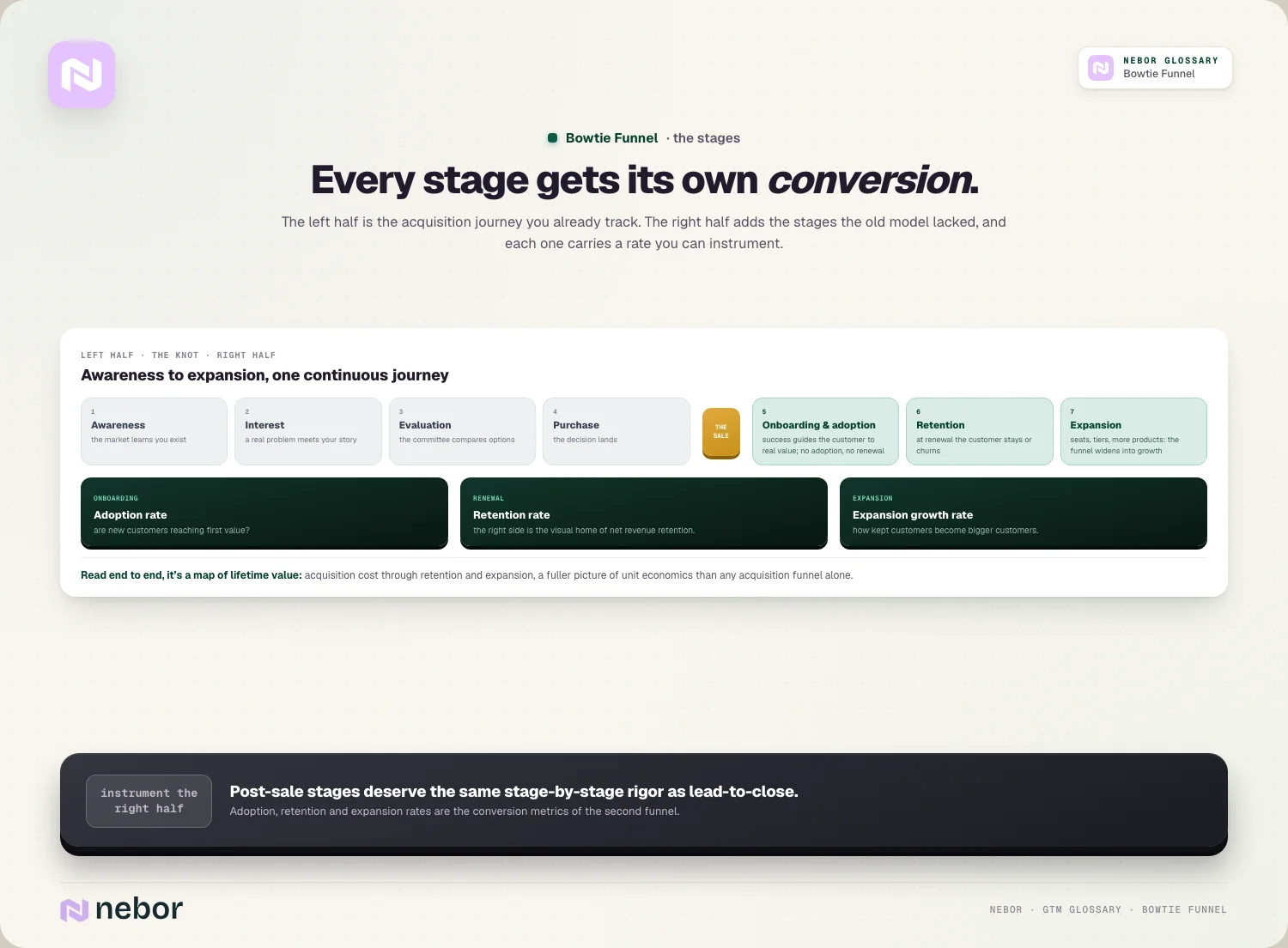
Beyond adoption come retention and expansion as the final stages. At renewal a customer either stays or churns, and happy customers expand by adding seats, upgrading tiers, or buying more, which is where expansion revenue comes from and where the right side of the bowtie widens into real growth.
Why the bowtie puts customer success on equal footing with sales
A quiet but important effect of the bowtie is that it raises customer success to the same level as sales. Because the model gives the post-sale stages their own place in the funnel, the team responsible for adoption, retention, and expansion becomes a revenue driver instead of a support cost.
This reframing changes how a company organizes and invests. When the funnel formally includes onboarding and renewal, it's obvious that customer success needs real resources and clear metrics, so the bowtie helps justify treating post-sale as a growth function instead of a reactive help desk.
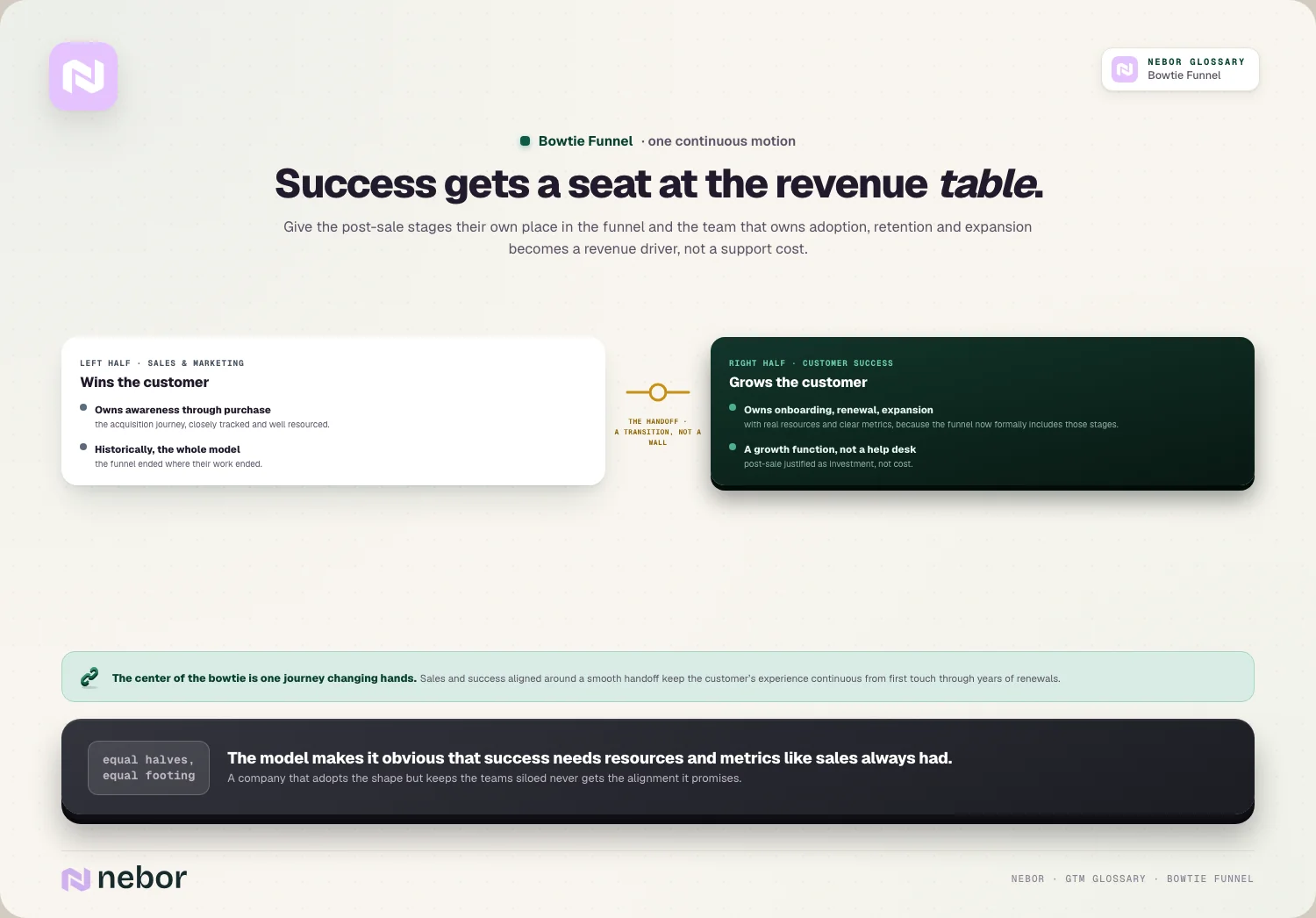
It also forces sales and success to work as one continuous motion. The handoff at the center of the bowtie is a transition within one journey instead of a wall between two teams, so the model encourages the alignment that keeps a customer's experience smooth from first touch through years of renewals.
How the bowtie funnel connects to your recurring revenue metrics
The bowtie isn't just a diagram, it maps directly onto the metrics that define a subscription business. The right side of the funnel is essentially the visual home of net revenue retention, because retention and expansion against churn are exactly what that metric measures.
Each post-sale stage has its own conversion to track, just like the pre-sale stages. Onboarding has an adoption rate, renewal has a retention rate, and expansion has its own growth rate, so the bowtie gives you a stage-by-stage view of the post-sale journey instead of a single blended conversion rate.
Read end to end, the bowtie is a map of how a customer becomes lifetime value. It traces the whole path from acquisition cost through retention and expansion, which is why it pairs naturally with customer lifetime value and gives a fuller picture of unit economics than an acquisition funnel alone ever could.
Why the first principle of the bowtie changes how teams behave
Underneath the shape, the bowtie carries a philosophy that changes behavior, which is that growth comes from helping customers achieve their desired outcome. Rather than treating the sale as the win, the model says the win is the customer succeeding, because that success is what drives renewals and expansion.
This principle reorients the whole go-to-market toward impact instead of transactions. When you believe growth flows from customer outcomes, you sell more honestly, onboard more carefully, and invest in success, because each of those choices feeds the retention and expansion the right side of the bowtie depends on.
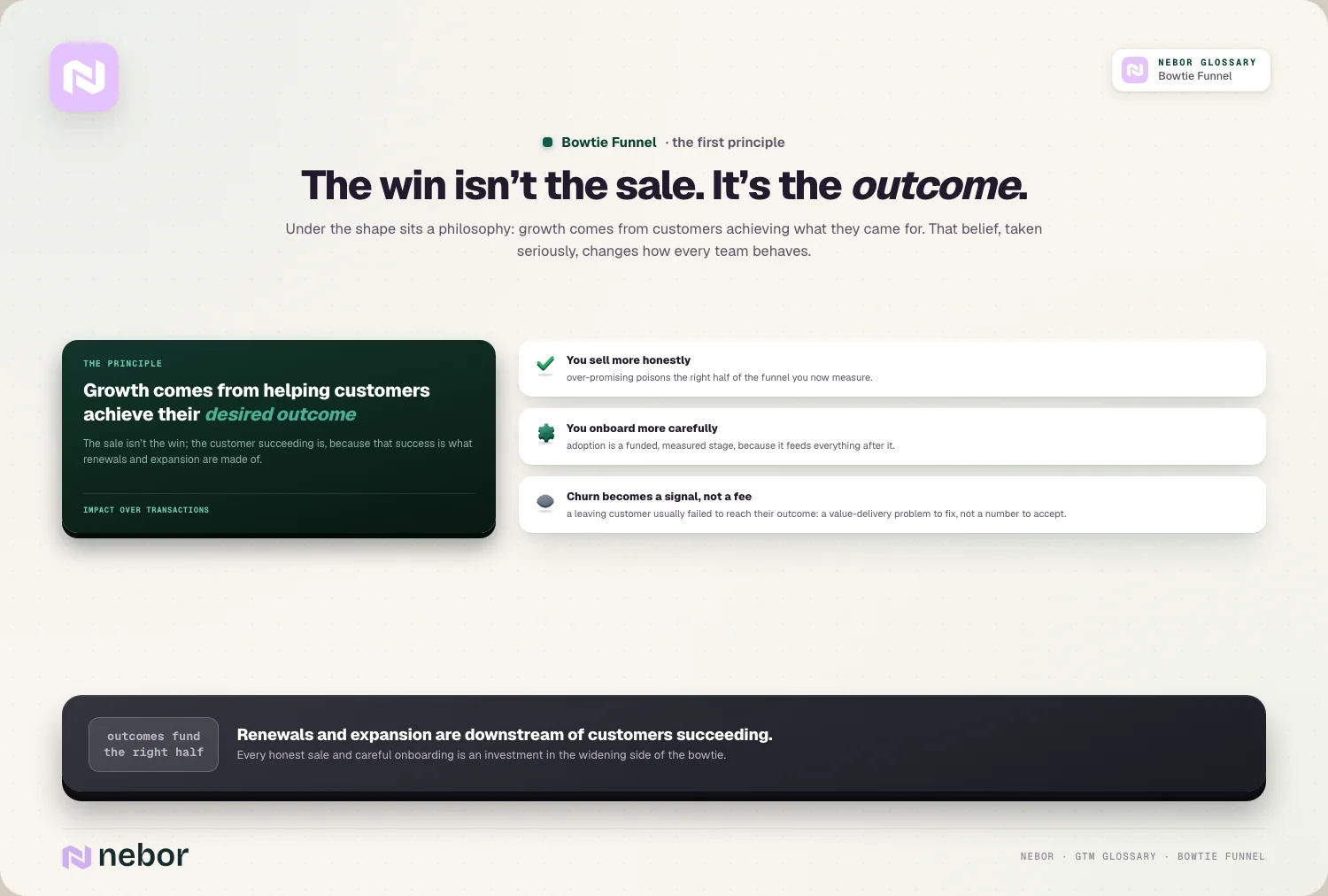
It also reframes churn as a signal instead of just a loss. Under this view, a customer who leaves usually failed to achieve their desired outcome, so high revenue churn points at a value-delivery problem to fix instead of simply a number to accept, which is a more actionable way to see it.
How to put the bowtie funnel to work driving your revenue engine
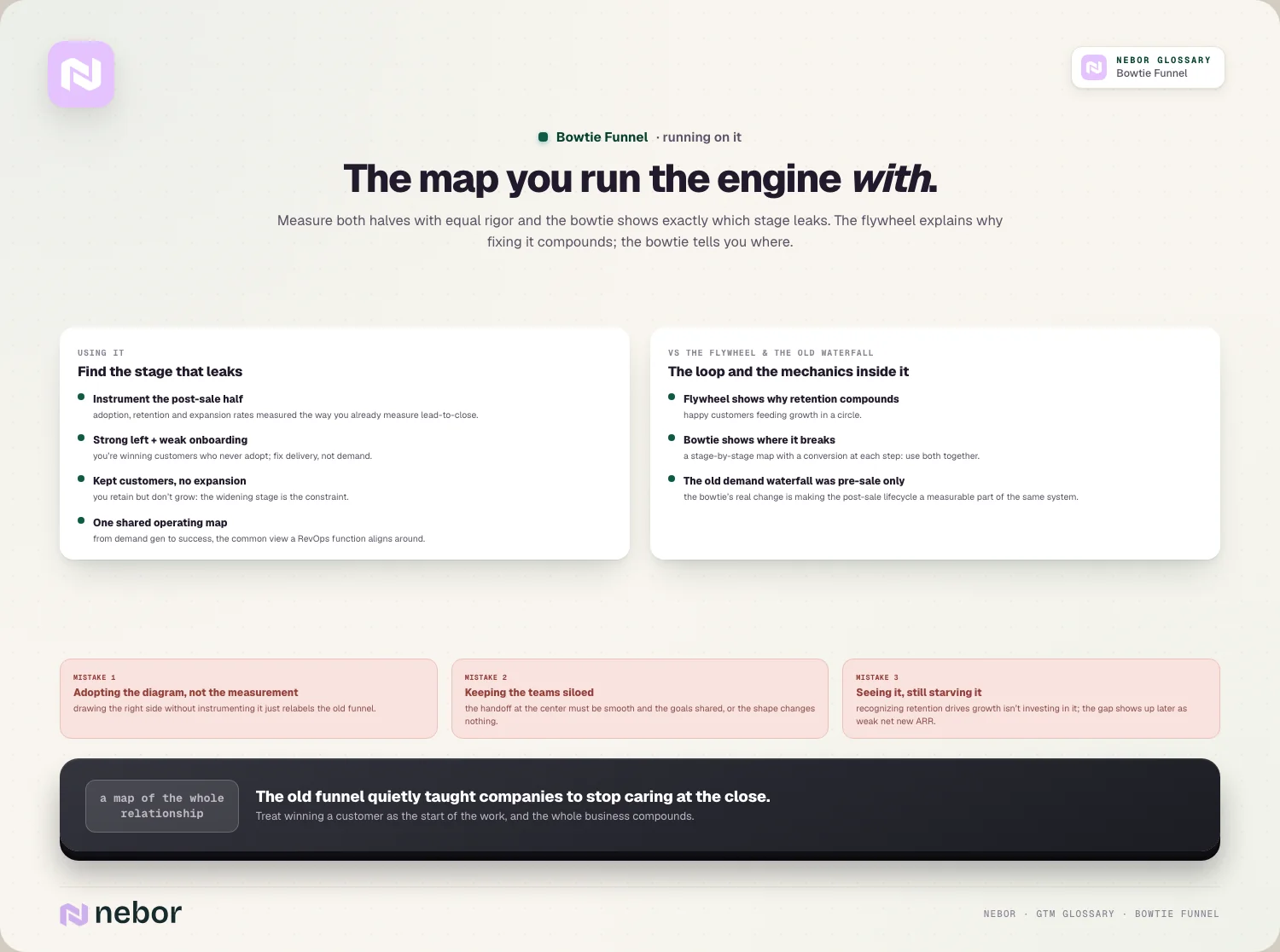
Using the bowtie well starts with measuring both halves of your funnel with equal rigor.
Most companies we meet already track their acquisition funnel closely, so the real work is instrumenting the post-sale stages, defining and measuring adoption, retention, and expansion the way your team already measures lead-to-close conversion.
The stage-by-stage view then tells you where growth is leaking in practice.
A strong left side with a weak onboarding stage means you're winning customers who never adopt, while weak expansion means you're keeping customers but never growing them, so the bowtie points you at the specific stage holding back your revenue engine.
This makes the bowtie a shared operating model instead of a marketing diagram. Because it spans every team from demand generation to customer success, it works best as the common map a whole revenue operations function uses to align around one view of the customer lifecycle.
How the bowtie funnel relates to the flywheel and the old demand waterfall
The bowtie is often compared to the flywheel, and the two are complementary instead of competing. The flywheel captures the circular momentum of happy customers feeding growth, while the bowtie is a stage-by-stage map that lets you measure conversion at each step.
In other words, one shows the loop and the other shows the mechanics inside it. You can use the flywheel to explain why retention compounds and the bowtie to pinpoint the exact stage where that compounding is breaking down.
It also marks a shift away from older acquisition-only models. Frameworks like the traditional demand waterfall focused almost entirely on the pre-sale journey, so the bowtie's real change is treating the post-sale lifecycle as a measurable part of the same system instead of a separate afterthought.
Kept together, these views reinforce each other, and in our experience the pairing beats either alone.
The bowtie tells you which stage to fix, the flywheel reminds your team why fixing retention compounds, and watching customer churn at the renewal stage ties the diagram back to the metric that decides whether the whole engine spins faster or grinds down.
The common mistakes teams make when they adopt the bowtie funnel
The most common mistake, and the one we keep finding in the setups we audit, is adopting the bowtie as a diagram without ever measuring the right side.
Drawing the post-sale stages is easy, but if you never instrument adoption, retention, and expansion, you've just relabeled the old funnel while still flying blind past the sale, which defeats the purpose.
Another is keeping sales and customer success siloed despite the shared model.
We advise treating the center handoff as the test, because the bowtie only works if that handoff is smooth and the teams share goals, so a company that adopts the shape but still treats post-sale as a separate world never gets the alignment the model is meant to create.
The subtler mistake is under-resourcing the post-sale side even after seeing it in the funnel.
Recognizing that retention and expansion drive growth isn't the same as investing in them, so teams that keep funding acquisition while starving success miss the engines the bowtie highlights, which later shows up as weak net new ARR.
Why the bowtie funnel is really a map of the whole customer relationship
The deepest way to understand the bowtie is as a correction to a model that quietly taught companies to stop caring once a deal closed. By extending the funnel through the whole relationship, it makes clear the sale is a beginning, and most of the value in a subscription business is earned over the years that follow.
That shift in perspective carries more value than the diagram itself, because it changes what a company optimizes for.
A team that sees the full bowtie invests in outcomes and retention, which compounds into a gtm flywheel where happy customers renew, expand, and refer, feeding growth that acquisition alone could never sustain.
A modern go-to-market system built on the bowtie treats winning a customer as the start of the work instead of the end.
When the demand you automate sales prospecting to create flows into a motion that onboards, retains, and expands with the same care it took to close, the whole business compounds instead of leaking value the moment the ink dries.
Share this post
RevOps
Marketing
Glossary
Related glossary items
Understanding the core GTM concepts




Ready to build your pipeline