

In this post:
Buyers have learned to tune out marketing claims. A company saying it's the best means nothing, because every company says it, so decision-makers look for a different signal of whether a vendor knows what they're doing at all.
That signal, increasingly, is the quality of the ideas a company shares.
Thought leadership is how a company earns trust by demonstrating expertise instead of asserting it. Instead of claiming to be an authority, you prove it by sharing original insight that helps buyers think more clearly.
That builds a kind of credibility marketing copy never can.
Thought leadership is the practice of sharing original insights, informed perspectives, and forward-looking expertise that shape industry conversations and influence how buyers think. It combines real data, analysis, and expertise to help decision-makers make better choices.
The payoff is both measurable and large. Most decision-makers say strong thought leadership makes them more receptive to a company's outreach, and many will invite a vendor to bid purely on the strength of the ideas it publishes.
TL;DR
Thought leadership is sharing original, truly useful insight that shapes how buyers think, proving your expertise instead of claiming it.
It builds trust that marketing claims can't, because decision-makers increasingly judge a company's capability by the quality of its ideas instead of its promises.
It shortens the sales cycle, because buyers who already recognize and trust your perspective move toward a decision faster and more willingly.
The hard part is that it has to be genuinely original and useful, because generic, AI-flavored content now fails and only real insight earns the trust.
What thought leadership is once you cut your way past the buzzword
Thought leadership is the practice of building authority by sharing ideas with real value in them. It's about demonstrating expertise through insight instead of asserting it through claims.
It centers on an original point of view. Real thought leadership offers a point of view or insight the audience couldn't easily get elsewhere, and that scarcity is what makes it worth their attention.
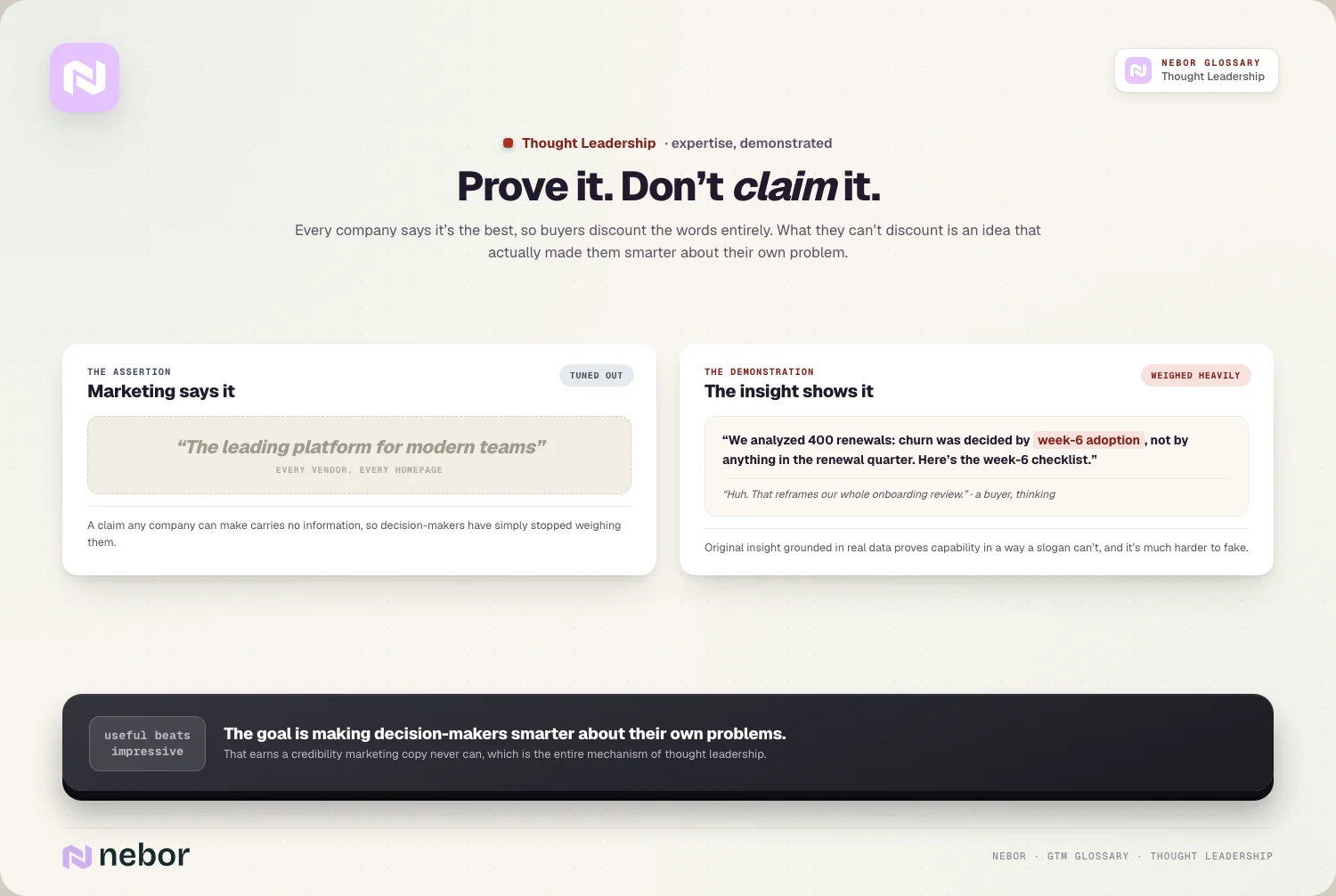
It's grounded in substance instead of surface. Strong thought leadership rests on real data, analysis, and hard-won expertise, so it holds up instead of sounding impressive but empty.
It helps the audience think more clearly. The goal is to make decision-makers smarter about their own problems, and helping them think is what builds the trust that eventually turns into business.
So thought leadership is proof of expertise where a slogan is only an assertion of it. It earns authority by being useful in practice, a fundamentally different thing from a company simply calling itself a leader.
Why buyers now trust expertise over polished marketing claims
The reason thought leadership works comes down to a shift in what buyers trust. Claims have lost their power, while demonstrated expertise has gained it.
Marketing claims ring hollow to modern buyers. Every company describes itself in glowing terms, so buyers discount those claims and look for harder evidence of real capability.
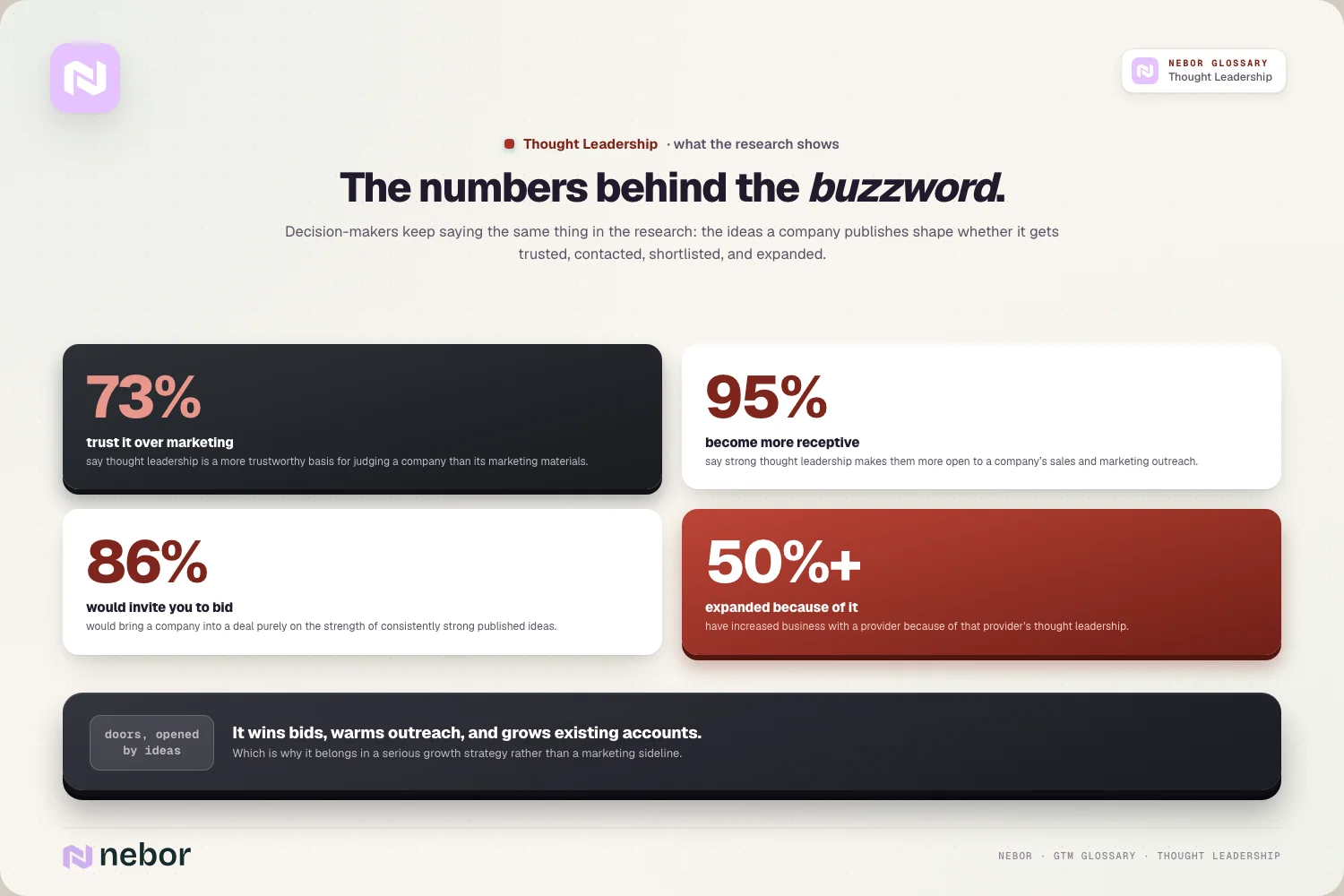
Ideas are far harder to fake than slogans. A truly insightful perspective demonstrates expertise in a way a slogan can't, so buyers weigh it more heavily when judging a vendor.
The data confirms the pattern about as clearly as data can. Around 73% of decision-makers say thought leadership is a more trustworthy basis for judging a company than its traditional marketing materials.
So buyers have shifted from trusting claims to trusting demonstrated expertise. Thought leadership works because it provides exactly the proof of capability that polished marketing copy fails to deliver.
How thought leadership makes buyers more receptive to outreach
One of the most practical effects of thought leadership is that it warms buyers up before you ever contact them. Recognition changes how your outreach lands when it arrives.
It builds familiarity before any contact happens. A buyer who has seen and valued your ideas already knows you, so your outreach reaches someone who recognizes you instead of a stranger.
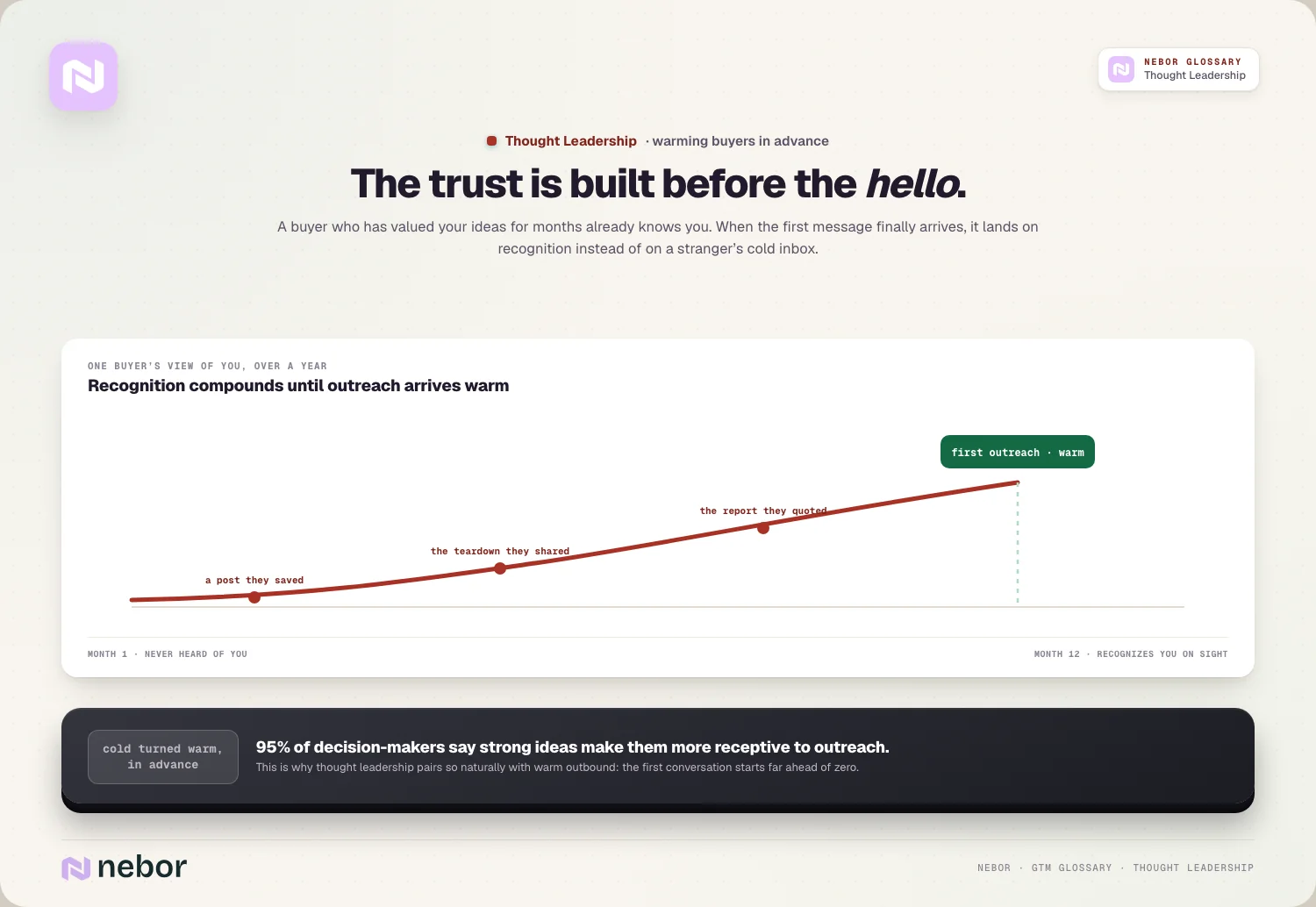
Receptivity to your message rises sharply with familiarity. Around 95% of decision-makers say strong thought leadership makes them more receptive to a company's sales and marketing outreach, which is a striking figure.
It feeds every warmer motion downstream of it. This is why thought leadership pairs so well with warm outbound, because outreach to someone who already trusts your perspective starts far ahead of a cold approach.
So thought leadership is what turns cold outreach warm before it's even sent. By earning recognition in advance, it makes every later conversation easier, which is a direct and measurable advantage.
Why thought leadership shortens the entire B2B sales cycle for you
Beyond making outreach warmer, thought leadership speeds up the whole path to a decision. Trust built early saves your team real time later.
It shortens the education phase of the deal. When a buyer already understands and respects your perspective, you skip much of the repetitive vendor education that normally slows deals down.
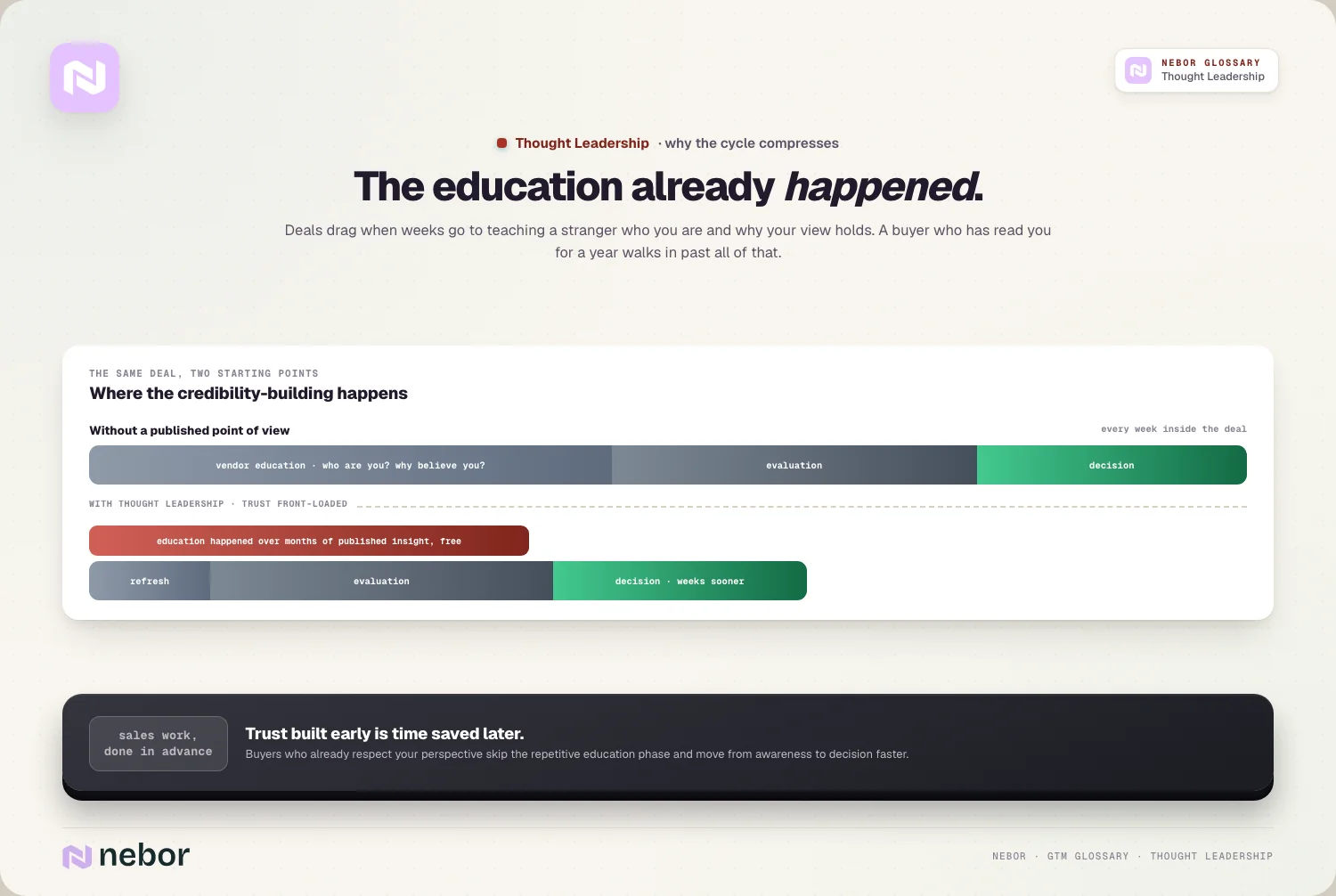
It moves your buyers through the funnel faster. Prospects who recognize your credibility move from awareness to decision more quickly, which can cut weeks off the process.
It shows up in measurably shorter cycles. Because trust is partly established before sales even engages, the sales cycle compresses, because less of it is spent building basic credibility.
So thought leadership does sales work in advance. It front-loads the trust-building that would otherwise happen slowly during the deal, so buyers who know you decide faster.
How thought leadership drives real revenue and account expansion
The effects of thought leadership reach all the way to closed and expanded business. It influences buying decisions in a measurably direct way.
It wins new business on its own. Around 86% of decision-makers would invite a company to bid based on consistently strong thought leadership, so it opens doors that outreach alone can't.
It grows the accounts you already hold. More than half of decision-makers say they've increased business with a provider because of that provider's thought leadership, so it drives expansion too.
It creates advocates inside the buying company. Buyers are more likely to champion a vendor internally when that vendor's ideas have earned their respect, which helps deals move through the buying group.
So thought leadership moves real revenue on top of building the brand. It wins bids, expands accounts, and creates internal champions, earning it a place in a serious growth strategy instead of a marketing sideline.
Why AI has made original thought leadership more valuable than ever
A common worry is that AI-generated content devalues thought leadership, but the opposite is true. AI has raised the premium on genuine insight.
Generic content is now effectively free to make. AI can produce endless competent, generic content, so that kind of writing has lost any power to differentiate a company.
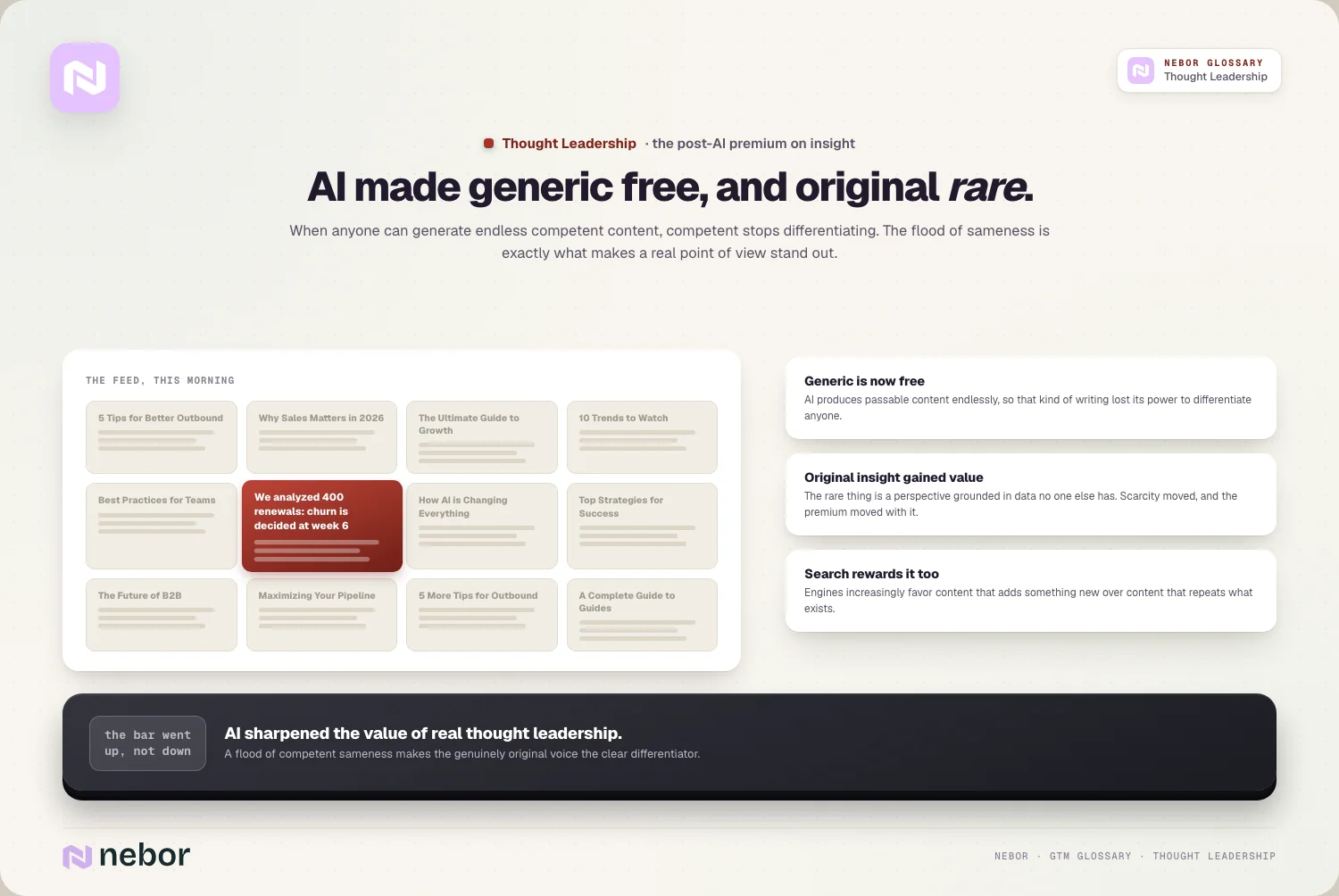
Original insight stands out more than it ever did. When everyone can generate passable content, the original human perspective becomes the rare, valuable thing that still earns attention.
It's what search engines reward as well. Original insight is increasingly what search engines reward, because they favor content that adds something new instead of repeating what already exists.
So AI has sharpened the value of real thought leadership instead of eroding it. The flood of generic content makes authentic, original insight the clear differentiator, which raises the bar instead of lowering it.
How thought leadership connects to social selling and distribution
Thought leadership only works if people see it, so distribution is inseparable from the ideas themselves. The two motions have to work together to pay off.
Ideas need a channel to travel through. Even great insight helps no one left unread, so thought leadership depends on getting the content in front of the right people consistently.
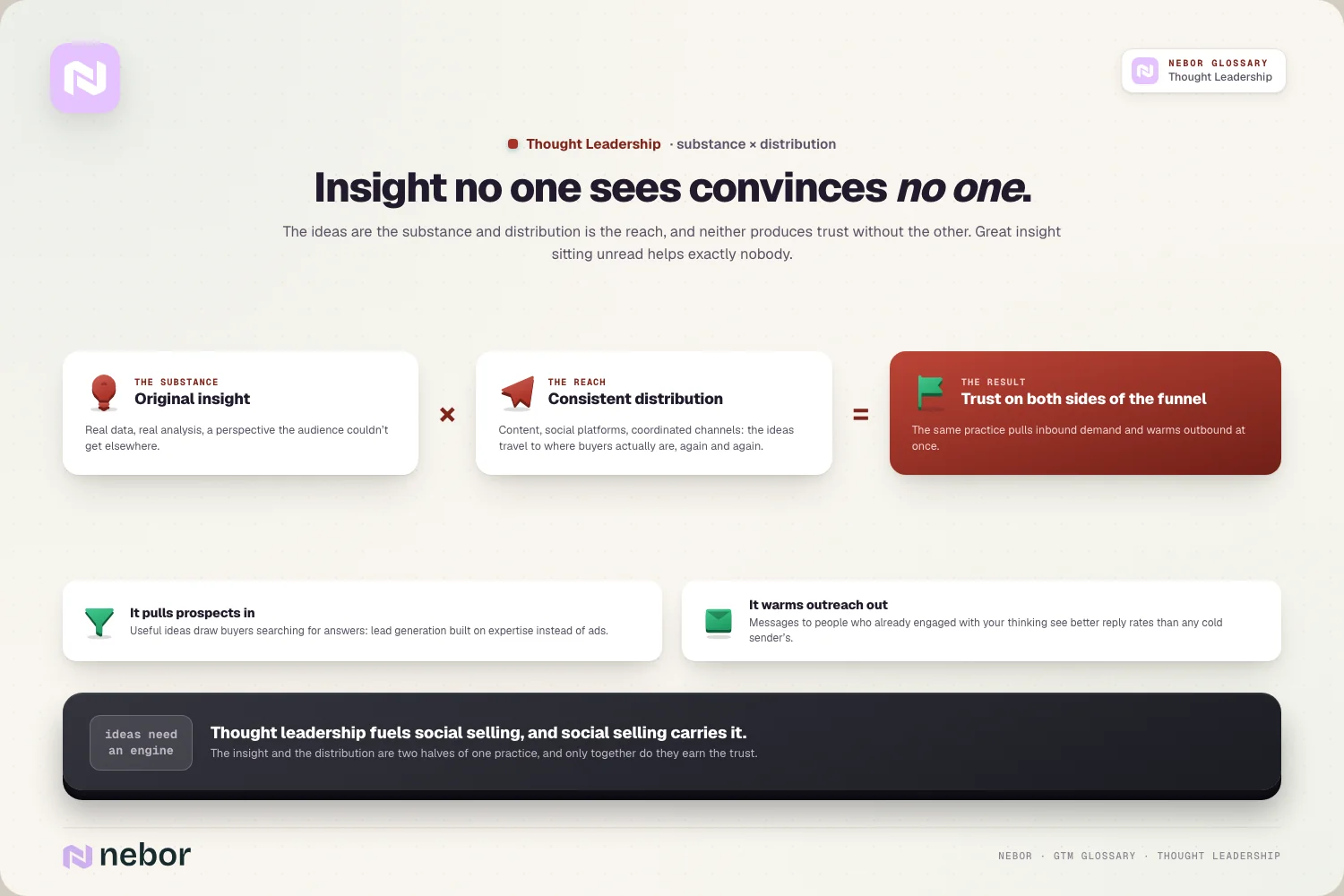
It fuels the social selling your team does. Sharing strong perspectives is the engine of social selling, because the content is what builds the presence and trust that warm relationships rest on.
It reaches buyers across every channel they use. Thought leadership spreads through content, social platforms, and a coordinated multi-channel outreach approach, so the ideas travel to where your buyers spend their time.
So thought leadership and distribution are two halves of one practice. The insight is the substance and distribution is the reach, and neither produces trust without the other.
How thought leadership feeds both inbound demand and warm outbound
Thought leadership doesn't belong to one side of your funnel, it strengthens both the inbound and outbound sides at once. That dual role is a big part of its value.
It pulls prospects toward you on its own. Publishing ideas buyers find real use in draws in the ones searching for answers, which acts as a form of lead generation built on your own expertise instead of paid ads.
It warms your outbound at the same time. Reaching out to someone who already knows your ideas is a form of inbound-led outbound, because the prospect engaged with your thinking before you contacted them.
It lifts the reply numbers on your sequences. Because recipients recognize you, outreach tied to strong thought leadership tends to see a better reply rate than cold messages from an unknown sender.
So thought leadership works on both motions at once. It attracts inbound interest and warms outbound outreach, repaying the effort across your entire go-to-market.
Why thought leadership has to target the right audience precisely
Thought leadership isn't about impressing everyone, it's about influencing the specific people who matter. Targeting shapes what you choose to write about.
It speaks to the buyers who can say yes. Effective thought leadership addresses the actual concerns of your buyer persona, so the insight lands with the people who make decisions.
Relevance beats raw reach in this arena every time. A perspective that deeply resonates with your exact market is worth more than one that vaguely interests a huge, unqualified audience.
It stays aligned with the market you serve. Anchoring thought leadership to your ideal customer profile keeps it focused on the buyers you can plausibly serve and win.
So thought leadership works best when it's aimed instead of broadcast. Speaking precisely to the people you want as customers turns published ideas into pipeline instead of applause.
How thought leadership works differently from ordinary content marketing
Thought leadership and content marketing get lumped together, but they aren't the same thing. The difference is in the ambition of the ideas.
Content marketing exists to inform the reader. Much of it answers common questions and covers known topics well, which is useful but doesn't necessarily say anything new or distinctive.
Thought leadership pushes the conversation somewhere new. It offers a fresh perspective or original finding that adds to what's already out there, instead of restating the consensus everyone already shares.
The bar for the label is considerably higher. A helpful how-to article is good content, but thought leadership has to carry a point of view strong enough to shape how readers think, which is a tougher standard.
So thought leadership is the sharp end of content instead of a synonym for it. All thought leadership is content, but only the content that moves thinking forward earns the name, and that bar is what keeps it rare.
How to distribute thought leadership so it reaches your buyers
Great ideas fail if no one sees them, and we tell clients that distribution deserves as much thought as the ideas themselves. Reach is only ever half the equation.
It needs channels you show up in consistently. Publishing steadily on the platforms where your buyers spend time, and reinforcing it through personalization at scale in your outreach, keeps the ideas in front of the right people.
It benefits from being carried in many formats. The same insight can travel as an article, a talk, a video, or a post, so repackaging one idea across formats extends its reach without new substance.
It compounds steadily as engagement builds around it. When your audience shares and discusses your ideas, the reach grows beyond your own channels, and that sharing is how thought leadership spreads organically.
So distribution turns good ideas into influence. Consistent, multi-format sharing is what carries thought leadership to the buyers it's meant to reach, instead of leaving it unseen.
How to produce genuine thought leadership on a consistent schedule
Producing real thought leadership is harder than posting content, and in our experience the difficulty is exactly where the value hides. A few things separate the genuine from the generic.
It requires a real point of view. Genuine thought leadership takes a clear, sometimes contrarian position instead of repeating safe, obvious consensus, and the position is what makes it worth reading.
Original data helps more than almost anything. Sharing your own research or findings gives buyers something they can't get elsewhere, one reason many marketers are investing more in original research.
Consistency over months is what builds the authority. A single strong piece fades, so thought leadership is built through steady, ongoing publishing that compounds recognition over time.
So real thought leadership takes a genuine perspective, original substance, and consistency. It's the opposite of churning out safe content, which is exactly why it earns the trust that safe content never does.
The common mistakes teams make when they attempt thought leadership
Thought leadership fails in a few predictable ways, and each hollows out the trust it's meant to build. Avoiding them is what keeps the whole effort credible.
The biggest is being generic in your takes, the flaw we point clients to first when their content earns silence. Publishing safe, obvious content that repeats consensus offers no original value, so it earns none of the trust real insight does.
Another is selling behind a thin veil of insight. Dressing up a sales pitch as thought leadership breaks the trust immediately, because buyers can tell when the goal is to sell instead of help.
A third is publishing without any rhythm. Publishing once and going quiet builds no lasting authority, because recognition comes from a steady body of work over time.
The last is chasing volume over substance. Flooding channels with shallow content, especially generic AI output, actively erodes credibility instead of building it.
Why thought leadership is a long game that compounds over time
The most important thing to understand about thought leadership is that its returns build slowly and then endure. It rewards patience in a way quick tactics don't.
It compounds the way a reputation does. Each valuable piece adds to how buyers see you, so the authority grows steadily and becomes harder for competitors to match.
It creates an advantage competitors can't copy quickly. Unlike a campaign that ends, a body of respected thinking keeps working, warming buyers and shortening cycles long after each piece is published.
It's increasingly the differentiator that decides deals. As generic content loses all value, genuine expertise becomes one of the few things that still sets a company apart in a crowded market.
A company that commits to real thought leadership builds one of the most durable advantages available in a modern go-to-market system. It earns trust at scale, which warms every conversation and strengthens the outreach you automate sales prospecting around.
Share this post
Content
Marketing
Glossary
Related glossary items
Understanding the core GTM concepts




Ready to build your pipeline











