

In this post:
You can buy all the customers you want. Pour enough money into ads, your reps, and discounts, and the logos will come. The real question is whether you can afford them, and that question has a number.
That number is customer acquisition cost, and it's the difference between growth that builds a business and growth that bankrupts one in slow motion. Plenty of companies grow fast right up until they realize each new customer costs more than they're worth.
Customer acquisition cost, or CAC, is the total amount you spend to acquire a new customer, calculated by dividing your sales and marketing costs over a period by the number of customers you won in that period. It tells you what each new customer really costs.
CAC turns growth into a question of economics instead of effort. Acquiring customers is easy if you ignore cost, but profitable growth depends on acquiring them for less than they're worth.
TL;DR
Customer acquisition cost is the total sales and marketing spend required to win a new customer, found by dividing those costs over a period by the number of new customers acquired.
It determines whether growth is profitable, because if a customer costs more to acquire than they generate, you're losing money on every sale, no matter how fast you grow.
CAC only means something next to value. You read it against customer lifetime value and payback period, because a high CAC can be fine if customers are worth even more.
The pressure is that CAC is rising for almost everyone. Acquisition keeps getting more expensive, so improving efficiency, more than simply spending more, is what protects profitable growth.
What is customer acquisition cost, and how do you calculate it?
Customer acquisition cost is what you spend, on average, to win one new customer. It's a simple ratio that captures the efficiency of your whole go-to-market spend, from your pipeline to your payroll.
The formula takes a minute to work out. You add up your sales and marketing costs over a period, then divide by the number of new customers your team won in that same period.
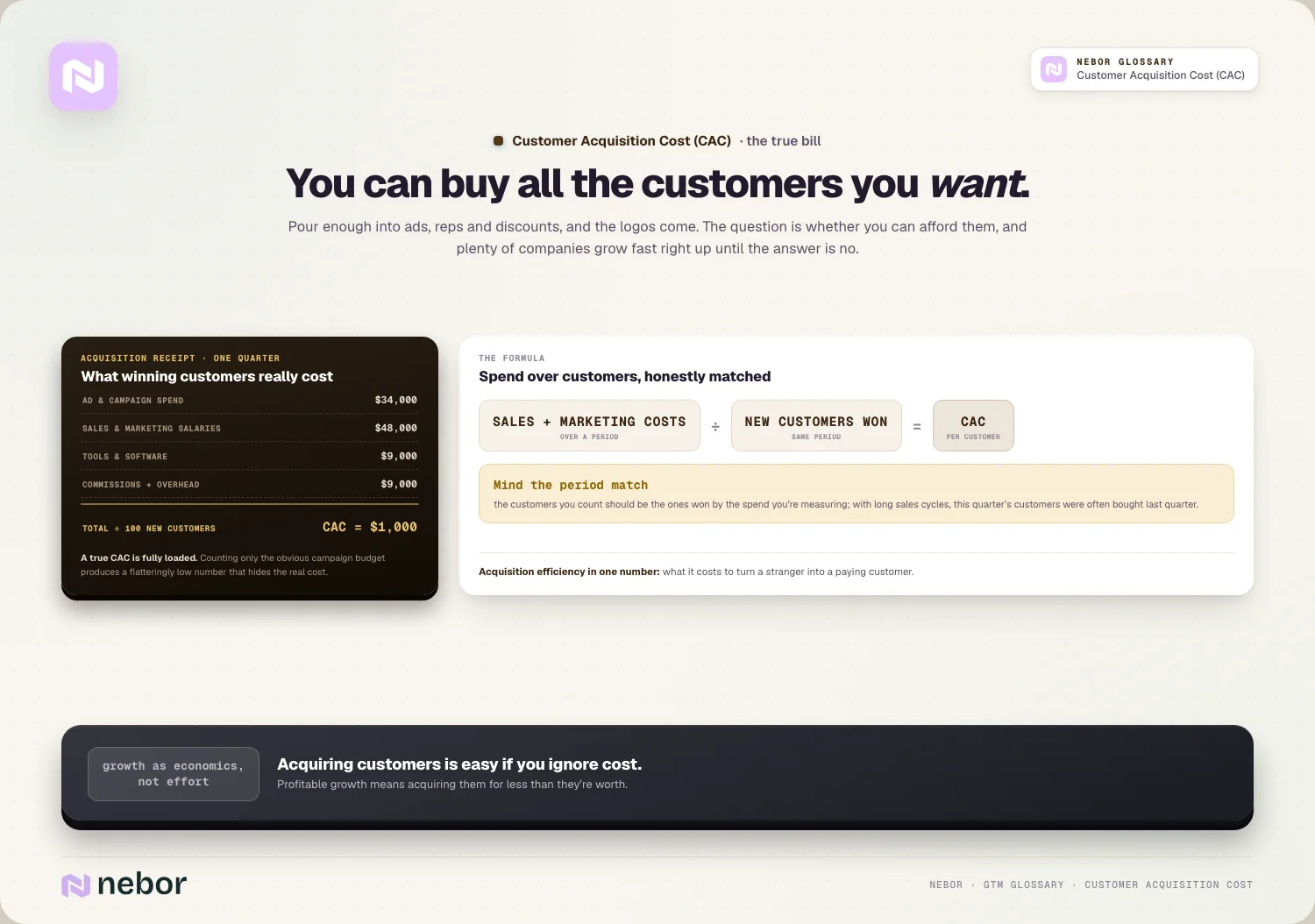
Those costs include more than ad spend. A true CAC counts salaries, tools, commissions, and overhead for sales and marketing on top of the obvious campaign budget, because all of it goes toward acquisition.
The result is a clear per-customer figure. If you spent $100,000 on sales and marketing in a quarter and won 100 customers, your CAC is $1,000 per customer.
So CAC is really a measure of acquisition efficiency. It tells you how much it costs to turn a stranger into a paying customer, which is one of the most important numbers in your entire business.
Why does CAC only matter relative to what a customer is worth?
A common mistake we see is treating CAC as good or bad on its own. A number in isolation tells you almost nothing, because what counts as a reasonable CAC depends entirely on what a customer is worth.
A high CAC can be perfectly healthy. If you spend $2,000 to acquire a customer who generates $50,000 over their lifetime, that's an excellent trade rather than a problem.
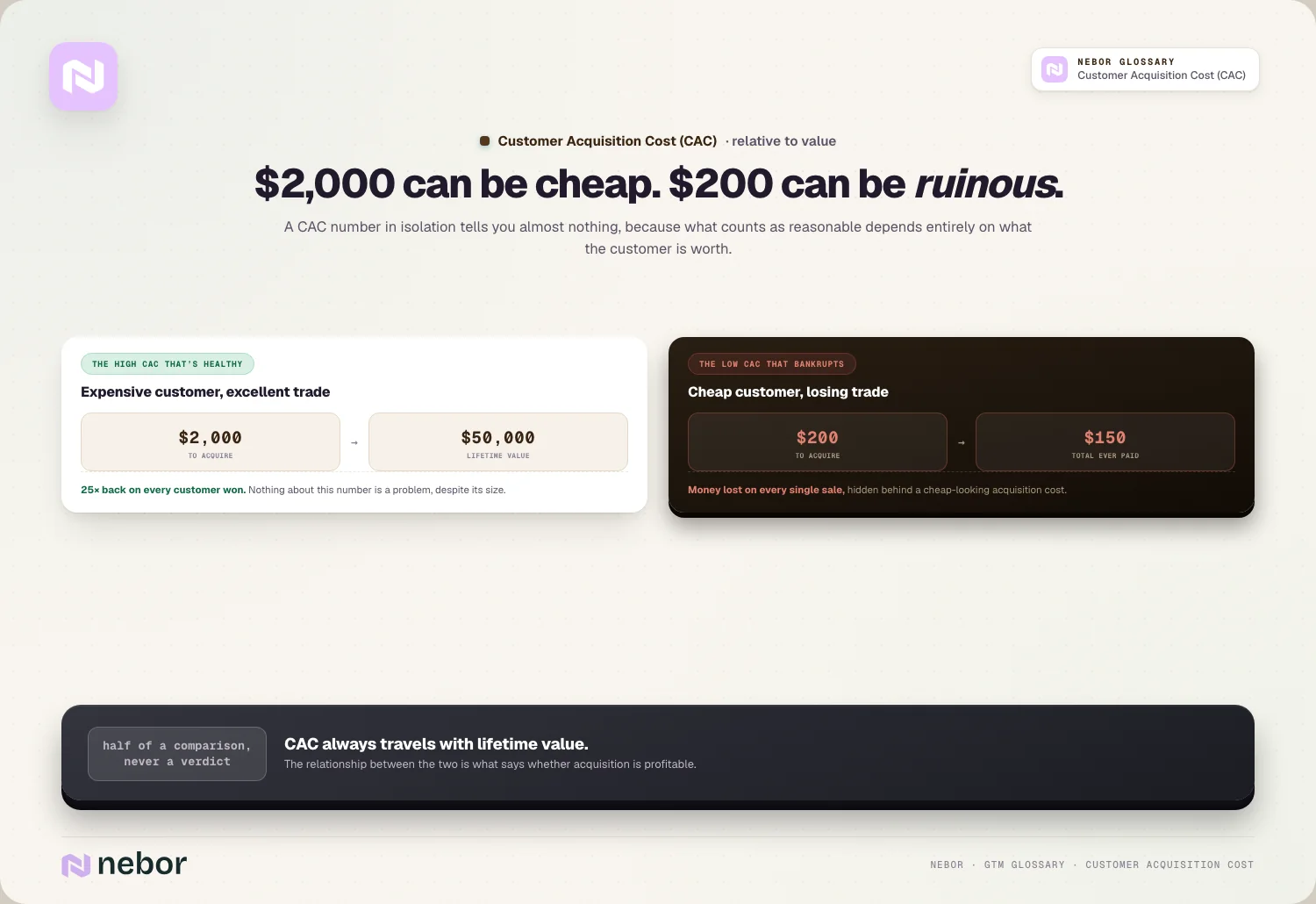
A low CAC can be terrible just as easily. If you spend $200 to acquire a customer who only ever pays you $150 in total, you lose money on every sale despite the cheap-looking cost.
This is why CAC always travels with value. You read it against customer lifetime value, because the relationship between the two is what tells you whether acquisition is profitable.
So CAC works as half of a comparison instead of a verdict. The number only becomes meaningful when you set it against what customers are really worth to you.
How do CAC and lifetime value work together inside one ratio?
The relationship between CAC and value is so important that it has its own metric. Understanding it is key to reading CAC correctly.
The pairing is the LTV to CAC ratio, which compares what a customer is worth to what they cost to acquire. It's the single clearest read on whether your growth is economically sound.
The common target leaves a healthy margin. Most B2B teams aim for an LTV at least three times CAC, meaning customers are worth at least three times what they cost to win.
The ratio then guides your spending, because a ratio well above target may mean you can afford to spend more to grow faster, while a ratio near or below one means acquisition is unprofitable.
So CAC and LTV are two halves of one picture. CAC tells you the cost, LTV tells you the value, and the ratio between them tells you whether to accelerate or pull back.
What is CAC payback, and why does the timing matter so much?
Beyond the ratio, there's a time dimension to CAC that matters just as much. It's not only whether a customer pays back, but how fast.
CAC payback period is the time it takes a customer to generate enough revenue to cover what you spent acquiring them. It measures how long your acquisition cost is underwater.
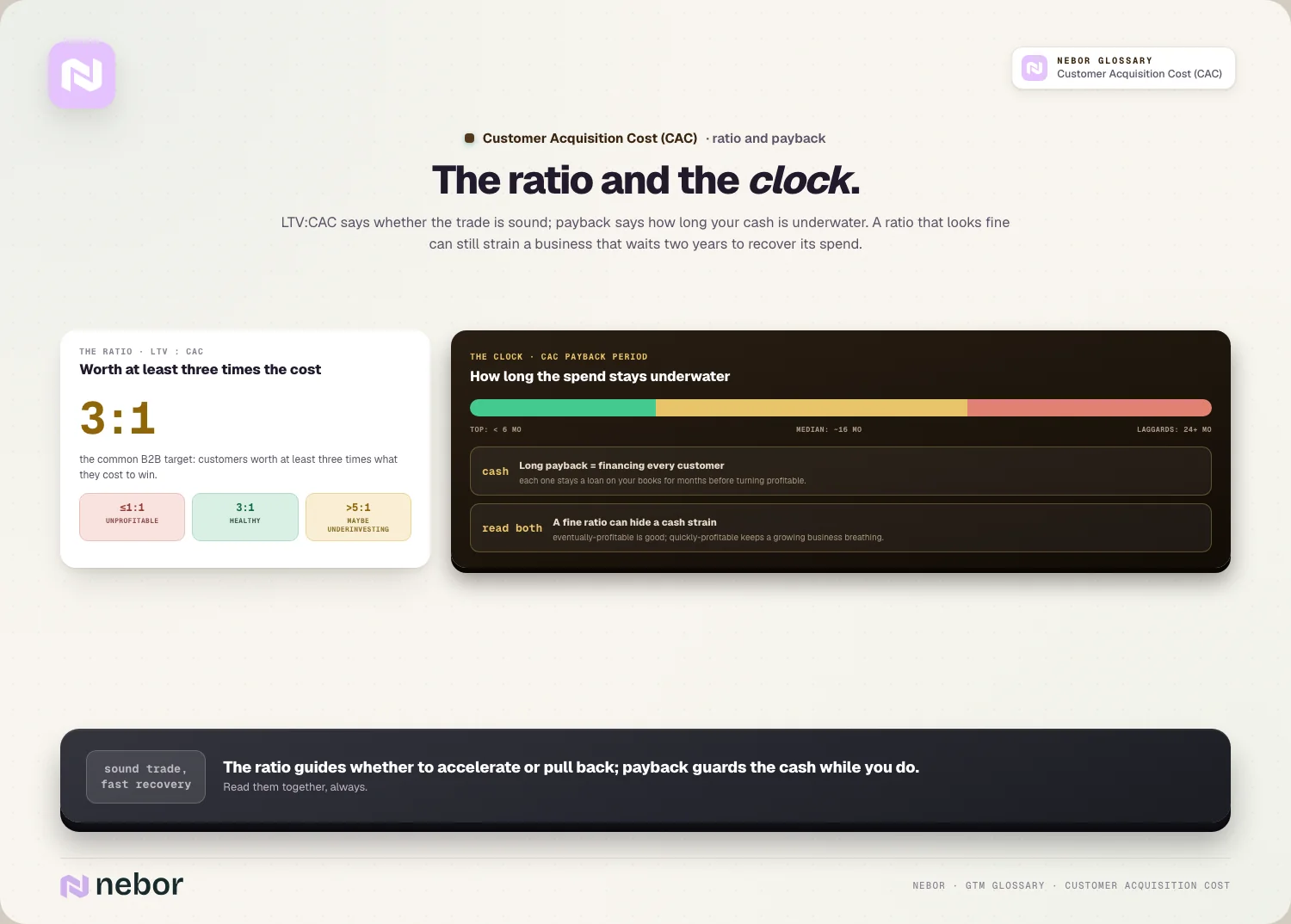
Shorter is much better for cash flow. The median B2B SaaS company recovers its CAC in around 16 months, with top performers under 6 and laggards over 24, which is a huge spread.
Cash flow is what makes it count. A long payback period means you're financing each customer for a long time before they turn profitable, which strains a growing business even when the LTV to CAC ratio looks fine.
So payback adds a time dimension to the CAC picture. A customer who eventually pays back is good, but one who pays back quickly is far better for the cash health of a growing business.
Why does CAC keep rising for almost everyone, year after year?
A hard reality of modern go-to-market is that acquisition keeps getting more expensive. Understanding why helps you respond instead of just absorbing it.
The trend is steep and well documented, with customer acquisition costs up around 40 to 60% since 2023, and far more over a longer horizon, squeezing margins across the board.
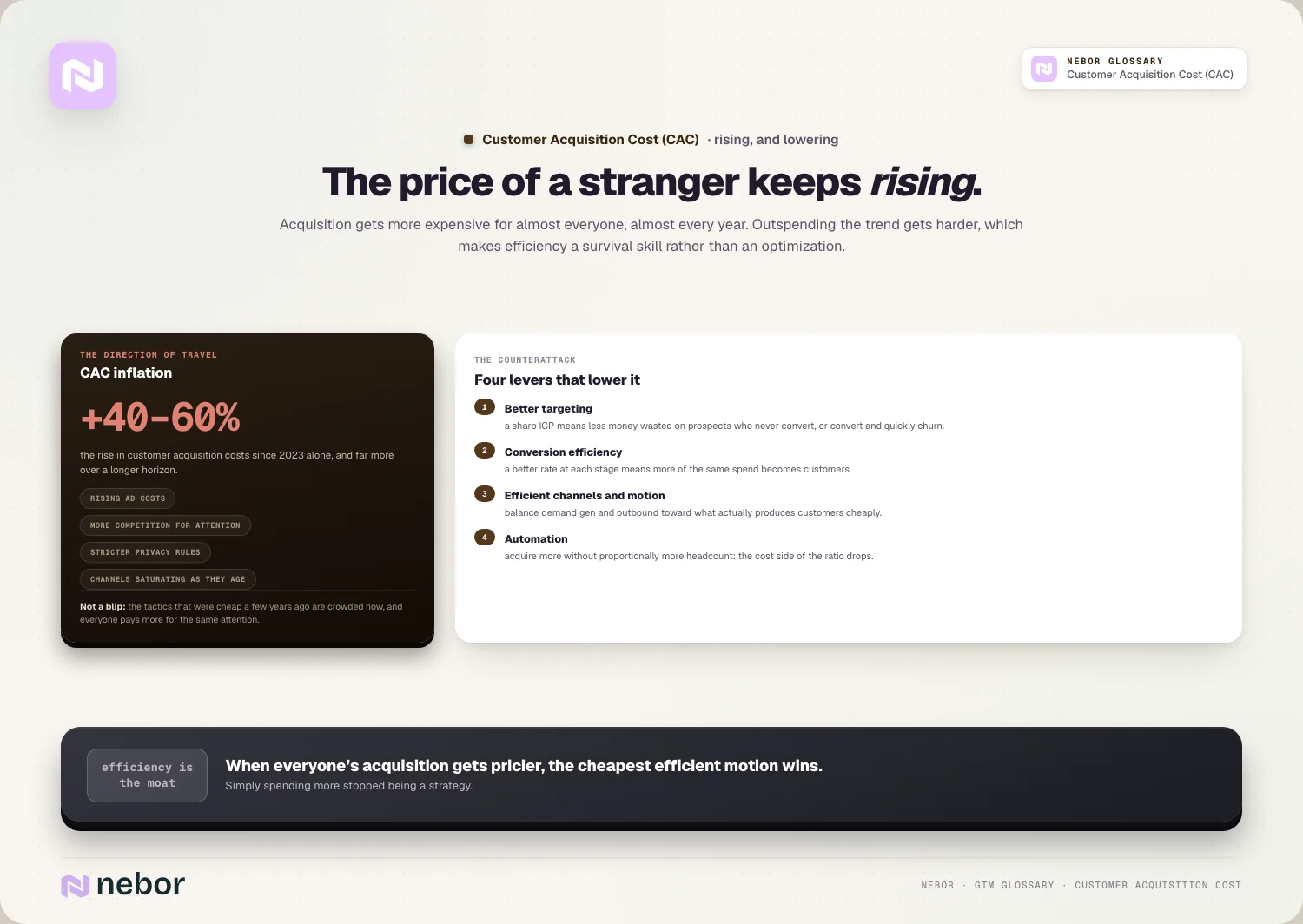
Several forces drive it at once, because rising ad costs, more competition for attention, and stricter privacy rules that make targeting harder all push the cost of winning a customer upward.
Channels also saturate over time, as the tactics that were cheap and effective a few years ago get crowded, so everyone pays more for the same attention, and returns erode.
So rising CAC isn't a temporary blip, it's the direction of travel. That makes acquisition efficiency a survival skill, because simply outspending the trend gets harder every year.
How do you lower your CAC without starving your own growth plans?
Since CAC keeps rising, lowering it is a constant project, and in our experience a few levers do most of the work.
Better targeting is the biggest, because acquiring well-fit customers defined by a sharp ideal customer profile means less money wasted on prospects who never convert or quickly churn.
Conversion efficiency comes next, where improving your conversion rate at each stage means more of your spend turns into customers, which directly lowers the cost per acquisition.
Efficient channels and motion matter too, with the balance between demand generation and outbound sales tilted toward what produces customers cheaply, keeping your blended CAC down.
And automation closes the loop, because systems that automate sales prospecting let you acquire more customers without proportionally more headcount, which lowers the cost side of the ratio.
How does retention change the CAC equation after the sale closes?
A subtle but powerful truth is that what happens after acquisition changes how much you can afford to spend acquiring, because retention and CAC are deeply linked.
Retention raises lifetime value directly, because when customers stay and grow, their LTV climbs, which means you can afford a higher CAC while keeping the ratio healthy.
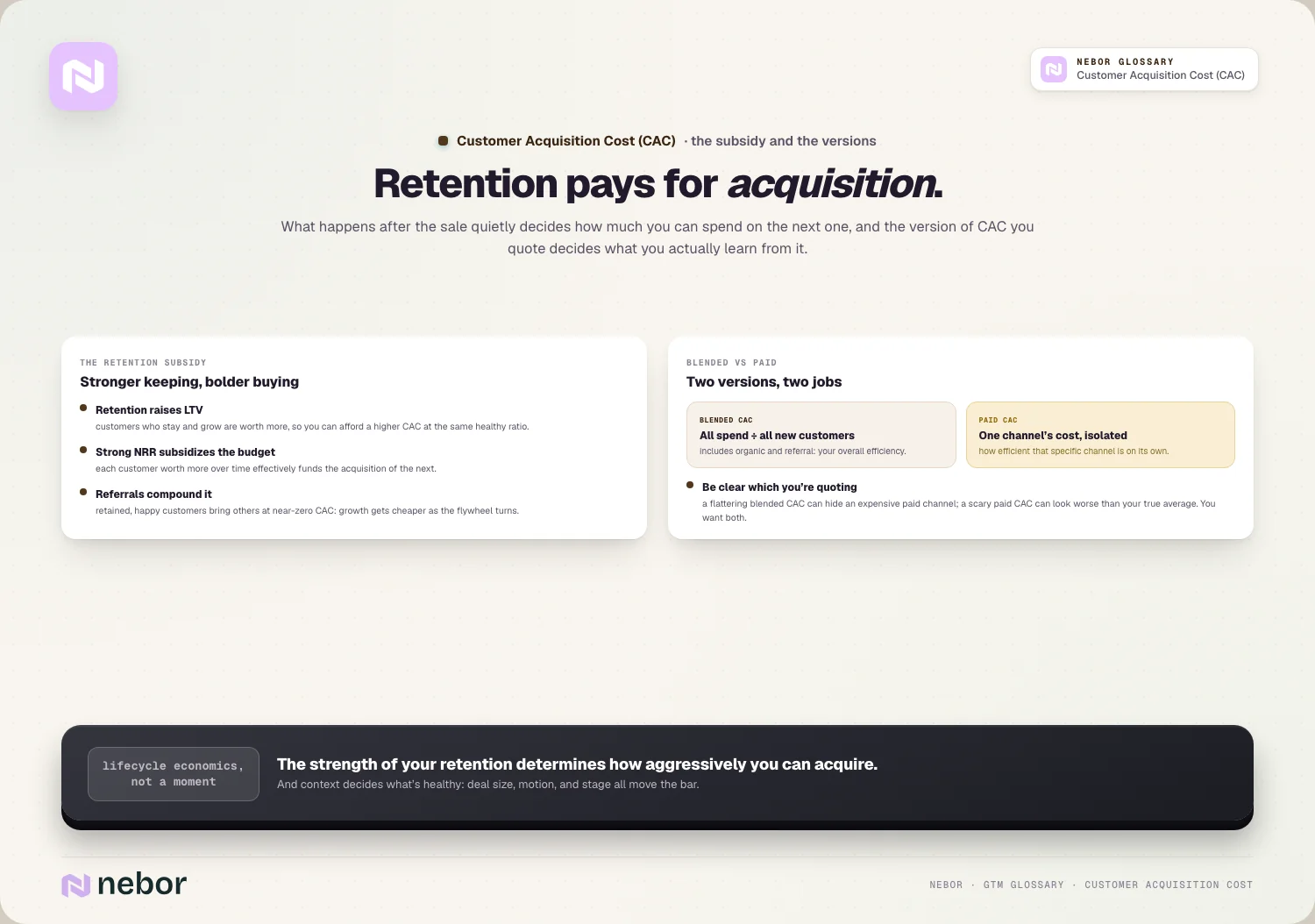
This is why net revenue retention matters for acquisition. Strong retention effectively subsidizes your acquisition budget, because each customer is worth more over time.
It compounds through referrals as well, since happy, retained customers refer others, which lowers the CAC of those new customers and feeds a GTM flywheel where growth gets cheaper over time.
So CAC isn't only about the moment of acquisition. The strength of your retention quietly determines how aggressively you can afford to acquire, which links CAC to the whole customer lifecycle.
How does CAC fit into the health of your wider revenue engine?
CAC isn't an isolated finance metric, it's a core input into how your whole business grows, connecting to everything around it.
It shapes how fast you can grow. A healthy CAC and ratio mean you can confidently invest more in acquisition, while a poor one forces you to slow down and fix efficiency first.
It moves with your velocity too, because lowering CAC often comes from the same improvements that raise pipeline velocity, where efficient conversion both speeds deals and cheapens them.
It's a key gauge of your revenue engine. A well-built engine acquires customers efficiently, so CAC is one of the clearest signals of whether that engine is working as designed.
So CAC is a lens on the health of your growth. It tells you not just what acquisition costs, but whether your whole go-to-market motion is economically sound.
How do you calculate CAC correctly and keep the number honest?
The formula is simple, but getting an honest CAC takes care about what you include, and in the numbers we've audited the most common errors come from leaving things out.
All acquisition costs belong in the count, well beyond ad spend, because a true CAC includes the salaries of your sales and marketing people, the tools they use, commissions, and the overhead that supports them.
The time periods deserve careful matching, because the customers you count should be the ones won during the period whose spend you're measuring, and a mismatch distorts the number in both directions.
Long sales cycles need a decision too, because when it takes months to close, the spend that won this quarter's customers may have happened last quarter, which matters for accuracy in longer-cycle businesses.
So an honest CAC is a fully-loaded one. The temptation is to count only the obvious campaign spend, but the real cost of acquisition includes all the people and tools behind it.
What's the difference between blended CAC and paid channel CAC?
Not all CAC is measured the same way, and the distinction matters. Two common versions tell you different things.
Blended CAC counts everything at once, dividing all your acquisition spend by all new customers, including those who came organically or by referral, giving your overall average cost.
Paid CAC isolates one channel instead, looking at the cost to acquire customers from a specific paid source, which tells you how efficient that channel is on its own.
The two serve different purposes side by side, because blended CAC shows your overall efficiency, while paid CAC helps you judge and optimize individual channels, so you usually want both.
So it pays to be clear which one you're quoting, because a flattering blended CAC can hide an expensive paid channel, and a scary paid CAC can look worse than your true blended cost.
Does a good CAC depend on your business model and your stage?
There's no universal good CAC, because what's healthy depends entirely on your model. Context decides whether a number is fine or alarming.
Deal size changes everything about the read, because a CAC of a few thousand dollars is fine for a large enterprise deal and disastrous for a low-priced self-serve product, so the number only makes sense against your price point.
Sales motion matters too, because a high-touch sales-led motion naturally carries a higher CAC than a self-serve one, but it usually wins larger, longer-lasting customers to justify it.
And growth stage plays its part, because early on you may accept a higher CAC to gain ground, while a mature business optimizes harder for efficiency, so the same number can be right or wrong depending on timing.
So CAC deserves judging against your own model instead of a generic benchmark. What matters is whether your CAC works for your price, your motion, and your stage, which only you can really assess.
What are the common CAC mistakes that mislead even good teams?
CAC gets misused in a few predictable ways. Avoiding them keeps it a useful guide rather than a misleading one.
Reading it in isolation tops the list, because a CAC number alone is meaningless, so judging it without LTV and payback leads to wrong conclusions about whether growth is healthy.
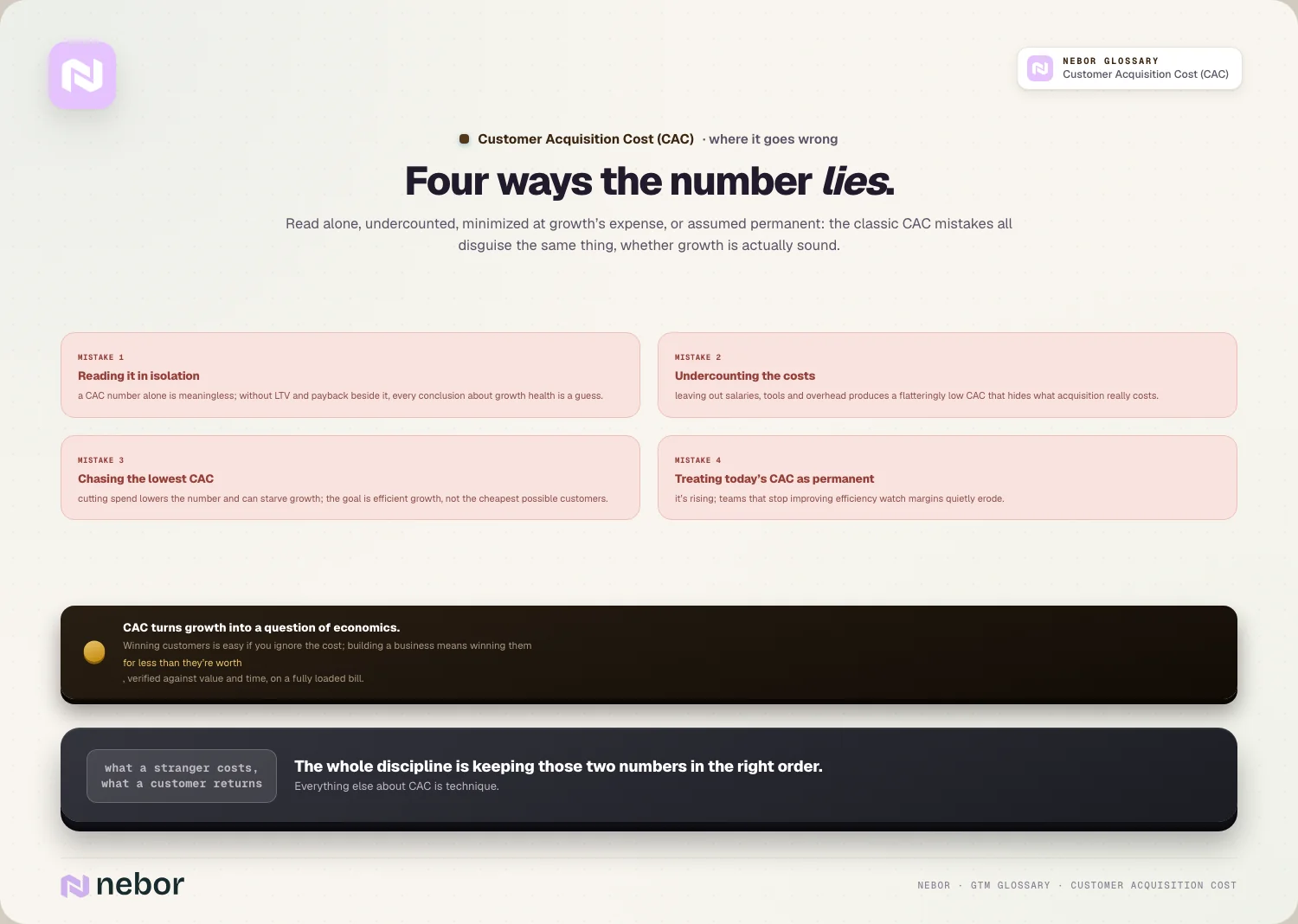
Undercounting costs comes next, where leaving salaries, tools, or overhead out of the calculation produces a flatteringly low CAC that hides the real cost of acquisition.
Chasing a low CAC at the expense of growth is subtler, because cutting acquisition spend lowers CAC but can starve growth, so the goal is efficient growth instead of the cheapest possible customers.
And there's ignoring the trend, because treating today's CAC as permanent misses that it's rising, so teams that don't keep improving efficiency watch their margins erode a little every quarter.
Why CAC is the number that decides if your growth can be trusted
Customer acquisition cost carries this much weight because it turns growth into a question of economics. Winning customers is easy if you ignore the cost, but building a business depends on winning them for less than they're worth.
The deeper point is that CAC only means something next to value. The number is half of a comparison, read against lifetime value and payback period, which together tell you whether your growth is sound.
The honest reality is that acquisition keeps getting more expensive, so efficiency is no longer optional. The teams that thrive are the ones lowering their CAC through better targeting and conversion, instead of just spending more to outrun the trend.
So if your growth feels expensive or fragile, your CAC and its ratio to value are where to look. Acquiring the right customers efficiently, and keeping them long enough to be worth it, is what makes growth profitable rather than just fast.
That economic discipline is exactly what a modern go-to-market system is built to deliver. It's the difference between growth that compounds and growth that drains the very business funding it.
Share this post
RevOps
Marketing
Glossary
Related glossary items
Understanding the core GTM concepts



Ready to build your pipeline