

In this post:
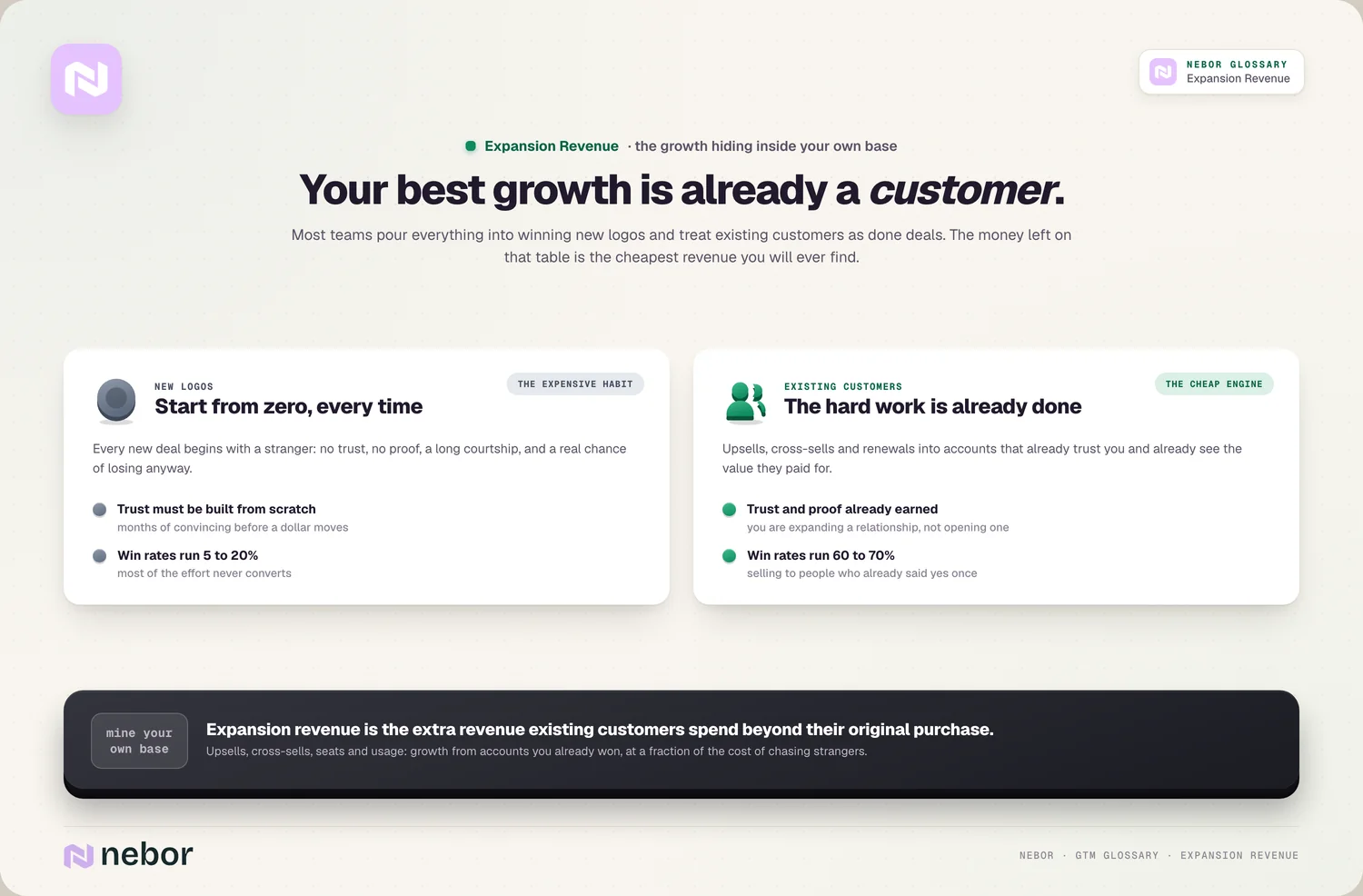
Most teams pour their energy into winning new logos and treat existing customers as done deals. That gets the priority exactly backwards, because your best growth opportunity is a customer who already trusts you, well ahead of any stranger you'd have to convince from scratch.
Selling more to someone who already buys from you is faster, cheaper, and far more likely to close than chasing a new prospect. Yet it's the growth lever teams most often underuse, leaving easy revenue on the table.
Expansion revenue is the additional revenue you generate from existing customers through upsells, cross-sells, upgrades, and added usage, on top of what they already pay. It's growth from the customers you've already won.
Expansion is the most efficient growth there is. It costs a fraction of new acquisition, converts at far higher rates, and compounds your customer base into a growth engine instead of a leaky bucket you constantly refill.
TL;DR
Expansion revenue is the extra revenue from existing customers through upsells, cross-sells, and upgrades, separate from revenue won from new customers.
It's the cheapest, highest-probability growth available, because selling to existing customers costs far less and closes far more often than acquiring new ones.
It's a core driver of net revenue retention and compounding growth, because a base that expands grows on its own even before new sales.
The condition attached is that expansion has to be earned through delivered value. You can't upsell customers who aren't succeeding, so expansion depends on retention and customer health.
So what is expansion revenue, exactly, and where does it come from?
Expansion revenue is the additional money existing customers spend with you beyond their original purchase. It's growth that comes from your current base instead of from new logos.
It comes from a few familiar sources. Upsells move customers to higher tiers, cross-sells add new products, and usage growth like more seats or higher volume increases what they pay.
It's measured separately from new business on purpose. Expansion revenue counts only the increase from existing customers, which isolates how much your current base is growing on its own.
It's the direct opposite of contraction in your base. Where downgrades and churn shrink your existing revenue, expansion grows it, and the balance between the two determines whether your base expands or leaks.
So expansion revenue amounts to growth from within. It measures how much more your existing customers are worth over time, which is one of the most important and efficient forms of growth.
Why is expansion so much cheaper than acquiring new customers?
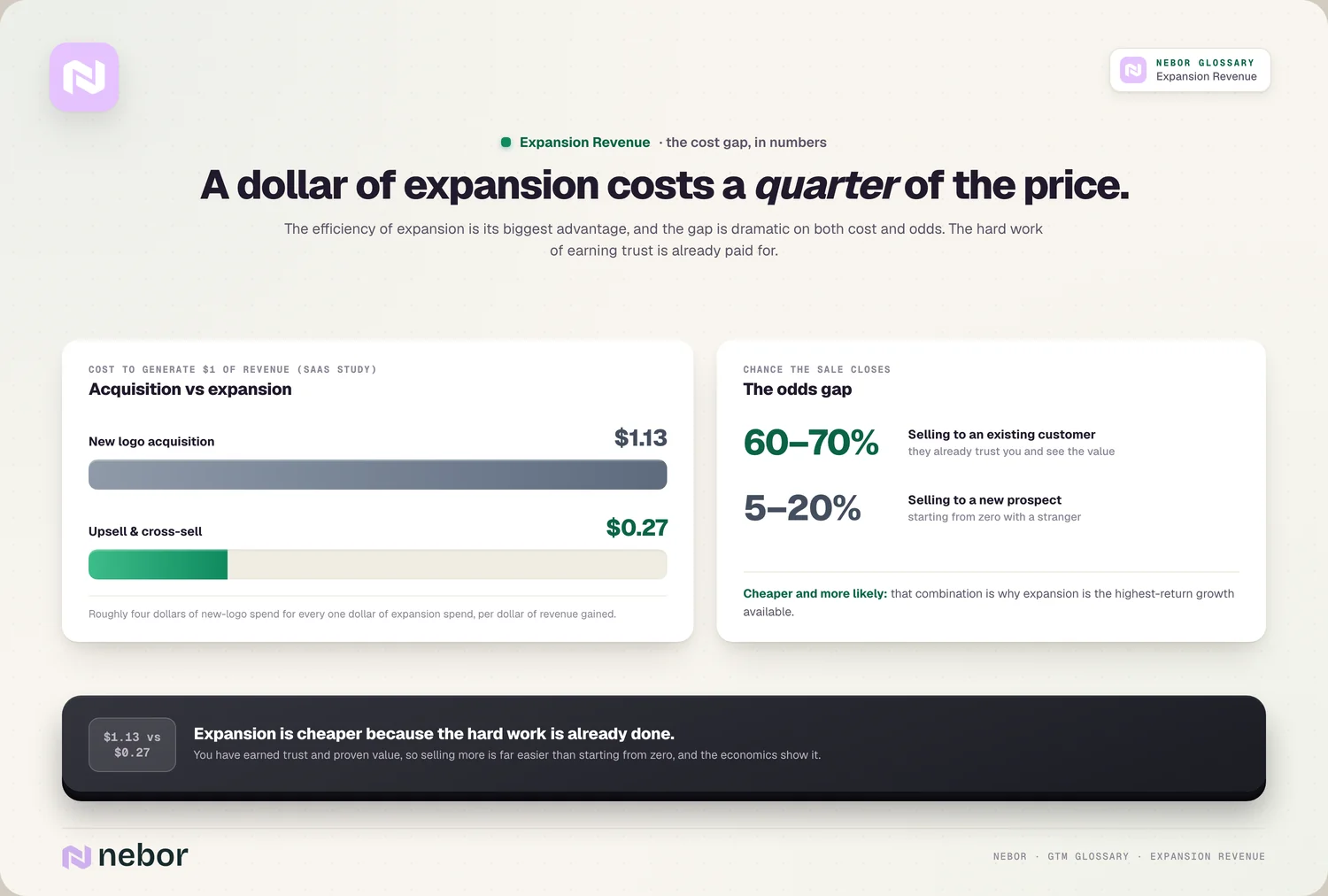
The efficiency of expansion is its biggest advantage, and the numbers behind it show a dramatic cost gap.
Expansion costs a small fraction of acquisition. One study of SaaS companies found that new logo acquisition costs around $1.13 per dollar of revenue, while upselling and cross-selling cost about 27 cents per dollar.
The probability gap is just as large. The chance of selling to an existing customer is around 60 to 70%, versus 5 to 20% for a new prospect, because they already trust you.
This compounds into real efficiency for your team. Acquiring a new customer can cost many times more than expanding an existing one, which makes expansion the highest-return growth available.
So expansion is cheaper because the hard work is done. You've already earned trust and proven value, so selling more is far easier than starting from zero with a stranger.
How does expansion relate to your customer acquisition cost?
Expansion changes the math on your whole acquisition strategy, so it helps to connect them. The two are linked through unit economics.
Expansion lowers your effective acquisition cost over time. When customers expand, the revenue from a customer grows without new customer acquisition cost, so your blended cost per dollar of revenue falls.
It raises lifetime value at the same time. Customers who expand are worth more over time, which increases customer lifetime value and lets you afford to spend more acquiring them.
The combination is quietly powerful for your team. High expansion means each customer is worth more and gets cheaper to grow, which improves the economics of your entire go-to-market.
So expansion works as a multiplier on your acquisition economics, beyond the extra revenue itself. It makes every customer you win more valuable, which strengthens the case for acquisition itself.
Why is expansion the engine behind strong net revenue retention?
Expansion is the mechanism behind one of the most watched metrics in business, because it's what pushes retention past 100%.
Net revenue retention measures whether your existing base grows or shrinks. Expansion is the part that can push net revenue retention above 100%, where customers spend more over time even with no new sales.
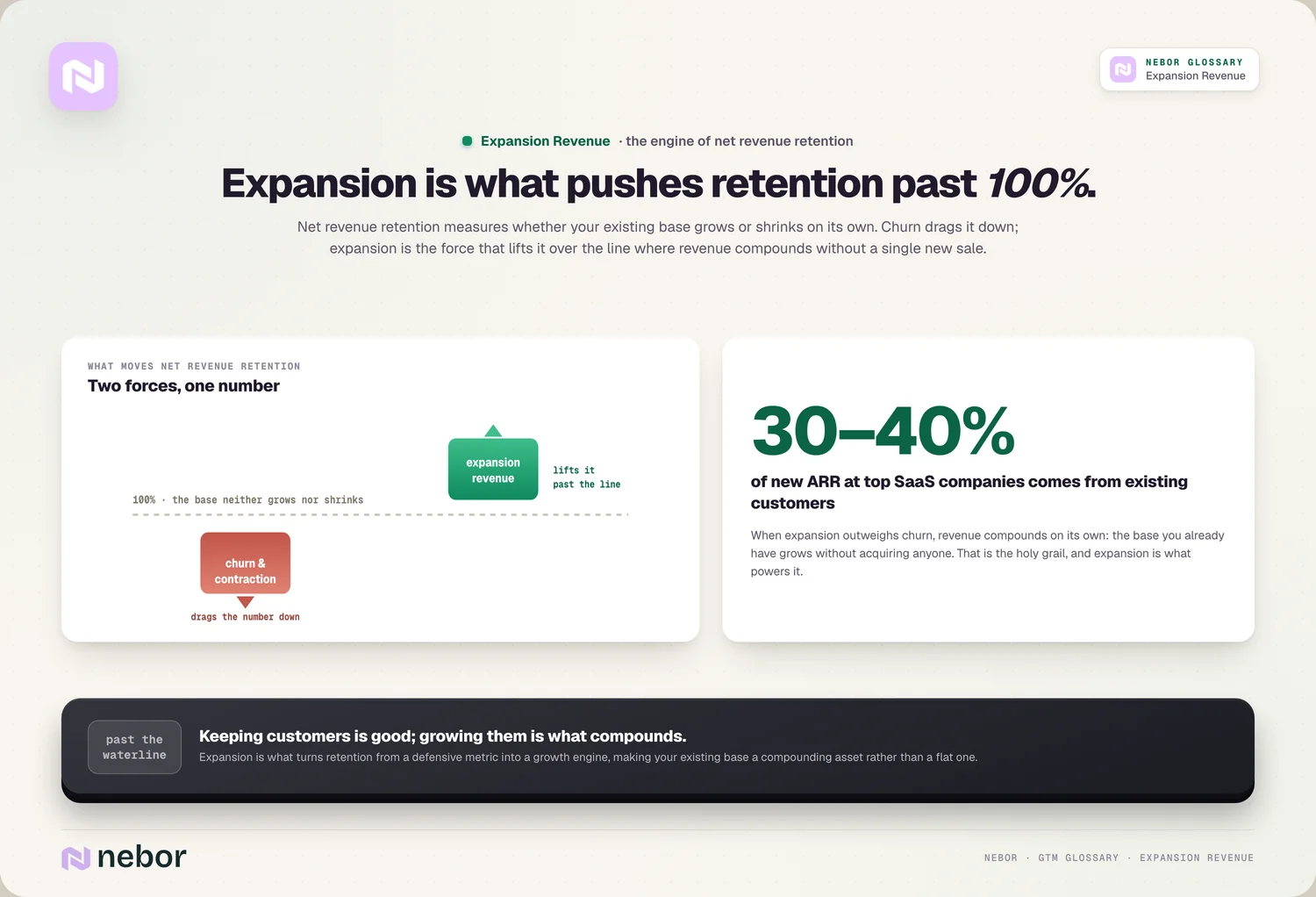
That's the holy grail of compounding growth. When expansion outweighs churn and contraction, your revenue compounds on its own, so the base you already have grows without acquiring anyone.
It's why the best companies obsess over it. Top SaaS companies generate around 30 to 40% of their new ARR from existing customers, which is expansion doing the heavy lifting.
So expansion is what turns retention into growth. Keeping customers is good, but growing them is what makes your existing base a compounding asset instead of a flat one.
Why does expansion depend entirely on the value you've delivered?
A hard truth about expansion is that you can't force it. It has to be earned, which connects it tightly to customer success.
You can't upsell a customer who's struggling. A customer who isn't getting value from what they already bought won't buy more, so expansion depends on them succeeding first.
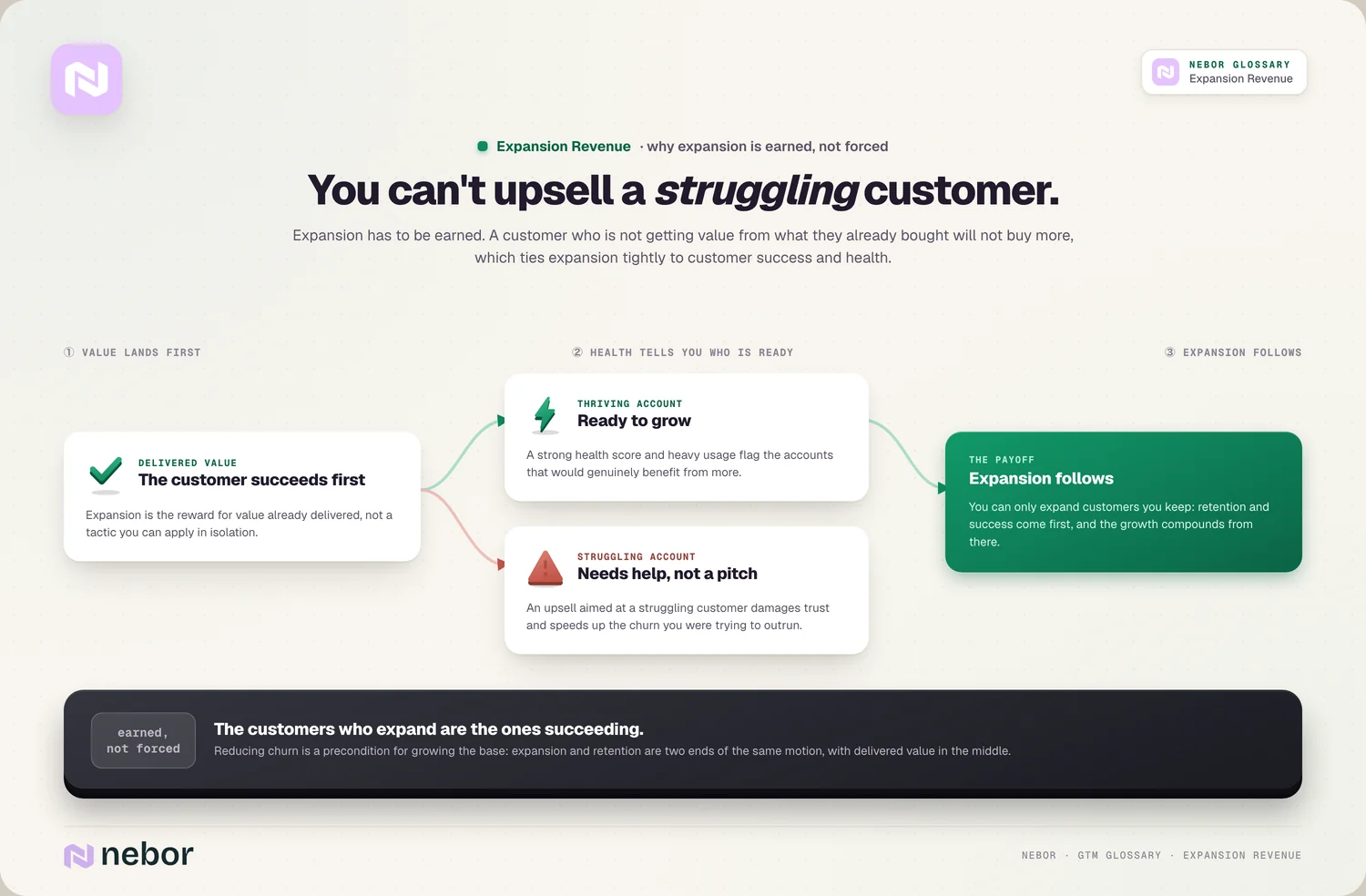
This ties expansion tightly to account health. A strong customer health score identifies the thriving customers ready to expand, while struggling ones need help before any upsell.
It depends on retention just as much. Expansion and customer churn rate are linked, because you can only expand customers you keep, so reducing churn is a precondition for growing your base.
So expansion is the reward for delivered value instead of a tactic you apply in isolation. The customers who expand are the ones succeeding, so retention and success come first.
How do you drive expansion revenue on purpose instead of by luck?
Expansion takes a deliberate motion instead of happening by accident, and in our experience a few levers do most of the work.
The classic approach is land and expand. You win an initial foothold, deliver value, then grow into more teams, use cases, and seats over time as trust builds.
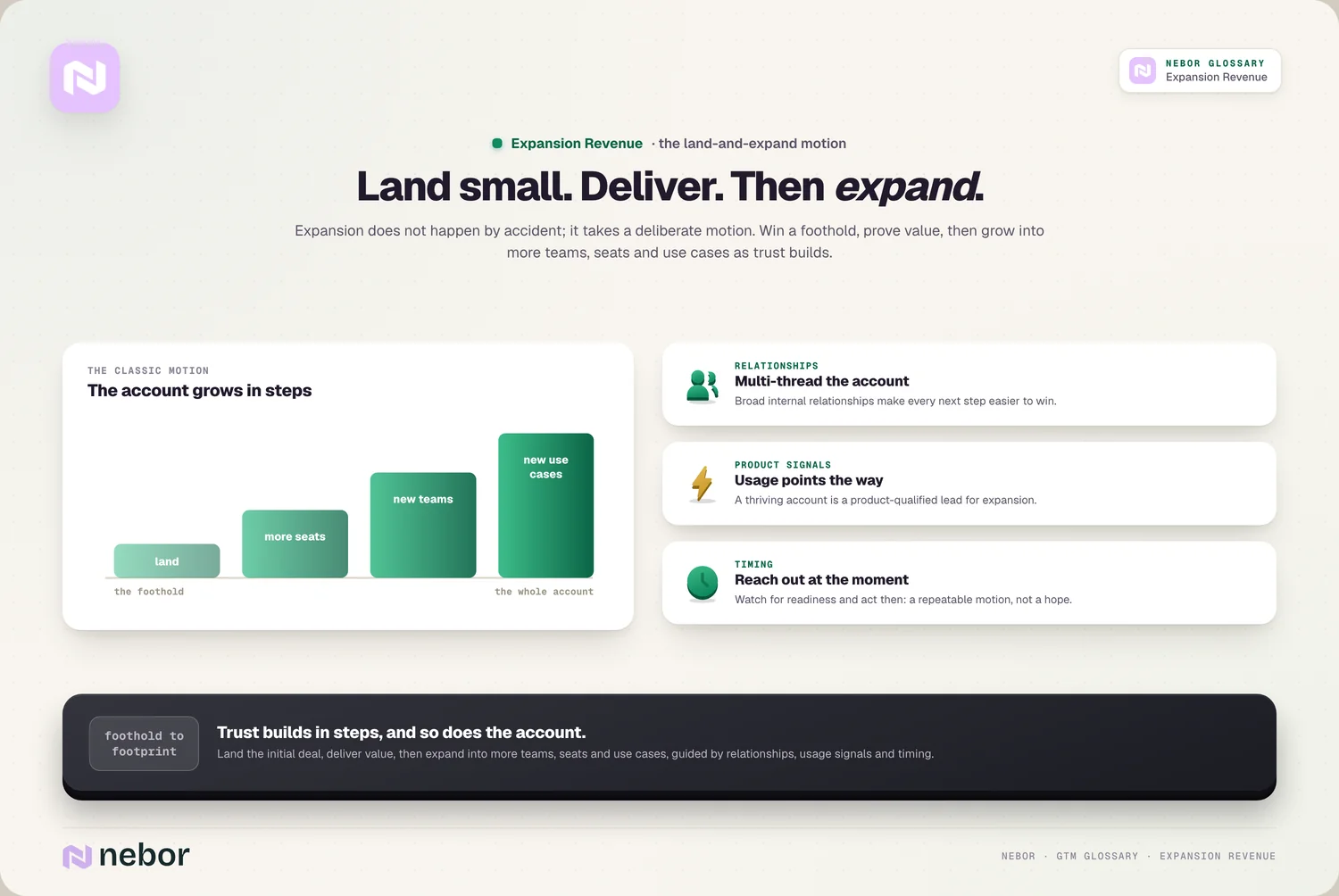
It depends on relationships inside the account. Growing an account means reaching more people in it, which is where multi-threading matters, because broad internal relationships make expansion easier.
Product signals point the way to the ready accounts. A thriving account behaves like a product qualified lead for expansion, because heavy usage shows they'd benefit from more.
It rewards proactive timing on top of everything. Watching for the moments a customer is ready to grow, and reaching out then, turns expansion from a hope into a repeatable motion you can automate sales prospecting signals around.
How does expansion revenue fit into your broader growth engine?
Expansion is a core part of how the whole business grows, far beyond a customer-success afterthought, and it connects to everything around it.
It compounds whatever flywheel you're already building. Expanding customers who also refer others feed a GTM flywheel where growth comes increasingly from your existing base instead of constant new acquisition.
It strengthens the engine underneath it all. A revenue engine with strong expansion grows more efficiently, because a meaningful share of growth comes from customers you already have.
It rewards good targeting years after the fact. Customers who fit your ideal customer profile expand more, so acquiring the right customers in the first place sets up expansion later.
So expansion is woven through the growth model. It links retention, lifetime value, and acquisition into a compounding system, and the best teams treat it as a first-class growth lever for exactly that reason.
When should you focus on expansion versus winning new customers?
A real strategic question is how to balance expansion against winning new customers. The answer depends on your stage and base.
Early on, acquisition simply has to dominate. With few customers, you don't have a base to expand, so new logos are where growth has to come from.
As the base grows, expansion gets more powerful. With a substantial customer base, expansion becomes a major, efficient growth source that's cheaper than constantly acquiring.
The strongest companies end up doing both. They keep acquiring while systematically expanding their base, so growth comes from both new and existing customers instead of one alone.
So the balance keeps shifting over time. The bigger and healthier your base, the more expansion should feature in your growth, because it's the most efficient revenue you can generate.
What's the difference between an upsell and a cross-sell in practice?
Expansion comes in a few forms, and the two most common get confused. Both grow an existing customer, in different ways.
An upsell moves a customer further up. It means getting them to a higher tier, more seats, or greater usage of what they already have, so they pay more for more of the same product.
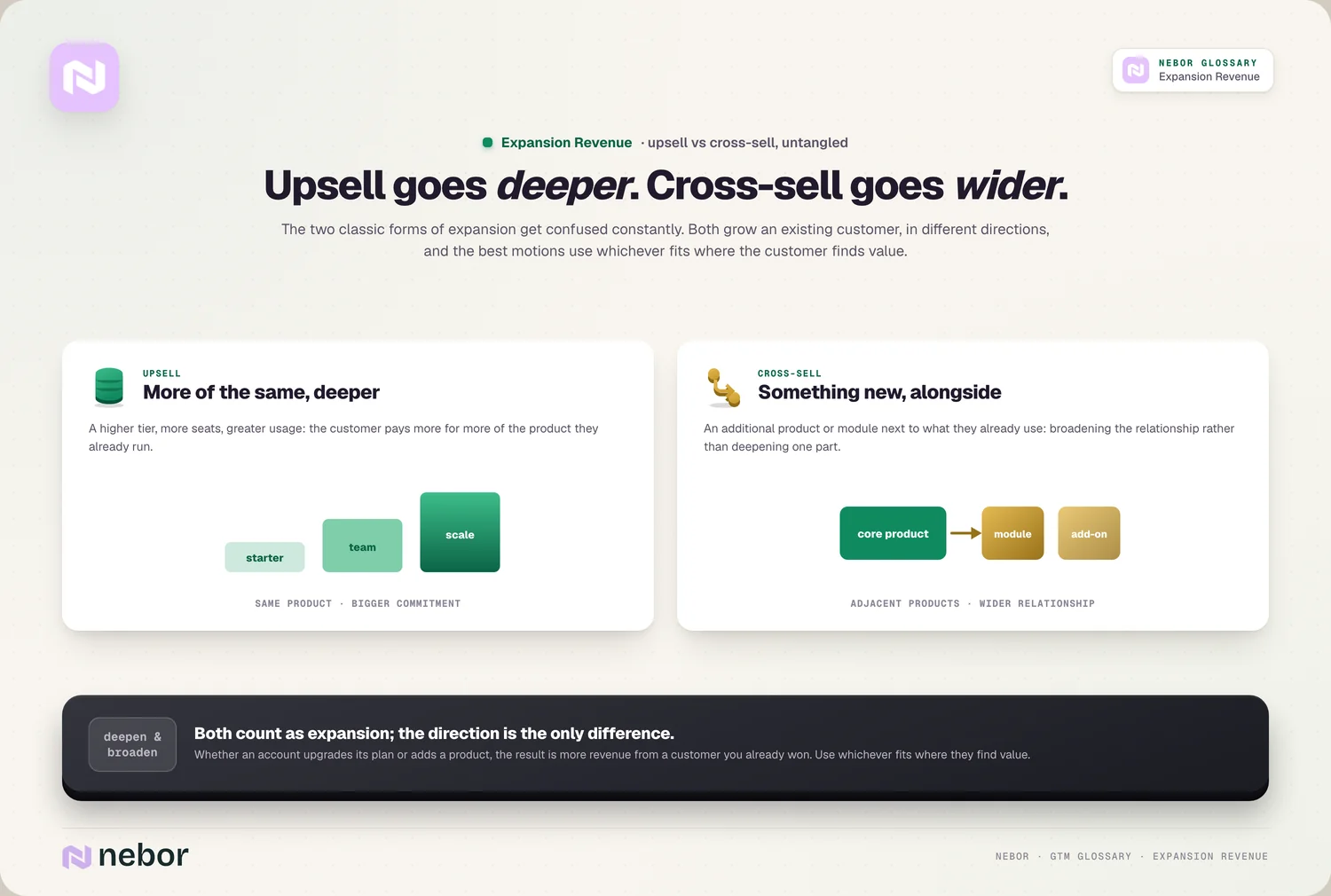
A cross-sell adds something new to the relationship. It means selling a customer an additional product or module alongside what they already use, broadening the relationship instead of deepening one part of it.
Both count as expansion in the numbers. Whether a customer upgrades their plan or adds a new product, the result is more revenue from an existing account, and that increase is what expansion measures.
So upsell deepens and cross-sell broadens, but both grow the account. The best expansion motions use both, matching whichever fits where the customer is finding value.
How do you measure expansion revenue without muddling the picture?
Measuring expansion well is what lets you manage it, so a few practices matter. The metric is simple but easy to muddle.
The core calculation is the increase from existing customers. You sum the new recurring revenue from upsells, cross-sells, and upgrades, excluding anything from newly acquired customers.
Read it against contraction every single time. Expansion only tells half the story, so you weigh it against downgrades and churn to see whether your base is net growing or shrinking.
Track the rate as well as the dollars. Top SaaS companies achieve expansion rates around 10 to 30% annually, so measuring expansion as a percentage of your base shows how healthy it is.
So measure expansion as both an absolute and a rate, alongside contraction. That combination tells you whether your existing base is genuinely compounding or just churning and refilling.
Who should own expansion, the sales team or customer success?
A practical question is which team should drive expansion. The answer varies, but the tension is worth resolving deliberately.
Customer success holds the day-to-day relationship with the account. They know which accounts are thriving and ready to grow, which makes them well placed to spot expansion opportunities early.
Sales holds the closing motion and the craft. Negotiating an upgrade or new contract is a sales skill, so many companies bring sales in once an opportunity is identified.
The best setups we've seen blend the two. Success surfaces the signals and sales closes the deal, or success owns expansion directly with the right incentives, so the handoff is deliberate instead of accidental.
So expansion ownership deserves deliberate design instead of ambiguity. Whoever owns it needs both the relationship insight to spot opportunities and the motion to close them, so the two functions have to coordinate.
What are the common mistakes teams make with expansion revenue?
Expansion goes wrong in a few predictable ways, and we keep seeing the same ones when we look inside client accounts. Avoiding them is what makes it a reliable growth source.
Neglecting it entirely wastes the most, because pouring everything into new acquisition while ignoring existing customers leaves the cheapest growth untapped.
Forcing it on struggling customers backfires, because pushing upsells on accounts that aren't succeeding can accelerate churn, given expansion has to be earned.
Hiding churn behind expansion fools you slowly, because a few expanding accounts can mask heavy churn underneath, so you read expansion alongside retention instead of alone.
And treating it as one-off upsells sells it short, because real expansion is a systematic motion of growing accounts over time, well beyond opportunistic upsells when someone happens to ask.
Why is expansion revenue getting more important with every year?
Expansion has always mattered, but it's become more central lately. A couple of forces are pushing teams toward it.
Acquisition keeps getting more expensive every year. As the cost of winning new customers rises, the efficiency of growing existing ones looks better by comparison, so expansion gets relatively more attractive every year.
Investors reward it more visibly every year. Strong net revenue retention, driven by expansion, has become one of the metrics buyers and investors scrutinize most, because it signals durable, efficient growth.
Markets eventually saturate on top of that. When the pool of new customers shrinks, growing your existing base becomes the main path forward, which makes expansion a long-term necessity instead of a bonus.
So expansion is moving from a nice-to-have to a core growth strategy. The teams that build a real expansion motion now are the ones positioned to grow efficiently as acquisition gets harder.
Why the customers you already have are the growth you're overlooking
Expansion revenue is the most efficient growth available. Selling more to customers who already trust you is cheaper, more likely to close, and faster than chasing strangers, yet it's the lever teams most often underuse.
The deeper point is that expansion turns your customer base into a growth engine. When existing customers grow faster than they churn, your revenue compounds on its own, and that compounding is what pushes net revenue retention past 100%.
The honest requirement is that expansion be earned. You can't upsell customers who aren't succeeding, so expansion depends on retention, delivered value, and customer health instead of aggressive selling.
So if your growth feels like an expensive treadmill of constant acquisition, expansion is where the easy gains often are. Building a deliberate motion to grow the customers you already have is how you turn your base into compounding revenue.
That compounding is exactly the efficient growth a modern go-to-market system is built to capture. Acquisition fills the base, but expansion is what makes the base worth more every year.
Share this post
RevOps
Glossary
Related glossary items
Understanding the core GTM concepts




Ready to build your pipeline











