
Outsourced SDR Companies in 2026: Who’s Worth Hiring, How Much They Cost, and the Model You Probably Should Pick


In this post:
The best outsourced SDR companies in 2026 fall into two camps: manpower-led agencies like Belkins and Martal Group that rent you a sales development team, and automation-led partners like Nebor that build you a prospecting system you keep.
If you're like most B2B teams, you're probably going through an agency shortlist wondering which agency to sign, and it's the wrong question. Because the sales outsourcing company you pick matters less than the model you pick.
There are two ways to outsource SDR work in 2026. With manpower-led outsourcing, the outsourcing company assigns you sales development representatives who research, build, and dial your list until the contract ends, and you walk away with nothing.
With automation-led outsourcing, the partner builds you a prospecting and qualification system that books your meetings, and the Clay tables, sequences, and enrichment logic behind your lead generation stay in your accounts.
Below, we walk through all 17, so you'll know which model fits you and which sales outsourcing company deserves your shortlist.
If the automation-led model sounds like the better fit, book a call with us and we'll show you what it would look like for your motion.
TL;DR (all 17 agencies, plus Nebor, in one table)
If you're skim-reading, this table is the answer up front; the full breakdown of every outsourced SDR company's offerings follows.
Manpower-led means you rent humans or AI workers, and the workflows live in the agency's tools.
Automation-led ownership means you pay a partner to build the prospecting and qualification system, and you keep it in your accounts after the engagement ends.
Agency | Model | Pricing | Min commitment | Geography | Own? |
|---|---|---|---|---|---|
Nebor | Automation-led, custom build | Custom engagement | 3-6 months typical | EU + global | Yes (workflows live in your accounts) |
Belkins | Manpower-led, full-service | $4K-$8K/SDR/mo | 6-12 mo | US-led, global | No |
Martal Group | Manpower-led, full-service | $2K-$40K/mo | 6 mo+ | US/Canada + EU + LATAM | No |
MarketStar | Manpower-led, full-service | $50K-$250K+/Q | Annual+ | 90+ countries | No |
JumpCrew | Manpower-led, full-service | $15K-$40K+/mo | 6 mo | US-based | No |
Air Marketing | Manpower-led, full-service | £4K-£10K/mo | 6 mo | UK | No |
SalesRoads | Manpower-led, custom build | $5K-$12K/SDR/mo + setup | 12 mo typical | US-based | No |
Leadium | Manpower-led, custom build | $4K-$9K/SDR/mo | 6-12 mo | 7 countries | No |
EBQ | Manpower-led, custom build | $3.5K-$10K/SDR/mo, $5K min | Flexible | US (Austin) | No |
SalesNash | Manpower-led, custom build | $3K-$7K/SDR/mo | 6 mo | Multi-region | No |
The Sales Factory | Manpower-led, nearshore | $2.5K-$6K/SDR/mo | 6 mo | Toronto-led, nearshore | No |
memoryBlue + Operatix | Manpower-led, global arbitrage | $3.5K-$11K/SDR/mo | 6-12 mo | NA + EMEA + LATAM + APAC, 22 languages | No |
SalesAR | Manpower-led, nearshore + PPM | From $1.5K/mo or $150-$600/mtg PPM | 3-6 mo | Ukraine + UK + US + EU | No |
LevelUp Leads | Manpower-led, fractional | $2K-$5K/mo | 3 mo | Fully remote | No |
Sopro | Hybrid manpower + platform | From £3K/mo | Month-to-month | UK + Australia | No |
AiSDR | AI-native | $900-$2,500/mo | Monthly (20% off annual) | SF + EU engineering | No |
Artisan AI | AI-native | $2K-$5K+/mo annual | 12 mo | San Francisco | No |
AI-native | $60K-$120K+/yr | 12 mo annual | SF (founded London) | No |
The two ways to outsource SDR work in 2026, and why one of them stopped working
Pick any sales agency ranking for "outsourced SDR companies" and the transaction is the same. You pay a monthly retainer, the outsourcing company assigns headcount, and that headcount emails potential customers until you stop paying.
What you're really buying is headcount, and that's how most of the outsourced sales category still operates. More sales pipeline means more SDRs; EMEA coverage means an EMEA rep. Your sales team stays the same size while the invoice grows.
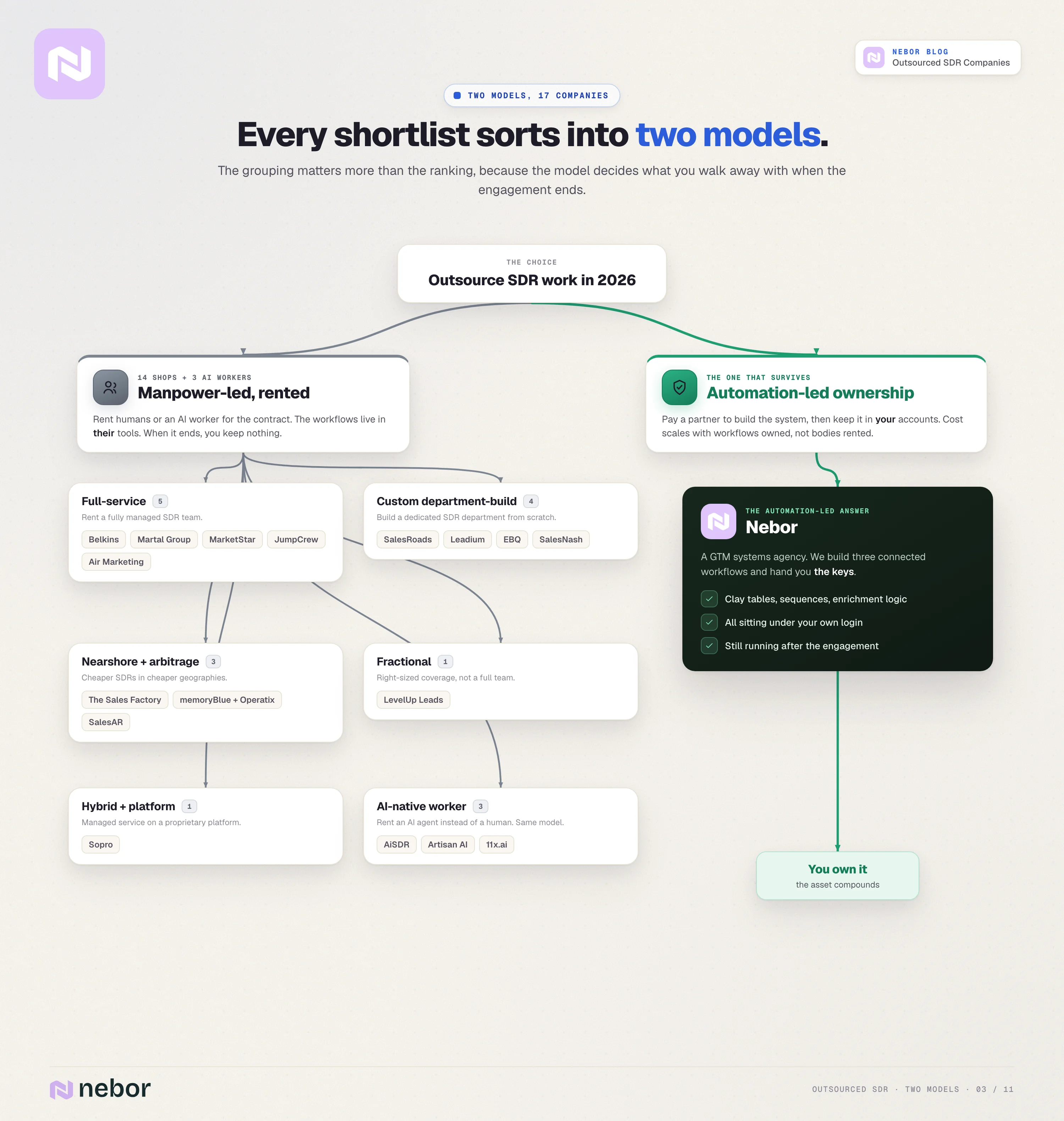
When the engagement ends, you keep the meetings that happened and lose everything else: the outreach platform, the list-building process, the messaging templates. The next sales outsourcing company you hire starts your lead generation from zero.
The AI-SDR startups (Artisan, 11x, AiSDR) sell what looks different, but you're still renting a worker, and when you cancel, the prompts, lists, and learnings stay with them.
We've written about why SDR-as-a-Service stopped making sense in 2026, and the AI version of SDR outsourcing is the same problem in a more expensive wrapper.
Automation-led outsourcing flips what you're paying for. You pay a partner to build the prospecting and qualification system, and the Clay tables, Instantly campaigns, n8n workflows, and HubSpot enrichment routines all live under your login.
A workflow that books 30 meetings this month can book 100 next month at the same fixed cost, so your lead generation stops depending on headcount. When the engagement ends, the workflows keep going: ownership over rental, in practice.
A warning, though: automation-led sales outsourcing is harder to do well. We've covered why most Clay implementations fail, and the short answer is that the system only works if the sales thinking behind it is right.
So whether you're outsourcing SDR services for the first time or switching agencies, the choice is the same: rent bodies for the length of a contract, or pay a partner to build something you keep.
Why you don't need more SDRs, and how Nebor takes top-of-funnel (ToFU outbound and inbound) work off your team's plate
Most B2B teams reach for outsourcing SDR services because they think their problem is capacity, but the diagnosis is one layer too shallow.
The real problem is that your existing reps spend most of their week on top-of-funnel lead generation work that shouldn't need a human: desk research, manual LinkedIn prospecting, copying names into spreadsheets, hunting for verified emails, drafting cold messages.
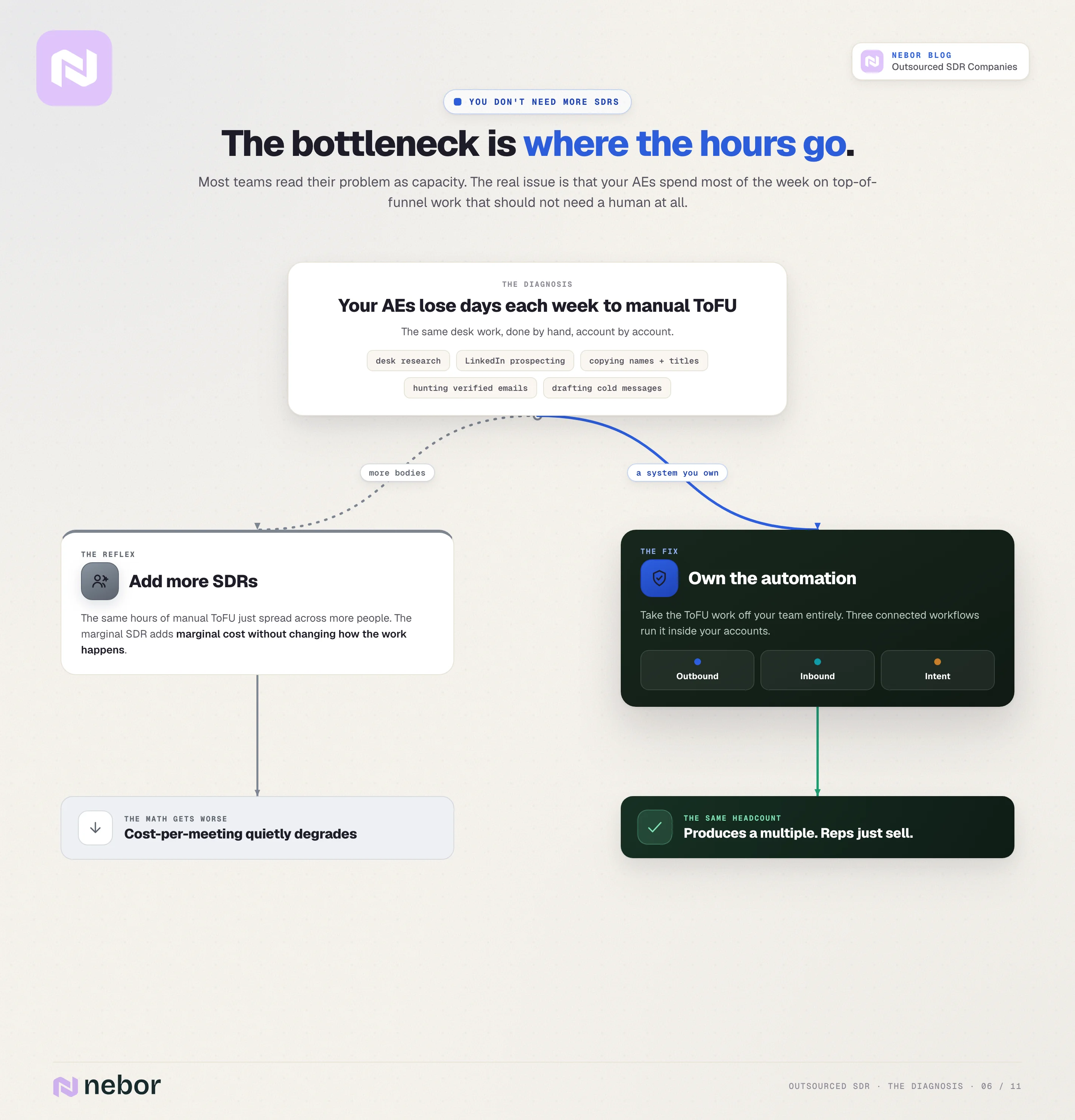
We've watched 30-person sales teams lose days each week to that work, then convince themselves the answer is hiring more sales development representatives. It doesn't work. Adding SDRs spreads the same manual work across more people, and the cost-per-meeting quietly degrades.
The fix is to take the manual ToFU work off your sales team entirely, and it's the highest-leverage business growth move most teams haven't made.
We're a GTM systems agency rather than a lead generation agency, and the distinction matters more than it sounds. For clients, we build three connected workflows that live in their accounts.
You get an outbound workflow for cold accounts matching your ICP, an inbound workflow that routes every warm signal to the right rep, and an intent workflow watching buying windows across your target market.
Workflow one: We build you an automated outbound system that produces meetings without your team touching a list
Outbound is where the heaviest manual lift is: hand-built target lists, LinkedIn scraping, email hunting, message drafting. We replace that whole loop with a Clay-anchored workflow that handles the lead generation and the outreach without your reps ever touching a spreadsheet.
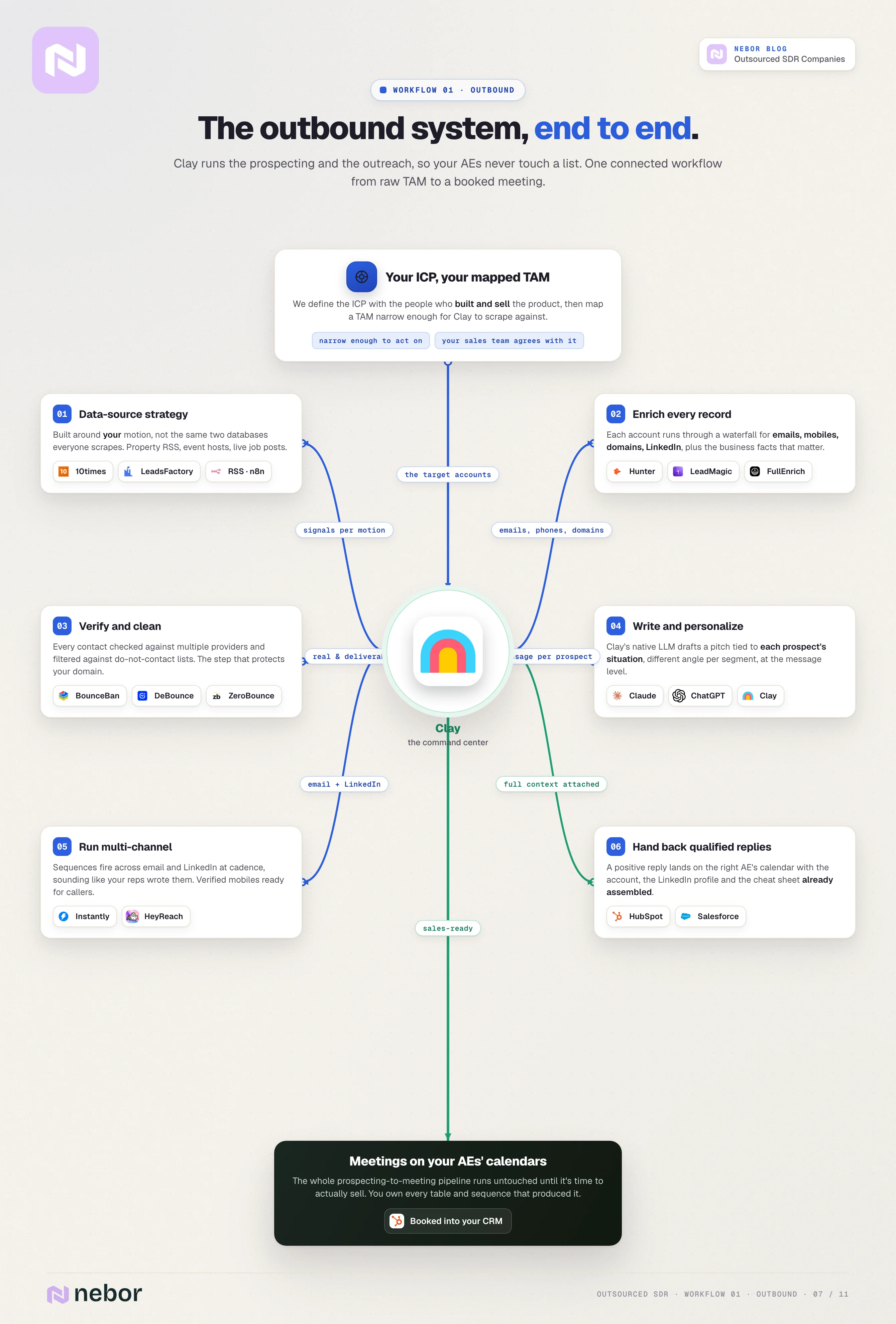
We define your ICP and map your TAM with you, then build a data-source strategy around your motion
We design multi-channel sequences that sound like your reps wrote them, creating customized outreach strategies for each segment
We hand qualified replies back to your reps with the full context they need
Workflow two: We build you an inbound (enrichment and routing) system that catches every signal before it leaks
Demo requests wait in a queue for hours, ad traffic goes uncaptured, and website visitors who fit the ICP never hear from anyone.
Marketing-generated leads land in the CRM as raw email addresses, and high quality leads go cold while the sales team triages them in batches.
We close that gap with an inbound automation built around Clay, your CRM, and a Slack alerting layer.
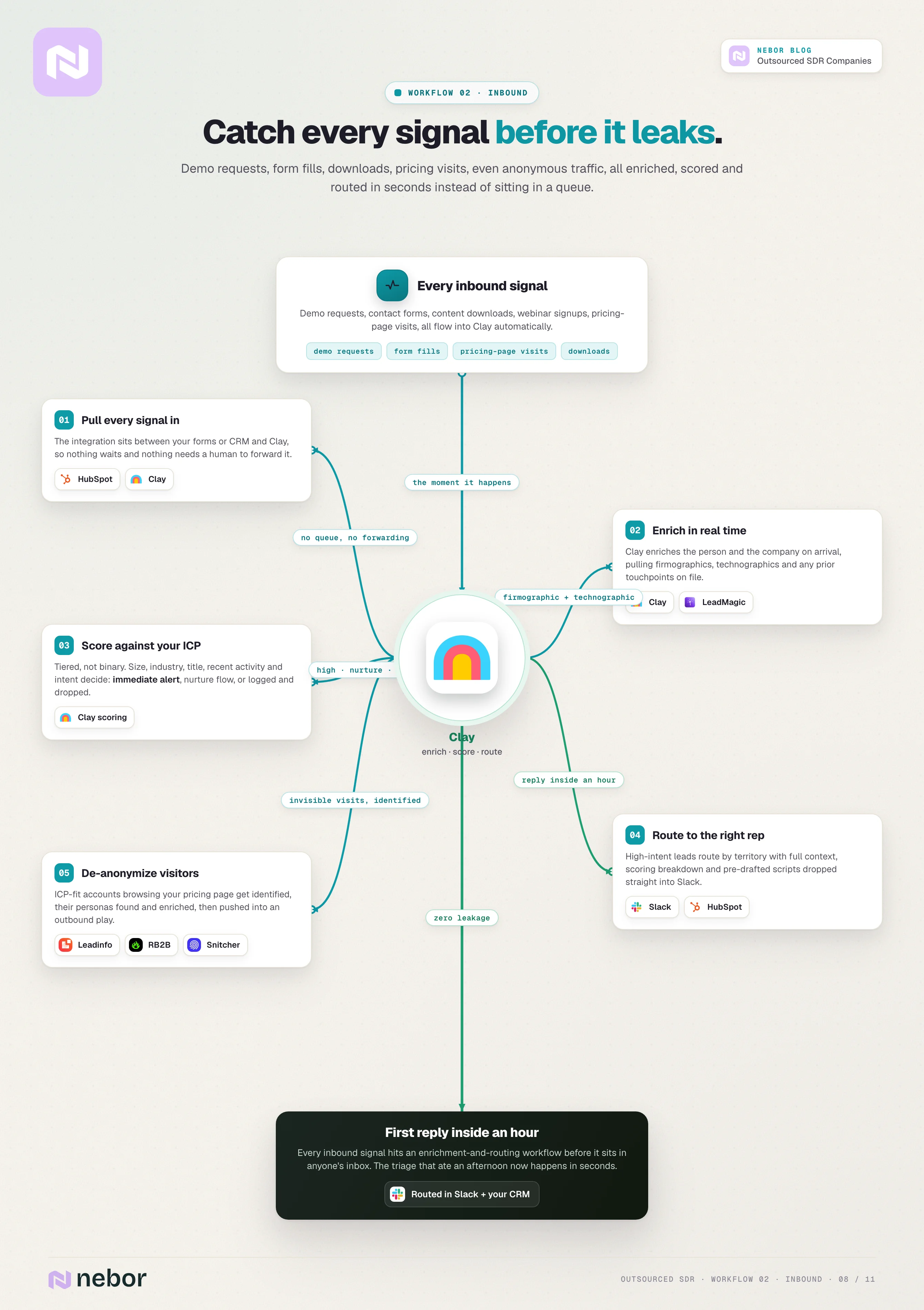
We pull every inbound signal into Clay automatically
We enrich and score against your ICP in real time
We route high quality leads with full context to the right rep through Slack
We de-anonymize website visitors and route ICP-fit ones into outbound
Workflow three: We build you a continuous intent monitoring workflow that engages prospects the moment they enter a buying window
The third workflow monitors buying signals across the public web and turns each one into action automatically.
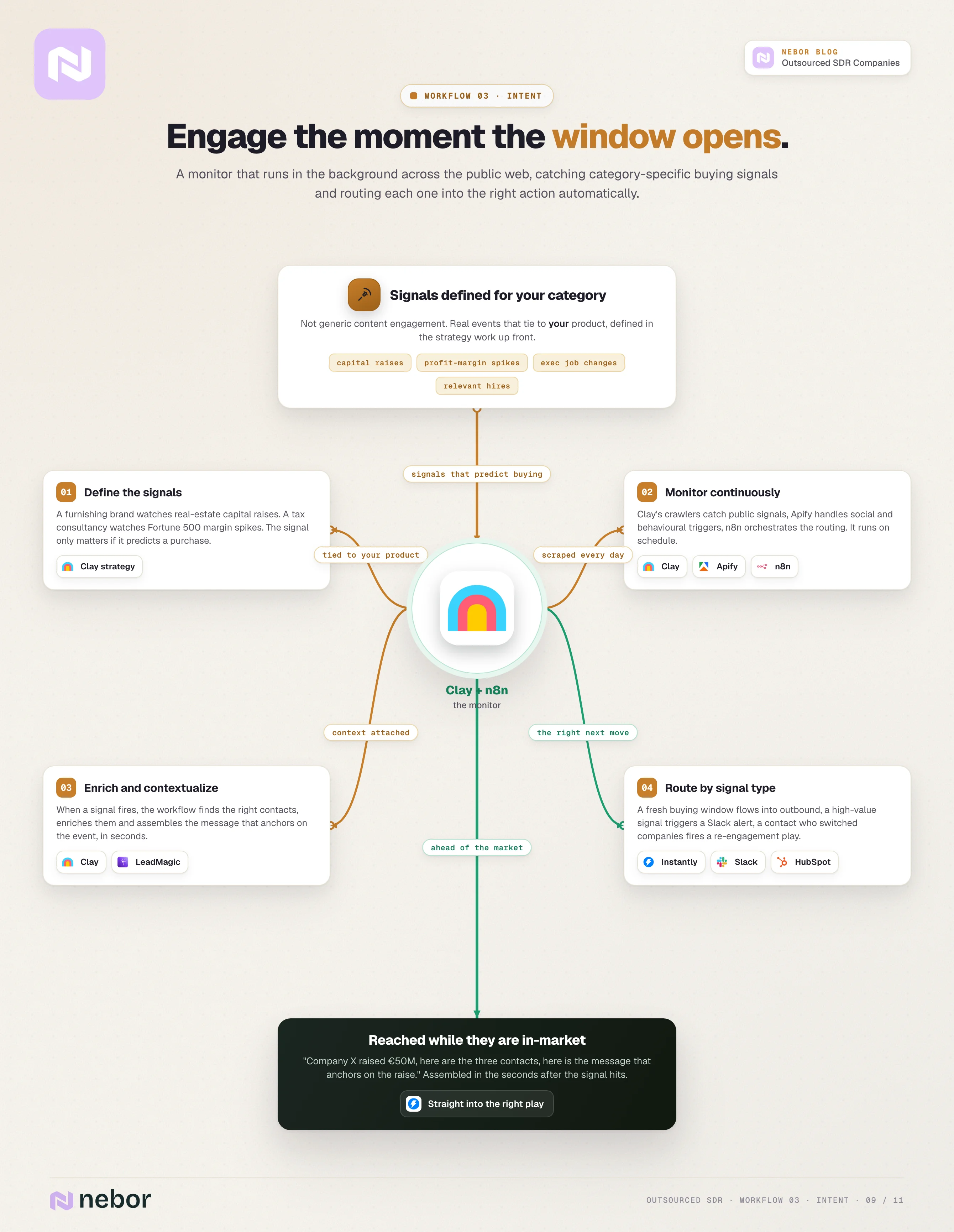
We define the intent signals that map to your ICP
We set up Clay, Apify, RSS readers, and n8n to monitor those signals continuously
We route every detected signal, auto-enriched and contextualised, to the right person, sequence, or alert
How the three workflows complement each other to free your team of the ToFU work
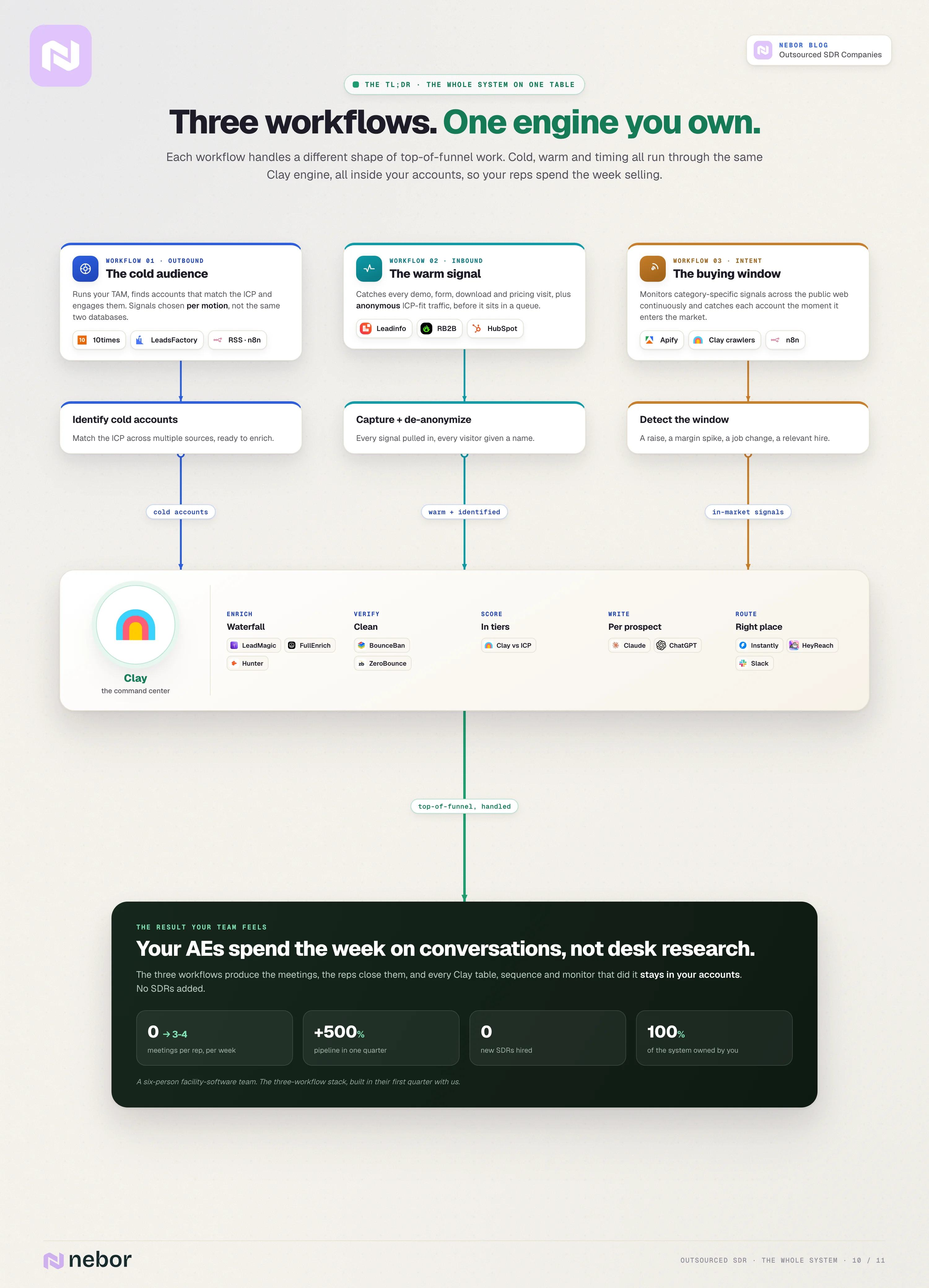
Your internal sales team's job changes shape: reps spend their week with potential customers and closing deals, and the workflows produce the sales pipeline.
For a recent client with a six-person sales team, per-rep meetings went from zero to three or four per week and pipeline grew 500% in three months, without adding an SDR.
Our answer to "should we hire more SDRs in 2026" is: probably not. Move the ToFU work into automation you own, and let the same internal team drive revenue growth without headcount growth.
We're salespeople first, automation experts second: we ran these systems for our own outbound before selling them.
To see what these three workflows would look like for your motion, book a call or find us on LinkedIn.
17 best outsourced SDR companies and the model each one actually sells
The list is grouped by model, because in outsourced sales the model determines what you walk away with when the engagement ends.
For anyone researching SDR outsourcing companies seriously, we name each outsourcing company's model, pricing where it's knowable, and the buyer its SDR outsourcing services fit. We've also written a longer contrarian case against hiring SDR agencies at all.
Manpower-led, full-service (rent a fully managed SDR team)
1. Belkins
Quick facts: Manpower-led, full-service. No public pricing. Industry chatter puts it at $4K to $8K per SDR per month with multi-month minimums.
Overview: Belkins is at the premium end of full-service sales outsourcing, staffing dedicated SDR teams. Their lead generation and appointment setting work carries a proven track record: a 95% retention rate across 1,000+ customers and 4.9 on Clutch.
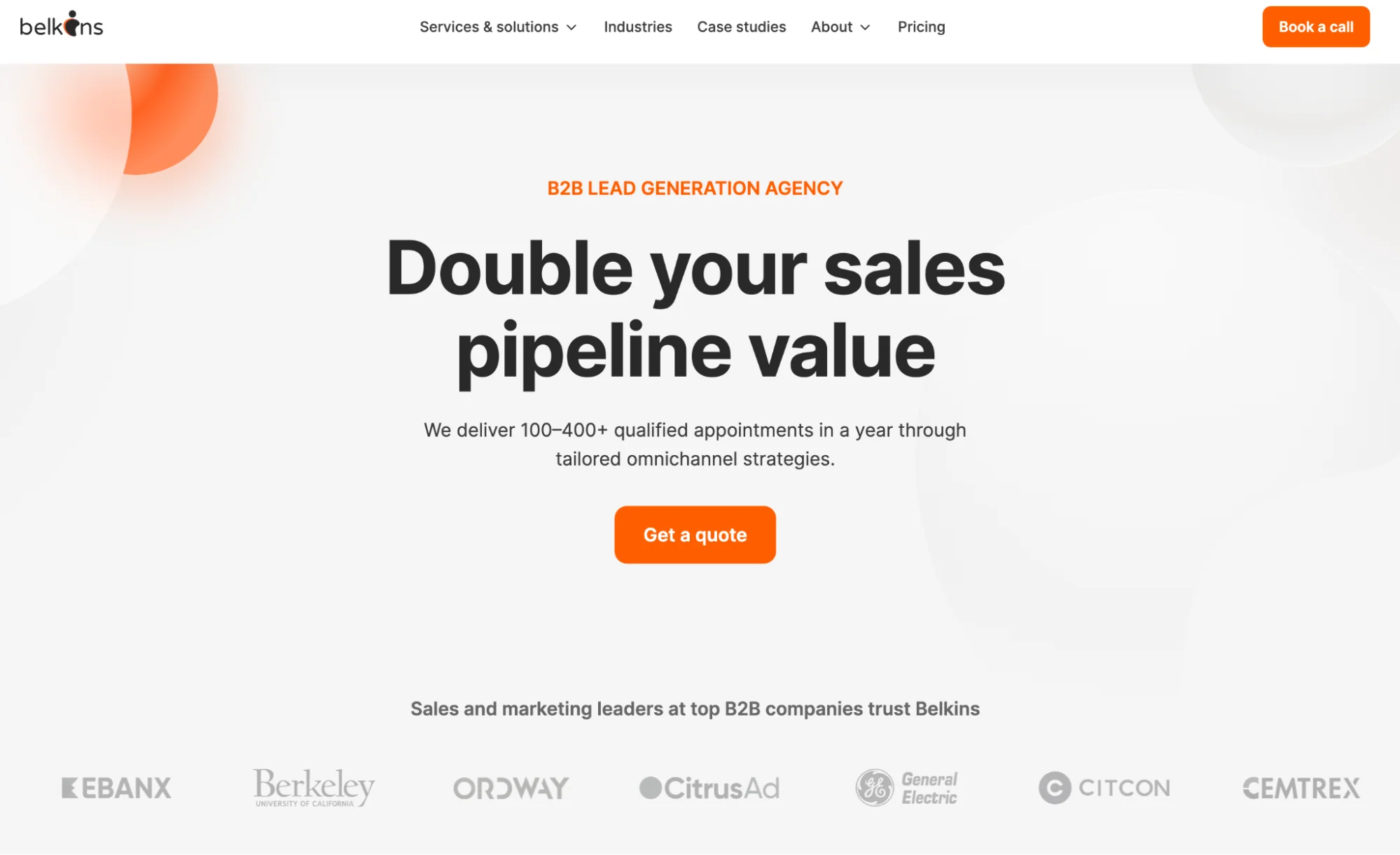
The fit is teams that want a fully managed outsourced SDR team: hand off the ICP, the sales strategies, and the campaign goals, and Belkins handles the rest.
2. Martal Group
Quick facts: Manpower-led, full-service. Tiered sales outsourcing services with reported ranges from $2,000 to $40,000 per month depending on scope.
Overview: Martal Group wraps lead generation, appointment setting, onboarding, and account management into one tiered engagement, with 200+ sales development representatives across North America, Europe, and LATAM. Their pitch pairs human intelligence with technology and sales training.
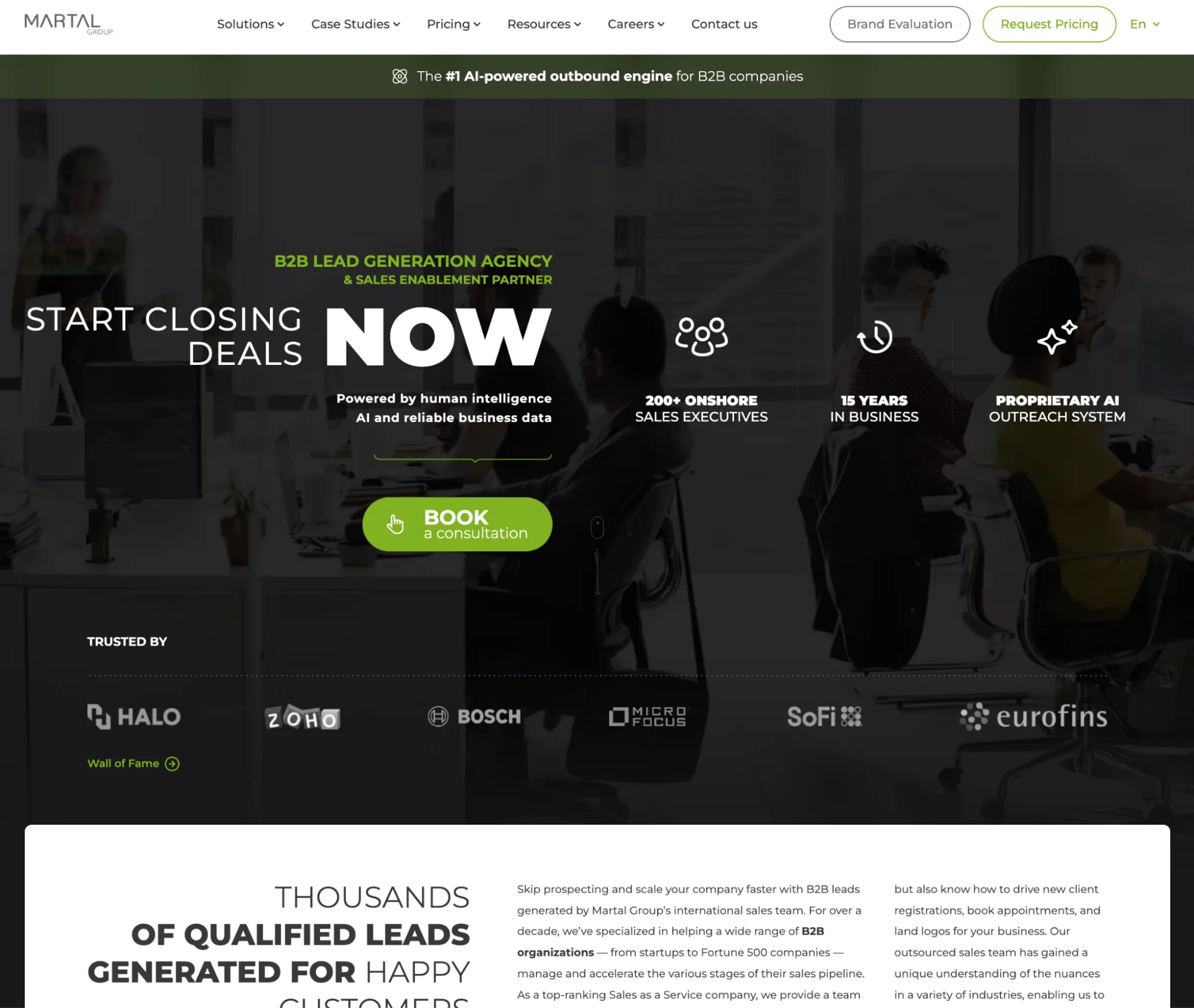
For an international software company selling across regions, the premium tiers turn outsourced sales into a longer revenue growth arc.
3. MarketStar
Quick facts: Manpower-led, full-service. No public pricing. Enterprise engagements typically cost $50K to $250K+ per quarter.
Overview: MarketStar delivers fully managed sales development programs and sales operations across 90+ countries, built for managing intricate sales processes. If enterprise SDR outsourcing at global scale is the brief, this is the profile.
They're best for Fortune 1000 rollouts and multi-region expansion, where local expertise across dozens of countries does work smaller agencies can't.
4. JumpCrew
Quick facts: Manpower-led, full-service. No public pricing. Multi-team engagements wrapping SDR, BDR, and AE functions, typically $15K to $40K+ per month.
Overview: JumpCrew bundles sales development representative, business development representative, and account executive resources into one engagement, deploying a dedicated team within 30 days that follows a structured sales process alongside your own sales efforts.
If you're an early-stage startup with no sales team yet, or a mid-market company testing a new product line, their end-to-end structure compresses months of in-house build into weeks.
5. Air Marketing
Quick facts: Manpower-led, full-service. No public pricing. UK retainers typically £4K to £10K per month.
Overview: Air Marketing staffs hand-picked SDR teams trained through their own sales training academy, with a client list that includes SAP, Dell, and Monzo.
The fit is UK and EMEA mid-market B2B that wants outsourced sales development with local expertise. If you're outsourcing SDR services in the UK market specifically, they're the reference name.
Manpower-led, custom department-build (build me a dedicated SDR department from scratch)
6. SalesRoads
Quick facts: Manpower-led, custom department-build. No public pricing. Typically $5K to $12K per SDR per month plus a setup fee.
Overview: SalesRoads builds fit-to-purpose outsourced sales development teams around your target market and GTM motion, bundling appointment setting, B2B lead generation, and market research into a custom department. They've done it for 430 companies, creating more than 50,000 new opportunities.
This works when you have clear sales objectives but no internal team with capacity to build the department. You'd rather pay an agency that aligns with your sales and company goals than hire a manager and four SDRs from scratch.
7. Leadium
Quick facts: Manpower-led, custom department-build. No public pricing. Per industry chatter, $4K to $9K per SDR per month plus onboarding fees.
Overview: Leadium staffs done-for-you outsourced sales development teams across seven countries, handling B2B lead generation from qualification through appointment setting.
They target companies that want personalized SDR outsourcing services without the offshoring stigma of cheaper alternatives.
8. EBQ
Quick facts: Manpower-led, custom department-build. Pricing partially public. $3,500 to $10,000 per SDR per month, $5,000 minimum.
Overview: EBQ assigns you a fractional team of SDRs, managers, and marketing support that operates as an extension of your internal team, with the performance monitoring sales leaders expect, an 18-year proven track record, and deep roots in the Salesforce ecosystem.
They're for mid-market B2B SaaS in the $5M to $50M ARR range.
9. SalesNash
Quick facts: Manpower-led, custom department-build. No public pricing. Per industry chatter, $3K to $7K per SDR per month.
Overview: SalesNash delivers full-scale sales development and lead generation across appointment setting, cold calling, and multichannel outreach, and client names like Amazon and Nvidia give them a proven track record for enterprise-curious buyers.
They fit verticals where sales outsourcing usually struggles. If you're a commercial real estate firm, or you sell into the advertising technology industries, they walk in with playbooks built with advertising tech companies and healthcare providers.
Manpower-led, nearshore and offshore arbitrage (cheaper SDRs based in cheaper geographies)
10. The Sales Factory
Quick facts: Manpower-led, nearshore arbitrage. No public pricing. Per industry chatter, $2.5K to $6K per SDR per month.
Overview: The Sales Factory offers outsourced sales development teams based in Canada. Their SDR services combine offshore cost efficiency with the cultural and language proximity of nearshore work.
Nearshore staffing avoids the classic offshore failure modes, so if a previous SDR outsourcing engagement failed on time zones, accents, or US business norms, this is the profile built for you.
11. memoryBlue + Operatix
Quick facts: Manpower-led, global arbitrage. Reportedly $3,500 to $11,000 per SDR per month depending on services and region.
Overview: The merged memoryBlue and Operatix operation fields 450+ SDRs across North America, EMEA, LATAM, and APAC, covering 22 languages.
For a US enterprise selling into APAC or a European company expanding into LATAM, it's one of the few outsourced sales footprints that supports that scope.
12. SalesAR
Quick facts: Manpower-led, nearshore + pay-per-meeting. Retainers from $1,500/month, ongoing engagements at €3,100 to €4,300, pay-per-appointment at $150 to $600 per meeting.
Overview: SalesAR staffs nearshore SDR teams across Ukraine, the UK, and the EU, with 350+ clients in SaaS, fintech, and professional services, and one of the few credible pay-per-appointment options in B2B lead generation.
They suit teams that want nearshore SDR services at lower entry pricing, and teams testing outsourcing sales development with the risk shifted to the agency through pay-per-meeting.
Manpower-led, fractional (right-sized SDR coverage instead of a full team)
13. LevelUp Leads
Quick facts: Manpower-led, fractional. No public pricing. Per industry chatter, $2K to $5K per month, scaling with hours and channels.
Overview: LevelUp Leads offers a fractional model between full-service agencies and freelancers: remote teams managing email, LinkedIn, cold calls, and adjacent sales services, sized to what you need.
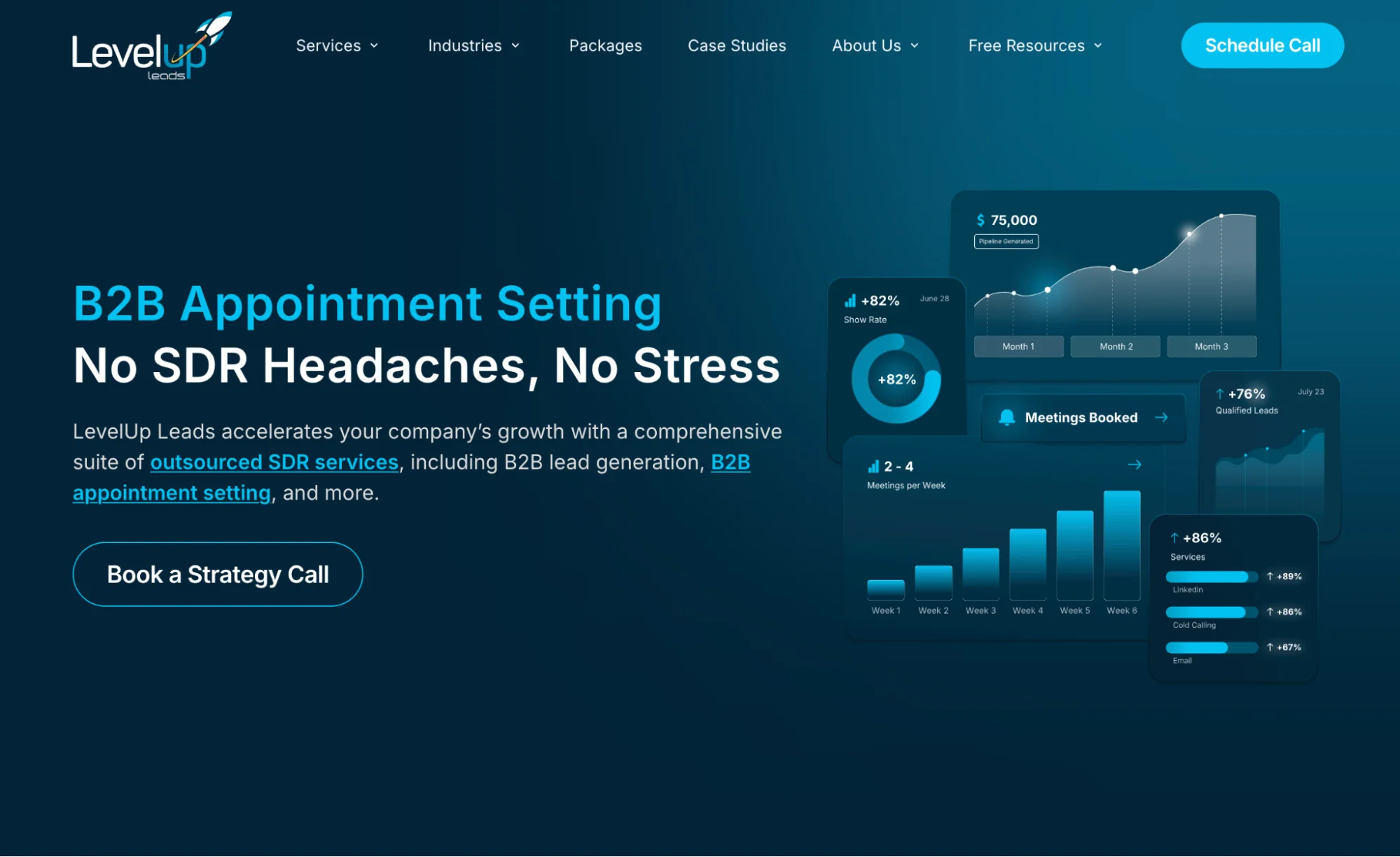
They best fit lean teams outsourcing SDR services on a budget: outbound capacity without committing to a full outsourced SDR team.
Hybrid (manpower + platform, somewhere between the rented-team and the rented-software model)
14. Sopro
Quick facts: Hybrid manpower + platform. Pricing public. From £3,000/month, typical campaigns £3,000 to £8,000, no setup fee or minimum contract.
Overview: Sopro pairs a proprietary outreach platform with managed execution and publishes a real pricing page, rare in this category.
They're best for UK and European mid-market teams that want managed lead generation with cleaner pricing than per-SDR retainers.
AI-native (rent an AI worker instead of a human one)
The three companies in this group sell an outsourced sales service based on AI workers instead of humans. The technology is real, but the model matches manpower-led sales outsourcing with worse exit terms.
15. AiSDR
Quick facts: AI-native. Pricing fully public. Explore plan $900/month, Grow plan $2,500/month, custom enterprise tier, 20% off annual.
Overview: AiSDR is the most accessible entry: an AI agent that finds in-market buyers and writes outreach that sounds like your best rep.
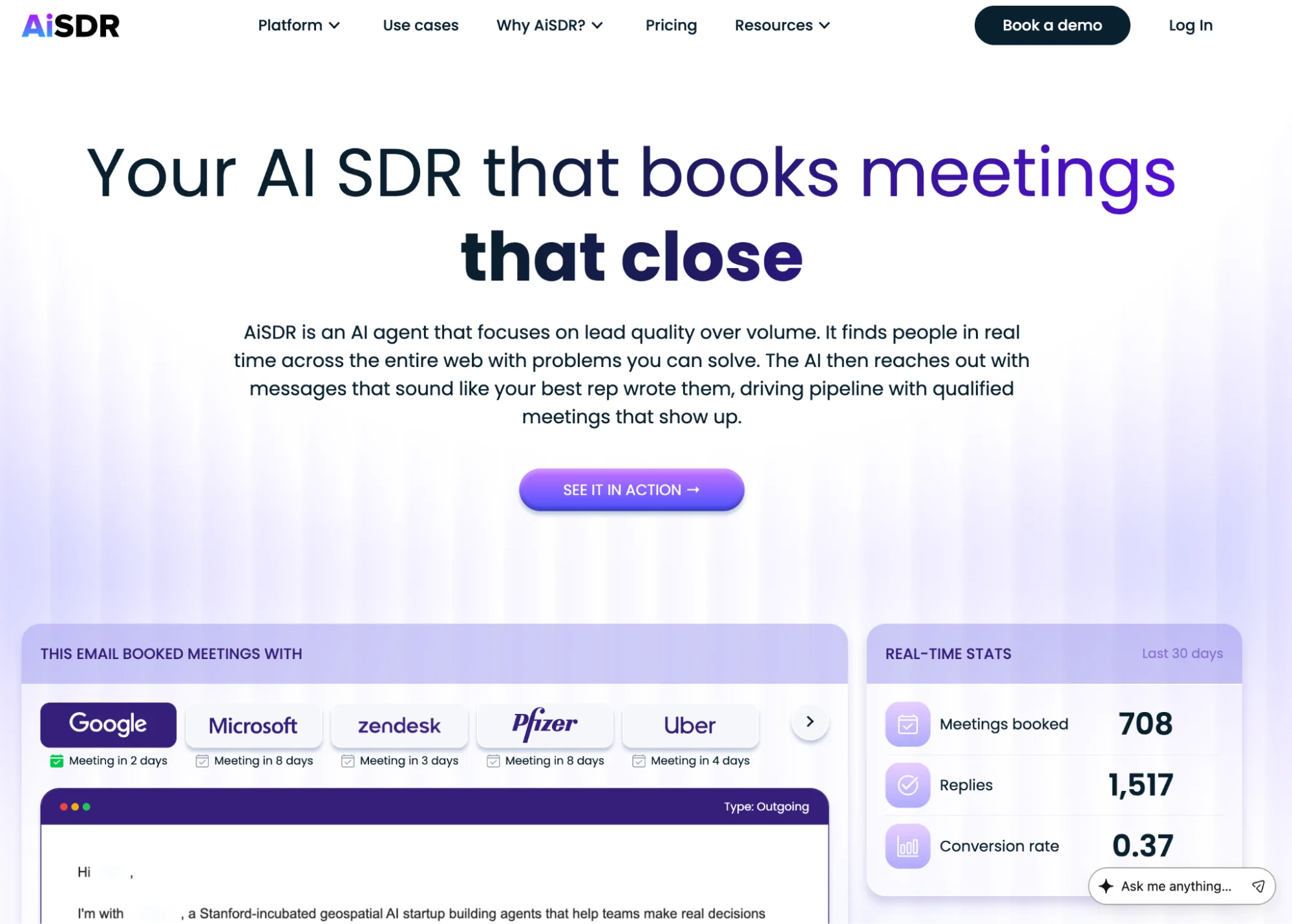
The best use case is SMB and lower mid-market SaaS that needs pipeline without hiring: solo founders, two-person sales teams testing outbound, growth teams exploring AI-driven lead generation.
16. Artisan AI
Quick facts: AI-native. Pricing sales-gated, annual only. Reportedly $2K/month entry, scaling to $5K+ for higher lead volumes.
Overview: Artisan AI is the category-creator of the AI-SDR movement, and the brand that defined it for a generation of founders.
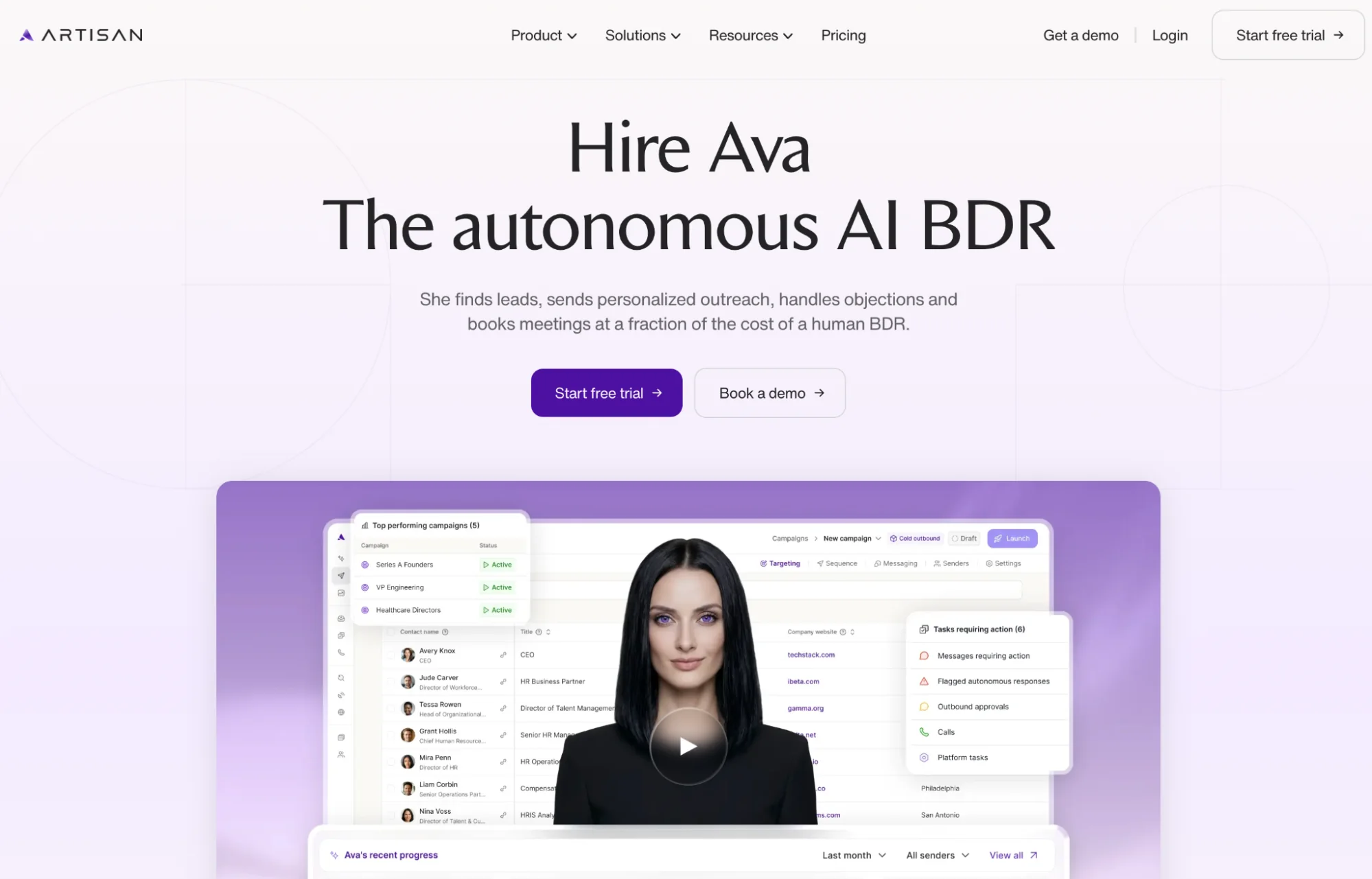
They fit SaaS that wants to skip building a sales development function entirely. By contrast, a human-and-Clay workflow that automatically identifies decision-makers gives you the same speed with the learning staying in your accounts.
17. 11x
Quick facts: AI-native. Pricing sales-gated, annual only. Reportedly ~$60K/year entry, scaling to $120K+ for multi-worker enterprise.
Overview: 11x sells digital workers Alice (prospecting) and Mike (calls), backed by Benchmark and a16z, with customers like Brex and ZoomInfo. They've been the loudest and most controversial seller of the AI-replaces-SDRs narrative.
On paper, the fit is mid-market and enterprise SaaS with established outbound and budget for a $60K to $120K annual commitment.
You'll also meet SalesBread (promises one qualified sales lead per day), CIENCE (has helped 2,500+ clients), and SalesPro Leads (5 stars on Clutch): credible options we cut for overlap with the names above.
How to choose the right SDR outsourcing company
When evaluating potential outsourcing partners, five screening questions separate good partners from expensive mistakes.
Check their experience in sales development and lead generation for your motion, and whether they've worked your particular industry before.
Assess the onboarding process: how do their SDRs align with your sales processes and goals in the first 30 days?
Define expectations, goals, and KPIs in the contract to prevent misunderstandings later.
Research their reputation through client testimonials and case studies. A reliable outsourcing company will introduce you to a current client.
Test client communication early: transparency and timely feedback predict how the whole engagement goes.
Why outsourcing SDR work still works, and the three scenarios where it actually makes sense
Building an in house sales team for sales development is harder than it looks. Sales development representatives are hard to hire, ramp takes four to six months, and tenure averages under two years, so the sales development team you build in Q1 rarely survives to Q4.
We've covered the in-house vs outsourced trade-off separately, but cost alone pushes most teams toward outsourced sales, whether that's a full agency or a sales development consulting firm.
A fully loaded SDR costs $80K to $130K once you add base, OTE, management, and tooling. That budget can fund sales outsourcing services that deliver sales pipeline in weeks: reduced overhead costs, and faster time to market for your sales initiatives.
Outsourcing also buys pattern recognition. A good sales outsourcing company has delivered hundreds of lead generation campaigns across hundreds of ICPs and knows which sales strategies convert in your category.
That playbook density supports business growth you can't replicate in-house in year one.
The catch is that the model has real challenges. Performance and commitment vary from team to team, dependency builds the longer you stay, and higher quality outsourced SDRs get expensive, which is hardest on smaller businesses.
Most SDR outsourcing companies will sign you regardless of fit, so the red flags worth screening for in any agency apply double, because quality in sales outsourcing is unusually opaque.
So the question isn't whether outsourcing SDR services works, but when.
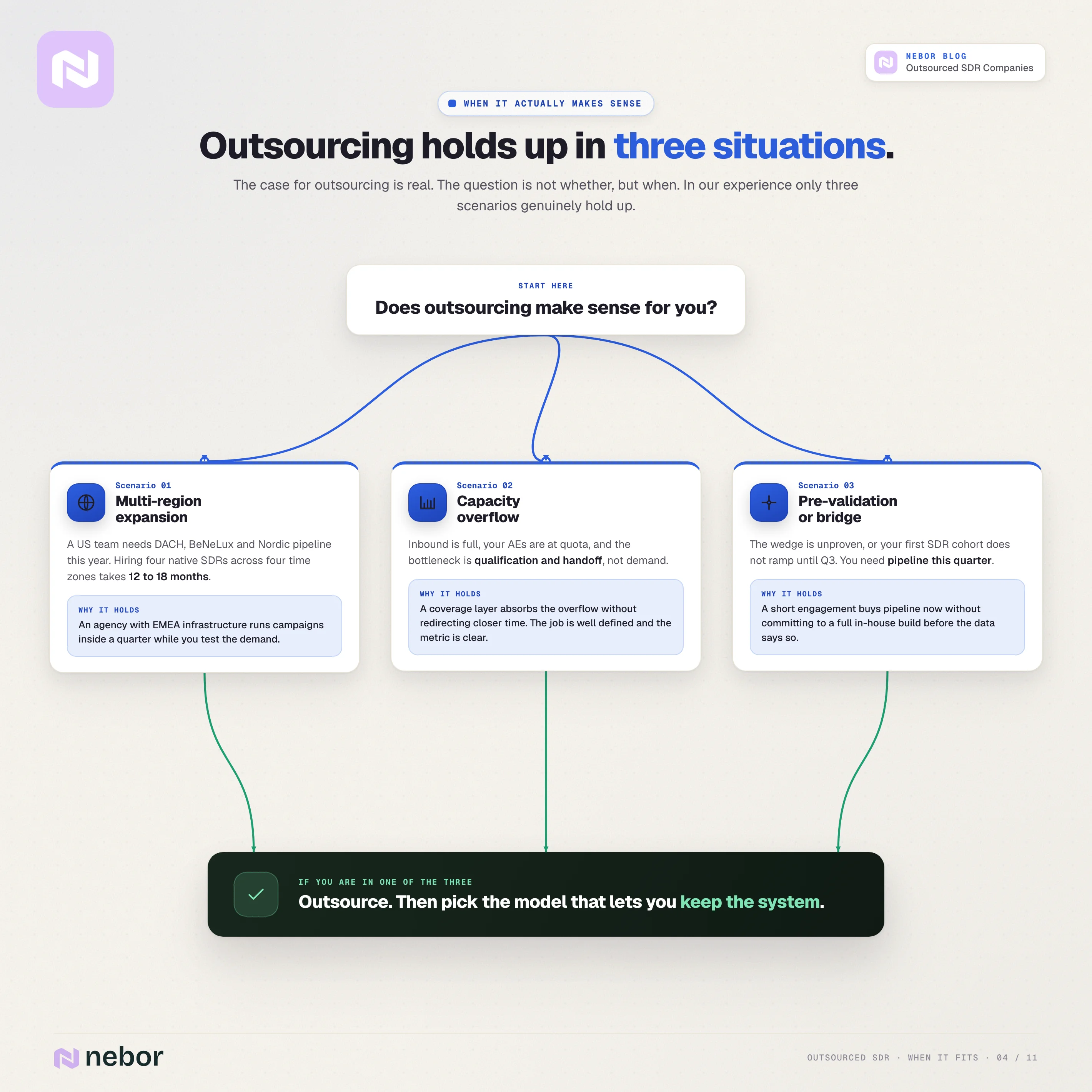
In our experience, only three scenarios hold up.
Multi-region or multi-language expansion. Hiring four European SDRs takes 12 to 18 months; an agency with EMEA infrastructure can have lead generation efforts live within a quarter.
Capacity overflow on a working funnel. Your inbound is full, your sales team is at quota, and the bottleneck is qualification and handoff. A coverage layer that helps you secure valuable client meetings makes sense here, without pulling closers away from closing deals.
Pre-validation or bridge to in-house. You haven't proven the wedge, or your first SDR cohort ramps in Q3. A short outsourced sales engagement buys pipeline before your own lead generation efforts ramp.
If your situation fits one of those three, pick the partner with the checklist above.
What outsourced SDR work costs in 2026, and where each pricing model hides its real cost
Less than 5% of companies providing SDR outsourcing services publish pricing; of the 17 SDR outsourcing companies here, only AiSDR and Sopro show complete, public numbers. Across the outsourced sales market, opacity is the norm.
Pricing falls into four shapes, each hiding its real cost somewhere different.
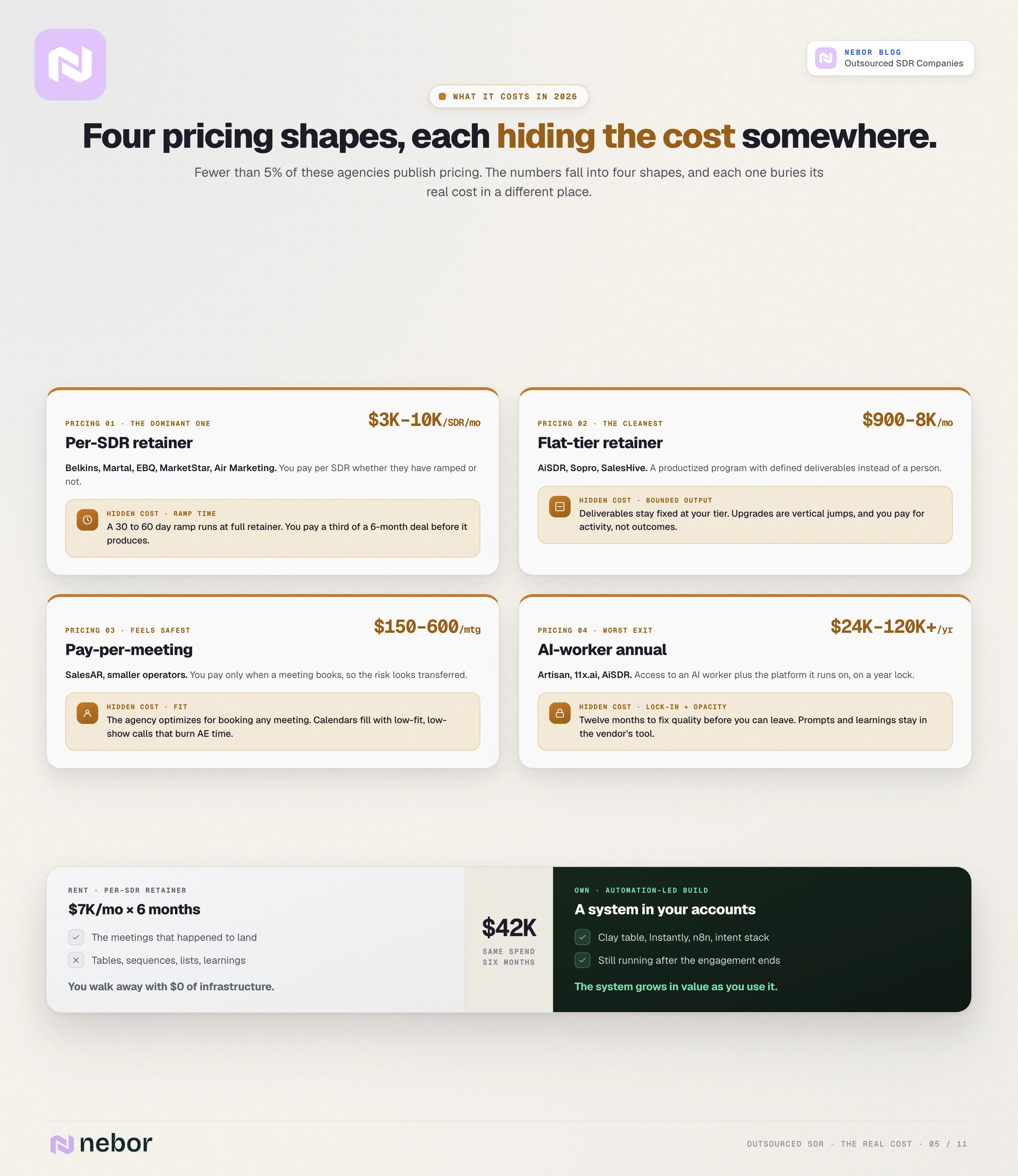
Per-SDR retainer ($3,000 to $10,000 per SDR per month).
The dominant model for outsourcing SDR services, sold by Belkins, Martal Group, EBQ, MarketStar, and Air Marketing. You agree on a number of SDRs and a monthly fee, and the hidden cost is paying full rate through the ramp months before the sales process produces anything.
Flat-tier retainer ($900 to $8,000 per month for a managed program).
The modern variant. AiSDR sells $900 and $2,500 tiers, Sopro starts at £3,000. You pay for a productized program with defined lead generation deliverables, and the appeal is cost efficiency: you know exactly what you pay each month. The hidden cost is bounded output, and you're paying for activity rather than outcomes.
Pay-per-meeting ($150 to $600 per booked meeting).
This sounds like the safest model, and a few agencies like SalesAR offer it. The hidden cost is fit.
The sales outsourcing company optimizes for booking anything that counts as a meeting, and the outsourced SDR company's objectives drift away from yours. Cost per qualified opportunity often lands higher than a retainer.
AI-worker annual ($24,000 to $120,000+ per year).
The newest shape with the worst exit terms. Artisan and 11x sell annual contracts, and the hidden cost is lock-in: 12 months for the outsourcing company to fix quality issues before you can leave.
The category has had public blowups too (11x restated revenue in 2025 after churn around hallucinated emails), and when the contract ends, you keep zero learnings.
All four end the same way: you own nothing that survives the contract.
Do the numbers. Six months of outsourced sales at $7K per month costs $42K, and at the end you have whatever meetings landed plus zero infrastructure.
That same $42K spent on an automation-led lead generation build gives you a Clay table, an Instantly campaign, an n8n workflow, and an intent-monitoring stack that live in your accounts and keep going.
We've made the longer case for why outsourcing the way most companies do it stopped making sense. The systems you build outlast the seats you rent.
Hire Nebor to improve and automate your sales and lead generation process so your sales reps can focus on selling
When you hire the typical sales outsourcing company on this list, you're paying for more salespeople working lengthy sales cycles. Outsourcing SDR services the traditional way buys activity that stops when the contract does.
At Nebor, we don't add more people to your sales process. We build lead generation systems that qualify inbound leads, drive multi-channel outbound, and use intent data to reach potential customers before they know they're in the market.
Meanwhile, your reps, the experienced sales professionals you already pay, spend their time closing deals. The division of labor is clean: the systems do the prospecting, and the sales team close deals.
When you partner with us, you're investing in infrastructure that compounds into business growth. It's built to drive revenue growth without the bandwidth limits of headcount or the premium cost of outsourced sales talent. If that's the model you'd rather buy, book a call and we'll map the build for your motion.


Related Articles

By clicking Sign Up you're confirming that you agree with our Terms and Conditions.