
10 Best Email Deliverability Experts to Fix Your Outbound Pipeline

In this post:
Your cold emails are not the problem. The deliverability infrastructure underneath them is.
Poor email deliverability quietly kills B2B pipelines, and most teams never spot it. Your team celebrates great delivery rates (meaning emails did not bounce), while messages pile up in spam folders nobody opens.
The outreach goes nowhere, but the dashboard says everything shipped.
Most founders, sales leaders, and RevOps do not know this is happening. They blame the messaging, the targeting, or the market.
They never think to check where their emails land. Sender reputation drops with every send, and the failure spiral kills future campaigns too.
The technical causes pile up while staying hidden. Domain authentication never finishes setup, IP warming gets rushed or skipped, domains end up on blacklists, and the lists you bought are full of spam traps.
The team does not see any of it until reply rates tank and quotas get missed.
This article walks through ten of the best email deliverability experts and services that can fix these issues and get your emails back in front of real people.
We start with how we approach deliverability at Nebor, where the work goes past fixing email and into building outbound systems that work on their own.
Let’s get started.
Note: Hiring a deliverability expert fixes today. It doesn't fix next quarter.
Reputation decays, providers keep moving the rules, and warmup never really finishes. A one-off audit gets you back to the inbox for a while, then the same problem returns quietly.
At Nebor we build it as a standing part of your outbound: domains, authentication, rotation, list hygiene and the monitoring that catches a slip early.
Book a 15-minute call and we'll walk you through how to set it up.
TL,DR
Most teams watch their delivery rate climb toward 98% and assume outreach is working, while the messages quietly pile up in spam folders nobody opens.
Delivered just means the cold email didn't bounce. Inbox placement is the number that actually decides whether you get replies, and the two can tell completely opposite stories.
More importantly, real deliverability is a system, not a one-off DNS fix. Where your leads come from, how your sending is configured, whether your copy reads human, and whether anyone replies all feed back into your sender reputation week after week.
That’s why the warm-up tool you bolt on, or the consultant who cleans up your SPF and walks away, only takes you so far.
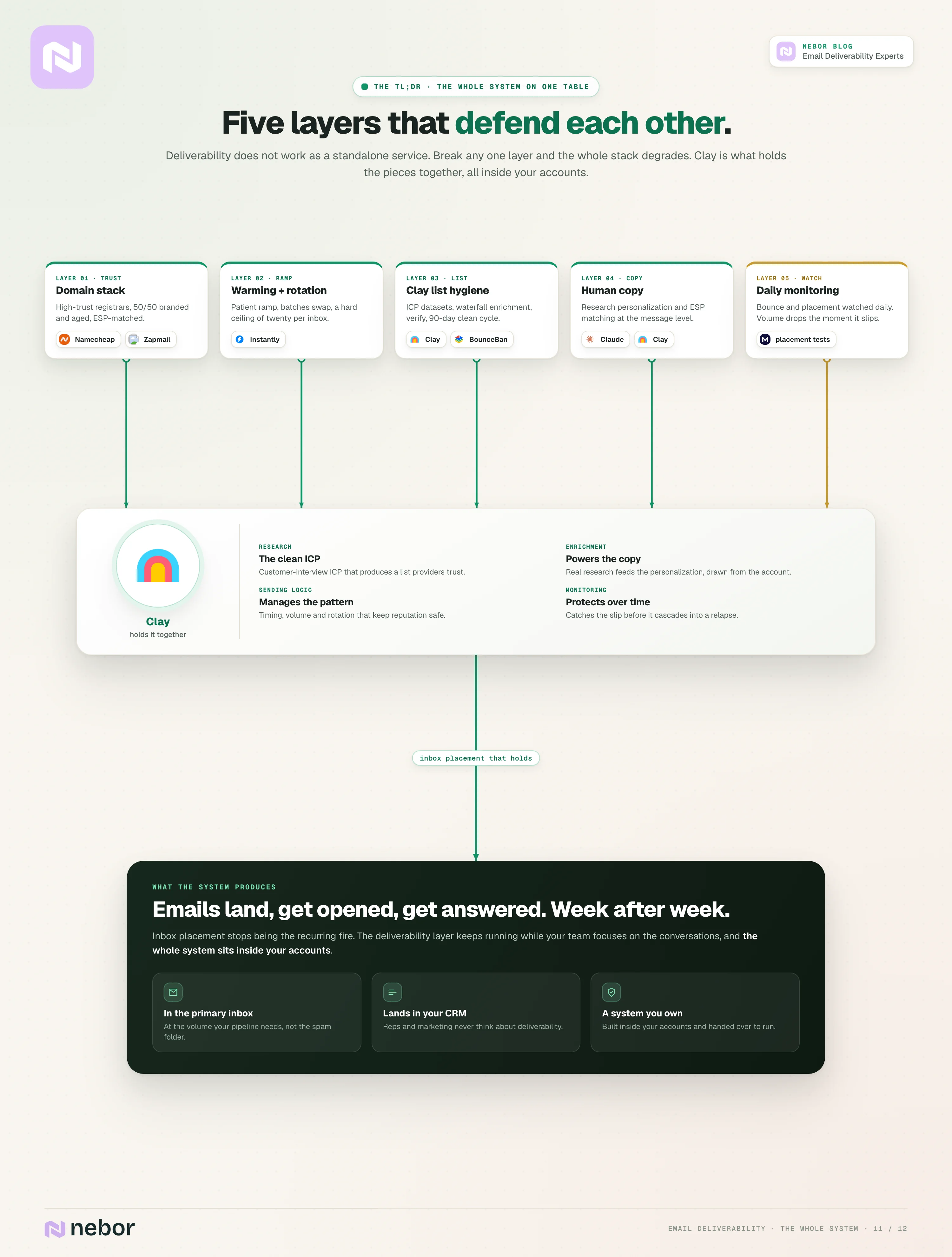
At Nebor, we treat deliverability as one layer of a complete outbound build: the domain stack, list hygiene, copy, and monitoring all designed to defend each other, with Clay holding the pieces together. Here’s a representation of what it looks like:
What a true email deliverability expert does (and doesn’t do)
When most people picture an email deliverability expert, they picture someone who jumps into the DNS, adds SPF, DKIM, and DMARC records, connects a warm-up tool, and calls it done.
That part matters, but it is the setup, not the expertise. Anyone with patience and a YouTube tab open can work through that checklist.
A real deliverability expert thinks one level up. Where most people ask if your domain is authenticated, a deliverability lead asks if the rest of your outbound system is protecting that domain’s reputation for the next twelve months.
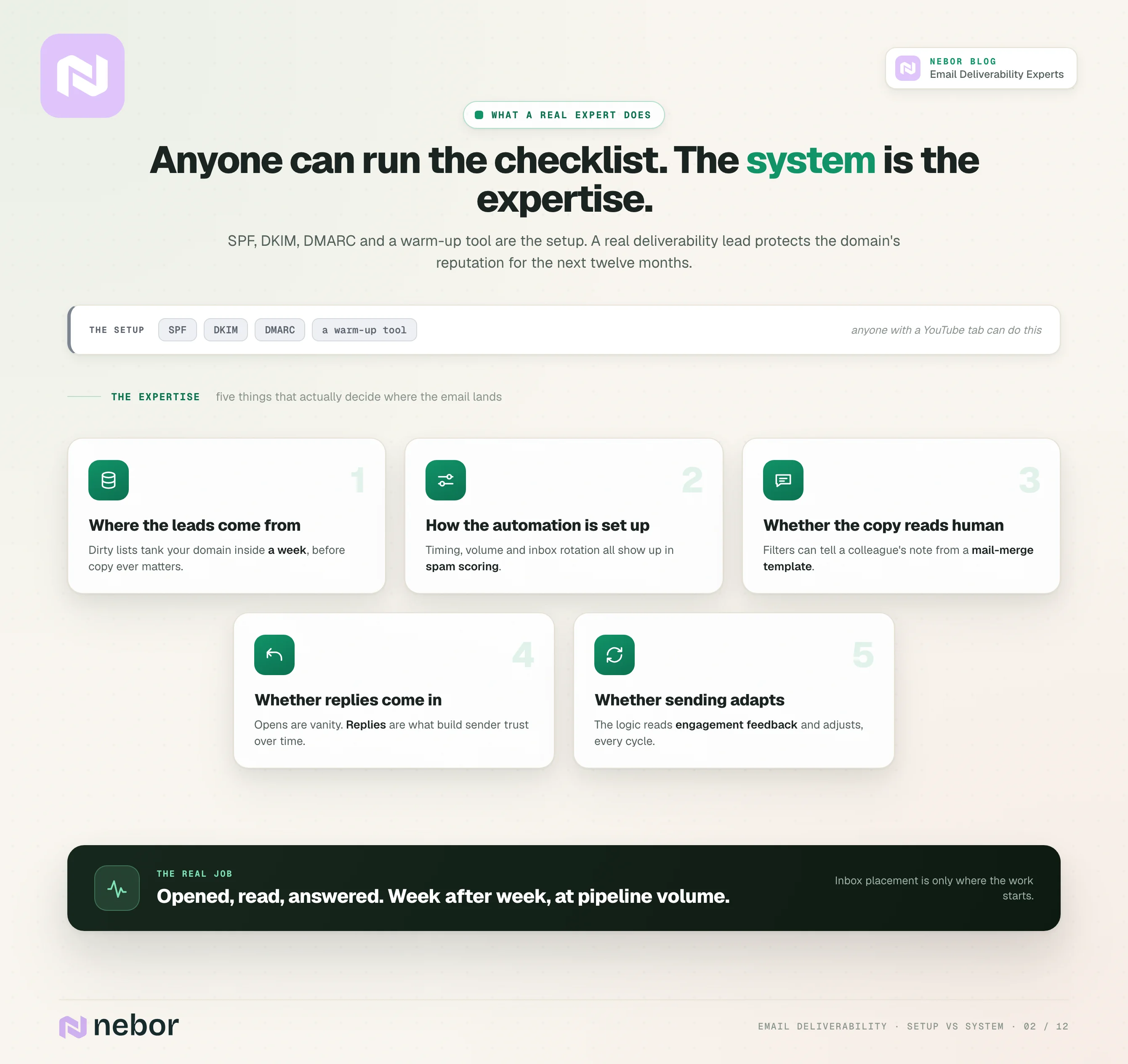
Deliverability is a system-wide problem, not a technical one. Several pieces decide whether emails reach an inbox.
Where your leads come from (dirty lists tank your domain inside a week)
How your automation is configured (timing, volume, and inbox rotation all show up in spam scoring)
Whether your copy reads like a human or like a bot (spam filters can tell the difference)
Whether replies are coming in at all (opens are vanity, replies build sender trust)
Whether your sending logic adapts to engagement feedback or blasts the same list every day
Inbox placement is the floor, not the ceiling. The real job is making sure those emails get opened, read, and answered, week after week, at the volume your pipeline needs.
So no, real deliverability experts do not disappear after a quick DNS clean-up. They build the system, then monitor and tune it, because deliverability degrades the moment you stop paying attention to it.
Inbox placement that does not lead to a booked meeting is just a clean dashboard. That is why we treat deliverability the way we do at Nebor.
How we build email deliverability into the rest of the outbound system
Most deliverability experts tune your technical settings and walk away. The list that started the problem is still dirty. The automation logic that keeps blowing up your sender reputation is still wrong. Six weeks later, the team is back in spam.
At Nebor, deliverability lives inside the rest of the outbound build. We treat it as one layer of a complete system, with the domain stack, the list hygiene, the copy, and the sending logic all designed to defend each other.
Treating deliverability as a set of isolated technical rules is what produces the six-week relapse pattern.
What that looks like, step by step.
We start with the technical foundation
Most consultants buy domains from random registrars, set up shared hosting, and move on. That move is where deliverability problems usually start.
Where you buy a sending domain from matters more than most teams realize. Domains registered through lesser-known or foreign registrars can ship with low trust scores before the first email goes out.
Some registrars share IP addresses across customers, which means your domain inherits the reputation of whoever else is on that IP, including the spammers.
Some registrars themselves get flagged by inbox providers because too many of their other customers send spam. A clean, brand-new domain can land in spam on day one because of where it came from.
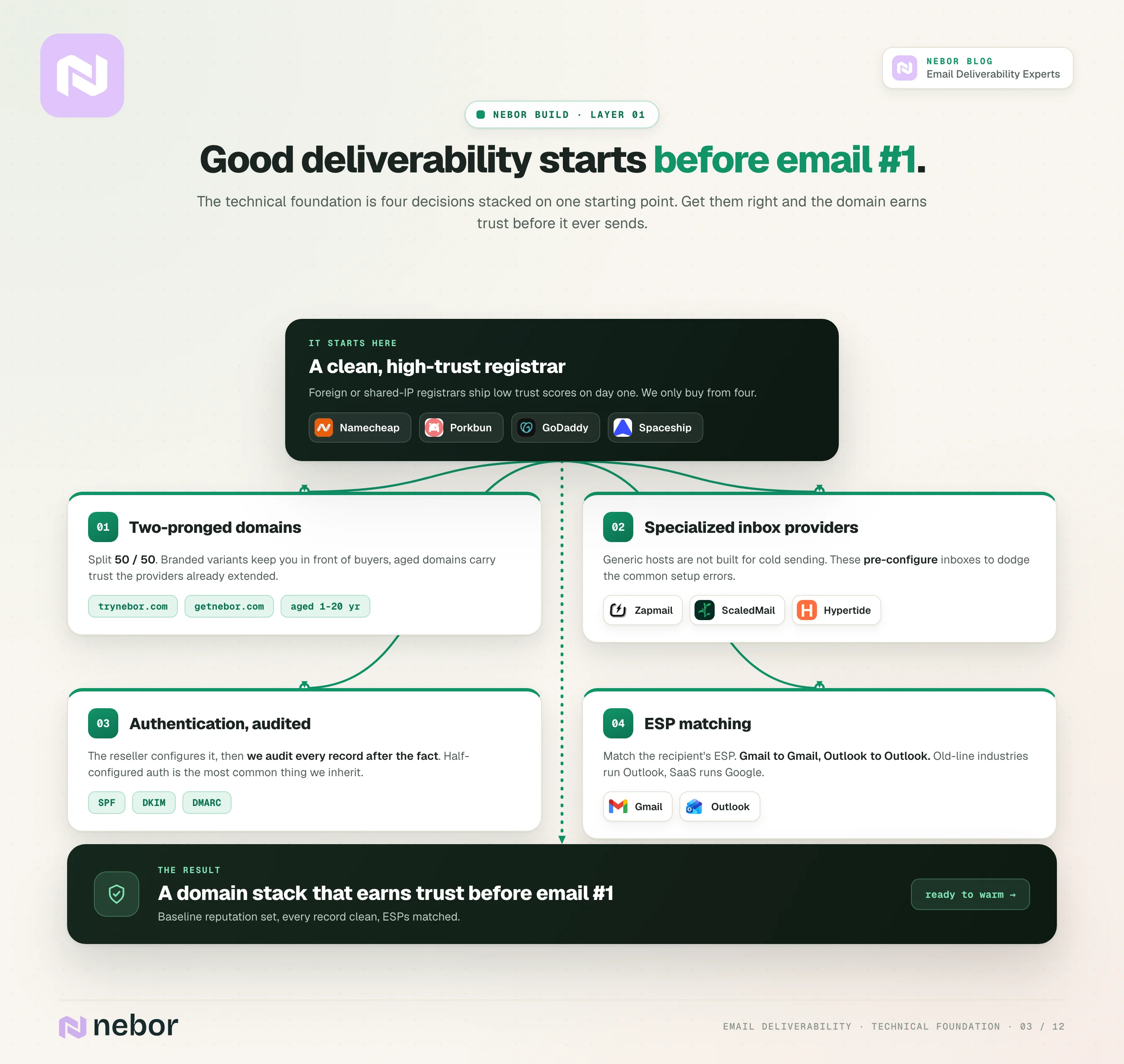
For that reason we only use Namecheap, Porkbun, GoDaddy, and Spaceship. Good deliverability starts before the first email goes out.
Beyond the registrar, the technical foundation has four parts.
A two-pronged domain strategy
We split domains 50-50 between branded variants (trynebor.com, getnebor.com) and aged domains in the 1-to-20-year range.
The branded side keeps brand consistency in front of buyers. The aged side carries trust the inbox providers have already extended to those domains.
Specialized inbox providers
Generic email hosts are not built for cold sending. We use providers built for the workload, including Zapmail, ScaledMail, IT Dukes, and Hypertide.
They pre-configure inboxes to avoid the common setup errors and they understand the deliverability quirks generic hosts miss.
Authentication done right
The better resellers configure SPF, DKIM, and DMARC automatically, but we audit each record after the fact. Half-configured authentication is one of the most common things we find when we take over an account.
ESP matching
The most stable cold-email pattern is to match ESPs. Gmail to Gmail, Outlook to Outlook, with SMTP for variation.
The right split depends on the target audience. Old-fashioned industries are usually on Outlook. SaaS companies are usually on Google. The lead's ESP is not always knowable, but it is usually guessable from industry alone.
Systematic inbox warming and rotation
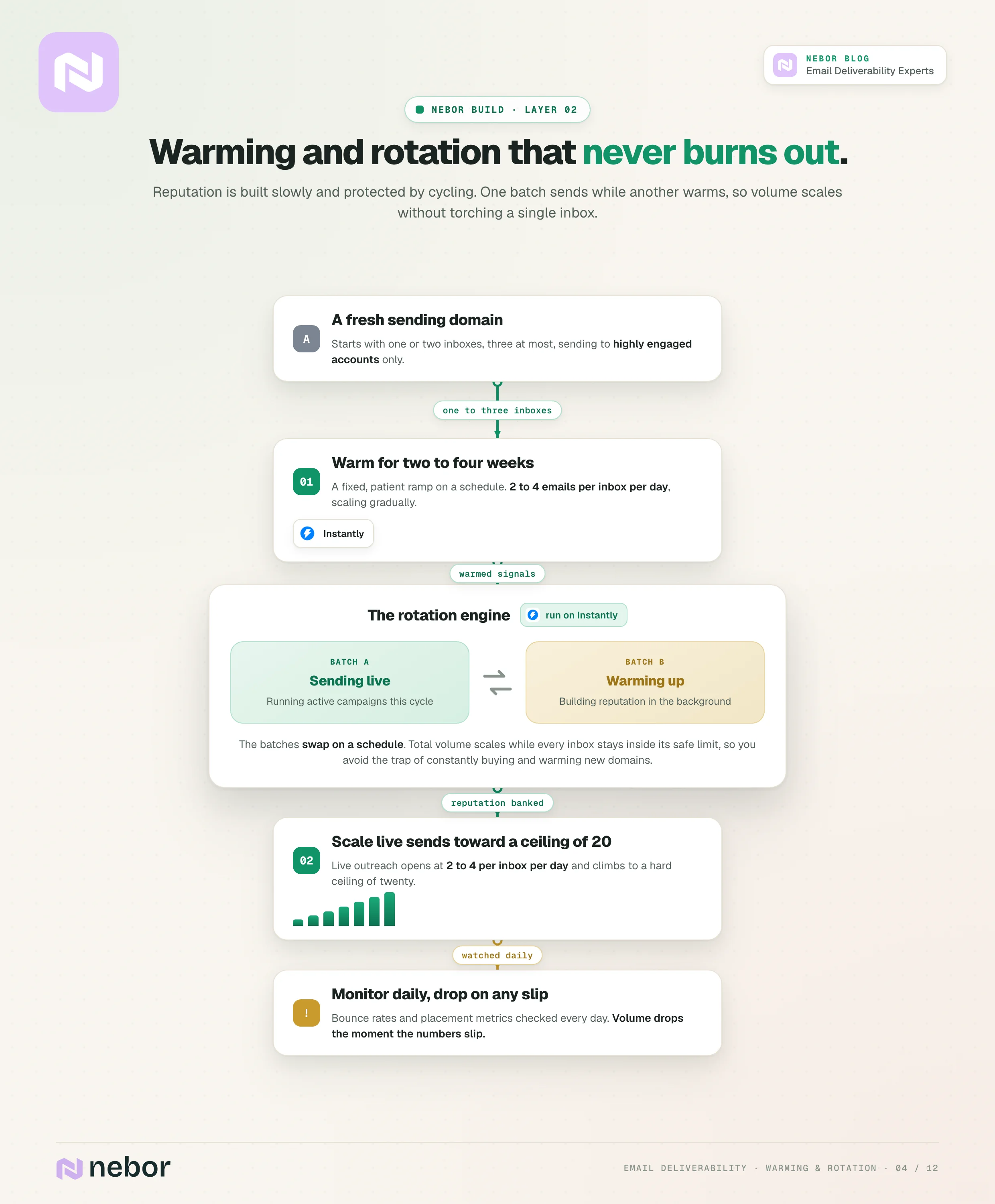
Warming a new sending domain takes two to four weeks of patient ramp-up. We handle that ramp through Instantly on a fixed schedule.
Each domain starts with one or two inboxes, three at the most, and two to four daily emails per inbox. Volume scales gradually from there. The recipients during warmup are highly engaged accounts, which builds positive signals into the inbox provider's reputation model.
Rotation is what protects long-term reputation. While one batch of inboxes sends live campaigns, another batch warms up in the background.
The cycling means total volume scales without burning out individual inboxes, and you avoid the trap of constantly buying and warming new domains.
Live outreach starts at two to four emails per inbox per day and scales to a ceiling of twenty. We monitor bounce rates and placement metrics daily, and volume drops the moment the numbers slip.
Clay-powered prospect lists that hold up over time
The list is where most deliverability problems actually start.
We build prospect lists in Clay, starting from a customer-interview pass that nails the ICP at a level Apollo filters never reach. Clay alone fixes nothing, the workflow design and the ICP work underneath are what produce a clean list.
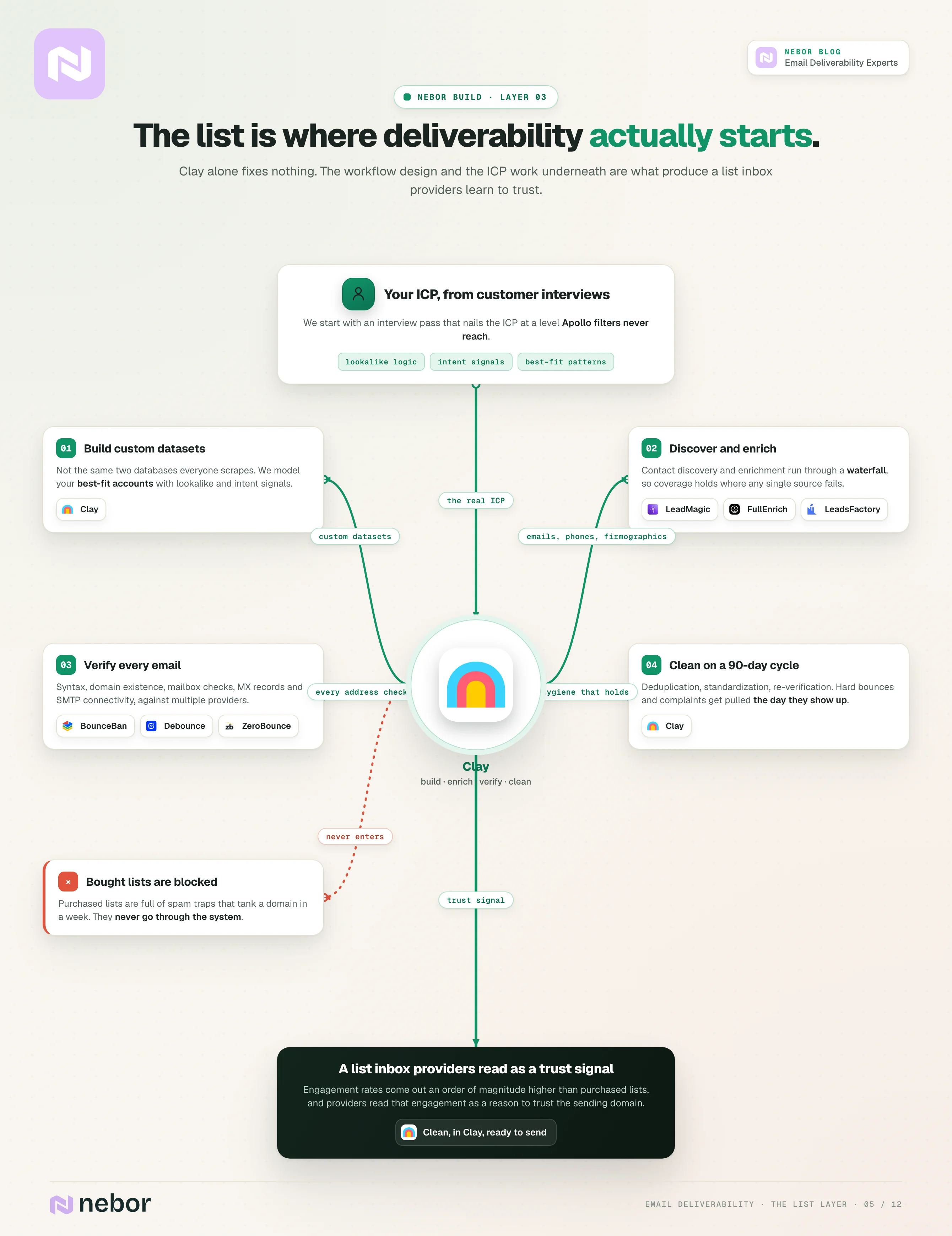
Contact discovery and enrichment pass through LeadMagic, FullEnrich,LeadsFactory.io and Findymail, then we verify the resulting emails through BounceBan, Debounce, and ZeroBounce.
Verification covers syntax, domain existence, mailbox-level checks, MX record validation, and SMTP connectivity. Bought lists never go through the system.
We build custom datasets in Clay using lookalike logic, intent signals, and patterns from the customer's best-fit accounts.
The engagement rates that come out of this approach are an order of magnitude higher than the rates from purchased lists, and inbox providers read those engagement signals as a trust signal back to the sending domain.
Our lists follow a 90-day cleaning cycle. Deduplication, standardization, re-verification. We pull hard bounces and spam complaints the day they show up.
Note: Hiring a deliverability expert fixes today. It doesn't fix next quarter.
Reputation decays, providers keep moving the rules, and warmup never really finishes. A one-off audit gets you back to the inbox for a while, then the same problem returns quietly.
At Nebor we build it as a standing part of your outbound: domains, authentication, rotation, list hygiene and the monitoring that catches a slip early.
Book a 15-minute call and we'll walk you through how to set it up.
Copy that does not trigger filters
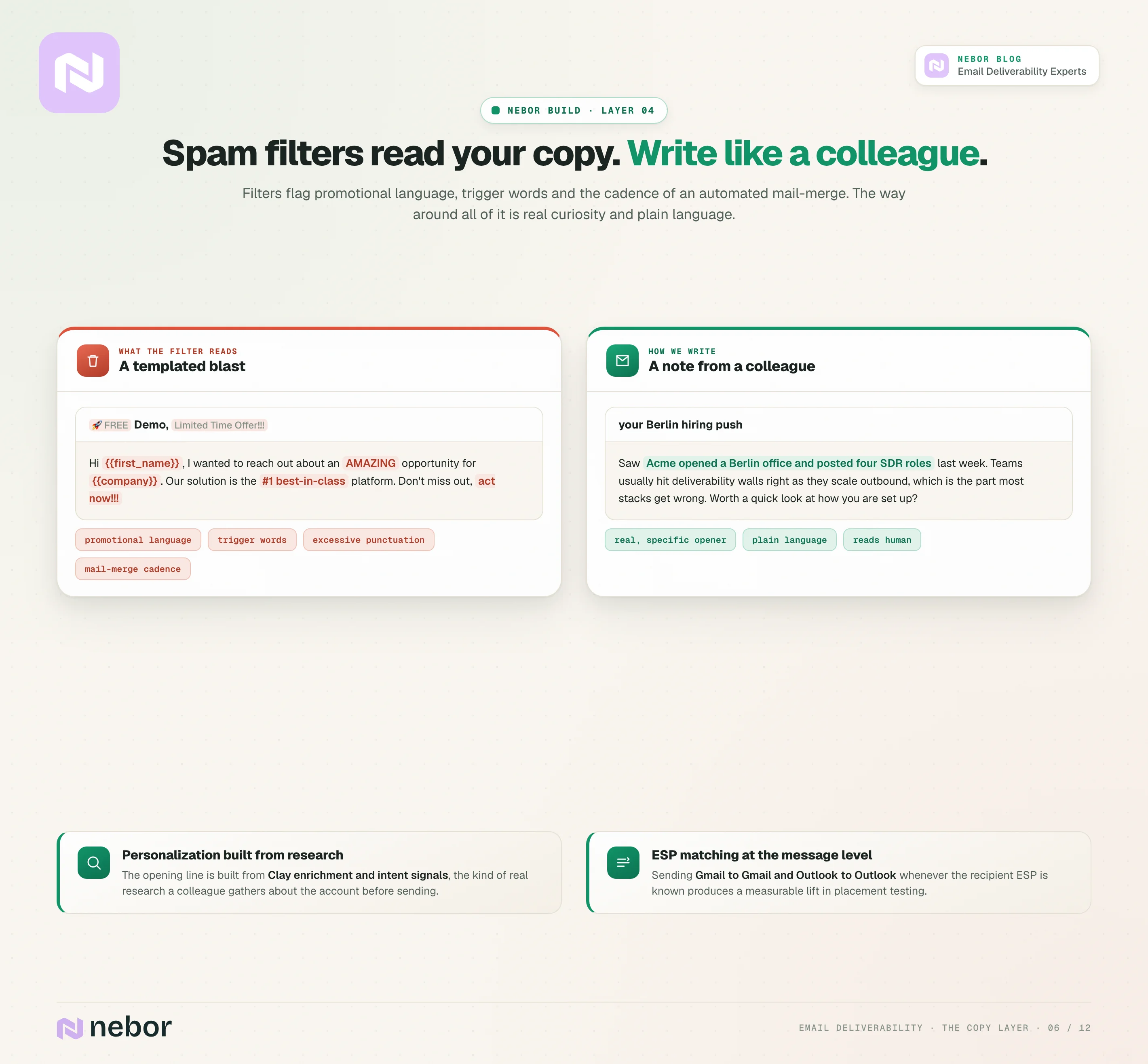
Spam filters read your copy. They flag promotional language, trigger words, excessive punctuation, and the specific cadence of automated mail-merge templates.
The way around all of that is to write the way one colleague writes another. Real curiosity, real specificity, plain language.
Two pieces underpin the copy work and matter the most.
Personalization that comes from research, not tokens
Our style of personalization is built on Clay’s enrichment, which means the opening line gets built from real research and real intent signals, not from inserting a job-title token into a templated sentence.
Mail-merge personalization sounds automated because it is automated. Research-driven personalization reads like a colleague who looked at the company before sending.
ESP matching at the message level
Sending Gmail-to-Gmail and Outlook-to-Outlook whenever the recipient ESP is known produces a measurable lift in our placement testing.
The match is not always possible, but the share of matched sends has a clear correlation with the inbox-versus-spam outcome.
How everything ties together, and ties into your existing stack
None of these layers actually works in isolation. Look here, we’ve tried to illustrate it.
The domain choice sets baseline trust. Authentication is what proves the sender's identity. List hygiene is what prevents the reputation damage that bad lists cause inside the first week.
Copy and sending pattern decide whether the filter trusts what it sees, and monitoring is what catches the slips before they cascade.
Break any one of those, and the whole stack degrades. That is why deliverability does not work as a standalone service. It works as one piece of a complete outbound system.
Clay is what holds the pieces together inside our build. The prospect research that produces clean lists, the enrichment that powers personalization, the automation logic that manages sending patterns, and the monitoring that protects your reputation over time all pass through the same workspace.
The whole stack lands inside your CRM and your existing tooling. Sales reps and marketing teams do not have to think about deliverability while sending outreach. The deliverability layer keeps working while the team focuses on the conversations.
Top 10 email deliverability experts and agencies to consider in 2026
The list below covers the best email deliverability consultants, agencies, and tools out there in 2026, plus where each one earns its place.
Some entries are full-service rebuilds, others are tactical tools you bolt on, and none of them solves every problem on its own.
1. Nebor
The previous section walked through the working detail. The shorter comparison-list version follows here. At Nebor, deliverability is one layer of the outbound build, not a service on its own.
Domain stack, inbox warming and rotation, list hygiene through Clay, copy that reads like a colleague, and live placement monitoring all live inside one system, set up inside the client's own accounts.
Right fit when the question is not “fix my warm-up tool” but “rebuild outbound so deliverability stops being the recurring emergency every quarter." Wrong fit when the deliverability problem is genuinely isolated and a tactical consultant can solve it inside a single sprint.
2. EmailConsul: for complex enterprise setups
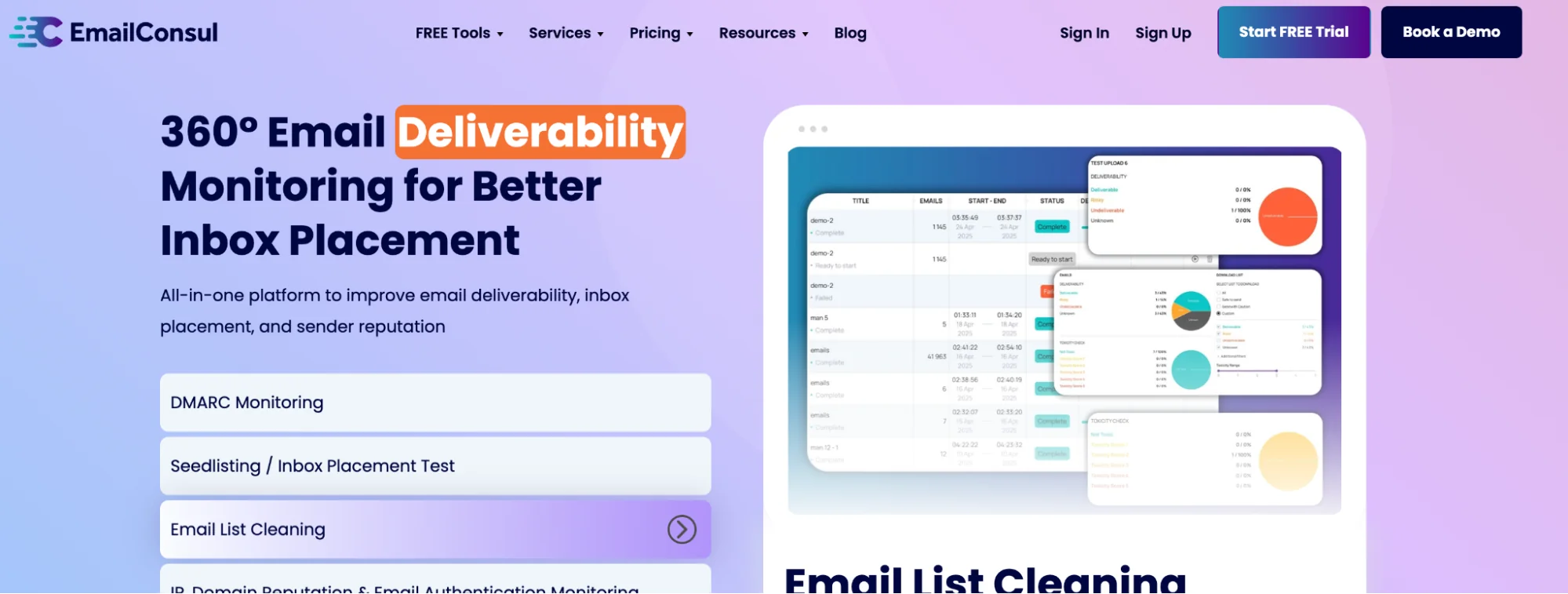
EmailConsul offers high-touch deliverability consulting for companies with messy infrastructure.
Multiple domains, separate sending streams for cold and marketing and transactional, enterprise-grade volumes, the kind of setup where one team manages all of it and the deliverability picture changes by the week.
Their work covers the full technical stack. SPF, DKIM, DMARC, DNS routing, subdomain strategy, blacklist resolution, ongoing inbox-placement monitoring, and reputation troubleshooting.
3. Daniel Fazio (aka the Cold Email Wizard)

Daniel Fazio, who publishes as the Cold Email Wizard, has built a following among solo founders and B2B service providers by sharing strategies, deliverability tips, and list-building playbooks for people doing cold outreach themselves.
If you are a founder doing outreach yourself, his content is some of the best free playbook material in the space. The catch is that he hands you the playbook. You still have to execute it.
4. Instantly: All-in-one outreach platform with deliverability features built in
We useInstantly daily inside our own builds. It is an outreach platform with deliverability features baked into the same product, including automatic warm-up, inbox rotation, bounce protection, and spam detection.
Domain and inbox management lives in one workspace. Campaigns get segmented, sends rotate across mailboxes, opens and bounces get tracked, and the platform staggers volume and personalizes copy at scale.
Their support team also handles direct deliverability questions when something is off.
5. Folderly: Deliverability-first consulting and monitoring
Folderly is one of the better-known dedicated deliverability companies. The product covers ongoing placement monitoring, full deliverability audits, and regular spam testing across major inbox providers.
The audit work shows you which inbox folder messages are landing in, broken down by provider, and what is causing each placement decision.
Right fit if your outbound system is otherwise in good shape and what you need is senior-level domain-health insight. Wrong fit if the broader system is broken upstream of the deliverability question.
6. Mailreach: Warm-up and reputation monitoring for sales teams
Mailreach is a warm-up and reputation-monitoring tool built specifically for sales workflows. The product pushes inbox engagement through a controlled network of real email accounts that open, reply to, and interact with your emails, which trains the inbox providers to trust the sending domain.
The dashboard tracks deliverability per inbox, monitors blacklist status, and surfaces tactical fixes when reputation slips. It does not touch the messaging or the targeting, so the work upstream still matters.
Right fit when your outbound engine is already working and you want to keep deliverability clean across multiple mailboxes without paying for white-glove consulting.
Many agencies and SDR teams use Mailreach inside a larger stack, and it integrates with Instantly and Lemlist out of the box.
7. Warmy.io: AI-driven warm-up with built-in deliverability testing
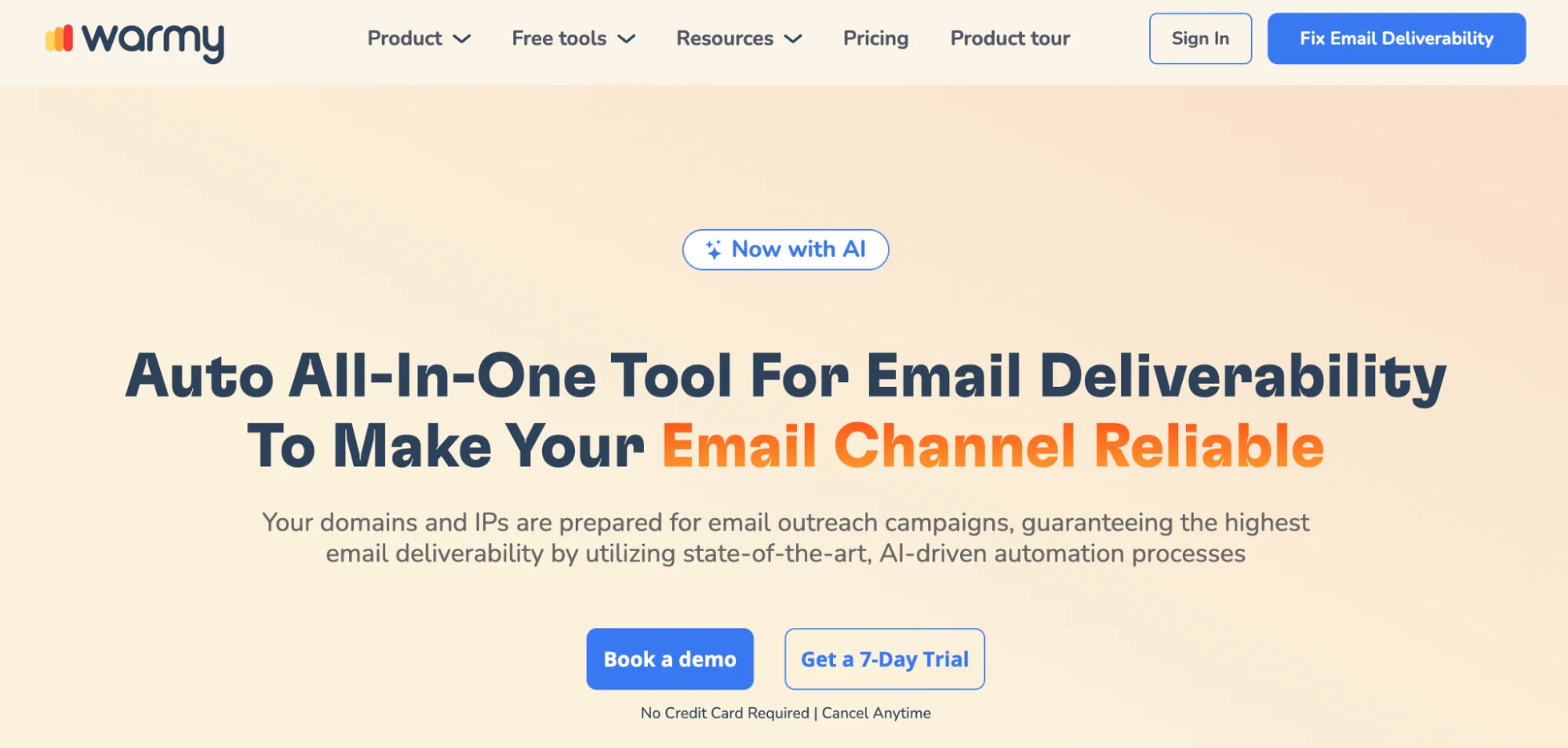
Warmy is a deliverability platform built around AI-driven inbox warming. The product pushes warmup through its own network of real inboxes, then layers on placement testing, template scoring, and ongoing reputation monitoring so the team can see the full deliverability picture in one dashboard.
The strength of Warmy is the combination of warm-up plus diagnostics in the same product. Mailreach focuses on the warm-up side and nothing else. Warmy adds the testing and audit layer on top, which means fewer separate tools to wire together.
Right fit for sales and growth teams that want one platform handling both reputation maintenance and active placement testing. Wrong fit if you only need the warm-up piece, which is where Mailreach or Lemwarm cover the same ground at a lower price.
8. InboxAlly: Engagement signals for inbox placement
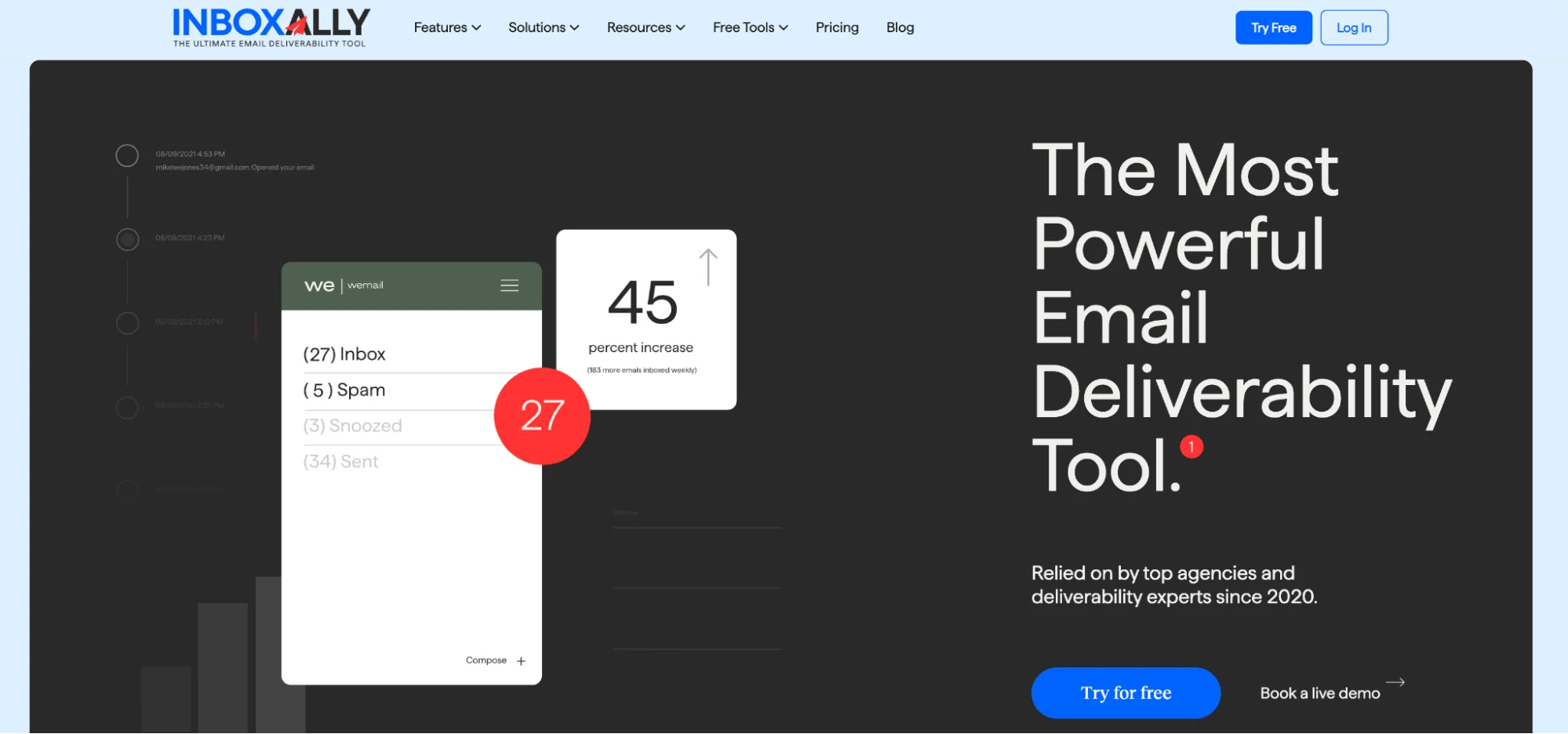
InboxAlly works by feeding inbox providers positive engagement signals on your messages. A network of test inboxes opens, clicks, and replies to simulate real user activity, and the inbox provider reads that activity as evidence the sender reputation deserves the primary inbox.
The strength of the tool is its narrow focus on engagement-based reputation building. It earns its place when you are launching a fresh domain, migrating between email providers, or trying to recover after a reputation hit.
InboxAlly does not handle DNS setup, blacklist resolution, or bounce management, so it works best layered with other tools that cover those gaps.
9. Lemwarm (by Lemlist): Lemlist’s built-in warm-up for cold outreach
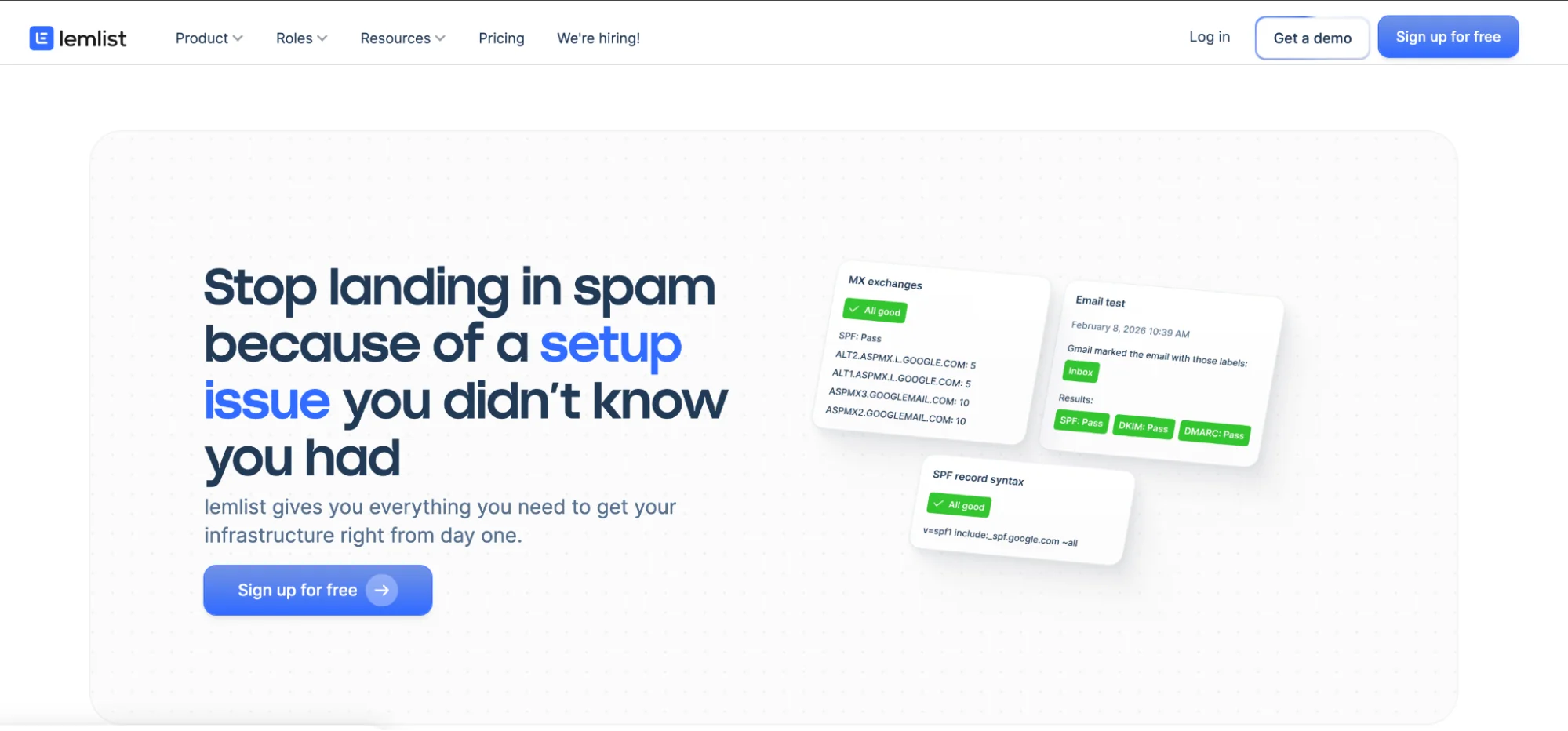
Lemwarm is the warm-up feature built into Lemlist. The setup is simple, which makes it a fit for solo founders or small teams doing their own outreach.
Inboxes warm up by talking to each other, which builds domain reputation enough to keep cold emails out of spam when campaigns scale.
Lemwarm is a starting point, not a full deliverability solution. Anyone doing serious outbound volume needs more underneath it.
10. Warmup Inbox: affordable reputation maintenance
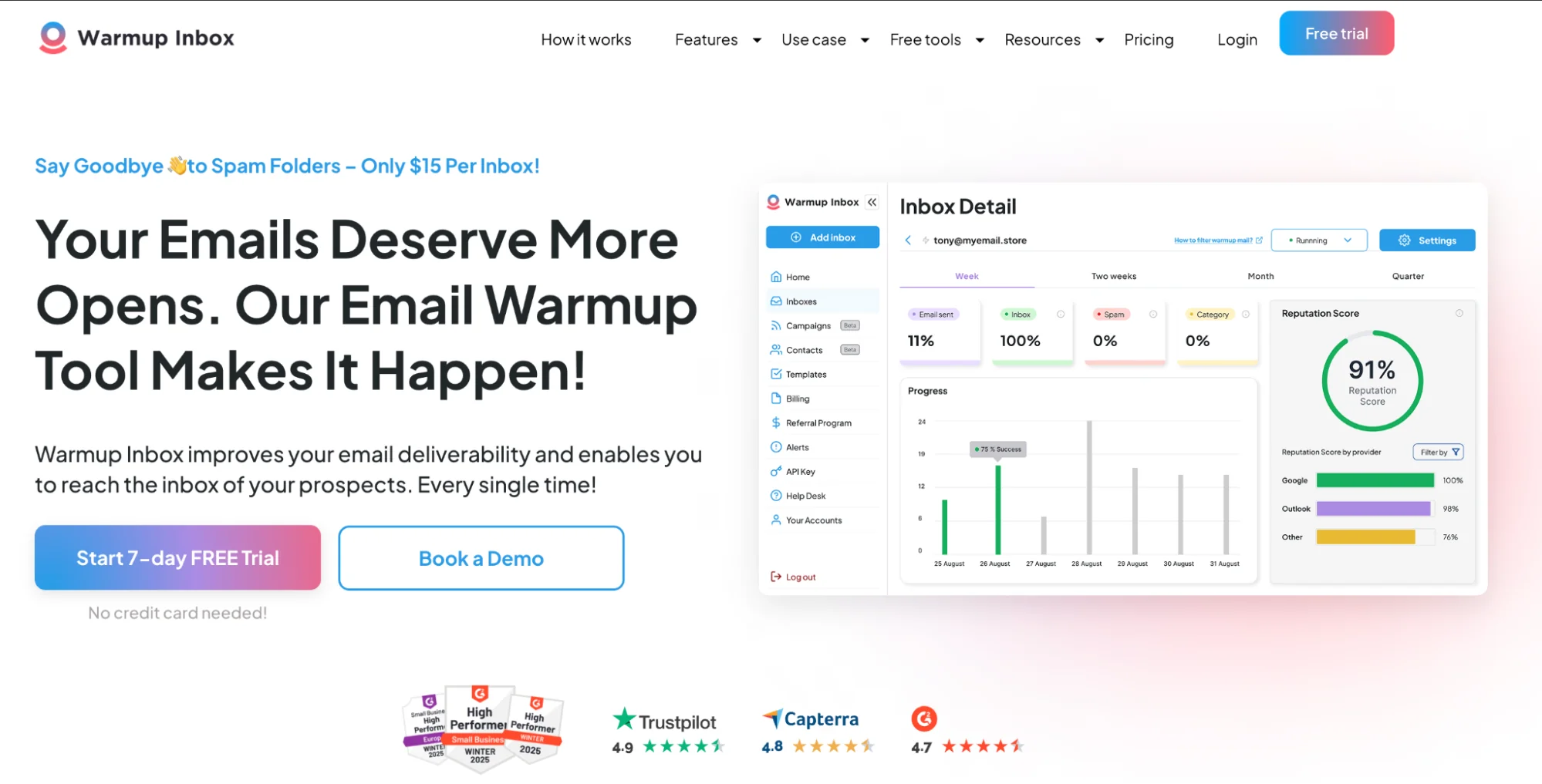
Warmup Inbox is a low-cost tool for building and maintaining sender reputation gradually. A network of real inboxes opens, replies to, and interacts with your emails to signal trust to the inbox providers.
The product is popular with freelancers, startups, and agencies that rotate domains across multiple campaigns. The dashboard is clean, the platform supports multiple mailboxes, and the metrics tracking covers deliverability scores and blacklist status.
11. MailGenius: free deliverability testing

MailGenius is a free email-setup test. The tool checks domain authentication, scores the email content for spam triggers, and previews where the message is likely to land.
The fixing is on you, but the diagnostics catch the common easy-to-miss errors. Missing SPF records, broken image links, subject-line keywords that flag filters, that kind of thing. A useful first stop for anyone debugging cold-email performance from scratch.
Best practices for working with a deliverability expert
The work goes faster and the results stick when both sides set up the engagement properly. A few rules from the engagements that have worked best.
Define the outcome you actually need from the engagement. Higher open rates, more booked meetings, and recovering from a damaged sender reputation are three different jobs that need three different audits.
Lock the goal before the audit starts, because the audit takes shape around what you are trying to fix.
Hand over the full picture from day one. Current email infrastructure, campaign history, recent deliverability rates, every past spam-folder incident the team can remember. Hidden context produces the wrong diagnosis, and the work then has to start over.
Keep the conversation honest from both sides. The deliverability expert needs to call out what is broken without softening it for the meeting, and you need to act on that input rather than negotiate it. The relationship works closer to a doctor than to a vendor.
Act on the recommendations as they actually land. Technical changes, content tweaks, list overhauls, all of them. Half-implemented advice usually shows up as half-fixed deliverability.
Monitor the numbers carefully after the work lands. Inbox placement, bounce rates, reply rates, blacklist status. Track them weekly so the team catches a slip before it becomes a six-week recovery project.
Tools and resources you will need for email deliverability
The deliverability stack on most working setups breaks into five layers, each with its own category of tools.
Authentication protocols. SPF, DKIM, and DMARC, configured properly at the DNS level. These verify sender identity and form the foundation everything else stands on.
Audit and monitoring services. Recurring placement testing, audits across major inbox providers, and dashboards that track sender reputation over time. Folderly and Mailreach both fit here.
IP warming and domain reputation tools. Tools that ramp send volume gradually and watch IP and domain reputation as the volume scales. Instantly, Lemwarm, and Warmup Inbox all play in this layer.
Spam-filter testing software. Tools that score emails against common filters before send. MailGenius is a free option for first-pass diagnostics.
List validation and hygiene services. BounceBan, Debounce, and ZeroBounce for verification, plus a working process for pulling hard bounces and complaints out of the list every cycle.
A senior deliverability consultant can walk you through which layers your setup actually needs and which tools fit each layer at your specific volume and audience.
How to choose the right email deliverability expert for you
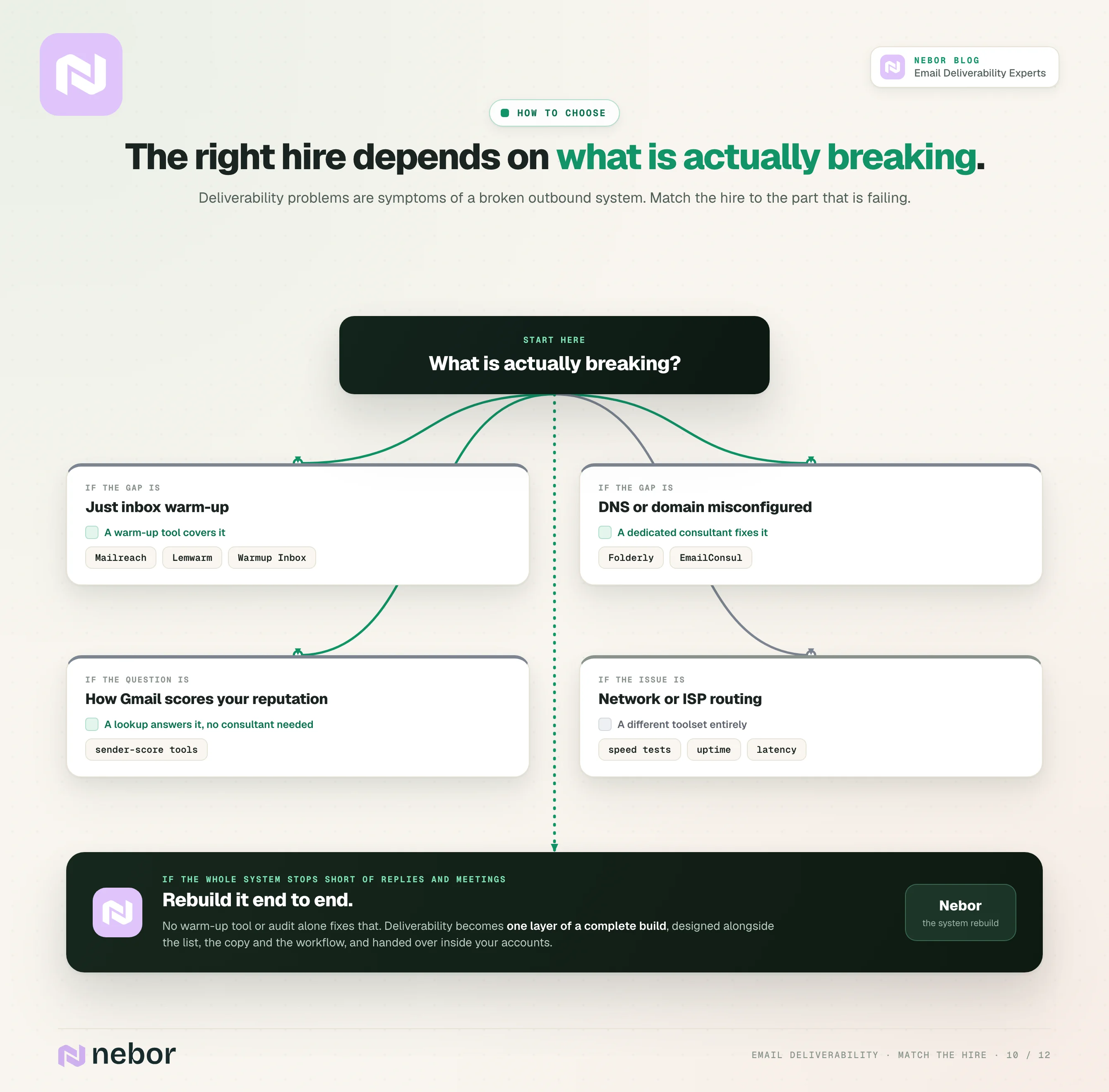
Deliverability issues are almost never solved by one tool or one fix. They are symptoms of a broken outbound system, and the right hire depends entirely on which part of that system is breaking.
Here is the working frame we use to think about it.
If the gap is purely inbox warm-up, a tool like Mailreach, Lemwarm, or Warmup Inbox covers it. If the DNS or domain setup is misconfigured, a dedicated deliverability consultant like Folderly or EmailConsul is the right hire.
If the question is how Gmail or Outlook is currently scoring your sender reputation, sender-score lookup tools answer that without a consultant in the room.
If the issue is upstream of email entirely (network performance, ISP routing), the relevant tools are speed tests, uptime monitors, and latency trackers, not a deliverability specialist.
If the actual problem is that the whole outbound system stops short of replies and booked meetings, no warm-up tool or audit alone fixes that. The fix is rebuilding the system end to end so deliverability stops being one of the things that keeps breaking.
That is the work we do at Nebor. The deliverability piece is one layer of a complete outbound build, designed and operated alongside the list, the targeting, and the workflow.
The system gets handed over to you, inside your accounts, ready for your team to operate.
Work with Nebor on the deliverability layer and the rest of the outbound build
Poor email deliverability kills more pipeline than bad messaging or wrong targeting. Fixing only the deliverability piece does not save outbound, because the system around it has to work too.
If your outbound is dying somewhere between the spam folder and the inbox, and you want the system rebuilt instead of another tool added on top, that is the work we do.
We audit the current setup, name what is breaking deliverability, and design a complete build that includes deliverability as one layer alongside the list, the copy, the workflow, and the monitoring.
The whole system gets built inside your accounts and handed over for your team to operate.
If you want the longer thinking before that conversation, Why we set out to be the best growth agency covers how we approach client builds. Otherwise, book a strategy call when you are ready to walk through your setup.
Note: Hiring a deliverability expert fixes today. It doesn't fix next quarter.
Reputation decays, providers keep moving the rules, and warmup never really finishes. A one-off audit gets you back to the inbox for a while, then the same problem returns quietly.
At Nebor we build it as a standing part of your outbound: domains, authentication, rotation, list hygiene and the monitoring that catches a slip early.
Book a 15-minute call and we'll walk you through how to set it up.


Related Articles


By clicking Sign Up you're confirming that you agree with our Terms and Conditions.