
Why the Best Time to Send Cold Emails is When the Intent Data or Buying Signals Say You Should


In this post:
There is a best time to send cold emails, and it is not what most people recommend.
The standard advice goes something like this:
People check their inboxes at certain times, so early mornings are an effective send window.
The best time to send cold outreach also varies by recipient time zone, industry, and a handful of other factors that nobody can fully control.
Don’t take our word for any of this. Here is what Google turns up for the query.
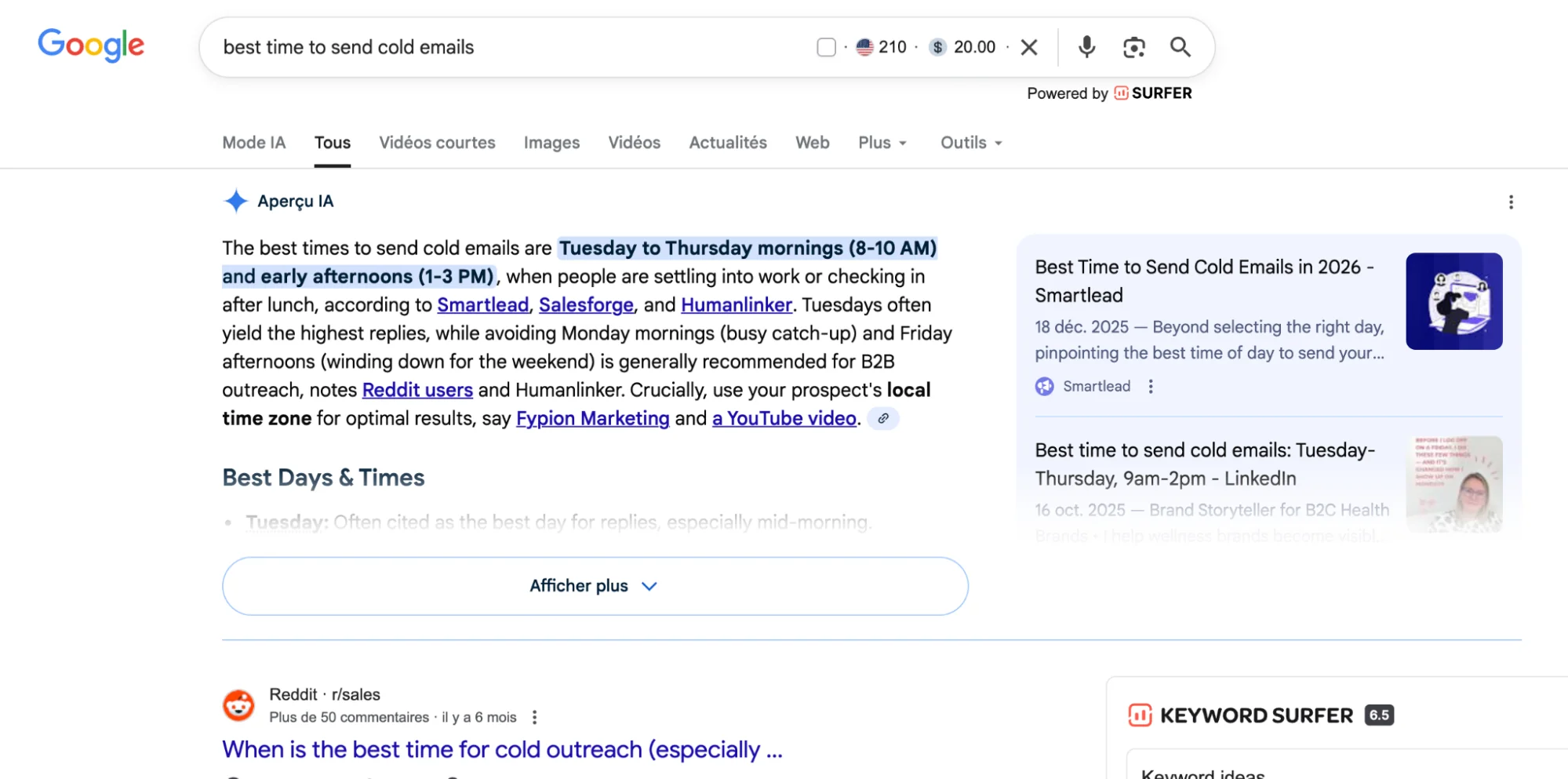
And here is a Reddit thread where experts repeat the same advice.
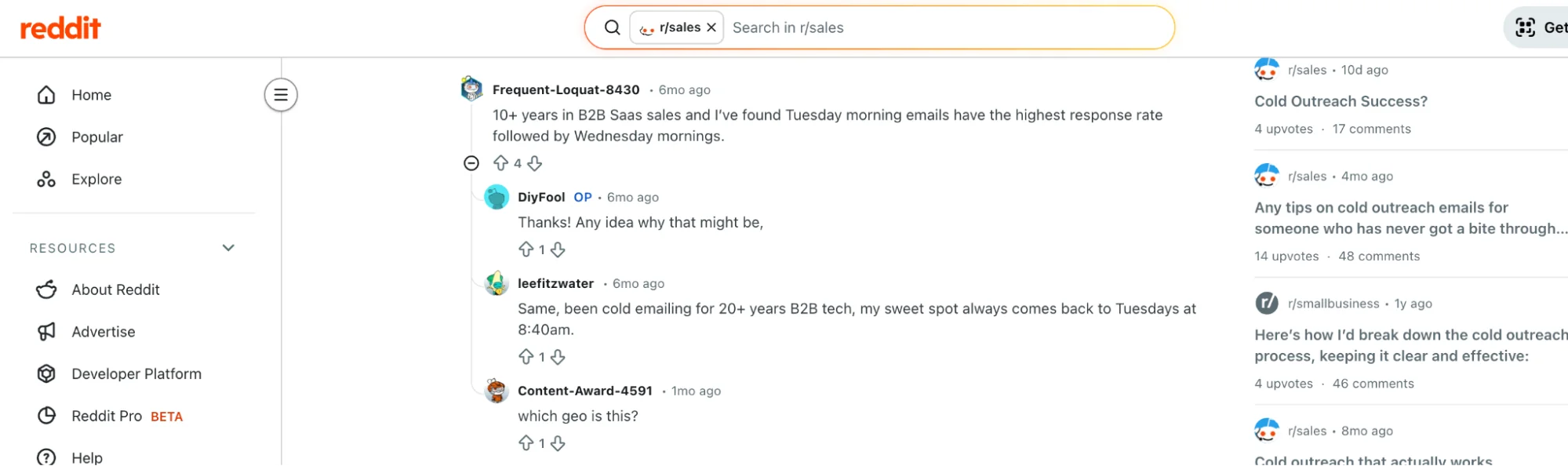
If you came here looking for the usual advice about sending on Tuesday at 10 AM, sticking to business hours, or avoiding Mondays because of the inbox avalanche, you are on the wrong blog.
We are not going to repeat the same tired statistics about open rates by day of the week, and we are not going to tell you that 2 PM is the sweet spot for reply rates.
We do recognize that timing plays a role in cold email success. It affects whether your emails get seen and engaged with at all. Some email providers also use engagement signals like opens and clicks to decide between inbox and spam folder placement.
The thing is, if you are obsessing over whether to hit send in the early morning or the late afternoon, you are missing the point of reaching out at the right moment.
You are sending to people who don't need your solution, with offers that don't match their current situation, at moments when buying is the last thing on their mind.
The real question is not "what time should I send this email?" The real question is "why am I sending this email to this person right now?"
If you cannot answer that with something better than "because it's Tuesday morning," you are doing cold email wrong.
Note: Nobody buys because your email arrived at 10am.
You can perfect the send time and still be writing to somebody with no reason to reply. What decides whether an email works is whether the person reading it has a valid pain point or a clear need for your service, product or solution at that moment.
At Nebor, we automate outbound prospecting and lead generation. We build the monitoring that watches your whole market for the events that create that need, enriches whatever it finds, and puts the outreach in front of your reps the same day, wired into your CRM so nothing gets lost.
Book a 15-minute call and let's discuss which signals would matter for your business.
TL,DR
You can own an automated Clay-powered sales opportunity detection system that tells you the best time to send cold emails and win deals
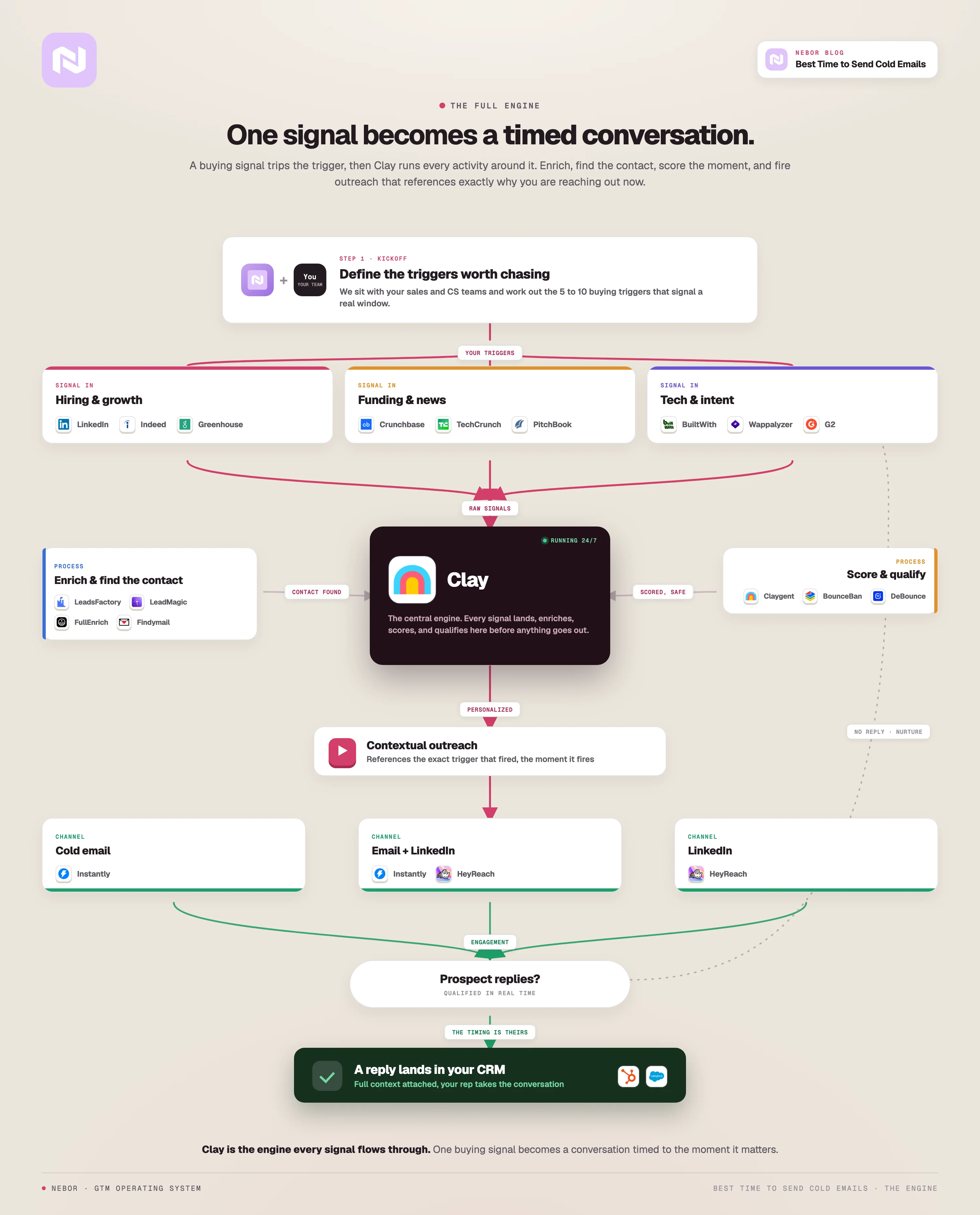
How the flawed industry consensus on cold email timing is keeping your reply rates poor
Let's talk about why the entire cold email industry has been optimizing the wrong variable for the past decade.
Every major cold email tool, every sales blog, every LinkedIn expert who talks about it has fixated on the same question. When should you hit send? Timing is only part of the puzzle, and it is not the part that matters most.
Most outreach teams analyze performance data to pick the best times to send emails. They focus on the work week and track open, click, and reply rates across multiple campaigns to optimize their schedules.
They will show you heat maps of email open rates by hour. They will cite studies from Mailchimp or HubSpot showing that Tuesday at 10 AM gets 23% higher open rates than Friday at 4 PM.
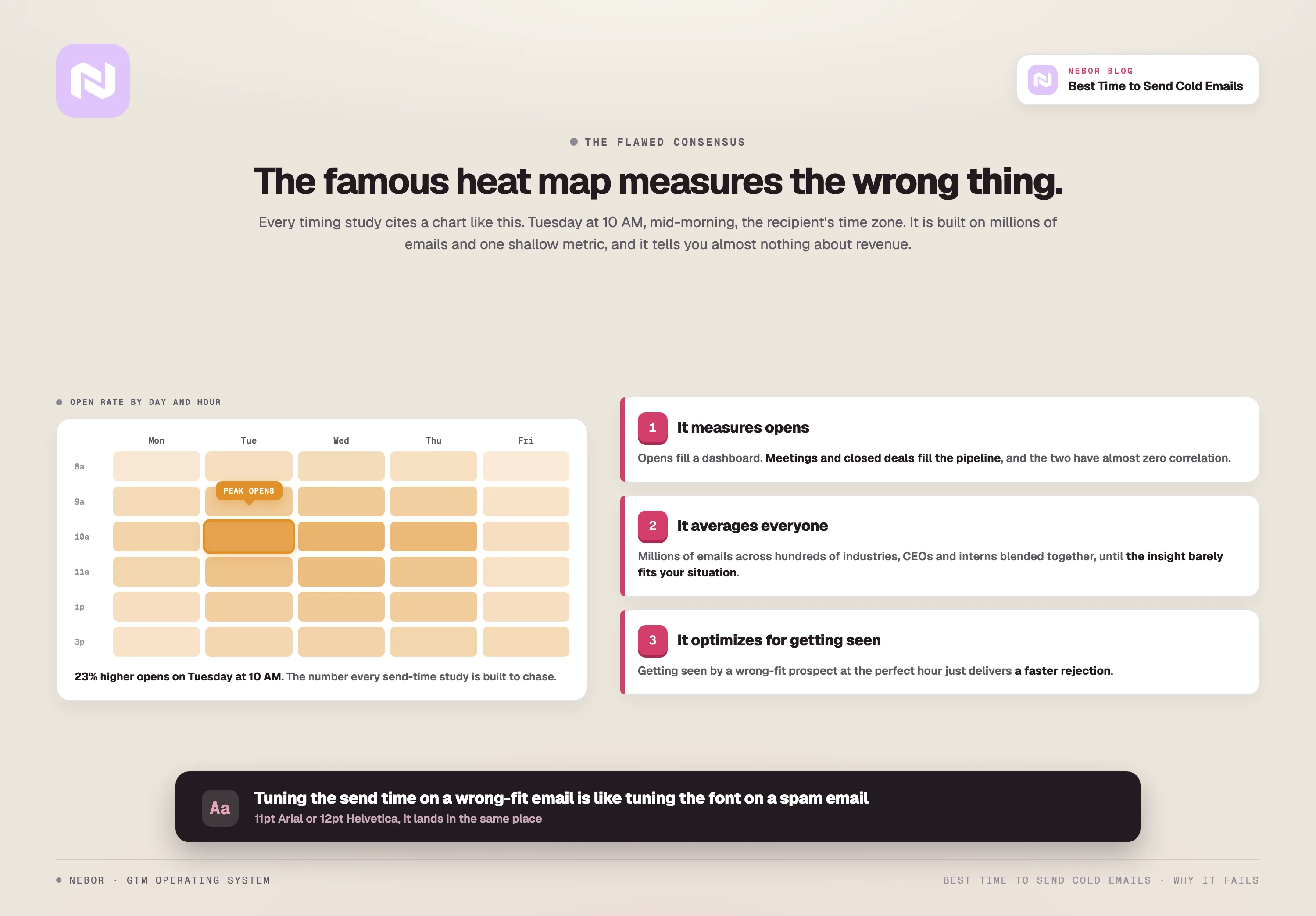
They will tell you to avoid lunch hours, weekends, and the dreaded Monday morning inbox avalanche.
And it’s all essentially useless.
These studies measure the wrong outcome. They track opens and maybe clicks. Opens don't pay your bills. Meetings and closed deals do. There is almost zero correlation between the best time to get an open and the best time to start a conversation that ends in revenue.
Think about the methodology behind these timing studies. They pull data from millions of emails sent by thousands of companies across hundreds of industries.
They average emails selling everything from accounting software to marketing services to industrial equipment. They lump together emails to CEOs, middle managers, and individual contributors.
They treat a cold email to someone who has never heard of you the same as a nurture email to someone who downloaded a lead magnet last week.
The resulting insights are so generic they barely apply to your specific situation.
There is a bigger problem underneath. Even if these timing recommendations worked, they optimize for the wrong goal.
They try to game inbox algorithms and recipient habits to get your email seen. Getting seen by the wrong person at the wrong time with the wrong offer is just faster rejection.
This is like optimizing the font size on a spam email. Maybe 12pt Helvetica performs 3% better than 11pt Arial. You are still sending spam. The fundamental approach does not work.
The cold email industry has convinced you that timing is a technical optimization problem. Send at the right hour, nail your subject line, A/B test your CTA placement, and your cold outreach will work. People who actually understand how B2B buying happens know this is a story.
Why intent data and buying signals beat any best-day or best-time statistic
Traditional advice says the best time to send a cold email is mid-morning (8-11 AM) or early afternoon (1-3 PM) on Tuesdays, Wednesdays, and Thursdays in the recipient's time zone. Timing alone rarely drives an actual buying decision.
Think about your own behavior for a second. When was the last time you bought enterprise software because an email showed up at 10 AM on a Tuesday?
Never.
You bought software when you had a problem painful enough to solve, when you had budget allocated, when you had organizational alignment, and when the timing made sense for your business.
The fact that someone's cold email arrived on a Tuesday rather than a Thursday was completely irrelevant to your buying decision. Your prospects work the same way.
The conventional wisdom about cold email timing rests on a flawed assumption. It treats every prospect as identical and acts like the calendar matters more than the context.
That assumption ignores almost everything we know about B2B buying behavior. It overlooks why context and signals actually matter.
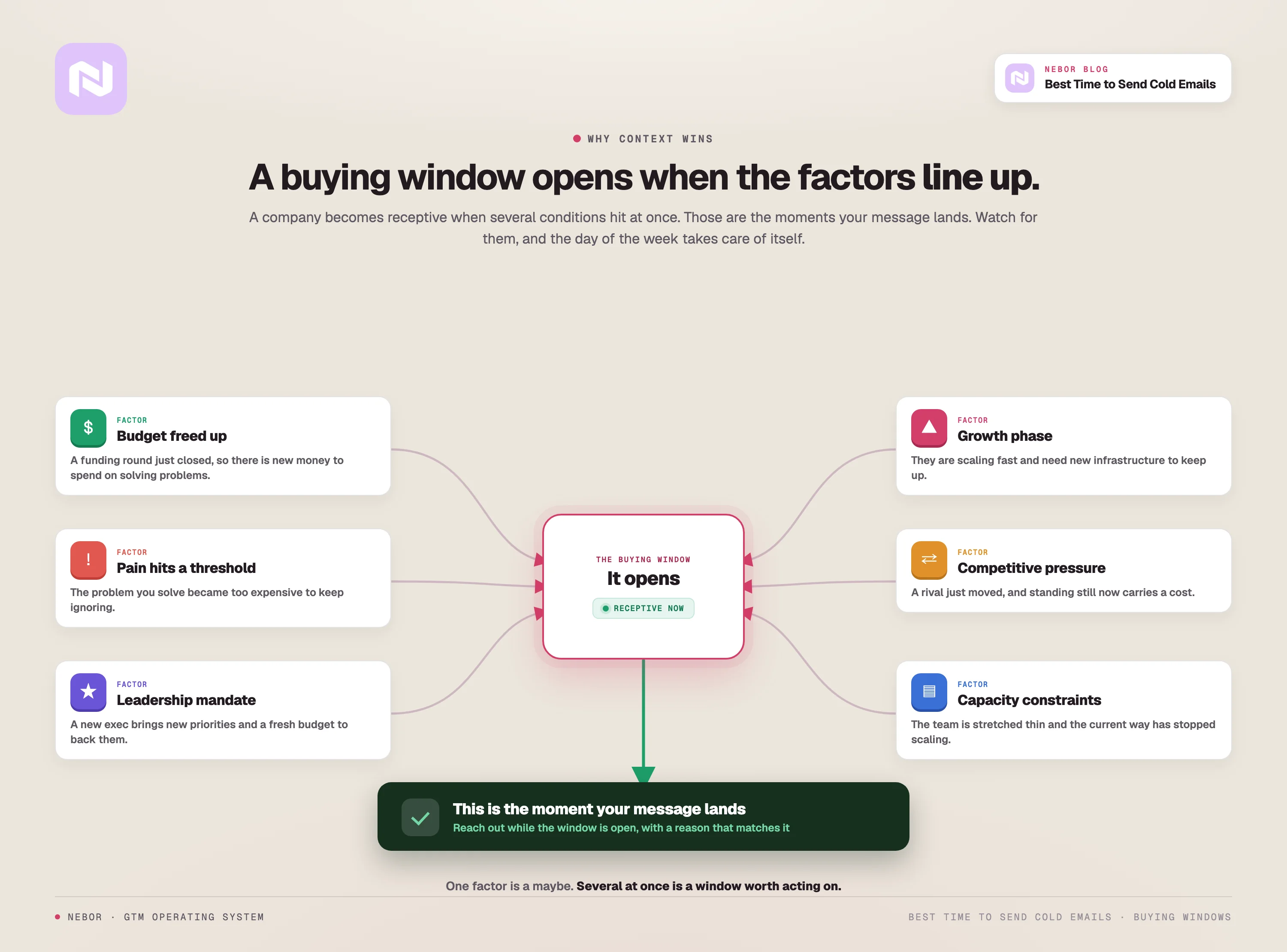
B2B purchases don't happen because prospects check email at the optimal time. They happen because companies enter buying windows. A buying window is a specific period when several factors line up to make the company receptive to new solutions.
Those factors include:
Budget availability or recent funding
Organizational pain points reaching a critical threshold
Leadership mandates or strategic shifts
Growth phases that require new infrastructure
Competitive pressure or market change
Team capacity constraints becoming unsustainable
When these conditions exist, prospects are receptive. When they don't, your perfectly-timed Tuesday morning email is just noise.
So what is more likely to get a response?
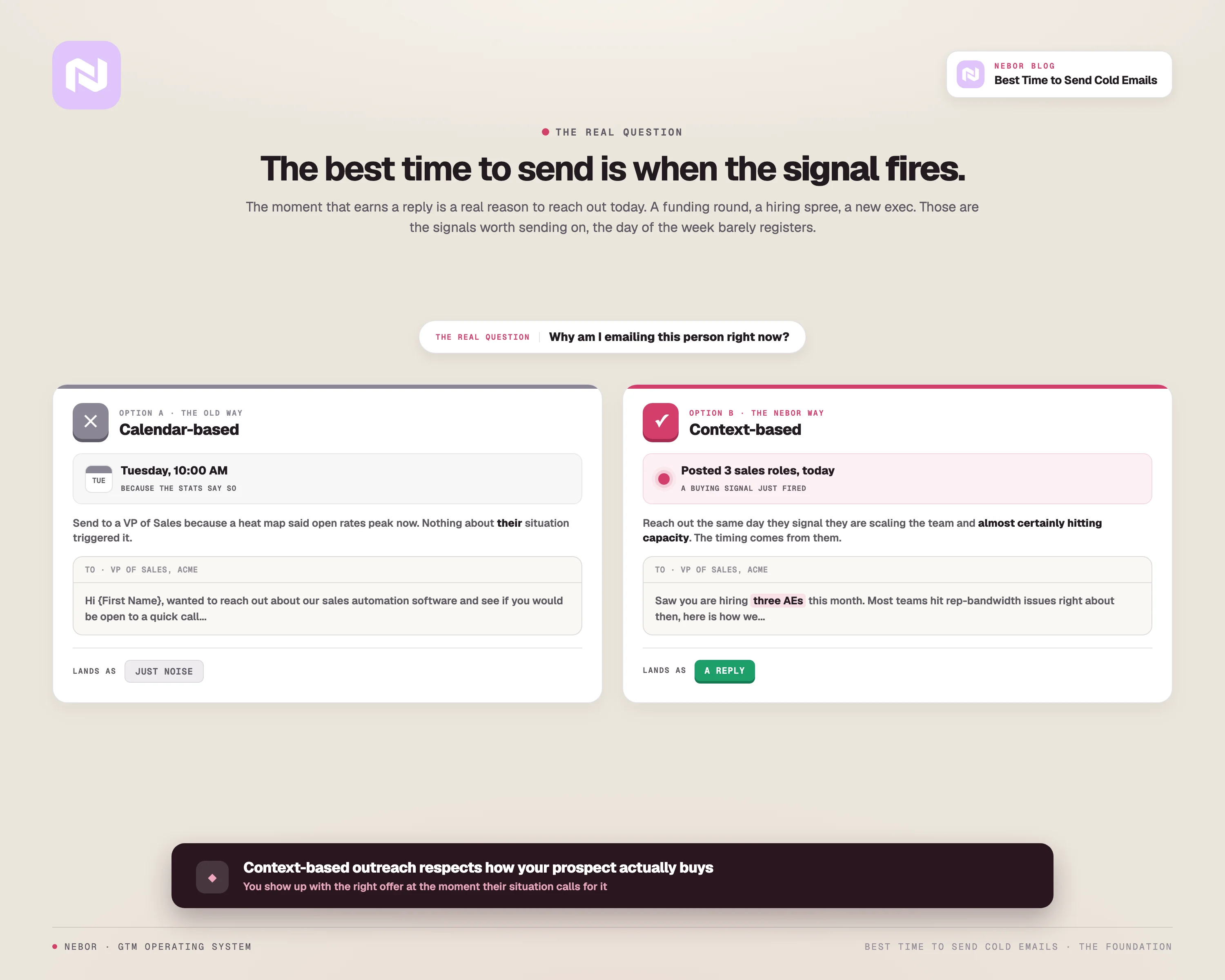
Option A. You send a pitch about your sales automation software to a VP of Sales on Tuesday at 10 AM because that is when the statistics say open rates are highest. Traditional advice would tell you to schedule the send around the recipient's local time zone for optimal engagement.
Option B. You send a tailored message about solving their sales rep bandwidth problem the same day you notice they posted three new sales job openings on LinkedIn, which tells you they are scaling their team and almost certainly hitting capacity issues.
The gap is obvious. Most companies and agencies still operate on Option A logic when it comes to cold outreach.
Here is what makes this even more absurd. The companies obsessing over send time are usually the same ones doing zero research on whether their prospects actually need what they're selling right now.
They will spend hours debating whether to send at 9 AM or 10 AM, and they will not spend five minutes checking whether the company just announced layoffs or just closed a funding round.
At Nebor, we build entire intent-driven outbound systems around a different philosophy. Reach people when they are showing signs they need your solution, not when your calendar tells you to.
When a SaaS company announces a new funding round, that is your signal to reach out about solutions that help them scale, not next Tuesday at 10 AM.
When a logistics company acquires new properties, that is your moment to pitch your furnishing solution.
When a manufacturing company posts job listings for operations managers, that is when they need your productivity software, not during whatever the calendar calls "optimal sending hours."
These moments don't happen on Tuesdays at 10 AM. They happen when they happen. If you are not monitoring for them, you are leaving real money on the table while you split-test subject lines.
The companies winning at cold email are not the ones with the most sophisticated A/B tests on subject lines or the most optimized sending schedules.
They are the ones who show up with the right offer at the right moment because they actually pay attention to what their prospects are doing in the real world.
The shift that separates mediocre cold email from cold email that drives revenue is the move from calendar-based outreach to context-based outreach.
Calendar-based outreach asks when should I send. Context-based outreach asks why should I send to this specific person right now. The first is spray and pray with fancy scheduling. The second is strategic, targeted, and respects how your prospect actually buys.
Note: Nobody buys because your email arrived at 10am.
You can perfect the send time and still be writing to somebody with no reason to reply. What decides whether an email works is whether the person reading it has a valid pain point or a clear need for your service, product or solution at that moment.
At Nebor, we automate outbound prospecting and lead generation. We build the monitoring that watches your whole market for the events that create that need, enriches whatever it finds, and puts the outreach in front of your reps the same day, wired into your CRM so nothing gets lost.
Book a 15-minute call and let's discuss which signals would matter for your business.
How to use intent data and buying signal monitoring to find the right moment to reach out
Once you accept that context matters more than calendar, the entire game changes. You stop treating cold email as a numbers game and start treating it as a trigger-based system.
This is where intent data and buying signals become the foundation of everything you do.
Most people hear "intent data" and picture a magic list of companies ready to buy right now. Or they think of first-party website tracking, like monitoring who visits your pricing page or downloads your whitepaper.
That is not wrong, just woefully incomplete.
Real intent data is broader and more useful than that. It is any observable signal that a company or decision-maker is entering a phase where they are likely to need your solution, whether or not they have ever heard of you.
Three types of intent data exist, and each one matters for a different reason.
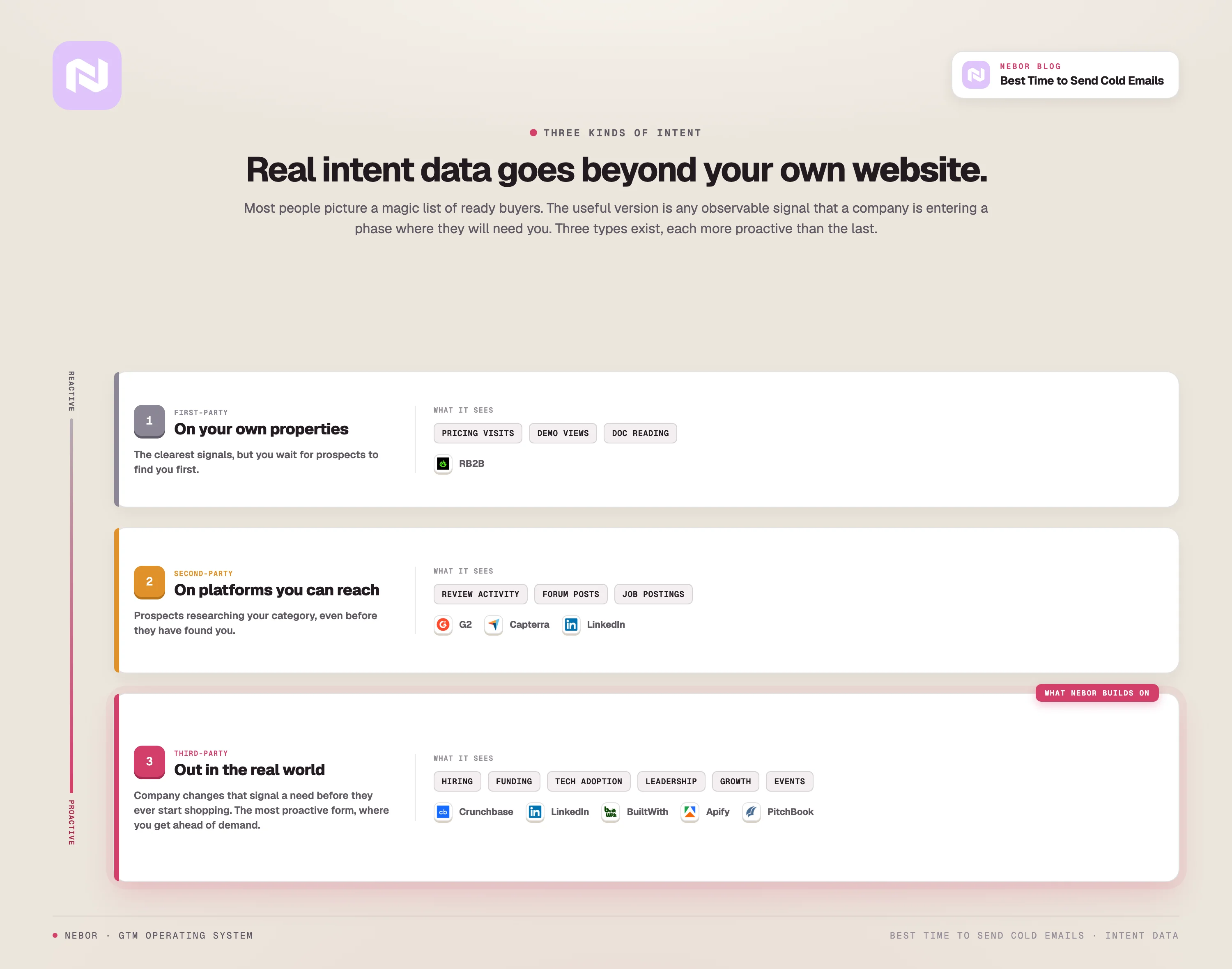
First-party intent data is what happens on your own properties. Someone visits your pricing page twice in one week. A prospect downloads your case study. A company browses your product documentation for 20 minutes. A decision-maker watches your demo video.
These are the clearest signals because the prospect is engaging with you directly. They know you exist. They are actively researching. This is valuable, and most companies are reasonably good at capturing first-party intent.
The limitation is that first-party intent only works for people who have already found you. You are waiting for prospects to discover you through content, ads, search, or referrals. You are reacting to inbound interest rather than proactively creating opportunities.
Second-party intent data is what happens on properties you have a relationship with or can access.
Examples include review platforms like G2 or Capterra where prospects research solutions, industry forums where your audience discusses problems, partner ecosystems where complementary tools share anonymous intent data, and job boards where companies post roles that signal needs.
If you sell project management software and you can see that a company just reviewed three of your competitors on G2, that is a strong signal they are actively shopping.
They have not come to your website yet, but they are clearly in-market, and you can use sales automation workflows to engage these high-intent prospects.
Second-party intent is more proactive than first-party. You are identifying prospects who are researching solutions in your category, even if they have not found you specifically yet. That gives you a chance to enter their consideration set before they make up their mind.
Third-party intent data is where things get interesting. This is information about company activities, business changes, and strategic shifts that happen completely outside your ecosystem but indicate a potential need for what you sell. This is the one we love and use the most.
It includes:
Hiring signals. Job postings for roles that suggest they need your solution
Funding announcements. New capital usually means new budget for solving problems
Technology adoption. Installing complementary tools that pair with yours
Leadership changes. New executives bring new priorities and budgets
Company growth indicators. Office expansions, new locations, acquisition news
Industry events. Conference attendance or speaking engagements
Content engagement. Downloading competitor resources, attending webinars
Website visits. Even if they don't convert, knowing who is researching matters
For a deeper read on how these signals turn into actual sales opportunities, see our take on what a lead generation agency actually does.
Third-party intent is the most proactive form of outbound. You are identifying companies that fit your ICP and are hitting specific changes or inflection points that suggest they will need your solution soon, even when they are not actively shopping yet.
This is how you get ahead of demand instead of just responding to it.
Here is a real example from our work.
We have a client who sells tax incentive consulting services to Fortune 500 companies. The traditional approach would be to build a list of F500 CFOs and send them all the same cold email on Tuesday morning, hoping someone bites.
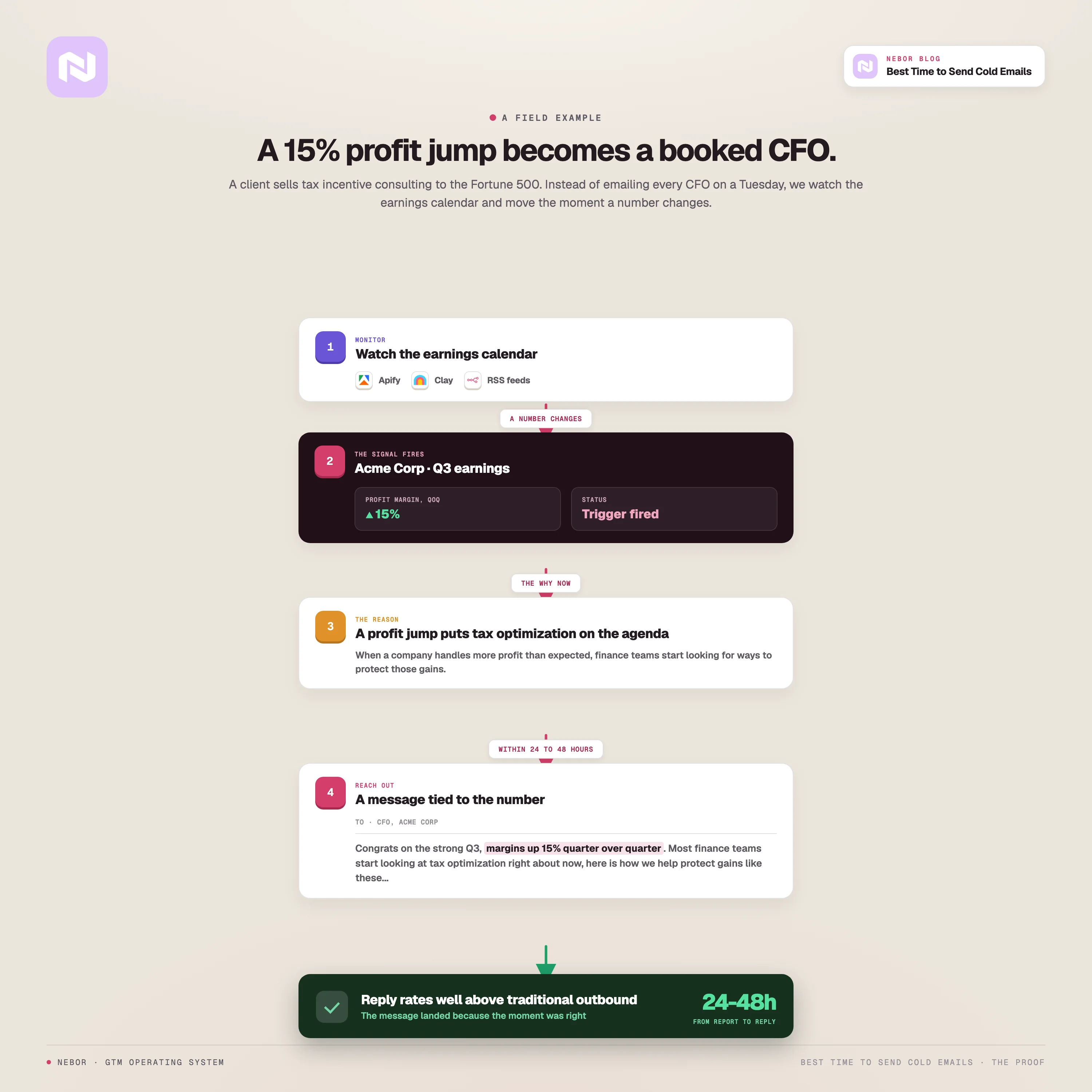
We did the opposite. We built an automation in Apify and Clay that monitors financial news and earnings reports for F500 companies through RSS feed readers.
When a company reports a sudden increase in profit margins, say a 15% jump quarter-over-quarter, that is our trigger.
That is the moment when CFOs and finance teams are thinking about tax optimization, because they are handling more profit than expected.
We reach out within 24-48 hours of the earnings report with a message that references the specific financial performance and positions our client's tax incentive services as a way to protect those gains.
The reply rates are simply better than traditional outbound, and not because we sent on the right day of the week. We get the reply because we showed up at exactly the right moment in their financial planning cycle with a relevant offer.
That is the power of intent data. Instead of waiting for prospects to raise their hand, you spot the moments when your solution becomes relevant to their current business reality.
Why personalization still matters when you act on intent data
Personalization is what turns intent data from a list of signals into real conversations and pipeline.
When you act on intent data in your cold email campaigns, you have the chance to write messages that speak directly to the recipient's current need, challenge, or interest.
This goes beyond dropping in a job title or company name. It is about showing the prospect that you understand their situation and have a relevant solution for it.
Referencing a recent funding round, a new job posting, or a technology adoption that is relevant to your offering shows that your outreach is timely and thoughtful.
That level of personalization lifts your reply rate and sets your cold emails apart from the generic pitches flooding your prospect's inbox.
It is also worth thinking about how your recipients read their email. Some read on mobile, some on desktop. A short, direct message that scans easily on any device gives you the best chance. Make short and sweet your default.
How to build an intent-driven cold email system from end to end
So how do you actually build this for your business? How do you move from calendar-based cold email to context-based outreach that converts?
The win here is the system, not a single tool you buy off the shelf. You build it to monitor signals, qualify opportunities, and trigger relevant outreach automatically.
Here is the framework we use at Nebor.
Step 1: Understand your ICP and define your trigger events
Which companies most need your service or solution? What specific situations or moments tell you a company might need it now?
Most companies fail at intent data before they even start because they are too vague about which signals actually matter for their business.
You need to get specific about which events or conditions point to a company entering a buying window for your solution. The pitfalls of relying on third-party leads are well documented, and signal-based targeting is what most B2B teams should do instead.
Here is what those events look like across a few different ICPs.
If you sell recruiting software. Job postings for recruiters or talent acquisition roles, rapid hiring (10+ open roles posted at once), funding rounds that suggest hiring acceleration, new office openings that require local hiring
If you sell sales automation tools. Job postings for SDRs or BDRs, CRM changes or implementations, sales leadership transitions, expansion into new markets or regions, funding announcements that suggest scaling
If you sell cybersecurity solutions. Recent security incidents in their industry, compliance deadlines, mergers and acquisitions, technology stack changes that introduce new vulnerabilities, IPO preparations
If you sell HR software. Rapid headcount growth, new office locations, executive appointments in HR or people operations, acquisition announcements that require workforce integration, policy changes in their industry
Notice how specific these are. Each is an observable event you can monitor. Each has a clear logical connection to why the company would need your solution right now.
Sit down with your sales team and your customer success team. Ask when your best customers typically buy. What was happening in their business right before they became receptive to your outreach?
You will find patterns.
The company hitting 50 employees and needing real HR infrastructure.
The company expanding internationally and needing multi-currency financial tools.
The company going through an executive transition where the new leader brings new priorities.
Document 5 to 10 specific trigger events that reliably point to buying windows for your solution. Those become the foundation of your entire intent data system.
Step 2: Match each trigger to trackable data sources
Once you know which signals matter, you need to figure out where you can actually monitor for those signals at scale.
Different triggers live in different places, and the source list shifts depending on what you are tracking.
Hiring signals. LinkedIn company pages, LinkedIn job search, Indeed, Greenhouse job boards, company careers pages, LinkedIn posts announcing team growth
Funding and financial news. Crunchbase, TechCrunch, PitchBook, financial news RSS feeds, SEC filings for public companies, company press releases
Technology adoption. BuiltWith, Wappalyzer, tech stack databases, product review platforms like G2, integration marketplaces, company job descriptions that mention specific tools
Leadership changes. LinkedIn updates, company announcements, press releases, Crunchbase executive tracking, industry publications
Company growth indicators. Real estate news for office expansions, acquisition databases, press releases, LinkedIn headcount tracking tools, company website updates
Event participation. Event websites, speaker directories, sponsor lists, LinkedIn posts about event attendance
Content and media. Google Alerts on company names, RSS feeds from industry publications, podcast directories, YouTube channel monitoring, company blog feeds
The key is to pick 2 or 3 high-quality sources for each of your trigger events. You don't need to monitor everything. You need to monitor the right things consistently.
Step 3: Build automated monitoring and data collection
You will need to use tools like Clay at the center to pull data from multiple sources, PhantomBuster to scrape social signals, RB2B or Apify to identify website visitors, and n8n or Make to connect everything.
[IMAGE: workflow architecture diagram, alt text "best sales tech stack for routing intent data and buying signals on autopilot"]
Alt text: Best sales tech stack for routing intent data and buying signals on autopilot
The goal is to have these signals flowing into a central system (Clay) automatically, so you are not manually checking sources every day. Frankly, if you want this to actually work, you will need Clay experts like Nebor.
At Nebor, we build these systems primarily in Clay because it is the best central hub for this kind of workflow automation. The principles still apply regardless of your tools.
Most Clay rollouts fail before the team builds the first table, which is one of the reasons we wrote about why most Clay implementations fail and what to fix before you touch the tool.
Step 4: Enrich and qualify with multiple data layers
Raw signals are not enough. A company posting a job or getting funding does not automatically make them a good prospect. You need to layer multiple data points to qualify opportunities.
Clay does its best work here. Once a company triggers one of your signals, you can automatically kick off the full pass.
Verify ICP fit. Check company size, industry, location, tech stack, and other firmographic data against your ideal customer profile. If they don't fit, filter them out immediately.
Find the right contacts. Use enrichment tools like LeadsFactory, LeadMagic, FullEnrich, or Findymail to identify decision-makers. Don't grab any email. Target specific roles relevant to your solution. VP Sales for sales tools, Director of HR for people ops software.
Pull additional context. Use Claygents (the Claude AI integration in Clay) or web scraping to gather more information about the company. Recent news, tech stack, company size, growth trajectory, and competitive positioning.
Score the opportunity. Not all signals are equal. A company that just closed a $50M Series B, AND is posting 10 sales jobs, AND visited your pricing page is a much stronger opportunity than one that triggered only one signal. Build scoring logic that prioritizes multi-signal opportunities.
Check exclusions. Automatically verify the contact has not unsubscribed, is not already a customer, has not heard from your team in the recent past, and is not on any do-not-contact list, by integrating a service like BounceBan or DeBounce.
This enrichment and qualification layer is critical. It stops you from reaching out to companies that triggered a signal but are not actually good fits.
It makes sure you are connecting with the right person, not just any email at the company. It also gives you the context you need to write relevant messaging.
Step 5: Trigger contextual outreach
When the signals line up, reach out with messaging that directly references why you are reaching out now. "I noticed you just opened a new location in Austin" beats "I wanted to reach out about our software" every single time.
What matters here is sending the right emails to the right people at the right time, not sending more of them. And "right time" has nothing to do with what day of the week it is.
The beauty of this approach is that it solves three problems at once.
Better targeting. You are reaching companies that fit your ICP and are in a phase where they are likely to buy.
Better timing. You are reaching out when something relevant just happened, not randomly.
Better messaging. You can write emails that reference the specific trigger event, so your outreach feels personal and timely rather than generic and salesy.
When you combine these three elements, your reply rates improve considerably compared to traditional cold email, because the conversations make sense for both parties.
Hire Nebor to find the actual best time to send cold emails for your business
If you are still scheduling your cold emails based on what time zone your prospects are in and what day of the week it is, you are optimizing the wrong variable.
Consistent pipeline from cold outreach comes from teams that have built systems to identify when prospects are actually in-market and ready to have conversations, not from teams obsessing over the send schedule.
At Nebor, we build these systems for B2B companies who are tired of spray-and-pray outreach that damages their reputation and burns their team's time.
We set up your cold email infrastructure, and we also build the automation that replaces manual sales prospecting by monitoring intent signals across dozens of data sources, identifying your best-fit prospects at the right moment, and triggering personalized outreach that references why you are reaching out now.
Your sales team stops wasting time on prospects who are not ready to buy. They stop burning through their total addressable market with generic outreach. They start having conversations with people who actually need what you offer, right when they need it.
We handle the technical infrastructure, the data monitoring, the workflow automation, the copy, and the campaign management.
You get qualified meetings with prospects who are genuinely in-market, and you own the entire system we build. After the engagement ends, the workflows live in your accounts. That is the ownership-over-rental position we lean on.
Note: Nobody buys because your email arrived at 10am.
You can perfect the send time and still be writing to somebody with no reason to reply. What decides whether an email works is whether the person reading it has a valid pain point or a clear need for your service, product or solution at that moment.
At Nebor, we automate outbound prospecting and lead generation. We build the monitoring that watches your whole market for the events that create that need, enriches whatever it finds, and puts the outreach in front of your reps the same day, wired into your CRM so nothing gets lost.
Book a 15-minute call and let's discuss which signals would matter for your business.


Related Articles


By clicking Sign Up you're confirming that you agree with our Terms and Conditions.