

In this post:
A company sets a revenue target for next year and then faces a deceptively simple question, which is how many salespeople it takes to hit it. Answered wrong, the whole plan becomes fiction.
Hire too few and the number is unreachable no matter how hard the team works, while hiring too many burns cash on capacity the pipeline can't feed.
Quota capacity planning is the discipline of answering that question with math instead of hope. It works out how much revenue your current and planned sales team can realistically produce, so you can tell whether a target is achievable and how many reps you'd need to close the gap.
Quota capacity planning is the process of modeling how much sales capacity a company has and needs, by connecting rep headcount, quotas, ramp time, and expected attainment to a revenue target. It answers whether the team as staffed can hit the number, and if not, how many more reps are required.
It earns its importance because a revenue target without a capacity plan is just a wish. Plenty of companies set ambitious numbers and discover mid-year that they never had enough productive reps to reach them, which is exactly the failure honest capacity planning prevents.
TL;DR
Quota capacity planning models whether your sales team can hit a revenue target, by connecting headcount, quotas, ramp time, and expected attainment.
Its core equation is fully-ramped rep count times quota times attainment, which gives the realistic revenue the team can produce.
The biggest danger is naive headcount math, because counting every rep at full quota ignores ramp and attrition and overstates real capacity by a wide margin.
Good planning hires ahead of need, because ramp takes months, so the reps who deliver next year's number usually have to be hired well before it starts.
What quota capacity planning calculates for a real sales team
Quota capacity planning estimates the revenue a sales team can realistically produce, then compares that to the target. The basic model multiplies the number of fully-ramped reps by their quota and by the attainment rate you expect them to hit, which yields the capacity the team can honestly deliver.
That equation is deliberately grounded in reality instead of optimism. It doesn't assume every rep hits quota or that new hires produce immediately, because it uses realistic attainment and counts only reps who are truly up to speed, which keeps the estimate honest.

Comparing that capacity to the revenue target is what makes the exercise useful. If the productive capacity falls short of the goal, the plan reveals the gap and how many additional reps it would take to close it, turning a vague ambition into a concrete staffing requirement.
Why naive headcount math badly overstates your real capacity
The most common and costly mistake in capacity planning is counting gross headcount as if every rep were fully productive. Multiplying total reps by quota and attainment ignores that a large share of the team isn't producing at full capacity at any given moment, which inflates the estimate dramatically.
The distortion is larger than most leaders expect, and we work through this math with clients before any hiring plan gets signed off.
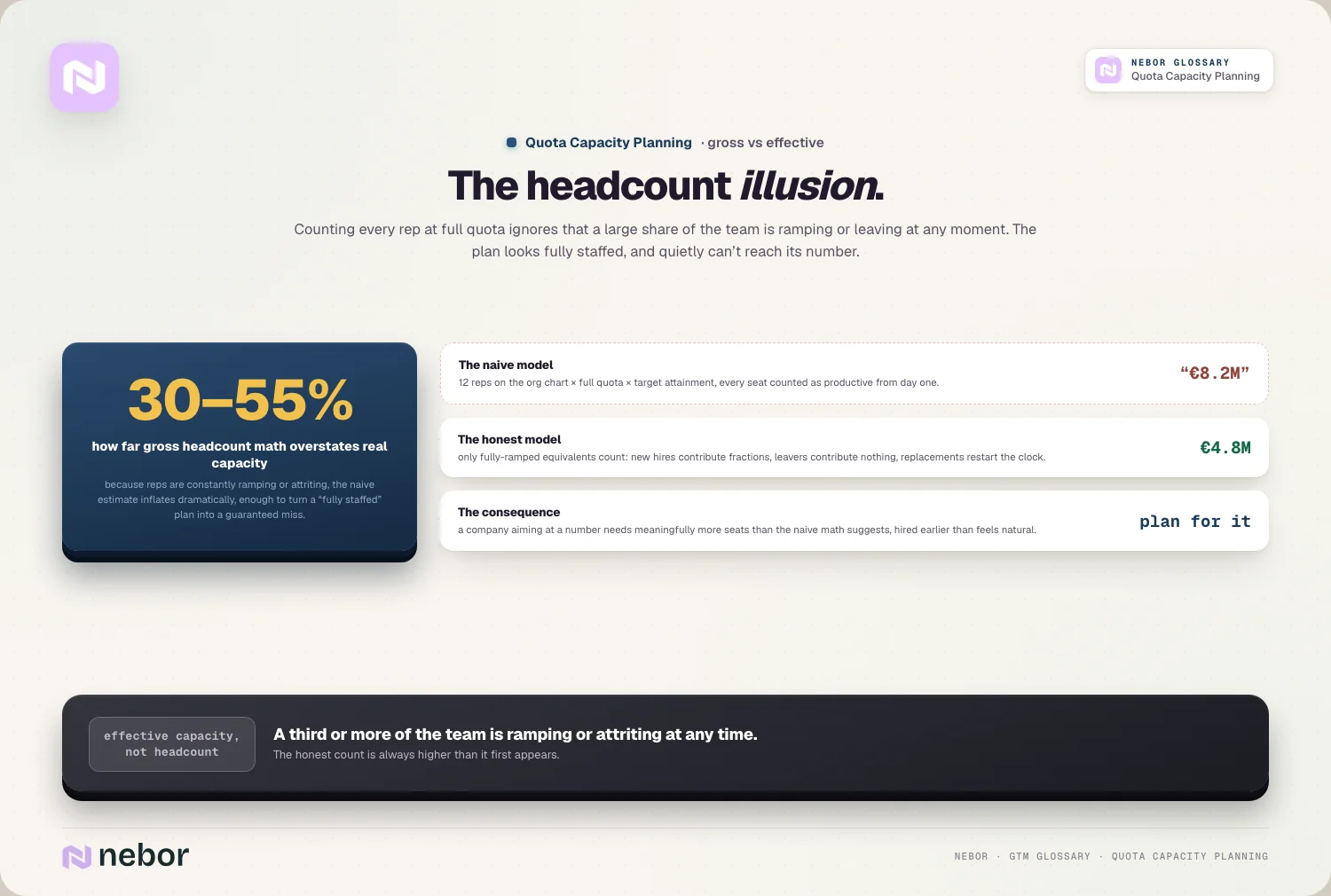
Because reps are constantly ramping or leaving, gross headcount math overstates real capacity by 30 to 55%, enough to turn a plan that looks fully staffed into one that can't reach its number.
Avoiding this means planning around effective capacity instead of headcount. A company aiming for a given revenue number needs meaningfully more seats than the naive math suggests, because a third or more of the team is ramping or attriting at any time, so the honest count is always higher than it first appears.
Why ramp time is the biggest hidden factor in the whole model
The single factor that breaks naive capacity math is ramp time, the months it takes a new rep to reach full productivity. A rep hired today doesn't produce a full quota's worth of revenue for a long time, so counting them at full capacity from day one badly overstates what they'll deliver.
Ramp follows a predictable curve that the model has to respect. An enterprise rep might produce only a small fraction of quota in their first quarter and climb toward full productivity over the year, so their first-year contribution is far below what they will eventually produce each year.
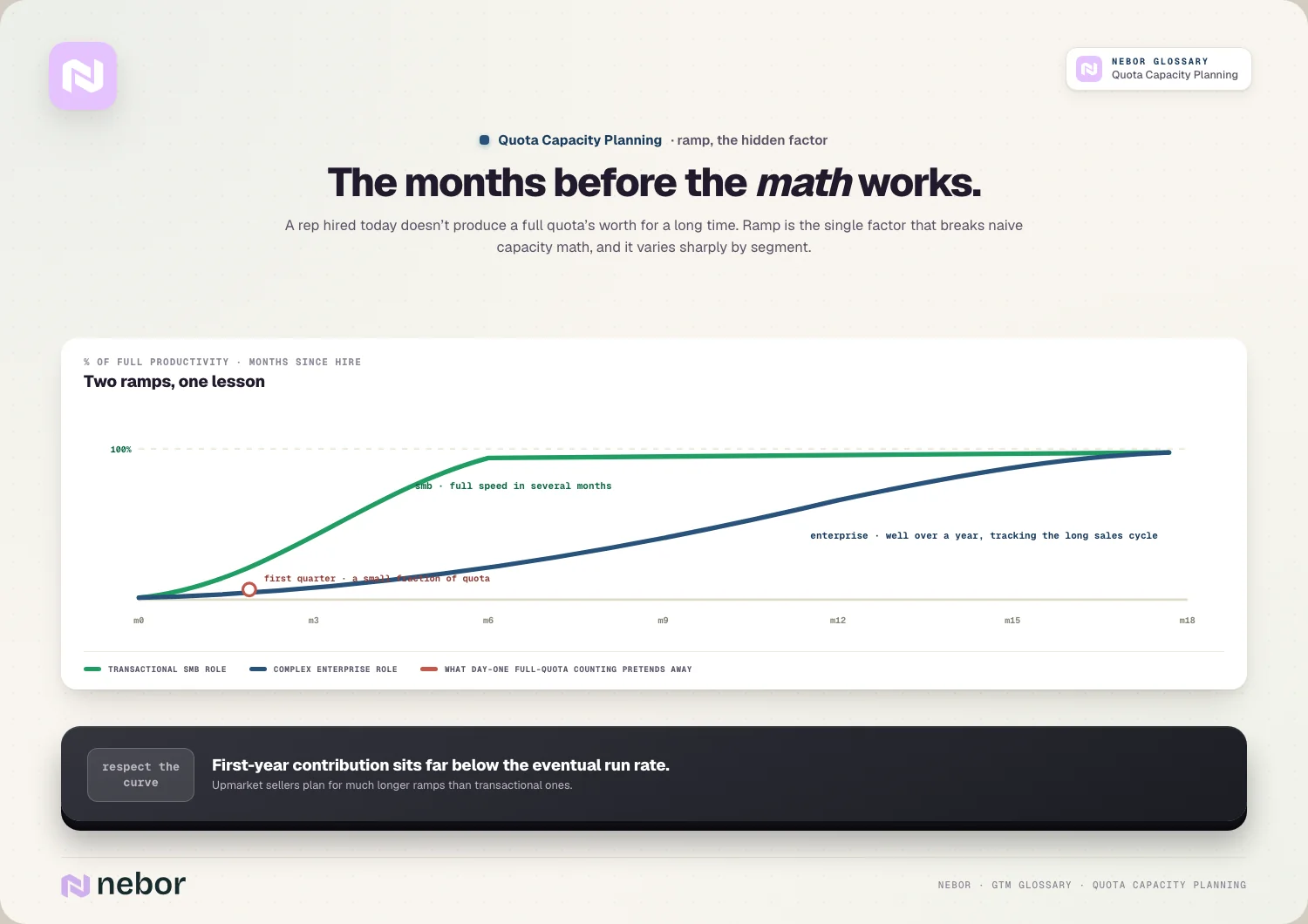
Ramp length also varies sharply by segment, which the plan has to account for. Simpler SMB roles might reach full speed in several months, while complex enterprise roles with a long sales cycle can take well over a year, so upmarket sellers plan for much longer ramps than transactional ones.
Why attrition has to be built into any honest capacity plan too
Beyond ramp, the other reality that erodes capacity is attrition, because reps leave and take their productivity with them. A plan that assumes every rep on your team stays all year will overstate capacity, because in practice a meaningful fraction departs and has to be replaced.
Attrition rates in sales are high enough to matter a great deal. With median attrition around a fifth of the team annually, an organization of any size needs a steady stream of replacement hires just to stand still, on top of any hires meant to grow capacity.
This is why capacity planning includes replacement hiring alongside growth hiring. A company that only hires for growth and ignores attrition slowly loses ground as departures outpace additions, so the plan has to fund enough hiring to cover both the leavers and the intended expansion.
Why companies have to hire well ahead of when they need capacity
Because ramp takes months, the reps who will deliver a given period's revenue usually have to be hired long before that period begins. A company that waits until it needs capacity to start hiring will have a team still ramping when the number is already due, which is a guaranteed shortfall.
This forces capacity planning to work backward from the target. Knowing that a new rep takes many months to reach full productivity, a company hires several quarters ahead of when the capacity is required, so the reps are ramped and producing by the time the revenue is expected.
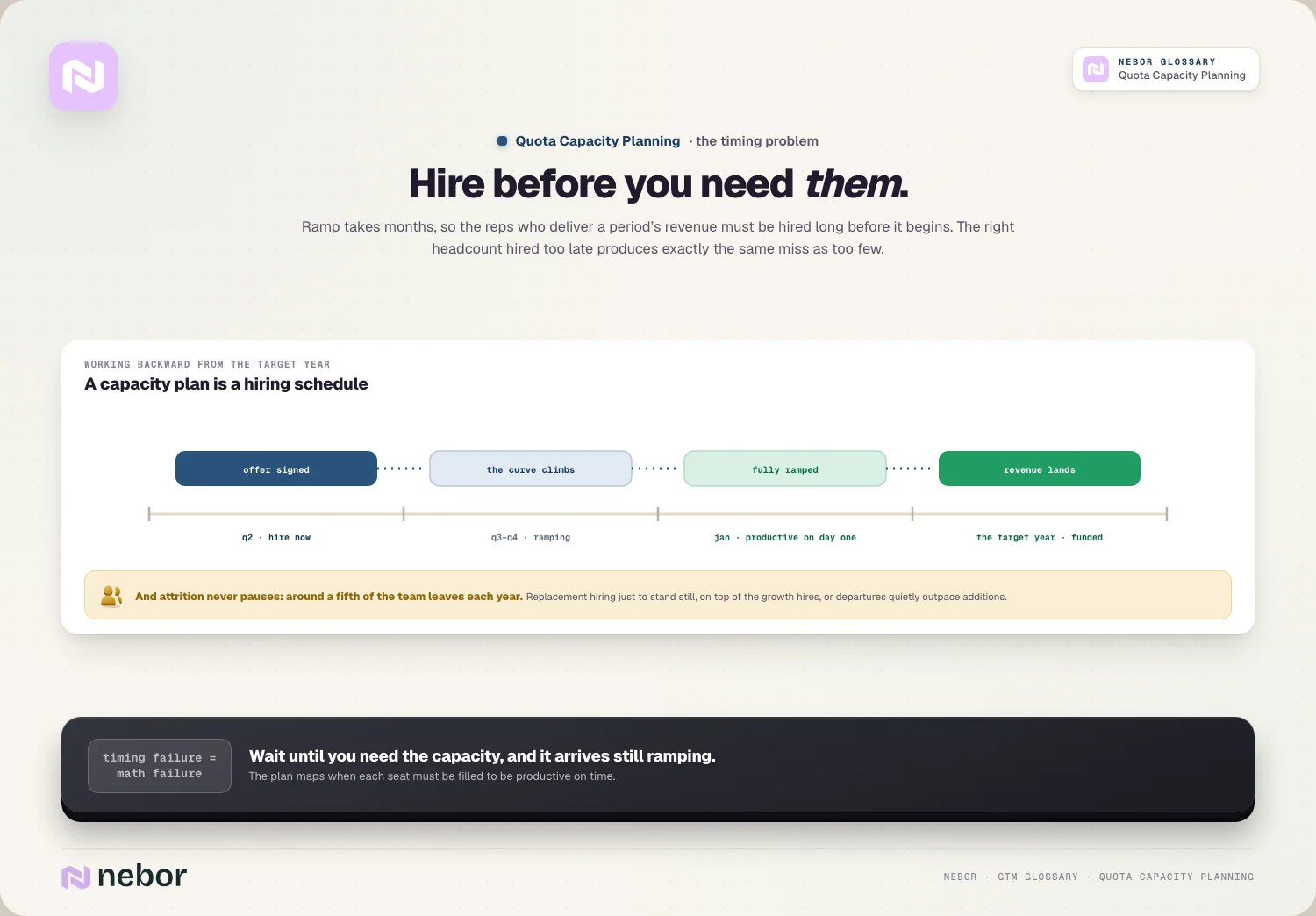
Getting the timing right is as important as getting the headcount right. The correct number of reps hired too late produces the same miss as too few reps, so a capacity plan is a hiring schedule as much as a headcount, mapping when each seat needs to be filled to be productive on time.
How quota capacity planning connects to quota setting itself
Capacity planning and quota setting are two sides of the same problem, because the quota you assign each rep is a key input to how much the team can produce.
Setting quotas too high inflates the modeled capacity on paper while lowering the quota attainment reps really reach, so the two are balanced together as part of the sales compensation plan.
The interplay between quota level and attainment is where we keep seeing plans go wrong. A stretch quota with low attainment can produce less net revenue than a realistic quota reps consistently hit, so the plan chooses quota levels that maximize real output instead of looking impressive on paper.
This is why capacity planning uses expected attainment instead of quota as the productive figure. What a company can bank is the revenue reps close, which is quota times realistic attainment, so grounding the plan in achievable attainment is what keeps it from overstating capacity.
Why fully-ramped capacity is the right unit to plan around here
The cleanest way to think about a sales team's power is in terms of fully-ramped, productive capacity instead of raw bodies. A fully-ramped rep represents a known quantity of expected revenue, so counting in those terms gives a far truer picture than counting heads in wildly different states of productivity.
This framing also clarifies what hiring buys you. Adding a rep adds a ramping rep who becomes a full unit of capacity later, without ever adding one immediately, so thinking in fully-ramped equivalents keeps the timing and the true contribution of each hire visible.
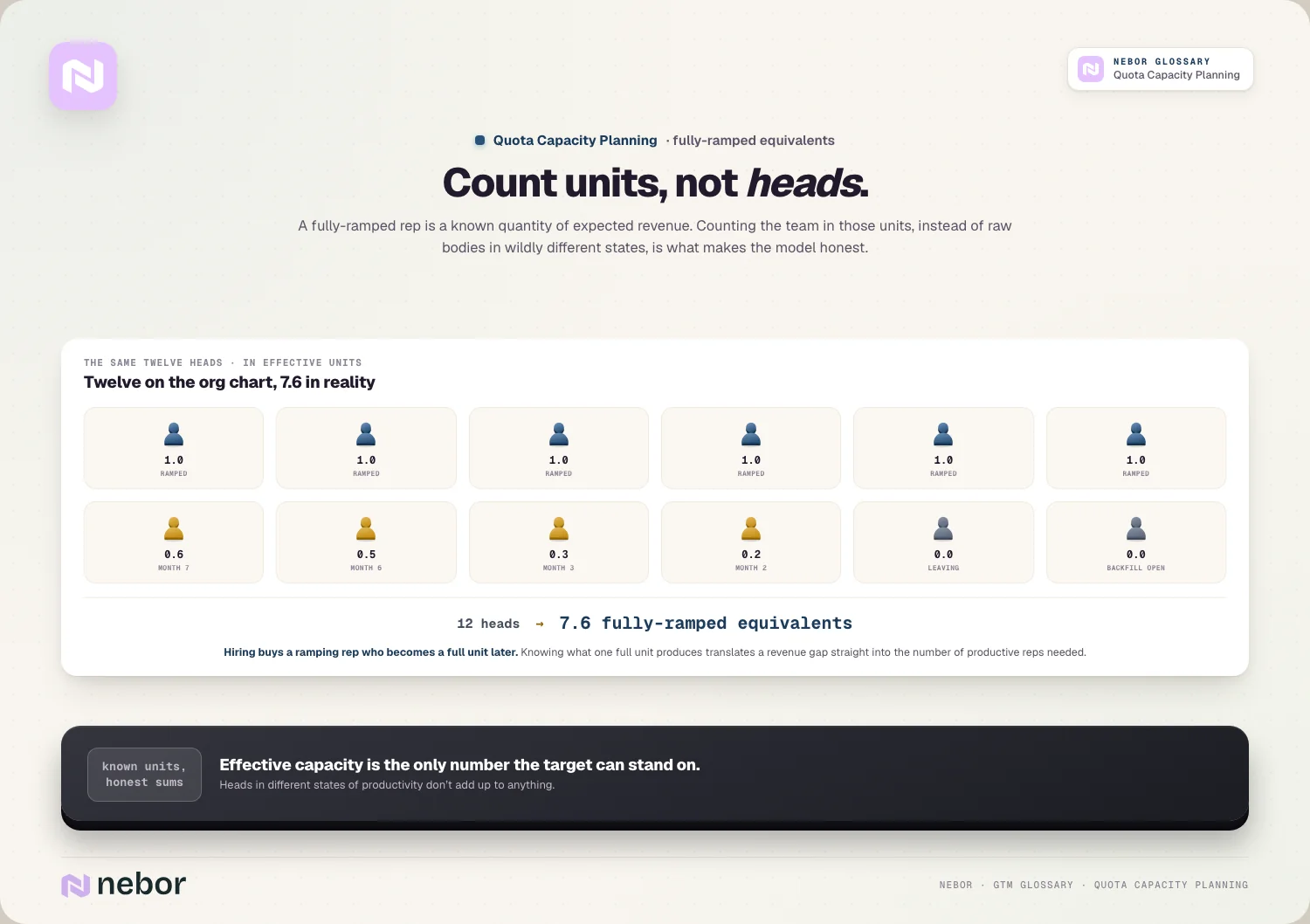
Planning in these terms connects headcount decisions directly to revenue and to sales velocity. When a company knows how much a fully-ramped rep produces, it can translate a revenue gap straight into the number of productive reps needed, which is the whole point of the model.
How capacity planning ties into territories and pipeline coverage
Capacity planning connects to territory design, because the reps it counts have to be given territories with enough opportunity to hit quota. Balanced territory carving is what makes the modeled attainment realistic, because a rep in a thin territory can't produce their quota no matter how ramped they are.
The plan also depends on your pipeline holding enough to work. Capacity assumes reps have deals to pursue, so the model has to line up with the pipeline coverage that feeds those reps, because adding sellers with nothing to sell produces no extra revenue.
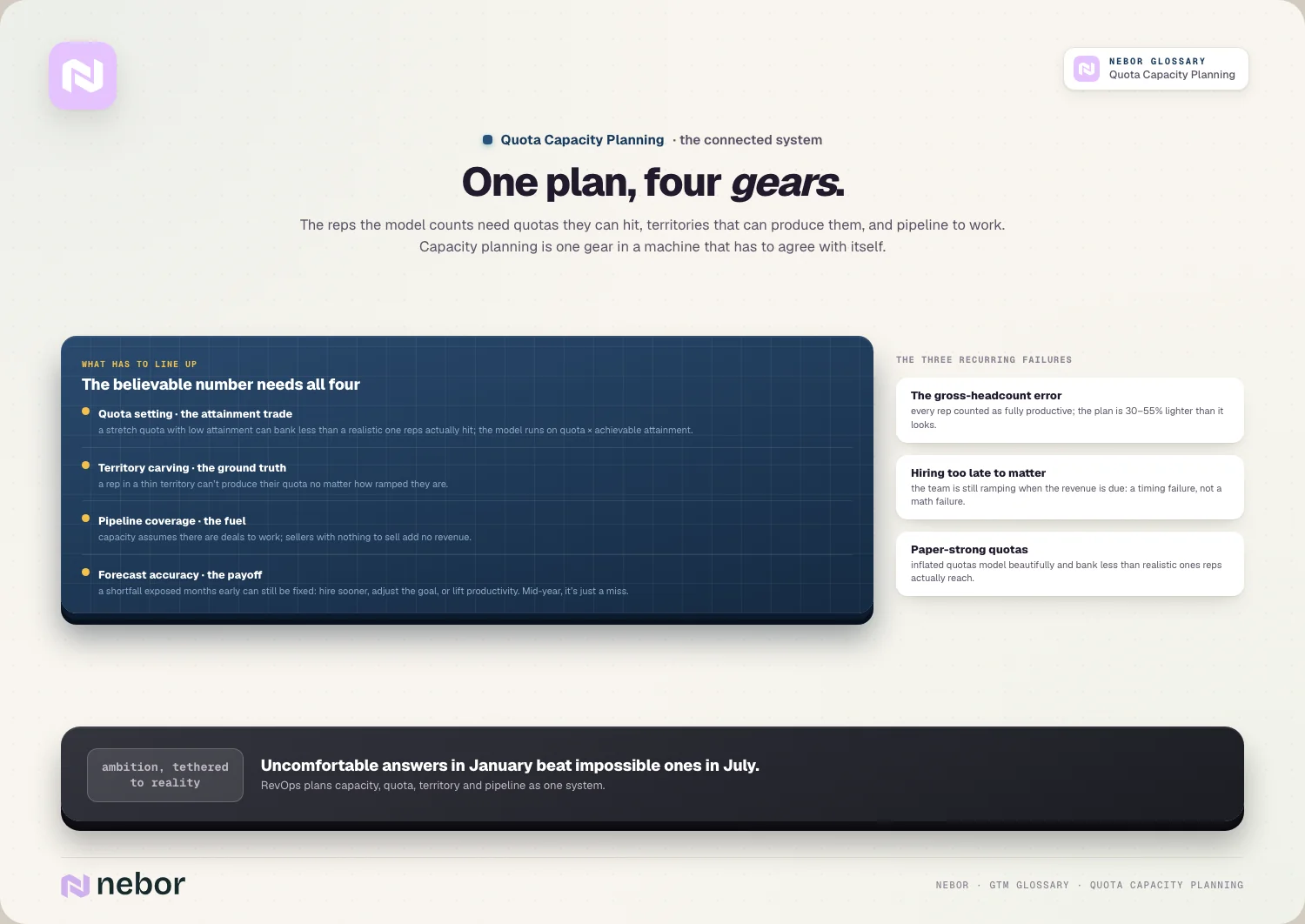
Seen this way, capacity planning is one piece of a connected planning system. It belongs alongside quota setting, territory design, and pipeline planning inside revenue operations, all of which have to agree for the revenue target to be achievable instead of just assigned.
Why capacity planning is central to a believable revenue forecast
A revenue forecast is only credible if the capacity behind it is real, which makes capacity planning a foundation of accurate forecasting. Promising a number the staffed team can't produce guarantees a miss, so grounding the forecast in genuine capacity is what makes it trustworthy.
The model exposes gaps early enough to act on them, which in our experience is its single biggest payoff, and we tell clients to rerun it every quarter.
When capacity planning shows a shortfall against the target, a company can respond by hiring sooner, adjusting the goal, or improving productivity, instead of discovering the gap mid-year when it's too late to fix.
This early visibility is what turns capacity planning into a strategic tool for the whole revenue engine. By connecting headcount and ramp to revenue months ahead, it improves overall forecast accuracy and lets leadership make staffing decisions while there's still time for them to pay off.
The common mistakes companies make with quota capacity planning
The most frequent mistake is the gross-headcount error, treating every rep as fully productive and ignoring ramp and attrition. This single oversight overstates capacity by a wide margin, so a plan that looks fully staffed falls short of what the number requires.
Another common error is hiring too late to matter. A company that starts hiring only when it needs the capacity ends up with a team still ramping when the revenue is due, so even the right headcount arrives too late to produce, which is a timing failure instead of a math failure.
Setting unrealistic quotas is the third recurring problem, because a low win rate under a stretch quota inflates modeled capacity while producing lower real attainment. The plan then looks stronger on paper than the revenue it banks, which undermines the whole exercise.
Why quota capacity planning is the bridge between a target and reality
The deepest value of quota capacity planning is that it forces an honest reckoning between ambition and what a team can deliver. A revenue target is easy to declare, but capacity planning tests whether the people, ramped and retained, can produce it, which turns a wish into a plan.
That honesty is what makes the exercise worth the effort even when its answers are unwelcome. Learning early that a target needs far more hiring than expected is uncomfortable, but it's far better than discovering the shortfall halfway through the year when nothing can be done about it.
Quota capacity planning is what keeps revenue goals tethered to reality, and that grounding is why it belongs at the planning core of a modern go-to-market system.
It ensures the team that has to hit the number is big enough, ramped enough, and fed with enough pipeline, so the outreach you automate sales prospecting to generate lands in the hands of a team that can convert it.
Deel dit bericht
RevOps
Begrippenlijst
Gerelateerde begrippen
De basis GTM-concepten begrijpen




Klaar om je pipeline te bouwen