

In this post:
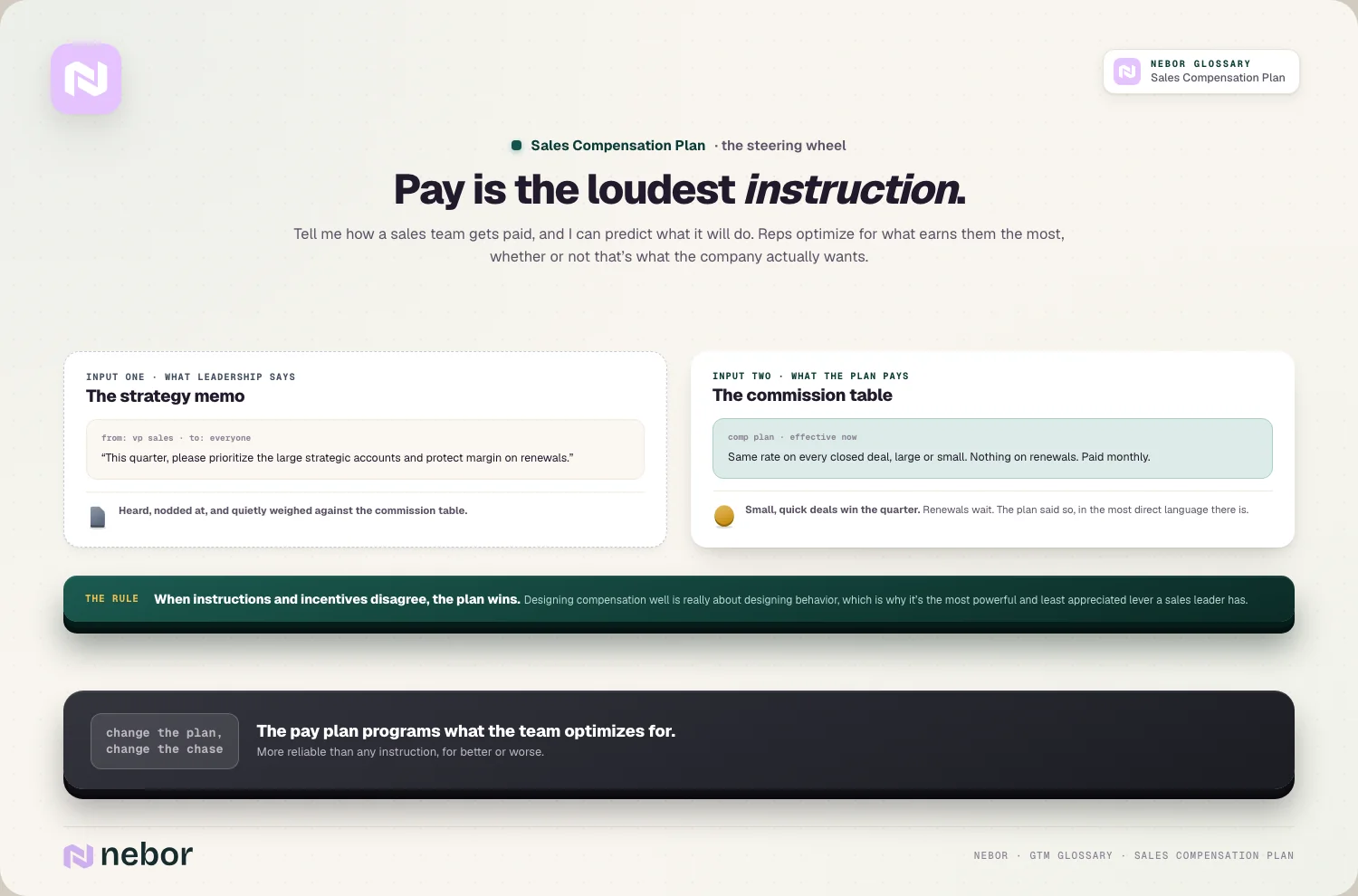
Tell me how a sales team gets paid, and I can predict what it will do. Reps optimize for the behavior that earns them the most money, whether or not that's what the company wants, so the pay plan is one of the most powerful and least appreciated levers a sales leader has.
Change the plan and you change what the whole team chases.
A sales compensation plan is the structure that decides how reps earn. It combines a steady base salary with variable pay tied to results, and the exact way those pieces are arranged tells reps, in the most direct language there is, which outcomes are worth their effort.
A sales compensation plan is the system of base pay and variable pay a company uses to fund and direct its sales force, defining how much reps earn and what they have to do to earn it. It functions like a steering wheel, because every rule in it points reps toward a particular behavior.
The reason it deserves so much care is that reps respond to incentives more reliably than to instructions. A leader can tell reps to focus on the right deals, but if the plan pays best for something else, the plan wins, so designing compensation well is really about designing behavior.
TL;DR
A sales compensation plan is the mix of base salary and variable pay that determines how reps earn, and it directs their behavior by rewarding certain outcomes over others.
Its core pieces are a base salary, variable pay tied to results, and a target total called OTE, the on-target earnings a rep makes at full quota.
The split between base and variable, along with accelerators for overachievement, is what shapes how aggressively and toward what a rep sells.
When it's designed well it aligns rep behavior with company goals, but a poorly designed plan steers the team toward the wrong things.
What the core pieces of a sales compensation plan look like in practice
A sales compensation plan is built from two basic parts, a fixed base and a variable component. The base salary is the steady, guaranteed pay a rep receives regardless of performance, giving them stability, while the variable pay is the portion they earn by hitting sales results.
The variable part is where the plan does its steering, because it ties directly to outcomes. It usually comes as commission on the deals a rep closes, sometimes topped with bonuses for hitting specific targets, so the more a rep produces, the more they earn on top of their base.
Together these two parts define both the security and the upside of the role. The base keeps a rep afloat through the ups and downs of selling, while the variable pay is what turns performance into income, and the balance between them shapes everything about how the role feels and functions.
What OTE means and why it anchors the whole compensation plan
OTE, or on-target earnings, is the number that ties a compensation plan together, because it represents what a rep earns when they hit exactly 100% of their quota. It's simply the base salary plus the variable pay a rep would make at full attainment, so it expresses the total a fully performing rep can expect.
OTE holds its central place because it's how compensation gets communicated and compared. When a company hires a rep or benchmarks a role, it talks in terms of OTE, because that single figure captures the realistic earning target in a way base salary alone never could.
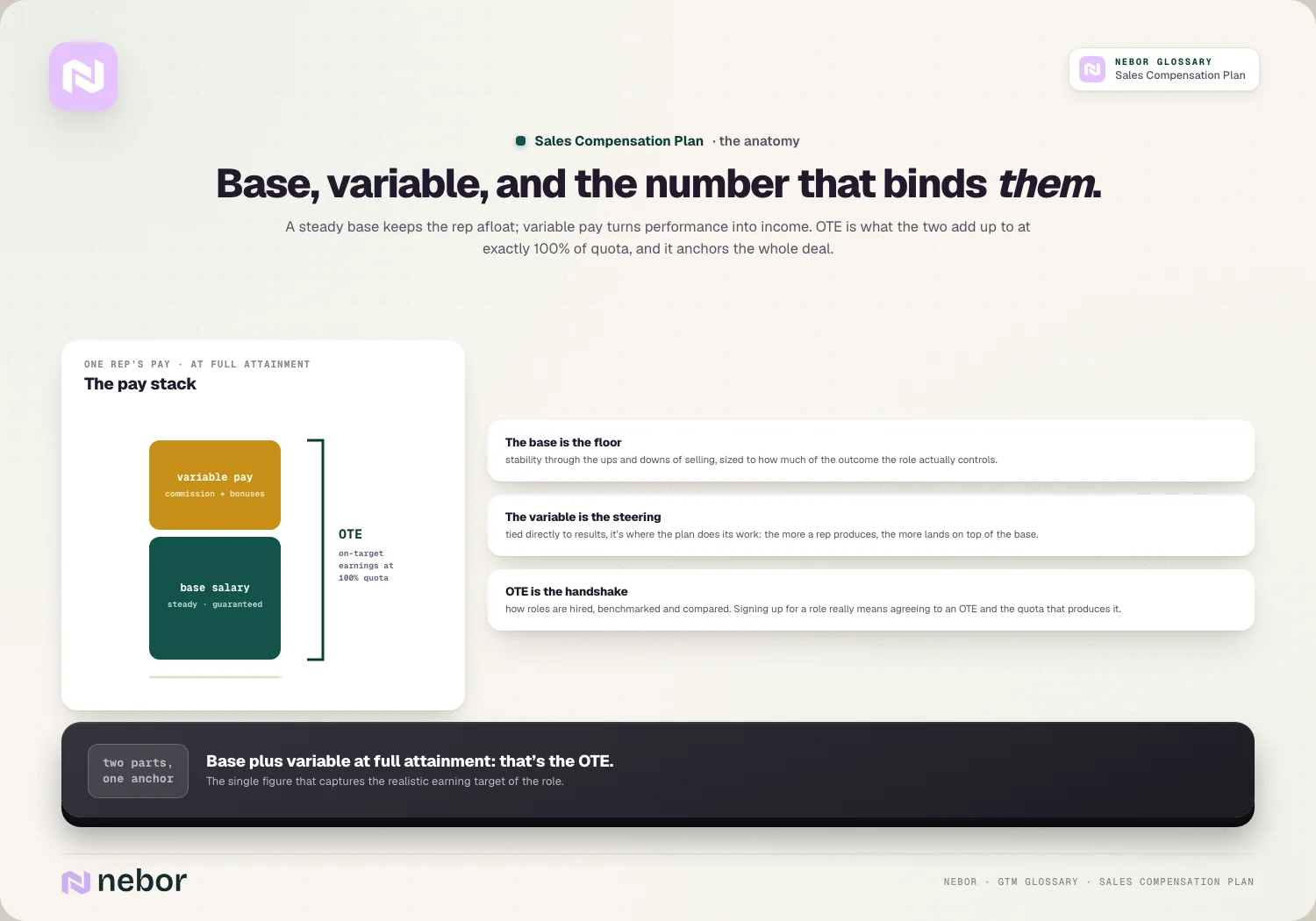
The number also frames the deal between rep and company. A rep signing up for a role is really agreeing to an OTE and a quota, understanding that hitting their number produces their target pay, which makes OTE the anchor the rest of the plan's mechanics are built around.
Why the split between base and variable pay matters so much here
The ratio of base to variable pay, often called the pay mix, is one of the most consequential choices in a plan. A base-heavy plan offers stability and suits roles where the outcome is less in the rep's control, while a variable-heavy one pushes harder on results and rewards aggressive selling.
The right mix varies by role because different roles have different control over the sale, and in our experience the common benchmarks hold up well.
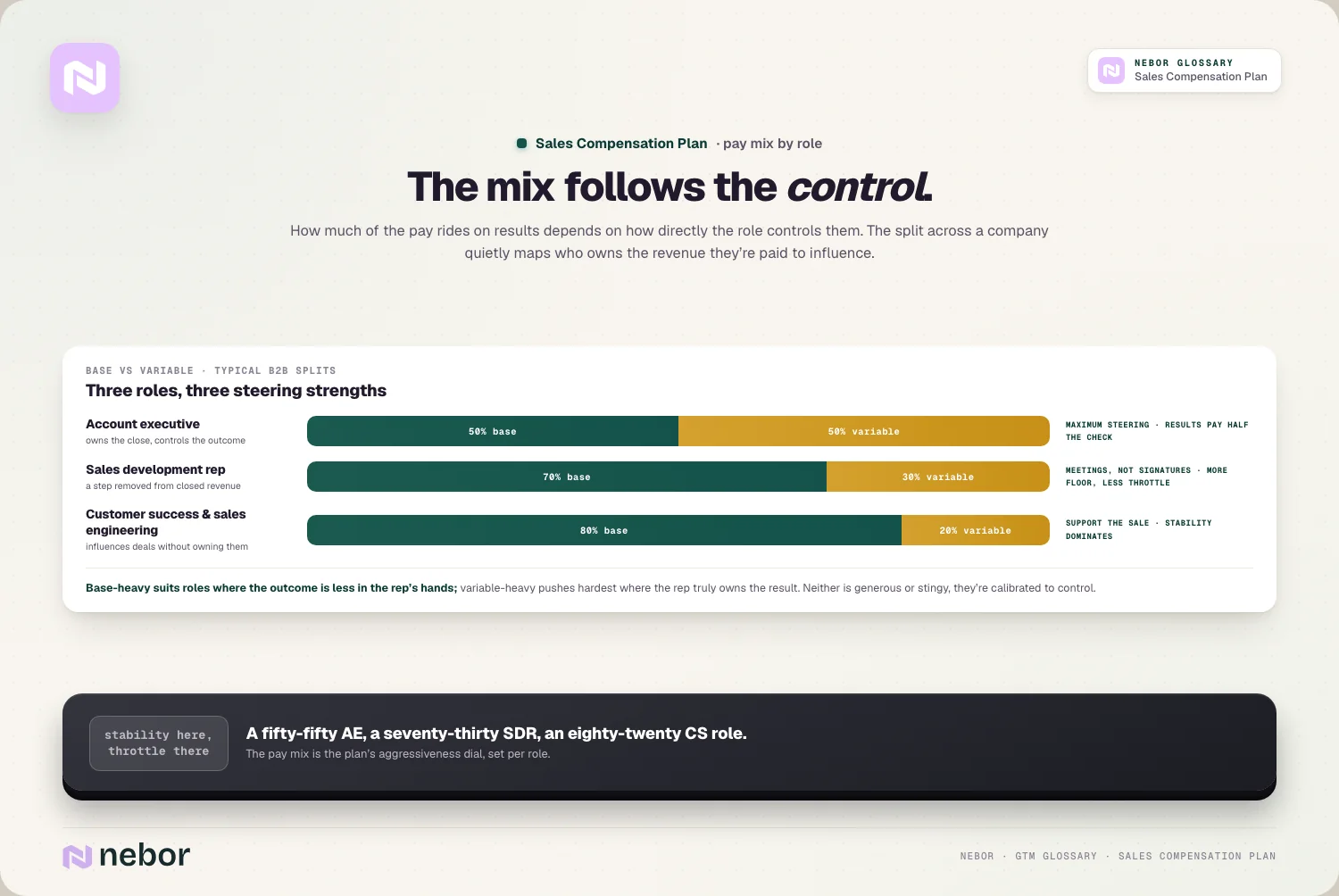
Closing account executives commonly land near a fifty-fifty split, while sales development reps usually carry more base, often around seventy-thirty, because their output is a step removed from closed revenue.
Support-oriented roles lean even further toward base. Customer success and sales engineering, whose work influences deals without owning them outright, tend toward an eighty-twenty mix, so the pay mix across a company reflects how directly each role controls the revenue it's paid to influence.
How accelerators reward overachievement and drive stretch effort
An accelerator is the mechanism that makes a compensation plan reward not just hitting quota but blowing past it. It raises the commission rate on revenue a rep books above their target, so a rep might earn a standard rate up to quota and then a higher rate on every dollar beyond it.
The purpose of an accelerator is to keep top performers pushing instead of coasting once they've hit their number. Without one, a rep who reaches quota early has little reason to keep selling hard, whereas an accelerator makes the deals past quota the most lucrative of all.
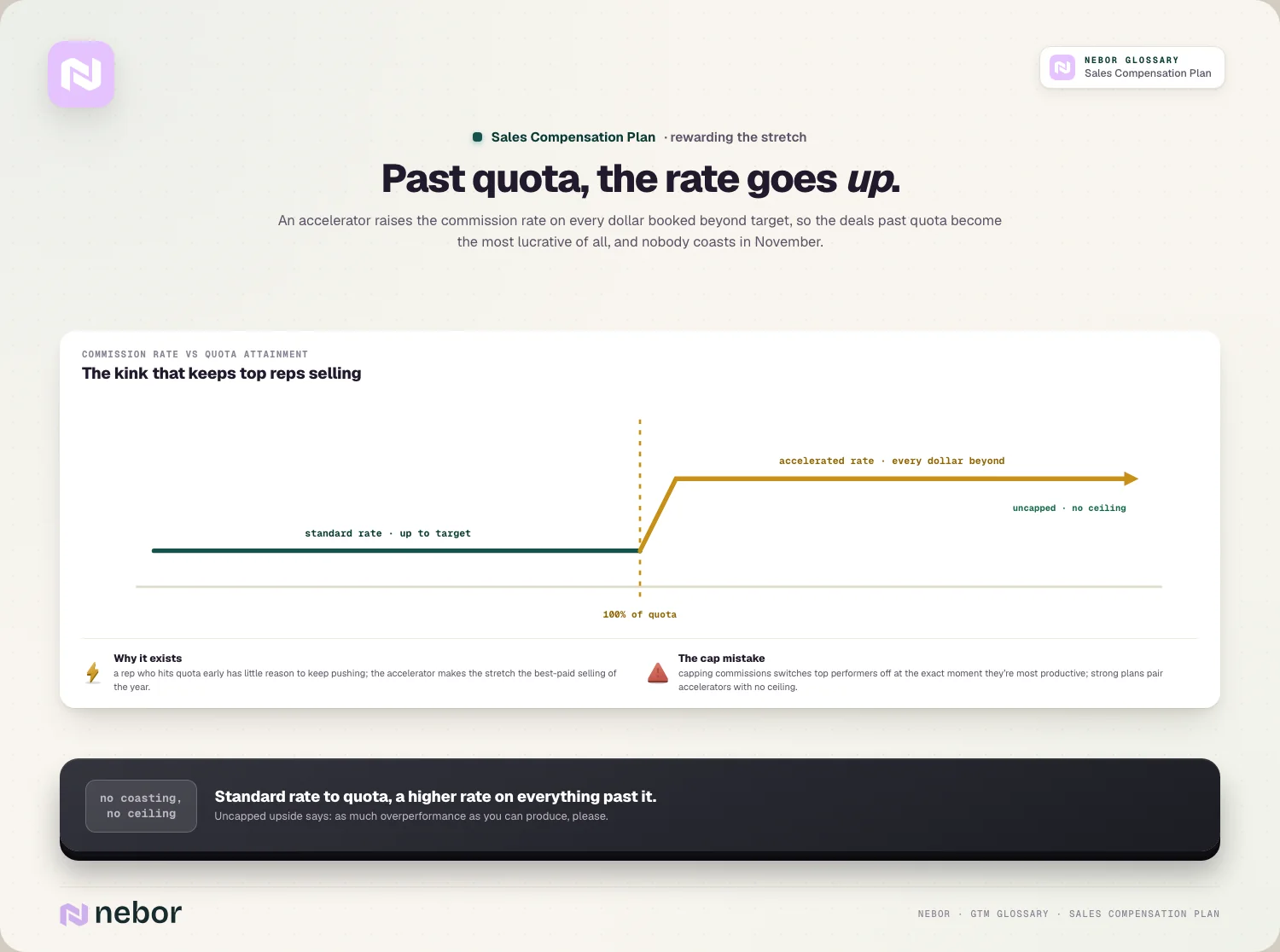
Some plans also use decelerators or leave commissions uncapped to shape behavior further. Leaving upside uncapped signals that the company wants as much overperformance as reps can produce, and strong plans usually pair accelerators with no ceiling instead of capping what a rep can earn.
Why the ratio of quota to OTE keeps a plan financially sound
Behind every compensation plan is a quiet financial ratio that keeps it sustainable, the relationship between a rep's quota and their OTE. A company needs each rep to generate enough revenue to comfortably fund their pay, so quotas are set as a multiple of OTE instead of an arbitrary number.
That multiple typically lands in a consistent range across B2B roles. Quota-to-OTE ratios usually land between roughly three and five times, with a common median around four, so a rep is expected to book several times their pay in revenue, which ties directly to healthy pipeline coverage.
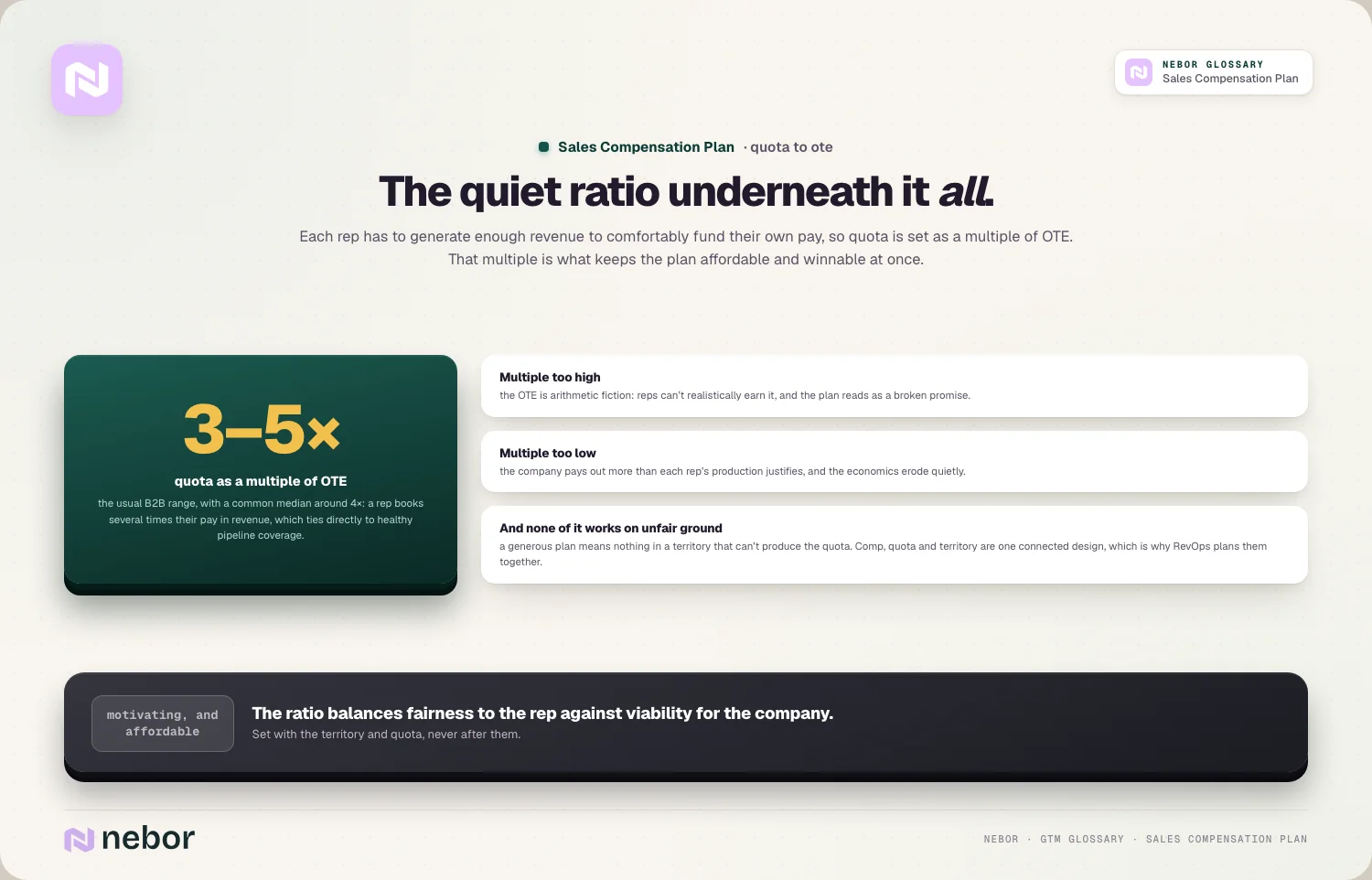
Getting this ratio right is what keeps compensation both motivating and affordable. Set the multiple too high and reps can't realistically earn their OTE, while setting it too low means the company pays out more than each rep's production justifies, so the ratio balances fairness against viability.
Why a compensation plan is really a tool for designing behavior
The deepest way to understand a compensation plan is as a behavior-design tool instead of just a payroll mechanism. Every rule in the plan tells reps which activities earn the most, so the plan effectively programs what the sales team optimizes for, whether the company intends that or not.
This is why the details matter far more than they appear. If a plan pays the same for a small quick deal and a large strategic one, reps chase the easy ones and your win rate on big deals suffers, and if it rewards new logos but not renewals, reps neglect existing customers, so the plan silently sets priorities.
Understanding this turns compensation into a strategic instrument that shapes sales velocity. A leader who wants reps to sell a particular product, pursue larger deals, or protect margins can encode that priority into the plan, which is far more reliable than simply asking for it.
How compensation connects to quotas, territories, and fairness
A compensation plan can't be fair unless the quotas and territories behind it are fair, because a rep's ability to hit their number depends on the opportunity they were given.
A generous plan means nothing to a rep whose territory can't feed their pipeline enough to reach quota, so comp, quota, and territory are designed together.
This ties compensation directly to territory carving, quota setting, and how well accounts fit your ideal customer profile. When territories hold balanced opportunity, reps have a genuine shot at the quota attainment that produces their OTE, whereas unbalanced ones make even a good plan feel unfair.
Getting all three aligned is a core job of revenue operations. Because compensation, quotas, and territories are interdependent, they're planned as one connected system, so the pay a rep can earn genuinely matches the opportunity and target they've been given.
Why transparency and simplicity make a compensation plan work
A compensation plan only steers behavior if reps understand it, so clarity matters as much as the mechanics. When your reps can easily see how their actions translate into pay, the plan does its job of directing effort, but when it's confusing, reps disengage from it and stop responding to its incentives.
Overly complex plans backfire even when the math is technically sound. A plan crammed with too many rules, targets, and modifiers leaves reps unsure what to focus on, so instead of pulling behavior in a clear direction it produces confusion, which is the opposite of what a steering wheel should do.
The strongest plans we've seen are transparent and simple enough to hold in your head. When a rep knows exactly which deals earn the most and can predict their own payout, they trust the plan and chase the behavior it rewards, and that trust is what makes compensation an effective tool instead of a source of friction.
What a compensation plan can incentivize beyond new bookings
While most plans center on new revenue, a well-designed one can steer reps toward whatever the business truly values, including outcomes beyond the initial sale. A company that cares about keeping customers can reward retention and renewals, and one that wants growth from its base can pay reps for expansion revenue.
Broadening what the plan rewards is how a company avoids the pull of pure new-logo hunting.
If reps only get paid for new deals, they have no reason to nurture the accounts that protect net revenue retention, so tying some pay to retention and expansion aligns them with the durability of the revenue as well as its acquisition.
This flexibility is exactly why compensation is such a powerful lever. Because the plan can attach money to almost any outcome, a company can use it to emphasize deal quality, product mix, customer success, or anything else it wants reps to prioritize, which turns the plan into a direct expression of strategy.
The common mistakes companies make when they design comp plans
The most common mistake, and the one we keep seeing in plans clients share, is unintentionally rewarding the wrong behavior, such as paying equally for good and bad deals.
When the incentives don't match what the company wants, reps optimize for the letter of the plan instead of its intent, and the results diverge from the strategy.
Another frequent error is making the plan too complicated for reps to understand. A plan with so many rules that reps can't tell how to maximize their pay stops steering behavior at all, so complexity that was meant to fine-tune incentives instead neutralizes them.
Capping earnings and changing the plan too often are two more recurring problems. Capping commissions removes the incentive for top reps to overperform, while constantly rewriting the plan destroys the trust and stability reps need to commit to it, and both work against the plan's whole purpose.
Why a sales compensation plan is really your strategy written in dollars
The most useful way to see a compensation plan is as your go-to-market strategy translated into money, because it turns intentions into the behavior a team shows. Whatever the plan pays best for is what your team does, so it's a more honest statement of priorities than any strategy deck.
That's why designing it deserves the same rigor as the product, the pitch, or the sales playbook.
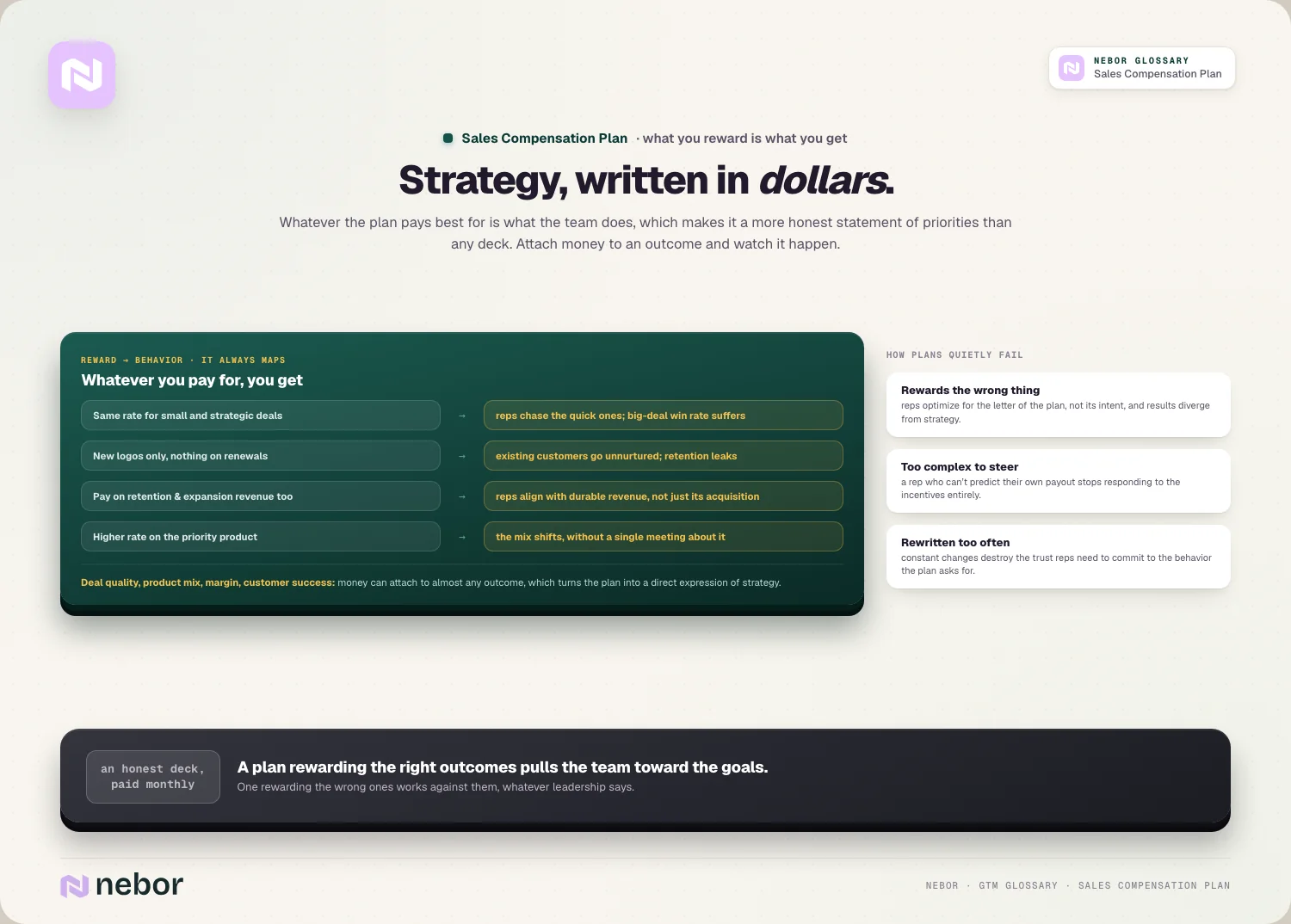
A plan that rewards the right outcomes pulls the team toward the company's goals without anyone pushing, while one that rewards the wrong ones works against those goals no matter what leadership says elsewhere.
Within a modern go-to-market system, a well-designed compensation plan is what keeps a sales team's effort pointed where the business needs it.
It aligns the pursuit of individual income with company outcomes, so the deals reps chase, including everything you automate sales prospecting to surface, are the ones that move the business forward.
Share this post
RevOps
Glossary
Related glossary items
Understanding the core GTM concepts




Ready to build your pipeline











