

In this post:
The time it takes to close a deal has become one of the biggest drags on B2B growth. Deals that used to close in a quarter now stretch across two, and most teams feel the slowdown without measuring exactly how much it's costing them.
Sales cycle length is the number that makes that slowdown visible. It measures how long a deal takes to close, so you can see whether your process is getting faster or slipping, and act on it instead of just sensing it.
Sales cycle length is the average time it takes to close a deal, usually measured from when an opportunity is created and enters your active pipeline to when it closes. It captures the selling process itself, separate from the earlier marketing-to-sales handoff.
The metric earns its keep because time is money in a very literal sense. A longer cycle ties up rep effort, delays revenue, and gives deals more chances to stall or die, so the length of your cycle shapes how fast the whole business can grow.
TL;DR
Sales cycle length is the average time from opportunity creation to close, measuring how long your actual selling process takes.
It's lengthening across B2B, driven by bigger buying committees, tighter budget scrutiny, and required pilots, with the average now stretching well past three months.
It varies enormously by deal size, so a healthy cycle for an SMB deal looks nothing like one for an enterprise deal, which makes context essential.
Shortening it is possible without cutting corners, because tactics like multi-threading and mutual action plans reliably compress cycle time.
What sales cycle length measures from opportunity to closed deal
Sales cycle length measures the duration of your selling process. It's the clock that ticks from the moment a real opportunity enters your pipeline to the moment it closes.
The start point matters more than it looks. Cycle length should begin at opportunity creation, when a deal is qualified and active, instead of at first marketing contact, so it measures the selling rather than the whole funnel.
The end point is the close itself. The cycle ends when the deal is won or lost, so the length captures the full stretch of active selling on that opportunity.
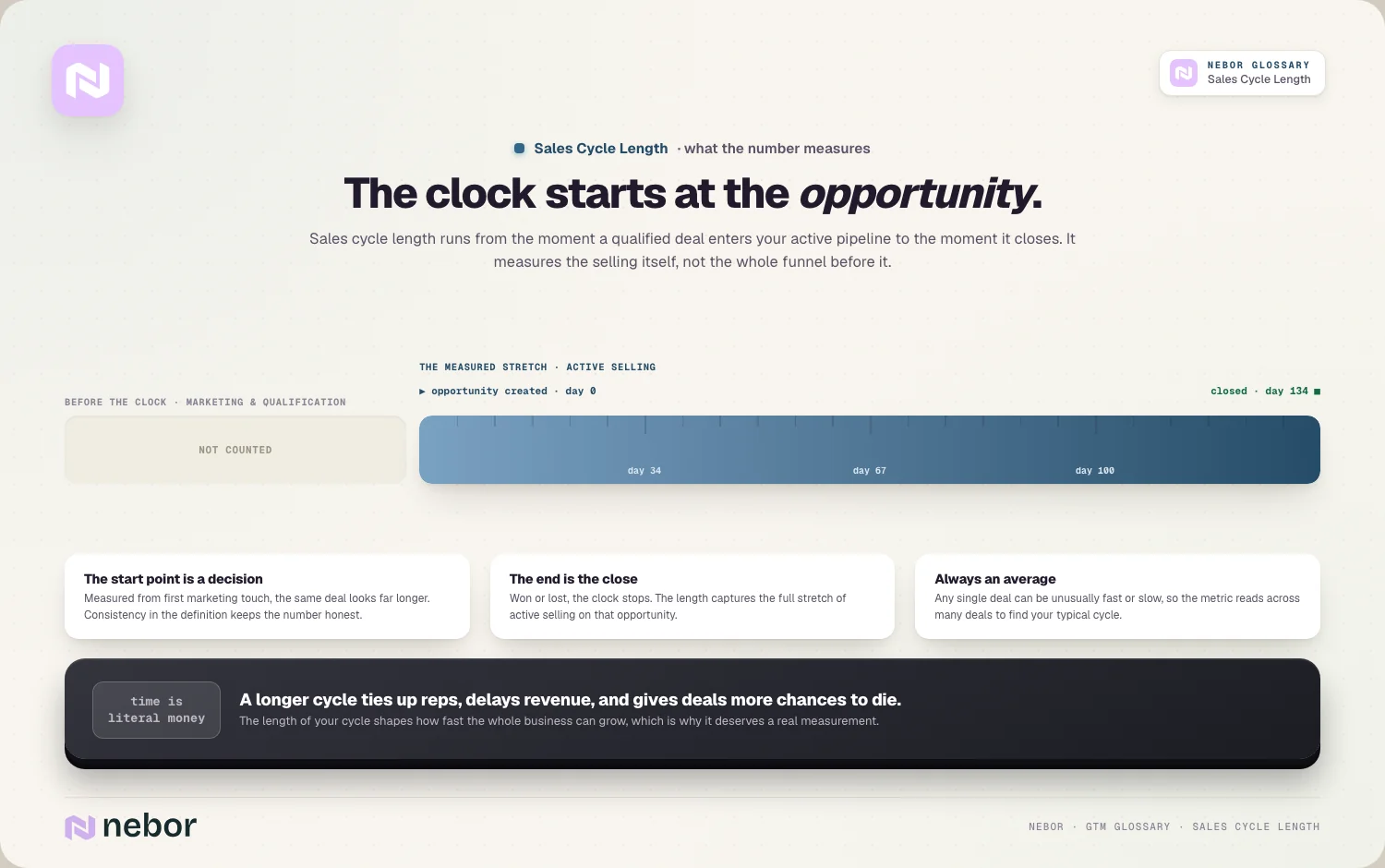
It's usually reported as an average across deals. You measure it across many deals to get a typical cycle, because any single deal can be unusually fast or slow.
So sales cycle length is a clean read on how long you take to sell. It isolates the selling stretch specifically, which is what makes it useful for spotting whether your process is speeding up or dragging.
Where you set the start point is a real decision instead of a technicality. Measuring from first marketing touch instead of opportunity creation can make a cycle look far longer, so consistency in that definition is what keeps the number honest.
Why B2B sales cycles seem to keep getting longer year after year
The trend in sales cycle length has been moving the wrong way, and understanding why matters. Several forces are steadily stretching deals out.
The published averages have climbed steadily for years. The mean B2B SaaS sales cycle is now around 134 days, up roughly 25% from a few years ago, so deals really do take longer than they used to.
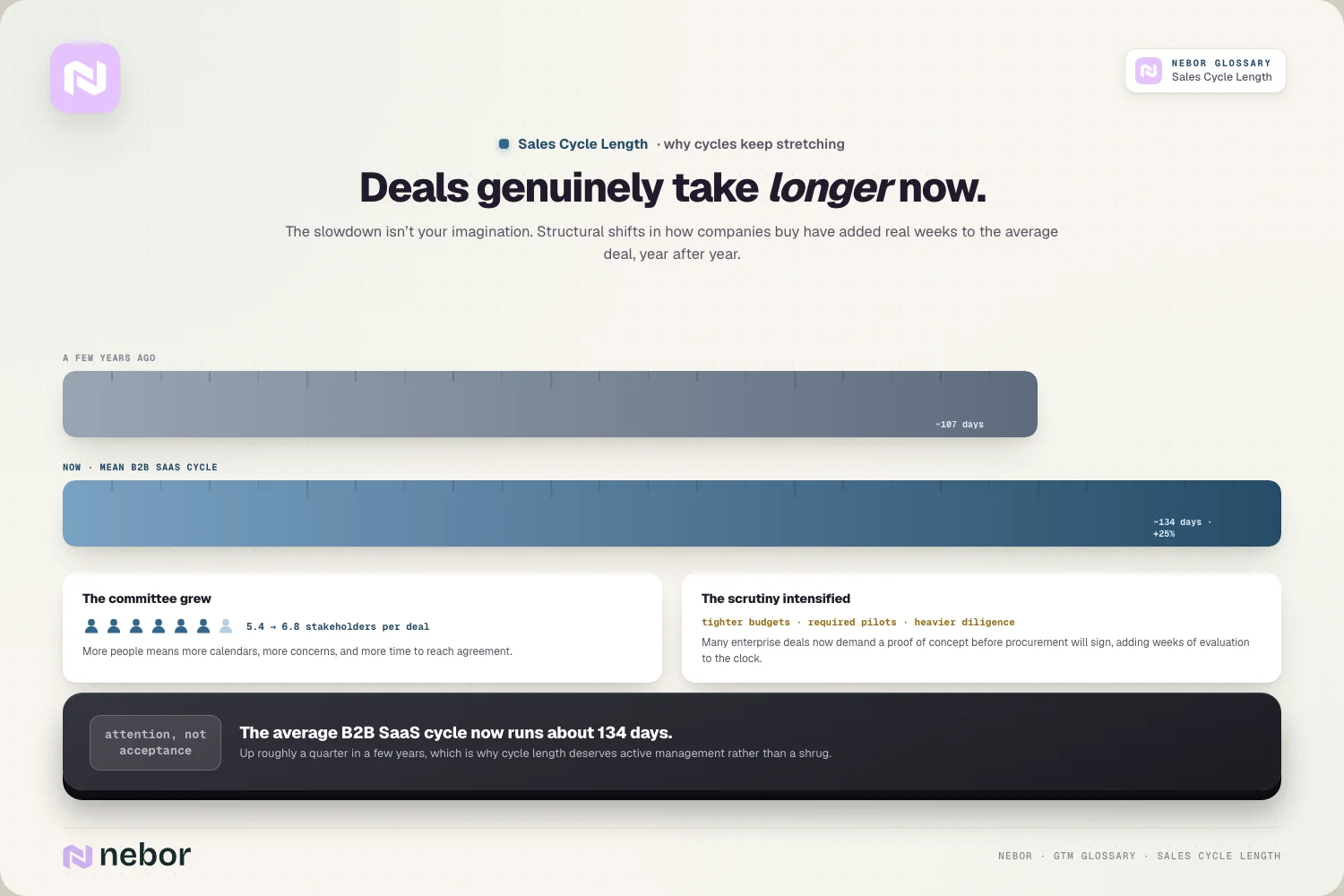
Buying committees have grown larger year by year. The average B2B deal now involves around 6.8 stakeholders, up from 5.4 a few years back, and more people means more time to reach agreement.
Scrutiny of every purchase has intensified along with them. Tighter budgets and required proofs of concept add weeks of evaluation, because many enterprise deals now demand a pilot before procurement will sign.
So the lengthening is far from your imagination. Structural shifts in how companies buy have added real time to the average deal, so cycle length deserves active attention instead of acceptance.
Why sales cycle length varies so much with the size of the deal
There's no single right cycle length, and the biggest reason is deal size. What counts as fast for one deal would be alarmingly slow for another.
Small deals still close fast by comparison. SMB deals under roughly fifteen thousand in annual value often close in 14 to 30 days, because fewer people and lower stakes speed the decision.
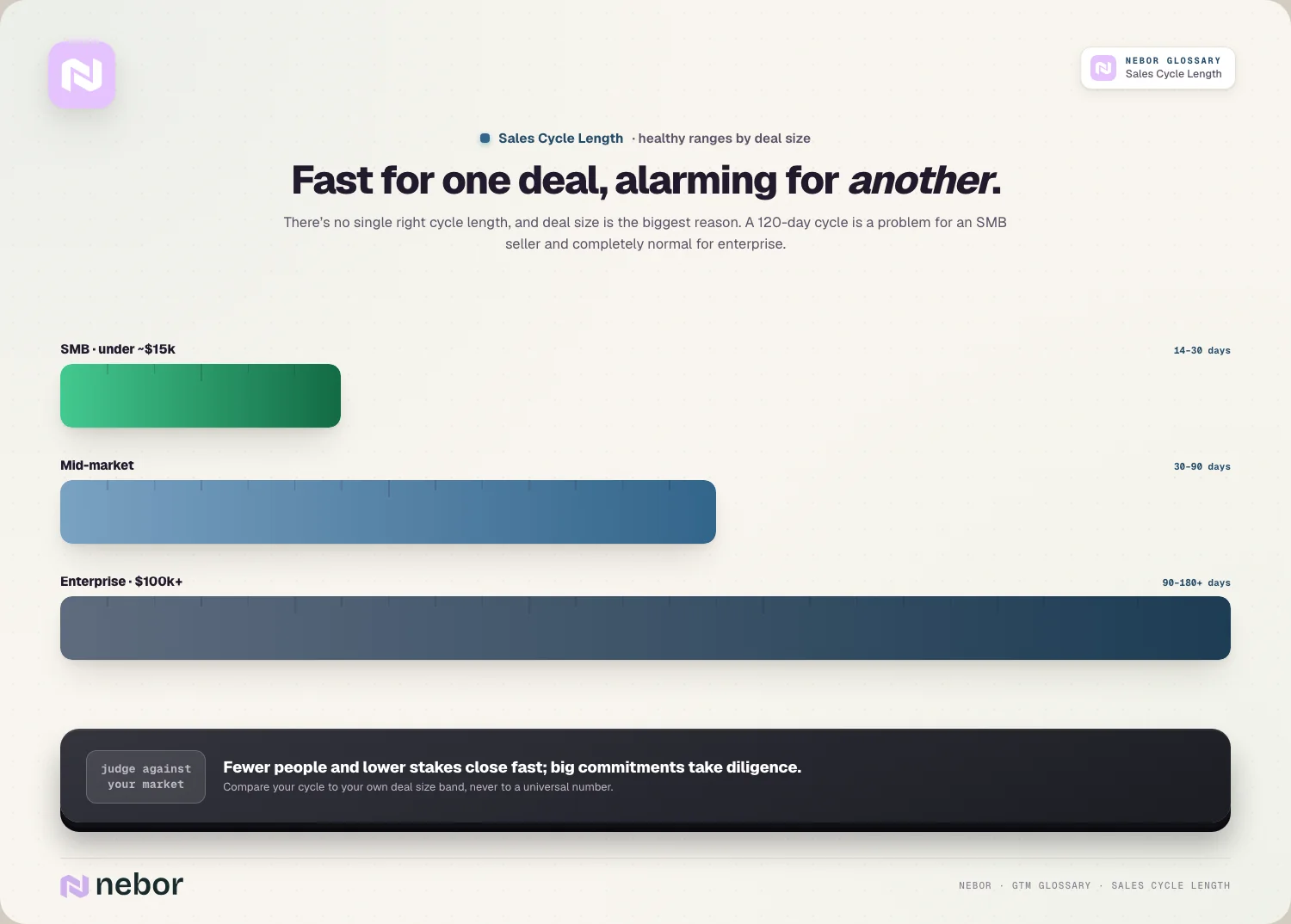
Mid-market deals take noticeably longer than that. Deals in the middle range typically take 30 to 90 days, reflecting more stakeholders and a more involved evaluation.
Enterprise deals take the longest of all. Large deals above a hundred thousand often take 90 to 180 days or more, because big commitments involve many people and heavy diligence.
So judge your cycle against your deal size instead of a universal number. A 120-day cycle is a problem for an SMB seller and completely normal for an enterprise one, because the comparison has to fit your market.
How sales cycle length connects directly to your pipeline velocity
Sales cycle length isn't a standalone number, it's one of the core inputs to how fast revenue moves. It is a direct input to a broader speed metric.
It's a direct component of the velocity math. Pipeline velocity combines deal count, win rate, deal size, and cycle length, so cycle length is one of the four levers that determine how fast you generate revenue.

Shorter cycles raise your velocity almost immediately. Because cycle length is in the denominator of velocity, cutting it directly increases how quickly revenue flows through your pipeline.
The two metrics always move together in practice. A team obsessing over velocity is really, in large part, working to compress its cycle length, because that's often the most controllable lever.
So cycle length feeds velocity from below. Improving it is one of the clearest ways to speed up the whole revenue engine, and that leverage is why the two metrics are so tightly linked.
Why a longer sales cycle costs you far more than just the time
The damage from a long cycle goes well beyond the calendar. A stretched cycle imposes costs that are easy to overlook.
It ties up your reps' selling capacity. A rep working a 150-day deal can't spend those hours elsewhere, so long cycles cap how many deals each rep can carry.
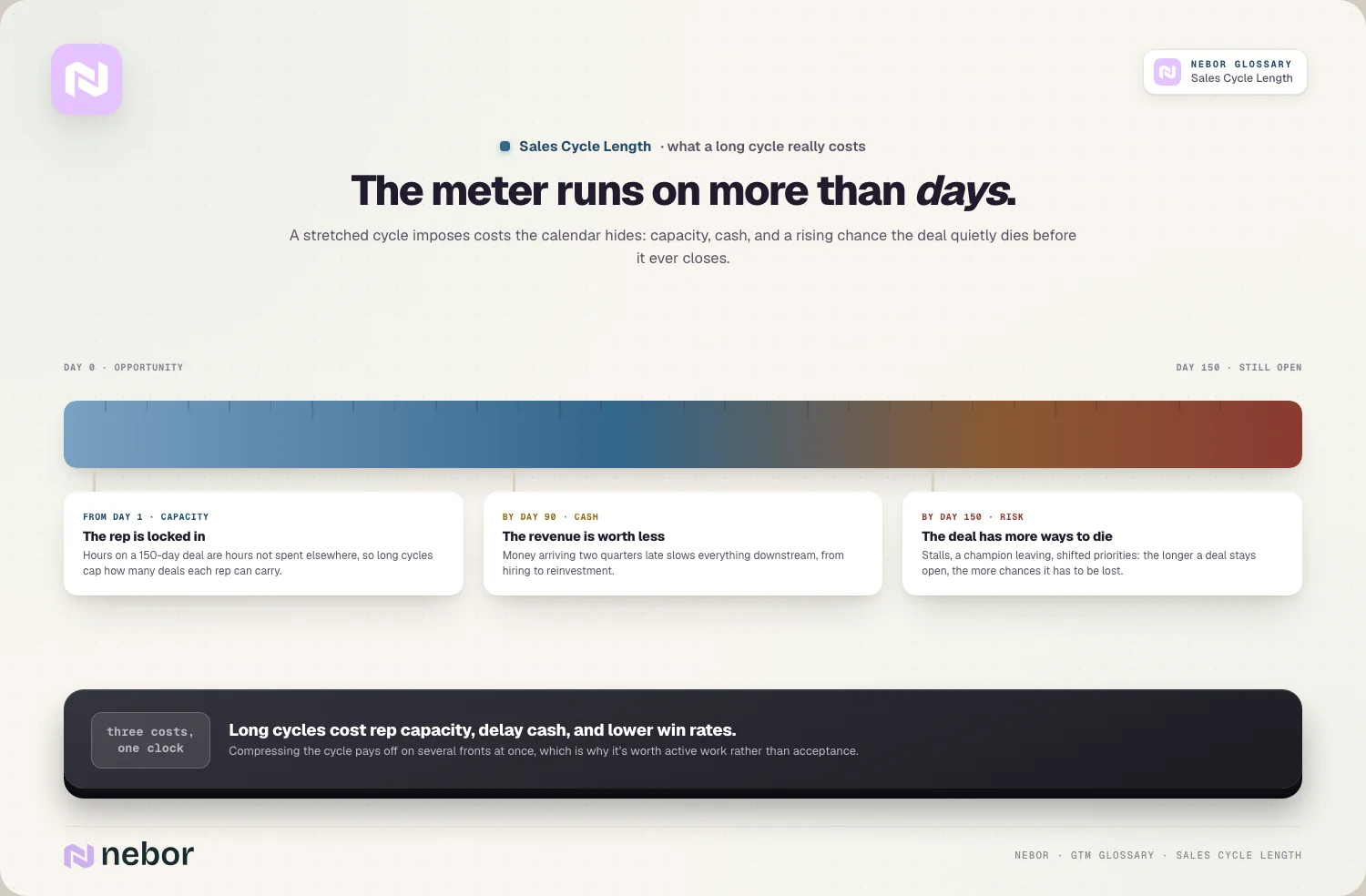
It delays the arrival of the revenue itself. Money that arrives two quarters later than it could have is worth less and slows everything downstream, from hiring to reinvestment.
It raises the risk of losing the deal. The longer a deal stays open, the more chances it has to stall, lose a champion, or fall to a shift in priorities, so long cycles lower win rates too, which drags down your conversion rate through the funnel.
So a long cycle is expensive in ways a single number hides. It costs rep capacity, delays cash, and increases the odds a deal dies, so compressing it pays off on several fronts at once.
How multi-threading shortens a sales cycle instead of stalling it
One of the most reliable ways to speed up a deal cuts against intuition, and we point clients to it first, because it involves adding people instead of simplifying. Reaching more stakeholders is what shortens the cycle.
Single-threaded deals stall with a grim kind of regularity. When you rely on one contact to sell internally, the deal moves at their pace and dies if they go quiet, which drags the cycle out.
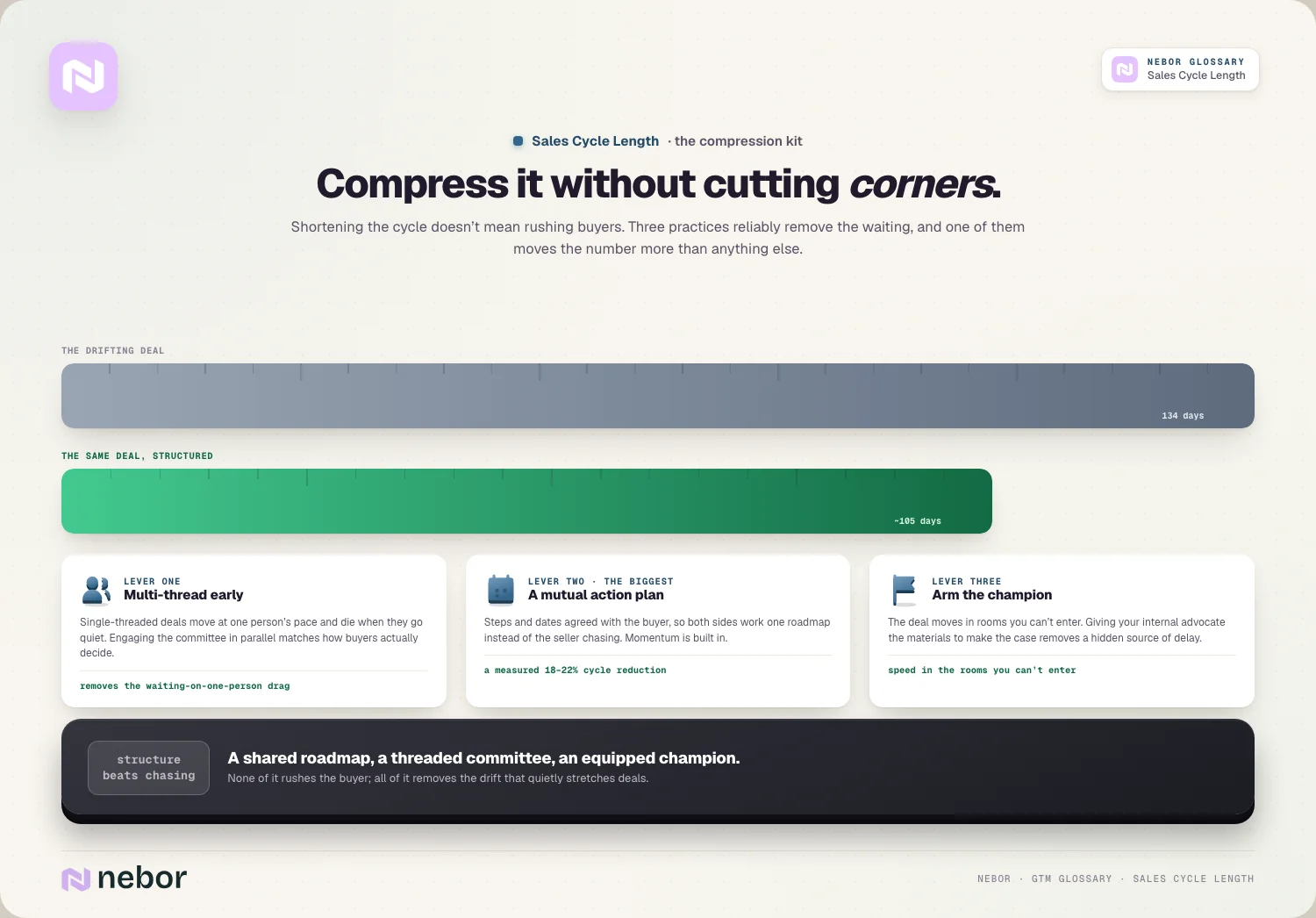
Multi-threading is what keeps the deal moving. Reaching several stakeholders early, the practice of multi-threading, means progress doesn't depend on any single person being available.
It addresses the buying committee problem directly. Because the buying committee is what makes deals slow, engaging it in parallel instead of one person at a time compresses the whole timeline.
So multi-threading speeds deals by matching how buyers really decide. Reaching the group early means you're not waiting on one champion to carry the whole process, which is often what stretches a cycle.
Why mutual action plans are the single biggest lever on cycle time
Among all the tactics for shortening cycles, one stands out for its measured impact. A shared plan between seller and buyer reliably compresses the timeline.
A mutual action plan aligns both sides. It lays out the steps and dates needed to close, so buyer and seller work from the same roadmap instead of the seller chasing.
The impact is large and measurable, and it's a practice we push clients toward constantly. Mutual action plans alone drive a consistent 18 to 22% reduction in cycle time, which is a substantial gain from a single practice.
It creates real accountability on both sides. When the buyer has agreed to the steps, the deal has momentum built in, because both sides are committed to the timeline instead of drifting.
So a mutual action plan turns a vague hope of closing into a scheduled path. That structure is why it moves cycle time more than almost any other single tactic.
How a strong champion helps you close a deal noticeably faster
The person selling for you inside the account has a direct effect on how fast the deal moves. A capable champion compresses the internal timeline.
A champion drives the progress you can't see. A strong internal champion pushes the deal forward in the rooms you can't enter, so it doesn't stall waiting on you.
Enablement speeds those internal champions up considerably. Giving yours the materials to make the internal case, instead of leaving them to build it, removes a common source of delay.
A weak champion lengthens everything that comes after. When your internal advocate lacks the influence or tools to move the deal, it drifts, and in our experience that's often the hidden reason a cycle drags on.
So investing in your champion is investing in speed. The better equipped they are to sell internally, the faster the committee reaches a decision, which shortens the cycle.
Why fast follow-up compresses the sales cycle at every stage
Speed within the cycle compounds, and small delays on your side add up across a deal. Moving quickly at each step keeps the whole cycle tight.
Momentum matters through every stage of the cycle. A deal that keeps moving is less likely to cool, so responsiveness at every stage keeps the cycle from stretching.
The timing of your proposals is measurable and fixable. Proposals sent within a day of the demo close significantly faster than those sent even 48 hours later, so your own delays lengthen the cycle.
Automation removes the lag between the steps. Automating follow-up and note capture keeps deals progressing without waiting on manual steps, which trims dead time from the cycle.
So your own speed is a lever you fully control. Every delay you remove on your side shortens the cycle, so fast, consistent follow-up matters at every stage of a deal.
How faster response early on sets up a shorter sales cycle later
The cycle's length is partly decided before selling even begins, in how fast you engage a fresh opportunity. Early speed pays off across the whole deal.
A fast start builds momentum that carries. Reaching a new lead quickly, the core of speed to lead, gets the deal moving while interest is high instead of letting it cool from the outset.
Good qualification prevents the drag before it starts. Screening for fit through solid lead qualification keeps poor-fit deals out of the pipeline, so they don't linger and inflate your cycle.
Right-fit deals close faster at every stage. Pursuing accounts that match your ideal customer profile means the need is real, which shortens the evaluation compared to selling to a stretch.
So the cycle you experience later is shaped by choices made early. Fast engagement and sharp qualification set up a shorter, cleaner cycle before the real selling starts.
How to measure and manage your sales cycle length the right way
Measuring cycle length properly is what lets you improve it, and a few practices sharpen the picture. The details change what the number tells you.
Measure from a consistent starting point every time. Beginning the clock at opportunity creation, every time, keeps the metric comparable across deals and periods.
Watch time-in-stage as well as the total. Seeing where deals stall longest reveals which stage is dragging, so you fix the real bottleneck instead of guessing.
Segment your deals before you compare anything. Averaging enterprise and SMB deals together produces a meaningless blended number, so you measure cycle length within each segment, which also feeds cleaner forecast accuracy.
So good measurement is about consistency and granularity. A single blended average hides more than it shows, while stage-level, segmented cycle data points you straight at what to fix.
The common mistakes teams make when reading sales cycle length
Sales cycle length gets misused in a few predictable ways, and each leads to a wrong conclusion. Avoiding them is what keeps the metric useful.
The biggest is comparing across deal segments. Judging an enterprise cycle against an SMB benchmark makes a normal deal look broken, or a slow one look fine.
Another is chasing speed at all costs. Rushing a deal that truly needs time can lose it, so the goal is removing waste instead of forcing a fast close.
A third is ignoring the time-in-stage view. Watching only the total cycle hides which stage is the bottleneck, so you can't target the real delay.
The last is treating it as fixed. Cycle length responds to how you sell, so accepting a long cycle as inevitable leaves real, achievable speed on the table.
Why sales cycle length is a lever you can pull and not just a number
The most useful way to see sales cycle length is as something you can actively shorten instead of merely a stat you record. The tactics that compress it are well understood and within reach.
Much of the length turns out to be self-inflicted. Slow follow-up, single-threaded deals, and no shared plan all stretch cycles in ways you control, which means much of the fix is in your hands.
The gains compound across your whole pipeline. A shorter cycle lifts velocity, frees rep capacity, and raises win rates all at once, so improving it pays off across the whole engine.
The market makes the compression work urgent. Because cycles are lengthening industry-wide, actively compressing yours is increasingly a competitive edge instead of a nice-to-have.
That control is what makes sales cycle length one of the highest-impact things to manage in a modern go-to-market system. It determines how fast the pipeline you automate sales prospecting to build converts into revenue.
Share this post
RevOps
Glossary
Related glossary items
Understanding the core GTM concepts




Ready to build your pipeline