
In this post:
Territory carving is the process of splitting a company's market into sales territories and assigning each one to a rep or team, so that every account has exactly one owner and every rep gets a fair share of the revenue on offer.
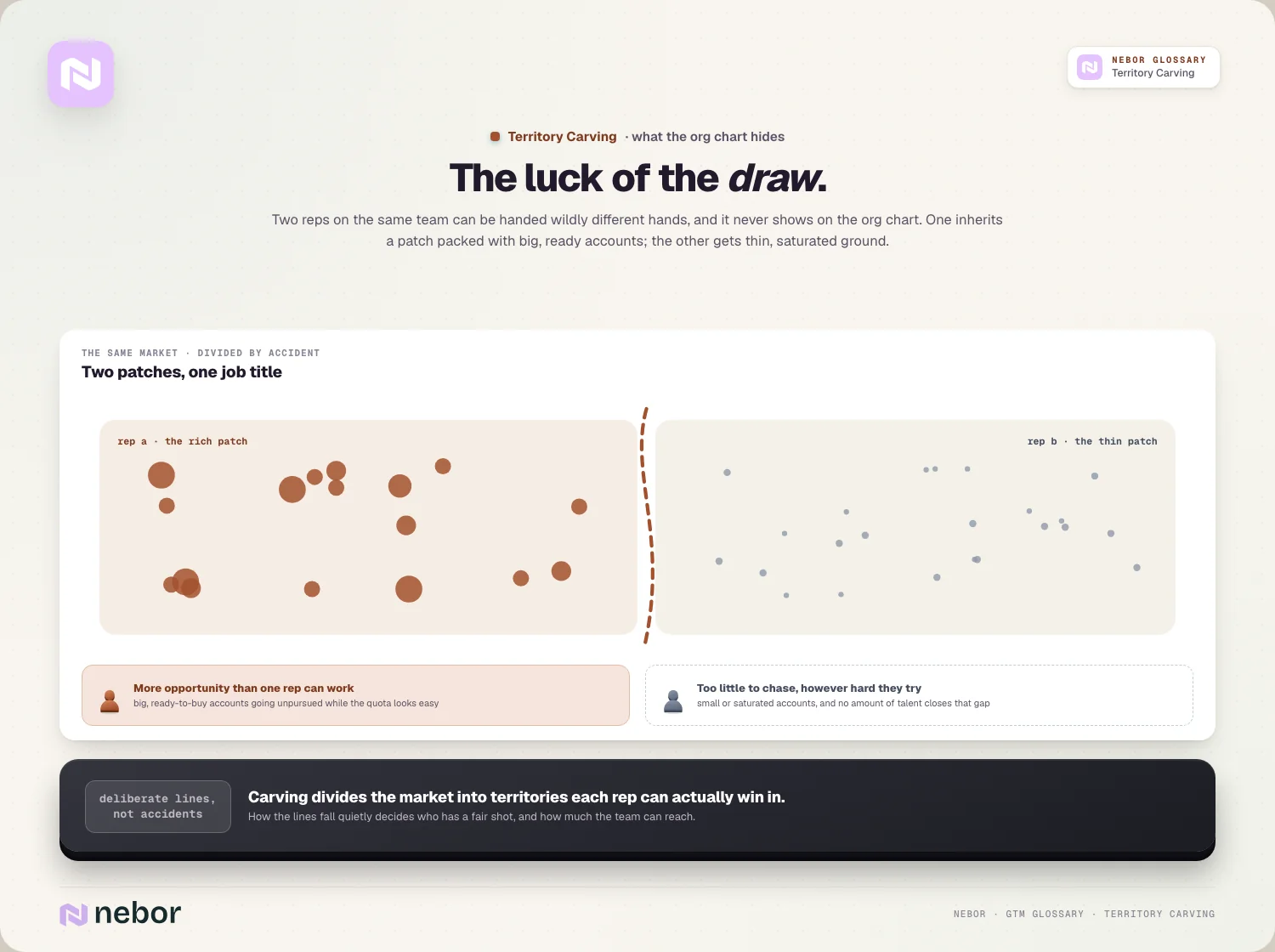
It sounds like admin. In practice it settles a good part of a rep's year before they make a single call. Give one rep a region full of large, growing companies and another a patch of small accounts that every competitor has already worked, and the gap in their results will say more about the map than about either of them.
Most uneven territories aren't designed that way. They happen when someone exports the account list, sorts it by country and deals it out in equal piles. The piles look fair. The money inside them isn't.
TL;DR
Territory carving divides your market into territories and gives each rep one. Balance it on revenue potential rather than account count, because 200 small, saturated accounts can be worth less than 50 large, growing ones.
Estimate potential per account from ICP fit, what similar customers spend and how much is still winnable, then check workload too. A territory can hold fair value and still have more accounts than one rep can work.
Imbalance costs you twice: the rich patch has deals nobody gets to, the thin patch has a rep with nothing good left to chase, and neither shows up on a single report.
Geography is the easiest line to draw and rarely balances by itself. Most B2B teams blend region with company size or industry, and pull the biggest accounts out first as named accounts.
Set quotas after the map, as a share of the potential each territory holds. Otherwise attainment tells you who got the good patch, not who sold well.
A territory map only holds if the CRM enforces it. Salesforce runs territories as models with assignment rules, HubSpot teams build them from properties and workflows, and either way the territory decides where lead routing sends each lead.
Recompute the balance at least once a year and whenever a rep leaves or you hire, move as few accounts as you can, and let open deals stay with their current owner until they close.
Balance the potential, not the account count
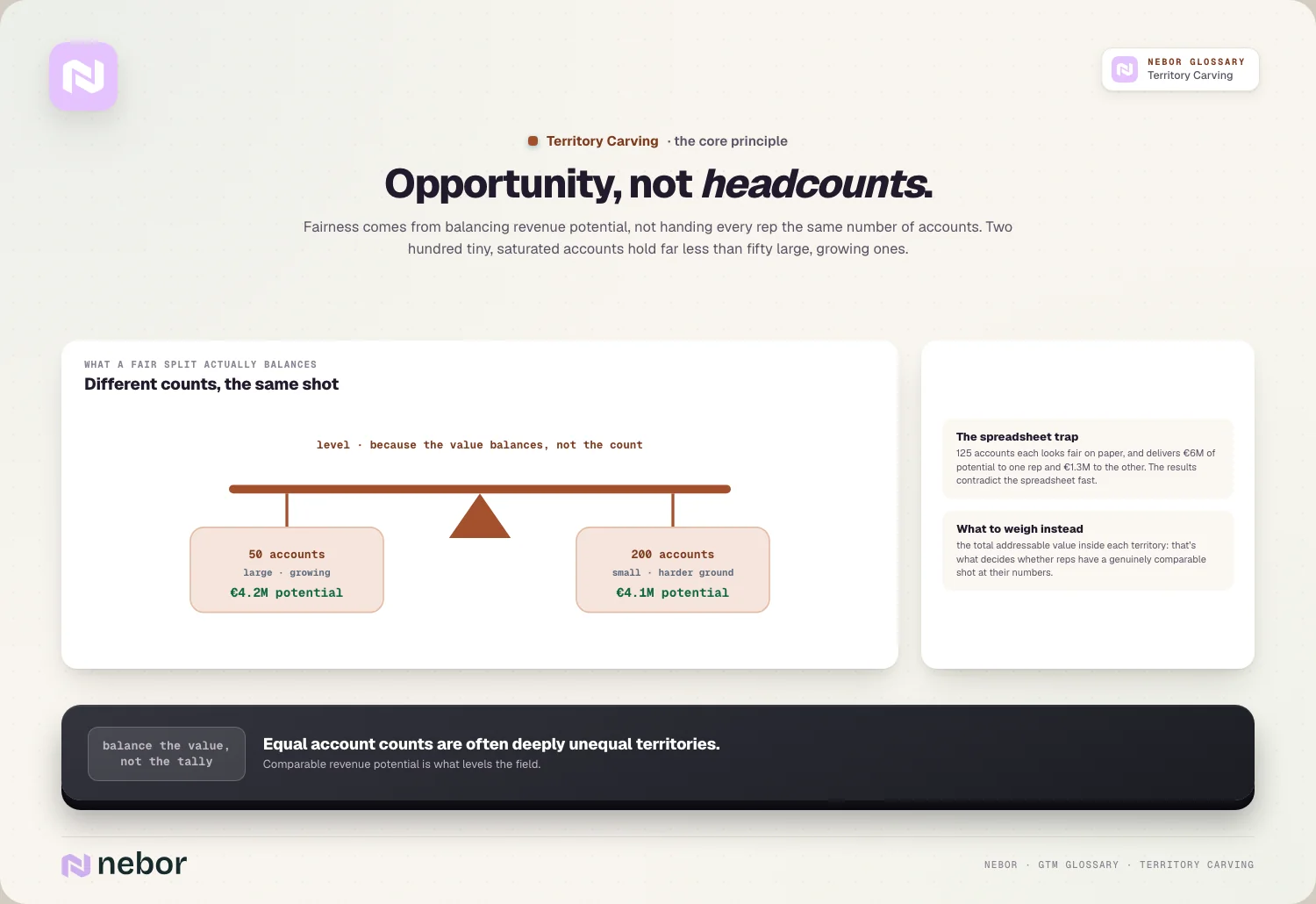
If we had to keep one rule in territory carving, it would be this one: a fair territory holds a fair share of revenue potential. It doesn't have to hold the same number of accounts, and usually it shouldn't.
Account counts are tempting because they're easy. Any CRM can tell you how many companies sit in Germany. Far fewer can tell you what those companies are worth to you, and that's the figure that decides whether a rep can hit plan. Two hundred small or saturated accounts can easily hold less revenue than fifty large ones that are growing and haven't bought from anyone yet.
Potential doesn't have to be precise to be useful. A rough figure per account beats none. These are the inputs we use most:
Fit. How closely the account matches your ideal customer profile, usually expressed as tiers from your account scoring.
Size of the prize. What a customer like this tends to spend with you, taken from the lifetime value of similar accounts you already have.
Room left. Whether the account is greenfield, an existing customer with room to expand, or tied into a competitor's multi-year contract.
The ceiling. Your TAM, SAM and SOM, which tell you how much of each region or segment you could realistically win at all.
Weight expected value by fit, add it up per territory, and you have a number you can compare across reps. It won't be perfect, but it will be far closer to the truth than a tally of logos. The arithmetic does depend on the firmographic data underneath (employee count, industry, location) being filled in and current.
Splitting 600 accounts between three reps
Here is how that plays out on a made-up but typical case: a software company selling into the Benelux and DACH, with 600 target accounts, three account executives and an estimated €10 million of potential across the whole list. The figures are invented to show the mechanics.
The first draft splits by region, the easy option in any CRM export. The second blends size and region.
Split | Territory | Accounts | Estimated potential |
|---|---|---|---|
By region | Netherlands | 210 | €3.0M |
By region | Belgium and Luxembourg | 180 | €1.4M |
By region | Germany, Austria and Switzerland | 210 | €5.6M |
Blended | Enterprise named accounts, all regions | 70 | €3.4M |
Blended | DACH mid-market | 230 | €3.3M |
Blended | Benelux mid-market | 300 | €3.3M |
On account counts, the regional split looks close to even. On potential, the DACH rep holds four times what the Belgium rep holds. One of them will beat quota while half the region goes untouched, and the other will run out of good accounts by spring.
The blended version pulls the 70 largest accounts into a named-account territory for the most senior rep, then splits the mid-market by region. Potential now sits within a few percent across all three. Account counts swing from 70 to 300, and that's fine.
What still needs a check is workload. A rep can only work so many accounts properly in one sales cycle, and 300 may be more than anyone can cover by hand. If so, the top tier gets personal attention and the rest goes into automated outbound until an account shows interest. Balance has two sides: value, so the quota is fair, and workload, so the value actually gets worked. How many reps you need, and how much each can carry, belongs to quota and capacity planning, and the carve should take its numbers from there.
Expect to adjust the result by hand at the end. Andris Zoltners and Prabhakant Sinha, who documented three decades of sales territory design across some 1,500 projects, found that optimization models alone couldn't settle alignment, and that managers' local knowledge had to be added to what the models produced. A rep who has spent five years with a customer is a fact the spreadsheet doesn't see.
What a lopsided territory map costs
Uneven territories lose money at both ends, which is why the loss is so hard to spot.
In the rich territory, the rep has more good accounts than hours. They work the biggest, warmest ones, hit their number and look like a star. The accounts lower down their list go untouched for a year, and some of them buy from a competitor who did call. Nobody files a report on deals that were never started.
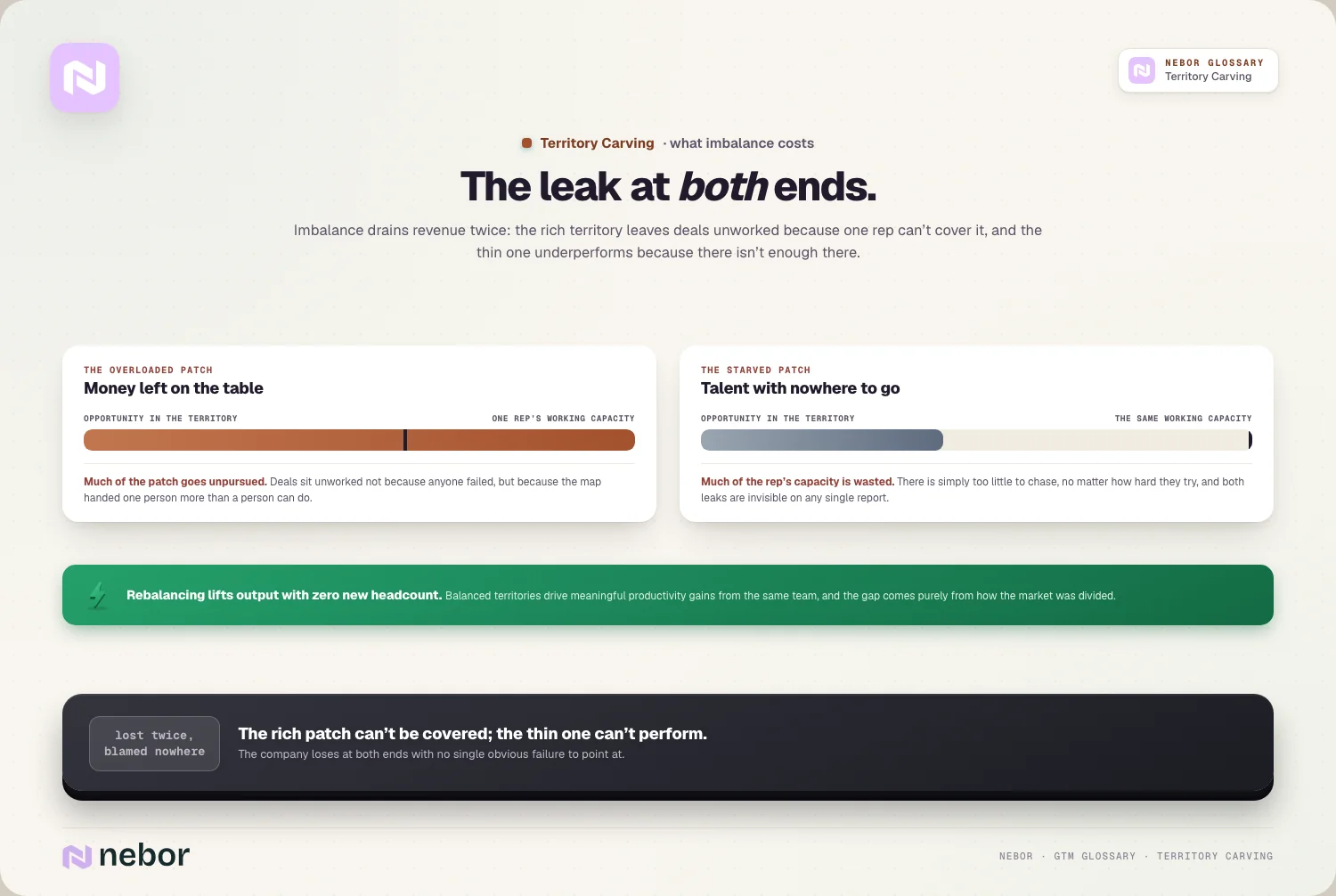
In the thin territory, the opposite happens. The rep works every account twice, books meetings with companies that were never a good fit because there's nothing better left, and misses quota. Their manager reads it as a performance problem.
Put the two together and the company is carrying unused capacity in one place and unworked demand in another, on the same payroll. That's why rebalancing is one of the few growth moves that needs no hiring. Reps in well-matched territories also spend their time on accounts that fit, and that tends to show up in win rates and sales velocity rather than in activity counts.
Which lines to draw: region, industry, size or a blend
Researchers have treated this as a formal problem since at least the early 1980s, when Zoltners and Sinha described sales territory alignment as grouping small geographic units of the market into larger territories. Today's models use more dimensions than geography, and each comes with a reason to exist and a way it tends to skew.
Geography is the oldest basis and still the easiest to run. It matters most for field sales, languages and time zones. Used alone it almost never balances, because buyers aren't spread evenly across a map.
Industry lets reps learn one market's buyers, vocabulary and objections. It works when you sell into logistics very differently than into finance, and it gets lumpy when one vertical is far bigger than the rest.
Company size separates jobs that really are different. Enterprise deals with long cycles and big buying groups need a different rep than a 50-person company that decides in two weeks.
Named accounts take a short list of strategic companies out of the general pool and give each one to a specific person, whatever region or vertical it sits in. This is the usual home for account-based marketing targets.
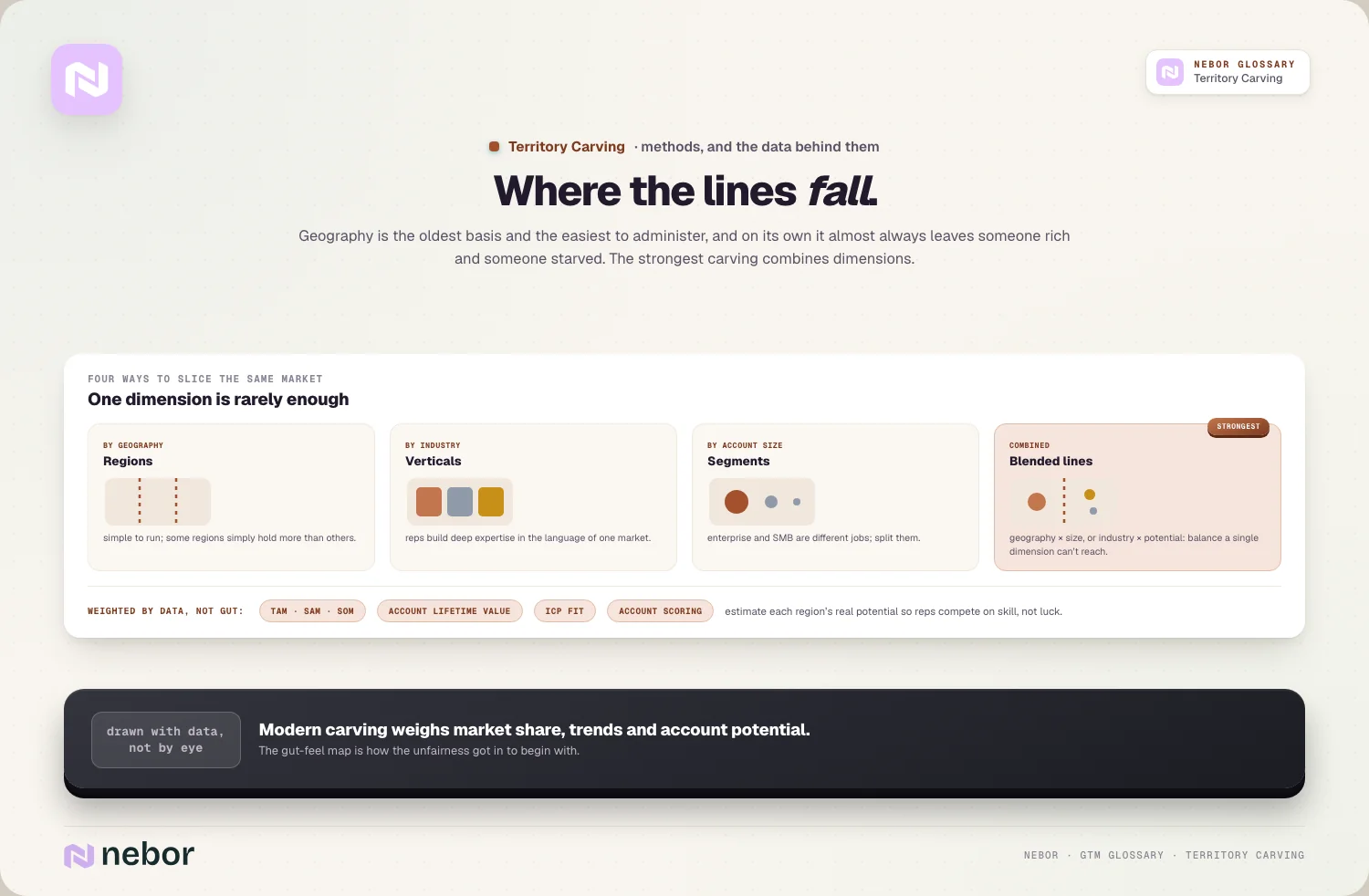
Most B2B teams we work with end up with a blend: named accounts at the top, then company size, then region or industry inside each size band. The order matters, because each rule takes accounts out of the pool before the next one runs. Write that order down. When two rules disagree about who owns an account, the written order settles it, not whoever argues hardest.
Why does the quota have to come after the map?
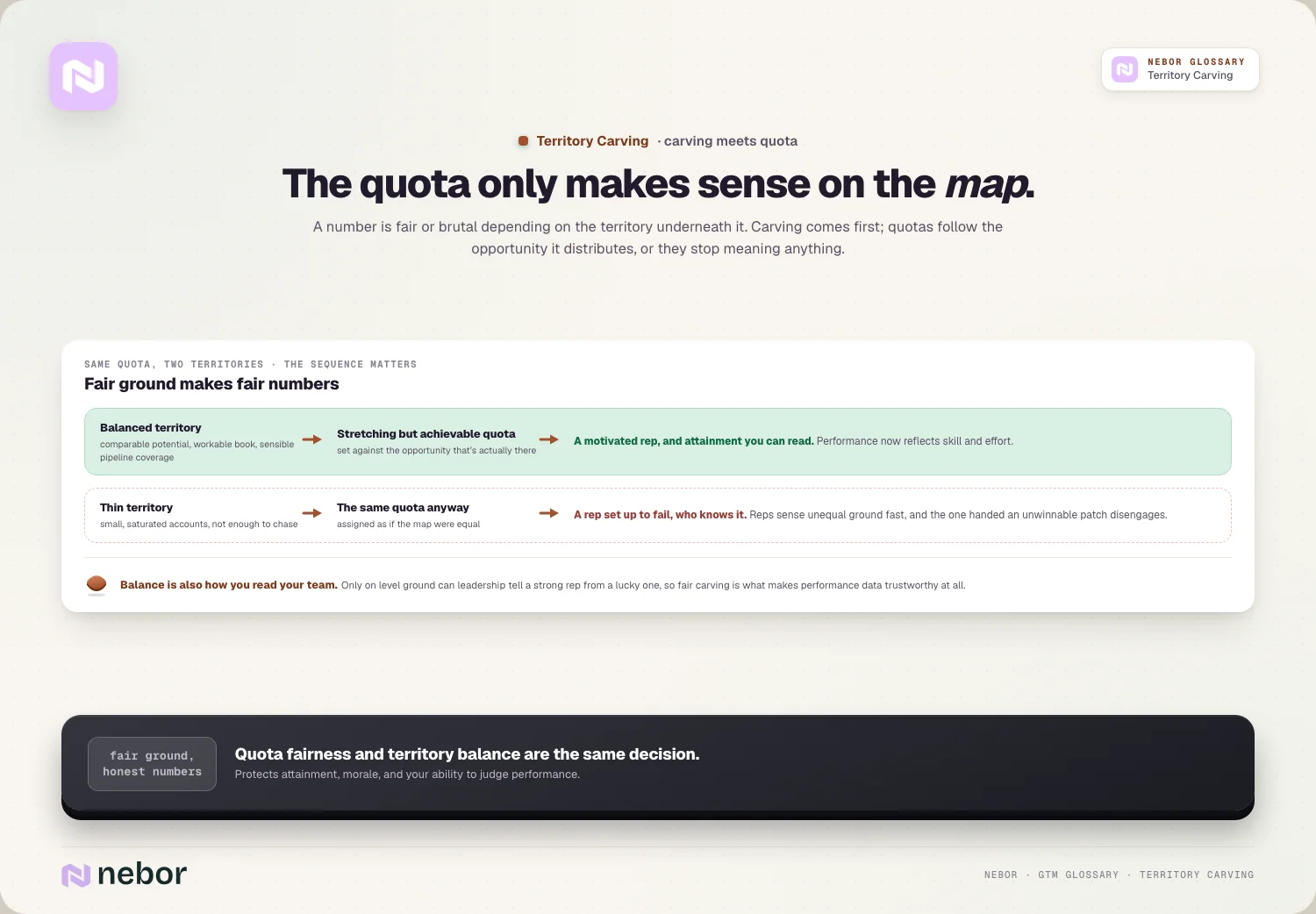
A quota is only fair against the territory under it. Give the same number to a rep with €5.6 million of potential and one with €1.4 million, and you've set a stretch goal for one and an impossible goal for the other. Do the carving first, then set each quota as a share of the potential that territory holds.
The same logic applies to pipeline targets. If your team works to a coverage target of, say, three times quota, check that each territory can produce that much pipeline coverage from the accounts it actually contains. A thin patch often can't, however many emails go out.
Fair territories also change what your own numbers can tell you. When territories hold comparable potential, differences in quota attainment mostly reflect the reps. When they don't, the attainment report ranks territories and presents it as a ranking of people. You end up promoting the rep who inherited Munich and coaching the one who got Liège.
Reps notice this faster than managers do. A rep who believes the patch is unwinnable stops trying to win it, and often starts looking for the next job.
From territory map to lead routing rule
A territory design that lives in a slide deck won't be followed for long. It has to become rules in the CRM, because those rules decide who gets every new account, every inbound lead and every opportunity. This is where territory carving meets lead routing: the territory says who owns a company, and the routing rule makes sure a lead from that company reaches that owner within minutes instead of sitting in a shared queue.
A routing setup that respects territories usually runs in this order:
Match the incoming lead to an existing account, by email domain or company name, before anything else happens.
If the account already has an owner, send the lead there. One company, one rep.
If it's a new account, run the territory rules on its country, size and industry, assign the account, and only then assign the lead.
Salesforce has this built in. Its Sales Territories feature (the current name for what was Enterprise Territory Management) groups accounts, leads and the users who work them into territories with assignment rules, and lets you keep several territory models in planning while only one is active. That's handy for a redraw, because you can test next year's map against real accounts before switching it on.
In HubSpot, teams usually build territories out of properties and workflows: a territory property on the company record, a workflow that sets it from country and company size, and a branch per territory that hands records to that territory's people. Where one territory has several reps, HubSpot's rotate record to owner action spreads newly enrolled records evenly across the users or team you pick.
Either way, the rules are only as good as the fields they read. A company with "Deutschland" in one record and "DE" in another, or no employee count at all, falls through to a default owner or to nobody. Standardized country values, enriched company size and the routine upkeep of CRM hygiene keep the territory rules firing. It's also why territory design normally sits with revenue operations, next to quota setting and routing, rather than with whichever sales manager drew the first map.
Redrawing territory lines without losing customers
A carve that was balanced in January won't be balanced in December. Accounts get acquired, raise money, shrink or sign with a competitor. Contacts change jobs, which is the slow work of data decay. New companies grow into your ICP. Within a year or two, the rep whose patch happened to boom is overloaded, the one whose patch stalled is starved, and you're back to the imbalance you carved to avoid.
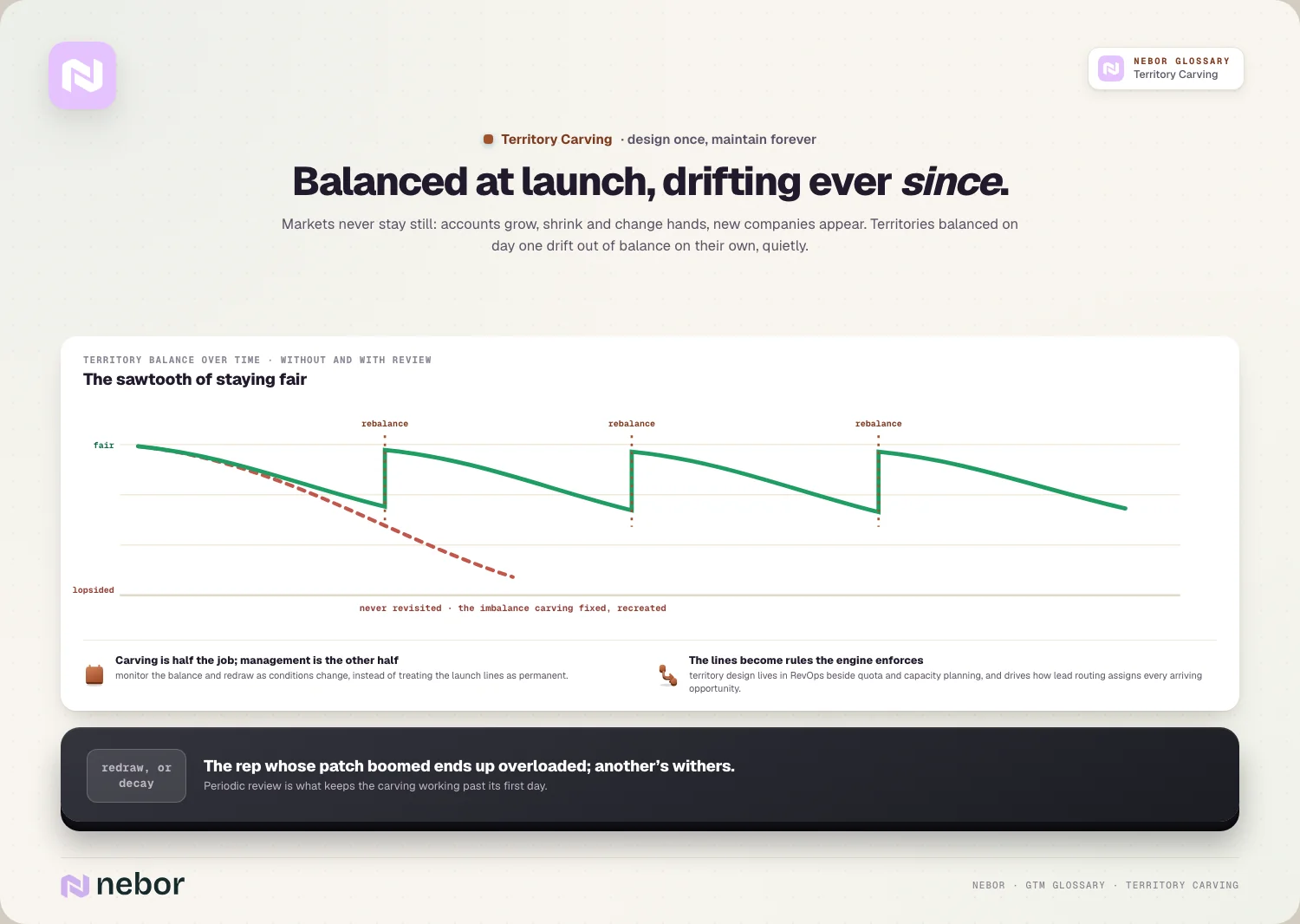
So drawing the map is half the work, and maintaining it is the other half. We'd recompute potential per territory at least once a year as part of annual planning, and redraw sooner when something forces it: a rep leaves, you hire, you launch in a new country, or one territory's potential pulls well away from the others.
Redrawing has a cost of its own. Every account that changes hands loses a relationship, and customers notice when their contact disappears. The alignment models Zoltners and Sinha describe were extended over the years to account for customer disruption alongside balance and travel time, which tells you how much it matters. A few rules keep the damage small:
Move as few accounts as you need to restore balance, and favor accounts with no open deals and no recent activity.
Let open opportunities stay with the rep who created them until they close, with commission rules agreed in advance.
Hand over existing customers properly, with the old owner on the first call where possible.
Announce the new map before a quarter starts, not halfway through one.
The bottom line
Territory carving decides who owns which accounts, and through that it shapes who hits quota, which leads get worked and which deals never start. The test of a carve isn't whether the account counts match. It's whether each rep has a comparable shot at their number and enough hours to work what they've been given.
The map also has to live somewhere other than a planning deck. Once territories become assignment rules in the CRM, they drive routing, ownership and reporting every day as part of the wider go-to-market system. When you automate sales prospecting on top of that, new accounts land with a rep who has room for them instead of piling up with whoever already has too many.
If you'd like a hand, Nebor can estimate account potential, carve the territories and set up the assignment and routing rules as owner fields and workflows in your CRM, then hand it all over with the logic written down for whoever runs the next redraw.
Frequently asked questions
What is the difference between territory carving, territory alignment and territory management?
Territory carving is the design step: deciding where the lines fall and who owns each territory. Territory alignment is the older academic term for much the same problem, grouping small pieces of a market into balanced territories. Territory management is the ongoing work after launch, which covers enforcing ownership in the CRM, tracking balance, handling reassignments and redrawing the map when the market moves.
What are the most common territory carving mistakes?
Splitting by account count instead of revenue potential is the big one, because equal piles of logos can hold very unequal amounts of money. Close behind are carving on geography alone, ignoring how many accounts one rep can actually work, setting quotas before the map is final, and treating the first carve as permanent, so it drifts out of balance within a year or two.
How many accounts should one sales rep own?
There is no single right number, because it depends on deal size, sales cycle length and how much of the work is automated. An enterprise rep running long, complex deals might handle a few dozen accounts properly, while a rep on short cycles with small companies may carry hundreds. Start from the hours a rep has per cycle and the touches each account needs, then check the total against the territory.
Do inside sales teams still need geographic territories?
They still need territories, though not always geographic ones. Remote reps don't travel, so region matters mainly for language, time zone and local rules. Many inside sales teams carve on company size or industry instead and keep a light regional split only where language demands it. What they can't skip is clear ownership, or two reps end up emailing the same buyer in the same week.
Should inbound leads go to the territory owner or to a round robin?
If the lead's company sits in a territory or already has an owner, send it to that owner, because splitting one account across reps confuses the buyer and the reporting. Round robin fits leads from new or unknown companies that no territory claims yet, or a territory staffed by several reps. Many teams use both: territory rules first, then a round robin inside the chosen territory.
What happens to open deals when territories are redrawn?
Most companies let open opportunities stay with the rep who created them until they are won or lost, then move the account to its new owner. That protects commission and spares the buyer from meeting a stranger halfway through an evaluation. Agree the rule before the redraw is announced, including a cut-off date and how credit is split for deals that close during the handover.
Who should own territory design in a company?
Usually revenue operations, working with sales leadership and finance. RevOps holds the data on account potential, runs quota and capacity planning, and maintains the CRM rules that enforce ownership and routing. Sales leaders add what the data misses, such as long customer relationships and each rep's strengths. Leaving it to individual sales managers tends to produce maps that suit the people who drew them.
What are named accounts in territory planning?
Named accounts are specific companies assigned to a specific rep by name rather than through a rule like region or size. They are usually the largest or most strategic accounts, often account-based marketing targets, and they are taken out of the pool before the general territory rules run. Keep the list short and review it every year, or it fills up with every account someone wanted to hold on to.
When does a sales team need formal territories?
Once more than two or three reps work the same market, or as soon as two reps have chased the same account. Before that, a simple ownership rule in the CRM is usually enough. Formal territories become worth the effort when hiring is planned, when reps start arguing over accounts, or when quota attainment varies so widely that nobody can tell skill from luck.
Can territory carving be automated?
Partly. Software can score account potential, propose balanced splits and enforce the result through CRM assignment rules, and Salesforce lets you model several territory maps before activating one. The final call still needs people, because a model doesn't know which rep has a ten-year relationship with a customer or which region is about to get a new office and more reps.
Share this post
RevOps
Glossary
Related glossary items
Understanding the core GTM concepts




Ready to build your pipeline