

In this post:
When most of a sales team misses quota, the instinct is to blame the reps. But a low attainment number is just as likely to mean the quotas were set wrong in the first place, and confusing those two causes leads to exactly the wrong fix.
Quota attainment is the metric at the center of that question. It measures how much of their target reps really hit, and reading it well means understanding whether a shortfall is a performance problem or a planning one.
Quota attainment is the percentage of a sales goal that a rep or team achieves in a period. It usually applies to a revenue target, though it can also measure deals, logos, or activity against a quota.
The number carries two common meanings, and mixing them up causes confusion. It can describe how much of quota one rep hit, or what share of reps on a team hit their quota at all, which are related but different readings.
TL;DR
Quota attainment is the share of a sales target that a rep or team achieves, usually measured against a revenue number for the period.
It has two readings, so it can mean how much of quota one rep hit, or what percentage of reps on the team hit their number, and the two get confused.
Attainment across B2B is lower than most people expect, with well under half of reps hitting quota in recent data, which is often by design rather than pure failure.
A low number doesn't automatically mean bad reps, because quotas set too high produce low attainment even with strong performers, so you diagnose the cause before reacting.
What quota attainment measures at the rep level and the team level
Quota attainment measures achievement against a target. At its simplest, it's the percentage of a quota that gets hit over a defined period.
The rep-level reading is the direct one. For an individual, attainment is how much of their own quota they closed, so a rep who booked 80% of their number is at 80% attainment.
The team-level reading works in a different way entirely. Across a team, attainment often means the share of reps who hit quota at all, so a team where half the reps make their number is at 50% attainment by that reading.
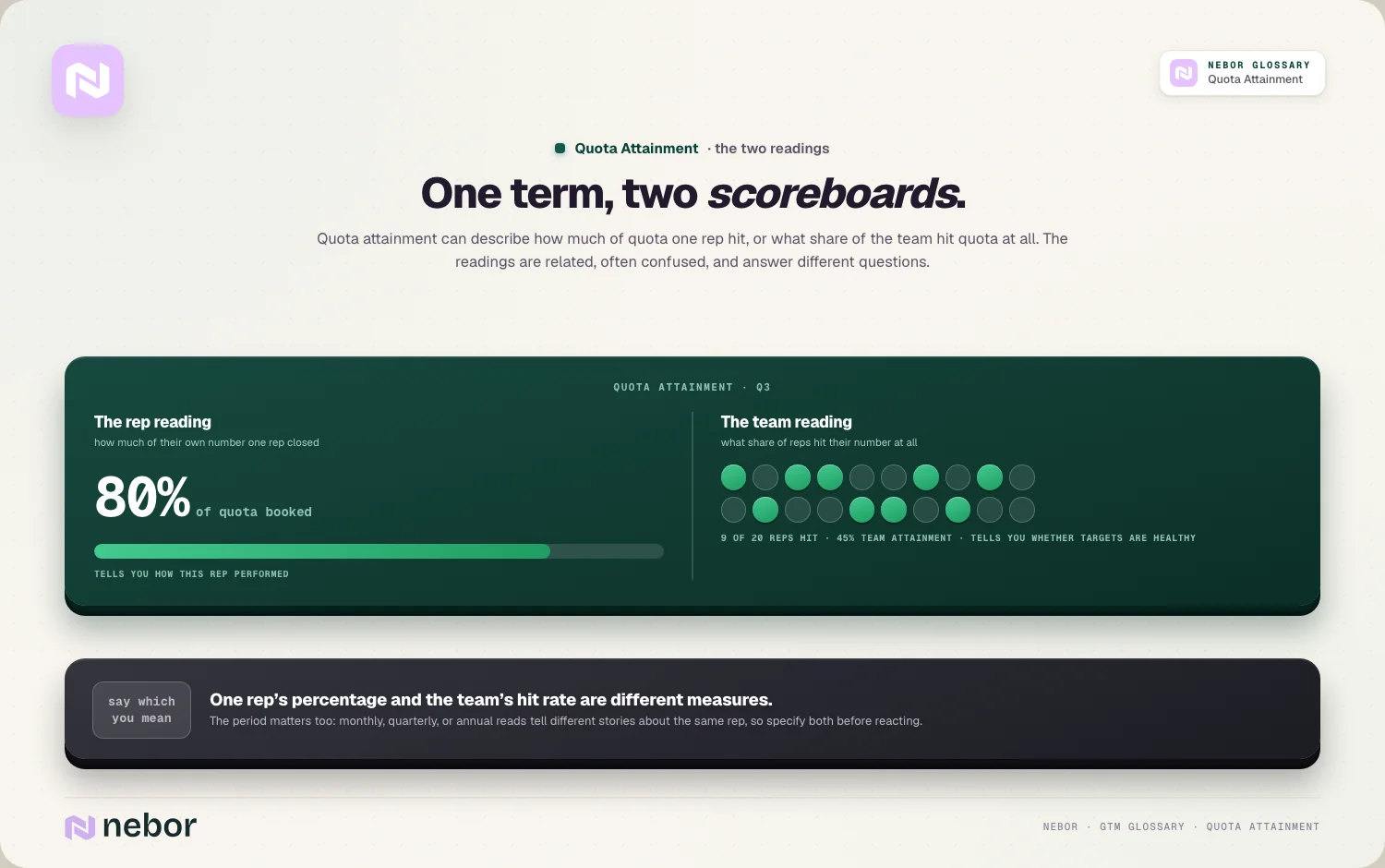
Both readings matter, each for a different reason. One tells you how a given rep performed, and the other tells you how healthy the whole team's targets and performance are, so you specify which you mean.
So quota attainment is a family of related measures instead of a single number. Being clear about whether you mean one rep's percentage or the team's hit rate is what keeps the metric useful.
The period you measure over matters too. Attainment can be read monthly, quarterly, or annually, and a rep behind at mid-quarter may still land the number, so the timeframe shapes what the figure is telling you.
Why quota attainment across B2B is lower than most people expect
The real state of quota attainment surprises people who assume most reps hit their numbers. The data tells a much harsher story.
Most reps end up missing their number. Recent figures show only around 41% of B2B reps hit quota, meaning the majority fall short in any given period.
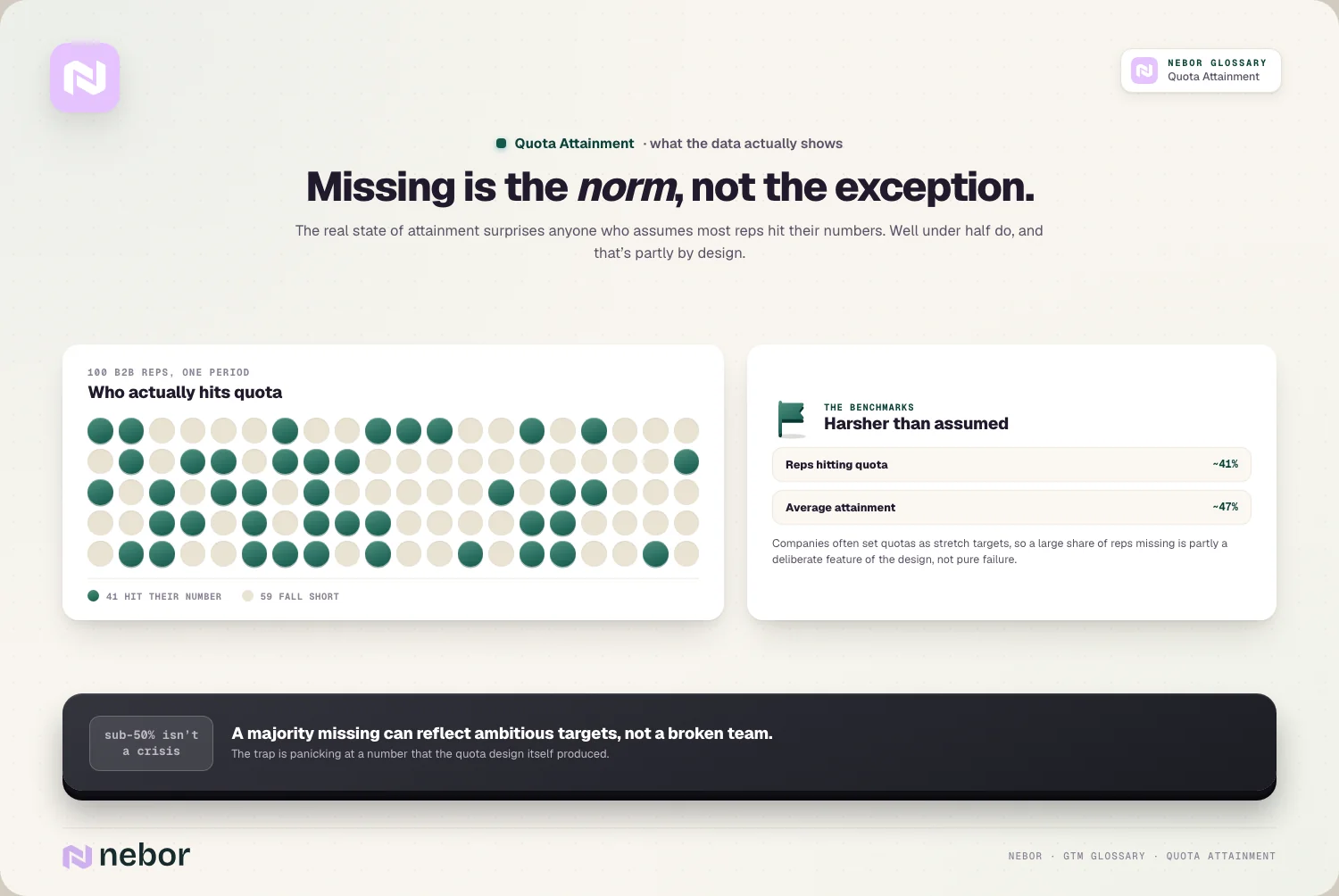
The published averages confirm the same pattern. Forrester puts average attainment near 47%, and other indexes land in a similar range, so missing quota is closer to the norm than the exception.
This is far from a story of pure failure. Companies often set quotas as stretch targets, so a large share of reps missing is partly a deliberate feature of how quotas are designed.
So low attainment is common and far from always alarming. The mistake to avoid is reading a sub-50% number as a crisis when it may reflect intentionally ambitious quotas instead of a broken team.
Why a low attainment number does not automatically mean bad reps
The most important skill in reading quota attainment is separating two very different causes, and we tell leaders to check the quota before the people. A low number can come from the reps or from the target itself.
Poor performance is one of the possible causes. If reps truly can't close enough, attainment falls, and the fix lies in coaching, hiring, or the sales process.
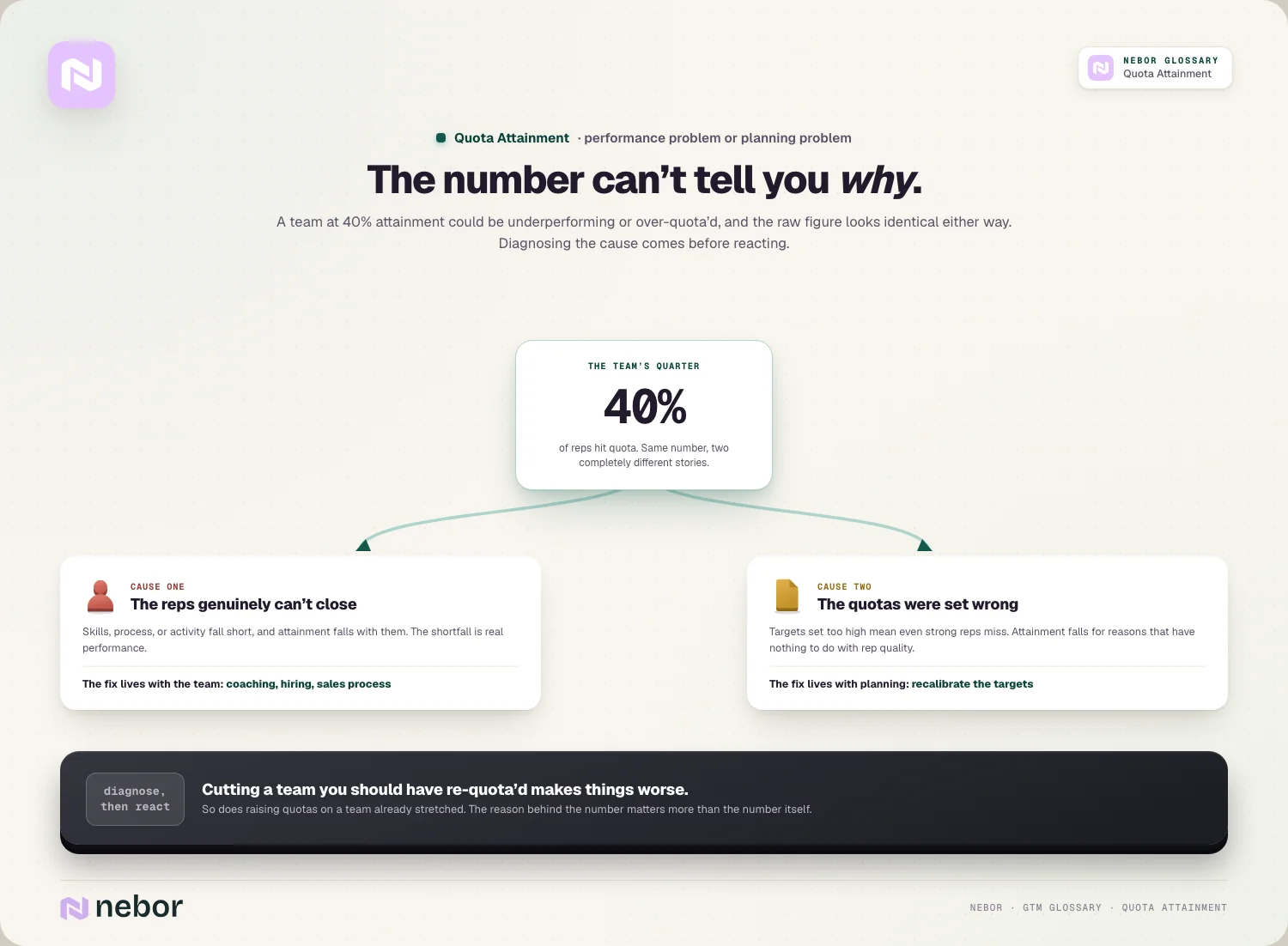
Unrealistic quotas are the other, quieter cause. If targets are set too high, even strong reps miss, so attainment falls for reasons that have nothing to do with rep quality.
The two look identical in the raw number. A team at 40% attainment could be underperforming or over-quota'd, and the raw figure alone can't tell you which.
So diagnosing the cause comes before reacting. Cutting a team you should have re-quota'd, or raising quotas on a team that's already stretched, both make things worse, so the reason behind the number matters more than the number itself.
How to tell whether your quotas are set at the right level at all
Since bad quotas masquerade as bad performance, judging whether targets are calibrated is essential, and in our experience the share of reps hitting quota is the clearest signal.
A healthy hit rate is a range. If roughly 60 to 70% of your reps hit their number, your quotas are likely well-calibrated, and most mature teams design toward that band.
Too few hitting is a warning sign. When only a small fraction of reps make quota, the targets are probably too high, which demotivates the team instead of stretching it.
Too many hitting is a flag as well. If nearly everyone blows past quota, the targets may be too low, so you're leaving performance and revenue on the table.
So calibration lives in a band well short of 100%. Quotas that almost no one hits and quotas everyone crushes are both miscalibrated, and the healthy zone is in between.
Why designing quotas so everyone hits their number is a mistake
A tempting instinct is to set quotas low enough that every rep succeeds, but that backfires. Quotas serve a purpose beyond being achievable.
Quotas are meant to stretch the team. A target everyone hits easily doesn't push anyone, so it caps output below what reps could produce.
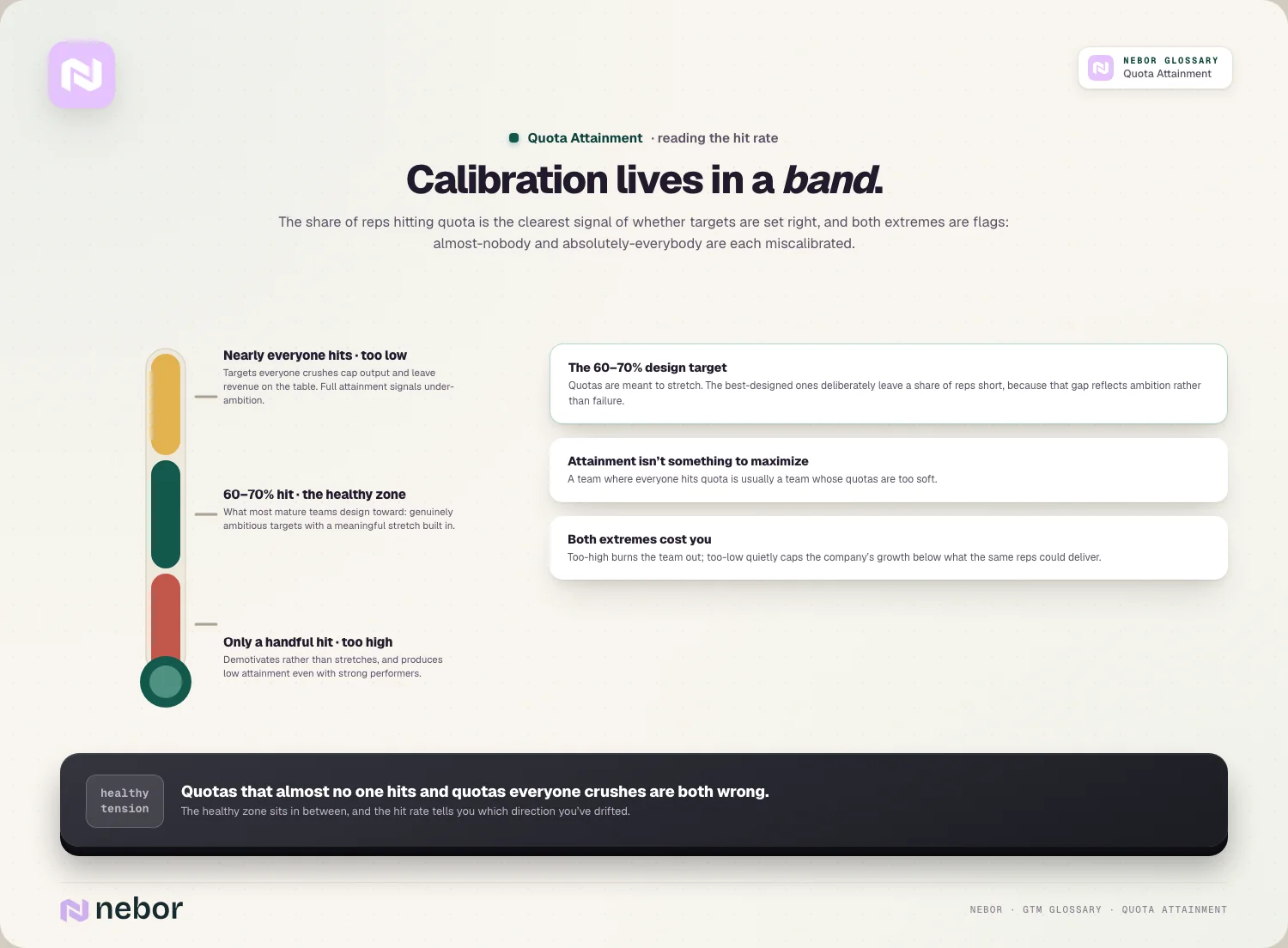
Full attainment usually signals under-ambition higher up the chain. If 100% of reps hit quota, the company is likely under-targeting, which means slower growth than the team could deliver.
Some healthy tension is the whole point. The best-designed quotas leave a meaningful share of reps short, because that gap reflects ambitious goals instead of failure.
So attainment isn't a number to maximize. A team where everyone hits quota is usually a team whose quotas are too soft, and the healthy design accepts that some reps will miss.
How quota attainment connects to pipeline coverage and win rate
Quota attainment is an outcome, and it rests on the inputs that produce it. Two metrics in particular determine whether reps hit their numbers.
Coverage feeds attainment from far upstream of the close. Without enough pipeline coverage, reps can't hit quota no matter how well they sell, so thin pipeline caps attainment from the start.
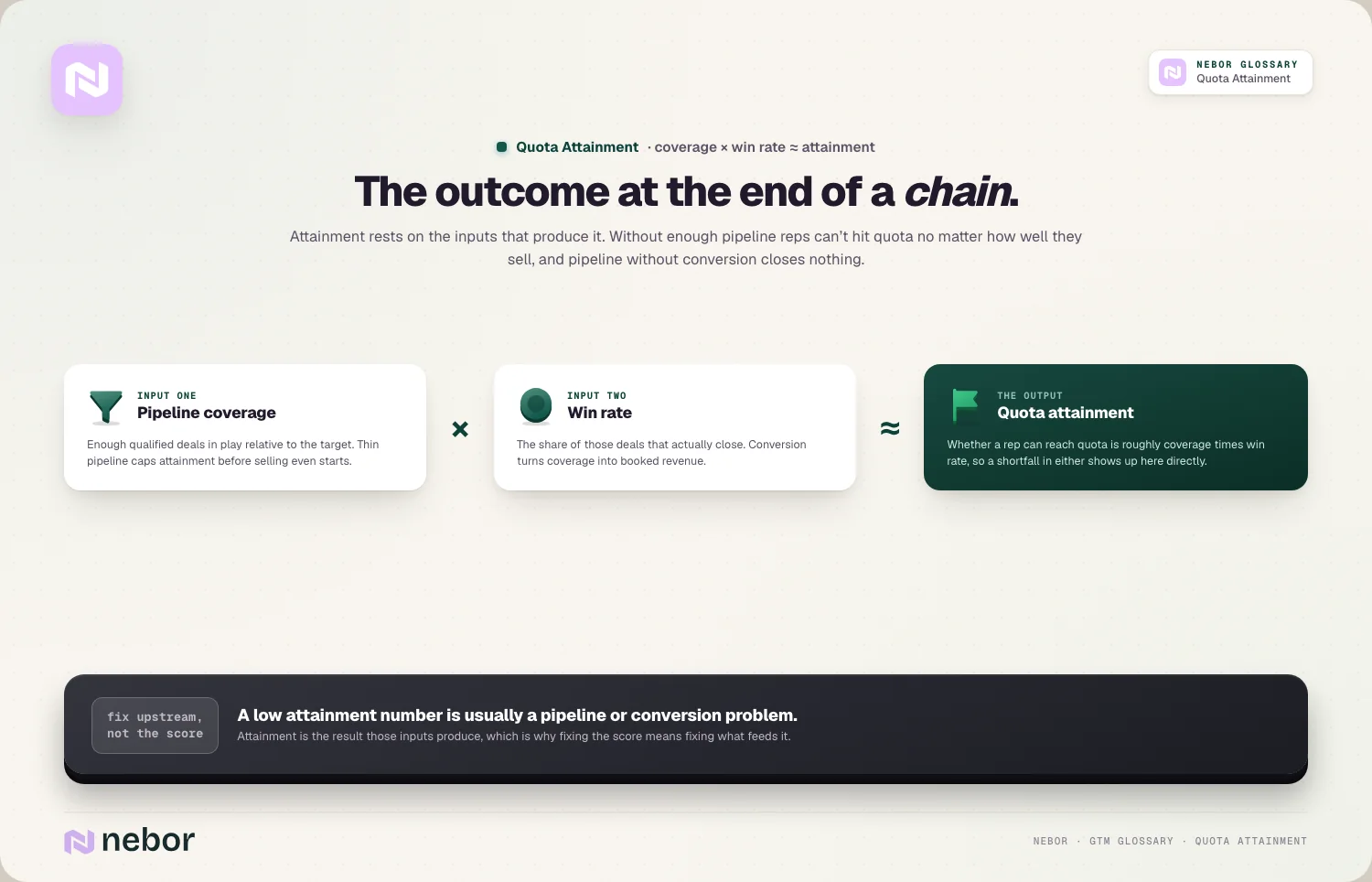
Win rate then converts what coverage supplies. A healthy win rate turns that pipeline into closed revenue, so attainment depends on both having enough deals and closing enough of them.
The chain is clear enough to write down. Coverage times win rate roughly determines whether a rep can reach quota, so a shortfall in either shows up directly in attainment.
So attainment is the end of a sequence that starts upstream. Fixing a low number often means fixing pipeline or conversion, because attainment is the result those inputs produce.
Why quota attainment is central to an accurate revenue forecast
Attainment shapes what you can predict as well as reporting the past, because forecasting leans heavily on how much of quota reps tend to hit.
Historical attainment is what informs the projections. Knowing that reps typically hit a certain share of quota lets you predict revenue from the quotas you've set, which grounds the forecast.
Volatile attainment weakens every forecast built on it. If attainment swings wildly period to period, any prediction built on it is shaky, which hurts overall forecast accuracy.
Consistent attainment is what enables real planning. A team with steady, predictable attainment lets leadership plan hiring, spend, and targets with confidence, because the pattern holds.
So attainment works as a forecasting input on top of a scorecard. The more reliable your attainment pattern, the more trustworthy the revenue predictions built on top of it.
How new-rep ramp time distorts a team's attainment picture from below
A hidden factor skews many attainment numbers, and ignoring it leads to false conclusions. New reps aren't yet expected to hit full quota.
Ramping reps drag the average number down. A rep still learning the product and building pipeline will miss quota simply because they haven't had time to ramp, whatever their real ability.
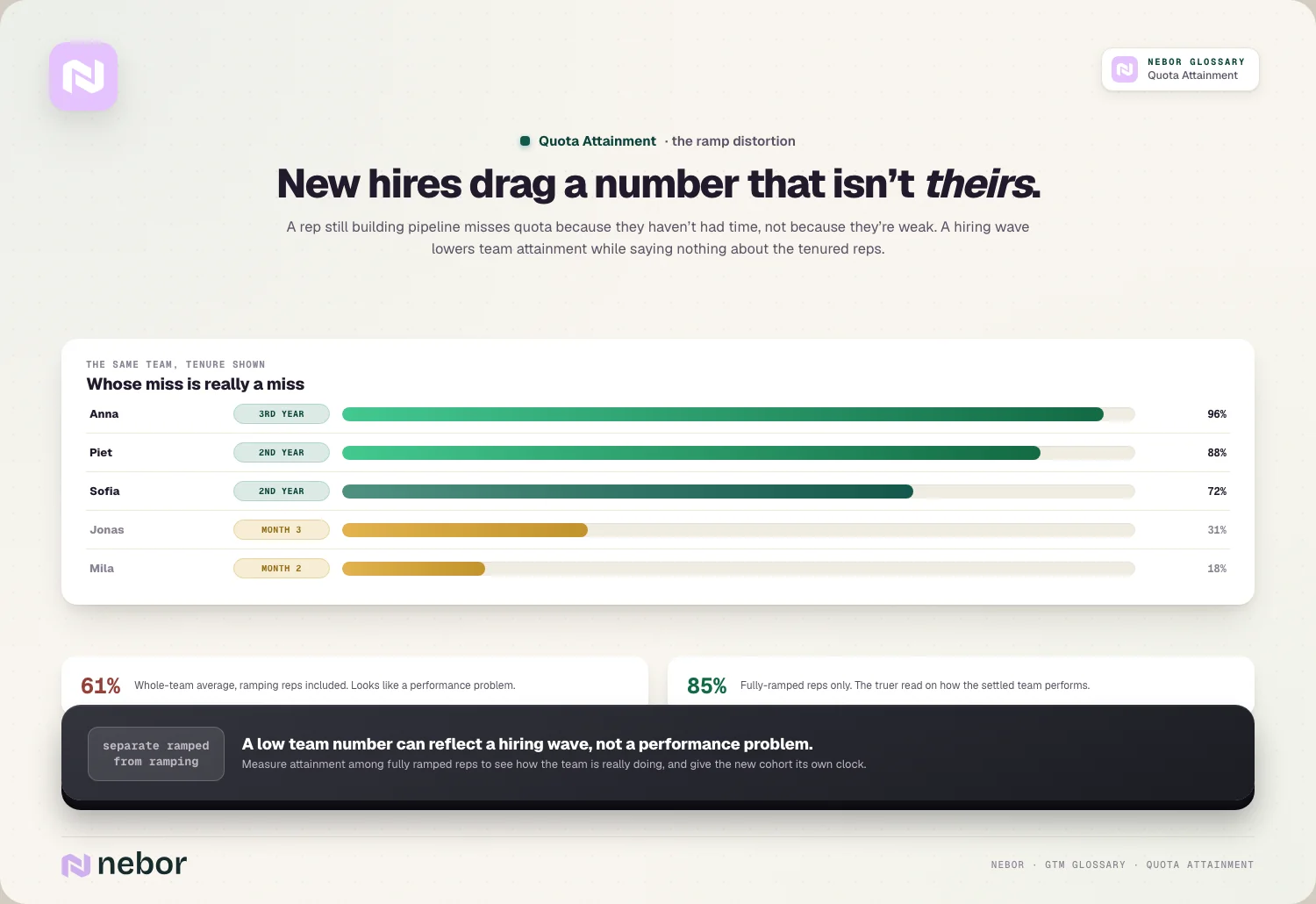
The mix of tenure on the team matters. A team that recently hired heavily will show lower attainment purely because a chunk of it is still ramping, which says nothing about the tenured reps.
Fully ramped attainment is the truer read of the team. Measuring attainment among only fully ramped reps strips out the ramp effect and shows how the settled team is really performing.
So context around tenure is essential to the read. A low team number can reflect a wave of new hires instead of a performance problem, so you separate ramped reps from ramping ones.
How quota attainment differs from win rate and pipeline velocity
Quota attainment belongs among several sales metrics that are easy to blur together. Each answers a different question about the same team.
Attainment measures the outcome at the end. It tells you whether reps hit their target, which is the end result the other metrics feed into.
Win rate measures the conversion inside it. It captures the share of deals a rep closes, so it's one ingredient of attainment instead of the whole picture.
Velocity measures the speed underneath both. Where pipeline velocity tracks how fast revenue moves through the funnel, attainment tracks whether that flow was enough to clear the bar.
So attainment is the scoreboard, and win rate and velocity are drivers behind it. Reading them together shows not just whether reps hit quota but why they did or didn't.
How to improve quota attainment without simply lowering the bar
When attainment is truly too low, the fix is to raise performance instead of softening targets, and several levers move the number the right way.
More pipeline is the first lever to pull. Building enough qualified opportunity through stronger lead generation gives reps the raw material to hit quota, backed by disciplined lead qualification so that pipeline is real.
Faster response is the lever that helps immediately after. Improving speed to lead so reps reach prospects while interest is high lifts conversion, which flows through to attainment.
Better enablement raises the win rates themselves. Coaching, playbooks, and sharper messaging help reps close more of what they have, which improves attainment without touching the quota.
Targeting matters as much as raw effort. Pointing reps at accounts that fit your ideal customer profile means they spend their time on winnable deals, which lifts attainment more than working harder on poor-fit ones.
So the honest path is to strengthen the engine instead of shrinking the goal. Lowering quotas can rescue a number on paper, but improving pipeline and conversion is what raises how much reps deliver.
Why quota attainment should be read alongside the whole revenue picture
A single attainment number, in isolation, can mislead badly. It gains meaning only when read next to the metrics around it.
It pairs with the health of the revenue engine. Strong attainment on a leaky engine may not last, so you check whether the underlying system is sound.
It interacts with deal size and cycle. A team hitting quota on fewer, larger deals is in a different position than one grinding out many small ones, so sales cycle length and deal mix color the number.
It reflects quota design as much as effort. Because attainment depends heavily on where quotas are set, reading it means judging the targets and the performance together.
So attainment is one panel in a dashboard instead of the verdict. When you read it beside coverage, win rate, and quota design, it tells you whether the team and its targets are in balance.
The common mistakes leaders make when reading quota attainment
Quota attainment gets misused in a few predictable ways, and we keep seeing the same ones when leaders share their dashboards with us, and avoiding them keeps the metric honest.
The biggest is treating low attainment as pure failure. Reacting to a low number without checking whether quotas were realistic punishes reps for a planning error.
Another is chasing 100% attainment as a goal. Designing quotas so everyone hits caps the team's output below what it could produce, so full attainment is often a sign of soft targets.
A third is ignoring the ramp effect. Judging a team's attainment without accounting for new hires who haven't ramped produces a falsely bleak picture.
The last is reading the number alone. Attainment without pipeline, win rate, and quota context can point you toward exactly the wrong fix, so it always needs its neighbors.
Why quota attainment is really a question about balance and calibration
The deepest way to understand quota attainment is as a balance between ambition and achievability. The number reflects how well those two are matched.
Quotas set too high make attainment collapse. Targets that almost no one can reach demoralize the team and tell you little about real performance.
Quotas set too low make attainment meaningless instead. If everyone hits quota, the number just confirms the targets were soft, which hides how much more the team could do.
The healthy zone is between the two extremes. Quotas calibrated so most reps hit them, with some falling short, push the team while staying credible, and that balance is what good attainment reflects.
That balance is what makes quota attainment one of the most revealing health checks in a modern go-to-market system. It shows whether your targets and your team are in sync, even as you automate sales prospecting to feed reps the pipeline they need to hit them.
Share this post
RevOps
Glossary
Related glossary items
Understanding the core GTM concepts




Ready to build your pipeline











