
11 Best Belkins.io Alternatives for B2B Lead Generation and Appointment Setting Automation


In this post:
Belkins is one of the household names in B2B lead generation. They have built one of the strongest brand reputations in the category, and if you Google the term "B2B lead generation" today, Belkins is one of the first agencies Google surfaces.
For many companies, they are the first call when it is time to kickstart outbound and appointment setting. For other companies, they are not the right fit. Here are a few real examples from G2 reviews.
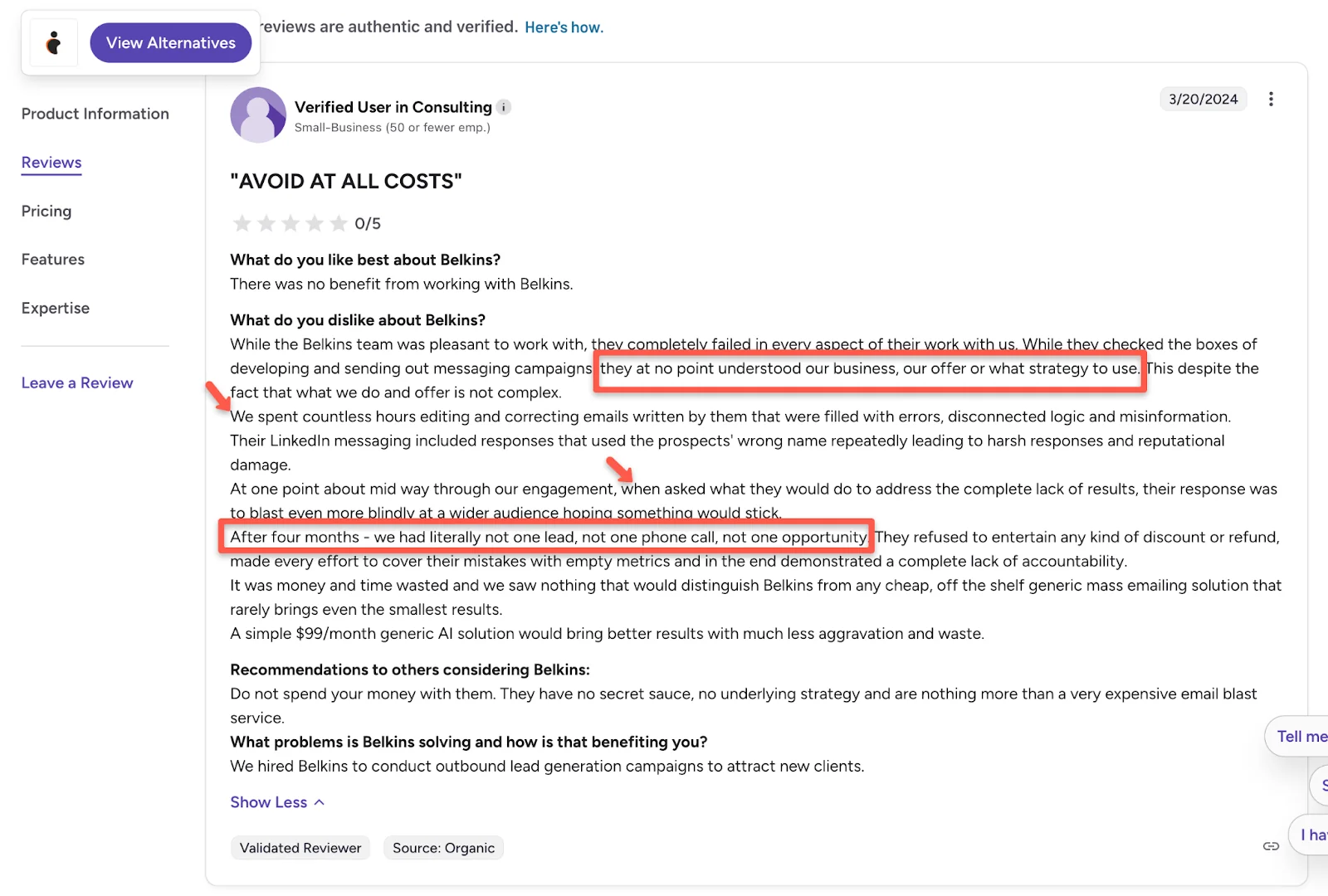
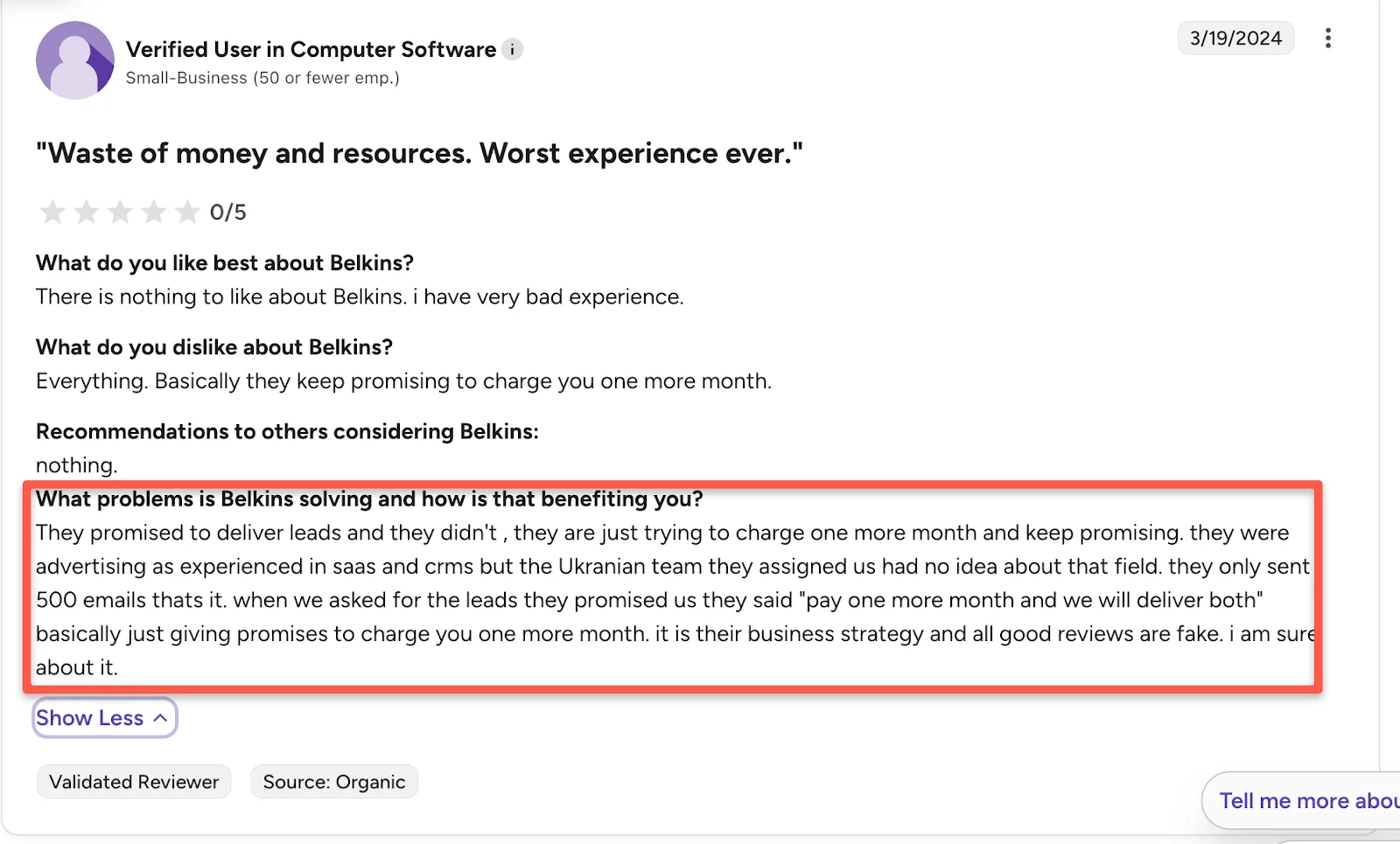
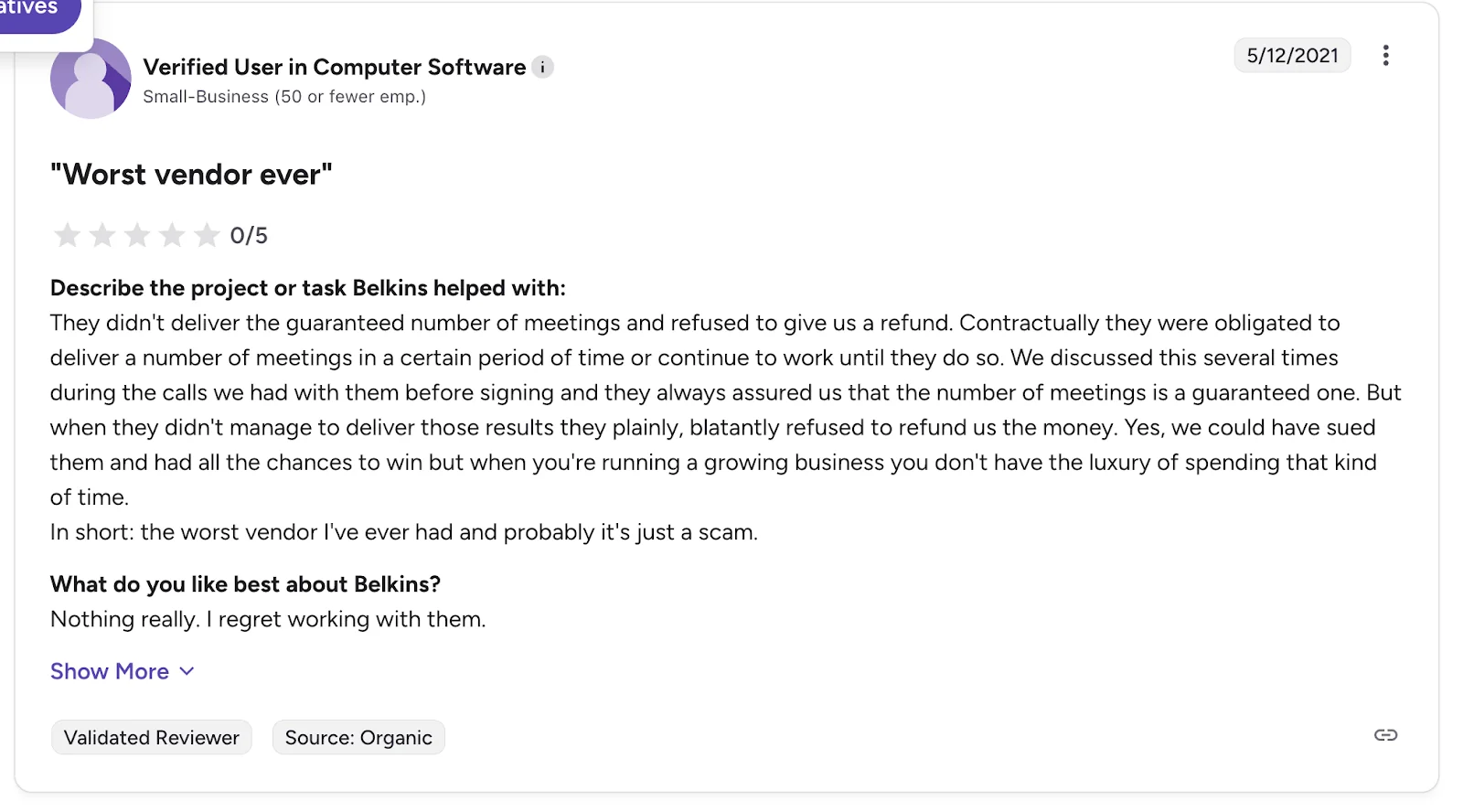
The point is that Belkins, popular as the agency is, does not work for everyone. So if you are searching for alternatives and ended up here, you are probably feeling something specific. Maybe one of these patterns sounds familiar to you.
The results you got did not match the cost on the invoice.
The leads looked great in the weekly report but were not actually ready to buy.
You want a lead generation or appointment-setting service with an automation layer you can plug into your CRM, not a team sending campaigns on the side.
You felt like you were paying for a sales process you could not see, control, or replicate without them.
You have outgrown the “agency does everything” model and want a system you actually own, one that keeps generating leads long after the monthly retainer is gone.
The pattern goes well beyond Belkins itself. These are the same patterns we hear from founders and sales leaders across industries.
The frustration is rarely about a single agency. It is about a model where you pay premium retainers for a process you cannot see end-to-end and a system that walks out the door when the contract does.
We built Nebor specifically to break that pattern. Instead of renting a team to send cold outreach for you, we build you an automated GTM system you own.
The Clay workflows, the enrichment logic, the multichannel sequences, the inbound capture layer, and the reporting all live inside your accounts and keep going long after we leave.
In this post, we will walk through the eleven best alternatives and competitors to Belkins for various industries and stages. We will also show you how a system you own can deliver the same or better pipeline results without the open-ended retainer fees.
Note: Belkins books meetings well, but the engine behind them stays with Belkins.
That is how the retainer model works. The lists, the sequences and the routing logic live in their accounts, so the pipeline stops the month you do.
At Nebor, we are a GTM engineering and RevOps agency. We build the same prospecting and outbound engine inside your own Clay and CRM accounts, then document it and train your team on it.
A year from now you are either still paying a retainer or you own the thing that produces your meetings.
Book a 15-minute call and we'll show you what owning it would look like for your business.
Why Nebor is the best Belkins alternative for your lead generation and appointment setting needs
Most B2B lead generation agencies, including the well-known names like Belkins, sell a version of the same model.
They staff up sales reps or lead generation account managers, hand out scripts, and tell the team to dial or send cold emails until something replies. The agency does the work and bills you for it, week after week, with a slide deck at the end of the week.
The structural problem is what happens when the contract ends. The data sources, the messaging logic, the workflows, and the tools all live in the agency's accounts.
The day you stop paying, your pipeline stops too. You walk away with a stack of slide decks and no way to keep doing the part that was working.
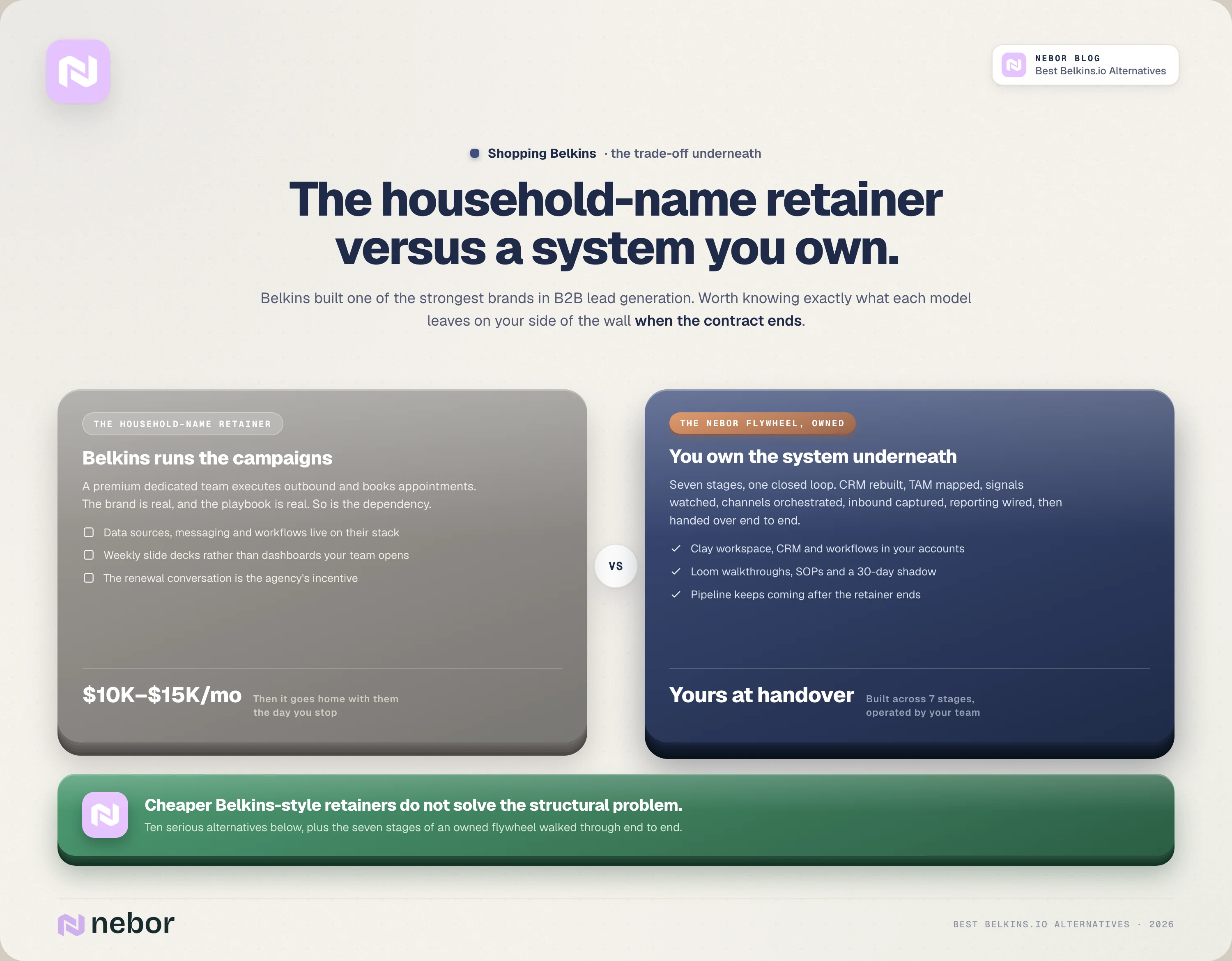
We started Nebor because we watched this play out from inside the model. The team doing outbound at a traditional Amsterdam agency saw clients pay six-figure retainers for activity metrics that did not translate into pipeline they could keep.
The agency’s incentives pointed toward the renewal conversation. The clients needed systems they could actually own. Those two things were not the same thing, and the gap is the thing we built Nebor to close.
The way we close that gap is what we call the GTM flywheel. The flywheel is one closed-loop system, not three or four siloed services bolted together.
Outbound and inbound share the data, the ICP scoring, and the routing logic. Each stage feeds the one that comes after it.
The work compounds across the months and quarters. The entire thing lives inside your accounts so it keeps going after we leave.
Our piece on building a GTM system from scratch carries the longer version of this argument.
The flywheel spans seven stages, each one feeding the next.
Stakeholder interviews and ICP definition. We talk to your team and lock down who actually buys, who decides, and what triggers them.
CRM rebuild as the system of record. We clean what is in there, redesign the structure to support a real revenue process, and set up the hygiene that keeps it clean after we leave.
TAM mapping and real-time buying signals. We build a live database of every fit-company in your market and watch it for signals that say a prospect is moving toward a decision.
Multichannel outbound orchestration. We wire email, LinkedIn, and phone as one coordinated motion that adapts to how each prospect responds.
Inbound capture, qualification, and handoff. We enrich, score, and route every web visitor, content engagement, and form-fill alongside outbound, on the same scoring logic.
Reporting and attribution your team actually opens. Dashboards inside the tools you already use, with weekly and monthly cadences built around real operational questions.
Documentation, training, and the operating handover. Loom walkthroughs and SOPs for every workflow, structured training across the relevant roles, and a 30-day shadow where your team takes over.
Here’s what it looks like.
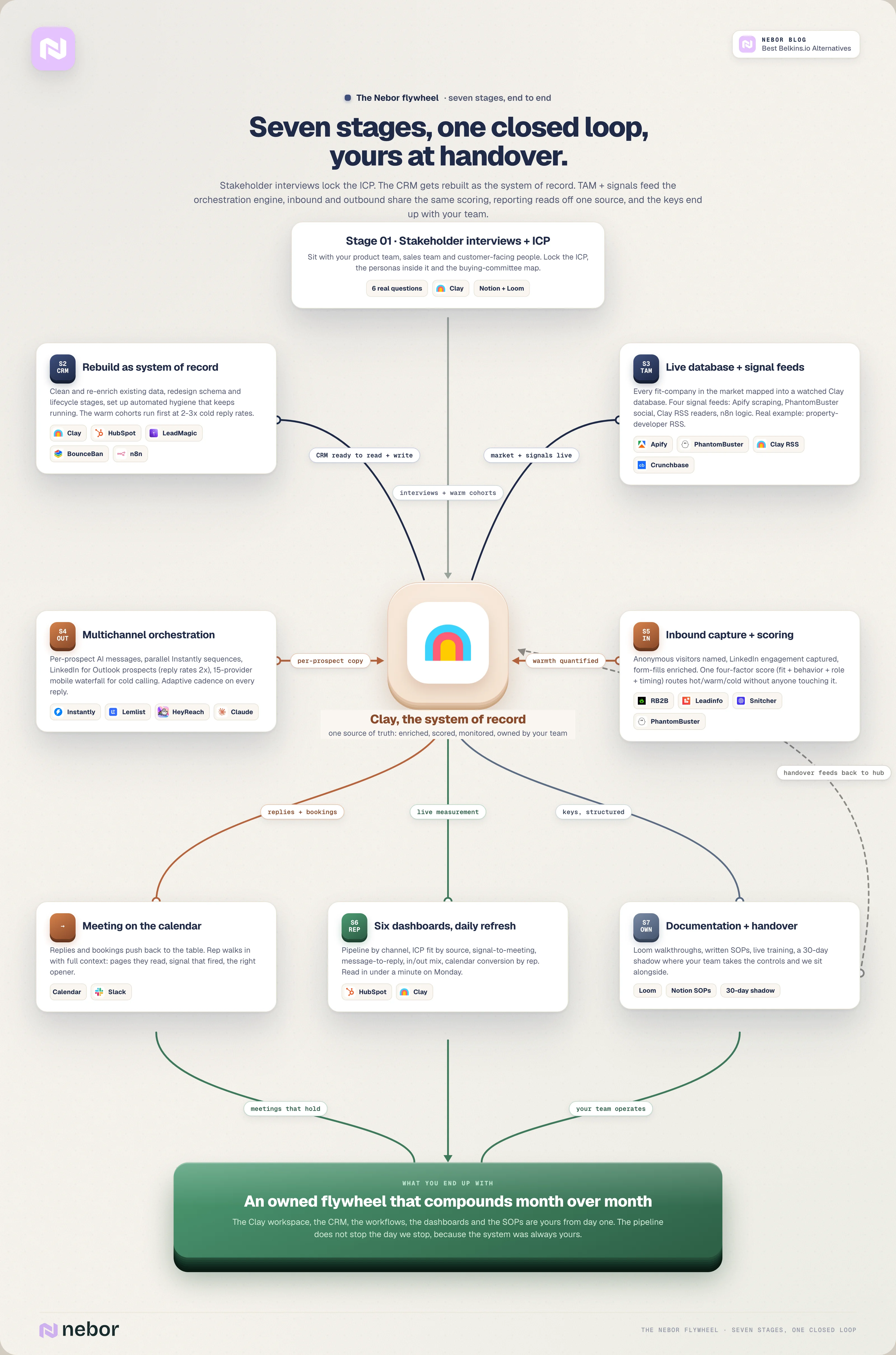
The next seven subsections walk through each stage in detail, and a final section closes the argument.
If you are short on time, scroll through the headings to the part that maps to where your current setup is breaking, and start there. The rest will still be there when you want it.
We start by interviewing your team and locking in your ICP
Most agencies kick off with a 30-minute discovery call and a questionnaire. Then they jump straight into campaigns using targeting criteria like “companies with 50+ employees in North America”. That description fits about a million companies.
We work in the opposite direction from the start. Before we build any list, we talk to your product team, your sales team, and the people who actually talk to customers, and we do deep stakeholder interviews.
The point of these interviews is not to gather surface-level info. We are after the core value proposition that your best customers actually buy. These are the kinds of questions we put on the table.
Why did you start the business in the first place?
What pain were you solving when you built the product?
Which customers stay the longest and spend the most?
What job titles actually show up in the buying process?
How do prospects solve this problem today without you?
What event triggers someone to start shopping for a tool like yours?
Most founders think they already know the answers. The gaps show up fast in the interview. This how we avoid frustrations like the one below:
From these interviews, we build a detailed ICP, the buyer personas inside it, and a map of the buying committee that has to sign off.
This becomes the foundation for every targeting decision, every message, and every workflow that follows. It is also what tells us, by month two, which of your assumptions about your own market were wrong.
If you want to see how the same buying-committee logic shows up later when an inbound lead lands, we wrote about it in our piece on the inbound meeting workflow.
We rebuild your CRM as the system of record for the whole flywheel
Your existing data is the most underrated asset in your sales motion. We take it, plug it into Clay and learn from it. Past customers, churned customers, demo no-shows, and lapsed prospects are already in your CRM right now.
Most agencies treat your CRM as someone else's problem. They start with purchased lists from ZoomInfo or Apollo and send their campaigns from a tab that never connects to your system.
When the engagement ends, your CRM is in the same state it was on day one. The system that built the pipeline goes home with them.
We treat the CRM as the central asset. The CRM is where your flywheel actually lives, so we rebuild it before any list goes anywhere else.
The first campaigns we send go to those warm leads. Reply rates on those first sends are usually two to three times what cold outreach delivers, which is the part that buys us the room to test the cold outbound motion properly later.
So, three jobs happen in this stage of the build. We clean what already lives in your CRM. We redesign the structure so it can carry a real revenue process. And we set up the hygiene jobs that keep it clean long after we leave.
Cleaning and re-enriching what is already in there
Designing the CRM so it actually drives the flywheel
Setting up automated hygiene so the system stays clean after we leave
The honest version is that nobody on your team wants to be the data steward. We build the system so they do not have to be one. After we leave, your sales reps and your RevOps lead get to work on revenue, and the hygiene happens in the background.
We map your TAM and watch it for buying signals in real time
By this point we have locked your ICP, cleaned and redesigned your CRM, and started a first wave of warm-cohort campaigns. We have seen which segments respond and which ones do not. The next stage of the build is scale.
Building the TAM as a live database in Clay
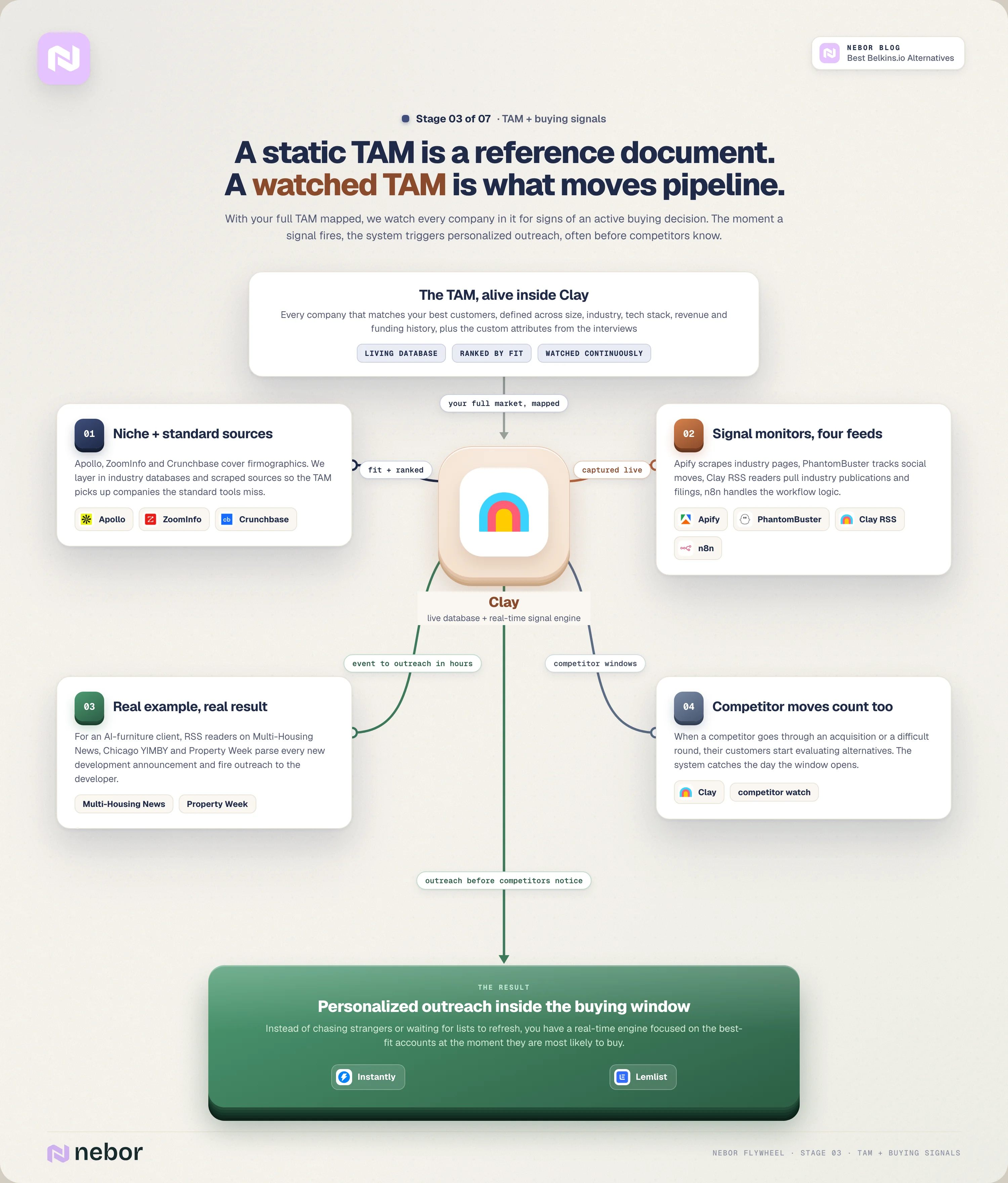
We build the TAM in Clay as a living database of every company that matches your best customers. Not a one-off list, not something we hand over and forget. We define it across the variables that actually matter for your business.
Company size and employee count
Industry and sub-vertical
Technology stack and tooling fingerprint
Revenue signals and funding history
The custom attributes we pulled from the stakeholder interviews
Then we plug Clay into the data sources that fit your specific ICP. The popular providers (Apollo, ZoomInfo, Crunchbase) cover the common firmographic layer.
For everything beyond that, we layer in niche providers, industry databases, and scraped sources so the TAM picks up companies the standard tools miss.
You can pipe the whole TAM into your CRM if you want full visibility. Your team stops working off one-off campaign lists and starts working from a constantly updated, ranked database of prospects organized by fit and buying likelihood.
The standard lead-list-building motion is reactive by design. When the list is exhausted, the agency builds another one.
That keeps you dependent on whoever is doing the list-building work that week. Our piece on TAM construction walks through how to build the TAM properly from the ground up.
Watching the TAM for buying signals and triggering outreach in real time
A static TAM is useful as a reference document. A TAM you are watching for signals is what actually moves the pipeline.
Because we have your full TAM mapped, we can monitor every company in it for signs that they are actively moving toward a purchase decision. The moment a signal appears, the system triggers personalized outreach, often before your competitors even know the prospect is in-market.
Clay is the center of this layer. The signals come in from a few directions.
Apify scrapes key data and industry pages for relevant updates.
PhantomBuster tracks social engagement, profile activity, and LinkedIn moves.
Clay’s RSS readers pull fresh updates from industry publications, regulatory filings, and trade databases.
n8n.io handles the workflow logic and the API calls between tools.
We also watch your competitors closely at this stage. When a competitor goes through an acquisition, a difficult round, or a public issue, their customers start evaluating alternatives. That is a window, and the system catches it the day it opens.
Whenever a new article or update lands on one of the sources we are watching, it flows into a Clay workflow.
The workflow parses it for the signals you care about, enriches the underlying account and contact data, and if the conditions match, sends a personalized outreach message. The first sign your reps see is usually a reply landing in their inbox.
Here is what this looks like with a real client.
One of our clients sells AI-powered furniture solutions to property developers. We set up Clay's RSS readers to monitor real estate and development sites like Multi-Housing News, Chicago YIMBY, and Property Week.
When a developer announces a new project, the Clay workflow captures the article, identifies the project name, developer, website, and key contact, enriches the contact with email and LinkedIn, generates a personalized message, and sends it automatically.
They went from cold-outreach campaigns that were not working to inbound replies from developers who saw a relevant message land at exactly the moment they were planning their build-out. We have written about why that is in our piece on signal-based outbound.
Instead of chasing strangers or waiting for lists to refresh, you have a real-time engine that focuses your effort on the best-fit accounts at the exact moment they are most likely to buy. That is a level of speed and precision you cannot get from a manual, campaign-driven model.
Note: Belkins books meetings well, but the engine behind them stays with Belkins.
That is how the retainer model works. The lists, the sequences and the routing logic live in their accounts, so the pipeline stops the month you do.
At Nebor, we are a GTM engineering and RevOps agency. We build the same prospecting and outbound engine inside your own Clay and CRM accounts, then document it and train your team on it.
A year from now you are either still paying a retainer or you own the thing that produces your meetings.
Book a 15-minute call and we'll show you what owning it would look like for your business.
We orchestrate multichannel outbound across email, LinkedIn, and phone
When you hire a traditional outbound agency, what you actually pay for is a team of operators sending messages by hand.
Email goes through one tool, LinkedIn goes through another, calls happen on a third, and a junior account manager copies content between them. The motion depends entirely on who is at their desk that day.
We build the motion as a single coordinated system.
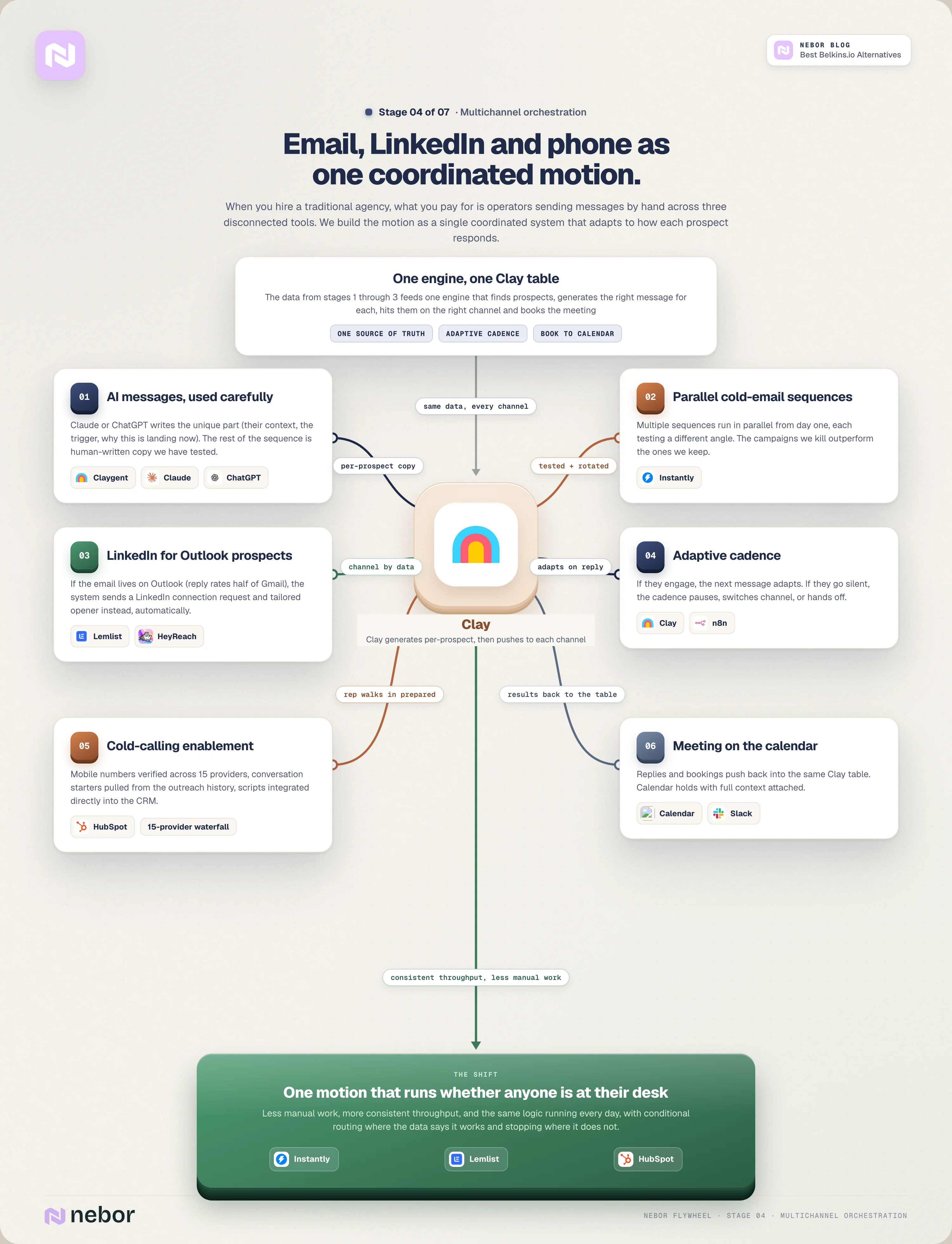
The data we collected in stages one through three feeds into one engine that finds your prospects, generates the right message for each one, hits them on the right channel at the right moment, and books the meeting straight into your sales rep's calendar.
Less manual work, more consistent throughput, and the same logic applied every day whether anyone is paying attention or not.
The complete system has four distinct moving parts.
AI-powered messages, used carefully and not as a replacement for thinking
Cold email execution through Instantly
LinkedIn outreach through Lemlist
Cold calling enablement for your in-house team
For cold calling, your reps get:
Mobile phone numbers we verify through 15 different providers, layered because no single provider's contact rate clears the bar on its own.
Conversation starters that we pull from the actual outreach history (what email opened, what they engaged with, what signal landed before the call).
Cold-calling scripts that we write for the specific segment and integrate directly into the CRM so the rep sees the script the moment they open the contact.
Everything flows into your CRM with the call openers ready to go. Your salespeople do less prep work and have better conversations from the first ring.
The complete picture is one automation that hits your prospects across email, LinkedIn, and phone, with coordinated messaging that adapts based on how they respond and what the data tells us each week.
We turn inbound traffic into qualified pipeline alongside outbound
Most lead generation agencies focus almost entirely on outbound. They send campaigns, book meetings, and move on. Meanwhile, your business is taking inbound activity every single day.
People visit your website, download your content, click through your ads, comment on your LinkedIn posts, attend your webinars. Most of those signals never reach your sales team.
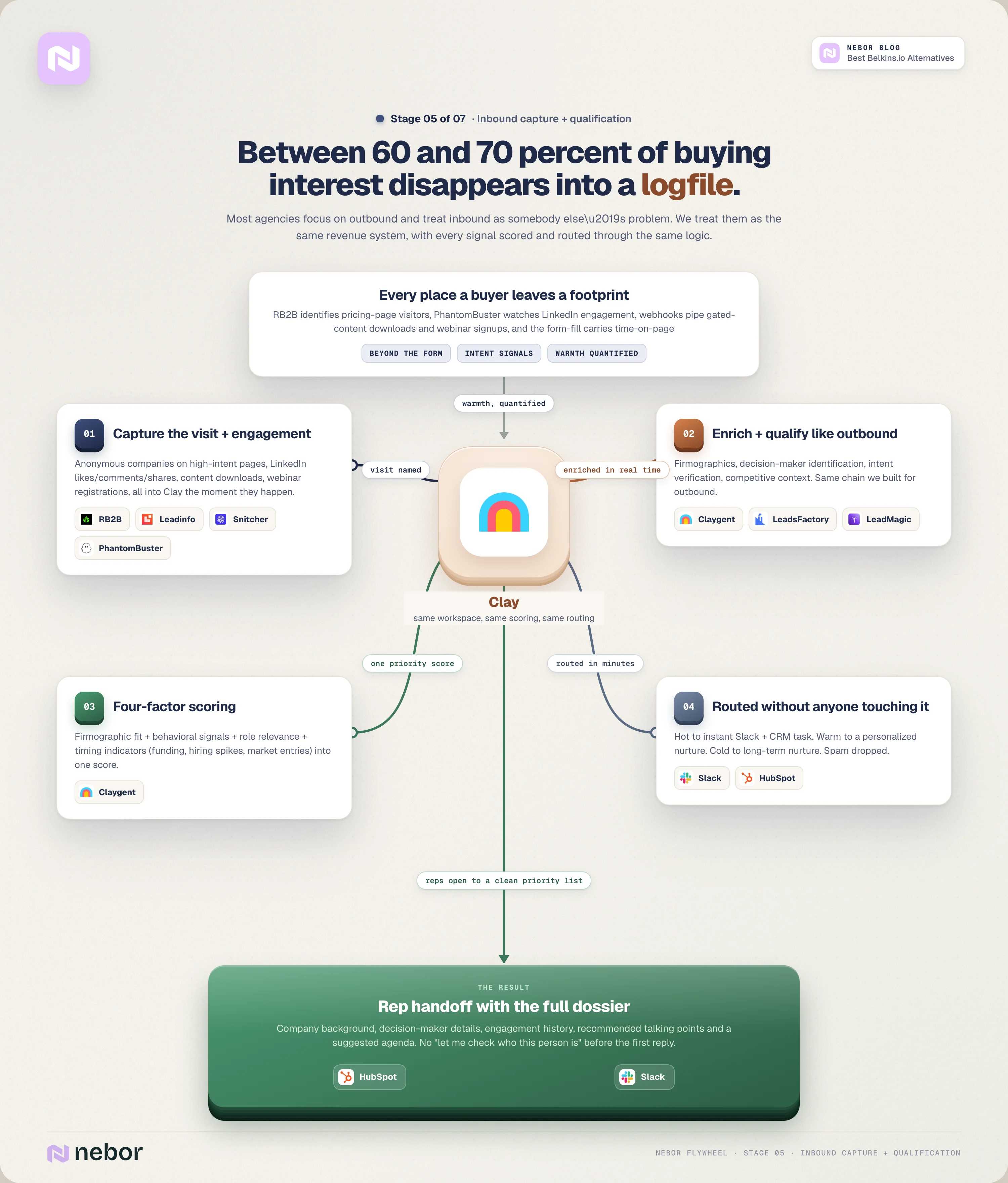
The form-fill is the only thing the marketing tool catches, which means somewhere between 60 and 70 percent of the buying interest you generate disappears into a logfile.
We treat outbound and inbound as the same revenue system. Every signal lands in the same Clay workspace, passes through the same ICP scoring, and follows the same routing logic that powers the outbound engine.
A cold prospect opening an email and an account director from your TAM checking your pricing page are the same thing as far as the system is concerned. They are both prospects who just told you they are paying attention.
So, we capture inbound signals well beyond the form fill
RB2B, Apify, PhantomBuster, Clay, and n8n.io handle the work between them.
Website visitor identification: RB2B identifies anonymous website visitors who hit your pricing page, demo page, or pillar content and matches them to verified company profiles.
Social engagement tracking: PhantomBuster watches the activity around your LinkedIn content, including likes, comments, shares, and profile visits. Every interaction lands in Clay and goes to outreach.
Content engagement monitoring. Webhooks and API integrations pipe downloads, webinar registrations, and gated-content interactions straight into the Clay workflow.
The outcome is that every digital interaction becomes a qualified data point. Your team stops waiting for leads to volunteer themselves and starts working from a real-time picture of who is engaging right now.
Qualifying inbound leads through the same Clay workflows that power outbound
We plug your inbound traffic in the same Clay workspace as the outbound motion, and the enrichment happens the same way.
We pull company firmographics (size, vertical, tech stack, growth indicators), decision-maker identification (who is involved, who has buying power), intent verification (whether they are actively researching or evaluating), and competitive context (what tools they are using today).
Handing inbound to sales without making the rep do the research
When a lead qualifies, the handoff carries everything the rep needs to start a useful conversation.
Full company background and recent activity, drawn from public sources and the enrichment layer.
Decision-maker details and verified contact info, including direct dial when we have it.
Engagement history covering what content they touched and when.
Recommended talking points tied to their actual situation, not a generic discovery script.
Suggested next steps and an agenda the rep can use as a starting point.
If you have a sales team spread across territories and languages, we can set up the system to route leads to the right rep based on territory, industry specialization, deal size, and current rep capacity.
We wrote about layering the buying-committee logic on top of all of this in our article on inbound meeting workflows, and the broader argument for connecting the two motions is covered in our piece on inbound-led outbound.
We instrument the system with reporting and attribution your team can read
Here is what most agency reporting looks like. A 14-tab Google Sheet that someone updates once a week. A monthly slide deck with a screenshot of the email tool’s open rate dashboard. A QBR pack stuffed with charts that nobody opens between QBRs.
All of that material is paperwork that nobody acts on. The point of reporting is for someone on your team to log in on Monday morning and know what is working, what is not, and where to spend the next five days.
If your reporting cannot answer those three questions in under a minute, your team is not using it, no matter how nice it looks.
We build the reporting layer the same way we build the rest of the system. The dashboards live in the tools your team already opens every day, they pull from the data the system is already producing, and they are in front of the people who actually have to act on the numbers.
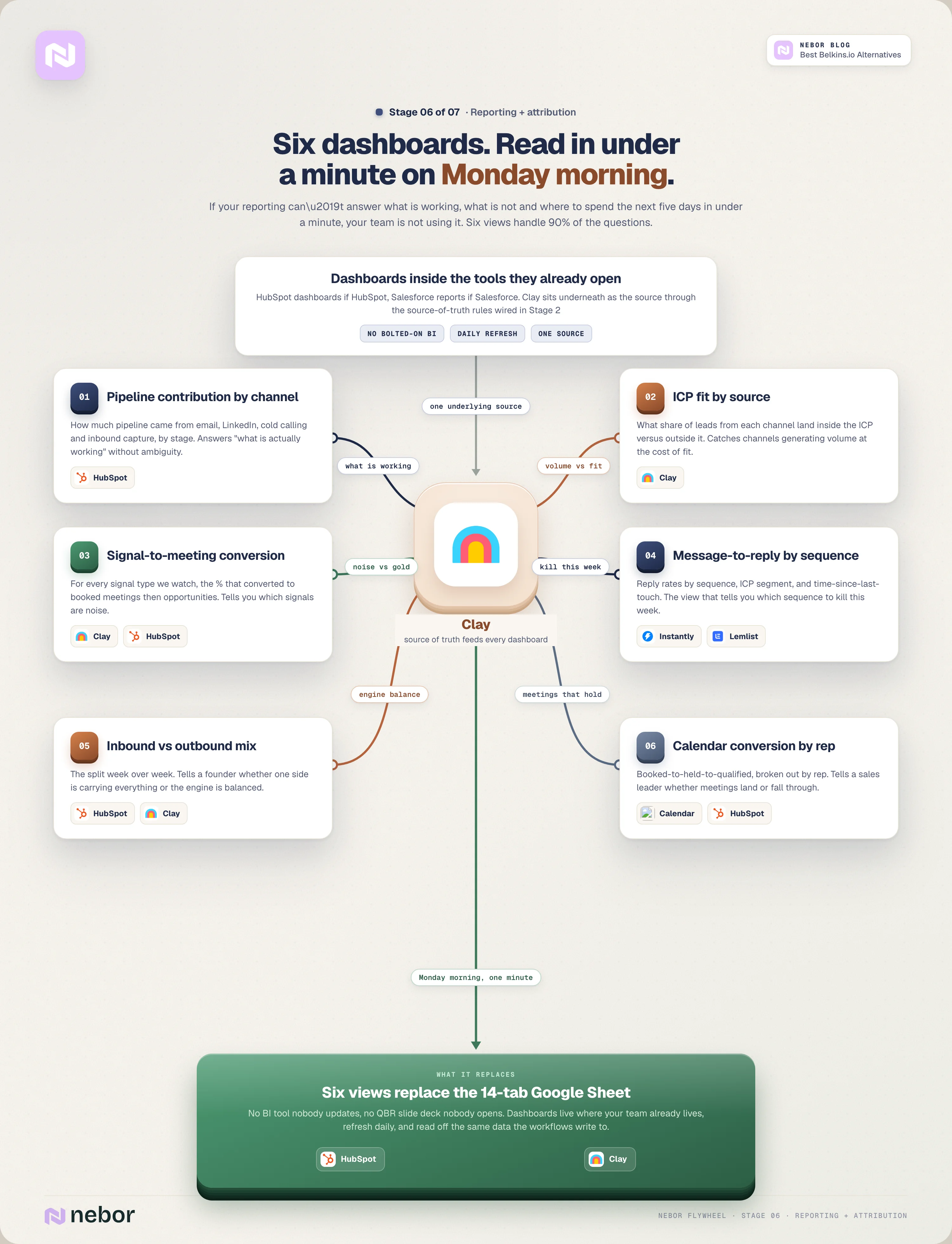
What the reporting actually covers
The dashboard set we build is intentionally small. Six views handle 90% of the questions a sales leader, a RevOps lead, or a founder will want to ask of the system in any given week.
Pipeline contribution by channel. How much pipeline came from email, LinkedIn, cold calling, and inbound capture in the period, by stage. Answers the question "what is actually working" without ambiguity.
ICP fit by source. What share of leads from each channel are landing inside the ICP versus outside it. Tells you whether a given channel is generating volume at the cost of fit.
Signal-to-meeting conversion. For every type of buying signal we are watching, the percentage of caught signals that converted to a booked meeting and then to an opportunity. Tells you which signals are worth keeping live and which ones are noise.
Message-to-reply by sequence. Reply rates segmented by sequence, by ICP segment, and by time-since-last-touch. The view that tells you which sequence to kill this week.
Inbound and outbound mix. The split of pipeline between motions, week over week. The number that tells a founder whether the engine is balanced or whether one side is carrying everything.
Calendar conversion by rep and territory. For multi-rep teams, the conversion rate from booked meeting to held meeting to qualified opportunity, broken out by rep. The view that tells a sales leader whether the meetings the system is booking are landing on a rep's calendar without falling through.
That set forms the operational reporting layer of the system, and it updates daily. It is the thing the team actually uses. We also hand over playbooks, training, and documentation so the system stays yours
The whole flywheel only works if you can operate it after we leave. If nobody on your team can operate the system after we leave, the engagement was a service contract regardless of how we packaged it.
Why this matters more than picking another Belkins-style agency
Pull back from the tactics for a moment. Almost every B2B lead generation agency on the market sells the same model.
You pay a monthly retainer, the agency sends your outbound campaigns, you get a slide deck at the end of the week, and when you stop paying, the leads stop coming.
You never see the inner workings, the data sources, the messaging logic, or the tools that made any of it happen. The day the contract ends, the system goes home with the agency.
In other words, you spend $10K to $15K a month to keep the pipeline moving, and when you stop, everything stops with it.
That is the structural problem with the rental model. Cheaper rentals do not fix the structural problem here. The right answer is to stop renting and start owning the system instead.
The GTM workflow we just walked through is what owning the system actually looks like. The CRM and the Clay workspace are yours from day one.
All of it lives in your accounts, on your billing, with your team operating the day-to-day. We structure the engagement so the keys end up with you, regardless of whether we keep working together after the handover.
We wrote about why this matters in the way we think about agency models in our post on what makes a great growth agency, and in our explanation of why we are not a lead generation agency.
We’ve got a shorter version of the argument in our piece on whether to outsource lead generation at all.
10 top Belkins.io alternatives for lead generation and appointment setting
Here are ten alternatives to Belkins that come up most often in shortlists, each with its own model of how they source leads and book meetings.
1. CIENCE Technologies
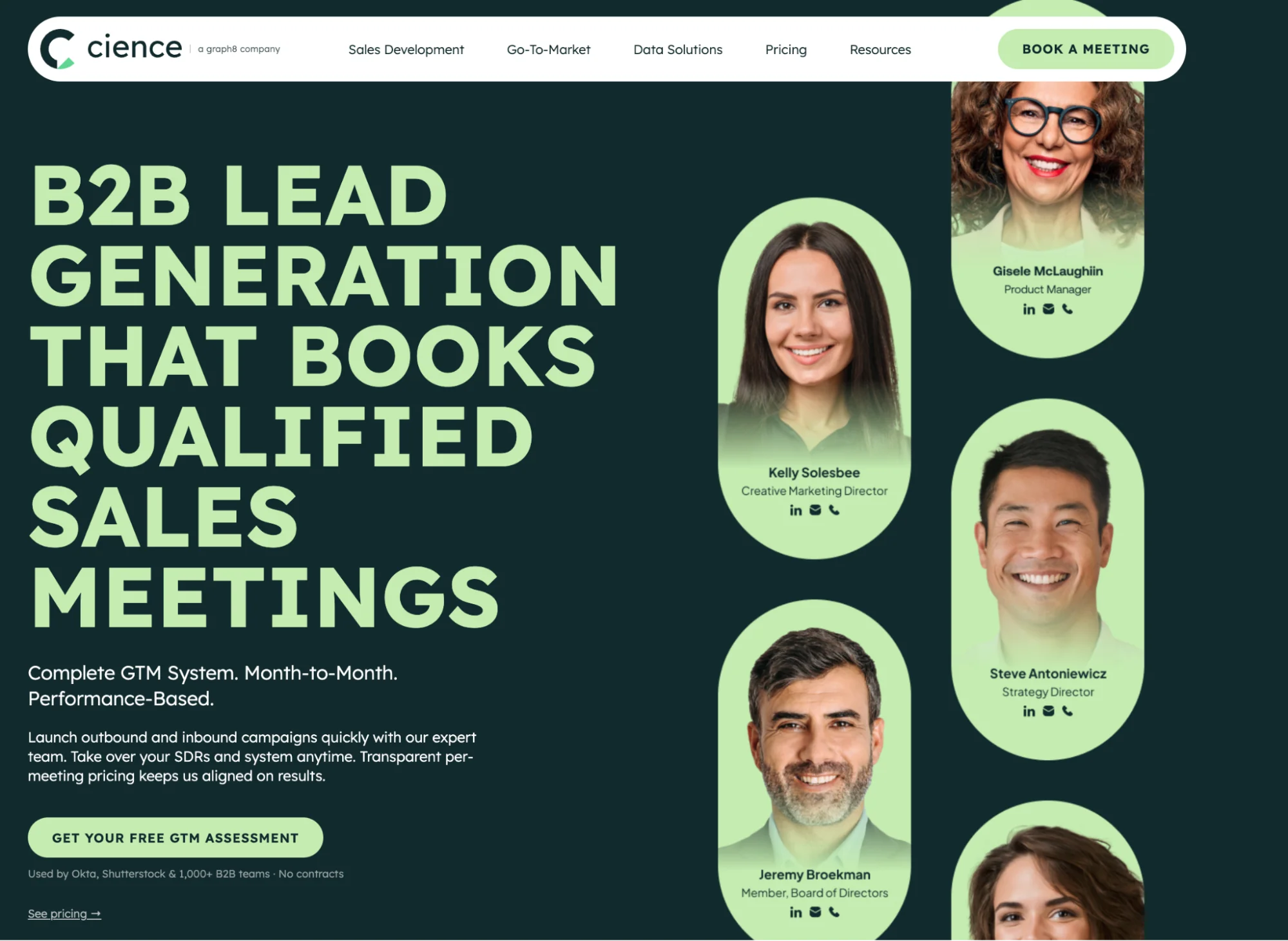
What they do well:Blends human SDRs with technology and deep outbound research at scale.
Most people in the industry see CIENCE alongside Belkins as one of the household names in B2B outbound. The agency combines SDR labor with research-backed targeting and proprietary lead-generation software, which gives them an edge on volume.
CIENCE is a strong fit if you need to hit many accounts and still want the messages to feel personalized at the contact level. They have deep experience in SaaS and tech, and they have a well-developed playbook for businesses where careful targeting and high volume both matter.
The trade-off is the same one that comes with most full-service outbound shops. The lists, the workflows, and the playbook live inside CIENCE's tooling. When the engagement winds down, the system winds down with it.
They build a strong rented motion at scale. If you want a system you take with you, that is a different kind of engagement.
2. Martal Group
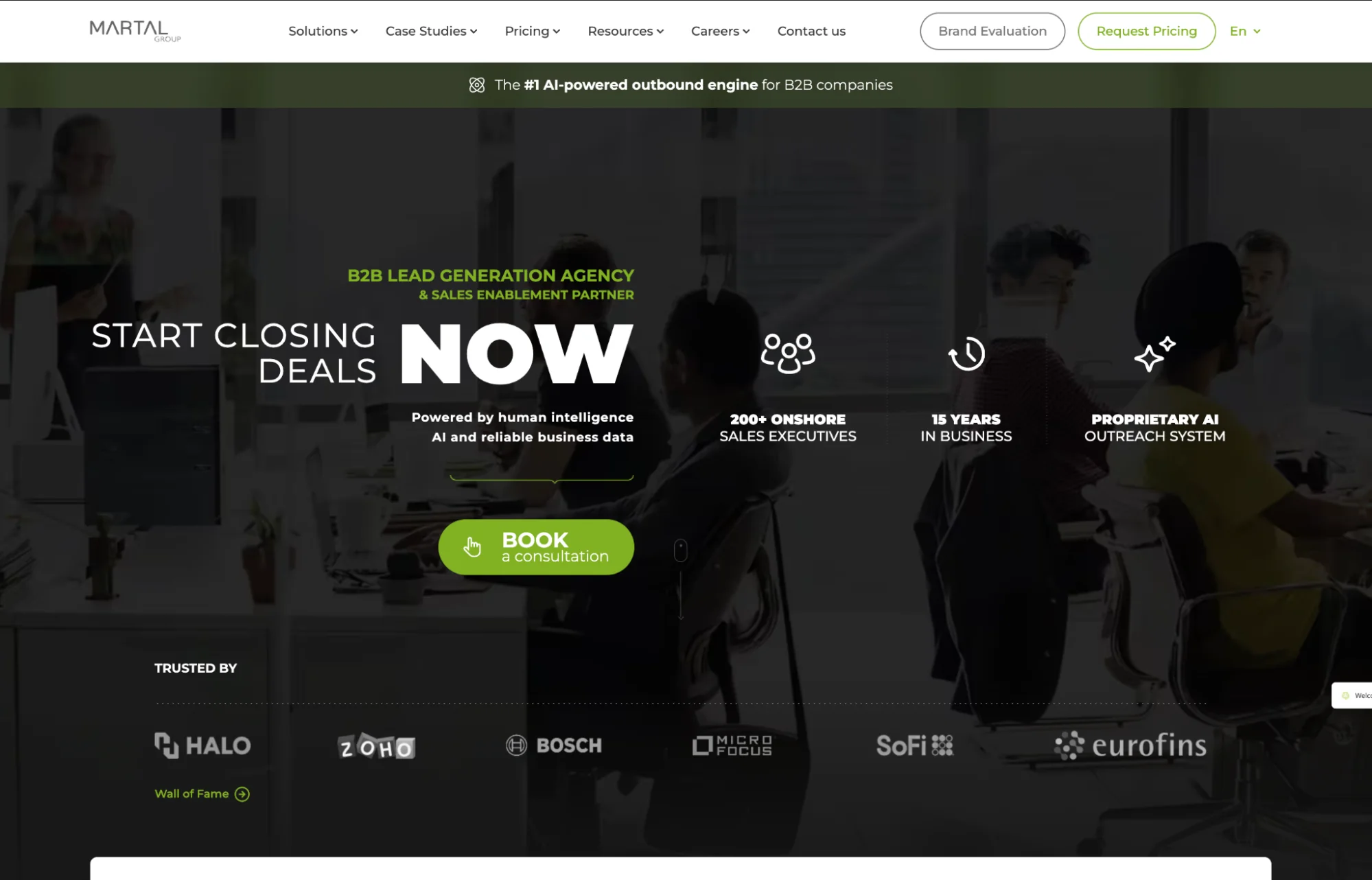
What they do well. Embed an outsourced sales arm, including fractional execs, SDRs, and operations support, into mid-sized B2B tech companies.
Martal is one of the larger, more established names in B2B outbound and appointment-setting. They are based in Oakville, Ontario, and they have built the playbook around plugging an entire sales function into a company that does not want to staff one in-house.
The offering is broader than most. Outbound and inbound lead generation, full-cycle or partial sales outsourcing, account-based marketing, email, cold calling, LinkedIn outreach, and embedded fractional execs all fall inside the same engagement. Weekly reporting and phased campaigns keep the work organized.
Martal works best for mid-sized B2B tech companies that want a sales function without the headcount cost. The trade-off is the level of dependency it creates. The fractional execs, the specialists, and the workflows are all on Martal's side of the wall, and the day the contract ends, the function ends with them.
3. memoryBlue
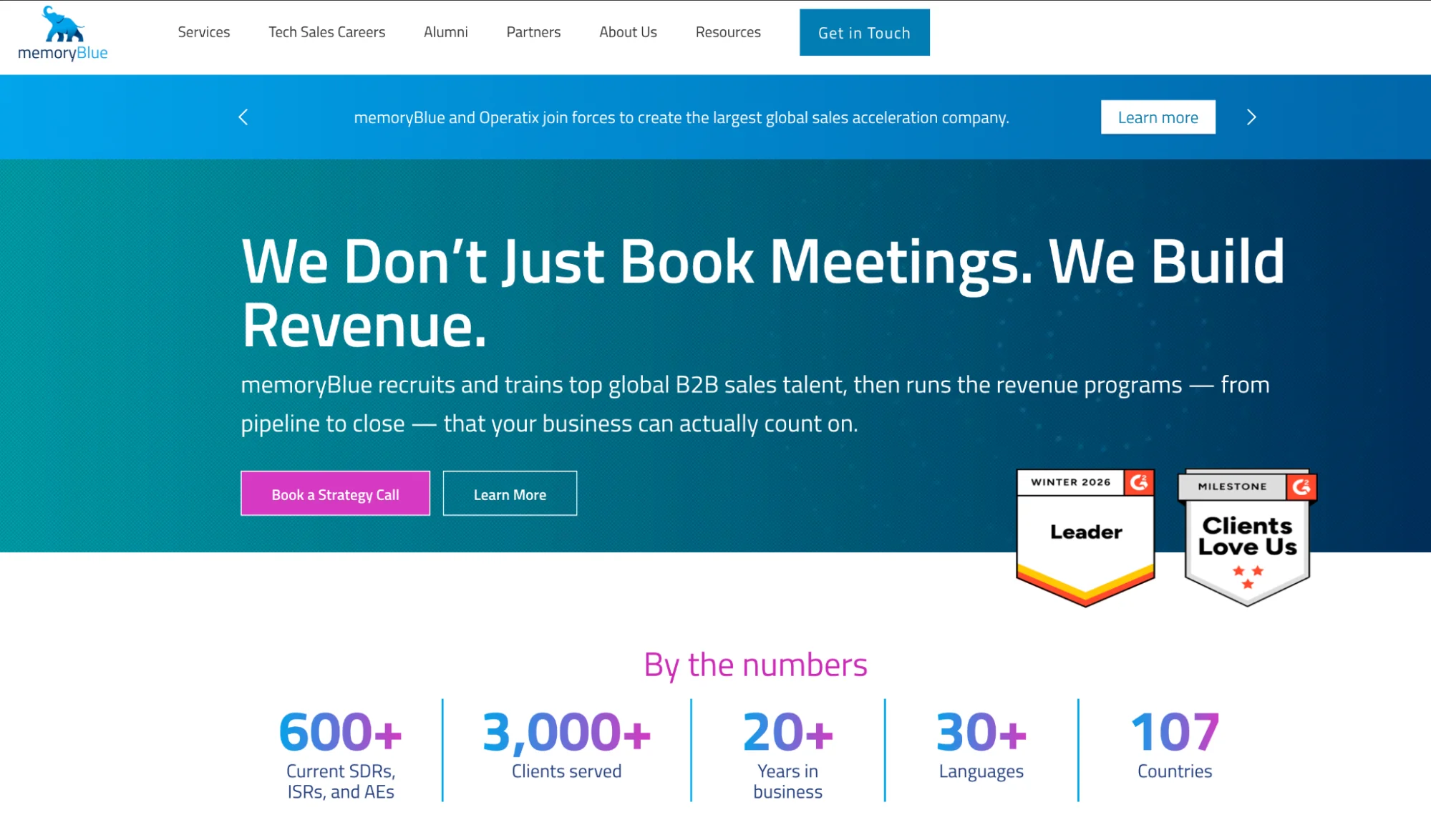
What they do well:Pair outbound execution with structured training that lifts your in-house SDRs at the same time.
memoryBlue has been active for 20+ years, mostly with tech and public sector clients, and the way they organize the work centers on processes, people, and performance rather than raw outreach volume.
If you want an agency that books meetings for you and also helps upskill your internal SDRs, tighten your messaging, and give your sales operation structure, memoryBlue lands closer to that model than most.
The engagement options are flexible too, including fixed fee, hybrid, and performance-based arrangements.
Where memoryBlue fits less neatly is if your real problem is data and tooling rather than people.
They are strong on the human-development side of outbound. They are not the firm to call if you want a partner to build the underlying data and workflow infrastructure your team will operate themselves later.
4. Pearl Lemon Leads
What they do well: Deliver high-volume, multi-channel outreach with a heavy emphasis on testing and creative copy.
Pearl Lemon works out of London and New York, with a global delivery footprint. The strength of the offering is breadth across cold email, LinkedIn, and cold calling, paired with creative copywriting and a fast cadence of testing and optimization.
They also offer inbound capture work, including chatbots and on-site messaging that catches leads who would otherwise drop off. If you want an agency that tries a lot of experiments, tries multiple channels at once, and moves quickly, Pearl Lemon fits that profile.
The honest limit is the same one most retainer agencies hit. The experiments and the workflows live on Pearl Lemon's side. You see the output, you see the optimization, but you do not walk away with the underlying setup. If retention of the system matters more than volume of activity, that is a constraint to weigh.
5. SalesRoads
What they do well: High-touch phone outreach to decision-makers, with conversation guarantees that put their money where the playbook is.
SalesRoads is a phone-first outbound shop. The SDR team is trained for voice work, and the offering puts cold calling at the center rather than treating it as the third channel after email and LinkedIn. They back the engagement with conversation guarantees, which is a stronger commitment than most agencies are willing to make.
If your sales motion depends on getting decision-makers into a real conversation, especially in complex B2B verticals where calls convert better than digital touches, SalesRoads is a solid pick.
The trade-off shows up in the same place as the rest of this list. The SDR team, the call scripts, and the calling infrastructure are SalesRoads' assets.
You are renting the conversation, not building the calling motion as something your team can keep. For businesses where the conversation is the whole product, that may be exactly what you want.
6. WebFX
What they do well: Pair outbound lead generation with content, SEO, and paid media inside one full-service marketing engagement.
WebFX is closer to a full-stack digital marketing partner than a pure lead generation shop. The offering covers outreach, content, SEO, paid ads, and conversion optimization, all under one roof and one weekly reporting rhythm.
The case for WebFX is continuity. If your buyers do meaningful research before they ever fill out a form, and your trust signals (case studies, whitepapers, technical content) carry as much weight as the cold message, it makes sense to have one partner covering the upstream and the downstream of the funnel rather than three.
The trade-off is depth versus breadth. WebFX is broad. They cover a lot of ground, but most of the work happens inside their delivery engine, not yours.
If you want a partner who specializes in building the data and automation infrastructure your team will own, WebFX is not built around that thesis. They are built around being the one-stop shop that delivers the whole motion for you.
7. Callbox
What they do well: Deliver multilingual, multi-region outbound across industries with the operational maturity that comes from working the same playbook for over twenty years.
Callbox is the traditional shop that earned its reputation. The teams know how to push outreach across different geographies and verticals, and the channel mix covers phone, cold email, and LinkedIn at a scale that mid-market shops have a hard time matching internally.
If your sales motion needs coverage across regions you do not have language or local knowledge in, and if scaling consistent outreach matters more to you than building the system in-house, Callbox is one of the few agencies built for that profile at scale.
The same trade-off applies as elsewhere. Callbox's strength is consistency at scale, but the operational layer stays on their side.
If you want the multilingual outreach motion to eventually live in your stack, that is a different kind of build, and Callbox is not the partner who will hand it over to you.
8. Nerdy Joe
What they do well: Deliver performance-based or pay-per-meeting cold email campaigns with transparent unit economics, anchored on careful deliverability work.
Nerdy Joe is a smaller, more boutique shop based in Miami with some Toronto presence. Cold email is the core of the offering, and the pricing is set up so you can see your real cost per meeting in a way most agencies do not show you.
The reason the unit economics work is that Nerdy Joe takes deliverability seriously. The infrastructure layer covers inbox warm-ups, domain and DNS setup, deliverability monitoring, list quality, and message tailoring before any sending starts. That is the work that separates cold email that lands from cold email that ends up flagged.
The trade-off is scope. Nerdy Joe is a cold email specialist, not a full-stack growth partner. If your real problem is multichannel orchestration, inbound capture, RevOps tooling, or a layered system you can keep operating yourself, Nerdy Joe will not be that.
They will be excellent at what they do and stay in their lane, which is the right move for a boutique. It is just worth knowing where the lane ends.
9. Cleverly
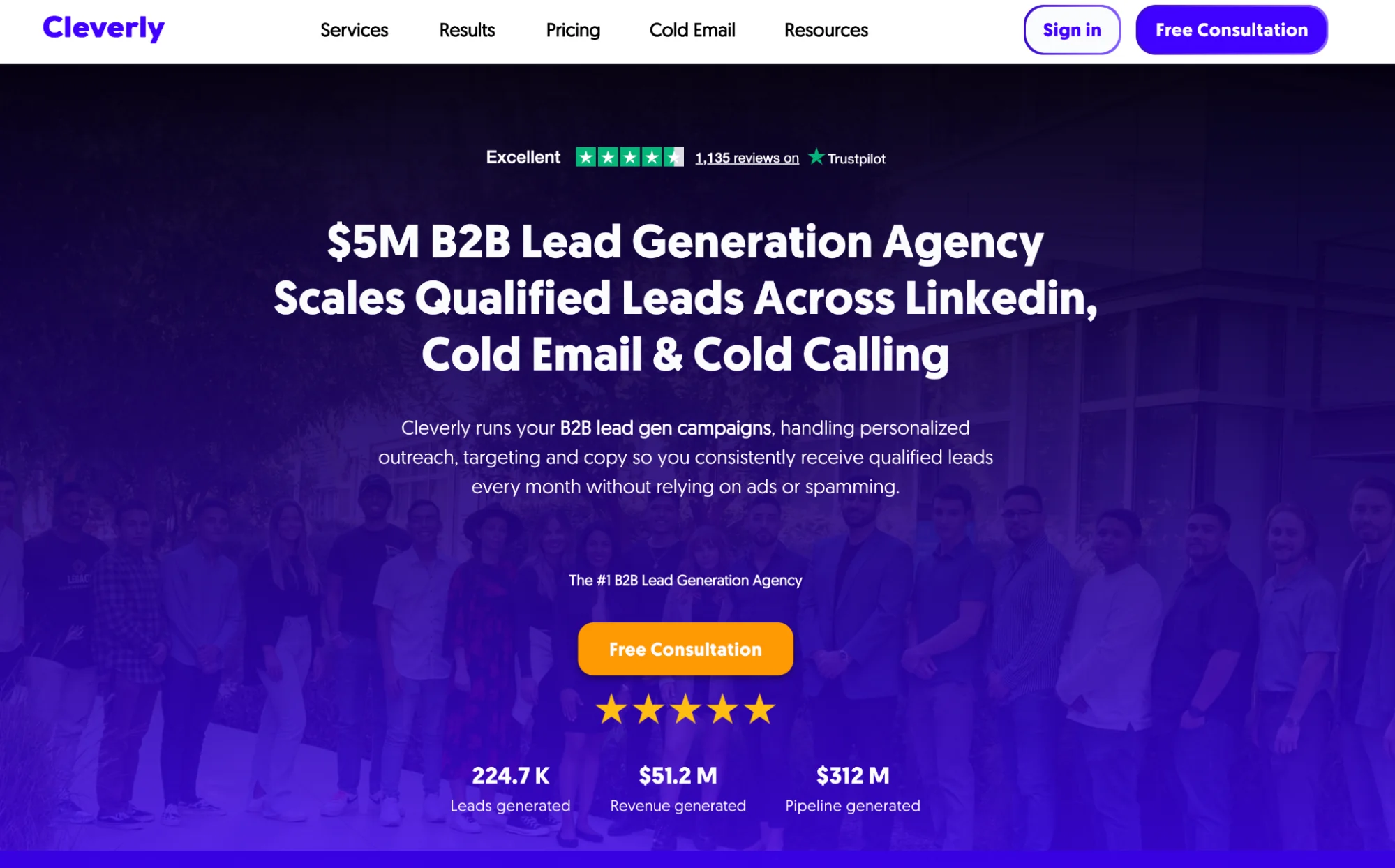
What they do well: Deliver done-for-you LinkedIn outreach campaigns at scale, with adjacent services around profile optimization and content.
Cleverly is the LinkedIn shop. The offering centers almost entirely on LinkedIn-based lead generation, including message writing, prospect list building, outreach, follow-ups, and meeting handoff.
They repeat these campaigns for many clients in parallel, and the playbook is well-tuned for the channel.
They also handle profile optimization, content strategy work, and white-label arrangements for agencies that want to resell LinkedIn outreach without building it themselves.
The right fit for Cleverly is the company whose buyers actually live on LinkedIn and where the LinkedIn channel can carry meaningful pipeline by itself. The trade-off is concentration.
If LinkedIn is the only channel you use, you are exposed to whatever LinkedIn's policies decide to be next quarter. Pairing the channel with email, phone, and inbound usually outperforms LinkedIn alone, and that is not the engagement Cleverly is built for.
10. DMT Business Development
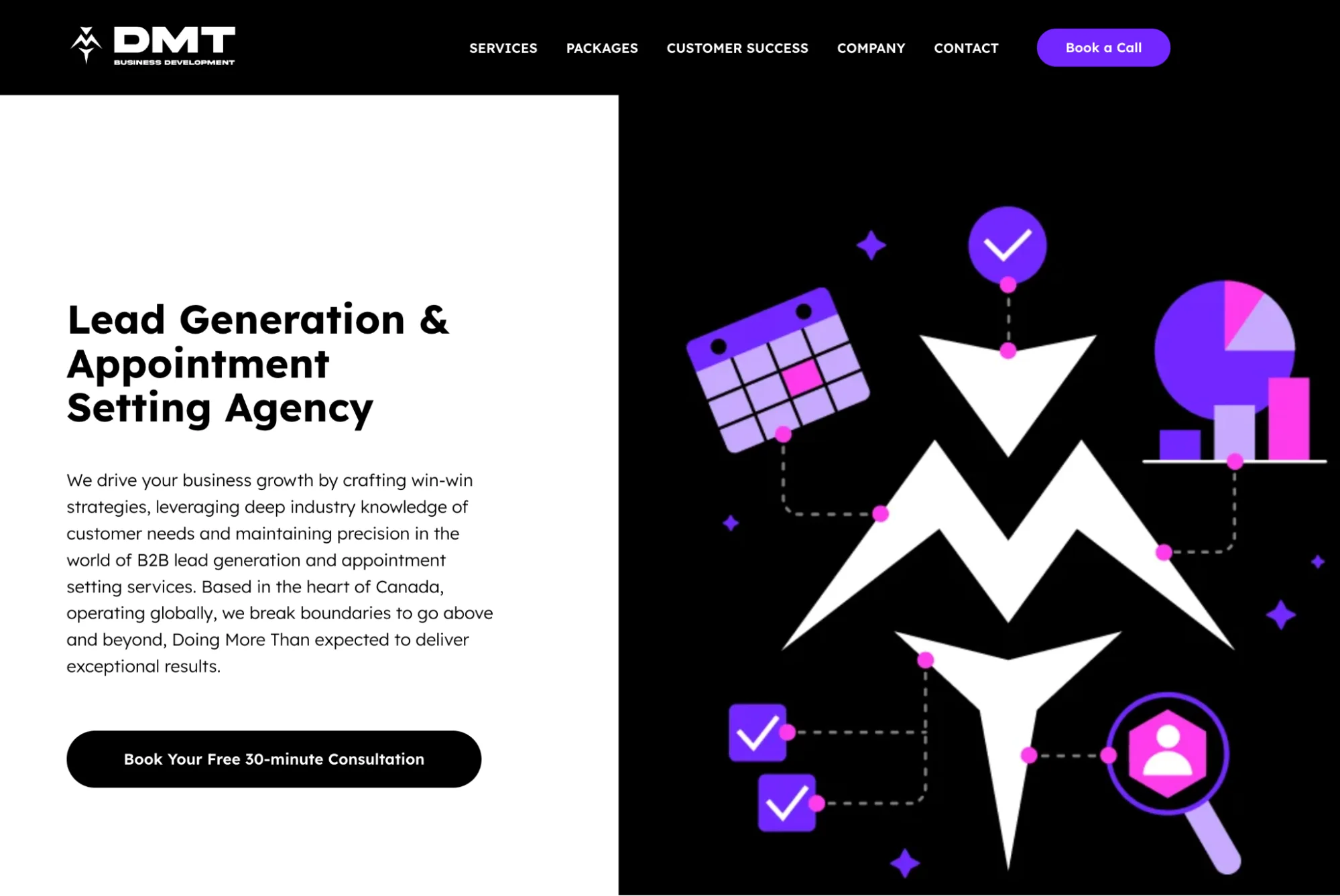
What they do well: End-to-end outbound and inbound appointment-setting for businesses with longer, more technical sales cycles.
DMT works across both outbound and inbound, with a particular strength in environments where the sales cycle has multiple stakeholders, longer decision windows, and technical evaluation steps in the middle.
They handle email, phone, and the qualification work on inbound activity that comes in alongside.
If your buying cycle is six to nine months and the conversation has to bridge an evaluator and an executive sponsor before the deal moves, DMT is built for that shape of sale.
As with every other entry on this list, the limit shows up at the handover. DMT delivers the appointment-setting motion well, but the motion lives inside their workflow, not yours.
For a complex sales cycle that you want your in-house team to eventually own, that limit matters more than it does for shorter, lighter motions.
Work with Nebor, the Belkins.io alternative built around ownership
Hopefully, this roundup helps you see who else is out there, and the kinds of trade-offs each model carries.
Some agencies are fast but generic, some are deep but slow, and some specialize in a single channel and stay there.
None of those positions is universally right or wrong, and the pick depends on where your business is in its sales-motion build.
Belkins is a well-known name for a real reason. The brand and the playbook are solid. The trade-off, the one most businesses end up feeling, is dependency.
You sign on, the pipeline appears, and at some point you realize the system that delivered it lives on someone else's billing.
Alternatives like us matter because the rental model is not the only option, even if it is the most marketed one.
The right alternative for your business is rarely another, cheaper Belkins. What works structurally is a different kind of engagement, where the system you pay to build is the system you walk away with.
As you evaluate the options on this list, four questions are worth keeping in mind.
Do you want to own the system after the engagement ends? You should be able to log into your data, edit your workflows, and keep the pipeline going without re-hiring anyone.
Do you need automation tied to actual buying signals? Systems that respond to real-time signals beat static campaign lists. The agencies that cannot show you their signal-to-meeting conversion are selling the latter.
Do you want transparency into the inner workings? Knowing what is working, what is converting, and why should not be a quarterly conversation. It should be a daily dashboard your team opens.
Do you want flexibility on what to test next? You should be able to swap channels, adjust targeting, and test strategy without rebuilding the foundation each time.
If those four questions describe what you are looking for, Nebor is purpose-built for that. We do quite a bit more than book meetings.
We take a structured look at your entire sales and marketing function, build the GTM flywheel inside your own stack, train your team to operate it. The pipeline you generate does not stop the day we stop, because the system was always yours.
Note: Belkins books meetings well, but the engine behind them stays with Belkins.
That is how the retainer model works. The lists, the sequences and the routing logic live in their accounts, so the pipeline stops the month you do.
At Nebor, we are a GTM engineering and RevOps agency. We build the same prospecting and outbound engine inside your own Clay and CRM accounts, then document it and train your team on it.
A year from now you are either still paying a retainer or you own the thing that produces your meetings.
Book a 15-minute call and we'll show you what owning it would look like for your business.


Related Articles
By clicking Sign Up you're confirming that you agree with our Terms and Conditions.