
10 Best Martal Group Alternatives For B2B Lead Generation And Appointment Setting

In this post:
In this post, we will walk through the best Martal Group alternatives and what you’re truly buying when you outsource lead generation. Different agency models, different outcomes, and what each one means six months in.
You’re on this page for one of three reasons.
You're already working with Martal, results aren't matching what you expected, and meetings keep coming through with inconsistent quality.
Or you got a proposal and before signing a six-figure annual contract you want to see what else is out there.
Or you've never heard of Martal, you're researching lead generation agencies, found them in your search, and now you're working through the comparison set.
Whichever bucket you're in, we think you're asking the wrong question.
Most people approach this by asking which agency will book them the most meetings. The better question is what your business actually needs from a lead generation partner.
Everyone calls themselves a lead generation agency, but underneath the label they're selling completely different things.
When you put Martal Group alternatives next to each other you're not comparing apples to apples. You're comparing different business models with different incentives, and they leave you in different places six months from now.
Here's a quick read on what you're actually buying.
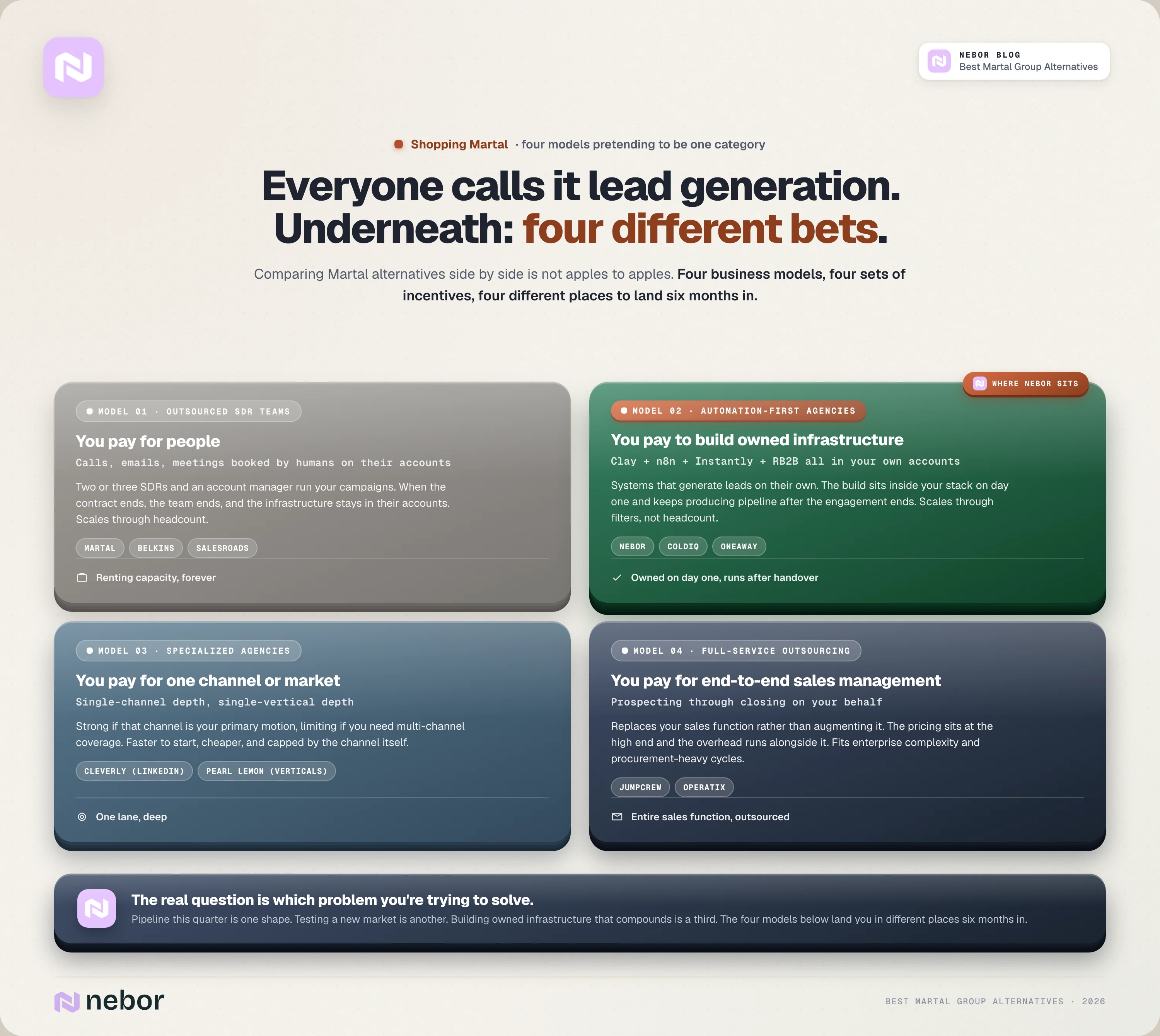
Outsourced SDR teams (Martal, Belkins, SalesRoads): You pay for people to make calls, send emails, and book meetings. When the contract ends, the team ends with it. You get meetings while the infrastructure stays in their accounts.
Automation-first agencies (Nebor, ColdIQ, OneAway): You pay to build systems that generate leads on their own. The focus is owned infrastructure that keeps working after onboarding or the engagement with the agency ends.
Specialized agencies (Cleverly for LinkedIn, Pearl Lemon for specific verticals): You pay for expertise in one channel or one market. Strong if that channel is your primary motion, limiting if you need multi-channel coverage.
Full-service sales outsourcing (JumpCrew, Operatix): You pay for end-to-end sales management, with the agency handling prospecting through closing on your behalf. The pricing is at the high end and the overhead comes with it.
So the real question is which problem you're actually trying to solve here.
If you need pipeline because you're 40% behind quota this quarter, you need a team that can start booking meetings in two weeks. Most agencies will promise they can, and almost none of them will deliver real results in that window.
If you need to test a new market before committing resources, you need an agency with month-to-month terms and a fast ramp-up. Probably one with an AI SDR like Martal has, or one with a bench of seasoned SDRs you can spin up.
If you want to build a scalable system that generates leads on autopilot, you need automation infrastructure sending personalized outreach across multiple workflows.
That’s the kind of build we keep ending up doing for B2B teams who are done with the rental model.
We’re for companies ready to stop renting lead generation services and start owning multi-channel outreach systems that cover both inbound and outbound motion.
Our clients come to us when they realize they don't want to pay monthly fees forever for results that disappear the moment the contract ends. They want to own the entire lead generation funnel.
When we're done, the deliverable is the system itself. It handles your prospecting and top-of-funnel work without you having to keep paying someone to refill the meeting calendar every month.
We put this list together because we believe you should understand your options. Some of the agencies on it compete with us directly. Others take completely different approaches like the old SDR-as-a-service playbook.
Let’s get into it.
Note: Dymaxa, ExpoGenie and My Way all generate their pipeline from systems we built and they own.
Different markets, different motions, same shape: the sourcing, the enrichment, the outreach and the CRM working together, in their accounts, with no agency in the middle.
At Nebor, we are a GTM engineering and RevOps agency, and that is the whole of what we do.
Book a 15-minute call and we'll show you the builds.
TL,DR
The lead generation looks like one category from the outside. Up close, you are choosing between two completely different bets on what your sales engine will look like a year from now.
Most of this list, including big names like Martal, is in the business of selling you sales activity. Reps making calls, sequences going out, meetings booked, invoice cleared every month. Useful for some teams.
The thing nobody tells you on the sales call is that the activity is all you actually own. The infrastructure underneath it, the data sources, the targeting logic, the playbooks, the routing rules, the messaging library, all of it lives on the agency’s side of the wall and walks home with them.
We took the opposite position when we started Nebor. For the same investment you would put into a few months of someone else sending campaigns for you, you get a revenue engine.
We build around how your sales team actually works in practice, living inside your own accounts, designed by sales operators who carried a bag long before they ever automated anything.
The way we work shows up everywhere in the engagement. Your reps stop spending half their week on research and start spending it on conversations. Your marketing team stops watching warm leads disappear into a logfile. Your founder stops being the only person who knows where pipeline actually came from and much more.
The structural difference is the part most teams feel six months in. Renting capacity scales by hiring more people. Owning infrastructure scales by widening the filter. New markets clone the workflow instead of onboarding a new team.
The cost per qualified meeting compounds down instead of going up. And the day the engagement ends, the engine keeps going because it was always yours.
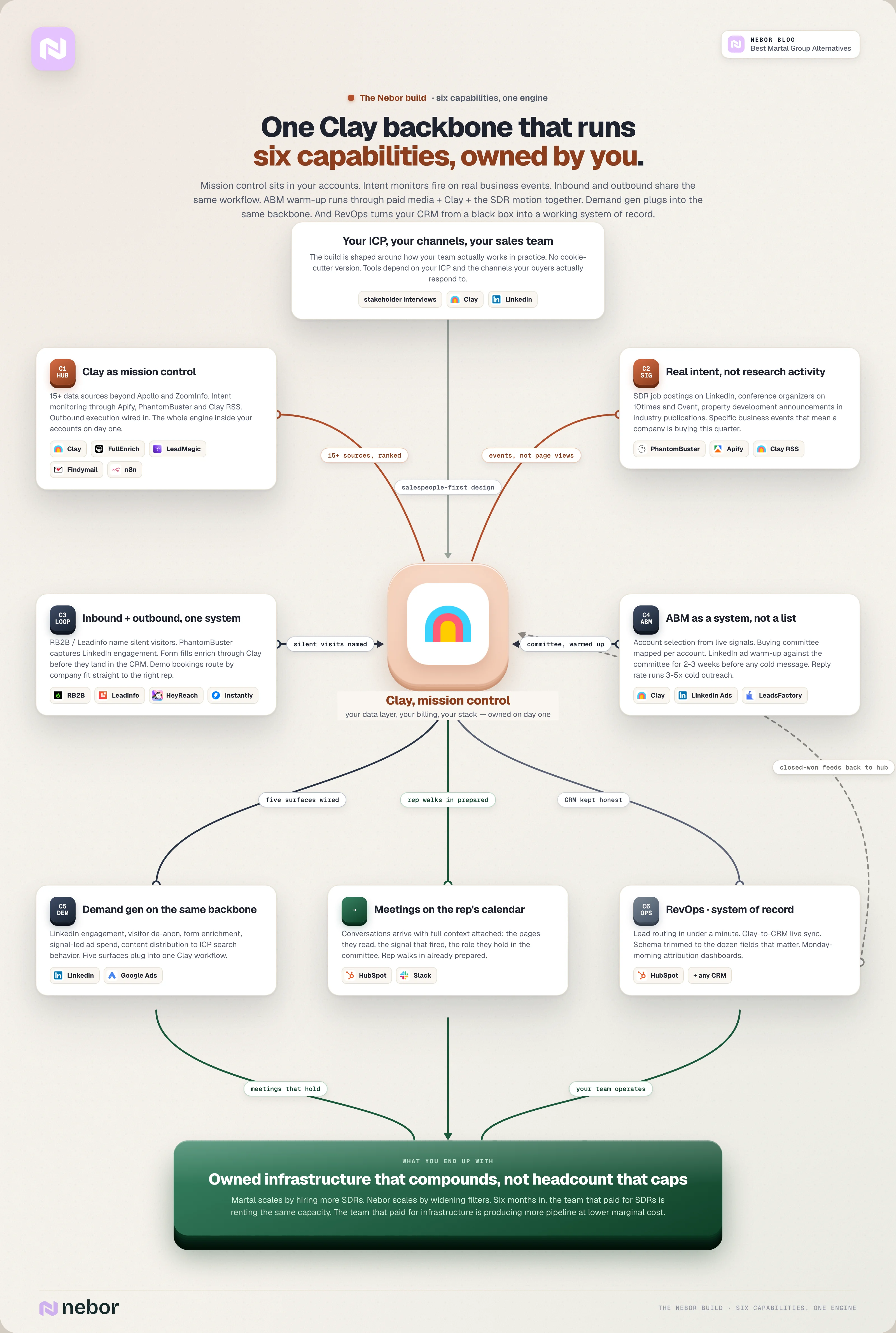
Here is what the build looks like end to end:
Why Nebor is the best Martal Group alternative for B2B lead generation and pipeline building
The main difference between us and Martal Group isn’t complicated.
Martal gives you people who send campaigns to bring you leads, using a mix of proprietary and third-party tools.
We build you systems that send those campaigns on their own and make your internal team faster and more efficient while also generating business opportunities (or leads if you prefer) at scale.
Both approaches end up at lead generation, but the shape of what you're left with six months later is what changes, and that's what the rest of this post is about.
Why the Martal Group model becomes a problem for teams that want to scale
Most agencies in this category follow the same playbook. They hire SDRs or junior marketers, train them on your product, build a handful of email sequences, and start reaching out. Meetings get booked, and you pay monthly for the activities that produce them.
Martal isn't any different, and the SDR-as-a-service shape of the offering has been around long enough to feel like a default.
We've seen it signal a few specific red flags when teams are evaluating new agencies, and the AI-assisted version pitched as Martal AI SDR is the same model with an automation layer on top.
In a typical engagement Martal Group assigns you SDRs, usually two or three reps supported by an account manager.
These people make calls, send emails, reach out on LinkedIn, and book meetings, and they're good at it because they're following proven playbooks and hitting their activity metrics.
The results, though, come out of human effort.
More meetings means more SDR time. New markets mean new SDRs and a new ramp curve, and every new campaign means more coordination calls and more handoff overhead.
Everything in this model scales through people, which is fine until your results stall the month one of them is having a bad stretch.
The deeper issue is that the infrastructure generating your leads isn't yours. The moment you stop paying, you're back to where you started. Whatever they built lives in their systems and belongs to them.
If you want to pause for budget reasons, everything stops with you. If you want to scale, you pay for more headcount on their side.
That works as an arrangement if external capacity is all you need and you're comfortable renting it forever, which is a decision a lot of teams reconsider once they look at the in-house alternative.
Most of the teams we talk to don't end up there, and the reason is the tooling.
Modern data and AI-assisted workflows have changed what's possible at the top of the funnel.
The pieces that used to require an SDR at a screen doing manual research and writing one-off messages can now happen inside a system, as long as the right humans designed the workflow in the first place.
That doesn't mean SDRs disappear. It does move their work into closing motions and out of the manual research that machines handle faster than people can.
The traditional human-only outbound model leaves money on the table because it caps your pipeline at how many SDRs you can pay for this month.
Teams built on modern infrastructure don't have that ceiling, and the gap between the two models keeps widening every quarter.
How we build your lead generation engine on Clay, automation, and real intent signals
We build your lead generation as an automated system, not as a managed service built on borrowed salespeople.
The team behind it isn't just a group of engineers stitching tools together. We're sales-and-marketing operators who ran the same manual prospecting work you'll get from services like Martal long before we ever automated it.
That background is the reason every workflow we build is shaped around bringing you leads without dropping quality, and around making your internal team faster at the work that still needs a human.
Before the breakdown, one thing to flag. There's no cookie-cutter version of this build, and the tools we put together depend on your ICP, your channels, and the way your sales team actually works in practice.
Clay is the center. It's where we map your entire market, enrich every prospect, monitor intent signals, and orchestrate outreach.
Think of it as mission control for your revenue engine, and the reason most Clay implementations succeed or fail comes down to how that center gets designed in the first month.
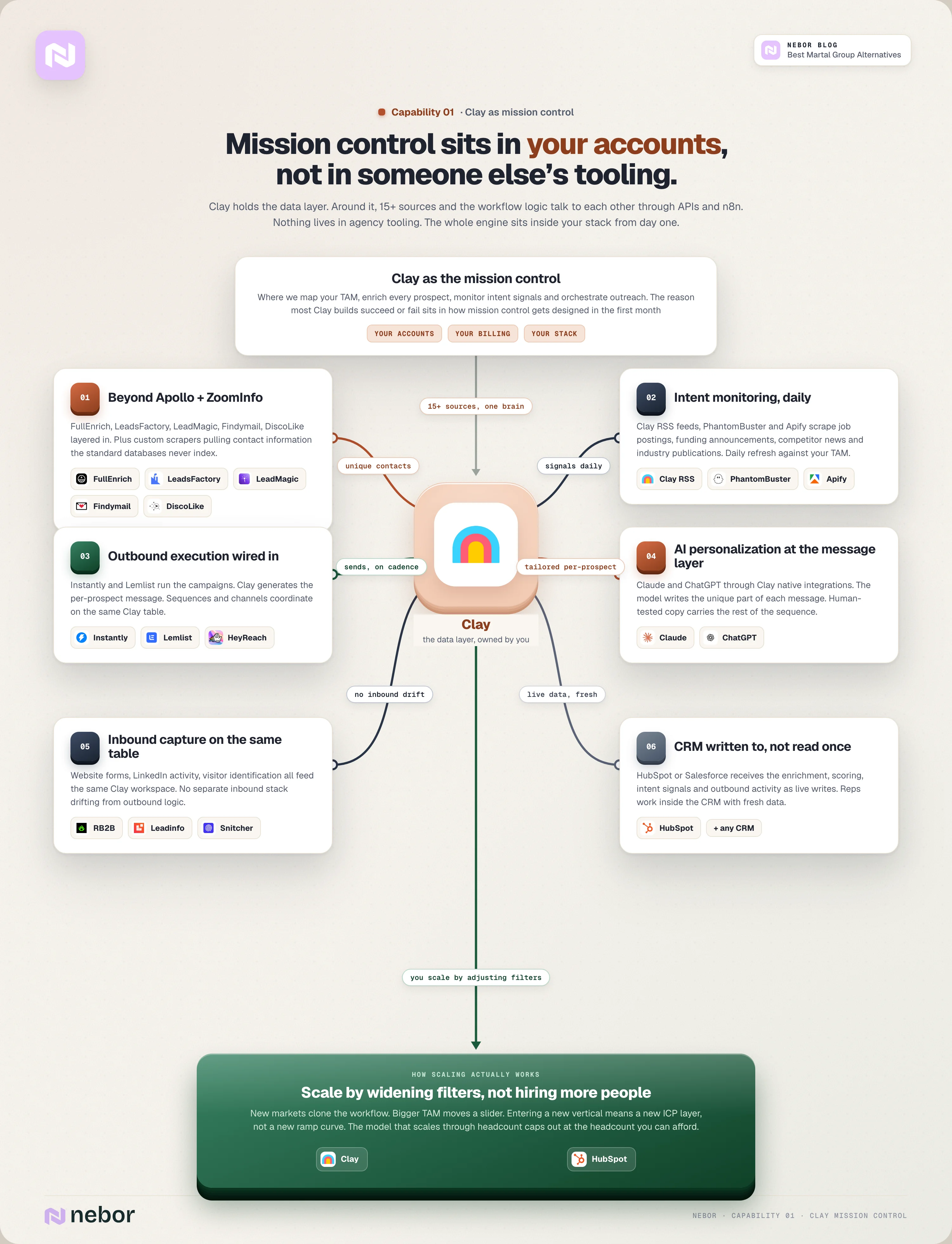
Everything else connects through APIs or n8n. Your website forms, your LinkedIn activity, your outbound email campaigns in Instantly or Lemlist, your AI-personalized messaging from Claude and ChatGPT, your CRM, all of it talks to each other on its own.
We layer in 15-plus data sources beyond Apollo and ZoomInfo, including FullEnrich, LeadsFactory, LeadMagic, Findymail, DiscoLike, and several custom scrapers that pull contact information you won't find in the standard databases.
Intent monitoring works alongside that, with Clay's RSS feeds, PhantomBuster, and Apify scraping job postings, funding announcements, competitor news, industry publications, and any other signal that tells you your ICP needs your solution this quarter.
We build the entire lead generation engine inside your own accounts. Clay, n8n, Instantly, PhantomBuster, and ten-plus other tools all live in your stack, connected and automated and owned by you.
Our team sets it up, optimizes it, and can manage it on an ongoing basis if you want, but the infrastructure belongs to you on day one.
Results come from automation that works around the clock. Scaling up is a matter of adjusting filters and widening TAM coverage rather than hiring more people, and entering a new market means cloning workflows rather than onboarding a new team.
This setup works better for any company building toward a long-term outbound and inbound motion that compounds over time instead of resetting every renewal.
The intent data problem, and why most agencies get it wrong
Martal Group talks about using intent data to "detect keyword surges" and find companies looking for solutions. That sounds good until you look at the source of that data.
Most agencies pull intent feeds from ZoomInfo or Cognism. Bigger players like Martal build their own internal version of the same thing.
What those tools actually track is article views and IP visits. If someone from Company X visits a "sales automation" article five times, the system flags it as intent.
Buying intent is what those tools claim to deliver, but what they're really measuring is research activity, and that activity could just as easily be coming from an intern writing a blog post or a competitor doing a market sweep.
At Nebor we define intent data differently, as the business events that show a specific company is moving toward needing your solution this quarter.
A few examples from real client work.
For a client selling sales automation, we monitor LinkedIn for companies posting multiple SDR job openings. That's a clear signal they're struggling with pipeline, and it qualifies them for our client's solution faster than any database lookup would.
For a client in event tech, we scrape event directories like 10times and Cvent to find companies actively hosting conferences and lining up sponsors. What lands here is the time-bound nature of the signal, since they're holding an event in eight weeks and they need software for it before then.
For a client selling AI furnishing software, we track property development announcements across key industry publications.
The moment a new project lands in the news, we know that company will need furniture, the reach-out goes the same day, and the meeting lands while the buying decision is still open.
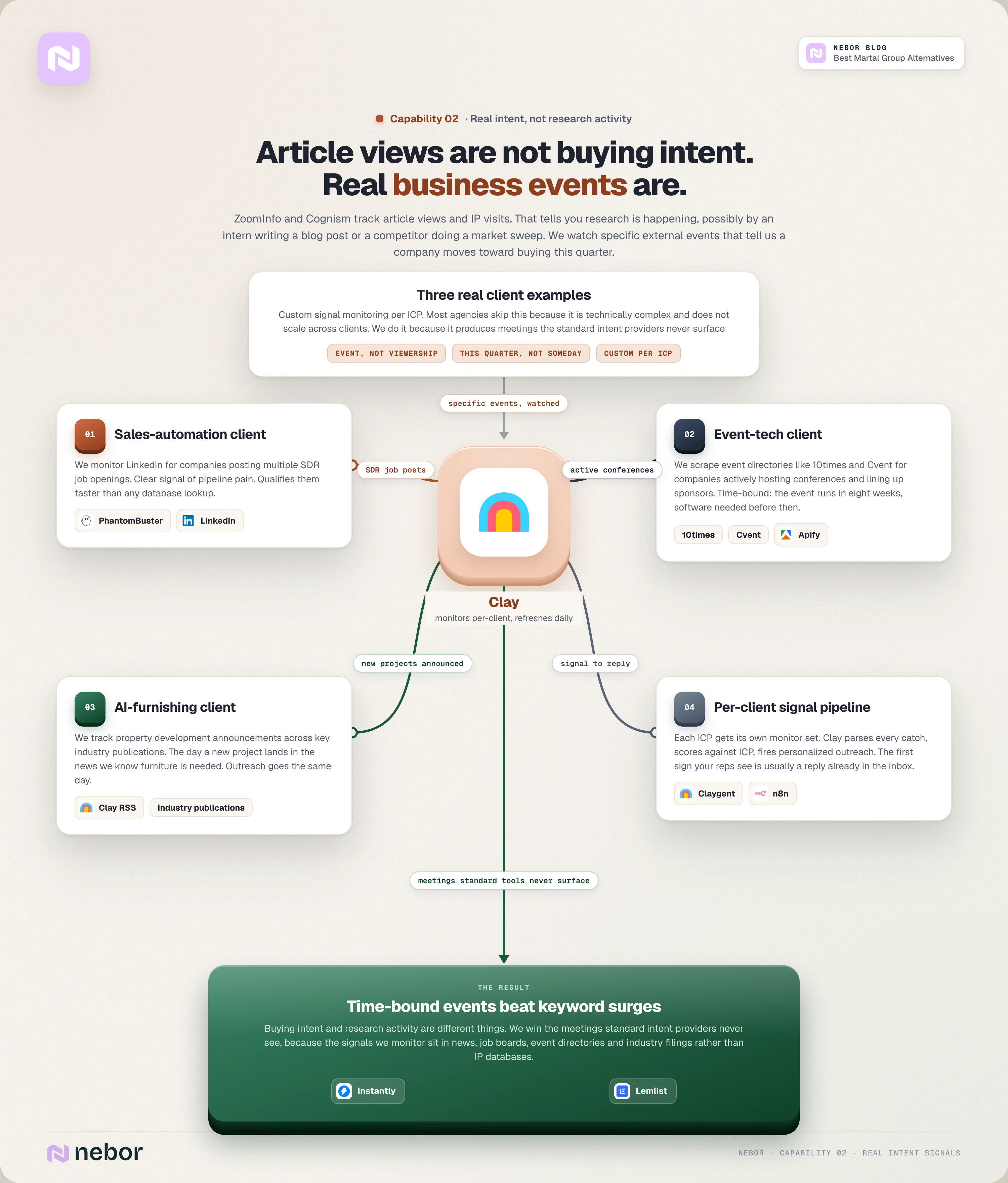
Signals like these don't appear in standard databases, and human-led outreach can't catch them in time even when the SDR is paying full attention to LinkedIn and the news.
You have to build custom monitoring for your specific ICP, and most sales services don't do this because it's technically complex and doesn't scale across clients. We do it because it produces meetings the standard intent providers will never surface.
Note: Dymaxa, ExpoGenie and My Way all generate their pipeline from systems we built and they own.
Different markets, different motions, same shape: the sourcing, the enrichment, the outreach and the CRM working together, in their accounts, with no agency in the middle.
At Nebor, we are a GTM engineering and RevOps agency, and that is the whole of what we do.
Book a 15-minute call and we'll show you the builds.
We connect your inbound and outbound into one system, so your sales reps stop qualifying their own pipeline
Most agencies only handle outbound or campaign automation.
Your inbound leads from website visitors, demo requests, ad campaigns, and LinkedIn engagement live somewhere else entirely, in a different tool with different rules. We treat that split as a structural problem in how the sales and marketing organization is set up.
Every warm lead from your website should flow through the same enrichment and qualification logic as your cold outreach. Anything else leaves you qualifying manually, responding slowly, and losing deals to whoever responded faster.
Here's the build.
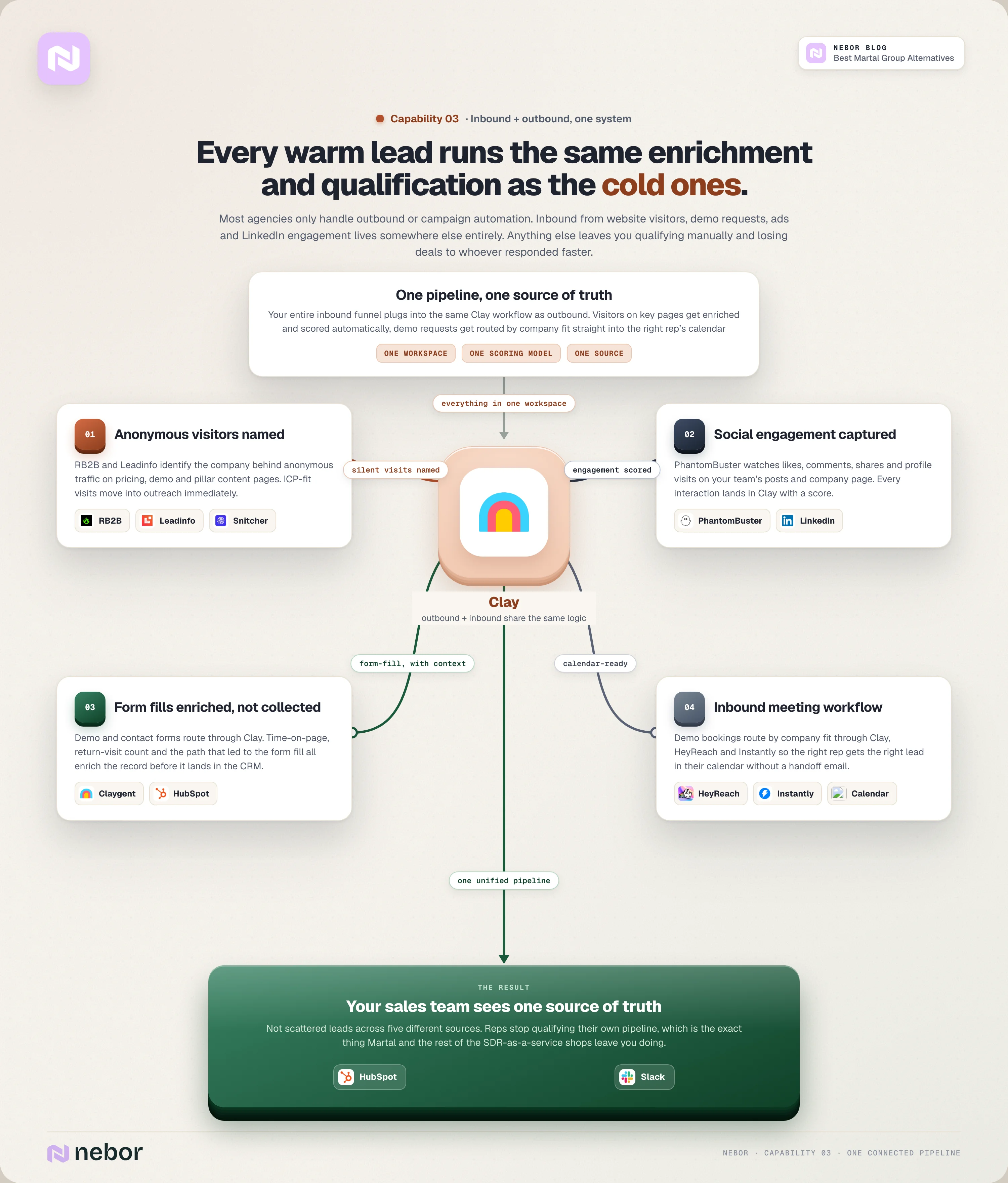
We plug your entire inbound funnel into the same Clay workflow behind your outbound, and visitors on key pages get enriched and scored automatically.
We bring PhantomBuster in to capture and qualify LinkedIn engagement on your team's posts and your company page.
Demo requests get routed by company fit, and we wire that into a proper inbound meeting workflow with, Clay, HeyReach, and Instantly so the right rep gets the right lead in their calendar without a handoff email.
When it is live, your sales team sees one unified pipeline and one source of truth, not scattered leads across five different sources.
What we've covered so far is the part Martal also sells in some form, and the comparison effectively stops there.
The next three capabilities are what Nebor builds alongside the outbound engine, and they're the parts you won't find packaged inside any SDR-as-a-service offering, including Martal.
You get ABM that works as a system beyond a simple list of accounts
Most agencies in this space treat ABM as a target list. They ask for your top 50 or top 200 accounts, drop them into a sequencer, and hand the work to an SDR.
That motion takes the same shape as a normal outbound campaign, just against a smaller account count, and labelling it ABM doesn't change what's actually happening underneath.
ABM starts upstream of the call. It starts with how the accounts get picked, how the buying committee inside each one gets mapped, and how those people get warmed up before anyone reaches out cold.
Martal doesn't sell that work, and we do.
The first piece is account selection that's tied to live signals rather than a static list pulled from ZoomInfo.
We map your TAM in Clay using your real ICP filters, then layer in the buying signals we covered in the intent data section above, things like funding announcements, hiring patterns, technology adoption, and leadership changes.
Accounts move in and out of the active list every week based on whether those signals land, and the TAM build itself lives inside Clay so you can edit it as your ICP sharpens without rebuilding the workflow from scratch.
The second piece is mapping the buying committee inside every active account.
Procurement, finance, the executive sponsor, the technical evaluator, the end user, all of them go into Clay against the company record.
We pull their LinkedIn profiles, their tenure, their previous companies, and anything else that helps us figure out who actually drives the buying decision and who blocks it.
The third piece is what most teams skip.
We push targeted LinkedIn ads at the buying committee before any outreach lands in their inbox. The committee sees your brand showing up in their feed for two or three weeks, the brand starts feeling familiar, and then the SDR or the founder reaches out cold.
The reply rate on that motion lands three to five times higher than cold outreach into the same accounts without the ad warm-up, and the reason is the obvious one. The committee already feels like they know the company by the time the message arrives.
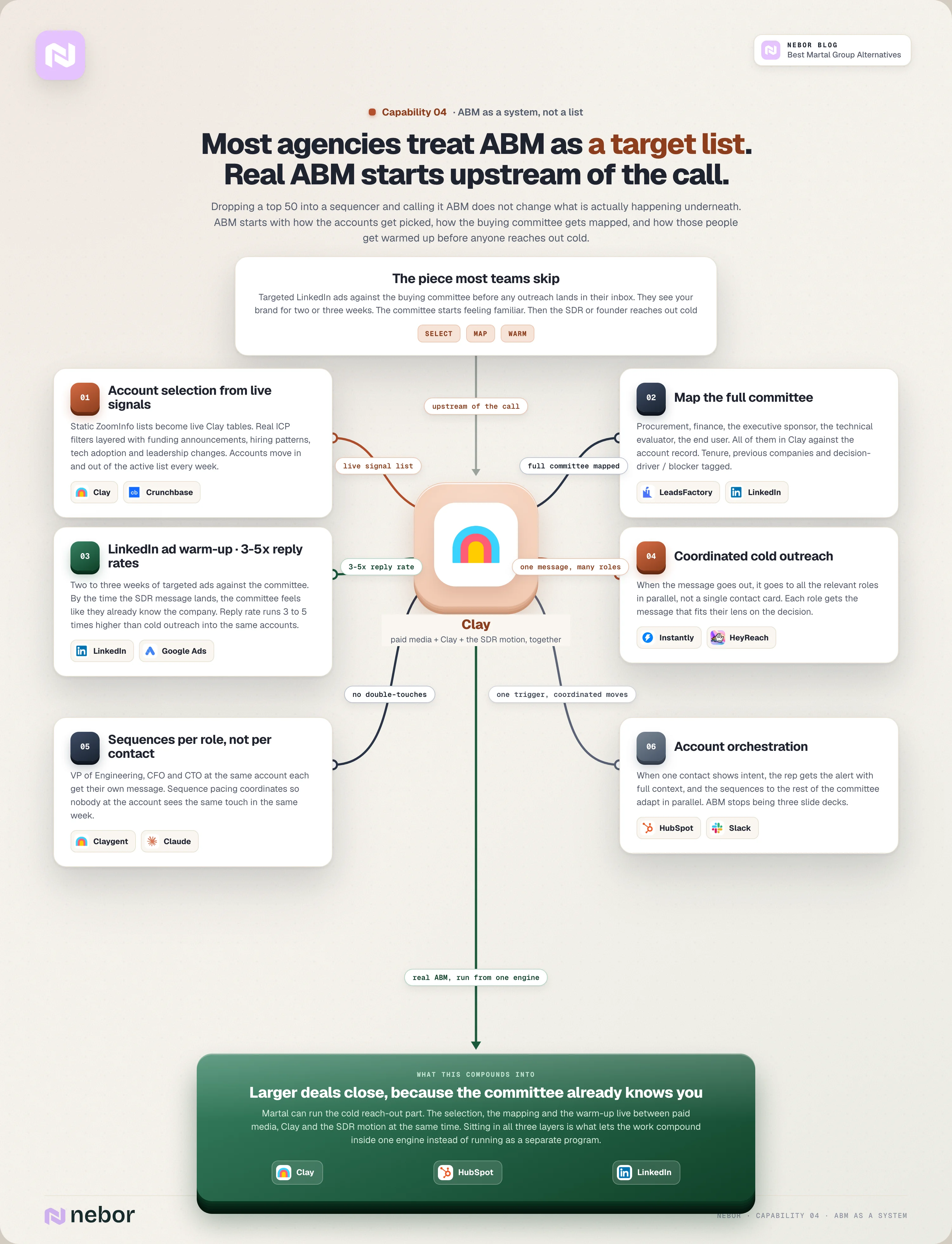
Martal can handle the cold reach-out part of all of this, but they can't handle the account selection or the committee warm-up, because the muscle for that lives between paid media, Clay, and the SDR motion at the same time.
We work in all three layers, which is why this compounds inside the same engine instead of living as a separate program.
Demand generation built into the same Clay backbone, so every signal feeds the pipeline
Demand gen has been treated as a separate function from outbound for a long time.
Marketing owns the LinkedIn ads, the SEO program, and the website, and sales owns the sequences and the calls. The handoff between them is a Salesforce field that nobody trusts.
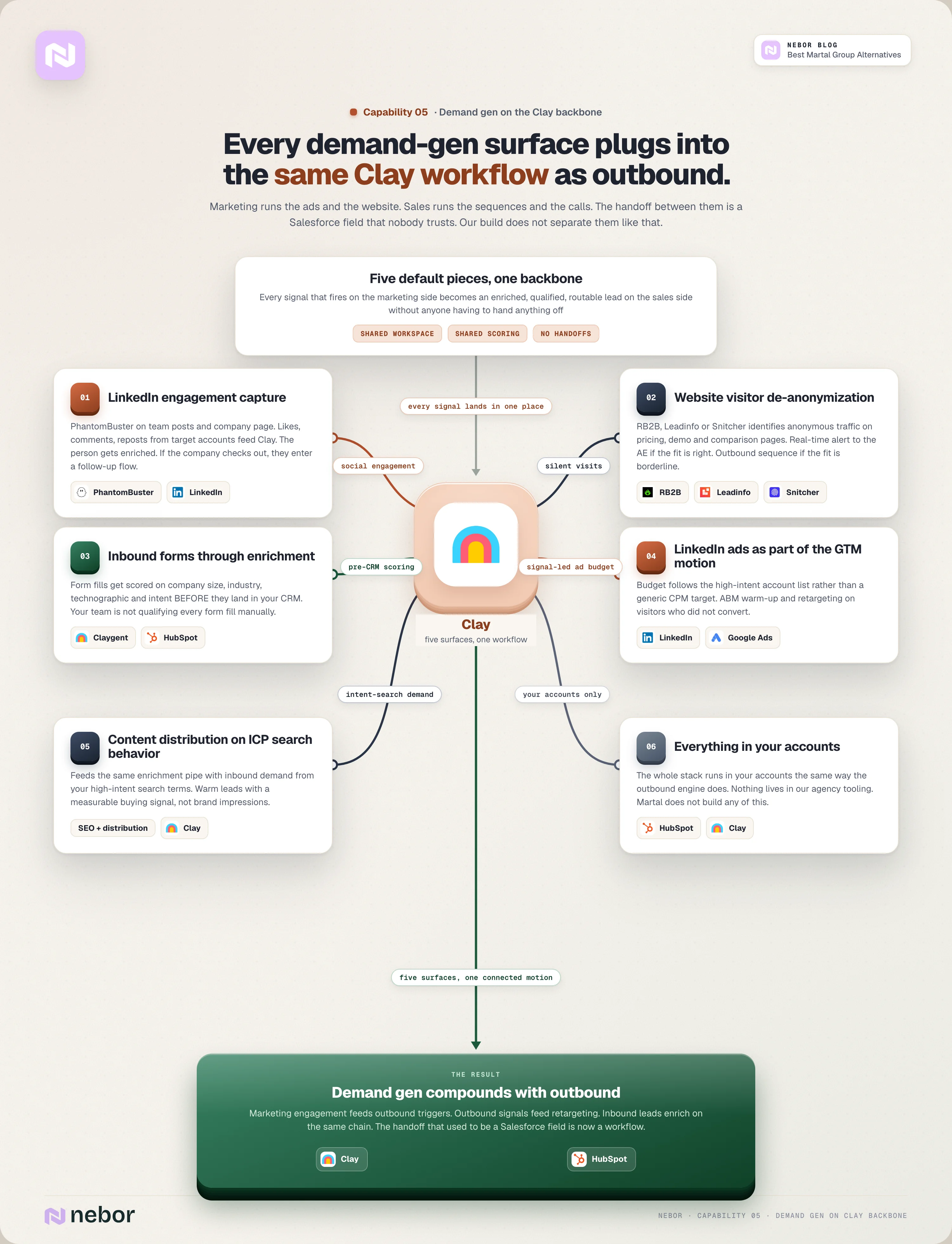
Our build doesn't separate them like that, and every demand gen surface we set up plugs into the same Clay workflow driving your outbound.
A signal that lands on the marketing side becomes an enriched, qualified, routable lead on the sales side without anyone having to hand anything off.
We wire in five pieces by default.
LinkedIn engagement capture from your team’s posts and your company page. When someone from a target account likes, comments on, or reposts content, we set up PhantomBuster to catch the engagement and push it to Clay, which enriches the person, and they enter a follow-up flow if the company fit checks out.
Website visitor de-anonymization with RB2B, Leadinfo, or Snitcher. Anonymous traffic on your high-intent pages (pricing, demo, comparison content) gets identified at the company level, enriched at the contact level, and routed into either an outbound sequence or a real-time alert to the AE depending on fit.
Inbound demo and contact form submissions piped through the same Clay enrichment pipe. Form fills get scored on company size, industry, technographic, and intent before they ever land in your CRM, which means your team isn't qualifying every form fill manually.
LinkedIn ad campaigns work as part of the GTM motion rather than as a brand exercise. We use them to warm the buying committee for ABM (covered above) and to retarget anonymous visitors who didn't convert the first time, with budget that follows the high-intent account list rather than a generic CPM target.
Content distribution support built around your ICP’s search behavior. The goal is to feed the same enrichment pipe with inbound demand from your high-intent search terms so your sales team gets warm leads with a measurable buying signal instead of the typical brand impressions.
The whole stack lives in your accounts, the same way the outbound engine does, with nothing living in our agency tooling.
Martal doesn't build any of this because none of it belongs inside the SDR-as-a-service playbook, and that's the structural difference we keep coming back to in this comparison.
RevOps to turn your CRM from a black box into the system of record that feeds the loop
Most B2B companies treat their CRM as a place where deals go to be reported on, and that's where the role ends.
Lead routing happens manually, attribution is half-broken, the data quality drifts every quarter, and nobody actually trusts what the dashboards say.
RevOps is the layer that makes the entire GTM motion compound, because every signal we capture in ABM, demand gen, inbound, and outbound has to land somewhere usable.
If the CRM is a black box, the loop leaks. If the CRM is a working system of record, the next outreach gets sharper, the next campaign performs more efficiently, and the next quarter's pipeline becomes something you can actually forecast against.
Here's the work we do at the RevOps layer.
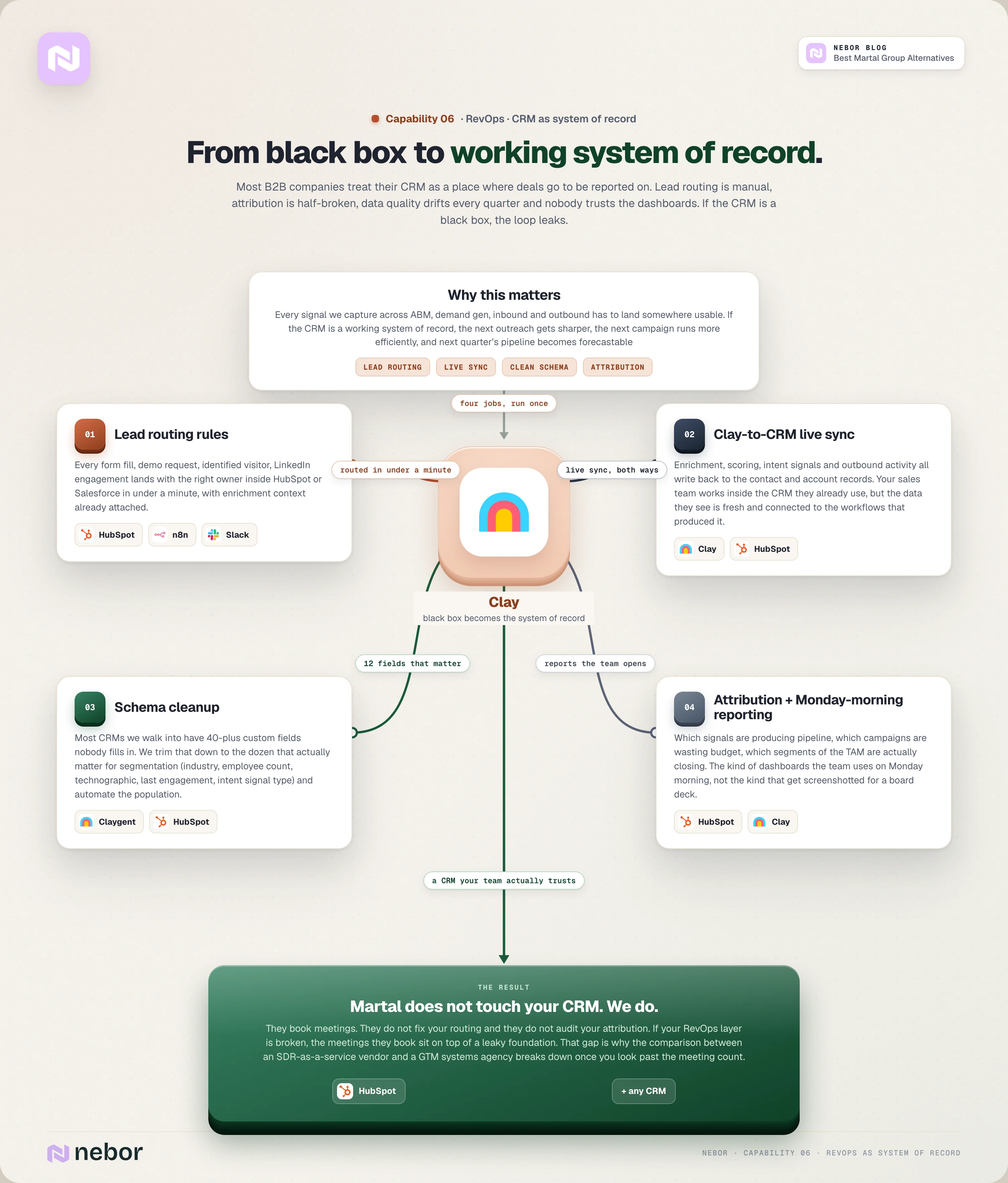
Lead routing rules
Every inbound (form fill, demo request, identified visitor, LinkedIn engagement) lands with the right owner inside HubSpot or Salesforce in under a minute, with the enrichment context already attached. No more leads waiting in a queue for an SDR to pick them up.
Clay-to-CRM sync
Everything that happens in Clay (enrichment, scoring, intent signals, outbound activity) writes back to the contact and account records in your CRM.
Your sales team works inside the CRM they already use, but the data they're looking at is fresh and connected to the workflows that produced it.
Contact and account schema cleanup
Most CRMs we walk into have 40-plus custom fields that nobody fills in. We trim that down to the dozen fields that actually matter for segmentation and targeting (industry, employee count, technographic, last engagement, intent signal type) and we automate the population so the data stays current.
Attribution and reporting
You see which signals are producing pipeline, which campaigns are wasting budget, and which segments of the TAM are actually closing.
The dashboards have to be the kind the team uses on Monday morning, not the kind that get screenshotted for a board deck and then forgotten about until the next one.
We can deliver this as a one-time architecture project or as an ongoing fractional RevOps engagement, depending on how much in-house capacity you have.
Either way the principle is the same as everywhere else in this build. The system lives in your stack, the team can operate it without us, and we're a phone call away when the next bottleneck shows up.
Martal Group books meetings.
They don't touch your CRM, they don't fix your routing, and they don't audit your attribution.
If your RevOps layer is broken, the meetings they book stand on a leaky foundation, and that's why the comparison between an SDR-as-a-service vendor and a GTM systems agency with a real RevOps practice breaks down once you look past the meeting count.
Top 10 Martal Group alternatives for B2B lead generation
If you’re looking for Martal Group alternatives, you have real options across two axes.
The first is the model the agency sells (outsourced SDR teams, automation-first builds, channel specialists, full-service outsourcing). The second is the segment they target (mid-market, enterprise, SaaS, services).
Here’s what actually differentiates the ten alternatives we work next to most often, and when each one fits better than Martal.
1. Nebor
Nebor builds GTM systems you own instead of giving you SDRs you rent.
We set up the full tech stack, including Clay, n8n, Instantly, PhantomBuster, HubSpot, RB2B, Leadinfo, and more inside your own accounts and hand you the infrastructure on day one.
The difference from Martal is the layer we operate at.
We map your TAM, build custom data scrapers for industry-specific sources, set up real-time intent monitoring that sends outreach when prospects show buying signals, and connect the whole thing to your CRM so the inbound and outbound motions feed each other instead of working on separate tracks.
We're a better fit if you're building toward a long-term motion and want compounding infrastructure rather than a linear meeting count tied to headcount.
2. Belkins
Belkins sells the same outsourced SDR model as Martal, with a heavier emphasis on appointment-setting for B2B service companies and agencies.
They assign dedicated teams, deliver multi-channel outreach, and lean into personalization over volume.
Belkins tends to work better for complex service sales where the pitch needs more customization, and Martal handles more product-based tech companies.
Both sell the same rental model underneath, where you pay for people and campaigns and the infrastructure stays in their accounts when the contract ends.
Belkins is the right call if you're selling high-touch services and need SDRs who can hold longer conversations with senior buyers.
3. CIENCE
CIENCE combines human SDRs with proprietary AI and delivers research-backed leads.
They focus on enterprise accounts and use a mix of manual research and automation to build targeted lists before any outreach starts.
Compared to Martal, CIENCE leans more heavily on the upfront research and list-building stage of the work.
CIENCE works better for highly specific ICPs where the generic databases don't surface enough of the right accounts, since they've built their own data layer.
Martal works better when your target market is broader and easier to find inside the standard providers.
CIENCE costs more than Martal and delivers more qualified leads in return, and it's still a rental model underneath. The moment you leave, the lists and the workflows go with them.
4. SalesRoads
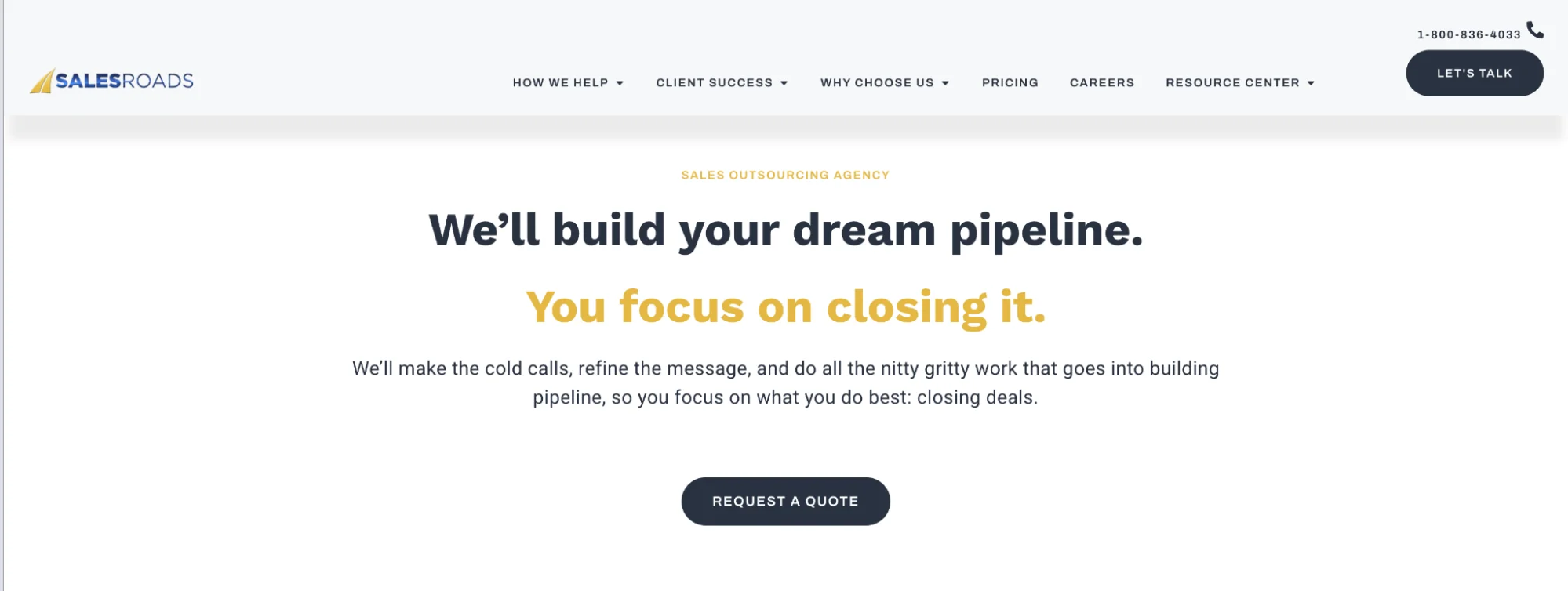
SalesRoads specializes in appointment setting for US mid-market and enterprise accounts.
They're known for cold-calling expertise and work best for solutions that need a live conversation before a demo can land.
The contrast with Martal is the channel mix. SalesRoads is phone-first, and Martal Group offers multi-channel coverage across email, LinkedIn, and calls.
If your product needs explanation over the phone or your buyers won't respond to cold email anyway, SalesRoads is the stronger pick. If you want email, LinkedIn, and calls working together as one motion, Martal's setup fits better.
SalesRoads is best for companies with complex products selling into conservative industries where phone calls still outperform digital channels.
5. ColdIQ
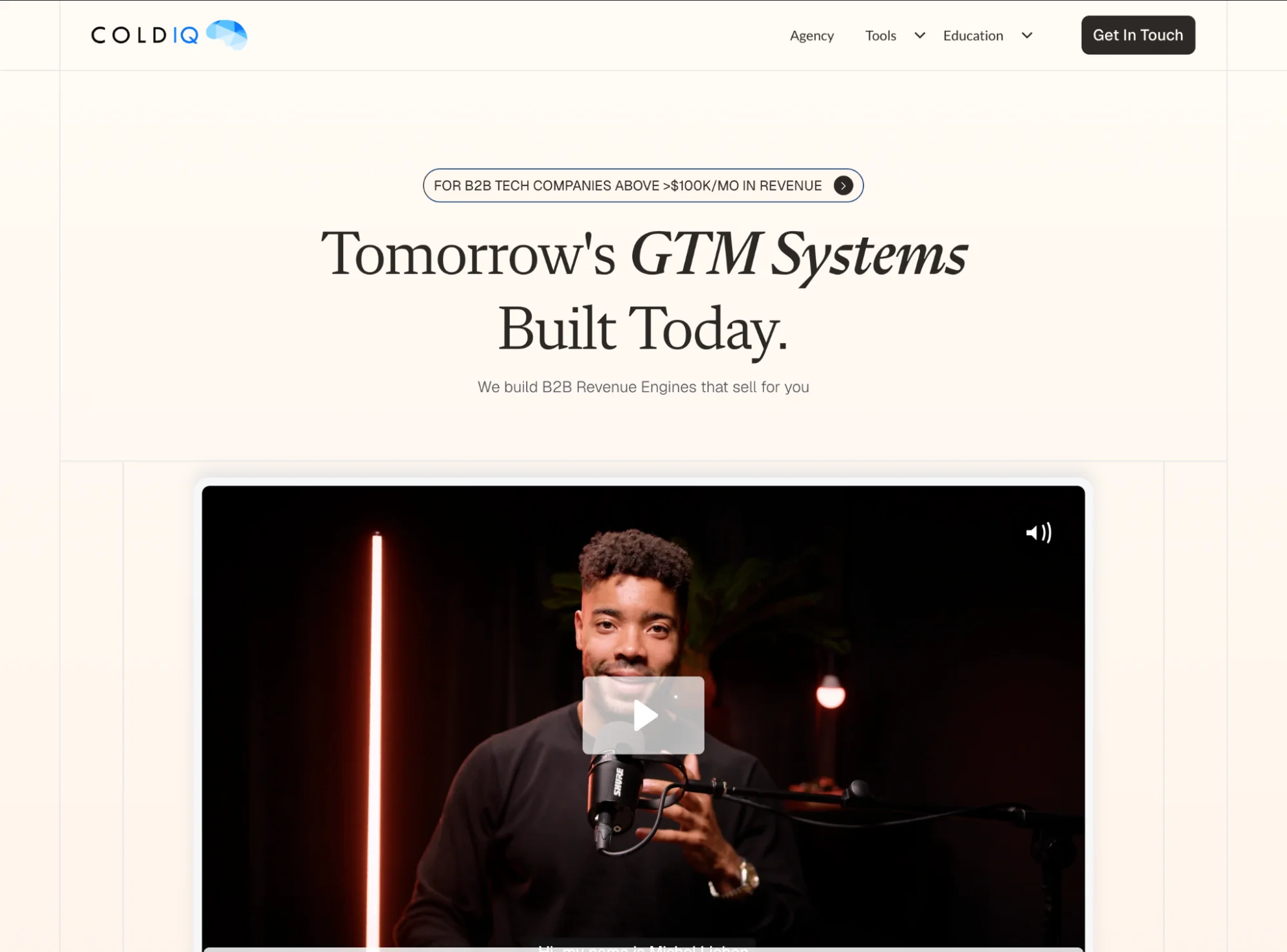
ColdIQ builds AI-powered sales systems with an approach close to ours, but they focus specifically on B2B SaaS companies.
They set up Clay workflows, automate data enrichment, and build email sequences, all inside your own tech stack.
The difference from Martal is the obvious one of ownership versus rental. The infrastructure ColdIQ builds belongs to you the same way ours does.
The difference from Nebor is that ColdIQ specializes in SaaS go-to-market and tends to be more prescriptive with their playbooks.
We customize more heavily across different industries and build broader intent monitoring across non-SaaS verticals like real estate, event tech, and industrial software.
ColdIQ is a strong alternative if you're a SaaS company and want infrastructure you own without the multi-industry complexity that comes with our build, and we've broken down the full ColdIQ comparison set in a separate piece for teams looking specifically at that decision.
6. OneAway
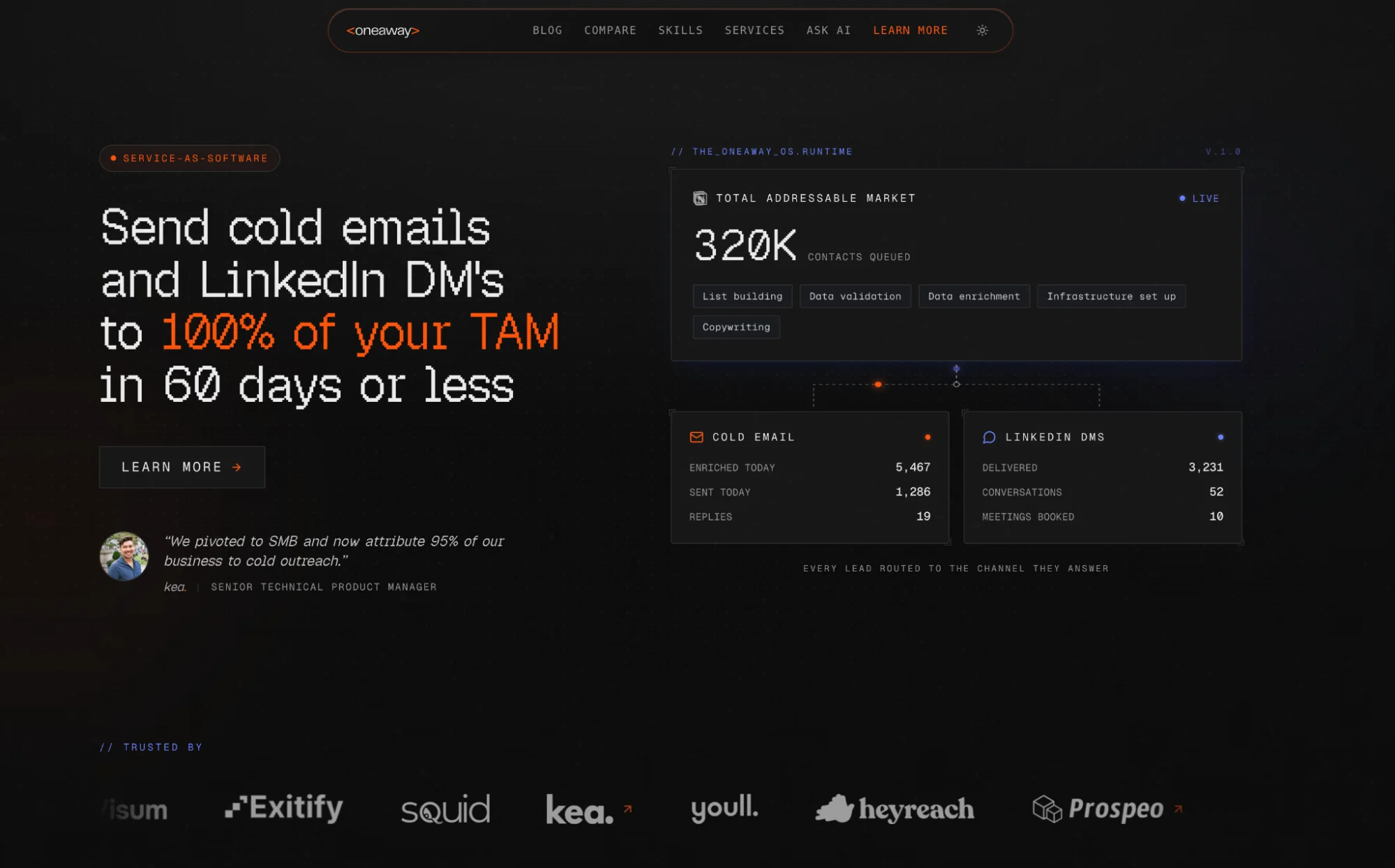
OneAway.io is a Clay-partnered lead generation agency that builds automated outbound systems using AI and multi-channel outreach.
They focus on B2B SaaS companies and emphasize personalized cold email and LinkedIn campaigns powered by Clay workflows.
In the spectrum between Martal and us, OneAway lands in the middle. They build automation infrastructure but also manage the campaigns on top of it for you, where Martal is pure outsourced headcount and we hand the whole engine over for you to own and operate.
OneAway uses more technology than Martal, but they still operate as a service provider managing your outreach rather than handing over infrastructure you operate on your own.
OneAway works well if you want the automation benefits without committing to full ownership of the system underneath, though we'd argue the whole point of automating sales prospecting is to get out of the rental loop entirely.
7. Cleverly
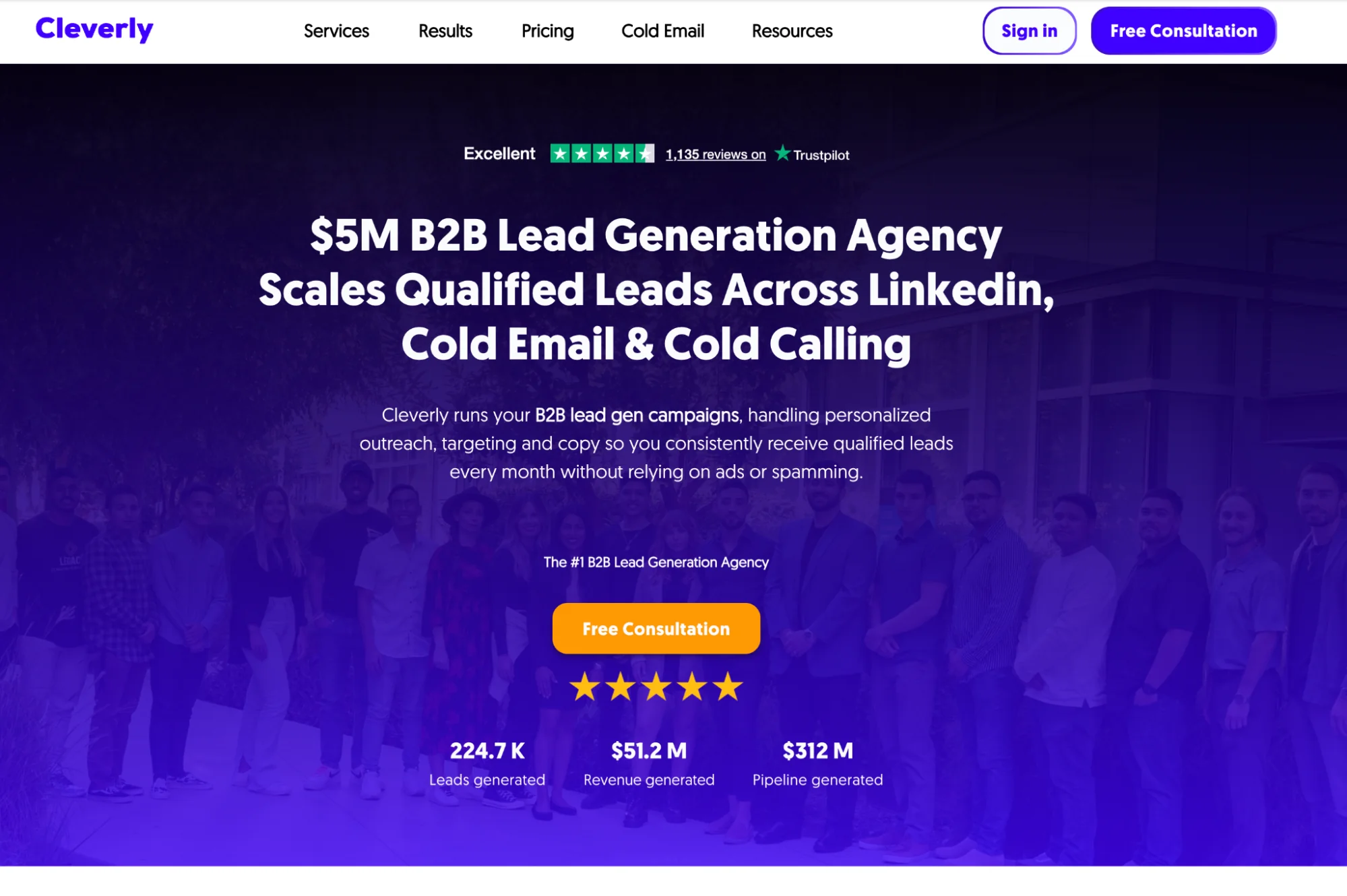
Cleverly.co specializes in LinkedIn lead generation, packaged in a productized format with faster onboarding and a lower commitment than the full-service agencies in this list.
Their site claims they'll book meetings within 30 days using LinkedIn automation and targeted messaging.
Compared to Martal Group, Cleverly is a much smaller operation that's faster to start and easier to test, with the trade-off that they're limited to LinkedIn as the only channel.
Martal takes longer to ramp but covers email, LinkedIn, and calls together as one motion.
Cleverly costs less, around $1,000 per month, and delivers fewer total meetings because it works on one channel only.
Cleverly is the right pick for companies testing LinkedIn outbound before committing to a full multi-channel program.
8. Pearl Lemon Leads

Pearl Lemon Leads delivers full-service B2B lead generation with a focus on content-driven outreach.
They create custom content assets for you, distribute them to prospects, and use engagement on that content as a qualification step before any direct reach-out happens.
Pearl Lemon's motion looks different from Martal's, since they warm up prospects with valuable content first and follow up only once the engagement signals real interest.
That motion takes longer overall, and it can work better for skeptical buyers in crowded markets where straight cold outreach gets ignored. Martal moves faster on the prospect-to-meeting path, identifying targets, reaching out across channels, and booking meetings inside the same week.
Pearl Lemon Leads is the better pick for thought-leadership-driven sales cycles, and the pricing reflects the content creation overhead built into the engagement model.
9. JumpCrew
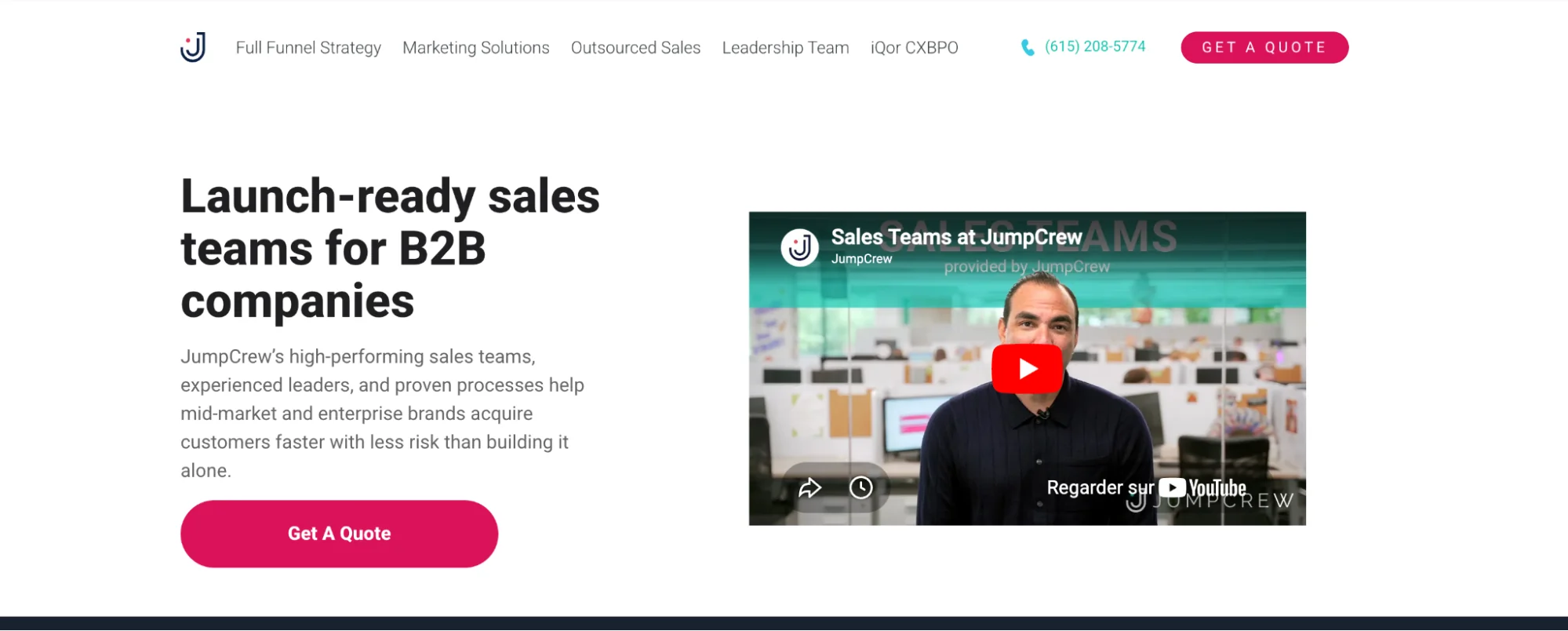
JumpCrew provides fractional SDR teams specifically for B2B SaaS and tech companies.
They cover both lead generation and pipeline acceleration, working closely alongside your existing sales team rather than working independently.
Compared to Martal, JumpCrew integrates more deeply with your internal processes and often handles mid-funnel follow-up alongside the top-of-funnel work, where Martal stays focused on appointments only.
JumpCrew costs more in exchange for that broader scope, since they can replace your entire outbound function rather than only outsourcing the cold outreach piece.
JumpCrew is the right fit if you need comprehensive SDR support that extends past the meeting-booked step.
10. Operatix
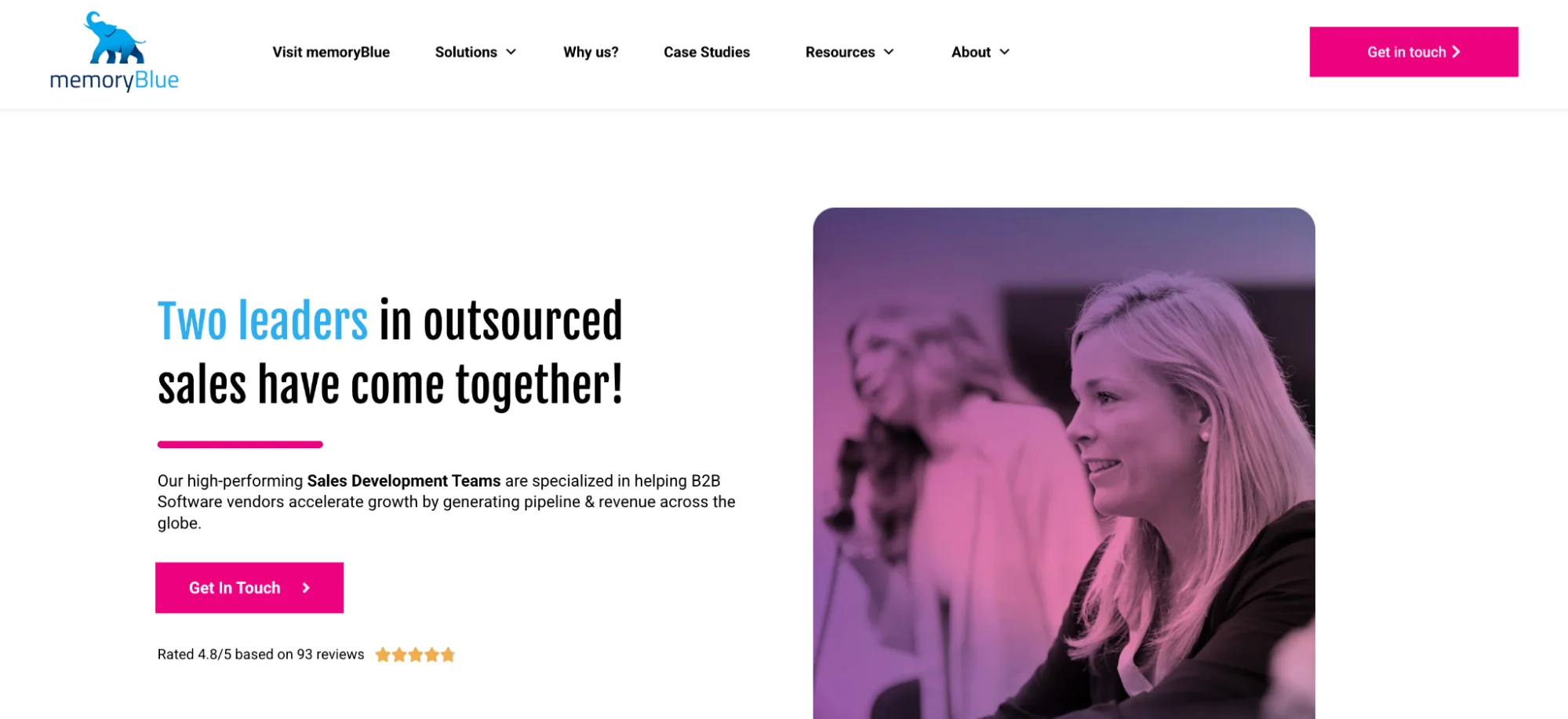
Operatix specializes in enterprise B2B sales development with global reach.
They work with large tech companies selling into Fortune 500 accounts and handle complex, multi-stakeholder sales processes that involve longer cycles and more decision-makers per deal.
The difference from Martal Group is the segment they target. Operatix is enterprise-only, while Martal covers both mid-market and enterprise.
Operatix SDRs have more experience with long sales cycles and the procurement gauntlet that comes with selling to large companies, and Martal moves faster on shorter cycles where the buying committee stays smaller.
Operatix is the right call if you're selling six-figure-plus deals into large enterprises. Expect higher costs in exchange for SDRs who understand how enterprise buying committees actually work.
When working with a Martal Group-style agency makes sense
Most of the alternatives to Martal Group on this list sell the same underlying model.
You pay for people and campaigns, and the infrastructure stays with the agency. Only a handful, Nebor and ColdIQ included, actually build the lead generation infrastructure inside your own accounts and hand it over for your team to operate.
Everything else is a variation on outsourced headcount with a different specialization layered on top.
We're upfront about who we're not the right fit for.
If you need meetings on the calendar next week, we're the wrong call, because building proper infrastructure takes weeks of setup before the system starts producing on its own.
If you want someone to handle it without any involvement from your team, we're also the wrong call, because we need your input on ICP, positioning, and the buying signals that actually predict close behavior in your market.
Martal Group will give you experienced SDRs sending campaigns on your behalf, and for some companies that's exactly the right shape of help.
Nebor will hand you the system those SDRs would have used, set up to work inside your own accounts so the leads keep arriving after the engagement ends.
The question worth answering before you sign with either of us is what you want the six-month outcome to look like.
If the answer is owned infrastructure that gets sharper every quarter and feeds your sales team across ABM, demand gen, and outbound on the same Clay backbone, Andrew, Yannick, and the rest of the Nebor team are the people to talk to.
We've laid out the fuller version of the argument in Why We Set Out to Be the Best Growth Agency, and the practical build behind it in How to Build a GTM System That Generates Business on Autopilot.
Reach out when you're ready and we'll walk you through what the system would look like inside your own accounts.
Note: Dymaxa, ExpoGenie and My Way all generate their pipeline from systems we built and they own.
Different markets, different motions, same shape: the sourcing, the enrichment, the outreach and the CRM working together, in their accounts, with no agency in the middle.
At Nebor, we are a GTM engineering and RevOps agency, and that is the whole of what we do.
Book a 15-minute call and we'll show you the builds.


Related Articles


By clicking Sign Up you're confirming that you agree with our Terms and Conditions.