
Top 10 CIENCE Alternatives for Successful B2B Lead Generation and Pipeline Automation

In this post:
So, you’ve signed up for CIENCE Technologies for lead generation and appointment setting.
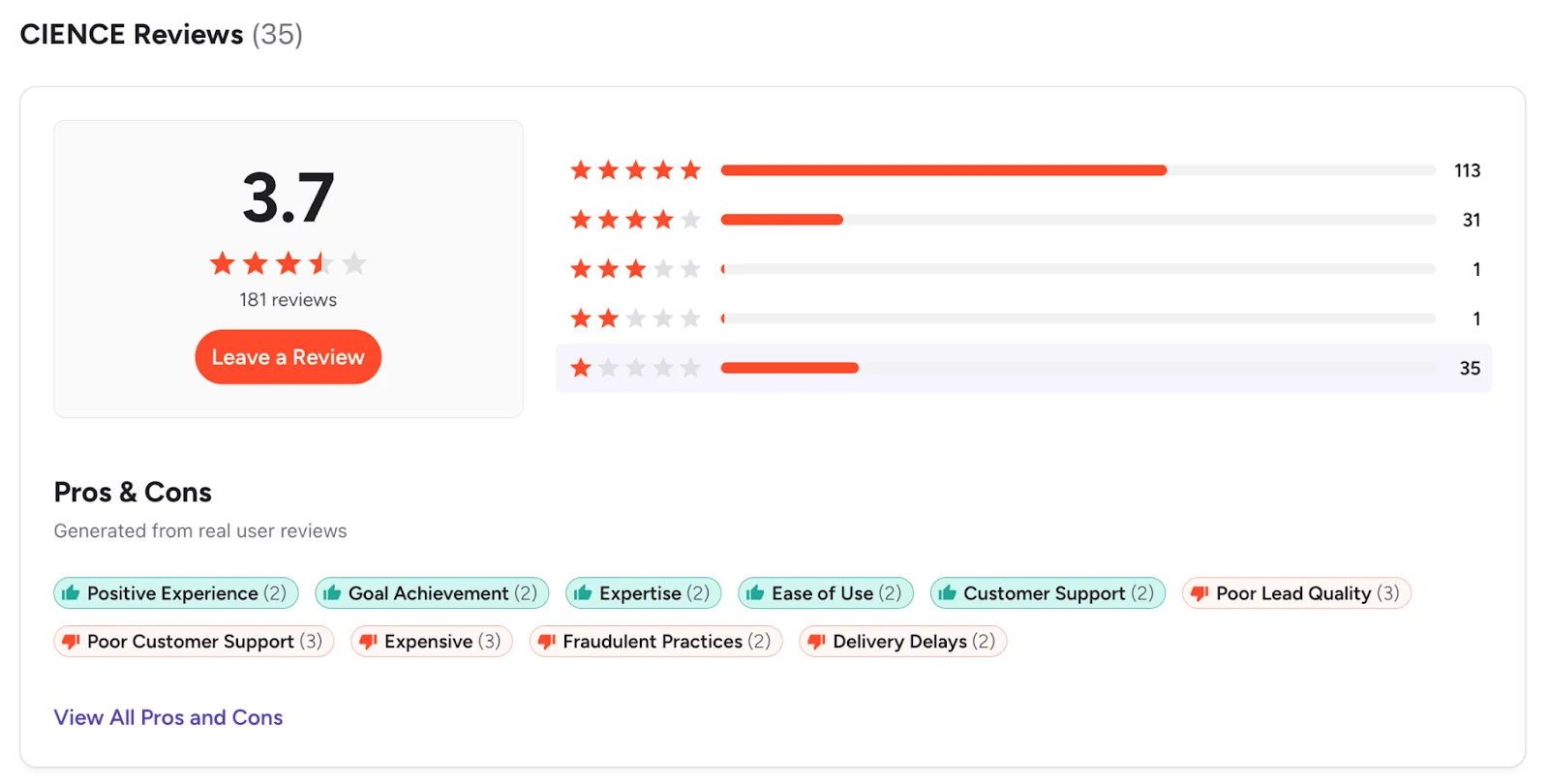
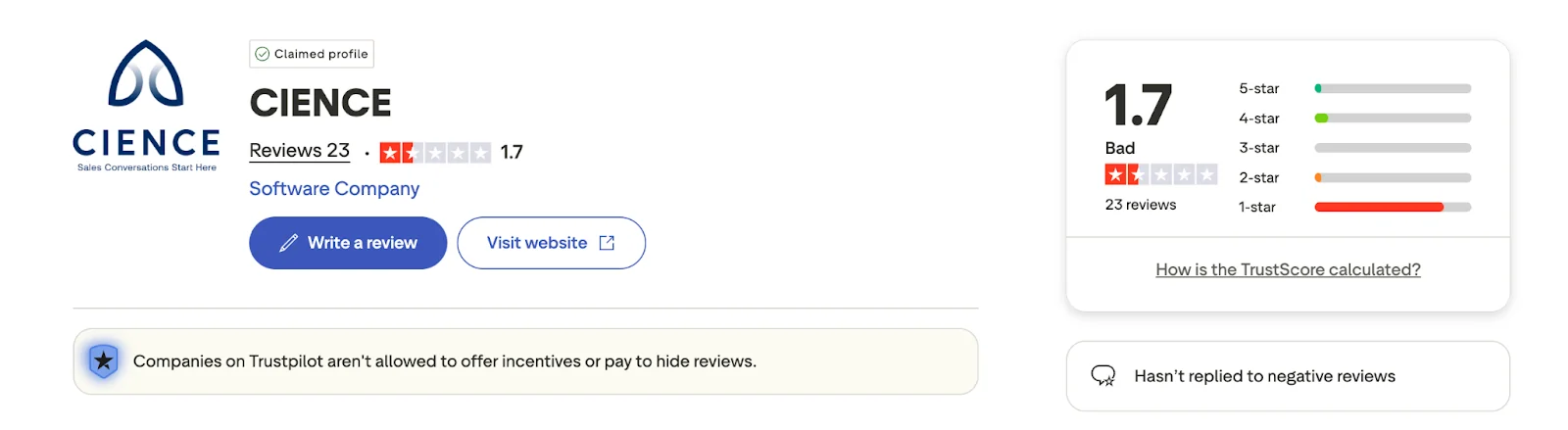
If you ended up here, we can take a good guess at what you're feeling right now. You probably just read a few reviews about CIENCE on G2 and Trustpilot, and they're sharply mixed.
Here's the general scheme of things from G2.
And here's Trustpilot's.
You've been paying for campaigns for months. The contract looked promising at the start, with a professional team and a proven process behind multi-channel outreach. Somewhere between the kickoff call and month three, reality set in.
Maybe the leads aren't quite right. They fit the basic criteria on paper, but when your sales team hops on calls, something is off. The prospects don't need what you're selling, or they aren't the actual decision-makers, or they're not ready to buy.
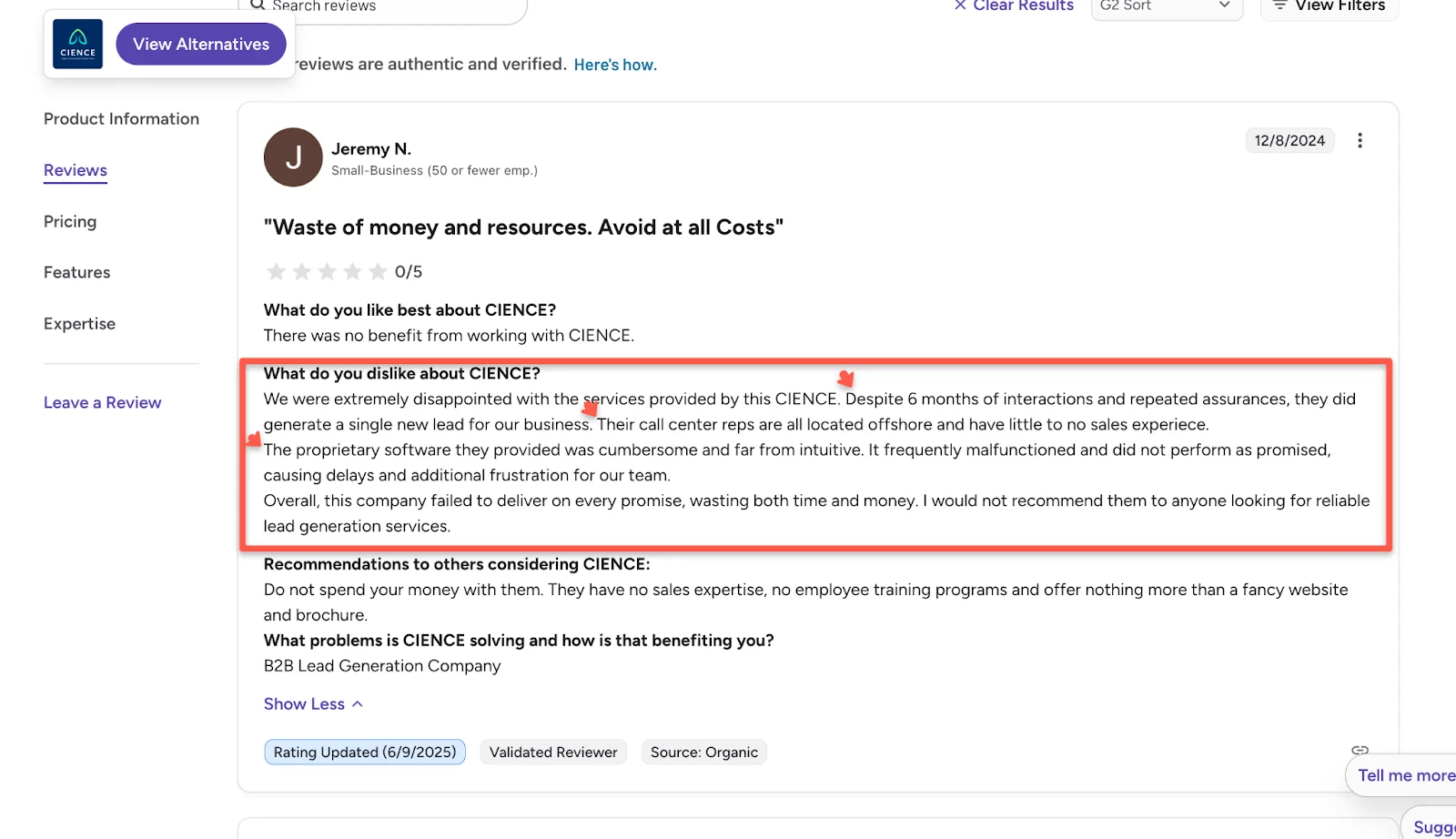
Or maybe it's the cost. You're paying for a full-service marketing team and you're wondering if you're getting full-service value.
The ROI calculation keeps nagging at you, especially when you see the invoice come through each month and compare it to the meetings that actually turned into deals.
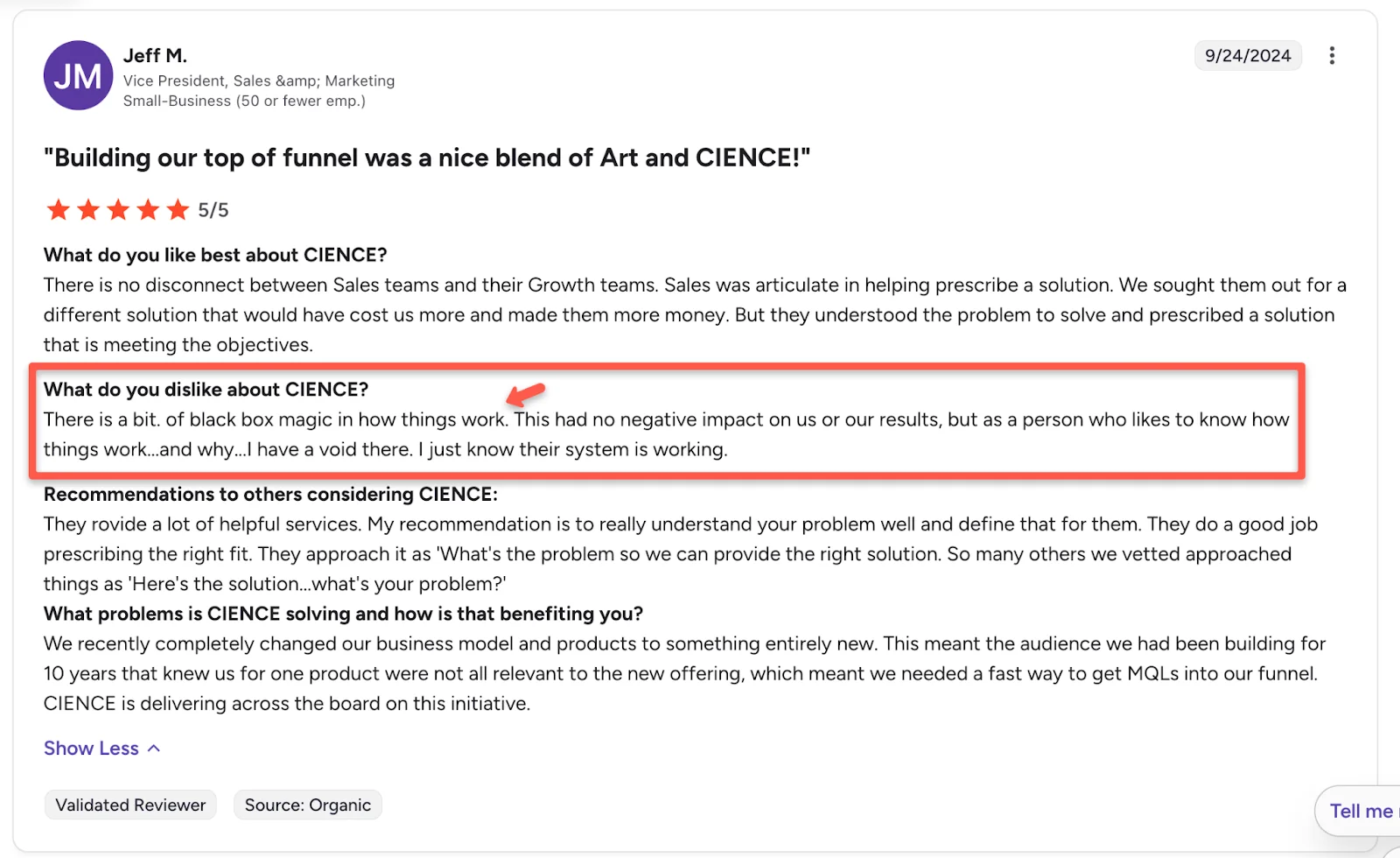
Or maybe it's the black-box feeling. You know outreach is happening on your behalf, and they're bringing in some good results, but you can't see what they're actually saying on the wire or how your brand is showing up in front of the buyer.
You've simply outgrown the model. What worked when you were scaling fast no longer makes sense. You want more control, more flexibility, or maybe you're ready to bring some of this in-house but need the right technology and systems to make that work.
If any of this sounds familiar, you're not alone. The People-as-a-Service plus proprietary prospecting tool model that CIENCE offers comes with real trade-offs.
You get human effort and the human limitations stapled to it. The campaign goes out, and you lose visibility into the day-to-day. Activity shows up in the dashboard, even when nobody can tell whether the activity is the right activity.
At Nebor, we come at this problem from a completely different angle. We're not just another outsourced SDR team. We're sales and lead generation automation experts who build intelligent systems that work on autopilot.
Below, we walk you through the top alternatives to CIENCE, covering different approaches and pricing models. Some are similar to CIENCE's service model. Others, like us, take a completely different approach through automation and technology.
By the end, you’ll understand your options and be able to choose the solution that actually fits your business, not just the one with the slickest sales pitch.
So, let's get started.
Note: B2B lead generation is no longer what it used to be. Most lead generation agencies and experts now depend on Clay, automation and AI to do the work people used to do by hand.
What most of them will not tell you is that they keep those tools and workflows in house and sell you only the campaigns and results. With a proprietary platform like CIENCE's you cannot even see what goes out under your name, and when you stop paying you are back at zero.
At Nebor, we are a GTM engineering and RevOps agency. We build the automated prospecting and lead generation that fills your pipeline, and we build it so you own it.
The difference shows up around month six. A lead generation agency is still charging you a retainer. With us, the workflows are already yours, so the only thing left to pay for is the software underneath them.
Book a 15-minute call and we'll show you what an automated lead generation motion would look like for your business.
TL,DR
CIENCE handles your outbound on the GO Platform, their proprietary system. It works while you pay for it, but you never see under the hood, you’re tied to their data and their stack, and the moment the contract ends, the engine walks out the door with them.
What you're left with is a stack of past-tense meetings and no asset. Plus their work is mostly and primarily outbound.
With the same investment, you can build and own your pipeline infrastructure and we help achieve that.
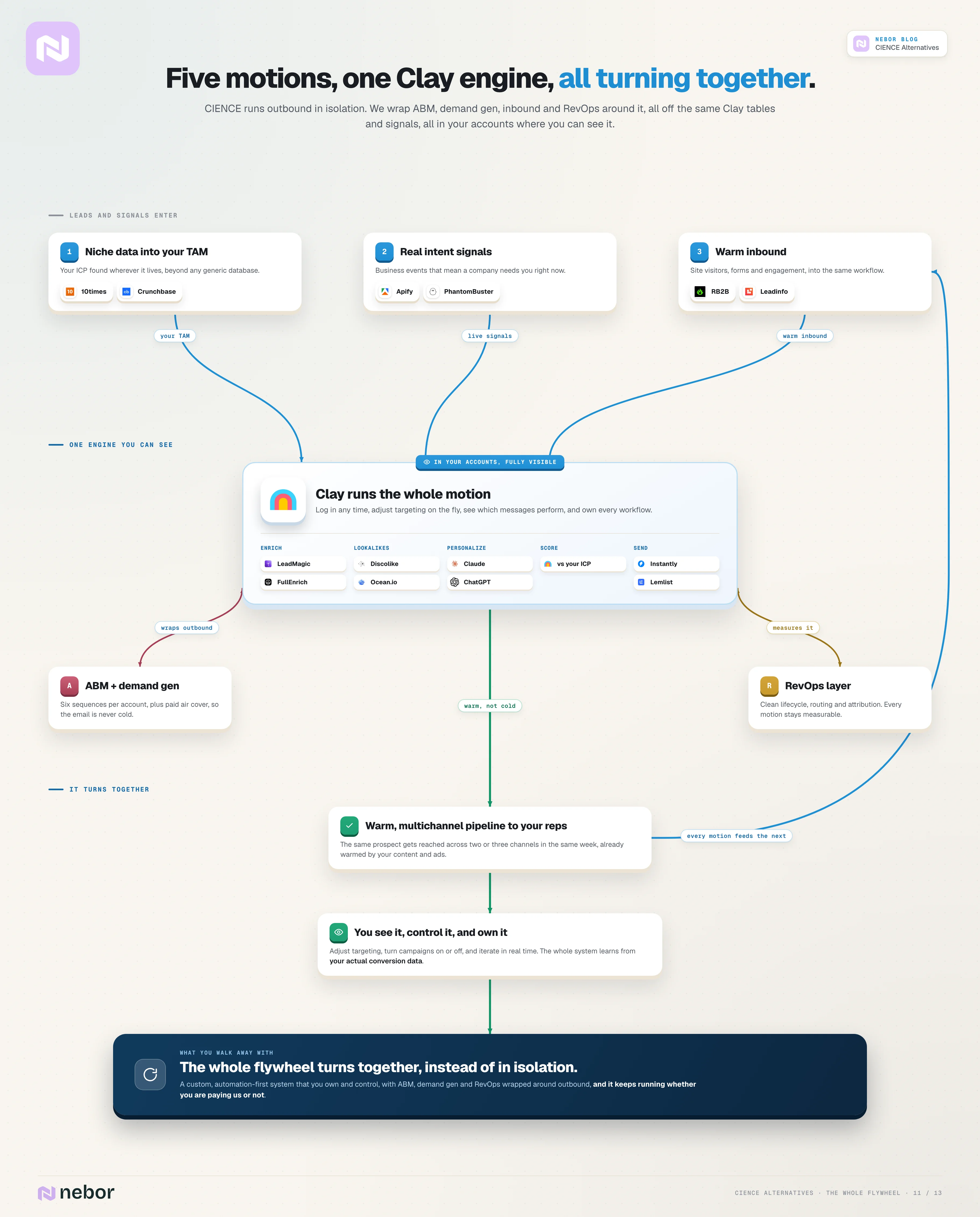
So, with us you get an open GTM system that lives in your accounts, on best-in-class tools you own, with Clay at the center where you can log in any time and see exactly what is happening.
And instead of outbound in isolation, we wrap ABM, demand generation, inbound and a real RevOps layer around it, so every motion feeds the next and the whole flywheel turns together.
You get more than meetings, you get the machine that produces them and it keeps working whether you're paying us or not.
Why Nebor is the best alternative to CIENCE for top of the funnel outreach and pipeline generation
We're not going to pretend CIENCE doesn't do good work.
They’ve built a solid reputation in the B2B lead generation space, and their “Machine-Powered, Human-Driven” approach has helped thousands of companies generate pipeline.
But the world has moved on since they built that approach.
The tools available today, the data you can access, the ways of capturing sales opportunities, and the level of automation you can achieve are light-years ahead of where things were even two years ago.
That creates a question. Do you want a service that uses its own proprietary platform and follows a standardized process?
Or do you want a partner who builds you a custom sales and lead gen system using the absolute best tools available, one that you actually own and control?
That's the real difference between CIENCE and Nebor.
Why working with an agency that works with a proprietary platform limits you
CIENCE operates primarily through their proprietary GO Platform. It's their software, their data, their infrastructure. It works in its own way, but it also means you're locked into their ecosystem.
Think about what that means in practice.
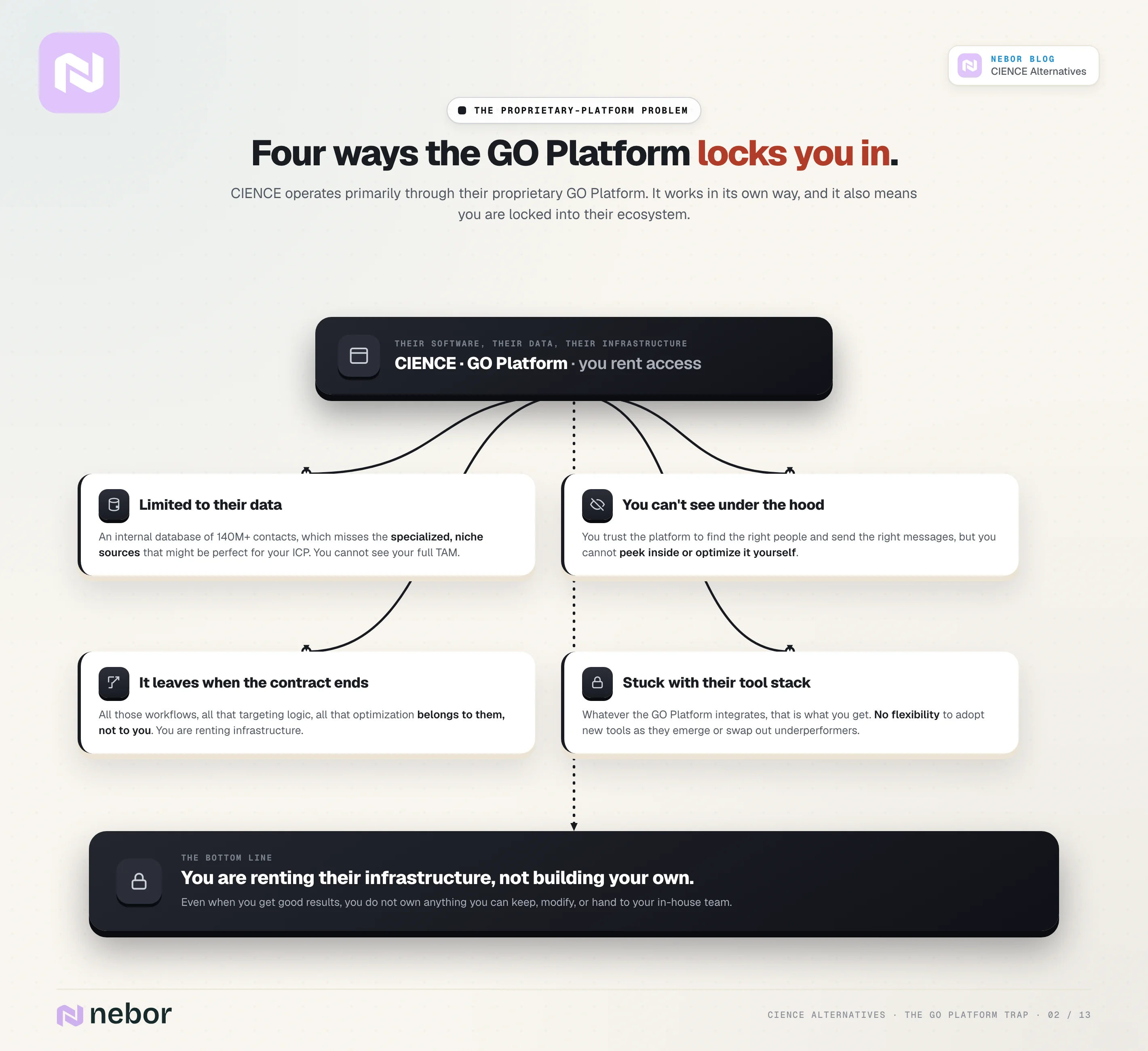
You're limited to their data sources. CIENCE uses an internal database of 140+ million contacts, which sounds impressive until you realize you're missing the specialized, niche data sources that might be perfect for your specific ICP.
You can't see and act on your full total addressable market when you're working off one platform. Your competitors with better systems can see and act on accounts you won't even know existed.
You can't see under the hood. You're trusting their platform to find the right people and send the right messages, but you don't get to peek inside and understand exactly how it works or optimize it yourself.
When the contract ends, the system leaves with them. All those workflows, all that targeting logic, all that optimization belongs to them, not to you. You're renting their infrastructure, not building your own.
You're stuck with their tool stack. Whatever integrations and capabilities the GO Platform has, that's what you get. No flexibility to adopt new tools as they emerge or swap out underperforming ones.
At Nebor, we take the opposite approach. We're not trying to sell you on our proprietary platform because we don't have one.
We build you a custom sales automation system using the best tools available in the market right now.
We build your system and workflows with the idea of handing them over to you
Here's how it actually works with us.
We start by understanding your business deeply. Not a 30-minute discovery call where we check boxes on an intake form.
We sit down with your key stakeholders, the people who built the product, the ones talking to customers every day, and we dig in.
What problem are you actually solving? Who stays with you the longest? What does the decision-making process inside the buyer's company look like in practice?
From there, we work out a strategy, a sales logic, and a tech stack that makes sense for your business. Nothing is set in stone. We're constantly evaluating what's best in class for each function. Today, that means:
Clay as the central system that connects everything
LeadMagic, FullEnrich, LeadsFactory.io, and Findymail for contact enrichment, because one data provider is never enough to guarantee data quality
Instantly.ai for email sequences
PhantomBuster and Apify for scraping and monitoring intent data
n8n to connect systems that don't have native integrations
And dozens of other specialized tools depending on your business and what you need
The key is that this isn't our system. It's yours. We build it, we teach you how it works, and you own it. Every automation, every workflow, every integration belongs to you.
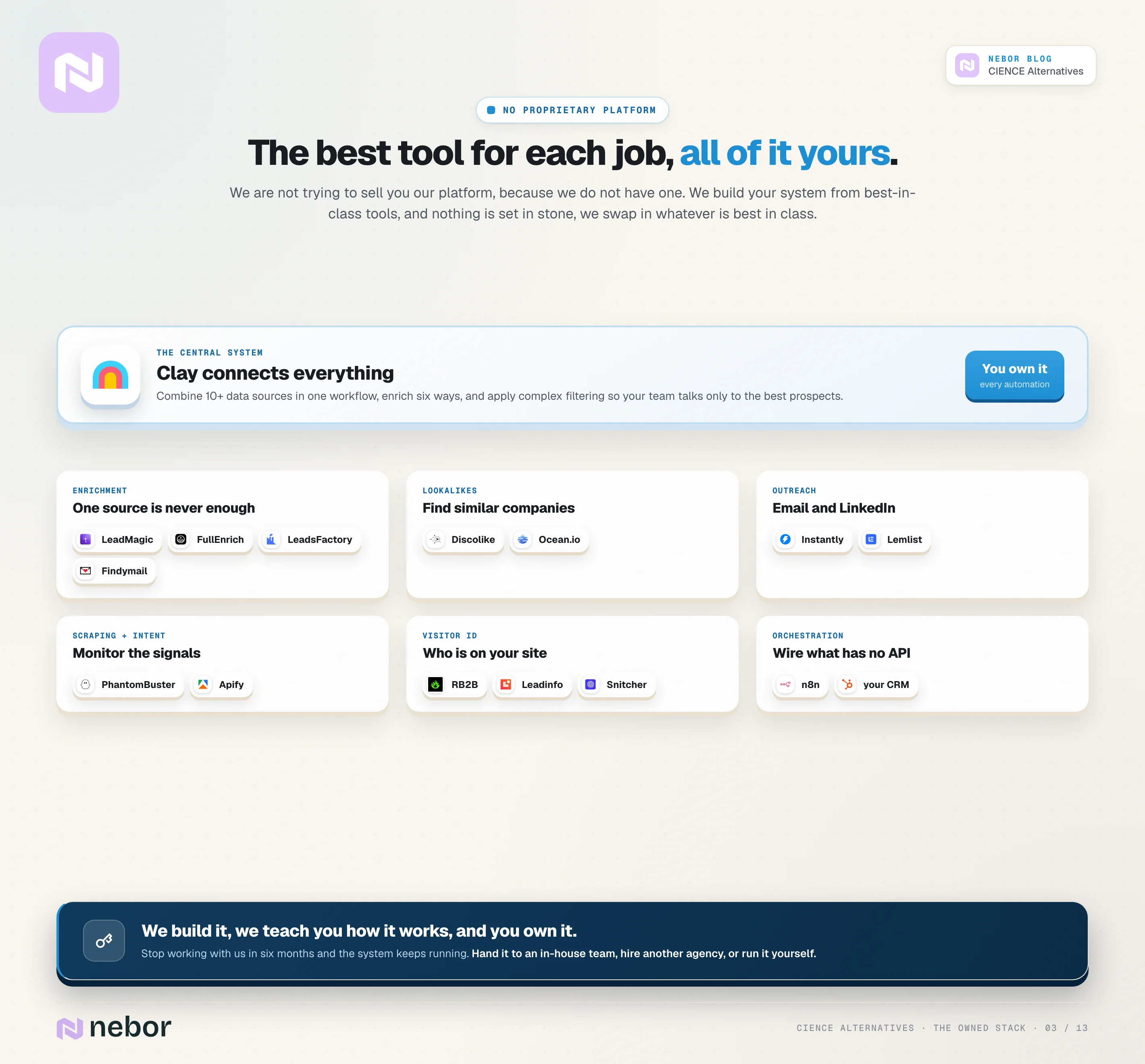
If you decide to stop working with us in six months, the system keeps going. You can hand it off to an in-house team, hire another agency to manage it, or operate it yourself. That's the difference between renting infrastructure and building assets.
We don’t limit ourselves to “our data” or any specific platform for that matter
CIENCE talks about their database of 140+ million contacts like it's a selling point. Having a big database is fine. The thing they don't tell you is that for most businesses with specific or niche ICPs, generic contact databases aren't enough.
We've worked with clients where the best data source wasn't Apollo or ZoomInfo or any of the usual suspects. It was industry-specific directories, event platforms, RSS feeds from niche publications, or even competitor customer lists scraped from review sites.
For example:
For a client offering event technology, we scrape data from 10times and Cvent because that's where their exact ICP lives. Companies actively hosting events with exhibitors and sponsors.
For a client selling AI-powered furnishing solutions, we set up and monitor RSS feeds from real estate publications like Multi-Housing News and Chicago Yimby. The moment a publication announces a new property development, our system identifies the developer, finds contact info, and sends personalized outreach.
For a client targeting high-growth companies, we scrape funding announcements from Crunchbase and TechCrunch in real-time. When a company raises capital, we reach out immediately while they're planning how to spend that money.
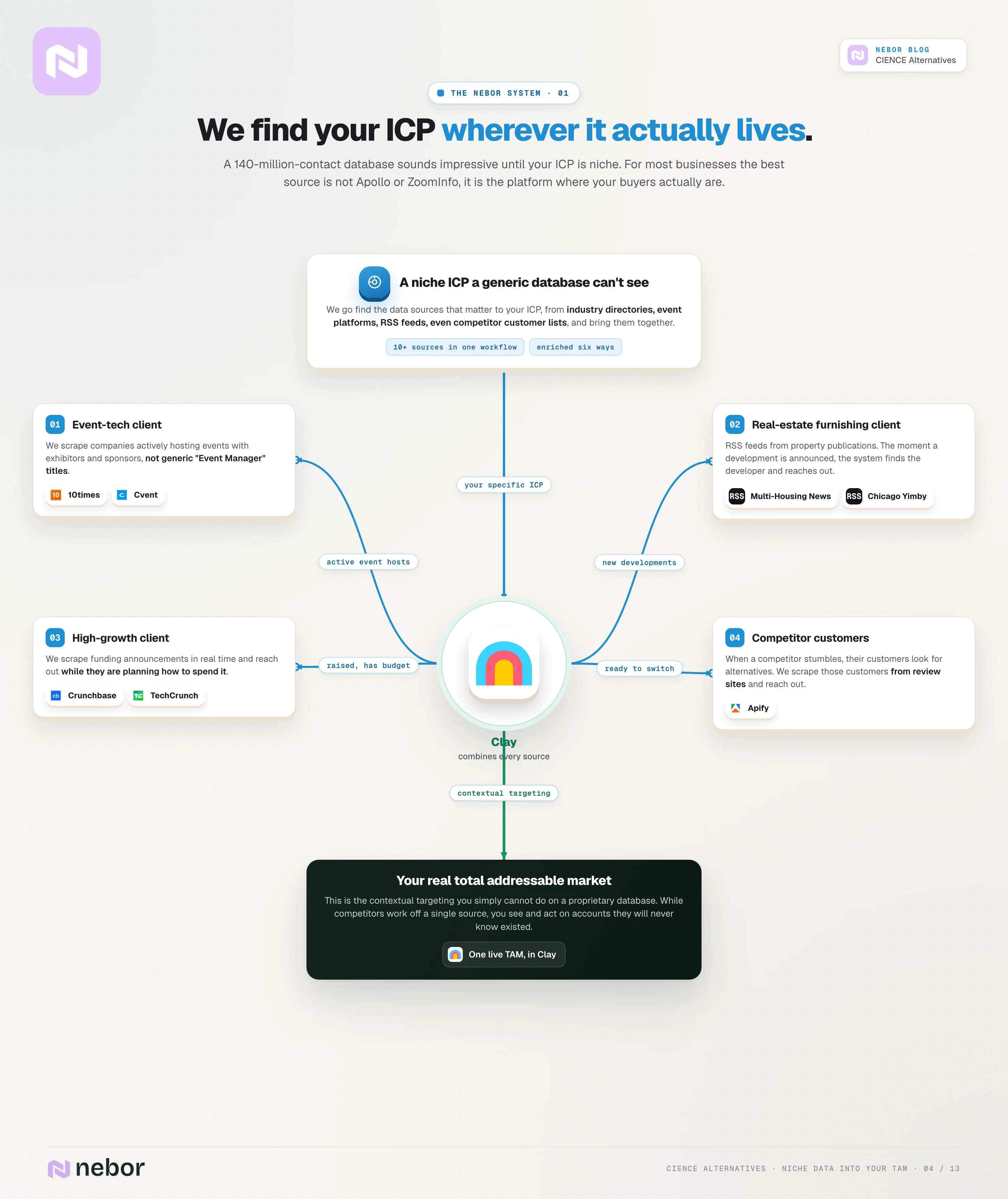
This is the kind of contextual targeting you simply cannot do when you're limited to a proprietary database. We go find your ICP wherever they actually are, using whatever data source makes the most sense.
Because we're building everything in Clay, we can combine data from 10+ different sources in a single workflow, enrich it six different ways, and apply complex filtering logic that ensures your team only talks to the absolute best prospects.
You get real intent data and buying signals
Both CIENCE and Nebor talk about using intent data. What we mean by "intent data" is completely different.
Most lead gen companies, including CIENCE, rely on what we'd call legacy intent data. Things like someone visiting an article about your industry, an IP address from their company showing up on a website, or a whitepaper download.
That's data, sure. It isn't actionable in any practical sense, and it's not what we'd call a real buying signal.
At Nebor, we set up systems that monitor actual business events that indicate a company needs your solution right now.
For our own agency, we monitor LinkedIn for companies posting SDR job openings every single day. When we see a company hiring multiple salespeople, we know they're struggling to build pipeline.
That's exactly the problem we solve. Our system automatically finds the hiring manager, enriches their contact info, and sends personalized outreach explaining how we can help them scale without adding more headcount.
For a cybersecurity client, we track funding announcements in the IT sector. When a company raises money, they're about to expand their team, which means they'll need more cybersecurity infrastructure. We reach out before they even start their vendor search.
For a tax incentive consulting firm, we use Apify to monitor Fortune 500 companies that just reported major profit increases. These are perfect timing signals for a service that helps enterprises reduce their tax burden.
For clients in competitive markets, we track competitor acquisitions. When your competitor gets acquired, their customers often start looking for alternatives. We automatically identify those customers and reach out with your solution.
This is what real intent data looks like.
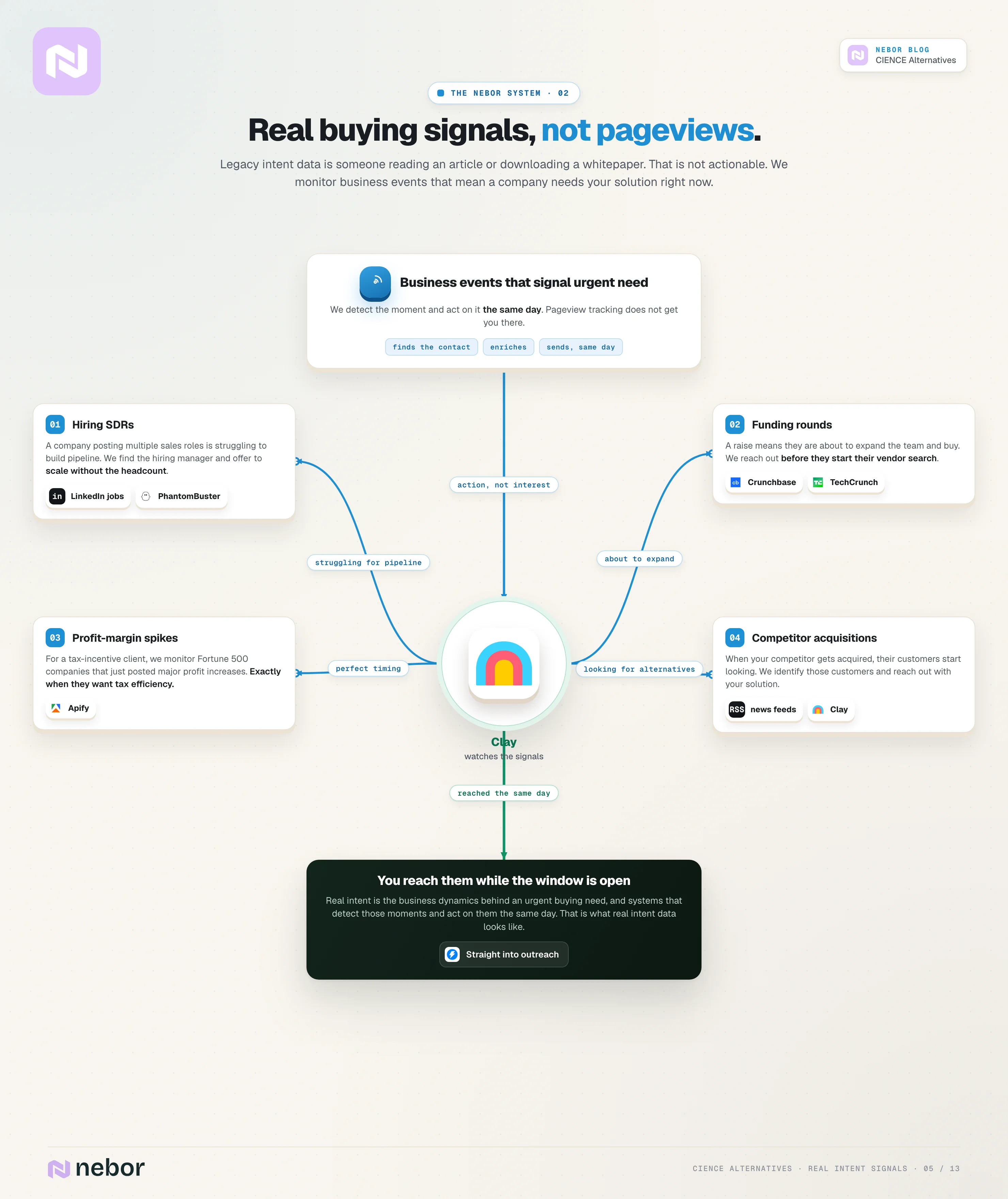
Real intent data is about the business dynamics behind urgent buying needs, and about building systems that detect those moments and act on them the same day. Pageview tracking doesn't get you there.
We connect inbound and outbound (most agencies don’t)
Here's something that surprised us when we started Nebor. Most businesses treat inbound and outbound as completely separate functions.
Marketing handles inbound leads. Sales or an agency handles outbound prospecting. There's almost no connection between the two.
CIENCE is primarily an outbound shop. They're great at finding new prospects and sending cold outreach campaigns. They aren't set up to help you maximize the warm traffic you're already generating.
We saw this as a massive missed opportunity, so we build systems that connect both sides.
Here's what that looks like in practice.
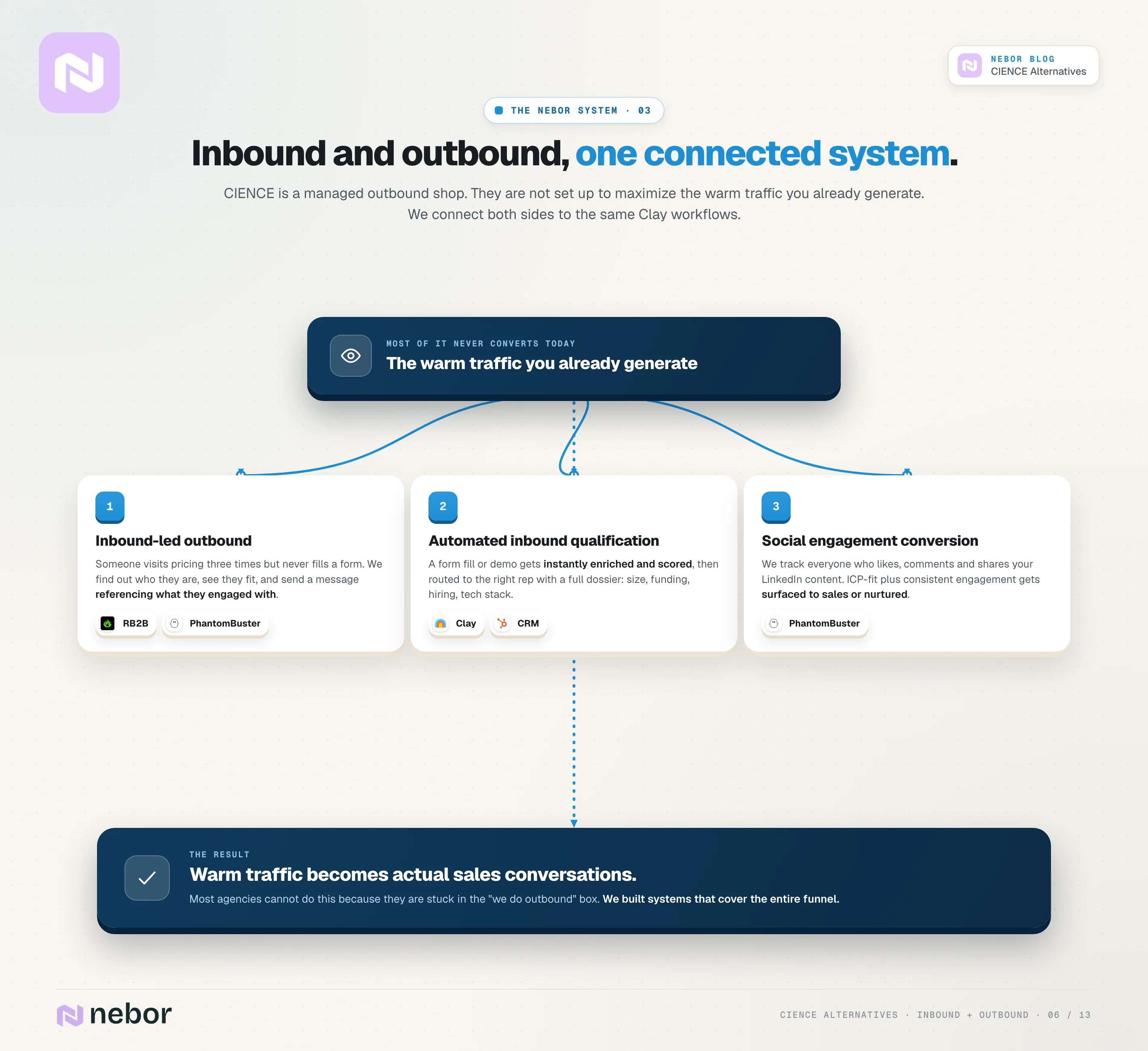
Inbound-led outbound. You're getting website visitors, LinkedIn followers, and people engaging with your content, but most of them never convert.
We connect your website (via RB2B), your LinkedIn (via PhantomBuster), and your CRM to Clay. From there, we automatically identify which of these warm leads match your ICP, enrich them with full contact data, and trigger personalized outreach campaigns.
So if someone visited your pricing page three times but didn't fill out a form, we can find out who they are, see they're a director at a company in your target market, and automatically send them a personalized message referencing the content they engaged with.
At that point you're past cold outreach. You're doing warm, contextual engagement against a buyer who's already shown you what they care about.
Automated inbound qualification
When someone does fill out a form or book a demo, our system instantly enriches their data, scores them against your ICP criteria, and routes qualified leads to the right sales rep with a full dossier.
Company size, recent funding, hiring patterns, tech stack, all of it. Your reps walk into calls fully prepared.
Social engagement conversion
With tools like PhantomBuster, we track everyone who engages with your LinkedIn content. Likes, comments, shares. If someone matches your ICP and shows consistent engagement, we automatically surface them to sales or drop them into a nurture sequence.
The result is that you're not just generating new cold leads. You're turning all the warm traffic you're already getting into actual sales conversations.
Most agencies can't do this because they're stuck in the "we do outbound" box. We built systems that cover the entire funnel.
Note: B2B lead generation is no longer what it used to be. Most lead generation agencies and experts now depend on Clay, automation and AI to do the work people used to do by hand.
What most of them will not tell you is that they keep those tools and workflows in house and sell you only the campaigns and results. With a proprietary platform like CIENCE's you cannot even see what goes out under your name, and when you stop paying you are back at zero.
At Nebor, we are a GTM engineering and RevOps agency. We build the automated prospecting and lead generation that fills your pipeline, and we build it so you own it.
The difference shows up around month six. A lead generation agency is still charging you a retainer. With us, the workflows are already yours, so the only thing left to pay for is the software underneath them.
Book a 15-minute call and we'll show you what an automated lead generation motion would look like for your business.
You get ABM as a system that works creatively through your accounts
ABM in most agencies means someone wrote an account list, the SDRs sent the same emails to everyone on it, and someone made a slide deck calling the whole thing "1:few." That isn't ABM. That's a contact list dressed up in a different vocabulary.
What we build works differently.
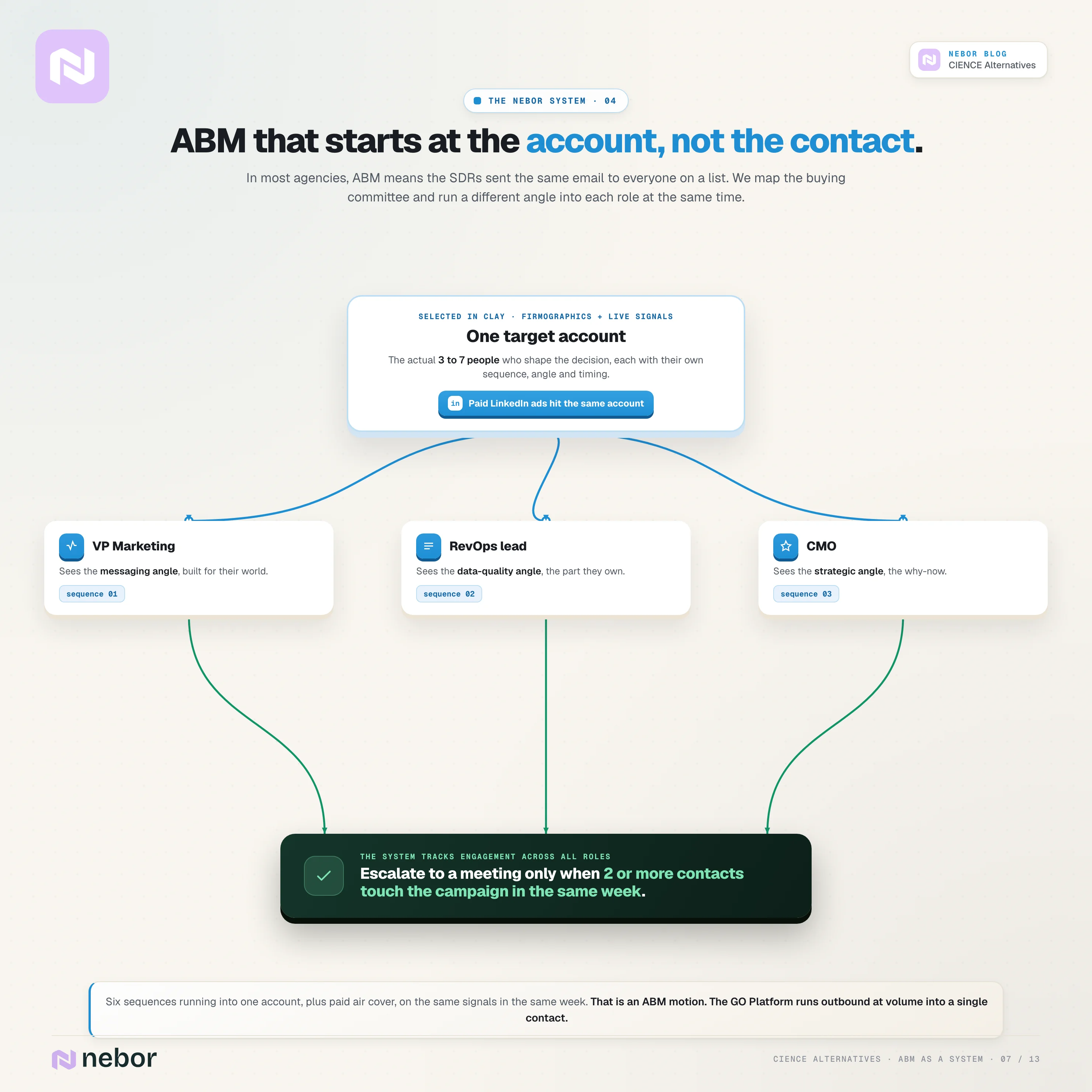
We start at the account instead of the contact. Account selection happens in Clay, with firmographic filters layered onto real-time signals like funding rounds, hiring patterns, expansion announcements, and tech stack changes.
From there we map the buying committee per account. The actual three to seven people who shape the decision in your category each get their own sequence, their own angle, and their own timing.
For most B2B SaaS companies, an account-level campaign means six different sequences landing on one account at the same time.
The VP Marketing sees the messaging angle, the RevOps lead sees the data-quality angle, and the CMO sees the strategic angle.
The system tracks engagement across all roles and only escalates to a meeting when two or more contacts touched the campaign in the same week. That is an ABM motion.
CIENCE's GO Platform does not do this. Their structure is built for outbound at volume into a single contact.
We also pipe the same account list straight into your LinkedIn ad audience for paid alignment.
While your SDR sequence hits the account from one side, your paid social spend hits the same accounts from the other side.
The reps and the ads are talking to the same accounts, on the same signals, in the same week.
Most agencies cannot do this because their outbound and their paid social live in different teams and different tools. We build it as one system.
We build demand generation next to outbound
Most cold outbound campaigns share the same structural problem. The prospect has never heard of you. Reply rates are what they are because every email is the first impression.
CIENCE leans hard on cold outreach by design. There is no demand layer feeding warmer context into the same prospects.
We build the demand layer as part of the same system.
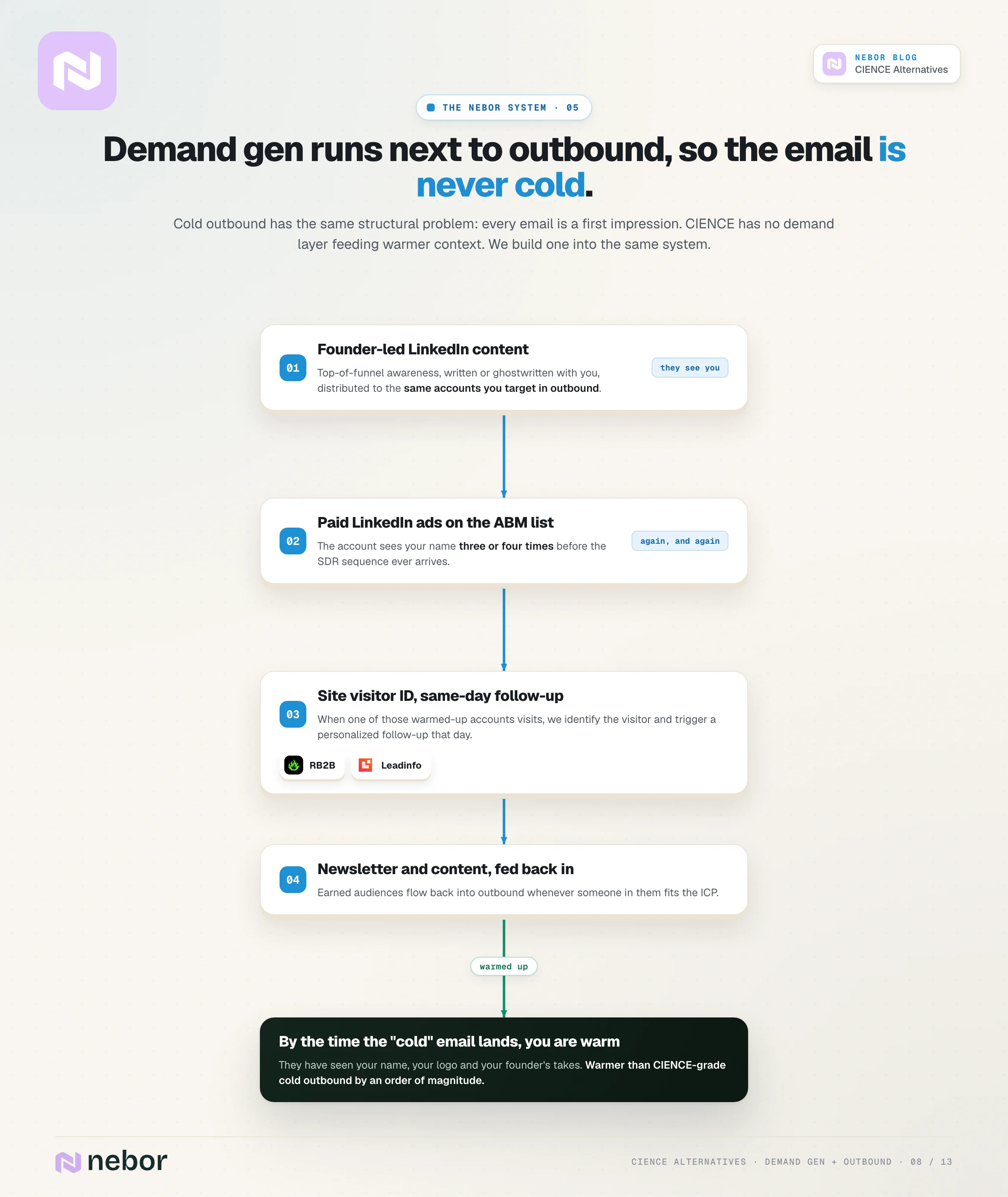
That looks like founder-led LinkedIn content for top-of-funnel awareness, written by your team or ghostwritten alongside you, distributed to the same accounts you are targeting in outbound.
Paid LinkedIn campaigns go out against the ABM list, so the account sees your name three or four times before the SDR sequence arrives.
RB2B and Leadinfo watch your site, so when one of those warmed-up accounts visits, we identify the visitor and trigger a personalized follow-up the same day.
Your newsletter and your content distribution feed earned audiences back into outbound whenever someone in that audience fits the ICP.
The compound result is that by the time a prospect gets your "cold" email from us, you are not actually cold. They have seen your name, your logo, and your founder's takes. They are warmer than CIENCE-grade cold outbound by an order of magnitude.
This is something you just don’t get with CIENCE. They are a managed outbound shop. The marketing layer, the LinkedIn presence, and the brand and content distribution stay with your team or with another agency, disconnected from the SDR motion.
We build one. Outbound flows through demand gen and demand gen flows back into outbound. The same prospect gets reached through two or three channels in the same week, all working off the same Clay tables and the same signals.
You get the RevOps layer that makes any of this measurable
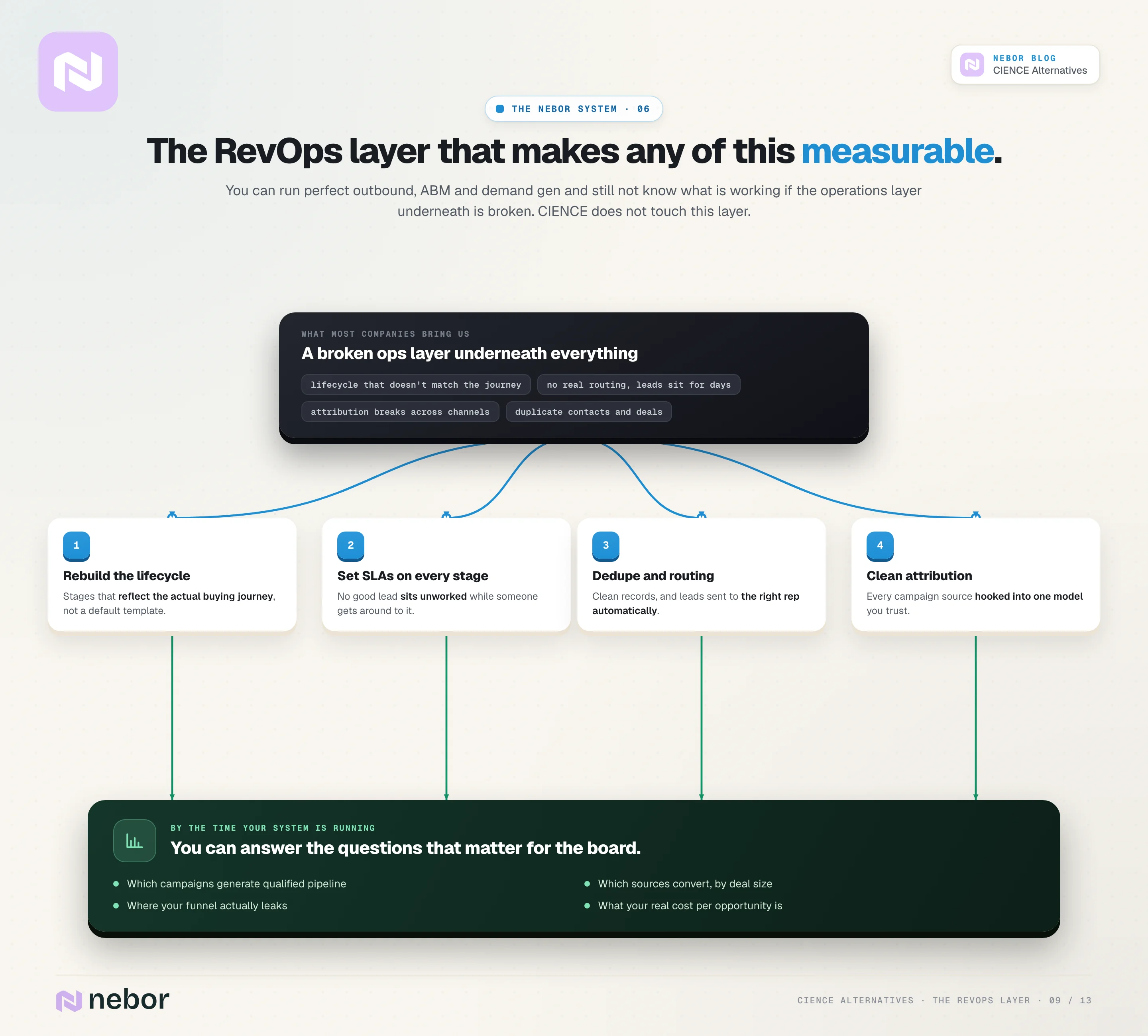
This is the one most agencies and most clients underestimate. You can build perfect outbound, perfect ABM, and perfect demand gen, and still not know what is working if the operations layer underneath is broken.
Most companies that come to us have lifecycle stages in HubSpot or Salesforce that do not reflect their actual buying journey. They have no real lead routing rules, so good leads go unworked for days before someone makes contact.
Their attribution breaks the moment a deal touches more than one channel. Their reporting dashboards exist but nobody trusts them because the data underneath is wrong. Duplicate contacts, duplicate deals, and a CRM that gets messier every quarter.
We fix this layer as part of the build. We rebuild the lifecycle, set SLAs on every stage transition, build the dedupe and routing rules, and hook every campaign source into clean attribution.
By the time your system is live, you can answer the questions that matter for the board. Which campaigns generate qualified pipeline. Which sources convert at what rate by deal size. Where your funnel actually leaks, and what your real cost per opportunity is.
CIENCE does not touch this layer either. Their model is to do outbound, book meetings, and report on volume. The rest of your operations stack stays your problem.
You get automation that actually works (and you can see it, too)
When CIENCE talks about automation, they’re usually talking about their internal systems and how they use technology to make their human SDR team more efficient. That's fine, but that's not automation working for you.
Our automation works differently. The workflow systems we build work on autopilot around the clock, with almost no human intervention.
The workflow identifies prospects based on intent signals and ICP criteria, enriches contact information across multiple data providers, personalizes each message with specific details on the buyer, and triggers outreach across email and LinkedIn in the right order.
Follow-ups go out based on how the prospect engages or doesn't. Qualified leads get routed to the right sales rep with full context attached, so the rep walks into the conversation already up to speed.
The difference is that all of this is happening in your Clay account, your Instantly.ai account, your CRM. You can log in any time and see exactly what is happening.
You can adjust targeting criteria on the fly. You can turn campaigns on or off. You can see which messages are performing best and iterate in real-time.
With CIENCE, you get weekly reports tallying how many emails their team pushed out and how many meetings landed.
That's the black box we talked about earlier. You don't see the actual workflows, you don't control the day-to-day execution, and you can't optimize things yourself without going through account managers.
We give you the automation, the visibility, and the control all at once.
We scale with you (and your budget)
Now let’s talk about the elephant in the room: cost.
CIENCE operates on a retainer model. You pay for their human SDR team, their platform access, and their managed service. Depending on the package, that costs anywhere from $5,000 to $15,000+ per month, often with multi-month commitments.
That model made sense five to ten years ago when you needed humans to do all this work. Today, when you can automate 90% of the process, you're paying for a lot of overhead you don't actually need.
Our pricing works differently because our model works differently. You're not paying for seat licenses or for humans to manually send emails. You're paying for three things.
Custom automation development, where we build your systems
Tool stack costs, the actual software subscriptions, usually $500 to $2,000 per month total
Ongoing optimization and management, where we continuously improve your workflows
The result is more capacity at a lower cost.
Our systems can process thousands of prospects per day, monitor dozens of intent signals at the same time, and drive complex multi-channel campaigns around the clock without the limitations of human capacity or timezones.
Because you own the system, you're building an asset. With CIENCE, when you stop paying, the whole thing goes dark. With us, when you stop paying, the system keeps going. You take over managing it yourself or hand it to an in-house team.
We actually understand modern GTM (because we build them every day)
Here's something important about Nebor. We're not just vendors who learned about sales automation by reading blog posts. Andrew and Yannick, our founders, were salespeople in the trenches at companies like Gartner and various agencies.
They watched businesses waste 60% of their time on manual work. They saw companies pay thousands for tools they barely used. They worked at agencies that cared more about retainer revenue than actual results.
That frustration is what drove them to build Nebor. Not as another lead gen agency, but as a solution to a broken system.
A few patterns we understand from the inside out.
Why most outbound campaigns fail
Why most inbound leads don't convert (no qualification process, slow follow-up, disconnected from sales)
Why most tech stacks are a mess (too many tools, nothing talks to each other, no one understands how it works)
Why most agencies overpromise and underdeliver (they care more about keeping contracts than driving outcomes)
We built our entire service model around fixing these problems.
At the end of the day, the difference between CIENCE and Nebor comes down to this.
CIENCE is a service provider. They do the work for you using their platform and their process. You pay them, they generate leads, and as long as you're paying, it keeps working. Or not.
Nebor is a systems builder. We build you a custom automation infrastructure using best-in-class tools. You own it, you control it, and it keeps working whether you're paying us or not.
If you want someone to handle your outbound so you don't have to think about it, both CIENCE and Nebor can do that. Toss a coin. We can both make a case for being competent, established players with proven track records.
If you want to actually transform how your business generates pipeline, with full visibility, modern technology, intelligent automation, and a system that scales with you, that's what we built Nebor to deliver.
Top 10 CIENCE alternatives for B2B lead generation and pipeline building
Below, we've compiled 10 solid alternatives to CIENCE, each with different strengths, pricing models, and approaches. If you're trying to decide whether you even need an SDR agency in the first place, that's worth reading too.
1. Nebor
Who we best serve: Companies wanting automation-driven pipeline growth with full transparency and ownership.
Nebor isn't your typical lead gen service. We're a sales and lead generation automation partner that builds custom systems you actually own.
While CIENCE delivers outbound campaigns through their proprietary platform, we build you a custom tech stack using best-in-class tools like Clay, Instantly, and PhantomBuster.
We go beyond basic outbound by connecting inbound and outbound workflows, monitoring real-time intent signals (funding rounds, hiring patterns, competitor movements), and finding your ICP wherever they actually live, beyond generic databases.
Layered on top, we build real ABM, demand generation, and the RevOps work that makes all of it measurable.
You get complete visibility into every automation, full control over targeting and messaging, and a system that continuously learns and improves based on your actual conversion data.
CIENCE vs Nebor: CIENCE offers a managed service with proprietary tools. We build you custom automation infrastructure around your business. And you own and control everything. Also, they focus on outbound only and we connect your entire GTM motion.
2. Belkins.io
Who it’s for: B2B companies across diverse industries seeking ROI-focused appointment setting.
Belkins has built a reputation as one of the top appointment setting agencies, with over 200,000 meetings booked and a 95% client retention rate. They focus heavily on getting qualified meetings on your calendar fast, often launching campaigns within a week.
Like CIENCE, Belkins operates as a full-service agency handling email and LinkedIn outreach with dedicated research teams. They emphasize quick launches and proven playbooks across 50+ industries.
CIENCE vs Belkins.io: Belkins is probably CIENCE's most direct competitor. Similar service model, similar scale, similar approach.
Both are full-service agencies with human SDR teams. Belkins emphasizes faster launch times and claims higher ROI metrics ($10 return per $1 invested), while CIENCE leans more heavily on their proprietary platform and data.
3. Martal Group
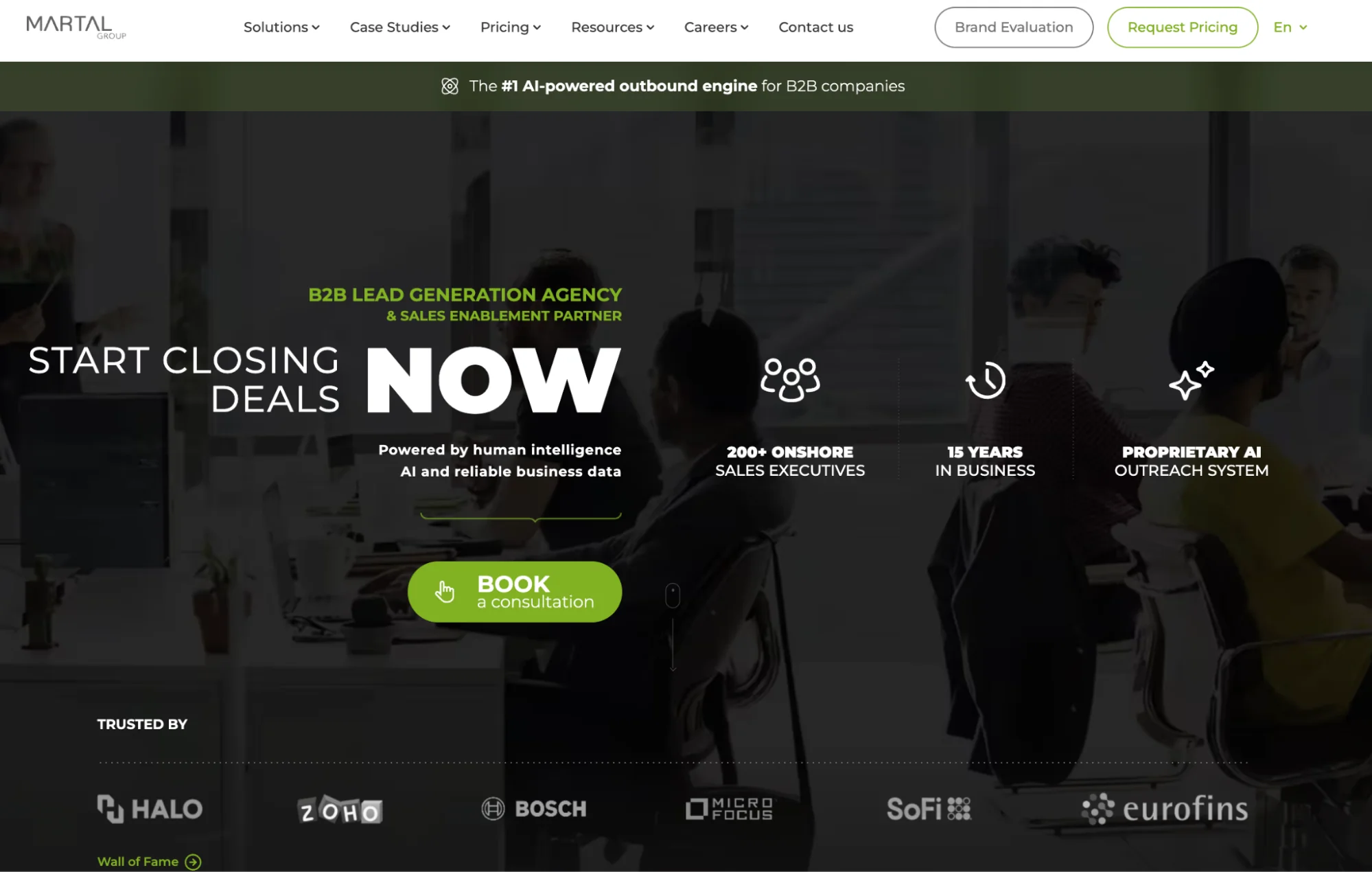
Who it’s for. Enterprise and mid-market companies needing senior-level sales expertise.
Martal Group differentiates itself by using experienced B2B sales professionals rather than junior SDRs.
Their team includes former VPs of Sales and senior account executives who understand complex sales cycles and can have substantive conversations with C-level prospects.
They focus on quality over quantity, typically working with companies selling high-ticket solutions with longer sales cycles. They also offer multilingual capabilities for international expansion.
CIENCE vs Martal Group: Martal uses more senior talent (higher cost, potentially higher quality). CIENCE scales with junior or normal SDRs and automation. Martal is better for complex, consultative sales. CIENCE is better for high-volume outreach.
4. SalesRoads
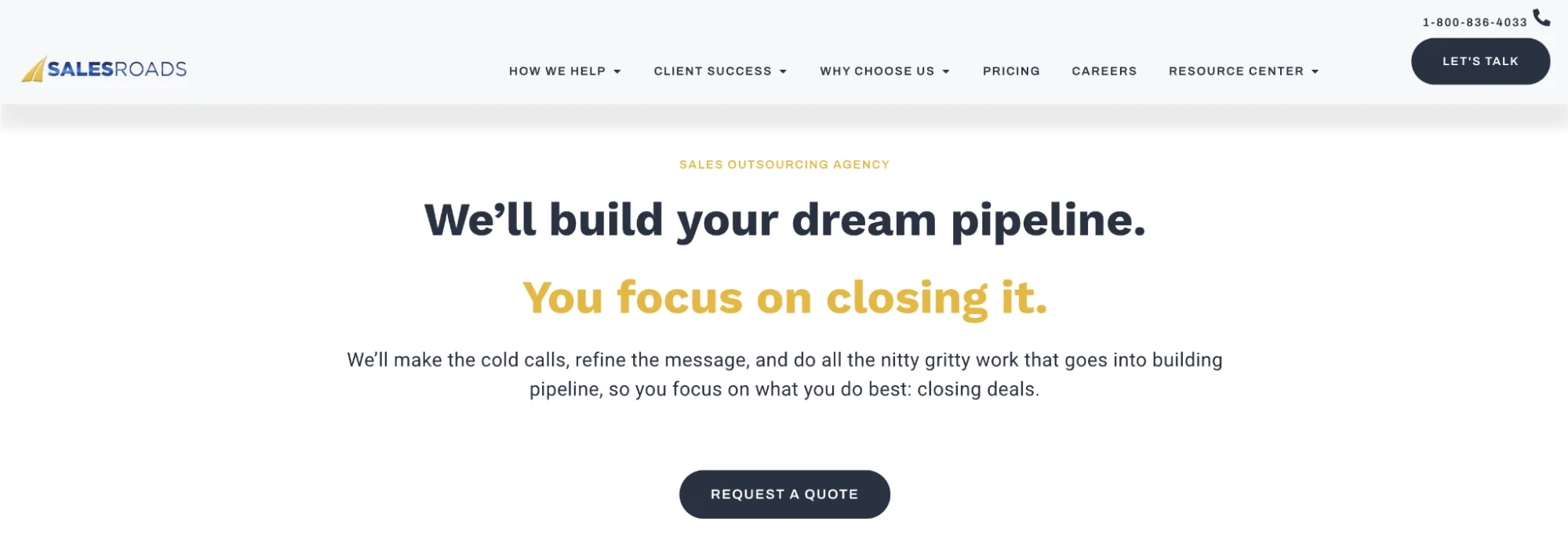
Who it’s for: Companies seeking US-based SDR teams with strong phone prospecting.
SalesRoads operates entirely with US-based sales development reps, which matters for companies targeting American prospects who prefer to speak with local callers.
They offer phone prospecting alongside email, making them stronger for industries where calls convert better than pure email sequences.
They handle the full path from list building to appointment setting, with a focus on conversational selling rather than just automated outreach.
SalesRoads vs CIENCE: SalesRoads is US-based only. CIENCE is global. They're stronger on phone prospecting. CIENCE is more email and LinkedIn-focused. SalesRoads costs more due to US labor but potentially delivers better conversation quality for certain markets.
5. Callbox
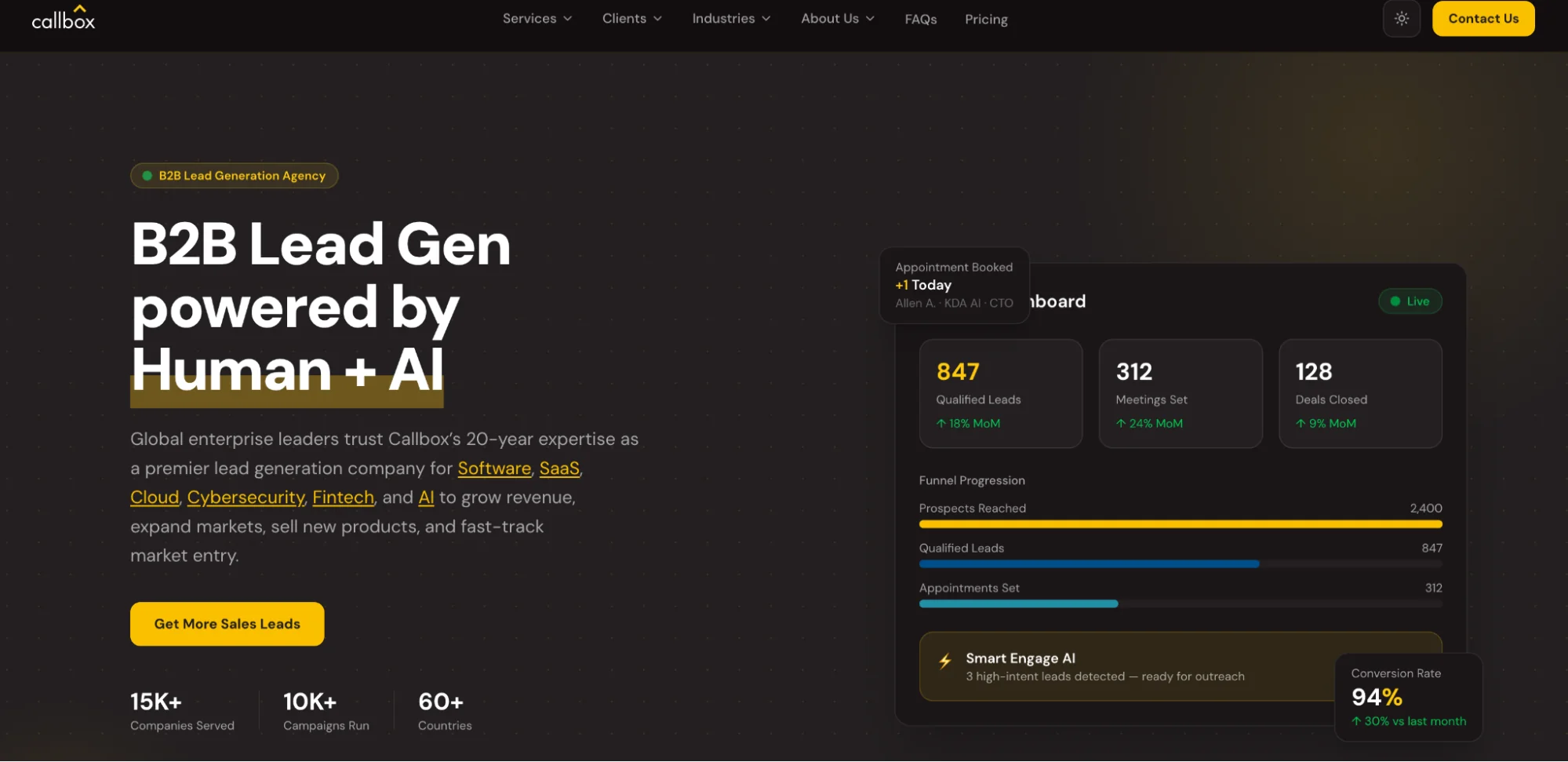
Who it’s for: Multi-channel campaigns across various international markets.
Callbox offers lead generation across email, phone, social media, and even direct mail. They have a global presence with teams in North America, Asia-Pacific, and Europe.
That makes them particularly good if you want to target audiences across international markets and get high-quality leads.
They provide both outsourced SDR services and lead generation campaigns, with flexible engagement models and strong pipeline management tools.
Callbox vs CIENCE: Both have global reach, but Callbox offers more channel diversity (including direct mail and events).
CIENCE is more tech-forward with their GO Platform. Callbox is more traditional full-service. Callbox works well for international campaigns requiring local language support.
6. Operatix
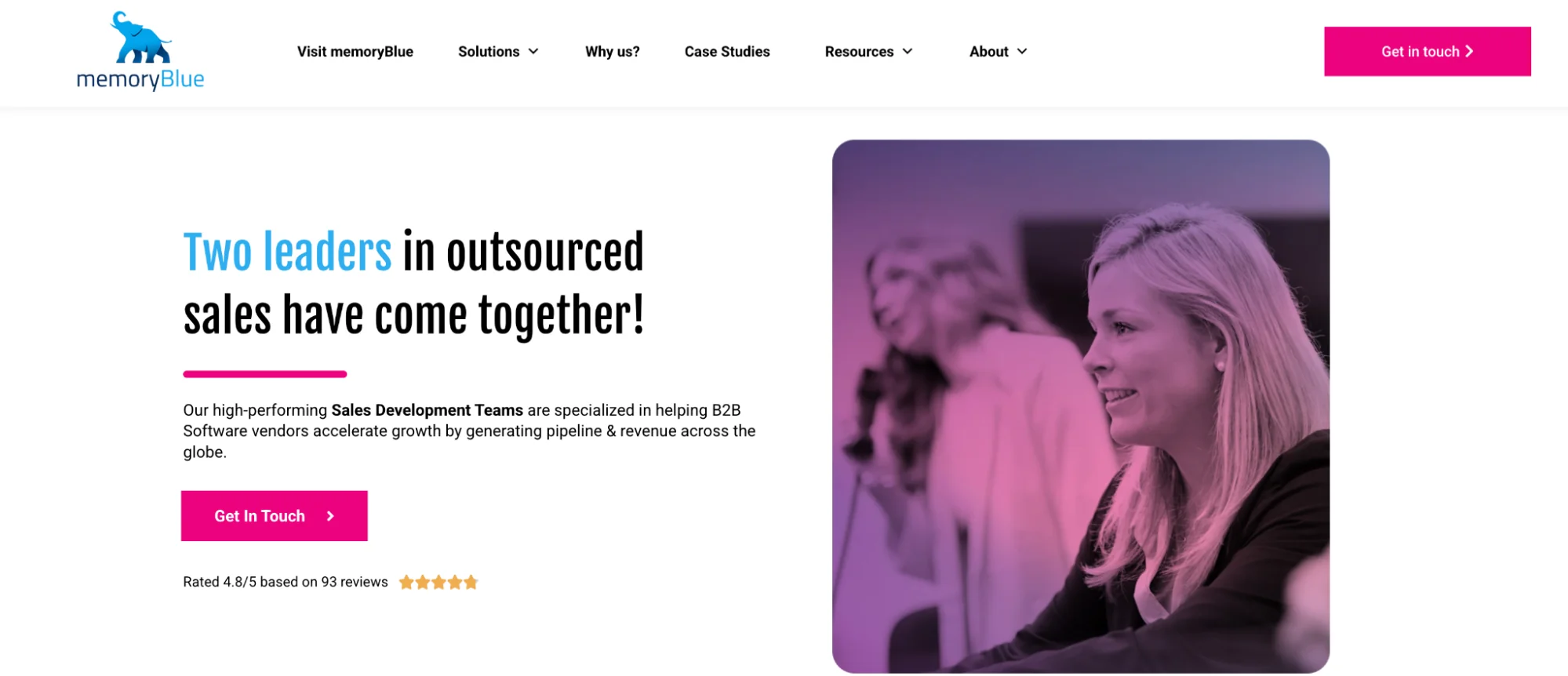
Who it’s for: Tech companies expanding into new markets, especially in Europe.
Operatix specializes in helping software and tech companies break into new markets. They have particularly strong capabilities in European markets and understand the nuances of selling across different regulatory environments and business cultures.
They combine strategic consulting with tactical execution, helping companies refine their ICP and positioning before launching outbound campaigns.
Operatix vs CIENCE: Operatix is more specialized (tech and SaaS focus) and consultative. CIENCE serves broader industries.
Operatix has stronger European market expertise. CIENCE is more North America-focused. Operatix typically works with larger deals and longer sales cycles.
7. Pearl Lemon Leads

Who it’s for: Startups and SMBs looking for affordable, flexible lead generation.
Pearl Lemon Leads positions itself as the accessible option for smaller companies that can't afford enterprise-level agencies. They offer month-to-month contracts, no long-term commitments, transparent pricing, and a scrappy, founder-friendly approach.
They focus heavily on LinkedIn outreach and email sequences, with quick turnaround times and personalized service for smaller accounts.
Pearl Lemon Leads vs CIENCE: Pearl Lemon costs a fraction of what CIENCE charges and works without long-term contracts. CIENCE offers more sophisticated tech and larger-scale operations.
Pearl Lemon is better for testing lead gen with a limited budget. CIENCE is better for scaling proven motions.
8. LeadGenius
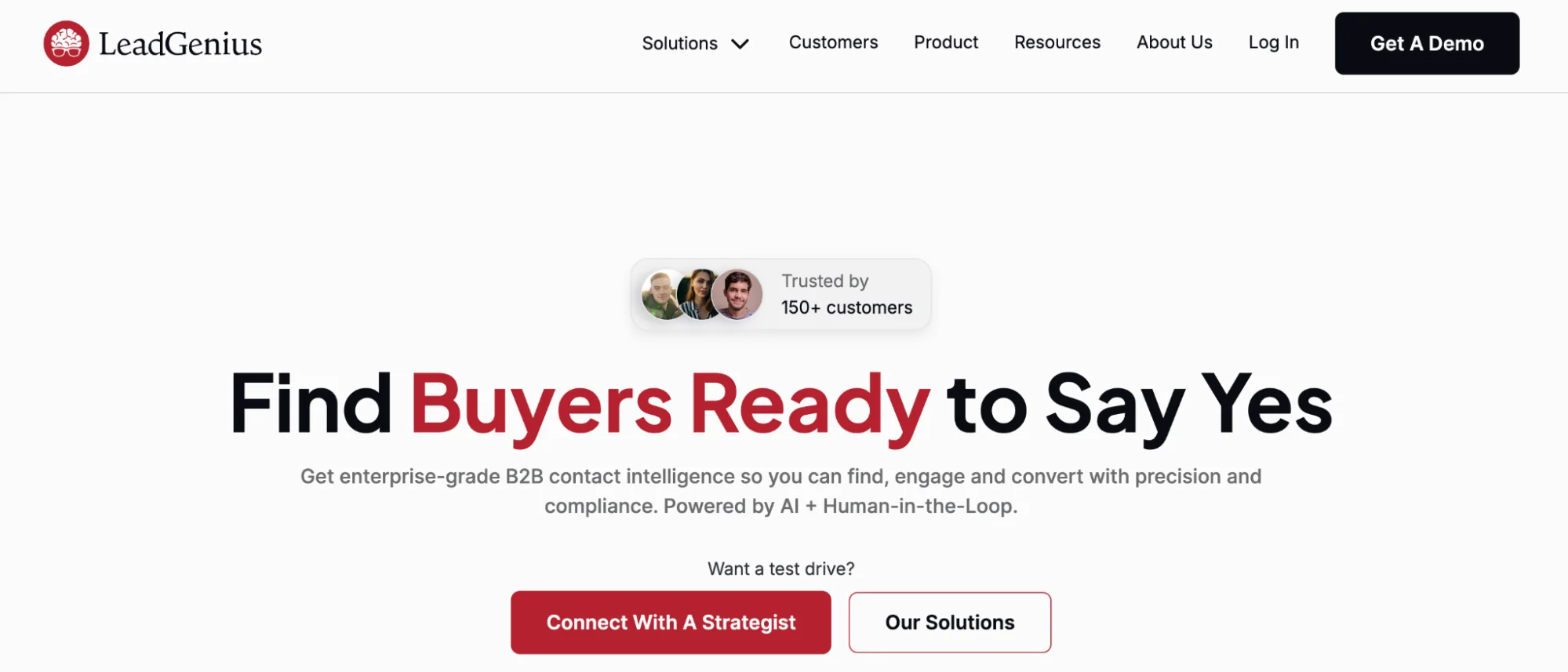
Who it’s for: Companies needing highly customized data and research-intensive targeting.
LeadGenius combines AI with human researchers to build ultra-specific prospect lists. We say ultra-specific because they excel when your ICP is complex, niche, or requires deep research to identify.
Their strength is data quality and customization rather than high-volume outreach.
LeadGenius vs CIENCE: LeadGenius focuses on custom data creation. CIENCE uses existing databases.
LeadGenius is better for hard-to-find ICPs. CIENCE is better for scalable, repeatable campaigns. LeadGenius typically feeds your own sales team. CIENCE delivers the outreach for you.
9. SalesHive
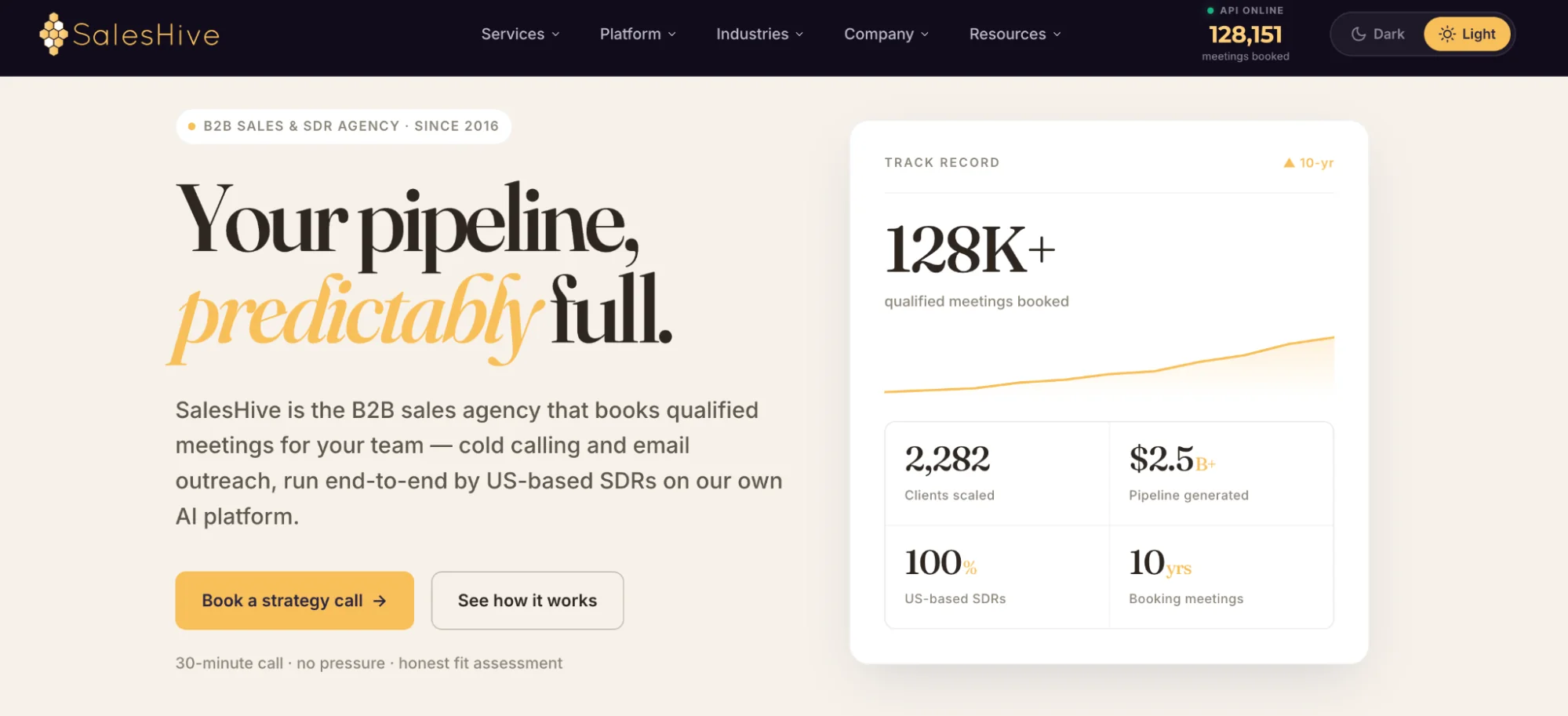
Who it’s for: B2B companies wanting guaranteed meetings with month-to-month flexibility.
SalesHive operates on a performance-based model where they guarantee a specific number of qualified meetings per month or you don't pay.
They use a mix of AI-powered tools and human SDRs to deliver multi-channel campaigns across email, LinkedIn, and cold calling.
What sets them apart is their flexibility. No long-term contracts required and flat-rate pricing with meeting guarantees.
You also get full transparency with a client dashboard showing all campaign activity and metrics in real-time.
SalesHive vs CIENCE: SalesHive offers meeting guarantees and month-to-month contracts.
CIENCE typically requires longer commitments. Both use hybrid human-tech approaches, but SalesHive provides more transparent pricing and performance guarantees.
SalesHive is better for companies wanting to test lead gen with less risk. CIENCE is better for longer-term strategic partnerships.
10. Abstrakt Marketing Group
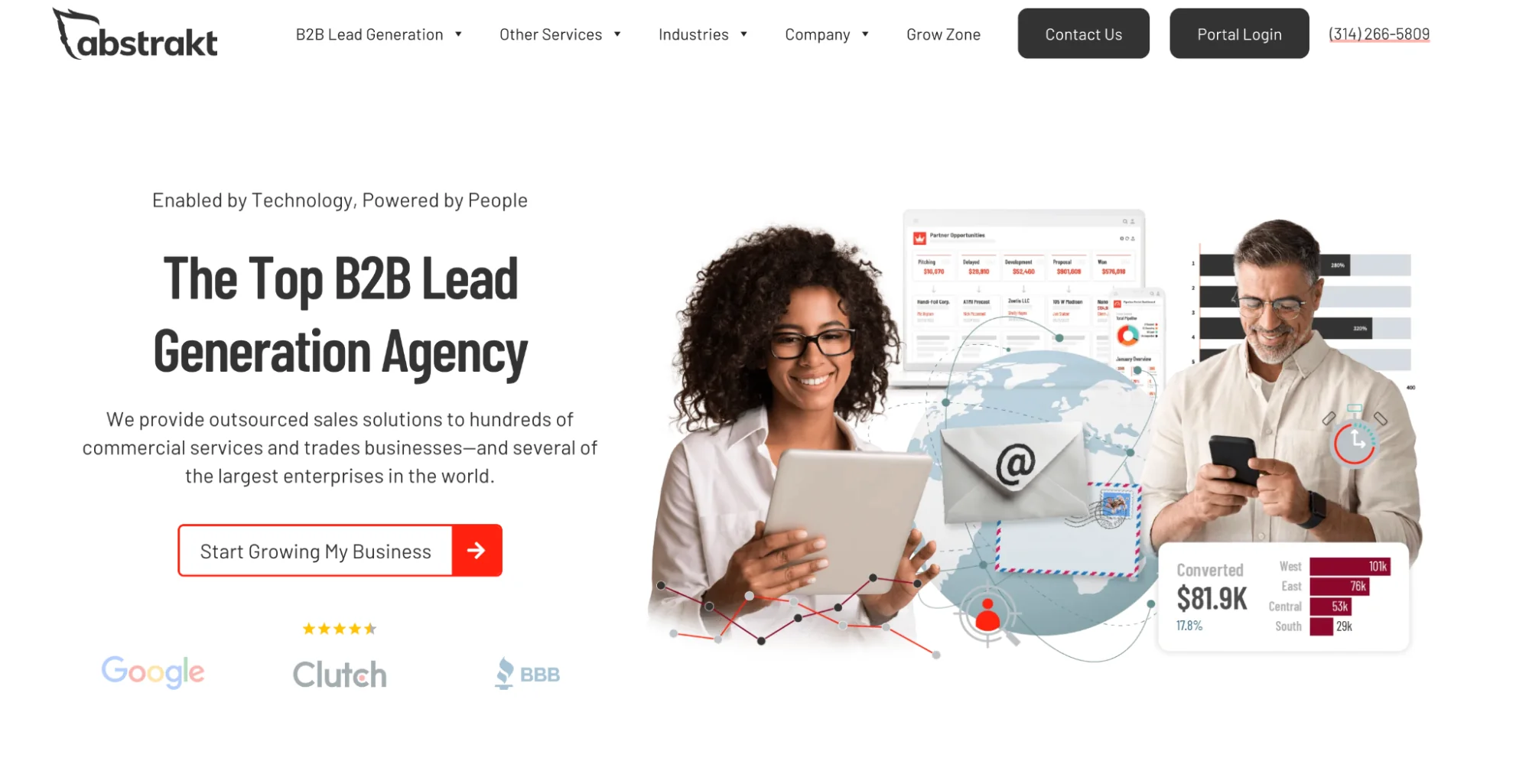
Who it’s for: B2B companies wanting US-based SDRs with transparent pricing.
Abstrakt Marketing Group is a full-service growth agency specializing in outbound appointment setting with a completely US-based team. They offer transparent, tiered pricing starting at $6,000 per month with clear deliverables.
They combine SDR outsourcing with inbound marketing, content creation, and CRM integration. Clutch has named them a Top Lead Generation Company, and they focus on real-time reporting and measurable results.
AMG vs CIENCE: Abstrakt is entirely US-based like SalesRoads. CIENCE uses global teams. They offer more transparent, upfront pricing.
CIENCE, like us, typically requires custom quotes. Abstrakt combines outbound with inbound marketing services. CIENCE is more outbound-focused. Both use hybrid human-tech approaches.
Work with Nebor, the best alternative to CIENCE, to grow your business and make your team more efficient
CIENCE built a successful business by combining human SDRs with proprietary technology. That was innovative in 2015. We are in 2026 now, and the entire way B2B companies should think about going to market has changed.
The tools available today (Clay, advanced AI, specialized data sources, sophisticated automation) make it possible to build systems that outperform traditional human teams at a fraction of the cost.
At Nebor, we're not competing with CIENCE by being a slightly better version of the same service. We're offering something different. A custom-built, automation-first system that you own and control, using the absolute best tools available in the market.
With ABM, demand gen, and RevOps wrapped around the outbound layer, so the whole flywheel turns together instead of in isolation.
If you're researching CIENCE alternatives, it's probably because something isn't working with your current approach. Sometimes that's the cost, sometimes the quality, sometimes the lack of control.
Often it's the realization that booking meetings on its own doesn't move the business if the rest of the funnel is broken.
Whatever it is, we built Nebor specifically to solve those problems.
Thanks for reading. If you want to dig into how this would actually work for your setup, find us on LinkedIn, or book a call with the team.
Note: B2B lead generation is no longer what it used to be. Most lead generation agencies and experts now depend on Clay, automation and AI to do the work people used to do by hand.
What most of them will not tell you is that they keep those tools and workflows in house and sell you only the campaigns and results. With a proprietary platform like CIENCE's you cannot even see what goes out under your name, and when you stop paying you are back at zero.
At Nebor, we are a GTM engineering and RevOps agency. We build the automated prospecting and lead generation that fills your pipeline, and we build it so you own it.
The difference shows up around month six. A lead generation agency is still charging you a retainer. With us, the workflows are already yours, so the only thing left to pay for is the software underneath them.
Book a 15-minute call and we'll show you what an automated lead generation motion would look like for your business.


Related Articles


By clicking Sign Up you're confirming that you agree with our Terms and Conditions.